JP2011221663A - Portable information display terminal - Google Patents
Portable information display terminal Download PDFInfo
- Publication number
- JP2011221663A JP2011221663A JP2010088053A JP2010088053A JP2011221663A JP 2011221663 A JP2011221663 A JP 2011221663A JP 2010088053 A JP2010088053 A JP 2010088053A JP 2010088053 A JP2010088053 A JP 2010088053A JP 2011221663 A JP2011221663 A JP 2011221663A
- Authority
- JP
- Japan
- Prior art keywords
- state
- display terminal
- information display
- portable information
- inclination
- Prior art date
- Legal status (The legal status is an assumption and is not a legal conclusion. Google has not performed a legal analysis and makes no representation as to the accuracy of the status listed.)
- Pending
Links
Images
Classifications
-
- G—PHYSICS
- G06—COMPUTING OR CALCULATING; COUNTING
- G06F—ELECTRIC DIGITAL DATA PROCESSING
- G06F1/00—Details not covered by groups G06F3/00 - G06F13/00 and G06F21/00
- G06F1/26—Power supply means, e.g. regulation thereof
-
- G—PHYSICS
- G06—COMPUTING OR CALCULATING; COUNTING
- G06F—ELECTRIC DIGITAL DATA PROCESSING
- G06F1/00—Details not covered by groups G06F3/00 - G06F13/00 and G06F21/00
- G06F1/26—Power supply means, e.g. regulation thereof
- G06F1/32—Means for saving power
- G06F1/3203—Power management, i.e. event-based initiation of a power-saving mode
- G06F1/3206—Monitoring of events, devices or parameters that trigger a change in power modality
-
- G—PHYSICS
- G06—COMPUTING OR CALCULATING; COUNTING
- G06F—ELECTRIC DIGITAL DATA PROCESSING
- G06F1/00—Details not covered by groups G06F3/00 - G06F13/00 and G06F21/00
- G06F1/16—Constructional details or arrangements
- G06F1/1613—Constructional details or arrangements for portable computers
- G06F1/1626—Constructional details or arrangements for portable computers with a single-body enclosure integrating a flat display, e.g. Personal Digital Assistants [PDAs]
-
- G—PHYSICS
- G09—EDUCATION; CRYPTOGRAPHY; DISPLAY; ADVERTISING; SEALS
- G09F—DISPLAYING; ADVERTISING; SIGNS; LABELS OR NAME-PLATES; SEALS
- G09F9/00—Indicating arrangements for variable information in which the information is built-up on a support by selection or combination of individual elements
-
- H—ELECTRICITY
- H04—ELECTRIC COMMUNICATION TECHNIQUE
- H04B—TRANSMISSION
- H04B1/00—Details of transmission systems, not covered by a single one of groups H04B3/00 - H04B13/00; Details of transmission systems not characterised by the medium used for transmission
- H04B1/38—Transceivers, i.e. devices in which transmitter and receiver form a structural unit and in which at least one part is used for functions of transmitting and receiving
- H04B1/40—Circuits
-
- H—ELECTRICITY
- H04—ELECTRIC COMMUNICATION TECHNIQUE
- H04N—PICTORIAL COMMUNICATION, e.g. TELEVISION
- H04N21/00—Selective content distribution, e.g. interactive television or video on demand [VOD]
- H04N21/40—Client devices specifically adapted for the reception of or interaction with content, e.g. set-top-box [STB]; Operations thereof
- H04N21/41—Structure of client; Structure of client peripherals
- H04N21/414—Specialised client platforms, e.g. receiver in car or embedded in a mobile appliance
- H04N21/41407—Specialised client platforms, e.g. receiver in car or embedded in a mobile appliance embedded in a portable device, e.g. video client on a mobile phone, PDA, laptop
-
- H—ELECTRICITY
- H04—ELECTRIC COMMUNICATION TECHNIQUE
- H04N—PICTORIAL COMMUNICATION, e.g. TELEVISION
- H04N21/00—Selective content distribution, e.g. interactive television or video on demand [VOD]
- H04N21/40—Client devices specifically adapted for the reception of or interaction with content, e.g. set-top-box [STB]; Operations thereof
- H04N21/41—Structure of client; Structure of client peripherals
- H04N21/422—Input-only peripherals, i.e. input devices connected to specially adapted client devices, e.g. global positioning system [GPS]
- H04N21/42202—Input-only peripherals, i.e. input devices connected to specially adapted client devices, e.g. global positioning system [GPS] environmental sensors, e.g. for detecting temperature, luminosity, pressure, earthquakes
-
- H—ELECTRICITY
- H04—ELECTRIC COMMUNICATION TECHNIQUE
- H04N—PICTORIAL COMMUNICATION, e.g. TELEVISION
- H04N21/00—Selective content distribution, e.g. interactive television or video on demand [VOD]
- H04N21/40—Client devices specifically adapted for the reception of or interaction with content, e.g. set-top-box [STB]; Operations thereof
- H04N21/43—Processing of content or additional data, e.g. demultiplexing additional data from a digital video stream; Elementary client operations, e.g. monitoring of home network or synchronising decoder's clock; Client middleware
- H04N21/443—OS processes, e.g. booting an STB, implementing a Java virtual machine in an STB or power management in an STB
- H04N21/4436—Power management, e.g. shutting down unused components of the receiver
Landscapes
- Engineering & Computer Science (AREA)
- Theoretical Computer Science (AREA)
- General Engineering & Computer Science (AREA)
- Signal Processing (AREA)
- General Physics & Mathematics (AREA)
- Multimedia (AREA)
- Physics & Mathematics (AREA)
- Ecology (AREA)
- Remote Sensing (AREA)
- Business, Economics & Management (AREA)
- Life Sciences & Earth Sciences (AREA)
- Biodiversity & Conservation Biology (AREA)
- Computer Hardware Design (AREA)
- Emergency Management (AREA)
- Environmental & Geological Engineering (AREA)
- Environmental Sciences (AREA)
- Human Computer Interaction (AREA)
- Software Systems (AREA)
- Computer Networks & Wireless Communication (AREA)
- Controls And Circuits For Display Device (AREA)
- User Interface Of Digital Computer (AREA)
- Telephone Function (AREA)
- Devices For Indicating Variable Information By Combining Individual Elements (AREA)
- Power Sources (AREA)
Abstract
Description
この発明は、携帯情報表示端末に関し、特に、筐体を備える携帯情報表示端末に関する。 The present invention relates to a portable information display terminal, and more particularly to a portable information display terminal including a housing.
従来、筐体を備える携帯情報表示端末が知られている(たとえば、特許文献1参照)。 Conventionally, a portable information display terminal including a housing is known (see, for example, Patent Document 1).
上記特許文献1には、表示部が設けられるパネル枠(筐体)と、パネル枠が載置面に立った状態でパネル枠を支持可能な支持体とを備える表示装置(携帯情報表示端末)が開示されている。パネル枠の表示部が設けられている側の面には、開口部が形成されており、開口部の内部に照度センサが設けられている。上記特許文献1では、照度センサが光を検知しない場合に、表示部に表示されている表示がオフにされるように構成されている。これにより、表示部が載置面に対向するようにパネル枠が伏せられた場合には、照度センサが光を検知しなくなることにより、自動的に表示部の表示がオフ(スタンバイモード)になる。
しかしながら、上記特許文献1による表示装置(携帯情報表示端末)では、周囲が明るい環境においては、パネル枠(筐体)が伏せられた状態と伏せられていない状態とを判別することが可能である一方、周囲が暗い環境においては、パネル枠が伏せられた状態と伏せられていない状態とを判別することが困難になると考えられる。したがって、伏せた状態でのみスタンバイモードに移行させたい場合であっても、周囲の明るさの環境によって、伏せた状態以外の状態でもスタンバイモードに移行してしまう場合があるという問題点がある。
However, in the display device (portable information display terminal) according to
この発明は、上記のような課題を解決するためになされたものであり、この発明の1つの目的は、筐体の状態に応じてスタンバイモードに自動的に移行させる制御を行う場合に、所定の状態以外の状態でスタンバイモードに移行してしまうのを抑制することが可能な携帯情報表示端末を提供することである。 The present invention has been made to solve the above-described problems, and one object of the present invention is to perform predetermined control when performing control for automatically shifting to a standby mode according to the state of the housing. It is providing the portable information display terminal which can suppress shifting to standby mode in states other than this state.
この発明の一の局面による携帯情報表示端末は、筐体と、筐体の傾きを検出することにより、第1の状態になったことと、第2の状態になったこととを検出するための傾きセンサと、傾きセンサにより第2の状態であることが検出された場合に、第2の状態であると判別して特定するとともに、スタンバイモードに移行する制御を行う制御部とを備えている。 A portable information display terminal according to one aspect of the present invention detects a case and a second state by detecting the case and the inclination of the case. An inclination sensor, and a control unit that determines and identifies the second state when the inclination sensor detects the second state, and performs control for shifting to the standby mode. Yes.
この一の局面による携帯情報表示端末では、上記のように、筐体の傾きを検出することにより、第1の状態になったことと、第2の状態になったこととを検出する傾きセンサを設けることによって、照度センサを用いる構成のように携帯情報表示端末の周囲の環境(明るさ)に影響されることなく、傾きセンサにより検出される傾きに基づいて、第1の状態および第2の状態の少なくとも2種類の状態を検出することができる。これにより、第2の状態でスタンバイモードに自動的に移行させる制御を行う場合に、第2の状態以外の状態(第1の状態)でスタンバイモードに移行してしまうのを抑制することができる。 In the portable information display terminal according to this one aspect, as described above, by detecting the tilt of the housing, the tilt sensor detects that the first state and the second state are reached. The first state and the second state based on the inclination detected by the inclination sensor without being affected by the environment (brightness) around the portable information display terminal as in the configuration using the illuminance sensor. At least two types of states can be detected. Thereby, when performing control to automatically shift to the standby mode in the second state, it is possible to suppress the transition to the standby mode in a state other than the second state (first state). .
上記一の局面による携帯情報表示端末において、好ましくは、情報を表示する表示部をさらに備え、第2の状態は、筐体および表示部が載置面に対向するように伏せられた不使用状態であり、制御部は、傾きセンサにより筐体および表示部を載置面に対向するように伏せた不使用状態であることが検出された場合に、スタンバイモードに移行する制御を行うように構成されている。このように構成すれば、ユーザが携帯情報表示端末を使用しない場合に、筐体および表示部を載置面に対向するように伏せるだけでスタンバイモードに移行させることができるので、スタンバイモードに移行される分、容易に、携帯情報表示端末の消費電力を小さくすることができる。 In the portable information display terminal according to the one aspect described above, preferably, the portable information display terminal further includes a display unit that displays information, and the second state is a non-use state in which the housing and the display unit are faced down so as to face the placement surface. The control unit is configured to perform control to shift to the standby mode when it is detected by the tilt sensor that the housing and the display unit are in a non-use state where the case and the display unit are faced to face the mounting surface. Has been. According to this configuration, when the user does not use the portable information display terminal, it is possible to shift to the standby mode simply by turning the casing and the display unit so as to face the mounting surface. Therefore, the power consumption of the portable information display terminal can be easily reduced.
上記一の局面による携帯情報表示端末において、好ましくは、傾きセンサは、第1の状態および第2の状態に加えて、ユーザにより筐体が把持された状態である第3の状態を検出するように構成されており、制御部は、ユーザにより筐体が把持された第3の状態であることが傾きセンサにより検出された場合には、第2の状態の傾きが検出された場合にも、スタンバイモードに移行しない制御を行うように構成されている。このように構成すれば、ユーザにより筐体が把持された第3の状態である場合には、ユーザは携帯情報表示端末を使用していることが多いため、ユーザにより筐体が把持された第3の状態で第2の状態の傾きが検出された場合に、使用中の携帯情報表示端末がスタンバイモードに移行してしまうのを防止することができる。
In the portable information display terminal according to the above aspect, the tilt sensor preferably detects a third state in which the housing is gripped by the user in addition to the first state and the second state. When the tilt sensor detects that the housing is in the third state in which the housing is gripped by the user, the control unit also detects the tilt in the second state. It is configured to perform control that does not shift to the standby mode. According to this configuration, in the third state in which the housing is gripped by the user, the user often uses the portable information display terminal, and thus the first state in which the housing is gripped by the user. When the inclination of the second state is detected in the
上記一の局面による携帯情報表示端末において、好ましくは、第1の状態および第2の状態は、筐体が載置面に載置される状態であり、第1の状態は、筐体を立てて使用する立て置き使用状態と、筐体を寝かせて使用する寝かせ使用状態とを含み、筺体は、立て置き使用状態における筺体の傾きと、寝かせ使用状態における筺体の傾きと、第2の状態における筺体の傾きとが、互いに異なる傾きになるように載置面に載置可能に構成されており、傾きセンサにより第2の状態における筐体の傾きが検出された場合に、制御部によりスタンバイモードに移行する制御を行うように構成されている。このように構成すれば、立て置き使用状態における筺体の傾きと、寝かせ使用状態における筺体の傾きと、第2の状態における筺体の傾きとが、互いに異なる傾きであることにより、容易に、傾きセンサにより携帯情報表示端末の立て置き使用状態、寝かせ使用状態および第2の状態のいずれの状態であるかを検出することができる。 In the portable information display terminal according to the above aspect, preferably, the first state and the second state are states in which the housing is placed on the placement surface, and the first state is a state where the housing is raised. A standing use state in which the housing is laid down and a sleeping use state in which the housing is laid down, and the housing is tilted in the standing use state, tilted in the lying use state, and in the second state. When the tilt of the housing in the second state is detected by the tilt sensor, the control unit is set in the standby mode. It is comprised so that control which transfers to may be performed. If comprised in this way, since the inclination of the housing in the standing use state, the inclination of the housing in the laying down usage state, and the inclination of the housing in the second state are different from each other, the inclination sensor can be easily provided. Thus, it can be detected whether the portable information display terminal is in the standing use state, the laying use state, or the second state.
この場合において、好ましくは、情報を表示する表示部をさらに備え、第2の状態は、筐体および表示部が載置面に対向するように伏せられた不使用状態であり、筺体は、立て置き使用状態での傾きと、寝かせ使用状態での傾きと、伏せられた不使用状態での傾きとが、互いに異なる傾きになるように載置面に載置可能な外形形状を有するように構成されている。このように構成すれば、筺体が互いに異なる傾きになるように載置面に載置可能な外形形状を有することにより、スタンド部材などの補助部材を別途用いることなく、傾きセンサが検知可能な立て置き使用状態における筺体の傾き、寝かせ使用状態における筺体の傾き、および、伏せられた不使用状態での傾きのいずれかの傾きで筐体を載置面に載置することができる。 In this case, it is preferable that the information processing apparatus further includes a display unit for displaying information, and the second state is a non-use state in which the housing and the display unit are faced down so as to face the mounting surface. It is configured to have an outer shape that can be placed on the placement surface so that the inclination in the standing use state, the inclination in the laying use state, and the inclination in the faced non-use state are different from each other. Has been. If comprised in this way, it has the external shape which can be mounted in a mounting surface so that a housing may become a mutually different inclination, The stand sensor which a tilt sensor can detect without using auxiliary members, such as a stand member, separately. The housing can be mounted on the mounting surface with any one of the inclination of the casing in the standing use state, the inclination of the casing in the laying down use state, and the inclination in the lying down unused state.
上記一の局面による携帯情報表示端末において、好ましくは、第1の状態は、使用状態であり、制御部は、傾きセンサにより第1の状態になったことが検出された場合には、検出された状態に対応するアプリケーションプログラムを起動するとともに、傾きセンサにより第2の状態であることが検出された場合には、アプリケーションプログラムを起動せずにスタンバイモードに移行するように制御するようにように構成されている。このように構成すれば、使用状態である第1の状態になった場合に、各状態に対応するアプリケーションプログラムを自動的に起動することができるとともに、第2の状態になった場合に、自動的にスタンバイモードに移行することができる。これにより、ユーザによる操作性を向上することができる。 In the portable information display terminal according to the above aspect, preferably, the first state is a use state, and the control unit is detected when the tilt sensor detects that the first state is entered. The application program corresponding to the detected state is started, and when the tilt sensor detects that the second state is detected, control is performed so as to shift to the standby mode without starting the application program. It is configured. If comprised in this way, when it will be in the 1st state which is a use state, while being able to start an application program corresponding to each state automatically, when it will be in a 2nd state, it will be automatic. In standby mode. Thereby, the operability by the user can be improved.
この場合において、好ましくは、リモコンモードの際に使用する通信部をさらに備え、第1の状態は、筐体を載置面に寝かせて使用する寝かせ使用状態を含み、制御部は、傾きセンサにより寝かせ使用状態であると検出された場合に、リモコンモードに対応するアプリケーションプログラムを起動するように構成されている。このように構成すれば、筐体を載置面に寝かせた場合に、リモコンモードに対応するアプリケーションプログラムが起動することにより、即時にリモコンとして使用することができるので、ユーザによる操作性を向上することができる。 In this case, preferably, a communication unit used in the remote control mode is further provided, and the first state includes a laying use state in which the housing is laid on the mounting surface, and the control unit is controlled by an inclination sensor. An application program corresponding to the remote control mode is activated when it is detected that the user is in the sleeping state. With this configuration, when the casing is laid on the mounting surface, the application program corresponding to the remote control mode is activated, so that it can be used immediately as a remote control, thereby improving user operability. be able to.
上記一の局面による携帯情報表示端末において、好ましくは、リモコンモードの際に使用する通信部をさらに備え、制御部は、リモコンモードで使用されている場合に、第2の状態になったことが傾きセンサにより検出された時に、携帯情報表示端末をスタンバイモードに移行させるとともに、リモコンモードの操作対象である機器に対してスタンバイモードに移行するように指示する信号を通信部を介して送信するように構成されている。このように構成すれば、リモコンモードで使用されている場合において、第2の状態に変更されることにより携帯情報表示端末がスタンバイモードに移行される場合には、リモコンモードの操作対象である機器を使用することがなくなると考えられるので、操作対象である機器に対してスタンバイモードに移行する信号を通信部を介して送信することにより、容易に操作対象である機器をもスタンバイモードに移行させることができる。 The portable information display terminal according to the above aspect preferably further includes a communication unit used in the remote control mode, and the control unit is in the second state when used in the remote control mode. When detected by the tilt sensor, the portable information display terminal is shifted to the standby mode, and a signal instructing the device that is the operation target of the remote control mode to shift to the standby mode is transmitted via the communication unit. It is configured. With this configuration, when the portable information display terminal is shifted to the standby mode by being changed to the second state when used in the remote control mode, the device that is the operation target of the remote control mode Therefore, the device that is the operation target can be easily shifted to the standby mode by transmitting a signal for shifting to the standby mode to the device that is the operation target via the communication unit. be able to.
以下、本発明を具体化した実施形態を図面に基づいて説明する。 DESCRIPTION OF THE PREFERRED EMBODIMENTS Embodiments embodying the present invention will be described below with reference to the drawings.
(第1実施形態)
まず、図1〜図12を参照して、本発明の第1実施形態による携帯情報表示端末1の構成について説明する。
(First embodiment)
First, with reference to FIGS. 1-12, the structure of the portable
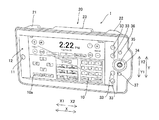
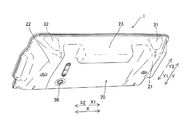
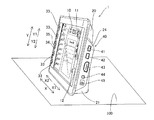
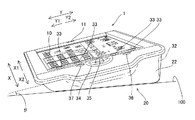
図1および図2に示すように、本発明の第1実施形態による携帯情報表示端末1は、情報を表示する液晶表示部10(図1参照)と、液晶表示部10が表面に設けられるフレーム20とにより主に構成されている。なお、液晶表示部10は、本発明の「表示部」の一例であり、フレーム20は、本発明の「筐体」の一例である。この携帯情報表示端末1は、ユーザにより把持された状態(図3および図4参照)で使用可能に構成されているとともに、フレーム20および液晶表示部10を載置面100に立てた状態(図5参照)、および、フレーム20および液晶表示部10を載置面100に寝かせた状態(図6参照)でも使用可能に構成されている。なお、ユーザにより把持された状態は、本発明の「第3の状態」の一例であり、フレーム20および液晶表示部10を載置面100に立てた状態は、本発明の「第1の状態」および「立て置き使用状態」の一例である。また、フレーム20および液晶表示部10を載置面100に寝かせた状態は、本発明の「第1の状態」および「寝かせ使用状態」の一例である。
As shown in FIGS. 1 and 2, the portable
この携帯情報表示端末1は、インターネット接続可能に構成されており、インターネット接続を行うことによりストリーミング配信の受信および再生出力機能、メール機能、ビデオチャット機能およびボイスチャット機能を使用可能に構成されている。また、携帯情報表示端末1は、インターネット接続をしていない場合にも、リモコンモードに移行することにより、メディアプレーヤーおよびテレビジョン装置(図示せず)などのリモコンとして使用可能に構成されている。また、携帯情報表示端末1は、フレーム20および液晶表示部10を立てた状態(図5参照)では、小規模のアプリケーションソフト(ガジェット)により、カレンダーや時計などを表示することが可能である。
This portable
次に、携帯情報表示端末1の液晶表示部10およびフレーム20の構成について詳細に説明する。液晶表示部10は、図1に示すように、タッチパネル機能を有しており、ユーザが液晶表示部10に表示された操作ボタン10aを押下することにより、アプリケーションプログラムに従った操作が可能なように構成されている。また、液晶表示部10の矢印X1方向側には、カメラユニット11が設置されている。このカメラユニット11は、たとえば、ユーザにより把持された状態で携帯情報表示端末1を使用する場合などに、ビデオチャット時の画像を入力する機能を有する。
Next, the configuration of the liquid
また、カメラユニット11の近傍には、マイクユニット12が設置されている。このマイクユニット12は、たとえば、ボイスチャットおよびビデオチャット時などの音声を入力する機能を有する。
A
また、フレーム20は、樹脂により形成されている。図1および図2に示すように、フレーム20の液晶表示部10が設けられている表面とは反対側の表面には、複数の突起部21、22および23が一体的に設けられている。突起部21および22は、フレーム20の長手方向(X方向)の両方の端部近傍にフレーム20の短手方向(Y方向)に延びるように設けられている。また、図6に示すように、突起部21(図2参照)および22は、それぞれ、フレーム20の短手方向(Y方向)の一方端側(矢印Y1方向側)から他方端側(矢印Y2方向側)に向かって徐々に厚みが増加するように構成されている。つまり、突起部21および22は、それぞれ、フレーム20の長手方向(矢印X1方向および矢印X2方向)から見て、フレーム20の短手方向の他方側(矢印Y2方向側)から一方側(矢印Y1方向側)に向かってテーパ状に先細る楔形形状を有するように構成されている。
The
上記のように突起部21および22を構成することによって、図5に示すように、突起部21および突起部22の矢印Y2方向側の面を下にして携帯情報表示端末1を載置面100に載置することにより、突起部21および22は、フレーム20および液晶表示部10を立てた状態でフレーム20を支持可能である。また、図6に示すように、突起部21および22は、フレーム20および液晶表示部10を載置面100に対して所定の角度θ傾斜させて寝かせた状態で、フレーム20を支持可能である。
By configuring the
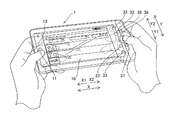
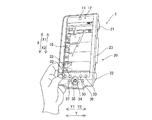
また、上記のように突起部21および22を構成することによって、図3に示すように、突起部21および22は、フレーム20および液晶表示部10の長手方向(X方向)をユーザから見て横向きにしてユーザが両手で把持することが可能である。また、図4に示すように、突起部22は、フレーム20および液晶表示部10の長手方向(X方向)を縦向きにして片手(左手)で把持可能である。
Further, by configuring the
また、突起部23は、図2に示すように、フレーム20の短手方向(Y方向)の他方端部(矢印Y2方向端部)近傍で、かつ、突起部21および22の間に設けられている。この突起部23の内部には、携帯情報表示端末1の電源を供給するための二次電池(リチウムイオン電池)が内蔵(収納)されている。
Further, as shown in FIG. 2, the
また、突起部21および22の他方端部側(矢印Y2方向側)の端面には、それぞれ、赤外線通信部31および32が内蔵されている。なお、赤外線通信部31および32は、本発明の「通信部」の一例である。これら赤外線通信部31および32は、後述するリモコンモードの際に、メディアプレーヤーおよびテレビジョン装置90(図11参照)などを操作可能な所定の信号(リモコン信号)を含む赤外線を発光するように構成されている。
また、液晶表示部10の長手方向(X方向)の矢印X2方向側の部分には、図1に示すように、情報処理装置モード用各種スイッチ33が設けられている。情報処理装置モード用各種スイッチ33は、それぞれ、メール、ビデオおよびボイスチャットなどを処理する情報処理装置モードで使用されるスイッチである。また、情報処理装置モード用各種スイッチ33の矢印X2方向側の近傍には、4方向移動スイッチ34(選択スイッチ)が設けられている。また、4方向移動スイッチ34の中心部分には、決定スイッチ35が設けられている。これら4方向移動スイッチ34および決定スイッチ35は、それぞれ、リモコンモードおよび情報処理装置モードの両方で使用可能に構成されている。
Further, as shown in FIG. 1,
また、4方向移動スイッチ34の矢印Y2方向側には、リモコンモードと情報処理装置モードとを切替可能なリモコンモード遷移スイッチ36が設けられている。また、4方向移動スイッチ34の矢印Y1方向側には、リモコンモードにおけるリモコン操作対象機器(テレビなど)の表示部にOSD表示された操作画面を現在の状態から1つ前の状態に戻すための戻る機能スイッチ37が設けられている。また、図2に示すように、フレーム20の裏面には、電源スイッチ38が設けられている。この電源スイッチ38は、携帯情報表示端末1がオフ状態である場合には、押圧されることによりオン状態に起動させるとともに、後述するスタンバイモードである場合には、押圧されることによりスタンバイモードから復帰させる機能を有する。
A remote control
また、図5に示すように、フレーム20の矢印X1方向側の側面部24には、複数の接続部40が設けられている。この接続部40は、2つのUSB接続部41および42と、HDMI接続部43と、音声ケーブル接続部44と、電源コネクタ45とを含んでいる。
Also, as shown in FIG. 5, a plurality of
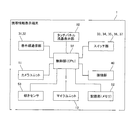
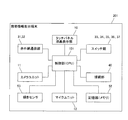
次に、携帯情報表示端末1の内部構成について説明する。携帯情報表示端末1のフレーム20には、図7に示すように、携帯情報表示端末1の制御を司る制御部(CPU)51と、記憶部(メモリ)52と、傾きセンサ53とが設けられている。
Next, the internal configuration of the portable
記憶部52は、制御部51により実行されるアプリケーションプログラムを記憶している。また、記憶部52は、ユーザの手で把持して使用する状態(以下、手持ち状態(図3および図4参照)と呼ぶ)、フレーム20および液晶表示部10を載置面100に立てて使用する状態(以下、立てた状態(図5参照)と呼ぶ)、および、フレーム20および液晶表示部10を載置面100に寝かせて使用する状態(以下、寝かせた状態(図6参照)と呼ぶ)において使用されたアプリケーションプログラムの使用履歴を記憶している。
The
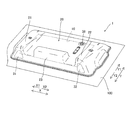
ここで、第1実施形態では、傾きセンサ53は、フレーム20(図1参照)の傾きを取得する機能を有する。傾きセンサ53は、立てた状態(図5参照)、寝かせた状態(図6参照)および手持ち状態(図3および図4参照)のいずれの使用状態であるかを検出(判別)するために設けられている。また、傾きセンサ53は、立てた状態(図5参照)、寝かせた状態(図6参照)および手持ち状態(図3および図4参照)のみならず、フレーム20および液晶表示部10が載置面100に対向するように伏せられた不使用状態(以下、不使用状態(図8参照)と呼ぶ)を検出可能に構成されている。なお、フレーム20および液晶表示部10が載置面100に対向するように伏せられた不使用状態は、本発明の「第2の状態」の一例である。
Here, in the first embodiment, the
また、上述したフレーム20の外形形状により、立てた状態(図5参照)での傾きと、寝かせた状態(図6参照)での傾きと、伏せた不使用状態(図8参照)での傾きとは、フレーム20の載置面100に対する角度が互いに90度以上異なるため、制御部51は、フレーム20の載置面100に対する異なる傾きに基づいて容易に各状態を判別して特定することが可能である。
In addition, due to the outer shape of the
また、手持ち状態(図3および図4参照)では、ユーザが微妙に動くことに起因して傾きセンサ53により検出される検出値が検出時間毎に変化するため、制御部51は、立てた状態、寝かせた状態および不使用状態と、手持ち状態とを区別することが可能となる。また、傾きセンサ53は、手持ち状態(図3および図4参照)である場合にも、フレーム20の長手方向を縦にして使用する縦向きでの使用状態(以下、縦持ち状態(図4参照)と呼ぶ)とフレーム20の長手方向を横にして使用する横向きでの使用状態(以下、横持ち状態(図3参照)と呼ぶ)とを検出可能に構成されている。また、縦持ち状態と横持ち状態とでは、図3および図4に示すように、液晶表示部10が約90度回転されるため、傾きセンサ53は、縦持ち状態と横持ち状態との異なる傾きを容易に判別して特定することが可能である。
Further, in the hand-held state (see FIGS. 3 and 4), the detection value detected by the
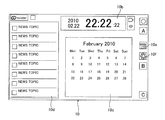
ここで、第1実施形態では、制御部51は、傾きセンサ53により取得された傾きに基づいてフレーム20および液晶表示部10の使用状態を判別して特定するように構成されている。そして、制御部51は、特定した使用状態に対応するアプリケーションプログラムを自動的に起動、または、スタンバイモードに移行する制御を行うように構成されている。具体的には、制御部51は、立てた状態(図5参照)であると特定した場合には、ユーザが操作することを前提としないアプリケーションプログラムを起動するように構成されている。ここで、ユーザが操作することを前提としないアプリケーションプログラムとは、たとえば、図9に示す時計10b、カレンダー10cおよびニュース10dのトピックスなどを液晶表示部10上に表示するガジェットを含むユーザにとって受動的なアプリケーションである。また、このガジェットは、液晶表示部10のアイコン10eおよび10fなどが操作されることにより、それぞれ、スケジューラーおよび天気予報などを液晶表示部10に表示可能に構成されている。
Here, in the first embodiment, the
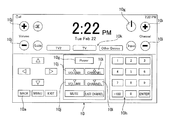
また、制御部51は、寝かせた状態(図6参照)であると特定した場合には、ユーザが操作することを前提とするアプリケーションプログラムを起動するように構成されている。ここで、ユーザが操作することを前提とするアプリケーションプログラムとは、たとえば、図10に示すように、メディアプレーヤーおよびテレビジョン装置90(図11参照)などのリモコンとして使用可能なユーザにとって能動的なアプリケーションである。このリモコンアプリケーションプログラムは、リモコンモードに移行された際に使用されるプログラムである。たとえば、リモコンアプリケーションプログラムでは、制御部51は、テレビジョン装置90の電源をオンまたはオフに切り替えるための電源ボタン10g、テレビジョン装置90が受信する放送のチャンネルを切り替えるためのチャンネルボタン群10hおよびチャンネル送りボタン10i、テレビジョン装置90から出力される音声の音量を調整する音量調整ボタン10j、および、テレビジョン装置90(図11参照)以外のテレビジョン装置(図示せず)およびメディアプレーヤー(図示せず)などのリモコンの操作対象を変更する対象切替ボタン群10kなどをタッチパネル機能を有する液晶表示部10に表示するように構成されている。
In addition, the
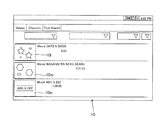
また、制御部51は、手持ち状態(図3および図4参照)であると特定した場合にも、ユーザが操作することを前提とするアプリケーションプログラムを起動するように構成されている。ここで、ユーザが操作することを前提とするアプリケーションプログラムとは、たとえば、図12に示すように、ストリーミング動画を再生可能な、ユーザにとって能動的なアプリケーションプログラムである。この動画再生アプリケーションプログラムは、情報処理装置モード時に使用されるプログラムである。たとえば、この動画再生アプリケーションプログラムでは、制御部51は、インターネット回線を介して表示される複数の動画コンテンツ10l、10mおよび10nなどからいずれか1つの動画コンテンツをタッチパネル上で選択可能に構成されている。また、動画再生アプリケーションプログラムでは、制御部51は、動画コンテンツ10l、10mおよび10nなどのうちいずれかの動画コンテンツがユーザにより選択された際には、選択された動画コンテンツの再生をすることが可能なように構成されている。なお、特定した使用状態に対応するアプリケーションプログラムは、ユーザにより予め設定される。
In addition, the
また、制御部51は、傾きセンサ53により検出される傾き値が常時小刻みに変化しているか否かを判断することにより、携帯情報表示端末1が載置面100に載置されている状態(図5、図6および図8の状態)、または、ユーザにより把持されている状態(図3および図4の状態)のいずれかを判断するように構成されている。傾きセンサ53により検出される傾き値が常時小刻みに変化している場合には、制御部51は、携帯情報表示端末1がユーザにより把持されている状態であると判断するように構成されている。また、傾きセンサ53により検出される傾き値が安定している場合には、制御部51は、携帯情報表示端末1が載置面100に載置されている状態であると判断するように構成されている。
Further, the
また、第1実施形態では、制御部51は、傾きセンサ53によりフレーム20および液晶表示部10が載置面100に対向するように伏せられた不使用状態(図8参照)であることを特定した場合に、スタンバイモードに移行する制御を行うように構成されている。この場合、制御部51は、使用状態(立てた状態、寝かせた状態および手持ち状態)の時とは異なり、ユーザにより使用されるアプリケーションプログラムを起動しないように構成されている。
In the first embodiment, the
また、第1実施形態では、制御部51は、手持ち状態の傾き値(小刻みに変動する傾き値)が傾きセンサ53により検出された場合には、不使用状態に対応する傾き値の範囲に含まれる傾き値が検出された場合にも、スタンバイモードに移行しないように構成されている。
In the first embodiment, when the inclination value of the handheld state (inclination value that fluctuates in small increments) is detected by the
次に、図3〜図8および図13を参照して、第1実施形態による携帯情報表示端末1の状態に対応するアプリケーションプログラムの起動および維持、および、スタンバイモード移行フローについて説明する。
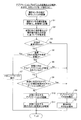
Next, with reference to FIGS. 3 to 8 and FIG. 13, the activation and maintenance of the application program corresponding to the state of the portable
図13に示すように、制御部51が傾きセンサ53により取得された傾き値が変化したこと(イベント発生)を認識することにより、携帯情報表示端末1の使用状態に対応するアプリケーションプログラムの起動フローがスタートされる。まず、ステップS1において、制御部51(図7参照)により、傾きセンサ53から取得した傾き値が認識(評価)され、その傾き値が記憶部52に記憶される。そして、ステップS2において、記憶された過去の傾き値(前回傾き値が変化したときに記憶された傾き値)と今回記憶された傾き値とに基づいて、携帯情報表示端末1が立てた状態(図5参照)、寝かせた状態(図6参照)、不使用状態(図8参照)、および、手持ち状態(図3および図4参照)のいずれの状態であるかが決定される。すなわち、記憶された過去の傾き値および今回記憶された傾き値が小刻みに変化している場合には、手持ち状態と決定される。また、記憶された過去の傾き値および今回記憶された傾き値が小刻みに変化しておらずに、今回記憶された傾き値が立てた状態の傾き値の範囲内である場合には、立てた状態と決定され、今回記憶された傾き値が寝かせた状態の傾き値の範囲内である場合には、寝かせた状態と決定され、今回記憶された傾き値が伏せた不使用状態の傾き値の範囲内である場合には、不使用状態と決定される。
As illustrated in FIG. 13, when the
その後、ステップS3において、制御部51により、決定された状態が、傾きセンサ53により取得された傾き値が変化する前(イベント発生前)の状態から変更されたか否かが判断される。そして、ステップS3において、決定された状態が傾きセンサ53により取得された傾き値が変化する前(イベント発生前)の状態から変更されていないと判断された場合には、ステップS4に進む。そして、ステップS4において、状態の変更がされていないので、アプリケーションプログラムが変更されることなく、アプリケーションプログラムはそのまま維持され、ステップS5に進む。そして、ステップS5において、液晶表示部10に表示されている表示向きも変更されることなく、そのまま維持され、アプリケーションプログラムの起動および維持、および、スタンバイモード移行フローが終了する。
Thereafter, in step S3, the
また、ステップS3において、決定された状態が、傾きセンサ53により取得された傾き値が変化する前(イベント発生前)の状態から変更されたと判断された場合には、ステップS6に進む。そして、ステップS6において、制御部51により、変更された状態がフレーム20および液晶表示部10が載置面100に対向するように伏せられた不使用状態(図8参照)であるか否かが判断される。そして、ステップS6において、変更された状態が不使用状態であると判断された場合には、ステップS7に進む。そして、ステップS7において、制御部51により、スタンバイモードに移行され、アプリケーションプログラムの起動および維持、および、スタンバイモード移行フローが終了する。また、ステップS6において、変更された状態が不使用状態ではないと判断された場合には、ステップS8に進む。
If it is determined in step S3 that the determined state is changed from the state before the inclination value acquired by the
その後、ステップS8において、制御部51により、変更された状態に対応するアプリケーションプログラムが設定されているか否かが判断される。つまり、ステップS8において、立てた状態、寝かせた状態および手持ち状態のそれぞれについて自動的に起動させるアプリケーションプログラムがユーザにより設定されているか否かが判断される。そして、ステップS8において、変更された状態に対応するアプリケーションプログラムが設定されていないと判断された場合には、上述したステップS4およびステップS5に進み、アプリケーションプログラムの起動および維持、および、スタンバイモード移行フローが終了する。また、ステップS8において、変更された状態に対応するアプリケーションプログラムが設定されていると判断された場合には、ステップS9に進む。
Thereafter, in step S8, the
そして、ステップS9において、制御部51により、設定されていたアプリケーションプログラムが現在使用中のアプリケーションプログラムと同じアプリケーションプログラムであるか否かが判断される。そして、ステップS9において、設定されていたアプリケーションプログラムが現在使用中のアプリケーションプログラムと同じアプリケーションプログラムであると判断された場合には、アプリケーションプログラムを変更する必要がないので、上述したステップS4およびステップS5に進み、アプリケーションプログラムの起動および維持、および、スタンバイモード移行フローが終了する。また、ステップS9において、設定されていたアプリケーションプログラムが現在使用中のアプリケーションプログラムと同じアプリケーションプログラムではないと判断された場合には、ステップS10に進む。
In step S9, the
その後、ステップS10において、変更された状態に対応するユーザにより設定されたアプリケーションプログラムが起動され、ステップS11に進む。そして、ステップS11において、状態に対応する表示向きに変更または状態に対応する表示向きが維持され、アプリケーションプログラムの起動および維持、および、スタンバイモード移行フローが終了する。たとえば、立てた状態と、寝かせた状態または手持ち状態の横持ち状態との間で状態が変更された場合には、液晶表示部10に表示される表示向きは180度回転されて変更される。また、手持ち状態のうちの縦持ち状態と、立てた状態、寝かせた状態または手持ち状態の横持ち状態との間で状態が変更された場合には、液晶表示部10に表示される表示向きは90度または270度回転されて変更される。また、手持ち状態のうちの横持ち状態と寝かせた状態との間で状態が変更された場合には、液晶表示部10に表示される表示向きは変更されずにそのまま維持される。
Thereafter, in step S10, an application program set by the user corresponding to the changed state is activated, and the process proceeds to step S11. In step S11, the display orientation corresponding to the state is changed or the display orientation corresponding to the state is maintained, and the activation and maintenance of the application program and the standby mode transition flow are completed. For example, when the state is changed between a standing state and a horizontally held state such as a sleeping state or a hand-held state, the display orientation displayed on the liquid
第1実施形態では、上記のように、フレーム20の傾きを検出することにより、第1の状態(フレーム20を載置面に寝かせて使用する状態(寝かせた状態)およびフレーム20を載置面に立てて使用する状態(立てた状態))になったことと、第2の状態(フレーム20が載置面に対向するように伏せた不使用状態)になったこととを検出する傾きセンサ53を設けることによって、照度センサを用いる構成のように携帯情報表示端末1の周囲の環境(明るさ)に影響されることなく、傾きセンサ53により検出される傾きに基づいて、第1の状態(フレーム20を載置面に寝かせて使用する状態(寝かせた状態)およびフレーム20を載置面に立てて使用する状態(立てた状態))および第2の状態(フレーム20が載置面に対向するように伏せた不使用状態)の少なくとも2種類の状態を検出することができる。これにより、第2の状態でスタンバイモードに自動的に移行させる制御を行う場合に、第2の状態以外の状態(第1の状態)でスタンバイモードに移行してしまうのを抑制することができる。
In the first embodiment, as described above, by detecting the inclination of the
また、第1実施形態では、上記のように、傾きセンサ53によりフレーム20および液晶表示部10を載置面100に対向するように伏せた不使用状態であることが検出された場合に、スタンバイモードに移行する制御を行うことによって、ユーザが携帯情報表示端末1を使用しない場合に、フレーム20および液晶表示部10を載置面100に対向するように伏せるだけでスタンバイモードに移行させることができるので、スタンバイモードに移行される分、容易に、携帯情報表示端末1の消費電力を小さくすることができる。
In the first embodiment, as described above, when it is detected by the
また、第1実施形態では、上記のように、ユーザによりフレーム20が把持された状態(手持ち状態)であることが傾きセンサ53により検出された場合には、フレーム20および液晶表示部10を載置面100に対向するように伏せた不使用状態の傾きが検出された場合にも、スタンバイモードに移行しない制御を行うことによって、ユーザによりフレーム20が把持された状態(手持ち状態)である場合には、ユーザは携帯情報表示端末1を使用していることが多いため、ユーザによりフレーム20が把持された状態で不使用状態の傾きが検出された場合に、使用中の携帯情報表示端末1がスタンバイモードに移行してしまうのを防止することができる。
In the first embodiment, as described above, when the
また、第1実施形態では、上記のように、フレーム20を、寝かせた状態におけるフレーム20の傾きと、立てた状態におけるフレーム20の傾きと、不使用状態におけるフレーム20の傾きとが、互いに異なる傾きになるように載置面100に載置可能に構成することによって、寝かせた状態におけるフレーム20の傾きと、立てた状態におけるフレーム20の傾きと、不使用状態におけるフレーム20の傾きとが、互いに異なる傾きであることにより、容易に、傾きセンサ53により携帯情報表示端末1の寝かせた状態、立てた状態および不使用状態のいずれの状態であるかを検出することができる。
In the first embodiment, as described above, the inclination of the
また、第1実施形態では、上記のように、フレーム20を、寝かせた状態におけるフレーム20の傾きと、立てた状態におけるフレーム20の傾きと、不使用状態におけるフレーム20の傾きとが、互いに異なる傾きになるように載置面100に載置可能な外形形状を有するように構成することによって、フレーム20が互いに異なる傾きになるように載置面100に載置可能な外形形状を有することにより、スタンド部材などの補助部材を別途用いることなく、傾きセンサ53が検知可能な寝かせた状態におけるフレーム20の傾き、立てた状態におけるフレーム20の傾き、および、伏せられた不使用状態におけるフレーム20の傾きのいずれかの傾きでフレーム20を載置面100に載置することができる。
In the first embodiment, as described above, the inclination of the
また、第1実施形態では、上記のように、傾きセンサ53により寝かせた状態または立てた状態になったことが検出された場合には、検出された状態に対応するアプリケーションプログラムを起動するとともに、傾きセンサ53により不使用状態であることが検出された場合には、アプリケーションプログラムを起動せずにスタンバイモードに移行するように制御することによって、使用状態である寝かせた状態および立てた状態になった場合に、各状態に対応するアプリケーションプログラムを自動的に起動することができるとともに、不使用状態になった場合に、自動的にスタンバイモードに移行することができる。これにより、ユーザによる操作性を向上することができる。
In the first embodiment, as described above, when it is detected by the
また、第1実施形態では、上記のように、傾きセンサ53によりフレーム20および液晶表示部10を載置面100に寝かせて使用する状態であると検出された場合に、リモコンモードに対応するアプリケーションプログラムを起動することによって、フレーム20および液晶表示部10を載置面100に寝かせた場合に、リモコンモードに対応するアプリケーションプログラムが起動することにより、即時にリモコンとして使用することができるので、ユーザによる操作性を向上することができる。
In the first embodiment, as described above, the application corresponding to the remote control mode is detected when the
(第2実施形態)
次に、図11、図14および図15を参照して、本発明の第2実施形態による携帯情報表示端末201について説明する。この第2実施形態では、不使用状態が検出された場合に、携帯情報表示端末1のみがスタンバイモードに移行する上記第1実施形態とは異なり、リモコンモード時に不使用状態に変更された場合に、携帯情報表示端末201およびリモコンモードの操作対象機器(たとえば、テレビジョン装置190)の両方をスタンバイモードに移行する例について説明する。
(Second Embodiment)
Next, a portable
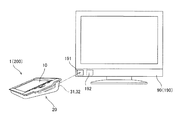
第2実施形態では、図14に示すように、制御部(CPU)151は、リモコンモードで使用されている場合において、不使用状態の傾き値が傾きセンサ53により検出された場合に、携帯情報表示端末201をスタンバイモードに移行させるように構成されている。この場合、制御部(CPU)151は、さらに、リモコンモードの操作対象である機器(たとえば、テレビジョン装置190(図11参照))に対してスタンバイモードに移行するように指示する信号を赤外線通信部31および32を介して送信するように構成されている。携帯情報表示端末201の赤外線通信部31および32からテレビジョン装置190にスタンバイモードに移行するように指示する信号が送信された場合には、テレビジョン装置190の受光部191により信号が受信される。この場合、テレビジョン装置190の制御部192は、受光部191により受信された信号に基づいてテレビジョン装置190をスタンバイモードに移行するように構成されている。すなわち、制御部151は、リモコンモードである場合において、フレーム20および液晶表示部10が載置面100に対向するように伏せられた場合に、携帯情報表示端末201およびリモコンモードの操作対象である機器(たとえば、テレビジョン装置190)の両方をスタンバイモードに移行する制御を行うように構成されている。
In the second embodiment, as shown in FIG. 14, when the control unit (CPU) 151 is used in the remote control mode and the inclination value in the non-use state is detected by the
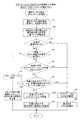
次に、図11、図14および図15を参照して、第2実施形態による携帯情報表示端末201の状態に対応するアプリケーションプログラムの起動および維持、および、スタンバイモード移行フローについて説明する。なお、図15のフローチャートのうち、ステップS1〜ステップS11の処理は、上記第1実施形態の処理と同様である。
Next, with reference to FIG. 11, FIG. 14, and FIG. 15, the activation and maintenance of the application program corresponding to the state of the portable
図15に示すように、ステップS7において、制御部151(図14参照)により、スタンバイモードに移行され、ステップS21に進む。そして、ステップS21において、制御部151により、赤外線通信部31および32を介してリモコンモードの操作対象である機器(たとえば、テレビジョン装置190(図11参照))に対してスタンバイモードに移行するように指示する赤外線信号が発信される。その後、アプリケーションプログラムの起動および維持、および、スタンバイモード移行フローが終了する。
As shown in FIG. 15, in step S7, the control unit 151 (see FIG. 14) shifts to the standby mode and proceeds to step S21. Then, in step S21, the
第2実施形態では、上記のように、リモコンモードで使用されている場合に、不使用状態になったことが傾きセンサ53により検出された時に、携帯情報表示端末201をスタンバイモードに移行させるとともに、リモコンモードの操作対象である機器(たとえば、テレビジョン装置190)に対してスタンバイモードに移行するように指示する信号を赤外線通信部31および32を介して送信することによって、リモコンモードで使用されている場合において、不使用状態に変更されることにより携帯情報表示端末201がスタンバイモードに移行される場合には、リモコンモードの操作対象である機器(たとえば、テレビジョン装置190)を使用することがなくなると考えられるので、操作対象である機器(たとえば、テレビジョン装置190)に対してスタンバイモードに移行する信号を赤外線通信部31および32を介して送信することにより、容易に操作対象である機器(たとえば、テレビジョン装置190)をもスタンバイモードに移行させることができる。
In the second embodiment, as described above, when the
なお、今回開示された実施形態は、すべての点で例示であって制限的なものではないと考えられるべきである。本発明の範囲は、上記した実施形態の説明ではなく特許請求の範囲によって示され、さらに特許請求の範囲と均等の意味および範囲内でのすべての変更が含まれる。 The embodiment disclosed this time should be considered as illustrative in all points and not restrictive. The scope of the present invention is shown not by the above description of the embodiments but by the scope of claims for patent, and further includes all modifications within the meaning and scope equivalent to the scope of claims for patent.
たとえば、上記第1および第2実施形態では、傾きセンサがフレームおよび液晶表示部を載置面に立てて使用する立てた状態、フレームおよび液晶表示部を載置面に寝かせて使用する寝かせた状態、フレームを手で把持して使用する手持ち状態、および、フレームおよび液晶表示部が載置面に対向するように伏せられた不使用状態のいずれかのみを検出する例について示したが、本発明はこれに限られない。たとえば、立てた状態、寝かせた状態、手持ち状態および不使用状態に加えて、携帯情報表示端末を壁面に引っ掛けて保持するなど、立てた状態、寝かせた状態、手持ち状態および不使用状態以外の状態を検出するようにしてもよい。 For example, in the first and second embodiments, the tilt sensor is in a standing state in which the frame and the liquid crystal display unit are used while being placed on the mounting surface, and in a state in which the frame and the liquid crystal display unit are used by being put on the mounting surface. Although an example in which only one of a hand-held state in which the frame is held by hand and a non-use state in which the frame and the liquid crystal display unit are faced down to face the mounting surface has been shown, Is not limited to this. For example, in addition to standing, sleeping, hand-held, and non-use states, the portable information display terminal is hooked and held on the wall, and other states than standing, sleeping, hand-held, and non-use states May be detected.
また、上記第1および第2実施形態では、携帯情報表示端末を載置面に対向するように伏せた場合に、携帯情報表示端末をスタンバイモードに移行する例について示したが、本発明はこれに限られない。たとえば、フレームおよび液晶表示部を載置面に立てて使用する立てた状態で携帯情報表示端末をスタンバイモードに移行するなど、携帯情報表示端末を載置面に対向するように伏せた状態以外の状態で携帯情報表示端末をスタンバイモードに移行するようにしてもよい。 Further, in the first and second embodiments, the example in which the portable information display terminal is shifted to the standby mode when the portable information display terminal is turned down so as to face the placement surface has been described. Not limited to. For example, the portable information display terminal is placed in a stand-up state in which the frame and the liquid crystal display unit are standing and used. The portable information display terminal may be shifted to the standby mode in the state.
また、上記第1および第2実施形態では、傾きセンサがフレームおよび液晶表示部を載置面に立てて使用する立てた状態、および、フレームおよび液晶表示部を載置面に寝かせて使用する寝かせた状態に載置可能な外形形状にフレームを構成した例について示したが、本発明はこれに限られない。別部材のスタンドなどをフレーム(筐体)に取り付けることにより、傾きセンサがフレームおよび液晶表示部を載置面に立てて使用する立てた状態、および、フレームおよび液晶表示部を載置面に寝かせて使用する寝かせた状態に載置するようにしてもよい。 In the first and second embodiments, the tilt sensor is in a standing state in which the frame and the liquid crystal display unit are placed on the mounting surface, and the frame sensor and the liquid crystal display unit are laid on the mounting surface. Although an example in which the frame is configured in an outer shape that can be placed in the above state is shown, the present invention is not limited to this. By attaching a stand or the like of another member to the frame (housing), the tilt sensor stands in a state where the frame and the liquid crystal display unit stand on the mounting surface, and the frame and the liquid crystal display unit are laid on the mounting surface. It may be placed in a laid state for use.
また、上記第1および第2実施形態では、リモコンモード時に、制御対象機器に対してリモコン信号を含む赤外線を出射することにより、制御対象機器のリモコン制御を行う例について示したが、本発明はこれに限られない。たとえば、Bluetooth(登録商標)およびZigbee(登録商標)などの無線通信規格を用いることにより制御対象機器のリモコン制御を行うようにしてもよい。 In the first and second embodiments, an example in which remote control of a control target device is performed by emitting infrared light including a remote control signal to the control target device in the remote control mode has been described. It is not limited to this. For example, the remote control of the device to be controlled may be performed by using a wireless communication standard such as Bluetooth (registered trademark) or Zigbee (registered trademark).
また、上記第1実施形態では、説明の便宜上、制御部の処理動作をスタート時はイベント駆動的に記載し、スタート移行の処理動作はフロー駆動的に記載したフローチャートを用いて説明したが、本発明はこれに限られない。制御部の処理動作を完全なイベント駆動型で行ってもよいし、完全なフロー駆動型で行ってもよいし、並行処理的に行ってもよい。 In the first embodiment, for convenience of explanation, the processing operation of the control unit is described in an event-driven manner at the start, and the processing operation of the start transition is described using a flowchart described in a flow-driven manner. The invention is not limited to this. The processing operation of the control unit may be performed by a complete event drive type, may be performed by a complete flow drive type, or may be performed in parallel processing.
また、上記第2実施形態では、携帯情報表示端末を載置面に対向するように伏せた場合に、テレビジョン装置をスタンバイモードに移行する例について示したが、本発明はこれに限られない。携帯情報表示端末のリモコンモードにおいてリモコン操作可能な外部機器であれば、携帯情報表示端末を載置面に対向するように伏せた場合に、テレビジョン装置以外の外部機器をスタンバイモードに移行するようにしてもよい。 Moreover, in the said 2nd Embodiment, when the portable information display terminal was turned down so as to oppose a mounting surface, the example which transfers a television apparatus to standby mode was shown, However, This invention is not limited to this. . If it is an external device that can be operated by remote control in the remote control mode of the portable information display terminal, when the portable information display terminal is turned down so as to face the mounting surface, the external device other than the television device is shifted to the standby mode. It may be.
1、201 携帯情報表示端末
10 液晶表示部(表示部)
20 フレーム(筐体)
31、32 赤外線通信部(通信部)
51、151 制御部
53 傾きセンサ
90、190 テレビジョン装置(機器)
100 載置面
1,201 Portable
20 frames (housing)
31, 32 Infrared communication part (communication part)
51, 151
100 Placement surface
Claims (8)
前記筐体の傾きを検出することにより、第1の状態になったことと、第2の状態になったこととを検出するための傾きセンサと、
前記傾きセンサにより前記第2の状態であることが検出された場合に、前記第2の状態であると判別して特定するとともに、スタンバイモードに移行する制御を行う制御部とを備えた、携帯情報表示端末。 A housing,
An inclination sensor for detecting that the first state and the second state are detected by detecting the inclination of the housing;
A mobile unit provided with a control unit that determines and identifies the second state when the tilt sensor detects the second state, and controls to shift to the standby mode Information display terminal.
前記第2の状態は、前記筐体および前記表示部が載置面に対向するように伏せられた不使用状態であり、
前記制御部は、前記傾きセンサにより前記筐体および前記表示部を前記載置面に対向するように伏せた不使用状態であることが検出された場合に、スタンバイモードに移行する制御を行うように構成されている、請求項1に記載の携帯情報表示端末。 A display unit for displaying information;
The second state is a non-use state in which the housing and the display unit are faced down so as to face the mounting surface.
The control unit performs control to shift to the standby mode when the tilt sensor detects that the housing and the display unit are in a non-use state where the casing and the display unit face each other to face the mounting surface. The portable information display terminal according to claim 1, which is configured as follows.
前記制御部は、ユーザにより前記筐体が把持された前記第3の状態であることが前記傾きセンサにより検出された場合には、前記第2の状態の傾きが検出された場合にも、前記スタンバイモードに移行しない制御を行うように構成されている、請求項1または2に記載の携帯情報表示端末。 In addition to the first state and the second state, the tilt sensor is configured to detect a third state in which the housing is gripped by a user,
When the tilt sensor detects that the control unit is in the third state in which the housing is gripped by the user, the control unit also detects the tilt in the second state. The portable information display terminal according to claim 1, wherein the portable information display terminal is configured to perform control that does not shift to the standby mode.
前記第1の状態は、前記筐体を立てて使用する立て置き使用状態と、前記筐体を寝かせて使用する寝かせ使用状態とを含み、
前記筺体は、前記立て置き使用状態における前記筺体の傾きと、前記寝かせ使用状態における前記筺体の傾きと、前記第2の状態における前記筺体の傾きとが、互いに異なる傾きになるように前記載置面に載置可能に構成されており、
前記傾きセンサにより前記第2の状態における前記筐体の傾きが検出された場合に、前記制御部により前記スタンバイモードに移行する制御を行うように構成されている、請求項1〜3のいずれか1項に記載の携帯情報表示端末。 The first state and the second state are states in which the casing is placed on a placement surface,
The first state includes a standing use state in which the housing is used in a standing state, and a sleeping use state in which the housing is used by being laid down,
The casing is placed in such a manner that an inclination of the casing in the standing use state, an inclination of the casing in the laying use state, and an inclination of the casing in the second state are different from each other. It can be placed on the surface,
The control unit is configured to perform control to shift to the standby mode when the tilt sensor detects the tilt of the housing in the second state. 2. A portable information display terminal according to item 1.
前記第2の状態は、前記筐体および前記表示部が前記載置面に対向するように伏せられた不使用状態であり、
前記筺体は、前記立て置き使用状態での傾きと、前記寝かせ使用状態での傾きと、前記伏せられた不使用状態での傾きとが、互いに異なる傾きになるように前記載置面に載置可能な外形形状を有するように構成されている、請求項4に記載の携帯情報表示端末。 A display unit for displaying information;
The second state is a non-use state in which the housing and the display unit are faced down so as to face the placement surface.
The casing is placed on the mounting surface so that the inclination in the standing use state, the inclination in the laying use state, and the inclination in the faced non-use state are different from each other. The portable information display terminal according to claim 4, wherein the portable information display terminal is configured to have a possible outer shape.
前記制御部は、前記傾きセンサにより前記第1の状態になったことが検出された場合には、検出された状態に対応するアプリケーションプログラムを起動するとともに、前記傾きセンサにより前記第2の状態であることが検出された場合には、アプリケーションプログラムを起動せずにスタンバイモードに移行するように制御するようにように構成されている、請求項1〜5のいずれか1項に記載の携帯情報表示端末。 The first state is a use state,
When it is detected by the tilt sensor that the first state has been reached, the control unit activates an application program corresponding to the detected state, and in the second state by the tilt sensor. The mobile information according to any one of claims 1 to 5, wherein the mobile information is configured to control to shift to a standby mode without starting an application program when it is detected. Display terminal.
前記第1の状態は、前記筐体を載置面に寝かせて使用する寝かせ使用状態を含み、
前記制御部は、前記傾きセンサにより前記寝かせ使用状態であると検出された場合に、前記リモコンモードに対応するアプリケーションプログラムを起動するように構成されている、請求項6に記載の携帯情報表示端末。 A communication unit used in remote control mode is further provided.
The first state includes a laying use state in which the casing is laid on a mounting surface and used.
The portable information display terminal according to claim 6, wherein the control unit is configured to start an application program corresponding to the remote control mode when the tilt sensor detects that the sleeping state is in use. .
前記制御部は、前記リモコンモードで使用されている場合に、前記第2の状態になったことが前記傾きセンサにより検出された時に、前記携帯情報表示端末をスタンバイモードに移行させるとともに、前記リモコンモードの操作対象である機器に対してスタンバイモードに移行するように指示する信号を前記通信部を介して送信するように構成されている、請求項1〜7のいずれか1項に記載の携帯情報表示端末。 A communication unit used in remote control mode is further provided.
When the control unit is used in the remote control mode and the tilt sensor detects that the second state has been entered, the control unit shifts the portable information display terminal to a standby mode, and the remote control The mobile phone according to any one of claims 1 to 7, configured to transmit, via the communication unit, a signal that instructs a device that is an operation target of the mode to shift to a standby mode. Information display terminal.
Priority Applications (5)
| Application Number | Priority Date | Filing Date | Title |
|---|---|---|---|
| JP2010088053A JP2011221663A (en) | 2010-04-06 | 2010-04-06 | Portable information display terminal |
| KR1020127027135A KR20130038843A (en) | 2010-04-06 | 2011-04-05 | Portable information display terminal |
| US13/639,712 US20130027375A1 (en) | 2010-04-06 | 2011-04-05 | Portable Information Display Terminal |
| EP11765895A EP2557478A1 (en) | 2010-04-06 | 2011-04-05 | Portable information display terminal |
| PCT/JP2011/058572 WO2011125995A1 (en) | 2010-04-06 | 2011-04-05 | Portable information display terminal |
Applications Claiming Priority (1)
| Application Number | Priority Date | Filing Date | Title |
|---|---|---|---|
| JP2010088053A JP2011221663A (en) | 2010-04-06 | 2010-04-06 | Portable information display terminal |
Publications (1)
| Publication Number | Publication Date |
|---|---|
| JP2011221663A true JP2011221663A (en) | 2011-11-04 |
Family
ID=44762931
Family Applications (1)
| Application Number | Title | Priority Date | Filing Date |
|---|---|---|---|
| JP2010088053A Pending JP2011221663A (en) | 2010-04-06 | 2010-04-06 | Portable information display terminal |
Country Status (5)
| Country | Link |
|---|---|
| US (1) | US20130027375A1 (en) |
| EP (1) | EP2557478A1 (en) |
| JP (1) | JP2011221663A (en) |
| KR (1) | KR20130038843A (en) |
| WO (1) | WO2011125995A1 (en) |
Cited By (1)
| Publication number | Priority date | Publication date | Assignee | Title |
|---|---|---|---|---|
| JP2016188941A (en) * | 2015-03-30 | 2016-11-04 | 旭硝子株式会社 | Transparent surface material with display |
Families Citing this family (8)
| Publication number | Priority date | Publication date | Assignee | Title |
|---|---|---|---|---|
| JP5327060B2 (en) * | 2010-01-05 | 2013-10-30 | 船井電機株式会社 | Mobile information display terminal |
| CN103150194A (en) * | 2013-04-10 | 2013-06-12 | 天津三星光电子有限公司 | Sleep control method of mobile terminal and mobile terminal thereof |
| JP6397171B2 (en) | 2013-08-26 | 2018-09-26 | 任天堂株式会社 | Information processing apparatus and information processing system |
| US9529420B2 (en) * | 2014-12-11 | 2016-12-27 | Google Inc. | Transitioning between two power states based on user related signals |
| KR102308968B1 (en) * | 2015-03-02 | 2021-10-05 | 김성일 | Method and storage medium, mobile terminal for controlling screen |
| JP6531268B2 (en) * | 2015-05-21 | 2019-06-19 | 株式会社エンビジョンAescジャパン | Vehicle battery pack |
| CN104991789B (en) * | 2015-06-02 | 2018-09-18 | 小米科技有限责任公司 | Application program open method and device |
| CN106406726B (en) * | 2016-08-26 | 2019-09-17 | Oppo广东移动通信有限公司 | Using control method, device and terminal device |
Family Cites Families (12)
| Publication number | Priority date | Publication date | Assignee | Title |
|---|---|---|---|---|
| JP3551774B2 (en) * | 1998-07-16 | 2004-08-11 | 三菱電機株式会社 | Power saving system |
| JP2002055177A (en) * | 2000-05-29 | 2002-02-20 | Citizen Watch Co Ltd | Electronic clock |
| JP2003345390A (en) * | 2002-05-23 | 2003-12-03 | Matsushita Electric Ind Co Ltd | Voice processing device and remote controller device |
| EP1692846B1 (en) * | 2003-11-21 | 2009-05-06 | Nokia Corporation | Two step activation of phone |
| JP2006101041A (en) * | 2004-09-28 | 2006-04-13 | Fujitsu Ltd | Mobile phone |
| US20060208573A1 (en) * | 2005-03-21 | 2006-09-21 | Panamax | Uninterrupted power supply with IR control link |
| JP4611866B2 (en) * | 2005-11-02 | 2011-01-12 | シャープ株式会社 | Electronics |
| JP4869710B2 (en) * | 2005-12-27 | 2012-02-08 | 京セラ株式会社 | Portable terminal device and image display method |
| US7667686B2 (en) * | 2006-02-01 | 2010-02-23 | Memsic, Inc. | Air-writing and motion sensing input for portable devices |
| GB2442031A (en) * | 2006-09-25 | 2008-03-26 | Peter John Ensinger | Standby saver |
| WO2009016719A1 (en) * | 2007-07-30 | 2009-02-05 | Fujitsu Limited | Automatic excitation setting device, method, and program |
| JP2009139772A (en) | 2007-12-10 | 2009-06-25 | Seiko Epson Corp | Display device and printing apparatus equipped with the same |
-
2010
- 2010-04-06 JP JP2010088053A patent/JP2011221663A/en active Pending
-
2011
- 2011-04-05 WO PCT/JP2011/058572 patent/WO2011125995A1/en not_active Ceased
- 2011-04-05 EP EP11765895A patent/EP2557478A1/en not_active Withdrawn
- 2011-04-05 KR KR1020127027135A patent/KR20130038843A/en not_active Withdrawn
- 2011-04-05 US US13/639,712 patent/US20130027375A1/en not_active Abandoned
Cited By (1)
| Publication number | Priority date | Publication date | Assignee | Title |
|---|---|---|---|---|
| JP2016188941A (en) * | 2015-03-30 | 2016-11-04 | 旭硝子株式会社 | Transparent surface material with display |
Also Published As
| Publication number | Publication date |
|---|---|
| EP2557478A1 (en) | 2013-02-13 |
| US20130027375A1 (en) | 2013-01-31 |
| KR20130038843A (en) | 2013-04-18 |
| WO2011125995A1 (en) | 2011-10-13 |
Similar Documents
| Publication | Publication Date | Title |
|---|---|---|
| JP5440334B2 (en) | Mobile information display terminal | |
| WO2011125995A1 (en) | Portable information display terminal | |
| JP5327060B2 (en) | Mobile information display terminal | |
| JP5445285B2 (en) | Mobile information display terminal | |
| US8988271B2 (en) | Electronic apparatus, control method thereof, remote control apparatus, and control method thereof | |
| JP5625462B2 (en) | Mobile information display terminal | |
| KR101445211B1 (en) | Electronic apparatus, remote control apparatus and control method thereof | |
| KR102330250B1 (en) | Display apparatus, control apparatus and operation method of the same | |
| US20120162084A1 (en) | Method and apparatus for touch input for electronic device | |
| JP6476117B2 (en) | Handheld information processing device with remote control output mode | |
| JP5076014B1 (en) | Electronic device, electronic device control apparatus, and electronic device control method | |
| JP2010245692A (en) | Mobile device | |
| WO2012137327A1 (en) | Portable information display terminal | |
| JP2008197276A (en) | Video display device | |
| JP2011142393A (en) | Portable information processing device | |
| KR20260058215A (en) | Display device and control method of the display device | |
| JP2013207733A (en) | Information terminal | |
| JP2008243011A (en) | Communication device | |
| JP2010171900A (en) | Mobile information communication terminal with projector function and control method therefor |