JP2011001663A - Conjugated fiber - Google Patents
Conjugated fiber Download PDFInfo
- Publication number
- JP2011001663A JP2011001663A JP2009147528A JP2009147528A JP2011001663A JP 2011001663 A JP2011001663 A JP 2011001663A JP 2009147528 A JP2009147528 A JP 2009147528A JP 2009147528 A JP2009147528 A JP 2009147528A JP 2011001663 A JP2011001663 A JP 2011001663A
- Authority
- JP
- Japan
- Prior art keywords
- dendritic polyester
- polymer
- spinning
- acid
- polyester
- Prior art date
- Legal status (The legal status is an assumption and is not a legal conclusion. Google has not performed a legal analysis and makes no representation as to the accuracy of the status listed.)
- Pending
Links
Images

Landscapes
- Multicomponent Fibers (AREA)
Abstract
【課題】 従来とは異なり、マトリックスポリマーと分子鎖の絡み合いが抑制され、紡糸過程での伸長変形を阻害し難い樹状ポリエステルを用いることにより、紡糸温度の低温化を図るとともに、力学特性に優れた複合繊維を提供するものである。
【解決手段】 芳香族オキシカルボニル単位(P)、芳香族および脂肪族ジオキシ単位(Q)、および芳香族ジカルボニル単位(R)からなる構造単位と3官能以上の有機残基(B)とを含み、かつ、Bの含有量が樹状ポリエステルを構成する全単量体に対して7.5〜50モル%の範囲にある樹状ポリエステルを熱可塑性であるマトリックスポリマーに0.1〜10重量%ブレンドしたポリマーが少なくとも一部を構成する複合繊維。
【選択図】 なしPROBLEM TO BE SOLVED: To lower the spinning temperature and excel in mechanical properties by using a dendritic polyester that prevents entanglement between a matrix polymer and a molecular chain unlike conventional ones and hardly inhibits elongation deformation during spinning. A composite fiber is provided.
A structural unit comprising an aromatic oxycarbonyl unit (P), an aromatic and aliphatic dioxy unit (Q), and an aromatic dicarbonyl unit (R), and a trifunctional or higher functional organic residue (B). 0.1 to 10% by weight of a dendritic polyester containing 7.5% to 50% by mole of the B-containing polyester based on the total monomer constituting the dendritic polyester. A composite fiber in which at least a part of the blended polymer constitutes at least a part.
[Selection figure] None
Description
本発明は、融点や粘度等が異なる2種類以上のポリマーにより構成させる複合繊維において、樹状ポリエステルが添加されたポリマーブレンドが少なくとも一部を構成する複合繊維に関するものである。 The present invention relates to a composite fiber composed of two or more types of polymers having different melting points, viscosities, and the like, wherein the polymer blend to which a dendritic polyester is added constitutes at least a part.
ポリエステルやポリアミドなどの熱可塑性ポリマーを用いた繊維は力学的特性や寸法安定性に優れるため、衣料用途のみならずインテリアや車両内装、産業用途等幅広く利用されており、産業上の価値は極めて高い。しかしながら、繊維の用途が多様化する現状において、その要求特性も様々なものとなり、芯鞘複合紡糸などを活用し、2種類以上の熱可塑性ポリマーを複合繊維としたり、繊維断面を異形化する試みが検討されている。 Fibers using thermoplastic polymers such as polyester and polyamide are excellent in mechanical properties and dimensional stability, so they are widely used not only in clothing but also in interiors, vehicle interiors, and industrial applications. . However, in the present situation where the uses of fibers are diversified, the required characteristics are also various, and attempts to make two or more types of thermoplastic polymers into composite fibers or to make fiber cross-sections different by utilizing core-sheath composite spinning etc. Is being considered.
一般に、芯鞘複合繊維では、2種類以上のポリマーを組み合わせ、芯成分を鞘成分が被覆することで、単独繊維では達成されない風合い、嵩高性などといった感性的効果、また、強度、弾性率、耐摩耗性などといった力学特性の付与が可能となる。また、溶剤に易溶出性を示すポリマーで鞘成分、難溶出成分で異形断面となるように芯成分を構成し、鞘成分を溶出することで精度の高い異形断面繊維を得ることができる。通常、ポリエステルやポリアミドなどのポリマーを溶融紡糸によって得た場合、真円形の断面を持つことが多いが、異形断面とすることで真円形の繊維では得られない特殊な風合いを付与したり、織り編みの際のこなれを良くしたり、繊維を被覆する他の樹脂との接触面積を増加させ、剥離などの問題を抑制することができる。 In general, in the core-sheath composite fiber, two or more kinds of polymers are combined, and the core component is coated with the sheath component, so that the sensual effects such as texture and bulkiness that cannot be achieved with a single fiber, strength, elastic modulus, Mechanical properties such as wear can be imparted. Moreover, a core component is comprised so that a sheath component and a hard-elution component may become a modified cross section with the polymer which shows an elution property easily to a solvent, and a highly accurate modified cross-section fiber can be obtained by eluting a sheath component. Usually, when polymers such as polyester and polyamide are obtained by melt spinning, they often have a true circular cross section, but the irregular cross section gives a special texture that cannot be obtained with a true circular fiber, or weaves It is possible to improve the knitting at the time of knitting, increase the contact area with other resin coating the fiber, and suppress problems such as peeling.
このように既存のポリマーを組み合わせることで機能の複合化、断面形態の制御などにより様々な特性向上が期待される複合繊維であるが、その製造においては、融点や粘度が異なるポリマーを口金内で複合化させ、同一の細孔から吐出することになる。この複合化されたポリマー流の流動性を確保するためには紡糸温度の設定が非常に重要となる。 In this way, it is a composite fiber that is expected to improve various properties by combining functions and controlling the cross-sectional form by combining existing polymers, but in its production, polymers with different melting points and viscosities are contained in the die. They are combined and discharged from the same pore. In order to ensure the fluidity of the combined polymer stream, the setting of the spinning temperature is very important.
複合繊維の溶融紡糸における温度条件は、組み合わせるポリマーのうち高融点や高粘度のものによって決まるのが一般的であり、この高融点や高粘度のポリマーが良好な良流動性を示す温度でないと実質的に紡糸はできない。このため、用途の要求特性に応じて複合繊維を構成するポリマーの組み合わせを企画しても、実際には紡糸ができなかったり、低融点や耐熱性の低いポリマーには過酷な紡糸温度で紡糸することになり、大きく熱分解を引き起こし、得られる繊維は実用に耐えないものとなってしまう場合も多く、繊維の特性や用途に制限をつくる一つの要因となっている。 The temperature conditions for melt spinning of composite fibers are generally determined by the high melting point and high viscosity of the polymers to be combined, and the high melting point or high viscosity polymer is not a temperature that exhibits good flowability. Spinning is not possible. For this reason, even if a combination of polymers constituting the composite fiber is planned according to the required characteristics of the application, spinning is not actually possible, or a polymer having a low melting point or low heat resistance is spun at a severe spinning temperature. In other words, the fiber is greatly pyrolyzed, and the resulting fiber often cannot be used practically, which is one factor that limits the properties and applications of the fiber.
例えば、地球的規模での環境に対する意識が高まり、バイオマスポリマーであるポリ乳酸は、易成形性であり、価格も低いことから多く活用方法が検討されているが、単独で繊維化した場合には耐摩耗性や耐熱性などが低いというようないくつかの欠点を有している。このため、複合繊維として、それらの欠点を克服しようとする試みがある。また、ポリ乳酸はアルカリ水溶液で簡単に溶出できるために、前記した異形断面繊維や海島複合繊維の易溶出成分(海成分)として使用することも好適である。しかしながら、ポリ乳酸は250℃以上で顕著な熱分解が発生することから紡糸温度が250℃以上であるポリエステルやポリアミドと組み合わせることはポリ乳酸の熱分解という観点から非常に困難なことであった。よって、ポリ乳酸と組み合わせるポリマーは共重合などすることにより融点を降下させることも考えられるが、この場合、ポリエステルやポリアミドが本来有する優れた特性が大きく損なわれる場合がある。 For example, environmental awareness on a global scale has increased, and polylactic acid, a biomass polymer, is easy to mold and has a low price. It has some drawbacks such as low wear resistance and heat resistance. For this reason, there is an attempt to overcome these drawbacks as a composite fiber. Moreover, since polylactic acid can be easily eluted with an aqueous alkali solution, it is also suitable to use it as an easily eluted component (sea component) of the above-mentioned irregular cross-section fiber or sea-island composite fiber. However, since polylactic acid undergoes remarkable thermal decomposition at 250 ° C. or higher, it has been very difficult to combine with polyester or polyamide having a spinning temperature of 250 ° C. or higher from the viewpoint of thermal decomposition of polylactic acid. Therefore, it is conceivable that the polymer combined with polylactic acid lowers the melting point by copolymerization or the like, but in this case, the excellent properties inherent in the polyester or polyamide may be greatly impaired.
この融点を降下させる目的とは、すなわち、高融点や高粘度のポリマーの溶融時の流動性を確保することであり、これに基づけば、高融点や高粘度のポリマーの粘度を低下させるために減粘剤などを添加することで流動性を向上させることが考えられる。これが可能となれば、紡糸温度を低温化し、ポリ乳酸などの耐熱性の低いポリマーと組み合わすことができるポリマーが増え、それに応じて様々な特性の向上が可能となることが考えられる。しかしながら、一般に減粘剤と呼ばれるものは低分子量物、すなわち低融点のポリマーを添加することにより添加されたポリマー全体の粘度を低下させるものである。一般には、この減粘剤自体の耐熱性が低いものである場合が多く、溶融混練中などに揮発することにより減粘効果が大きく低減するものであったり、減粘剤の分解物が繊維の特性を大きく損なわせたりすること等から現在まで溶融紡糸に適用したもので成功した例は少ない。 The purpose of lowering the melting point is to ensure fluidity when the high melting point or high viscosity polymer is melted. Based on this, in order to reduce the viscosity of the high melting point or high viscosity polymer, It is conceivable to improve fluidity by adding a thinning agent or the like. If this is possible, it is considered that the spinning temperature can be lowered and the number of polymers that can be combined with a polymer having low heat resistance such as polylactic acid increases, and various properties can be improved accordingly. However, what is generally called a thinning agent is one that lowers the viscosity of the added polymer by adding a low molecular weight product, that is, a low melting point polymer. Generally, the heat resistance of the thinning agent itself is often low, and the thinning effect is greatly reduced by volatilization during melt kneading or the like. There have been few examples of successful application to melt spinning up to the present due to the significant loss of properties.
一方、樹状ポリマーを熱可塑性ポリマーに添加して、ポリマーの流動性を向上することが提案されている(特許文献1)。樹状ポリマーは分岐モノマーを介して、低分子量の主鎖を連結することで超分岐構造を有し、その樹状ポリマー全体では高分子量体となるため、低粘度成分添加の減粘効果を有しつつも、耐熱性が向上することとなる。特許文献1では、熱可塑性ポリマーと非反応性の樹状ポリマーを添加することで、流動性が向上することが開示されている。しかしながら、特許文献1に用いられる樹状ポリマーの主鎖部分は脂肪族系ポリマーで構成されており、脂肪族系ポリマーはその分子構造から、溶融下においての主鎖部の柔軟性が高く、樹状ポリマーと熱可塑性ポリマーが非反応性であるとしても、樹状ポリマー主鎖部分と熱可塑性ポリマーの主鎖部分で分子鎖どうしの絡み合いが多く発生してしまう場合があった。これは、樹脂の押出加工(射出成形等)では変形量が小さく、さらに剪断変形が支配的であるため大きな問題とはならないが、紡糸などの大きな伸長変形を伴う場合には深刻な問題を引き起こしてしまう場合があった。すなわち、分子鎖の絡み合いの程度が大きくなることで、熱可塑性ポリマーの分子鎖がスムーズな伸長変形することを阻害され、紡糸性を著しく損ない、場合よっては添加された熱可塑性ポリマーの弾性的性質が強くなり過ぎ、口金直下でのポリマーが糸として繋がらない五月雨現象が発生する場合がある。特に複合紡糸の場合には2種類以上のポリマーが伸長変形することになるため、複合ポリマー流を構成するポリマーのうち1成分でも前記したような挙動を示すと、その伸長変形の制御は非常に困難なものとなり、紡糸不能に陥る場合が多い。
On the other hand, it has been proposed to improve the fluidity of a polymer by adding a dendritic polymer to a thermoplastic polymer (Patent Document 1). A dendritic polymer has a hyperbranched structure by linking low-molecular-weight main chains via a branching monomer, and the dendritic polymer as a whole becomes a high-molecular-weight polymer. However, the heat resistance is improved.
前記した樹状ポリマーとの絡み合いを抑制する方法としては、樹状ポリマーの主鎖に剛直成分を組み込み溶融下での柔軟性を低下させ、熱可塑性ポリマーとの主鎖との絡み合いを抑制する方法が提案されている(特許文献2)。しかしながら、特許文献2に記載される樹状ポリマーは分子末端がカルボン酸基であり、分子末端構造について考慮されていないことが課題として残る。このカルボン酸基は、溶融下においては自己触媒反応により、マトリクスポリマーである熱可塑性ポリマーの加水分解を起こし、添加した熱可塑性ポリマーの分子量低下を招く場合があった。この現象は溶融滞留時間の短い樹脂の押出加工(射出成形等)では大きな問題とならないが、複雑に入り組んだ配管やパック口金構造を有する溶融紡糸機では、滞留時間が長いものとなったり、異常滞留部ができやすかったりするため、熱可塑性ポリマーの分子量低下が顕著化し、紡糸性や複合繊維の力学物性に大きな影響を与える場合があった。
As a method for suppressing the entanglement with the dendritic polymer, a method for suppressing the entanglement with the main chain with the thermoplastic polymer by incorporating a rigid component into the main chain of the dendritic polymer to reduce the flexibility under melting. Has been proposed (Patent Document 2). However, the dendritic polymer described in
本発明は、融点や粘度等が異なる2種類以上のポリマーにより構成させる複合繊維において、樹状ポリエステルが添加されたポリマーブレンドが少なくとも一部を構成する複合繊維に関するものである。 The present invention relates to a composite fiber composed of two or more types of polymers having different melting points, viscosities, and the like, wherein the polymer blend to which a dendritic polyester is added constitutes at least a part.
上記目的は、以下の手段により達成される。すなわち、
(1)2種類以上のポリマーからなる複合繊維であって、芳香族オキシカルボニル単位(P)、芳香族および/または脂肪族ジオキシ単位(Q)、芳香族ジカルボニル単位(R)から選ばれる少なくとも1種の構造単位と、3官能の有機残基(B)とを含み、かつ前記P、Q、RおよびBの含有量の合計に対してBの含有量が7.5〜50モル%であり、末端のカルボン酸基量が1×10-4当量/g以下である樹状ポリエステルを、マトリックスポリマーに0.1〜10重量%添加したポリマーブレンドを少なくとも構成の一部であることを特徴とする複合繊維、
(2)樹状ポリエステルが、カルボン酸反応性単官能化合物残基を含有することを特徴とする(1)記載の複合繊維、
(3)カルボン酸反応性単官能化合物が、オルトエステル、オキサゾリン、エポキシドから選ばれる少なくとも1種の化合物であることを特徴とする(2)に記載の複合繊維、
(4)マトリックスポリマーが、ポリエステル、ポリアミド、またはポリフェニレサルファイドであることを特徴とする(1)〜(3)いずれかに記載の複合繊維、
(5)ポリトリメチレンテレフタレートが少なくとも構成の一部であることを特徴とする(1)〜(4)のいずれかに記載の複合繊維、
(6)ポリ乳酸が少なくとも構成の一部であることを特徴とする(1)〜(5)のいずれかに記載の複合繊維、
である。
The above object is achieved by the following means. That is,
(1) A composite fiber composed of two or more types of polymers, at least selected from aromatic oxycarbonyl units (P), aromatic and / or aliphatic dioxy units (Q), and aromatic dicarbonyl units (R) 1 type of structural unit and a trifunctional organic residue (B), and the content of B is 7.5 to 50 mol% with respect to the total content of P, Q, R and B A polymer blend obtained by adding 0.1 to 10% by weight of a dendritic polyester having a terminal carboxylic acid group amount of 1 × 10 −4 equivalent / g or less to a matrix polymer is at least a part of the constitution Composite fiber,
(2) Dendritic polyester contains a carboxylic acid reactive monofunctional compound residue, The composite fiber according to (1),
(3) The composite fiber according to (2), wherein the carboxylic acid-reactive monofunctional compound is at least one compound selected from orthoester, oxazoline, and epoxide,
(4) The composite fiber according to any one of (1) to (3), wherein the matrix polymer is polyester, polyamide, or polyphenylsulfide,
(5) The composite fiber according to any one of (1) to (4), wherein polytrimethylene terephthalate is at least a part of the configuration.
(6) The composite fiber according to any one of (1) to (5), wherein the polylactic acid is at least a part of the configuration,
It is.
本発明の複合繊維により、ポリマーの組み合わせに制限なく複合繊維を得ることが可能であり、更に流動性向上に伴う紡糸温度の低下が可能となり、熱分解に伴う分子量低下が抑制されるため優れた力学特性を有した複合繊維を得ることができる。 With the conjugate fiber of the present invention, it is possible to obtain a conjugate fiber without any restriction on the combination of polymers, and further, the spinning temperature can be lowered due to the improvement in fluidity, and the molecular weight reduction due to thermal decomposition is suppressed, which is excellent. A composite fiber having mechanical properties can be obtained.
本発明の樹状ポリエステルは、芳香族オキシカルボニル単位(P)、芳香族および/または脂肪族ジオキシ単位(Q)、芳香族ジカルボニル単位(R)から選ばれる少なくとも1種の構造単位と、3官能の有機残基(B)とを含み、かつ前記(P)、(Q)、(R)および(B)の含有量の合計に対して(B)の含有量が7.5〜50モル%の範囲にあり、末端のカルボン酸量が1×10-4当量/g以下である樹状ポリエステルである。 The dendritic polyester of the present invention comprises at least one structural unit selected from aromatic oxycarbonyl units (P), aromatic and / or aliphatic dioxy units (Q), and aromatic dicarbonyl units (R); A functional organic residue (B), and the content of (B) is 7.5 to 50 mol with respect to the total content of (P), (Q), (R) and (B). %, And the amount of the terminal carboxylic acid is 1 × 10 −4 equivalent / g or less.
ここで、芳香族オキシカルボニル単位(P)、芳香族および/または脂肪族ジオキシ単位(Q)、芳香族ジカルボニル単位(R)は、それぞれ下式で表される構造単位であることが好ましい。 Here, the aromatic oxycarbonyl unit (P), the aromatic and / or aliphatic dioxy unit (Q), and the aromatic dicarbonyl unit (R) are each preferably a structural unit represented by the following formula.

ここで、R1およびR3は、それぞれ芳香族残基である。R2は、芳香族残基または脂肪族残基である。R1、R2、およびR3は、それぞれ複数の構造単位を含んでも良い。 Here, R1 and R3 are each an aromatic residue. R2 is an aromatic residue or an aliphatic residue. R1, R2, and R3 may each include a plurality of structural units.
前記の芳香族残基としては、置換または非置換のフェニレン基、ナフチレン基、ビフェニレン基などが挙げられ、脂肪族残基としてはエチレン、プロピレン、ブチレンなどが挙げられる。R1、R2およびR3は、好ましくは、それぞれ下式で表される構造単位から選ばれる少なくとも1種以上の構造単位である。 Examples of the aromatic residue include a substituted or unsubstituted phenylene group, naphthylene group, and biphenylene group, and examples of the aliphatic residue include ethylene, propylene, and butylene. R1, R2 and R3 are preferably at least one structural unit selected from structural units represented by the following formulas.
ただし、式中Yは、水素原子、ハロゲン原子およびアルキル基から選ばれる少なくとも1種である。式中nは2〜8の整数である。ここで好ましいアルキル基としては、炭素数1〜4が好ましい。 In the formula, Y is at least one selected from a hydrogen atom, a halogen atom and an alkyl group. In the formula, n is an integer of 2 to 8. As a preferable alkyl group here, C1-C4 is preferable.
本発明の樹状ポリエステルは、3官能の有機残基(B)が、互いにエステル結合および/またはアミド結合により直接、あるいは、枝構造部分(P)、(Q)または(R)を介して結合した、3分岐の分岐構造を基本骨格としている。分岐構造は、3分岐など単一の基本骨格で形成されていてもよいし、3分岐と4分岐、3分岐と5分岐など複数の基本骨格が共存していてもよい。ポリマーの全てが該基本骨格からなる必要はなく、例えば、末端封鎖のために末端に他の構造が含まれても良い。また、樹状ポリエステル中には、Bの3つの官能基が全て反応している構造、2つだけが反応している構造、および1つだけが反応している構造が混在していてもよい。好ましくは(B)の3つの官能基が全て反応した構造が、(B)全体に対して15モル%以上であることが好ましく、より好ましくは20モル%以上であり、さらに好ましくは30モル%以上である。前記3分岐の基本骨格を模式的に示すと、下式で示される。 In the dendritic polyester of the present invention, the trifunctional organic residue (B) is bonded to each other directly by an ester bond and / or an amide bond, or via a branch structure part (P), (Q) or (R). The three-branch branched structure is used as the basic skeleton. The branched structure may be formed of a single basic skeleton such as three branches, or a plurality of basic skeletons such as three and four branches, three and five branches may coexist. It is not necessary for all of the polymers to be composed of the basic skeleton, and for example, other structures may be included at the ends for end capping. The dendritic polyester may contain a structure in which all three functional groups of B are reacted, a structure in which only two are reacted, and a structure in which only one is reacted. . Preferably, the structure in which all three functional groups of (B) have reacted is preferably 15 mol% or more, more preferably 20 mol% or more, and still more preferably 30 mol% with respect to the whole (B). That's it. The three-branch basic skeleton is schematically shown by the following formula.
3官能の有機残基(B)の含有量は、前記P、Q、R、およびBの含有量の合計に対して7.5モル%以上であれば、得られたポリエステルは樹状構造に起因する効果を十分得ることができる。Bの含有量が50モル%以下であれば、剪断応答性の低下や流動性向上効果が低下することもなく、ゲル化反応の抑制が可能となる。また、この範囲内であれば、マトリクスポリマー中での樹状ポリエステル分散径を縮小できるため、マトリクスポリマーと配合して得られる熱可塑性樹ポリマーの流動性向上効果が向上することとなる。(B)の含有量は、好ましくは10〜40モル%であり、高い剪断応答性と、マトリクスポリマーに配合した際の流動性向上効果や樹状ポリエステルの分散径が小さくなるという点から15〜35モル%とすることがさらに好ましい。 If the content of the trifunctional organic residue (B) is 7.5 mol% or more with respect to the total content of P, Q, R, and B, the obtained polyester has a dendritic structure. A sufficient effect can be obtained. If the content of B is 50 mol% or less, the gelation reaction can be suppressed without lowering the shear response and the fluidity improving effect. Moreover, since the dendritic polyester dispersion diameter in a matrix polymer can be reduced if it exists in this range, the fluid improvement effect of the thermoplastic resin obtained by mix | blending with a matrix polymer will improve. The content of (B) is preferably 10 to 40 mol%, and is 15 to 20 in terms of high shear responsiveness, fluidity improvement effect when blended with a matrix polymer, and reduced dispersion diameter of dendritic polyester. More preferably, it is 35 mol%.
ここで、(B)の含有量は樹状ポリエステルの枝構造および分岐構造を構成する構造単位に対しての値であり、末端構造を構成する残基は含まない。ここで、枝構造とは、樹状ポリエステル中での(P)、(Q)、(R)のいずれかを含有してなる直鎖ポリエステル構造を意味しており、分岐構造とは、(B)由来の構造を意味している。 Here, content of (B) is a value with respect to the structural unit which comprises the branch structure and branched structure of dendritic polyester, and does not contain the residue which comprises a terminal structure. Here, the branch structure means a linear polyester structure containing any of (P), (Q), and (R) in the dendritic polyester, and the branched structure means (B ) Means the derived structure.
本発明に用いる樹状ポリエステルは、溶融液晶性を示すことが好ましい。ここで溶融液晶性を示すとは、室温から昇温していった際に、ある温度域で液晶状態を示すことである。液晶状態とは、剪断下において光学的異方性を示す状態である。 The dendritic polyester used in the present invention preferably exhibits molten liquid crystallinity. The term “showing molten liquid crystallinity” means that the liquid crystal state is exhibited in a certain temperature range when the temperature is raised from room temperature. The liquid crystal state is a state showing optical anisotropy under shear.
溶融液晶性を示すために、基本骨格は、下式で示されるように、有機残基(B)が、枝構造部分(P)、(Q)または(R)により構成される構造単位(D)を介して結合していることが好ましい。 In order to exhibit molten liquid crystallinity, the basic skeleton is a structural unit (D) in which the organic residue (B) is composed of a branch structure portion (P), (Q) or (R) as shown by the following formula: It is preferable that it couple | bonds through.
3官能の有機残基(B)としては、カルボン酸基、ヒドロキシル基、アミノ基を含有する化合物の残基であることが好ましく、例えば、フロログルシノール、トリメシン酸、トリメリット酸、無水トリメリット酸、α−レゾルシル酸、4−ヒドロキシ−1,2−ベンゼンジカルボン酸、5−ヒドロキシイソフタル酸などの残基が好ましく、さらに好ましくは、トリメシン酸、α−レゾルシル酸の残基であり、最も好ましくはトリメシン酸の残基である。 The trifunctional organic residue (B) is preferably a residue of a compound containing a carboxylic acid group, a hydroxyl group, or an amino group. For example, phloroglucinol, trimesic acid, trimellitic acid, trimellitic anhydride Residues such as acid, α-resorcylic acid, 4-hydroxy-1,2-benzenedicarboxylic acid, and 5-hydroxyisophthalic acid are preferable, and residues of trimesic acid and α-resorcylic acid are most preferable. Is a residue of trimesic acid.
また、樹状ポリエステルの芳香族オキシカルボニル単位(P)、芳香族および/または脂肪族ジオキシ単位(Q)、芳香族ジカルボニル単位(R)は、樹状ポリエステルの分岐間の枝構造部分を構成する単位である。p、qおよびrはそれぞれ構造単位P、QおよびRの平均含有率(モル比)であり、このp、qおよびrの値は、例えば、樹状ポリエステルをペンタフルオロフェノール50重量%:重クロロホルム50重量%の混合溶媒に溶解し、40℃でプロトン核の核磁気共鳴スペクトル分析を行い、それぞれの構造単位に由来するピーク強度比から求めることができる。各構造単位のピーク面積強度比から、平均含有率を算出し、小数点3桁は四捨五入する。 The aromatic oxycarbonyl unit (P), aromatic and / or aliphatic dioxy unit (Q), and aromatic dicarbonyl unit (R) of the dendritic polyester constitute a branch structure portion between branches of the dendritic polyester. Unit. p, q and r are the average contents (molar ratio) of the structural units P, Q and R, respectively. The values of p, q and r are, for example, dendritic polyester 50% by weight of pentafluorophenol: deuterated chloroform It can melt | dissolve in a 50 weight% mixed solvent, can perform the nuclear magnetic resonance spectrum analysis of a proton nucleus at 40 degreeC, and can obtain | require from the peak intensity ratio derived from each structural unit. The average content is calculated from the peak area intensity ratio of each structural unit, and the three decimal places are rounded off.
pとqの比率およびpとrの比率(p/q、p/r)は、いずれも5/95〜95/5の範囲が好ましく、より好ましくは10/90〜90/10であり、さらに好ましくは20/80〜80/20である。この範囲であれば、液晶性が発現しやすく好ましい。p/qおよびp/rの比率を95/5以下とすることで、樹状ポリエステルの融点を適当な範囲とすることができるため好ましい。また、p/qおよびp/rを5/95以上とすることで樹状ポリエステルの溶融液晶性を発現することができるため好ましい。 The ratio of p to q and the ratio of p to r (p / q, p / r) are preferably in the range of 5/95 to 95/5, more preferably 10/90 to 90/10, It is preferably 20/80 to 80/20. If it is this range, liquid crystallinity is easy to express and it is preferable. It is preferable to set the ratio of p / q and p / r to 95/5 or less because the melting point of the dendritic polyester can be within an appropriate range. Further, it is preferable that p / q and p / r be 5/95 or more because the melted liquid crystallinity of the dendritic polyester can be expressed.
前記一般式の(P)構造単位において、R1は芳香族オキシカルボニル単位由来の構造単位であり、具体例としては、p−ヒドロキシ安息香酸、6−ヒドロキシ−2−ナフトエ酸から生成した構造単位などが挙げられる。好ましくはp−ヒドロキシ安息香酸由来の構造単位であり、6−ヒドロキシ−2−ナフトエ酸由来の構造単位部併用することも可能である。また本発明の効果を損なわない範囲でグリコール酸、乳酸、ヒドロキシプロピオン酸、ヒドロキシ酪酸、ヒドロキシ吉草酸、ヒドロキシカプロン酸などの脂肪族ヒドロキシカルボン酸由来の構造単位を含有しても良い。 In the (P) structural unit of the above general formula, R1 is a structural unit derived from an aromatic oxycarbonyl unit. Specific examples thereof include a structural unit generated from p-hydroxybenzoic acid and 6-hydroxy-2-naphthoic acid. Is mentioned. A structural unit derived from p-hydroxybenzoic acid is preferred, and a structural unit derived from 6-hydroxy-2-naphthoic acid can be used in combination. Further, structural units derived from aliphatic hydroxycarboxylic acids such as glycolic acid, lactic acid, hydroxypropionic acid, hydroxybutyric acid, hydroxyvaleric acid, and hydroxycaproic acid may be contained within a range not impairing the effects of the present invention.
(Q)構造単位において、R2は芳香族および/または脂肪族ジオキシ単位由来の構造単位であり、例えば、4,4’−ジヒドロキシビフェニル、ハイドロキノン、3,3’,5,5’−テトラメチル−4,4’−ジヒドロキシビフェニル、t−ブチルハイドロキノン、フェニルハイドロキノン、メチルハイドロキノン、2,6−ジヒドロキシナフタレン、2,7−ジヒドロキシナフタレン、2,2−ビス(4−ヒドロキシフェニル)プロパンおよび4,4’−ジヒドロキシジフェニルエーテル、エチレングリコール、1,3−プロピレングリコール、1,4−ブタンジオールなど由来の構造単位が挙げられる。好ましくは、4,4’−ジヒドロキシビフェニル、ハイドロキノン、およびエチレングリコール由来の構造単位であり、4,4’−ジヒドロキシビフェニルとハイドロキノンもしくは4,4’−ジヒドロキシビフェニルとエチレングリコール由来の構造単位が含まれることが液晶性の制御の点から好ましい。 (Q) In the structural unit, R2 is a structural unit derived from an aromatic and / or aliphatic dioxy unit, for example, 4,4′-dihydroxybiphenyl, hydroquinone, 3,3 ′, 5,5′-tetramethyl- 4,4'-dihydroxybiphenyl, t-butylhydroquinone, phenylhydroquinone, methylhydroquinone, 2,6-dihydroxynaphthalene, 2,7-dihydroxynaphthalene, 2,2-bis (4-hydroxyphenyl) propane and 4,4 ' -Structural units derived from dihydroxydiphenyl ether, ethylene glycol, 1,3-propylene glycol, 1,4-butanediol and the like. Preferably, it is a structural unit derived from 4,4′-dihydroxybiphenyl, hydroquinone and ethylene glycol, and includes a structural unit derived from 4,4′-dihydroxybiphenyl and hydroquinone or 4,4′-dihydroxybiphenyl and ethylene glycol. This is preferable from the viewpoint of controlling liquid crystallinity.
(R)構造単位において、R3は芳香族ジカルボニル単位由来の構造単位であり、例えば、テレフタル酸、イソフタル酸、2,6−ナフタレンジカルボン酸、4,4’−ジフェニルジカルボン酸、1,2−ビス(フェノキシ)エタン−4,4’−ジカルボン酸、1,2−ビス(2−クロロフェノキシ)エタン−4,4’−ジカルボン酸および4,4’−ジフェニルエーテルジカルボン酸など由来の構造単位が挙げられる。好ましくはテレフタル酸またはイソフタル酸由来の構造単位であり、特に両者を併用した場合に融点調節がしやすく好ましい。セバシン酸やアジピン酸などの脂肪族ジカルボン酸由来の構造単位が一部含まれることもある。 In the (R) structural unit, R3 is a structural unit derived from an aromatic dicarbonyl unit. For example, terephthalic acid, isophthalic acid, 2,6-naphthalenedicarboxylic acid, 4,4′-diphenyldicarboxylic acid, 1,2- Examples include structural units derived from bis (phenoxy) ethane-4,4′-dicarboxylic acid, 1,2-bis (2-chlorophenoxy) ethane-4,4′-dicarboxylic acid, 4,4′-diphenyl ether dicarboxylic acid, and the like. It is done. A structural unit derived from terephthalic acid or isophthalic acid is preferred, and when both are used in combination, the melting point can be easily adjusted. Some structural units derived from aliphatic dicarboxylic acids such as sebacic acid and adipic acid may be included.
本発明の樹状ポリエステルの枝構造部分は、主としてポリエステル骨格からなることが好ましいが、カーボネート構造やアミド構造、ウレタン構造などを、特性に大きな影響を与えない程度に導入することも可能である。中でもアミド構造を導入することが好ましい。このような別の結合を導入することで、多種多様なマトリクスポリマーに対する相溶性を調整することが可能であり、好ましい。アミド結合の導入の方法としては、p−アミノ安息香酸、m−アミノ安息香酸、p−アミノフェノール、m−アミノフェノール、p−フェニレンジアミン、m−フェニレンジアミン、テトラメチレンジアミンペンタメチレンジアミン、ヘキサメチレンジアミン、2−メチルペンタメチレンジアミン、ノナメチレンジアミン、ウンデカメチレンジアミン、ドデカメチレンジアミン、2,2,4−/2,4,4−トリメチルヘキサメチレンジアミン、5−メチルノナメチレンジアミン、m−キシリレンジアミン、p−キシリレンジアミン、1,3−ビス(アミノメチル)シクロヘキサン、1,4−ビス(アミノメチル)シクロヘキサン、1−アミノ−3−アミノメチル−3,5,5−トリメチルシクロヘキサン、ビス(4−アミノシクロヘキシル)メタン、ビス(3−メチル−4−アミノシクロヘキシル)メタン、2,2−ビス(4−アミノシクロヘキシル)プロパン、ビス(アミノプロピル)ピペラジン、アミノエチルピペラジンなどの脂肪族、脂環族、あるいは芳香族のアミン化合物などを共重合することが好ましい。中でもp−アミノフェノールまたはp−アミノ安息香酸の共重合が好ましい。 The branch structure portion of the dendritic polyester of the present invention is preferably mainly composed of a polyester skeleton, but it is also possible to introduce a carbonate structure, an amide structure, a urethane structure, etc. to such an extent that the characteristics are not greatly affected. Among them, it is preferable to introduce an amide structure. By introducing such another bond, compatibility with a wide variety of matrix polymers can be adjusted, which is preferable. As a method for introducing an amide bond, p-aminobenzoic acid, m-aminobenzoic acid, p-aminophenol, m-aminophenol, p-phenylenediamine, m-phenylenediamine, tetramethylenediamine pentamethylenediamine, hexamethylene Diamine, 2-methylpentamethylenediamine, nonamethylenediamine, undecamethylenediamine, dodecamethylenediamine, 2,2,4- / 2,4,4-trimethylhexamethylenediamine, 5-methylnonamethylenediamine, m-xyl Range amine, p-xylylenediamine, 1,3-bis (aminomethyl) cyclohexane, 1,4-bis (aminomethyl) cyclohexane, 1-amino-3-aminomethyl-3,5,5-trimethylcyclohexane, bis (4-Aminocyclohexyl Aliphatic, alicyclic or aromatic such as methane, bis (3-methyl-4-aminocyclohexyl) methane, 2,2-bis (4-aminocyclohexyl) propane, bis (aminopropyl) piperazine, aminoethylpiperazine It is preferable to copolymerize such an amine compound. Of these, copolymerization of p-aminophenol or p-aminobenzoic acid is preferred.
樹状ポリエステルの枝構造部分の具体例としては、p−ヒドロキシ安息香酸および6−ヒドロキシ−2−ナフトエ酸由来の構造単位からなるもの、p−ヒドロキシ安息香酸由来の構造単位、6−ヒドロキシ−2−ナフトエ酸由来の構造単位、4,4’−ジヒドロキシビフェニル由来の構造単位およびテレフタル酸由来の構造単位からなるもの、p−ヒドロキシ安息香酸由来の構造単位、4,4’−ジヒドロキシビフェニル由来の構造単位、テレフタル酸由来の構造単位およびイソフタル酸由来の構造単位からなるもの、p−ヒドロキシ安息香酸由来の構造単位、4,4’−ジヒドロキシビフェニル由来の構造単位、ハイドロキノン由来の構造単位、テレフタル酸由来の構造単位およびイソフタル酸由来の構造単位からなるもの、p−ヒドロキシ安息香酸由来の構造単位、エチレングリコール由来の構造単位およびテレフタル酸由来の構造単位からなるもの、p−ヒドロキシ安息香酸由来の構造単位、エチレングリコール由来の構造単位、4,4’−ジヒドロキシビフェニル由来の構造単位およびテレフタル酸由来の構造単位からなるもの、p−ヒドロキシ安息香酸由来の構造単位、ハイドロキノン由来の構造単位、4,4’−ジヒドロキシビフェニル由来の構造単位、テレフタル酸由来の構造単位および2,6−ナフタレンジカルボン酸由来の構造単位からなるもの、p−ヒドロキシ安息香酸由来の構造単位、6−ヒドロキシ−2−ナフトエ酸由来の構造単位、ハイドロキノン由来の構造単位およびテレフタル酸由来の構造単位からなるものなどが挙げられる。 Specific examples of the branch structure portion of the dendritic polyester include structural units derived from p-hydroxybenzoic acid and 6-hydroxy-2-naphthoic acid, structural units derived from p-hydroxybenzoic acid, 6-hydroxy-2 A structural unit derived from naphthoic acid, a structural unit derived from 4,4′-dihydroxybiphenyl and a structural unit derived from terephthalic acid, a structural unit derived from p-hydroxybenzoic acid, a structure derived from 4,4′-dihydroxybiphenyl Units, structural units derived from terephthalic acid and structural units derived from isophthalic acid, structural units derived from p-hydroxybenzoic acid, structural units derived from 4,4′-dihydroxybiphenyl, structural units derived from hydroquinone, derived from terephthalic acid And a structural unit derived from isophthalic acid, p-hydroxy A structural unit derived from benzoic acid, a structural unit derived from ethylene glycol and a structural unit derived from terephthalic acid, a structural unit derived from p-hydroxybenzoic acid, a structural unit derived from ethylene glycol, derived from 4,4′-dihydroxybiphenyl Structural units and structural units derived from terephthalic acid, structural units derived from p-hydroxybenzoic acid, structural units derived from hydroquinone, structural units derived from 4,4′-dihydroxybiphenyl, structural units derived from terephthalic acid, and 2, Consists of structural units derived from 6-naphthalenedicarboxylic acid, structural units derived from p-hydroxybenzoic acid, structural units derived from 6-hydroxy-2-naphthoic acid, structural units derived from hydroquinone and structural units derived from terephthalic acid Things.
特に好ましいのは、枝構造部分が、下式に記載した構造単位(P−I)、(Q−II)、(Q−III)、(R−IV)および(R−V)から構成されること、 Particularly preferably, the branch structure part is composed of the structural units (PI), (Q-II), (Q-III), (R-IV) and (R-V) described in the following formula. thing,
もしくは、下式に記載した構造単位(P−I)、(Q−II)、(R−VI)および(R−IV)から構成されることである。 Or it is comprised from the structural unit (PI), (Q-II), (R-VI), and (R-IV) described in the following formula.
枝構造部分が、前記構造単位(P−I)、(Q−II)、(Q−III)、(R−IV)および(R−V)から構成される場合には、構造単位(P−I)の含有量pは、各構造単位の合計p+q+rに対して30〜70モル%が好ましく、より好ましくは45〜60モル%である。 When the branch structure portion is composed of the structural units (P-I), (Q-II), (Q-III), (R-IV) and (R-V), the structural unit (P- The content p of I) is preferably 30 to 70 mol%, more preferably 45 to 60 mol%, based on the total p + q + r of each structural unit.
また、構造単位(Q−II)の含有量qは、構造単位(Q−II)および(Q−III)の合計含有量qに対して60〜75モル%が好ましい。また、構造単位(R−IV)の含有量rは、構造単位(R−IV)および(R−V)の合計含有量rに対して60〜92モル%が好ましい。 Further, the content q of the structural unit (Q-II) is preferably 60 to 75 mol% with respect to the total content q of the structural units (Q-II) and (Q-III). Moreover, the content r of the structural unit (R-IV) is preferably 60 to 92 mol% with respect to the total content r of the structural units (R-IV) and (R-V).
このような場合には、本発明の効果である、せん断応答性やマトリクスポリマーへの添加効果が顕著に発現するため好ましい。 In such a case, the effect of the present invention, which is the shear response and the effect of addition to the matrix polymer, is remarkably exhibited, which is preferable.
前記のように、構造単位(Q−II)および(Q−III)の合計含有量qと(R−IV)および(R−V)の合計含有量rは実質的に等モルであることが好ましいが、いずれかの成分を過剰に加えてもよい。 As described above, the total content q of the structural units (Q-II) and (Q-III) and the total content r of (R-IV) and (R-V) are substantially equimolar. Although preferred, either component may be added in excess.
枝構造部分が、前記構造単位(P−I)、(Q−II)、(R−VI)および(R−IV)から構成される場合には、前記構造単位(P−I)の含有量pは、p+q+rに対して30〜90モル%が好ましく、40〜80モル%がより好ましい。 When the branch structure portion is composed of the structural units (PI), (Q-II), (R-VI), and (R-IV), the content of the structural unit (PI) p is preferably from 30 to 90 mol%, more preferably from 40 to 80 mol%, based on p + q + r.
また、有機残基(B)の含有量は、樹状ポリエステルを構成する全単量体の含有量に対して7.5モル%以上であり、10モル%以上がより好ましく、さらに好ましくは15モル%以上である。このような場合に、枝構造部分の連鎖長が、樹状ポリエステルが樹状の形態をとるのに適した長さとなるため好ましい。有機残基(B)の含有量の上限としては、50モル%以下であり、40モル%以下がより好ましい。 In addition, the content of the organic residue (B) is 7.5 mol% or more, more preferably 10 mol% or more, further preferably 15%, based on the content of all monomers constituting the dendritic polyester. More than mol%. In such a case, the chain length of the branch structure portion is preferable because the dendritic polyester is suitable for taking a dendritic form. As an upper limit of content of an organic residue (B), it is 50 mol% or less, and 40 mol% or less is more preferable.
また本発明の樹状ポリエステルは特性に影響が出ない範囲で、部分的に架橋構造を有していてもよい。 The dendritic polyester of the present invention may have a partially crosslinked structure as long as the properties are not affected.
本発明において、樹状ポリエステルの製造方法は、公知のポリエステルの重縮合法に準じて製造できる。前記R1で表される構造単位から選ばれる少なくとも1種の構造単位を含む単量体、R2で表される構造単位から選ばれる少なくとも1種の構造単位を含む単量体およびR3で表される構造単位から選ばれる少なくとも1種の構造単位を含む単量体、および、3官能の多官能単量体を反応させる方法であって、該多官能単量体の添加量(モル)が、樹状ポリエステルを構成する全単量体(モル)に対して7.5モル%以上として製造する方法が好ましい。多官能単量体の添加量は、より好ましくは10モル%以上、さらに好ましくは15モル%以上である。また、添加量の上限としては、50モル%以下が好ましく、より好ましくは35モル%以下である。 In the present invention, a method for producing a dendritic polyester can be produced according to a known polyester polycondensation method. A monomer containing at least one structural unit selected from the structural unit represented by R1, a monomer containing at least one structural unit selected from the structural unit represented by R2, and R3 A method of reacting a monomer containing at least one structural unit selected from structural units and a trifunctional polyfunctional monomer, wherein the addition amount (mol) of the polyfunctional monomer is a resin. The method of manufacturing as 7.5 mol% or more with respect to all the monomers (mol) which comprise a glassy polyester is preferable. The addition amount of the polyfunctional monomer is more preferably 10 mol% or more, and further preferably 15 mol% or more. Moreover, as an upper limit of addition amount, 50 mol% or less is preferable, More preferably, it is 35 mol% or less.
また、前記反応に際して、R1、R2およびR3で表される構造単位から選ばれる少なくとも1種の構造単位を含む単量体をアシル化した後、3官能以上の多官能単量体を反応させる態様も好ましい。また、R1、R2およびR3で表される構造単位から選ばれる少なくとも1種の構造単位を含む単量体、および、3官能以上の多官能単量体をアシル化した後、重合反応させる態様も好ましい。 Further, in the above reaction, after acylating a monomer containing at least one structural unit selected from structural units represented by R1, R2 and R3, a polyfunctional monomer having three or more functionalities is reacted. Is also preferable. Also, a mode in which a monomer containing at least one structural unit selected from the structural units represented by R1, R2 and R3, and a trifunctional or higher polyfunctional monomer is acylated and then subjected to a polymerization reaction is also available. preferable.
前記構造単位(P−I)、(Q−II)、(Q−III)、(R−IV)および(R−V)とトリメシン酸残基から構成される樹状ポリエステルを製造する場合を例に挙げて、好ましい製造方法を説明する。
(1)p−アセトキシ安息香酸、4,4’−ジアセトキシビフェニル、ジアセトキシベンゼン、テレフタル酸およびイソフタル酸から脱酢酸縮重合反応によって液晶性ポリエステルオリゴマーを合成した後、トリメシン酸を加えて脱酢酸重合反応させて製造する方法。
(2)p−アセトキシ安息香酸、4,4’−ジアセトキシビフェニル、ジアセトキシベンゼン、テレフタル酸、イソフタル酸およびトリメシン酸から脱酢酸縮重合反応によって製造する方法。
(3)p−ヒドロキシ安息香酸、4,4’−ジヒドロキシビフェニル、ハイドロキノンとテレフタル酸およびイソフタル酸に無水酢酸を反応させて、フェノール性水酸基をアシル化した後、脱酢酸重縮合反応によって液晶性ポリエステルオリゴマーを合成し、さらにトリメシン酸を加えて脱酢酸重合反応させて製造する方法。
(4)p−ヒドロキシ安息香酸、4,4’−ジヒドロキシビフェニル、ハイドロキノンとテレフタル酸、イソフタル酸およびトリメシン酸に無水酢酸を反応させて、フェノール性水酸基をアシル化した後、脱酢酸重縮合反応によって製造する方法。
(5)p−ヒドロキシ安息香酸のフェニルエステル、4,4’−ジヒドロキシビフェニル、ハイドロキノン、テレフタル酸ジフェニルエステルおよびイソフタル酸ジフェニルエステルから脱フェノール重縮合反応により液晶性ポリエステルオリゴマーを合成した後、トリメシン酸を加えて脱フェノール重縮合反応によって製造する方法。
(6)p−ヒドロキシ安息香酸のフェニルエステル、4,4’−ジヒドロキシビフェニル、ハイドロキノン、テレフタル酸ジフェニルエステル、イソフタル酸ジフェニルエステルおよびトリメシン酸のフェニルエステルから脱フェノール重縮合反応によって製造する方法。
(7)p−ヒドロキシ安息香酸、テレフタル酸、イソフタル酸、トリメシン酸にジフェニルカーボネートを反応させて、それぞれフェニルエステルとした後、4,4’−ジヒドロキシビフェニル、ハイドロキノンを加え、脱フェノール重縮合反応によって製造する方法。
An example of producing a dendritic polyester composed of the structural units (PI), (Q-II), (Q-III), (R-IV) and (R-V) and a trimesic acid residue And a preferable production method will be described.
(1) After synthesizing a liquid crystalline polyester oligomer from p-acetoxybenzoic acid, 4,4'-diacetoxybiphenyl, diacetoxybenzene, terephthalic acid and isophthalic acid by deacetic acid condensation polymerization reaction, trimesic acid is added to remove acetic acid A method for producing by polymerization reaction.
(2) A method of producing from p-acetoxybenzoic acid, 4,4′-diacetoxybiphenyl, diacetoxybenzene, terephthalic acid, isophthalic acid and trimesic acid by a deacetic acid condensation polymerization reaction.
(3) p-hydroxybenzoic acid, 4,4'-dihydroxybiphenyl, hydroquinone, terephthalic acid and isophthalic acid are reacted with acetic anhydride to acylate the phenolic hydroxyl group, and then the liquid crystalline polyester is subjected to deacetic acid polycondensation reaction. A method in which an oligomer is synthesized and further trimesic acid is added and subjected to a deacetic acid polymerization reaction.
(4) Acetic anhydride is reacted with p-hydroxybenzoic acid, 4,4′-dihydroxybiphenyl, hydroquinone, terephthalic acid, isophthalic acid and trimesic acid to acylate the phenolic hydroxyl group, and then by deacetic acid polycondensation reaction. How to manufacture.
(5) After synthesizing a liquid crystalline polyester oligomer from a phenyl ester of p-hydroxybenzoic acid, 4,4′-dihydroxybiphenyl, hydroquinone, terephthalic acid diphenyl ester and isophthalic acid diphenyl ester by a dephenol polycondensation reaction, trimesic acid was added. In addition, a method of producing by dephenol polycondensation reaction.
(6) A method of producing from phenyl ester of p-hydroxybenzoic acid, 4,4′-dihydroxybiphenyl, hydroquinone, diphenyl ester of terephthalic acid, diphenyl ester of isophthalic acid and phenyl ester of trimesic acid by dephenol polycondensation reaction.
(7) After reacting p-hydroxybenzoic acid, terephthalic acid, isophthalic acid, and trimesic acid with diphenyl carbonate to form phenyl esters, respectively, 4,4′-dihydroxybiphenyl and hydroquinone are added, and dephenol polycondensation reaction is performed. How to manufacture.
なかでも(1)〜(5)の製造方法が好ましく、(3)および(4)の方法がより好ましく、鎖長制御と立体規制の点から(4)の製造方法が最も好ましい。 Of these, the production methods (1) to (5) are preferred, the methods (3) and (4) are more preferred, and the production method (4) is most preferred from the viewpoint of chain length control and steric regulation.
分子量を上げるためには、トリメシン酸のカルボン酸量に相当する分だけ、ハイドロキノンや4,4’−ジヒドロキシビフェニルなどのジヒドロキシモノマーを、ジカルボン酸モノマーに対して過剰に加え、全単量体におけるカルボン酸と水酸基当量を合わせることが好ましい。 In order to increase the molecular weight, an amount corresponding to the amount of carboxylic acid of trimesic acid is added in excess of dihydroxy monomer such as hydroquinone or 4,4′-dihydroxybiphenyl to the dicarboxylic acid monomer, and the carboxylic acid in all monomers is increased. The acid and the hydroxyl equivalent are preferably combined.
脱酢酸重縮合反応を行う場合には、樹状ポリエステルが溶融する温度で、場合によっては減圧下で反応させ、所定量の酢酸を留出させ、重縮合反応を完了させる溶融重合法が好ましい。例えば、所定量のp−ヒドロキシ安息香酸、4,4’−ジヒドロキシビフェニル、ハイドロキノン、テレフタル酸、イソフタル酸、トリメシン酸および無水酢酸を、攪拌翼および留出管を備え、下部に吐出口を備えた反応容器中に仕込む。混合物を、窒素ガス雰囲気下で攪拌しながら加熱して、水酸基をアセチル化させた後、200〜350℃まで昇温して脱酢酸重縮合反応を行い、酢酸を留出させる。理論留出量の91%まで酢酸を留出させ、反応を完了させる。 When the deacetic acid polycondensation reaction is performed, a melt polymerization method in which the reaction is carried out at a temperature at which the dendritic polyester melts, optionally under reduced pressure, to distill a predetermined amount of acetic acid and to complete the polycondensation reaction, is preferable. For example, a predetermined amount of p-hydroxybenzoic acid, 4,4′-dihydroxybiphenyl, hydroquinone, terephthalic acid, isophthalic acid, trimesic acid, and acetic anhydride were provided with a stirring blade and a distillation pipe, and a discharge port was provided at the bottom. Charge into the reaction vessel. The mixture is heated with stirring under a nitrogen gas atmosphere to acetylate the hydroxyl group, and then heated to 200 to 350 ° C. to perform a deacetic acid polycondensation reaction to distill acetic acid. Acetic acid is distilled off to 91% of theoretical distillation to complete the reaction.
アセチル化させる条件としては、実際の製造工程を考慮すると反応温度は、130〜170℃の範囲が好ましく、反応時間は、0.5〜6時間が好ましい。 As conditions for the acetylation, the reaction temperature is preferably in the range of 130 to 170 ° C. in consideration of the actual production process, and the reaction time is preferably 0.5 to 6 hours.
重縮合させる温度は、樹状ポリエステルが溶融する温度であり、好ましくは樹状ポリエステルの融点+10℃以上の温度である。具体的には、200〜350℃の範囲が好ましい。重縮合させるときの雰囲気は、常圧窒素下でも問題ないが、減圧すると反応が早く進み、系内の残留酢酸が少なくなるため好ましい。減圧度は、0.1mmHg(13.3Pa)〜200mmHg(26600Pa)が好ましく、より好ましくは10mmHg(1330Pa)〜100mmHg(13300Pa)である。なお、アセチル化と重縮合は同一の反応容器で連続して行っても良いし、アセチル化と重縮合を異なる反応容器で行っても良い。 The polycondensation temperature is a temperature at which the dendritic polyester is melted, and is preferably a melting point of the dendritic polyester + 10 ° C. or higher. Specifically, a range of 200 to 350 ° C. is preferable. The atmosphere for polycondensation is satisfactory even under atmospheric pressure nitrogen, but a reduced pressure is preferable because the reaction proceeds faster and the residual acetic acid in the system decreases. The degree of vacuum is preferably 0.1 mmHg (13.3 Pa) to 200 mmHg (26600 Pa), more preferably 10 mmHg (1330 Pa) to 100 mmHg (13300 Pa). Note that acetylation and polycondensation may be carried out continuously in the same reaction vessel, or acetylation and polycondensation may be carried out in different reaction vessels.
重縮合反応が完了した後、反応容器内を樹状ポリエステルが溶融する温度に保ち、例えば、0.01〜1.0kg/cm2(0.001〜0.1MPa)に加圧し、反応容器下部に設けられた吐出口より、樹状ポリエステルをストランド状に吐出する。吐出口には断続的に開閉する機構を設け、液滴状に吐出することも可能である。吐出した樹状ポリエステルは、空気中もしくは水中を通過して冷却された後、必要に応じて、カッティングもしくは粉砕される。 After the polycondensation reaction is completed, the reaction vessel is kept at a temperature at which the dendritic polyester melts, and is pressurized to, for example, 0.01 to 1.0 kg / cm 2 (0.001 to 0.1 MPa), and the bottom of the reaction vessel The dendritic polyester is discharged in a strand form from the discharge port provided in. A mechanism that opens and closes intermittently is provided at the discharge port, and it is also possible to discharge liquid droplets. The discharged dendritic polyester is cooled by passing through air or water, and then cut or pulverized as necessary.
得られたペレット状、粒状または粉状の樹状ポリエステルは、さらに必要に応じて、熱乾燥や真空乾燥により水、酢酸などを除く。また、重合度の微調整、あるいは、さらに重合度を上げるために、固相重合をすることも可能である。固相重合は、例えば、前記により得られた樹状ポリエステルを、窒素気流下、または、減圧下、樹状ポリエステルの融点−5℃〜融点−50℃(例えば、200〜300℃)の温度範囲で1〜50時間加熱する方法が挙げられる。 The obtained pellet-like, granular or powdery dendritic polyester further removes water, acetic acid and the like by heat drying or vacuum drying, if necessary. Further, in order to finely adjust the degree of polymerization, or to further increase the degree of polymerization, solid phase polymerization can also be performed. In the solid phase polymerization, for example, the dendritic polyester obtained as described above is subjected to a temperature range of a melting point of the dendritic polyester from −5 ° C. to a melting point of −50 ° C. (for example, 200 to 300 ° C.) under a nitrogen stream or under reduced pressure. And heating for 1 to 50 hours.
樹状ポリエステルの重縮合反応は無触媒でも進行するが、酢酸第一錫、テトラブチルチタネート、酢酸カリウムおよび酢酸ナトリウム、三酸化アンチモン、金属マグネシウムなどの金属化合物を使用することもできる。 The polycondensation reaction of the dendritic polyester proceeds even without catalyst, but metal compounds such as stannous acetate, tetrabutyl titanate, potassium acetate and sodium acetate, antimony trioxide, and magnesium metal can also be used.
本発明の樹状ポリエステルは、数平均分子量は1,000〜40,000であることが好ましく、より好ましくは1,000〜20,000、さらに好ましくは1,000〜10,000であり、最も好ましくは1,000〜5,000の範囲である。なお、この数平均分子量は、樹状ポリエステルが可溶な溶媒、例えばペンタフルオロフェノール/クロロホルム(体積混合比75/25)混合溶媒を溶離液として用いたGPC−LS(ゲル浸透クロマトグラフ−光散乱)法により絶対分子量として測定した値である。 The dendritic polyester of the present invention preferably has a number average molecular weight of 1,000 to 40,000, more preferably 1,000 to 20,000, still more preferably 1,000 to 10,000, Preferably it is the range of 1,000-5,000. The number average molecular weight is determined by GPC-LS (gel permeation chromatography-light scattering) using a solvent in which the dendritic polyester is soluble, for example, a pentafluorophenol / chloroform (volume mixing ratio 75/25) mixed solvent as an eluent. ) Method as an absolute molecular weight.
本発明では、分子量を制御するために単官能カルボン酸を重合系中に添加することができる。単官能カルボン酸を添加することにより、過剰な重合反応を抑制し、ゲル化などの副反応の発生を抑制することができる。単官能カルボン酸は、反応性、耐熱性やハンドリング性の観点から、安息香酸またはその誘導体であることが好ましい。具体的には、安息香酸、4−tert−ブチル安息香酸、3−tert−ブチル安息香酸、4−クロロ安息香酸、3−クロロ安息香酸、4−メチル安息香酸、3−メチル安息香酸、2−メチル安息香酸、3,5−ジメチル安息香酸、3,4−ジメチル安息香酸、2,3−ジメチル安息香酸、2,4−ジメチル安息香酸、2,5−ジメチル安息香酸、2,6−ジメチル安息香酸、4−エチル安息香酸などを添加することが可能である。添加方法は、樹状ポリエステルの重合反応開始前に添加する方法、重合反応途中に添加する方法のいずれかを選択できる。 In the present invention, a monofunctional carboxylic acid can be added to the polymerization system in order to control the molecular weight. By adding a monofunctional carboxylic acid, an excessive polymerization reaction can be suppressed and occurrence of side reactions such as gelation can be suppressed. The monofunctional carboxylic acid is preferably benzoic acid or a derivative thereof from the viewpoints of reactivity, heat resistance and handling properties. Specifically, benzoic acid, 4-tert-butylbenzoic acid, 3-tert-butylbenzoic acid, 4-chlorobenzoic acid, 3-chlorobenzoic acid, 4-methylbenzoic acid, 3-methylbenzoic acid, 2- Methylbenzoic acid, 3,5-dimethylbenzoic acid, 3,4-dimethylbenzoic acid, 2,3-dimethylbenzoic acid, 2,4-dimethylbenzoic acid, 2,5-dimethylbenzoic acid, 2,6-dimethylbenzoic acid Acid, 4-ethylbenzoic acid, etc. can be added. As the addition method, either a method of adding before the start of the polymerization reaction of the dendritic polyester or a method of adding during the polymerization reaction can be selected.
樹状ポリエステルのカルボン酸末端とカルボン酸反応性単官能化合物との反応方法としては、樹状ポリエステルの重合反応途中に添加する方法、樹状ポリエステルの重合反応後に、再溶融または溶媒中に溶解せしめた樹状ポリエステルとカルボン酸反応性単官能化合物とを反応させる方法のいずれかを選択できるが、樹状ポリエステルとの反応性や安全性の観点から、樹状ポリエステルの重合反応後に、再溶融または溶媒中に溶解せしめた樹状ポリエステルとカルボン酸反応性単官能化合物とを反応させる方法を用いることが好ましい。また、マトリクスポリマーや充填剤に樹状ポリエステルを配合し、成形加工する際にカルボン酸反応性単官能化合物を同時に配合する方法を用いても良い。 The reaction method between the carboxylic acid terminal of the dendritic polyester and the carboxylic acid-reactive monofunctional compound is a method of adding it during the polymerization reaction of the dendritic polyester, or after the polymerization reaction of the dendritic polyester, remelting or dissolving in a solvent. Either a method of reacting a dendritic polyester with a carboxylic acid-reactive monofunctional compound can be selected, but from the viewpoint of reactivity and safety with the dendritic polyester, after the polymerization reaction of the dendritic polyester, remelting or It is preferable to use a method in which a dendritic polyester dissolved in a solvent is reacted with a carboxylic acid-reactive monofunctional compound. Alternatively, a method may be used in which a dendritic polyester is blended with a matrix polymer or a filler, and a carboxylic acid-reactive monofunctional compound is blended simultaneously when molding.
こうして得られた樹状ポリエステルは優れた溶融液晶性を示し、マトリクスポリマーに配合することにより、マトリクスポリマーの流動性を改良することができるが、本発明の製造方法の要点は、用いる樹状ポリエステルの分子末端に存在するカルボン酸基の量を1×10-4当量/g以下としたことである。一般にカルボン酸基はプロトンが電離することにより自己触媒反応を起こし、加水分解を引き起こすことが知られている。また、加水分解により生成したカルボン酸基が更に自己触媒反応を起こすため、ポリエステルは大きく分子量を低下させることとなるが、本発明の製造方法に用いる樹状ポリエステルに関しても、同様である。また、他のマトリクスポリマーと溶融混練した場合には、樹状ポリエステルが元々有するカルボン酸基に加え、加水分解による発生したカルボン酸基がマトリクスポリマーの分子鎖を攻撃することとなるため、吐出されたポリマーの分子量は大きく低下してしまう。また、樹状ポリエステルに官能基が多く存在することにより、マトリクスポリマーによってはエステル交換反応などにより分子構造が変化し、特性を変化させてしまう場合がある。このような現象は滞留時間が短い押出加工(例えば射出成形など)では大きな問題とならないものの、滞留時間が長い溶融紡糸においては無視できない問題となる場合がある。参考例7に記載の通り、樹状ポリエステルは分子末端を未制御のままでは8.95×10−4当量/gと非常に多くのカルボン酸基を有する構造である。本発明者等は樹状ポリエステルの流動性向上の効果を溶融紡糸に適用すべく鋭意検討した結果、樹状ポリエステルの分子末端に存在するカルボン酸基量を1×10−4当量/g以下することでマトリクスポリマーの加水分解を抑制できることを見出し、これを満足する樹状ポリエステルであれば、流動性を向上する効果が大きく、紡糸温度を低下することにより、溶融混練時などの樹状ポリエステルおよびマトリクスポリマーの加水分解が抑制される。よって樹状ポリエステルを添加することによる悪影響は全く考慮する必要がなくなり、単純に紡糸温度を低下させた分熱分解が抑制され、吐出されるポリマーの分子量は向上することとなる。また、熱分解が抑制されることにより、分解ガスの発生が低下するため、口金汚れが大きく抑制され、長時間安定した紡糸を可能とする。 The dendritic polyester thus obtained shows excellent melt liquid crystallinity, and the fluidity of the matrix polymer can be improved by blending it with the matrix polymer. However, the main point of the production method of the present invention is the dendritic polyester used. The amount of the carboxylic acid group present at the molecular terminal is 1 × 10 −4 equivalent / g or less. In general, it is known that a carboxylic acid group causes hydrolysis by causing an autocatalytic reaction when a proton is ionized. Moreover, since the carboxylic acid group produced | generated by hydrolysis raise | generates a further autocatalytic reaction, polyester will reduce a molecular weight largely, but it is the same also about dendritic polyester used for the manufacturing method of this invention. In addition, when melt-kneaded with other matrix polymers, in addition to the carboxylic acid groups originally possessed by the dendritic polyester, the carboxylic acid groups generated by hydrolysis will attack the molecular chains of the matrix polymer. The molecular weight of the polymer is greatly reduced. In addition, due to the presence of many functional groups in the dendritic polyester, depending on the matrix polymer, the molecular structure may change due to transesterification and the like, which may change the characteristics. Such a phenomenon is not a big problem in extrusion processing (for example, injection molding) with a short residence time, but may be a problem that cannot be ignored in melt spinning with a long residence time. As described in Reference Example 7, the dendritic polyester has a structure having an extremely large number of carboxylic acid groups of 8.95 × 10 −4 equivalent / g when the molecular terminals are left uncontrolled. As a result of intensive studies to apply the effect of improving the fluidity of the dendritic polyester to melt spinning, the present inventors reduce the amount of carboxylic acid groups present at the molecular ends of the dendritic polyester to 1 × 10 −4 equivalent / g or less. If the dendritic polyester satisfying this is found to be able to suppress hydrolysis of the matrix polymer, the effect of improving the fluidity is great, and by lowering the spinning temperature, the dendritic polyester at the time of melt kneading and the like Hydrolysis of the matrix polymer is suppressed. Therefore, there is no need to consider the adverse effect of adding the dendritic polyester, thermal decomposition is suppressed by simply lowering the spinning temperature, and the molecular weight of the discharged polymer is improved. Moreover, since generation | occurrence | production of decomposition | disassembly gas falls by suppressing thermal decomposition, a nozzle | cap | die stain | pollution | contamination is suppressed largely and it becomes possible to perform stable spinning for a long time.
樹状ポリエステルの分子末端に存在するカルボン酸基量の定量は、中和滴定法によって行うことができる。例えば、樹状ポリエステル0.5gをo−クロロフェノールまたはo−クレゾール10mLに90℃に加熱しながら溶解させ、冷却した後、クロロホルム4mLを加える。ブロモフェノールブルー−エタノール溶液(0.2重量%)を数滴加えた後、滴定試薬(0.04M水酸化カリウム−メタノール溶液)をビュレットにて滴下し、中和点に達するまでに滴下した滴定試薬量から樹状ポリエステルの末端カルボン酸量を計算できる。 The quantification of the amount of carboxylic acid groups present at the molecular ends of the dendritic polyester can be performed by a neutralization titration method. For example, 0.5 g of dendritic polyester is dissolved in 10 mL of o-chlorophenol or o-cresol while heating at 90 ° C., cooled, and then 4 mL of chloroform is added. After adding a few drops of bromophenol blue-ethanol solution (0.2% by weight), titration reagent (0.04M potassium hydroxide-methanol solution) was dropped with a burette, and the titration was dropped until the neutralization point was reached. The amount of the terminal carboxylic acid of the dendritic polyester can be calculated from the reagent amount.
本発明の製造方法に用いる樹状ポリエステルの分子末端カルボン酸基量は、カルボン酸反応性単官能化合物を反応せしめることにより低下させることが可能であり、該単官能化合物であれば樹状ポリエステルの流動性向上の効果を損なうことなく、分子末端のカルボン酸基を低下させることができる。ここで、カルボン酸反応性単官能化合物とは、常温または加熱時にカルボン酸と反応し、エステル、アミド、ウレタン、ウレア結合を形成しうる官能基を分子内に1つ有する化合物をいう。樹状ポリエステルの分子末端に存在するカルボン酸基に、カルボン酸反応性単官能化合物を反応させ、分子末端に単官能化合物を導入することにより、樹状ポリエステルの滞留安定性や耐加水分解性を向上させ、さらに他のマトリクスポリマーと溶融混練した際には、マトリクスポリマーの分解を抑制できる。 The molecular terminal carboxylic acid group amount of the dendritic polyester used in the production method of the present invention can be lowered by reacting a carboxylic acid-reactive monofunctional compound. Carboxylic acid groups at the molecular terminals can be reduced without impairing the effect of improving fluidity. Here, the carboxylic acid-reactive monofunctional compound refers to a compound having one functional group in the molecule that can react with carboxylic acid at room temperature or when heated to form an ester, amide, urethane, or urea bond. The carboxylic acid-reactive monofunctional compound reacts with the carboxylic acid group present at the molecular end of the dendritic polyester, and the monofunctional compound is introduced at the molecular end, thereby improving the residence stability and hydrolysis resistance of the dendritic polyester. When it is improved and melt-kneaded with another matrix polymer, decomposition of the matrix polymer can be suppressed.
本発明の樹状ポリエステルに用いることのできるカルボン酸反応性単官能化合物としては、オルトエステル、オキサゾリン、エポキシド、イソシアネート、カルボジイミド、ジアゾ化合物から選ばれる1種類以上の化合物である。カルボン酸との反応性およびハンドリング性の観点から、オルトエステル、オキサゾリン、エポキシド、イソシアネートが好ましく、中でも樹状ポリエステルの融点を高く維持できるという観点からオルトエステルが特に好ましい。カルボン酸反応性単官能化合物は、単独で使用または2種類以上のカルボン酸反応性単官能化合物を併用しても構わないことは言うまでもない。 The carboxylic acid-reactive monofunctional compound that can be used in the dendritic polyester of the present invention is one or more compounds selected from orthoesters, oxazolines, epoxides, isocyanates, carbodiimides, and diazo compounds. Orthoesters, oxazolines, epoxides, and isocyanates are preferred from the viewpoints of reactivity with carboxylic acid and handling properties, and orthoesters are particularly preferred from the viewpoint of maintaining a high melting point of the dendritic polyester. It goes without saying that the carboxylic acid-reactive monofunctional compound may be used alone or in combination of two or more carboxylic acid-reactive monofunctional compounds.
前記したオルトエステル化合物としては、例えば、オルト酢酸トリメチル、オルト酢酸トリエチル、オルト酢酸トリプロピル、オルト酢酸トリブチル、オルト酢酸トリベンジル、オルト蟻酸トリメチル、オルト蟻酸トリエチル、オルト蟻酸トリプロピル、オルト蟻酸トリブチル、オルト蟻酸トリベンジル、オルトプロピオン酸トリメチル、オルトプロピオン酸トリエチル、オルトプロピオン酸トリプロピル、オルトプロピオン酸トリブチル、オルトプロピオン酸トリベンジル、オルト安息香酸トリメチル、オルト安息香酸トリエチル、オルト安息香酸トリプロピル、オルト安息香酸トリブチル、オルト安息香酸トリベンジルなどが挙げられる。このうち、樹状ポリエステルとの反応性や親和性およびハンドリング性の観点から、オルト酢酸トリメチル、オルト酢酸トリエチル、オルト蟻酸トリメチル、オルト蟻酸トリエチルが好ましく、熱可塑性繊維の特性への影響を予防するとい観点からオルト酢酸トリメチルまたはオルト酢酸トリエチルが特に好ましい。
その他のカルボン酸反応性単官能化合物として、オキサゾリン化合物としては、例えば、2−メチル−2−オキサゾリン、2−エチル−2−オキサゾリン、2−プロピル−2−オキサゾリン、2−ブチル−2−オキサゾリン、2−イソプロピル−2−オキサゾリン、2−イソブチル−2−オキサゾリン、2−sec−ブチル−2−オキサゾリン、2−tert−ブチル−2−オキサゾリン、2−フェニル−2−オキサゾリン、2−ビフェニル−2−オキサゾリンが挙げられ、エポキシ化合物としては、エチレンオキサイド、プロピレンオキサイド、ブチルグリシジルエーテル、フェニルグリシジルエーテル、安息香酸グリシジルエステルが挙げられる。
Examples of the ortho ester compound include trimethyl orthoacetate, triethyl orthoacetate, tripropyl orthoacetate, tributyl orthoacetate, tribenzyl orthoacetate, trimethyl orthoformate, triethyl orthoformate, tripropyl orthoformate, tributyl orthoformate, orthoformate. Tribenzyl, trimethyl orthopropionate, triethyl orthopropionate, tripropyl orthopropionate, tributyl orthopropionate, tribenzyl orthopropionate, trimethyl orthobenzoate, triethyl orthobenzoate, tripropyl orthobenzoate, tributyl orthobenzoate, ortho And tribenzyl benzoate. Of these, trimethyl orthoacetate, triethyl orthoacetate, trimethyl orthoformate, and triethyl orthoformate are preferable from the viewpoint of reactivity, affinity and handling properties with the dendritic polyester, and prevent the influence on the properties of the thermoplastic fiber. From the viewpoint, trimethyl orthoacetate or triethyl orthoacetate is particularly preferred.
Examples of other carboxylic acid-reactive monofunctional compounds include oxazoline compounds such as 2-methyl-2-oxazoline, 2-ethyl-2-oxazoline, 2-propyl-2-oxazoline, 2-butyl-2-oxazoline, 2-isopropyl-2-oxazoline, 2-isobutyl-2-oxazoline, 2-sec-butyl-2-oxazoline, 2-tert-butyl-2-oxazoline, 2-phenyl-2-oxazoline, 2-biphenyl-2- Examples of the epoxy compound include ethylene oxide, propylene oxide, butyl glycidyl ether, phenyl glycidyl ether, and benzoic acid glycidyl ester.
理論的には、前記カルボン酸末端の封鎖に用いるカルボン酸反応性単官能化合物を、封鎖したい末端基に相当する量添加することで末端封鎖が可能である。封鎖したい末端基相当量に対して、末端封鎖に用いる有機化合物を、1.005倍当量以上用いることが好ましい。また、末端封鎖に用いる有機化合物の添加量は2.5倍当量以下であれば、樹状ポリエステルの末端封鎖が充分行われ、かつ、カルボン酸基が系中に残存して、ガスを発生したりすることもない。 Theoretically, end-capping is possible by adding the carboxylic acid-reactive monofunctional compound used for capping the carboxylic acid end to the end group to be blocked. It is preferable to use 1.005 times or more equivalent of the organic compound used for terminal blocking with respect to the equivalent amount of the terminal group to be blocked. If the amount of the organic compound used for end-capping is 2.5 times equivalent or less, the end-blocking of the dendritic polyester is sufficiently performed, and carboxylic acid groups remain in the system to generate gas. There's nothing to do.
本発明者らは複合繊維おいて紡糸温度を低下させ、融点や耐熱性の異なるポリマーの組み合わせを実現するため、鋭意検討した結果、請求項1記載の樹状ポリエステルをブレンドすることにより、従来の樹状ポリエステルでは問題となっていた樹状ポリエステルのカルボン酸基を起点とした加水分解を抑制しつつ、流動性を向上させることに成功し、これがブレンドされた高融点や高粘度のポリマーを複合繊維に適用することで、力学特性に優れた複合繊維を得ることに成功した。また、本発明の複合繊維では、紡糸温度を低下させることができるため、耐熱性の低いポリマーと高融点や高粘度ポリマー、あるいは耐熱性の低いポリマーどうしの組み合わせに用いることも有用であり、ポリマーの組み合わせに制限なく、用途、必要特性に合わせ、様々な複合繊維を得ることができる。また、別の観点では、複合紡糸の断面形態を制御するにあたり、組み合わせたポリマーの粘度比が非常に重要な要素となるが、この樹状ポリエステルの添加量を変更することにより、未制御、すなわち未添加の場合と比較して、易成形性等で優れた複合繊維を得ることが可能となる。ここで請求項1記載の樹状ポリエステルをブレンドするマトリックスポリマーとしては、例えば、ポリエステル、ポリアミド、ポリフェニレンスルフィド、ポリオレフィン、ポリカーボネート、ポリエステルカーボネート、ポリイミド、ポリアミドイミド、ポリエーテルケトン、ポリエーテルエーテルケトン、ポリフッ化ビニリデン、ポリビニールアルコールおよびこれらの共重合体、エチレン酢酸ビニルなどを挙げることができる。中でも、参考例7〜11に示すように紡糸温度を10〜15℃低下可能であり、汎用性が高いポリエステルやポリアミド、参考例12に示すように紡糸温度を20℃低下可能な耐熱性・薬品性に優れるポリフェニレンスルフィドが好ましい。
The inventors of the present invention have studied diligently in order to achieve a combination of polymers having different melting points and heat resistances by lowering the spinning temperature in the composite fiber, and as a result of blending the dendritic polyester according to
樹状ポリエステルは本発明の目的からすると、高融点や高粘度ポリマーにブレンドし、これらの流動性を向上することが好ましい。高融点や高粘度ポリマーに本発明の樹状ポリエステルが添加されていることにより、流動性が向上し、紡糸温度を未添加の場合と比較して、10℃以上低下させることが可能である。例えば、極限粘度が1.0dL/g以上の高分子量ポリエステルなどは、その融点はそれほど高くないものの超高粘度のため、参考例11に示すように紡糸温度を衣料用ポリエステル(通常IV0.65dL/g程度)の場合に比べ10〜20℃程度高くする場合も有る。これを複合紡糸に用いる場合には複合ポリマー流の流動性を向上させるために通常よりも紡糸温度は高く設定する必要がある。また、ポリ乳酸などの耐熱性の低いポリマーと組み合わせる場合には、熱分解が著しく進行し、複合繊維の力学的特性を低下させるだけでなく、紡糸性を低下させ紡糸自体を困難にする場合がある。本発明の複合繊維において、樹状ポリエステルは複合繊維を構成するポリマーのうち高融点ポリマーに添加することが好ましい。ここで言う融点とは、示差走査熱量測定(DSC)で観測される融解ピークのピークトップ温度を意味し、具体的な測定方法としては、以下のようにして行うことができる。すなわち、サンプルとして10mgを計量し、アルミパンに封入後、TA Instruments社製DSC2920 Modulated DSCに設置して、昇温速度16℃/分で測定を行う。そして、2nd runにおいてそのポリマーの融解ピークのピークトップ温度をそのポリマーの融点として求めたものである。 For the purpose of the present invention, the dendritic polyester is preferably blended with a high melting point or high viscosity polymer to improve their fluidity. By adding the dendritic polyester of the present invention to a high melting point or high viscosity polymer, the fluidity is improved, and the spinning temperature can be lowered by 10 ° C. or more compared to the case where the spinning temperature is not added. For example, a high molecular weight polyester having an intrinsic viscosity of 1.0 dL / g or more has an extremely high melting point although its melting point is not so high. Therefore, as shown in Reference Example 11, the spinning temperature is set to a polyester for clothing (usually IV0.65 dL / g)), the temperature may be increased by about 10 to 20 ° C. When this is used for composite spinning, it is necessary to set the spinning temperature higher than usual in order to improve the fluidity of the composite polymer stream. In addition, when combined with a polymer having low heat resistance such as polylactic acid, the thermal decomposition proceeds remarkably, not only lowering the mechanical properties of the composite fiber, but also lowering the spinnability and making spinning itself difficult. is there. In the conjugate fiber of the present invention, the dendritic polyester is preferably added to the high melting point polymer among the polymers constituting the conjugate fiber. The melting point here means the peak top temperature of the melting peak observed by differential scanning calorimetry (DSC), and a specific measuring method can be performed as follows. That is, 10 mg as a sample is weighed and sealed in an aluminum pan, and then placed on a DS Instruments 2920 Modulated DSC manufactured by TA Instruments, and measurement is performed at a temperature rising rate of 16 ° C./min. Then, the peak top temperature of the melting peak of the polymer at 2nd run is obtained as the melting point of the polymer.
2種類のポリマーを用いる場合には、前記した測定方法によって予め各ポリマーの融点を測定し、各ポリマーの融点を比較して、高い方に樹状ポリエステルを添加すると良い。同様に3種類以上のポリマーを使用する場合には、測定された融点から最も高い融点を有するポリマーに添加することに加え、2番目以降の融点を有するポリマーに添加すると最も融点が低いポリマーに適した紡糸温度にすることができるため、好ましい。 When two types of polymers are used, the melting point of each polymer is measured in advance by the measurement method described above, the melting points of the respective polymers are compared, and the dendritic polyester is added to the higher one. Similarly, when three or more types of polymers are used, in addition to the polymer having the highest melting point from the measured melting point, addition to the polymer having the second and subsequent melting points is suitable for the polymer having the lowest melting point. This is preferable because the spinning temperature can be increased.
本発明に用いるマトリクスポリマーには、熱安定性を保持するために、フェノール系およびリン系化合物の中から選ばれた1種以上の耐熱剤をあらかじめ添加することもできる。かかる耐熱剤の添加量は、耐熱改良効果の点から、0.01重量%以上が好ましく、特に0.02重量%以上であることが好ましい。得られる繊維への力学特性変化を予防するためには、添加量は、5重量%以下が好ましく、特に1重量%以下であることが好ましい。また、フェノール系およびリン系化合物を併用して使用することは、特に耐熱性、熱安定性および流動性保持効果が大きく好ましい。 In order to maintain thermal stability, one or more kinds of heat-resistant agents selected from phenol-based compounds and phosphorus-based compounds can be added to the matrix polymer used in the present invention in advance. The amount of the heat-resistant agent added is preferably 0.01% by weight or more, particularly preferably 0.02% by weight or more from the viewpoint of the heat-resistance improving effect. In order to prevent a change in mechanical properties to the obtained fiber, the amount added is preferably 5% by weight or less, and particularly preferably 1% by weight or less. Moreover, it is particularly preferable to use a phenolic compound and a phosphorus compound in combination because of their large heat resistance, thermal stability, and fluidity retention effect.
フェノール系化合物としては、ヒンダードフェノール系化合物が好ましく用いられ、中でも、N、N’−ヘキサメチレンビス(3,5−ジ−t−ブチル−4−ヒドロキシ−ヒドロシンナミド)、テトラキス[メチレン−3−(3’,5’−ジ−t−ブチル−4’−ヒドロキシフェニル)プロピオネート]メタンなどが好ましく用いられる。 As the phenolic compound, a hindered phenolic compound is preferably used. Among them, N, N′-hexamethylenebis (3,5-di-t-butyl-4-hydroxy-hydrocinnamide), tetrakis [methylene-3- (3 ′, 5′-di-t-butyl-4′-hydroxyphenyl) propionate] methane and the like are preferably used.
リン系化合物としては、ビス(2,6−ジ−t−ブチル−4−メチルフェニル)ペンタエリスリトール−ジ−ホスファイト、ビス(2,4−ジ−t−ブチルフェニル)ペンタエリスリトール−ジ−ホスファイト、ビス(2,4−ジ−クミルフェニル)ペンタエリスリトール−ジ−ホスファイト、トリス(2,4−ジ−t−ブチルフェニル)ホスファイト、テトラキス(2,4−ジ−t−ブチルフェニル)−4,4’−ビスフェニレンホスファイト、ジ−ステアリルペンタエリスリトール−ジ−ホスファイト、トリフェニルホスファイト、3,5−ジーブチル−4−ヒドロキシベンジルホスフォネートジエチルエステルなどが挙げられる。中でも、熱可塑性繊維の製造工程において耐熱剤が揮発や分解することを少なくするために、融点が高いものが好ましく用いられる。さらに、紫外線吸収剤(たとえばレゾルシノール、サリシレート)、着色防止剤(亜リン酸塩、次亜リン酸塩など)、滑剤および離型剤(ステアリン酸、モンタン酸およびその金属塩など)、着色剤、導電剤あるいは着色剤としてのカーボンブラック、結晶核剤、可塑剤および帯電防止剤などの通常の添加剤、もしくは、マトリクスポリマー以外の重合体を配合することができる。 Examples of phosphorus compounds include bis (2,6-di-t-butyl-4-methylphenyl) pentaerythritol-di-phosphite and bis (2,4-di-t-butylphenyl) pentaerythritol-di-phos. Phyto, bis (2,4-di-cumylphenyl) pentaerythritol-di-phosphite, tris (2,4-di-t-butylphenyl) phosphite, tetrakis (2,4-di-t-butylphenyl)- 4,4'-bisphenylene phosphite, di-stearyl pentaerythritol di-phosphite, triphenyl phosphite, 3,5-dibutyl-4-hydroxybenzyl phosphonate diethyl ester and the like. Among them, those having a high melting point are preferably used in order to reduce the volatilization and decomposition of the heat-resistant agent in the manufacturing process of the thermoplastic fiber. In addition, ultraviolet absorbers (for example, resorcinol, salicylate), anti-coloring agents (such as phosphite and hypophosphite), lubricants and mold release agents (such as stearic acid, montanic acid and metal salts thereof), coloring agents, Conventional additives such as carbon black, a crystal nucleating agent, a plasticizer and an antistatic agent as a conductive agent or a coloring agent, or a polymer other than a matrix polymer can be blended.
本発明の複合繊維では、樹状ポリエステルをマトリクスポリマーにブレンドしたポリマーブレンドの複合比率は1〜99重量%とすることが好ましいが、複合繊維を構成するポリマーのうち、複合比率が高いポリマーがその複合繊維の力学特性、特に強度、伸度あるいは弾性率を決定することとなるため、目的とする機能により複合比率を決定する必要がある。ここで言う複合比率とは、一定量の複合繊維の重量に対する樹状ポリエステルが占める重量比率のことを意味する。 In the composite fiber of the present invention, the composite ratio of the polymer blend obtained by blending the dendritic polyester with the matrix polymer is preferably 1 to 99% by weight. Among the polymers constituting the composite fiber, a polymer having a high composite ratio is used. Since the mechanical properties of the composite fiber, particularly the strength, elongation or elastic modulus, are determined, it is necessary to determine the composite ratio according to the intended function. The composite ratio here means the weight ratio of the dendritic polyester to the weight of a certain amount of the composite fiber.
本発明の複合繊維とは、2種類以上のポリマーが組み合わされた繊維のことを意味し、繊維横断面において2種類以上のポリマーが層状あるいは海島状等の形態をとって存在している繊維のことを言う。この複合繊維の断面形態としては、例えば、芯鞘、サイドバイサイドおよび海島などが挙げられる。 The composite fiber of the present invention means a fiber in which two or more kinds of polymers are combined, and is a fiber in which two or more kinds of polymers are present in a layered or sea-island form in the fiber cross section. Say that. Examples of the cross-sectional form of the composite fiber include a core sheath, a side-by-side, and a sea island.
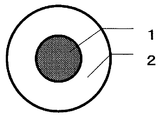
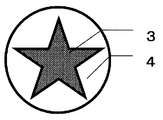
ここで言う芯鞘の芯成分は真円に加え、星形、三葉などの多葉断面、不定形などが製造可能である。ここで言う芯鞘複合繊維とは、図1〜3に示すように、異なる2種類以上のポリマーが繊維軸に対して垂直の断面において、芯成分を鞘成分が被覆するように構成されている繊維を意味し、樹状ポリエステルがブレンドされたポリマーブレンドはこの芯成分あるいは鞘成分を構成ことができる。また、更なる特性の向上のために芯成分と鞘成分を多層としたり、芯成分または/あるいは鞘成分が2種類以上のポリマーにより構成(例えば、ポリマーアロイ)することも好適である。芯鞘複合繊維の製造方法としては、公知の方法を用いることができ、例えば、インサート型やパイプ型などの複合口金を用いて、芯成分と鞘成分を複合流とし、細孔から吐出することで作製させる。この時、芯成分を難溶出成分で構成し、かつあらかじめ異形断面とし、複合繊維として紡糸し、巻き取り後に易溶出成分を溶出することにより、例えば星形(図2)あるいは三葉などといった多葉断面(図3)などの異形断面繊維が得られる。ここで言う異形断面とは、異形度が1.3以上のいわゆる真円でない断面形状のことを言う。 In addition to the perfect circle, the core component of the core-sheath mentioned here can be produced in a multi-leaf cross section such as a star shape or a trilobal shape, an indefinite shape, or the like. As shown in FIGS. 1 to 3, the core-sheath composite fiber referred to here is configured such that two or more different types of polymers cover the core component with the sheath component in a cross section perpendicular to the fiber axis. The term “fiber” refers to a polymer blend in which a dendritic polyester is blended, and can constitute the core component or the sheath component. In order to further improve the characteristics, it is also preferable that the core component and the sheath component are multilayered, or that the core component and / or the sheath component is composed of two or more kinds of polymers (for example, polymer alloy). As a manufacturing method of the core-sheath composite fiber, a known method can be used. For example, using a composite die such as an insert type or a pipe type, the core component and the sheath component are made into a composite flow and discharged from the pores. To make. At this time, the core component is composed of a difficult-to-elute component, has a pre-shaped cross section in advance, is spun as a composite fiber, and elutes the easily-eluting component after winding, for example, a star shape (FIG. 2) or a trilobal A modified cross-section fiber such as a leaf cross-section (FIG. 3) is obtained. The irregular cross section referred to here means a cross-sectional shape that is not a so-called perfect circle having an irregularity of 1.3 or more.
また、サイドバイサイドとは、横断面方向で見て、2種類以上のポリマーが張り合わされた形態をとり構成されているものであり、このサイドバイサイド複合繊維の製造方法としては、公知の方法を用いることができる。例えば、少なくとも吐出直後にポリマーが接触するように口金面の垂直方向に対して傾斜を付けた計量孔を2個以上有した細孔により、組み合わせるポリマーをそれぞれ計量し、吐出直前に細孔内でポリマー同士が合流し、張り合わされることにより作製される。また、別々の吐出孔を設けて、吐出直後で合流し、張り合わせる方法も採用することができる。このサイドバイサイドにいては、2種類以上のポリマーが多層に張り合わされていても良いし、3種類以上のポリマーを張り合わせることにより、3種類以上の特性を付与することも好適である。 Further, the side-by-side is configured to take a form in which two or more kinds of polymers are bonded to each other when viewed in the cross-sectional direction, and a known method can be used as a method for producing this side-by-side composite fiber. it can. For example, each of the polymers to be combined is weighed with pores having two or more metering holes that are inclined with respect to the vertical direction of the base surface so that the polymer contacts at least immediately after ejection, The polymer is made by joining and pasting. Further, it is possible to employ a method in which separate discharge holes are provided and merged and bonded immediately after discharge. In this side-by-side, two or more types of polymers may be laminated in multiple layers, and it is also preferable to impart three or more types of properties by bonding three or more types of polymers.
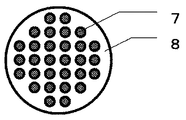
海島型複合繊維とは、図4に示すように異なる2種類以上のポリマーが繊維方向に対し垂直な断面に海島構造を形成しており、ここでいう海島構造とは、島成分が海成分により複数に区別されている状態あるいは構造を形成しているもののことを言い、その区別された状態または島成分の断面形状に制約はなく、易溶出成分を溶出することにより、いわゆる極細繊維だけでなく、分割繊維等も得ることができる。 As shown in FIG. 4, the sea-island type composite fiber has two or more different polymers forming a sea-island structure in a cross section perpendicular to the fiber direction. It refers to what forms a state or structure that is differentiated into multiple parts, and there is no restriction on the cross-sectional shape of the differentiated state or island component, and not only so-called ultrafine fibers by eluting easily eluted components Moreover, a split fiber etc. can also be obtained.
本発明の樹状ポリエステルはブレンドされたポリマーブレンドはこの海成分であっても島成分であってもよいが、前述した樹状ポリエステルの末端構造制御の効果を有効にするのであれば、島成分(難溶出成分)に添加するのが好ましい。カルボン酸基はポリマー中に存在することにより、自己触媒反応によって加水分解を促進させることが知られているが、従来の樹状ポリエステルにおいては多くこのカルボン酸基を有することにより、加水分解、すなわち溶出を促進させてしまう効果があった。このため、例えば、難溶出成分として高融点ポリマーを使用した場合、樹状ポリエステルを添加して、紡糸温度を低下させ、分子量低下なく、難溶出成分および易溶出成分を吐出し、繊維化したとしても、易溶出成分を溶出する工程において、難溶出成分として用いた高融点ポリマーまで加水分解による溶解が進み、得られた極細繊維や異形断面糸の力学特性を損なうことになる。 In the dendritic polyester of the present invention, the blended polymer blend may be the sea component or the island component, but if the effect of controlling the terminal structure of the dendritic polyester described above is made effective, the island component It is preferable to add to (hardly eluting components). It is known that the presence of carboxylic acid groups in the polymer promotes hydrolysis by autocatalytic reaction. However, in many conventional dendritic polyesters, hydrolysis is caused by having many carboxylic acid groups. There was an effect of promoting elution. For this reason, for example, when a high melting point polymer is used as a difficult-to-elute component, the dendritic polyester is added, the spinning temperature is lowered, and the hardly-eluting component and the easily-eluting component are discharged and fiberized without lowering the molecular weight. However, in the process of eluting the easily eluted component, dissolution by hydrolysis proceeds to the high melting point polymer used as the hardly eluted component, and the mechanical properties of the obtained ultrafine fibers and irregular cross-section yarns are impaired.
このような海島複合繊維を製造する方法としては公知のパイプ型やインサート型の海島複合口金を用いる方法、異なる2種類のポリマーをあらかじめブレンドし、アロイポリマーとして単独口金から吐出する方法、あるいはこれらの組み合わせる方法がある。 As a method for producing such a sea-island composite fiber, a method using a known pipe-type or insert-type sea-island composite base, a method in which two different types of polymers are blended in advance, and an alloy polymer is discharged from a single base, or these There are ways to combine them.
本発明の複合繊維においては、高融点ポリマーの流動性を向上させ、紡糸温度を低く設定することができ、組み合わせたいずれのポリマーの熱分解を抑制することができることで、優れた力学的特性を有した複合繊維となる。また、紡糸性の観点からもポリマーの熱分解を抑制することはポリマー流動の安定性が増すため、好ましいのである。 In the conjugate fiber of the present invention, the flowability of the high melting point polymer can be improved, the spinning temperature can be set low, and the thermal decomposition of any of the combined polymers can be suppressed, resulting in excellent mechanical properties. The resulting composite fiber. Also, from the viewpoint of spinnability, it is preferable to suppress thermal decomposition of the polymer because the stability of the polymer flow is increased.
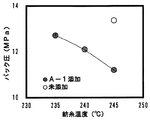
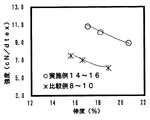
本発明の複合繊維は、紡糸温度を低下させることができるため、複合化のため組み合わせるポリマーをいずれも熱分解を抑制させることができ、得られる複合繊維は力学特性が大きく向上する。これは同融点であっても高分子量ポリマーを利用することにより、通常の紡糸温度よりも高く設定せざる得ない場合にも有効に作用し、例えば、実施例13と比較例7の比較からもその効果は明らかである。また、このように未延伸糸において力学特性が優れる複合繊維は図7に示すように同伸度当たりの強度が大きく向上するように優れた延伸糸となる。 Since the conjugate fiber of the present invention can lower the spinning temperature, any polymer combined for conjugation can suppress thermal decomposition, and the resulting conjugate fiber is greatly improved in mechanical properties. Even when the melting point is the same, by using a high molecular weight polymer, it works effectively even when it has to be set higher than the normal spinning temperature. For example, from the comparison between Example 13 and Comparative Example 7, The effect is obvious. Further, the composite fiber having excellent mechanical properties in the undrawn yarn as described above becomes an excellent drawn yarn so that the strength per degree of elongation is greatly improved as shown in FIG.
更に、融点が大幅に異なるポリマー同士の組み合わせにも非常に有効であることは言うまでもなく、例えば、本発明の効果が顕著化する例としては、下記するようなポリマーの組み合わせが考えられる。 Furthermore, it goes without saying that the present invention is also very effective for the combination of polymers having significantly different melting points. For example, the following combinations of polymers are conceivable as examples in which the effects of the present invention become remarkable.
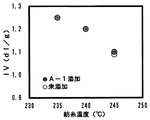
例えば、ポリ乳酸(PLA)が一部を構成する複合繊維としては、最近ではバイオ原料による合成が可能となったポリトリメチレンテレフタレート(3GT)との芯鞘構造とすることによりバイオ原料比率を向上させた繊維が着目されている。しかしながら、3GTの融点が230℃であるため、紡糸温度は3GTに合わせておのずと245℃以上に設定する必要があり、250℃が好適に用いられている。この250℃という紡糸温度は、PLAの融点が160℃であるのに対して、90℃も高く、結果的にPLAの熱分解を著しく進行させてしまうこととなる。一方、紡糸温度をできるだけ低温化しようと、紡糸温度を245℃に設定しても、紡糸は可能であるが、3GTにとっては安定紡糸限界の温度であるために、吐出が不安定になり、例えば、比較例1に示すように結果的に低い力学特性となってしまう。一方、本発明の複合繊維に関しては実施例3に示したように紡糸温度を安定紡糸限界温度かさらに10℃低下させても問題のない紡糸性が確保されるため、優れた力学特性となる。また、PLAが熱分解することにより、生産に関しては、PLAの熱分解に伴う着色や糸切れが多発するという問題、また、このように採取したPLA/3GT芯鞘複合繊維の力学特性は当然期待される値に対して低下したものとなってしまう。 For example, as a composite fiber of which polylactic acid (PLA) is a part, the bio-raw material ratio is improved by adopting a core-sheath structure with polytrimethylene terephthalate (3GT), which has recently become possible to synthesize with bio-raw materials. Attention has been focused on the fibers that have been allowed to come. However, since the melting point of 3GT is 230 ° C., the spinning temperature must be set to 245 ° C. or higher according to 3GT, and 250 ° C. is preferably used. The spinning temperature of 250 ° C. is as high as 90 ° C., whereas the melting point of PLA is 160 ° C., and as a result, the thermal decomposition of PLA significantly proceeds. On the other hand, in order to make the spinning temperature as low as possible, spinning is possible even if the spinning temperature is set to 245 ° C., but for 3GT, since it is the stable spinning limit temperature, the discharge becomes unstable. As a result, as shown in Comparative Example 1, the resulting mechanical properties are low. On the other hand, the conjugate fiber of the present invention has excellent mechanical properties because, as shown in Example 3, the spinning performance without problems is ensured even when the spinning temperature is lowered to the stable spinning limit temperature or further 10 ° C. In addition, as a result of the thermal decomposition of PLA, the problem of frequent coloration and yarn breakage associated with the thermal decomposition of PLA, and the mechanical properties of the PLA / 3GT core-sheath composite fiber collected in this way are naturally expected. Will be reduced with respect to the value to be processed.
また、PLAはアルカリ水溶液に易溶出性であるため、海島複合繊維における海成分として利用する場合があり、前記したいわゆる海島複合口金やポリマーアロイ技術を活用して、3GT/PLA海島複合繊維とする場合がある。この3GT/PLA海島複合繊維は海成分であるPLAを除去することにより、3GTの特性であるソフト性や染色性を生かした極細繊維を得ることができ、衣料用だけでなく、産業用途においても利用価値が高い。しかしながら、この海島複合繊維を得る際にも、前記した芯鞘複合繊維の場合と同様に紡糸温度は245℃以上にする必要があり、PLAの熱分解が著しく進行することとなる。繊維表層に存在するPLAの熱分解が進行すると、紡糸時の糸切れが多発することに加え、熱分解したPLAが紡糸機のガイドやローラとの擦過により削れ、紡糸装置を汚すこととなり、装置の清掃周期を早めるほかこの付着した汚れによって紡糸性の低下などの問題を起こす。また、このような結果、得られる3GT/PLA海島複合繊維の力学特性は低いものとなり、後加工性等が大きく低下したものとなることは言うまでもない。 In addition, PLA is easily dissolved in an alkaline aqueous solution, so it may be used as a sea component in a sea-island composite fiber. By using the so-called sea-island composite base or polymer alloy technology, a 3GT / PLA sea-island composite fiber is obtained. There is a case. This 3GT / PLA sea-island composite fiber removes PLA, which is a sea component, to obtain ultra-fine fibers that take advantage of the softness and dyeability that are the characteristics of 3GT. High utility value. However, when obtaining this sea-island composite fiber, it is necessary to set the spinning temperature to 245 ° C. or higher as in the case of the core-sheath composite fiber described above, and the thermal decomposition of PLA remarkably proceeds. As the thermal decomposition of PLA on the fiber surface progresses, yarn breakage occurs frequently during spinning, and the thermally decomposed PLA is scraped by rubbing with the guides and rollers of the spinning machine to contaminate the spinning device. In addition to speeding up the cleaning cycle, the adhered dirt causes problems such as a decrease in spinnability. Further, as a result, it goes without saying that the resulting 3GT / PLA sea-island composite fiber has low mechanical properties and greatly deteriorates post-processability and the like.
一方、本発明の複合繊維においては、この組み合わせで言うと高融点である3GTに請求項1記載の樹状ポリエステルを添加することにより、3GTの流動性を向上させる効果から参考例7からわかるように紡糸温度を10℃低下させることができるため、これを複合繊維とした場合も同様に紡糸温度が低下でき、PLAの熱分解が大きく抑制されたものあとなる。このため、糸切れやPLAの削れなどの問題が大きく抑制され、生産性の向上および繊維の品位を高めるのに大きく貢献できるものとなることに加え、実施例3と比較例1との比較からわかるように優れた力学特性を有した複合繊維となる。
On the other hand, in the composite fiber of the present invention, it can be seen from Reference Example 7 from the effect of improving the fluidity of 3GT by adding the dendritic polyester of
また、収縮特性の異なるポリマーを組み合わせることにより、独特の風合いを有した複合繊維とする場合がある。例えば、3GTとポリエチレンテレフタレート(PET)をサイドバイサイドとして、これを熱処理等することにより収縮特性を発現させる技術がある。この場合、3GTの融点が230℃であるのに対して、紡糸温度はPETに合わせることになるため、275℃以上に設定する必要があり、3GTの融点との温度差は45℃と3GTにとっては非常に過酷な温度雰囲気にさらされることとなる。ここで問題となるのは、3GTの熱分解に起因した口金汚れである。口金汚れとは、溶融ポリマーを吐出した際に分解物が吐出孔周りに付着し、これとポリマー流が接触することで糸切れの要因となる。前記したように3GT/PETのサイドバイサイド複合繊維の場合には3GTの融点と比較して、高い紡糸温度に設定する必要があり、この口金汚れのため、生産性の悪化や繊維の品位を落とすという問題があったが、本発明の複合繊維においては,PETに請求項1に記載の樹状ポリエステルを添加することにより、PETの流動性を向上させ、参考例11に示したように紡糸温度を5℃以上低下することが可能なのである。この効果により3GTの熱分解を抑制し、口金汚れを低減することが可能になることに加え、3GTの分子量が高くなることによってより優れた収縮特性を発現させることが可能となる。また、サイドバイサイドの場合は、ポリマーの吐出時の流速(吐出線速度)が異なると、ポリマーが吐出面側に屈曲してしまう糸曲がりの原因となり、紡糸性が大幅に低下することがある。紡糸温度が高いと経時的にポリマーの粘度が変化するため、この吐出線速度を合わせることが非常に困難となり、これも紡糸性や繊維の品位を落とす要因となるが、本発明の複合繊維においては、これの抑制にも大きく貢献することができる。従来方法で行った比較例11では長時間紡糸した際にこの糸曲がりが確認されたが紡糸温度を低温化した実施例18においては糸曲がりが確認されず、長時間紡糸を行った際でも良好な紡糸性が維持されていた。
Further, a composite fiber having a unique texture may be obtained by combining polymers having different shrinkage characteristics. For example, there is a technique in which 3GT and polyethylene terephthalate (PET) are used as side-by-side and heat treatment is performed to develop shrinkage characteristics. In this case, since the melting point of 3GT is 230 ° C., the spinning temperature will be adjusted to that of PET, so it is necessary to set it to 275 ° C. or more, and the temperature difference from the melting point of 3GT is 45 ° C. for 3GT. Will be exposed to very harsh temperature atmosphere. The problem here is the dirt on the base caused by the thermal decomposition of 3GT. When the molten polymer is discharged, the decomposed material adheres to the periphery of the discharge hole, and the polymer stream comes into contact with the base, which causes thread breakage. As described above, in the case of the 3GT / PET side-by-side composite fiber, it is necessary to set the spinning temperature higher than the melting point of 3GT, and due to the contamination of the die, the productivity is deteriorated and the quality of the fiber is lowered. Although there was a problem, in the conjugate fiber of the present invention, the flowability of PET was improved by adding the dendritic polyester according to
前記したようにポリフェニレンサルファイド(PPS)は耐熱性や耐薬品性に優れるため、産業用途において利用価値が高い。一方、PETは熱可塑性ポリマーの中では耐酸性は比較的高い部類に入るが、耐アルカリ性は低く、この特性を補うには、PET/PPS芯鞘複合繊維とすることが考えられる。しかしながら、PPSは高融点ポリマーであるため、紡糸温度は310℃以上と非常に高く設定する必要があり、PPSを起因としたガスが発生するために口金汚れが問題となることに加え、熱媒を変更する必要があることから紡糸機を専用化しなくてはいけない場合がある。また、このPET/PPS芯鞘複合繊維を考えた場合には、この高い紡糸温度のため、PETが熱分解してしまい、繊維の力学特性を低下させる結果となる。本発明の複合繊維においては、PPSまたは/あるいはPETに請求項1記載の樹状ポリエステルを添加することにより、PPSまたは/あるいはPETの流動性を向上させることができ、参考例12に示したように紡糸温度を10℃低下させることが可能となる。この結果、PPSに起因したガス発生を抑制するとともに、紡糸温度が300℃と一般の溶融紡糸装置においても熱媒を変更することなく紡糸が可能である温度であり、産業用途における使用にも耐えうる優れた力学特性を有したPET/PPS芯鞘複合繊維を生産性良く採取することができる。
As described above, polyphenylene sulfide (PPS) is excellent in heat resistance and chemical resistance, and thus has high utility value in industrial applications. On the other hand, PET is in the category of relatively high acid resistance among thermoplastic polymers, but has low alkali resistance. To supplement this property, it is conceivable to use a PET / PPS core-sheath composite fiber. However, since PPS is a high melting point polymer, it is necessary to set the spinning temperature as extremely high as 310 ° C. or more, and gas generated due to PPS is generated, so that the contamination of the base becomes a problem, and the heat medium Since there is a need to change the spinning machine, it may be necessary to specialize the spinning machine. When this PET / PPS core-sheath composite fiber is considered, because of this high spinning temperature, PET is thermally decomposed, resulting in a decrease in the mechanical properties of the fiber. In the conjugate fiber of the present invention, the fluidity of PPS or / or PET can be improved by adding the dendritic polyester according to
本発明の複合繊維は、優れた特性を有するため、衣料用途に用いた場合には品位に優れたものとなることが言うまでもなく、図9に示したように同伸度当たりの強度が向上するというような力学的特性が向上するために、特に産業資材用途でその特性を有効に活用することができる。 Since the conjugate fiber of the present invention has excellent characteristics, it is needless to say that when used for apparel, it has excellent quality, and the strength per elongation is improved as shown in FIG. Therefore, the characteristics can be effectively utilized particularly for industrial materials.
例えば、芯鞘複合繊維においては、屈曲疲労や摩耗特性も従来品よりも向上し、タイヤコードやタイヤのキャップレイヤー材などのゴム補強用途のみならず漁網や農業資材の他、スクリーン紗などにも好適に用いることができる。 For example, in core-sheath composite fibers, bending fatigue and wear characteristics are also improved compared to conventional products, not only for rubber reinforcement applications such as tire cords and tire cap layer materials, but also for fishing nets and agricultural materials, as well as for screen rods, etc. It can be used suitably.
本発明の複合繊維では、強度は2cN/dtex以上が好ましく、産業資材用途で必要とされる力学的特性を考えれば、5cN/dtex以上であることが好ましい。現実的な上限としては20cN/dtexである。また、伸度は延伸糸で2〜60%、特に高強度が必要とされる産業資材分野では2〜25%、衣料用では25〜60%とすることが好ましい。前記した複合繊維は、繊維巻き取りパッケージやトウ、カットファイバー、わた、ファイバーボール、コード、パイル、織編、不織布、紙、液体分散体など多用な繊維製品とすることができる。 In the conjugate fiber of the present invention, the strength is preferably 2 cN / dtex or more, and is preferably 5 cN / dtex or more in consideration of the mechanical properties required for industrial materials. A practical upper limit is 20 cN / dtex. The elongation is preferably 2 to 60% for drawn yarn, particularly 2 to 25% in the industrial material field where high strength is required, and 25 to 60% for clothing. The above-described composite fibers can be used in various fiber products such as fiber winding packages, tows, cut fibers, cotton, fiber balls, cords, piles, knitted fabrics, nonwoven fabrics, paper, and liquid dispersions.
本発明の複合繊維を得る方法、すなわち、樹状ポリエステルのマトリクスポリマーへのブレンド方法および繊維化については、公知の混練方法や複合紡糸方法を採用することで作製できる。 The method for obtaining the composite fiber of the present invention, that is, the method for blending the dendritic polyester into the matrix polymer and the fiber formation can be produced by employing a known kneading method or composite spinning method.
まず、樹状ポリエステルのブレンドについては例えば以下のような方法を用いることができる。すなわち、請求項1に記載した樹状ポリエステルとマトリックスポリマーを必要に応じ乾燥し、二軸押し出し混練機に導入する。この時、ブレンド装置としてはブレンド斑を低減するために二軸押し出し混練機とすることが好ましい。ここで、作製したポリマーブレンドをそのまま複合紡糸機に導いても、マスターペレットとして一旦ペレット化しても良い。省力化のためには混練直結紡糸が好ましく、樹状ポリエステルのブレンド率やポリエステル分子量が異なる品種をいくつかつくるなど汎用性を持たせるため場合にはマスターペレット化しておくことが好ましい。また、混練直結紡糸の場合には、二軸押し出し混練機では一軸押し出し混練機の場合とは異なり、混練機中で誘起された発泡が仕込み側に抜け難いため、発泡が繊維にまで混入し糸切れが頻発する場合がある。このため、特に高分子量ポリエステルなど高粘度ポリマーをマトリックスポリマーとする場合には、二軸押し出し混練機の吐出側でベントを行い、泡を抜く操作を行うことが好ましい。なお、マスターペレット化場合にもガット切れが頻発する時はベントを行うことが好ましい。また、本発明においては樹状ポリエステル添加による良流動化効果により、未添加の場合に比べ同一温度であればスクリュートルクが小さくなるため、混練温度の低温化が可能である。これにより、ポリマーの熱分解や熱変性、また加水分解などを抑制することができ、バージンポリマーが本来持っていた高分子量や易加工性などを利用し易くできるのである。先の樹状ポリエステルブレンドでマスターペレット化した場合には、紡糸過程でバージンポリマーにより希釈されるわけであるが、この時も二軸押し出し混練機を用いる方がブンレンドの均一性の観点から好ましい。というのは、本発明では樹状ポリエステルブレンド率で良流動化効果の程度が異なるため、ポリマーブレンド中でブレンドが不均一であるとスクリュートルクや先端圧、濾圧、口金背面圧、ひいては紡糸応力などの斑が発生し、安定した紡糸が不能となる場合があるからである。
First, for the blend of dendritic polyester, for example, the following method can be used. That is, the dendritic polyester and the matrix polymer described in
本発明の樹状ポリエステルブレンドによる良流動化効果のため、未添加の場合に比べ混練機温度を低温化できることも有用であるが、本発明においては紡糸機、特に紡糸ヘッドの設定温度を低下させることが可能であることがその効果の特徴として挙げられる。すなわち、2つ以上の溶融押出機を具備した複合紡糸機では溶融温度についてはおのおのポリマーで独立して設定できるものの、紡糸ヘッドでポリマーらは同パック内に導かれるため、同じ温度履歴を受けることとなる。この温度を決定するのは前述したように主に高融点や高粘度ポリマーが流動性を示す温度であり、耐熱性が低いポリマーがある場合には紡糸ヘッド内で大きく熱分解を起こすこととなる。これが複合繊維の物性だけでなく、紡糸性にも悪影響を与え、紡糸自体が困難となる場合が多い。このため、組み合わせるポリマーにはおのずと制限ができてしまうのである。一方、本発明の複合繊維の場合には、樹状ポリエステル添加による流動性の向上を利用することにより、例えば、高融点や高粘度ポリマーのため通常では紡糸温度を高温化せざるを得ない場合であっても、樹状ポリエステル添加により10℃以上の低温化も可能であり、この効果は、高粘度ポリマーほど大きく発現する。このため、紡糸温度を低く設定することができ、低粘度あるいは耐熱性の低いポリマーの熱分解というような従来の問題を解消することが可能である。しかも、本発明者らは樹状ポリエステル添加による流動性向上する技術を利用した紡糸技術について鋭意検討した結果、前述したR2構造の構成単位に芳香族が含まれていることによって、紡糸といったような非常に大きい伸長変形の際にも、マトリクスポリマーへの分子鎖の絡み合いが抑制させることにより、紡糸性良く複合繊維を得ることができることを見出した。 Because of the good fluidization effect of the dendritic polyester blend of the present invention, it is also useful to be able to lower the kneader temperature compared to when it is not added, but in the present invention, the set temperature of the spinning machine, particularly the spinning head is lowered. It is possible to mention that the effect is possible. That is, in a compound spinning machine equipped with two or more melt extruders, although the melting temperature can be set independently for each polymer, the polymer is guided into the same pack by the spinning head, and therefore receives the same temperature history. It becomes. As described above, this temperature is mainly determined by the temperature at which a high melting point or high viscosity polymer exhibits fluidity, and if there is a polymer with low heat resistance, it will cause significant thermal decomposition in the spinning head. . This adversely affects not only the physical properties of the composite fiber but also the spinnability, and spinning itself is often difficult. For this reason, the polymer to be combined is naturally limited. On the other hand, in the case of the composite fiber of the present invention, by utilizing the improvement in fluidity due to the addition of the dendritic polyester, for example, the spinning temperature usually has to be increased due to the high melting point or high viscosity polymer. Even so, it is possible to lower the temperature by 10 ° C. or more by adding the dendritic polyester, and this effect is more pronounced as the high viscosity polymer. For this reason, the spinning temperature can be set low, and it is possible to solve the conventional problems such as thermal decomposition of a polymer having low viscosity or low heat resistance. Moreover, as a result of intensive studies on the spinning technique using the technique for improving the fluidity by adding the dendritic polyester, the present inventors have found that the aromatic unit is contained in the structural unit of the R2 structure described above, so that spinning is performed. It has been found that composite fibers can be obtained with good spinnability by suppressing the entanglement of molecular chains with the matrix polymer even in the case of very large deformation.
さらに、従来の樹状ポリエステルでは、末端構造がカルボン酸基であるため、添加することで加水分解速度が高まることにより、溶融時ならびに海島複合繊維などにおいては海成分除去時に樹状ポリエステルが添加された高融点ポリマーまで加水分解が進み、分子量を大きく低下させてしまう問題があった。本発明者らは、樹状ポリエステルを活用した複合繊維において、かかる問題について鋭意検討した結果、参考例7に例示されるように樹状ポリエステルの末端基のカルボン酸基量を1×10⁻⁴当量/g以下とすることにより、前記した加水分解が大きく抑制され、分子量が維持させた様々な複合繊維を得ることが可能となった。 Furthermore, in the conventional dendritic polyester, since the terminal structure is a carboxylic acid group, the hydrolysis rate is increased by the addition, so that the dendritic polyester is added at the time of melting and when removing sea components in sea-island composite fibers. However, there was a problem that the hydrolysis proceeded to a high melting point polymer and the molecular weight was greatly reduced. As a result of intensive studies on such problems in the composite fiber using the dendritic polyester, the present inventors have determined that the amount of carboxylic acid group of the end group of the dendritic polyester is 1 × 10 −4 as exemplified in Reference Example 7. By setting the equivalent weight / g or less, it was possible to obtain various composite fibers in which the hydrolysis described above was greatly suppressed and the molecular weight was maintained.
本発明において、紡糸温度は、可能な限り樹状ポリエステル未添加のマトリクスポリマーを単独で紡糸する場合に比較して5〜20℃低下させることが好ましい。より好ましくは、7〜15℃低下である。また、紡糸速度はマトリックスポリマーと組み合わせるポリマーの物性や複合繊維の目的によって異なるが、500〜6000m/分程度とすることができる。特に、産業資材用途で高い力学的特性が必要な場合には、高分子量ポリマーを用い、500〜2000m/分とし、その後高倍率延伸することが好ましい。 In the present invention, the spinning temperature is preferably lowered by 5 to 20 ° C. as much as possible as compared with the case where the matrix polymer not added with the dendritic polyester is spun alone. More preferably, it is a 7-15 degreeC fall. The spinning speed varies depending on the physical properties of the polymer combined with the matrix polymer and the purpose of the composite fiber, but can be about 500 to 6000 m / min. In particular, when high mechanical properties are required for industrial material applications, it is preferable to use a high molecular weight polymer, set to 500 to 2000 m / min, and then stretch at a high magnification.
延伸に際しては、特に予熱温度を適切に設定することが好ましい。というのは本発明で用いる樹状ポリエステルはガラス転移温度などの軟化温度が70℃より高い場合があり、例えばPETの通常の予熱温度である85〜95℃程度では、樹状ポリエステルが延伸過程で異物として振る舞い結果として延伸糸のタフネスの低下を招く場合がある。この影響は、特に高倍率延伸時ほど顕著に現れる。このため、樹状ポリエステルの添加量が微量であっても予熱温度は樹状ポリエステルのガラス転移温度や軟化温度以上に設定することが好ましい。予熱温度の上限としては、予熱過程で繊維の自発伸長により糸道乱れが発生しない温度とすることが好ましい。この延伸時の予熱温度設定も糸斑低減に寄与することができる。 In stretching, it is particularly preferable to set the preheating temperature appropriately. This is because the dendritic polyester used in the present invention may have a softening temperature such as a glass transition temperature higher than 70 ° C. For example, at about 85 to 95 ° C, which is a normal preheating temperature of PET, the dendritic polyester is in the process of stretching. As a result of acting as a foreign object, the toughness of the drawn yarn may be reduced. This effect is particularly prominent as the film is stretched at a high magnification. For this reason, even if the addition amount of dendritic polyester is trace amount, it is preferable to set preheating temperature more than the glass transition temperature and softening temperature of dendritic polyester. The upper limit of the preheating temperature is preferably a temperature at which yarn path disturbance does not occur due to spontaneous elongation of the fiber during the preheating process. This preheating temperature setting at the time of drawing can also contribute to the reduction of yarn unevenness.
本発明の複合繊維から異形断面繊維を得る場合には、水酸化ナトリウム水溶液などのアルカリ水溶液にて易溶出成分を除去することにより難溶出成分からなる異形断面繊維を得ることができる。本発明の複合繊維をアルカリ水溶液にて処理する方法としては、例えば、複合繊維あるいはそれからなる繊維構造体としたあと、アルカリ水溶液に浸漬させればよい。この時、アルカリ水溶液は50℃以上に加熱すると、加水分解の進行を早めるため、好ましい。また、流体染色機などを利用し、処理すれば、一度に大量に処理をおこなうことができるため、生産性もよく、工業的な観点から好ましいことである。 When obtaining a modified cross-section fiber from the conjugate fiber of the present invention, a modified cross-section fiber composed of a hardly eluted component can be obtained by removing the easily eluted component with an aqueous alkali solution such as an aqueous sodium hydroxide solution. As a method for treating the conjugate fiber of the present invention with an alkaline aqueous solution, for example, the conjugate fiber or a fiber structure made of the conjugate fiber may be used, and then immersed in the alkaline aqueous solution. At this time, it is preferable to heat the alkaline aqueous solution to 50 ° C. or more because the hydrolysis progresses faster. In addition, if processing is performed using a fluid dyeing machine or the like, a large amount of processing can be performed at a time, so that productivity is good and it is preferable from an industrial viewpoint.
以下、本発明を実施例を用いて詳細に説明する。なお、実施例中の測定方法は以下の方法を用いた。 Hereinafter, the present invention will be described in detail with reference to examples. In addition, the measuring method in an Example used the following method.
A.樹状ポリエステルの絶対分子量
樹状ポリエステルの絶対分子量は樹状ポリエステルが可溶な溶媒であるペンタフルオロフェノールを使用して、GPC−MALLS(ゲル浸透クロマトグラフ(ShodexGPC−101)−光散乱検出器(Wyatt製DAWN HELEOS))により、試料濃度0.04%、測定温度23℃で測定した。
A. Absolute molecular weight of dendritic polyester The absolute molecular weight of dendritic polyester is GPC-MALLS (gel permeation chromatograph (Shodex GPC-101) -light scattering detector) using pentafluorophenol which is a solvent in which dendritic polyester is soluble. The sample concentration was 0.04% and the measurement temperature was 23 ° C. by Wyatt DAWN HELEOS)).
B.樹状ポリエステルの化学組成比
樹状ポリエステルの化学組成比は核磁気共鳴装置(日本電子製JNM−AL400)を用いて、ペンタフルオロフェノール/重水素化クロロホルム(50/50)混合溶媒に溶解して、40℃で1H−NMR測定を行い、ピーク強度比から各成分の化学組成比を算出した。
B. Chemical composition ratio of dendritic polyester The chemical composition ratio of dendritic polyester is dissolved in a mixed solvent of pentafluorophenol / deuterated chloroform (50/50) using a nuclear magnetic resonance apparatus (JNM-AL400 manufactured by JEOL). 1H-NMR measurement was performed at 40 ° C., and the chemical composition ratio of each component was calculated from the peak intensity ratio.
C.樹状ポリエステルの融点
樹状ポリエステルの融点(Tm)は、樹状ポリエステルを、示差熱量測定において、室温から20℃/分の昇温条件で測定した際に観測される吸熱ピーク温度(Tm1)の観測後、Tm1+20℃の温度で5分間保持し、20℃/分の降温条件で室温まで一旦冷却し、再度20℃/分の昇温条件で測定した際に観測される吸熱ピーク温度(Tm)とした。
C. The melting point of the dendritic polyester The melting point (Tm) of the dendritic polyester is the endothermic peak temperature (Tm1) observed when the dendritic polyester is measured under the temperature rising condition from room temperature to 20 ° C./min in differential calorimetry. After observation, endothermic peak temperature (Tm) observed when the temperature is kept at Tm1 + 20 ° C for 5 minutes, cooled to room temperature under a temperature drop condition of 20 ° C / min, and measured again under a temperature rise condition of 20 ° C / min. It was.
D.樹状ポリエステルの液晶開始温度
液晶開始温度は、剪断応力加熱装置(CSS−450)により、剪断速度1.0(1/秒)、昇温速度5.0℃/分、対物レンズ60倍において測定し、視野全体が流動開始する温度とした。
D. Liquid crystal starting temperature of dendritic polyester The liquid crystal starting temperature was measured with a shear stress heating device (CSS-450) at a shear rate of 1.0 (1 / second), a heating rate of 5.0 ° C./min, and an objective lens of 60 times. And the temperature at which the entire field of view starts to flow.
E.樹状ポリエステルの分子末端カルボン酸基量測定
分子末端カルボン酸基量測定は、中和滴定法によって行った。樹状ポリエステル0.5gをo−クロロフェノール10mLに90℃で加熱しながら溶解させ、冷却した後、クロロホルム4mLを加えた。ブロモフェノールブルー−エタノール溶液(0.2重量%)を数滴加えた後、滴定試薬(0.04M水酸化カリウム−メタノール溶液)をビュレットを用いて滴下し、中和点に達するまでに滴下した滴定試薬量から樹状ポリエステルの末端カルボン酸量を計算した。
E. Measurement of the molecular terminal carboxylic acid group amount of the dendritic polyester The molecular terminal carboxylic acid group amount was measured by a neutralization titration method. Dendritic polyester (0.5 g) was dissolved in 10-mL o-chlorophenol while heating at 90 ° C., cooled, and then 4 mL chloroform was added. After adding a few drops of bromophenol blue-ethanol solution (0.2 wt%), a titration reagent (0.04M potassium hydroxide-methanol solution) was added dropwise using a burette and added until the neutralization point was reached. The terminal carboxylic acid amount of the dendritic polyester was calculated from the titration reagent amount.
F.ポリエステルの極限粘度(IV)(マトリクスポリマーおよび吐出ポリマー)
ポリエステルの極限粘度はo−クロロフェノールに溶解してオストワルド式粘度計を用いて25℃で測定した。
F. Intrinsic viscosity (IV) of polyester (matrix polymer and discharge polymer)
The intrinsic viscosity of the polyester was dissolved in o-chlorophenol and measured at 25 ° C. using an Ostwald viscometer.
G.ナイロンの相対粘度(ηr)(マトリクスポリマーおよび吐出ポリマー)
98%硫酸水溶液にナイロンを溶解し0.01g/mLの濃度に調整した後、オストワルド式粘度計を用いて25℃で測定した。
G. Relative viscosity (ηr) of nylon (matrix polymer and discharge polymer)
Nylon was dissolved in a 98% sulfuric acid aqueous solution and adjusted to a concentration of 0.01 g / mL, and then measured at 25 ° C. using an Ostwald viscometer.
H.重量平均分子量
ポリ乳酸の重量平均分子量は以下のようにして求めた。試料のクロロホルム溶液にTHF(テトロヒドロフラン)を混合し測定溶液とした。これをWATERS社製GPC WATERS2690を用いて25℃で測定し、ポリスチレン換算で重量平均分子量を求めた。
H. Weight average molecular weight The weight average molecular weight of polylactic acid was calculated | required as follows. THF (tetrohydrofuran) was mixed with the sample chloroform solution to obtain a measurement solution. This was measured at 25 degreeC using GPC WATERS2690 by WATERS, and the weight average molecular weight was calculated | required in polystyrene conversion.
I.融点
TA Instruments社製DSC2920 Modulated DSCを用いて2nd runでポリマーの融解を示すピークトップ温度をポリマーの融点とした。この時の昇温速度は16℃/分、サンプル量は10mgとした。
I. Melting | fusing point The peak top temperature which shows melting | dissolving of a polymer by 2nd run was made into melting | fusing point of a polymer using DSC2920 Modulated DSC made from TA Instruments. The temperature rising rate at this time was 16 ° C./min, and the sample amount was 10 mg.
J.繊維の単糸繊度
繊維を検尺機によって100mの小綛とし、その重量を100倍することにより、総繊度とした。総繊度をフィラメント数で割ることで、単糸繊度を算出した。
J. et al. Single yarn fineness of the fiber The fiber was made into a 100 m small wrinkle with a measuring machine, and its weight was multiplied by 100 to obtain the total fineness. The single yarn fineness was calculated by dividing the total fineness by the number of filaments.
K.繊維の力学特性(強度、伸度、タフネス)
室温(25℃)で、初期試料長=200mm、引っ張り速度=200mm/分とし、JIS L1013に示される条件で荷重−伸長曲線を求めた。次に破断時の荷重値を初期の繊度で割り、それを強度とし、破断時の伸びを初期試料長で割り伸度として強伸度曲線を求めた。また、下記式に従い、強度および伸度からタフネスを算出した。弾性率は荷重−伸長曲線の初期立ち上がり部分を直線近似し、その傾きから求めた
(タフネス)=(強度)×√(伸度) (cN/dtex・%1/2)
L.複合繊維の断面形態観察
複合口金から吐出された複合ポリマー流を口金下で冷却固化後サンプリングし、得られたガット状サンプル1本を剃刀にて繊維軸に対して垂直方向に切断した。この切断面を400倍に設定した実体顕微鏡にて観察した。
K. Mechanical properties of fibers (strength, elongation, toughness)
At room temperature (25 ° C.), an initial sample length = 200 mm, a pulling speed = 200 mm / min, and a load-elongation curve was obtained under the conditions shown in JIS L1013. Next, the load value at break was divided by the initial fineness, which was used as the strength, and the elongation at break was divided by the initial sample length to obtain a strong elongation curve. Moreover, toughness was calculated from strength and elongation according to the following formula. The elastic modulus was obtained by linearly approximating the initial rising portion of the load-elongation curve and obtained from the slope (toughness) = (strength) × √ (elongation) (cN / dtex ·% 1/2 )
L. Observation of cross-sectional shape of composite fiber The composite polymer flow discharged from the composite base was sampled after cooling and solidification under the base, and one obtained gut sample was cut with a razor in a direction perpendicular to the fiber axis. This cut surface was observed with a stereomicroscope set to 400 times.
参考例1(樹状ポリエステルA−1の合成)
攪拌翼および留出管を備えた500mLの反応容器にp−ヒドロキシ安息香酸66.3g(0.48モル)、4,4’−ジヒドロキシビフェニル8.38g(0.045モル)、テレフタル酸7.48g(0.045モル)、固有粘度が約0.6dl/gのポリエチレンテレフタレ−ト14.41g(0.075モル)、トリメシン酸31.52g(0.15モル)を加えておよび無水酢酸62.48g(フェノール性水酸基合計の1.00当量)を仕込み、窒素ガス雰囲気下で攪拌しながら145℃で2時間反応させた。その後、280℃まで昇温し、3時間攪拌し、理論留出量の91%の酢酸が留出したところで加熱および攪拌を停止し、内容物を冷水中に吐出した。
Reference Example 1 (Synthesis of Dendritic Polyester A-1)
In a 500 mL reaction vessel equipped with a stirring blade and a distillation tube, 66.3 g (0.48 mol) of p-hydroxybenzoic acid, 8.38 g (0.045 mol) of 4,4′-dihydroxybiphenyl, and
得られた樹状ポリエステルを、乾燥機を用いて110℃で5時間乾燥した後、ブレンダーを用いて粉砕し、得られた樹状ポリエステル粉末を、真空加熱乾燥機を用いて100℃で12時間加熱真空乾燥した。 The obtained dendritic polyester was dried at 110 ° C. for 5 hours using a dryer and then pulverized using a blender, and the obtained dendritic polyester powder was used for 12 hours at 100 ° C. using a vacuum heat dryer. Heated to vacuum dry.
乾燥後の樹状ポリエステル粉末70gと、カルボン酸反応性単官能化合物としてオルト酢酸エチル31.4g(0.19モル)を、撹拌翼を備えた500mLの反応容器に仕込み、200℃に昇温した。200℃で20分撹拌した後、内容物を冷水中に吐出した。 70 g of dried dendritic polyester powder and 31.4 g (0.19 mol) of ethyl orthoacetate as a carboxylic acid-reactive monofunctional compound were charged into a 500 mL reaction vessel equipped with a stirring blade and heated to 200 ° C. . After stirring at 200 ° C. for 20 minutes, the contents were discharged into cold water.
得られた樹状ポリエステル(A−1)について、核磁気共鳴スペクトル分析を行った結果、トリメシン酸残基に対して、p−オキシベンゾエート単位の含有量pが2.66、4,4’−ジオキシビフェニル単位とエチレンオキシド単位の含有量qが0.66、テレフタレート単位の含有量rが0.66であり、p+q+r=4であった。 The obtained dendritic polyester (A-1) was subjected to nuclear magnetic resonance spectral analysis. As a result, the content p of the p-oxybenzoate unit was 2.66, 4,4′- with respect to the trimesic acid residue. The content q of dioxybiphenyl units and ethylene oxide units was 0.66, the content r of terephthalate units was 0.66, and p + q + r = 4.
得られた樹状ポリエステル(A−1)の融点Tmは172℃、液晶開始温度は131℃で、数平均分子量2100であった。 The obtained dendritic polyester (A-1) had a melting point Tm of 172 ° C., a liquid crystal starting temperature of 131 ° C., and a number average molecular weight of 2100.
また、得られた樹状ポリエステル(A−1)の分子末端カルボン酸基量は、0.23×10⁻⁶当量/gであった。 Moreover, the molecular terminal carboxylic acid group amount of the obtained dendritic polyester (A-1) was 0.23 × 10 −6 equivalent / g.
参考例2(樹状ポリエステルA−2の合成)
カルボン酸反応性単官能化合物をオルト酢酸エチル20.9g(0.13モル)である以外は参考例1と同様にして、樹状ポリエステル(A−2)を得た。得られた樹状ポリエステルの評価結果を表1に示す。
Reference Example 2 (Synthesis of dendritic polyester A-2)
A dendritic polyester (A-2) was obtained in the same manner as in Reference Example 1 except that the carboxylic acid-reactive monofunctional compound was 20.9 g (0.13 mol) of ethyl orthoacetate. The evaluation results of the obtained dendritic polyester are shown in Table 1.
参考例3(樹状ポリエステルA−3の合成)
カルボン酸反応性単官能化合物を2−フェニル−2−オキサゾリン28.5g(0.19モル)である以外は参考例1と同様にして、樹状ポリエステル(A−3)を得た。得られた樹状ポリエステルの評価結果を表1に示す。
Reference Example 3 (Synthesis of dendritic polyester A-3)
A dendritic polyester (A-3) was obtained in the same manner as in Reference Example 1 except that the carboxylic acid-reactive monofunctional compound was 28.5 g (0.19 mol) of 2-phenyl-2-oxazoline. The evaluation results of the obtained dendritic polyester are shown in Table 1.
参考例4(樹状ポリエステルA−4の合成)
カルボン酸反応性単官能化合物を安息香酸グリシジルエステル34.4g(0.19モル)である以外は参考例1と同様にして、樹状ポリエステル(A−4)を得た。得られた樹状ポリエステルの評価結果を表1に示す。
Reference Example 4 (Synthesis of dendritic polyester A-4)
A dendritic polyester (A-4) was obtained in the same manner as in Reference Example 1 except that the carboxylic acid-reactive monofunctional compound was 34.4 g (0.19 mol) of benzoic acid glycidyl ester. The evaluation results of the obtained dendritic polyester are shown in Table 1.
参考例5(樹状ポリエステルB−1の合成)
攪拌翼および留出管を備えた500mLの反応容器にp−ヒドロキシ安息香酸66.3g(0.48モル)、4,4’−ジヒドロキシビフェニル8.38g(0.045モル)、テレフタル酸7.48g(0.045モル)、固有粘度が約0.6dl/gのポリエチレンテレフタレ−ト14.41g(0.075モル)、トリメシン酸31.52g(0.15モル)を加えておよび無水酢酸62.48g(フェノール性水酸基合計の1.00当量)を仕込み、窒素ガス雰囲気下で攪拌しながら145℃で2時間反応させた。その後、280℃まで昇温し、3時間攪拌し、理論留出量の91%の酢酸が留出したところで加熱および攪拌を停止し、内容物を冷水中に吐出し、分子末端を封鎖していない樹状ポリエステル(B−1)を得た。樹状ポリエステルB−1の評価結果を表1に示す。
Reference Example 5 (Synthesis of dendritic polyester B-1)
In a 500 mL reaction vessel equipped with a stirring blade and a distillation tube, 66.3 g (0.48 mol) of p-hydroxybenzoic acid, 8.38 g (0.045 mol) of 4,4′-dihydroxybiphenyl, and
参考例6(樹状ポリエステルB−2の合成)
カルボン酸反応性単官能化合物をオルト酢酸エチル7.85g(0.05モル)である以外は参考例1と同様にして、分子末端の封鎖を不十分とした樹状ポリエステル(B−2)を得た。樹状ポリエステルB−2の評価結果を表1に示す。
Reference Example 6 (Synthesis of dendritic polyester B-2)
A dendritic polyester (B-2) with insufficient molecular terminal blocking was prepared in the same manner as in Reference Example 1 except that the carboxylic acid-reactive monofunctional compound was 7.85 g (0.05 mol) of ethyl orthoacetate. Obtained. The evaluation results of the dendritic polyester B-2 are shown in Table 1.
参考例7
参考例1で合成した樹状ポリエステルA−1と、マトリックスポリマーとしてIV1.51dL/gのポリトリメチレンテレフタレート(3GT 融点230℃)を乾燥した後、別々に計量し、独立に二軸混練機(15mmφ、L/D=15)に仕込んだ。この時、樹状ポリエステルの添加量は、1重量%とした。二軸押出混練機のスクリュー回転数は100rpmとし、二軸押出混練機の吐出側でベントを行い、泡を消した。吐出量は20g/分で絶対濾過径10μの金属不織布で濾過した後、丸孔24ホール(φ=0.3mm L/D=1.5)の口金から吐出した。紡糸温度(混練機および紡糸ヘッド)を250〜235℃まで段階的に変更し、そのパック圧と吐出ポリマーのIVについて調べた。また、この比較として、紡糸温度を245℃に固定し、樹状ポリエステルを未添加の場合、樹状ポリエステルを参考例5で合成した樹状ポリエステルB−1とした場合(末端封鎖なし)および参考例6で合成した樹状ポリエステルB−2とした場合(末端封鎖が不十分)を同様に紡糸した。
Reference Example 7
The dendritic polyester A-1 synthesized in Reference Example 1 and IV1.51 dL / g polytrimethylene terephthalate (
紡糸温度とパック圧の関係を図5にパック圧と吐出ポリマーIVの関係を図6に示す。 FIG. 5 shows the relationship between the spinning temperature and the pack pressure, and FIG. 6 shows the relationship between the pack pressure and the discharge polymer IV.
樹状ポリエステルA−1が添加された場合は、未添加の場合と比較して、パック圧合わせで紡糸温度が10℃低下できることがわかった。また、樹状ポリエステルB−1および樹状ポリエステルB−2が添加されたものについては、パック圧が低下するものの、図6からわかるように吐出ポリマーIVが樹状ポリエステルA−1添加のものと比較して低下したものであることがわかった。結果を表2に示す。 When the dendritic polyester A-1 was added, it was found that the spinning temperature could be reduced by 10 ° C. by pack pressure matching as compared with the case where the dendritic polyester A-1 was not added. Moreover, about what added dendritic polyester B-1 and dendritic polyester B-2, although a pack pressure falls, as FIG. 6 shows, discharge polymer IV is a thing with dendritic polyester A-1 addition. It turned out that it was what fell compared. The results are shown in Table 2.
参考例8
紡糸温度を240℃とし、添加する樹状ポリエステルを参考例2で合成した樹状ポリエステルA−2、参考例3で合成した樹状ポリエステルA−3、参考例4で合成した樹状ポリエステルA−4と変更したこと以外は全て参考例7に従って紡糸した。結果、未添加の場合と比較して、紡糸温度を低下しているにも関わらずパック圧は低下しており、更に樹状ポリエステルB−1添加の場合や樹状ポリエステルB−2添加の場合と比較して、吐出ポリマーのIVは高くなることがわかった。結果を表2に示す。
Reference Example 8
Spinning temperature was set to 240 ° C., and the dendritic polyester A-2 synthesized in Reference Example 2, the dendritic polyester A-3 synthesized in Reference Example 3 and the dendritic polyester A- synthesized in Reference Example 4 were added. Spinning was performed according to Reference Example 7 except that the value was changed to 4. As a result, compared with the case where no addition was made, the pack pressure was lowered despite the fact that the spinning temperature was lowered, and further when dendritic polyester B-1 was added or when dendritic polyester B-2 was added. It was found that the IV of the discharged polymer was higher than that of. The results are shown in Table 2.
参考例9
紡糸温度を235℃に固定し、樹状ポリエステルA−1の添加量を0.1重量%および10重量%と変更したこと以外は全て参考例7に従い実施した。
Reference Example 9
The same procedure as in Reference Example 7 was conducted except that the spinning temperature was fixed at 235 ° C. and the addition amount of the dendritic polyester A-1 was changed to 0.1 wt% and 10 wt%.
結果、添加量0.1重量%の場合でも良流動性の効果が得られていることがわかり、10重量%では大幅にパック圧が低下させることができることがわかった。また、吐出ポリマーのIVについても、維持されていることが確認された。結果を表2に示す。 As a result, it was found that even when the addition amount was 0.1% by weight, a good fluidity effect was obtained, and at 10% by weight, the pack pressure could be greatly reduced. It was also confirmed that the IV of the discharged polymer was maintained. The results are shown in Table 2.
参考例10
マトリクスポリマーをηr2.5のナイロン6(N6 融点220℃)として、表3に示す条件に示したように紡糸温度を変化させて紡糸を行い、パック圧を調べた。
Reference Example 10
The matrix polymer was
樹状ポリエステルA−1を添加した場合は未添加の場合と比較して、紡糸温度を15℃低下した場合でもパック圧が同等であり、N6に添加した場合でも効果が高く、紡糸温度低下が可能であることがわかった。結果を表3に示す。 When the dendritic polyester A-1 is added, the pack pressure is the same even when the spinning temperature is lowered by 15 ° C., compared with the case where the dendritic polyester A-1 is not added. I found it possible. The results are shown in Table 3.
参考例11
マトリクスポリマーをIV1.16dL/g(H−PET)およびIV0.65dL/g(R−PET)のPET(いずれも融点260℃)として、表3に示す条件に示したように紡糸温度を変化させて紡糸を行い、パック圧を調べた。
Reference Example 11
The matrix polymer is PET of IV 1.16 dL / g (H-PET) and IV 0.65 dL / g (R-PET) (both have a melting point of 260 ° C.), and the spinning temperature is changed as shown in the conditions shown in Table 3. Spinning was performed and the pack pressure was examined.
マトリクスポリマーをPETとした場合でも樹状ポリエステルを添加したことによる良流動性の効果から紡糸温度を15℃以上低下させることができることがわかった。またこの効果がIVに係わらず発揮されることがわかった。結果を表3に示す。 Even when the matrix polymer is PET, it has been found that the spinning temperature can be lowered by 15 ° C. or more due to the good fluidity effect due to the addition of the dendritic polyester. It was also found that this effect is exhibited regardless of IV. The results are shown in Table 3.
参考例12
マトリクスポリマーをPPSとして、表3に示す条件に示したように紡糸温度を変化させて紡糸を行い、パック圧を調べた。
Reference Example 12
Using PPS as the matrix polymer, spinning was performed while changing the spinning temperature as shown in Table 3, and the pack pressure was examined.
マトリクスポリマーをPPSとした場合でも樹状ポリエステルを添加したことによる良流動性の効果から紡糸温度を18℃低下させることができことがわかった。結果を表3に示す。 Even when the matrix polymer was PPS, it was found that the spinning temperature could be lowered by 18 ° C. from the effect of good flowability due to the addition of the dendritic polyester. The results are shown in Table 3.
実施例1〜3、比較例1
光学純度99%のポリL乳酸(PLA重量平均分子量11万 融点160℃)と参考例7で用いたIV1.51dL/gのポリトリメチレンテレフタレート(3GT 融点230℃)に樹状ポリエステルA−1を1重量%添加したポリマーブレンドをそれぞれ210℃、245℃にて溶融後、ポンプによる計量を行い、紡糸温度250℃にてPLAが芯成分、(3GT+樹状ポリエステルA−1)が鞘成分になるように図1に示すような同心円型芯鞘複合繊維になるように公知の芯鞘複合口金に流入させた。芯鞘複合比は芯成分/鞘成分=30/70となるようにし、芯鞘を合わせた単孔吐出量は0.8g/分で丸孔24ホール(φ=0.3mm)の口金から紡糸を行い、ユニフローの冷却風帯域を通過させた後、給油し紡糸速度1500m/分で巻き取った。
Examples 1-3, Comparative Example 1
Dendritic polyester A-1 was added to poly (L-lactic acid) having an optical purity of 99% (PLA weight average molecular weight 110,000 melting point 160 ° C.) and IV 1.51 dL / g polytrimethylene terephthalate (
参考例7において3GT(鞘成分)に樹状ポリエステルがブレンドされたポリマーブレンドとすることによる流動性の向上により紡糸温度を10℃低下できることが確認されたため、紡糸温度は245℃から段階的に低下させた(実施例1〜3)。これの比較として、紡糸温度を245℃とし、樹状ポリエステル未添加とした場合も同様に紡糸を行った(比較例1)。 In Reference Example 7, it was confirmed that the spinning temperature can be lowered by 10 ° C. by improving the fluidity by using a polymer blend in which dendritic polyester is blended with 3GT (sheath component), and therefore the spinning temperature is gradually lowered from 245 ° C. (Examples 1-3). As a comparison, spinning was similarly performed when the spinning temperature was 245 ° C. and no dendritic polyester was added (Comparative Example 1).
得られた芯鞘複合繊維の物性を比較すると、比較例1については、若干吐出が不安定になるため、力学特性が低下してしまい、結果、本発明の繊維(実施例1〜3)は、いずれも比較例1と比較して力学物性(タフネス)が向上し、品位に優れたPLA/3GT芯鞘複合繊維になっていることがわかった。また、紡糸性という観点においては、比較例1においては、8時間紡糸後の口金面を見ると、分解ガスの発生により24ホール中10ホールで吐出孔付近に白濁した分解物が付着しているのに対し、実施例3においては24ホール中1ホールに微細な付着物が見られる程度であり、本発明においては口金汚れを抑制する効果に優れたものであることがわかった。結果を表4に示す。 Comparing the physical properties of the obtained core-sheath composite fiber, in Comparative Example 1, since the discharge becomes slightly unstable, the mechanical properties are lowered, and as a result, the fibers of the present invention (Examples 1 to 3) are As a result, it was found that the mechanical properties (toughness) were improved as compared with Comparative Example 1, and the PLA / 3GT core-sheath composite fiber was excellent in quality. From the viewpoint of spinnability, in Comparative Example 1, when looking at the die surface after spinning for 8 hours, decomposition products that are cloudy are attached in the vicinity of the discharge holes in 10 holes out of 24 holes due to generation of decomposition gas. On the other hand, in Example 3, fine deposits were observed in 1 of 24 holes, and in the present invention, it was found that the effect of suppressing the contamination of the die was excellent. The results are shown in Table 4.
実施例4〜6
添加する樹状ポリエステルを参考例2で合成した樹状ポリエステルA−2(実施例4)、参考例3で合成した樹状ポリエステルA−3(実施例5)、参考例4で合成した樹状ポリエステルA−4(実施例6)としたこと以外は全て実施例2(紡糸温度240℃)に従い紡糸した。
Examples 4-6
Dendritic polyester A-2 (Example 4) synthesized in Reference Example 2, Dendritic polyester A-3 (Example 5) synthesized in Reference Example 3, and Dendritic synthesized in Reference Example 4 Spinning was carried out in accordance with Example 2 (spinning
得られた芯鞘複合繊維の力学物性は比較例1と比較して向上していることがわかった。また、紡糸性についても問題なく、良好にPLA/3GT芯鞘複合繊維を採取することができた。結果を表5に示す。 It was found that the mechanical properties of the obtained core-sheath composite fiber were improved as compared with Comparative Example 1. In addition, the PLA / 3GT core-sheath composite fiber was successfully collected without any problem with respect to spinnability. The results are shown in Table 5.
比較例2,3
添加する樹状ポリエステルを参考例5で合成した樹状ポリエステルの末端が封鎖されていないB−1(比較例2)、参考例6で合成した樹状ポリエステルの末端封鎖が不十分なB−2(比較例3)としたこと以外は全て実施例3(紡糸温度240℃)に従い紡糸した。
Comparative Examples 2 and 3
The end of the dendritic polyester synthesized in Reference Example 5 was not blocked at B-1 (Comparative Example 2), and the end of the dendritic polyester synthesized in Reference Example 6 was insufficient at B-2. Spinning was carried out in accordance with Example 3 (spinning
比較例1と比較すると、力学特性は向上したものであるが、本発明のPLA/3GT芯鞘複合繊維と比較すると、力学特性が低下したものであった。更に紡糸8時間後の口金面を見ると、比較例2では、24ホール中8ホールで吐出孔付近に白濁した分解物が付着しており、比較例3では、24ホール中5ホールで分解物の付着があることがわかり、参考例7の結果でも吐出ポリマーIVの低下が観られていることから、樹状ポリエステルのカルボン酸基の自己触媒反応によって加水分解が進行し、分子量が低下したものであった。結果を表3に示す。 Compared with Comparative Example 1, the mechanical properties were improved, but compared with the PLA / 3GT core-sheath composite fiber of the present invention, the mechanical properties were lowered. Further, when looking at the die surface after 8 hours of spinning, in Comparative Example 2, a white turbid decomposition product adhered in the vicinity of the discharge hole in 8 holes in 24 holes, and in Comparative Example 3, the decomposition product in 5 holes in 24 holes. As the result of Reference Example 7 shows that the discharge polymer IV is decreased, hydrolysis progresses due to the autocatalytic reaction of the carboxylic acid group of the dendritic polyester, and the molecular weight decreases. Met. The results are shown in Table 3.
実施例7,8、比較例4
鞘成分として、参考例10で用いたηr2.5のナイロン6(N6 融点220℃)に樹状ポリエステルA−1を2重量%添加したポリマーブレンドを用い、紡糸温度を255℃としたこと以外は全て実施例1に従い芯鞘複合繊維を得た(実施例7)。
Examples 7 and 8 and Comparative Example 4
As a sheath component, a polymer blend obtained by adding 2% by weight of dendritic polyester A-1 to nylon 6 (N6 melting point 220 ° C.) of ηr2.5 used in Reference Example 10 was used except that the spinning temperature was 255 ° C. All obtained core-sheath composite fibers according to Example 1 (Example 7).
紡糸温度の低下による力学特性向上の効果を確かめるため、紡糸温度は245℃に低下させ、同様に紡糸を行った(実施例8)。これの比較として、樹状ポリエステル未添加とした場合も実施例7に従い紡糸を行った(比較例4)。 In order to confirm the effect of improving the mechanical properties by lowering the spinning temperature, the spinning temperature was lowered to 245 ° C. and spinning was performed in the same manner (Example 8). As a comparison, spinning was performed according to Example 7 even when no dendritic polyester was added (Comparative Example 4).
得られた芯鞘複合繊維の物性を比較すると、実施例7および実施例8は力学物性(タフネス)が向上していることがわかった。また、紡糸性という観点においては、比較例4においては紡糸温度が高いため、分解ガスが多く発生し、紡糸ヘッドのハウジング内に分解物が多く付着しているのに対して、実施例8においては分解物の付着がほとんど見られなかった。結果を表6に示す。 When the physical properties of the obtained core-sheath conjugate fibers were compared, it was found that Example 7 and Example 8 had improved mechanical properties (toughness). From the viewpoint of spinnability, in Comparative Example 4, the spinning temperature is high, so that a large amount of decomposition gas is generated and a large amount of decomposition products are deposited in the housing of the spinning head. Almost no adhesion of decomposition products was observed. The results are shown in Table 6.
実施例9,10、比較例5,6
参考例10で用いたηr2.5のN6と樹状ポリエステルA−1を2重量%となるようにドライブレンドしたものと光学純度99%のポリL乳酸(PLA重量平均分子量11万)を乾燥した後、混練比率(N6+A−1)/PLA=40/60となるように別々に計量して二軸押し出し混練機(混練温度220℃)に仕込んでアロイポリマーとして吐出し、水槽中で冷却固化することでガット化した後、ペレットとした。この(N6+A−1)/PLAアロイポリマーを単独成分の溶融紡糸機に挿入し、紡糸温度235℃、単孔吐出量は0.8g/分で丸孔24ホール(φ=0.3mm)の口金から紡糸を行い、ユニフローの冷却風帯域を通過させた後、給油し紡糸速度3500m/分で巻き取った。採取した繊維の横断面ではPLAが海成分を形成し、N6が微細に分散して島成分をなしている図4に示すような海島複合繊維となっていた。
Examples 9 and 10, Comparative Examples 5 and 6
N6 of ηr2.5 used in Reference Example 10 and dendritic polyester A-1 were dry blended to 2% by weight and poly L lactic acid (PLA weight average molecular weight 110,000) having an optical purity of 99% was dried. After that, it is weighed separately so that the kneading ratio (N6 + A-1) / PLA = 40/60, charged into a biaxial extrusion kneader (kneading temperature 220 ° C.), discharged as an alloy polymer, and cooled and solidified in a water bath. It was set as the pellet after becoming gut. This (N6 + A-1) / PLA alloy polymer was inserted into a single component melt spinning machine, the spinning temperature was 235 ° C., the single-hole discharge rate was 0.8 g / min, and the round hole was 24 holes (φ = 0.3 mm). Was spun and passed through a uniflow cooling air zone, and then oiled and wound at a spinning speed of 3500 m / min. In the cross section of the collected fiber, PLA formed a sea component, and N6 was finely dispersed to form an island component as shown in FIG.
また、紡糸温度低下の効果を確かめるため、紡糸温度は230℃として力学特性を調べた(実施例10)。これの比較として、樹状ポリエステル未添加として紡糸温度を235℃とした場合(比較例5)、紡糸温度を230℃とした場合(比較例6)として同様に紡糸を行った。 Further, in order to confirm the effect of lowering the spinning temperature, the mechanical properties were examined at a spinning temperature of 230 ° C. (Example 10). As a comparison, spinning was performed in the same manner when the spinning temperature was set to 235 ° C. with no dendritic polyester added (Comparative Example 5) and when the spinning temperature was set to 230 ° C. (Comparative Example 6).
実施例10では紡糸温度を5℃低下させているにも係わらず、良好な紡糸性が維持されていたが、比較例6のように樹状ポリエステルを添加せず紡糸温度の低下を行った場合は、溶融吐出は可能であるものの、パック圧が増加し、吐出孔直下でポリマー流が膨れ上がる(バラス)現象が見られ、紡糸速度3500m/分では満足に巻き取ることができなかった。
更に、紡糸温度を低下させた実施例10においては比較例5と比較して力学特性に優れた海島複合繊維となり、後加工性に優れるものであった。結果を表7に示す。
In Example 10, although the spinning temperature was maintained despite the spinning temperature being lowered by 5 ° C., the spinning temperature was lowered without adding the dendritic polyester as in Comparative Example 6. Although melt discharge was possible, the pack pressure increased, the polymer flow swelled immediately below the discharge hole (ballast), and it could not be wound up satisfactorily at a spinning speed of 3500 m / min.
Furthermore, in Example 10 in which the spinning temperature was lowered, it became a sea-island composite fiber having excellent mechanical properties as compared with Comparative Example 5, and was excellent in post-processability. The results are shown in Table 7.
実施例11〜13、比較例7
芯成分として、参考例11で用いたIV1.16dL/gの高分子量PET(H−PET 融点260℃)と参考例1で合成した樹状ポリエステルA−1を別々に計量して、樹状ポリエステルが1重量%となるように投入し、鞘成分として参考例12で用いたIV0.65dL/gのPET(R−PET 融点260℃)樹状ポリエステルを未添加のままを投入して、それぞれ押出温度300℃、280℃として、溶融し、公知の複合紡糸方法に従って、複合比率が芯成分/鞘成分=80/20となるように同心円型芯鞘複合繊維を得た。芯鞘成分を合わせた単孔吐出量は2.0g/分で丸孔10ホール(φ=0.6mm)の口金から紡糸を行い、ユニフローの冷却風帯域を通過させた後、給油し巻き取った。紡糸速度を900m/分に固定し、紡糸温度低下に伴う、力学特性の向上効果を調べた。
Examples 11-13, Comparative Example 7
As a core component, the high molecular weight PET (H-PET melting point 260 ° C.) having an IV of 1.16 dL / g used in Reference Example 11 and the dendritic polyester A-1 synthesized in Reference Example 1 were separately weighed to obtain a dendritic polyester. Was added in an amount of 1% by weight, and an IV 0.65 dL / g PET (R-PET melting point 260 ° C.) dendritic polyester used in Reference Example 12 as a sheath component was added as it was without addition, and extruded. Concentric core-sheath composite fibers were obtained by melting at temperatures of 300 ° C. and 280 ° C. so that the composite ratio would be core component / sheath component = 80/20 according to a known composite spinning method. The single-hole discharge rate combined with the core-sheath component is 2.0 g / min. Spinning from a 10-hole (φ = 0.6 mm) round hole, passing through the uniflow cooling air zone, and then refueling and winding It was. The spinning speed was fixed at 900 m / min, and the effect of improving the mechanical properties as the spinning temperature decreased was investigated.
また、比較例7の力学物性と比較して、紡糸温度を低下させるに伴ってさらに力学特性(タフネス)が向上し、実施例13においては、比較例7と比較して力学特性(タフネス)が大きく向上したものであった。結果を表8に示す。 Further, as compared with the mechanical properties of Comparative Example 7, the mechanical properties (toughness) are further improved as the spinning temperature is lowered. In Example 13, the mechanical properties (toughness) are compared with Comparative Example 7. It was a great improvement. The results are shown in Table 8.
実施例14〜16、比較例8〜10
実施例11,13および比較例7で得られたPET芯鞘複合繊維(未延伸糸)を延伸・熱処理した。この時、延伸機としては3ホットローラー型延伸機を用い、フィードローラー(非加熱)、第1ホットローラー、第2ホットローラー、第3ホットローラー、デリバリーローラー(非加熱)と糸を通して延伸・熱処理を行った。第1ホットローラー温度(予熱温度)を90℃、第2ホットローラー温度を150℃、第3ホットローラー温度を230℃とし、第1ホットローラーと第2ホットローラー間の延伸倍率を3.4に固定し、第2ホットローラーと第3ホットローラー間の延伸倍率を変化させた。表7にはフィードローラーからデリバリーローラーまでの総延伸倍率を示した。
Examples 14-16, Comparative Examples 8-10
The PET core-sheath composite fibers (undrawn yarns) obtained in Examples 11 and 13 and Comparative Example 7 were drawn and heat-treated. At this time, a 3 hot roller type stretching machine is used as the stretching machine, and stretching and heat treatment are performed through the feed roller (non-heated), first hot roller, second hot roller, third hot roller, delivery roller (non-heated) and yarn. Went. The first hot roller temperature (preheating temperature) is 90 ° C., the second hot roller temperature is 150 ° C., the third hot roller temperature is 230 ° C., and the draw ratio between the first hot roller and the second hot roller is 3.4. The stretching ratio between the second hot roller and the third hot roller was changed. Table 7 shows the total draw ratio from the feed roller to the delivery roller.
採取した延伸糸の強度と伸度の関係を図7にプロットしたが、紡糸温度を低下させた実施例13を未延伸糸とした実施例14〜16は、比較例8〜10に比べ同一伸度での強度が高いものであり、力学特性に優れた複合繊維が得られていることがわかった。また、強度と同様に実施例14〜16はいずれも比較例8〜10と比較して、同伸度当たりの弾性率が増加していることがわかった。結果を表9に示す。 The relationship between strength and elongation of the drawn yarns plotted was plotted in FIG. 7, but Examples 14 to 16 in which Example 13 in which the spinning temperature was lowered were undrawn yarns had the same elongation compared to Comparative Examples 8 to 10. It was found that a composite fiber having a high strength at a degree and excellent mechanical properties was obtained. Moreover, it turned out that the elasticity modulus per the same elongation has increased all Examples 14-16 compared with Comparative Examples 8-10 similarly to intensity | strength. The results are shown in Table 9.
実施例17,18、比較例11
A成分として参考例7で用いたIV1.51dL/gの3GT(融点230℃)とB成分として参考例12で用いたIV0.65dL/gのPET(融点260℃)に樹状ポリエステルA−1を1重量%添加したポリマーブレンドをそれぞれ250℃と275℃で溶融後、紡糸温度を275℃として、公知のサイドバイサイド複合口金においてサイドバイサイドの断面形態となるように細孔に流入させた。複合比はA成分/B成分となるようにし、A成分とB成分をあわせた単孔吐出量は0.8g/分で丸孔24ホール(φ=0.3mm)の口金から紡糸を行い、ユニフローの冷却風帯域を通過させた後、給油し紡糸速度1500m/分で巻き取った。
Examples 17 and 18 and Comparative Example 11
Dendritic polyester A-1 with 3 GT (
参考例12においてPET(B成分)に樹状ポリエステルがブレンドされたポリマーブレンドとすることによる流動性の向上により紡糸温度を10℃以上低下できることが確認されたため、紡糸温度は275℃から低下させた(実施例18)。これの比較として、紡糸温度を275℃とし、樹状ポリエステル未添加とした場合も同様に紡糸を行った(比較例11)。 In Reference Example 12, since it was confirmed that the spinning temperature could be lowered by 10 ° C. or more by improving the fluidity by using a polymer blend in which a dendritic polyester was blended with PET (component B), the spinning temperature was lowered from 275 ° C. (Example 18). As a comparison, spinning was similarly performed when the spinning temperature was 275 ° C. and no dendritic polyester was added (Comparative Example 11).
得られたサイドバイサイド複合繊維の物性を比較すると、比較例11と比較して、実施例17および実施例18は力学物性(タフネス)が向上し、品位に優れた3GT/PETサイドバイサイド複合繊維が得られていることがわかった。また、紡糸性という観点においては、比較例11においては紡糸温度が高いため、8時間紡糸後の口金面を見ると、24ホール中8ホールで糸曲がりが見られるのに対し、実施例18においては24ホール中いずれにおいても糸曲がりを確認することができなかった。本発明においては紡糸性の維持にも有効であることがわかった。結果を表10に示す。 Comparing the physical properties of the obtained side-by-side composite fibers, compared to Comparative Example 11, Example 17 and Example 18 have improved mechanical properties (toughness), and 3GT / PET side-by-side composite fibers excellent in quality are obtained. I found out. From the viewpoint of spinnability, since the spinning temperature is high in Comparative Example 11, when the base surface after spinning for 8 hours is viewed, yarn bending is observed in 8 holes out of 24 holes, whereas in Example 18, In any of the 24 holes, no yarn bending could be confirmed. In the present invention, it was found that it is also effective for maintaining spinnability. The results are shown in Table 10.
実施例19.20、比較例12
参考例11で用いたIV1.16dL/gの高分子量PET(H−PET 融点260℃)と参考例12で用いたPPS(融点280℃)に樹状ポリエステルA−1を1重量%添加したポリマーブレンドをそれぞれ300℃、310℃にて溶融後、ポンプによる計量を行い、紡糸温度250℃にて高分子量PETが芯成分、(PPS+樹状ポリエステルA−1)が鞘成分とし、図1に示すような同心円型芯鞘複合繊維になるように公知の芯鞘複合口金に流入させた。芯鞘複合比は芯成分/鞘成分=70/30となるようにし、芯鞘を合わせた単孔吐出量は0.8g/分で丸孔24ホール(φ=0.3mm)の口金から紡糸を行い、ユニフローの冷却風帯域を通過させた後、給油し紡糸速度1000m/分で巻き取った。
Example 19.20, Comparative Example 12
Polymer obtained by adding 1% by weight of dendritic polyester A-1 to high molecular weight PET (H-PET melting point 260 ° C.) of IV 1.16 dL / g used in Reference Example 11 and PPS (melting point 280 ° C.) used in Reference Example 12 The blends were melted at 300 ° C. and 310 ° C., respectively, and weighed by a pump. At a spinning temperature of 250 ° C., high molecular weight PET was the core component, and (PPS + dendritic polyester A-1) was the sheath component. It was made to flow in a well-known core-sheath composite base so that it might become such a concentric core-sheath composite fiber. The core-sheath composite ratio is such that the core component / sheath component = 70/30, the single-hole discharge rate combined with the core-sheath is 0.8 g / min, and spinning is performed from a die having a round hole of 24 holes (φ = 0.3 mm). After passing through the uniflow cooling air zone, the oil was supplied and wound up at a spinning speed of 1000 m / min.
参考例12においてPPS(鞘成分)に樹状ポリエステルがブレンドされたポリマーブレンドとすることによる流動性の向上により紡糸温度を10℃以上低下できることが確認されたため、紡糸温度は310℃から低下させた(実施例20)。これの比較として、紡糸温度を310℃とし、樹状ポリエステル未添加とした場合も同様に紡糸を行った(比較例12)。 In Reference Example 12, since it was confirmed that the spinning temperature could be lowered by 10 ° C. or more by improving the fluidity by using a polymer blend in which a dendritic polyester was blended with PPS (sheath component), the spinning temperature was lowered from 310 ° C. (Example 20). As a comparison, spinning was similarly performed when the spinning temperature was 310 ° C. and no dendritic polyester was added (Comparative Example 12).
得られた芯鞘複合繊維の物性を比較すると、比較例12と比較して、実施例19および実施例20と紡糸温度を低下させることにより、力学物性(タフネス)が向上し、品位に優れたH−PET/PPS芯鞘複合繊維になっていることがわかった。また、紡糸性という観点においては、比較例12においては紡糸温度が高いため、分解ガスの大量に発生し、かつ24時間巻き取りにおける糸切れ回数は5回であったのに対し、実施例20に関しては、分解ガスが大きく抑制されており、糸切れすることがなかった。本発明においては糸切れを抑制する効果に優れたものであることがわかった。結果を表11に示す。 When the physical properties of the obtained core-sheath composite fiber were compared, mechanical properties (toughness) were improved and quality was excellent by lowering the spinning temperature of Example 19 and Example 20 compared to Comparative Example 12. It was found to be H-PET / PPS core-sheath composite fiber. From the viewpoint of spinnability, in Comparative Example 12, since the spinning temperature was high, a large amount of decomposition gas was generated, and the number of yarn breaks in 24-hour winding was 5 times, whereas Example 20 With respect to, the cracked gas was greatly suppressed and the yarn was not broken. In this invention, it turned out that it is what was excellent in the effect which suppresses thread breakage. The results are shown in Table 11.
1:芯成分
2:鞘成分
3:難溶出成分(星形)
4:易溶出成分
5:難溶出成分(三葉)
6:易溶出成分
7:島成分
8:海成分
1: Core component 2: Sheath component 3: Difficult elution component (star shape)
4: Elution component 5: Difficult elution component (Mitsuha)
6: Elution component 7: Island component 8: Sea component
Claims (6)
Priority Applications (1)
| Application Number | Priority Date | Filing Date | Title |
|---|---|---|---|
| JP2009147528A JP2011001663A (en) | 2009-06-22 | 2009-06-22 | Conjugated fiber |
Applications Claiming Priority (1)
| Application Number | Priority Date | Filing Date | Title |
|---|---|---|---|
| JP2009147528A JP2011001663A (en) | 2009-06-22 | 2009-06-22 | Conjugated fiber |
Publications (1)
| Publication Number | Publication Date |
|---|---|
| JP2011001663A true JP2011001663A (en) | 2011-01-06 |
Family
ID=43559847
Family Applications (1)
| Application Number | Title | Priority Date | Filing Date |
|---|---|---|---|
| JP2009147528A Pending JP2011001663A (en) | 2009-06-22 | 2009-06-22 | Conjugated fiber |
Country Status (1)
| Country | Link |
|---|---|
| JP (1) | JP2011001663A (en) |
Cited By (4)
| Publication number | Priority date | Publication date | Assignee | Title |
|---|---|---|---|---|
| KR20180028393A (en) * | 2017-10-12 | 2018-03-16 | 충남대학교산학협력단 | Fibers having a functional group and methods for their preparation |
| KR101838125B1 (en) | 2016-09-08 | 2018-04-26 | 충남대학교산학협력단 | Fibers having a functional group and methods for their preparation |
| WO2018147251A1 (en) * | 2017-02-09 | 2018-08-16 | 東レ株式会社 | Thermally adhesive sheath-core conjugate fiber and tricot fabric |
| CN115434035A (en) * | 2022-09-20 | 2022-12-06 | 江苏中淮纺织新材料有限公司 | Composite fiber and preparation method thereof |
-
2009
- 2009-06-22 JP JP2009147528A patent/JP2011001663A/en active Pending
Cited By (5)
| Publication number | Priority date | Publication date | Assignee | Title |
|---|---|---|---|---|
| KR101838125B1 (en) | 2016-09-08 | 2018-04-26 | 충남대학교산학협력단 | Fibers having a functional group and methods for their preparation |
| WO2018147251A1 (en) * | 2017-02-09 | 2018-08-16 | 東レ株式会社 | Thermally adhesive sheath-core conjugate fiber and tricot fabric |
| KR20180028393A (en) * | 2017-10-12 | 2018-03-16 | 충남대학교산학협력단 | Fibers having a functional group and methods for their preparation |
| KR101884873B1 (en) | 2017-10-12 | 2018-08-02 | 충남대학교산학협력단 | Fibers having a functional group and methods for their preparation |
| CN115434035A (en) * | 2022-09-20 | 2022-12-06 | 江苏中淮纺织新材料有限公司 | Composite fiber and preparation method thereof |
Similar Documents
| Publication | Publication Date | Title |
|---|---|---|
| CN100567600C (en) | A modified copolyester chip or fiber and its preparation method | |
| JP5243410B2 (en) | Polylactic acid composition and fiber comprising the same | |
| CA2901965C (en) | Composite fibers, weave fabrics, knitted fabrics and composite materials | |
| KR101314878B1 (en) | High Crimping Bicomponent Fibers | |
| CN107936237B (en) | Bio-based degradable polyester fiber and preparation method thereof | |
| KR20150036294A (en) | Polyester co-phosphonates | |
| JP2001200034A (en) | Compositions and methods for making stretchable polymers and shaped articles made therefrom | |
| JP4992610B2 (en) | fiber | |
| TW201522502A (en) | Carbon fiber reinforced resin composition, pellets, molded article, and casing for electronic device | |
| CN103789866B (en) | A kind of preparation method of polyhydroxy polycarboxylic ester fiber | |
| CN104428351B (en) | Material for molding, shaped article obtained from the material for molding, and method for producing the shaped article | |
| JPH06508860A (en) | Copolyesters for high modulus fibers | |
| TWI304448B (en) | Poly (trimethylene terephthalate) bicomponent fiber process | |
| JP2010196187A (en) | Polyphenylene sulfide short fiber and method for producing the same | |
| JP5109986B2 (en) | Melt spinning method | |
| JP4720306B2 (en) | Liquid crystalline resin fiber and method for producing the same | |
| US8916673B2 (en) | Process for producing liquid crystalline polyester resin and apparatus for producing liquid crystalline polyester resin | |
| Mao et al. | Enhancing poly (butylene terephthalate)(PBT) fiber orientation and tenacity via controlled recycling of composition-tuned vitrimers | |
| Choi et al. | Reinforcing properties of poly (trimethyleneterephthalate) by a thermotropic liquid crystal polymer | |
| JP3737043B2 (en) | Continuous polymerization method of polytrimethylene terephthalate, continuous polymerization method of polytrimethylene terephthalate composition | |
| WO2017022569A1 (en) | Poly(ethylene terephthalate) fiber and polyester resin | |
| JP2009052160A (en) | fiber | |
| JP2009052161A (en) | Composite fiber | |
| JP2010163552A (en) | Fiber-reinforced composite material and method for producing the same | |
| JP4080221B2 (en) | Polyester composition and fibers comprising the same |