JP2010143987A - Method of bonding thermosetting fluorine elastomer to substrate - Google Patents
Method of bonding thermosetting fluorine elastomer to substrate Download PDFInfo
- Publication number
- JP2010143987A JP2010143987A JP2008320565A JP2008320565A JP2010143987A JP 2010143987 A JP2010143987 A JP 2010143987A JP 2008320565 A JP2008320565 A JP 2008320565A JP 2008320565 A JP2008320565 A JP 2008320565A JP 2010143987 A JP2010143987 A JP 2010143987A
- Authority
- JP
- Japan
- Prior art keywords
- primer
- based elastomer
- composition
- fluorine
- substrate
- Prior art date
- Legal status (The legal status is an assumption and is not a legal conclusion. Google has not performed a legal analysis and makes no representation as to the accuracy of the status listed.)
- Pending
Links
Landscapes
- Manufacture Of Macromolecular Shaped Articles (AREA)
- Paints Or Removers (AREA)
- Adhesives Or Adhesive Processes (AREA)
Abstract
【課題】熱硬化型フッ素系エラストマーと基材とをバランス良く接着させる接着方法を提供する。
【解決手段】基材上に、エポキシ樹脂系プライマー組成物を塗布、硬化させて、プライマー層(A)を形成し、
次いでこの上に、
(B−a)1分子中に少なくとも2個のアルケニル基を有し、かつ主鎖中にパーフルオロポリエーテル構造を有する直鎖状フルオロポリエーテル化合物、
(B−b)含フッ素オルガノ水素シロキサン、
(B−c)ヒドロシリル化反応触媒、
(B−d)1分子中にエポキシ基及び/又はトリアルコキシシリル基を少なくとも1個以上有する化合物
を含有し、組成物中のSiH基のアルケニル基に対する比率が0.3以上1.0未満であるフッ素樹脂系プライマー組成物を塗布、硬化させて、プライマー層(B)を形成し、
更にこの上に、熱硬化型フッ素系エラストマー(C)を配して硬化させることを特徴とする熱硬化型フッ素系エラストマーと基材との接着方法。
【選択図】なしAn adhesion method for bonding a thermosetting fluorine-based elastomer and a substrate in a well-balanced manner is provided.
An epoxy resin primer composition is applied and cured on a substrate to form a primer layer (A),
Then on this,
(Ba) a linear fluoropolyether compound having at least two alkenyl groups in one molecule and having a perfluoropolyether structure in the main chain;
(Bb) fluorine-containing organohydrogensiloxane,
(Bc) hydrosilylation reaction catalyst,
(Bd) contains a compound having at least one epoxy group and / or trialkoxysilyl group in one molecule, and the ratio of SiH group to alkenyl group in the composition is 0.3 or more and less than 1.0 A certain fluororesin primer composition is applied and cured to form a primer layer (B),
Further, a thermosetting fluorine-based elastomer (C) is further disposed thereon to be cured, and the method of bonding the thermosetting fluorine-based elastomer and the substrate.
[Selection figure] None
Description
本発明は、熱硬化型フッ素系エラストマーと基材とをバランス良く接着させる接着方法に関し、特に、熱硬化型フッ素系エラストマーと表面がポーラスな基材とをバランス良く接着させる熱硬化型フッ素系エラストマーと基材との接着方法に関する。 The present invention relates to an adhesion method in which a thermosetting fluorine-based elastomer and a substrate are bonded in a well-balanced manner, and in particular, a thermosetting fluorine-based elastomer in which a thermosetting fluorine-based elastomer and a porous substrate are bonded in a well-balanced manner. The present invention relates to a method for bonding a substrate and a substrate.
1分子中に少なくとも2個のアルケニル基を有し、かつ主鎖中にパーフルオロポリエーテル構造を有するポリマーを主成分とする熱硬化型フッ素系エラストマー組成物は、耐熱性、耐薬品性、耐溶剤性、耐水性等の特性に優れたフッ素系エラストマー硬化物を与えるが、同時に離型性にも優れており、従って接着させるのが困難な材料でもある。 A thermosetting fluorine-based elastomer composition mainly composed of a polymer having at least two alkenyl groups in one molecule and having a perfluoropolyether structure in the main chain has heat resistance, chemical resistance, This gives a cured fluoroelastomer having excellent properties such as solvent resistance and water resistance, but at the same time it is also excellent in releasability and is therefore a difficult material to bond.
これら熱硬化型フッ素系エラストマーの物性低下を招かずに各種基材に接着させるためには、接着助剤を内添せず、代わりにプライマー等を使用する必要がある。 In order to adhere these various thermosetting fluoroelastomers to various base materials without deteriorating the physical properties, it is necessary to use a primer or the like instead of adding an adhesion aid internally.
プライマーとしては、シランカップリング剤を主体とするシラン系プライマー、合成ゴムを主成分とするプライマー、アクリル樹脂を主成分とするプライマー、ウレタン樹脂を主成分とするプライマーやエポキシ樹脂を主成分とするプライマー等が上市されているが、これらのプライマーは、前記熱硬化型エラストマー組成物との親和性や界面での濡れ性に劣るため、十分な接着性が得られない。 As a primer, a silane primer mainly composed of a silane coupling agent, a primer mainly composed of synthetic rubber, a primer mainly composed of an acrylic resin, a primer mainly composed of a urethane resin, and an epoxy resin as a main component. Primers and the like are on the market, but these primers are inferior in affinity with the thermosetting elastomer composition and wettability at the interface, so that sufficient adhesion cannot be obtained.
特開平9−95615号公報(特許文献1)には、付加反応硬化型の硬化性組成物、特に、各種基材に対し良好な接着性を有する含フッ素エラストマーを与える硬化性組成物に関し、(A)両末端にビニル基を有し、かつ主鎖中にパーフルオロポリエーテル構造を有する直鎖状の含フッ素アミド化合物、(B)一分子中に一個以上の一価のパーフルオロオキシアルキル基、一価のパーフルオロアルキル基、二価のパーフルオロオキシアルキレン基又は二価のパーフルオロアルキレン基を有し、且つ二個以上のヒドロシリル基を有する含フッ素オルガノ水素シロキサン、(C)触媒量の白金族化合物、(D)一分子中にケイ素原子に直結した水素原子と、炭素原子又は炭素原子と酸素原子を介してケイ素原子に結合したエポキシ基及び/又はトリアルコキシシリル基とをそれぞれ一個以上有するオルガノシロキサンを含有する硬化性組成物が開示されている。これによれば、該硬化性組成物は、耐溶剤性、耐薬品性、耐熱性、低温特性、低透湿性等に優れた硬化物を与える上、比較的低温かつ短時間の加熱によって金属やプラスチック等の基材に対する良好な接着性を有する硬化物を与えることができる、とされている。 JP-A-9-95615 (Patent Document 1) relates to an addition reaction curable curable composition, particularly a curable composition that gives a fluorine-containing elastomer having good adhesion to various substrates. A) a linear fluorinated amide compound having vinyl groups at both ends and having a perfluoropolyether structure in the main chain, (B) one or more monovalent perfluorooxyalkyl groups in one molecule , A fluorine-containing organohydrogensiloxane having a monovalent perfluoroalkyl group, a divalent perfluorooxyalkylene group or a divalent perfluoroalkylene group and having two or more hydrosilyl groups, (C) a catalytic amount A platinum group compound, (D) a hydrogen atom directly bonded to a silicon atom in one molecule, an epoxy group bonded to a silicon atom via a carbon atom or a carbon atom and an oxygen atom, and / or Curable composition comprising an organosiloxane having an alkoxysilyl group or one respectively is disclosed. According to this, the curable composition gives a cured product excellent in solvent resistance, chemical resistance, heat resistance, low temperature characteristics, low moisture permeability, etc. It is said that a cured product having good adhesion to a substrate such as plastic can be provided.
特開2001−72868号公報(特許文献2)には、硬化後に含フッ素エラストマーを形成し、硬化時に各種基材に対し強固に接着する硬化性組成物に関し、前記特許文献1と同様の(A)〜(D)成分と、(E)カルボン酸無水物とを必須成分とする硬化性組成物が開示されている。これによれば、該硬化性組成物は、特許文献1と同様に、各種基材に対する良好な接着性を有する硬化物を与えることができ、特にPPS、ナイロンに対して接着性に優れた含フッ素エラストマーを与えるので、PPS、ナイロンを基材とするケース等の物品に対する接着用途に有効である、とされている。 Japanese Patent Application Laid-Open No. 2001-72868 (Patent Document 2) relates to a curable composition that forms a fluorine-containing elastomer after curing and adheres firmly to various substrates at the time of curing. )-(D) component and the curable composition which have (E) carboxylic anhydride as an essential component are disclosed. According to this, like the patent document 1, this curable composition can give the hardened | cured material which has the favorable adhesiveness with respect to various base materials, and contains especially excellent adhesiveness with respect to PPS and nylon. Since it gives a fluorine elastomer, it is said that it is effective for adhesion to articles such as cases based on PPS and nylon.
特開2002−105319号公報(特許文献3)には、硬化後に含フッ素エラストマーを形成し、硬化時に各種の基材に対して強固に接着する硬化性組成物に関し、前記特許文献1,2と同様の(A)〜(D)成分と、(E)一分子中にケイ素原子に結合した水素原子、炭素原子を介してケイ素原子に結合した環状無水カルボン酸残基、炭素原子を介してケイ素原子に結合した一価のパーフルオロオキシアルキル基又は一価のパーフルオロアルキル基をそれぞれ一個以上有するオルガノシロキサンとを必須成分とする硬化性組成物が開示されている。これによれば、該硬化性組成物は、特許文献1,2と同様に、各種基材に対する良好な接着性を有する硬化物を与えることができ、特に、ポリフェニレンサルファイド樹脂、ポリアミド樹脂、ポリイミド樹脂に対する接着性に優れた含フッ素エラストマーを与えるので、これらのプラスチックを基材とする各種の自動車部品、電気・電子部品の接着用途に有用である、とされている。 Japanese Patent Application Laid-Open No. 2002-105319 (Patent Document 3) relates to a curable composition that forms a fluorine-containing elastomer after curing and adheres firmly to various substrates at the time of curing. The same components (A) to (D), and (E) a hydrogen atom bonded to a silicon atom in one molecule, a cyclic carboxylic anhydride residue bonded to a silicon atom via a carbon atom, and a silicon atom via a carbon atom. Disclosed is a curable composition comprising, as an essential component, a monovalent perfluorooxyalkyl group bonded to an atom or an organosiloxane having at least one monovalent perfluoroalkyl group. According to this, like the patent documents 1 and 2, this curable composition can give the hardened | cured material which has the favorable adhesiveness with respect to various base materials, especially polyphenylene sulfide resin, polyamide resin, polyimide resin Therefore, it is said that it is useful for bonding various automobile parts and electric / electronic parts based on these plastics.
上記特許文献1〜3に開示された接着性を有する熱硬化型フッ素系エラストマー組成物は、公知の熱硬化型フッ素系エラストマー組成物に(D),(E)成分で示されるアルコキシシリル基、エポキシ基、カルボキシル基、及び酸無水物の構造を有する各種化合物(接着助剤)を内添することによって、金属、ガラス、セラミックス、プラスチックに接着させることを可能としたものである。しかし、これら接着助剤を添加すると、ゴムの機械的強度が低下したり、圧縮永久歪み特性が低下してしまうという問題があった。 The thermosetting fluorine-based elastomer composition disclosed in Patent Documents 1 to 3 has an alkoxysilyl group represented by the components (D) and (E) in a known thermosetting fluorine-based elastomer composition, By internally adding various compounds (adhesion aids) having an epoxy group, carboxyl group, and acid anhydride structure, it is possible to adhere to metals, glass, ceramics, and plastics. However, when these adhesion aids are added, there are problems that the mechanical strength of the rubber is lowered and the compression set characteristics are lowered.
そこで、特開2005−082700号公報(特許文献4)には、組成物中に含まれるSiH基とアルケニル基との比率(SiH/アルケニル)を0.3以上1.0未満に調整した組成物をプライマーとして各種基材表面に塗布、硬化させ、その上に熱硬化型エラストマー組成物を硬化させることによって、接着させる方法が開示されている。しかし、この方法によっても、基材表面がポーラスな状態の場合、プライマー成分が微小空孔の中にしみこんだり、塗布濃度が偏ったりするため、十分な接着効果が得られないことがあり、また、基材表面がポーラスな材料は表面が脆い場合が多く、仮にプライマーと基材が接着したとしても、基材表層から剥がれてしまうという問題があった。 Therefore, JP-A-2005-082700 (Patent Document 4) describes a composition in which the ratio of SiH groups to alkenyl groups (SiH / alkenyl) contained in the composition is adjusted to 0.3 or more and less than 1.0. A method is disclosed in which the composition is applied and cured on the surface of various base materials as a primer, and the thermosetting elastomer composition is cured thereon to be adhered. However, even with this method, when the substrate surface is in a porous state, the primer component may penetrate into the micropores, or the coating concentration may be biased, so that a sufficient adhesion effect may not be obtained. A material having a porous substrate surface often has a brittle surface, and even if the primer and the substrate are bonded, there is a problem that the substrate surface is peeled off.
また、特許第4055552号公報(特許文献5)には、エポキシ樹脂系組成物をプライマーとして使用する方法が開示されている。しかし、この方法によっても、熱硬化型フッ素系エラストマー組成物と各種基材とを接着させることは可能であるが、当該接着物を極性媒体に長時間浸漬(例えば、エチレングリコールの50%水溶液、90℃)すると、基材とプライマー間の接着は良好に維持されるものの、フッ素系エラストマーとプライマーの界面で剥離してしまうという問題があった。 Japanese Patent No. 4055552 (Patent Document 5) discloses a method of using an epoxy resin composition as a primer. However, even with this method, it is possible to bond the thermosetting fluorine-based elastomer composition and various substrates, but the adhesive is immersed in a polar medium for a long time (for example, a 50% aqueous solution of ethylene glycol, 90 ° C.), the adhesion between the base material and the primer was maintained well, but there was a problem of peeling at the interface between the fluorine-based elastomer and the primer.
本発明は、上記事情に鑑みなされたもので、熱硬化型フッ素系エラストマーと基材とをバランス良く接着させる接着方法、特に、熱硬化型フッ素系エラストマーと表面がポーラスな基材とをバランス良く接着させる熱硬化型フッ素系エラストマーと基材との接着方法を提供することを目的とする。 The present invention has been made in view of the above circumstances, and is a bonding method in which a thermosetting fluorine-based elastomer and a substrate are bonded in a well-balanced manner, and in particular, the thermosetting fluorine-based elastomer and a substrate having a porous surface in a well-balanced manner. An object of the present invention is to provide a method for bonding a thermosetting fluorine-based elastomer to be bonded to a substrate.
本発明者らは、上記目的を達成するために鋭意検討した結果、
基材上に、エポキシ樹脂系プライマー組成物を塗布、硬化させて、プライマー層(A)を形成し、
次いで前記プライマー層(A)上に、下記成分
(B−a)1分子中に少なくとも2個のアルケニル基を有し、かつ主鎖中にパーフルオロポリエーテル構造を有する直鎖状フルオロポリエーテル化合物、
(B−b)含フッ素オルガノ水素シロキサン、
(B−c)ヒドロシリル化反応触媒、
(B−d)1分子中にエポキシ基及び/又はトリアルコキシシリル基を少なくとも1個以上有する化合物
を含有するフッ素樹脂系プライマー組成物であって、該組成物中のSiH基とアルケニル基の比率(SiH/アルケニル)が0.3以上1.0未満であるフッ素樹脂系プライマー組成物を塗布、硬化させて、プライマー層(B)を形成し、
更に前記プライマー層(B)上に、熱硬化型フッ素系エラストマー(C)を配して硬化させることを特徴とする熱硬化型フッ素系エラストマーと基材との接着方法を用いることによって、熱硬化型フッ素系エラストマーと基材とをバランス良く接着させることができ、特に熱硬化型フッ素系エラストマーと表面がポーラスな基材とをバランス良く接着させることができることを知見し、本発明をなすに至った。
As a result of intensive studies to achieve the above object, the present inventors
On the base material, an epoxy resin primer composition is applied and cured to form a primer layer (A),
Next, a linear fluoropolyether compound having at least two alkenyl groups in one molecule of the following component (Ba) on the primer layer (A) and having a perfluoropolyether structure in the main chain ,
(Bb) fluorine-containing organohydrogensiloxane,
(Bc) hydrosilylation reaction catalyst,
(Bd) A fluororesin primer composition containing a compound having at least one epoxy group and / or trialkoxysilyl group in one molecule, the ratio of SiH groups to alkenyl groups in the composition A primer layer (B) is formed by applying and curing a fluororesin primer composition having (SiH / alkenyl) of 0.3 or more and less than 1.0,
Furthermore, thermosetting by using a method of bonding a thermosetting fluoroelastomer and a substrate, wherein the thermosetting fluoroelastomer (C) is disposed on the primer layer (B) and cured. Has been found to be able to adhere a well-balanced fluoroelastomer and substrate, and in particular, can be well-balanced to a thermosetting fluoroelastomer and a porous substrate. It was.
従って、本発明は、下記熱硬化型フッ素系エラストマーと基材との接着方法を提供する。
請求項1:
熱硬化型フッ素系エラストマーと基材との接着方法であって、
前記基材上に、エポキシ樹脂系プライマー組成物を塗布、硬化させて、プライマー層(A)を形成し、
次いで前記プライマー層(A)上に、下記成分
(B−a)1分子中に少なくとも2個のアルケニル基を有し、かつ主鎖中にパーフルオロポリエーテル構造を有する直鎖状フルオロポリエーテル化合物、
(B−b)含フッ素オルガノ水素シロキサン、
(B−c)ヒドロシリル化反応触媒、
(B−d)1分子中にエポキシ基及び/又はトリアルコキシシリル基を少なくとも1個以上有する化合物
を含有するフッ素樹脂系プライマー組成物であって、該組成物中のSiH基とアルケニル基の比率(SiH/アルケニル)が0.3以上1.0未満であるフッ素樹脂系プライマー組成物を塗布、硬化させて、プライマー層(B)を形成し、
更に前記プライマー層(B)上に、熱硬化型フッ素系エラストマー(C)を配して硬化させることを特徴とする熱硬化型フッ素系エラストマーと基材との接着方法。
請求項2:
エポキシ樹脂系プライマー組成物が、下記成分
(A−a)1分子中に2個以上のエポキシ基を含有し、エポキシ当量が50〜1000g/eqの、フェノール又はクレゾールノボラック樹脂のポリグリシジルエーテルであるポリエポキシド化合物:100質量部、
(A−b)有機チタン酸エステル:1〜200質量部、
(A−c)エポキシ基を有するシラン化合物又はシリコーンレジン化合物:0.1〜50質量部、
(A−d)溶剤:(A−a)成分〜(A−c)成分の合計量100質量部に対して10〜500質量部
を含有するエポキシ樹脂系プライマー組成物であることを特徴とする請求項1記載の熱硬化型フッ素系エラストマーと基材との接着方法。
請求項3:
熱硬化型フッ素系エラストマー(C)が、1分子中に少なくとも2個のアルケニル基を有し、かつ主鎖中にパーフルオロポリエーテル構造を有するポリマーを主成分とし、1分子中に少なくとも2個のSiH基を有する化合物と、白金族触媒とを含む組成物をヒドロシリル化反応によって加熱硬化したエラストマーであることを特徴とする請求項1又は2記載の熱硬化型フッ素系エラストマーと基材との接着方法。
請求項4:
基材が、金属、カーボン、ガラス、セラミックス、セメント、スレート、石材、モルタルから選択される無機材料、若しくはアクリル樹脂、フェノール樹脂、エポキシ樹脂、ポリカーボネート樹脂、ポリブチレンテレフタレート樹脂から選択される有機材料、又はこの表面を金属で被覆したものであることを特徴とする請求項1乃至3のいずれか1項記載の熱硬化型フッ素系エラストマーと基材との接着方法。
Accordingly, the present invention provides the following method for bonding a thermosetting fluoroelastomer and a substrate.
Claim 1:
A method for bonding a thermosetting fluorine-based elastomer and a substrate,
On the base material, an epoxy resin primer composition is applied and cured to form a primer layer (A),
Next, a linear fluoropolyether compound having at least two alkenyl groups in one molecule of the following component (Ba) on the primer layer (A) and having a perfluoropolyether structure in the main chain ,
(Bb) fluorine-containing organohydrogensiloxane,
(Bc) hydrosilylation reaction catalyst,
(Bd) A fluororesin primer composition containing a compound having at least one epoxy group and / or trialkoxysilyl group in one molecule, the ratio of SiH groups to alkenyl groups in the composition A primer layer (B) is formed by applying and curing a fluororesin primer composition having (SiH / alkenyl) of 0.3 or more and less than 1.0,
Further, a thermosetting fluorine-based elastomer (C) is disposed on the primer layer (B) and cured, and the method of bonding the thermosetting fluorine-based elastomer and the substrate is characterized.
Claim 2:
The epoxy resin-based primer composition is a polyglycidyl ether of phenol or cresol novolak resin containing two or more epoxy groups in one molecule of the following component (Aa) and having an epoxy equivalent of 50 to 1000 g / eq. Polyepoxide compound: 100 parts by mass,
(Ab) Organic titanate ester: 1 to 200 parts by mass,
(Ac) Silane compound or silicone resin compound having an epoxy group: 0.1 to 50 parts by mass,
(Ad) Solvent: An epoxy resin primer composition containing 10 to 500 parts by mass with respect to 100 parts by mass of the total amount of components (Aa) to (Ac). A method for bonding a thermosetting fluorine-based elastomer according to claim 1 to a substrate.
Claim 3:
The thermosetting fluorine-based elastomer (C) is mainly composed of a polymer having at least two alkenyl groups in one molecule and a perfluoropolyether structure in the main chain, and at least two in one molecule. The thermosetting fluoroelastomer according to claim 1 or 2, which is an elastomer obtained by heat-curing a composition comprising a SiH group-containing compound and a platinum group catalyst by a hydrosilylation reaction. Bonding method.
Claim 4:
An inorganic material selected from a metal, carbon, glass, ceramics, cement, slate, stone, mortar, or an organic material selected from an acrylic resin, a phenol resin, an epoxy resin, a polycarbonate resin, and a polybutylene terephthalate resin, The method for bonding a thermosetting fluorine-based elastomer and a substrate according to any one of claims 1 to 3, wherein the surface is coated with a metal.
本発明によれば、熱硬化型フッ素系エラストマーと基材とをバランス良く接着させる接着方法、特に、熱硬化型フッ素系エラストマーと表面がポーラスな基材とをバランス良く接着させる熱硬化型フッ素系エラストマーと基材との接着方法を提供することができる。 ADVANTAGE OF THE INVENTION According to this invention, the adhesion method which adhere | attaches a thermosetting type fluorine-type elastomer and a base material with sufficient balance, especially the thermosetting type fluorine-type adhesive which adheres a thermosetting type fluorine-type elastomer and a base material with a porous surface with sufficient balance. A method for bonding an elastomer and a substrate can be provided.
以下、本発明を詳細に説明する。
[プライマー層(A)]
基材上に塗布、硬化させて、プライマー層(A)を形成させるエポキシ樹脂系プライマー組成物は、後述する基材及びプライマー層(B)との相溶性が高く硬化後は高強度を有する硬化物を形成するものである。
このようなエポキシ樹脂系プライマー組成物は、後述するプライマー層(B)を形成するフッ素樹脂系プライマー組成物が遷移金属等のヒドロシリル化反応触媒を使用することから、これらの触媒毒とならない硬化システムを有するものが良い。つまり、エポキシ樹脂の硬化剤及び硬化促進剤としては、アミン系、イミダゾール系、チオール系等が良く知られているが、これらはプライマー層(B)を形成するプライマー組成物の触媒毒になる可能性が高いので好ましくないが、スルホン酸、カルボン酸、酸無水物等の酸を硬化促進剤として使用したエポキシ樹脂系プライマーは、プライマー層(B)を形成するフッ素樹脂系プライマー組成物の触媒毒の影響が少ないので好ましい。
Hereinafter, the present invention will be described in detail.
[Primer layer (A)]
The epoxy resin primer composition that is applied and cured on the base material to form the primer layer (A) has high compatibility with the base material and the primer layer (B) described later, and has high strength after curing. It forms things.
Such an epoxy resin-based primer composition is a curing system that does not become a poison for these catalysts because the fluororesin-based primer composition that forms the primer layer (B) described later uses a hydrosilylation reaction catalyst such as a transition metal. It is good to have. That is, amine-based, imidazole-based, thiol-based, and the like are well known as epoxy resin curing agents and curing accelerators, but these may be catalyst poisons of the primer composition forming the primer layer (B). The epoxy resin-based primer using an acid such as sulfonic acid, carboxylic acid, or acid anhydride as a curing accelerator is a catalyst poison of the fluororesin-based primer composition that forms the primer layer (B). This is preferable because the influence of
このようなエポキシ樹脂系プライマー組成物は、前記特許文献5で示される、下記成分
(A−a)1分子中に2個以上のエポキシ基を含有し、エポキシ当量が50〜1000g/eqの、フェノール又はクレゾールノボラック樹脂のポリグリシジルエーテルであるポリエポキシド化合物:100質量部、
(A−b)有機チタン酸エステル:1〜200質量部、
(A−c)エポキシ基を有するシラン化合物又はシリコーンレジン化合物:0.1〜50質量部、
(A−d)溶剤:(A−a)成分〜(A−c)成分の合計量100質量部に対して10〜500質量部
を必須成分とするエポキシ樹脂系プライマー組成物が好適である。
Such an epoxy resin-based primer composition contains two or more epoxy groups in one molecule of the following component (Aa) shown in Patent Document 5 and has an epoxy equivalent of 50 to 1000 g / eq. Polyepoxide compound which is a polyglycidyl ether of phenol or cresol novolac resin: 100 parts by mass,
(Ab) Organic titanate ester: 1 to 200 parts by mass,
(Ac) Silane compound or silicone resin compound having an epoxy group: 0.1 to 50 parts by mass,
(Ad) Solvent: An epoxy resin primer composition having 10 to 500 parts by mass as an essential component with respect to 100 parts by mass of the total amount of the components (Aa) to (Ac) is preferable.
ここで、(A−a)成分は、ポリエポキシド化合物である。このポリエポキシド化合物は、1分子内に2個以上のエポキシ基を有する化合物であり、芳香族、脂肪族、脂環族のいずれの化合物であってもよい。
これらのポリエポキシド化合物のうち、耐薬品性、耐熱水性の観点から、好ましいのは芳香族ポリエポキシド化合物であり、特にフェノール又はクレゾールノボラック樹脂のポリグリシジルエーテルが最も好ましい。
また、ポリエポキシド化合物のエポキシ当量は、通常50〜1000g/eqであり、好ましいのは100〜500g/eqである。
Here, the component (Aa) is a polyepoxide compound. This polyepoxide compound is a compound having two or more epoxy groups in one molecule, and may be any compound of aromatic, aliphatic and alicyclic.
Among these polyepoxide compounds, from the viewpoint of chemical resistance and hot water resistance, aromatic polyepoxide compounds are preferred, and phenol or cresol novolak resin polyglycidyl ether is most preferred.
The epoxy equivalent of the polyepoxide compound is usually 50 to 1000 g / eq, and preferably 100 to 500 g / eq.
(A−b)成分は、有機チタン酸エステル類である。有機チタン酸エステル類としては、有機チタン酸エステル、チタンのキレート化合物、チタンのケイ酸エステルによるキレート化合物、チタネート系カップリング剤、これらの部分加水分解縮合物が挙げられる。
有機チタン酸エステル類(A−b)の配合量は、ポリエポキシド化合物(A−a)100質量部に対して1〜200質量部が好ましく、5〜100質量部がより好ましい。有機チタン酸エステル類の配合量がこの範囲を下回ると被膜形成速度が遅くなることがあり、また、被膜が十分に形成し難くなる場合がある。一方、有機チタン酸エステル類の配合量がこの範囲を上回ると、オープンタイムが短くなりすぎて作業性が悪くなることがあり、また貯蔵安定性が低下する場合がある。
The component (Ab) is an organic titanate ester. Examples of organic titanate esters include organic titanate esters, titanium chelate compounds, chelate compounds based on titanium silicate esters, titanate coupling agents, and partial hydrolysis condensates thereof.
1-200 mass parts is preferable with respect to 100 mass parts of polyepoxide compounds (Aa), and, as for the compounding quantity of organic titanic acid ester (Ab), 5-100 mass parts is more preferable. If the blending amount of the organic titanates is below this range, the film formation rate may be slow, and it may be difficult to form a film sufficiently. On the other hand, if the blending amount of the organic titanates exceeds this range, the open time becomes too short, the workability may be deteriorated, and the storage stability may be lowered.
(A−c)成分は、エポキシ基を有するシラン化合物又はシリコーンレジン化合物である。エポキシ基含有シラン化合物としては、例えば、γ−グリシドキシプロピルトリメトキシシラン、γ−グリシドキシプロピルトリエトキシシラン、γ−グリシドキシプロピルメチルジメトキシシラン、β−(3,4−エポキシシクロヘキシル)エチルトリメトキシシラン、β−(3,4−エポキシシクロヘキシル)エチルトリエトキシシラン等を挙げることができる。エポキシ基含有シリコーンレジン化合物としては、前記エポキシ基含有シラン化合物の部分加水分解物、前記エポキシ基含有シラン化合物と各種シラン化合物との部分加水分解物等を挙げることができる。ここで、各種シラン化合物は、例えば、テトラメトキシシラン、テトラエトキシシラン、メチルトリメトキシシラン、プロピルトリメトキシシラン、メチルトリエトキシシラン、ビニルトリメトキシシラン、ビニルトリエトキシシラン、ジメチルジメトキシシラン、フェニルトリメトキシシラン、ジフェニルジメトキシシラン、フェニルトリエトキシシラン等が挙げられる。
上記のエポキシ基を有するシラン化合物又はシリコーンレジン化合物(A−c)の配合量は、ポリエポキシド化合物(A−a)100質量部に対して0.1〜50質量部が好ましく、1〜30質量部がより好ましい。シラン化合物又はシリコーンレジン化合物の配合量がこの範囲を下回ると被膜の初期強度が弱くなる場合がある。一方、配合量がこの範囲を上回ると、耐薬品性が悪くなることがある。
The (Ac) component is a silane compound or a silicone resin compound having an epoxy group. Examples of the epoxy group-containing silane compound include γ-glycidoxypropyltrimethoxysilane, γ-glycidoxypropyltriethoxysilane, γ-glycidoxypropylmethyldimethoxysilane, β- (3,4-epoxycyclohexyl). Examples thereof include ethyltrimethoxysilane and β- (3,4-epoxycyclohexyl) ethyltriethoxysilane. Examples of the epoxy group-containing silicone resin compound include partial hydrolysates of the epoxy group-containing silane compound, partial hydrolysates of the epoxy group-containing silane compound and various silane compounds, and the like. Here, various silane compounds include, for example, tetramethoxysilane, tetraethoxysilane, methyltrimethoxysilane, propyltrimethoxysilane, methyltriethoxysilane, vinyltrimethoxysilane, vinyltriethoxysilane, dimethyldimethoxysilane, phenyltrimethoxy. Examples thereof include silane, diphenyldimethoxysilane, and phenyltriethoxysilane.
As for the compounding quantity of the silane compound or silicone resin compound (Ac) which has said epoxy group, 0.1-50 mass parts is preferable with respect to 100 mass parts of polyepoxide compounds (A-a), and 1-30 mass parts. Is more preferable. If the blending amount of the silane compound or the silicone resin compound is below this range, the initial strength of the film may be weakened. On the other hand, if the blending amount exceeds this range, chemical resistance may deteriorate.
(A−d)成分は、エポキシ樹脂系プライマー組成物をプライマー塗布作業に適した粘度に調節するために用いる溶剤である。溶剤は上記(A−a)成分〜(A−c)成分を溶解するものであればよく、その種類は特に限定されない。かかる溶剤の具体例としては、トルエン、キシレン、ヘプタン、ヘキサン、石油系溶媒等の炭化水素系溶剤、トリクロロエチレン等のハロゲン系溶剤、酢酸エチル、酢酸ブチル等のエステル系溶剤、アセトン、メチルエチルケトン、メチルイソブチルケトン等のケトン系溶剤、メタノール、エタノール、イソプロパノール等のアルコール系溶剤、ヘキサメチルシクロトリシロキサン、オクタメチルシクロテトラシロキサン、デカメチルシクロペンタシロキサン等のシリコーン系溶剤が例示される。
この溶剤の配合量は、(A−a)成分〜(A−c)成分の合計量100質量部に対して10〜500質量部が好ましい。溶剤の配合量がこの範囲を下回るとプライマー組成物の粘度が高くなりすぎる場合がある。一方、溶剤の配合量がこの範囲を上回ると十分な接着性が得られないことがある。
The component (Ad) is a solvent used to adjust the epoxy resin primer composition to a viscosity suitable for primer application work. The solvent is not particularly limited as long as it dissolves the components (Aa) to (Ac). Specific examples of such solvents include hydrocarbon solvents such as toluene, xylene, heptane, hexane, petroleum solvents, halogen solvents such as trichloroethylene, ester solvents such as ethyl acetate and butyl acetate, acetone, methyl ethyl ketone, methyl isobutyl. Examples include ketone solvents such as ketones, alcohol solvents such as methanol, ethanol, and isopropanol, and silicone solvents such as hexamethylcyclotrisiloxane, octamethylcyclotetrasiloxane, and decamethylcyclopentasiloxane.
The blending amount of the solvent is preferably 10 to 500 parts by mass with respect to 100 parts by mass of the total amount of the components (Aa) to (Ac). If the amount of the solvent is less than this range, the viscosity of the primer composition may become too high. On the other hand, if the amount of the solvent exceeds this range, sufficient adhesion may not be obtained.
また、プライマー層の皮膜形成を促進させるために、このようなエポキシ樹脂系プライマー組成物に、p−トルエンスルホン酸、メタンスルホン酸、ジメチルスルホン酸等のスルホニウム塩系やテレフタルサン、サリチル酸、シュウ酸、無水コハク酸、無水マレイン酸、トリフルオロ酢酸等のカルボン酸系の硬化促進剤を配合したものも好適である。
この硬化促進剤の配合量は、(A−a)100質量部に対して0.1〜20質量部が好ましく、0.2〜10質量部がより好ましい。硬化促進剤の配合量がこの範囲を下回ると硬化速度が遅くなり、十分な強度を有する皮膜が形成できない場合がある。一方、硬化促進剤の配合量がこの範囲を上回ると可使時間が短くなり、作業性に支障が出る場合がある。
In addition, in order to promote film formation of the primer layer, such an epoxy resin-based primer composition may be added to sulfonium salt systems such as p-toluenesulfonic acid, methanesulfonic acid, dimethylsulfonic acid, terephthalsan, salicylic acid, oxalic acid. Also suitable are those blended with a carboxylic acid-based curing accelerator such as succinic anhydride, maleic anhydride, trifluoroacetic acid and the like.
0.1-20 mass parts is preferable with respect to 100 mass parts of (Aa), and, as for the compounding quantity of this hardening accelerator, 0.2-10 mass parts is more preferable. When the blending amount of the curing accelerator is less than this range, the curing rate is slow, and a film having sufficient strength may not be formed. On the other hand, if the blending amount of the curing accelerator exceeds this range, the pot life may be shortened and the workability may be hindered.
このようなエポキシ樹脂系プライマー組成物は、フッ素樹脂系プライマー組成物に比べ、後述する各種基材との親和性が高く、未硬化時に粘性があるため、カーボン、アルミナ等の無機焼成体等のように基材表面がポーラスな状態の場合であっても、塗布の際、プライマー成分が微小空孔の中に完全にしみこんだり、塗布濃度が偏ったりすることがなく、基材に対してより高い接着効果が得られる。また、基材表面がポーラスな材料は表面が脆い場合が多いが、硬化皮膜が樹脂状で強靭であるため、プライマー層(A)が基材表層から剥がれてしまうこともない。 Such an epoxy resin-based primer composition has a higher affinity with various substrates described later than a fluororesin-based primer composition and has a viscosity when uncured, such as an inorganic fired body such as carbon and alumina. Thus, even when the substrate surface is in a porous state, the primer component does not completely penetrate into the micropores during application, and the application concentration is not biased. High adhesion effect is obtained. In addition, the material having a porous substrate surface is often brittle, but since the cured film is resinous and tough, the primer layer (A) is not peeled off from the substrate surface layer.
さらに、エポキシ樹脂系プライマー組成物は、有機物であり、表面に水酸基等の反応性基を有していると考えられるため、後述するプライマー層(B)に対して十分な接着効果が得られる。 Furthermore, since the epoxy resin primer composition is an organic substance and is considered to have a reactive group such as a hydroxyl group on the surface, a sufficient adhesive effect can be obtained for the primer layer (B) described later.
[プライマー層(B)]
プライマー層(A)上に塗布、硬化させて、プライマー層(B)を形成させるフッ素樹脂系プライマー組成物は、プライマー層(A)及び後述する熱硬化型エラストマー(C)との親和性が高く硬化後はゴム弾性を有する硬化物を形成するものである。
このようなフッ素樹脂系プライマー組成物は、前記特許文献4で示される、下記成分
(B−a)1分子中に少なくとも2個のアルケニル基を有し、かつ主鎖中にパーフルオロポリエーテル構造を有する直鎖状フルオロポリエーテル化合物、
(B−b)含フッ素オルガノ水素シロキサン、
(B−c)ヒドロシリル化反応触媒、
(B−d)1分子中にエポキシ基及び/又はトリアルコキシシリル基を少なくとも1個以上有する化合物
を含有するフッ素樹脂系プライマー組成物であって、該組成物中のSiH基とアルケニル基の比率(SiH/アルケニル)が0.3以上1.0未満のフッ素樹脂系プライマー組成物が好適である。
なお、(B−d)成分の使用量は、(B−a)成分100質量部に対し0.1〜20質量部、好ましくは0.3〜10質量部の範囲である。0.1質量部未満の場合には十分な接着力が得られず、20質量部を超えると得られる硬化物の物理的特性が低下し、また硬化性を阻害することがあるので好ましくないからである。
[Primer layer (B)]
The fluororesin primer composition that is applied and cured on the primer layer (A) to form the primer layer (B) has high affinity with the primer layer (A) and the thermosetting elastomer (C) described later. After curing, a cured product having rubber elasticity is formed.
Such a fluororesin-based primer composition has at least two alkenyl groups in one molecule of the following component (Ba) shown in Patent Document 4 and has a perfluoropolyether structure in the main chain. A linear fluoropolyether compound having
(Bb) fluorine-containing organohydrogensiloxane,
(Bc) hydrosilylation reaction catalyst,
(Bd) A fluororesin primer composition containing a compound having at least one epoxy group and / or trialkoxysilyl group in one molecule, the ratio of SiH groups to alkenyl groups in the composition A fluororesin-based primer composition having (SiH / alkenyl) of 0.3 or more and less than 1.0 is suitable.
In addition, the usage-amount of (Bd) component is 0.1-20 mass parts with respect to 100 mass parts of (Ba) component, Preferably it is the range of 0.3-10 mass parts. If the amount is less than 0.1 parts by mass, sufficient adhesive strength cannot be obtained, and if it exceeds 20 parts by mass, the physical properties of the resulting cured product are deteriorated, and the curability may be hindered. It is.
このようなフッ素樹脂系プライマー組成物は、前述の如くプライマー層(A)との親和性が高いため、プライマー層(A)に対して十分な接着効果が得られる。 Since such a fluororesin-based primer composition has a high affinity with the primer layer (A) as described above, a sufficient adhesion effect to the primer layer (A) can be obtained.
さらに、フッ素樹脂系プライマー組成物は、エポキシ樹脂系プライマー組成物に比べ、後述する熱硬化型フッ素系エラストマー(C)との親和性も高く、類似組成を含有し、同じ硬化機構であるため、熱硬化型フッ素系エラストマー(C)に対してより高い接着効果が得られる。 Furthermore, since the fluororesin primer composition has a high affinity with the thermosetting fluoroelastomer (C) described later, compared to the epoxy resin primer composition, contains a similar composition, and has the same curing mechanism, A higher adhesive effect can be obtained with respect to the thermosetting fluorine-based elastomer (C).
[熱硬化型フッ素系エラストマー(C)]
プライマー層(B)上に配して、熱硬化型フッ素系エラストマー(C)を形成させる熱硬化型フッ素系エラストマー組成物は、プライマー層(B)との親和性が高く硬化後は高強度を有する硬化物を形成するものである。
このような熱硬化型フッ素系エラストマー組成物は、1分子中に少なくとも2個のアルケニル基を有し、かつ主鎖中にパーフルオロポリエーテル構造を有するポリマーを主成分とし、これに加え、1分子中に少なくとも2つ、好ましくは3つ以上のSiH基を有する化合物と、白金族触媒とを用いて、ヒドロシリル化反応によって加熱硬化させることによって、エラストマーとするもので、この種のエラストマー組成物は、特許第2990646号公報、特開平11−116684号公報、特開2002−12769号公報等に記載してあるものを挙げることができる。また、上記ポリマーに有機過酸化物を加えてパーオキサイド架橋により硬化するものとしては、例えば、特開2000−7835号公報、特願2002−001257号等に記載してあるものを挙げることができる。
[Thermosetting fluorinated elastomer (C)]
The thermosetting fluorine-based elastomer composition which is disposed on the primer layer (B) to form the thermosetting fluorine-based elastomer (C) has high affinity with the primer layer (B) and has high strength after curing. The cured product is formed.
Such a thermosetting fluorine-based elastomer composition is mainly composed of a polymer having at least two alkenyl groups in one molecule and having a perfluoropolyether structure in the main chain. An elastomer composition of this type is made into an elastomer by heat-curing by a hydrosilylation reaction using a compound having at least two, preferably three or more SiH groups in the molecule, and a platinum group catalyst. Examples thereof include those described in Japanese Patent No. 2990646, Japanese Patent Application Laid-Open No. 11-116684, Japanese Patent Application Laid-Open No. 2002-12769, and the like. Moreover, as what hardens | cures by peroxide bridge | crosslinking by adding an organic peroxide to the said polymer, what is described in Unexamined-Japanese-Patent No. 2000-7835, Japanese Patent Application No. 2002-001257 etc. can be mentioned, for example. .
[基材]
熱硬化型フッ素系エラストマーと接着させる基材は、無機材料としては、鉄、ステンレススチール、アルミニウム、ニッケル、亜鉛、金、銀、銅等の各種金属、及びカーボン、ガラス、セラミックス、セメント、スレート、大理石や御影石等の石材、モルタル等の各種基材及びこの表面を金属でメッキ処理した物、有機材料としては、アクリル樹脂、フェノール樹脂、エポキシ樹脂、ポリカーボネート樹脂、ポリブチレンテレフタレート樹脂等の各種基材及びこの表面を金属でメッキ処理した物が挙げられる。本方法によれば、これらの無機有機材料等と、上記熱硬化型フッ素系エラストマーとを強固に接着させることができる。
[Base material]
The base material to be bonded to the thermosetting fluorine-based elastomer includes, as inorganic materials, various metals such as iron, stainless steel, aluminum, nickel, zinc, gold, silver, copper, and carbon, glass, ceramics, cement, slate, Various base materials such as marble, granite, and other base materials such as mortar, and the surface of which is plated with metal, and organic materials such as acrylic resin, phenol resin, epoxy resin, polycarbonate resin, polybutylene terephthalate resin And a product obtained by plating the surface with a metal. According to this method, these inorganic organic materials and the like can be firmly bonded to the thermosetting fluorine-based elastomer.
[塗布方法、使用方法]
本発明の接着方法は、まず、上記エポキシ樹脂系プライマー組成物を通常採用されているコーティング法、例えば、刷毛塗り法、スプレーコーティング法、ワイヤバー法、ブレード法、ロールコーティング法、ディッピング法等を用いて任意の基材にコーティングする。通常常温にて1〜30分、好ましくは2〜15分風乾後、50〜180℃、好ましくは80〜150℃で1〜60分、好ましくは5〜30分加熱し硬化皮膜を形成させ、プライマー層(A)を形成させる。次に、上記フッ素樹脂系プライマー組成物を上記と同様に通常採用されているコーティング法で上記プライマー層(A)上にコーティングする。通常常温にて1〜30分、好ましくは2〜15分風乾後、50〜180℃、好ましくは80〜150℃で1〜60分、好ましくは5〜30分加熱し硬化皮膜を形成させ、プライマー層(B)を形成させる。その後、上記プライマー層(B)上に上記熱硬化型フッ素系エラストマーを所定の条件で加熱硬化させることによって、基材と接着し一体となった成形物が得られる。
[Coating method and usage]
In the bonding method of the present invention, first, a coating method in which the above epoxy resin primer composition is usually employed, for example, a brush coating method, a spray coating method, a wire bar method, a blade method, a roll coating method, a dipping method or the like is used. To coat any substrate. Usually after air drying at room temperature for 1 to 30 minutes, preferably 2 to 15 minutes, 50 to 180 ° C., preferably 80 to 150 ° C. for 1 to 60 minutes, preferably 5 to 30 minutes to form a cured film, primer Layer (A) is formed. Next, the said fluororesin type primer composition is coated on the said primer layer (A) by the coating method normally employ | adopted similarly to the above. Usually after air drying at room temperature for 1 to 30 minutes, preferably 2 to 15 minutes, 50 to 180 ° C., preferably 80 to 150 ° C. for 1 to 60 minutes, preferably 5 to 30 minutes to form a cured film, primer Layer (B) is formed. Thereafter, the thermosetting fluorine-based elastomer is heat-cured on the primer layer (B) under predetermined conditions, whereby a molded product bonded to the substrate and integrated is obtained.
このような熱硬化型フッ素系エラストマーと基材との接着方法によれば、プライマー層(A)が基材及びプライマー層(B)と強固に接着し、プライマー層(B)がプライマー層(A)及び熱硬化型フッ素系エラストマーと強固に接着するため、結果として、熱硬化型フッ素系エラストマーと基材とをバランス良く接着させることができ、特に、表面がポーラスな基材であっても、熱硬化型フッ素系エラストマーと該基板とをバランス良く接着させることができる。 According to such a method for bonding a thermosetting fluorine-based elastomer and a substrate, the primer layer (A) is firmly bonded to the substrate and the primer layer (B), and the primer layer (B) is bonded to the primer layer (A ) And the thermosetting fluorine-based elastomer, and as a result, the thermosetting fluorine-based elastomer and the substrate can be bonded in a well-balanced manner. The thermosetting fluorine-based elastomer and the substrate can be bonded with a good balance.
以下、実施例及び比較例を示し、本発明を具体的に説明するが、本発明は下記の実施例に制限されるものではない。粘度は25℃における測定値を示す。なお、下記式でMeはメチル基を表す。 EXAMPLES Hereinafter, although an Example and a comparative example are shown and this invention is demonstrated concretely, this invention is not restrict | limited to the following Example. A viscosity shows the measured value in 25 degreeC. In the following formulae, Me represents a methyl group.
[製造例1](熱硬化型フッ素系エラストマー組成物)
下記式(1)
Following formula (1)
[製造例2](エポキシ樹脂系プライマー組成物)
撹拌機付き容器にフェノールノボラック型エポキシ樹脂(数平均分子量800、エポキシ当量170)70質量部、テトラノルマルブトキシチタネート20質量部、γ−グリシドキシプロピルトリメトキシシラン5質量部、サリチル酸5質量部、トルエン80質量部、酢酸エチル70質量部を投入し、均一溶解してプライマー組成物(I)を調製した。
[Production Example 2] (Epoxy resin primer composition)
In a container equipped with a stirrer, 70 parts by mass of a phenol novolac type epoxy resin (number average molecular weight 800, epoxy equivalent 170), 20 parts by mass of tetranormal butoxytitanate, 5 parts by mass of γ-glycidoxypropyltrimethoxysilane, 5 parts by mass of salicylic acid, 80 parts by mass of toluene and 70 parts by mass of ethyl acetate were added and uniformly dissolved to prepare a primer composition (I).
[製造例3](フッ素樹脂系プライマー組成物)
下記式(3)
Following formula (3)
[実施例1]
製造例2のプライマー組成物(I)をアルミニウム、エポキシ樹脂、焼成カーボン、アルミナのテストピース(100mm×25mm×2mm)上に刷毛で塗布し、室温にて5分風乾し、120℃で15分加熱処理した。
その上に、製造例3のプライマー組成物(II)を刷毛で塗布し、室温にて5分風乾し、120℃で15分加熱処理した。
これらの2層プライマー表面上に、100mm×2mm×2mmのビード状になるような型をあてて、製造例1の加熱硬化型のフッ素系エラストマー組成物を注入し、120℃で10分加熱硬化させ、さらに170℃で1時間加熱処理した。
[Example 1]
The primer composition (I) of Production Example 2 was applied to a test piece (100 mm × 25 mm × 2 mm) of aluminum, epoxy resin, calcined carbon, and alumina with a brush, air-dried at room temperature for 5 minutes, and 15 minutes at 120 ° C. Heat-treated.
On top of that, the primer composition (II) of Production Example 3 was applied with a brush, air-dried at room temperature for 5 minutes, and heat-treated at 120 ° C. for 15 minutes.
On these two-layer primer surfaces, a mold having a bead shape of 100 mm × 2 mm × 2 mm was applied, and the heat-curable fluorine-based elastomer composition of Production Example 1 was injected, followed by heat curing at 120 ° C. for 10 minutes. And further heat-treated at 170 ° C. for 1 hour.
[比較例1](プライマー層(A)のみの場合)
製造例2のプライマー組成物(I)をアルミニウム、エポキシ樹脂、焼成カーボン、アルミナのテストピース(100mm×25mm×2mm)上に刷毛で塗布し、室温にて5分風乾し、120℃で15分加熱処理した。
このプライマー表面上に、100mm×2mm×2mmのビード状になるような型をあてて、製造例1の熱硬化型フッ素系エラストマー組成物を注入し、120℃で10分加熱硬化させ、さらに170℃で1時間加熱処理した。
[Comparative Example 1] (In the case of only the primer layer (A))
The primer composition (I) of Production Example 2 was applied to a test piece (100 mm × 25 mm × 2 mm) of aluminum, epoxy resin, calcined carbon, and alumina with a brush, air-dried at room temperature for 5 minutes, and 15 minutes at 120 ° C. Heat-treated.
A 100 mm × 2 mm × 2 mm bead-like mold is applied onto the primer surface, the thermosetting fluorine-based elastomer composition of Production Example 1 is injected, and heat-cured at 120 ° C. for 10 minutes, and further 170 Heat treatment was performed at 0 ° C. for 1 hour.
[比較例2](プライマー層(B)のみの場合)
製造例3のプライマー組成物(II)をアルミニウム、エポキシ樹脂、焼成カーボン、アルミナのテストピース(100mm×25mm×2mm)上に刷毛で塗布し、室温にて5分風乾し、120℃で15分加熱処理した。
このプライマー表面上に、100mm×2mm×2mmのビード状になるような型をあてて、製造例1の熱硬化型フッ素系エラストマー組成物を注入し、120℃で10分加熱硬化させ、さらに170℃で1時間加熱処理した。
[Comparative Example 2] (In the case of only the primer layer (B))
The primer composition (II) of Production Example 3 was applied to a test piece (100 mm × 25 mm × 2 mm) of aluminum, epoxy resin, calcined carbon, and alumina with a brush, air-dried at room temperature for 5 minutes, and 15 minutes at 120 ° C. Heat-treated.
A 100 mm × 2 mm × 2 mm bead-like mold is applied onto the primer surface, the thermosetting fluorine-based elastomer composition of Production Example 1 is injected, and heat-cured at 120 ° C. for 10 minutes, and further 170 Heat treatment was performed at 0 ° C. for 1 hour.
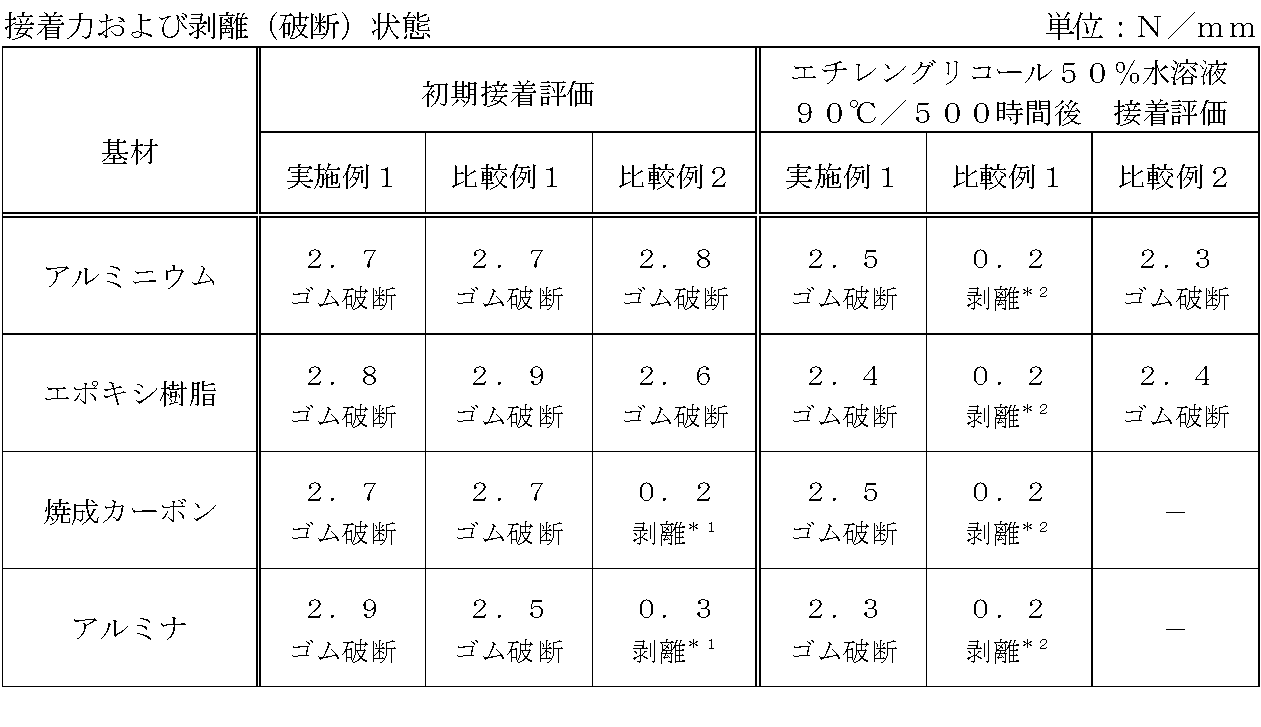
実施例1、比較例2および比較例3の一体成形物をJIS K6854−1に準じて90度剥離接着強さ試験機にて接着強度を測定した。結果を表1に示す。
更に、これらの一体成形物を50%のエチレングリコール水溶液に90℃で500時間浸漬し、浸漬後の剥離接着強度を同様な方法で測定した。結果を表1に示す。
The adhesive strength of the integrally molded products of Example 1, Comparative Example 2 and Comparative Example 3 was measured with a 90 ° peel adhesion strength tester according to JIS K6854-1. The results are shown in Table 1.
Further, these integrally molded products were immersed in a 50% ethylene glycol aqueous solution at 90 ° C. for 500 hours, and the peel adhesion strength after immersion was measured by the same method. The results are shown in Table 1.
*2:フッ素系エラストマー硬化物とプライマー間で剥離
表1の結果から、本発明の接着方法(実施例1)であれば、初期接着が良好なだけでなく、エチレングリコール50%水溶液に浸漬した後でも、良好な接着性を保っている。
一方、プライマー層(A)のみ(比較例1)の場合、初期接着は実施例と同様に良好であるが、エチレングリコール50%水溶液に浸漬した後は、フッ素系エラストマー硬化物とプライマー層(A)の間で剥離した。
また、プライマー層(B)のみ(比較例2)の場合、表面がポーラスな材料である焼成カーボンとアルミナへの接着力が弱く、基材とプライマー層(B)の間で剥離した。
From the results of Table 1, the adhesion method of the present invention (Example 1) not only provides good initial adhesion, but also maintains good adhesion even after being immersed in a 50% aqueous solution of ethylene glycol.
On the other hand, in the case of only the primer layer (A) (Comparative Example 1), the initial adhesion is as good as in the Examples, but after being immersed in a 50% aqueous solution of ethylene glycol, the cured fluorine elastomer and the primer layer (A ).
Further, in the case of only the primer layer (B) (Comparative Example 2), the adhesive force to the baked carbon and alumina, which are materials having a porous surface, was weak and peeled between the substrate and the primer layer (B).
Claims (4)
前記基材上に、エポキシ樹脂系プライマー組成物を塗布、硬化させて、プライマー層(A)を形成し、
次いで前記プライマー層(A)上に、下記成分
(B−a)1分子中に少なくとも2個のアルケニル基を有し、かつ主鎖中にパーフルオロポリエーテル構造を有する直鎖状フルオロポリエーテル化合物、
(B−b)含フッ素オルガノ水素シロキサン、
(B−c)ヒドロシリル化反応触媒、
(B−d)1分子中にエポキシ基及び/又はトリアルコキシシリル基を少なくとも1個以上有する化合物
を含有するフッ素樹脂系プライマー組成物であって、該組成物中のSiH基とアルケニル基の比率(SiH/アルケニル)が0.3以上1.0未満であるフッ素樹脂系プライマー組成物を塗布、硬化させて、プライマー層(B)を形成し、
更に前記プライマー層(B)上に、熱硬化型フッ素系エラストマー(C)を配して硬化させることを特徴とする熱硬化型フッ素系エラストマーと基材との接着方法。 A method for bonding a thermosetting fluorine-based elastomer and a substrate,
On the base material, an epoxy resin primer composition is applied and cured to form a primer layer (A),
Next, a linear fluoropolyether compound having at least two alkenyl groups in one molecule of the following component (Ba) on the primer layer (A) and having a perfluoropolyether structure in the main chain ,
(Bb) fluorine-containing organohydrogensiloxane,
(Bc) hydrosilylation reaction catalyst,
(Bd) A fluororesin primer composition containing a compound having at least one epoxy group and / or trialkoxysilyl group in one molecule, the ratio of SiH groups to alkenyl groups in the composition A primer layer (B) is formed by applying and curing a fluororesin primer composition having (SiH / alkenyl) of 0.3 or more and less than 1.0,
Further, a thermosetting fluorine-based elastomer (C) is disposed on the primer layer (B) and cured, and the method of bonding the thermosetting fluorine-based elastomer and the substrate is characterized.
(A−a)1分子中に2個以上のエポキシ基を含有し、エポキシ当量が50〜1000g/eqの、フェノール又はクレゾールノボラック樹脂のポリグリシジルエーテルであるポリエポキシド化合物:100質量部、
(A−b)有機チタン酸エステル:1〜200質量部、
(A−c)エポキシ基を有するシラン化合物又はシリコーンレジン化合物:0.1〜50質量部、
(A−d)溶剤:(A−a)成分〜(A−c)成分の合計量100質量部に対して10〜500質量部
を含有するエポキシ樹脂系プライマー組成物であることを特徴とする請求項1記載の熱硬化型フッ素系エラストマーと基材との接着方法。 The epoxy resin-based primer composition is a polyglycidyl ether of phenol or cresol novolak resin containing two or more epoxy groups in one molecule of the following component (Aa) and having an epoxy equivalent of 50 to 1000 g / eq. Polyepoxide compound: 100 parts by mass,
(Ab) Organic titanate ester: 1 to 200 parts by mass,
(Ac) Silane compound or silicone resin compound having an epoxy group: 0.1 to 50 parts by mass,
(Ad) Solvent: An epoxy resin primer composition containing 10 to 500 parts by mass with respect to 100 parts by mass of the total amount of components (Aa) to (Ac). A method for bonding a thermosetting fluorine-based elastomer according to claim 1 to a substrate.
Priority Applications (1)
| Application Number | Priority Date | Filing Date | Title |
|---|---|---|---|
| JP2008320565A JP2010143987A (en) | 2008-12-17 | 2008-12-17 | Method of bonding thermosetting fluorine elastomer to substrate |
Applications Claiming Priority (1)
| Application Number | Priority Date | Filing Date | Title |
|---|---|---|---|
| JP2008320565A JP2010143987A (en) | 2008-12-17 | 2008-12-17 | Method of bonding thermosetting fluorine elastomer to substrate |
Publications (1)
| Publication Number | Publication Date |
|---|---|
| JP2010143987A true JP2010143987A (en) | 2010-07-01 |
Family
ID=42564738
Family Applications (1)
| Application Number | Title | Priority Date | Filing Date |
|---|---|---|---|
| JP2008320565A Pending JP2010143987A (en) | 2008-12-17 | 2008-12-17 | Method of bonding thermosetting fluorine elastomer to substrate |
Country Status (1)
| Country | Link |
|---|---|
| JP (1) | JP2010143987A (en) |
Cited By (2)
| Publication number | Priority date | Publication date | Assignee | Title |
|---|---|---|---|---|
| JP2015117283A (en) * | 2013-12-17 | 2015-06-25 | オリンパス株式会社 | Adhesive composition for medical equipment, and medical equipment |
| GB2638333A (en) * | 2024-02-19 | 2025-08-20 | Henkel Ag & Co Kgaa | Primer compositions for adhesives |
Citations (4)
| Publication number | Priority date | Publication date | Assignee | Title |
|---|---|---|---|---|
| JPH0995615A (en) * | 1995-09-29 | 1997-04-08 | Shin Etsu Chem Co Ltd | Curable composition |
| JP2004155983A (en) * | 2002-11-08 | 2004-06-03 | Shin Etsu Chem Co Ltd | Primer composition |
| JP2005082700A (en) * | 2003-09-09 | 2005-03-31 | Shin Etsu Chem Co Ltd | Primer composition for thermosetting fluorine-based elastomer and adhesion method |
| JP2006052386A (en) * | 2004-07-12 | 2006-02-23 | Shin Etsu Chem Co Ltd | Primer composition for fluorine-based elastomer or fluorine-based gel |
-
2008
- 2008-12-17 JP JP2008320565A patent/JP2010143987A/en active Pending
Patent Citations (4)
| Publication number | Priority date | Publication date | Assignee | Title |
|---|---|---|---|---|
| JPH0995615A (en) * | 1995-09-29 | 1997-04-08 | Shin Etsu Chem Co Ltd | Curable composition |
| JP2004155983A (en) * | 2002-11-08 | 2004-06-03 | Shin Etsu Chem Co Ltd | Primer composition |
| JP2005082700A (en) * | 2003-09-09 | 2005-03-31 | Shin Etsu Chem Co Ltd | Primer composition for thermosetting fluorine-based elastomer and adhesion method |
| JP2006052386A (en) * | 2004-07-12 | 2006-02-23 | Shin Etsu Chem Co Ltd | Primer composition for fluorine-based elastomer or fluorine-based gel |
Cited By (4)
| Publication number | Priority date | Publication date | Assignee | Title |
|---|---|---|---|---|
| JP2015117283A (en) * | 2013-12-17 | 2015-06-25 | オリンパス株式会社 | Adhesive composition for medical equipment, and medical equipment |
| WO2015093127A1 (en) * | 2013-12-17 | 2015-06-25 | オリンパス株式会社 | Adhesive composition for medical devices and medical device |
| GB2638333A (en) * | 2024-02-19 | 2025-08-20 | Henkel Ag & Co Kgaa | Primer compositions for adhesives |
| GB2638285A (en) * | 2024-02-19 | 2025-08-20 | Henkel Ag & Co Kgaa | Primer compositions for adhesives |
Similar Documents
| Publication | Publication Date | Title |
|---|---|---|
| JP4336767B2 (en) | Elastomer-modified epoxy siloxane composition | |
| EP0061871B1 (en) | Primer composition used for adhesion of silicone rubber and application method | |
| JP5130995B2 (en) | Solvent-free silicone adhesive composition | |
| EP2130850B1 (en) | Curable fluoropolyether coating compositions | |
| JP6289366B2 (en) | Curable resin composition, resin composition, resin sheet using these, and cured products thereof | |
| EP2878632B1 (en) | Room-temperature-curable polyorganosiloxane composition and electric/electronic apparatus | |
| CN1662581A (en) | Amino-functional polysiloxanes and their use in coatings | |
| CN1875071A (en) | Curable silicone composition and its cured product | |
| JP4618451B2 (en) | Organopolysiloxane having triazine thiol group and alkenyl group, method for producing the same, and primer composition for adhesion containing the organopolysiloxane | |
| CN101887843A (en) | Manufacturing method of semiconductor chip | |
| JP4114062B2 (en) | Primer composition | |
| WO2019087759A1 (en) | Silicone adhesive composition, adhesive tape, adhesive sheet and double-sided adhesive sheet | |
| US20210062048A1 (en) | Tapes with elastomeric backing layers | |
| CN1974669B (en) | Self-adhesive organopolysiloxane composition | |
| JP2007246842A (en) | Thermosetting composition and film provided with a layer obtained from the composition | |
| US20050288474A1 (en) | Primer composition | |
| JPH10120985A (en) | Primer composition | |
| CN101827905B (en) | Room-temperature curable organopolysiloxane composition | |
| JP3539167B2 (en) | Primer composition | |
| JP2002309089A (en) | Curable silicone adhesive composition | |
| JP4733937B2 (en) | Room temperature curable organopolysiloxane composition and electrical / electronic equipment | |
| JP2010143987A (en) | Method of bonding thermosetting fluorine elastomer to substrate | |
| US20210238450A1 (en) | Method of applying an hvof-resistant tape | |
| JP2005082700A (en) | Primer composition for thermosetting fluorine-based elastomer and adhesion method | |
| TWI875959B (en) | Silicone-oxygen composite antifouling sheet and anti-graffiti construction method using the antifouling sheet |
Legal Events
| Date | Code | Title | Description |
|---|---|---|---|
| A621 | Written request for application examination |
Free format text: JAPANESE INTERMEDIATE CODE: A621 Effective date: 20101126 |
|
| A977 | Report on retrieval |
Free format text: JAPANESE INTERMEDIATE CODE: A971007 Effective date: 20121024 |
|
| A131 | Notification of reasons for refusal |
Free format text: JAPANESE INTERMEDIATE CODE: A131 Effective date: 20121031 |
|
| A521 | Written amendment |
Free format text: JAPANESE INTERMEDIATE CODE: A523 Effective date: 20121204 |
|
| A02 | Decision of refusal |
Free format text: JAPANESE INTERMEDIATE CODE: A02 Effective date: 20130312 |