JP2010142237A - Composition and method - Google Patents
Composition and method Download PDFInfo
- Publication number
- JP2010142237A JP2010142237A JP2010008205A JP2010008205A JP2010142237A JP 2010142237 A JP2010142237 A JP 2010142237A JP 2010008205 A JP2010008205 A JP 2010008205A JP 2010008205 A JP2010008205 A JP 2010008205A JP 2010142237 A JP2010142237 A JP 2010142237A
- Authority
- JP
- Japan
- Prior art keywords
- diet
- pet
- ppm
- vitamin
- lipoic acid
- Prior art date
- Legal status (The legal status is an assumption and is not a legal conclusion. Google has not performed a legal analysis and makes no representation as to the accuracy of the status listed.)
- Ceased
Links
- 239000000203 mixture Substances 0.000 title claims abstract description 25
- 238000000034 method Methods 0.000 title claims description 33
- 235000005911 diet Nutrition 0.000 claims abstract description 69
- 230000037213 diet Effects 0.000 claims abstract description 65
- AGBQKNBQESQNJD-UHFFFAOYSA-N lipoic acid Chemical compound OC(=O)CCCCC1CCSS1 AGBQKNBQESQNJD-UHFFFAOYSA-N 0.000 claims abstract description 55
- CIWBSHSKHKDKBQ-JLAZNSOCSA-N Ascorbic acid Chemical compound OC[C@H](O)[C@H]1OC(=O)C(O)=C1O CIWBSHSKHKDKBQ-JLAZNSOCSA-N 0.000 claims abstract description 42
- GVJHHUAWPYXKBD-UHFFFAOYSA-N (±)-α-Tocopherol Chemical compound OC1=C(C)C(C)=C2OC(CCCC(C)CCCC(C)CCCC(C)C)(C)CCC2=C1C GVJHHUAWPYXKBD-UHFFFAOYSA-N 0.000 claims abstract description 39
- 235000019136 lipoic acid Nutrition 0.000 claims abstract description 31
- 229960002663 thioctic acid Drugs 0.000 claims abstract description 31
- ZZZCUOFIHGPKAK-UHFFFAOYSA-N D-erythro-ascorbic acid Natural products OCC1OC(=O)C(O)=C1O ZZZCUOFIHGPKAK-UHFFFAOYSA-N 0.000 claims abstract description 20
- 229930003268 Vitamin C Natural products 0.000 claims abstract description 20
- 239000003963 antioxidant agent Substances 0.000 claims abstract description 20
- 235000006708 antioxidants Nutrition 0.000 claims abstract description 20
- 235000019154 vitamin C Nutrition 0.000 claims abstract description 20
- 239000011718 vitamin C Substances 0.000 claims abstract description 20
- PHIQHXFUZVPYII-ZCFIWIBFSA-N (R)-carnitine Chemical compound C[N+](C)(C)C[C@H](O)CC([O-])=O PHIQHXFUZVPYII-ZCFIWIBFSA-N 0.000 claims abstract description 19
- 229930003427 Vitamin E Natural products 0.000 claims abstract description 19
- WIGCFUFOHFEKBI-UHFFFAOYSA-N gamma-tocopherol Natural products CC(C)CCCC(C)CCCC(C)CCCC1CCC2C(C)C(O)C(C)C(C)C2O1 WIGCFUFOHFEKBI-UHFFFAOYSA-N 0.000 claims abstract description 19
- 235000019165 vitamin E Nutrition 0.000 claims abstract description 19
- 239000011709 vitamin E Substances 0.000 claims abstract description 19
- 229940046009 vitamin E Drugs 0.000 claims abstract description 19
- 229960001518 levocarnitine Drugs 0.000 claims abstract description 15
- 230000003078 antioxidant effect Effects 0.000 claims abstract description 14
- 235000016709 nutrition Nutrition 0.000 claims abstract description 9
- 230000003340 mental effect Effects 0.000 claims abstract description 8
- 230000006866 deterioration Effects 0.000 claims abstract description 7
- 230000002401 inhibitory effect Effects 0.000 claims abstract description 4
- 241000282326 Felis catus Species 0.000 claims description 12
- 235000013305 food Nutrition 0.000 claims description 8
- 230000000694 effects Effects 0.000 claims description 7
- 230000036997 mental performance Effects 0.000 claims description 5
- 230000004792 oxidative damage Effects 0.000 claims description 2
- 230000005764 inhibitory process Effects 0.000 claims 1
- 241000282472 Canis lupus familiaris Species 0.000 description 46
- RWSXRVCMGQZWBV-WDSKDSINSA-N glutathione Chemical compound OC(=O)[C@@H](N)CCC(=O)N[C@@H](CS)C(=O)NCC(O)=O RWSXRVCMGQZWBV-WDSKDSINSA-N 0.000 description 24
- 241001465754 Metazoa Species 0.000 description 20
- 230000003923 mental ability Effects 0.000 description 13
- 239000000243 solution Substances 0.000 description 13
- 229960003180 glutathione Drugs 0.000 description 12
- 108010053070 Glutathione Disulfide Proteins 0.000 description 10
- YPZRWBKMTBYPTK-BJDJZHNGSA-N glutathione disulfide Chemical compound OC(=O)[C@@H](N)CCC(=O)N[C@H](C(=O)NCC(O)=O)CSSC[C@@H](C(=O)NCC(O)=O)NC(=O)CC[C@H](N)C(O)=O YPZRWBKMTBYPTK-BJDJZHNGSA-N 0.000 description 10
- 238000012360 testing method Methods 0.000 description 10
- 230000037396 body weight Effects 0.000 description 9
- RTZKZFJDLAIYFH-UHFFFAOYSA-N Diethyl ether Chemical compound CCOCC RTZKZFJDLAIYFH-UHFFFAOYSA-N 0.000 description 7
- 235000020940 control diet Nutrition 0.000 description 7
- 239000000284 extract Substances 0.000 description 7
- WEVYAHXRMPXWCK-UHFFFAOYSA-N Acetonitrile Chemical compound CC#N WEVYAHXRMPXWCK-UHFFFAOYSA-N 0.000 description 6
- KCXVZYZYPLLWCC-UHFFFAOYSA-N EDTA Chemical compound OC(=O)CN(CC(O)=O)CCN(CC(O)=O)CC(O)=O KCXVZYZYPLLWCC-UHFFFAOYSA-N 0.000 description 6
- 230000032683 aging Effects 0.000 description 6
- 239000000126 substance Substances 0.000 description 6
- 108010024636 Glutathione Proteins 0.000 description 4
- 210000004369 blood Anatomy 0.000 description 4
- 239000008280 blood Substances 0.000 description 4
- 230000003111 delayed effect Effects 0.000 description 4
- 230000000378 dietary effect Effects 0.000 description 4
- VHJLVAABSRFDPM-ZXZARUISSA-N dithioerythritol Chemical compound SC[C@H](O)[C@H](O)CS VHJLVAABSRFDPM-ZXZARUISSA-N 0.000 description 4
- 239000004615 ingredient Substances 0.000 description 4
- XOAAWQZATWQOTB-UHFFFAOYSA-N taurine Chemical compound NCCS(O)(=O)=O XOAAWQZATWQOTB-UHFFFAOYSA-N 0.000 description 4
- QVJPPFAOCXDDPW-UHFFFAOYSA-N 5-[chloro(difluoro)methyl]-1,2-oxazole Chemical compound FC(F)(Cl)C1=CC=NO1 QVJPPFAOCXDDPW-UHFFFAOYSA-N 0.000 description 3
- QTBSBXVTEAMEQO-UHFFFAOYSA-N Acetic acid Chemical compound CC(O)=O QTBSBXVTEAMEQO-UHFFFAOYSA-N 0.000 description 3
- 241000282465 Canis Species 0.000 description 3
- ACTIUHUUMQJHFO-UHFFFAOYSA-N Coenzym Q10 Natural products COC1=C(OC)C(=O)C(CC=C(C)CCC=C(C)CCC=C(C)CCC=C(C)CCC=C(C)CCC=C(C)CCC=C(C)CCC=C(C)CCC=C(C)CCC=C(C)C)=C(C)C1=O ACTIUHUUMQJHFO-UHFFFAOYSA-N 0.000 description 3
- YMWUJEATGCHHMB-UHFFFAOYSA-N Dichloromethane Chemical compound ClCCl YMWUJEATGCHHMB-UHFFFAOYSA-N 0.000 description 3
- 235000011201 Ginkgo Nutrition 0.000 description 3
- 244000194101 Ginkgo biloba Species 0.000 description 3
- 235000008100 Ginkgo biloba Nutrition 0.000 description 3
- HEMHJVSKTPXQMS-UHFFFAOYSA-M Sodium hydroxide Chemical compound [OH-].[Na+] HEMHJVSKTPXQMS-UHFFFAOYSA-M 0.000 description 3
- DBMJMQXJHONAFJ-UHFFFAOYSA-M Sodium laurylsulphate Chemical compound [Na+].CCCCCCCCCCCCOS([O-])(=O)=O DBMJMQXJHONAFJ-UHFFFAOYSA-M 0.000 description 3
- 238000000540 analysis of variance Methods 0.000 description 3
- 238000004458 analytical method Methods 0.000 description 3
- 238000003556 assay Methods 0.000 description 3
- 235000017471 coenzyme Q10 Nutrition 0.000 description 3
- ACTIUHUUMQJHFO-UPTCCGCDSA-N coenzyme Q10 Chemical compound COC1=C(OC)C(=O)C(C\C=C(/C)CC\C=C(/C)CC\C=C(/C)CC\C=C(/C)CC\C=C(/C)CC\C=C(/C)CC\C=C(/C)CC\C=C(/C)CC\C=C(/C)CCC=C(C)C)=C(C)C1=O ACTIUHUUMQJHFO-UPTCCGCDSA-N 0.000 description 3
- 230000007423 decrease Effects 0.000 description 3
- 238000009472 formulation Methods 0.000 description 3
- 231100000252 nontoxic Toxicity 0.000 description 3
- 230000003000 nontoxic effect Effects 0.000 description 3
- 239000006228 supernatant Substances 0.000 description 3
- 235000021195 test diet Nutrition 0.000 description 3
- 231100000419 toxicity Toxicity 0.000 description 3
- 230000001988 toxicity Effects 0.000 description 3
- 230000004580 weight loss Effects 0.000 description 3
- GJJVAFUKOBZPCB-ZGRPYONQSA-N (r)-3,4-dihydro-2-methyl-2-(4,8,12-trimethyl-3,7,11-tridecatrienyl)-2h-1-benzopyran-6-ol Chemical class OC1=CC=C2OC(CC/C=C(C)/CC/C=C(C)/CCC=C(C)C)(C)CCC2=C1 GJJVAFUKOBZPCB-ZGRPYONQSA-N 0.000 description 2
- IJGRMHOSHXDMSA-UHFFFAOYSA-N Atomic nitrogen Chemical compound N#N IJGRMHOSHXDMSA-UHFFFAOYSA-N 0.000 description 2
- 241000207199 Citrus Species 0.000 description 2
- 244000000626 Daucus carota Species 0.000 description 2
- 235000002767 Daucus carota Nutrition 0.000 description 2
- 206010012289 Dementia Diseases 0.000 description 2
- VEXZGXHMUGYJMC-UHFFFAOYSA-N Hydrochloric acid Chemical compound Cl VEXZGXHMUGYJMC-UHFFFAOYSA-N 0.000 description 2
- PWKSKIMOESPYIA-BYPYZUCNSA-N L-N-acetyl-Cysteine Chemical compound CC(=O)N[C@@H](CS)C(O)=O PWKSKIMOESPYIA-BYPYZUCNSA-N 0.000 description 2
- MEFKEPWMEQBLKI-AIRLBKTGSA-N S-adenosyl-L-methioninate Chemical compound O[C@@H]1[C@H](O)[C@@H](C[S+](CC[C@H](N)C([O-])=O)C)O[C@H]1N1C2=NC=NC(N)=C2N=C1 MEFKEPWMEQBLKI-AIRLBKTGSA-N 0.000 description 2
- BUGBHKTXTAQXES-UHFFFAOYSA-N Selenium Chemical compound [Se] BUGBHKTXTAQXES-UHFFFAOYSA-N 0.000 description 2
- FAPWRFPIFSIZLT-UHFFFAOYSA-M Sodium chloride Chemical compound [Na+].[Cl-] FAPWRFPIFSIZLT-UHFFFAOYSA-M 0.000 description 2
- 244000300264 Spinacia oleracea Species 0.000 description 2
- 235000009337 Spinacia oleracea Nutrition 0.000 description 2
- 206010047700 Vomiting Diseases 0.000 description 2
- 240000008042 Zea mays Species 0.000 description 2
- 235000005824 Zea mays ssp. parviglumis Nutrition 0.000 description 2
- 235000002017 Zea mays subsp mays Nutrition 0.000 description 2
- 229960004308 acetylcysteine Drugs 0.000 description 2
- 229960001570 ademetionine Drugs 0.000 description 2
- OENHQHLEOONYIE-UKMVMLAPSA-N all-trans beta-carotene Natural products CC=1CCCC(C)(C)C=1/C=C/C(/C)=C/C=C/C(/C)=C/C=C/C=C(C)C=CC=C(C)C=CC1=C(C)CCCC1(C)C OENHQHLEOONYIE-UKMVMLAPSA-N 0.000 description 2
- 238000010171 animal model Methods 0.000 description 2
- 230000006399 behavior Effects 0.000 description 2
- 235000013734 beta-carotene Nutrition 0.000 description 2
- 239000011648 beta-carotene Substances 0.000 description 2
- TUPZEYHYWIEDIH-WAIFQNFQSA-N beta-carotene Natural products CC(=C/C=C/C=C(C)/C=C/C=C(C)/C=C/C1=C(C)CCCC1(C)C)C=CC=C(/C)C=CC2=CCCCC2(C)C TUPZEYHYWIEDIH-WAIFQNFQSA-N 0.000 description 2
- 229960002747 betacarotene Drugs 0.000 description 2
- 229960004203 carnitine Drugs 0.000 description 2
- 230000008859 change Effects 0.000 description 2
- 235000020971 citrus fruits Nutrition 0.000 description 2
- 229940110767 coenzyme Q10 Drugs 0.000 description 2
- 208000010877 cognitive disease Diseases 0.000 description 2
- 235000005822 corn Nutrition 0.000 description 2
- 238000001212 derivatisation Methods 0.000 description 2
- 235000015872 dietary supplement Nutrition 0.000 description 2
- LOKCTEFSRHRXRJ-UHFFFAOYSA-I dipotassium trisodium dihydrogen phosphate hydrogen phosphate dichloride Chemical compound P(=O)(O)(O)[O-].[K+].P(=O)(O)([O-])[O-].[Na+].[Na+].[Cl-].[K+].[Cl-].[Na+] LOKCTEFSRHRXRJ-UHFFFAOYSA-I 0.000 description 2
- 235000021050 feed intake Nutrition 0.000 description 2
- 230000006870 function Effects 0.000 description 2
- OWQDWQKWSLFFFR-WDSKDSINSA-N gamma-Glu-Glu Chemical compound OC(=O)[C@@H](N)CCC(=O)N[C@H](C(O)=O)CCC(O)=O OWQDWQKWSLFFFR-WDSKDSINSA-N 0.000 description 2
- 239000011521 glass Substances 0.000 description 2
- 238000004128 high performance liquid chromatography Methods 0.000 description 2
- 238000011534 incubation Methods 0.000 description 2
- 206010024378 leukocytosis Diseases 0.000 description 2
- -1 lipoic acid ester Chemical class 0.000 description 2
- 230000007774 longterm Effects 0.000 description 2
- 235000012680 lutein Nutrition 0.000 description 2
- 229960005375 lutein Drugs 0.000 description 2
- 239000001656 lutein Substances 0.000 description 2
- KBPHJBAIARWVSC-RGZFRNHPSA-N lutein Chemical compound C([C@H](O)CC=1C)C(C)(C)C=1\C=C\C(\C)=C\C=C\C(\C)=C\C=C\C=C(/C)\C=C\C=C(/C)\C=C\[C@H]1C(C)=C[C@H](O)CC1(C)C KBPHJBAIARWVSC-RGZFRNHPSA-N 0.000 description 2
- ORAKUVXRZWMARG-WZLJTJAWSA-N lutein Natural products CC(=C/C=C/C=C(C)/C=C/C=C(C)/C=C/C1=C(C)CCCC1(C)C)C=CC=C(/C)C=CC2C(=CC(O)CC2(C)C)C ORAKUVXRZWMARG-WZLJTJAWSA-N 0.000 description 2
- 238000002844 melting Methods 0.000 description 2
- 230000008018 melting Effects 0.000 description 2
- 235000015097 nutrients Nutrition 0.000 description 2
- 238000001543 one-way ANOVA Methods 0.000 description 2
- VLTRZXGMWDSKGL-UHFFFAOYSA-N perchloric acid Chemical compound OCl(=O)(=O)=O VLTRZXGMWDSKGL-UHFFFAOYSA-N 0.000 description 2
- 239000002953 phosphate buffered saline Substances 0.000 description 2
- 150000003839 salts Chemical class 0.000 description 2
- 229910052711 selenium Inorganic materials 0.000 description 2
- 239000011669 selenium Substances 0.000 description 2
- 235000011649 selenium Nutrition 0.000 description 2
- 210000002966 serum Anatomy 0.000 description 2
- 239000007787 solid Substances 0.000 description 2
- 235000003687 soy isoflavones Nutrition 0.000 description 2
- 235000000891 standard diet Nutrition 0.000 description 2
- KDYFGRWQOYBRFD-UHFFFAOYSA-L succinate(2-) Chemical compound [O-]C(=O)CCC([O-])=O KDYFGRWQOYBRFD-UHFFFAOYSA-L 0.000 description 2
- 208000011580 syndromic disease Diseases 0.000 description 2
- 229960003080 taurine Drugs 0.000 description 2
- 229930003799 tocopherol Natural products 0.000 description 2
- 239000011732 tocopherol Substances 0.000 description 2
- 229930003802 tocotrienol Natural products 0.000 description 2
- 239000011731 tocotrienol Substances 0.000 description 2
- 229940068778 tocotrienols Drugs 0.000 description 2
- 235000019148 tocotrienols Nutrition 0.000 description 2
- KBPHJBAIARWVSC-XQIHNALSSA-N trans-lutein Natural products CC(=C/C=C/C=C(C)/C=C/C=C(C)/C=C/C1=C(C)CC(O)CC1(C)C)C=CC=C(/C)C=CC2C(=CC(O)CC2(C)C)C KBPHJBAIARWVSC-XQIHNALSSA-N 0.000 description 2
- 229940088594 vitamin Drugs 0.000 description 2
- 229930003231 vitamin Natural products 0.000 description 2
- 235000013343 vitamin Nutrition 0.000 description 2
- 239000011782 vitamin Substances 0.000 description 2
- 150000003722 vitamin derivatives Chemical class 0.000 description 2
- 238000005406 washing Methods 0.000 description 2
- XLYOFNOQVPJJNP-UHFFFAOYSA-N water Substances O XLYOFNOQVPJJNP-UHFFFAOYSA-N 0.000 description 2
- FJHBOVDFOQMZRV-XQIHNALSSA-N xanthophyll Natural products CC(=C/C=C/C=C(C)/C=C/C=C(C)/C=C/C1=C(C)CC(O)CC1(C)C)C=CC=C(/C)C=CC2C=C(C)C(O)CC2(C)C FJHBOVDFOQMZRV-XQIHNALSSA-N 0.000 description 2
- OENHQHLEOONYIE-JLTXGRSLSA-N β-Carotene Chemical compound CC=1CCCC(C)(C)C=1\C=C\C(\C)=C\C=C\C(\C)=C\C=C\C=C(/C)\C=C\C=C(/C)\C=C\C1=C(C)CCCC1(C)C OENHQHLEOONYIE-JLTXGRSLSA-N 0.000 description 2
- 208000024827 Alzheimer disease Diseases 0.000 description 1
- 235000011299 Brassica oleracea var botrytis Nutrition 0.000 description 1
- 235000017647 Brassica oleracea var italica Nutrition 0.000 description 1
- 240000003259 Brassica oleracea var. botrytis Species 0.000 description 1
- 101100283604 Caenorhabditis elegans pigk-1 gene Proteins 0.000 description 1
- CURLTUGMZLYLDI-UHFFFAOYSA-N Carbon dioxide Chemical compound O=C=O CURLTUGMZLYLDI-UHFFFAOYSA-N 0.000 description 1
- ZAKOWWREFLAJOT-CEFNRUSXSA-N D-alpha-tocopherylacetate Chemical compound CC(=O)OC1=C(C)C(C)=C2O[C@@](CCC[C@H](C)CCC[C@H](C)CCCC(C)C)(C)CCC2=C1C ZAKOWWREFLAJOT-CEFNRUSXSA-N 0.000 description 1
- VZCYOOQTPOCHFL-OWOJBTEDSA-N Fumaric acid Chemical compound OC(=O)\C=C\C(O)=O VZCYOOQTPOCHFL-OWOJBTEDSA-N 0.000 description 1
- 108010068370 Glutens Proteins 0.000 description 1
- 241000282412 Homo Species 0.000 description 1
- 235000007688 Lycopersicon esculentum Nutrition 0.000 description 1
- 235000014676 Phragmites communis Nutrition 0.000 description 1
- 240000003768 Solanum lycopersicum Species 0.000 description 1
- 239000004809 Teflon Substances 0.000 description 1
- 229920006362 Teflon® Polymers 0.000 description 1
- 244000269722 Thea sinensis Species 0.000 description 1
- GLEVLJDDWXEYCO-UHFFFAOYSA-N Trolox Chemical compound O1C(C)(C(O)=O)CCC2=C1C(C)=C(C)C(O)=C2C GLEVLJDDWXEYCO-UHFFFAOYSA-N 0.000 description 1
- 235000009754 Vitis X bourquina Nutrition 0.000 description 1
- 235000012333 Vitis X labruscana Nutrition 0.000 description 1
- 240000006365 Vitis vinifera Species 0.000 description 1
- 235000014787 Vitis vinifera Nutrition 0.000 description 1
- 230000005856 abnormality Effects 0.000 description 1
- 238000010521 absorption reaction Methods 0.000 description 1
- 230000009471 action Effects 0.000 description 1
- 239000013543 active substance Substances 0.000 description 1
- 150000001408 amides Chemical class 0.000 description 1
- 239000006053 animal diet Substances 0.000 description 1
- 230000003712 anti-aging effect Effects 0.000 description 1
- 235000010323 ascorbic acid Nutrition 0.000 description 1
- 229960005070 ascorbic acid Drugs 0.000 description 1
- 239000011668 ascorbic acid Substances 0.000 description 1
- 230000002238 attenuated effect Effects 0.000 description 1
- 235000014590 basal diet Nutrition 0.000 description 1
- 230000008901 benefit Effects 0.000 description 1
- 238000004820 blood count Methods 0.000 description 1
- 239000001506 calcium phosphate Substances 0.000 description 1
- 229910000389 calcium phosphate Inorganic materials 0.000 description 1
- 235000011010 calcium phosphates Nutrition 0.000 description 1
- 238000004364 calculation method Methods 0.000 description 1
- 239000002775 capsule Substances 0.000 description 1
- 235000011089 carbon dioxide Nutrition 0.000 description 1
- 210000004027 cell Anatomy 0.000 description 1
- 239000003153 chemical reaction reagent Substances 0.000 description 1
- HVYWMOMLDIMFJA-DPAQBDIFSA-N cholesterol group Chemical group [C@@H]1(CC[C@H]2[C@@H]3CC=C4C[C@@H](O)CC[C@]4(C)[C@H]3CC[C@]12C)[C@H](C)CCCC(C)C HVYWMOMLDIMFJA-DPAQBDIFSA-N 0.000 description 1
- 230000003930 cognitive ability Effects 0.000 description 1
- 230000006999 cognitive decline Effects 0.000 description 1
- ZAKOWWREFLAJOT-UHFFFAOYSA-N d-alpha-Tocopheryl acetate Natural products CC(=O)OC1=C(C)C(C)=C2OC(CCCC(C)CCCC(C)CCCC(C)C)(C)CCC2=C1C ZAKOWWREFLAJOT-UHFFFAOYSA-N 0.000 description 1
- 230000007123 defense Effects 0.000 description 1
- 235000021196 dietary intervention Nutrition 0.000 description 1
- 201000010099 disease Diseases 0.000 description 1
- 208000037265 diseases, disorders, signs and symptoms Diseases 0.000 description 1
- 239000002552 dosage form Substances 0.000 description 1
- 238000005538 encapsulation Methods 0.000 description 1
- 150000002148 esters Chemical class 0.000 description 1
- 238000000605 extraction Methods 0.000 description 1
- 235000012041 food component Nutrition 0.000 description 1
- 230000037406 food intake Effects 0.000 description 1
- 239000013505 freshwater Substances 0.000 description 1
- 108010085978 gamma-glutamylglutamate Proteins 0.000 description 1
- 235000021312 gluten Nutrition 0.000 description 1
- 239000008187 granular material Substances 0.000 description 1
- 235000019674 grape juice Nutrition 0.000 description 1
- 235000009569 green tea Nutrition 0.000 description 1
- 238000000227 grinding Methods 0.000 description 1
- 230000002489 hematologic effect Effects 0.000 description 1
- IPCSVZSSVZVIGE-UHFFFAOYSA-M hexadecanoate Chemical compound CCCCCCCCCCCCCCCC([O-])=O IPCSVZSSVZVIGE-UHFFFAOYSA-M 0.000 description 1
- 238000010348 incorporation Methods 0.000 description 1
- 230000000977 initiatory effect Effects 0.000 description 1
- 238000010829 isocratic elution Methods 0.000 description 1
- 238000002955 isolation Methods 0.000 description 1
- 239000007788 liquid Substances 0.000 description 1
- 238000011068 loading method Methods 0.000 description 1
- 210000004698 lymphocyte Anatomy 0.000 description 1
- 238000012423 maintenance Methods 0.000 description 1
- 238000004519 manufacturing process Methods 0.000 description 1
- 235000012054 meals Nutrition 0.000 description 1
- 238000005259 measurement Methods 0.000 description 1
- 210000002433 mononuclear leukocyte Anatomy 0.000 description 1
- 229910052757 nitrogen Inorganic materials 0.000 description 1
- YPZRWBKMTBYPTK-UHFFFAOYSA-N oxidized gamma-L-glutamyl-L-cysteinylglycine Natural products OC(=O)C(N)CCC(=O)NC(C(=O)NCC(O)=O)CSSCC(C(=O)NCC(O)=O)NC(=O)CCC(N)C(O)=O YPZRWBKMTBYPTK-UHFFFAOYSA-N 0.000 description 1
- 229910052760 oxygen Inorganic materials 0.000 description 1
- 239000001301 oxygen Substances 0.000 description 1
- 238000007427 paired t-test Methods 0.000 description 1
- 239000000825 pharmaceutical preparation Substances 0.000 description 1
- 229940127557 pharmaceutical product Drugs 0.000 description 1
- 239000008363 phosphate buffer Substances 0.000 description 1
- 230000037081 physical activity Effects 0.000 description 1
- 239000006187 pill Substances 0.000 description 1
- 238000002360 preparation method Methods 0.000 description 1
- 230000002265 prevention Effects 0.000 description 1
- 230000008569 process Effects 0.000 description 1
- 239000002994 raw material Substances 0.000 description 1
- NPCOQXAVBJJZBQ-UHFFFAOYSA-N reduced coenzyme Q9 Natural products COC1=C(O)C(C)=C(CC=C(C)CCC=C(C)CCC=C(C)CCC=C(C)CCC=C(C)CCC=C(C)CCC=C(C)CCC=C(C)CCC=C(C)C)C(O)=C1OC NPCOQXAVBJJZBQ-UHFFFAOYSA-N 0.000 description 1
- 238000000611 regression analysis Methods 0.000 description 1
- 230000002441 reversible effect Effects 0.000 description 1
- 229940091258 selenium supplement Drugs 0.000 description 1
- 230000035945 sensitivity Effects 0.000 description 1
- 238000000926 separation method Methods 0.000 description 1
- 239000011734 sodium Substances 0.000 description 1
- 239000002904 solvent Substances 0.000 description 1
- 230000001629 suppression Effects 0.000 description 1
- 208000024891 symptom Diseases 0.000 description 1
- 239000003826 tablet Substances 0.000 description 1
- 235000010384 tocopherol Nutrition 0.000 description 1
- 229960001295 tocopherol Drugs 0.000 description 1
- 229940042585 tocopherol acetate Drugs 0.000 description 1
- 125000002640 tocopherol group Chemical class 0.000 description 1
- 235000019149 tocopherols Nutrition 0.000 description 1
- 235000015193 tomato juice Nutrition 0.000 description 1
- VZCYOOQTPOCHFL-UHFFFAOYSA-N trans-butenedioic acid Natural products OC(=O)C=CC(O)=O VZCYOOQTPOCHFL-UHFFFAOYSA-N 0.000 description 1
- QORWJWZARLRLPR-UHFFFAOYSA-H tricalcium bis(phosphate) Chemical compound [Ca+2].[Ca+2].[Ca+2].[O-]P([O-])([O-])=O.[O-]P([O-])([O-])=O QORWJWZARLRLPR-UHFFFAOYSA-H 0.000 description 1
- 229940035936 ubiquinone Drugs 0.000 description 1
- 230000008673 vomiting Effects 0.000 description 1
- 230000003442 weekly effect Effects 0.000 description 1
- 238000005303 weighing Methods 0.000 description 1
- GVJHHUAWPYXKBD-IEOSBIPESA-N α-tocopherol Chemical compound OC1=C(C)C(C)=C2O[C@@](CCC[C@H](C)CCC[C@H](C)CCCC(C)C)(C)CCC2=C1C GVJHHUAWPYXKBD-IEOSBIPESA-N 0.000 description 1
Landscapes
- Fodder In General (AREA)
- Medicines That Contain Protein Lipid Enzymes And Other Medicines (AREA)
- Pharmaceuticals Containing Other Organic And Inorganic Compounds (AREA)
- Acyclic And Carbocyclic Compounds In Medicinal Compositions (AREA)
- Feed For Specific Animals (AREA)
Abstract
Description
発明の背景
イヌやネコなどのコンパニオンアニマルは、高齢化問題に苦しんでいるようである。そのあるものは、一般的な格言からも明らかである。一つには、「年をとったイヌに新しい芸は仕込めない」がある。この格言は、イヌが年をとるにつれて、身体活動度と同様にその精神能力(mental capacity)が減退するようだという観察から生じたものである。思考、学習及び記憶に関連する精神活動が減退しているようである(Cummings BJ、Head E、Ruehl W、Milgram NW Cotman CW 1996年:"The canine as an animal model of human aging and dementia";Neurobiology of aging 17巻:259〜268頁)。さらに、精神能力における変化に伴って、高齢の動物では、行動にはっきりとした変化がある場合もある。その多くがこの精神能力の減退に起因するものであった。
BACKGROUND OF THE INVENTION Companion animals such as dogs and cats appear to suffer from aging problems. Some of them are clear from general sayings. For one thing, “old dogs cannot be taught new tricks”. This adage stems from the observation that as a dog gets older, its mental capacity appears to decline as well as physical activity. Mental activity related to thinking, learning and memory appears to be declining (Cummings BJ, Head E, Ruehl W, Milgram NW Cotman CW 1996: “The canine as an animal model of human aging and dementia”; Neurobiology of aging 17: 259-268). In addition, with changes in mental ability, there may be a clear change in behavior in older animals. Many of these were due to this decline in mental ability.
今日、高齢のコンパニオンペットの食餌中に有意レベルの少なくとも1種の酸化防止剤を配合すると、高齢のコンパニオンペットの精神能力の低下を抑制することが示された。 Today, it has been shown that the incorporation of significant levels of at least one antioxidant in the diet of older companion pets inhibits the deterioration of mental competencies of older companion pets.
発明の概要
本発明に従って、高齢のペットの通常の栄養必要量を満たし、且つさらに、高齢のコンパニオンペットの精神能力の低下を抑制するために、十分量の酸化防止剤またはその混合物を含む、コンパニオンペット用の食餌を提供する。
SUMMARY OF THE INVENTION A companion according to the present invention comprising a sufficient amount of an antioxidant or a mixture thereof to meet the normal nutritional requirements of an aged pet and further suppress the deterioration of mental ability of an aged companion pet. Provide food for pets.
本発明の別の側面は、高齢のコンパニオンペットの精神能力の低下を抑制する方法であって、本発明を遂行するために所定レベルの酸化防止剤またはその混合物を含む食餌を前記ペットに給餌することを含む、前記方法に関する。 Another aspect of the present invention is a method for inhibiting the deterioration of mental performance of an elderly companion pet, wherein the pet is fed with a diet containing a predetermined level of an antioxidant or a mixture thereof to accomplish the present invention. The method.
さらに本発明に従って、高齢のペットの通常の栄養所定量を満たし、且つさらに高齢のコンパニオンペットの精神能力の低下を抑制するのに十分量のビタミンE、ビタミンC、アルファ-リポ酸、l-カルニチン及びその任意の混合物からなる群から選択される酸化防止剤を含む、高齢のコンパニオンペット用食餌を提供する。 Further in accordance with the present invention, vitamin E, vitamin C, alpha-lipoic acid, l-carnitine in sufficient amounts to meet the normal nutritional requirements of older pets and to suppress the mental competencies of older companion pets And an anti-aging companion pet diet comprising an antioxidant selected from the group consisting of any mixture thereof.
本発明の別の側面では、高齢のコンパニオンペットの精神能力を向上させるための方法であって、精神能力を向上させるのに十分な量の酸化防止剤またはその混合物を高齢のペットに給餌することを含む、前記方法を提供する。 In another aspect of the invention, a method for improving the mental performance of an elderly companion pet, the method comprising feeding the elderly pet with an amount of an antioxidant or a mixture thereof sufficient to improve mental performance The method is provided.
これらの方法の全てにおいて、動物の食餌に酸化防止剤またはその混合物を加えることが望ましい。 In all of these methods, it is desirable to add an antioxidant or a mixture thereof to the animal diet.
発明の詳細な説明
高齢のコンパニオンペット、たとえばイヌやネコに給餌する食餌(diet)とは、その年齢の動物に給餌する標準的な食餌である。以下は、少なくとも7歳の年齢のイヌ用の典型的な食餌である。
DETAILED DESCRIPTION OF THE INVENTION An elderly companion pet, such as a diet fed to a dog or cat, is a standard diet fed to an animal of that age. The following is a typical diet for dogs of at least 7 years of age.
コンパニオンペットの食餌に有意量の酸化防止剤及びその混合物を加えると、高齢のペットでは、具体的には問題解決能力によって示されるように、その挙動、特に精神能力に有意且つ明白な変化をもたらすことができる。「高齢」なる用語は、一般的に少なくとも7歳のイヌ及び少なくとも7歳のネコを意味するものとする。 Adding significant amounts of antioxidants and mixtures thereof to the companion pet's diet results in significant and obvious changes in behavior, particularly mental ability, in older pets, particularly as demonstrated by problem-solving ability be able to. The term “aged” is generally intended to mean dogs at least 7 years old and cats at least 7 years old.
イヌ及びネコについても精神能力が喪失することは、長年にわたって知見されてきたことである。この精神能力の喪失は、非常に多くの面で明白である。たとえばイヌの場合には、方角がわからなくなる、家を汚す、睡眠-起床パターンが変わる、家族やペットとの交流が少なくなる、そして学習または集中ができなくなることとして表れる。これらの症状は、ネコでも同様に表れることがある。ヒトに表れるアルツハイマー病は、イヌやネコでは知見されていない。 The loss of mental ability in dogs and cats has also been found for many years. This loss of mental ability is evident in many ways. For example, in the case of a dog, the direction is lost, the house is soiled, the sleep-wake-up pattern changes, the family and pet interact less, and learning or concentration is not possible. These symptoms may appear in cats as well. Alzheimer's disease that appears in humans has not been found in dogs or cats.
精神能力の喪失に関しては、多くの理論が提唱されてきた。今日まで、本発明者らは、客観的なパラメーターによって測定されるように精神能力において正の変化を実際に生じさせたり、精神能力のこのような喪失を抑制する食餌の手段については全く気づいていなかった。 Many theories have been proposed regarding the loss of mental ability. To date, the inventors are completely unaware of dietary means that actually make a positive change in mental ability, as measured by objective parameters, or suppress this loss of mental ability. There wasn't.
本発明者らは、精神能力の喪失の抑制を達成することに成功した。本発明の食餌を使用することによって、高齢のイヌの精神能力の低下を抑制し、且つ問題解決能力が向上したことを示した。精神能力の低下は、本質的に逆転させることができる。そのような処置の必要な高齢のペットの精神能力は、向上させることができる。記憶及び学習能力によって示されるような、問題解決能力を向上することができる。全体としての賢さを向上させることができる。加齢に関連する認知力低下を遅延させることができる。認知機能障害症候群に関しては、高齢のイヌにおいてその進行を遅延化させることができ、この症候群に伴う臨床徴候を制御することができる。好適な場合には予防、そしてこれらの単数または複数の成分の必要なペットがターゲット群である。 The inventors have succeeded in achieving suppression of loss of mental ability. It was shown that the use of the diet of the present invention suppressed the deterioration of mental ability of elderly dogs and improved problem solving ability. The decline in mental ability can be essentially reversed. The mental ability of older pets in need of such treatment can be improved. It can improve problem-solving ability, as demonstrated by memory and learning ability. Can improve overall wisdom. Cognitive decline associated with aging can be delayed. With respect to cognitive dysfunction syndrome, its progression can be delayed in older dogs and the clinical signs associated with this syndrome can be controlled. Prevention is where appropriate, and the necessary pets of these component (s) are the target group.
本目的を達成する食餌中の成分は、酸化防止剤またはその混合物である。酸化防止剤は、フリーラジカルを消滅させる物質である。そのような物質の例としては、食品、たとえばイチョウ、柑橘類パルプ、ブドウ絞りカス、トマト絞りカス、ニンジン及びホウレンソウがあり、これらは全て乾燥しているのが好ましく、並びに他の種々の物質、たとえばベータ-カロテン、セレン、補酵素Q10(ユビキノン)、ルテイン、トコトリエノール類、大豆イソフラボン類、S-アデノシルメチオニン、グルタチオン、タウリン、N-アセチルシステイン、ビタミンE、ビタミンC、アルファ-リポ酸、l-カルニチンなどが挙げられる。ビタミンEは、トコフェロールまたはトコフェロール類の混合物、及びその種々の誘導体、たとえばビタミンEのアセテート、スクシネート、パルミテートなどとして投与することができる。アルファ型が好ましいが、ベータ、ガンマ及びデルタ型も含めることができる。d型が好ましいが、ラセミ混合物も許容可能である。上記の型及び誘導体は、ペットにより摂食された後、ビタミンE様の活性で機能するだろう。ビタミンCは、アスコルビン酸及びその種々の誘導体、たとえばリン酸カルシウム塩、コレステリル塩、2-モノリン酸塩などとして食餌中に投与することができ、これらはペットにより摂食された後、ビタミンC様の活性で機能するだろう。これらは液体、半固体、固体及び熱安定形などのどんな形態であってもよい。アルファ-リポ酸は、アルファ-リポ酸として、及び米国特許第5,621,117号に記載の如くリポ酸エステル誘導体、ラセミ混合物、その塩、エステルまたはアミドとして食餌中に投与することができる。L-カルニチンは、食餌中に投与することができ、塩酸塩、フマル酸塩、及びコハク酸塩などの塩、並びにアセチル化カルニチンなどの種々のカルニチン誘導体も使用することができる。 An ingredient in the diet that achieves this purpose is an antioxidant or a mixture thereof. Antioxidants are substances that eliminate free radicals. Examples of such substances are foods such as ginkgo, citrus pulp, grape juice, tomato juice, carrots and spinach, which are preferably all dry and various other substances such as Beta-carotene, selenium, coenzyme Q10 (ubiquinone), lutein, tocotrienols, soy isoflavones, S-adenosylmethionine, glutathione, taurine, N-acetylcysteine, vitamin E, vitamin C, alpha-lipoic acid, l- Examples include carnitine. Vitamin E can be administered as tocopherol or a mixture of tocopherols, and various derivatives thereof, such as vitamin E acetate, succinate, palmitate, and the like. The alpha form is preferred, but beta, gamma and delta forms can also be included. The d form is preferred, but racemic mixtures are acceptable. The above types and derivatives will function with vitamin E-like activity after being ingested by a pet. Vitamin C can be administered into the diet as ascorbic acid and its various derivatives, such as calcium phosphate, cholesteryl, 2-monophosphate, etc., which are vitamin C-like activity after ingestion by pets Will work. These can be in any form such as liquid, semi-solid, solid and heat stable forms. Alpha-lipoic acid can be administered into the diet as alpha-lipoic acid and as lipoic acid ester derivatives, racemic mixtures, salts, esters or amides thereof as described in US Pat. No. 5,621,117. L-carnitine can be administered in the diet, and salts such as hydrochloride, fumarate, and succinate, and various carnitine derivatives such as acetylated carnitine can also be used.
全て食餌の重量%(乾燥物質ベース)として食餌中に投与する量は、それ自体活性物質として計算し、独立した物質として測定する。使用する最大量は、毒性を惹起するようであってはならない。少なくとも約100ppmまたは少なくとも約150ppmのビタミンEを使用することができる。約500ppm〜約1,000ppmの好ましい範囲を使用することができる。必ずではないが、通常、約2000ppmまたは約1500ppmの最大量を超えない。ビタミンCに関しては少なくとも約50ppmを使用し、少なくとも約75ppmが望ましく、少なくとも約100ppmがより望ましい。非毒性の最大量を使用することができる。アルファ-リポ酸の量は、少なくとも約25ppmから変動することができ、少なくとも約50ppmが望ましく、約100ppmがより望ましい。最大量は約100ppm〜約600ppmまたは、ペットに対して非毒性のままであるような量を変動することができる。好ましい範囲は約100ppm〜約200ppmである。l-カルニチンに関しては約50ppm、望ましくは約200ppm、より望ましくは約300ppmが有用な最少量である。ネコに関しては、少々高い最少量のl-カルニチン、たとえば約100ppm、200ppm、及び500ppmを使用することができる。非毒性の最大量、たとえば約5,000ppm未満を使用することができる。イヌに関しては、少ない量、たとえば約5,000ppm未満の量を使用することができる。イヌに関しては、好ましい範囲は約200ppm〜約400ppmである。ネコに関しては、好ましい範囲は約400ppm〜約600ppmである。 The amount administered in the diet, all as a weight percent of the diet (dry substance basis), is itself calculated as the active substance and measured as an independent substance. The maximum amount used should not seem to cause toxicity. At least about 100 ppm or at least about 150 ppm of vitamin E can be used. A preferred range of about 500 ppm to about 1,000 ppm can be used. Usually, but not necessarily, the maximum amount of about 2000 ppm or about 1500 ppm is not exceeded. For vitamin C, at least about 50 ppm is used, preferably at least about 75 ppm, and more preferably at least about 100 ppm. The maximum non-toxic amount can be used. The amount of alpha-lipoic acid can vary from at least about 25 ppm, is preferably at least about 50 ppm, and more preferably is about 100 ppm. The maximum amount can vary from about 100 ppm to about 600 ppm, or an amount that remains non-toxic to the pet. A preferred range is from about 100 ppm to about 200 ppm. For l-carnitine, about 50 ppm, desirably about 200 ppm, more desirably about 300 ppm is the minimum useful amount. For cats, a slightly higher minimum amount of l-carnitine, such as about 100 ppm, 200 ppm, and 500 ppm can be used. A non-toxic maximum amount can be used, for example, less than about 5,000 ppm. For dogs, small amounts can be used, for example, less than about 5,000 ppm. For dogs, the preferred range is from about 200 ppm to about 400 ppm. For cats, the preferred range is from about 400 ppm to about 600 ppm.
約1〜15ppmのベータ-カロテンを使用することができる。約0.1〜約5ppmのセレンを使用することができる。少なくとも約5ppmのルテインを使用することができる。少なくとも約25ppmのトコトリエノール類を使用することができる。少なくとも約25ppmの補酵素Q10を使用することができる。少なくとも約50ppmのS-アデノシルメチオニン。少なくとも約1000ppmのタウリンを使用することができる。少なくとも約25ppmの大豆イソフラボン類を使用することができる。少なくとも約50ppmのN-アセチルシステインを使用することができる。少なくとも約50ppmのグルタチオンを使用することができる。抽出物の少なくとも約50ppmまたは食餌の1%のイチョウを使用することができる。 About 1-15 ppm of beta-carotene can be used. About 0.1 to about 5 ppm of selenium can be used. At least about 5 ppm of lutein can be used. At least about 25 ppm of tocotrienols can be used. At least about 25 ppm of coenzyme Q10 can be used. At least about 50 ppm S-adenosylmethionine. At least about 1000 ppm of taurine can be used. At least about 25 ppm soy isoflavones can be used. At least about 50 ppm N-acetylcysteine can be used. At least about 50 ppm glutathione can be used. Ginkgo at least about 50 ppm of extract or 1% of diet can be used.
以下のものは、ORAC(活性酸素ラジカル吸収能力)量が高い原材料成分である。1%含有率(トウモロコシなどの低ORAC成分に関しては全部で5%の置換率)で食餌中に添加すると、食餌全体のORAC量が増加し、且つこれらの成分を含有する食餌を食べた動物の血清のORAC量が増加した。食餌に全体で5%として4種類の他の成分1%と組み合わせて1%で添加できれば、乾燥物質1グラム当たりTrolox等価物25μモルを超えるORAC量の任意成分を使用できるだろう。 The following are raw material components having a high ORAC (active oxygen radical absorption capacity) amount. When added to the diet at a 1% content (5% total replacement rate for low ORAC components such as corn), the amount of ORAC in the entire diet increases and animals that have eaten a diet containing these components Serum ORAC levels increased. If you can add 1% in combination with 4% of the other 4 ingredients as a total of 5% to the diet, you can use any ingredient with an ORAC amount of more than 25 μmol Trolox equivalent per gram of dry matter.
ホウレンソウ絞りカス、トマト絞りカス、柑橘類パルプ、ブドウ絞りカス、ニンジン顆粒、ブロッコリ、緑茶、イチョウ、トウモロコシグルテン・ミール。 Spinach dregs, tomato dregs, citrus pulp, grape dregs, carrot granules, broccoli, green tea, ginkgo, corn gluten and meal.
実施例1
イヌは全てビーグル犬であり、7歳以上であった。対照食餌と試験食餌の栄養成分は、先の表1に開示した標準食餌とほぼ同じであった。しかしながら、対照食餌はビタミンE59ppmと、ビタミンC<32ppmとを含有していた。試験食餌は、ビタミンE900ppm、ビタミンC121ppm、l-カルニチン260ppmと、アルファ-リポ酸135ppmとを含有していた。
Example 1
All dogs were beagle dogs and were over 7 years old. The nutritional components of the control and test diets were almost the same as the standard diet disclosed in Table 1 above. However, the control diet contained 59 ppm vitamin E and vitamin C <32 ppm. The test diet contained 900 ppm vitamin E, 121 ppm vitamin C, 260 ppm l-carnitine, and 135 ppm alpha-lipoic acid.
対照食餌群または栄養強化試験食餌群のいずれかに配属させる前に、基準となる一連の問題解決能力のタスクを12匹の高齢のビーグル犬で実施した。高齢の動物は、学習(弁別逆転)並びに記憶(位置の遅延見本非整合タスク[delayed non-match to position:DNMP]及びサンプルの遅延非整合タスク[delayed non-match to sample:DNMS])に関して等しくそろえた。T-検定を使用して、弁別逆転、DNMP、及びDNMSタスクの基準となる学習において、2つの群のイヌを比較した。結果に優位性はなかった。従って、食餌の関与前に認知力をベースとして、イヌを等しくそろえた。食餌を開始して約1ヶ月後、イヌに最初に与えた問題解決タスクは、空間的注意試験であるランドマーク弁別学習タスクであった[Milgramら、1999年、Milgram,N.W.、Adams,B.、Callahan,H.、Head,E.、Mackay,B、Thirlwell,C及びCotman(1999年)、C.W.Landmark Discrimination Learning in the Dog.Learning&Memory、6巻、54〜61頁]。 A standard set of problem-solving tasks was performed on 12 aged beagle dogs prior to assignment to either the control diet group or the enrichment study diet group. Aged animals are equal in terms of learning (discriminatory reversal) and memory (delayed non-match to position (DNMP) and delayed non-match to sample (DNMS)) I got it. Using the T-test, two groups of dogs were compared in baseline learning of discrimination reversal, DNMP, and DNMS tasks. There was no advantage in the results. Therefore, dogs were equally aligned based on cognitive ability before dietary involvement. About one month after starting the diet, the first problem-solving task given to dogs was the landmark discrimination learning task, a spatial attention test [Milgram et al., 1999, Milgram, NW, Adams, B. Callahan, H., Head, E., Mackay, B, Thirlwell, C and Cotman (1999), CWLandmark Discrimination Learning in the Dog. Learning & Memory, Vol. 6, pp. 54-61].
ランドマーク弁別学習では、被験動物に、目的に近い特定の対象を選択させなければならない。しかしながら、初期の学習は、イヌの対象弁別タスクを学習する能力に基づく。本出願人は、弁別学習における年齢の影響がタスクの難易度に依存することを既に知見しており、ランドマーク弁別学習力が高齢のイヌでは顕著に減弱していることを示す証拠を得ていた。 In landmark discrimination learning, the test animal must select a specific target close to the purpose. However, early learning is based on the ability to learn canine target discrimination tasks. The applicant has already found that the influence of age in discrimination learning depends on task difficulty, and has gained evidence that landmark discrimination learning is significantly attenuated in older dogs. It was.
栄養強化食餌試験と対照食餌を摂取する高齢の動物とをランドマーク弁別学習タスクで比較すると、群の間には高い有意差が存在した(p<02)。栄養強化食餌の動物は、対照食餌の動物よりも少ししか間違わずにタスクを修得した。栄養強化食餌の6匹の動物全てが40回以内で学習能力の判定基準を満たすことができたのに対し、対照食餌の6匹の動物のうち3匹しか、この学習能力の判定基準を満たさなかった。さらに、問題を解決できたこの3匹のイヌでも、栄養強化食餌を摂取しているイヌよりも間違い(エラー)が多かった。 There was a high significant difference between the groups when comparing the enriched diet test and older animals on the control diet in the landmark discrimination learning task (p <02). Enriched diet animals completed the task with a few mistakes compared to control diet animals. All six animals on the enriched diet were able to meet the criteria for learning ability within 40 times, whereas only three of the six animals on the control diet met this criterion for learning ability There wasn't. In addition, the three dogs that were able to solve the problem had more errors (errors) than dogs that were on a fortified diet.
対照群及び栄養強化食餌試験群のイヌは、ランドマーク弁別学習を全て終えた後、オッド・タスク(oddity task)で試験した。このタスクは、3つ全ての食べ物のウエルにカバーをかけた3つの対象をイヌに示すことを含む。これらの対象の2つは全く同一で、1つは違っている。ご褒美の食べ物をもらうには、イヌは残りの対象を選択しなければならない。栄養強化試験食餌のイヌは、対照食餌を給餌されたイヌよりもほんの少ししか間違わずにこのタスクを学習した(合計した4つ全てのオッド・テストの得点に関してp<.003)。 Dogs in the control group and the fortified diet test group were tested in the oddity task after completing all landmark discrimination learning. This task involves showing the dog three subjects who covered all three food wells. Two of these objects are identical and one is different. To receive reward food, the dog must select the remaining subjects. Dogs on the enrichment test diet learned this task with only a few mistakes compared to dogs fed the control diet (p <.003 for all four odd test scores combined).
実施例2
ビーグル犬(n=28)をサイズ弁別タスクで予備トレーニングし、このタスクを学習させる際の判断基準での間違いでランク付けした。次いでイヌを3つの群に分け、先の弁別得点をベースとして3つの食餌のうちの1つにランダムに割り当てた。この研究に登録したイヌは全て7歳以上であった。ビタミンEの量が種々異なる3種類のドライフードのうちの1つをイヌにあてがい、ランドマーク弁別プロトコルで開始した。ビタミンE量と他の成分について、以下の表2に列記する。
Example 2
Beagle dogs (n = 28) were pre-trained in a size discrimination task and ranked by mistake in the criteria used to learn this task. The dogs were then divided into three groups and randomly assigned to one of the three diets based on the previous discrimination score. All dogs enrolled in this study were over 7 years old. One of three dry foods with varying amounts of vitamin E was assigned to dogs and started with a landmark discrimination protocol. The amount of vitamin E and other ingredients are listed in Table 2 below.
このランドマーク弁別プロトコルは、3段階の試験からなっており(ランドマーク0、1、2)、ここで、イヌは判断基準 (続けて2日間で10問中8問正解し、続いて次の3日間で10問中7問の平均)に到達してから、次の試験段階に進まなければならない。イヌはそれぞれ、各段階を学習させるのに1日当たり10回で40日間試行させた。反復MANOVA(repeated MANOVA)から、判断基準の得点の間違いには食餌の有意な全体効果があることが明らかになった(P<0.05)。ランドマーク1+2対食餌のビタミンE量に関する間違いの総数の回帰分析から、ビタミンEが最も高い食餌のイヌは間違いが最も少なく(中間=65)、ビタミンEが最も低い食餌のイヌは間違いが最も多い(中間=170)という有意な(P<0.05)回帰直線の傾きが明らかになった。 This landmark discrimination protocol consists of a three-stage test (Landmarks 0, 1, 2), where dogs are judged criteria (following 8 out of 10 questions in 2 days, followed by After reaching the average of 7 out of 10 questions over 3 days, you must move on to the next test stage. Each dog was allowed 10 trials per day for 40 days to learn each stage. Iterative MANOVA (repeated MANOVA) revealed that a mistake in scoring criteria has a significant overall effect of diet (P <0.05). From a regression analysis of the total number of errors regarding landmark 1 + 2 versus dietary vitamin E, dogs with the highest vitamin E diet have the least mistakes (middle = 65) and dogs with the lowest vitamin E diet have the most mistakes A significant (P <0.05) regression line slope of (intermediate = 170) was revealed.
実施例3
30匹の、無作為供給源の成犬をこの研究で使用した。イヌは少なくとも月齢10ヶ月であり、妊娠中でなく、授乳中でなく、試験開始前に適当な体重のものであった。食餌処置用に、それぞれの群について3匹の雄と3匹の雌との5つの群に動物を無作為に分けた。
Example 3
Thirty random source adult dogs were used in this study. The dog was at least 10 months of age, was not pregnant, was not breastfeeding, and was of an appropriate weight before the start of the study. For dietary treatment, animals were randomly divided into 5 groups of 3 males and 3 females for each group.
2週間の予備給餌期間の間、アメリカ飼料検査官協会(American Association of Feed Control Officials:AAFCO 2000)により提案されたように栄養成分に関して全ての推薦量を満たしているか、またはこれを超える対照用の食物(添加dl-アルファ-リポ酸0ppm)を全てのイヌに与えた(表1)。予備給餌期間の後、以下のdl-アルファ-リポ酸目的含有量(乾燥物質ベース):0ppm、150ppm、1500ppm、3000ppm、4500ppmのうちの1つで5つの処理群に無作為に分けた。全ての食餌、対照及びアルファ-リポ酸において、ビタミンEを添加し、これは600〜1000国際単位(IU)で配合し、ビタミンCは100〜200ppmレベルで添加した。 For a two-week pre-feeding period, for controls that meet or exceed all recommended amounts for nutrients as proposed by the American Association of Feed Control Officials (AAFCO 2000) Food (added dl-alpha-lipoic acid 0 ppm) was fed to all dogs (Table 1). After the pre-feeding period, the following content of dl-alpha-lipoic acid (dry matter basis) was randomly divided into 5 treatment groups with one of 0 ppm, 150 ppm, 1500 ppm, 3000 ppm, 4500 ppm. In all diets, controls and alpha-lipoic acid, vitamin E was added, formulated at 600-1000 international units (IU), and vitamin C added at a level of 100-200 ppm.
試験飼料は、水以外全て単独の栄養成分源であった。新鮮な水を適宜準備した。イヌを選別し、初期体重を計量した後、飼料の予想MEをベースとして、それぞれのイヌについて投与飼料量を計算した。初期投与飼料量の計算は、以下の式に従って計算した正常な活動となるように因子により変形したイヌ用の必要維持エネルギー量(MER)をベースとした。
但し、RER(kcal/日)=70×体重(kg)0.75である。
イヌの体重を毎週計測し、その最適な体重を維持するのに十分な量の飼料を与えるために必要により投与飼料量を調節した。最適体重は、5点スケール上で3であると決定した。イヌが初期体重の−10%以内の体重を維持できなかったら、投与飼料量を調節した後、この研究から外した。体重及び摂取飼料量の測定結果は全て記録した。
However, RER (kcal / day) = 70 × weight (kg) 0.75.
Dogs were weighed weekly and dosed feed adjusted as necessary to provide a sufficient amount of feed to maintain its optimum body weight. The optimal body weight was determined to be 3 on a 5-point scale. If the dog could not maintain a body weight within -10% of the initial body weight, it was removed from the study after adjusting the dose. All measurements of body weight and feed intake were recorded.
サンプルを粉砕し、サンプル0.100±0.001gをリン酸塩緩衝液5.0mL(10mM Na2HPO4、2mM エチレンジアミン四酢酸:EDTA、0.9%NaCl、pH7.4)45.0mL中に2回抽出した。抽出物250μLをテフロンライニングキャップのついた5mLガラス製遠心分離管に入れた。EDTA溶液(100mM EDTA、〜1MのNaOHでpHを7.8に調節)15μLと新しく調製した5mMジチオエリスリトール(DTE)50μLを添加した。この溶液を緩やかに渦巻かせ、室温で5分間、インキュベートした。次いで1MのH3PO410μLと2.0mLのジエチルエーテルとを添加した。試験管にキャップをつけ、緩やかに渦巻かせ、室温で3分間、1500×gで遠心分離した。エーテル層を別の5mLのガラス製遠心分離管に移し、この間に水性層を1.5mLのエーテルで2回抽出した。同一サンプルからの抽出物を全て混合した。次いで抽出物を、室温で水浴中、窒素エバポレーター中で乾燥した。この時点でサンプルをキャップし、一晩凍結した。 Grinding the sample, sample 0.100 ± 0.001 g of the phosphate buffer 5.0mL (10mM Na 2 HPO 4, 2mM ethylenediaminetetraacetic acid: EDTA, 0.9% NaCl, pH7.4 ) and extracted twice into 4 5.0 mL. 250 μL of the extract was placed in a 5 mL glass centrifuge tube with a Teflon lining cap. 15 μL of EDTA solution (100 mM EDTA, pH adjusted to 7.8 with ˜1 M NaOH) and 50 μL of freshly prepared 5 mM dithioerythritol (DTE) were added. This solution was gently swirled and incubated at room temperature for 5 minutes. Then 10 μL of 1M H 3 PO 4 and 2.0 mL of diethyl ether were added. The test tube was capped, swirled gently, and centrifuged at 1500 × g for 3 minutes at room temperature. The ether layer was transferred to another 5 mL glass centrifuge tube during which the aqueous layer was extracted twice with 1.5 mL ether. All extracts from the same sample were mixed. The extract was then dried in a nitrogen evaporator in a water bath at room temperature. At this point the sample was capped and frozen overnight.
次いで乾燥した抽出物を融解し、70μLのSDS/EDTA溶液(0.11%ドデシル硫酸ナトリウム:SDS、15mMのEDTA、0.9%NaCl)と、5μLの新しく調製した1mMのDTEで再構築した。次いで、新しく調製したNaBH450μLをそれぞれの管に添加した。管を緩やかに渦巻かせ、室温で10分間インキュベートした。10分後、サンプルを−70℃で凍結した。溶液を融解する前に2MのHClを20μL添加した。溶液を融解した後、100mMのNH4HCO3800μLを添加した。溶液を緩やかに渦巻かせ、アセトニトリル中100mMのモモブロモビマン(momobromobimane:mBBr)溶液5μLを添加した。次いで溶液を、暗所、室温で90分間インキュベートした。 The dried extract was then thawed and reconstituted with 70 μL SDS / EDTA solution (0.11% sodium dodecyl sulfate: SDS, 15 mM EDTA, 0.9% NaCl) and 5 μL freshly prepared 1 mM DTE. Then 50 μL of freshly prepared NaBH 4 was added to each tube. The tube was gently swirled and incubated at room temperature for 10 minutes. After 10 minutes, the samples were frozen at -70 ° C. Before melting the solution, 20 μL of 2M HCl was added. After melting the solution, 800 μL of 100 mM NH 4 HCO 3 was added. The solution was swirled gently and 5 μL of a 100 mM momobromobimane (mBBr) solution in acetonitrile was added. The solution was then incubated for 90 minutes at room temperature in the dark.
インキュベーション後、1.5mLのジクロロメタンで抽出することにより、過剰量のmBBrとDTE誘導体とをサンプルから除去した。この水性層をHPLCに設置した。〜2MのNH4OHでpH3.95に調節した、30%アセトニトリル、1%酢酸からなる移動相を使用してリポ酸を分離し、注入毎に15分間、均一溶離液(isocratic elution)で1.0mL/分の流速で送出した。この調製によって、押しだされた飼料の密度は1g/mLに等しいことが仮定される。 After incubation, excess mBBr and DTE derivatives were removed from the sample by extraction with 1.5 mL dichloromethane. This aqueous layer was placed on the HPLC. In NH 4 OH in ~2M was adjusted to pH3.95, 30% acetonitrile, to separate the lipoic acid using a mobile phase consisting of 1% acetic acid, injected every 15 minutes, a uniform eluant (isocratic elution) 1.0 Delivered at a flow rate of mL / min. With this preparation, it is assumed that the density of the extruded feed is equal to 1 g / mL.
この研究に関し、開始前2週間と、0、28、56、84、112、140及び168日で、全血球計算と血液生化学分析用に血液を無菌的に収集した。さらに、食餌介入0、28、及び84日で、全血15mlをリンパ球単離用に収集した。 For this study, blood was collected aseptically for complete blood counts and blood biochemistry analysis at 2 weeks prior to initiation and at 0, 28, 56, 84, 112, 140 and 168 days. In addition, at dietary interventions 0, 28, and 84 days, 15 ml of whole blood was collected for lymphocyte isolation.
ヘパリン化全血を50mlのAccuspinコニカル遠心分離管(Sigma Chemical)に層状にし、等容量のリン酸塩緩衝塩水(PBS)を添加した。ブレーキをかけずにサンプルを700gで30分間遠心分離した。単核白血球層を回収し、15mlのコニカル遠心分離管に移し、PB1〜3mlで再懸濁させ、前述の如く遠心分離した(1回目の洗浄)。2回目の洗浄は、1回目の洗浄と同様に実施した。最終的に細胞を回収し、過塩素酸(10%w/v)中に懸濁させ、分析まで−70℃で凍結した。 Heparinized whole blood was layered into 50 ml Accuspin conical centrifuge tubes (Sigma Chemical) and an equal volume of phosphate buffered saline (PBS) was added. The sample was centrifuged at 700 g for 30 minutes without braking. The mononuclear leukocyte layer was collected, transferred to a 15 ml conical centrifuge tube, resuspended in 1 to 3 ml PB and centrifuged as before (first wash). The second washing was performed in the same manner as the first washing. The cells were finally harvested, suspended in perchloric acid (10% w / v) and frozen at -70 ° C until analysis.
サンプルを−70℃のフリーザーからドライアイス入りのクーラーに移した。冷蔵遠心分離器中で、バイアルを12,000rpmで5分間、遠心分離した。グルタチオン(GSH)分析用に上清のアリコートを、コニカル試験管に移した。 Samples were transferred from a -70 ° C freezer to a cooler with dry ice. Vials were centrifuged at 12,000 rpm for 5 minutes in a refrigerated centrifuge. An aliquot of the supernatant was transferred to a conical tube for glutathione (GSH) analysis.
酸溶解性の抽出物の誘導体化は、Jones(Jonesら)により変形されたReedと協同研究者(Farissら)の方法に従った。
手短に言うと、150μlの抽出物または外部標準を1.5mlのエッペンドルフ試験管に加え、続いて20μlのγ-glu-glu内部標準と50μlのIAAとを添加し、添加後に混合した。この溶液をKOH-KHCO3処理溶液を使用して、pH〜10(紫色)に調節した。溶液を、暗所、室温で1時間インキュベートした。総容積と同様の容積でサンガー試薬を添加し、この溶液を暗所、室温で一晩(20時間)インキュベートした。
Derivatization of acid-soluble extracts followed the method of Reed modified by Jones (Jones et al.) And collaborators (Fariss et al.).
Briefly, 150 μl of extract or external standard was added to a 1.5 ml Eppendorf tube followed by 20 μl of γ-glu-glu internal standard and 50 μl of IAA, mixed after the addition. This solution was adjusted to pH ˜10 (purple) using KOH-KHCO 3 treatment solution. The solution was incubated for 1 hour at room temperature in the dark. Sanger reagent was added in a volume similar to the total volume and the solution was incubated overnight (20 hours) in the dark at room temperature.
インキュベート後、この溶液を12,000rpmで5分間、遠心分離し、上清を別の1.5mlエッペンドルフ試験管に移した。200μlの上清を、300μlの注入口をもつ琥珀色のオートバイアル(autovial)に加え、HPLC分析用にクリンパーで上部を固定した。 After incubation, the solution was centrifuged at 12,000 rpm for 5 minutes, and the supernatant was transferred to another 1.5 ml Eppendorf tube. 200 μl of the supernatant was added to an amber motorcycle autovial with a 300 μl inlet and the top was fixed with a crimper for HPLC analysis.
溶媒と分離条件は上記の如くであった(Fariss、Jones)。GSHとGSSGのレベルを真正標準に関して定量した。ガンマ-グルタミル-グルタメートを内部標準として使用して、誘導体化効率を評価した。 Solvent and separation conditions were as described above (Fariss, Jones). The levels of GSH and GSSG were quantified with respect to authentic standards. Gamma-glutamyl-glutamate was used as an internal standard to evaluate derivatization efficiency.
臨床化学、血液学及び体重対ベースラインに関する値の比較は、ウインドウズ用SASのペアードt-検定(paired t-test)により分析し、優位性をP<0.05に設定した。それぞれの時間点で測定した値の中間値は、一元配置分散分析ANOVA(one-way ANOVA)により分離し、優位性はP<0.05に設定した。84日目とベースラインとの間のGSH:GSSGの差を、一元配置分散分析ANOVAのウインドウズ用SASにより群の間で分析し、優位性はP<0.05に設定した。 Comparison of values for clinical chemistry, hematology and body weight versus baseline were analyzed by the SAS paired t-test for Windows and the superiority was set at P <0.05. The intermediate values measured at each time point were separated by one-way analysis of variance ANOVA and the superiority was set to P <0.05. Differences in GSH: GSSG between day 84 and baseline were analyzed between groups by one-way analysis of variance ANOVA for Windows SAS, with a preference set at P <0.05.
結果
7つの連続するアッセイ(0、28、56、112、140、168日)にわたって測定した飼料中のリポ酸の濃度(ppm)は、本出願人の設備で通常得られる製造パラメーターと予想アッセイ感受性の範囲内であった。
Results The concentration (ppm) of lipoic acid in the feed, measured over 7 consecutive assays (0, 28, 56, 112, 140, 168 days) is the production parameter normally obtained in Applicant's equipment and the expected assay sensitivity. It was in the range.
飼料摂取データは平凡であった。全ての群で殆どの動物は、本研究の開始時よりも、平均して6ヶ月でより多くの飼料を摂取した。4500ppm配合した群で最初に幾らか体重減少があったが、6ヶ月の時点までに逆転するように変化した以外には、体重データは平凡であった。身体状況のスコアは、この少々の体重減によって影響を受けていないようであった。 Feed intake data was mediocre. Most animals in all groups consumed more food on average 6 months than at the start of the study. The body weight data was mediocre except that the 4500 ppm combination initially had some weight loss but changed to reverse by 6 months. The physical condition score did not appear to be affected by this slight weight loss.
日常的な身体検査では、栄養に関連した異常やdl-アルファ-リポ酸毒性の証拠については明示されなかった。本研究の母集団の全ての動物は、本研究の全課程で正常のままであった。本研究の間に、数匹が時々嘔吐したが、嘔吐がリポ酸に起因するという結論を導く傾向は知見されなかった。最高配合量の群の動物が1匹、体重減少と白血球増加症により、21日目で本研究から脱落した。この動物の白血球増加は本研究の終了時までに消失せず、他の疾病プロセスに起因するものと疑われた。 Routine physical examination revealed no evidence of nutritional abnormalities or dl-alpha-lipoic acid toxicity. All animals in the study population remained normal throughout the course of the study. During this study, several animals occasionally vomited, but no trend was found leading to the conclusion that vomiting was due to lipoic acid. One animal in the highest formulation group dropped out of the study on day 21 due to weight loss and leukocytosis. This animal's leukocytosis did not disappear by the end of the study and was suspected to be due to other disease processes.
28、56、84、112、140及び168日での血清生化学値を同一群のイヌの初期値と比較したとき、幾つか統計的な差に気づいたが、これらの値は研究室のレファレンス・レンジ(reference range)内であるかまたは非常に近傍であり、数ヶ月にわたって一貫した傾向が注目されたので、これらの全てが生物学的に有意であるとはみなさなかった。それぞれの期間での対照群と他の処置群との比較からも、幾つかの統計的な差が明らかになったが、これらの値は臨床的研究室のレファレンス・レンジ内であるかまたは非常に近傍であり、傾向が存在しなかったので、これらは全く生物学的に有意であるとはみなさなかった。 When comparing the serum biochemical values at 28, 56, 84, 112, 140 and 168 with the initial values of dogs in the same group, we noticed some statistical differences, but these values were the laboratory reference. Not all of these were considered biologically significant, as trends within and within the reference range were very close and consistent trends were noted over several months. Comparison of the control and other treatment groups at each time period also revealed some statistical differences, but these values are within the clinical laboratory reference range or These were not considered to be biologically significant at all, since there was no tendency to exist.
28、56、84、112、140及び168日に関する血液学的値を同一群のイヌの初期値と比較したとき、幾つかの統計的な差に気づいたが、これらの値は研究室のレファレンス・レンジ内であるかまたは非常に近傍であり、傾向が存在しなかったので、これらは全く生物学的に有意であるとはみなさなかった。それぞれの期間での対照群と他の処置群との比較から、幾つかの統計的な差が明らかになったが、これらは臨床的研究室のレファレンス・レンジ内であるか非常に近傍であり、傾向が存在しなかったので、これらは全く生物学的に有意であるとはみなさなかった。 When comparing the hematological values for days 28, 56, 84, 112, 140 and 168 with the initial values for the same group of dogs, we noticed some statistical differences, but these values were the laboratory reference. • They were not considered biologically significant at all because they were within range or very close and there was no trend. Comparison of the control and other treatment groups at each time period revealed some statistical differences that were within or very close to the clinical laboratory reference range. Since no trends existed, these were not considered to be biologically significant at all.
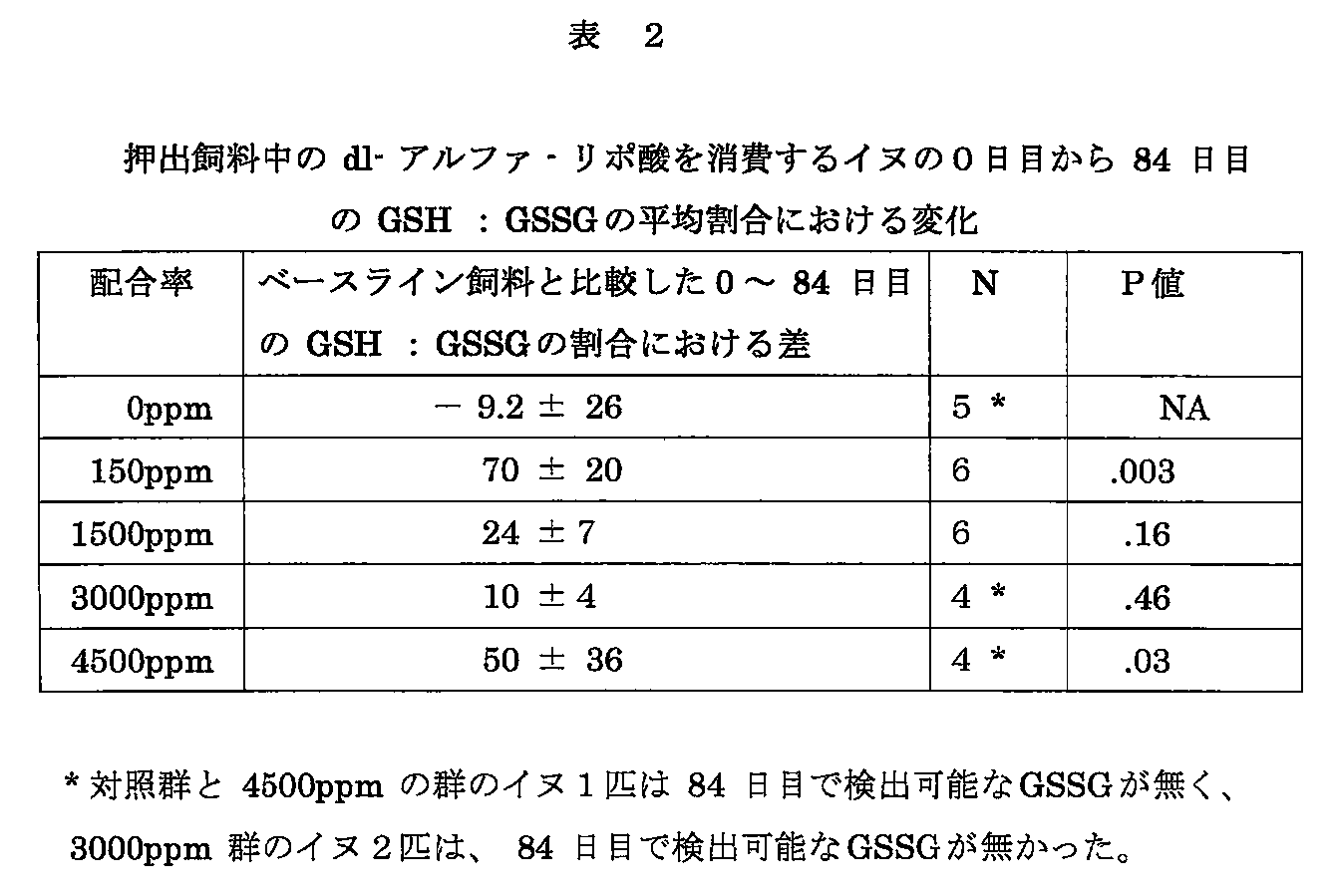
GSH:GSSG比
給餌84日間にわたるGSH:GSSG比における変化は、食餌の顕著な全体効果(P=.024)を示し、栄養補助群では全てその割合が増加した(表2)。ANOVAによって、最少配合量及び最高配合量に関し基礎飼料と比較して、有意差が明らかになったが、最大の数値上昇は最少配合量レベルの場合であった。則ち、最大配合量及び最少配合量に関するGSH:GSSGの比における変異は、基礎飼料において同一期間にわたって知見された変化とはかなり異なっていた。これら(対照群で1点、処理群で3点)のどのサンプルにおいても、GSSGは検出不可能であったので、4つの点に関して84日目では割合は決定できなかった。従って、本アッセイが84日目で低レベルのGSSG検出するのに十分に感受性であったならば、栄養補助群の値で、高い割合のGSH:GSSGを示せただろう。
GSH: GSSG ratio Changes in the GSH: GSSG ratio over the 84 days of feeding showed a significant overall effect of diet (P = .024), all increased in the dietary supplement group (Table 2). ANOVA revealed a significant difference with respect to the minimum and maximum formulation compared to the basic feed, but the largest numerical increase was at the minimum formulation level. That is, the variation in the GSH: GSSG ratio for the maximum and minimum loadings was significantly different from the changes found in the basal diet over the same period. No GSSG could be detected in any of these samples (1 point in the control group, 3 points in the treatment group), so no proportion could be determined on day 84 for 4 points. Thus, if this assay was sensitive enough to detect low levels of GSSG at day 84, the dietary supplement values would have shown a high percentage of GSH: GSSG.
アルファ-リポ酸に関しては、さらに知見が応用可能である。アルファ-リポ酸を食餌中で長期給餌することは、安全且つ効果的である。アルファリポ酸は、低グルタチオン(GSH)対酸化グルタチオン(GSSG)比を向上させる。食餌中でのアルファ-リポ酸の長期投与は、最短でも1、2、3、4、5または6ヶ月から1、2、3、4、5年またはそれ以上、動物の一生涯にわたって実施することができるだろう。アルファ-リポ酸は、カプセル封入など、食餌の中で特別に保護する必要なく機能することができ、たとえば錠剤、ピル、カプセルなどの医薬品で使用されているような単位剤形で食餌中に配合する必要がない。リポ酸は、最少で約25、50、75または100ppmで食餌中に提供する。最高範囲はその毒性レベル未満であり、約400、300または200ppmまで様々である。通常、1日当たり約6または7mg/動物体重kgを超えず、より通常には約5mg/kgを超えない。このアルファ-リポ酸は酸化防止剤の防衛力を高めるだけでなく、動物の酸化的損傷に耐える能力をも向上させる。ビタミンE及びビタミンCなどの配合されている他の酸化防止剤の適量でも全て向上される。このことは、アルファ-リポ酸の作用は、ビタミンC及び/またはビタミンEの作用を超えているということを実証している。 More knowledge can be applied regarding alpha-lipoic acid. Long-term feeding of alpha-lipoic acid in the diet is safe and effective. Alpha lipoic acid improves the low glutathione (GSH) to oxidized glutathione (GSSG) ratio. Long-term administration of alpha-lipoic acid in the diet should be carried out over the life of the animal for a minimum of 1, 2, 3, 4, 5 or 6 months to 1, 2, 3, 4, 5 years or more Will be able to. Alpha-lipoic acid can function without the need for special protection in the diet, such as encapsulation, and is incorporated into the diet in unit dosage forms such as those used in pharmaceutical products such as tablets, pills, capsules, etc. There is no need to do. Lipoic acid is provided in the diet at a minimum of about 25, 50, 75 or 100 ppm. The highest range is below its toxicity level and varies up to about 400, 300 or 200 ppm. Usually, no more than about 6 or 7 mg / kg animal body weight per day, more usually no more than about 5 mg / kg. This alpha-lipoic acid not only increases the defense of antioxidants, but also increases the animal's ability to withstand oxidative damage. Even the appropriate amount of other antioxidants such as vitamin E and vitamin C is improved. This demonstrates that the action of alpha-lipoic acid exceeds that of vitamin C and / or vitamin E.
Claims (38)
Applications Claiming Priority (4)
| Application Number | Priority Date | Filing Date | Title |
|---|---|---|---|
| US24451000P | 2000-10-31 | 2000-10-31 | |
| US25344700P | 2000-11-28 | 2000-11-28 | |
| US09/922,632 US20020076469A1 (en) | 2000-10-31 | 2001-08-06 | Composition and method |
| US09/978,127 US20020115710A1 (en) | 2000-10-31 | 2001-10-16 | Composition and method |
Related Parent Applications (1)
| Application Number | Title | Priority Date | Filing Date |
|---|---|---|---|
| JP2002547325A Division JP2004520022A (en) | 2000-10-31 | 2001-10-30 | Compositions and methods |
Publications (1)
| Publication Number | Publication Date |
|---|---|
| JP2010142237A true JP2010142237A (en) | 2010-07-01 |
Family
ID=42563314
Family Applications (1)
| Application Number | Title | Priority Date | Filing Date |
|---|---|---|---|
| JP2010008205A Ceased JP2010142237A (en) | 2000-10-31 | 2010-01-18 | Composition and method |
Country Status (1)
| Country | Link |
|---|---|
| JP (1) | JP2010142237A (en) |
Citations (2)
| Publication number | Priority date | Publication date | Assignee | Title |
|---|---|---|---|---|
| WO2000011968A1 (en) * | 1998-09-01 | 2000-03-09 | Sigma-Tau Healthscience S.P.A. | ANTIOXIDANT COMPOSITION COMPRISING ACETYL L-CARNITINE AND α-LIPOIC ACID |
| WO2000044375A1 (en) * | 1999-01-29 | 2000-08-03 | Mars Uk Limited | Antioxidant compositions and methods for companion animals |
-
2010
- 2010-01-18 JP JP2010008205A patent/JP2010142237A/en not_active Ceased
Patent Citations (2)
| Publication number | Priority date | Publication date | Assignee | Title |
|---|---|---|---|---|
| WO2000011968A1 (en) * | 1998-09-01 | 2000-03-09 | Sigma-Tau Healthscience S.P.A. | ANTIOXIDANT COMPOSITION COMPRISING ACETYL L-CARNITINE AND α-LIPOIC ACID |
| WO2000044375A1 (en) * | 1999-01-29 | 2000-08-03 | Mars Uk Limited | Antioxidant compositions and methods for companion animals |
Similar Documents
| Publication | Publication Date | Title |
|---|---|---|
| JP2007202565A (en) | Composition and method | |
| US8592478B2 (en) | Antioxidant-containing food composition | |
| AU2007216836B2 (en) | Composition and method | |
| US8592479B2 (en) | Antioxidant-containing food composition for use in enhancing antiviral immunity in companion animals | |
| US20090156658A1 (en) | Antioxidant-Containing Food Composition For Use In Inhibiting Histamine Pathways In Companion Animals | |
| US20020076469A1 (en) | Composition and method | |
| JP2010142237A (en) | Composition and method | |
| AU2007216796B2 (en) | Composition and method | |
| AU2002241634B2 (en) | Aged companion pet diet | |
| AU2002241634A1 (en) | Aged companion pet diet | |
| ZA200303739B (en) | Pet food composition and method. |
Legal Events
| Date | Code | Title | Description |
|---|---|---|---|
| A131 | Notification of reasons for refusal |
Free format text: JAPANESE INTERMEDIATE CODE: A131 Effective date: 20120906 |
|
| A601 | Written request for extension of time |
Free format text: JAPANESE INTERMEDIATE CODE: A601 Effective date: 20121205 |
|
| A602 | Written permission of extension of time |
Free format text: JAPANESE INTERMEDIATE CODE: A602 Effective date: 20121210 |
|
| A601 | Written request for extension of time |
Free format text: JAPANESE INTERMEDIATE CODE: A601 Effective date: 20130104 |
|
| A602 | Written permission of extension of time |
Free format text: JAPANESE INTERMEDIATE CODE: A602 Effective date: 20130109 |
|
| A521 | Written amendment |
Free format text: JAPANESE INTERMEDIATE CODE: A523 Effective date: 20130206 |
|
| A131 | Notification of reasons for refusal |
Free format text: JAPANESE INTERMEDIATE CODE: A131 Effective date: 20131004 |
|
| A601 | Written request for extension of time |
Free format text: JAPANESE INTERMEDIATE CODE: A601 Effective date: 20131226 |
|
| A602 | Written permission of extension of time |
Free format text: JAPANESE INTERMEDIATE CODE: A602 Effective date: 20140107 |
|
| A02 | Decision of refusal |
Free format text: JAPANESE INTERMEDIATE CODE: A02 Effective date: 20140818 |
|
| A521 | Written amendment |
Free format text: JAPANESE INTERMEDIATE CODE: A523 Effective date: 20141217 |
|
| A911 | Transfer of reconsideration by examiner before appeal (zenchi) |
Free format text: JAPANESE INTERMEDIATE CODE: A911 Effective date: 20150130 |
|
| A912 | Removal of reconsideration by examiner before appeal (zenchi) |
Free format text: JAPANESE INTERMEDIATE CODE: A912 Effective date: 20150403 |
|
| A521 | Written amendment |
Free format text: JAPANESE INTERMEDIATE CODE: A523 Effective date: 20151008 |
|
| A045 | Written measure of dismissal of application |
Free format text: JAPANESE INTERMEDIATE CODE: A045 Effective date: 20160421 |