JP2005515216A - Quinazolinone derivatives - Google Patents
Quinazolinone derivatives Download PDFInfo
- Publication number
- JP2005515216A JP2005515216A JP2003556396A JP2003556396A JP2005515216A JP 2005515216 A JP2005515216 A JP 2005515216A JP 2003556396 A JP2003556396 A JP 2003556396A JP 2003556396 A JP2003556396 A JP 2003556396A JP 2005515216 A JP2005515216 A JP 2005515216A
- Authority
- JP
- Japan
- Prior art keywords
- group
- compound
- cyclo
- disease
- optionally substituted
- Prior art date
- Legal status (The legal status is an assumption and is not a legal conclusion. Google has not performed a legal analysis and makes no representation as to the accuracy of the status listed.)
- Withdrawn
Links
Classifications
-
- C—CHEMISTRY; METALLURGY
- C07—ORGANIC CHEMISTRY
- C07D—HETEROCYCLIC COMPOUNDS
- C07D401/00—Heterocyclic compounds containing two or more hetero rings, having nitrogen atoms as the only ring hetero atoms, at least one ring being a six-membered ring with only one nitrogen atom
- C07D401/02—Heterocyclic compounds containing two or more hetero rings, having nitrogen atoms as the only ring hetero atoms, at least one ring being a six-membered ring with only one nitrogen atom containing two hetero rings
- C07D401/04—Heterocyclic compounds containing two or more hetero rings, having nitrogen atoms as the only ring hetero atoms, at least one ring being a six-membered ring with only one nitrogen atom containing two hetero rings directly linked by a ring-member-to-ring-member bond
-
- A—HUMAN NECESSITIES
- A61—MEDICAL OR VETERINARY SCIENCE; HYGIENE
- A61P—SPECIFIC THERAPEUTIC ACTIVITY OF CHEMICAL COMPOUNDS OR MEDICINAL PREPARATIONS
- A61P1/00—Drugs for disorders of the alimentary tract or the digestive system
- A61P1/04—Drugs for disorders of the alimentary tract or the digestive system for ulcers, gastritis or reflux esophagitis, e.g. antacids, inhibitors of acid secretion, mucosal protectants
-
- A—HUMAN NECESSITIES
- A61—MEDICAL OR VETERINARY SCIENCE; HYGIENE
- A61P—SPECIFIC THERAPEUTIC ACTIVITY OF CHEMICAL COMPOUNDS OR MEDICINAL PREPARATIONS
- A61P17/00—Drugs for dermatological disorders
-
- A—HUMAN NECESSITIES
- A61—MEDICAL OR VETERINARY SCIENCE; HYGIENE
- A61P—SPECIFIC THERAPEUTIC ACTIVITY OF CHEMICAL COMPOUNDS OR MEDICINAL PREPARATIONS
- A61P17/00—Drugs for dermatological disorders
- A61P17/02—Drugs for dermatological disorders for treating wounds, ulcers, burns, scars, keloids, or the like
-
- A—HUMAN NECESSITIES
- A61—MEDICAL OR VETERINARY SCIENCE; HYGIENE
- A61P—SPECIFIC THERAPEUTIC ACTIVITY OF CHEMICAL COMPOUNDS OR MEDICINAL PREPARATIONS
- A61P19/00—Drugs for skeletal disorders
- A61P19/02—Drugs for skeletal disorders for joint disorders, e.g. arthritis, arthrosis
-
- A—HUMAN NECESSITIES
- A61—MEDICAL OR VETERINARY SCIENCE; HYGIENE
- A61P—SPECIFIC THERAPEUTIC ACTIVITY OF CHEMICAL COMPOUNDS OR MEDICINAL PREPARATIONS
- A61P19/00—Drugs for skeletal disorders
- A61P19/08—Drugs for skeletal disorders for bone diseases, e.g. rachitism, Paget's disease
- A61P19/10—Drugs for skeletal disorders for bone diseases, e.g. rachitism, Paget's disease for osteoporosis
-
- A—HUMAN NECESSITIES
- A61—MEDICAL OR VETERINARY SCIENCE; HYGIENE
- A61P—SPECIFIC THERAPEUTIC ACTIVITY OF CHEMICAL COMPOUNDS OR MEDICINAL PREPARATIONS
- A61P21/00—Drugs for disorders of the muscular or neuromuscular system
- A61P21/04—Drugs for disorders of the muscular or neuromuscular system for myasthenia gravis
-
- A—HUMAN NECESSITIES
- A61—MEDICAL OR VETERINARY SCIENCE; HYGIENE
- A61P—SPECIFIC THERAPEUTIC ACTIVITY OF CHEMICAL COMPOUNDS OR MEDICINAL PREPARATIONS
- A61P25/00—Drugs for disorders of the nervous system
-
- A—HUMAN NECESSITIES
- A61—MEDICAL OR VETERINARY SCIENCE; HYGIENE
- A61P—SPECIFIC THERAPEUTIC ACTIVITY OF CHEMICAL COMPOUNDS OR MEDICINAL PREPARATIONS
- A61P25/00—Drugs for disorders of the nervous system
- A61P25/04—Centrally acting analgesics, e.g. opioids
-
- A—HUMAN NECESSITIES
- A61—MEDICAL OR VETERINARY SCIENCE; HYGIENE
- A61P—SPECIFIC THERAPEUTIC ACTIVITY OF CHEMICAL COMPOUNDS OR MEDICINAL PREPARATIONS
- A61P25/00—Drugs for disorders of the nervous system
- A61P25/08—Antiepileptics; Anticonvulsants
-
- A—HUMAN NECESSITIES
- A61—MEDICAL OR VETERINARY SCIENCE; HYGIENE
- A61P—SPECIFIC THERAPEUTIC ACTIVITY OF CHEMICAL COMPOUNDS OR MEDICINAL PREPARATIONS
- A61P25/00—Drugs for disorders of the nervous system
- A61P25/14—Drugs for disorders of the nervous system for treating abnormal movements, e.g. chorea, dyskinesia
- A61P25/16—Anti-Parkinson drugs
-
- A—HUMAN NECESSITIES
- A61—MEDICAL OR VETERINARY SCIENCE; HYGIENE
- A61P—SPECIFIC THERAPEUTIC ACTIVITY OF CHEMICAL COMPOUNDS OR MEDICINAL PREPARATIONS
- A61P25/00—Drugs for disorders of the nervous system
- A61P25/28—Drugs for disorders of the nervous system for treating neurodegenerative disorders of the central nervous system, e.g. nootropic agents, cognition enhancers, drugs for treating Alzheimer's disease or other forms of dementia
-
- A—HUMAN NECESSITIES
- A61—MEDICAL OR VETERINARY SCIENCE; HYGIENE
- A61P—SPECIFIC THERAPEUTIC ACTIVITY OF CHEMICAL COMPOUNDS OR MEDICINAL PREPARATIONS
- A61P3/00—Drugs for disorders of the metabolism
- A61P3/08—Drugs for disorders of the metabolism for glucose homeostasis
-
- A—HUMAN NECESSITIES
- A61—MEDICAL OR VETERINARY SCIENCE; HYGIENE
- A61P—SPECIFIC THERAPEUTIC ACTIVITY OF CHEMICAL COMPOUNDS OR MEDICINAL PREPARATIONS
- A61P3/00—Drugs for disorders of the metabolism
- A61P3/08—Drugs for disorders of the metabolism for glucose homeostasis
- A61P3/10—Drugs for disorders of the metabolism for glucose homeostasis for hyperglycaemia, e.g. antidiabetics
-
- A—HUMAN NECESSITIES
- A61—MEDICAL OR VETERINARY SCIENCE; HYGIENE
- A61P—SPECIFIC THERAPEUTIC ACTIVITY OF CHEMICAL COMPOUNDS OR MEDICINAL PREPARATIONS
- A61P31/00—Antiinfectives, i.e. antibiotics, antiseptics, chemotherapeutics
- A61P31/04—Antibacterial agents
-
- A—HUMAN NECESSITIES
- A61—MEDICAL OR VETERINARY SCIENCE; HYGIENE
- A61P—SPECIFIC THERAPEUTIC ACTIVITY OF CHEMICAL COMPOUNDS OR MEDICINAL PREPARATIONS
- A61P31/00—Antiinfectives, i.e. antibiotics, antiseptics, chemotherapeutics
- A61P31/12—Antivirals
- A61P31/14—Antivirals for RNA viruses
- A61P31/18—Antivirals for RNA viruses for HIV
-
- A—HUMAN NECESSITIES
- A61—MEDICAL OR VETERINARY SCIENCE; HYGIENE
- A61P—SPECIFIC THERAPEUTIC ACTIVITY OF CHEMICAL COMPOUNDS OR MEDICINAL PREPARATIONS
- A61P35/00—Antineoplastic agents
-
- A—HUMAN NECESSITIES
- A61—MEDICAL OR VETERINARY SCIENCE; HYGIENE
- A61P—SPECIFIC THERAPEUTIC ACTIVITY OF CHEMICAL COMPOUNDS OR MEDICINAL PREPARATIONS
- A61P37/00—Drugs for immunological or allergic disorders
-
- A—HUMAN NECESSITIES
- A61—MEDICAL OR VETERINARY SCIENCE; HYGIENE
- A61P—SPECIFIC THERAPEUTIC ACTIVITY OF CHEMICAL COMPOUNDS OR MEDICINAL PREPARATIONS
- A61P43/00—Drugs for specific purposes, not provided for in groups A61P1/00-A61P41/00
-
- A—HUMAN NECESSITIES
- A61—MEDICAL OR VETERINARY SCIENCE; HYGIENE
- A61P—SPECIFIC THERAPEUTIC ACTIVITY OF CHEMICAL COMPOUNDS OR MEDICINAL PREPARATIONS
- A61P9/00—Drugs for disorders of the cardiovascular system
- A61P9/10—Drugs for disorders of the cardiovascular system for treating ischaemic or atherosclerotic diseases, e.g. antianginal drugs, coronary vasodilators, drugs for myocardial infarction, retinopathy, cerebrovascula insufficiency, renal arteriosclerosis
-
- C—CHEMISTRY; METALLURGY
- C07—ORGANIC CHEMISTRY
- C07D—HETEROCYCLIC COMPOUNDS
- C07D239/00—Heterocyclic compounds containing 1,3-diazine or hydrogenated 1,3-diazine rings
- C07D239/70—Heterocyclic compounds containing 1,3-diazine or hydrogenated 1,3-diazine rings condensed with carbocyclic rings or ring systems
- C07D239/72—Quinazolines; Hydrogenated quinazolines
- C07D239/86—Quinazolines; Hydrogenated quinazolines with hetero atoms directly attached in position 4
- C07D239/88—Oxygen atoms
-
- C—CHEMISTRY; METALLURGY
- C07—ORGANIC CHEMISTRY
- C07D—HETEROCYCLIC COMPOUNDS
- C07D239/00—Heterocyclic compounds containing 1,3-diazine or hydrogenated 1,3-diazine rings
- C07D239/70—Heterocyclic compounds containing 1,3-diazine or hydrogenated 1,3-diazine rings condensed with carbocyclic rings or ring systems
- C07D239/72—Quinazolines; Hydrogenated quinazolines
- C07D239/95—Quinazolines; Hydrogenated quinazolines with hetero atoms directly attached in positions 2 and 4
-
- C—CHEMISTRY; METALLURGY
- C07—ORGANIC CHEMISTRY
- C07D—HETEROCYCLIC COMPOUNDS
- C07D401/00—Heterocyclic compounds containing two or more hetero rings, having nitrogen atoms as the only ring hetero atoms, at least one ring being a six-membered ring with only one nitrogen atom
- C07D401/02—Heterocyclic compounds containing two or more hetero rings, having nitrogen atoms as the only ring hetero atoms, at least one ring being a six-membered ring with only one nitrogen atom containing two hetero rings
- C07D401/06—Heterocyclic compounds containing two or more hetero rings, having nitrogen atoms as the only ring hetero atoms, at least one ring being a six-membered ring with only one nitrogen atom containing two hetero rings linked by a carbon chain containing only aliphatic carbon atoms
-
- C—CHEMISTRY; METALLURGY
- C07—ORGANIC CHEMISTRY
- C07D—HETEROCYCLIC COMPOUNDS
- C07D401/00—Heterocyclic compounds containing two or more hetero rings, having nitrogen atoms as the only ring hetero atoms, at least one ring being a six-membered ring with only one nitrogen atom
- C07D401/02—Heterocyclic compounds containing two or more hetero rings, having nitrogen atoms as the only ring hetero atoms, at least one ring being a six-membered ring with only one nitrogen atom containing two hetero rings
- C07D401/08—Heterocyclic compounds containing two or more hetero rings, having nitrogen atoms as the only ring hetero atoms, at least one ring being a six-membered ring with only one nitrogen atom containing two hetero rings linked by a carbon chain containing alicyclic rings
-
- C—CHEMISTRY; METALLURGY
- C07—ORGANIC CHEMISTRY
- C07D—HETEROCYCLIC COMPOUNDS
- C07D401/00—Heterocyclic compounds containing two or more hetero rings, having nitrogen atoms as the only ring hetero atoms, at least one ring being a six-membered ring with only one nitrogen atom
- C07D401/02—Heterocyclic compounds containing two or more hetero rings, having nitrogen atoms as the only ring hetero atoms, at least one ring being a six-membered ring with only one nitrogen atom containing two hetero rings
- C07D401/12—Heterocyclic compounds containing two or more hetero rings, having nitrogen atoms as the only ring hetero atoms, at least one ring being a six-membered ring with only one nitrogen atom containing two hetero rings linked by a chain containing hetero atoms as chain links
-
- C—CHEMISTRY; METALLURGY
- C07—ORGANIC CHEMISTRY
- C07D—HETEROCYCLIC COMPOUNDS
- C07D401/00—Heterocyclic compounds containing two or more hetero rings, having nitrogen atoms as the only ring hetero atoms, at least one ring being a six-membered ring with only one nitrogen atom
- C07D401/14—Heterocyclic compounds containing two or more hetero rings, having nitrogen atoms as the only ring hetero atoms, at least one ring being a six-membered ring with only one nitrogen atom containing three or more hetero rings
Landscapes
- Health & Medical Sciences (AREA)
- Organic Chemistry (AREA)
- Chemical & Material Sciences (AREA)
- Life Sciences & Earth Sciences (AREA)
- Medicinal Chemistry (AREA)
- General Chemical & Material Sciences (AREA)
- Engineering & Computer Science (AREA)
- Nuclear Medicine, Radiotherapy & Molecular Imaging (AREA)
- Chemical Kinetics & Catalysis (AREA)
- Pharmacology & Pharmacy (AREA)
- Bioinformatics & Cheminformatics (AREA)
- Animal Behavior & Ethology (AREA)
- General Health & Medical Sciences (AREA)
- Public Health (AREA)
- Veterinary Medicine (AREA)
- Neurology (AREA)
- Biomedical Technology (AREA)
- Neurosurgery (AREA)
- Physical Education & Sports Medicine (AREA)
- Diabetes (AREA)
- Orthopedic Medicine & Surgery (AREA)
- Rheumatology (AREA)
- Immunology (AREA)
- Emergency Medicine (AREA)
- Hematology (AREA)
- Obesity (AREA)
- Dermatology (AREA)
- Virology (AREA)
- Endocrinology (AREA)
- Communicable Diseases (AREA)
- Oncology (AREA)
- Pain & Pain Management (AREA)
- Cardiology (AREA)
- AIDS & HIV (AREA)
- Tropical Medicine & Parasitology (AREA)
- Psychology (AREA)
- Hospice & Palliative Care (AREA)
- Psychiatry (AREA)
- Heart & Thoracic Surgery (AREA)
- Vascular Medicine (AREA)
Abstract
式
【化1】
[式中、R1は置換された環状アミノ基または任意に置換されたアミノ基、
R2は置換基、
nは0ないし4の整数、
L1は(1)シクロ(低級)アルキレン基、(2)シクロ(低級)アルケニレン基、(3)1個またはそれ以上の窒素原子を有する飽和または不飽和単環基のジラジカルであって、前記単環基から1個の水素原子を除去した後に得られもの、または(4)−N(R3)−L2−(式中、R3は水素または低級アルキル基、L2は低級アルキレン基または低級アルケニレン基)、
をそれぞれ意味する。]
で表され、ポリ(アデノシン5’−ジホスホ−リボース)ポリメラーゼ(PARP)阻害活性を有するキナゾリノン誘導体またはそのプロドラッグまたはその塩。Formula
[Wherein R 1 represents a substituted cyclic amino group or an optionally substituted amino group,
R 2 is a substituent,
n is an integer from 0 to 4,
L 1 is a diradical of (1) a cyclo (lower) alkylene group, (2) a cyclo (lower) alkenylene group, (3) a saturated or unsaturated monocyclic group having one or more nitrogen atoms, What is obtained after removing one hydrogen atom from a monocyclic group, or (4) -N (R 3 ) -L 2- (wherein R 3 is hydrogen or a lower alkyl group, L 2 is a lower alkylene group) Or a lower alkenylene group),
Means each. ]
And a quinazolinone derivative having a poly (adenosine 5′-diphospho-ribose) polymerase (PARP) inhibitory activity or a prodrug or a salt thereof.
Description
本発明は、薬理活性を有する新規キナゾリノン誘導体、それらの製造法ならびにそれらを含有する医薬組成物に関する。 The present invention relates to novel quinazolinone derivatives having pharmacological activity, methods for producing them, and pharmaceutical compositions containing them.
ポリ(アデノシン5’−ジファスホ−リボース)ポリメラーゼ[「ポリ(ADPリボース)ポリメラーゼ」すなわち「PARP」、「ポリ(ADPリボース)シンセターゼ」としては「PARS」と呼ばれることもある]は、筋肉、心臓および脳の細胞などの種々の器官の細胞の核にある酵素である。PARPはDNAの鎖切断の修復に生理的役割を果たす。損傷したDNA断片によって一旦活性化されると、PARPは、最高100個のADPリボースをヒストンおよびPARP自体などの種々の核タンパク質に連結するように触媒作用を及ぼす。 Poly (adenosine 5′-diphospho-ribose) polymerase [“poly (ADP ribose) polymerase” or “PARP”, sometimes referred to as “PARS” as “poly (ADP ribose) synthetase”) is the muscle, heart and It is an enzyme in the nucleus of cells of various organs such as brain cells. PARP plays a physiological role in repairing DNA strand breaks. Once activated by damaged DNA fragments, PARP catalyzes linking up to 100 ADP riboses to various nucleoproteins such as histones and PARP itself.
PARP阻害活性を有するいくつかのキナゾリノン誘導体が、たとえばWO95/24379、WO98/33802およびWO99/11624において既知となっている。 Several quinazolinone derivatives having PARP inhibitory activity are known, for example in WO95 / 24379, WO98 / 33802 and WO99 / 11624.
本発明は、PARP阻害活性などの薬理活性を有する新規キナゾリノン化合物、それらの製造方法、それらを含有する医薬組成物、ならびにそれらの用途に関する。 The present invention relates to novel quinazolinone compounds having pharmacological activity such as PARP inhibitory activity, methods for producing them, pharmaceutical compositions containing them, and uses thereof.
本発明の一つの目的は、PARP阻害活性を有する新規キナゾリノン化合物を提供することである。 One object of the present invention is to provide a novel quinazolinone compound having PARP inhibitory activity.
本発明の他の目的は、キナゾリノン化合物の製造法を提供することである。 Another object of the present invention is to provide a method for producing a quinazolinone compound.
本発明のさらに他の目的は、キナゾリノン化合物を有効成分として含有する医薬組成物を提供することである。 Still another object of the present invention is to provide a pharmaceutical composition containing a quinazolinone compound as an active ingredient.
本発明のいま一つの目的は、キナゾリノン化合物の、種々の疾患を治療または予防するための医薬の製造への利用を提供する、またはPARP活性を阻害するに有効な量のキナゾリノン化合物を投与することによって種々の疾患を治療または予防するための方法を提供することである。 Another object of the present invention is to provide use of a quinazolinone compound in the manufacture of a medicament for treating or preventing various diseases, or to administer an amount of a quinazolinone compound effective to inhibit PARP activity. To provide a method for treating or preventing various diseases.
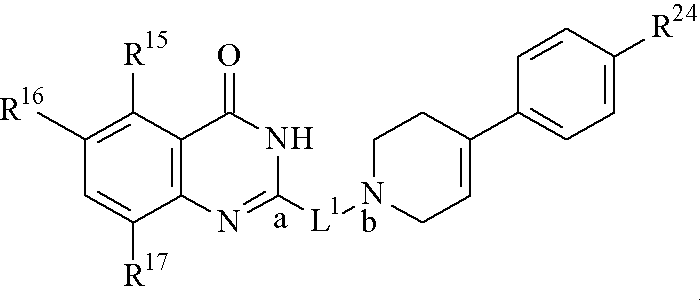
本発明のキナゾリノン化合物は下記の式(I) The quinazolinone compound of the present invention has the following formula (I)
[式中、R1は置換された環状アミノ基、任意に置換された炭素環基または任意に置換されたアミノ基、
R2は置換基、
nは0ないし4の整数、
L1は(1)シクロ(低級)アルキレン基、(2)シクロ(低級)アルケニレン基、(3)1個またはそれ以上の窒素原子を有する飽和または不飽和単環基のジラジカルであって、前記単環基から1個の水素原子を除去した後に得られるもの、または(4)−N(R3)−L2−(式中、R3は水素または低級アルキル基、L2は低級アルキレン基または低級アルケニレン基)、
をそれぞれ意味する。]
で表される化合物またはそのプロドラッグまたはその塩。
[Wherein R 1 represents a substituted cyclic amino group, an optionally substituted carbocyclic group or an optionally substituted amino group,
R 2 is a substituent,
n is an integer from 0 to 4,
L 1 is a diradical of (1) a cyclo (lower) alkylene group, (2) a cyclo (lower) alkenylene group, (3) a saturated or unsaturated monocyclic group having one or more nitrogen atoms, What is obtained after removing one hydrogen atom from a monocyclic group, or (4) -N (R 3 ) -L 2- (wherein R 3 is hydrogen or a lower alkyl group, L 2 is a lower alkylene group) Or a lower alkenylene group),
Means each. ]
Or a prodrug or salt thereof.
化合物(I)またはそのプロドラッグまたはその塩は、下記の方法によって製造することができる。下記の式において、化合物はプロドラッグまたはそれらの塩であってもよい。 Compound (I) or a prodrug or salt thereof can be produced by the following method. In the following formula, the compound may be a prodrug or a salt thereof.
製造法1Manufacturing method 1
[式中、R1、R2、nおよびL1はそれぞれ前記定義の通りである.]
この製造法において、化合物(I)またはその塩は、塩基、たとえば無機塩基、たとえばアルカリ金属[たとえばナトリウムまたはカリウム]、そのアルコキシド、水酸化物、炭酸塩または重炭酸塩、または有機塩基、たとえばトリアルキルアミン[たとえばトリメチルアミンまたはトリエチルアミン]などの存在下で、化合物(II)を環化反応に付すことによって製造することができる。
[Wherein R 1 , R 2 , n and L 1 are as defined above. ]
In this process, compound (I) or a salt thereof is a base, such as an inorganic base, such as an alkali metal [such as sodium or potassium], an alkoxide, hydroxide, carbonate or bicarbonate, or an organic base such as It can be produced by subjecting compound (II) to a cyclization reaction in the presence of an alkylamine [for example, trimethylamine or triethylamine].
この反応は、通常、慣用の溶媒、たとえば水、アルコール(たとえばメタノール、エタノールまたはイソプロピルアルコール)、エーテル、テトラヒドロフラン、ジオキサン、ジエチルエーテル、アミド(たとえばN,N−ジメチルホルムアミド、N,N−ジメチルアセトアミド)、ニトリル(たとえばアセトニトリル)、または反応に悪影響を及ぼさない他の有機溶媒中で行われる。反応温度は特に限定されず、反応は、通常、冷却ないし加熱下で行うことができる。 This reaction is usually carried out in a conventional solvent such as water, alcohol (eg methanol, ethanol or isopropyl alcohol), ether, tetrahydrofuran, dioxane, diethyl ether, amide (eg N, N-dimethylformamide, N, N-dimethylacetamide). , Nitriles (eg acetonitrile), or other organic solvents that do not adversely affect the reaction. The reaction temperature is not particularly limited, and the reaction can usually be carried out under cooling or heating.
製造法2Manufacturing method 2
[式中、Xは脱離基、 [Wherein X is a leaving group,
は1個またはそれ以上の窒素原子を有する飽和または不飽和単環基であり、
R1およびnはそれぞれ前記定義の通りである。]
この製造法において、化合物(I−a)またはその塩は、塩基、たとえば無機塩基、たとえばアルカリ金属[たとえばナトリウムまたはカリウム]、そのアルコキシド、水酸化物、炭酸塩または重炭酸塩、または有機塩基、たとえばトリアルキルアミン[たとえばトリメチルアミンまたはトリエチルアミン]などの存在下で、化合物(III)またはその塩を化合物(VI)またはその塩と反応させることによって製造することができる。
Is a saturated or unsaturated monocyclic group having one or more nitrogen atoms,
R 1 and n are each as defined above. ]
In this production method, compound (Ia) or a salt thereof is a base, such as an inorganic base, such as an alkali metal [eg, sodium or potassium], an alkoxide thereof, a hydroxide, carbonate or bicarbonate, or an organic base, For example, it can be produced by reacting compound (III) or a salt thereof with compound (VI) or a salt thereof in the presence of a trialkylamine [eg trimethylamine or triethylamine].
この反応は、通常、慣用の溶媒、たとえばアルコール(たとえばメタノール、エタノールまたはイソプロピルアルコール)、テトラヒドロフラン、ジオキサン、ジエチルエーテル、アミド(たとえばN,N−ジメチルホルムアミド、N,N−ジメチルアセトアミド)、ニトリル(アセトニトリル)、または反応に悪影響を及ぼさない他の有機溶媒中で行われる。反応温度は特に限定されず、反応は、通常、冷却ないし加熱下で行うことができる。 This reaction is usually carried out using conventional solvents such as alcohols (eg methanol, ethanol or isopropyl alcohol), tetrahydrofuran, dioxane, diethyl ether, amides (eg N, N-dimethylformamide, N, N-dimethylacetamide), nitriles (acetonitrile). Or in other organic solvents that do not adversely affect the reaction. The reaction temperature is not particularly limited, and the reaction can usually be carried out under cooling or heating.
本発明の化合物は、有機化合物の精製に用いられる慣用の精製方法、たとえば再結晶、カラムクロマトグラフィー、薄層クロマトグラフィー、高速液体クロマトグラフィーなどによって精製することができる。化合物は、NMRスペクトログラフィー、質量スペクトログラフィー、IRスペクトログラフィー、元素分析および融点測定などの慣用の方法によって同定することができる。 The compound of the present invention can be purified by a conventional purification method used for purification of organic compounds, for example, recrystallization, column chromatography, thin layer chromatography, high performance liquid chromatography and the like. The compounds can be identified by conventional methods such as NMR spectroscopy, mass spectrometry, IR spectroscopy, elemental analysis and melting point measurement.
出発化合物(II)またはその塩のいくつかは新規であり、既知の製造法またはそれに類似する製造法、たとえばJ.Med.Chem.1998,41,5247−5256およびJ.Org.Chem.,21,478−(1956)に記載の製造法にしたがって製造することができる。下記の製造法を例として示す。 Some of the starting compounds (II) or salts thereof are novel and are known or similar to the preparation methods such as J. Org. Med. Chem. 1998, 41, 5247-5256 and J.A. Org. Chem. , 21, 478- (1956). The following production method is shown as an example.
参考製造法1Reference manufacturing method 1
[式中、R1、R2、nおよびL1はそれぞれ前記定義の通りである。]
本発明の化合物(I)の好適な塩は、医薬として許容される慣用の無毒の塩であって、例としては、有機酸付加塩(たとえば蟻酸塩、酢酸塩、トリフルオロ酢酸塩、マレイン酸塩、酒石酸、シュウ酸塩、メタンスルホン酸塩、ベンゼンスルホン酸塩、トルエンスルホン酸塩など)、無機酸付加塩(たとえば塩酸塩、臭化水素酸塩、硫酸塩、リン酸塩など)、アミノ酸との塩(たとえばアスパラギン酸塩、グルタミン酸塩など)などを挙げることができる。
[Wherein, R 1 , R 2 , n and L 1 are as defined above. ]
Suitable salts of the compound (I) of the present invention are pharmaceutically acceptable conventional non-toxic salts such as organic acid addition salts (eg formate, acetate, trifluoroacetate, maleic acid). Salt, tartaric acid, oxalate, methanesulfonate, benzenesulfonate, toluenesulfonate, etc.), inorganic acid addition salts (eg hydrochloride, hydrobromide, sulfate, phosphate, etc.), amino acids And salts thereof (for example, aspartate, glutamate, etc.).
「プロドラッグ」は、生体変換後に医薬的に活性となる、化学的または代謝的に分解可能な基を有する本発明の化合物の誘導体を意味する。 “Prodrug” means a derivative of a compound of the invention having a chemically or metabolically degradable group that becomes pharmaceutically active after biotransformation.
本発明の化合物(I)は、1個またはそれ以上の非対称中心を有することがあり、それらは、鏡像体またはジアステレオ異性体として存在することができる。さらに、アルケニル基を有する化合物(I)のいくつかはシスまたはトランス異性体として存在することがある。各々の場合において、本発明は混合物および別個の異性体の両方を包含する。 The compounds (I) of the present invention may have one or more asymmetric centers, which can exist as enantiomers or diastereoisomers. Furthermore, some of the compounds (I) having an alkenyl group may exist as cis or trans isomers. In each case, the present invention includes both mixtures and separate isomers.
化合物(I)は、互変異形態で存在することもあり、本発明は混合物および別個の互変異性体の両方を包含する。 Compound (I) may exist in tautomeric forms and the invention includes both mixtures and separate tautomers.
化合物(I)またはその塩は、溶媒和の形態で存在することができ、それも本発明の範囲に含まれる。溶媒和としては、好ましくは水和物およびエタノレートが挙げられる。 Compound (I) or a salt thereof can exist in a solvated form, which is also included in the scope of the present invention. Solvates preferably include hydrates and ethanolates.
生物学的研究に好適な化合物(I)の放射能標識誘導体もまた本発明の範囲に含まれる。 Radiolabeled derivatives of compound (I) suitable for biological studies are also within the scope of the present invention.
本明細書の以上および以下の記述において、本発明の範囲に包含される種々の定義の好適な例および実例を次に詳細に説明する。 In the foregoing and following description of the present specification, preferred examples and examples of various definitions encompassed within the scope of the present invention are described in detail below.
「低級」とは、特記ない限り、炭素原子1ないし6個を有する基を意味する。 “Lower” means a group having 1 to 6 carbon atoms unless otherwise specified.
好適な「低級アルキル基」としては、炭素原子1ないし6個、特に1ないし2個を有する直鎖または分枝状アルキルを挙げることができる。好ましい例としては、メチル、エチル、プロピル、イソプロピル、ブチル、イソブチル、第三級ブチル、ペンチルおよびヘキシルを挙げることができる。 Suitable “lower alkyl groups” include straight-chain or branched alkyl having 1 to 6, especially 1 to 2 carbon atoms. Preferred examples include methyl, ethyl, propyl, isopropyl, butyl, isobutyl, tertiary butyl, pentyl and hexyl.
好適な「低級アルコキシ基」としては、炭素原子1ないし6個、特に1ないし2個を有する直鎖または分枝状アルコキシを挙げることができる。好ましい例としては、メトキシ、エトキシ、n−プロポキシ、イソプロポキシ、n−ブトキシ、イソブトキシ、第二級ブトキシおよび第三級ブトキシを挙げることができ、好ましいものとしては、メトキシを挙げることができる。 Suitable “lower alkoxy groups” include straight-chain or branched alkoxy having 1 to 6, in particular 1 to 2 carbon atoms. Preferable examples include methoxy, ethoxy, n-propoxy, isopropoxy, n-butoxy, isobutoxy, secondary butoxy and tertiary butoxy, and preferable examples include methoxy.
好適な「低級アルキルアミノ基」としては、モノ(低級)アルキルアミノおよびジ(低級)アルキルアミノを挙げることができる。好ましい例としては、メチルアミノ、ジメチルアミノ、エチルアミノ、ジメチルアミノ、n−プロピルアミノ、イソプロピルアミノ、n−ブチルアミノ、イソブチルアミノ、第二級ブチルアミノおよび第三級ブチルアミノを挙げることができ、好ましいものとしては、ジメチルアミノおよびジエチルアミノを挙げることができる。 Suitable “lower alkylamino groups” include mono (lower) alkylamino and di (lower) alkylamino. Preferred examples include methylamino, dimethylamino, ethylamino, dimethylamino, n-propylamino, isopropylamino, n-butylamino, isobutylamino, secondary butylamino and tertiary butylamino, Preferable examples include dimethylamino and diethylamino.
好適な「アリール基」は、好ましくは炭素原子6ないし12個を有する単環、二環または多環芳香基を意味し、例としては、フェニル、ナフチル、テトラヒドロナフチル、インデニル、インダニル(1,2−ジヒドロインデニル)、フルオレニルなどを挙げることができ、好ましいものとしては、フェニルまたはナフチルを挙げることができる。 A suitable “aryl group” means a monocyclic, bicyclic or polycyclic aromatic group, preferably having 6 to 12 carbon atoms, such as phenyl, naphthyl, tetrahydronaphthyl, indenyl, indanyl (1,2 -Dihydroindenyl), fluorenyl and the like can be mentioned, and preferable examples include phenyl or naphthyl.
「ハロゲン」は、フッ素、塩素、臭素またはヨウ素を意味する。 “Halogen” means fluorine, chlorine, bromine or iodine.
好適な「ハロ(低級)アルキル基」は、炭素原子を1ないし4個、特に1または2個、および同一または異なるハロゲン原子、好ましくはフッ素、塩素および臭素、特にフッ素および塩素を、1ないし9個、特に1ないし5個有する。好ましい例としては、トリフルオロメチル、トリクロロメチル、クロロジフルオロメチル、ジクロロフルオロメチル、クロロメチル、ブロモメチル、1−フルオロエチル、2−フルオロエチル、2,2−ジフルオロエチル、2,2,2−トリフルオロエチル、2,2,2−トリクロロエチルおよびペンタフルオロエチルを挙げることができ、好ましいものとしては、トリフルオロメチルを挙げることができる。 Suitable “halo (lower) alkyl groups” contain 1 to 4 carbon atoms, in particular 1 or 2, and the same or different halogen atoms, preferably fluorine, chlorine and bromine, in particular fluorine and chlorine, 1 to 9 Have 1 to 5, especially 1 to 5. Preferred examples include trifluoromethyl, trichloromethyl, chlorodifluoromethyl, dichlorofluoromethyl, chloromethyl, bromomethyl, 1-fluoroethyl, 2-fluoroethyl, 2,2-difluoroethyl, 2,2,2-trifluoro Ethyl, 2,2,2-trichloroethyl and pentafluoroethyl can be mentioned, and preferred is trifluoromethyl.
「炭素環基」はシクロ(低級)アルキルまたはシクロ(低級)アルケニルを意味する。 “Carbocyclic group” means cyclo (lower) alkyl or cyclo (lower) alkenyl.
「シクロ(低級)アルキレン」における好適な「シクロ(低級)アルキル基」および「シクロ(低級)アルキル部分」としては、炭素原子3ないし7個、特に5ないし6個を有する飽和炭素環基を挙げることができる。好ましい例としては、シクロプロピル、シクロブチル、シクロペンチル、シクロヘキシルおよびシクロヘプチルを挙げることができ、好ましいものとしては、シクロプロピルおよびシクロヘキシル(たとえば1,3−シクロへキシレン、1,4−シクロへキシレンなど)を挙げることができる。 Preferred “cyclo (lower) alkyl groups” and “cyclo (lower) alkyl moieties” in “cyclo (lower) alkylene” include saturated carbocyclic groups having 3 to 7, especially 5 to 6 carbon atoms. be able to. Preferred examples include cyclopropyl, cyclobutyl, cyclopentyl, cyclohexyl and cycloheptyl, and preferred are cyclopropyl and cyclohexyl (eg, 1,3-cyclohexylene, 1,4-cyclohexylene, etc.) Can be mentioned.
「シクロ(低級)アルケニレン」における好適な「シクロ(低級)アルケニル基」および「シクロ(低級)アルケニル部分」としては、炭素原子を3ないし7個、特に5ないし6個有する部分飽和炭素環基を挙げることができる。好ましい例としては、シクロプロペニル、シクロブテニル、シクロペンテニル、シクロヘキセニルおよびシクロヘプテニルを挙げることができ、好ましいものとしてはシクロペンテニルおよびシクロヘキセニルを挙げることができる。 Preferred “cyclo (lower) alkenyl group” and “cyclo (lower) alkenyl moiety” in “cyclo (lower) alkenylene” are partially saturated carbocyclic groups having 3 to 7, especially 5 to 6 carbon atoms. Can be mentioned. Preferable examples include cyclopropenyl, cyclobutenyl, cyclopentenyl, cyclohexenyl, and cycloheptenyl, and preferable examples include cyclopentenyl and cyclohexenyl.
「シクロ(低級)アルキレン基」の好ましい例としては、シクロペンテニレン(たとえば1,3−シクロシクロペント−1−エニレンなど)、シクロヘキセニレン(たとえば1,3−シクロヘックス−1−エニレンなど)を挙げることができる。 Preferred examples of the “cyclo (lower) alkylene group” include cyclopentenylene (for example, 1,3-cyclocyclopent-1-enylene and the like), cyclohexenylene (for example, 1,3-cyclohex-1-enylene and the like) ).
「ヘテロアリール(低級)アルキル」および「ヘテロ芳香族アシル」における好適な「ヘテロアリール基」および「ヘテロアリール」部分は、好ましくは1ないし3個のヘテロ原子、特に1または2個の同一または異なるヘテロ原子を有する5ないし7員環を意味する。ヘテロアリール中のヘテロ原子は、酸素、硫黄または窒素原子である。例としては、フリル、チエニル、ピラゾリル、イミダゾリル、トリアゾリル(たとえば1,2,3−および1,2,4−トリアゾリルなど)、イソオキサゾリル、チアゾリル、イソチアゾリル、オキサジアゾリル(たとえば1,3,4−および1,2,5−オキサジアゾリルなど)、アゼピニル、ピロリル、ピリジニル、ピペラジニル、ピリダジニル、ピリミジニル、ピラジニル、トリアジニル(たとえば1,3,5−、1,2,4−および1,2,3−トリアジニルなど)、オキサジニル(たとえば1,2,4−および1,2,6−オキサジニルなど)、オキセピニル、チエピニルおよびジアゼピニル(たとえば1,2,4−ジアゼピニルなど)を挙げることができ、好ましいものとしてはチエニル、ピラゾリル、イミダゾリル、チアゾリル、ピリジニルおよびピラジニルを挙げることができる。 Preferred “heteroaryl groups” and “heteroaryl” moieties in “heteroaryl (lower) alkyl” and “heteroaromatic acyl” are preferably 1 to 3 heteroatoms, especially 1 or 2 identical or different A 5- to 7-membered ring having a hetero atom is meant. A heteroatom in heteroaryl is an oxygen, sulfur or nitrogen atom. Examples include furyl, thienyl, pyrazolyl, imidazolyl, triazolyl (such as 1,2,3- and 1,2,4-triazolyl), isoxazolyl, thiazolyl, isothiazolyl, oxadiazolyl (such as 1,3,4, and 1, 2,5-oxadiazolyl etc.), azepinyl, pyrrolyl, pyridinyl, piperazinyl, pyridazinyl, pyrimidinyl, pyrazinyl, triazinyl (eg 1,3,5-, 1,2,4- and 1,2,3-triazinyl etc.), oxazinyl (For example, 1,2,4- and 1,2,6-oxazinyl, etc.), oxepinyl, thiepinyl and diazepinyl (for example, 1,2,4-diazepinyl, etc.) can be mentioned, and preferred are thienyl, pyrazolyl, imidazolyl. , Thiazoli , It can be mentioned pyridinyl and pyrazinyl.
好適な「環状アミノ基」としては、1個またはそれ以上の窒素原子をヘテロ原子として有するヘテロ芳香族または脂肪族環系であって、複素環は飽和または不飽和であり、一つの環系または数個の縮合環系であり、窒素、酸素、硫黄などのさらなるヘテロ原子を任意に含むことができる。環状アミノ基は、さらにスピロ環系または架橋環系をも意味する。環状アミノ基を形成する原子の数は限定されず、たとえば単環系の場合、3ないし8個の原子からなり、三環系の場合、7ないし11個の原子からなる。 Suitable “cyclic amino groups” are heteroaromatic or aliphatic ring systems having one or more nitrogen atoms as heteroatoms, wherein the heterocycle is saturated or unsaturated, and a single ring system or Several fused ring systems can optionally contain additional heteroatoms such as nitrogen, oxygen, sulfur. A cyclic amino group also means a spiro ring system or a bridged ring system. The number of atoms forming the cyclic amino group is not limited. For example, the monocyclic system consists of 3 to 8 atoms, and the tricyclic system consists of 7 to 11 atoms.
「環状アミノ基」の好ましい例としては下記のものを挙げることができる。
(1) ヘテロ原子として1個またはそれ以上の窒素原子を有する飽和単環基を有する環状アミノ基の例としては、アゼチジニル(3−アゼチジニル)、ピロリジニル(たとえば1−および3−ピロリジニルなど)、ピペリジル(たとえば1−および4−ピペリジルなど)、ホモピペリジノ(たとえばヘキサヒドロ−1H−アゼピン−1−イルなど)、ホモピペラジニル(たとえばヘキサヒドロ−1H−1,4−ジアゼピン−1−イルなど)、イミダゾリジニル(たとえば1−イミダゾリジニルなど)、ピペラジニル(たとえば1−ピペラジニルなど)、ペルヒドロピリミジニル(たとえばペルヒドロピリミジン−1−イルなど)およびジアザシクロヘプタニル(たとえば1,4−ジアザシクロヘプタン−1−イルなど);
(2) ヘテロ原子として1個またはそれ以上の窒素原子を有する不飽和単環基を有する環状アミノ基の例としては、ピロリニル(たとえば2−ピロリン−1−イルなど)、ピロリル(たとえば1−ピロリルなど)、テトラヒドロピリジニル(たとえば3,6−ジヒドロ−1(2H)−ピリジニルなど)、ピリジニル(たとえば2−ピリジニルなど)、テトラヒドロアゼピニル(たとえば2,3,6,7−テトラヒドロ−1H−アゼピン−1−イル、2,3,4,7−テトラヒドロ−1H−アゼピン−1−イルなど)、イミダゾリル(1−イミダゾリル)、ピラゾリル、トリアゾリル、テトラゾリル、テトラゾリル、ピリミジニル、ピラジニル、ピリダジニル、ジヒドロ−ピリダジニル(たとえば1,2−ジヒドロ−ピリダジン−1−イルなど)およびジヒドロ−ピリミジニル(たとえば1,2−ジヒドロ−ピリミジン−1−イルなど);
(3) ヘテロ原子として1ないし3個の窒素原子および1ないし2個の硫黄原子を有する飽和および不飽和単環基を有する環状アミノ基の例としては、チアゾリジニル(たとえば3−チアゾリジニルなど)、イソチアゾリニル(たとえば2−イソチアゾリニルなど)およびチオモルホリノ;
(4) ヘテロ原子として1ないし3個の窒素原子および1ないし2個の酸素原子を有する飽和および不飽和単環基を有する環状アミノ基の例としては、オキサゾリル、イソオキサゾリル、オキサジアゾリル(たとえば1,2,4−オキサジアゾリルおよび1,3,4−オキサジアゾリル)またはモルホリニル;
(5) 飽和および不飽和縮合環基を有する環状アミノ基の例としては、インドリル(たとえば1−インドリルなど)、ジヒドロベンゾイミダゾリル(たとえば1,2−ジヒドロベンゾイミダゾール−1−イルなど)、ペルヒドロピロロ[1,2−a]ピラジニル(たとえばペルヒドロピロロ[1,2−a]ピラジン−2−イルなど)、テトラヒドロベンゾ[f]イソキノリニル(たとえば1,4,5,6−テトラヒドロベンゾ[f]イソキノリン−3(2H)−イルなど)、ヘキサヒドロベンズ[f]イソキノリニル(たとえばシス−およびトランス−1,4,4a,5,6,10b−ヘキサヒドロベンズ[f]イソキノリン−3(2H)−イルなど)、テトラヒドロピリド[3,4−b]インドリル(たとえば1,3,4,9−テトラヒドロ−2H−ピリド[3,4−b]インドール−2−イルなど)、テトラヒドロベンズアゼピニル(たとえば1,2,4,5−テトラヒドロ−3H−3−ベンズアゼピン−3−イルなど)、ジヒドロイソキノリニル(たとえば3,4−ジヒドロ−2(1H)−イソキノリニルなど);
(6) スピロ環状基を有する環状アミノ基の例としては、アザスピロ[4,5]デカニル(たとえば2−アザスピロ[4,5]デカン−2−イルなど)、スピロ[1H−インデン−1,4’−ピペリジニル](たとえばスピロ[1H−インデン−1,4’−ピペリジン−1’−イル]など)およびジヒドロスピロ[1H−インデン−1,4’−ピペリジニル](たとえば2,3−ジヒドロスピロ[1H−インデン−1,4’−ピペリジン−1’−イル]など);
(7) 複素環基で架橋された環状アミノ基の例としては、アザビシクロ[2,2,1]ヘプタニル(たとえば2−アザビシクロ[2,2,1]ヘプタン−7−イルなど)およびジアザビシクロ[2.2.1]ヘプチル(たとえば2,5−ジアザビシクロ[2.2.1]ヘプト−2−イルなど)。
Preferred examples of the “cyclic amino group” include the following.
(1) Examples of cyclic amino groups having a saturated monocyclic group having one or more nitrogen atoms as heteroatoms include azetidinyl (3-azetidinyl), pyrrolidinyl (eg 1- and 3-pyrrolidinyl), piperidyl (Such as 1- and 4-piperidyl), homopiperidino (such as hexahydro-1H-azepin-1-yl), homopiperazinyl (such as hexahydro-1H-1,4-diazepin-1-yl), imidazolidinyl (such as 1- Imidazolidinyl and the like), piperazinyl (such as 1-piperazinyl), perhydropyrimidinyl (such as perhydropyrimidin-1-yl) and diazacycloheptanyl (such as 1,4-diazacycloheptan-1-yl);
(2) Examples of cyclic amino groups having an unsaturated monocyclic group having one or more nitrogen atoms as heteroatoms include pyrrolinyl (eg 2-pyrrolin-1-yl), pyrrolyl (eg 1-pyrrolyl). Etc.), tetrahydropyridinyl (eg 3,6-dihydro-1 (2H) -pyridinyl etc.), pyridinyl (eg 2-pyridinyl etc.), tetrahydroazepinyl (eg 2,3,6,7-tetrahydro-1H -Azepin-1-yl, 2,3,4,7-tetrahydro-1H-azepin-1-yl, etc.), imidazolyl (1-imidazolyl), pyrazolyl, triazolyl, tetrazolyl, tetrazolyl, pyrimidinyl, pyrazinyl, pyridazinyl, dihydro- Pyridazinyl (eg 1,2-dihydro-pyridazin-1-yl etc. ) And dihydro-pyrimidinyl (such as 1,2-dihydro-pyrimidin-1-yl);
(3) Examples of cyclic amino groups having saturated and unsaturated monocyclic groups having 1 to 3 nitrogen atoms and 1 to 2 sulfur atoms as heteroatoms include thiazolidinyl (eg, 3-thiazolidinyl), isothiazolinyl (Such as 2-isothiazolinyl) and thiomorpholino;
(4) Examples of cyclic amino groups having saturated and unsaturated monocyclic groups having 1 to 3 nitrogen atoms and 1 to 2 oxygen atoms as heteroatoms include oxazolyl, isoxazolyl, oxadiazolyl (for example, 1, 2 , 4-oxadiazolyl and 1,3,4-oxadiazolyl) or morpholinyl;
(5) Examples of cyclic amino groups having saturated and unsaturated condensed ring groups include indolyl (for example, 1-indolyl), dihydrobenzoimidazolyl (for example, 1,2-dihydrobenzoimidazol-1-yl), perhydropyrrolo [1 , 2-a] pyrazinyl (such as perhydropyrrolo [1,2-a] pyrazin-2-yl), tetrahydrobenzo [f] isoquinolinyl (such as 1,4,5,6-tetrahydrobenzo [f] isoquinoline-3 (2H ) -Yl), hexahydrobenz [f] isoquinolinyl (such as cis- and trans-1,4,4a, 5,6,10b-hexahydrobenz [f] isoquinolin-3 (2H) -yl), tetrahydro Pyrido [3,4-b] indolyl (eg 1,3,4,9-tetrahydride) B-2H-pyrido [3,4-b] indol-2-yl), tetrahydrobenzazepinyl (eg 1,2,4,5-tetrahydro-3H-3-benzazepin-3-yl), dihydro Isoquinolinyl (such as 3,4-dihydro-2 (1H) -isoquinolinyl);
(6) Examples of the cyclic amino group having a spiro cyclic group include azaspiro [4,5] decanyl (for example, 2-azaspiro [4,5] decan-2-yl) and spiro [1H-indene-1,4]. '-Piperidinyl] (eg spiro [1H-indene-1,4'-piperidin-1'-yl]) and dihydrospiro [1H-indene-1,4'-piperidinyl] (eg 2,3-dihydrospiro [ 1H-indene-1,4′-piperidin-1′-yl] and the like];
(7) Examples of the cyclic amino group bridged by a heterocyclic group include azabicyclo [2,2,1] heptanyl (for example, 2-azabicyclo [2,2,1] heptan-7-yl) and diazabicyclo [2 2.1] heptyl (such as 2,5-diazabicyclo [2.2.1] hept-2-yl).
上記の中で、R1に含まれる好ましい「環状アミノ基」としては、上記の(1)または(2)を挙げることができ、最も好ましいものとして、ピペリジニル、テトラヒドロピリジニルおよびピペラジニルを挙げることができる。 Among the above, preferable “cyclic amino group” contained in R 1 can include the above (1) or (2), and most preferable include piperidinyl, tetrahydropyridinyl and piperazinyl. Can do.
「1個またはそれ以上の窒素原子を有する飽和または不飽和単環基のジラジカルであって、前記単環基から1個の水素原子を除去した後に得られるもの」の好ましい例としては、アゼチジニレン(たとえば1,2−または1,3−アゼチジニレン)、ピロリジニレン(たとえば1,2−または1,3−ピロリジニレン)、ピペリジニレン(たとえば1,3−または1,4−ピペリジニレン)を挙げることができる。 Preferred examples of “a diradical of a saturated or unsaturated monocyclic group having one or more nitrogen atoms, obtained after removing one hydrogen atom from the monocyclic group” include azetidinylene ( For example, 1,2- or 1,3-azetidinylene), pyrrolidinylene (for example, 1,2- or 1,3-pyrrolidinylene), piperidinylene (for example, 1,3- or 1,4-piperidinylene) can be mentioned.
大きな細胞ストレスが加わっている間、PARP活性が、蓄積エネルギーの枯渇による細胞損傷または細胞死を急速に引き起こし、NMDAおよびNO誘発神経毒性の両方に重要な働きをすることが知られている(Zhangら,Science,263:687−89(1994))。したがって、本発明の化合物(I)などのPARP阻害活性を有する化合物または医薬として許容されるその塩は、NMDAおよびNO誘発毒性を要因とする種々の疾患の治療および予防に有用である。そのような疾患としては、たとえばネクローシスまたはアポトーシスによる細胞損傷または細胞死から生じる組織損傷;虚血および再潅流障害から生じる神経組織損傷、神経障害および神経変性疾患;神経変性疾患;頭部外傷;発作;アルツハイマー病;パーキンソン病;癲癇;筋萎縮性側索硬化症(ALS);ハンチントン舞踏病;統合失調症;慢性疼痛症;低酸素後の虚血およびニューロン損失;低血糖症;虚血;外傷;および神経発作を挙げることができる。 It is known that PARP activity rapidly causes cell damage or cell death due to depletion of stored energy and plays an important role in both NMDA and NO-induced neurotoxicity during large cell stress (Zhang). Et al., Science, 263: 687-89 (1994)). Therefore, a compound having PARP inhibitory activity such as compound (I) of the present invention or a pharmaceutically acceptable salt thereof is useful for the treatment and prevention of various diseases caused by NMDA and NO-induced toxicity. Such diseases include, for example, tissue damage resulting from cell damage or cell death due to necrosis or apoptosis; nerve tissue damage resulting from ischemia and reperfusion injury; neuropathy and neurodegenerative diseases; neurodegenerative diseases; head trauma; Alzheimer's disease; Parkinson's disease; epilepsy; amyotrophic lateral sclerosis (ALS); Huntington's chorea; schizophrenia; chronic pain; hypoxia ischemia and neuronal loss; hypoglycemia; ischemia; And neurological seizures.
PARP阻害剤が梗塞の大きさを推定することに役立つことが示されている(Thiemermannら,Proc.Natl.Acad.Sci.USA,94:679−83(1997))。したがって、本発明の化合物(I)などのPARP阻害活性を有する化合物または医薬として許容されるその塩は、既往虚血性心疾患または骨格様筋組織の治療および予防に有用である。 It has been shown that PARP inhibitors can help estimate infarct size (Thiemermann et al., Proc. Natl. Acad. Sci. USA, 94: 679-83 (1997)). Therefore, a compound having a PARP inhibitory activity such as compound (I) of the present invention or a pharmaceutically acceptable salt thereof is useful for the treatment and prevention of past ischemic heart disease or skeletal muscle tissue.
PARPがDNA修復を増進する働きをすると考えられることも知られている。したがって、本発明の化合物(I)などのPARP阻害活性を有する化合物または医薬として許容されるその塩は、放射線感受性低酸素腫瘍細胞;放射線療法後のDNAの潜在性致死損傷から回復する腫瘍細胞の治療および予防に有効である。 It is also known that PARP is thought to function to promote DNA repair. Accordingly, a compound having PARP inhibitory activity, such as compound (I) of the present invention or a pharmaceutically acceptable salt thereof, is a radiation-sensitive hypoxic tumor cell; a tumor cell that recovers from latent lethal damage of DNA after radiation therapy. Effective for treatment and prevention.
さらに、本発明の化合物(I)などのPARP阻害活性を有する化合物または医薬として許容されるその塩は、細胞の寿命および増殖能を増大し、老化細胞の遺伝子発現を変化することに有用である。また、皮膚老化;アルツハイマー病;アテローム硬化症;変形性関節症;骨粗鬆症;筋ジストロフィー症;複製老化に関わる骨格様筋の変性疾患;年齢関連黄斑変性症;免疫老化;エイズ;および他の免疫老化疾患の治療および予防に有用である。 Furthermore, a compound having PARP inhibitory activity such as compound (I) of the present invention or a pharmaceutically acceptable salt thereof is useful for increasing cell life span and proliferating ability and changing gene expression of senescent cells. . Also, skin aging; Alzheimer's disease; atherosclerosis; osteoarthritis; osteoporosis; muscular dystrophy; skeletal muscle degenerative disease associated with replicative aging; age-related macular degeneration; immune aging; AIDS; It is useful for the treatment and prevention.
さらに、本発明の化合物(I)などのPARP阻害活性を有する化合物または医薬として許容されるその塩は、炎症性腸疾患(たとえば大腸炎);関節炎;糖尿病;内毒素ショック;敗血症性ショック;および腫瘍の治療および予防に有効である。また、腫瘍細胞の増殖を減少することに有用であり、アルキルアミン剤と共に用いて腫瘍細胞を治療する際に相乗効果をもたらす。 In addition, compounds having PARP inhibitory activity, such as compound (I) of the present invention, or pharmaceutically acceptable salts thereof are inflammatory bowel disease (eg, colitis); arthritis; diabetes; endotoxin shock; septic shock; Effective in the treatment and prevention of tumors. It is also useful in reducing tumor cell growth and provides a synergistic effect when used with alkylamine agents to treat tumor cells.
本発明の化合物(I)などのPARP阻害活性を有する化合物または医薬として許容されるその塩は、下垂体卒中;結膜炎;網膜芽細胞腫;網膜症;急性網膜壊死症候群;シェーグレン症候群の治療および予防に有用である。 Compounds having PARP inhibitory activity, such as compound (I) of the present invention, or pharmaceutically acceptable salts thereof include pituitary stroke; conjunctivitis; retinoblastoma; retinopathy; acute retinal necrosis syndrome; Useful for.
化合物(I)またはそのプロドラッグまたはその塩は、単独に投与することができ、または好ましくは医薬として許容される賦形剤または担体との混合形態で投与することができる。 Compound (I) or a prodrug or salt thereof can be administered alone or preferably in a mixed form with a pharmaceutically acceptable excipient or carrier.
本発明の有効成分は、化合物(I)を有効成分として、外用(局所塗布)、経腸、静脈内、筋肉内、非経口または粘膜内投与に適した有機または無機の担体または賦形剤と共に含有する医薬製剤の形態、たとえば固体、半固体または液体の形態で用いることができる。有効成分は、たとえば慣用の無毒の医薬として許容される担体と共に配合し、軟膏、クリーム、硬膏、錠剤、ペレット剤、カプセル剤、坐剤、液剤(食塩水など)、乳剤、懸濁剤(オリーブ油など)、エアロゾール、ピル、粉末、シロップ、注射剤、トローチ、バップ、芳香水、ローション、口腔錠、舌下錠、点鼻剤および用途に適した他の形態として製剤することができる。使用可能な担体としては、水、ワックス、ブドウ糖、乳糖、アカシアゴム、ゼラチン、マニトール、澱粉のり、三珪酸マグネシウム、タルク、トウモロコシ澱粉、ケラチン、パラフィン、コロイドシリカ、ポテト澱粉、尿素、および製造の際の用途に適した他の担体であって、固体、半固体または液体の形態のものを挙げることができ、さらに、補助剤、安定化剤、増粘剤、着色剤および香料を用いてもよい。有効化合物は、疾患の経過または症状に応じて所望の効果を得るために十分な有効量が医薬組成物に含有される。 The active ingredient of the present invention comprises compound (I) as an active ingredient together with an organic or inorganic carrier or excipient suitable for external use (topical application), enteral, intravenous, intramuscular, parenteral or intramucosal administration. It can be used in the form of contained pharmaceutical preparations, for example in solid, semi-solid or liquid form. The active ingredient is formulated together with, for example, a conventional non-toxic pharmaceutically acceptable carrier, and ointments, creams, plasters, tablets, pellets, capsules, suppositories, liquids (such as saline), emulsions, suspensions (olive oil) Etc.), aerosols, pills, powders, syrups, injections, troches, bops, aromatic waters, lotions, buccal tablets, sublingual tablets, nasal drops and other forms suitable for use. Usable carriers are water, wax, glucose, lactose, acacia gum, gelatin, mannitol, starch paste, magnesium trisilicate, talc, corn starch, keratin, paraffin, colloidal silica, potato starch, urea, and during production Other carriers suitable for use in the present invention may be in the form of solid, semi-solid or liquid, and auxiliary, stabilizer, thickener, colorant and fragrance may be used. . The active compound is contained in the pharmaceutical composition in an effective amount sufficient to obtain a desired effect depending on the course or symptoms of the disease.
有効成分は、たとえば経口投与、注射、外用、吸入、粘膜への塗布用に製剤することができる。 The active ingredient can be formulated, for example, for oral administration, injection, external application, inhalation, and application to mucous membranes.
本発明を用いる治療が可能となる哺乳類としては、カウ、ウマなどの家畜哺乳類、イヌ、ネコ、ラットなどの家庭内動物およびヒトを挙げることができ、好ましくはヒトを挙げることができる。 Examples of mammals that can be treated using the present invention include domestic mammals such as cows and horses, domestic animals such as dogs, cats and rats, and humans, and preferably humans.
化合物(I)の治療有効用量は、個々の患者の年齢および症状により変動するが、化合物(I)のヒトへの平均一回量約0.01mg、0.1mg、1mg、10mg、50mg、100mg、250mg、500mgおよび1000mgが前記疾患の治療に有効であろう。一般的に、0.01mg/人ないし約1000mg/人の範囲の量を一日当たり投与すればよい。 The therapeutically effective dose of Compound (I) will vary depending on the age and symptoms of the individual patient, but the average single dose of Compound (I) to a human is about 0.01 mg, 0.1 mg, 1 mg, 10 mg, 50 mg, 100 mg. 250 mg, 500 mg and 1000 mg would be effective in treating the disease. In general, an amount in the range of 0.01 mg / person to about 1000 mg / person may be administered per day.
目的化合物(I)の有用性を示すために、化合物(I)の薬理試験データを以下に示す。
(1) 試験化合物
化合物A:
2−[3−(4−フェニル−3,6−ジヒドロ−1(2H)−ピリジニル)−1−シクロペンテン−1−イル]−4(3H)−キナゾリノン(実施例2−4の化合物化合物)
化合物B:
2−[4−(4−フェニル−3,6−ジヒドロ−1(2H)−ピリジニル)−1−ピペリジニル]−4(3H)−キナゾリノン(実施例6−3の化合物)
In order to show the usefulness of the target compound (I), pharmacological test data of the compound (I) are shown below.
(1) Test compound
Compound A :
2- [3- (4-Phenyl-3,6-dihydro-1 (2H) -pyridinyl) -1-cyclopenten-1-yl] -4 (3H) -quinazolinone (compound compound of Example 2-4)
Compound B :
2- [4- (4-Phenyl-3,6-dihydro-1 (2H) -pyridinyl) -1-piperidinyl] -4 (3H) -quinazolinone (compound of Example 6-3)
PARP阻害活性(試験管内のアッセイ)
(2) アッセイ条件
指示濃度1mCi/ml32P−NAD、50mMトリスHCl、25mM−MgCl2、1mM−DTT(ジチオスレイトール)、0.05mM−NAD(ニコチンアミドアデニンジヌクレオチド)、1mg/ml活性DNA、pH8.0からなる100μl反応緩衝液内の試験化合物と共に、組換え型ヒトPARP(5.3mgタンパク質/ml)をインキューベートした。インキュベーションを室温で15分間実施し、200μlの氷冷20%トリクロロ酢酸を加えて反応を停止させ、GF/Bフィルターで急速濾過した。フィルターをシンチレーション液で処理して、酸不溶計数を測定して、単位活性を定量化した。
PARP inhibitory activity (in vitro assay)
(2) Assay conditions Indicated concentration 1 mCi / ml 32 P-NAD, 50 mM Tris HCl, 25 mM MgCl 2 , 1 mM DTT (dithiothreitol), 0.05 mM NAD (nicotinamide adenine dinucleotide), 1 mg / ml activity Recombinant human PARP (5.3 mg protein / ml) was incubated with test compounds in 100 μl reaction buffer consisting of DNA, pH 8.0. Incubation was performed at room temperature for 15 minutes, the reaction was stopped by adding 200 μl of ice-cold 20% trichloroacetic acid, and rapidly filtered through a GF / B filter. The filter was treated with scintillation fluid and acid insoluble counts were measured to quantify unit activity.
PARP阻害活性(%)=
[1−(試験化合物との酵素活性)/(賦形剤との酵素活性)]×100
(3) 結果
試験化合物におけるPARP阻害活性(IC50)
PARP inhibitory activity (%) =
[1- (Enzyme activity with test compound) / (Enzyme activity with excipient)] × 100
(3) Results PARP inhibitory activity (IC 50 ) in the test compound
本発明は、有効なPARP阻害活性を有する新規キナゾリン化合物に関する。本発明に含まれるPARP阻害剤は、マウスにMPTP処理を行うことによって誘発された線条DAおよびその代謝物の減少を防止することに有効な新規キナゾリン化合物に関する。したがって、これらの化合物がパーキンソン病などの神経変性疾患の治療において防御上の利点を有することがあるということが示唆される。 The present invention relates to novel quinazoline compounds having effective PARP inhibitory activity. The PARP inhibitor included in the present invention relates to a novel quinazoline compound that is effective in preventing the reduction of stria DA and its metabolites induced by MPTP treatment in mice. Thus, it is suggested that these compounds may have protective benefits in the treatment of neurodegenerative diseases such as Parkinson's disease.
本書で使用する略語は下記の意味を有する。 Abbreviations used in this document have the following meanings.
略語 定義
Me メチル
Et エチル
TBu 第三級ブチル
Bzl ベンジル
Ph フェニル
Ac アセチル
Bz ベンゾイル
ここに引用される特許明細書、特許出願書および刊行物は、引用されることによって本明細書に包含される。
Abbreviations Definitions Me Methyl Et Ethyl TBu Tertiary butyl Bzl Benzyl Ph Phenyl Ac Acetyl Bz Benzoyl The patent specifications, patent applications and publications cited herein are hereby incorporated by reference.
以下の製造例および実施例は、本発明を詳しく説明するために示したものであって、本発明の範囲を制限すると解釈されるべきではない。 The following preparation examples and examples are given in order to illustrate the invention in detail and should not be construed to limit the scope of the invention.
製造例1
N−エチル−N,N−ジイソプロピルアミン(0.174mL、1.00mモル)とO−(7−アザベンゾトリアゾール−1−イル)−N,N,N',N'−テトラメチルウロニウム・ヘキサフルオロホスフェート(380mg、1.00mモル)を、2−アミノベンズアミド(136mg、1.00mモル)と1−(4−フェニルシクロヘキシル)−3−ピペリジンカルボン酸(287mg、1.00mモル)のN,N−ジメチルホルムアミド(3mL)中の溶液に室温で加えた。混合物を室温で6時間攪拌した。水で反応を停止させ、有機物質をクロロホルムで抽出した。粗製の生成物をメタノールとクロロホルムで洗浄して、N−[2−(アミノカルボニル)フェニル]−1−(4−フェニルシクロヘキシル)−3−ピペリジンカルボキサミド(188mg、46.4%)を生成物として得た。
質量分析 (APCI): 405.93 (M++H)
Production Example 1
N-ethyl-N, N-diisopropylamine (0.174 mL, 1.00 mmol) and O- (7-azabenzotriazol-1-yl) -N, N, N ′, N′-tetramethyluronium Hexafluorophosphate (380 mg, 1.00 mmol) was added to 2-aminobenzamide (136 mg, 1.00 mmol) and 1- (4-phenylcyclohexyl) -3-piperidinecarboxylic acid (287 mg, 1.00 mmol) N , N-dimethylformamide (3 mL) was added at room temperature. The mixture was stirred at room temperature for 6 hours. The reaction was quenched with water and the organic material was extracted with chloroform. The crude product was washed with methanol and chloroform to give N- [2- (aminocarbonyl) phenyl] -1- (4-phenylcyclohexyl) -3-piperidinecarboxamide (188 mg, 46.4%) as product. Obtained.
Mass spectrometry (APCI): 405.93 (M + + H)
製造例2
下記の化合物を製造例1と同様の方法にしたがって製造した。
(1) 2−({[3−(4−フェニル−3,6−ジヒドロ−1(2H)−ピリジニル)−1−シクロヘキセン−1−イル]−カルボニル}アミノ)ベンズアミド
質量分析 (API-ES): 402.3 (M++H)
(2) 2−({4−[4−(3−メトキシフェニル)−3,6−ジヒドロ−1(2H)−ピリジニル]ブタノイル}−アミノ)ベンズアミド
質量分析 (API-ES): 283.3 (M++H)
(3) 2−({[3−(4−フェニル−1−ピペリジニル)シクロヘキシル]−カルボニル}アミノ)ベンズアミド
質量分析 (APCI): 405.80 (M++H)
Production Example 2
The following compounds were produced according to the same method as in Production Example 1 .
(1) 2-({[3- (4-Phenyl-3,6-dihydro-1 (2H) -pyridinyl) -1-cyclohexen-1-yl] -carbonyl} amino) benzamide mass spectrometry (API-ES) : 402.3 (M + + H)
(2) 2-({4- [4- (3-methoxyphenyl) -3,6-dihydro-1 (2H) -pyridinyl] butanoyl} -amino) benzamide mass spectrometry (API-ES): 283.3 (M + + H)
(3) 2 - ({[3- (4-phenyl-1-piperidinyl) cyclohexyl] - carbonyl} amino) benzamide Mass spectrometry (APCI): 405.80 (M + + H)
製造例3
2−{[(4−オキソシクロヘキシル)カルボニル]アミノ}ベンズアミド(260mg、1.00mモル)と4−フェニル−1,2,3,6−テトラヒドロピリジン塩酸塩(293mg、1.50mモル)のテトラヒドロフラン(5mL)中の溶液に、水素化トリアセトキシホウ素ナトリウム(318mg、1.50mモル)と酢酸(0.086mL、1.50mモル)を室温で加えた。混合物を15時間攪拌し、水で反応を停止させた。有機物質をクロロホルムで抽出し、硫酸ナトリウムで乾燥した。シリカゲルクロマトグラフィーで精製して、2−({[4−(4−フェニル−3,6−ジヒドロ−1(2H)−ピリジニル)シクロヘキシル]カルボニル}アミノ)ベンズアミド(266mg、66.0%)を生成物として得た。
質量分析 (API-ES): 404.4 (M++H)
Production Example 3
Tetrahydrofuran of 2-{[(4-oxocyclohexyl) carbonyl] amino} benzamide (260 mg, 1.00 mmol) and 4-phenyl-1,2,3,6-tetrahydropyridine hydrochloride (293 mg, 1.50 mmol) To a solution in (5 mL) sodium triacetoxyborohydride (318 mg, 1.50 mmol) and acetic acid (0.086 mL, 1.50 mmol) were added at room temperature. The mixture was stirred for 15 hours and quenched with water. The organic material was extracted with chloroform and dried over sodium sulfate. Purification by silica gel chromatography yields 2-({[4- (4-phenyl-3,6-dihydro-1 (2H) -pyridinyl) cyclohexyl] carbonyl} amino) benzamide (266 mg, 66.0%). Obtained as a thing.
Mass Spectrometry (API-ES): 404.4 (M + + H)
実施例1
2−{[4−(4−フェニル−3,6−ジヒドロ−1(2H)−ピリジニル)ブタノイル]アミノ}ベンズアミド(475mg、1.31mモル)をジオキサン(5mL)に溶解した。溶液に水酸化ナトリウム水溶液(1M、3.92mL)を室温で加え、混合物を同温で15時間攪拌した。有機物質をクロロホルムで抽出し、有機層を水で洗浄し、硫酸ナトリウムで乾燥した。シリカゲルクロマトグラフィーで精製して、シス−またはトランス−2−{3−[4−フェニル−3,6−ジヒドロ−1(2H)−ピリジニル]プロピル}−4(3H)−キナゾリノンを得た。
低極性生成物(37mg、38.7%)
1H NMR (200MHz, DMSO-d6, δ): 1.4-1.8 (4H, m), 1.9-2.2 (4H, m), 2.3-2.4 (1H, m), 2.6-2.8 (4H, m), 3.0-3.2 (3H, m), 6.19 (1H, br s), 7.2-7.5 (6H, m), 7.62 (1H, d, J=7.4 Hz), 7.75 (1H, t, J=8.3 Hz), 8.07 (1H, d, J=6.6 Hz), 12.08 (1H, br s).
極性生成物(30mg、31.4%)
1H NMR (200MHz, DMSO-d6, δ): 1.2-1.8 (4H, m), 1.8-2.2 (4H, m), 2.4-2.6 (1H, m), 2.75 (2H, t, J=5.4 Hz), 3.0-3.3 (3H, m), 6.17 (1H, br s), 7.1-7.5 (6H, m), 7.59 (1H, d, J=7.8 Hz), 7.77 (1H, t, J=7.6 Hz), 8.08 (1H, d, J=7.9 Hz), 12.12 (1H, br s)
Example 1
2-{[4- (4-Phenyl-3,6-dihydro-1 (2H) -pyridinyl) butanoyl] amino} benzamide (475 mg, 1.31 mmol) was dissolved in dioxane (5 mL). To the solution was added aqueous sodium hydroxide solution (1M, 3.92 mL) at room temperature, and the mixture was stirred at the same temperature for 15 hours. The organic material was extracted with chloroform, and the organic layer was washed with water and dried over sodium sulfate. Purification by silica gel chromatography gave cis- or trans-2- {3- [4-phenyl-3,6-dihydro-1 (2H) -pyridinyl] propyl} -4 (3H) -quinazolinone.
Low polarity product (37 mg, 38.7%)
1 H NMR (200MHz, DMSO-d 6 , δ): 1.4-1.8 (4H, m), 1.9-2.2 (4H, m), 2.3-2.4 (1H, m), 2.6-2.8 (4H, m), 3.0-3.2 (3H, m), 6.19 (1H, br s), 7.2-7.5 (6H, m), 7.62 (1H, d, J = 7.4 Hz), 7.75 (1H, t, J = 8.3 Hz), 8.07 (1H, d, J = 6.6 Hz), 12.08 (1H, br s).
Polar product (30 mg, 31.4%)
1 H NMR (200MHz, DMSO-d 6 , δ): 1.2-1.8 (4H, m), 1.8-2.2 (4H, m), 2.4-2.6 (1H, m), 2.75 (2H, t, J = 5.4 Hz), 3.0-3.3 (3H, m), 6.17 (1H, br s), 7.1-7.5 (6H, m), 7.59 (1H, d, J = 7.8 Hz), 7.77 (1H, t, J = 7.6 Hz), 8.08 (1H, d, J = 7.9 Hz), 12.12 (1H, br s)
実施例2
下記の化合物を実施例1と同様の方法にしたがって製造した。
Example 2
The following compounds were prepared according to the same method as in Example 1 .
実施例3
下記の化合物を実施例1と同様の方法にしたがって製造した。
Example 3
The following compounds were prepared according to the same method as in Example 1 .
実施例4
下記の化合物を実施例1と同様の方法にしたがって製造した。
(1) 2−[1−(4−フェニルシクロヘキシル)−3−ピペリジニル]−4(3H)−キナゾリノン
1H NMR (200MHz, CDCl3: δ): 1.6-2.3 (13H, m), 2.4-2.6 (2H, m), 2.84 (1H, sept., J=3.8 Hz), 3.09 (1H, br s), 3.18 (1H, br d, J=10.7 Hz), 3.32 (1H, br d, J=11.9 Hz), 7.1-7.5 (6H, m), 7.62 (1H, d, J=7.0 Hz), 7.71 (1H, t, J=6.8 Hz), 8.29 (1H, d, J=8.0 Hz), 12.87 (1H, br s)
質量分析 (APCI): 388.20 (M++H).
Example 4
The following compounds were prepared according to the same method as in Example 1 .
(1) 2- [1- (4-Phenylcyclohexyl) -3-piperidinyl] -4 (3H) -quinazolinone
1 H NMR (200MHz, CDCl 3 : δ): 1.6-2.3 (13H, m), 2.4-2.6 (2H, m), 2.84 (1H, sept., J = 3.8 Hz), 3.09 (1H, br s) , 3.18 (1H, br d, J = 10.7 Hz), 3.32 (1H, br d, J = 11.9 Hz), 7.1-7.5 (6H, m), 7.62 (1H, d, J = 7.0 Hz), 7.71 ( 1H, t, J = 6.8 Hz), 8.29 (1H, d, J = 8.0 Hz), 12.87 (1H, br s)
Mass spectrometry (APCI): 388.20 (M + + H).
実施例5
トリエチルアミン(1.54mL、11.1mモル)を、2−クロロ−4(3H)−キナゾリノン(100mg、0.554mモル)と2−(4−フェニル−3,6−ジヒドロ−1(2H)−ピリジニル)エタンアミン二塩酸塩(229mg、0.831mモル)のN,N−ジメチルホルムアミド(3mL)中の懸濁液に加え、混合物を100℃で3時間加熱した。室温まで冷却し、水で反応を停止させ、生成物を酢酸エチルで抽出した。有機層を水で洗浄し、硫酸ナトリウムで乾燥した。シリカゲルクロマトグラフィーで精製して、2−{[2−(4−フェニル−3,6−ジヒドロ−1(2H)−ピリジニル)エチル]アミノ}−4(3H)−キナゾリノン(76mg、39.6%)を生成物として得た。
1H NMR (400MHz, DMSO-d6: δ): 2.51 (2H, br s), 2.64 (2H, t, J=6.0 Hz), 2.71 (2H, t, J=5.6 Hz), 3.17 (2H, d, J=3.1 Hz), 3.51 (2H, q, J=5.5 Hz), 6.18 (1H, t, J=3.5 Hz), 6.36 (1H, br s), 7.10 (1H, t, J=7.5 Hz), 7.2-7.3 (2H, m), 7.34 (2H, t, J=6.5 Hz), 7.44 (2H, d, J=7.2 Hz), 7.56 (1H, t, J=7.7 Hz), 7.87 (1H, dd, J=7.9, 1.4 Hz), 11.05 (1H, br s)
Example 5
Triethylamine (1.54 mL, 11.1 mmol) was added to 2-chloro-4 (3H) -quinazolinone (100 mg, 0.554 mmol) and 2- (4-phenyl-3,6-dihydro-1 (2H)- Pyridinyl) ethanamine dihydrochloride (229 mg, 0.831 mmol) was added to a suspension in N, N-dimethylformamide (3 mL) and the mixture was heated at 100 ° C. for 3 hours. Cool to room temperature, quench the reaction with water and extract the product with ethyl acetate. The organic layer was washed with water and dried over sodium sulfate. Purification by silica gel chromatography gave 2-{[2- (4-phenyl-3,6-dihydro-1 (2H) -pyridinyl) ethyl] amino} -4 (3H) -quinazolinone (76 mg, 39.6%). ) Was obtained as the product.
1 H NMR (400MHz, DMSO-d 6 : δ): 2.51 (2H, br s), 2.64 (2H, t, J = 6.0 Hz), 2.71 (2H, t, J = 5.6 Hz), 3.17 (2H, d, J = 3.1 Hz), 3.51 (2H, q, J = 5.5 Hz), 6.18 (1H, t, J = 3.5 Hz), 6.36 (1H, br s), 7.10 (1H, t, J = 7.5 Hz ), 7.2-7.3 (2H, m), 7.34 (2H, t, J = 6.5 Hz), 7.44 (2H, d, J = 7.2 Hz), 7.56 (1H, t, J = 7.7 Hz), 7.87 (1H , dd, J = 7.9, 1.4 Hz), 11.05 (1H, br s)
実施例6
下記の化合物を実施例5と同様の方法にしたがって製造した。
Example 6
The following compounds were prepared according to the same method as in Example 5 .
実施例7
下記の化合物を実施例4と同様の方法にしたがって製造した。
(1) 2−[[2−(ジメチルアミノ)エチル](メチル)アミノ]−4(3H)−キナゾリノン
1H NMR (400MHz, DMSO-d6: δ): 2.87 (6H, s), 3.22 (3H, s), 3.3-3.4 (2H, m), 3.94 (2H, t, J=5.9 Hz), 7.15 (1H, t, J=7.6 Hz), 7.30 (1H, br), 7.60 (1H, t, J=7.6 Hz), 7.91 (1H, d, J=7.8 Hz)
Example 7
The following compounds were prepared according to the same method as in Example 4 .
(1) 2-[[2- (Dimethylamino) ethyl] (methyl) amino] -4 (3H) -quinazolinone
1 H NMR (400MHz, DMSO-d 6 : δ): 2.87 (6H, s), 3.22 (3H, s), 3.3-3.4 (2H, m), 3.94 (2H, t, J = 5.9 Hz), 7.15 (1H, t, J = 7.6 Hz), 7.30 (1H, br), 7.60 (1H, t, J = 7.6 Hz), 7.91 (1H, d, J = 7.8 Hz)
実施例8
トリエチルアミン(1.40mL、10.0mモル)を、2−クロロ−4(3H)−キナゾリノン(181mg、1.00mモル)とN,N−ジメチル−1,2−エタンジアミン(0.196mL、1.50mモル)のジオキサン(5mL)中の懸濁液に加え、混合物を還流下に2時間加熱した。室温まで冷却し、水で反応を停止させ、生成物を酢酸エチルで抽出した。有機層を水で洗浄し、硫酸ナトリウムで乾燥した。シリカゲルクロマトグラフィーで精製し、生成物を酢酸エチル中塩化水素溶液(4M、1mL)で処理して、2−{[2−(ジメチルアミノ)エチル]アミノ}−4(3H)−キナゾリノン塩酸塩(141mg、52.3%)を生成物として得た。
1H NMR (400MHz, DMSO-d6: δ): 2.86 (6H, s), 3.36 (2H, br), 4.00 (2H, br d, J=4.5 Hz), 7.36 (1H, t, J=8.0 Hz), 7.7-7.9 (2H, m), 8.00 (1H, d, J=7.9 Hz), 8.5 (1H, br), 10.46 (1H, br)
Example 8
Triethylamine (1.40 mL, 10.0 mmol) was added 2-chloro-4 (3H) -quinazolinone (181 mg, 1.00 mmol) and N, N-dimethyl-1,2-ethanediamine (0.196 mL, 1 mmol). .50 mmol) in dioxane (5 mL) and the mixture was heated at reflux for 2 h. Cool to room temperature, quench the reaction with water and extract the product with ethyl acetate. The organic layer was washed with water and dried over sodium sulfate. Purify by silica gel chromatography and treat the product with a solution of hydrogen chloride in ethyl acetate (4M, 1 mL) to give 2-{[2- (dimethylamino) ethyl] amino} -4 (3H) -quinazolinone hydrochloride ( 141 mg, 52.3%) was obtained as product.
1 H NMR (400MHz, DMSO-d 6 : δ): 2.86 (6H, s), 3.36 (2H, br), 4.00 (2H, br d, J = 4.5 Hz), 7.36 (1H, t, J = 8.0 Hz), 7.7-7.9 (2H, m), 8.00 (1H, d, J = 7.9 Hz), 8.5 (1H, br), 10.46 (1H, br)
Claims (13)
R2は置換基、
nは0ないし4の整数、
L1は(1)シクロ(低級)アルキレン基、(2)シクロ(低級)アルケニレン基、(3)1個またはそれ以上の窒素原子を有する飽和または不飽和単環基のジラジカルであって、前記単環基から1個の水素原子を除去した後に得られもの、または(4)−N(R3)−L2−(式中、R3は水素または低級アルキル基、L2は低級アルキレン基または低級アルケニレン基)、
をそれぞれ意味する。]で表される化合物またはそのプロドラッグまたはその塩。 Formula (I)
R 2 is a substituent,
n is an integer from 0 to 4,
L 1 is a diradical of (1) a cyclo (lower) alkylene group, (2) a cyclo (lower) alkenylene group, (3) a saturated or unsaturated monocyclic group having one or more nitrogen atoms, What is obtained after removing one hydrogen atom from a monocyclic group, or (4) -N (R 3 ) -L 2- (wherein R 3 is hydrogen or a lower alkyl group, L 2 is a lower alkylene group) Or a lower alkenylene group),
Means each. Or a prodrug or salt thereof.
R2は置換基、
nは0ないし4の整数、
L1は(1)シクロ(低級)アルキレン基、(2)シクロ(低級)アルケニレン基、(3)1個またはそれ以上の窒素原子を有する飽和または不飽和単環基のジラジカルであって、前記単環基から1個の水素原子を除去した後に得られもの、または(4)−N(R3)−L2−(式中、R3は水素または低級アルキル基、L2は低級アルキレン基または低級アルケニレン基)、
をそれぞれ意味する。]
で表される化合物またはそのプロドラッグまたはその塩の製造法であって、
(1) 下記の式(II)
で表される化合物またはその塩を塩基の存在下で環化反応に付して、式(I)
(上記各式中、R1、R2、nおよびL1はそれぞれ前記定義の通りである。)
で表される化合物またはその塩を得ることを特徴とする前記製造法。 Formula (I)
R 2 is a substituent,
n is an integer from 0 to 4,
L 1 is a diradical of (1) a cyclo (lower) alkylene group, (2) a cyclo (lower) alkenylene group, (3) a saturated or unsaturated monocyclic group having one or more nitrogen atoms, What is obtained after removing one hydrogen atom from a monocyclic group, or (4) -N (R 3 ) -L 2- (wherein R 3 is hydrogen or a lower alkyl group, L 2 is a lower alkylene group) Or a lower alkenylene group),
Means each. ]
A process for producing a compound represented by the formula:
(1) The following formula (II)
Or a salt thereof is subjected to a cyclization reaction in the presence of a base to give a compound of formula (I)
(In the above formulas, R 1 , R 2 , n and L 1 are as defined above.)
The said manufacturing method characterized by obtaining the compound or its salt represented by these.
Use of the compound according to claim 1 or a prodrug thereof or a pharmaceutically acceptable salt thereof for the manufacture of a medicament.
Applications Claiming Priority (2)
| Application Number | Priority Date | Filing Date | Title |
|---|---|---|---|
| AUPR9756A AUPR975601A0 (en) | 2001-12-24 | 2001-12-24 | Quinazolinone derivatives |
| PCT/JP2002/013286 WO2003055865A1 (en) | 2001-12-24 | 2002-12-19 | Quinazolinone derivative |
Publications (1)
| Publication Number | Publication Date |
|---|---|
| JP2005515216A true JP2005515216A (en) | 2005-05-26 |
Family
ID=3833368
Family Applications (1)
| Application Number | Title | Priority Date | Filing Date |
|---|---|---|---|
| JP2003556396A Withdrawn JP2005515216A (en) | 2001-12-24 | 2002-12-19 | Quinazolinone derivatives |
Country Status (6)
| Country | Link |
|---|---|
| US (1) | US20050043333A1 (en) |
| EP (1) | EP1458688A1 (en) |
| JP (1) | JP2005515216A (en) |
| AU (1) | AUPR975601A0 (en) |
| CA (1) | CA2471348A1 (en) |
| WO (1) | WO2003055865A1 (en) |
Cited By (2)
| Publication number | Priority date | Publication date | Assignee | Title |
|---|---|---|---|---|
| JP2015506965A (en) * | 2012-02-09 | 2015-03-05 | メルク パテント ゲゼルシャフト ミット ベシュレンクテル ハフツングMerck Patent Gesellschaft mit beschraenkter Haftung | Tetrahydro-quinazolinone derivatives as inhibitors of TANK and PARP |
| JP2025508714A (en) * | 2022-02-16 | 2025-04-10 | デューク ストリート バイオ リミテッド | Pharmaceutical Compounds |
Families Citing this family (32)
| Publication number | Priority date | Publication date | Assignee | Title |
|---|---|---|---|---|
| US7151102B2 (en) | 2000-10-30 | 2006-12-19 | Kudos Pharmaceuticals Limited | Phthalazinone derivatives |
| US7196085B2 (en) | 2002-04-30 | 2007-03-27 | Kudos Pharmaceuticals Limited | Phthalazinone derivatives |
| US7449464B2 (en) | 2003-03-12 | 2008-11-11 | Kudos Pharmaceuticals Limited | Phthalazinone derivatives |
| GB0305681D0 (en) | 2003-03-12 | 2003-04-16 | Kudos Pharm Ltd | Phthalazinone derivatives |
| EA011211B1 (en) | 2003-11-20 | 2009-02-27 | Янссен Фармацевтика Н. В. | 7-phenylalkyl substituted 2-quinolinones and quinoxalinones as poly(adp-ribose) polymerase inhibitors |
| TWI338000B (en) | 2003-12-01 | 2011-03-01 | Kudos Pharm Ltd | Dna damage repair inhibitors for treatment of cancer |
| WO2006003150A1 (en) * | 2004-06-30 | 2006-01-12 | Janssen Pharmaceutica N.V. | Substituted 2-alkyl quinazolinone derivatives as parp inhibitors |
| JP4852540B2 (en) | 2004-06-30 | 2012-01-11 | ジヤンセン・フアーマシユーチカ・ナームローゼ・フエンノートシヤツプ | Phthalazine derivatives as PARP inhibitors |
| GB0419072D0 (en) | 2004-08-26 | 2004-09-29 | Kudos Pharm Ltd | Phthalazinone derivatives |
| WO2006072588A1 (en) * | 2005-01-07 | 2006-07-13 | Laboratorios Del Dr. Esteve S.A. | Substituted 2-amino-quinazolin-4-cn compounds for use in the treatment of cns disorders, pain, stroke, addiction and epilepsy, their preaparation and use as intermediates |
| GB0521373D0 (en) | 2005-10-20 | 2005-11-30 | Kudos Pharm Ltd | Pthalazinone derivatives |
| HRP20120346T1 (en) | 2007-03-08 | 2012-05-31 | Janssen Pharmaceutica N.V. | Quinolinone derivatives as parp and tank inhibitors |
| AU2008299721A1 (en) | 2007-09-14 | 2009-03-19 | Astrazeneca Ab | Phthalazinone derivatives |
| WO2009041566A1 (en) * | 2007-09-26 | 2009-04-02 | Santen Pharmaceutical Co., Ltd. | Preventive or remedy for posterior eye diseases containing quinazolinone derivative or quinoxaline derivative as the active ingredient |
| JP2009096804A (en) * | 2007-09-26 | 2009-05-07 | Santen Pharmaceut Co Ltd | Preventive or therapeutic agent for keratoconjunctival disorder comprising quinazolinone derivative or quinoxaline derivative as an active ingredient |
| PL2215075T3 (en) | 2007-10-26 | 2014-04-30 | Janssen Pharmaceutica Nv | Quinolinone derivatives as parp inhibitors |
| AR070221A1 (en) | 2008-01-23 | 2010-03-25 | Astrazeneca Ab | DERIVATIVES OF FTALAZINONA POLYMERASE INHIBITORS, PHARMACEUTICAL COMPOSITIONS THAT CONTAIN THEM AND USES OF THE SAME TO PREVENT AND / OR TREAT CANCERIGENE TUMORS, ISCHEMICAL INJURIES AND OTHER ASSOCIATED DISEASES. |
| AU2009228945B2 (en) | 2008-03-27 | 2013-05-02 | Janssen Pharmaceutica Nv | Quinazolinone derivatives as tubulin polymerization inhibitors |
| JP5492183B2 (en) | 2008-03-27 | 2014-05-14 | ジヤンセン・フアーマシユーチカ・ナームローゼ・フエンノートシヤツプ | Tetrahydrophenanthridinone and tetrahydrocyclopentaquinolinone as PARP and tubulin polymerization inhibitors |
| BR122021018683B1 (en) | 2008-10-07 | 2022-11-16 | Kudos Pharmaceuticals Limited | PHARMACEUTICAL FORMULATION OF 4-[3-(4-CYCLOPROPANOCARBONYL-PIPERAZINE-1-CARBONYL)-4-FLUORINE-BENZYL]-2H-PHTHALAZIN-1-ONE, USE OF A MATRIX POLYMER, DOSAGE FORM AND METHOD FOR PRODUCING A SOLID AMORPHAUS DISPERSION |
| WO2011058367A2 (en) | 2009-11-13 | 2011-05-19 | Astrazeneca Ab | Diagnostic test for predicting responsiveness to treatment with poly(adp-ribose) polymerase (parp) inhibitor |
| RU2013114710A (en) * | 2010-09-03 | 2014-10-10 | Байер Интеллектуэль Проперти Гмбх | Substituted Condensed Pyrimidinones and Dihydropyrimidinones |
| KR20140036312A (en) | 2011-07-13 | 2014-03-25 | 산텐 세이야꾸 가부시키가이샤 | Novel compound having parp inhibitory activity |
| IN2015MN00002A (en) | 2012-07-09 | 2015-10-16 | Lupin Ltd | |
| MX2018001871A (en) | 2015-08-17 | 2018-05-28 | Lupin Ltd | Heteroaryl derivatives as parp inhibitors. |
| DE102015012049A1 (en) * | 2015-09-15 | 2017-03-16 | Merck Patent Gmbh | Compounds as ASIC inhibitors and their uses |
| CA3096127A1 (en) | 2017-04-28 | 2018-11-01 | Akribes Biomedical Gmbh | A parp inhibitor in combination with a glucocorticoid and/or ascorbic acid and/or a protein growth factor for the treatment of impaired wound healing |
| ES2941818T3 (en) | 2017-12-21 | 2023-05-25 | Ribon Therapeutics Inc | Quinazolinones as PARP14 inhibitors |
| GB201913030D0 (en) | 2019-09-10 | 2019-10-23 | Francis Crick Institute Ltd | Treatment of hr deficient cancer |
| GB2632441A (en) * | 2023-08-08 | 2025-02-12 | Duke Street Bio Ltd | Deuterated PARP1 inhibitor compounds |
| WO2025091346A1 (en) * | 2023-11-01 | 2025-05-08 | Suzhou Eoc Medical Research Co., Ltd. | Parp inhibitors and uses thereof |
| WO2025111705A1 (en) * | 2023-11-30 | 2025-06-05 | Waverley Pharma Inc. | Quinazolinone derivatives as poly (adp ribose) polymerase 1 (parp-1) inhibitors |
Family Cites Families (6)
| Publication number | Priority date | Publication date | Assignee | Title |
|---|---|---|---|---|
| DE3412080A1 (en) * | 1984-03-31 | 1985-10-03 | Bayer Ag, 5090 Leverkusen | MICROBICIDES CONTAINING 2- (1H-PYRAZOL-1-YL) -4- (3H) -QUINAZOLINONE |
| GB9404485D0 (en) * | 1994-03-09 | 1994-04-20 | Cancer Res Campaign Tech | Benzamide analogues |
| US6156758A (en) * | 1999-09-08 | 2000-12-05 | Isis Pharmaceuticals, Inc. | Antibacterial quinazoline compounds |
| AUPR201600A0 (en) * | 2000-12-11 | 2001-01-11 | Fujisawa Pharmaceutical Co., Ltd. | Quinazolinone derivative |
| EP1347982B1 (en) * | 2000-12-12 | 2005-11-16 | Neurogen Corporation | Spiro isobenzofuran-1,4'-piperidin]-3-ones and 3h-spiroisobenzofuran-1,4'-piperidines |
| AUPS019702A0 (en) * | 2002-01-29 | 2002-02-21 | Fujisawa Pharmaceutical Co., Ltd. | Condensed heterocyclic compounds |
-
2001
- 2001-12-24 AU AUPR9756A patent/AUPR975601A0/en not_active Abandoned
-
2002
- 2002-12-19 EP EP02788856A patent/EP1458688A1/en not_active Withdrawn
- 2002-12-19 US US10/499,348 patent/US20050043333A1/en not_active Abandoned
- 2002-12-19 JP JP2003556396A patent/JP2005515216A/en not_active Withdrawn
- 2002-12-19 WO PCT/JP2002/013286 patent/WO2003055865A1/en not_active Ceased
- 2002-12-19 CA CA002471348A patent/CA2471348A1/en not_active Abandoned
Cited By (2)
| Publication number | Priority date | Publication date | Assignee | Title |
|---|---|---|---|---|
| JP2015506965A (en) * | 2012-02-09 | 2015-03-05 | メルク パテント ゲゼルシャフト ミット ベシュレンクテル ハフツングMerck Patent Gesellschaft mit beschraenkter Haftung | Tetrahydro-quinazolinone derivatives as inhibitors of TANK and PARP |
| JP2025508714A (en) * | 2022-02-16 | 2025-04-10 | デューク ストリート バイオ リミテッド | Pharmaceutical Compounds |
Also Published As
| Publication number | Publication date |
|---|---|
| CA2471348A1 (en) | 2003-07-10 |
| US20050043333A1 (en) | 2005-02-24 |
| WO2003055865A1 (en) | 2003-07-10 |
| EP1458688A1 (en) | 2004-09-22 |
| AUPR975601A0 (en) | 2002-01-31 |
Similar Documents
| Publication | Publication Date | Title |
|---|---|---|
| US20050043333A1 (en) | Quinazolinone derivative | |
| US10717711B2 (en) | Amino quinazolines as kinase inhibitors | |
| JP2005516053A (en) | Fused heterocyclic compounds | |
| JP5014551B2 (en) | Β-carboline derivatives effective as phosphodiesterase inhibitors | |
| JP4465188B2 (en) | New compounds | |
| US20040077667A1 (en) | Quinazolinone derivatives | |
| US20050171101A1 (en) | Phenanthridinones as parp inhibitors | |
| JP2013519732A (en) | Arylcarboxamide derivatives as sodium channel inhibitors for the treatment of pain | |
| CN101805309A (en) | Benzamide derivatives as histone deacetylase inhibitors | |
| KR20080057318A (en) | 2-amino-7,8-dihydro-6H-pyrido [4,3-D] pyrimidin-5-one | |
| US11753418B2 (en) | Compounds for the modulation of Myc activity | |
| AU2006236557A1 (en) | 2-amino-quinazolin-5-ones as HSP90 inhibitors useful in treating proliferation diseases | |
| KR20150053919A (en) | Prodrugs of amino quinazoline kinase inhibitor | |
| JP7764472B2 (en) | Non-covalent inhibitors of cyclin-dependent kinase 7 (CDK7) | |
| WO2022084741A1 (en) | Cftr modulator compounds, compositions, and uses thereof | |
| KR101803866B1 (en) | 5-benzylaminomethyl-6-aminopyrazolo[3,4-b]pyridine derivatives as cholesteryl ester-transfer protein(cetp) inhibitors useful for the treatment of atherosclerosis | |
| JP7763538B2 (en) | PARP7 inhibitors and uses thereof | |
| US12215101B2 (en) | Pro drugs of PDE10 compounds | |
| CN114805341A (en) | Aromatic heterocyclic compounds and preparation method and application thereof | |
| HK40083035A (en) | Parp7 inhibitor and use thereof | |
| HK40083035B (en) | Parp7 inhibitor and use thereof | |
| JP2010229096A (en) | Pharmaceutical composition |
Legal Events
| Date | Code | Title | Description |
|---|---|---|---|
| RD01 | Notification of change of attorney |
Free format text: JAPANESE INTERMEDIATE CODE: A7421 Effective date: 20050225 |
|
| A521 | Request for written amendment filed |
Free format text: JAPANESE INTERMEDIATE CODE: A523 Effective date: 20050324 |
|
| A711 | Notification of change in applicant |
Free format text: JAPANESE INTERMEDIATE CODE: A712 Effective date: 20050520 |
|
| A300 | Application deemed to be withdrawn because no request for examination was validly filed |
Free format text: JAPANESE INTERMEDIATE CODE: A300 Effective date: 20060307 |