JP2005508317A - Hydroxyeicosenoic acid analog - Google Patents
Hydroxyeicosenoic acid analog Download PDFInfo
- Publication number
- JP2005508317A JP2005508317A JP2003528488A JP2003528488A JP2005508317A JP 2005508317 A JP2005508317 A JP 2005508317A JP 2003528488 A JP2003528488 A JP 2003528488A JP 2003528488 A JP2003528488 A JP 2003528488A JP 2005508317 A JP2005508317 A JP 2005508317A
- Authority
- JP
- Japan
- Prior art keywords
- group
- compound
- acid
- δppm
- cdcl
- Prior art date
- Legal status (The legal status is an assumption and is not a legal conclusion. Google has not performed a legal analysis and makes no representation as to the accuracy of the status listed.)
- Withdrawn
Links
Images
Classifications
-
- C—CHEMISTRY; METALLURGY
- C07—ORGANIC CHEMISTRY
- C07C—ACYCLIC OR CARBOCYCLIC COMPOUNDS
- C07C309/00—Sulfonic acids; Halides, esters, or anhydrides thereof
- C07C309/63—Esters of sulfonic acids
- C07C309/64—Esters of sulfonic acids having sulfur atoms of esterified sulfo groups bound to acyclic carbon atoms
- C07C309/67—Esters of sulfonic acids having sulfur atoms of esterified sulfo groups bound to acyclic carbon atoms of an unsaturated carbon skeleton
-
- C—CHEMISTRY; METALLURGY
- C07—ORGANIC CHEMISTRY
- C07D—HETEROCYCLIC COMPOUNDS
- C07D257/00—Heterocyclic compounds containing rings having four nitrogen atoms as the only ring hetero atoms
- C07D257/02—Heterocyclic compounds containing rings having four nitrogen atoms as the only ring hetero atoms not condensed with other rings
- C07D257/04—Five-membered rings
-
- A—HUMAN NECESSITIES
- A61—MEDICAL OR VETERINARY SCIENCE; HYGIENE
- A61P—SPECIFIC THERAPEUTIC ACTIVITY OF CHEMICAL COMPOUNDS OR MEDICINAL PREPARATIONS
- A61P1/00—Drugs for disorders of the alimentary tract or the digestive system
- A61P1/02—Stomatological preparations, e.g. drugs for caries, aphtae, periodontitis
-
- A—HUMAN NECESSITIES
- A61—MEDICAL OR VETERINARY SCIENCE; HYGIENE
- A61P—SPECIFIC THERAPEUTIC ACTIVITY OF CHEMICAL COMPOUNDS OR MEDICINAL PREPARATIONS
- A61P1/00—Drugs for disorders of the alimentary tract or the digestive system
- A61P1/04—Drugs for disorders of the alimentary tract or the digestive system for ulcers, gastritis or reflux esophagitis, e.g. antacids, inhibitors of acid secretion, mucosal protectants
-
- A—HUMAN NECESSITIES
- A61—MEDICAL OR VETERINARY SCIENCE; HYGIENE
- A61P—SPECIFIC THERAPEUTIC ACTIVITY OF CHEMICAL COMPOUNDS OR MEDICINAL PREPARATIONS
- A61P1/00—Drugs for disorders of the alimentary tract or the digestive system
- A61P1/16—Drugs for disorders of the alimentary tract or the digestive system for liver or gallbladder disorders, e.g. hepatoprotective agents, cholagogues, litholytics
-
- A—HUMAN NECESSITIES
- A61—MEDICAL OR VETERINARY SCIENCE; HYGIENE
- A61P—SPECIFIC THERAPEUTIC ACTIVITY OF CHEMICAL COMPOUNDS OR MEDICINAL PREPARATIONS
- A61P1/00—Drugs for disorders of the alimentary tract or the digestive system
- A61P1/18—Drugs for disorders of the alimentary tract or the digestive system for pancreatic disorders, e.g. pancreatic enzymes
-
- A—HUMAN NECESSITIES
- A61—MEDICAL OR VETERINARY SCIENCE; HYGIENE
- A61P—SPECIFIC THERAPEUTIC ACTIVITY OF CHEMICAL COMPOUNDS OR MEDICINAL PREPARATIONS
- A61P11/00—Drugs for disorders of the respiratory system
-
- A—HUMAN NECESSITIES
- A61—MEDICAL OR VETERINARY SCIENCE; HYGIENE
- A61P—SPECIFIC THERAPEUTIC ACTIVITY OF CHEMICAL COMPOUNDS OR MEDICINAL PREPARATIONS
- A61P11/00—Drugs for disorders of the respiratory system
- A61P11/06—Antiasthmatics
-
- A—HUMAN NECESSITIES
- A61—MEDICAL OR VETERINARY SCIENCE; HYGIENE
- A61P—SPECIFIC THERAPEUTIC ACTIVITY OF CHEMICAL COMPOUNDS OR MEDICINAL PREPARATIONS
- A61P11/00—Drugs for disorders of the respiratory system
- A61P11/08—Bronchodilators
-
- A—HUMAN NECESSITIES
- A61—MEDICAL OR VETERINARY SCIENCE; HYGIENE
- A61P—SPECIFIC THERAPEUTIC ACTIVITY OF CHEMICAL COMPOUNDS OR MEDICINAL PREPARATIONS
- A61P13/00—Drugs for disorders of the urinary system
- A61P13/12—Drugs for disorders of the urinary system of the kidneys
-
- A—HUMAN NECESSITIES
- A61—MEDICAL OR VETERINARY SCIENCE; HYGIENE
- A61P—SPECIFIC THERAPEUTIC ACTIVITY OF CHEMICAL COMPOUNDS OR MEDICINAL PREPARATIONS
- A61P15/00—Drugs for genital or sexual disorders; Contraceptives
-
- A—HUMAN NECESSITIES
- A61—MEDICAL OR VETERINARY SCIENCE; HYGIENE
- A61P—SPECIFIC THERAPEUTIC ACTIVITY OF CHEMICAL COMPOUNDS OR MEDICINAL PREPARATIONS
- A61P15/00—Drugs for genital or sexual disorders; Contraceptives
- A61P15/06—Antiabortive agents; Labour repressants
-
- A—HUMAN NECESSITIES
- A61—MEDICAL OR VETERINARY SCIENCE; HYGIENE
- A61P—SPECIFIC THERAPEUTIC ACTIVITY OF CHEMICAL COMPOUNDS OR MEDICINAL PREPARATIONS
- A61P17/00—Drugs for dermatological disorders
- A61P17/02—Drugs for dermatological disorders for treating wounds, ulcers, burns, scars, keloids, or the like
-
- A—HUMAN NECESSITIES
- A61—MEDICAL OR VETERINARY SCIENCE; HYGIENE
- A61P—SPECIFIC THERAPEUTIC ACTIVITY OF CHEMICAL COMPOUNDS OR MEDICINAL PREPARATIONS
- A61P17/00—Drugs for dermatological disorders
- A61P17/06—Antipsoriatics
-
- A—HUMAN NECESSITIES
- A61—MEDICAL OR VETERINARY SCIENCE; HYGIENE
- A61P—SPECIFIC THERAPEUTIC ACTIVITY OF CHEMICAL COMPOUNDS OR MEDICINAL PREPARATIONS
- A61P19/00—Drugs for skeletal disorders
-
- A—HUMAN NECESSITIES
- A61—MEDICAL OR VETERINARY SCIENCE; HYGIENE
- A61P—SPECIFIC THERAPEUTIC ACTIVITY OF CHEMICAL COMPOUNDS OR MEDICINAL PREPARATIONS
- A61P19/00—Drugs for skeletal disorders
- A61P19/02—Drugs for skeletal disorders for joint disorders, e.g. arthritis, arthrosis
-
- A—HUMAN NECESSITIES
- A61—MEDICAL OR VETERINARY SCIENCE; HYGIENE
- A61P—SPECIFIC THERAPEUTIC ACTIVITY OF CHEMICAL COMPOUNDS OR MEDICINAL PREPARATIONS
- A61P27/00—Drugs for disorders of the senses
- A61P27/02—Ophthalmic agents
-
- A—HUMAN NECESSITIES
- A61—MEDICAL OR VETERINARY SCIENCE; HYGIENE
- A61P—SPECIFIC THERAPEUTIC ACTIVITY OF CHEMICAL COMPOUNDS OR MEDICINAL PREPARATIONS
- A61P29/00—Non-central analgesic, antipyretic or antiinflammatory agents, e.g. antirheumatic agents; Non-steroidal antiinflammatory drugs [NSAID]
-
- A—HUMAN NECESSITIES
- A61—MEDICAL OR VETERINARY SCIENCE; HYGIENE
- A61P—SPECIFIC THERAPEUTIC ACTIVITY OF CHEMICAL COMPOUNDS OR MEDICINAL PREPARATIONS
- A61P31/00—Antiinfectives, i.e. antibiotics, antiseptics, chemotherapeutics
-
- A—HUMAN NECESSITIES
- A61—MEDICAL OR VETERINARY SCIENCE; HYGIENE
- A61P—SPECIFIC THERAPEUTIC ACTIVITY OF CHEMICAL COMPOUNDS OR MEDICINAL PREPARATIONS
- A61P31/00—Antiinfectives, i.e. antibiotics, antiseptics, chemotherapeutics
- A61P31/04—Antibacterial agents
-
- A—HUMAN NECESSITIES
- A61—MEDICAL OR VETERINARY SCIENCE; HYGIENE
- A61P—SPECIFIC THERAPEUTIC ACTIVITY OF CHEMICAL COMPOUNDS OR MEDICINAL PREPARATIONS
- A61P37/00—Drugs for immunological or allergic disorders
- A61P37/02—Immunomodulators
-
- A—HUMAN NECESSITIES
- A61—MEDICAL OR VETERINARY SCIENCE; HYGIENE
- A61P—SPECIFIC THERAPEUTIC ACTIVITY OF CHEMICAL COMPOUNDS OR MEDICINAL PREPARATIONS
- A61P37/00—Drugs for immunological or allergic disorders
- A61P37/02—Immunomodulators
- A61P37/06—Immunosuppressants, e.g. drugs for graft rejection
-
- A—HUMAN NECESSITIES
- A61—MEDICAL OR VETERINARY SCIENCE; HYGIENE
- A61P—SPECIFIC THERAPEUTIC ACTIVITY OF CHEMICAL COMPOUNDS OR MEDICINAL PREPARATIONS
- A61P43/00—Drugs for specific purposes, not provided for in groups A61P1/00-A61P41/00
-
- A—HUMAN NECESSITIES
- A61—MEDICAL OR VETERINARY SCIENCE; HYGIENE
- A61P—SPECIFIC THERAPEUTIC ACTIVITY OF CHEMICAL COMPOUNDS OR MEDICINAL PREPARATIONS
- A61P7/00—Drugs for disorders of the blood or the extracellular fluid
- A61P7/02—Antithrombotic agents; Anticoagulants; Platelet aggregation inhibitors
-
- A—HUMAN NECESSITIES
- A61—MEDICAL OR VETERINARY SCIENCE; HYGIENE
- A61P—SPECIFIC THERAPEUTIC ACTIVITY OF CHEMICAL COMPOUNDS OR MEDICINAL PREPARATIONS
- A61P9/00—Drugs for disorders of the cardiovascular system
-
- A—HUMAN NECESSITIES
- A61—MEDICAL OR VETERINARY SCIENCE; HYGIENE
- A61P—SPECIFIC THERAPEUTIC ACTIVITY OF CHEMICAL COMPOUNDS OR MEDICINAL PREPARATIONS
- A61P9/00—Drugs for disorders of the cardiovascular system
- A61P9/10—Drugs for disorders of the cardiovascular system for treating ischaemic or atherosclerotic diseases, e.g. antianginal drugs, coronary vasodilators, drugs for myocardial infarction, retinopathy, cerebrovascula insufficiency, renal arteriosclerosis
-
- C—CHEMISTRY; METALLURGY
- C07—ORGANIC CHEMISTRY
- C07C—ACYCLIC OR CARBOCYCLIC COMPOUNDS
- C07C235/00—Carboxylic acid amides, the carbon skeleton of the acid part being further substituted by oxygen atoms
- C07C235/02—Carboxylic acid amides, the carbon skeleton of the acid part being further substituted by oxygen atoms having carbon atoms of carboxamide groups bound to acyclic carbon atoms and singly-bound oxygen atoms bound to the same carbon skeleton
- C07C235/28—Carboxylic acid amides, the carbon skeleton of the acid part being further substituted by oxygen atoms having carbon atoms of carboxamide groups bound to acyclic carbon atoms and singly-bound oxygen atoms bound to the same carbon skeleton the carbon skeleton being acyclic and unsaturated
-
- C—CHEMISTRY; METALLURGY
- C07—ORGANIC CHEMISTRY
- C07C—ACYCLIC OR CARBOCYCLIC COMPOUNDS
- C07C255/00—Carboxylic acid nitriles
- C07C255/01—Carboxylic acid nitriles having cyano groups bound to acyclic carbon atoms
- C07C255/15—Carboxylic acid nitriles having cyano groups bound to acyclic carbon atoms containing cyano groups and singly-bound oxygen atoms bound to the same unsaturated acyclic carbon skeleton
-
- C—CHEMISTRY; METALLURGY
- C07—ORGANIC CHEMISTRY
- C07C—ACYCLIC OR CARBOCYCLIC COMPOUNDS
- C07C259/00—Compounds containing carboxyl groups, an oxygen atom of a carboxyl group being replaced by a nitrogen atom, this nitrogen atom being further bound to an oxygen atom and not being part of nitro or nitroso groups
- C07C259/04—Compounds containing carboxyl groups, an oxygen atom of a carboxyl group being replaced by a nitrogen atom, this nitrogen atom being further bound to an oxygen atom and not being part of nitro or nitroso groups without replacement of the other oxygen atom of the carboxyl group, e.g. hydroxamic acids
- C07C259/06—Compounds containing carboxyl groups, an oxygen atom of a carboxyl group being replaced by a nitrogen atom, this nitrogen atom being further bound to an oxygen atom and not being part of nitro or nitroso groups without replacement of the other oxygen atom of the carboxyl group, e.g. hydroxamic acids having carbon atoms of hydroxamic groups bound to hydrogen atoms or to acyclic carbon atoms
-
- C—CHEMISTRY; METALLURGY
- C07—ORGANIC CHEMISTRY
- C07C—ACYCLIC OR CARBOCYCLIC COMPOUNDS
- C07C309/00—Sulfonic acids; Halides, esters, or anhydrides thereof
- C07C309/01—Sulfonic acids
- C07C309/02—Sulfonic acids having sulfo groups bound to acyclic carbon atoms
- C07C309/03—Sulfonic acids having sulfo groups bound to acyclic carbon atoms of an acyclic saturated carbon skeleton
- C07C309/07—Sulfonic acids having sulfo groups bound to acyclic carbon atoms of an acyclic saturated carbon skeleton containing oxygen atoms bound to the carbon skeleton
- C07C309/09—Sulfonic acids having sulfo groups bound to acyclic carbon atoms of an acyclic saturated carbon skeleton containing oxygen atoms bound to the carbon skeleton containing etherified hydroxy groups bound to the carbon skeleton
- C07C309/10—Sulfonic acids having sulfo groups bound to acyclic carbon atoms of an acyclic saturated carbon skeleton containing oxygen atoms bound to the carbon skeleton containing etherified hydroxy groups bound to the carbon skeleton with the oxygen atom of at least one of the etherified hydroxy groups further bound to an acyclic carbon atom
-
- C—CHEMISTRY; METALLURGY
- C07—ORGANIC CHEMISTRY
- C07C—ACYCLIC OR CARBOCYCLIC COMPOUNDS
- C07C309/00—Sulfonic acids; Halides, esters, or anhydrides thereof
- C07C309/01—Sulfonic acids
- C07C309/02—Sulfonic acids having sulfo groups bound to acyclic carbon atoms
- C07C309/20—Sulfonic acids having sulfo groups bound to acyclic carbon atoms of an acyclic unsaturated carbon skeleton
-
- C—CHEMISTRY; METALLURGY
- C07—ORGANIC CHEMISTRY
- C07C—ACYCLIC OR CARBOCYCLIC COMPOUNDS
- C07C309/00—Sulfonic acids; Halides, esters, or anhydrides thereof
- C07C309/01—Sulfonic acids
- C07C309/02—Sulfonic acids having sulfo groups bound to acyclic carbon atoms
- C07C309/23—Sulfonic acids having sulfo groups bound to acyclic carbon atoms of an unsaturated carbon skeleton containing rings other than six-membered aromatic rings
-
- C—CHEMISTRY; METALLURGY
- C07—ORGANIC CHEMISTRY
- C07C—ACYCLIC OR CARBOCYCLIC COMPOUNDS
- C07C309/00—Sulfonic acids; Halides, esters, or anhydrides thereof
- C07C309/01—Sulfonic acids
- C07C309/02—Sulfonic acids having sulfo groups bound to acyclic carbon atoms
- C07C309/24—Sulfonic acids having sulfo groups bound to acyclic carbon atoms of a carbon skeleton containing six-membered aromatic rings
-
- C—CHEMISTRY; METALLURGY
- C07—ORGANIC CHEMISTRY
- C07C—ACYCLIC OR CARBOCYCLIC COMPOUNDS
- C07C309/00—Sulfonic acids; Halides, esters, or anhydrides thereof
- C07C309/63—Esters of sulfonic acids
- C07C309/64—Esters of sulfonic acids having sulfur atoms of esterified sulfo groups bound to acyclic carbon atoms
- C07C309/68—Esters of sulfonic acids having sulfur atoms of esterified sulfo groups bound to acyclic carbon atoms of a carbon skeleton substituted by singly-bound oxygen atoms
-
- C—CHEMISTRY; METALLURGY
- C07—ORGANIC CHEMISTRY
- C07C—ACYCLIC OR CARBOCYCLIC COMPOUNDS
- C07C311/00—Amides of sulfonic acids, i.e. compounds having singly-bound oxygen atoms of sulfo groups replaced by nitrogen atoms, not being part of nitro or nitroso groups
- C07C311/15—Sulfonamides having sulfur atoms of sulfonamide groups bound to carbon atoms of six-membered aromatic rings
- C07C311/16—Sulfonamides having sulfur atoms of sulfonamide groups bound to carbon atoms of six-membered aromatic rings having the nitrogen atom of at least one of the sulfonamide groups bound to hydrogen atoms or to an acyclic carbon atom
- C07C311/17—Sulfonamides having sulfur atoms of sulfonamide groups bound to carbon atoms of six-membered aromatic rings having the nitrogen atom of at least one of the sulfonamide groups bound to hydrogen atoms or to an acyclic carbon atom to an acyclic carbon atom of a hydrocarbon radical substituted by singly-bound oxygen atoms
-
- C—CHEMISTRY; METALLURGY
- C07—ORGANIC CHEMISTRY
- C07C—ACYCLIC OR CARBOCYCLIC COMPOUNDS
- C07C311/00—Amides of sulfonic acids, i.e. compounds having singly-bound oxygen atoms of sulfo groups replaced by nitrogen atoms, not being part of nitro or nitroso groups
- C07C311/50—Compounds containing any of the groups, X being a hetero atom, Y being any atom
- C07C311/51—Y being a hydrogen or a carbon atom
-
- C—CHEMISTRY; METALLURGY
- C07—ORGANIC CHEMISTRY
- C07C—ACYCLIC OR CARBOCYCLIC COMPOUNDS
- C07C317/00—Sulfones; Sulfoxides
- C07C317/44—Sulfones; Sulfoxides having sulfone or sulfoxide groups and carboxyl groups bound to the same carbon skeleton
-
- C—CHEMISTRY; METALLURGY
- C07—ORGANIC CHEMISTRY
- C07C—ACYCLIC OR CARBOCYCLIC COMPOUNDS
- C07C323/00—Thiols, sulfides, hydropolysulfides or polysulfides substituted by halogen, oxygen or nitrogen atoms, or by sulfur atoms not being part of thio groups
- C07C323/50—Thiols, sulfides, hydropolysulfides or polysulfides substituted by halogen, oxygen or nitrogen atoms, or by sulfur atoms not being part of thio groups containing thio groups and carboxyl groups bound to the same carbon skeleton
- C07C323/51—Thiols, sulfides, hydropolysulfides or polysulfides substituted by halogen, oxygen or nitrogen atoms, or by sulfur atoms not being part of thio groups containing thio groups and carboxyl groups bound to the same carbon skeleton having the sulfur atoms of the thio groups bound to acyclic carbon atoms of the carbon skeleton
- C07C323/52—Thiols, sulfides, hydropolysulfides or polysulfides substituted by halogen, oxygen or nitrogen atoms, or by sulfur atoms not being part of thio groups containing thio groups and carboxyl groups bound to the same carbon skeleton having the sulfur atoms of the thio groups bound to acyclic carbon atoms of the carbon skeleton the carbon skeleton being acyclic and saturated
-
- C—CHEMISTRY; METALLURGY
- C07—ORGANIC CHEMISTRY
- C07C—ACYCLIC OR CARBOCYCLIC COMPOUNDS
- C07C323/00—Thiols, sulfides, hydropolysulfides or polysulfides substituted by halogen, oxygen or nitrogen atoms, or by sulfur atoms not being part of thio groups
- C07C323/64—Thiols, sulfides, hydropolysulfides or polysulfides substituted by halogen, oxygen or nitrogen atoms, or by sulfur atoms not being part of thio groups containing thio groups and sulfur atoms, not being part of thio groups, bound to the same carbon skeleton
- C07C323/66—Thiols, sulfides, hydropolysulfides or polysulfides substituted by halogen, oxygen or nitrogen atoms, or by sulfur atoms not being part of thio groups containing thio groups and sulfur atoms, not being part of thio groups, bound to the same carbon skeleton containing sulfur atoms of sulfo, esterified sulfo or halosulfonyl groups, bound to the carbon skeleton
-
- C—CHEMISTRY; METALLURGY
- C07—ORGANIC CHEMISTRY
- C07C—ACYCLIC OR CARBOCYCLIC COMPOUNDS
- C07C33/00—Unsaturated compounds having hydroxy or O-metal groups bound to acyclic carbon atoms
- C07C33/04—Acyclic alcohols with carbon-to-carbon triple bonds
- C07C33/042—Acyclic alcohols with carbon-to-carbon triple bonds with only one triple bond
- C07C33/044—Alkynediols
-
- C—CHEMISTRY; METALLURGY
- C07—ORGANIC CHEMISTRY
- C07C—ACYCLIC OR CARBOCYCLIC COMPOUNDS
- C07C33/00—Unsaturated compounds having hydroxy or O-metal groups bound to acyclic carbon atoms
- C07C33/40—Halogenated unsaturated alcohols
- C07C33/42—Halogenated unsaturated alcohols acyclic
- C07C33/423—Halogenated unsaturated alcohols acyclic containing only double bonds as unsaturation
-
- C—CHEMISTRY; METALLURGY
- C07—ORGANIC CHEMISTRY
- C07C—ACYCLIC OR CARBOCYCLIC COMPOUNDS
- C07C33/00—Unsaturated compounds having hydroxy or O-metal groups bound to acyclic carbon atoms
- C07C33/40—Halogenated unsaturated alcohols
- C07C33/42—Halogenated unsaturated alcohols acyclic
- C07C33/426—Halogenated unsaturated alcohols acyclic containing only triple bonds as unsaturation
-
- C—CHEMISTRY; METALLURGY
- C07—ORGANIC CHEMISTRY
- C07C—ACYCLIC OR CARBOCYCLIC COMPOUNDS
- C07C59/00—Compounds having carboxyl groups bound to acyclic carbon atoms and containing any of the groups OH, O—metal, —CHO, keto, ether, groups, groups, or groups
- C07C59/40—Unsaturated compounds
- C07C59/42—Unsaturated compounds containing hydroxy or O-metal groups
-
- C—CHEMISTRY; METALLURGY
- C07—ORGANIC CHEMISTRY
- C07C—ACYCLIC OR CARBOCYCLIC COMPOUNDS
- C07C59/00—Compounds having carboxyl groups bound to acyclic carbon atoms and containing any of the groups OH, O—metal, —CHO, keto, ether, groups, groups, or groups
- C07C59/40—Unsaturated compounds
- C07C59/42—Unsaturated compounds containing hydroxy or O-metal groups
- C07C59/46—Unsaturated compounds containing hydroxy or O-metal groups containing rings other than six-membered aromatic rings
-
- C—CHEMISTRY; METALLURGY
- C07—ORGANIC CHEMISTRY
- C07C—ACYCLIC OR CARBOCYCLIC COMPOUNDS
- C07C59/00—Compounds having carboxyl groups bound to acyclic carbon atoms and containing any of the groups OH, O—metal, —CHO, keto, ether, groups, groups, or groups
- C07C59/40—Unsaturated compounds
- C07C59/58—Unsaturated compounds containing ether groups, groups, groups, or groups
- C07C59/60—Unsaturated compounds containing ether groups, groups, groups, or groups the non-carboxylic part of the ether being unsaturated
-
- C—CHEMISTRY; METALLURGY
- C07—ORGANIC CHEMISTRY
- C07C—ACYCLIC OR CARBOCYCLIC COMPOUNDS
- C07C69/00—Esters of carboxylic acids; Esters of carbonic or haloformic acids
- C07C69/66—Esters of carboxylic acids having esterified carboxylic groups bound to acyclic carbon atoms and having any of the groups OH, O—metal, —CHO, keto, ether, acyloxy, groups, groups, or in the acid moiety
- C07C69/67—Esters of carboxylic acids having esterified carboxylic groups bound to acyclic carbon atoms and having any of the groups OH, O—metal, —CHO, keto, ether, acyloxy, groups, groups, or in the acid moiety of saturated acids
- C07C69/708—Ethers
-
- C—CHEMISTRY; METALLURGY
- C07—ORGANIC CHEMISTRY
- C07D—HETEROCYCLIC COMPOUNDS
- C07D277/00—Heterocyclic compounds containing 1,3-thiazole or hydrogenated 1,3-thiazole rings
- C07D277/02—Heterocyclic compounds containing 1,3-thiazole or hydrogenated 1,3-thiazole rings not condensed with other rings
- C07D277/20—Heterocyclic compounds containing 1,3-thiazole or hydrogenated 1,3-thiazole rings not condensed with other rings having two or three double bonds between ring members or between ring members and non-ring members
- C07D277/32—Heterocyclic compounds containing 1,3-thiazole or hydrogenated 1,3-thiazole rings not condensed with other rings having two or three double bonds between ring members or between ring members and non-ring members with hetero atoms or with carbon atoms having three bonds to hetero atoms with at the most one bond to halogen, e.g. ester or nitrile radicals, directly attached to ring carbon atoms
- C07D277/34—Oxygen atoms
-
- C—CHEMISTRY; METALLURGY
- C07—ORGANIC CHEMISTRY
- C07C—ACYCLIC OR CARBOCYCLIC COMPOUNDS
- C07C2601/00—Systems containing only non-condensed rings
- C07C2601/06—Systems containing only non-condensed rings with a five-membered ring
- C07C2601/08—Systems containing only non-condensed rings with a five-membered ring the ring being saturated
-
- C—CHEMISTRY; METALLURGY
- C07—ORGANIC CHEMISTRY
- C07C—ACYCLIC OR CARBOCYCLIC COMPOUNDS
- C07C2601/00—Systems containing only non-condensed rings
- C07C2601/12—Systems containing only non-condensed rings with a six-membered ring
- C07C2601/14—The ring being saturated
Landscapes
- Organic Chemistry (AREA)
- Chemical & Material Sciences (AREA)
- Health & Medical Sciences (AREA)
- Chemical Kinetics & Catalysis (AREA)
- Pharmacology & Pharmacy (AREA)
- General Health & Medical Sciences (AREA)
- Veterinary Medicine (AREA)
- Animal Behavior & Ethology (AREA)
- Public Health (AREA)
- General Chemical & Material Sciences (AREA)
- Medicinal Chemistry (AREA)
- Nuclear Medicine, Radiotherapy & Molecular Imaging (AREA)
- Life Sciences & Earth Sciences (AREA)
- Engineering & Computer Science (AREA)
- Bioinformatics & Cheminformatics (AREA)
- Immunology (AREA)
- Pulmonology (AREA)
- Dermatology (AREA)
- Rheumatology (AREA)
- Cardiology (AREA)
- Reproductive Health (AREA)
- Endocrinology (AREA)
- Urology & Nephrology (AREA)
- Heart & Thoracic Surgery (AREA)
- Communicable Diseases (AREA)
- Oncology (AREA)
- Physical Education & Sports Medicine (AREA)
- Ophthalmology & Optometry (AREA)
- Diabetes (AREA)
- Vascular Medicine (AREA)
- Hematology (AREA)
- Orthopedic Medicine & Surgery (AREA)
- Gynecology & Obstetrics (AREA)
- Pregnancy & Childbirth (AREA)
- Pain & Pain Management (AREA)
- Transplantation (AREA)
- Gastroenterology & Hepatology (AREA)
- Pharmaceuticals Containing Other Organic And Inorganic Compounds (AREA)
- Organic Low-Molecular-Weight Compounds And Preparation Thereof (AREA)
- Acyclic And Carbocyclic Compounds In Medicinal Compositions (AREA)
Abstract
以下の式(I)で示されるヒドロキシエイコセン酸類似体、またはその薬学的に許容される塩若しくは水和物。
【化1】

(式中、
結合
【化2】
はシスビニレン基またはエチニレン基を示し;
YはCH2、OまたはS(O)p を示し、ここでpは0、1または2であり;
mは1〜4の整数を示し、nは0〜3の整数を示し、mとnとの和は3〜7の整数であり;
R1はC1-4アルキル基またはC3-8シクロアルキル基を示し;
R2は水素原子またはメチル基を示し;
R3はCOR4、ニトリル基、ハロゲン原子、テトラゾール基またはチアゾリジンジオン基を示し;
R4はOR6、NHR6、N(OH)R6、NHSO2R5、グリセロールまたは機能性グリセロールを示し;
R5はC1-15アルキル基、C6-10アリール基、またはアルキル基、ハロゲンまたはアミノ基で置換されているC7-14アリール基を示し;
R6は水素原子、C1-10アルキル基、またはヒドロキシ基で置換されているC1-10アルキル基を示す)。本発明の化合物は、エラスターゼ放出阻害剤として有用である。A hydroxyeicosenoic acid analog represented by the following formula (I), or a pharmaceutically acceptable salt or hydrate thereof:
[Chemical 1]
(Where
Bonding
Represents a cisvinylene group or an ethynylene group;
Y represents CH 2 , O or S (O) p , where p is 0, 1 or 2;
m represents an integer of 1 to 4, n represents an integer of 0 to 3, and the sum of m and n is an integer of 3 to 7;
R 1 represents a C 1-4 alkyl group or a C 3-8 cycloalkyl group;
R 2 represents a hydrogen atom or a methyl group;
R 3 represents COR 4 , a nitrile group, a halogen atom, a tetrazole group or a thiazolidinedione group;
R 4 represents OR 6 , NHR 6 , N (OH) R 6 , NHSO 2 R 5 , glycerol or functional glycerol;
R 5 represents a C 1-15 alkyl group, a C 6-10 aryl group, or a C 7-14 aryl group substituted with an alkyl group, a halogen or an amino group;
R 6 represents a C 1-10 alkyl group substituted with a hydrogen atom, C 1-10 alkyl group or a hydroxyl group). The compounds of the present invention are useful as elastase release inhibitors.
Description
【技術分野】
【0001】
本発明は、エラスターゼ放出阻害活性を有する新規なヒドロキシエイコセン酸類似体、その薬学的に許容される塩または水和物に関する。
本発明は、またヒドロキシエイコセン酸類似体を有効成分として含有するエラスターゼ放出阻害組成物に関する。
【背景技術】
【0002】
リンパ球の一種である好中球が産生するプロテアーゼは、細菌のような外来微生物または損傷細胞を分解するのに主要な役割を果たし、そのために生体防御反応に重要な役割を果たしている。セリンプロテアーゼの一種である好中球エラスターゼ(以下、単にエラスターゼと称する)は、感染症または炎症性疾患の場合に生じ得る好中球顆粒から豊富に放出される。エラスターゼは、例えばエラスチン、コラーゲン、プロテオグリカン、フィブロネクチンなどのような生体内結合組織例えば肺、軟骨、血管壁、皮膚、靭帯などの支質を構成するタンパク質を分解し得る酵素である。さらに、この酵素はその他のタンパク質または細胞にも作用することが明らかとなった。
【0003】
エラスターゼは生体のホメオスタシスを維持し、一方その作用は、内因性タンパク質阻害剤、典型的には、α1−プロテアーゼ阻害剤、α2−マクログロブリン、分泌白血球プロテアーゼ阻害剤などによって制御されている。しかしながら、エラスターゼと内因性阻害剤とのバランスが炎症部位でのエラスターゼ過剰産生により、または阻害剤濃度の低下により失われると、エラスターゼ放出活性が制御不能となり組織に損傷を生じることがある。
【0004】
エラスターゼは、例えば次のようなある種の疾患の病因に関与することが知られている。肺気腫、成人呼吸困難症候群、特発性肺繊維症、のう胞性肺繊維症、慢性間質性肺炎、慢性気管支炎、慢性気道感染症、び慢性汎細気管支炎、気管支拡張症、喘息、膵臓炎、腎臓炎、肝不全、慢性リウマチ、関節硬化症、変形関節炎、乾癬、歯周炎、アテローム性動脈硬化症、臓器移植の拒絶反応、早期破水、水疱症、ショック症状、敗血症、全身性エリテマトーデス、クローン病、血管内凝固症候群、脳梗塞、心臓疾患、腎臓疾患で観察される虚血性再潅流障害、角膜組織の瘢痕形成、脊椎炎などである。
【0005】
上記に鑑み、エラスターゼ放出阻害剤はこれらの疾患の治療または予防剤として有用である。近年、期待をもって広汎な研究がされ、様々なエラスターゼ放出阻害剤が報告されてきた。しかしながら、それらの活性は、必ずしも満足できるものではない。さらに、ヒドロキシエイコセン酸類似体を含有するエラスターゼ放出阻害剤として臨床上有用な薬物は未だ全く見いだされていない。
【発明の開示】
【0006】
本発明の目的は、顕著なエラスターゼ放出阻害活性を有する新規な化合物を提供することである。
本発明の他の目的は、ヒドロキシエイコセン酸類似体、またはその薬学的に許容される塩若しくは水和物および薬学的に許容される担体を含有するエラスターゼ放出阻害組成物を提供することである。
【0007】
詳細な説明
本発明者等は、鋭意研究した結果、以下の式で示される新規なヒドロキシエイコセン酸類似体がエラスターゼ放出阻害活性を示すことを見いだし、これに基づいて本発明を完成した。
更に詳しくは、本発明は以下の式(I)で示されるヒドロキシエイコセン酸類似体、またはその薬学的に許容される塩若しくは水和物に係わるものである。
【0008】
【化1】
結合
【化2】
YはCH2、OまたはS(O)p を示し、ここでpは0、1または2であり;
mは1〜4の整数を示し、nは0〜3の整数を示し、mとnとの和は3〜7の整数であり;
R1はC1-4アルキル基またはC3-8シクロアルキル基を示し;
R2は水素原子またはメチル基を示し;
R3はCOR4、ニトリル基、ハロゲン原子、テトラゾール基またはチアゾリジン
ジオン基を示し、ここでR4はOR6、NHR6、N(OH)R6、NHSO2R5(ここでR5はC1-15アルキル基、C6-10アリール基またはアルキル基、ハロゲンまたはアミノ基で置換されているC7-14アリール基であり、そしてR6は水素原子、C1-10アルキル基、またはヒドロキシ基で置換されているC1-10アルキル基である)、またはグリセロールまたは機能性グリセロール(例えば、ジアシルグリセロールおよびホスホグリセリド))である。
【0009】
特に好ましい化合物は(R)−16−ヒドロキシエイコサ−14−イン酸、(R)−17−ヒドロキシエイコサ−15−イン酸、(R)−(Z)−16−ヒドロキシエイコサ−14−エン酸および(R)−(Z)−15−ヒドロキシノナデカ−13−エン酸である。
【0010】
本明細書で使用される、「C1-4アルキル基」なる用語は、直鎖または分枝鎖のアルキル基を意味し、例えばメチル基、エチル基、プロピル基、イソプロピル基、ブチル基、イソブチル基およびtert−ブチル基を含む。
【0011】
記号mは1〜4の整数を示し、そしてnは0〜3の整数を示し、そしてmとnとの和は3〜7であり、好ましくは、和は3、4または5である。
【0012】
本明細書で使用される、「C3-8シクロアルキル基」なる用語は、例えばシクロプロピル基、シクロブチル基、シクロペンチル基、シクロヘキシル基、シクロヘプチス基およびシクロオクチル基を含む。
【0013】
本明細書で使用される「C1-15アルキル基」なる用語は、例えばメチル基、ブチル基、tert−ブチル基、オクチル基、デシル基、およびペンタデシル基を含む。
【0014】
本明細書で使用される「C6-10アリール基」なる用語は、例えばフェニル基、1−ナフチル基および2−ナフチル基を含む。
【0015】
本明細書で使用される「アルキル基、ハロゲンまたはアミノ基で置換されているC7-14アリ−ル基」なる用語は、例えばp−トリル基、o−トリル基、メシチル基、m−クメニル基、m−クロロフェニル基およびp−アミノフェニル基を含む。
【0016】
本明細書で使用される「C1-10アルキル基」なる用語は、直鎖または分枝鎖のアルキル基を意味し、例えばメチル基、エチル基、ブチル基、イソブチル基、ペンチル基、ヘキシル基、ヘプチル基、オクチル基、2−メチル−1−ヘキシル基、2,4−ジメチル−1−ペンチル基、ノニル基およびデシル基を含む。
【0017】
本明細書で使用される「ヒドロキシル基で置換されているC1-10アルキル基」なる用語は、ヒドロキシル基で置換されている直鎖または分枝鎖のアルキル基を意味し、例えば2−ヒドロキシエチル基、6−ヒドロキシヘキシル基、1−ヒドロキシ−2−プロピル基または1−ヒドロキシ−2−メチル−2−プロピル基を含む。
【0018】
本明細書で使用される「薬学的に許容される塩」なる用語は、例えばアルカリ金属(ナトリウムおよびカリウム等)との塩、アルカリ土類金属(カルシウムおよびマグネシウム)の塩、またはアンモニア、メチルアミン、ジメチルアミン、ジエチルアミン、シクロペンチルアミン、ベンジルアミン、ピペリジン、モノエタノールアミン、ジエタノールアミン、トリエタノールアミン、モノメチルモノエチルアミン、トロメタミン、リジン、オルニチン、ピペラジン、ベンザチン、3−アミノピリジン、プロカイン、コリン、2−アミノ−4−メチルピリジン、テトラアルキルアンモニウム、トリス(ヒドロキシメチル)アミノメタンおよびエチレンジアミンとの塩を含む。
【0019】
式(I)の化合物は、例えば以下の反応スキームに示す方法によって製造することができる。
【0020】
反応スキームにおいて、ZおよびZ2は同一または異なって、ハロゲン原子または脱離基(例えば、メタンスルフォニルオキシ基およびp−トルエンスルフォニルオキシ基)を示し;R7は塩基に安定なヒドロキシ基の保護基(例えばトリメチルシリル基、トリエチルシリル基、tert−ブチルジメチルシリル基、tert−ブチルジフェニルシリル基、メトキシメチル基、エトキシエチル基、テトラヒドロピラニル基、ベンジル基およびp−メトキシベンジル基)を示し;R31はCO2H、OR6、CONHR6またはハロゲン原子を示し;R61はR6(水素原子を除く)と同一であり;R32はCO2R61、OR6またはCONHR6を示し;plは1または2の整数であり;そしてR1、R2、R3、R4、R5、R6、
【化3】
【0021】
【化4】
【化5】
(1)式(II)の化合物を式(III)の化合物と−78℃乃至室温の温度で、塩基、例えばn−BuLi、LiNH2またはNaNH2の存在下に適当な有機溶媒、例えばテトラヒドロフラン、ヘキサメチルリン酸トリアミド、N,N’−ジメチルプロピレン尿素、NH3、ジメチルスルホキシドまたはジメチルホルムアミドまたはこれらの混合物中で反応させて式(IV)の化合物を得る。
【0024】
(2)式(IV)の化合物を0℃乃至60℃の温度、好ましくは室温乃至40℃で適当な有機溶媒、例えばR61OHで表されるアルコール溶媒またはエーテル溶媒、例えばテトラヒドロフランまたはジエチルエーテル中で有機酸、例えばp−トルエンスルホン酸または酢酸、またはそのアミン塩、例えばピリジニウムp−トルエンスルホネート、或いは無機酸、例えば塩酸または硫酸で処理してヒドロキシル基の保護基を除去して式(Ia)の化合物を得る。
【0025】
(3)式(Ia)の化合物を例えば、水素雰囲気下、Pd含有触媒Pd−CaCO3、Pd(OAc)2等、またはNi含有触媒、Ni(OAc)2およびNaBH4等を使用する方法、MeOHまたはAcOH中で還元剤としてZnを使用する方法などにより還元して式(Ib)の化合物を得る。
【0026】
(4)式(Ia)中R32がCO2R61である式(Ia2)の化合物または式(Ib)中、R32がCO2R61である式(Ib2)の化合物を適当な有機溶媒、例えばアルコール溶媒MeOHまたはEtOH等、または水混和性溶媒テトラヒドロフランまたはジオキサン等と水との混合溶媒中で加水分解に通常使用されている塩基、例えばNaOH、LiOHまたはKOHで処理して式(I)中、R3がCO2Hである式(Ic)の化合物を得る。
【0027】
【化6】
(5)式(II)の化合物と式(III2)の化合物とを上記(1)と同様に反応させ、次いで上記(2)と同様に脱保護して式(IV2)の化合物を得る。
(6)式(IV2)の化合物を上記(3)と同様に還元して式(IV3)の化合物を得る。
【0029】
(7)式(IV2)または式(IV3)の化合物を式(V)または式(V2)の化合物と適当な有機溶媒、例えばMeOH、EtOH、t−BuOH、アセトン、ジメチルホルムアミド、テトラヒドロフランまたはCH3CN中で適当な塩基、例えばEt3N、NaH、KH、NaHCO3、K2CO3、NaOH、CaCO3または第四級アンモニウム塩(例えば、Et4NBr)の存在下に、そして必要ならばさらにNaI等を加えて、反応させ式(Id)の化合物を得る。
【0030】
(8)式(Id)の化合物を上記(4)と同様に加水分解して式(Ie)の化合物を得る。
(9)式(Id)または式(Ie)の化合物を−20℃乃至50℃の温度で適当な有機溶媒、例えばジクロロメタン、MeOH、EtOH、ジエチルエーテル、または水、若しくはこれらの混合物中で酸化剤、例えばNaIO4、H2O2、AcOOH、m−クロロ過安息香酸またはtert−BuOOHで処理してそれぞれ式(Id2)または式(Ie2)の化合物を得る。式(Ie2)の化合物は、式(Id2)の化合物を上記(4)と同様に加水分解して製造することもできる。
【0031】
【化7】
【化8】
(10)式(II)の化合物と式(III3)の化合物とを上記(1)と同様に反応させて式(IV4)の化合物を得る。
(11)式(IV4)の化合物を式(III4)の化合物と適当な有機溶媒、例えばベンゼン、トルエン、ジメチルホルムアミド、ジメチルスルホキシド、ヘキサメチル燐酸トリアミドまたはCH3CN中で適当な塩基、例えばNaOH、KOH、NaH、KH、またはK2CO3、若しくはAg2O、そして必要ならば追加の反応剤、例えばn−Bu4NI、またはn−Bu4NHSO4の存在下に、反応させて式(IV5)の化合物を得る。
【0034】
(12)式(IV5)の化合物を上記(2)と同様に反応させて式(If)の化合物を得る。
(13)式(If)の化合物を上記(3)と同様に反応させて式(Ig)の化合物を得る。
(14)式(If)または(Ig)の化合物を上記(4)と同様に反応させて式(Ih)の化合物を得る。
【0035】
(15)式(Ic)、(Ie)、(Ie2)または(Ih)の化合物をN−ヒドロキシースクシンイミドおよび1−(3−ジメチルアミノプロピル)−3−エチルカルボジイミド塩酸塩、またはN,N−カルボニルジイミダゾールで対応する活性エステルに、或いはSOCl2または(COCl)2で対応する酸塩化物に変換し、次にHR4と必要に応じて塩基、例えば1,3−ジアザビシクロ[5.4.0]ウンデカ−7−エン、1,5−ジアザビシクロ[4.3.0]ノナ−5−エンまたはEt3Nの存在下に反応させて式(Ii)の化合物を得る。
【0036】
【化9】
(16)式(IV2)または(IV3)の化合物を式(VI)の化合物と、上記(7)と同様に反応させ、次いで上記(2)と同様に脱保護し、次にCCl4−PPh3、PBr3、CBr4−PPh3、I2−PPh3等を使用して直接ハロゲン化するか、またはメタンスルホニルクロリド、p−トルエンスルホニルクロリド等を使用して脱離基に変換することにより、式(VII)の化合物を得る。
【0038】
(17)式(VII)の化合物を適当な有機溶媒、例えばジメチルスルホキシド、ジメチルホルムアミド、テトラヒドロフラン、CH3CN、トルエンまたはベンゼン、若しくはこれらと水との混合溶媒中で、そして必要ならば添加剤、例えば15−クラウンエーテルまたはn−Bu4NIの存在下で、シアノ化剤、例えばNaCN、KCN、LiCNまたはCuCNと反応させて式(Ij)の化合物を得る。式(Ij)の化合物をさらにアジド形成剤、例えばNaN3またはMe3SiN3と反応させて式(Ik)の化合物を得る。
(18)式(VII)の化合物をチアゾリジンジオンと反応させて式(Im)の化合物を得る。
【0039】
本発明の化合物は、経口または非経口経路、例えば直腸内、皮下、筋肉内、静脈内、経皮および鼻噴/肺吸入または経皮吸収経路により、全身的にまたは経口で投与することができる。
【0040】
本発明の化合物は、通常の方法で調製された錠剤、散剤、顆粒剤、微細散剤、カプセル剤、液剤、乳剤、懸濁剤などの剤形で経口投与することができる。静脈内経路のための製剤は、水性または非水性液剤、乳剤、懸濁剤、適用直前に注射用溶剤に溶解した後使用すべき固形製剤などの形態であってよい。本発明の化合物は、α−、β−またはγ−シクロデキストリンまたは置換シクロデキストリンとの包接化合物を形成させることによって製剤に処方することができる。また、本発明の化合物の水性または非水性液剤、乳剤または懸濁剤を、例えば、注射経路によって投与することができる。投与量は、患者の年齢、体重およびその他の要因によって変えることができ、そして1ng/kg/日乃至1000mg/kg/日を成人に一日一回または幾つかの分割した形態で投与する。
【0041】
式(I)で表される代表的な化合物を以下に例示する。
【0042】
【表1】
【表2】
【表3】
【表4】
本発明の化合物は、強力なエラスターゼ放出阻害活性を有し、そのためエラスターゼが関与する疾病の治療および予防に有用である。
【発明を実施するための最良の形態】
【0047】
〔実施例〕
本発明は、以下の実施例および試験例によって、より詳しく説明される。
【0048】
実施例1
(R)−16−ヒドロキシエイコサ−14−イン酸(化合物番号12)
(1)n−BuLi(4.0mL,ヘキサン中2.47M,9.9mmol)をアルゴン気流下、−50℃で(R)−3−tert−ブチルジメチルシロキシ−1−ヘプチン(1.02g、4.5mmol)((R)−1−ヘプチン−3−オールおよび13−ブロモトリデカン酸(1.32g,4.5mmol)の通常のシリル化反応によって製造した)のTHF(テトラヒドロフラン)(20ml)とHMPA(ヘキサメチル燐酸トリアミド)(2.5mL)の混合溶媒中の溶液に滴下した。その後、反応溶液の温度を約2.5時間かけて室温に上昇させ、次いでその温度で2時間攪拌した。得られた溶液に塩酸水溶液(150mL,1.0M)を加え、混合物をEt2O(100mL×2)で抽出した。有機層をブライン(100mL)で洗い、無水硫酸マグネシウムで乾燥し、そして濃縮した。得られた粗製生成物をEtOH(22.5mL)に溶解し、濃硫酸(0.5mL)を加え、次いで混合物を室温で三日間攪拌した。反応溶液に飽和重炭酸ナトリウム水溶液(150mL)を加え、混合物をEt2O(100mL×2)で抽出した。得られた有機層を飽和重炭酸ナトリウム水溶液(150mL)で洗い、無水硫酸マグネシウムで乾燥し、そして濃縮した。得られた粗製生成物をシリカゲルカラムクロマトグラフィーで精製すると(R)−16−ヒドロキシエイコサ−14−イン酸エチルエステル(667mg)が得られた。
1H-NMR (CDCl3, 300MHz) δppm: 0.92 (t, J=7.1Hz, 3H), 1.20-1.75 (m, 26H), 1.25 (t, J=7.1Hz, 3H), 2.20 (dt, J=1.9, 7.0Hz, 2H), 2.29 (t, J=7.5Hz, 2H), 4.12 (q, J=7.1Hz, 2H), 4.30-4.40 (m, 1H)
IR (neat): 3436, 2928, 2855, 1737, 1466, 1375, 1180, 1102, 1036, 723 cm-1
【0049】
(2)NaOH水溶液(1.3mL,1.0M,1.3mmol)を室温でTHF(12.2mL)と水(4.1mL)の混合溶媒中の上記(1)で得られた化合物の溶液に加え、そして混合物を室温で三日間攪拌した。反応溶液をシュウ酸水溶液(1.0M)で酸性とし、水(100mL)を加え、次いで混合物をAcOEt(100mL×2)で抽出した。有機層をブライン(100mL)で洗い、無水硫酸マグネシウムで乾燥し、そして濃縮した。得られた粗製生成物をシリカゲルカラムクロマトグラフィーで精製すると標記化合物(102mg)が得られた。
1H-NMR (CDCl3, 300MHz) δppm: 0.92 (t, J=7.2Hz, 3H), 1.18-1.78 (m, 26H), 2.20 (dt, J=1.8, 7.0Hz, 2H), 2.35 (t, J=7.5Hz, 2H), 4.30-4.38 (m, 1H)
IR (KBr): 3403, 2920, 2852, 1698, 1472, 1434, 1413, 1279, 1256, 1232, 1209, 1188, 1147, 1113, 1051, 940, 718, 602, 472, 418 cm-1
【0050】
実施例2
(R)−(Z)−16−ヒドロキシエイコサ−14−エン酸(化合物番号50)
(1)EtOH(1.0mL)中のNaBH4(8.0mg,0.21mmol)の懸濁液を水素雰囲気下、EtOH(5.0mL)中のNi(OAc)2・4H2O(30mg,0.105mmol)の溶液に滴下し、そして混合物を室温で30分間攪拌した。反応溶液にエチレンジアミン(0.06mL,1.05mmol)を室温で滴下し、次にEtOH(2.0mL)中の実施例1(1)で得られた化合物(370mg、1.05mmol)の溶液を滴下し、混合物を水素の吸収が止むまで約5時間室温で攪拌した。反応溶液にEt2O(50mL)を加え、混合物を10分間攪拌し、次いでシリカゲルパッドで濾過し、そして濃縮した。得られた粗製生成物をシリカゲルカラムクロマトグラフィーで精製すると(R)−(Z)−16−ヒドロキシエイコサ−14−エン酸エチルエステル(265mg)が得られた。
1H-NMR (CDCl3, 300MHz) δppm: 0.90 (t, J=6.8Hz, 3H), 1.23-1.48 (m, 27H), 1.55-1.66 (m, 2H), 2.04-2.12 (m, 2H), 2.29 (t, J=7.5Hz, 2H), 4.12 (q, J=7.2Hz, 2H), 4.37-4.48 (m, 1H), 5.32-5.40 (m, 1H), 5.44-5.53 (m, 1H)
IR (neat): 3427, 2926, 2854, 1739, 1466, 1375, 1180, 1100, 1030, 724 cm-1
【0051】
(2)上記(1)で得られた化合物を使用して、反応を実施例1(2)と同様に実施すると標記化合物が得られた。
1H-NMR (CDCl3, 300MHz) δppm: 0.90 (t, J=6.8Hz, 3H), 1.23-1.49 (m, 24H), 1.54-1.70 (m, 2H), 2.04-2.12 (m, 2H), 2.35 (t, J=7.5Hz, 2H), 4.44 (dt, J=6.4, 8.5Hz, 1H), 5.32-5.41 (m, 1H), 5.44-5.54 (m, 1H)
IR (neat): 3369, 2925, 2845, 1712, 1466, 1412, 1384, 1281, 1119, 1003, 722 cm-1
【0052】
実施例3
(R)−17−ヒドロキシヘンエイコサ−15−イン酸(化合物番号4)
(1)13−ブロモトリデカン酸の代わりに14−ブロモテトラデカン酸を使用する以外は、実質的に実施例1(1)と同様に反応を実施すると(R)−17−ヒドロキシヘンエイコサ−15−イン酸エチルエステルが得られた。
1H-NMR (CDCl3, 300MHz) δppm: 0.92 (t, J=7.2Hz, 3H), 1.19-1.74 (m, 31H), 2.20 (dt, J=1.9, 7.0Hz, 2H), 2.29 (t, J=7.5Hz, 2H), 4.12 (q, J=7.2Hz, 2H), 4.28-4.41 (m, 1H)
IR(neat): 3436, 2927, 2855, 1737, 1466, 1375, 1180, 1104, 1036, 722 cm-1
【0053】
(2)上記(1)で得られた化合物を使用して、反応を実施例1(2)と同様に実施すると標記化合物が得られた。
1H-NMR (CDCl3, 300MHz) δppm: 0.92 (t, J=7.2Hz, 3H), 1.20-1.80 (m, 28H), 2.20 (dt, J=1.9, 7.0Hz, 2H), 2.35 (t, J=7.5Hz, 2H), 4.35 (tt, J=6.6, 1.9Hz, 1H)
IR (KBr): 3371, 3281, 2922, 2849, 1702, 1465, 1438, 1412, 1316, 1274, 1228, 1206, 1188, 1150, 1111, 1051, 1012, 889, 725, 491 cm-1
【0054】
実施例4
(R)−(Z)−17−ヒドロキシヘンエイコサ−15−エン酸(化合物番号46)
(1)実施例3(1)で得られた化合物を使用する以外は、実施例2(1)と同様に反応を実施すると(R)−(Z)−17−ヒドロキシヘンエイコサ−15−エン酸エチルエステルが得られた。
1H-NMR (CDCl3, 300MHz) δppm: 0.90 (t, J=6.8Hz, 3H), 1.18-1.70 (m, 31H), 1.98-2.18 (m, 2H), 2.29 (t, J=7.5Hz, 2H), 4.12 (q, J=7.2Hz, 2H), 4.37-4.48 (m, 1H), 5.32-5.54 (m, 2H)
IR (neat): 3428, 2925, 2854, 2360, 1739, 1466, 1374, 1180, 1100, 1031, 723, 430 cm-1
【0055】
(2)上記(1)で得られた化合物を使用して、反応を実施例1(2)と同様に実施すると標記化合物が得られた。
1H-NMR (CDCl3, 300MHz) δppm: 0.90 (t, J=6.8Hz, 3H), 1.19-1.72 (m, 28H), 1.95-2.16 (m, 2H), 2.35 (t, J=7.5Hz, 2H), 4.38-4.49 (m, 1H), 5.30-5.55 (m, 2H)
IR (neat): 3400, 2925, 2854, 1712, 1466, 1412, 1200, 1002, 970, 723, 430 cm-1
【0056】
実施例5
(R)−15−ヒドロキシノナデカ−13−イン酸(化合物番号28)
(1)13−ブロモトリデカン酸の代わりに12−ブロモドデカン酸を使用する以外は、実施例1(1)と実質的に同様に反応を実施すると(R)−15−ヒドロキシノナデカ−13−イン酸エチルエステルが得られた。
1H-NMR (CDCl3, 300MHz) δppm: 0.92 (t, J=7.2Hz, 3H), 1.19-1.79 (m, 27H), 2.20 (dt, J=2.0, 7.0Hz, 2H), 2.29 (t, J=7.5Hz, 2H), 4.12 (q, J=7.2Hz, 2H), 4.29-4.40 (m, 1H)
IR (neat): 3436, 2929, 2856, 2361, 1737, 1466, 1375, 1180, 1100, 1036, 722 cm-1
【0057】
(2)上記(1)で得られた化合物を使用して、反応を実施例1(2)と同様に実施すると標記化合物が得られた。
1H-NMR (CDCl3, 300MHz) δppm: 0.92 (t, J=7.2Hz, 3H), 1.20-1.80 (m, 24H), 2.20 (dt, J=2.0, 7.0Hz, 2H), 2.35 (t, J=7.5Hz, 2H), 4.35 (tt, J=6.5, 2.0Hz, 1H)
IR (KBr): 3373, 3279, 2922, 2850, 1707, 1464, 1414, 1330, 1288, 1264, 1236, 1210, 1190, 1150, 1108, 1051, 1012, 962, 888, 726, 588 cm-1
【0058】
実施例6
(R)−(Z)−15−ヒドロキシノナデカ−13−エン酸(化合物番号65)
(1)実施例5(1)で得られた化合物を使用して、反応を実施例2(1)と同様に実施すると(R)−(Z)−17−ヒドロキシノナデカ−13−エン酸エチルエステルが得られた。
1H-NMR (CDCl3, 300MHz) δppm: 0.85-0.98 (m, 3H), 1.20-1.68 (m, 27H), 1.97-2.16 (m, 2H), 2.29 (t, J=7.5Hz, 2H), 4.12 (q, J=7.2Hz, 2H), 4.43 (dt, J=8.5, 6.3Hz, 1H), 5.31-5.55 (m, 2H)
IR (neat): 3426, 2927, 2855, 1740, 1466, 1375, 1248, 1181, 1099, 1030, 724 cm-1
【0059】
(2)上記(1)で得られた化合物を使用して、反応を実施例1(2)と同様に実施すると標記化合物が得られた。
1H-NMR (CDCl3, 300MHz) δppm: 0.91 (t, J=6.8Hz, 3H), 1.16-1.70 (m, 24H), 1.97-2.17 (m, 2H), 2.35 (t, J=7.5Hz, 2H), 4.38-4.49 (m, 1H), 5.30-5.54 (m, 2H)
IR (neat): 3368, 2925, 2854, 1712, 1466, 1413, 1275, 1100, 1002, 724 cm-1
【0060】
実施例7
(RS)−(Z)−16−ヒドロキシ−16−メチルエイコサ−14−エン酸(化合物番号54)
(1)(R)−3−tert−ブチルジメチルシロキシ−1−ヘプチンの代わりに(RS)−3−tert−ブチルジメチルシロキシ−3−メチル−1−ヘプチンを使用する以外は、実質的に実施例1(1)と同様に反応を実施すると(RS)−16−ヒドロキシ−16−メチルエイコサ−14−イン酸エチルエステルが得られ、次いで実施例2(1)と同様に反応を実施すると(RS)−(Z)−16−ヒドロキシ−16−メチルエイコサ−14−エン酸エチルエステルが得られた。
1H-NMR (CDCl3, 300MHz) δppm: 0.91 (t, J=7.0Hz, 3H), 1.20-1.68 (m, 32H), 2.24-2.35 (m, 4H), 4.12 (q, J=7.2Hz, 2H), 5.28-5.42 (m, 2H)
IR(neat): 3436, 2926, 2854, 2361, 1739, 1644, 1466, 1372, 1303, 1180, 1101, 1034, 942, 724 cm-1
【0061】
(2)上記(1)で得られた化合物を使用して、反応を実施例1(2)と同様に実施すると標記化合物が得られた。
1H-NMR (CDCl3, 300MHz) δppm: 0.91 (t, J=7.0Hz, 3H), 1.19-1.70 (m, 29H), 2.25-2.39 (m, 4H), 5.28-5.41 (m, 2H)
IR(neat): 3400, 2926, 2854, 1712, 1466, 1412, 1371, 1223, 1048, 940, 724 cm-1
【0062】
実施例8
(RS)−(Z)−16−ヒドロキシ−18−メチルノナデカ−14−エン酸(化合物番号63)
(1)(R)−3−tert−ブチルジメチルシロキシ−1−ヘプチンの代わりに(RS)−3−tert−ブチルジメチルシロキシ−5−メチル−1−ヘキシンを使用する以外は、実質的に実施例1(1)と同様に反応を実施すると(RS)−16−ヒドロキシ−18−メチルノナデカ−14−イン酸エチルエステルが得られ、次いで実施例2(1)と同様に反応を実施すると(RS)−(Z)−16−ヒドロキシ−18−メチルノナデカ−14−エン酸エチルエステルが得られた。
1H-NMR (CDCl3, 300MHz) δppm: 0.92 (d, J=6.5Hz, 3H), 0.94( d, J=6.5Hz, 3H), 1.18-1.80 (m, 26H), 2.02-2.15 (m, 2H), 2.29 (t, J=7.5Hz, 2H), 4.12(q, J=7.2Hz, 2H), 4.47-4.56 (m, 1H), 5.31-5.57 (m, 2H)
IR(neat): 3436, 2926, 2854, 1739, 1466, 1369, 1180, 1034, 722 cm-1
【0063】
(2)上記(1)で得られた化合物を使用して、反応を実施例1(2)と同様に実施すると標記化合物が得られた。
1H-NMR (CDCl3, 300Mz) δppm: 0.92(d, J=6.7Hz, 3H), 0.94(d, J=6.5Hz, 3H), 1.19-1.77 (m, 23H), 2.00-2.19 (m, 2H), 2.35 (t, J=7.5Hz, 2H), 4.47-4.57 (m, 1H), 5.30-5.40 (m, 1H), 5.42-5.52 (m, 1H)
IR(KBr): 3370, 2924, 2852, 1714, 1472, 1384, 1370, 1350, 1318, 1277, 1259, 1236, 1210, 1104, 1081, 1009, 994, 974, 823, 751, 720, 629, 556, 460 cm-1
【0064】
実施例9
(RS)−16−ヒドロキシノナデカ−14−イン酸(化合物番号10)
(1)(R)−3−tert−ブチルジメチルシロキシ−1−ヘプチンの代わりに(RS)−3−tert−ブチルジメチルシロキシ−1−ヘキシンを使用する以外は、実質的に実施例1(1)と同様に反応を実施すると(RS)−16−ヒドロキシノナデカ−14−イン酸エチルエステルが得られた。
1H-NMR (CDCl3, 300MHz) δppm: 0.91-0.99 (m, 3H), 1.20-1.78 (m, 27H), 2.20 (dt, J=2.0, 7.1Hz, 2H), 2.29 (t, J=7.5Hz, 2H), 4.12 (q, J=7.1Hz, 2H), 4.31-4.43 (m, 1H)
IR (neat): 3448, 2929, 2855, 1737, 1466, 1374, 1245, 1180, 1101, 1029, 854, 723 cm-1
【0065】
(2)上記(1)で得られた化合物を使用して、反応を実施例1(2)と同様に実施すると標記化合物が得られた。
1H-NMR (CDCl3, 300MHz) δppm: 0.95 (t, J=7.3Hz, 3H), 1.22-1.73 (m, 24H), 2.20 (dt, J=1.9, 7.0Hz, 2H), 2.35 (t, J=7.5Hz, 2H), 4.36 (tt, J=6.6, 1.9Hz, 1H)
IR (KBr): 3358, 2920, 2852, 1698, 1472, 1413, 1320, 1296, 1254, 1243, 1230, 1207, 1188, 1150, 1106, 1067, 1027, 942, 718, 474, 416 cm-1
【0066】
実施例10
(RS)−16−ヒドロキシオクタデカ−14−イン酸(化合物番号8)
(1)(R)−3−tert−ブチルジメチルシロキシ−1−ヘプチンの代わりに(RS)−3−tert−ブチルジメチルシロキシ−1−ペンチンを使用する以外は、実質的に実施例1(1)と同様に反応を実施すると(RS)−16−ヒドロキシオクタデカ−14−イン酸エチルエステルが得られた。
1H-NMR (CDCl3, 300MHz) δppm: 1.00 (t, J=7.4Hz, 3H), 1.18-1.78 (m, 25H), 2.20 (dt, J=1.9, 7.0Hz, 2H), 2.29 (t, J=7.5Hz, 2H), 4.12 (q, J=7.2Hz, 2H), 4.26-4.36 (m, 1H)
IR (neat): 3436, 2928, 2854, 1737, 1465, 1374, 1180, 1099, 1035, 965, 722 cm-1
【0067】
(2)上記(1)で得られた化合物を使用して、反応を実施例1(2)と同様に実施すると標記化合物が得られた。
1H-NMR (CDCl3, 300MHz) δppm: 1.00 (t, J=7.4Hz, 3H), 1.20-1.75 (m, 22H), 2.20 (dt, J=2.0, 7.0Hz, 2H), 2.35 (t, J=7.5Hz, 2H), 4.31 (tt, J=6.4, 1.9Hz, 1H)
IR (KBr): 3357, 2921, 2852, 1698, 1472, 1439, 1413, 1341, 1324, 1279, 1256, 1232, 1209, 1188, 1148, 1088, 1072, 1035, 1007, 965, 718, 625 cm-1
【0068】
実施例11
4−((R)−10−ヒドロキシテトラデカ−8−イニルスルファニル)酪酸(化合物番号78)
(1)n−BuLi(19.7mL,ヘキサン中2.47M,48.7mmol)をアルゴン気流下、0℃で(R)−3−tert−ブチルジメチルシロキシ−1−ヘプチン(10.0g、44.3mmol)のTHF(179ml)溶液に滴下した。その後、反応溶液をその温度で30分間攪拌した。反応溶液を−40℃に冷却し、これにDMPU(N,N−ジメチルプロピレン尿素)(22.4mL)中の1,7−ジブロモヘプタン(22.9g、88.6mmol)の溶液を滴下し、そして反応溶液の温度を約2時間かけて室温に上昇させ、次いでその温度で2時間攪拌した。得られた溶液に飽和塩化アンモニウム水溶液(500mL)を加え、混合物をヘキサン(300mL×2)で抽出した。有機層をブライン(500mL)で洗い、無水硫酸マグネシウムで乾燥し、そして濃縮した。得られた粗製生成物を蒸留によって精製すると((R)−10−ブロモ−1−ブチリデカ−2−イニルオキシ)−tert−ブチルジメチルシラン(12.6g)が得られた。
1H-NMR (CDCl3, 300MHz) δppm: 0.10 (s, 3H), 0.12 (s, 3H), 0.84-0.96 (m, 3H), 0.91 (s, 9H), 1.24-1.68 (m, 14H), 1.80-1.92 (m, 2H), 2.19 (dt, J=1.9, 6.9Hz, 2H), 3.41 (t, J=6.4Hz, 2H), 4.32 (tt, J=6.5, 1.9Hz, 1H)
IR (neat): 2930, 2858, 2233, 1463, 1407, 1389, 1361, 1341, 1251, 1217, 1152, 1110, 1083, 1006, 938, 837, 778, 725, 667, 565 cm-1
【0069】
(2)HCl水溶液(0.5mL,1.0M,1.3mmol)を室温でMeOH(15mL)中の上記(1)で得られた化合物(910mg, 2.24mmol)の溶液に加え、そして混合物を室温で1時間攪拌した。反応溶液に飽和重炭酸ナトリウム水溶液(100mL)を加え、次いで混合物をAcOEt(100mL×2)で抽出した。有機層をブライン(100mL)で洗い、無水硫酸マグネシウムで乾燥し、そして濃縮した。得られた粗製生成物をシリカゲルカラムクロマトグラフィーで精製すると(R)−14−ブロモテトラデカ−6−イン−5−オール(628mg)が得られた。
1H-NMR (CDCl3, 300MHz) δppm: 0.88-0.96 (m, 3H), 1.22-1.77 (m, 14H), 1.79-1.93 (m, 2H), 2.21 (dt, J=2.0, 6.9Hz, 2H), 3.41 (t, J=6.8Hz, 2H), 4.29-4.40 (m, 1H)
IR (neat): 3368, 2930, 2858, 2231, 1465, 1379, 1333, 1250, 1148, 1104, 1038, 1008, 876, 726, 646, 563 cm-1
【0070】
(3)NaOMe(79mg,1.47mmol)をアルゴン気流下に上記(2)で得られた化合物(250mg、0.864mmol)のMeOH(6mL)溶液に加え、これにMeOH(3mL)中のγ−チオブチロラクトン(132mg、1.30mmol)の溶液を滴下し、次いでNaI(15mg)を加え、そして混合物を14時間室温で攪拌し、次に45℃で1時間攪拌した。反応溶液を室温に冷却し、飽和塩化アンモニウム水溶液(50mL)を加え、混合物をEt2O(50mL×2)で抽出した。有機層をブライン(50mL)で洗い、無水硫酸マグネシウムで乾燥し、そして濃縮した。得られた粗製生成物をシリカゲルカラムクロマトグラフィーで精製すると4−((R)−10−ヒドロキシテトラデカ−8−イニルスルファニル)酪酸メチルエステル(0.23g)が得られた。
1H-NMR (CDCl3, 300MHz) δppm: 0.92 (t, J=7.1Hz, 3H), 1.23-1.77 (m, 16H), 1.85-1.97 (m, 2H), 2.20 (dt, J=1.9, 7.0Hz, 2H), 2.41-2.59 (m, 6H), 3.68 (s, 3H), 4.35 (tt, J=6.6, 1.9Hz, 1H)
IR (neat): 3453, 2930, 2858, 2230, 1740, 1437, 1366, 1315, 1212, 1175, 1145, 1037, 1008, 888, 727 cm-1
【0071】
(4)上記(3)で得られた化合物を使用して、反応を実施例1(2)と同様に実施すると標記化合物が得られた。
1H-NMR (CDCl3, 300MHz) δppm: 0.92 (t, J=7.1Hz, 3H), 1.22-1.75 (m, 18H), 1.86-1.98 (m, 2H), 2.21 (dt, J=1.9, 6.9Hz, 2H), 2.51 (t, J=7.2Hz, 4H), 2.57 (t, J=7.2Hz, 2H), 4.36 (tt, J=6.5, 1.9Hz, 1H)
IR (neat): 3340, 2930, 2858, 2231, 1708, 1456, 1293, 1236, 1147, 1036, 1003, 889, 728 cm-1
【0072】
実施例12
4−((R)−(Z)−10−ヒドロキシテトラデカ−8−エニルスルファニル)酪酸(化合物番号94)
(1)実施例11(2)で得られた化合物を使用して、実施例2(1)と同様に反応を実施すると(R)−(Z)−14−ブロモテトラデカ−6−エン−5−オールが得られた。
1H-NMR (CDCl3, 300MHz) δppm: 0.84-0.96 (m, 3H), 1.20-1.67 (m, 14H), 1.79-1.92 (m, 2H), 1.98-2.16 (m, 2H), 3.41 (t, J=6.8Hz, 2H), 4.37-4.47 (m, 1H), 5.32-5.54 (m, 2H)
IR (neat): 3351, 3006, 2930, 2856, 1656, 1466, 1378, 1252, 1121, 1007, 878, 727, 646, 564 cm-1
【0073】
(2)(R)−14−ブロモテトラデカ−6−イン−5−オールの代わりに上記(1)で得られた化合物を使用して、実質的に実施例11(3)と同様に反応を実施すると4−((R)−(Z)−10−ヒドロキシテトラデカ−8−エニルスルファニル)酪酸メチルエステルが得られた。
1H-NMR (CDCl3, 300MHz) δppm: 0.91 (t, J=6.9Hz, 3H), 1.20-1.68 (m, 16H), 1.85-2.18 (m, 4H), 1.98-2.18 (m, 2H), 2.40-2.60 (m, 6H), 3.68 (s, 3H), 4.37-4.58 (m, 1H), 5.31-5.53 (m, 2H)
IR (neat): 3436, 3004, 2928, 2855, 1740, 1438, 1366, 1314, 1211, 1174, 1140, 1006, 887, 749 cm-1
【0074】
(3)上記(2)で得られた化合物を使用して、反応を実施例1(2)と同様に実施すると標記化合物が得られた。
1H-NMR (CDCl3, 300MHz) δppm: 0.86-0.95 (m, 3H), 1.21-1.67 (m, 16H), 1.85-2.21 (m, 4H), 2.50 (2t, J=7.2Hz, 4H), 2.57 (t, J=7.2Hz, 2H), 4.40-4.50 (m, 1H), 5.31-5.54 (m, 2H)
IR (neat): 3368, 2929, 2856, 1708, 1457, 1293, 1235, 1138, 1000, 753 cm-1
【0075】
実施例13
5−((R)−10−ヒドロキシテトラデカ−8−イニルスルファニル)ペンタン酸(化合物番号75)
(1)γ−チオブチロラクトンの代わりにδ−チオバレロラクトンを使用して、実質的に実施例11(3)と同様に反応を実施すると5−((R)−10−ヒドロキシテトラデカ−8−イニルスルファニル)ペンタン酸メチルエステルが得られた。
1H-NMR (CDCl3, 300MHz) δppm: 0.92 (t, J=7.1Hz, 3H), 1.22-1.80 (m, 20H), 2.21 (dt, J=1.9, 7.0Hz, 2H), 2.34 (t, J=7.3Hz, 2H), 2.50 (t, J=7.1Hz, 2H), 2.52 (t, J=7.2Hz, 2H), 3.68 (s, 3H), 4.30-4.40 (m, 1H)
IR (neat): 3436, 2931, 2858, 2230, 1740, 1459, 1437, 1378, 1271, 1206, 1174, 1039, 888, 729, 504 cm-1
【0076】
(2)上記(1)で得られた化合物を使用して、実施例1(2)と同様に反応を実施すると標記化合物が得られた。
1H-NMR (CDCl3, 300MHz) δppm: 0.92 (t, J=7.1Hz, 3H), 1.22-1.82 (m, 20H), 2.21 (dt, J=2.0, 6.9Hz, 2H), 2.39 (t, J=7.2Hz, 2H), 2.51 (t, J=7.1Hz, 2H), 2.53 (t, J=7.1Hz, 2H), 4.35 (tt, J=6.5, 2.0Hz, 1H)
IR (neat): 3350, 2930, 2858, 1712, 1708, 1460, 1282, 1229, 1149, 1037, 1004, 892, 727 cm-1
【0077】
実施例14
5−((R)−(Z)−10−ヒドロキシテトラデカ−8−エニルスルファニル)ペンタン酸(化合物番号91)
(1)(R)−14−ブロモテトラデカ−6−イン−5−オールおよびγ−チオブチロラクトンの代わりに実施例12(1)で得られた化合物およびδ−チオバレロラクトンを使用
して、実質的に実施例11(3)と同様に反応を実施すると5−((R)−(Z)−10−ヒドロキシテトラデカ−8−エニルスルファニル)ペンタン酸メチルエステルが得られた。
1H-NMR (CDCl3, 300MHz) δppm: 0.86-0.95 (m, 3H), 1.21-1.79 (m, 20H), 1.98-2.18 (m, 2H), 2.34 (t, J=7.3Hz, 2H), 2.50 (t, J=7.3Hz, 2H), 2.52 (t, J=7.1Hz, 2H), 3.67 (s, 3H), 4.37-4.47 (m, 1H), 5.32-5.53 (m, 2H)
IR (neat): 3436, 2928, 2855, 2360, 2343, 1740, 1437, 1384, 1271, 1205, 1174, 1009, 886, 750, 669 cm-1
【0078】
(2)上記(1)で得られた化合物を使用して、実施例1(2)と同様に反応を実施すると標記化合物が得られた。
1H-NMR (CDCl3, 300MHz) δppm: 0.86-0.95 (m, 3H), 1.21-1.81 (m, 20H), 1.97-2.20 (m, 2H), 2.38 (t, J=7.2Hz, 2H), 2.44-2.58 (m, 4H), 4.44 (dt, J=8.2, 6.6Hz, 1H), 5.31-5.54 (m, 2H)
IR (neat): 3367, 3006, 2930, 2855, 1712, 1708, 1461, 1418, 1278, 1228, 1124, 1001, 897, 752 cm-1
【0079】
実施例15
4−((R)−10−ヒドロキシテトラデカ−8−イン−1−スルホニル)酪酸(化合物番号80)
CHCl3(3mL)中の実施例11で得られた化合物(30mg、0.0913mmol)の溶液に室温で、m−クロロ過安息香酸(35mg,0.274mmol)を加え、そして混合物を室温で4時間攪拌した。反応溶液に飽和チオ硫酸ナトリウム水溶液(30mL)を加え、次いで混合物をAcOEt(30mL×2)で抽出した。有機層をブライン(30mL)で洗い、無水硫酸マグネシウムで乾燥し、そして濃縮した。得られた粗製生成物をシリカゲルカラムクロマトグラフィーで精製すると標記化合物(17mg)が得られた。
1H-NMR (CDCl3, 300MHz) δppm: 0.92 (t, J=7.1Hz, 3H), 1.21-1.92 (m, 16H), 2.10-2.27 (m, 4H), 2.60 (t, J=6.7Hz, 2H), 2.94-3.13 (m, 4H), 4.28-4.46 (m, 1H)
IR (KBr): 3485, 3370, 2932, 2860, 1692, 1470, 1446, 1420, 1328, 1274, 1242, 1217, 1200, 1124, 1083, 1056, 1016, 912, 776, 750, 728, 613, 575, 510, 473, 420 cm-1
【0080】
実施例16
4−((R)−10−ヒドロキシテトラデカ−8−イン−1−スルフィニル)酪酸(化合物番号79)
水(0.9mL)中のNaIO4(74mg,0.347mmol)の溶液を室温で、MeOH(2.3mL)中の実施例11で得られた化合物の溶液に加え、そして混合物を室温で4時間攪拌した。反応溶液にブライン(30mL)を加え、次いで混合物をAcOEt(30mL×2)で抽出した。有機層をブライン(30mL)で洗い、無水硫酸マグネシウムで乾燥し、そして濃縮した。得られた粗製生成物をシリカゲルカラムクロマトグラフィーで精製すると標記化合物(28mg)が得られた。
1H-NMR (CDCl3, 300MHz) δppm: 0.92 (t, J=7.1Hz, 3H), 1.29-1.86 (m, 16H), 2.08-2.26 (m, 4H), 2.46-2.96 (m, 6H), 4.30-4.40 (m, 1H)
IR (neat): 3368, 2933, 2859, 1724, 1456, 1412, 1291, 1225, 1144, 1034, 1003, 847, 727 cm-1
【0081】
実施例17
(RS)−16−ヒドロキシエイコサ−14−インアミド(化合物番号23)
(1) THF(5mL)中のアセトニトリル(0.263mL.5.0mmol)の溶液を−65℃に冷却し、次にn−BuLi(2.23mL,ヘキサン中2.46M,5.5mmol)をアルゴン気流下に攪拌しながら滴下した。次に、反応溶液をその温度で1時間攪拌した。反応溶液を0℃で10分間かけてTHF(10mL)中の1,11−ジブロモウンデカン(3.14g,10mmol)の溶液に滴下した。混合物を室温で15分間攪拌した。得られた溶液に水(10mL)および酢酸エチル(30mL)を加えると有機層が分離した。有機層を無水硫酸マグネシウムで乾燥し、そして濃縮した。得られた粗製生成物をシリカゲルカラムクロマトグラフィーで精製すると13−ブロモトリデカニトリル(800mg)が得られた。
1H-NMR (CDCl3, 200MHz) δppm: 1.20-1.96 (m, 20H), 2.35 (t, J=7.0Hz, 2H), 3.43 (t, J=6.8Hz, 2H)
IR (neat): 3400, 2927, 2854, 2246, 1636, 1466, 1384, 1251, 1068, 722, 644, 562 cm-1
【0082】
(2)70%硫酸水溶液(0.5mL)中の上記(1)で得られた化合物(800mg)の溶液をアルゴン気流下に2時間70℃で加熱下に攪拌した。反応溶液を室温に冷却し、氷水(30mL)を加え、そしてこのようにして分離した粗製結晶性物質を濾去した。この物質を酢酸エチル(100mL)に溶解し、水酸化ナトリウム水溶液(2.0M)で中和し,次いで抽出した。有機層をブライン(100mL)で洗い、無水硫酸マグネシウムで乾燥し、そして濃縮した。得られた結晶を減圧下に乾燥すると13−ブロモトリデカンアミド(790mg)が得られた。
1H-NMR (CDCl3, 300MHz) δppm: 1.20-1.71 (m, 18H), 1.79-1.91 (m, 2H), 2.22 (t, J=7.6Hz, 2H), 3.41 (t, J=6.9Hz, 2H), 5.34 (bs, 2H)
IR (KBr): 3395, 3191, 2922, 2851, 1647, 1471, 1420, 1330, 1281, 1254, 1228, 1204, 1123, 801, 721, 648, 565, 520, 472, 421 cm-1
【0083】
(3)13−ブロモトリデカン酸および(R)−3−tert−ブチルジメチルシロキシ−1−ヘプチンの代わりにそれぞれ上記(2)で得られた化合物および(RS)−3−tert−ブチルジメチルシロキシ−1−ヘプチンを使用する以外は、実施例1(1)と実質的に同様に反応を実施すると標記化合物が得られた。
1H-NMR (CDCl3, 300MHz) δppm: 0.92 (t, J=7.1Hz, 3H), 1.20-1.80 (m, 26H), 2.16-2.27 (m, 4H), 4.35 (tt, J=6.5, 1.9Hz, 1H), 5.28 (bs, 1H), 5.38 (bs, 1H)
IR (KBr): 3360, 3188, 2920, 2850, 1663, 1633, 1472, 1426, 1411, 1334, 1268, 1241, 1216, 1191, 1139, 1105, 1041, 882, 811, 721, 641, 530 cm-1
【0084】
実施例18
(RS)−16−ヒドロキシノナデカ−14−インアミド(化合物番号22)
13−ブロモトリデカン酸および(R)−3−tert−ブチルジメチルシロキシ−1−ヘプチンの代わりにそれぞれ実施例17(2)で得られた化合物および(RS)−3−tert−ブチルジメチルシロキシ−1−ヘキシンを使用する以外は、実質的に実施例1(1)と同様に反応を実施すると標記化合物が得られた。
1H-NMR (CDCl3, 300MHz) δppm: 0.95 (t, J=7.2Hz, 3H), 1.20-1.71 (m, 24H), 2.16-2.26 (m, 4H), 4.32-4.40 (m, 1H), 5.10-5.45 (m, 2H)
IR (KBr): 3359, 3187, 2920, 2850, 1662, 1633, 1471, 1426, 1412, 1334, 1316, 1242, 1216, 1139, 1103, 1066, 1027, 946, 880, 814, 704, 643, 530 cm-1
【0085】
実施例19
(R)−(Z)−16−ヒドロキシ−16−シクロヘキシルヘキサデカ−14−エン酸(化合物番号62)
(1)(R)−3−tert−ブチルジメチルシロキシ−1−ヘプチンの代わりに(R)−3−tert−ブチルジメチルシロキシ−3−シクロヘキシル−1−プロピンを使用して、実質的に実施例1(1)と同様に反応を実施すると(R)−16−ヒドロキシ−16−シクロヘキシルヘキサデカ−14−イン酸エチルエステルが得られ、次いで反応を実施例2(1)と同様に実施すると(R)−(Z)−16−ヒドロキシ−16−シクロヘキシルヘキサデカ−14−エン酸エチルエステルが得られた。
1H-NMR (CDCl3, 300MHz) δppm: 0.84-2.16 (m, 36H), 2.29(t, J=7.5Hz, 2H),4.08-4.18 (m, 3H), 5.32-5.42 (m, 1H), 5.47-5.59 (m, 1H)
IR(neat): 3400, 2924, 2853, 1739, 1450, 1373, 1183, 1100, 1031, 973, 892, 722 cm-1
【0086】
(2)上記(1)で得られた化合物を使用して、実施例1(2)と同様に反応を実施すると標記化合物が得られた。
1H-NMR (CDCl3, 300MHz) δppm: 0.84-1.43 (m, 24H), 1.57-1.81 (m, 6H), 1.86-2.17 (m, 3H), 2.35( t, J=7.4Hz, 2H), 4.15( dd, J=9.2, 7.3Hz, 1H), 5.32-5.42 (m, 1H), 5.48-5.59 (m, 1H)
IR(KBr): 3290, 2924, 2850, 1702, 1467, 1449, 1383, 1288, 1262, 1234, 1184, 1105, 1083, 1058, 1002, 929, 802, 729, 640, 572, 468, 444, 432, 418 cm-1
【0087】
実施例20
(RS)−(Z)−16−ヒドロキシノナデカ−14−エン酸(化合物番号49)
(1)実施例9(1)で得られた化合物を使用して、実施例2(1)と同様に反応を実施すると(RS)−(Z)−16−ヒドロキシノナデカ−14−エン酸エチルエステルが得られた。
1H-NMR (CDCl3, 300MHz) δppm: 0.93 (t, J=7.1Hz, 3H), 1.18-1.68 (m, 27H), 2.00-2.16 (m, 2H), 2.29 (t, J=7.5Hz, 2H), 4.12 (q, J=7.2Hz, 2H), 4.40-4.49 (m, 1H), 5.31-5.45 (m, 2H)
IR (neat): 3400, 2925, 2854, 2361, 1737, 1646, 1465, 1384, 1318, 1179, 1098, 1026, 757 cm-1
【0088】
(2)上記(1)で得られた化合物を使用して、実施例1(2)と同様に反応を実施すると標記化合物が得られた。
1H-NMR (CDCl3, 300MHz) δppm: 0.93 (t, J=7.2Hz, 3H), 1.19-1.69 (m, 24H), 1.98-2.16 (m, 2H), 2.35 (t, J=7.5Hz, 2H), 4.40-4.49 (m, 1H), 5.31-5.40 (m, 1H), 5.42-5.54 (m, 1H)
IR (KBr): 3389, 3011, 2957, 2920, 2851, 1718, 1464, 1435, 1324, 1305, 1282, 1260, 1230, 1207, 1188, 1126, 1070, 1032, 959, 925, 898, 842, 720, 699, 544, 472, 429 cm-1
【0089】
実施例21
(RS)−(Z)−16−ヒドロキシオクタデカ−14−エン酸(化合物番号48)
(1)実施例10(1)で得られた化合物を使用して、実施例2(1)と同様に反応を実施すると(RS)−(Z)−16−ヒドロキシオクタデカ−14−エン酸エチルエステルが得られた。
1H-NMR (CDCl3, 300MHz) δppm: 0.91 (t, J=7.5Hz, 3H), 1.18-1.68 (m, 25H), 1.97-2.16 (m, 2H), 2.29 (t, J=7.5Hz, 2H), 4.12 (q, J=7.2Hz, 2H), 4.31-4.41 (m, 1H), 5.31-5.56 (m, 2H)
IR (neat): 3428, 2925, 2854, 1739, 1465, 1374, 1246, 1180, 1110, 1034, 966, 722 cm-1
【0090】
(2)上記(1)で得られた化合物を使用して、実施例1(2)と同様に反応を実施すると標記化合物が得られた。
1H-NMR (CDCl3, 300MHz) δppm: 0.91 (t, J=7.5Hz, 3H), 1.18-1.70 (m, 22H), 1.95-2.18 (m, 2H), 2.35 (t, J=7.5Hz, 2H), 4.31-4.41 (m, 1H), 5.29-5.70(m,2H)
IR (KBr): 3284, 2922, 2852, 1698, 1472, 1433, 1412, 1302, 1278, 1255, 1230, 1208, 1188, 1121, 1072, 962, 856, 793, 742, 718, 684, 529 cm-1
【0091】
実施例22
(R)−16−ヒドロキシエイコサ−14−インニトリル(化合物番号37)
(1)1,7−ジブロモヘプタンの代わりに1,12−ジブロモドデカンを使用して、実施例11(1)と同様に反応を実施すると((R)−15−ブロモ−1−ブチルペンタデカ−2−イニルオキシ)−tert−ブトキシジメチルシランが得られた。
1H-NMR (CDCl3, 300MHz) δppm: 0.10 (s, 3H), 0.12 (s, 3H), 0.88-0.92 (m, 12H), 1.24-1.52 (m, 22H), 1.58-1.67 (m, 2H), 1.80-1.93 (m, 2H), 2.18 (dt, J=2.0, 6.9Hz, 2H), 3.41 (t, J=6.8Hz, 2H), 4.31 (ddt, J=1.9, 1.9, 6.5Hz, 1H)
IR (neat): 2930, 2856, 1464, 1361, 1341, 1251, 1152, 1110, 1083, 1005, 938, 838, 778, 667, 566 cm-1
【0092】
(2)DMSO(ジメチルスルホキシド)(20mL)(乾燥後蒸留)中のシアン化ナトリウム(735mg、15mmol)の溶液に、上記(1)で得られた化合物(4.74g、10mmol)を、80℃で攪拌加熱しながら、10分間かけて滴下し、次いで混合物を2時間攪拌した。反応溶液を室温にまで冷却させ、水に注ぎ、そして混合物をヘキサン(200mL)で抽出し、そして水(50mL)で洗浄した。これを無水硫酸マグネシウムで乾燥し、そして濃縮した。得られた粗製生成物をシリカゲルカラムクロマトグラフィーで精製すると(R)−16−(tert−ブチルジメチルシラニルオキシ)エイコサ−14−インニトリル(3.73g)が得られた。
1H-NMR (CDCl3, 300MHz) δppm: 0.10 (s, 3H), 0.12 (s, 3H), 0.84-0.92 (m, 12H), 1.19-1.52 (m, 22H), 1.58-1.72 (m, 4H), 2.18 (dt, J=2.0, 7.0Hz, 2H), 2.33 (t, J=7.1Hz, 2H), 4.27-4.36 (m, 1H)
【0093】
(3)実施例11(1)で得られた化合物の代わりに上記(2)で得られた化合物を使用して、実施例11(2)と同様に反応を実施すると標記化合物が得られた。
1H-NMR (CDCl3, 300MHz) δppm: 0.92 (t, J=7.1Hz, 3H), 1.20-1.74 (m, 26H), 2.20 (dt, J=1.9, 7.0Hz, 2H), 2.33 (t, J=7.2Hz, 2H), 4.28-4.39 (m, 1H)
IR (neat): 3436, 2929, 2856, 2247, 1466, 1147, 1104, 1038, 1008, 723 cm-1
【0094】
実施例23
(R)−19−(1H−テトラゾール−5−イル)ノナデカ−6−イン−5−オール(化合物番号36)
DMF(ジメチルホルムアミド)(30mL)中の実施例22で得られた化合物(1.0g、3.3mmol)の溶液にナトリウムアジド(644mg、9.9mmol)および塩化アンモニウム(530mg、9.9mmol)を加え、そして混合物を39時間、125℃で還流下に加熱した。反応終了後、反応溶液を水(100mL)に注ぎ、そして混合物をAcOEt(200mL)で抽出した。有機層を水(50mL)次いでブライン(50mL)で洗った。これを無水硫酸マグネシウムで乾燥し、そして濃縮した。得られた粗製生成物をシリカゲルカラムクロマトグラフィーで精製し、Et2O/石油エーテルから再結晶すると標記化合物(442mg)が得られた。
1H-NMR (CDCl3, 300MHz) δppm: 0.92 (t, J=7.1Hz, 3H), 1.17-1.54 (m, 22H), 1.62-1.92 (m, 4H), 2.14-2.24 (m, 2H), 2.97-3.11 (m, 2H), 4.38-4.47 (m, 1H)
IR (KBr): 3208, 2920, 2852, 1546, 1472, 1408, 1378, 1292, 1261, 1246, 1228, 1214, 1147, 1107, 1066, 1047, 1008, 825, 758, 718, 608 cm-1
【0095】
実施例24
(R)−19−ブロモノナデカ−6−イン−5−オール(化合物番号109)
実施例11(1)で得られた化合物の代わりに実施例22(1)で得られた化合物を使用して、実施例11(2)と同様に反応を実施すると標記化合物が得られた。
1H-NMR (CDCl3, 300MHz) δppm: 0.92 (t, J=7.1Hz, 3H), 1.23-1.58 (m, 22H), 1.60-1.74 (m, 2H), 1.79-1.92 (m, 2H), 2.20 (dt, J=2.0, 7.0Hz, 2H), 3.41 (t, J=6.8Hz, 2H), 4.30-4.39 (m, 1H)
IR (neat): 3368, 2927, 2855, 2230, 1466, 1148, 1037, 722, 646, 563 cm-1
【0096】
実施例25
(R)−(Z)−19−ブロモノナデカ−6−エン−5−オール(化合物番号110)
実施例1(1)で得られた化合物の代わりに実施例24で得られた化合物を使用して、実施例2(1)と同様に反応を実施すると標記化合物が得られた。
1H-NMR (CDCl3, 300MHz) δppm: 0.91 (t, J=6.9Hz, 3H), 1.20-1.65 (m, 24H), 1.79-1.92 (m, 2H), 2.01-2.15 (m, 2H), 3.41 (t, J=6.8Hz, 2H), 4.37-4.47 (m, 1H), 5.31 (m, 2H)
IR (neat): 3368, 3005, 2925, 2854, 1656, 1466, 1378, 1251, 1008, 722, 647, 564 cm-1
【0097】
実施例26
(R)−(Z)−19−ヒドロキシエイコサ−14−エンニトリル(化合物番号111)
実施例22(1)で得られた化合物の代わりに実施例25で得られた化合物を使用して、実施例22(2)と同様に反応を実施すると標記化合物が得られた。
1H-NMR (CDCl3, 300MHz) δppm: 0.91 (t, J=7.0Hz, 3H), 1.20-1.72 (m, 26H), 2.00-2.14 (m, 2H), 2.33 (t, J=7.1Hz, 2H), 4.37-4.48 (m, 1H), 5.31-5.54 (m, 2H)
IR (neat): 3436, 2926, 2854, 2247, 1466, 1007, 723, 500 cm-1
【0098】
実施例27
(R)−(Z)−19−(1H−テトラゾール−5−イル)ノナデカ−6−エン−5−オール(化合物番号59)
実施例22で得られた化合物の代わりに実施例26で得られた化合物を使用して、実施例23と同様に反応を実施すると標記化合物が得られた。
1H-NMR (CDCl3, 300MHz) δppm: 0.90 (t, J=6.8Hz, 3H), 1.16-1.56 (m, 23H), 1.58-1.72 (m, 1H), 1.76-1.90 (m, 2H), 1.96-2.20 (m, 2H), 3.02 (t, J=7.7Hz, 2H), 4.46-4.58 (m, 1H), 5.34-5.58 (m, 2H)
IR (neat): 3292, 3006, 2925, 2854, 2627, 2098, 1656, 1558, 1466, 1378, 1251, 1103, 1054, 1001, 897, 724 cm-1
【0099】
実施例28
(RS)−(Z)−15−ヒドロキシオクタデカ−13−エン酸(化合物番号72)
(1)13−ブロモトリデカン酸および(R)−3−tert−ブチルジメチルシロキシ−1−ヘプチンの代わりに12−ブロモドデカン酸および(RS)−3−tert−ブチルジメチルシロキシ−1−ヘキシンをそれぞれ使用する以外は、実質的に実施例1(1)と同様に反応を実施すると(RS)−15−ヒドロキシオクタデカ−13−イン酸エチルエステルが得られた。
1H-NMR (CDCl3, 300MHz) δppm: 0.95 (t, J=7.2Hz, 3H), 1.21-1.74 (m, 25H), 2.20 (dt, J=1.9, 7.0Hz, 2H), 2.29 (t, J=7.5Hz, 2H), 4.13 (q, J=7.2Hz ,2H), 4.32-4.40 (m,1H)
IR(neat): 3436, 2929, 2855, 1737, 1466, 1374, 1248, 1180, 1100, 1029, 854, 723 cm-1
【0100】
(2)上記(1)で得られた化合物を使用して、反応を実施例2(1)と同様に実施すると(RS)−(Z)−15−ヒドロキシオクタデカ−13−エン酸エチルエステルが得られた。
1H-NMR (CDCl3, 300MHz) δppm:0.93 (t, J=7.2Hz, 3H), 1.20-1.68 (m, 25H), 2.02-2.13 (m, 2H), 2.28 (t, J=7.5Hz, 2H), 4.12 (q ,J=7.2Hz, 2H), 5.31-5.40 (m,1H), 5.43-5.54 (m, 1H)
IR(neat): 3428, 2926, 2854, 2360, 1739, 1466, 1374, 1350, 1247, 1180, 1098, 1063, 1033, 848, 723 cm-1
【0101】
(3)上記(2)で得られた化合物を使用して、実施例1(2)と同様に反応を実施すると標記化合物が得られた。
1H-NMR (CDCl3, 300MHz) δppm: 0.93 (t, J=7.2Hz, 3H), 1.20-1.75 (m, 22H), 1.93-2.20 (m, 2H), 2.35 (t, J=7.5Hz, 2H), 4.40-4.49 (m, 1H), 5.36 (dt, J=8.7, 1.4Hz, 1H), 5.43-5.53 (m, 1H)
IR(neat): 3368, 2926, 2854, 1711, 1466, 1384, 1247, 1098, 1064, 1004, 756 cm-1
【0102】
実施例29
(S)−(Z)−16−ヒドロキシエイコサ−14−エン酸(化合物番号56)
(1)実施例2(1)で得られた化合物(250mg、0.71mmol)にアルゴン気流下、0℃で安息香酸(130mg、1.06mmol)、トリフェニルホスフィン(278mg、1.06mmol)およびジエチルアゾジカルボキシレート(0.46mL、1.06mmol)を加え、次に、混合物を室温に上昇させながら1時間攪拌した。反応溶液にヘキサン(5mL)を加え、混合物を濾過し、そしてシリカゲルカラムクロマトグラフィーで精製すると安息香酸(S)−(Z)−1−ブチル−15−エトキシカルボニルペンタデカ−2−エニル エステル(149mg)が得られた。
1H-NMR (CDCl3, 300MHz) δppm: 0.91 (t, J=7.1Hz, 3H), 1.19-1.43 (m, 25H), 1.50-1.86 (m, 4H), 2.13-2.33 (m, 4H), 4.12 (q, J=7.1Hz, 2H), 5.36-5.48(m, 1H), 5.50-5.63 (m, 1H), 5.72-5.83 (m, 1H), 7.38-7.47 (m, 2H), 7.50-7.57 (m, 1H), 7.99-8.07 (m, 2H)
IR(neat): 2928, 2855, 1736, 1718, 1603, 1585, 1466, 1452, 1372, 1315, 1271, 1177, 1110, 1070, 1027, 945, 712, 688 cm-1
【0103】
(2)EtOH(1mL)中の上記(1)で得られた化合物(149mg、0.325mmol)の溶液にエタノール中のナトリウムエトキシド20%溶液(0.17mL、0.488mmol)の溶液を加え、そして混合物を室温で一夜攪拌した。得られた反応溶液を飽和塩化アンモニウム溶液(10mL)に注ぎ、酢酸エチル(200mL×2)で抽出し、そして有機層をブライン(30mL)で洗い、無水硫酸マグネシウムで乾燥した。得られた粗製生成物をシリカゲルカラムクロマトグラフィーで精製すると(S)−(Z)−16−ヒドロキシエイコサ−14−エン酸エチルエステル(53mg)が得られた。
1H-NMR (CDCl3, 300MHz) δppm; 0.90 (t, J=6.6Hz, 3H), 1.21-1.68 (m, 29H), 2.02-2.12 (m, 2H), 2.28 (t, J=7.5Hz, 2H), 4.12 (q, J=7.1Hz, 2H), 4.37-4.49(m, 1H), 5.31-5.40 (m, 1H), 5.43-5.57 (m, 1H)
IR(neat): 3428, 2926, 2855, 1739, 1466, 1375, 1180, 1100, 1031, 723 cm-1
【0104】
(3)上記(2)で得られた化合物(48mg、0.135mmol)を使用して、実施例1(2)と同様に反応を実施すると標記化合物が得られた(40mg)。
1H-NMR (CDCl3, 300MHz) δppm: 0.90 (t, J=6.8Hz, 3H), 1.20-1.51 (m, 22H), 1.54-1.70 (m, 4H), 2.00-2.16 (m, 2H), 2.35 (t, J=7.5Hz, 2H), 4.43 (dt, J=8.5, 6.4Hz, 1H), 5.31-5.41 (m, 1H), 5.43-5.55 (m, 1H)
IR(KBr): 3277, 2922, 2852, 1703, 1468, 1438, 1302, 1105, 1047, 1017, 972, 791, 721, 638, 466 cm-1
【0105】
実施例30
(R)−(Z)−(13−ヒドロキシヘプタデカ−11−エニルオキシ)酢酸(化合物番号102)
(1)THF(10mL)とHMPA(5mL)の混合溶媒中のプロピ−2−イニルオキシ酢酸(1.14g、10mmol)の溶液に−50℃でアルゴン気流下、n−BuLi(9.23mL、ヘキサン中2.46M、24mmol)を滴下した。次に、30分かけて温度を−30℃に上昇させ、次いでこのようにして得られた反応溶液にTHF(10mL)中の2−(7−ブロモヘプチルオキシ)−テトラヒドロピラン(4.19g、15mmol)の溶液を滴下した。攪拌しながら、2時間かけて室温に上昇させた後、反応溶液を塩酸水溶液(3.0M)を添加して酸性とし、AcOEt(60mL×2)で抽出した。有機層をブライン(100mL)で洗った。有機層を無水硫酸マグネシウムで乾燥し、溶媒を減圧で留去した。このようにして得られた粗製生成物のエタノール(50mL)溶液に濃硫酸(0.5mL)を加え、そして得られた混合物を室温で一夜攪拌した。反応溶液を飽和重炭酸ナトリウム水溶液に注ぎ、酢酸エチル(100mL×2)で抽出した。有機層をブラインで洗い、無水硫酸マグネシウムで乾燥し、そして濃縮した。得られた粗製生成物をシリカゲルカラムクロマトグラフィーで精製すると(10−ヒドロキシデカ−2−イニルオキシ)酢酸エチルエステル(0.92g)が得られた。
1H-NMR (CDCl3, 300MHz) δppm: 1.20-1.64 (m, 13H), 2.22 (tt, J=7.0, 2.2Hz, 2H), 3.65(t, J=6.5Hz, 2H), 4.18 (s, 2H),4.24 (q, J=7.2Hz, 2H), 4.29(t, J=2.2Hz, 2H)
IR(Neat): 3400, 2933, 2858, 2221, 1752, 1639, 1450, 1384, 1278, 1208, 1137, 1114, 1027, 936, 858, 722, 595, 500 cm-1
【0106】
(2)ジクロロメタン(30mL)中の上記(1)で得られた化合物(0.92g、3.59mmol)および四臭化炭素(1.55g、4.7mmol)の溶液に氷冷下、およびアルゴン気流下にジクロロメタン(10mL)中のトリフェニルホスフィン(1.32g、4.7mmol)の溶液を加えた。1時間攪拌後、ジクロロメタンを減圧で留去し、次いで粗製生成物をシリカゲルカラムクロマトグラフィーで精製すると10−ブロモデカ−2−イニルオキシ)酢酸エチルエステル(1.05g)が得られた。
1H-NMR (CDCl3, 300MHz) δppm: 1.22-1.58 (m, 11H), 1.81-1.93 (m, 2H), 2.22 (tt, J=7.0, 2.2Hz, 2H), 3.41 (t, J=6.8Hz, 2H), 4.17 (s, 2H), 4.24 (q, J=7.2Hz, 2H), 4.29 (t, J=2.2Hz, 2H)
IR(neat): 2934, 2858, 2220, 1752, 1450, 1380, 1249, 1205, 1138, 1113, 1028, 937, 859, 723, 644, 561 cm-1
【0107】
(3)エタノール(20mL)中の上記(2)で得られた化合物(1.0g,3.13mmol)の溶液にPd−C(5%,50mg)を加え、混合物を1時間水素ガス雰囲気下、室温で攪拌した。反応溶液をCeliteで濾過し、濃縮した。
粗製生成物をシリカゲルカラムクロマトグラフィーで精製すると10−ブロモデシルオキシ)酢酸エチルエステル(0.76g)が得られた。
1H-NMR (CDCl3, 300MHz) δppm: 1.17-1.49 (m, 15H), 1.54-1.69 (m, 2H), 1.79-1.92 (m, 2H), 3.41 (t, J=6.9Hz, 2H), 3.52 (t, J=6.7Hz, 2H), 4.06 (s, 2H), 4.22 (q, J=7.2Hz, 2H)
IR(neat): 2929, 2855, 1757, 1736, 1466, 1376, 1273, 1201, 1139, 1032, 723, 646, 564 cm-1
【0108】
(4)THF(30mL)中の上記(3)で得られた化合物の溶液に水酸化ナトリウム水溶液(8.9mL、1.0M)を加え、そして得られた混合物を30℃で三日間攪拌した。反応溶液を飽和塩化アンモニウム水溶液に注ぎ、そして酢酸エチル(75mL×2)で抽出した。有機層をブラインで洗浄し、無水硫酸マグネシウムで乾燥し、そして濃縮した。得られた粗製生成物をシリカゲルカラムクロマトグラフィーで精製すると(10−ブロモデシルオキシ)酢酸(415mg)が得られた。
1H-NMR (CDCl3, 300MHz) δppm: 1.22-1.50 (m, 12H), 1.57-1.70 (m, 2H), 1.80-1.92 (m, 2H), 3.41 (t, J=6.8Hz, 2H), 3.58 (t, J=6.7Hz, 2H), 4.09 (s, 2H)
IR(neat): 2928, 2855, 2284, 1734, 1431, 1245, 1134, 723, 677, 562 cm-1
【0109】
(5)13−ブロモトリデカン酸の代わりに上記(4)で得られた化合物を使用して、実施例1(1)と実質的に同様に反応を実施すると(R)−(13−ヒドロキシヘプタデカ−11−イニルオキシ)酢酸エチルエステルが得られた。
1H-NMR(CDCl3, 300MHz) δppm: 0.92 (t, J=7.1Hz, 3H), 1.20-1.75 (m, 25H), 2.20 (dt, J=2.0, 7.0Hz, 2H), 3.52 (t, J=6.7Hz, 2H), 4.06 (s, 2H), 4.22 (q, J=7.1Hz ,2H), 4.30-4.39 (m, 1H)
IR(neat): 3468, 2930, 2857, 1756, 1466, 1377, 1275, 1202, 1138, 1034, 723 cm-1
【0110】
(6)上記(5)で得られた化合物を使用して、実施例2(1)と実質的に同様に反応を実施すると(R)−(Z)−(13−ヒドロキシヘプタデカ−11−エニルオキシ)酢酸エチルエステルが得られた。
1H-NMR (CDCl3, 300MHz) δppm: 0.90 (t, J=6.8Hz, 3H), 1.20-1.70 (m, 25H), 2.00-2.15 (m, 2H), 3.52 (t, J=6.7Hz, 2H), 4.06 (s, 2H), 4.22 (q, J=7.2Hz, 2H), 4.38-4.47 (m, 1H), 5.32-5.41 (m, 1H), 5.43-5.53 (m, 1H)
IR(neat): 3436, 2927, 2855, 2361, 1757, 1656, 1466, 1377, 1275, 1202, 1139, 1027, 723 cm-1
【0111】
(7)上記(6)で得られた化合物を使用して、実質的に実施例1(2)と同様に反応を実施すると標記化合物が得られた。
1H-NMR (CDCl3, 300MHz) δppm: 0.90 (t, J=6.9Hz, 3H), 1.18-1.50 (m, 22H), 1.54-1.69 (m, 2H), 1.99-2.17 (m, 2H), 3.57 (t, J=6.6Hz, 2H), 4.09 (s, 2H), 4.39-4.49 (m, 1H), 5.32-5.41 (m, 1H), 5.44-5.45 (m, 1H)
IR(neat): 3400, 2927, 2855, 2361, 1734, 1466, 1384, 1240, 1136, 1021, 756, 670, 571 cm-1
【0112】
実施例31
(R)−5−(14−ヒドロキシオクタデカ−12−イニル)チアゾリジン−2,4−ジオン(化合物番号33)
(1) THF(20mL)中の(R)−tert−ブチルジメチルシロキシ−1−ヘプチン(3.01g、13.3mmol)の溶液に0℃でn−BuLi(5.95mL、ヘキサン中2.46M、14.6mmol)をアルゴン気流下、滴下した。次に、反応溶液を40℃に冷却し、次にTHF(50mL)とDMPU(20mL)の混合溶媒中の1,11−ジブロモウンデカン(6.87g、21.9mmol)の溶液に滴下した。反応溶液を1.5時間かけて室温に上昇させた。得られた溶液に塩酸水溶液(10mL、3.0M)を加え,混合物をヘキサン(100mL×2)で抽出した。有機層をブライン(200mL)で洗い、無水硫酸マグネシウムで乾燥し、そして濃縮した。得られた粗製生成物を蒸留して精製すると(R)−5−(14−ブロモ−1−ブチルテトラデカ−2−イニルオキシ)−tert−ブチルジメチルシラン(3.39g)が得られた。
1H-NMR (CDCl3, 300MHz) δppm: 0.10 (s, 3H), 0.12 (s, 3H), 0.84-0.96 (m, 12H), 1.20-1.68 (m, 26H), 1.80-1.91 (m, 2H), 2.18 (dt, J=1.9, 6.9Hz, 2H), 3.41 (t, J=6.8Hz, 2H), 4.27-4.35 (m, 1H)
IR(neat): 2929, 2856, 1464, 1361, 1341, 1251, 1110, 1083, 1006, 938, 837, 778, 667, 565 cm-1
【0113】
(2)THF(5mL)とHMPA(3mL)の混合溶媒中の2,4−チアゾリジンジオン(141mg、1.2mmol)の溶液に−60℃でn−BuLi(1.17mL、ヘキサン中2.46M、2.88mmol)をアルゴン気流下、滴下した。混合物をその温度で30分間次いで室温で更に30分間攪拌した。混合物を再び−60℃に冷却し、THF(5mL)中の上記(1)で得られた化合物(460mg、1.0mmol)の溶液を滴下し、次いで混合物を4時間かけて0℃まで昇温させた。得られた溶液に塩酸水溶液(5mL、3.0M)を加え、混合物をヘキサン(100mL×2)で抽出した。有機層をブライン(200mL)で洗い、無水硫酸マグネシウムで乾燥し、そして濃縮した。得られた粗製生成物をシリカゲルカラムクロイマトグラフィーで精製すると(R)−5−[14−(tert−ブチルジメチルシロキシ)オクタデカ−12−イニル]チアゾリジン−2,4−ジオン(175mg)が得られた。
1H-NMR(CDCl3, 300MHz) δppm: 0.10 (s, 3H), 0.12 (s, 3H), 0.84-0.96 (m, 12H), 1.20-1.68 (m, 26H), 2.18 (dt, J=2.0, 6.9Hz, 2H), 4.24-4.36 (m, 2H), 7.26 (bs, 1H)
IR(neat): 3216, 3067, 2928, 2855, 2231, 1758, 1702, 1464, 1385, 1333, 1250, 1152, 1110, 1084, 1005, 937, 837, 777, 668, 605, 536 cm-1
【0114】
(3) MeOH(5mL)中の上記(2)で得られた化合物(170mg,0.35mmol)の溶液に塩酸水溶液(0.5mL、3.0M)を加え、そして混合物を1時間室温で攪拌した。溶液を飽和重炭酸ナトリウム水溶液(5mL)に注ぎ次いで酢酸エチル(200mL×2)で抽出した。有機層をブライン(30mL)で洗い、無水硫酸マグネシウムで乾燥し、そして濃縮した。得られた粗製生成物をシリカゲルカラムクロマトグラフィーで精製すると標記化合物が得られた(104mg)。
1H-NMR(CDCl3, 300MHz) δppm: 0.92 (t, J=7.1Hz, 3H), 1.18-2.24 (m, 28H), 4.27 (dd, J=9.2, 4.3Hz, 1H), 4.35 (ddt, J=1.9, 1.9, 6.6Hz, 1H), 8.56 (bs, 1H)
IR(neat): 3346, 3160, 3053, 2921, 2850, 2229, 1753, 1724, 1468, 1329, 1209, 1164, 1107, 1046, 889, 774, 739, 722, 671, 610, 546, 465, 428 cm-1
【0115】
実施例32
(R)−(Z)−5−(14−ヒドロキシオクタデカ−12−エニル)チアゾリジン−2,4−ジオン(化合物番号68)
(1)MeOH(50mL)中の実施例31(1)で得られた化合物(4.28g、9.31mmol)の溶液に塩酸水溶液(0.5mL、3.0M)を加え、そして混合物を1時間室温で攪拌した。溶液を飽和重炭酸ナトリウム水溶液(10mL)に注ぎ、次いで酢酸エチル(30mL×2)で抽出した。有機層をブライン(50mL)で洗い、無水硫酸マグネシウムで乾燥し、そして濃縮した。得られた粗製生成物をシリカゲルカラムクロマトグラフィーで精製すると(R)−18−ブロモオクタデカ−6−イン−5−オールが得られた(1.59g)。
1H-NMR(CDCl3, 300MHz) δppm: 0.92 (t, J=7.1Hz, 3H), 1.21-1.57 (m, 20H), 1.60-1.74 (m, 2H), 1.80-1.92 (m, 2H), 2.20 (dt, J=2.0, 7.0Hz, 2H), 3.41 (t, J=6.9Hz, 2H), 4.30-4.40 (m, 1H)
IR(neat): 3368, 2929, 2855, 2215, 1672, 1466, 1384, 1148, 1039, 723, 646, 564 cm-1
【0116】
(2)上記(1)で得られた化合物を使用して、実質的に実施例2(1)と同様に反応を実施すると(R)−(Z)−(13−ブロモオクタデカ−6−エン−5−オールが得られた。
1H-NMR (CDCl3, 300MHz) δppm: 0.91 (t, J=6.9Hz, 3H), 1.20-1.68 (m, 22H), 1.80-1.92 (m, 2H), 1.99-2.15 (m, 2H), 3.41 (t, J=6.9Hz, 2H), 4.38-4.48 (m, 1H), 5.32-5.42 (m, 1H), 5.43-5.54 (m, 1H)
IR(neat): 3368, 3005, 2926, 2854, 1466, 1378, 1251, 1008, 723, 646, 564 cm-1
【0117】
(3)DMF(25mL)中の上記(2)で得られた化合物(500mg、1.38mmol)の溶液にtert−ブチルジメチルシリルクロリド(230mg、1.52mmol)およびイミダゾール(188mg、2.76mmol)を加えた。混合物を室温で一夜攪拌した。得られた反応溶液を飽和塩化アンモニウム水溶液(10mL)に加え、酢酸エチル(30mL×2)で抽出した。有機層をブライン(50mL)で洗った。有機層をブライン(50mL)で洗い、無水硫酸マグネシウムで乾燥し、そして濃縮した。得られた粗製生成物をシリカゲルカラムクロマトグラフィーで精製すると(R)−(Z)−(14−ブロモ−1−ブチルテトラデカ−2−エニルオキシ)−tert−ブチルジメチルシラン(650mg)が得られた。
1H-NMR (CDCl3, 300MHz) δppm: 0.02 (s, 3H), 0.04 (s, 3H), 0.81-0.94 (m, 12H), 1.18-1.60 (m, 22H), 1.71-1.82 (m, 2H), 1.94-2.09 (m, 2H), 3.53 (t, J=6.8Hz, 2H), 4.33-4.43 (m, 1H), 5.29-5.37 (m, 2H)
IR(neat): 2956, 2928, 2856, 1464, 1361, 1253, 1078, 1006, 939, 836, 775, 723, 668 cm-1
【0118】
(4)上記(3)で得られた化合物を使用して、実施例31(2)と同様に反応を実施すると5−[(R)−(Z)−(14−tert−ブチルジメチルシロキシ)オクタデカ−12−エニル]チアゾリジン−2,4−ジオンが得られた。
1H-NMR (CDCl3, 300MHz) δppm:0.02 (s, 3H), 0.04 (s, 3H), 0.89-0.96 (m, 12H), 1.20-1.62 (m, 22H), 1.84-2.08 (m, 4H), 2.09-2.25 (m, 2H), 4.28 (dd, J=9.2, 4.2Hz, 1H), 4.33-4.43 (m, 1H), 5.24-5.37 (m, 2H), 7.88 (bs, 1H)
IR(neat): 3216, 3011, 2927, 2855, 1758, 1702, 1464, 1385, 1361, 1330, 1253, 1152, 1006, 939, 836, 775, 669, 605, 536 cm-1
【0119】
(5)上記(4)で得られた化合物を使用して、実施例31(3)と同様に反応を実施すると標記化合物が得られた。
1H-NMR (CDCl3, 300MHz) δppm: 0.90 (t, J=6.8Hz, 3H), 1.20-1.71 (m, 24H), 1.84-2.24 (m, 4H), 4.27 (dd, J=9.0, 4.2Hz, 1H), 4.38-4.48 (m, 1H), 5.31-5.54 (m, 1H), 5.43-5.54 (m, 1H), 8.51 (bs, 1H)
IR(KBr): 3348, 3160, 3060, 2921, 2850, 1753, 1720, 1656, 1561, 1542, 1509, 1468, 1330, 1212, 1164, 1054, 739, 671, 610, 546, 466, 438 cm-1
【0120】
実施例33
N−((R)−(Z)−16−ヒドロキシエイコサ−14−エノイル)−4−メチルベンゼンスルホンアミド(化合物番号53)
(1)THF(5mL)中の実施例2で得られた化合物(150mg、0.46mmol)の溶液に0℃でN−ヒドロキシスクシンイミド(159mg、1.38mmol)および1−(3−ジメチルアミノプロピル)−3−エチルカルボジイミド塩酸塩(265mg、1.38mmol)を加えた。混合物を二日間その温度で攪拌した。反応溶液に水(50mL)を加え、そして混合物を酢酸エチル(50mL×2)で抽出した。有機層をブライン(100mL)で洗い、無水硫酸マグネシウムで乾燥し、そして濃縮した。得られた粗製生成物をシリカゲルカラムクロマトグラフィーで精製すると(R)−(Z)−16−ヒドロキシエイコサ−14−エン酸2,5−ジオキソピロリジン−1−イルエステルが得られた(163mg)。
1H-NMR(CDCl3, 300MHz) δppm: 0.90 (t, J=6.8Hz, 3H), 1.18-1.80 (m, 26H), 2.02-2.15 (m, 2H), 2.60 (t, J=7.5Hz, 2H), 2.83 (s, 4H), 4.38-4.48 (m, 1H), 5.31-5.41 (m, 1H), 5.43-5.53 (m, 1H)
IR(KBr): 3349, 2923, 2853, 1827, 1790, 1728, 1470, 1407, 1381, 1211, 1150, 1072, 996, 869, 814, 722, 655, 582, 553, 420 cm-1
【0121】
(2)THF(3mL)中の上記(1)で得られた化合物(70mg、0.165mmol)の溶液にp−トルエンスルホンアミド(283mg、1.65mmol)およびDBU(1,8−ジアザビシクロ[5.4.0]ウンデカ−7−エン)(0.027mL、0.182mmol)を加え、混合物を室温で一夜攪拌した。反応溶液を飽和塩化アンモニウム水溶液(30mL)に注ぎ、酢酸エチル(50mL×2)で抽出した。有機層をブライン(50mL)で洗い、無水硫酸マグネシウムで乾燥しそして濃縮した。得られた粗製生成物をシリカゲルカラムクロマトグラフィーで精製すると標記化合物が得られた(36mg)。
1H-NMR (CDCl3, 300MHz) δppm: 0.90 (t, J=6.9Hz, 3H), 1.16-1.66 (m, 26H), 2.00-2.14 (m, 2H), 2.22 (t, J=7.5Hz, 2H), 2.44 (s, 3H), 4.38-4.48 (m, 1H), 5.32-5.42 (m, 1H), 5.44-5.54 (m, 1H), 7.30-7.37(m, 2H), 7.90-8.00 (m, 3H)
IR(KBr): 3311, 3008, 2927, 2852, 1726, 1598, 1472, 1427, 1410, 1387, 1337, 1305, 1188, 1174, 1124, 1085, 1068, 1022, 1004, 861, 850, 816, 720, 671, 550 cm-1
【0122】
実施例34
(R)−(Z)−16−ヒドロキシエイコサ−14−エン酸ヒドロキシアミド(化合物番号55)
Et2O(2mL)中の実施例2で得られた化合物(80mg、0.245mmol)の溶液にクロロギ酸エチル(28μL、0.294mmol)およびN−メチルモルホリン(35μL、0.319mmol)を0℃で加えた。混合物をその温度で30分間攪拌した。次いで、反応溶液を濾過し、そして濾液に塩を含まないヒドロキシルアミン(60mg)を加え、得られた混合物を室温で30分間攪拌し、そして濃縮した。得られた粗製生成物をシリカゲルカラムクロマトグラフィーで精製すると標記化合物が得られた(12mg)。
1H-NMR (CDCl3, 300MHz) δppm: 0.90 (t, J=6.8Hz, 3H), 1.15-1.75 (m, 26H), 1.96-2.28 (m, 4H), 4.38-4.48 (m, 1H), 5.31-5.42 (m, 1H), 5.44-5.54 (m, 1H)
IR(neat): 3255, 2917, 2848, 2286, 1656, 1467, 1384, 1076, 722, 503 cm-1
【0123】
実施例35
(R)−(Z)−16−ヒドロキシエイコサ−14−エン酸(2−ヒドロキシエチル)アミド(化合物番号52)
CH2Cl2(10mL)中の実施例2で得られた化合物(300mg、0.92mmol)の溶液にアルゴン気流下、室温で塩化オキサリル(1.01mL、CH2Cl2中2M、2.02mmol)を滴下し、そして混合物を2時間攪拌した。反応溶液を減圧で蒸留した。このようにして得られた残留物をCH2Cl2(10mL)に溶解し、エタノールアミン(0.45mL、7.36mmol)加え、次いで混合物を室温で2時間攪拌した。反応溶液に水を加え、Et2O(50mL×2)で抽出した。有機層をブライン(50mL)で洗った。有機層を無水硫酸マグネシウムで乾燥し、そして濃縮した。得られた粗製生成物をシリカゲルカラムクロマトグラフィーで精製すると標記化合物が得られた(132mg)。
1H-NMR (CDCl3, 300MHz) δppm: 0.90 (t, J=6.9Hz, 3H), 1.21-1.72 (m, 26H), 2.00-2.15 (m, 2H), 2.21 (t, J=7.7Hz, 2H), 3.39-3.47 (m, 2H), 3.70-3.76 (m, 2H), 4.37-4.38 (m, 1H), 5.32-5.41 (m, 2H), 5.43-5.54 (m, 1H), 5.89 (bs, 1H)
IR (KBr): 3296, 3089, 3014, 2920, 2851, 1642, 1555, 1464, 1441, 1379, 1319, 1280, 1216, 1181, 1126, 1060, 1040, 1004, 876, 730, 688, 610, 540 cm-1
【0124】
試験例1
fMLP(N−ホルミル−Met−Leu−Phe)刺激によるエラスターゼ産生試験
ラット好中球産生物を、1%無菌カゼイン生理食塩水溶液の腹腔内注射(120mL/kg)後15〜18時間で得た。細胞を断頭後腹腔内洗浄により採集した。洗浄液は、氷冷PBS(リン酸緩衝生理食塩水)であった。腹腔内滲出液をプールし、遠心分離し、そして1×107細胞/mLでHBSS(ハンクス平衡塩類溶液)に懸濁した。サイトカラシンB(最終濃度:5μg/ml)を加えて細胞を感作させた。細胞を96ウエル培養プレートに加え(190μL/ウエル)、次いで本発明の化合物を種々の濃度(10-7〜3×10-5M)で加え、空気中5%CO2の雰囲気中、37℃でインキュベートした。10分後、fMLP(20μL,10μL)を加え、一方fMLPを加えなかった群には0.4%エタノールを含むHBSS溶液10μLを加えた。穏やかに攪拌した後、細胞をさらに10分間インキュベートした。反応を氷で停止させ、インキュベートした上澄み液を遠心分離で採取した。
【0125】
インキュベートした上澄み液のエラスターゼ活性のアッセイ
インキュベートした上澄み液のエラスターゼ活性は、特定のエラスターゼ基質、すなわちN−スクシニル−L−アラニル−L−アラニル−L−プロリン−バリン−MCA(ペプチド研究所(株)、大阪)を、50mM Tris−HCl(pH8.0)中0.12mMで使用して測定した。インキュベートした上澄み液50μLを基質溶液(50μL)に加え、37℃で30分間インキュベートした。エラスターゼ活性は励起時360nmそして発光時480nmの波長でアッセイした。
【0126】
エラスターゼ放出阻害活性(阻害率)は、以下の方程式に従って算出した。
阻害率(%)={1−(A−C)/(B−C)}×100
この式で、AはfMLP(1μM)を加えたときの蛍光強度を表し、BはfMLP(1μM)および本発明の化合物を加えたときの蛍光強度を表し、そしてCはfMLP(1μM)を加えなかったときの蛍光強度を表す。
【0127】
本発明の化合物の50%阻害濃度(IC50値)は濃度―阻害率曲線で算出した。結果を表1に示す。
〔表1〕
試験化合物 IC 50 値(μM)
化合物12 9.18
化合物4 10.3
化合物50 8.29
化合物65 17 . 5
【0128】
上記表において、化合物12、4、50および65は実施例の化合物に対応する。上記の結果から、本発明の化合物はエラスターゼ産生において強力な阻害活性を有することが実証される。
【0129】
試験例2
ラット一過性MCA閉塞(tMCAo)モデルでの梗塞容積に対する化合物50の効果
[方法]
雄Wistar成体ラット(200〜250g)を空気中、2%ハロタンで麻酔した。右内頚動脈(ICA)を注意深く切開した。シリコーンコーティングした縫合糸(長さ18mm)をICAに挿入した。加熱パッドで体温を37℃に維持した。外科手術後、麻酔を中断し、虚血動物は前肢で重篤な片側不全麻痺を示した。MCA閉塞1時間後、糸を除くと虚血領域の再潅流が可能となった。ラットには、再潅流直後に、静脈内にビヒクル(10%HP−β−CD)、またはビヒクルに溶解した化合物50の1時間注入を施した。
【0130】
梗塞容積を測定するには、ラットを再潅流71時間後に屠殺した。脳に生理食塩水を心臓を介して潅流させ、そして頭蓋骨から取り除き、2mm冠状に切断した。切片を2%トリフェニルテトラゾリウムクロリド(TTC)溶液に37℃で30分間浸漬した。
数値は全て平均値±SEMとして表した。統計学的解析には、ダネットマルチプルレンジ検定(Dunnett’s multiple−range test)を使用した。
【0131】
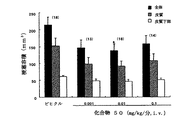
[結果]
ラット一過性MCAoモデルでの梗塞容積に対する化合物50の用量依存効果
HP−β−CD10%に溶解した前記化合物0.001、0.01および0.1mg/kg/分を再潅流直後1時間連続投与した。化合物は梗塞容積を0.001mg/kg/分から減少させ、そして0.01mg/kg/分の用量でビヒクル処理群と比較して35.3%梗塞容積を著しく減少させた(図1)。この結果は、化合物50が虚血性脳損傷に対しても保護効果を有することを示している。
【産業上の利用可能性】
【0132】
本発明によるヒドロキシエイコセン酸類似体は、強力なエラスターゼ放出阻害を有し、そのためにエラスターゼ放出阻害剤として有用である。
【0133】
エラスターゼは、例えば次のようなある種の疾患の病因に関与することが知られている。肺気腫、成人呼吸困難症候群、特発性肺繊維症、のう胞性肺繊維症、慢性間質性肺炎、慢性気管支炎、慢性気道感染症、び慢性汎細気管支炎、気管支拡張症、喘息、膵臓炎、腎臓炎、肝不全、慢性リウマチ、関節硬化症、変形関節炎、乾癬、歯周炎、アテローム性動脈硬化症、臓器移植の拒絶反応、早期破水、水疱症、ショック症状、敗血症、全身性エリテマトーデス、クローン病、血管内凝固症候群、脳梗塞、心臓疾患、腎臓疾患で観察される虚血性再潅流障害、角膜組織の瘢痕形成、脊椎炎などである。
【0134】
従って、本発明によるエラスターゼ放出阻害剤は、上述した疾患の治療剤または予防剤として有用である。
【図面の簡単な説明】
【0135】
【図1】ラットt−MCAoモデルでの梗塞容積に対する化合物50の効果を示す。全体(閉じた棒型)、皮質(中の詰まった棒型)および皮質下部(中空の棒型)の梗塞容積を再潅流後71時間で測定した。データは平均値±SEMで示した。*p<0.05対ビヒクル処置群(ダネット検定(Dunnett’s test))。【Technical field】
[0001]
The present invention relates to a novel hydroxyeicosenoic acid analog having elastase release inhibitory activity, a pharmaceutically acceptable salt or hydrate thereof.
The present invention also relates to an elastase release inhibiting composition containing a hydroxyeicosenoic acid analog as an active ingredient.
[Background]
[0002]
Proteases produced by neutrophils, which are a type of lymphocyte, play a major role in degrading foreign microorganisms such as bacteria or damaged cells, and therefore play an important role in biodefense reactions. A type of serine protease, neutrophil elastase (hereinafter simply referred to as elastase), is abundantly released from neutrophil granules that can occur in the case of infection or inflammatory disease. Elastase is an enzyme capable of degrading proteins constituting stromal substances such as in vivo connective tissues such as elastin, collagen, proteoglycan, fibronectin and the like, such as lung, cartilage, blood vessel wall, skin and ligament. Furthermore, this enzyme has been shown to act on other proteins or cells.
[0003]
Elastase maintains homeostasis in the body, while its action is controlled by endogenous protein inhibitors, typically α1-protease inhibitors, α2-macroglobulin, secreted leukocyte protease inhibitors, and the like. However, if the balance between elastase and the endogenous inhibitor is lost due to overproduction of elastase at the site of inflammation or due to a decrease in inhibitor concentration, elastase release activity may become uncontrollable and cause tissue damage.
[0004]
Elastase is known to be involved in the pathogenesis of certain diseases such as the following. Emphysema, adult respiratory distress syndrome, idiopathic pulmonary fibrosis, cystic pulmonary fibrosis, chronic interstitial pneumonia, chronic bronchitis, chronic respiratory tract infections, chronic panbronchiolitis, bronchiectasis, asthma, pancreatitis, Nephritis, liver failure, rheumatoid arthritis, arthrosclerosis, osteoarthritis, psoriasis, periodontitis, atherosclerosis, organ transplant rejection, early water rupture, blistering, shock symptoms, sepsis, systemic lupus erythematosus, clone Diseases, intravascular coagulation syndrome, cerebral infarction, heart disease, ischemic reperfusion injury observed in kidney disease, scar formation of corneal tissue, spondylitis, and the like.
[0005]
In view of the above, the elastase release inhibitor is useful as a therapeutic or prophylactic agent for these diseases. In recent years, extensive research has been conducted with expectations, and various elastase release inhibitors have been reported. However, their activity is not always satisfactory. Furthermore, no clinically useful drug has yet been found as an elastase release inhibitor containing a hydroxyeicosenoic acid analog.
DISCLOSURE OF THE INVENTION
[0006]
An object of the present invention is to provide a novel compound having remarkable elastase release inhibitory activity.
Another object of the present invention is to provide an elastase release inhibiting composition containing a hydroxyeicosenoic acid analog, or a pharmaceutically acceptable salt or hydrate thereof, and a pharmaceutically acceptable carrier. .
[0007]
Detailed description
As a result of diligent research, the present inventors have found that a novel hydroxyeicosenoic acid analog represented by the following formula exhibits elastase release inhibitory activity, and based on this, the present invention has been completed.
More specifically, the present invention relates to a hydroxyeicosenoic acid analog represented by the following formula (I), or a pharmaceutically acceptable salt or hydrate thereof.
[0008]
[Chemical 1]
Join
[Chemical 2]
Y is CH2, O or S (O)pWhere p is 0, 1 or 2;
m represents an integer of 1 to 4, n represents an integer of 0 to 3, and the sum of m and n is an integer of 3 to 7;
R1Is C1-4Alkyl group or C3-8Represents a cycloalkyl group;
R2Represents a hydrogen atom or a methyl group;
RThreeIs CORFour, Nitrile group, halogen atom, tetrazole group or thiazolidine
A dione group, where RFourIs OR6, NHR6, N (OH) R6, NHSO2RFive(Where RFiveIs C1-15Alkyl group, C6-10C substituted with an aryl or alkyl group, a halogen or an amino group7-14An aryl group and R6Is a hydrogen atom, C1-10C substituted with an alkyl group or a hydroxy group1-10Alkyl groups), or glycerol or functional glycerol (eg, diacylglycerol and phosphoglycerides).
[0009]
Particularly preferred compounds are (R) -16-hydroxyeicosa-14-inic acid, (R) -17-hydroxyeicosa-15-inic acid, (R)-(Z) -16-hydroxyeicosa-14- Enoic acid and (R)-(Z) -15-hydroxynonadeca-13-enoic acid.
[0010]
As used herein, “C1-4The term “alkyl group” means a linear or branched alkyl group and includes, for example, a methyl group, an ethyl group, a propyl group, an isopropyl group, a butyl group, an isobutyl group, and a tert-butyl group.
[0011]
The symbol m represents an integer of 1 to 4, n represents an integer of 0 to 3, and the sum of m and n is 3 to 7, preferably the sum is 3, 4 or 5.
[0012]
As used herein, “C3-8The term “cycloalkyl group” includes, for example, cyclopropyl group, cyclobutyl group, cyclopentyl group, cyclohexyl group, cycloheptis group and cyclooctyl group.
[0013]
As used herein, “C1-15The term “alkyl group” includes, for example, methyl, butyl, tert-butyl, octyl, decyl, and pentadecyl.
[0014]
As used herein, “C6-10The term “aryl group” includes, for example, a phenyl group, a 1-naphthyl group and a 2-naphthyl group.
[0015]
As used herein, “C substituted with an alkyl, halogen or amino group”7-14The term “aryl group” includes, for example, p-tolyl group, o-tolyl group, mesityl group, m-cumenyl group, m-chlorophenyl group and p-aminophenyl group.
[0016]
As used herein, “C1-10The term “alkyl group” means a linear or branched alkyl group, for example, methyl group, ethyl group, butyl group, isobutyl group, pentyl group, hexyl group, heptyl group, octyl group, 2-methyl-1 -It includes a hexyl group, a 2,4-dimethyl-1-pentyl group, a nonyl group and a decyl group.
[0017]
As used herein, “C substituted with hydroxyl group1-10The term “alkyl group” means a linear or branched alkyl group substituted with a hydroxyl group, such as a 2-hydroxyethyl group, a 6-hydroxyhexyl group, a 1-hydroxy-2-propyl group or 1 -Contains a hydroxy-2-methyl-2-propyl group.
[0018]
As used herein, the term “pharmaceutically acceptable salt” refers to, for example, salts with alkali metals (such as sodium and potassium), salts of alkaline earth metals (calcium and magnesium), or ammonia, methylamine , Dimethylamine, diethylamine, cyclopentylamine, benzylamine, piperidine, monoethanolamine, diethanolamine, triethanolamine, monomethylmonoethylamine, tromethamine, lysine, ornithine, piperazine, benzathine, 3-aminopyridine, procaine, choline, 2-amino Including salts with -4-methylpyridine, tetraalkylammonium, tris (hydroxymethyl) aminomethane and ethylenediamine.
[0019]
The compound of the formula (I) can be produced, for example, by the method shown in the following reaction scheme.
[0020]
In the reaction scheme, Z and Z2Are the same or different and each represents a halogen atom or a leaving group (for example, a methanesulfonyloxy group and a p-toluenesulfonyloxy group); R7Is a base-stable hydroxy protecting group (eg, trimethylsilyl, triethylsilyl, tert-butyldimethylsilyl, tert-butyldiphenylsilyl, methoxymethyl, ethoxyethyl, tetrahydropyranyl, benzyl and p -Methoxybenzyl group); R31Is CO2H, OR6, CONHR6Or a halogen atom; R61Is R6(Excluding hydrogen atoms); R32Is CO2R61, OR6Or CONHR6Pl is an integer of 1 or 2, and R1, R2, RThree, RFour, RFive, R6,
[Chemical 3]
[0021]
[Formula 4]
[Chemical formula 5]
(1) A compound of formula (II) is mixed with a compound of formula (III) at a temperature of −78 ° C. to room temperature, for example, n-BuLi, LiNH2Or NaNH2In the presence of a suitable organic solvent such as tetrahydrofuran, hexamethylphosphoric triamide, N, N'-dimethylpropyleneurea, NHThree, Dimethyl sulfoxide or dimethylformamide or a mixture thereof to give a compound of formula (IV).
[0024]
(2) The compound of formula (IV) is heated to a temperature of 0 ° C. to 60 ° C., preferably room temperature to 40 ° C.61An organic acid such as p-toluenesulfonic acid or acetic acid, or an amine salt thereof such as pyridinium p-toluenesulfonate, or an inorganic acid such as hydrochloric acid or sulfuric acid in an alcohol or ether solvent represented by OH, such as tetrahydrofuran or diethyl ether To remove the hydroxyl protecting group to give the compound of formula (Ia).
[0025]
(3) The compound of formula (Ia) is converted into a Pd-containing catalyst Pd-CaCO, for example, in a hydrogen atmosphere.Three, Pd (OAc)2Or Ni-containing catalyst, Ni (OAc)2And NaBHFourTo obtain a compound of the formula (Ib) by a method using Zn or the like in MeOH or AcOH.
[0026]
(4) R in formula (Ia)32Is CO2R61Is the formula (Ia2Or a compound of formula (Ib)32Is CO2R61The formula (Ib2) In a suitable organic solvent such as an alcohol solvent MeOH or EtOH, or a water miscible solvent such as tetrahydrofuran or dioxane, and a mixed solvent of water and a base usually used for hydrolysis, such as NaOH, LiOH or KOH. In the formula (I), RThreeIs CO2A compound of formula (Ic) which is H is obtained.
[0027]
[Chemical 6]
(5) Compound of formula (II) and formula (III)2) In the same manner as in (1) above, followed by deprotection in the same manner as in (2) above to give the compound of formula (IV2) Is obtained.
(6) Formula (IV2The compound of formula (IV) is reduced in the same manner as in (3) above.Three) Is obtained.
[0029]
(7) Formula (IV2) Or formula (IVThree) Of the formula (V) or formula (V2) And a suitable organic solvent such as MeOH, EtOH, t-BuOH, acetone, dimethylformamide, tetrahydrofuran or CHThreeA suitable base in CN, eg EtThreeN, NaH, KH, NaHCOThree, K2COThree, NaOH, CaCOThreeOr a quaternary ammonium salt (eg EtFourIn the presence of NBr) and, if necessary, additional NaI or the like is added to react to give the compound of formula (Id).
[0030]
(8) The compound of the formula (Id) is hydrolyzed in the same manner as in the above (4) to obtain the compound of the formula (Ie).
(9) oxidizing the compound of formula (Id) or formula (Ie) in a suitable organic solvent such as dichloromethane, MeOH, EtOH, diethyl ether, or water, or mixtures thereof at a temperature of -20 ° C to 50 ° C For example, NaIOFour, H2O2, AcOOH, m-chloroperbenzoic acid or tert-BuOOH to give a compound of formula (Id2) Or formula (Ie2) Is obtained. Formula (Ie2) Is a compound of formula (Id)2) Can be produced by hydrolysis in the same manner as in the above (4).
[0031]
[Chemical 7]
[Chemical 8]
(10) Compound of formula (II) and formula (III)ThreeAnd the compound of formula (IV)Four) Is obtained.
(11) Formula (IVFour) Of the formula (III)Four) And a suitable organic solvent such as benzene, toluene, dimethylformamide, dimethyl sulfoxide, hexamethylphosphoric triamide or CHThreeA suitable base in CN, such as NaOH, KOH, NaH, KH, or K2COThreeOr Ag2O and, if necessary, additional reactants such as n-BuFourNI or n-BuFourNHSOFourIn the presence ofFive) Is obtained.
[0034]
(12) Formula (IVFive) To give a compound of formula (If).
(13) A compound of formula (Ig) is obtained by reacting the compound of formula (If) in the same manner as in the above (3).
(14) A compound of the formula (Ih) is obtained by reacting the compound of the formula (If) or (Ig) in the same manner as in the above (4).
[0035]
(15) Formulas (Ic), (Ie), (Ie2) Or (Ih) to the corresponding active ester with N-hydroxy-succinimide and 1- (3-dimethylaminopropyl) -3-ethylcarbodiimide hydrochloride, or N, N-carbonyldiimidazole, or SOCl2Or (COCl)2To the corresponding acid chloride, then HRFourAnd optionally a base such as 1,3-diazabicyclo [5.4.0] undec-7-ene, 1,5-diazabicyclo [4.3.0] non-5-ene or EtThreeReaction in the presence of N gives a compound of formula (Ii).
[0036]
[Chemical 9]
(16) Formula (IV2) Or (IVThree) Is reacted with a compound of formula (VI) as in (7) above, followed by deprotection as in (2) above, followed by CClFour-PPhThree, PBrThree, CBrFour-PPhThree, I2-PPhThreeThe compound of formula (VII) is obtained by direct halogenation using a methanesulfonyl chloride or the like, or conversion to a leaving group using methanesulfonyl chloride, p-toluenesulfonyl chloride or the like.
[0038]
(17) The compound of the formula (VII) is mixed with a suitable organic solvent such as dimethyl sulfoxide, dimethylformamide, tetrahydrofuran, CHThreeCN, toluene or benzene, or a mixed solvent thereof with water, and if necessary an additive such as 15-crown ether or n-BuFourReaction with a cyanating agent such as NaCN, KCN, LiCN or CuCN in the presence of NI provides a compound of formula (Ij). The compound of formula (Ij) is further converted to an azide forming agent such as NaNThreeOr MeThreeSiNThreeTo give a compound of formula (Ik).
(18) A compound of formula (VII) is reacted with thiazolidinedione to give a compound of formula (Im).
[0039]
The compounds of the present invention can be administered systemically or orally by oral or parenteral routes such as rectal, subcutaneous, intramuscular, intravenous, transdermal and nasal / pulmonary inhalation or transdermal absorption routes. .
[0040]
The compound of the present invention can be orally administered in dosage forms such as tablets, powders, granules, fine powders, capsules, solutions, emulsions, suspensions and the like prepared by conventional methods. Formulations for the intravenous route may be in the form of aqueous or non-aqueous solutions, emulsions, suspensions, solid formulations to be used after dissolving in an injectable solvent immediately before application. The compounds of the invention can be formulated into formulations by forming inclusion compounds with α-, β-, or γ-cyclodextrins or substituted cyclodextrins. In addition, aqueous or non-aqueous solutions, emulsions or suspensions of the compounds of the invention can be administered, for example, by the route of injection. The dosage can vary depending on the age, weight and other factors of the patient and is administered from 1 ng / kg / day to 1000 mg / kg / day to an adult once a day or in several divided forms.
[0041]
Typical compounds represented by the formula (I) are exemplified below.
[0042]
[Table 1]
[Table 2]
[Table 3]
[Table 4]
The compounds of the present invention have potent elastase release inhibitory activity and are therefore useful for the treatment and prevention of diseases involving elastase.
BEST MODE FOR CARRYING OUT THE INVENTION
[0047]
〔Example〕
The invention is illustrated in more detail by the following examples and test examples.
[0048]
Example 1
(R) -16-hydroxyeicosa-14-inic acid (Compound No. 12)
(1) n-BuLi (4.0 mL, 2.47 M in hexane, 9.9 mmol) was added to (R) -3-tert-butyldimethylsiloxy-1-heptin (1.02 g, at −50 ° C. under an argon stream. 4.5 mmol) THF (tetrahydrofuran) (20 ml) (prepared by conventional silylation reaction of (R) -1-heptin-3-ol and 13-bromotridecanoic acid (1.32 g, 4.5 mmol)) And HMPA (hexamethylphosphoric triamide) (2.5 mL) in a mixed solvent was added dropwise. Thereafter, the temperature of the reaction solution was raised to room temperature over about 2.5 hours, and then stirred at that temperature for 2 hours. To the resulting solution was added aqueous hydrochloric acid (150 mL, 1.0 M) and the mixture was added to Et.2Extracted with O (100 mL × 2). The organic layer was washed with brine (100 mL), dried over anhydrous magnesium sulfate and concentrated. The resulting crude product was dissolved in EtOH (22.5 mL), concentrated sulfuric acid (0.5 mL) was added, and then the mixture was stirred at room temperature for 3 days. To the reaction solution was added saturated aqueous sodium bicarbonate (150 mL) and the mixture was added to Et.2Extracted with O (100 mL × 2). The resulting organic layer was washed with saturated aqueous sodium bicarbonate (150 mL), dried over anhydrous magnesium sulfate, and concentrated. The obtained crude product was purified by silica gel column chromatography to obtain (R) -16-hydroxyeicosa-14-ynoic acid ethyl ester (667 mg).
1H-NMR (CDClThree, 300MHz) δppm: 0.92 (t, J = 7.1Hz, 3H), 1.20-1.75 (m, 26H), 1.25 (t, J = 7.1Hz, 3H), 2.20 (dt, J = 1.9, 7.0Hz, 2H ), 2.29 (t, J = 7.5Hz, 2H), 4.12 (q, J = 7.1Hz, 2H), 4.30-4.40 (m, 1H)
IR (neat): 3436, 2928, 2855, 1737, 1466, 1375, 1180, 1102, 1036, 723 cm-1
[0049]
(2) A solution of the compound obtained in (1) above in a mixed solvent of THF (12.2 mL) and water (4.1 mL) at room temperature with an aqueous NaOH solution (1.3 mL, 1.0 M, 1.3 mmol) And the mixture was stirred at room temperature for 3 days. The reaction solution was acidified with oxalic acid aqueous solution (1.0 M), water (100 mL) was added, and then the mixture was extracted with AcOEt (100 mL × 2). The organic layer was washed with brine (100 mL), dried over anhydrous magnesium sulfate and concentrated. The obtained crude product was purified by silica gel column chromatography to obtain the title compound (102 mg).
1H-NMR (CDClThree, 300MHz) δppm: 0.92 (t, J = 7.2Hz, 3H), 1.18-1.78 (m, 26H), 2.20 (dt, J = 1.8, 7.0Hz, 2H), 2.35 (t, J = 7.5Hz, 2H ), 4.30-4.38 (m, 1H)
IR (KBr): 3403, 2920, 2852, 1698, 1472, 1434, 1413, 1279, 1256, 1232, 1209, 1188, 1147, 1113, 1051, 940, 718, 602, 472, 418 cm-1
[0050]
Example 2
(R)-(Z) -16-Hydroxyeicosa-14-enoic acid (Compound No. 50)
(1) NaBH in EtOH (1.0 mL)Four(8.0 mg, 0.21 mmol) suspension of Ni (OAc) in EtOH (5.0 mL) under hydrogen atmosphere.2・ 4H2A solution of O (30 mg, 0.105 mmol) was added dropwise and the mixture was stirred at room temperature for 30 minutes. Ethylenediamine (0.06 mL, 1.05 mmol) was added dropwise to the reaction solution at room temperature, and then a solution of the compound obtained in Example 1 (1) (370 mg, 1.05 mmol) in EtOH (2.0 mL) was added. The mixture was added dropwise and the mixture was stirred at room temperature for about 5 hours until hydrogen uptake stopped. Et in the reaction solution2O (50 mL) was added and the mixture was stirred for 10 minutes, then filtered through a silica gel pad and concentrated. The obtained crude product was purified by silica gel column chromatography to obtain (R)-(Z) -16-hydroxyeicosa-14-enoic acid ethyl ester (265 mg).
1H-NMR (CDClThree, 300MHz) δppm: 0.90 (t, J = 6.8Hz, 3H), 1.23-1.48 (m, 27H), 1.55-1.66 (m, 2H), 2.04-2.12 (m, 2H), 2.29 (t, J = 7.5Hz, 2H), 4.12 (q, J = 7.2Hz, 2H), 4.37-4.48 (m, 1H), 5.32-5.40 (m, 1H), 5.44-5.53 (m, 1H)
IR (neat): 3427, 2926, 2854, 1739, 1466, 1375, 1180, 1100, 1030, 724 cm-1
[0051]
(2) The title compound was obtained when the reaction was carried out in the same manner as in Example 1 (2) using the compound obtained in (1) above.
1H-NMR (CDClThree, 300MHz) δppm: 0.90 (t, J = 6.8Hz, 3H), 1.23-1.49 (m, 24H), 1.54-1.70 (m, 2H), 2.04-2.12 (m, 2H), 2.35 (t, J = 7.5Hz, 2H), 4.44 (dt, J = 6.4, 8.5Hz, 1H), 5.32-5.41 (m, 1H), 5.44-5.54 (m, 1H)
IR (neat): 3369, 2925, 2845, 1712, 1466, 1412, 1384, 1281, 1119, 1003, 722 cm-1
[0052]
Example 3
(R) -17-Hydroxyheneicosa-15-inic acid (Compound No. 4)
(1) When the reaction is carried out in substantially the same manner as in Example 1 (1) except that 14-bromotetradecanoic acid is used instead of 13-bromotridecanoic acid, (R) -17-hydroxyheneicosa- 15-Inic acid ethyl ester was obtained.
1H-NMR (CDClThree, 300MHz) δppm: 0.92 (t, J = 7.2Hz, 3H), 1.19-1.74 (m, 31H), 2.20 (dt, J = 1.9, 7.0Hz, 2H), 2.29 (t, J = 7.5Hz, 2H ), 4.12 (q, J = 7.2Hz, 2H), 4.28-4.41 (m, 1H)
IR (neat): 3436, 2927, 2855, 1737, 1466, 1375, 1180, 1104, 1036, 722 cm-1
[0053]
(2) The title compound was obtained when the reaction was carried out in the same manner as in Example 1 (2) using the compound obtained in (1) above.
1H-NMR (CDClThree, 300MHz) δppm: 0.92 (t, J = 7.2Hz, 3H), 1.20-1.80 (m, 28H), 2.20 (dt, J = 1.9, 7.0Hz, 2H), 2.35 (t, J = 7.5Hz, 2H ), 4.35 (tt, J = 6.6, 1.9Hz, 1H)
IR (KBr): 3371, 3281, 2922, 2849, 1702, 1465, 1438, 1412, 1316, 1274, 1228, 1206, 1188, 1150, 1111, 1051, 1012, 889, 725, 491 cm-1
[0054]
Example 4
(R)-(Z) -17-Hydroxyheneicosa-15-enoic acid (Compound No. 46)
(1) When the reaction is carried out in the same manner as in Example 2 (1) except that the compound obtained in Example 3 (1) is used, (R)-(Z) -17-hydroxyheneicosa-15- The enoic acid ethyl ester was obtained.
1H-NMR (CDClThree, 300MHz) δppm: 0.90 (t, J = 6.8Hz, 3H), 1.18-1.70 (m, 31H), 1.98-2.18 (m, 2H), 2.29 (t, J = 7.5Hz, 2H), 4.12 (q , J = 7.2Hz, 2H), 4.37-4.48 (m, 1H), 5.32-5.54 (m, 2H)
IR (neat): 3428, 2925, 2854, 2360, 1739, 1466, 1374, 1180, 1100, 1031, 723, 430 cm-1
[0055]
(2) The title compound was obtained when the reaction was carried out in the same manner as in Example 1 (2) using the compound obtained in (1) above.
1H-NMR (CDClThree, 300MHz) δppm: 0.90 (t, J = 6.8Hz, 3H), 1.19-1.72 (m, 28H), 1.95-2.16 (m, 2H), 2.35 (t, J = 7.5Hz, 2H), 4.38-4.49 (m, 1H), 5.30-5.55 (m, 2H)
IR (neat): 3400, 2925, 2854, 1712, 1466, 1412, 1200, 1002, 970, 723, 430 cm-1
[0056]
Example 5
(R) -15-hydroxynonadeca-13-oic acid (Compound No. 28)
(1) When the reaction is carried out in substantially the same manner as in Example 1 (1) except that 12-bromododecanoic acid is used instead of 13-bromotridecanoic acid, (R) -15-hydroxynonadec-13 -Ethic acid ethyl ester was obtained.
1H-NMR (CDClThree, 300MHz) δppm: 0.92 (t, J = 7.2Hz, 3H), 1.19-1.79 (m, 27H), 2.20 (dt, J = 2.0, 7.0Hz, 2H), 2.29 (t, J = 7.5Hz, 2H ), 4.12 (q, J = 7.2Hz, 2H), 4.29-4.40 (m, 1H)
IR (neat): 3436, 2929, 2856, 2361, 1737, 1466, 1375, 1180, 1100, 1036, 722 cm-1
[0057]
(2) Using the compound obtained in (1) above, the reaction was carried out in the same manner as in Example 1 (2) to obtain the title compound.
1H-NMR (CDClThree, 300MHz) δppm: 0.92 (t, J = 7.2Hz, 3H), 1.20-1.80 (m, 24H), 2.20 (dt, J = 2.0, 7.0Hz, 2H), 2.35 (t, J = 7.5Hz, 2H ), 4.35 (tt, J = 6.5, 2.0Hz, 1H)
IR (KBr): 3373, 3279, 2922, 2850, 1707, 1464, 1414, 1330, 1288, 1264, 1236, 1210, 1190, 1150, 1108, 1051, 1012, 962, 888, 726, 588 cm-1
[0058]
Example 6
(R)-(Z) -15-Hydroxynonadeca-13-enoic acid (Compound No. 65)
(1) Using the compound obtained in Example 5 (1) and carrying out the reaction in the same manner as in Example 2 (1), (R)-(Z) -17-hydroxynonadec-13-enoic acid The ethyl ester was obtained.
1H-NMR (CDClThree, 300MHz) δppm: 0.85-0.98 (m, 3H), 1.20-1.68 (m, 27H), 1.97-2.16 (m, 2H), 2.29 (t, J = 7.5Hz, 2H), 4.12 (q, J = 7.2Hz, 2H), 4.43 (dt, J = 8.5, 6.3Hz, 1H), 5.31-5.55 (m, 2H)
IR (neat): 3426, 2927, 2855, 1740, 1466, 1375, 1248, 1181, 1099, 1030, 724 cm-1
[0059]
(2) The title compound was obtained when the reaction was carried out in the same manner as in Example 1 (2) using the compound obtained in (1) above.
1H-NMR (CDClThree, 300MHz) δppm: 0.91 (t, J = 6.8Hz, 3H), 1.16-1.70 (m, 24H), 1.97-2.17 (m, 2H), 2.35 (t, J = 7.5Hz, 2H), 4.38-4.49 (m, 1H), 5.30-5.54 (m, 2H)
IR (neat): 3368, 2925, 2854, 1712, 1466, 1413, 1275, 1100, 1002, 724 cm-1
[0060]
Example 7
(RS)-(Z) -16-hydroxy-16-methyleicosa-14-enoic acid (Compound No. 54)
(1) Substantially carried out except that (RS) -3-tert-butyldimethylsiloxy-3-methyl-1-heptin is used instead of (R) -3-tert-butyldimethylsiloxy-1-heptin (RS) -16-hydroxy-16-methyleicosa-14-ynoic acid ethyl ester is obtained by carrying out the reaction in the same manner as in Example 1 (1), and then in the same manner as in Example 2 (1) (RS). )-(Z) -16-hydroxy-16-methyleicosa-14-enoic acid ethyl ester was obtained.
1H-NMR (CDClThree, 300MHz) δppm: 0.91 (t, J = 7.0Hz, 3H), 1.20-1.68 (m, 32H), 2.24-2.35 (m, 4H), 4.12 (q, J = 7.2Hz, 2H), 5.28-5.42 (m, 2H)
IR (neat): 3436, 2926, 2854, 2361, 1739, 1644, 1466, 1372, 1303, 1180, 1101, 1034, 942, 724 cm-1
[0061]
(2) Using the compound obtained in (1) above, the reaction was carried out in the same manner as in Example 1 (2) to obtain the title compound.
1H-NMR (CDClThree, 300MHz) δppm: 0.91 (t, J = 7.0Hz, 3H), 1.19-1.70 (m, 29H), 2.25-2.39 (m, 4H), 5.28-5.41 (m, 2H)
IR (neat): 3400, 2926, 2854, 1712, 1466, 1412, 1371, 1223, 1048, 940, 724 cm-1
[0062]
Example 8
(RS)-(Z) -16-hydroxy-18-methylnonadeca-14-enoic acid (Compound No. 63)
(1) Substantially carried out except that (RS) -3-tert-butyldimethylsiloxy-5-methyl-1-hexyne is used instead of (R) -3-tert-butyldimethylsiloxy-1-heptin (RS) -16-hydroxy-18-methylnonadeca-14-ynoic acid ethyl ester is obtained when the reaction is carried out in the same manner as in Example 1 (1), and then the reaction is carried out in the same manner as in Example 2 (1) (RS )-(Z) -16-hydroxy-18-methylnonadeca-14-enoic acid ethyl ester was obtained.
1H-NMR (CDClThree, 300MHz) δppm: 0.92 (d, J = 6.5Hz, 3H), 0.94 (d, J = 6.5Hz, 3H), 1.18-1.80 (m, 26H), 2.02-2.15 (m, 2H), 2.29 (t , J = 7.5Hz, 2H), 4.12 (q, J = 7.2Hz, 2H), 4.47-4.56 (m, 1H), 5.31-5.57 (m, 2H)
IR (neat): 3436, 2926, 2854, 1739, 1466, 1369, 1180, 1034, 722 cm-1
[0063]
(2) The title compound was obtained when the reaction was carried out in the same manner as in Example 1 (2) using the compound obtained in (1) above.
1H-NMR (CDClThree, 300Mz) δppm: 0.92 (d, J = 6.7Hz, 3H), 0.94 (d, J = 6.5Hz, 3H), 1.19-1.77 (m, 23H), 2.00-2.19 (m, 2H), 2.35 (t , J = 7.5Hz, 2H), 4.47-4.57 (m, 1H), 5.30-5.40 (m, 1H), 5.42-5.52 (m, 1H)
IR (KBr): 3370, 2924, 2852, 1714, 1472, 1384, 1370, 1350, 1318, 1277, 1259, 1236, 1210, 1104, 1081, 1009, 994, 974, 823, 751, 720, 629, 556 , 460 cm-1
[0064]
Example 9
(RS) -16-Hydroxynonadeca-14-inic acid (Compound No. 10)
(1) Example 1 (1) substantially except that (RS) -3-tert-butyldimethylsiloxy-1-hexyne is used instead of (R) -3-tert-butyldimethylsiloxy-1-heptin. ) To give (RS) -16-hydroxynonadeca-14-oic acid ethyl ester.
1H-NMR (CDClThree, 300MHz) δppm: 0.91-0.99 (m, 3H), 1.20-1.78 (m, 27H), 2.20 (dt, J = 2.0, 7.1Hz, 2H), 2.29 (t, J = 7.5Hz, 2H), 4.12 (q, J = 7.1Hz, 2H), 4.31-4.43 (m, 1H)
IR (neat): 3448, 2929, 2855, 1737, 1466, 1374, 1245, 1180, 1101, 1029, 854, 723 cm-1
[0065]
(2) The title compound was obtained when the reaction was carried out in the same manner as in Example 1 (2) using the compound obtained in (1) above.
1H-NMR (CDClThree, 300MHz) δppm: 0.95 (t, J = 7.3Hz, 3H), 1.22-1.73 (m, 24H), 2.20 (dt, J = 1.9, 7.0Hz, 2H), 2.35 (t, J = 7.5Hz, 2H ), 4.36 (tt, J = 6.6, 1.9Hz, 1H)
IR (KBr): 3358, 2920, 2852, 1698, 1472, 1413, 1320, 1296, 1254, 1243, 1230, 1207, 1188, 1150, 1106, 1067, 1027, 942, 718, 474, 416 cm-1
[0066]
Example 10
(RS) -16-hydroxyoctadeca-14-inic acid (Compound No. 8)
(1) Example 1 (1) substantially except that (RS) -3-tert-butyldimethylsiloxy-1-pentyne is used instead of (R) -3-tert-butyldimethylsiloxy-1-heptin. ) To give (RS) -16-hydroxyoctadeca-14-ynoic acid ethyl ester.
1H-NMR (CDClThree, 300MHz) δppm: 1.00 (t, J = 7.4Hz, 3H), 1.18-1.78 (m, 25H), 2.20 (dt, J = 1.9, 7.0Hz, 2H), 2.29 (t, J = 7.5Hz, 2H ), 4.12 (q, J = 7.2Hz, 2H), 4.26-4.36 (m, 1H)
IR (neat): 3436, 2928, 2854, 1737, 1465, 1374, 1180, 1099, 1035, 965, 722 cm-1
[0067]
(2) Using the compound obtained in (1) above, the reaction was carried out in the same manner as in Example 1 (2) to obtain the title compound.
1H-NMR (CDClThree, 300MHz) δppm: 1.00 (t, J = 7.4Hz, 3H), 1.20-1.75 (m, 22H), 2.20 (dt, J = 2.0, 7.0Hz, 2H), 2.35 (t, J = 7.5Hz, 2H ), 4.31 (tt, J = 6.4, 1.9Hz, 1H)
IR (KBr): 3357, 2921, 2852, 1698, 1472, 1439, 1413, 1341, 1324, 1279, 1256, 1232, 1209, 1188, 1148, 1088, 1072, 1035, 1007, 965, 718, 625 cm-1
[0068]
Example 11
4-((R) -10-hydroxytetradec-8-ynylsulfanyl) butyric acid (Compound No. 78)
(1) n-BuLi (19.7 mL, 2.47 M in hexane, 48.7 mmol) was added in an argon stream at 0 ° C. with (R) -3-tert-butyldimethylsiloxy-1-heptin (10.0 g, 44 .3 mmol) in THF (179 ml). The reaction solution was then stirred at that temperature for 30 minutes. The reaction solution was cooled to −40 ° C., and a solution of 1,7-dibromoheptane (22.9 g, 88.6 mmol) in DMPU (N, N-dimethylpropyleneurea) (22.4 mL) was added dropwise thereto. The temperature of the reaction solution was raised to room temperature over about 2 hours, and then stirred at that temperature for 2 hours. A saturated aqueous ammonium chloride solution (500 mL) was added to the resulting solution, and the mixture was extracted with hexane (300 mL × 2). The organic layer was washed with brine (500 mL), dried over anhydrous magnesium sulfate and concentrated. The resulting crude product was purified by distillation to give ((R) -10-bromo-1-butylida-2-ynyloxy) -tert-butyldimethylsilane (12.6 g).
1H-NMR (CDClThree, 300MHz) δppm: 0.10 (s, 3H), 0.12 (s, 3H), 0.84-0.96 (m, 3H), 0.91 (s, 9H), 1.24-1.68 (m, 14H), 1.80-1.92 (m, 2H), 2.19 (dt, J = 1.9, 6.9Hz, 2H), 3.41 (t, J = 6.4Hz, 2H), 4.32 (tt, J = 6.5, 1.9Hz, 1H)
IR (neat): 2930, 2858, 2233, 1463, 1407, 1389, 1361, 1341, 1251, 1217, 1152, 1110, 1083, 1006, 938, 837, 778, 725, 667, 565 cm-1
[0069]
(2) Aqueous HCl (0.5 mL, 1.0 M, 1.3 mmol) is added to a solution of the compound obtained in (1) above (910 mg, 2.24 mmol) in MeOH (15 mL) at room temperature and the mixture Was stirred at room temperature for 1 hour. Saturated aqueous sodium bicarbonate (100 mL) was added to the reaction solution, and then the mixture was extracted with AcOEt (100 mL × 2). The organic layer was washed with brine (100 mL), dried over anhydrous magnesium sulfate and concentrated. The obtained crude product was purified by silica gel column chromatography to obtain (R) -14-bromotetradec-6-in-5-ol (628 mg).
1H-NMR (CDClThree, 300MHz) δppm: 0.88-0.96 (m, 3H), 1.22-1.77 (m, 14H), 1.79-1.93 (m, 2H), 2.21 (dt, J = 2.0, 6.9Hz, 2H), 3.41 (t, J = 6.8Hz, 2H), 4.29-4.40 (m, 1H)
IR (neat): 3368, 2930, 2858, 2231, 1465, 1379, 1333, 1250, 1148, 1104, 1038, 1008, 876, 726, 646, 563 cm-1
[0070]
(3) NaOMe (79 mg, 1.47 mmol) was added to a solution of the compound (250 mg, 0.864 mmol) obtained in (2) above in MeOH (6 mL) under a stream of argon, and γ in MeOH (3 mL) was added thereto. A solution of thiobutyrolactone (132 mg, 1.30 mmol) was added dropwise, then NaI (15 mg) was added and the mixture was stirred for 14 hours at room temperature and then at 45 ° C. for 1 hour. The reaction solution is cooled to room temperature, saturated aqueous ammonium chloride solution (50 mL) is added, and the mixture is added to Et.2Extracted with O (50 mL × 2). The organic layer was washed with brine (50 mL), dried over anhydrous magnesium sulfate and concentrated. The resulting crude product was purified by silica gel column chromatography to give 4-((R) -10-hydroxytetradec-8-ynylsulfanyl) butyric acid methyl ester (0.23 g).
1H-NMR (CDClThree, 300MHz) δppm: 0.92 (t, J = 7.1Hz, 3H), 1.23-1.77 (m, 16H), 1.85-1.97 (m, 2H), 2.20 (dt, J = 1.9, 7.0Hz, 2H), 2.41 -2.59 (m, 6H), 3.68 (s, 3H), 4.35 (tt, J = 6.6, 1.9Hz, 1H)
IR (neat): 3453, 2930, 2858, 2230, 1740, 1437, 1366, 1315, 1212, 1175, 1145, 1037, 1008, 888, 727 cm-1
[0071]
(4) The title compound was obtained by carrying out the reaction in the same manner as in Example 1 (2) using the compound obtained in (3) above.
1H-NMR (CDClThree, 300MHz) δppm: 0.92 (t, J = 7.1Hz, 3H), 1.22-1.75 (m, 18H), 1.86-1.98 (m, 2H), 2.21 (dt, J = 1.9, 6.9Hz, 2H), 2.51 (t, J = 7.2Hz, 4H), 2.57 (t, J = 7.2Hz, 2H), 4.36 (tt, J = 6.5, 1.9Hz, 1H)
IR (neat): 3340, 2930, 2858, 2231, 1708, 1456, 1293, 1236, 1147, 1036, 1003, 889, 728 cm-1
[0072]
Example 12
4-((R)-(Z) -10-hydroxytetradec-8-enylsulfanyl) butyric acid (Compound No. 94)
(1) Using the compound obtained in Example 11 (2) and carrying out the reaction in the same manner as in Example 2 (1), (R)-(Z) -14-bromotetradec-6-ene- 5-ol was obtained.
1H-NMR (CDClThree, 300MHz) δppm: 0.84-0.96 (m, 3H), 1.20-1.67 (m, 14H), 1.79-1.92 (m, 2H), 1.98-2.16 (m, 2H), 3.41 (t, J = 6.8Hz, 2H), 4.37-4.47 (m, 1H), 5.32-5.54 (m, 2H)
IR (neat): 3351, 3006, 2930, 2856, 1656, 1466, 1378, 1252, 1121, 1007, 878, 727, 646, 564 cm-1
[0073]
(2) Using the compound obtained in (1) above in place of (R) -14-bromotetradec-6-in-5-ol, the reaction was carried out in substantially the same manner as in Example 11 (3). To give 4-((R)-(Z) -10-hydroxytetradec-8-enylsulfanyl) butyric acid methyl ester.
1H-NMR (CDClThree, 300MHz) δppm: 0.91 (t, J = 6.9Hz, 3H), 1.20-1.68 (m, 16H), 1.85-2.18 (m, 4H), 1.98-2.18 (m, 2H), 2.40-2.60 (m, 6H), 3.68 (s, 3H), 4.37-4.58 (m, 1H), 5.31-5.53 (m, 2H)
IR (neat): 3436, 3004, 2928, 2855, 1740, 1438, 1366, 1314, 1211, 1174, 1140, 1006, 887, 749 cm-1
[0074]
(3) The title compound was obtained by carrying out the reaction in the same manner as in Example 1 (2) using the compound obtained in (2) above.
1H-NMR (CDClThree, 300MHz) δppm: 0.86-0.95 (m, 3H), 1.21-1.67 (m, 16H), 1.85-2.21 (m, 4H), 2.50 (2t, J = 7.2Hz, 4H), 2.57 (t, J = 7.2Hz, 2H), 4.40-4.50 (m, 1H), 5.31-5.54 (m, 2H)
IR (neat): 3368, 2929, 2856, 1708, 1457, 1293, 1235, 1138, 1000, 753 cm-1
[0075]
Example 13
5-((R) -10-hydroxytetradec-8-ynylsulfanyl) pentanoic acid (Compound No. 75)
(1) When δ-thiovalerolactone is used instead of γ-thiobutyrolactone and the reaction is carried out in substantially the same manner as in Example 11 (3), 5-((R) -10-hydroxytetradec-8 -Inylsulfanyl) pentanoic acid methyl ester was obtained.
1H-NMR (CDClThree, 300MHz) δppm: 0.92 (t, J = 7.1Hz, 3H), 1.22-1.80 (m, 20H), 2.21 (dt, J = 1.9, 7.0Hz, 2H), 2.34 (t, J = 7.3Hz, 2H ), 2.50 (t, J = 7.1Hz, 2H), 2.52 (t, J = 7.2Hz, 2H), 3.68 (s, 3H), 4.30-4.40 (m, 1H)
IR (neat): 3436, 2931, 2858, 2230, 1740, 1459, 1437, 1378, 1271, 1206, 1174, 1039, 888, 729, 504 cm-1
[0076]
(2) The title compound was obtained by carrying out the reaction in the same manner as in Example 1 (2) using the compound obtained in (1) above.
1H-NMR (CDClThree, 300MHz) δppm: 0.92 (t, J = 7.1Hz, 3H), 1.22-1.82 (m, 20H), 2.21 (dt, J = 2.0, 6.9Hz, 2H), 2.39 (t, J = 7.2Hz, 2H ), 2.51 (t, J = 7.1Hz, 2H), 2.53 (t, J = 7.1Hz, 2H), 4.35 (tt, J = 6.5, 2.0Hz, 1H)
IR (neat): 3350, 2930, 2858, 1712, 1708, 1460, 1282, 1229, 1149, 1037, 1004, 892, 727 cm-1
[0077]
Example 14
5-((R)-(Z) -10-hydroxytetradec-8-enylsulfanyl) pentanoic acid (Compound No. 91)
(1) The compound obtained in Example 12 (1) and δ-thiovalerolactone were used instead of (R) -14-bromotetradec-6-in-5-ol and γ-thiobutyrolactone.
Then, when the reaction was carried out substantially in the same manner as in Example 11 (3), 5-((R)-(Z) -10-hydroxytetradec-8-enylsulfanyl) pentanoic acid methyl ester was obtained.
1H-NMR (CDClThree, 300MHz) δppm: 0.86-0.95 (m, 3H), 1.21-1.79 (m, 20H), 1.98-2.18 (m, 2H), 2.34 (t, J = 7.3Hz, 2H), 2.50 (t, J = 7.3Hz, 2H), 2.52 (t, J = 7.1Hz, 2H), 3.67 (s, 3H), 4.37-4.47 (m, 1H), 5.32-5.53 (m, 2H)
IR (neat): 3436, 2928, 2855, 2360, 2343, 1740, 1437, 1384, 1271, 1205, 1174, 1009, 886, 750, 669 cm-1
[0078]
(2) The title compound was obtained by carrying out the reaction in the same manner as in Example 1 (2) using the compound obtained in (1) above.
1H-NMR (CDClThree, 300MHz) δppm: 0.86-0.95 (m, 3H), 1.21-1.81 (m, 20H), 1.97-2.20 (m, 2H), 2.38 (t, J = 7.2Hz, 2H), 2.44-2.58 (m, 4H), 4.44 (dt, J = 8.2, 6.6Hz, 1H), 5.31-5.54 (m, 2H)
IR (neat): 3367, 3006, 2930, 2855, 1712, 1708, 1461, 1418, 1278, 1228, 1124, 1001, 897, 752 cm-1
[0079]
Example 15
4-((R) -10-hydroxytetradec-8-in-1-sulfonyl) butyric acid (Compound No. 80)
CHClThreeTo a solution of the compound obtained in Example 11 (30 mg, 0.0913 mmol) in (3 mL) at room temperature was added m-chloroperbenzoic acid (35 mg, 0.274 mmol) and the mixture was stirred at room temperature for 4 hours. did. To the reaction solution was added saturated aqueous sodium thiosulfate solution (30 mL), and then the mixture was extracted with AcOEt (30 mL × 2). The organic layer was washed with brine (30 mL), dried over anhydrous magnesium sulfate and concentrated. The obtained crude product was purified by silica gel column chromatography to obtain the title compound (17 mg).
1H-NMR (CDClThree, 300MHz) δppm: 0.92 (t, J = 7.1Hz, 3H), 1.21-1.92 (m, 16H), 2.10-2.27 (m, 4H), 2.60 (t, J = 6.7Hz, 2H), 2.94-3.13 (m, 4H), 4.28-4.46 (m, 1H)
IR (KBr): 3485, 3370, 2932, 2860, 1692, 1470, 1446, 1420, 1328, 1274, 1242, 1217, 1200, 1124, 1083, 1056, 1016, 912, 776, 750, 728, 613, 575 , 510, 473, 420 cm-1
[0080]
Example 16
4-((R) -10-hydroxytetradec-8-in-1-sulfinyl) butyric acid (Compound No. 79)
A solution of NaIO4 (74 mg, 0.347 mmol) in water (0.9 mL) is added at room temperature to a solution of the compound obtained in Example 11 in MeOH (2.3 mL) and the mixture is stirred at room temperature for 4 hours. Stir. Brine (30 mL) was added to the reaction solution and then the mixture was extracted with AcOEt (30 mL × 2). The organic layer was washed with brine (30 mL), dried over anhydrous magnesium sulfate and concentrated. The obtained crude product was purified by silica gel column chromatography to obtain the title compound (28 mg).
1H-NMR (CDClThree, 300MHz) δppm: 0.92 (t, J = 7.1Hz, 3H), 1.29-1.86 (m, 16H), 2.08-2.26 (m, 4H), 2.46-2.96 (m, 6H), 4.30-4.40 (m, 1H)
IR (neat): 3368, 2933, 2859, 1724, 1456, 1412, 1291, 1225, 1144, 1034, 1003, 847, 727 cm-1
[0081]
Example 17
(RS) -16-hydroxyeicosa-14-inamide (Compound No. 23)
(1) A solution of acetonitrile (0.263 mL. 5.0 mmol) in THF (5 mL) was cooled to −65 ° C., then n-BuLi (2.23 mL, 2.46 M in hexane, 5.5 mmol). The solution was added dropwise with stirring under an argon stream. The reaction solution was then stirred at that temperature for 1 hour. The reaction solution was added dropwise to a solution of 1,11-dibromoundecane (3.14 g, 10 mmol) in THF (10 mL) at 0 ° C. over 10 minutes. The mixture was stirred at room temperature for 15 minutes. Water (10 mL) and ethyl acetate (30 mL) were added to the resulting solution, and the organic layer was separated. The organic layer was dried over anhydrous magnesium sulfate and concentrated. The obtained crude product was purified by silica gel column chromatography to obtain 13-bromotrideconitrile (800 mg).
1H-NMR (CDClThree, 200MHz) δppm: 1.20-1.96 (m, 20H), 2.35 (t, J = 7.0Hz, 2H), 3.43 (t, J = 6.8Hz, 2H)
IR (neat): 3400, 2927, 2854, 2246, 1636, 1466, 1384, 1251, 1068, 722, 644, 562 cm-1
[0082]
(2) A solution of the compound (800 mg) obtained in (1) above in 70% aqueous sulfuric acid (0.5 mL) was stirred with heating at 70 ° C. for 2 hours under an argon stream. The reaction solution was cooled to room temperature, ice water (30 mL) was added, and the crude crystalline material thus separated was filtered off. This material was dissolved in ethyl acetate (100 mL), neutralized with aqueous sodium hydroxide (2.0 M) and then extracted. The organic layer was washed with brine (100 mL), dried over anhydrous magnesium sulfate and concentrated. The obtained crystals were dried under reduced pressure to give 13-bromotridecanamide (790 mg).
1H-NMR (CDClThree, 300MHz) δppm: 1.20-1.71 (m, 18H), 1.79-1.91 (m, 2H), 2.22 (t, J = 7.6Hz, 2H), 3.41 (t, J = 6.9Hz, 2H), 5.34 (bs , 2H)
IR (KBr): 3395, 3191, 2922, 2851, 1647, 1471, 1420, 1330, 1281, 1254, 1228, 1204, 1123, 801, 721, 648, 565, 520, 472, 421 cm-1
[0083]
(3) Instead of 13-bromotridecanoic acid and (R) -3-tert-butyldimethylsiloxy-1-heptin, the compound obtained in (2) above and (RS) -3-tert-butyldimethylsiloxy, respectively The title compound was obtained by carrying out the reaction in substantially the same manner as in Example 1 (1) except that -1-heptin was used.
1H-NMR (CDClThree, 300MHz) δppm: 0.92 (t, J = 7.1Hz, 3H), 1.20-1.80 (m, 26H), 2.16-2.27 (m, 4H), 4.35 (tt, J = 6.5, 1.9Hz, 1H), 5.28 (bs, 1H), 5.38 (bs, 1H)
IR (KBr): 3360, 3188, 2920, 2850, 1663, 1633, 1472, 1426, 1411, 1334, 1268, 1241, 1216, 1191, 1139, 1105, 1041, 882, 811, 721, 641, 530 cm-1
[0084]
Example 18
(RS) -16-Hydroxynonadeca-14-inamide (Compound No. 22)
Instead of 13-bromotridecanoic acid and (R) -3-tert-butyldimethylsiloxy-1-heptin, the compound obtained in Example 17 (2) and (RS) -3-tert-butyldimethylsiloxy- The title compound was obtained by carrying out the reaction in substantially the same manner as in Example 1 (1) except that 1-hexyne was used.
1H-NMR (CDClThree, 300MHz) δppm: 0.95 (t, J = 7.2Hz, 3H), 1.20-1.71 (m, 24H), 2.16-2.26 (m, 4H), 4.32-4.40 (m, 1H), 5.10-5.45 (m, 2H)
IR (KBr): 3359, 3187, 2920, 2850, 1662, 1633, 1471, 1426, 1412, 1334, 1316, 1242, 1216, 1139, 1103, 1066, 1027, 946, 880, 814, 704, 643, 530 cm-1
[0085]
Example 19
(R)-(Z) -16-Hydroxy-16-cyclohexylhexadec-14-enoic acid (Compound No. 62)
(1) Substantially working examples using (R) -3-tert-butyldimethylsiloxy-3-cyclohexyl-1-propyne instead of (R) -3-tert-butyldimethylsiloxy-1-heptin (R) -16-hydroxy-16-cyclohexylhexadec-14-ynoic acid ethyl ester is obtained by carrying out the reaction in the same manner as 1 (1), and then the reaction is carried out in the same manner as in Example 2 (1) ( R)-(Z) -16-hydroxy-16-cyclohexylhexadec-14-enoic acid ethyl ester was obtained.
1H-NMR (CDClThree, 300MHz) δppm: 0.84-2.16 (m, 36H), 2.29 (t, J = 7.5Hz, 2H), 4.08-4.18 (m, 3H), 5.32-5.42 (m, 1H), 5.47-5.59 (m, 1H)
IR (neat): 3400, 2924, 2853, 1739, 1450, 1373, 1183, 1100, 1031, 973, 892, 722 cm-1
[0086]
(2) The title compound was obtained by carrying out the reaction in the same manner as in Example 1 (2) using the compound obtained in (1) above.
1H-NMR (CDClThree, 300MHz) δppm: 0.84-1.43 (m, 24H), 1.57-1.81 (m, 6H), 1.86-2.17 (m, 3H), 2.35 (t, J = 7.4Hz, 2H), 4.15 (dd, J = 9.2, 7.3Hz, 1H), 5.32-5.42 (m, 1H), 5.48-5.59 (m, 1H)
IR (KBr): 3290, 2924, 2850, 1702, 1467, 1449, 1383, 1288, 1262, 1234, 1184, 1105, 1083, 1058, 1002, 929, 802, 729, 640, 572, 468, 444, 432 , 418 cm-1
[0087]
Example 20
(RS)-(Z) -16-Hydroxynonadeca-14-enoic acid (Compound No. 49)
(1) Using the compound obtained in Example 9 (1) and carrying out the reaction in the same manner as in Example 2 (1), (RS)-(Z) -16-hydroxynonadeca-14-enoic acid The ethyl ester was obtained.
1H-NMR (CDClThree, 300MHz) δppm: 0.93 (t, J = 7.1Hz, 3H), 1.18-1.68 (m, 27H), 2.00-2.16 (m, 2H), 2.29 (t, J = 7.5Hz, 2H), 4.12 (q , J = 7.2Hz, 2H), 4.40-4.49 (m, 1H), 5.31-5.45 (m, 2H)
IR (neat): 3400, 2925, 2854, 2361, 1737, 1646, 1465, 1384, 1318, 1179, 1098, 1026, 757 cm-1
[0088]
(2) The title compound was obtained by carrying out the reaction in the same manner as in Example 1 (2) using the compound obtained in (1) above.
1H-NMR (CDClThree, 300MHz) δppm: 0.93 (t, J = 7.2Hz, 3H), 1.19-1.69 (m, 24H), 1.98-2.16 (m, 2H), 2.35 (t, J = 7.5Hz, 2H), 4.40-4.49 (m, 1H), 5.31-5.40 (m, 1H), 5.42-5.54 (m, 1H)
IR (KBr): 3389, 3011, 2957, 2920, 2851, 1718, 1464, 1435, 1324, 1305, 1282, 1260, 1230, 1207, 1188, 1126, 1070, 1032, 959, 925, 898, 842, 720 , 699, 544, 472, 429 cm-1
[0089]
Example 21
(RS)-(Z) -16-Hydroxyoctadeca-14-enoic acid (Compound No. 48)
(1) Using the compound obtained in Example 10 (1) and carrying out the reaction in the same manner as in Example 2 (1), (RS)-(Z) -16-hydroxyoctadeca-14-enoic acid The ethyl ester was obtained.
1H-NMR (CDClThree, 300MHz) δppm: 0.91 (t, J = 7.5Hz, 3H), 1.18-1.68 (m, 25H), 1.97-2.16 (m, 2H), 2.29 (t, J = 7.5Hz, 2H), 4.12 (q , J = 7.2Hz, 2H), 4.31-4.41 (m, 1H), 5.31-5.56 (m, 2H)
IR (neat): 3428, 2925, 2854, 1739, 1465, 1374, 1246, 1180, 1110, 1034, 966, 722 cm-1
[0090]
(2) The title compound was obtained by carrying out the reaction in the same manner as in Example 1 (2) using the compound obtained in (1) above.
1H-NMR (CDClThree, 300MHz) δppm: 0.91 (t, J = 7.5Hz, 3H), 1.18-1.70 (m, 22H), 1.95-2.18 (m, 2H), 2.35 (t, J = 7.5Hz, 2H), 4.31-4.41 (m, 1H), 5.29-5.70 (m, 2H)
IR (KBr): 3284, 2922, 2852, 1698, 1472, 1433, 1412, 1302, 1278, 1255, 1230, 1208, 1188, 1121, 1072, 962, 856, 793, 742, 718, 684, 529 cm-1
[0091]
Example 22
(R) -16-hydroxyeicosa-14-inonitrile (Compound No. 37)
(1) When 1,12-dibromododecane is used instead of 1,7-dibromoheptane, the reaction is carried out in the same manner as in Example 11 (1) ((R) -15-bromo-1-butylpentadeca 2-Inyloxy) -tert-butoxydimethylsilane was obtained.
1H-NMR (CDClThree, 300MHz) δppm: 0.10 (s, 3H), 0.12 (s, 3H), 0.88-0.92 (m, 12H), 1.24-1.52 (m, 22H), 1.58-1.67 (m, 2H), 1.80-1.93 ( m, 2H), 2.18 (dt, J = 2.0, 6.9Hz, 2H), 3.41 (t, J = 6.8Hz, 2H), 4.31 (ddt, J = 1.9, 1.9, 6.5Hz, 1H)
IR (neat): 2930, 2856, 1464, 1361, 1341, 1251, 1152, 1110, 1083, 1005, 938, 838, 778, 667, 566 cm-1
[0092]
(2) To a solution of sodium cyanide (735 mg, 15 mmol) in DMSO (dimethyl sulfoxide) (20 mL) (distill after drying), the compound (4.74 g, 10 mmol) obtained in (1) above was added at 80 ° C. The mixture was added dropwise over 10 minutes with stirring and heating, and then the mixture was stirred for 2 hours. The reaction solution was allowed to cool to room temperature, poured into water, and the mixture was extracted with hexane (200 mL) and washed with water (50 mL). This was dried over anhydrous magnesium sulfate and concentrated. The obtained crude product was purified by silica gel column chromatography to obtain (R) -16- (tert-butyldimethylsilanyloxy) eicosa-14-inonitrile (3.73 g).
1H-NMR (CDClThree, 300MHz) δppm: 0.10 (s, 3H), 0.12 (s, 3H), 0.84-0.92 (m, 12H), 1.19-1.52 (m, 22H), 1.58-1.72 (m, 4H), 2.18 (dt, J = 2.0, 7.0Hz, 2H), 2.33 (t, J = 7.1Hz, 2H), 4.27-4.36 (m, 1H)
[0093]
(3) The title compound was obtained by carrying out the reaction in the same manner as in Example 11 (2) using the compound obtained in (2) above instead of the compound obtained in Example 11 (1). .
1H-NMR (CDClThree, 300MHz) δppm: 0.92 (t, J = 7.1Hz, 3H), 1.20-1.74 (m, 26H), 2.20 (dt, J = 1.9, 7.0Hz, 2H), 2.33 (t, J = 7.2Hz, 2H ), 4.28-4.39 (m, 1H)
IR (neat): 3436, 2929, 2856, 2247, 1466, 1147, 1104, 1038, 1008, 723 cm-1
[0094]
Example 23
(R) -19- (1H-tetrazol-5-yl) nonadeca-6-in-5-ol (Compound No. 36)
To a solution of the compound obtained in Example 22 (1.0 g, 3.3 mmol) in DMF (dimethylformamide) (30 mL) was added sodium azide (644 mg, 9.9 mmol) and ammonium chloride (530 mg, 9.9 mmol). And the mixture was heated under reflux at 125 ° C. for 39 hours. After completion of the reaction, the reaction solution was poured into water (100 mL) and the mixture was extracted with AcOEt (200 mL). The organic layer was washed with water (50 mL) and then brine (50 mL). This was dried over anhydrous magnesium sulfate and concentrated. The resulting crude product was purified by silica gel column chromatography, Et2Recrystallization from O / petroleum ether gave the title compound (442 mg).
1H-NMR (CDClThree, 300MHz) δppm: 0.92 (t, J = 7.1Hz, 3H), 1.17-1.54 (m, 22H), 1.62-1.92 (m, 4H), 2.14-2.24 (m, 2H), 2.97-3.11 (m, 2H), 4.38-4.47 (m, 1H)
IR (KBr): 3208, 2920, 2852, 1546, 1472, 1408, 1378, 1292, 1261, 1246, 1228, 1214, 1147, 1107, 1066, 1047, 1008, 825, 758, 718, 608 cm-1
[0095]
Example 24
(R) -19-Bromononadeca-6-in-5-ol (Compound No. 109)
The title compound was obtained by carrying out the reaction in the same manner as in Example 11 (2) using the compound obtained in Example 22 (1) instead of the compound obtained in Example 11 (1).
1H-NMR (CDClThree, 300MHz) δppm: 0.92 (t, J = 7.1Hz, 3H), 1.23-1.58 (m, 22H), 1.60-1.74 (m, 2H), 1.79-1.92 (m, 2H), 2.20 (dt, J = 2.0, 7.0Hz, 2H), 3.41 (t, J = 6.8Hz, 2H), 4.30-4.39 (m, 1H)
IR (neat): 3368, 2927, 2855, 2230, 1466, 1148, 1037, 722, 646, 563 cm-1
[0096]
Example 25
(R)-(Z) -19-Bromononadeca-6-en-5-ol (Compound No. 110)
The title compound was obtained by carrying out the reaction in the same manner as in Example 2 (1) using the compound obtained in Example 24 instead of the compound obtained in Example 1 (1).
1H-NMR (CDClThree, 300MHz) δppm: 0.91 (t, J = 6.9Hz, 3H), 1.20-1.65 (m, 24H), 1.79-1.92 (m, 2H), 2.01-2.15 (m, 2H), 3.41 (t, J = 6.8Hz, 2H), 4.37-4.47 (m, 1H), 5.31 (m, 2H)
IR (neat): 3368, 3005, 2925, 2854, 1656, 1466, 1378, 1251, 1008, 722, 647, 564 cm-1
[0097]
Example 26
(R)-(Z) -19-Hydroxyeicosa-14-enenitrile (Compound No. 111)
The title compound was obtained by carrying out the reaction in the same manner as in Example 22 (2) using the compound obtained in Example 25 instead of the compound obtained in Example 22 (1).
1H-NMR (CDClThree, 300MHz) δppm: 0.91 (t, J = 7.0Hz, 3H), 1.20-1.72 (m, 26H), 2.00-2.14 (m, 2H), 2.33 (t, J = 7.1Hz, 2H), 4.37-4.48 (m, 1H), 5.31-5.54 (m, 2H)
IR (neat): 3436, 2926, 2854, 2247, 1466, 1007, 723, 500 cm-1
[0098]
Example 27
(R)-(Z) -19- (1H-tetrazol-5-yl) nonadeca-6-en-5-ol (Compound No. 59)
Using the compound obtained in Example 26 instead of the compound obtained in Example 22, the reaction was carried out in the same manner as in Example 23 to obtain the title compound.
1H-NMR (CDClThree, 300MHz) δppm: 0.90 (t, J = 6.8Hz, 3H), 1.16-1.56 (m, 23H), 1.58-1.72 (m, 1H), 1.76-1.90 (m, 2H), 1.96-2.20 (m, 2H), 3.02 (t, J = 7.7Hz, 2H), 4.46-4.58 (m, 1H), 5.34-5.58 (m, 2H)
IR (neat): 3292, 3006, 2925, 2854, 2627, 2098, 1656, 1558, 1466, 1378, 1251, 1103, 1054, 1001, 897, 724 cm-1
[0099]
Example 28
(RS)-(Z) -15-hydroxyoctadeca-13-enoic acid (Compound No. 72)
(1) 12-bromododecanoic acid and (RS) -3-tert-butyldimethylsiloxy-1-hexyne instead of 13-bromotridecanoic acid and (R) -3-tert-butyldimethylsiloxy-1-heptin Except for the respective use, the reaction was carried out in substantially the same manner as in Example 1 (1), and (RS) -15-hydroxyoctadeca-13-oic acid ethyl ester was obtained.
1H-NMR (CDClThree, 300MHz) δppm: 0.95 (t, J = 7.2Hz, 3H), 1.21-1.74 (m, 25H), 2.20 (dt, J = 1.9, 7.0Hz, 2H), 2.29 (t, J = 7.5Hz, 2H ), 4.13 (q, J = 7.2Hz, 2H), 4.32-4.40 (m, 1H)
IR (neat): 3436, 2929, 2855, 1737, 1466, 1374, 1248, 1180, 1100, 1029, 854, 723 cm-1
[0100]
(2) (RS)-(Z) -15-hydroxyoctadeca-13-enoic acid ethyl ester when the reaction was carried out in the same manner as in Example 2 (1) using the compound obtained in (1) above. was gotten.
1H-NMR (CDClThree, 300MHz) δppm: 0.93 (t, J = 7.2Hz, 3H), 1.20-1.68 (m, 25H), 2.02-2.13 (m, 2H), 2.28 (t, J = 7.5Hz, 2H), 4.12 (q , J = 7.2Hz, 2H), 5.31-5.40 (m, 1H), 5.43-5.54 (m, 1H)
IR (neat): 3428, 2926, 2854, 2360, 1739, 1466, 1374, 1350, 1247, 1180, 1098, 1063, 1033, 848, 723 cm-1
[0101]
(3) The title compound was obtained by carrying out the reaction in the same manner as in Example 1 (2) using the compound obtained in (2) above.
1H-NMR (CDClThree, 300MHz) δppm: 0.93 (t, J = 7.2Hz, 3H), 1.20-1.75 (m, 22H), 1.93-2.20 (m, 2H), 2.35 (t, J = 7.5Hz, 2H), 4.40-4.49 (m, 1H), 5.36 (dt, J = 8.7, 1.4Hz, 1H), 5.43-5.53 (m, 1H)
IR (neat): 3368, 2926, 2854, 1711, 1466, 1384, 1247, 1098, 1064, 1004, 756 cm-1
[0102]
Example 29
(S)-(Z) -16-Hydroxyeicosa-14-enoic acid (Compound No. 56)
(1) Benzoic acid (130 mg, 1.06 mmol), triphenylphosphine (278 mg, 1.06 mmol) and the compound (250 mg, 0.71 mmol) obtained in Example 2 (1) at 0 ° C. under an argon stream Diethyl azodicarboxylate (0.46 mL, 1.06 mmol) was added and then the mixture was stirred for 1 hour while warming to room temperature. Hexane (5 mL) was added to the reaction solution, the mixture was filtered and purified by silica gel column chromatography to obtain benzoic acid (S)-(Z) -1-butyl-15-ethoxycarbonylpentadec-2-enyl ester (149 mg )was gotten.
1H-NMR (CDClThree, 300MHz) δppm: 0.91 (t, J = 7.1Hz, 3H), 1.19-1.43 (m, 25H), 1.50-1.86 (m, 4H), 2.13-2.33 (m, 4H), 4.12 (q, J = 7.1Hz, 2H), 5.36-5.48 (m, 1H), 5.50-5.63 (m, 1H), 5.72-5.83 (m, 1H), 7.38-7.47 (m, 2H), 7.50-7.57 (m, 1H) , 7.99-8.07 (m, 2H)
IR (neat): 2928, 2855, 1736, 1718, 1603, 1585, 1466, 1452, 1372, 1315, 1271, 1177, 1110, 1070, 1027, 945, 712, 688 cm-1
[0103]
(2) To a solution of the compound obtained in (1) above (149 mg, 0.325 mmol) in EtOH (1 mL) was added a solution of sodium ethoxide 20% solution (0.17 mL, 0.488 mmol) in ethanol. And the mixture was stirred overnight at room temperature. The resulting reaction solution was poured into saturated ammonium chloride solution (10 mL), extracted with ethyl acetate (200 mL × 2), and the organic layer was washed with brine (30 mL) and dried over anhydrous magnesium sulfate. The obtained crude product was purified by silica gel column chromatography to obtain (S)-(Z) -16-hydroxyeicosa-14-enoic acid ethyl ester (53 mg).
1H-NMR (CDClThree, 300MHz) δppm; 0.90 (t, J = 6.6Hz, 3H), 1.21-1.68 (m, 29H), 2.02-2.12 (m, 2H), 2.28 (t, J = 7.5Hz, 2H), 4.12 (q , J = 7.1Hz, 2H), 4.37-4.49 (m, 1H), 5.31-5.40 (m, 1H), 5.43-5.57 (m, 1H)
IR (neat): 3428, 2926, 2855, 1739, 1466, 1375, 1180, 1100, 1031, 723 cm-1
[0104]
(3) Using the compound (48 mg, 0.135 mmol) obtained in (2) above, the reaction was carried out in the same manner as in Example 1 (2) to obtain the title compound (40 mg).
1H-NMR (CDClThree, 300MHz) δppm: 0.90 (t, J = 6.8Hz, 3H), 1.20-1.51 (m, 22H), 1.54-1.70 (m, 4H), 2.00-2.16 (m, 2H), 2.35 (t, J = 7.5Hz, 2H), 4.43 (dt, J = 8.5, 6.4Hz, 1H), 5.31-5.41 (m, 1H), 5.43-5.55 (m, 1H)
IR (KBr): 3277, 2922, 2852, 1703, 1468, 1438, 1302, 1105, 1047, 1017, 972, 791, 721, 638, 466 cm-1
[0105]
Example 30
(R)-(Z)-(13-Hydroxyheptadeca-11-enyloxy) acetic acid (Compound No. 102)
(1) n-BuLi (9.23 mL, hexane) in a solution of prop-2-ynyloxyacetic acid (1.14 g, 10 mmol) in a mixed solvent of THF (10 mL) and HMPA (5 mL) at −50 ° C. under an argon stream. 2.46 M, 24 mmol) was added dropwise. The temperature was then raised to −30 ° C. over 30 minutes, and then the reaction solution thus obtained was added to 2- (7-bromoheptyloxy) -tetrahydropyran (4.19 g, THF, 10 mL). 15 mmol) was added dropwise. After being raised to room temperature over 2 hours with stirring, the reaction solution was acidified by adding aqueous hydrochloric acid (3.0 M), and extracted with AcOEt (60 mL × 2). The organic layer was washed with brine (100 mL). The organic layer was dried over anhydrous magnesium sulfate and the solvent was distilled off under reduced pressure. To a solution of the crude product thus obtained in ethanol (50 mL) was added concentrated sulfuric acid (0.5 mL) and the resulting mixture was stirred at room temperature overnight. The reaction solution was poured into a saturated aqueous sodium bicarbonate solution and extracted with ethyl acetate (100 mL × 2). The organic layer was washed with brine, dried over anhydrous magnesium sulfate and concentrated. The obtained crude product was purified by silica gel column chromatography to obtain (10-hydroxydec-2-ynyloxy) acetic acid ethyl ester (0.92 g).
1H-NMR (CDClThree, 300MHz) δppm: 1.20-1.64 (m, 13H), 2.22 (tt, J = 7.0, 2.2Hz, 2H), 3.65 (t, J = 6.5Hz, 2H), 4.18 (s, 2H), 4.24 (q , J = 7.2Hz, 2H), 4.29 (t, J = 2.2Hz, 2H)
IR (Neat): 3400, 2933, 2858, 2221, 1752, 1639, 1450, 1384, 1278, 1208, 1137, 1114, 1027, 936, 858, 722, 595, 500 cm-1
[0106]
(2) A solution of the compound obtained in (1) above (0.92 g, 3.59 mmol) and carbon tetrabromide (1.55 g, 4.7 mmol) in dichloromethane (30 mL) under ice-cooling and argon A solution of triphenylphosphine (1.32 g, 4.7 mmol) in dichloromethane (10 mL) was added under a stream of air. After stirring for 1 hour, dichloromethane was distilled off under reduced pressure, and then the crude product was purified by silica gel column chromatography to obtain 10-bromodec-2-ynyloxy) acetic acid ethyl ester (1.05 g).
1H-NMR (CDClThree, 300MHz) δppm: 1.22-1.58 (m, 11H), 1.81-1.93 (m, 2H), 2.22 (tt, J = 7.0, 2.2Hz, 2H), 3.41 (t, J = 6.8Hz, 2H), 4.17 (s, 2H), 4.24 (q, J = 7.2Hz, 2H), 4.29 (t, J = 2.2Hz, 2H)
IR (neat): 2934, 2858, 2220, 1752, 1450, 1380, 1249, 1205, 1138, 1113, 1028, 937, 859, 723, 644, 561 cm-1
[0107]
(3) Pd-C (5%, 50 mg) was added to a solution of the compound obtained in (2) above (1.0 g, 3.13 mmol) in ethanol (20 mL), and the mixture was allowed to stand under a hydrogen gas atmosphere for 1 hour. And stirred at room temperature. The reaction solution was filtered through Celite and concentrated.
The crude product was purified by silica gel column chromatography to give 10-bromodecyloxy) acetic acid ethyl ester (0.76 g).
1H-NMR (CDClThree, 300MHz) δppm: 1.17-1.49 (m, 15H), 1.54-1.69 (m, 2H), 1.79-1.92 (m, 2H), 3.41 (t, J = 6.9Hz, 2H), 3.52 (t, J = 6.7Hz, 2H), 4.06 (s, 2H), 4.22 (q, J = 7.2Hz, 2H)
IR (neat): 2929, 2855, 1757, 1736, 1466, 1376, 1273, 1201, 1139, 1032, 723, 646, 564 cm-1
[0108]
(4) To a solution of the compound obtained in (3) above in THF (30 mL) was added aqueous sodium hydroxide solution (8.9 mL, 1.0 M) and the resulting mixture was stirred at 30 ° C. for 3 days. . The reaction solution was poured into saturated aqueous ammonium chloride and extracted with ethyl acetate (75 mL × 2). The organic layer was washed with brine, dried over anhydrous magnesium sulfate and concentrated. The obtained crude product was purified by silica gel column chromatography to obtain (10-bromodecyloxy) acetic acid (415 mg).
1H-NMR (CDClThree, 300MHz) δppm: 1.22-1.50 (m, 12H), 1.57-1.70 (m, 2H), 1.80-1.92 (m, 2H), 3.41 (t, J = 6.8Hz, 2H), 3.58 (t, J = 6.7Hz, 2H), 4.09 (s, 2H)
IR (neat): 2928, 2855, 2284, 1734, 1431, 1245, 1134, 723, 677, 562 cm-1
[0109]
(5) Using the compound obtained in (4) above in place of 13-bromotridecanoic acid, the reaction is carried out in substantially the same manner as in Example 1 (1), and (R)-(13-hydroxy Heptadeca-11-ynyloxy) acetic acid ethyl ester was obtained.
1H-NMR (CDClThree, 300MHz) δppm: 0.92 (t, J = 7.1Hz, 3H), 1.20-1.75 (m, 25H), 2.20 (dt, J = 2.0, 7.0Hz, 2H), 3.52 (t, J = 6.7Hz, 2H ), 4.06 (s, 2H), 4.22 (q, J = 7.1Hz, 2H), 4.30-4.39 (m, 1H)
IR (neat): 3468, 2930, 2857, 1756, 1466, 1377, 1275, 1202, 1138, 1034, 723 cm-1
[0110]
(6) Using the compound obtained in (5) above and carrying out the reaction in substantially the same manner as in Example 2 (1), (R)-(Z)-(13-hydroxyheptadeca-11- Ethyloxy) acetic acid ethyl ester was obtained.
1H-NMR (CDClThree, 300MHz) δppm: 0.90 (t, J = 6.8Hz, 3H), 1.20-1.70 (m, 25H), 2.00-2.15 (m, 2H), 3.52 (t, J = 6.7Hz, 2H), 4.06 (s , 2H), 4.22 (q, J = 7.2Hz, 2H), 4.38-4.47 (m, 1H), 5.32-5.41 (m, 1H), 5.43-5.53 (m, 1H)
IR (neat): 3436, 2927, 2855, 2361, 1757, 1656, 1466, 1377, 1275, 1202, 1139, 1027, 723 cm-1
[0111]
(7) When the reaction was carried out in substantially the same manner as in Example 1 (2) using the compound obtained in (6) above, the title compound was obtained.
1H-NMR (CDClThree, 300MHz) δppm: 0.90 (t, J = 6.9Hz, 3H), 1.18-1.50 (m, 22H), 1.54-1.69 (m, 2H), 1.99-2.17 (m, 2H), 3.57 (t, J = 6.6Hz, 2H), 4.09 (s, 2H), 4.39-4.49 (m, 1H), 5.32-5.41 (m, 1H), 5.44-5.45 (m, 1H)
IR (neat): 3400, 2927, 2855, 2361, 1734, 1466, 1384, 1240, 1136, 1021, 756, 670, 571 cm-1
[0112]
Example 31
(R) -5- (14-Hydroxyoctadeca-12-ynyl) thiazolidine-2,4-dione (Compound No. 33)
(1) n-BuLi (5.95 mL, 2.46 M in hexane) at 0 ° C. in a solution of (R) -tert-butyldimethylsiloxy-1-heptin (3.01 g, 13.3 mmol) in THF (20 mL). 14.6 mmol) was added dropwise under an argon stream. The reaction solution was then cooled to 40 ° C. and then added dropwise to a solution of 1,11-dibromoundecane (6.87 g, 21.9 mmol) in a mixed solvent of THF (50 mL) and DMPU (20 mL). The reaction solution was allowed to rise to room temperature over 1.5 hours. To the resulting solution was added aqueous hydrochloric acid (10 mL, 3.0 M), and the mixture was extracted with hexane (100 mL × 2). The organic layer was washed with brine (200 mL), dried over anhydrous magnesium sulfate and concentrated. The crude product obtained was purified by distillation to give (R) -5- (14-bromo-1-butyltetradec-2-ynyloxy) -tert-butyldimethylsilane (3.39 g).
1H-NMR (CDClThree, 300MHz) δppm: 0.10 (s, 3H), 0.12 (s, 3H), 0.84-0.96 (m, 12H), 1.20-1.68 (m, 26H), 1.80-1.91 (m, 2H), 2.18 (dt, J = 1.9, 6.9Hz, 2H), 3.41 (t, J = 6.8Hz, 2H), 4.27-4.35 (m, 1H)
IR (neat): 2929, 2856, 1464, 1361, 1341, 1251, 1110, 1083, 1006, 938, 837, 778, 667, 565 cm-1
[0113]
(2) n-BuLi (1.17 mL, 2.46 M in hexane) at −60 ° C. in a solution of 2,4-thiazolidinedione (141 mg, 1.2 mmol) in a mixed solvent of THF (5 mL) and HMPA (3 mL). 2.88 mmol) was added dropwise under an argon stream. The mixture was stirred at that temperature for 30 minutes and then at room temperature for an additional 30 minutes. The mixture was again cooled to −60 ° C. and a solution of the compound obtained in (1) above (460 mg, 1.0 mmol) in THF (5 mL) was added dropwise, then the mixture was warmed to 0 ° C. over 4 hours. I let you. To the resulting solution was added aqueous hydrochloric acid solution (5 mL, 3.0 M), and the mixture was extracted with hexane (100 mL × 2). The organic layer was washed with brine (200 mL), dried over anhydrous magnesium sulfate and concentrated. The resulting crude product was purified by silica gel column chromatography to give (R) -5- [14- (tert-butyldimethylsiloxy) octadeca-12-ynyl] thiazolidine-2,4-dione (175 mg). It was.
1H-NMR (CDClThree, 300MHz) δppm: 0.10 (s, 3H), 0.12 (s, 3H), 0.84-0.96 (m, 12H), 1.20-1.68 (m, 26H), 2.18 (dt, J = 2.0, 6.9Hz, 2H) , 4.24-4.36 (m, 2H), 7.26 (bs, 1H)
IR (neat): 3216, 3067, 2928, 2855, 2231, 1758, 1702, 1464, 1385, 1333, 1250, 1152, 1110, 1084, 1005, 937, 837, 777, 668, 605, 536 cm-1
[0114]
(3) To a solution of the compound obtained in (2) above (170 mg, 0.35 mmol) in MeOH (5 mL) was added aqueous hydrochloric acid (0.5 mL, 3.0 M) and the mixture was stirred for 1 hour at room temperature. did. The solution was poured into saturated aqueous sodium bicarbonate (5 mL) and extracted with ethyl acetate (200 mL × 2). The organic layer was washed with brine (30 mL), dried over anhydrous magnesium sulfate and concentrated. The obtained crude product was purified by silica gel column chromatography to obtain the title compound (104 mg).
1H-NMR (CDClThree, 300MHz) δppm: 0.92 (t, J = 7.1Hz, 3H), 1.18-2.24 (m, 28H), 4.27 (dd, J = 9.2, 4.3Hz, 1H), 4.35 (ddt, J = 1.9, 1.9, 6.6Hz, 1H), 8.56 (bs, 1H)
IR (neat): 3346, 3160, 3053, 2921, 2850, 2229, 1753, 1724, 1468, 1329, 1209, 1164, 1107, 1046, 889, 774, 739, 722, 671, 610, 546, 465, 428 cm-1
[0115]
Example 32
(R)-(Z) -5- (14-Hydroxyoctadeca-12-enyl) thiazolidine-2,4-dione (Compound No. 68)
(1) To a solution of the compound obtained in Example 31 (1) (4.28 g, 9.31 mmol) in MeOH (50 mL) was added aqueous hydrochloric acid (0.5 mL, 3.0 M) and the mixture was 1 Stir for hours at room temperature. The solution was poured into saturated aqueous sodium bicarbonate (10 mL) and then extracted with ethyl acetate (30 mL × 2). The organic layer was washed with brine (50 mL), dried over anhydrous magnesium sulfate and concentrated. The obtained crude product was purified by silica gel column chromatography to obtain (R) -18-bromooctadeca-6-in-5-ol (1.59 g).
1H-NMR (CDClThree, 300MHz) δppm: 0.92 (t, J = 7.1Hz, 3H), 1.21-1.57 (m, 20H), 1.60-1.74 (m, 2H), 1.80-1.92 (m, 2H), 2.20 (dt, J = 2.0, 7.0Hz, 2H), 3.41 (t, J = 6.9Hz, 2H), 4.30-4.40 (m, 1H)
IR (neat): 3368, 2929, 2855, 2215, 1672, 1466, 1384, 1148, 1039, 723, 646, 564 cm-1
[0116]
(2) When the reaction is carried out in substantially the same manner as in Example 2 (1) using the compound obtained in (1) above, (R)-(Z)-(13-bromooctadeca-6- En-5-ol was obtained.
1H-NMR (CDClThree, 300MHz) δppm: 0.91 (t, J = 6.9Hz, 3H), 1.20-1.68 (m, 22H), 1.80-1.92 (m, 2H), 1.99-2.15 (m, 2H), 3.41 (t, J = 6.9Hz, 2H), 4.38-4.48 (m, 1H), 5.32-5.42 (m, 1H), 5.43-5.54 (m, 1H)
IR (neat): 3368, 3005, 2926, 2854, 1466, 1378, 1251, 1008, 723, 646, 564 cm-1
[0117]
(3) tert-butyldimethylsilyl chloride (230 mg, 1.52 mmol) and imidazole (188 mg, 2.76 mmol) in a solution of the compound obtained in (2) above (500 mg, 1.38 mmol) in DMF (25 mL) Was added. The mixture was stirred overnight at room temperature. The resulting reaction solution was added to a saturated aqueous ammonium chloride solution (10 mL) and extracted with ethyl acetate (30 mL × 2). The organic layer was washed with brine (50 mL). The organic layer was washed with brine (50 mL), dried over anhydrous magnesium sulfate and concentrated. The obtained crude product was purified by silica gel column chromatography to obtain (R)-(Z)-(14-bromo-1-butyltetradec-2-enyloxy) -tert-butyldimethylsilane (650 mg). .
1H-NMR (CDClThree, 300MHz) δppm: 0.02 (s, 3H), 0.04 (s, 3H), 0.81-0.94 (m, 12H), 1.18-1.60 (m, 22H), 1.71-1.82 (m, 2H), 1.94-2.09 ( m, 2H), 3.53 (t, J = 6.8Hz, 2H), 4.33-4.43 (m, 1H), 5.29-5.37 (m, 2H)
IR (neat): 2956, 2928, 2856, 1464, 1361, 1253, 1078, 1006, 939, 836, 775, 723, 668 cm-1
[0118]
(4) Using the compound obtained in (3) above and carrying out the reaction in the same manner as in Example 31 (2), 5-[(R)-(Z)-(14-tert-butyldimethylsiloxy) Octadec-12-enyl] thiazolidine-2,4-dione was obtained.
1H-NMR (CDClThree, 300MHz) δppm: 0.02 (s, 3H), 0.04 (s, 3H), 0.89-0.96 (m, 12H), 1.20-1.62 (m, 22H), 1.84-2.08 (m, 4H), 2.09-2.25 ( m, 2H), 4.28 (dd, J = 9.2, 4.2Hz, 1H), 4.33-4.43 (m, 1H), 5.24-5.37 (m, 2H), 7.88 (bs, 1H)
IR (neat): 3216, 3011, 2927, 2855, 1758, 1702, 1464, 1385, 1361, 1330, 1253, 1152, 1006, 939, 836, 775, 669, 605, 536 cm-1
[0119]
(5) The title compound was obtained by carrying out the reaction in the same manner as in Example 31 (3) using the compound obtained in (4) above.
1H-NMR (CDClThree, 300MHz) δppm: 0.90 (t, J = 6.8Hz, 3H), 1.20-1.71 (m, 24H), 1.84-2.24 (m, 4H), 4.27 (dd, J = 9.0, 4.2Hz, 1H), 4.38 -4.48 (m, 1H), 5.31-5.54 (m, 1H), 5.43-5.54 (m, 1H), 8.51 (bs, 1H)
IR (KBr): 3348, 3160, 3060, 2921, 2850, 1753, 1720, 1656, 1561, 1542, 1509, 1468, 1330, 1212, 1164, 1054, 739, 671, 610, 546, 466, 438 cm-1
[0120]
Example 33
N-((R)-(Z) -16-hydroxyeicosa-14-enoyl) -4-methylbenzenesulfonamide (Compound No. 53)
(1) A solution of the compound obtained in Example 2 (150 mg, 0.46 mmol) in THF (5 mL) at 0 ° C. with N-hydroxysuccinimide (159 mg, 1.38 mmol) and 1- (3-dimethylaminopropyl). ) -3-Ethylcarbodiimide hydrochloride (265 mg, 1.38 mmol) was added. The mixture was stirred at that temperature for 2 days. Water (50 mL) was added to the reaction solution, and the mixture was extracted with ethyl acetate (50 mL × 2). The organic layer was washed with brine (100 mL), dried over anhydrous magnesium sulfate and concentrated. The resulting crude product was purified by silica gel column chromatography to give (R)-(Z) -16-hydroxyeicosa-14-enoic acid 2,5-dioxopyrrolidin-1-yl ester (163 mg ).
1H-NMR (CDClThree, 300MHz) δppm: 0.90 (t, J = 6.8Hz, 3H), 1.18-1.80 (m, 26H), 2.02-2.15 (m, 2H), 2.60 (t, J = 7.5Hz, 2H), 2.83 (s , 4H), 4.38-4.48 (m, 1H), 5.31-5.41 (m, 1H), 5.43-5.53 (m, 1H)
IR (KBr): 3349, 2923, 2853, 1827, 1790, 1728, 1470, 1407, 1381, 1211, 1150, 1072, 996, 869, 814, 722, 655, 582, 553, 420 cm-1
[0121]
(2) p-Toluenesulfonamide (283 mg, 1.65 mmol) and DBU (1,8-diazabicyclo [5] were added to a solution of the compound obtained in (1) above (70 mg, 0.165 mmol) in THF (3 mL). .4.0] undec-7-ene) (0.027 mL, 0.182 mmol) was added and the mixture was stirred at room temperature overnight. The reaction solution was poured into a saturated aqueous ammonium chloride solution (30 mL) and extracted with ethyl acetate (50 mL × 2). The organic layer was washed with brine (50 mL), dried over anhydrous magnesium sulfate and concentrated. The obtained crude product was purified by silica gel column chromatography to obtain the title compound (36 mg).
1H-NMR (CDClThree, 300MHz) δppm: 0.90 (t, J = 6.9Hz, 3H), 1.16-1.66 (m, 26H), 2.00-2.14 (m, 2H), 2.22 (t, J = 7.5Hz, 2H), 2.44 (s , 3H), 4.38-4.48 (m, 1H), 5.32-5.42 (m, 1H), 5.44-5.54 (m, 1H), 7.30-7.37 (m, 2H), 7.90-8.00 (m, 3H)
IR (KBr): 3311, 3008, 2927, 2852, 1726, 1598, 1472, 1427, 1410, 1387, 1337, 1305, 1188, 1174, 1124, 1085, 1068, 1022, 1004, 861, 850, 816, 720 , 671, 550 cm-1
[0122]
Example 34
(R)-(Z) -16-Hydroxyeicosa-14-enoic acid hydroxyamide (Compound No. 55)
Et2To a solution of the compound obtained in Example 2 (80 mg, 0.245 mmol) in O (2 mL) was added ethyl chloroformate (28 μL, 0.294 mmol) and N-methylmorpholine (35 μL, 0.319 mmol) at 0 ° C. added. The mixture was stirred at that temperature for 30 minutes. The reaction solution was then filtered and salt-free hydroxylamine (60 mg) was added to the filtrate and the resulting mixture was stirred at room temperature for 30 minutes and concentrated. The obtained crude product was purified by silica gel column chromatography to obtain the title compound (12 mg).
1H-NMR (CDClThree, 300MHz) δppm: 0.90 (t, J = 6.8Hz, 3H), 1.15-1.75 (m, 26H), 1.96-2.28 (m, 4H), 4.38-4.48 (m, 1H), 5.31-5.42 (m, 1H), 5.44-5.54 (m, 1H)
IR (neat): 3255, 2917, 2848, 2286, 1656, 1467, 1384, 1076, 722, 503 cm-1
[0123]
Example 35
(R)-(Z) -16-Hydroxyeicosa-14-enoic acid (2-hydroxyethyl) amide (Compound No. 52)
CH2Cl2To a solution of the compound obtained in Example 2 (300 mg, 0.92 mmol) in (10 mL) at room temperature under a stream of argon, oxalyl chloride (1.01 mL, CH2Cl22M in, 2.02 mmol) was added dropwise and the mixture was stirred for 2 hours. The reaction solution was distilled under reduced pressure. The residue thus obtained is CH2Cl2(10 mL), ethanolamine (0.45 mL, 7.36 mmol) was added and the mixture was then stirred at room temperature for 2 hours. Water is added to the reaction solution and Et.2Extracted with O (50 mL × 2). The organic layer was washed with brine (50 mL). The organic layer was dried over anhydrous magnesium sulfate and concentrated. The resulting crude product was purified by silica gel column chromatography to obtain the title compound (132 mg).
1H-NMR (CDClThree, 300MHz) δppm: 0.90 (t, J = 6.9Hz, 3H), 1.21-1.72 (m, 26H), 2.00-2.15 (m, 2H), 2.21 (t, J = 7.7Hz, 2H), 3.39-3.47 (m, 2H), 3.70-3.76 (m, 2H), 4.37-4.38 (m, 1H), 5.32-5.41 (m, 2H), 5.43-5.54 (m, 1H), 5.89 (bs, 1H)
IR (KBr): 3296, 3089, 3014, 2920, 2851, 1642, 1555, 1464, 1441, 1379, 1319, 1280, 1216, 1181, 1126, 1060, 1040, 1004, 876, 730, 688, 610, 540 cm-1
[0124]
Test example 1
Elastase production test by fMLP (N-formyl-Met-Leu-Phe) stimulation
Rat neutrophil products were obtained 15-18 hours after intraperitoneal injection (120 mL / kg) of 1% sterile casein saline solution. Cells were harvested by intraperitoneal washing after decapitation. The washing solution was ice-cold PBS (phosphate buffered saline). Intraperitoneal exudates are pooled, centrifuged and 1 × 10⁷Suspended in HBSS (Hanks balanced salt solution) at cells / mL. Cytochalasin B (final concentration: 5 μg / ml) was added to sensitize the cells. Cells are added to a 96-well culture plate (190 μL / well) and then compounds of the invention are added at various concentrations (10-7~ 3x10-FiveM) and 5% CO in air2Incubated at 37 ° C. in the atmosphere. Ten minutes later, fMLP (20 μL, 10 μL) was added, while 10 μL of HBSS solution containing 0.4% ethanol was added to the group to which fMLP was not added. After gentle agitation, the cells were incubated for an additional 10 minutes. The reaction was stopped with ice and the incubated supernatant was collected by centrifugation.
[0125]
Assay of elastase activity in incubated supernatant
The elastase activity of the incubated supernatant was determined using a specific elastase substrate, namely N-succinyl-L-alanyl-L-alanyl-L-proline-valine-MCA (Peptide Institute, Osaka), 50 mM Tris-HCl. Measured using 0.12 mM in (pH 8.0). 50 μL of the incubated supernatant was added to the substrate solution (50 μL) and incubated at 37 ° C. for 30 minutes. Elastase activity was assayed at a wavelength of 360 nm upon excitation and 480 nm upon emission.
[0126]
The elastase release inhibitory activity (inhibition rate) was calculated according to the following equation.
Inhibition rate (%) = {1− (A−C) / (B−C)} × 100
In this formula, A represents the fluorescence intensity when fMLP (1 μM) was added, B represents the fluorescence intensity when fMLP (1 μM) and the compound of the present invention were added, and C added fMLP (1 μM). It shows the fluorescence intensity when there was not.
[0127]
50% inhibitory concentration (IC) of the compounds of the invention50Value) was calculated from a concentration-inhibition rate curve. The results are shown in Table 1.
[Table 1]
Test compound IC 50 Value (μM)
Compound 12 9.18
Compound 4 10.3
Compound 65 17 . 5
[0128]
In the table above, compounds 12, 4, 50 and 65 correspond to the compounds of the examples. The above results demonstrate that the compounds of the present invention have potent inhibitory activity in elastase production.
[0129]
Test example 2
Effect of
[Method]
Male Wistar adult rats (200-250 g) were anesthetized with 2% halothane in air. The right internal carotid artery (ICA) was carefully incised. A silicone coated suture (
[0130]
To measure infarct volume, rats were sacrificed 71 hours after reperfusion. The brain was perfused with saline through the heart and removed from the skull and cut into 2 mm coronals. The sections were immersed in a 2% triphenyltetrazolium chloride (TTC) solution at 37 ° C. for 30 minutes.
All numerical values were expressed as mean ± SEM. For the statistical analysis, Dunnett's multiple-range test was used.
[0131]
[result]
Dose-dependent effect of
0.001, 0.01 and 0.1 mg / kg / min of the compound dissolved in 10% of HP-β-CD were continuously administered for 1 hour immediately after reperfusion. The compound reduced infarct volume from 0.001 mg / kg / min and significantly reduced 35.3% infarct volume compared to the vehicle treated group at a dose of 0.01 mg / kg / min (FIG. 1). This result indicates that
[Industrial applicability]
[0132]
The hydroxyeicosenoic acid analogs according to the present invention have potent elastase release inhibition and are therefore useful as elastase release inhibitors.
[0133]
Elastase is known to be involved in the pathogenesis of certain diseases such as the following. Emphysema, adult respiratory distress syndrome, idiopathic pulmonary fibrosis, cystic pulmonary fibrosis, chronic interstitial pneumonia, chronic bronchitis, chronic respiratory tract infections, chronic panbronchiolitis, bronchiectasis, asthma, pancreatitis, Nephritis, liver failure, rheumatoid arthritis, arthrosclerosis, osteoarthritis, psoriasis, periodontitis, atherosclerosis, organ transplant rejection, early water rupture, blistering, shock symptoms, sepsis, systemic lupus erythematosus, clone Diseases, intravascular coagulation syndrome, cerebral infarction, heart disease, ischemic reperfusion injury observed in kidney disease, scar formation of corneal tissue, spondylitis, and the like.
[0134]
Therefore, the elastase release inhibitor according to the present invention is useful as a therapeutic or prophylactic agent for the above-mentioned diseases.
[Brief description of the drawings]
[0135]
FIG. 1 shows the effect of
Claims (4)
結合
YはCH2、O またはS(O)p を示し、ここでpは0、1または2であり;
mは1〜4の整数を示し、nは0〜3の整数を示し、mとnとの和は3〜7の整数であり;
R1はC1-4アルキル基またはC3-8シクロアルキル基を示し;
R2は水素原子またはメチル基を示し;
R3はCOR4、ニトリル基、ハロゲン原子、テトラゾール基またはチアゾリジンジオン基を示し;
R4はOR6、NHR6、N(OH)R6、NHSO2R5、グリセロールまたは機能性グリセロールを示し;
R5はC1-15アルキル基、C6-10アリール基、またはアルキル基、ハロゲンまたはアミノ基で置換されているC7-14アリール基を示し;
R6は水素原子、C1-10アルキル基、またはヒドロキシ基で置換されているC1-10アルキル基を示す。)A hydroxyeicosenoic acid analog represented by the following formula (I), or a pharmaceutically acceptable salt or hydrate thereof:
Join
Y represents CH 2 , O 2 or S (O) p , where p is 0, 1 or 2;
m represents an integer of 1 to 4, n represents an integer of 0 to 3, and the sum of m and n is an integer of 3 to 7;
R 1 represents a C 1-4 alkyl group or a C 3-8 cycloalkyl group;
R 2 represents a hydrogen atom or a methyl group;
R 3 represents COR 4 , a nitrile group, a halogen atom, a tetrazole group or a thiazolidinedione group;
R 4 represents OR 6 , NHR 6 , N (OH) R 6 , NHSO 2 R 5 , glycerol or functional glycerol;
R 5 represents a C 1-15 alkyl group, a C 6-10 aryl group, or a C 7-14 aryl group substituted with an alkyl group, a halogen or an amino group;
R 6 represents a C 1-10 alkyl group substituted with a hydrogen atom, C 1-10 alkyl group or a hydroxy group. )
結合
YはCH2、OまたはS(O)p を示し、ここでpは0、1または2であり;
mは1〜4の整数を示し、nは0〜3の整数を示し、mとnとの和は3〜7の整数であり;
R1はC1-4アルキル基またはC3-8シクロアルキル基を示し;
R2は水素原子またはメチル基を示し;
R3はCOR4、ニトリル基、ハロゲン原子、テトラゾール基またはチアゾリジンジオン基を示し;
R4はOR6、NHR6、N(OH)R6、NHSO2R5、グリセロールまたは機能性グリセロールを示し;
R5はC1-15アルキル基、C6-10アリール基、またはアルキル基、ハロゲンまたはアミノ基で置換されているC7-14アリール基を示し;
R6は水素原子、C1-10アルキル基、またはヒドロキシ基で置換されているC1-10アルキル基を示す。)An elastase release-inhibiting composition comprising a hydroxyeicosenoic acid analog represented by the following formula (I), or a pharmaceutically acceptable salt or hydrate thereof, and a pharmaceutically acceptable carrier.
Join
Y represents CH 2 , O or S (O) p , where p is 0, 1 or 2;
m represents an integer of 1 to 4, n represents an integer of 0 to 3, and the sum of m and n is an integer of 3 to 7;
R 1 represents a C 1-4 alkyl group or a C 3-8 cycloalkyl group;
R 2 represents a hydrogen atom or a methyl group;
R 3 represents COR 4 , a nitrile group, a halogen atom, a tetrazole group or a thiazolidinedione group;
R 4 represents OR 6 , NHR 6 , N (OH) R 6 , NHSO 2 R 5 , glycerol or functional glycerol;
R 5 represents a C 1-15 alkyl group, a C 6-10 aryl group, or a C 7-14 aryl group substituted with an alkyl group, a halogen or an amino group;
R 6 represents a C 1-10 alkyl group substituted with a hydrogen atom, C 1-10 alkyl group or a hydroxy group. )
Applications Claiming Priority (2)
| Application Number | Priority Date | Filing Date | Title |
|---|---|---|---|
| US31887401P | 2001-09-14 | 2001-09-14 | |
| PCT/US2002/025971 WO2003024390A2 (en) | 2001-09-14 | 2002-09-09 | Hydroxyeicosenoic acid analogs |
Publications (1)
| Publication Number | Publication Date |
|---|---|
| JP2005508317A true JP2005508317A (en) | 2005-03-31 |
Family
ID=23239912
Family Applications (2)
| Application Number | Title | Priority Date | Filing Date |
|---|---|---|---|
| JP2003528770A Withdrawn JP2005503412A (en) | 2001-09-14 | 2002-09-09 | Hydroxyaliphatic sulfonic acid analog |
| JP2003528488A Withdrawn JP2005508317A (en) | 2001-09-14 | 2002-09-09 | Hydroxyeicosenoic acid analog |
Family Applications Before (1)
| Application Number | Title | Priority Date | Filing Date |
|---|---|---|---|
| JP2003528770A Withdrawn JP2005503412A (en) | 2001-09-14 | 2002-09-09 | Hydroxyaliphatic sulfonic acid analog |
Country Status (10)
| Country | Link |
|---|---|
| US (1) | US20050038259A1 (en) |
| EP (2) | EP1436252A4 (en) |
| JP (2) | JP2005503412A (en) |
| KR (2) | KR20040047826A (en) |
| CN (2) | CN1582269A (en) |
| CA (2) | CA2460263A1 (en) |
| MX (2) | MXPA04002390A (en) |
| NO (2) | NO20041066L (en) |
| PL (2) | PL366978A1 (en) |
| WO (2) | WO2003024922A1 (en) |
Families Citing this family (7)
| Publication number | Priority date | Publication date | Assignee | Title |
|---|---|---|---|---|
| JP2002515480A (en) | 1998-05-15 | 2002-05-28 | ユニバーシティ オブ バーモント | Novel analogs of 16-hydroxyeicosatetraenoic acid |
| TWM241930U (en) * | 2003-08-07 | 2004-08-21 | Cotron Corp | Adapter for connecting stereo earphone-microphone set of a mobile telephone to a stereo system |
| KR20110014974A (en) * | 2008-03-31 | 2011-02-14 | 썬 파마슈티컬 인더스트리스 리미티드 | Improved Method of Making Morfinan Analogs |
| FR2989375A1 (en) * | 2012-04-17 | 2013-10-18 | Centre Nat Rech Scient | NOVEL BRANCHED AND UNSATURATED COMPOUNDS FOR THE MANUFACTURE OF RETICULABLE POLYMERS |
| US11690825B2 (en) | 2016-03-09 | 2023-07-04 | Board Of Regents, The University Of Texas System | 20-HETE receptor (GPR75) antagonists and methods of use |
| KR20220044816A (en) * | 2019-08-12 | 2022-04-11 | 인티그레이티드 나노테라퓨틱스 아이엔씨. | Lipids for charge mass transfer, formulations thereof, and methods for preparing the same |
| CN113582885B (en) * | 2021-08-30 | 2023-04-21 | 南京克米斯璀新能源科技有限公司 | A kind of production method of sodium alkyl sulfonate |
Family Cites Families (7)
| Publication number | Priority date | Publication date | Assignee | Title |
|---|---|---|---|---|
| DE548799C (en) * | 1930-03-25 | 1932-04-22 | Chemische Ind Ges | Process for the production of sulfonic acid derivatives of the oxy fatty acids |
| NL294261A (en) * | 1962-06-23 | 1900-01-01 | ||
| US5300665A (en) * | 1992-09-16 | 1994-04-05 | Rhone-Poulenc Surfactants And Specialties, L.P. | Process for preparing fatty acid esters and amides of sulfonic acid salts |
| US5491170A (en) * | 1994-12-19 | 1996-02-13 | Warner-Lambert Company | β-carboxy sulfonamide ACAT inhibitors |
| JPH0978094A (en) * | 1995-09-12 | 1997-03-25 | Lion Corp | Liquid oxygen-based bleaching agent composition |
| US5753702A (en) * | 1996-05-22 | 1998-05-19 | University Of Vermont | Arachidonic acid metabolite, 16-hete |
| JP2002515480A (en) * | 1998-05-15 | 2002-05-28 | ユニバーシティ オブ バーモント | Novel analogs of 16-hydroxyeicosatetraenoic acid |
-
2002
- 2002-09-09 CN CNA028221532A patent/CN1582269A/en active Pending
- 2002-09-09 PL PL02366978A patent/PL366978A1/en unknown
- 2002-09-09 KR KR10-2004-7003682A patent/KR20040047826A/en not_active Withdrawn
- 2002-09-09 KR KR10-2004-7003770A patent/KR20040047829A/en not_active Withdrawn
- 2002-09-09 JP JP2003528770A patent/JP2005503412A/en not_active Withdrawn
- 2002-09-09 PL PL02366980A patent/PL366980A1/en unknown
- 2002-09-09 EP EP02761382A patent/EP1436252A4/en not_active Withdrawn
- 2002-09-09 CA CA002460263A patent/CA2460263A1/en not_active Abandoned
- 2002-09-09 WO PCT/US2002/025970 patent/WO2003024922A1/en not_active Ceased
- 2002-09-09 EP EP02761383A patent/EP1425258A4/en not_active Withdrawn
- 2002-09-09 WO PCT/US2002/025971 patent/WO2003024390A2/en not_active Ceased
- 2002-09-09 US US10/489,205 patent/US20050038259A1/en not_active Abandoned
- 2002-09-09 CA CA002460358A patent/CA2460358A1/en not_active Abandoned
- 2002-09-09 CN CNA028226585A patent/CN1585745A/en active Pending
- 2002-09-09 JP JP2003528488A patent/JP2005508317A/en not_active Withdrawn
- 2002-09-09 MX MXPA04002390A patent/MXPA04002390A/en not_active Application Discontinuation
- 2002-09-09 MX MXPA04002336A patent/MXPA04002336A/en not_active Application Discontinuation
-
2004
- 2004-03-12 NO NO20041066A patent/NO20041066L/en unknown
- 2004-03-12 NO NO20041065A patent/NO20041065L/en unknown
Also Published As
| Publication number | Publication date |
|---|---|
| CA2460358A1 (en) | 2003-03-27 |
| MXPA04002390A (en) | 2004-11-22 |
| CN1585745A (en) | 2005-02-23 |
| KR20040047829A (en) | 2004-06-05 |
| PL366978A1 (en) | 2005-02-07 |
| EP1425258A4 (en) | 2005-02-16 |
| NO20041066L (en) | 2004-06-14 |
| US20050038259A1 (en) | 2005-02-17 |
| EP1425258A2 (en) | 2004-06-09 |
| CA2460263A1 (en) | 2003-03-27 |
| WO2003024390A2 (en) | 2003-03-27 |
| WO2003024390A3 (en) | 2004-01-22 |
| JP2005503412A (en) | 2005-02-03 |
| MXPA04002336A (en) | 2005-10-05 |
| EP1436252A4 (en) | 2005-02-09 |
| NO20041065L (en) | 2004-06-14 |
| WO2003024922A1 (en) | 2003-03-27 |
| CN1582269A (en) | 2005-02-16 |
| KR20040047826A (en) | 2004-06-05 |
| EP1436252A1 (en) | 2004-07-14 |
| PL366980A1 (en) | 2005-02-07 |
Similar Documents
| Publication | Publication Date | Title |
|---|---|---|
| US5514716A (en) | Hydroxamic acid and carboxylic acid derivatives, process for their preparation and use thereof | |
| EP1446115B1 (en) | Cyanoalkylamino derivatives as protease inhibitors | |
| CN104892542B (en) | The 2 carbonyl thiazoles and 2 carbonyl oxazoles of anti-inflammatory | |
| JP4529119B2 (en) | Carboxylic acid derivative compound and drug containing the compound as an active ingredient | |
| JP3894949B2 (en) | Anti-atherosclerotic diaryl compounds | |
| EP2838887B1 (en) | (2-ureidoacetamido)alkyl derivatives as formyl peptide receptor 2 modulators | |
| JP2002528495A (en) | Nitrosated and nitrosylated non-steroidal anti-inflammatory compounds, compositions and methods of use | |
| CN105377814B (en) | Derivatives of N-urea-substituted amino acids as formyl peptide receptor modulators | |
| FR2778406A1 (en) | ALPHA-CETOAMIDE DERIVATIVES, PROCESS FOR THEIR PREPARATION, PHARMACEUTICAL PREPARATIONS CONTAINING THEM, AND THEIR USE AS ANTI-VIRAL DRUGS | |
| JP4580866B2 (en) | TACE inhibitor | |
| JP2005508317A (en) | Hydroxyeicosenoic acid analog | |
| JPH0219822B2 (en) | ||
| JP3265134B2 (en) | Nitrogen-containing bicyclic heterocyclic derivative and pharmaceutical preparation containing the same | |
| AU2002326657A1 (en) | Hydroxyeicosenoic acid analogs | |
| JP3185700B2 (en) | Peptidyl aldehyde derivatives and uses thereof | |
| JP2005120070A (en) | Elastase release inhibitor and cerebral infarction drug | |
| JPH06172287A (en) | Aminocarboxylic acid derivative and pharmaceutical composition containing the compound | |
| JP2005097236A (en) | Elastase release inhibitor and cerebral infarction drug | |
| JPH10512870A (en) | Thiol derivatives having metallopeptidase inhibitory activity | |
| JP3999939B2 (en) | Peptidylaldehyde derivatives and uses thereof | |
| AU2004200091B2 (en) | Nitrosated and nitrosylated nonsteroidal antiinflammatory compounds, compositions and methods of use | |
| US20050020680A1 (en) | Hydroxyfattysulfonic acid analogs | |
| AU2002326656A1 (en) | Hydroxyfattysulfonic acid analogs | |
| JP2000103778A (en) | Benzenesulfonamide compounds, methods for their preparation and prostaglandin E2 receptor antagonists containing them as active ingredients | |
| JPH1059928A (en) | 4-nitrosulfoneanilide derivative |
Legal Events
| Date | Code | Title | Description |
|---|---|---|---|
| A300 | Application deemed to be withdrawn because no request for examination was validly filed |
Free format text: JAPANESE INTERMEDIATE CODE: A300 Effective date: 20060110 |