JP2005299036A - Antimicrobial and deodorizing fiber and method for producing the same and textile formed product using the fiber - Google Patents
Antimicrobial and deodorizing fiber and method for producing the same and textile formed product using the fiber Download PDFInfo
- Publication number
- JP2005299036A JP2005299036A JP2004119145A JP2004119145A JP2005299036A JP 2005299036 A JP2005299036 A JP 2005299036A JP 2004119145 A JP2004119145 A JP 2004119145A JP 2004119145 A JP2004119145 A JP 2004119145A JP 2005299036 A JP2005299036 A JP 2005299036A
- Authority
- JP
- Japan
- Prior art keywords
- fiber
- component
- antibacterial
- deodorant
- composite
- Prior art date
- Legal status (The legal status is an assumption and is not a legal conclusion. Google has not performed a legal analysis and makes no representation as to the accuracy of the status listed.)
- Granted
Links
- 239000000835 fiber Substances 0.000 title claims abstract description 247
- 238000004519 manufacturing process Methods 0.000 title claims abstract description 15
- 230000001877 deodorizing effect Effects 0.000 title description 16
- 239000004753 textile Substances 0.000 title description 4
- 230000000845 anti-microbial effect Effects 0.000 title description 2
- 230000000844 anti-bacterial effect Effects 0.000 claims abstract description 74
- 239000002781 deodorant agent Substances 0.000 claims abstract description 68
- 229920005992 thermoplastic resin Polymers 0.000 claims abstract description 44
- 229910052751 metal Inorganic materials 0.000 claims abstract description 30
- 239000002184 metal Substances 0.000 claims abstract description 30
- 239000011701 zinc Substances 0.000 claims abstract description 15
- HCHKCACWOHOZIP-UHFFFAOYSA-N Zinc Chemical compound [Zn] HCHKCACWOHOZIP-UHFFFAOYSA-N 0.000 claims abstract description 10
- 229910052725 zinc Inorganic materials 0.000 claims abstract description 10
- 229910052684 Cerium Inorganic materials 0.000 claims abstract description 6
- 229910052782 aluminium Inorganic materials 0.000 claims abstract description 6
- 230000007547 defect Effects 0.000 claims abstract description 6
- 229910052742 iron Inorganic materials 0.000 claims abstract description 6
- 125000002091 cationic group Chemical group 0.000 claims abstract description 5
- 239000002131 composite material Substances 0.000 claims description 122
- 238000009987 spinning Methods 0.000 claims description 34
- 229920005989 resin Polymers 0.000 claims description 24
- 239000011347 resin Substances 0.000 claims description 24
- 229920005672 polyolefin resin Polymers 0.000 claims description 23
- 239000000203 mixture Substances 0.000 claims description 16
- 229920001684 low density polyethylene Polymers 0.000 claims description 12
- 239000004702 low-density polyethylene Substances 0.000 claims description 12
- 229920001038 ethylene copolymer Polymers 0.000 claims description 3
- 238000009751 slip forming Methods 0.000 claims 1
- 239000000126 substance Substances 0.000 abstract description 19
- 241000894006 Bacteria Species 0.000 abstract description 12
- 239000007789 gas Substances 0.000 abstract description 9
- 241000233866 Fungi Species 0.000 abstract description 7
- 235000014113 dietary fatty acids Nutrition 0.000 abstract description 5
- 239000000194 fatty acid Substances 0.000 abstract description 5
- 229930195729 fatty acid Natural products 0.000 abstract description 5
- 150000004665 fatty acids Chemical class 0.000 abstract description 5
- 150000003464 sulfur compounds Chemical class 0.000 abstract description 3
- 230000009422 growth inhibiting effect Effects 0.000 abstract description 2
- 239000000306 component Substances 0.000 description 96
- 238000000034 method Methods 0.000 description 62
- 239000004745 nonwoven fabric Substances 0.000 description 42
- -1 nitrogen-containing cyclic compounds Chemical class 0.000 description 38
- QTBSBXVTEAMEQO-UHFFFAOYSA-N Acetic acid Chemical compound CC(O)=O QTBSBXVTEAMEQO-UHFFFAOYSA-N 0.000 description 24
- 229920001155 polypropylene Polymers 0.000 description 22
- 239000004743 Polypropylene Substances 0.000 description 19
- 239000000463 material Substances 0.000 description 19
- 238000002844 melting Methods 0.000 description 17
- 230000008018 melting Effects 0.000 description 17
- QGZKDVFQNNGYKY-UHFFFAOYSA-N Ammonia Chemical compound N QGZKDVFQNNGYKY-UHFFFAOYSA-N 0.000 description 16
- 238000012545 processing Methods 0.000 description 15
- 238000012360 testing method Methods 0.000 description 15
- 229920001225 polyester resin Polymers 0.000 description 13
- 239000004645 polyester resin Substances 0.000 description 13
- XLOMVQKBTHCTTD-UHFFFAOYSA-N Zinc monoxide Chemical group [Zn]=O XLOMVQKBTHCTTD-UHFFFAOYSA-N 0.000 description 12
- 239000003795 chemical substances by application Substances 0.000 description 12
- 229920001577 copolymer Polymers 0.000 description 12
- 239000004700 high-density polyethylene Substances 0.000 description 12
- 239000000178 monomer Substances 0.000 description 12
- 229920001903 high density polyethylene Polymers 0.000 description 11
- 239000002002 slurry Substances 0.000 description 10
- 230000000052 comparative effect Effects 0.000 description 9
- RWSOTUBLDIXVET-UHFFFAOYSA-N Dihydrogen sulfide Chemical compound S RWSOTUBLDIXVET-UHFFFAOYSA-N 0.000 description 8
- 229910021529 ammonia Inorganic materials 0.000 description 8
- 229910000037 hydrogen sulfide Inorganic materials 0.000 description 8
- 229920000139 polyethylene terephthalate Polymers 0.000 description 8
- 239000005020 polyethylene terephthalate Substances 0.000 description 8
- 238000003672 processing method Methods 0.000 description 8
- VGGSQFUCUMXWEO-UHFFFAOYSA-N Ethene Chemical compound C=C VGGSQFUCUMXWEO-UHFFFAOYSA-N 0.000 description 7
- 229920001971 elastomer Polymers 0.000 description 7
- 239000000806 elastomer Substances 0.000 description 7
- 239000004744 fabric Substances 0.000 description 7
- 238000002074 melt spinning Methods 0.000 description 7
- 229920001169 thermoplastic Polymers 0.000 description 7
- 239000003242 anti bacterial agent Substances 0.000 description 6
- MTHSVFCYNBDYFN-UHFFFAOYSA-N diethylene glycol Chemical compound OCCOCCO MTHSVFCYNBDYFN-UHFFFAOYSA-N 0.000 description 6
- 230000000694 effects Effects 0.000 description 6
- 239000004088 foaming agent Substances 0.000 description 6
- 229920001519 homopolymer Polymers 0.000 description 6
- 229920000092 linear low density polyethylene Polymers 0.000 description 6
- 239000004707 linear low-density polyethylene Substances 0.000 description 6
- 244000005700 microbiome Species 0.000 description 6
- 229920006122 polyamide resin Polymers 0.000 description 6
- 238000004080 punching Methods 0.000 description 6
- 239000004416 thermosoftening plastic Substances 0.000 description 6
- 239000011787 zinc oxide Substances 0.000 description 6
- 238000011161 development Methods 0.000 description 5
- 238000002156 mixing Methods 0.000 description 5
- 239000006104 solid solution Substances 0.000 description 5
- XLYOFNOQVPJJNP-UHFFFAOYSA-N water Substances O XLYOFNOQVPJJNP-UHFFFAOYSA-N 0.000 description 5
- KAKZBPTYRLMSJV-UHFFFAOYSA-N Butadiene Chemical compound C=CC=C KAKZBPTYRLMSJV-UHFFFAOYSA-N 0.000 description 4
- OKTJSMMVPCPJKN-UHFFFAOYSA-N Carbon Chemical compound [C] OKTJSMMVPCPJKN-UHFFFAOYSA-N 0.000 description 4
- 239000005977 Ethylene Substances 0.000 description 4
- RRHGJUQNOFWUDK-UHFFFAOYSA-N Isoprene Chemical compound CC(=C)C=C RRHGJUQNOFWUDK-UHFFFAOYSA-N 0.000 description 4
- PPBRXRYQALVLMV-UHFFFAOYSA-N Styrene Chemical compound C=CC1=CC=CC=C1 PPBRXRYQALVLMV-UHFFFAOYSA-N 0.000 description 4
- NINIDFKCEFEMDL-UHFFFAOYSA-N Sulfur Chemical compound [S] NINIDFKCEFEMDL-UHFFFAOYSA-N 0.000 description 4
- 239000002250 absorbent Substances 0.000 description 4
- 230000002745 absorbent Effects 0.000 description 4
- WNLRTRBMVRJNCN-UHFFFAOYSA-N adipic acid Chemical compound OC(=O)CCCCC(O)=O WNLRTRBMVRJNCN-UHFFFAOYSA-N 0.000 description 4
- 230000003385 bacteriostatic effect Effects 0.000 description 4
- 238000004332 deodorization Methods 0.000 description 4
- 230000001788 irregular Effects 0.000 description 4
- QQVIHTHCMHWDBS-UHFFFAOYSA-N isophthalic acid Chemical compound OC(=O)C1=CC=CC(C(O)=O)=C1 QQVIHTHCMHWDBS-UHFFFAOYSA-N 0.000 description 4
- 239000000155 melt Substances 0.000 description 4
- 229920000573 polyethylene Polymers 0.000 description 4
- 229920001384 propylene homopolymer Polymers 0.000 description 4
- CXMXRPHRNRROMY-UHFFFAOYSA-N sebacic acid Chemical compound OC(=O)CCCCCCCCC(O)=O CXMXRPHRNRROMY-UHFFFAOYSA-N 0.000 description 4
- 239000011593 sulfur Substances 0.000 description 4
- 229910052717 sulfur Inorganic materials 0.000 description 4
- VXNZUUAINFGPBY-UHFFFAOYSA-N 1-Butene Chemical compound CCC=C VXNZUUAINFGPBY-UHFFFAOYSA-N 0.000 description 3
- LYCAIKOWRPUZTN-UHFFFAOYSA-N Ethylene glycol Chemical compound OCCO LYCAIKOWRPUZTN-UHFFFAOYSA-N 0.000 description 3
- OFOBLEOULBTSOW-UHFFFAOYSA-N Malonic acid Chemical compound OC(=O)CC(O)=O OFOBLEOULBTSOW-UHFFFAOYSA-N 0.000 description 3
- 239000004793 Polystyrene Substances 0.000 description 3
- 239000004480 active ingredient Substances 0.000 description 3
- 230000000843 anti-fungal effect Effects 0.000 description 3
- 150000001875 compounds Chemical class 0.000 description 3
- 230000006866 deterioration Effects 0.000 description 3
- 150000002009 diols Chemical class 0.000 description 3
- 238000009826 distribution Methods 0.000 description 3
- 239000010419 fine particle Substances 0.000 description 3
- 238000005187 foaming Methods 0.000 description 3
- 239000012567 medical material Substances 0.000 description 3
- 230000000704 physical effect Effects 0.000 description 3
- 229920000642 polymer Polymers 0.000 description 3
- 229920002223 polystyrene Polymers 0.000 description 3
- 229920005990 polystyrene resin Polymers 0.000 description 3
- 229920002620 polyvinyl fluoride Polymers 0.000 description 3
- QQONPFPTGQHPMA-UHFFFAOYSA-N propylene Natural products CC=C QQONPFPTGQHPMA-UHFFFAOYSA-N 0.000 description 3
- 125000004805 propylene group Chemical group [H]C([H])([H])C([H])([*:1])C([H])([H])[*:2] 0.000 description 3
- 238000005507 spraying Methods 0.000 description 3
- 239000004094 surface-active agent Substances 0.000 description 3
- 239000000725 suspension Substances 0.000 description 3
- LIKMAJRDDDTEIG-UHFFFAOYSA-N 1-hexene Chemical compound CCCCC=C LIKMAJRDDDTEIG-UHFFFAOYSA-N 0.000 description 2
- OZAIFHULBGXAKX-UHFFFAOYSA-N 2-(2-cyanopropan-2-yldiazenyl)-2-methylpropanenitrile Chemical compound N#CC(C)(C)N=NC(C)(C)C#N OZAIFHULBGXAKX-UHFFFAOYSA-N 0.000 description 2
- WSSSPWUEQFSQQG-UHFFFAOYSA-N 4-methyl-1-pentene Chemical compound CC(C)CC=C WSSSPWUEQFSQQG-UHFFFAOYSA-N 0.000 description 2
- 229910018072 Al 2 O 3 Inorganic materials 0.000 description 2
- FERIUCNNQQJTOY-UHFFFAOYSA-N Butyric acid Chemical compound CCCC(O)=O FERIUCNNQQJTOY-UHFFFAOYSA-N 0.000 description 2
- 229920001634 Copolyester Polymers 0.000 description 2
- 206010053759 Growth retardation Diseases 0.000 description 2
- 206010021639 Incontinence Diseases 0.000 description 2
- SIKJAQJRHWYJAI-UHFFFAOYSA-N Indole Chemical compound C1=CC=C2NC=CC2=C1 SIKJAQJRHWYJAI-UHFFFAOYSA-N 0.000 description 2
- LSDPWZHWYPCBBB-UHFFFAOYSA-N Methanethiol Chemical compound SC LSDPWZHWYPCBBB-UHFFFAOYSA-N 0.000 description 2
- 229910019142 PO4 Inorganic materials 0.000 description 2
- KKEYFWRCBNTPAC-UHFFFAOYSA-N Terephthalic acid Chemical compound OC(=O)C1=CC=C(C(O)=O)C=C1 KKEYFWRCBNTPAC-UHFFFAOYSA-N 0.000 description 2
- 230000002378 acidificating effect Effects 0.000 description 2
- 239000001361 adipic acid Substances 0.000 description 2
- 235000011037 adipic acid Nutrition 0.000 description 2
- 150000001412 amines Chemical class 0.000 description 2
- 239000011230 binding agent Substances 0.000 description 2
- WERYXYBDKMZEQL-UHFFFAOYSA-N butane-1,4-diol Chemical compound OCCCCO WERYXYBDKMZEQL-UHFFFAOYSA-N 0.000 description 2
- 239000011248 coating agent Substances 0.000 description 2
- 238000000576 coating method Methods 0.000 description 2
- 238000007334 copolymerization reaction Methods 0.000 description 2
- 238000007598 dipping method Methods 0.000 description 2
- 238000009408 flooring Methods 0.000 description 2
- 238000010438 heat treatment Methods 0.000 description 2
- FUZZWVXGSFPDMH-UHFFFAOYSA-N hexanoic acid Chemical compound CCCCCC(O)=O FUZZWVXGSFPDMH-UHFFFAOYSA-N 0.000 description 2
- 238000007654 immersion Methods 0.000 description 2
- 238000009616 inductively coupled plasma Methods 0.000 description 2
- 239000010410 layer Substances 0.000 description 2
- 229910044991 metal oxide Inorganic materials 0.000 description 2
- 150000004706 metal oxides Chemical class 0.000 description 2
- ZGEGCLOFRBLKSE-UHFFFAOYSA-N methylene hexane Natural products CCCCCC=C ZGEGCLOFRBLKSE-UHFFFAOYSA-N 0.000 description 2
- RXOHFPCZGPKIRD-UHFFFAOYSA-N naphthalene-2,6-dicarboxylic acid Chemical compound C1=C(C(O)=O)C=CC2=CC(C(=O)O)=CC=C21 RXOHFPCZGPKIRD-UHFFFAOYSA-N 0.000 description 2
- SLCVBVWXLSEKPL-UHFFFAOYSA-N neopentyl glycol Chemical compound OCC(C)(C)CO SLCVBVWXLSEKPL-UHFFFAOYSA-N 0.000 description 2
- 230000000474 nursing effect Effects 0.000 description 2
- JRZJOMJEPLMPRA-UHFFFAOYSA-N olefin Natural products CCCCCCCC=C JRZJOMJEPLMPRA-UHFFFAOYSA-N 0.000 description 2
- NBIIXXVUZAFLBC-UHFFFAOYSA-K phosphate Chemical compound [O-]P([O-])([O-])=O NBIIXXVUZAFLBC-UHFFFAOYSA-K 0.000 description 2
- 239000010452 phosphate Substances 0.000 description 2
- XNGIFLGASWRNHJ-UHFFFAOYSA-N phthalic acid Chemical compound OC(=O)C1=CC=CC=C1C(O)=O XNGIFLGASWRNHJ-UHFFFAOYSA-N 0.000 description 2
- 238000012643 polycondensation polymerization Methods 0.000 description 2
- 229920000728 polyester Polymers 0.000 description 2
- 239000011342 resin composition Substances 0.000 description 2
- 150000003839 salts Chemical class 0.000 description 2
- ZFRKQXVRDFCRJG-UHFFFAOYSA-N skatole Chemical compound C1=CC=C2C(C)=CNC2=C1 ZFRKQXVRDFCRJG-UHFFFAOYSA-N 0.000 description 2
- 230000001954 sterilising effect Effects 0.000 description 2
- 150000003440 styrenes Chemical class 0.000 description 2
- 238000005211 surface analysis Methods 0.000 description 2
- GETQZCLCWQTVFV-UHFFFAOYSA-N trimethylamine Chemical compound CN(C)C GETQZCLCWQTVFV-UHFFFAOYSA-N 0.000 description 2
- 210000002700 urine Anatomy 0.000 description 2
- NQPDZGIKBAWPEJ-UHFFFAOYSA-N valeric acid Chemical compound CCCCC(O)=O NQPDZGIKBAWPEJ-UHFFFAOYSA-N 0.000 description 2
- 239000004711 α-olefin Substances 0.000 description 2
- PFTAWBLQPZVEMU-DZGCQCFKSA-N (+)-catechin Chemical compound C1([C@H]2OC3=CC(O)=CC(O)=C3C[C@@H]2O)=CC=C(O)C(O)=C1 PFTAWBLQPZVEMU-DZGCQCFKSA-N 0.000 description 1
- PMJHHCWVYXUKFD-SNAWJCMRSA-N (E)-1,3-pentadiene Chemical compound C\C=C\C=C PMJHHCWVYXUKFD-SNAWJCMRSA-N 0.000 description 1
- KWKAKUADMBZCLK-UHFFFAOYSA-N 1-octene Chemical compound CCCCCCC=C KWKAKUADMBZCLK-UHFFFAOYSA-N 0.000 description 1
- 238000001644 13C nuclear magnetic resonance spectroscopy Methods 0.000 description 1
- FZHNODDFDJBMAS-UHFFFAOYSA-N 2-ethoxyethenylbenzene Chemical compound CCOC=CC1=CC=CC=C1 FZHNODDFDJBMAS-UHFFFAOYSA-N 0.000 description 1
- NBOCQTNZUPTTEI-UHFFFAOYSA-N 4-[4-(hydrazinesulfonyl)phenoxy]benzenesulfonohydrazide Chemical compound C1=CC(S(=O)(=O)NN)=CC=C1OC1=CC=C(S(=O)(=O)NN)C=C1 NBOCQTNZUPTTEI-UHFFFAOYSA-N 0.000 description 1
- NLHHRLWOUZZQLW-UHFFFAOYSA-N Acrylonitrile Chemical compound C=CC#N NLHHRLWOUZZQLW-UHFFFAOYSA-N 0.000 description 1
- GVNWZKBFMFUVNX-UHFFFAOYSA-N Adipamide Chemical compound NC(=O)CCCCC(N)=O GVNWZKBFMFUVNX-UHFFFAOYSA-N 0.000 description 1
- 241000228245 Aspergillus niger Species 0.000 description 1
- 239000004156 Azodicarbonamide Substances 0.000 description 1
- 229920002101 Chitin Polymers 0.000 description 1
- 229920001661 Chitosan Polymers 0.000 description 1
- 229920000742 Cotton Polymers 0.000 description 1
- 201000004624 Dermatitis Diseases 0.000 description 1
- 206010012444 Dermatitis diaper Diseases 0.000 description 1
- 208000003105 Diaper Rash Diseases 0.000 description 1
- MWRWFPQBGSZWNV-UHFFFAOYSA-N Dinitrosopentamethylenetetramine Chemical compound C1N2CN(N=O)CN1CN(N=O)C2 MWRWFPQBGSZWNV-UHFFFAOYSA-N 0.000 description 1
- 239000004593 Epoxy Substances 0.000 description 1
- JHWNWJKBPDFINM-UHFFFAOYSA-N Laurolactam Chemical compound O=C1CCCCCCCCCCCN1 JHWNWJKBPDFINM-UHFFFAOYSA-N 0.000 description 1
- 239000004594 Masterbatch (MB) Substances 0.000 description 1
- VVQNEPGJFQJSBK-UHFFFAOYSA-N Methyl methacrylate Chemical compound COC(=O)C(C)=C VVQNEPGJFQJSBK-UHFFFAOYSA-N 0.000 description 1
- 229920000571 Nylon 11 Polymers 0.000 description 1
- 229920000299 Nylon 12 Polymers 0.000 description 1
- 229920001007 Nylon 4 Polymers 0.000 description 1
- 229920003189 Nylon 4,6 Polymers 0.000 description 1
- 229920002292 Nylon 6 Polymers 0.000 description 1
- 229920000305 Nylon 6,10 Polymers 0.000 description 1
- 229920002302 Nylon 6,6 Polymers 0.000 description 1
- 239000004952 Polyamide Substances 0.000 description 1
- 239000005062 Polybutadiene Substances 0.000 description 1
- 239000004698 Polyethylene Substances 0.000 description 1
- VYPSYNLAJGMNEJ-UHFFFAOYSA-N Silicium dioxide Chemical compound O=[Si]=O VYPSYNLAJGMNEJ-UHFFFAOYSA-N 0.000 description 1
- 241000191967 Staphylococcus aureus Species 0.000 description 1
- 238000002441 X-ray diffraction Methods 0.000 description 1
- YIMQCDZDWXUDCA-UHFFFAOYSA-N [4-(hydroxymethyl)cyclohexyl]methanol Chemical compound OCC1CCC(CO)CC1 YIMQCDZDWXUDCA-UHFFFAOYSA-N 0.000 description 1
- 238000010521 absorption reaction Methods 0.000 description 1
- 239000002253 acid Substances 0.000 description 1
- 230000001154 acute effect Effects 0.000 description 1
- 239000000654 additive Substances 0.000 description 1
- 239000003513 alkali Substances 0.000 description 1
- 150000001336 alkenes Chemical class 0.000 description 1
- XYLMUPLGERFSHI-UHFFFAOYSA-N alpha-Methylstyrene Chemical compound CC(=C)C1=CC=CC=C1 XYLMUPLGERFSHI-UHFFFAOYSA-N 0.000 description 1
- 238000004458 analytical method Methods 0.000 description 1
- 239000003963 antioxidant agent Substances 0.000 description 1
- 230000003078 antioxidant effect Effects 0.000 description 1
- 235000006708 antioxidants Nutrition 0.000 description 1
- 239000002216 antistatic agent Substances 0.000 description 1
- XOZUGNYVDXMRKW-AATRIKPKSA-N azodicarbonamide Chemical compound NC(=O)\N=N\C(N)=O XOZUGNYVDXMRKW-AATRIKPKSA-N 0.000 description 1
- 235000019399 azodicarbonamide Nutrition 0.000 description 1
- 230000001580 bacterial effect Effects 0.000 description 1
- 229960000686 benzalkonium chloride Drugs 0.000 description 1
- CADWTSSKOVRVJC-UHFFFAOYSA-N benzyl(dimethyl)azanium;chloride Chemical compound [Cl-].C[NH+](C)CC1=CC=CC=C1 CADWTSSKOVRVJC-UHFFFAOYSA-N 0.000 description 1
- IAQRGUVFOMOMEM-UHFFFAOYSA-N butene Natural products CC=CC IAQRGUVFOMOMEM-UHFFFAOYSA-N 0.000 description 1
- 239000003054 catalyst Substances 0.000 description 1
- ADRVNXBAWSRFAJ-UHFFFAOYSA-N catechin Natural products OC1Cc2cc(O)cc(O)c2OC1c3ccc(O)c(O)c3 ADRVNXBAWSRFAJ-UHFFFAOYSA-N 0.000 description 1
- 235000005487 catechin Nutrition 0.000 description 1
- 150000001768 cations Chemical class 0.000 description 1
- 238000005119 centrifugation Methods 0.000 description 1
- 229960001927 cetylpyridinium chloride Drugs 0.000 description 1
- YMKDRGPMQRFJGP-UHFFFAOYSA-M cetylpyridinium chloride Chemical compound [Cl-].CCCCCCCCCCCCCCCC[N+]1=CC=CC=C1 YMKDRGPMQRFJGP-UHFFFAOYSA-M 0.000 description 1
- 238000006243 chemical reaction Methods 0.000 description 1
- 229950001002 cianidanol Drugs 0.000 description 1
- 238000004581 coalescence Methods 0.000 description 1
- 239000003086 colorant Substances 0.000 description 1
- 238000001816 cooling Methods 0.000 description 1
- 229910052802 copper Inorganic materials 0.000 description 1
- 239000008358 core component Substances 0.000 description 1
- 238000002788 crimping Methods 0.000 description 1
- 239000013078 crystal Substances 0.000 description 1
- 238000012258 culturing Methods 0.000 description 1
- 150000001993 dienes Chemical class 0.000 description 1
- 235000019329 dioctyl sodium sulphosuccinate Nutrition 0.000 description 1
- 238000002845 discoloration Methods 0.000 description 1
- YHAIUSTWZPMYGG-UHFFFAOYSA-L disodium;2,2-dioctyl-3-sulfobutanedioate Chemical compound [Na+].[Na+].CCCCCCCCC(C([O-])=O)(C(C([O-])=O)S(O)(=O)=O)CCCCCCCC YHAIUSTWZPMYGG-UHFFFAOYSA-L 0.000 description 1
- 238000000578 dry spinning Methods 0.000 description 1
- 238000000921 elemental analysis Methods 0.000 description 1
- 238000004049 embossing Methods 0.000 description 1
- 238000004993 emission spectroscopy Methods 0.000 description 1
- 229920005648 ethylene methacrylic acid copolymer Polymers 0.000 description 1
- 238000011156 evaluation Methods 0.000 description 1
- 230000029142 excretion Effects 0.000 description 1
- 238000001914 filtration Methods 0.000 description 1
- 239000003063 flame retardant Substances 0.000 description 1
- 238000005111 flow chemistry technique Methods 0.000 description 1
- 239000003205 fragrance Substances 0.000 description 1
- 230000002538 fungal effect Effects 0.000 description 1
- 238000005227 gel permeation chromatography Methods 0.000 description 1
- 238000001891 gel spinning Methods 0.000 description 1
- 230000005484 gravity Effects 0.000 description 1
- 230000001771 impaired effect Effects 0.000 description 1
- PZOUSPYUWWUPPK-UHFFFAOYSA-N indole Natural products CC1=CC=CC2=C1C=CN2 PZOUSPYUWWUPPK-UHFFFAOYSA-N 0.000 description 1
- RKJUIXBNRJVNHR-UHFFFAOYSA-N indolenine Natural products C1=CC=C2CC=NC2=C1 RKJUIXBNRJVNHR-UHFFFAOYSA-N 0.000 description 1
- 238000011081 inoculation Methods 0.000 description 1
- 238000004898 kneading Methods 0.000 description 1
- 239000004611 light stabiliser Substances 0.000 description 1
- 229920004889 linear high-density polyethylene Polymers 0.000 description 1
- 239000000314 lubricant Substances 0.000 description 1
- FPYJFEHAWHCUMM-UHFFFAOYSA-N maleic anhydride Chemical compound O=C1OC(=O)C=C1 FPYJFEHAWHCUMM-UHFFFAOYSA-N 0.000 description 1
- 239000012968 metallocene catalyst Substances 0.000 description 1
- 150000002739 metals Chemical class 0.000 description 1
- 125000002496 methyl group Chemical group [H]C([H])([H])* 0.000 description 1
- 230000000813 microbial effect Effects 0.000 description 1
- 238000000465 moulding Methods 0.000 description 1
- DIOQZVSQGTUSAI-UHFFFAOYSA-N n-butylhexane Natural products CCCCCCCCCC DIOQZVSQGTUSAI-UHFFFAOYSA-N 0.000 description 1
- AFFLGGQVNFXPEV-UHFFFAOYSA-N n-decene Natural products CCCCCCCCC=C AFFLGGQVNFXPEV-UHFFFAOYSA-N 0.000 description 1
- 238000006386 neutralization reaction Methods 0.000 description 1
- QJGQUHMNIGDVPM-UHFFFAOYSA-N nitrogen group Chemical group [N] QJGQUHMNIGDVPM-UHFFFAOYSA-N 0.000 description 1
- 150000002832 nitroso derivatives Chemical class 0.000 description 1
- 239000002667 nucleating agent Substances 0.000 description 1
- 235000015097 nutrients Nutrition 0.000 description 1
- 238000007254 oxidation reaction Methods 0.000 description 1
- 230000035699 permeability Effects 0.000 description 1
- 238000001420 photoelectron spectroscopy Methods 0.000 description 1
- 239000000049 pigment Substances 0.000 description 1
- PMJHHCWVYXUKFD-UHFFFAOYSA-N piperylene Natural products CC=CC=C PMJHHCWVYXUKFD-UHFFFAOYSA-N 0.000 description 1
- 239000004014 plasticizer Substances 0.000 description 1
- 229920001596 poly (chlorostyrenes) Polymers 0.000 description 1
- 229920002589 poly(vinylethylene) polymer Polymers 0.000 description 1
- 229920002647 polyamide Polymers 0.000 description 1
- 229920003056 polybromostyrene Polymers 0.000 description 1
- 229920002857 polybutadiene Polymers 0.000 description 1
- 229920001748 polybutylene Polymers 0.000 description 1
- 229920000306 polymethylpentene Polymers 0.000 description 1
- 239000011116 polymethylpentene Substances 0.000 description 1
- 229920000098 polyolefin Polymers 0.000 description 1
- 229920006124 polyolefin elastomer Polymers 0.000 description 1
- 229920005606 polypropylene copolymer Polymers 0.000 description 1
- 229920003225 polyurethane elastomer Polymers 0.000 description 1
- 239000011148 porous material Substances 0.000 description 1
- 239000000843 powder Substances 0.000 description 1
- 238000000634 powder X-ray diffraction Methods 0.000 description 1
- 230000005855 radiation Effects 0.000 description 1
- 210000001732 sebaceous gland Anatomy 0.000 description 1
- 239000011163 secondary particle Substances 0.000 description 1
- 230000001953 sensory effect Effects 0.000 description 1
- 239000000741 silica gel Substances 0.000 description 1
- 229910002027 silica gel Inorganic materials 0.000 description 1
- 229910052710 silicon Inorganic materials 0.000 description 1
- 239000010703 silicon Substances 0.000 description 1
- 229910052709 silver Inorganic materials 0.000 description 1
- 239000004332 silver Substances 0.000 description 1
- 229940074386 skatole Drugs 0.000 description 1
- 230000037380 skin damage Effects 0.000 description 1
- 239000002904 solvent Substances 0.000 description 1
- 238000001179 sorption measurement Methods 0.000 description 1
- 239000011029 spinel Substances 0.000 description 1
- 229910052596 spinel Inorganic materials 0.000 description 1
- 239000007921 spray Substances 0.000 description 1
- 239000003381 stabilizer Substances 0.000 description 1
- 238000004659 sterilization and disinfection Methods 0.000 description 1
- 125000003011 styrenyl group Chemical group [H]\C(*)=C(/[H])C1=C([H])C([H])=C([H])C([H])=C1[H] 0.000 description 1
- 125000000472 sulfonyl group Chemical group *S(*)(=O)=O 0.000 description 1
- 239000002344 surface layer Substances 0.000 description 1
- 238000001356 surgical procedure Methods 0.000 description 1
- 210000000106 sweat gland Anatomy 0.000 description 1
- 229920006027 ternary co-polymer Polymers 0.000 description 1
- 229920006345 thermoplastic polyamide Polymers 0.000 description 1
- 239000006097 ultraviolet radiation absorber Substances 0.000 description 1
- 229940005605 valeric acid Drugs 0.000 description 1
- 125000000391 vinyl group Chemical group [H]C([*])=C([H])[H] 0.000 description 1
- 229920002554 vinyl polymer Polymers 0.000 description 1
- 239000004636 vulcanized rubber Substances 0.000 description 1
- 238000002166 wet spinning Methods 0.000 description 1
- 238000004876 x-ray fluorescence Methods 0.000 description 1
Landscapes
- Multicomponent Fibers (AREA)
- Artificial Filaments (AREA)
Abstract
【課題】細菌、かびに対して優れた増殖抑制効果を有し、更に塩基性ガス、硫黄系化合物、低級脂肪酸等、多種類の臭気性物質にも対応可能な抗菌・消臭性繊維とその製造方法及びこれを用いた繊維成形物を提供する。
【解決手段】熱可塑性樹脂からなる繊維に、2価金属及び/または3価金属からなる下記一般式で表される複合酸化物を該繊維重量に対し、0.1〜10重量%含有させたことを特徴とする抗菌・消臭性繊維、それを用いた繊維成形物およびその製造方法。
M2+ (1-x)M3+ x-δO
(M2+は亜鉛又は亜鉛を必須成分とする2価金属を示し、M3+はAl,Fe,Ceから選ばれる3価金属を示し、xは0<x≦0.5の範囲の数を示し、δはカチオン格子欠陥を示す)
【選択図】なし
An antibacterial / deodorant fiber having an excellent growth inhibitory effect against bacteria and fungi, and capable of dealing with various kinds of odorous substances such as basic gases, sulfur compounds, and lower fatty acids. A production method and a fiber molded article using the same are provided.
SOLUTION: A fiber made of a thermoplastic resin contains 0.1 to 10% by weight of a complex oxide represented by the following general formula consisting of a divalent metal and / or a trivalent metal based on the weight of the fiber. An antibacterial / deodorant fiber, a fiber molded article using the same, and a method for producing the same.
M 2+ (1-x) M 3+ x-δ O
(M 2+ represents zinc or a divalent metal containing zinc as an essential component, M 3+ represents a trivalent metal selected from Al, Fe, and Ce, and x is a number in the range of 0 <x ≦ 0.5. Where δ is a cationic lattice defect)
[Selection figure] None
Description
本発明は、抗菌・消臭性繊維に関する。更に詳しくは、おむつ、ナプキン等の吸収性物品、医療衛生材、生活関連材、一般医療材、寝装材、フィルター材、介護用品、及びペット用品等の用途として適した抗菌・消臭性繊維とその製造方法及びこれを用いた繊維成形物に関する。 The present invention relates to antibacterial and deodorant fibers. More specifically, antibacterial and deodorant fibers suitable for applications such as absorbent articles such as diapers and napkins, medical hygiene materials, life-related materials, general medical materials, bedding materials, filter materials, nursing care products, and pet products And a method for producing the same and a fiber molded article using the same.
近年、生活様式の変化、居住環境の高密度化や機密性の高まり等により、我々の生活空間には様々な細菌やかびが存在している。特に日本のような高温多湿の環境下では、衛生材料、衣服などの繊維材料の表面に細菌やカビなどが増殖し易い。その結果、皮膚障害を起こしたり、繊維の変質、変色による品質低下、或いは微生物の繁殖に伴う悪臭を生じる。中でも悪臭の発生は特に問題とされ、微生物の増殖抑制、悪臭除去に対する要求は近年共に高まってきている。代表的な悪臭成分として、アンモニア、トリメチルアミン等の塩基性ガス、硫化水素やメチルメルカプタン等の含硫黄化合物及び、汗腺、皮脂腺等から出る排泄物を微生物が分解することにより生じる酢酸、酪酸、吉草酸及びカプロン酸等の低級脂肪酸類等がある。これら以外にも、人に不快を感じさせる成分としては、インドール、スカトールのような含窒素環状化合物等が知られている。 In recent years, there are various bacteria and fungi in our living space due to changes in lifestyle, higher density of living environment and increased confidentiality. In particular, in a hot and humid environment such as Japan, bacteria, molds and the like are likely to grow on the surface of sanitary materials, textile materials such as clothes. As a result, skin damage occurs, fiber deterioration, quality deterioration due to discoloration, or malodor associated with microbial growth. In particular, the generation of malodor is regarded as a particular problem, and demands for suppressing the growth of microorganisms and removing malodor are increasing in recent years. Typical malodorous components include basic gases such as ammonia and trimethylamine, sulfur-containing compounds such as hydrogen sulfide and methyl mercaptan, and acetic acid, butyric acid, and valeric acid produced by microorganisms that decompose excretion from sweat glands and sebaceous glands. And lower fatty acids such as caproic acid. In addition to these, nitrogen-containing cyclic compounds such as indole and skatole are known as components that make people feel uncomfortable.
微生物の増殖に伴う悪臭の発生に対しては、抗菌性を繊維に付与させる事で間接的に抑制する事が出来る。代表的な抗菌性物質としては銀系等の無機系抗菌剤、塩化ベンザルコニウム、有機シリコン系第四級アンモニウム塩等に代表される有機系抗菌剤、キチン、キトサン、カテキン(例えば特許文献1参照)等の天然系抗菌剤等が例示できる。 The generation of malodor associated with the growth of microorganisms can be indirectly suppressed by imparting antibacterial properties to the fibers. Typical antibacterial substances include inorganic antibacterial agents such as silver, benzalkonium chloride, organic antibacterial agents typified by organic silicon quaternary ammonium salts, chitin, chitosan, catechin (for example, Patent Document 1). Examples thereof include natural antibacterial agents and the like.
しかし、これら抗菌性物質は、微生物の増殖抑制や、殺菌に優れているものの、既に系内に存在する臭気物質に対しての消臭効果は低い。無機系抗菌剤や天然系抗菌剤の一部で消臭効果が見られるものがあるが、先に挙げた塩基性ガス、硫黄系化合物、低級脂肪酸の全てに対して効果が発現するものはほとんど無い。 However, these antibacterial substances are excellent in suppressing the growth of microorganisms and sterilizing, but have a low deodorizing effect on odorous substances already present in the system. Some inorganic antibacterial agents and natural antibacterial agents have a deodorizing effect, but most of the basic gases, sulfur compounds, and lower fatty acids listed above are effective. No.
かかる臭気物質を除去する代表的な方法として、活性炭やシリカゲル等の多孔質体を用いて吸着する物理的吸着法、中和、酸化反応等により反応、除去する化学的方法(例えば特許文献2参照)、強い芳香により不快感を抑える感覚的方法等がある。 As a typical method for removing such odorous substances, a physical adsorption method using a porous material such as activated carbon or silica gel, a chemical method for reacting and removing by neutralization, oxidation reaction, etc. (see, for example, Patent Document 2) ), There are sensory methods to suppress discomfort by strong fragrance.
一方で、現行の消臭剤は、アンモニア、アミン類等の含窒素化合物には効果があるが含硫黄化合物には効果がないことや、逆に後者に対し効果があっても前者に対しては効果がないことが多く、更に低級脂肪酸類も含めた多種類の臭気物質に対して消臭可能な消臭剤は非常に少ないのが現状である。さらに上記の消臭剤は、系内の臭気物質に対して有効であっても、細菌、かびなどの微生物に対してはほとんど効果が無く、微生物の増殖による品質の低下を防ぐ事は出来なかった。 On the other hand, the current deodorant is effective for nitrogen-containing compounds such as ammonia and amines, but is not effective for sulfur-containing compounds. Is often ineffective, and there are very few deodorants that can deodorize a wide variety of odorous substances including lower fatty acids. Furthermore, even if the above deodorizers are effective against odorous substances in the system, they are almost ineffective against microorganisms such as bacteria and fungi and cannot prevent deterioration of quality due to the growth of microorganisms. It was.
このようなことから、本発明の課題は、細菌、かびに対して優れた増殖抑制効果を有し、更に塩基性ガス、硫黄系化合物、低級脂肪酸等、多種類の臭気性物質にも対応可能な抗菌・消臭性繊維とその製造方法及びこれを用いた繊維成形物を提供することである。 Therefore, the problem of the present invention is that it has an excellent growth inhibitory effect against bacteria and fungi, and can also cope with many kinds of odorous substances such as basic gases, sulfur compounds, and lower fatty acids. An antibacterial / deodorant fiber, a method for producing the same, and a fiber molded article using the same.
本発明者らは、前記課題を解決するために、鋭意検討を重ねた。その結果、下記の構成を有する繊維が、前記課題を解決することを見出し、この知見に基づいて本発明を完成するに至った。本発明は、以下の構成を有する。 The inventors of the present invention have made extensive studies to solve the above problems. As a result, it has been found that a fiber having the following configuration solves the above-mentioned problems, and the present invention has been completed based on this finding. The present invention has the following configuration.
[1]熱可塑性樹脂からなる繊維に、2価金属及び/または3価金属からなる下記一般式で表される複合酸化物を該繊維重量に対し、0.1〜10重量%含有させたことを特徴とする抗菌・消臭性繊維。
M2+ (1-x)M3+ x-δO
(M2+は亜鉛又は亜鉛を必須成分とする2価金属を示し、M3+はAl,Fe,Ceから選ばれる3価金属を示し、xは0<x≦0.5の範囲の数を示し、δはカチオン格子欠陥を示す)
[2]抗菌・消臭性繊維が、繊維軸方向に非連続な亀裂及び/又は断裂による凹部分が存在している前記[1]項に記載の抗菌・消臭性繊維。
[3]抗菌・消臭性繊維が、少なくとも2成分(これらの必須成分をA成分、B成分とする)の熱可塑性樹脂からなる複合繊維であり、該複合繊維のB成分中に、前記複合酸化物を繊維重量に対し、0.1〜10重量%含ませた前記[1]項に記載の抗菌・消臭性繊維。
[4]複合繊維が、A成分は繊維軸方向に沿って連続して形成されており、B成分は繊維軸方向に非連続な亀裂及び/又は断裂による凹部分を有して形成されている前記[3]項に記載の抗菌・消臭性複合繊維。
[5]B成分の熱可塑性樹脂が、ポリオレフィン系樹脂であり、B成分が鞘側、A成分が芯側に配された芯鞘型複合繊維である前記[3]または[4]項に記載の抗菌・消臭性複合繊維。
[6]B成分の熱可塑性樹脂が、低密度ポリエチレン樹脂及び/またはエチレン共重合体が30重量%以上添加されたポリオレフィン系樹脂である前記[3]〜[5]のいずれか1項に記載の抗菌・消臭性繊維。
[7]複合繊維が、A成分、B2成分の熱可塑性樹脂が交互に配置された断面形状を持つ分割型複合繊維である前記[3]〜[6]のいずれか1項に記載の抗菌・消臭性繊維。
[8]前記[1]〜[7]のいずれか1項に記載の抗菌・消臭性繊維を用いた繊維成形物。
[9]2価金属及び/または3価金属からなる下記一般式で表される複合酸化物を、熱可塑性樹脂に0.1〜10重量%混入させて紡糸後、該紡糸未延伸繊維の破断延伸倍率の50〜95%で延伸することを特徴とする抗菌・消臭性繊維の製造方法。
M2+ (1-x)M3+ x-δO
(M2+は亜鉛又は亜鉛を必須成分とする2価金属を示し、M3+はAl,Fe,Ceから選ばれる3価金属を示し、xは0<x≦0.5の範囲の数を示し、δはカチオン格子欠陥を示す)
[10]少なくともA、B2成分の熱可塑性樹脂を用い、B成分中に、前記複合酸化物を0.1〜10重量%混入させて複合紡糸後、該複合紡糸未延伸繊維の破断延伸倍率の50〜95%で延伸する前記[9]項に記載の抗菌・消臭性繊維の製造方法。
[1] A fiber made of a thermoplastic resin contains 0.1 to 10% by weight of a complex oxide represented by the following general formula made of a divalent metal and / or a trivalent metal based on the weight of the fiber. Antibacterial and deodorant fiber characterized by
M 2+ (1-x) M 3+ x-δ O
(M 2+ represents zinc or a divalent metal containing zinc as an essential component, M 3+ represents a trivalent metal selected from Al, Fe, and Ce, and x is a number in the range of 0 <x ≦ 0.5. Where δ is a cationic lattice defect)
[2] The antibacterial / deodorant fiber according to the above item [1], wherein the antibacterial / deodorant fiber has a discontinuous crack and / or a concave portion due to tearing in the fiber axis direction.
[3] The antibacterial / deodorant fiber is a composite fiber composed of a thermoplastic resin of at least two components (these essential components are A component and B component). The antibacterial / deodorant fiber according to item [1], wherein the oxide is contained in an amount of 0.1 to 10% by weight based on the fiber weight.
[4] In the composite fiber, the A component is formed continuously along the fiber axis direction, and the B component is formed with a discontinuous crack and / or a recess due to tearing in the fiber axis direction. The antibacterial / deodorant conjugate fiber according to item [3].
[5] The component [3] or [4], wherein the thermoplastic resin of component B is a polyolefin resin, the component B is a core-sheath type composite fiber disposed on the sheath side, and the component A is disposed on the core side. Antibacterial and deodorant composite fiber.
[6] The thermoplastic resin of component B is any one of the above [3] to [5], which is a polyolefin resin to which a low density polyethylene resin and / or an ethylene copolymer is added in an amount of 30% by weight or more. Antibacterial and deodorant fiber.
[7] The antibacterial / antibody according to any one of [3] to [6], wherein the composite fiber is a split-type composite fiber having a cross-sectional shape in which thermoplastic resins of component A and component B2 are alternately arranged. Deodorant fiber.
[8] A fiber molded article using the antibacterial / deodorant fiber according to any one of [1] to [7].
[9] Breaking the unstretched fiber after spinning by mixing 0.1 to 10% by weight of a composite oxide composed of a divalent metal and / or a trivalent metal represented by the following general formula into a thermoplastic resin A method for producing antibacterial and deodorant fibers, characterized by stretching at a stretch ratio of 50 to 95%.
M 2+ (1-x) M 3+ x-δ O
(M 2+ represents zinc or a divalent metal containing zinc as an essential component, M 3+ represents a trivalent metal selected from Al, Fe, and Ce, and x is a number in the range of 0 <x ≦ 0.5. Where δ is a cationic lattice defect)
[10] Using at least the A and B component thermoplastic resins, 0.1 to 10% by weight of the composite oxide is mixed in the B component, and after composite spinning, the composite stretched fiber has an elongation ratio at break. The method for producing an antibacterial / deodorant fiber according to [9], wherein the fiber is stretched at 50 to 95%.
本発明の抗菌・消臭性繊維は、熱可塑性樹脂成分中に2価金属及び/または3価金属からなる複合酸化物を含有させる事により、細菌、かびに対する増殖抑制及び、消臭性能を発現させる事が出来る。また、繊維軸方向に非連続な亀裂及び/又は断裂による凹部分を存在させる事により、より多くの複合酸化物が繊維表面に露出される為、更に優れた抗菌・消臭性能を発現する事が出来る。 The antibacterial / deodorant fiber of the present invention exhibits growth suppression and deodorization performance against bacteria and fungi by containing a composite oxide composed of a divalent metal and / or a trivalent metal in the thermoplastic resin component. You can make it. In addition, by discontinuous cracks and / or recesses due to tearing in the fiber axis direction, more composite oxide is exposed on the fiber surface, so that even better antibacterial and deodorant performance can be achieved. I can do it.
以下、本発明を更に詳しく説明する。
本発明の抗菌・消臭性繊維は、繊維が熱可塑性樹脂で構成され、繊維成分中に2価金属及び/または3価金属からなる複合酸化物を繊維重量に対し、0.1〜10重量%含む熱可塑性単一繊維又は熱可塑性複合繊維である。
Hereinafter, the present invention will be described in more detail.
In the antibacterial / deodorant fiber of the present invention, the fiber is composed of a thermoplastic resin, and a composite oxide composed of a divalent metal and / or a trivalent metal is contained in the fiber component in an amount of 0.1 to 10 wt. % Thermoplastic single fiber or thermoplastic composite fiber.
本発明に用いる複合酸化物は、下記式
M2+ (1-x)M3+ x-δO (1)
(式中、M2+はZn又はZnを必須成分とする2価金属を示し、M3+はAl,Fe,Ceから選ばれる3価金属、好ましくはAlを示し、xは0<x≦0.5の範囲の数を示し、δはカチオン格子欠陥を示す)で表わされる酸化亜鉛系複合酸化物を有効成分とする事を特徴とする。この酸化亜鉛系複合酸化物とは、ZnOにAl等のM3+が置換固溶したZnOと同じ結晶構造の固溶体、あるいは該固溶体とスピネル(M2+M3+ 2O4)との混合物を意味し、粉末X線回折にかけるとZnOと殆ど同じ回折パターンを示す。
The composite oxide used in the present invention has the following formula:
M 2+ (1-x) M 3+ x-δ O (1)
( Wherein M 2+ represents Zn or a divalent metal having Zn as an essential component, M 3+ represents a trivalent metal selected from Al, Fe, and Ce, preferably Al, and x is 0 <x ≦ It is characterized in that the active ingredient is a zinc oxide composite oxide represented by the following formula: 0.5 represents a number in the range of 0.5, and δ represents a cation lattice defect. This zinc oxide composite oxide is a solid solution having the same crystal structure as ZnO in which M 3+ such as Al is substituted and dissolved in ZnO, or a mixture of the solid solution and spinel (M 2+ M 3+ 2 O 4 ). And shows almost the same diffraction pattern as ZnO when subjected to powder X-ray diffraction.
式(1)において、xの値が0.5以下の場合、式(1)の固溶体にAl2O3、Fe2O3、Ce2O3等が混在しないか混在しても問題になる量ではないので、式(1)の固溶体の特性が十分に発揮され好ましい。またxの値が小さくても、M2+が活性化される範囲であれば、十分な消臭性能を得ることができる。この為、本発明に用いる複合酸化物のxの範囲は、0<x≦0.5、好ましくは0.1≦x≦0.4、より好ましくは0.2≦x≦0.4である。なお、副生したAl2O3、Fe2O3、Ce2O3等が式(1)の複合金属酸化物に混在した状態であっても、本発明の効果が損なわれない限り消臭剤として適用することができる。また、M2+はZn又はZnを必須成分とする2価金属であり、具体的にはCa、Mg、Cu等を用いる事で十分な性能を発現し、かつ安全性の高い物質を得る事が出来る。 In Formula (1), when the value of x is 0.5 or less, it does not matter whether Al 2 O 3 , Fe 2 O 3 , Ce 2 O 3 or the like is mixed in the solid solution of Formula (1). Since it is not an amount, the characteristics of the solid solution of the formula (1) are sufficiently exhibited, which is preferable. Even if the value of x is small, sufficient deodorizing performance can be obtained as long as M 2+ is activated. Therefore, the range of x of the composite oxide used in the present invention is 0 <x ≦ 0.5, preferably 0.1 ≦ x ≦ 0.4, more preferably 0.2 ≦ x ≦ 0.4. . In addition, even if the by-produced Al 2 O 3 , Fe 2 O 3 , Ce 2 O 3 and the like are mixed in the composite metal oxide of the formula (1), the deodorization is performed as long as the effect of the present invention is not impaired. It can be applied as an agent. M 2+ is Zn or a divalent metal containing Zn as an essential component. Specifically, by using Ca, Mg, Cu or the like, sufficient performance can be obtained and a highly safe substance can be obtained. I can do it.
本発明に用いる複合酸化物の含有量、及びM2、M3+、の混率を定性、定量的に確認する方法として、繊維表面に露出した複合酸化物の微粒子を蛍光X線分析、X線光電子分光分析等により表面分析を行う方法、繊維を構成する熱可塑性樹脂を溶解可能な溶媒を用いて溶解、含有する複合酸化物を濾過、遠心分離等の手法で分離した後、先に挙げた表面分析及び原子吸光法、ICP(高周波誘導結合プラズマ)発光分光分析法等の手法で元素分析を行う方法等が挙げられる。勿論、例示したこれらの方法に限定されず、他の手法でも確認可能である。更に、これらの手法を併用することにより、含有する無機物が2価及び/または3価金属の固溶体であるか、異なる金属酸化物を混合させた物であるかを判別し易くなる為好ましい。 As a method for qualitatively and quantitatively confirming the content of the composite oxide used in the present invention and the mixing ratio of M 2 and M 3+ , fine particles of the composite oxide exposed on the fiber surface are analyzed by X-ray fluorescence analysis and X-ray analysis. The method of performing surface analysis by photoelectron spectroscopy, etc., dissolving using a solvent that can dissolve the thermoplastic resin that constitutes the fiber, separating the complex oxide contained by filtration, centrifugation, etc. Examples thereof include a method of performing elemental analysis by techniques such as surface analysis, atomic absorption, ICP (high frequency inductively coupled plasma) emission spectroscopy. Of course, it is not limited to these illustrated methods, and can be confirmed by other methods. Furthermore, it is preferable to use these techniques in combination because it is easy to determine whether the inorganic substance contained is a solid solution of divalent and / or trivalent metals or a mixture of different metal oxides.
本発明に用いる酸化亜鉛系複合酸化物の繊維中の含有量は、繊維重量に対して0.1〜10重量%、好ましくは0.3〜5重量%、より好ましくは0.5〜5重量%である。含有量が0.1重量%以上であるとき、十分な消臭性能を発現させる事ができ好ましい。一方、含有量が10重量%以下であれば、紡糸性の悪化や不織布加工時における繊維表面からの脱落が起こらず、生産性が良好に維持される。 The content of the zinc oxide composite oxide used in the present invention in the fiber is 0.1 to 10% by weight, preferably 0.3 to 5% by weight, more preferably 0.5 to 5% by weight based on the fiber weight. %. When the content is 0.1% by weight or more, it is preferable because sufficient deodorizing performance can be expressed. On the other hand, if the content is 10% by weight or less, the spinnability is not deteriorated and the fiber surface does not fall off during processing of the nonwoven fabric, and the productivity is maintained favorably.
本発明の抗菌・消臭性繊維が1種類の均一な熱可塑性樹脂成分からなる繊維(単一繊維)である場合、用いる熱可塑性樹脂成分としては、ポリオレフィン系樹脂、ポリエステル系樹脂、ポリアミド系樹脂、立体規則性ポリスチレン樹脂、またはこれらの混合物等が例示されるが、特に限定されるものではない。また、本発明を構成する繊維は、エラストマー樹脂を主成分とする樹脂組成物から得られるものでも構わない。ここで主成分とは、エラストマー樹脂の最も多い成分を言う。エラストマー樹脂は、常温(20〜30℃)では加硫ゴムと同様な弾性体の性質を持ち(分子中のソフトセグメントによる)、高温では通常の熱可塑性樹脂と同様に既存の繊維成形機をそのまま使って成形することができる(分子中のハードセグメントによる)高分子材料である。このようなエラストマー樹脂としては、ポリスチレンエラストマー、ポリオレフィンエラストマー、ポリエステルエラストマー、ポリアミドエラストマー、ポリウレタンエラストマーを挙げることができる。このようなエラストマー樹脂を用いると、本来の抗菌・消臭性機能の他に、伸縮弾性機能も具備する事が出来る。 When the antibacterial / deodorant fiber of the present invention is a fiber (single fiber) made of one type of uniform thermoplastic resin component, the thermoplastic resin component used is a polyolefin resin, a polyester resin, or a polyamide resin. , Stereoregular polystyrene resin, or a mixture thereof is exemplified, but is not particularly limited. Moreover, the fiber which comprises this invention may be obtained from the resin composition which has an elastomer resin as a main component. Here, the main component means a component having the largest amount of elastomer resin. Elastomeric resins have the same elastic properties as vulcanized rubber at room temperature (20-30 ° C) (depending on the soft segment in the molecule), and existing fiber molding machines can be used at high temperatures just like ordinary thermoplastic resins. It is a polymeric material (due to hard segments in the molecule) that can be molded using. Examples of such elastomer resins include polystyrene elastomers, polyolefin elastomers, polyester elastomers, polyamide elastomers, and polyurethane elastomers. When such an elastomer resin is used, in addition to the original antibacterial / deodorant function, a stretchable elastic function can be provided.
本発明の抗菌・消臭性繊維が複合繊維である場合、少なくとも2成分の熱可塑性樹脂(A成分とB成分とする)で構成される。本発明でいう熱可塑性樹脂のA成分およびB成分は、繊維形成性を有し、通常の溶融紡糸装置を使用して溶融紡出可能なものであれば特に限定されることはない。例えば、ポリオレフィン系樹脂、ポリエステル系樹脂、ポリアミド系樹脂及び熱可塑性エラストマー樹脂、立体規則性ポリスチレン樹脂、またはこれらの混合物等が例示されるが、特にB成分については、後述の理由よりポリオレフィン系樹脂を用いる事が特に好ましい。 When the antibacterial / deodorant fiber of the present invention is a composite fiber, it is composed of at least two thermoplastic resins (A component and B component). The A component and B component of the thermoplastic resin referred to in the present invention are not particularly limited as long as they have fiber-forming properties and can be melt-spun using a normal melt spinning apparatus. For example, polyolefin resin, polyester resin, polyamide resin and thermoplastic elastomer resin, stereoregular polystyrene resin, or a mixture thereof are exemplified. Particularly, regarding B component, polyolefin resin is used for reasons described later. It is particularly preferable to use it.
上記のポリオレフィン系樹脂としては、高密度ポリエチレン、直鎖状低密度ポリエチレン、低密度ポリエチレン、ポリプロピレン(プロピレン単独重合体)、プロピレンを主成分とするエチレン−プロピレン共重合体、プロピレンを主成分とするエチレン−プロピレン−ブテン−1共重合体、ポリブテン−1、ポリヘキセン−1、ポリオクテン−1、ポリ4−メチルペンテン−1、ポリメチルペンテン、1,2−ポリブタジエン、1,4−ポリブタジエンが利用できる。更にこれらの単独重合体に、単独重合体を構成する単量体以外のエチレン、ブテン−1、ヘキセン−1、オクテン−1または4−メチルペンテン−1等のα−オレフィンが共重合成分として少量含有されていてもよい。また、ブタジエン、イソプレン、1,3−ペンタジエン、スチレン及びα−メチルスチレン等の他のエチレン系不飽和モノマーが共重合成分として少量含有されていてもよい。また上記ポリオレフィン樹脂を2種以上混合して使用してもよい。これらは、通常のチーグラーナッタ触媒から重合されたポリオレフィン樹脂だけでなく、メタロセン触媒から重合されたポリオレフィン樹脂、及びそれらの共重合体も好ましく用いる事ができる。また、好適に使用できるポリオレフィン系樹脂のメルトフローレート(以下、MFRと略す)は、紡糸可能な範囲であれば特に限定されることはないが、1〜100g/10分が好ましく、より好ましくは、5〜70g/10分である。 Examples of the polyolefin resin include high-density polyethylene, linear low-density polyethylene, low-density polyethylene, polypropylene (propylene homopolymer), an ethylene-propylene copolymer containing propylene as a main component, and propylene as a main component. An ethylene-propylene-butene-1 copolymer, polybutene-1, polyhexene-1, polyoctene-1, poly-4-methylpentene-1, polymethylpentene, 1,2-polybutadiene, and 1,4-polybutadiene can be used. Further, these homopolymers contain a small amount of α-olefin such as ethylene, butene-1, hexene-1, octene-1, or 4-methylpentene-1 other than the monomers constituting the homopolymer as a copolymerization component. It may be contained. In addition, other ethylenically unsaturated monomers such as butadiene, isoprene, 1,3-pentadiene, styrene, and α-methylstyrene may be contained in a small amount as a copolymerization component. Two or more of the above polyolefin resins may be mixed and used. These are preferably not only polyolefin resins polymerized from ordinary Ziegler-Natta catalysts, but also polyolefin resins polymerized from metallocene catalysts, and copolymers thereof. The melt flow rate (hereinafter abbreviated as MFR) of a polyolefin resin that can be suitably used is not particularly limited as long as it can be spun, but is preferably 1 to 100 g / 10 min, more preferably 5 to 70 g / 10 min.
また、上記ポリオレフィン系樹脂を複合繊維として用いる場合、溶融後のQ値(重量平均分子量/数平均分子量)を11以下とする事が好ましい。このQ値とは、ゲルパーミエイションクロマトグラフ法により求められる重合体の重量平均分子量と数平均分子量の比のことであり、個別に溶融計量された重合体を紡糸する前に個別に採取し、冷却した重合体を試料として測定した値である。熱可塑性重合体は溶融紡糸時に受ける熱及び剪断力の影響で劣化しやすく、溶融紡糸後のQ値は紡糸前のそれに比べ低下することが知られている。Q値は分子量分布の幅を示すものであり、複合繊維の製造適性と加工適性に大きく影響するものである。すなわち、Q値が大きく分子量分布の幅が広いと、安定した複合繊維を得ることができ、しかも熱接着不織布用途に展開した場合には熱処理温度領域が広くなり、品質の安定した不織布を得ることができる。しかしながら、Q値が大きくなって分子量分布の幅が広くなりすぎると、溶融紡糸時の糸条冷却が悪くなって曳糸性が低下する。したがって、Q値は11以下が好ましい。 Moreover, when using the said polyolefin resin as a composite fiber, it is preferable to make Q value (a weight average molecular weight / number average molecular weight) after melting into 11 or less. The Q value is the ratio of the weight average molecular weight to the number average molecular weight of the polymer determined by gel permeation chromatography, and is individually collected before spinning the individually melt-metered polymer. It is a value measured using a cooled polymer as a sample. It is known that a thermoplastic polymer is likely to deteriorate due to the effects of heat and shear force applied during melt spinning, and the Q value after melt spinning is lower than that before spinning. The Q value indicates the width of the molecular weight distribution, and greatly affects the suitability for manufacturing and processability of the composite fiber. That is, when the Q value is large and the molecular weight distribution is wide, a stable conjugate fiber can be obtained, and when it is applied to a thermal bonding nonwoven fabric, the heat treatment temperature range is widened to obtain a nonwoven fabric having a stable quality. Can do. However, if the Q value becomes large and the width of the molecular weight distribution becomes too wide, the cooling of the yarn during melt spinning becomes worse and the spinnability is lowered. Therefore, the Q value is preferably 11 or less.
上記MFR、Q値以外のポリオレフィンの物性、例えばロックウェル硬度、分岐メチル鎖数等の物性は、本発明の要件を満たすものであれば、特に限定されない。 The physical properties of the polyolefin other than the MFR and Q value, such as the physical properties such as Rockwell hardness and the number of branched methyl chains, are not particularly limited as long as they satisfy the requirements of the present invention.
ポリエステル系樹脂は、ジオールとジカルボン酸とから縮重合によって得ることができる。ポリエステル樹脂の縮重合に用いられるジカルボン酸としては、テレフタル酸、イソフタル酸、2,6−ナフタレンジカルボン酸、アジピン酸、セバシン酸等を挙げることができる。また、用いられるジオールとしては、エチレングリコール、ジエチレングリコール、1,4−ブタンジオール、ネオペンチルグリコール、1,4−シクロヘキサンジメタノール等を挙げることができる。本発明ではポリエステル樹脂としては、ポリエチレンテレフタレートが好ましく利用できる。また、これらのポリエステル樹脂は、単独重合体だけでなく、共重合ポリエステル(コポリエステル)でもよい。このとき、共重合成分としては、アジピン酸、セバシン酸、フタル酸、イソフタル酸、2,6−ナフタレンジカルボン酸等のジカルボン酸成分、ジエチレングリコール、ネオペンチルグリコール等のジオール成分が利用できる。 The polyester resin can be obtained by condensation polymerization from a diol and a dicarboxylic acid. Examples of the dicarboxylic acid used for the condensation polymerization of the polyester resin include terephthalic acid, isophthalic acid, 2,6-naphthalenedicarboxylic acid, adipic acid, and sebacic acid. Examples of the diol used include ethylene glycol, diethylene glycol, 1,4-butanediol, neopentyl glycol, 1,4-cyclohexanedimethanol and the like. In the present invention, polyethylene terephthalate can be preferably used as the polyester resin. These polyester resins may be not only homopolymers but also copolyesters (copolyesters). At this time, as the copolymer component, dicarboxylic acid components such as adipic acid, sebacic acid, phthalic acid, isophthalic acid, and 2,6-naphthalenedicarboxylic acid, and diol components such as diethylene glycol and neopentyl glycol can be used.
ポリアミド系樹脂としては、ナイロン−4、ナイロン−6、ナイロン−46、ナイロン−66、ナイロン−610、ナイロン−11、ナイロン−12、ポリメタキシレンアジパミド(MXD−6)、ポリパラキシレンデカンアミド(PXD−12)、ポリビスシクロヘキシルメタンデカンアミド(PCM−12)が利用できる。更にこれらのポリアミド樹脂に用いられている単量体を構成単位とするアミドの共重合体も利用できる。 Polyamide resins include nylon-4, nylon-6, nylon-46, nylon-66, nylon-610, nylon-11, nylon-12, polymetaxylene adipamide (MXD-6), polyparaxylene decane Amide (PXD-12) and polybiscyclohexylmethanedecanamide (PCM-12) can be used. Furthermore, an amide copolymer having the monomer used in these polyamide resins as a structural unit can also be used.
立体規則性ポリスチレン系樹脂は、13C−NMR法により測定されるタクティシティーとして、連続する複数個の構造単位の存在割合、例えば2個の場合はダイアット、3個の場合はトリアッド、5個の場合はペンタッドによって示す事ができるが、本発明で用いられる該立体規則性ポリスチレン系樹脂としては、通常ペンタッド分率が85%以上、好ましくは95%以上のシンジオタクティシティーを有するポリスチレン、ポリメチルスチレン、ポリエチルスチレン、ポリイソプロピルスチレン等のポリアルキルスチレン、ポリクロロスチレン、ポリブロモスチレン、ポリフルオロスチレン等のポリハロゲン化スチレン、ポリクロロメチルスチレン等のポリハロゲン化アルキルスチレン、ポリメトキシスチレン、ポリエトキシスチレン等のポリアルコキシスチレン、ポリ安息香酸エステルスチレン等であり、これらを単独もしくは混合して使用する事ができるのは勿論、これら共重合体を構成するモノマー相互の共重合体もしくはこれらモノマーを主成分とする共重合体である。 The stereoregular polystyrene-based resin has a tacticity measured by a 13 C-NMR method as an abundance ratio of a plurality of continuous structural units, for example, two diats, three triads, In this case, the stereoregular polystyrene resin used in the present invention is usually polystyrene or polymethyl having a syndiotacticity of a pentad fraction of 85% or more, preferably 95% or more. Polyalkylstyrenes such as styrene, polyethylstyrene, polyisopropylstyrene, polyhalogenated styrenes such as polychlorostyrene, polybromostyrene, polyfluorostyrene, polyhalogenated alkylstyrenes such as polychloromethylstyrene, polymethoxystyrene, poly Ethoxystyrene These are polyalkoxy styrenes, polybenzoic acid ester styrenes, etc., and these can be used alone or in combination, as well as the copolymers of the monomers constituting these copolymers or these monomers as the main components. It is a copolymer.
すなわち、上述のモノマー群から選択される1種以上のモノマーとエチレン、プロピレン、ブテン、ヘキセン、ヘプテン、オクテン、デセン等のオレフィン系モノマー、ブタジエン、イソプレン等のジエン系モノマー、環状オレフィンモノマー、環状ジエンモノマーもしくはメタクリル酸メチル、無水マレイン酸、アクリロニトリル等の極性ビニル系モノマーとのシンジオタクティックスチレン構造を有する共重合体である。これらの単独重合体もしくは共重合体は市販品を使用する事ができる。 That is, one or more monomers selected from the above monomer group, olefin monomers such as ethylene, propylene, butene, hexene, heptene, octene, and decene, diene monomers such as butadiene and isoprene, cyclic olefin monomers, and cyclic dienes It is a copolymer having a syndiotactic styrene structure with a monomer or a polar vinyl monomer such as methyl methacrylate, maleic anhydride, acrylonitrile and the like. A commercial item can be used for these homopolymers or copolymers.
上記熱可塑性樹脂の中でも特に、ガスに対する透過性が比較的高いポリオレフィン系樹脂に複合酸化物を練り込む、或いは付着などの手段で繊維表層に添加する事で、臭気物質に対する反応が効率良く進む。即ち、前記単一繊維及び複合繊維のB成分には、ポリオレフィン系樹脂を用いることが好ましい。 Among the above thermoplastic resins, the reaction to the odorous substance efficiently proceeds by kneading the composite oxide into a polyolefin resin having a relatively high gas permeability or adding it to the fiber surface layer by means such as adhesion. That is, it is preferable to use a polyolefin resin for the B component of the single fiber and the composite fiber.
更に、本発明に用いる単一繊維の熱可塑性樹脂成分又は複合繊維のB成分は、繊維軸方向に非連続な亀裂及び/又は断裂による凹部分(以下、非連続凹部)を発現させる事が好ましい。この場合、非連続凹部が発現することで、添加された複合酸化物が表面に露出し易くなる為、抗菌性、消臭性が更に向上する。前記の非連続凹部とは、凹部の繊維軸方向の長さ及び深さが規則的なもの、または不規則的なもの等を包含し、凹部の形状、長さ及び深さ等はなんら限定されるものではない。つまり、繊維軸方向の切断面における該凹部の傾斜が鋭角、直角及び鈍角のいずれであっても良く、深さについても浅いものからA成分が完全に露出する程の深さであってもよい。即ち、繊維軸方向に非連続凹部が形成されていれば形状及び形態を特に限定するものではない。 Furthermore, it is preferable that the single fiber thermoplastic resin component or the B component of the composite fiber used in the present invention develops a non-continuous crack and / or a concave portion due to a tear (hereinafter referred to as a non-continuous concave portion) in the fiber axis direction. . In this case, since the discontinuous concave portion is developed, the added composite oxide is easily exposed on the surface, so that antibacterial properties and deodorizing properties are further improved. The non-continuous recesses include those having regular or irregular lengths and depths in the fiber axis direction of the recesses, and the shape, length and depth of the recesses are not limited at all. It is not something. That is, the inclination of the concave portion in the cut surface in the fiber axis direction may be any of an acute angle, a right angle, and an obtuse angle, and the depth may be such that the A component is completely exposed from a shallow depth. . In other words, the shape and form are not particularly limited as long as discontinuous recesses are formed in the fiber axis direction.
複合繊維のB成分に用いる非連続凹部を形成しやすい好ましい熱可塑性樹脂としては、低密度ポリエチレン樹脂及び/またはエチレン共重合体が30重量%以上添加されたポリオレフィン系樹脂を挙げることができる。本発明でいう低密度ポリエチレン樹脂とは、融点105〜120℃、比重0.85〜0.930の繊維形成性を有する樹脂を指す。 As a preferable thermoplastic resin which is easy to form the non-continuous recessed part used for B component of a composite fiber, the polyolefin resin to which the low density polyethylene resin and / or ethylene copolymer were added 30weight% or more can be mentioned. The low density polyethylene resin referred to in the present invention refers to a resin having a fiber forming property with a melting point of 105 to 120 ° C. and a specific gravity of 0.85 to 0.930.
単一繊維の場合、未延伸繊維の破断延伸倍率の50〜95%、好ましくは60〜90%で延伸することで繊維軸方向に非連続な非連続凹部が発現する。又、複合繊維の場合、複合繊維のB成分に上記樹脂を含ませることによって、溶融紡糸で得られた未延伸糸を延伸する過程で、熱可塑性樹脂A成分にB成分が追随できず断裂が発現し、非連続凹部が発現する。或いは、B成分中に含まれた複合酸化物の微粒子が延伸時の分子配向を阻害し、亀裂を生じさせる。即ち、熱可塑性樹脂A成分とB成分の延伸性の差異を利用することで、延伸時にA成分に追随できないB成分が、非連続凹部を形成するのである。この際、延伸倍率はB成分が亀裂及び/又は断裂を起こす条件であり、具体的には未延伸繊維の破断延伸倍率の50〜95%、好ましくは60〜90%であることが望ましい。これより低い延伸倍率だと亀裂及び/又は断裂を発生させる事が難しく、これより高い延伸倍率だと延伸切れを起こして延伸が困難となる。 In the case of a single fiber, discontinuous recesses that are discontinuous in the fiber axis direction are developed by stretching at 50 to 95%, preferably 60 to 90%, of the breaking draw ratio of unstretched fibers. In the case of a composite fiber, by including the above resin in the B component of the composite fiber, the B component cannot follow the thermoplastic resin A component in the process of drawing the undrawn yarn obtained by melt spinning, resulting in tearing. Appears and discontinuous recesses appear. Alternatively, the complex oxide fine particles contained in the B component inhibit the molecular orientation during stretching and cause cracks. That is, by utilizing the difference in stretchability between the thermoplastic resin A component and the B component, the B component that cannot follow the A component during stretching forms a discontinuous recess. In this case, the draw ratio is a condition that causes the component B to crack and / or break, and specifically, it is 50 to 95%, preferably 60 to 90% of the break draw ratio of the undrawn fiber. If the draw ratio is lower than this, it is difficult to generate cracks and / or tears, and if the draw ratio is higher than this, the film is stretched and becomes difficult to stretch.
一方、非連続凹部を形成させる他の方法として、熱可塑性樹脂に、例えばアゾジカルボンアミド、アゾビスイソブチロニトリル等のアゾ化合物、N,N’―ジニトロソペンタメチレンテトラミン等のニトロソ化合物、p―トルエンスルホニルヒドラジン及びp,p’―オキシビス(ベンゼンスルホニルヒドラジド)等のスルホニルヒドラジド化合物に代表される有機発泡剤または無機発泡剤を、曳糸性及び繊維物性を損なわない範囲内で添加する方法がある。また、複合繊維の場合は、A成分として発泡剤の未添加熱可塑性樹脂と、B成分として発泡剤の添加熱可塑性樹脂の2成分で構成しても非連続凹部を形成させることができる。発泡剤を添加する方法としては、溶融紡糸の際熱可塑性樹脂B成分に直接添加、混合する方法及び、マスターバッチ化した発泡剤を紡糸時に添加、混合する方法等がある。 On the other hand, as another method for forming the non-continuous concave portion, for example, an azo compound such as azodicarbonamide and azobisisobutyronitrile, a nitroso compound such as N, N′-dinitrosopentamethylenetetramine, p, -An organic foaming agent or an inorganic foaming agent typified by a sulfonyl hydrazide compound such as toluenesulfonylhydrazine and p, p'-oxybis (benzenesulfonylhydrazide) is added within a range not impairing the spinnability and fiber properties. is there. In the case of a composite fiber, a non-continuous recess can be formed even if it is composed of two components, a non-foaming thermoplastic resin as the A component and a foaming thermoplastic resin as the B component. As a method of adding a foaming agent, there are a method of directly adding and mixing the thermoplastic resin B component during melt spinning, a method of adding and mixing a masterbatched foaming agent at the time of spinning, and the like.
単一繊維の場合又は、複合繊維の場合これら発泡剤の添加量は目的とする繊維の繊度、発泡剤の種類に応じて適宣加減されるが、一般には熱可塑性樹脂またはB成分に対して0.1〜2.0重量%、好ましくは0.2〜1.0重量%である。前記発泡により気泡もしくは凹部が形成される。これにより、未延伸糸の段階ですでに、繊維軸方向に沿って非連続凹部が形成できるが、該未延伸糸を延伸することで、さらに前記非連続凹部及び気泡は広がり、容易に非連続凹部を発現させることができる。延伸倍率は、未延伸繊維の破断延伸倍率の60〜90%で延伸することが好ましく、繊維軸方向に非連続の凹部を有する抗菌・消臭性繊維を作製することができる。 In the case of a single fiber or in the case of a composite fiber, the amount of these foaming agents can be appropriately reduced depending on the fineness of the target fiber and the type of foaming agent. 0.1 to 2.0% by weight, preferably 0.2 to 1.0% by weight. Bubbles or recesses are formed by the foaming. As a result, a non-continuous recess can be formed along the fiber axis direction already at the stage of the undrawn yarn. However, by stretching the undrawn yarn, the non-continuous recess and the bubbles further spread and are easily discontinuous. A recess can be developed. The draw ratio is preferably 60 to 90% of the break draw ratio of the undrawn fiber, and antibacterial and deodorant fibers having discontinuous recesses in the fiber axis direction can be produced.
本発明に用いる熱可塑性樹脂には、本発明の効果を妨げない範囲内でさらに、酸化防止剤、光安定剤、紫外線吸収剤、中和剤、造核剤、エポキシ安定剤、滑剤、抗菌剤、難燃剤、帯電防止剤、顔料及び可塑剤等の添加剤を適宣必要に応じて添加してもよい。 The thermoplastic resin used in the present invention further includes an antioxidant, a light stabilizer, an ultraviolet absorber, a neutralizer, a nucleating agent, an epoxy stabilizer, a lubricant, and an antibacterial agent within the range not impeding the effects of the present invention. Additives such as flame retardants, antistatic agents, pigments and plasticizers may be added as necessary.
本発明の抗菌・消臭性繊維として、少なくともA成分、B成分2種の熱可塑性樹脂からなる複合繊維を利用することで、熱接着性能を発揮させることができる。複合繊維に充分な熱接着性能を発揮させるためには、該複合繊維が、A成分とB成分とからなる場合、B成分の熱可塑性樹脂がA成分の熱可塑性樹脂よりも低融点であり、B成分が繊維表面に露出していることがよい。熱可塑性単一繊維の場合、繊維成形品に成形する主な加工方法には、バインダーによる被覆や、ニードルパンチ、スパンレース等の物理的交絡法になるが、これらの方法では、バインダーによって有効成分を被覆してしまう場合や、針、高圧水流によって有効成分を脱落させてしまう場合がある。しかし、複合繊維とすることで、熱加工により成形が可能となるため、被覆や脱落による抗菌・消臭性能の低下を最小限に抑えることができる。 As the antibacterial / deodorant fiber of the present invention, the thermal bonding performance can be exhibited by using a composite fiber composed of at least two kinds of thermoplastic resins of A component and B component. In order for the composite fiber to exhibit sufficient thermal bonding performance, when the composite fiber is composed of an A component and a B component, the B component thermoplastic resin has a lower melting point than the A component thermoplastic resin, The component B is preferably exposed on the fiber surface. In the case of a thermoplastic single fiber, the main processing methods for forming into a fiber molded product are coating with a binder, physical entanglement methods such as needle punching, spunlace, etc. In these methods, the active ingredient depends on the binder. In some cases, the active ingredient may be dropped by a needle or high-pressure water flow. However, since the composite fiber can be molded by thermal processing, it is possible to minimize a decrease in antibacterial / deodorant performance due to coating or dropping.
本発明の抗菌・消臭性繊維の断面形状としては、円形断面形状だけでなく、異形断面形状(非円形断面形状)にすることができる。異形断面形状としては、例えば、星形、楕円形、三角形、四角形、五角形、多葉形、アレイ形、T字形及び馬蹄形等を挙げることができ、これらの場合、表面積が拡大するので抗菌・消臭効果が向上する。更にこれらは前記異形の他、中空断面にすることもできる。
又、複合繊維の場合鞘芯型、並列型、偏心鞘芯型、多層型、放射型または海島型等が例示できるが、複合酸化物が効率良く露出されやすい事、熱接着による不織布化が容易である事等の理由から、鞘芯型、並列型、偏心鞘芯型断面である事が好ましい。
The cross-sectional shape of the antibacterial / deodorant fiber of the present invention can be not only a circular cross-sectional shape but also an irregular cross-sectional shape (non-circular cross-sectional shape). Examples of the irregular cross-sectional shape include a star shape, an ellipse shape, a triangle shape, a quadrilateral shape, a pentagon shape, a multi-leaf shape, an array shape, a T shape, and a horseshoe shape. The odor effect is improved. Furthermore, these can have a hollow cross section in addition to the above-mentioned irregular shape.
In the case of a composite fiber, examples include a sheath core type, a parallel core type, an eccentric sheath core type, a multilayer type, a radiation type, and a sea-island type. However, the composite oxide is easily exposed efficiently, and it is easy to form a nonwoven fabric by thermal bonding. For these reasons, the sheath core type, the parallel type, and the eccentric sheath core type cross section are preferable.
一方、複合繊維の場合熱可塑性樹脂A,B2成分が交互に配置された断面形状を持つ事で分割型複合繊維として利用が拡大する。つまり、ニードルパンチや高圧水流加工等の物理的衝撃を受けて分割、細繊化される事により複合酸化物がより効率良く繊維表面に露出され易くなる為好ましい。更に、熱可塑性樹脂B成分に、延伸性の差異による前記非連続凹部を発現させる事により、非連続凹部への応力集中による分割性向上や、非連続凹部発現による表面積の増加が同時に進行する為より好ましい。
前記分割型複合繊維の断面形状は、例えば放射型を始め、中空放射型、多層型等が挙げられ、好ましくは熱可塑性樹脂A、B両成分が交互に配列した断面形状を採用することができる。つまり一方のセグメントが、隣接するセグメントを、例えば芯鞘型複合繊維のごとく完全に包囲してしまわない形状であれば良い。
On the other hand, in the case of a composite fiber, the use as a split-type composite fiber is expanded by having a cross-sectional shape in which the thermoplastic resins A and B2 are alternately arranged. That is, it is preferable because the composite oxide is more easily exposed to the fiber surface by being divided and refined by receiving a physical impact such as needle punching or high-pressure water flow processing. Furthermore, by causing the thermoplastic resin B component to exhibit the non-continuous recess due to the difference in stretchability, the improvement of splitting due to stress concentration on the non-continuous recess and the increase in surface area due to the development of the non-continuous recess simultaneously progress. More preferred.
Examples of the cross-sectional shape of the split-type conjugate fiber include a radial type, a hollow radial type, a multilayer type, and the like, and preferably a cross-sectional shape in which both thermoplastic resins A and B are alternately arranged can be adopted. . That is, it is sufficient that one segment has a shape that does not completely surround an adjacent segment like a core-sheath type composite fiber.
本発明の抗菌・消臭性複合繊維を構成する熱可塑性樹脂の組合せとしては、その組合せ例をB成分/A成分の形式で表すと、ポリオレフィン樹脂/ポリオレフィン樹脂、ポリオレフィン樹脂/ポリエステル樹脂、ポリエステル樹脂/ポリエステル樹脂、ポリアミド樹脂/ポリエステル樹脂、ポリオレフィン樹脂/ポリアミド樹脂の組合せが利用できる。ポリオレフィン樹脂/ポリオレフィン樹脂の組合せとしては、高密度ポリエチレン/ポリプロピレン、直鎖状低密度ポリエチレン/ポリプロピレン、低密度ポリエチレン/ポリプロピレン、プロピレンと他のα−オレフィンとの二元共重合体または三元共重合体/ポリプロピレン、直鎖状低密度ポリエチレン/高密度ポリエチレン、低密度ポリエチレン/高密度ポリエチレンが例示できる。 As a combination of the thermoplastic resin constituting the antibacterial / deodorant composite fiber of the present invention, the combination example can be expressed in the form of component B / component A. Polyolefin resin / polyolefin resin, polyolefin resin / polyester resin, polyester resin / Polyester resin, polyamide resin / polyester resin, polyolefin resin / polyamide resin combination can be used. Polyolefin resin / polyolefin resin combinations include high density polyethylene / polypropylene, linear low density polyethylene / polypropylene, low density polyethylene / polypropylene, binary copolymers of propylene and other α-olefins or ternary copolymers. Examples include coalescence / polypropylene, linear low density polyethylene / high density polyethylene, and low density polyethylene / high density polyethylene.
ポリオレフィン樹脂/ポリエステル樹脂の組合せとしては、ポリプロピレン/ポリエチレンテレフタレート、高密度ポリエチレン/ポリエチレンテレフタレート、直鎖状低密度ポリエチレン/ポリエチレンテレフタレート、低密度ポリエチレン/ポリエチレンテレフタレートが例示できる。 Examples of the polyolefin resin / polyester resin combination include polypropylene / polyethylene terephthalate, high-density polyethylene / polyethylene terephthalate, linear low-density polyethylene / polyethylene terephthalate, and low-density polyethylene / polyethylene terephthalate.
ポリエステル樹脂/ポリエステル樹脂の組合せとしては、共重合ポリエステル/ポリエチレンテレフタレートが例示できる。 Examples of the polyester resin / polyester resin combination include copolymer polyester / polyethylene terephthalate.
本発明の抗菌・消臭性複合繊維において、熱可塑性樹脂A成分と熱可塑性樹脂B成分との複合比は10対90重量%〜90対10重量%の範囲にすることが好ましく、より好ましくは30対70重量%〜70対30重量%である。かかる範囲の複合比とすることにより、熱可塑性樹脂A、B両成分が均一に配置された断面形状となる。尚、以下の説明においても複合比の単位は重量%である。 In the antibacterial / deodorant composite fiber of the present invention, the composite ratio of the thermoplastic resin A component and the thermoplastic resin B component is preferably in the range of 10:90 wt% to 90:10 wt%, more preferably 30 to 70% by weight to 70 to 30% by weight. By setting it as the composite ratio of this range, it becomes the cross-sectional shape by which both thermoplastic resin A and B component were arrange | positioned uniformly. In the following description, the unit of the composite ratio is% by weight.
本発明において、複合酸化物を繊維に含有させる具体的な方法としては、熱可塑性樹脂B成分中にパウダー、マスターバッチ等を練り込む事が最も好ましいが、複合酸化物の微粒子をスラリー状にして、繊維処理剤と共に付着させる方法でも良い。繊維処理剤を繊維に付着させる方法に制限はなく、紡糸及び/または延伸工程でオイリングロールとの接触、浸漬槽への浸漬、スプレー噴霧等により繊維に付着できる。繊維に付着するだけでなく、ウェブや繊維成形体に付着してもよい。例えば、不織布加工工程でウェブに接触法、浸漬法、噴霧法により付着させる方法や、繊維成形体に加工した後に接触法、浸漬法、噴霧法により付着させる方法が利用できる。更に付着は、繊維処理剤及び複合酸化物スラリーの混合物を一度に付着させる方法でもよいが、紡糸工程、延伸工程または不織布加工工程において複合酸化物スラリーを先に付着させた後、複合酸化物スラリーの上に繊維処理剤を含む界面活性剤を付着させる方法が好ましく利用できる。これらの手法では繊維処理剤が複合酸化物スラリーを覆い保護するため、不織布加工工程中の繊維開繊工程における複合酸化物スラリーの脱落をより最小限に抑えることができる。 In the present invention, as a specific method for incorporating the composite oxide into the fiber, it is most preferable to knead powder, a masterbatch, etc. into the thermoplastic resin B component. Alternatively, a method of attaching together with the fiber treatment agent may be used. There is no limitation on the method for attaching the fiber treatment agent to the fiber, and the fiber treatment agent can be attached to the fiber by spinning and / or drawing, contact with an oiling roll, immersion in an immersion tank, spray spraying, or the like. In addition to adhering to the fiber, it may adhere to the web or the fiber molded body. For example, a method of adhering to a web by a contact method, dipping method, or spraying method in a nonwoven fabric processing step, or a method of adhering to a web by a contact method, dipping method, or spraying method after processing into a fiber molded body can be used. Further, the adhesion may be a method in which a mixture of the fiber treatment agent and the composite oxide slurry is attached at a time, but after the composite oxide slurry is first attached in the spinning process, stretching process or nonwoven fabric processing process, the composite oxide slurry is applied. A method of attaching a surfactant containing a fiber treatment agent on the surface can be preferably used. In these techniques, since the fiber treatment agent covers and protects the composite oxide slurry, it is possible to further minimize the dropout of the composite oxide slurry in the fiber opening process during the nonwoven fabric processing process.
一例として、乾式紡糸法、湿式紡糸法、ゲル紡糸法、溶融紡糸法等の公知の方法で製造された繊維に、この紡糸工程において、タッチロール等の方法で複合酸化物スラリーまたは、複合酸化物スラリーと繊維処理剤との混合物を付着させた後、延伸工程において、複合酸化物スラリーの層上に、繊維処理剤からなる界面活性剤を付着させる方法が挙げられる。 As an example, a fiber manufactured by a known method such as a dry spinning method, a wet spinning method, a gel spinning method, a melt spinning method, etc. Examples include a method in which a mixture of a slurry and a fiber treatment agent is attached, and then a surfactant composed of the fiber treatment agent is attached on the layer of the composite oxide slurry in the stretching step.
更に他の例として、ウェブ/ウォータージェット加工法、短繊維/エアレイド/サーマルボンド加工法、メルトブロー紡糸/サーマルボンド加工法、スパンボンド紡糸/サーマルボンド法等公知の方法で作製された不織布に、タッチロール、グラビアロール等で、複合酸化物スラリーと繊維処理剤との混合物を付着、或いは、複合酸化物スラリーを付着させた後、複合酸化物スラリーの層上に繊維処理剤からなる界面活性剤を付着させる方法を挙げることができる。しかし、特に例示したこれらの方法に限定されない。 As another example, touch a non-woven fabric produced by a known method such as a web / water jet processing method, a short fiber / airlaid / thermal bond processing method, a melt blow spinning / thermal bond processing method, a spun bond spinning / thermal bond method, etc. After a mixture of the composite oxide slurry and the fiber treatment agent is attached with a roll, a gravure roll, or the like, or after the composite oxide slurry is attached, a surfactant composed of the fiber treatment agent is applied on the layer of the composite oxide slurry. The method of making it adhere can be mentioned. However, it is not limited to these illustrated methods.
本発明の抗菌・消臭性複合繊維を用いた繊維成形物としては、ネット、ウェブ、編織物、不織布等を挙げることができ、特に不織布が好ましく用いられる。不織布加工の方法としては、サーマルボンド法(スルーエアー法、ポイントボンド法)、エアレイド法、ニードルパンチ法、ウォータージェット法等の公知の方法を用いることができる。短繊維をカード機等でウェブにした後に、前記不織布加工の方法でウェブを不織布にするだけでなく、メルトブロー法またはスパンボンド法でウェブを直接製造した後、前記不織布加工の方法でウェブを不織布にすることができる。また、混綿、混紡、混繊、交撚、交編、交繊等の方法で混合した繊維を前記不織布加工の方法で布状の形態にすることもできる。なお、本発明で得られた繊維成形物を単体で使用してもよいし、他の不織布、編織物、メッシュ状物、フィルム等の成形品と積層または一体化した状態で使用してもよい。 Examples of the fiber molded article using the antibacterial / deodorant composite fiber of the present invention include a net, a web, a knitted fabric, a non-woven fabric, and the like, and a non-woven fabric is particularly preferably used. As a nonwoven fabric processing method, a known method such as a thermal bond method (through air method, point bond method), an airlaid method, a needle punch method, a water jet method, or the like can be used. After the short fiber is made into a web with a card machine or the like, not only the web is made into a nonwoven fabric by the nonwoven fabric processing method, but also the web is directly produced by the melt blow method or the spunbond method, and then the web is nonwoven fabric by the nonwoven fabric processing method. Can be. Further, fibers mixed by a method such as blended cotton, blended fiber, blended fiber, twisted knot, knitted yarn, or woven fiber can be made into a cloth-like form by the nonwoven fabric processing method. In addition, the fiber molded product obtained in the present invention may be used alone, or may be used in a state of being laminated or integrated with a molded product such as another nonwoven fabric, a knitted fabric, a mesh product, or a film. .
本発明の抗菌・消臭性複合繊維を用いた繊維成形物としては、おむつ、ナプキン、失禁パット等の吸収性物品、ガウン、術衣等の医療衛生材、壁用シート、床材等の室内内装材、カバークロス、生ゴミ用カバー等の生活関連材、使い捨てトイレ、トイレ用カバー等のトイレタリー製品、ペットシート、ペット用おむつ、ペット用タオル等のペット用品、一般医療材、寝装材、フィルター材、介護用品など様々な繊維製品への用途に利用することができる。特に本発明の抗菌・消臭性複合繊維またはそれを用いた不織布を吸収性物品に用いると、抗菌・消臭性以外に、おむつかぶれ等の皮膚炎から皮膚を保護する効果があるため好ましい。 Examples of fiber molded articles using the antibacterial / deodorant composite fiber of the present invention include absorbent articles such as diapers, napkins, incontinence pads, medical hygiene materials such as gowns and surgical clothes, indoor sheets such as wall sheets and flooring materials. Life-related materials such as interior materials, cover cloths, garbage covers, disposable toilets, toiletries such as toilet covers, pet items such as pet sheets, pet diapers, pet towels, general medical materials, bedding materials, It can be used for various textile products such as filter materials and nursing care products. In particular, it is preferable to use the antibacterial / deodorant composite fiber of the present invention or a nonwoven fabric using the same for an absorbent article because it has an effect of protecting the skin from dermatitis such as diaper rash in addition to the antibacterial / deodorant property.
以下、実施例により本発明を詳述するが、本発明はこれら実施例により何ら限定されるものではない。なお、各例において物性評価は以下に示す方法で行った。 EXAMPLES Hereinafter, although an Example demonstrates this invention in detail, this invention is not limited at all by these Examples. In each example, the physical properties were evaluated by the following methods.
(メルトフローレート)
JIS K 7210に準拠し、メルトフローレートの測定を行った。
ここで、MIは、表1の条件4に準拠し、MFRは、表1の条件14に準拠して測定した。
(Melt flow rate)
The melt flow rate was measured in accordance with JIS K 7210.
Here, MI was measured according to condition 4 in Table 1, and MFR was measured according to condition 14 in Table 1.
(非連続凹部の有無)
走査型電子顕微鏡を用いて、繊維表面の亀裂及び/または断裂による非連続凹部の有無を確認した、繊維表面を電子顕微鏡で撮影後、得られた写真から任意に20本の繊維を選び、非連続凹部の平均数を算出した。
A:11個/本以上、非連続凹部が非常に多い。
B:6〜10個/本、非連続凹部が多い。
C:5個以下/本、 非連続凹部は少ない。
無:0個/本、 非連続凹部は見られない。
(With or without discontinuous recess)
Using a scanning electron microscope, the presence or absence of non-continuous recesses due to cracks and / or tearing of the fiber surface was confirmed. After photographing the fiber surface with an electron microscope, 20 fibers were arbitrarily selected from the obtained photograph, The average number of continuous recesses was calculated.
A: 11 or more, very many non-continuous recesses.
B: 6-10 pieces / piece, many non-continuous recesses.
C: 5 or less / piece, few discontinuous recesses.
No: 0 / piece, no discontinuous recesses seen.
(消臭性試験)
実施例及び比較例で得られた不織布の消臭性能を、アンモニア、酢酸、硫化水素について次のように測定した。テドラーバッグ(容積5リットル)に所定量(3g)の不織布を入れて密封した。次いで、シリンジを用いて、所定濃度の臭気成分を含む空気を、全ガス量3リットルとなるようにテドラーバッグ内に注入した。ガスを注入してから一定時間経過後に、テドラーバッグ内のガスをガス検知管(ガステック社製、アンモニア用3La、3L型、酢酸用81型、硫化水素用4LL、4LT型)を用いて直接測定し、下記式により臭気成分の除去率を求めた。
除去率(%)={(C0−C)/C0}×100
C0:初期濃度
C:一定時間経過後の対象臭気物質濃度
(Deodorization test)
The deodorizing performance of the nonwoven fabrics obtained in Examples and Comparative Examples was measured for ammonia, acetic acid, and hydrogen sulfide as follows. A predetermined amount (3 g) of a non-woven fabric was placed in a Tedlar bag (volume 5 liters) and sealed. Next, using a syringe, air containing an odor component having a predetermined concentration was injected into the Tedlar bag so that the total gas volume was 3 liters. After a certain period of time has passed since the gas was injected, the gas in the Tedlar bag was directly measured using a gas detector tube (manufactured by Gastec, 3La for ammonia, 3L, 81 for acetic acid, 4LL for hydrogen sulfide, 4LT). And the removal rate of the odor component was calculated | required by the following formula.
Removal rate (%) = {(C 0 −C) / C 0 } × 100
C 0 : Initial concentration C: Target odor substance concentration after a certain time
(抗菌性試験)
繊維製品衛生加工協議会(SEK)の統一試験法に準じて行った。滅菌後クリーンベンチ内で乾燥した試料0.4gの全体に、あらかじめ高圧蒸気滅菌して氷冷した1/20濃度のニュートリエントブロスで、生菌数を1×105個/mlに調製した試験菌懸濁液0.2mlを均一に接種して、滅菌したキャップを締め付ける。これを37±1℃で18時間培養し、培養後の生菌数を測定する。試料には標準布(抗菌防臭加工製品の加工効果評価試験マニュアルに規定のもの)と各実施例で作製した加工布の2種類であり、試験菌としては黄色ブドウ球菌(Staphylococcus aureus ATCC 6538P)を用いた。そして、下記の式で抗菌性の指標である静菌活性値を算出した。
静菌活性値=logB−logC
但し、試験成立条件(logB−logA)>1.5を満たす事
A:標準布の接種直後に回収した菌数の平均値
B:標準布の18時間培養後回収した菌数の平均値
C:加工布の18時間培養後回収した菌数の平均値
静菌活性値が2.2以上のものを抗菌性ありと判定した。
(Antimicrobial test)
The test was conducted in accordance with the unified testing method of the Textile Products Sanitary Processing Council (SEK). A test in which 0.4 g of the sample dried in a clean bench after sterilization was sterilized with high-pressure steam in advance and ice-cooled in a 1/20 concentration of nutrient broth to adjust the viable cell count to 1 × 10 5 cells / ml. Inoculate 0.2 ml of the bacterial suspension uniformly and tighten the sterilized cap. This is cultured at 37 ± 1 ° C. for 18 hours, and the number of viable bacteria after the culture is measured. There are two types of samples, standard cloth (specified in the processing effect evaluation test manual for antibacterial and deodorized processed products) and processed cloth prepared in each example, and Staphylococcus aureus ATCC 6538P is used as the test bacteria. Using. And the bacteriostatic activity value which is an antibacterial parameter | index was computed with the following formula.
Bacteriostatic activity value = log B-log C
However, satisfying the test establishment condition (log B-log A)> 1.5 A: Average value of the number of bacteria recovered immediately after inoculation of the standard cloth B: Average value of the number of bacteria recovered after 18 hours of culture of the standard cloth C: An average value of the number of bacteria collected after 18 hours of culturing of the processed cloth.
(抗カビ性試験)
別途に培養したAspergillus nigerを、スルホコハク酸ジオクチルナトリウム0.05重量%添加した殺菌水に懸濁して混合胞子懸濁液を調製する。培地としてチッソ株式会社製「サニ太くん(真菌用)」(商品名)を用い、培地上に3cm角の不織布サンプルをのせて前記懸濁液を1ml滴下後、25℃設定のインキュベーター中に5日間静置する。抗カビ性の判定は、カビ集落に由来する発色の個数に応じて、以下の基準で行った。
有 :発色が全く見られないか、或いは発色がほとんど確認できない程度
やや有:若干の発色が見られる(10個以下)
無 :発色した個数が非常に多い、或いは培地の広い範囲が染色されている
(Anti-fungal test)
Separately cultured Aspergillus niger is suspended in sterilized water added with 0.05% by weight of sodium dioctyl sulfosuccinate to prepare a mixed spore suspension. Using “Sani-taikun (for fungi)” (trade name) manufactured by Chisso Corporation as a medium, place a 3 cm square nonwoven fabric sample on the medium, drop 1 ml of the suspension, and then add 5 ml in an incubator set at 25 ° C. Let stand for days. The antifungal property was determined according to the following criteria according to the number of color development derived from the fungal colony.
Existence: Color development is not seen at all, or color development is almost impossible to confirm. Slightly present: Some color development is seen (10 or less)
No: The number of developed colors is very large, or a wide range of medium is stained
実施例1
(抗菌・消臭性複合繊維の作製)
複合酸化物としては特開平11−209258号公報に記載の「実施例1」にしたがって得られる複合酸化物を用いる。この複合酸化物の組成はZn0.75Al0.25Oであった。この複合酸化物を用いて次のように抗菌・消臭性繊維を作製した。鞘(B)成分に、該複合酸化物4重量%(繊維重量に対して2重量%)と、結晶性高密度ポリエチレン(京葉ポリエチレン株式会社製S6900、エチレン単独重合体、融点131℃、MI16g/10min、略記号PE)96重量%との組成物を用い、芯(B)成分として、結晶性ポリプロピレン(株式会社日本ポリプロ製SA2E、プロピレン単独重合体、融点163℃、MFR16g/10min、略記号PP)を用いて、それぞれの樹脂の体積比率を50:50とし、鞘芯型複合紡糸装置(鞘芯型紡糸口金を使用)により紡糸温度250℃で複合紡糸を行った。得られた未延伸糸は8.5dtexであり、引取工程において、アルカリフォスフェートK塩を付着させた。この未延伸糸を用いてロール型延伸装置により、延伸温度90℃、延伸倍率4.5倍(最大破断倍率5.3倍)で延伸を行ない、得られた延伸糸をカッターで切断して、ステープル状の複合繊維とした。得られた複合繊維は鞘芯型複合繊維であり、正量繊度2.2dtex、繊維長51mmであった。表1に、鞘芯成分の樹脂構成、複合酸化物、繊維処理剤の添加量を示す。なお、表に示す添加量は繊維重量に対する複合酸化物の重量%である。
(不織布加工)
スルーエアー加工(略記号TA):繊維をローラーカード試験機でカードウェブとし、サクションバンドドライヤー(133℃)で熱処理して、目付約50g/m2のスルーエアー不織布とした。表1に、得られた不織布の抗菌・消臭性能を示す。静菌活性値は4.4と基準を充分に満たしており、アンモニア、酢酸、硫化水素に対して良好な消臭性能を発現していた。
Example 1
(Production of antibacterial and deodorant composite fibers)
As the composite oxide, a composite oxide obtained according to “Example 1” described in JP-A-11-209258 is used. The composite oxide had a composition of Zn 0.75 Al 0.25 O. Antibacterial and deodorant fibers were produced using this composite oxide as follows. In the sheath (B) component, 4% by weight of the composite oxide (2% by weight with respect to the fiber weight), crystalline high-density polyethylene (S6900, manufactured by Keiyo Polyethylene Co., Ltd., ethylene homopolymer, melting point 131 ° C., MI 16 g / 10 min, abbreviation PE) 96% by weight, and as the core (B) component, crystalline polypropylene (SA2E manufactured by Nippon Polypro Co., Ltd., propylene homopolymer, melting point 163 ° C., MFR 16 g / 10 min, abbreviation PP ), The volume ratio of each resin was 50:50, and composite spinning was performed at a spinning temperature of 250 ° C. with a sheath-core type composite spinning device (using a sheath-core type spinneret). The obtained undrawn yarn was 8.5 dtex, and an alkaline phosphate K salt was adhered in the take-up step. Using this unstretched yarn, a roll type stretching device was used to stretch at a stretching temperature of 90 ° C. and a draw ratio of 4.5 times (maximum breakage ratio of 5.3 times), and the obtained drawn yarn was cut with a cutter. A staple-like composite fiber was obtained. The obtained conjugate fiber was a sheath-core type conjugate fiber, and had a positive fineness of 2.2 dtex and a fiber length of 51 mm. Table 1 shows the resin composition of the sheath core component, the composite oxide, and the added amount of the fiber treatment agent. In addition, the addition amount shown to a table | surface is the weight% of complex oxide with respect to fiber weight.
(Nonwoven fabric processing)
Through air processing (abbreviated symbol TA): The fiber was made into a card web with a roller card tester, and heat treated with a suction band dryer (133 ° C.) to give a through air nonwoven fabric with a basis weight of about 50 g / m 2 . Table 1 shows the antibacterial / deodorant performance of the obtained nonwoven fabric. The bacteriostatic activity value was 4.4, sufficiently satisfying the standard, and exhibited good deodorizing performance against ammonia, acetic acid and hydrogen sulfide.
実施例2
(抗菌・消臭性複合繊維の作製)
鞘(B)成分として、実施例1で用いた複合酸化物6重量%(繊維重量に対して3重量%)と、エチレン−ブテン−プロピレン共重合体(エチレン含量4重量%、ブテン含量5重量%、プロピレン含量91重量%、融点131℃、MFR16g/10min、略記号co−PP)94重量%との組成物を用い、芯(A)成分として、結晶性ポリプロピレン(プロピレン単独重合体、融点163℃、MFR10g/10min)を用いて、鞘芯型複合紡糸装置(鞘芯型紡糸口金を使用)により紡糸温度280℃で複合紡糸を行った。この未延伸糸を用いてロール型延伸装置により、延伸温度90℃、延伸倍率2.5倍(最大破断倍率4.5倍)で延伸を行い、ステープル状の複合繊維とした。得られた繊維は正量繊度2.2dtex、繊維長38mmであった。
(不織布加工)
ポイントボンド加工(略記号PB):繊維をローラーカード試験機でカードウェブとし、これをエンボス加工機{ロール温度126℃、線圧20kg/cm(換算値1.96×102N/cm)、エンボス面積率25%}で熱処理して、目付約50g/m2のポイントボンド不織布とした。表1に、得られた不織布の抗菌・消臭性能を示す。
Example 2
(Production of antibacterial and deodorant composite fibers)
As the sheath (B) component, 6% by weight of the composite oxide used in Example 1 (3% by weight with respect to the fiber weight) and an ethylene-butene-propylene copolymer (ethylene content of 4% by weight, butene content of 5% by weight) %, Propylene content 91% by weight, melting point 131 ° C., MFR 16 g / 10 min, abbreviation co-PP) 94% by weight, and as the core (A) component, crystalline polypropylene (propylene homopolymer, melting point 163 Composite spinning was performed at a spinning temperature of 280 ° C. using a sheath-core type composite spinning device (using a sheath-core type spinneret) using a MFR of 10 g / 10 min. The unstretched yarn was stretched by a roll-type stretching device at a stretching temperature of 90 ° C. and a stretch ratio of 2.5 times (maximum breakage ratio of 4.5 times) to obtain staple-like composite fibers. The obtained fiber had a positive fineness of 2.2 dtex and a fiber length of 38 mm.
(Nonwoven fabric processing)
Point bond processing (abbreviated symbol PB): The fiber is made into a card web with a roller card testing machine, and this is an embossing machine {roll temperature 126 ° C., linear pressure 20 kg / cm (converted value 1.96 × 10 2 N / cm), It was heat-treated with an embossed area ratio of 25%} to obtain a point bond nonwoven fabric having a basis weight of about 50 g / m 2 . Table 1 shows the antibacterial / deodorant performance of the obtained nonwoven fabric.
実施例3
(消臭性繊維の作製)
鞘(B)成分として、実施例1で用いた複合酸化物2重量%と、高密度ポリエチレン樹脂(融点138℃、MI 12g/10min)98重量%との組成物を用い、芯(A)成分として、ポリプロピレン樹脂(株式会社日本ポリプロ製SA03A、融点168℃、MFR 23g/10min、略記号PP)を用いて、それぞれの樹脂は体積比率で60:40(複合酸化物の含有量は繊維重量に対して1.2重量%)とした。鞘芯型複合紡糸装置(鞘芯型紡糸口金を使用)により紡糸温度250℃で複合紡糸を行った。この未延伸糸を用いてロール型延伸装置により、延伸温度90℃、延伸倍率4.6倍(最大破断倍率5.5倍)で延伸を行い、ステープル状の複合繊維とした。得られた繊維は正量繊度6dtex、繊維長38mmであった。
Example 3
(Production of deodorant fiber)
As the sheath (B) component, a composition comprising 2% by weight of the composite oxide used in Example 1 and 98% by weight of a high-density polyethylene resin (melting point: 138 ° C., MI 12 g / 10 min) was used. As a polypropylene resin (SA03A manufactured by Nippon Polypro Co., Ltd., melting point 168 ° C., MFR 23 g / 10 min, abbreviation PP), each resin is 60:40 by volume ratio (the content of the composite oxide is based on the fiber weight) 1.2% by weight). Composite spinning was performed at a spinning temperature of 250 ° C. using a sheath-core composite spinning device (using a sheath-core spinneret). The unstretched yarn was stretched at a stretching temperature of 90 ° C. and a stretching ratio of 4.6 times (maximum breaking ratio of 5.5 times) using a roll-type stretching device to obtain a staple-like composite fiber. The obtained fiber had a positive fineness of 6 dtex and a fiber length of 38 mm.
実施例4
(消臭性繊維の作製)
鞘(B)成分として、実施例1で用いた複合酸化物4重量%(繊維重量に対して2重量%)と、直鎖状低密度ポリエチレン(東ソー株式会社製M70、融点126℃、MI 20g/10min 略記号LLDPE)96重量%との組成物を用い、芯(A)成分として、ポリエチレンテレフタレート(極限粘度η=0.635、略記号PET)を用いて、鞘芯型複合紡糸装置(鞘芯型紡糸口金を使用)により紡糸温度280℃で複合紡糸を行った。この未延伸糸を用いてロール型延伸装置により、延伸温度90℃、延伸倍率2.6倍(最大破断倍率3.5倍)で延伸を行い、ステープル状の複合繊維とした。得られた繊維は正量繊度3.3dtex、繊維長51mmであった。
(不織布加工)
実施例1と同様の方法で不織布化を行い、抗菌性、消臭性試験を行った。
Example 4
(Production of deodorant fiber)
As the sheath (B) component, 4% by weight of the composite oxide used in Example 1 (2% by weight with respect to the fiber weight) and linear low density polyethylene (M70 manufactured by Tosoh Corporation, melting point 126 ° C., MI 20 g) / 10 min Abbreviated symbol LLDPE) and a composition with 96% by weight, and using polyethylene terephthalate (Intrinsic viscosity η = 0.635, Abbreviated symbol PET) as the core (A) component, Using a core-type spinneret, composite spinning was performed at a spinning temperature of 280 ° C. Using this undrawn yarn, a roll-type drawing apparatus was used to draw at a drawing temperature of 90 ° C. and a draw ratio of 2.6 times (maximum breakage ratio of 3.5 times) to obtain staple-like composite fibers. The obtained fiber had a positive fineness of 3.3 dtex and a fiber length of 51 mm.
(Nonwoven fabric processing)
The nonwoven fabric was made by the same method as in Example 1, and antibacterial and deodorant tests were conducted.
実施例5
鞘(B)成分として、実施例1で用いた複合酸化物4重量%(繊維重量に対して2重量%)と、MIが16g/10min、融点107℃の低密度ポリエチレン樹脂(以下LDPEと略記)96重量%の組成物を用い、芯(A)成分として、結晶性ポリプロピレン(プロピレン単独重合体、融点163℃、MFR16g/10min)を用いて、それぞれの樹脂は体積比率で50:50とした。鞘芯型複合紡糸装置(鞘芯型紡糸口金を使用)により紡糸温度250℃で複合紡糸を行った。得られた未延伸糸を、引取工程において、アルカリフォスフェートK塩を付着させた。この未延伸糸を用いてロール型延伸装置により、延伸温度90℃、延伸倍率4倍(最大破断倍率5倍)で延伸を行ない、得られた延伸糸をカッターで切断して、ステープル状の複合繊維とした。得られた複合繊維は鞘芯型複合繊維であり、正量繊度2.2dtex、繊維長51mmであった。
(不織布加工)
熱処理条件を120℃とした以外は実施例1と同様の方法で不織布化を行い、抗菌性、消臭性試験を行った。
Example 5
As the sheath (B) component, 4% by weight of the composite oxide used in Example 1 (2% by weight with respect to the fiber weight), a low density polyethylene resin (hereinafter abbreviated as LDPE) having an MI of 16 g / 10 min and a melting point of 107 ° C. ) Using 96% by weight of the composition, as the core (A) component, crystalline polypropylene (propylene homopolymer, melting point 163 ° C., MFR 16 g / 10 min) was used, and each resin had a volume ratio of 50:50. . Composite spinning was performed at a spinning temperature of 250 ° C. using a sheath-core composite spinning device (using a sheath-core spinneret). The obtained undrawn yarn was adhered with alkali phosphate K salt in the take-up step. The unstretched yarn is stretched at a stretching temperature of 90 ° C. and a stretching ratio of 4 times (maximum breaking ratio of 5 times) using a roll-type stretching apparatus, and the obtained stretched yarn is cut with a cutter to form a staple composite Made of fiber. The obtained conjugate fiber was a sheath-core type conjugate fiber, and had a positive fineness of 2.2 dtex and a fiber length of 51 mm.
(Nonwoven fabric processing)
A non-woven fabric was formed by the same method as in Example 1 except that the heat treatment condition was 120 ° C., and antibacterial and deodorant tests were performed.
実施例6
実施例5と同じ構成の未延伸糸を用いてロール型延伸装置により、延伸温度90℃、延伸倍率3倍(最大破断倍率5.2倍)で延伸を行った他は、実施例5と同様の方法で複合紡糸を行った。延伸糸をカッターで切断して、ステープル状の複合繊維とした。正量繊度2.5dtex、繊維長51mmであった。得られたステープルを実施例5と同じ方法で不織布化を行い、抗菌性・消臭性試験を行った。
Example 6
Except that the undrawn yarn having the same configuration as in Example 5 was stretched at a stretching temperature of 90 ° C. and a stretching ratio of 3 times (maximum breaking ratio of 5.2 times) with a roll-type stretching apparatus, the same as in Example 5. Composite spinning was carried out by the method described above. The drawn yarn was cut with a cutter to obtain a staple-like composite fiber. The positive fineness was 2.5 dtex and the fiber length was 51 mm. The obtained staple was made into a non-woven fabric by the same method as in Example 5, and an antibacterial and deodorizing test was conducted.
実施例7
実施例5と同じ構成の未延伸糸を用いてロール型延伸装置により、延伸温度90℃、延伸倍率2倍(最大破断倍率5倍)で延伸を行った他は、実施例5と同様の方法で複合紡糸を行った。延伸糸をカッターで切断して、ステープル状の複合繊維とした。正量繊度2.5dtex、繊維長51mmであった。走査型電子顕微鏡観察より、実施例5と異なり繊維表面に非連続凹部は確認されなかった。得られたステープルを実施例5と同じ方法で不織布化を行い、抗菌性・消臭性試験を行った。
Example 7
The same method as in Example 5 except that unrolled yarn having the same structure as in Example 5 was stretched by a roll-type stretching apparatus at a stretching temperature of 90 ° C. and a stretching ratio of 2 times (maximum breaking ratio of 5 times). And composite spinning. The drawn yarn was cut with a cutter to obtain a staple-like composite fiber. The positive fineness was 2.5 dtex and the fiber length was 51 mm. From observation with a scanning electron microscope, unlike Example 5, no discontinuous recess was confirmed on the fiber surface. The obtained staple was made into a non-woven fabric by the same method as in Example 5, and an antibacterial / deodorant test was conducted.
実施例8
鞘(B)成分として、実施例1で用いた複合酸化物3重量%(繊維重量に対して1.2重量%)と、エチレン−メタクリル酸共重合体(三井デュポンポリケミカル株式会社製N1525、以下EMAと略記)70重量%、結晶性高密度ポリエチレン(京葉ポリエチレン株式会社製M6900、エチレン単独重合体、融点131℃、MI16g/10min)27重量%、芯(A)成分として、ポリプロピレン樹脂(株式会社日本ポリプロ製SA03A)を用いてそれぞれの樹脂は体積比率で40:60とし、鞘芯型複合紡糸装置(鞘芯型紡糸口金を使用)により紡糸温度250℃で複合紡糸を行った。得られた未延伸糸は9.5dtexであり、この未延伸糸を用いてロール型延伸装置により、延伸温度90℃、延伸倍率5.0倍(最大破断倍率5.9倍)で延伸を行ない、得られた延伸糸をカッターで切断して、ステープル状の複合繊維とした。得られた複合繊維は鞘芯型複合繊維であり、正量繊度2.2dtex、繊維長38mmであった。
Example 8
As the sheath (B) component, 3% by weight of the composite oxide used in Example 1 (1.2% by weight with respect to the fiber weight) and an ethylene-methacrylic acid copolymer (N1525 manufactured by Mitsui DuPont Polychemical Co., Ltd.) 70% by weight (hereinafter abbreviated as EMA), crystalline high-density polyethylene (M6900 manufactured by Keiyo Polyethylene Co., Ltd., ethylene homopolymer, melting point 131 ° C., MI 16 g / 10 min) 27% by weight, core (A) component, polypropylene resin (stock) Each resin was made into 40:60 by volume ratio using SA03A manufactured by Nippon Polypro Co., Ltd., and composite spinning was performed at a spinning temperature of 250 ° C. using a sheath-core type composite spinning device (using a sheath-core type spinneret). The obtained undrawn yarn is 9.5 dtex, and the undrawn yarn is drawn at a drawing temperature of 90 ° C. and a draw ratio of 5.0 times (maximum breaking ratio of 5.9 times) using a roll-type drawing device. The drawn yarn obtained was cut with a cutter to obtain staple-like composite fibers. The obtained conjugate fiber was a sheath-core type conjugate fiber, and had a positive fineness of 2.2 dtex and a fiber length of 38 mm.
実施例9
B成分に、実施例1で用いた複合酸化物4重量%(繊維重量に対して2重量%)と、結晶性高密度ポリエチレン(融点131℃、MI19g/10min)96重量%との組成物を用い、A成分として、結晶性ポリプロピレン(融点163℃、MFR24g/10min)を用いて、それぞれの樹脂は体積比率で50:50とした。分割型複合繊維用口金を用いて、容積比率50/50、中空放射型16分割断面構造の分割型複合繊維を紡糸し、単糸繊度21dtexの未延伸糸とした。得られた未延伸糸を90℃、5.5倍(最大破断倍率6.3倍)で延伸し、スタッファボックスで機械捲縮を付与して、4.5dtexの分割型複合繊維を得た。次に、得られた繊維をローラーカード機でカーディングしてウェブとした。続いてウェブを、プレーンニードルを有するパンチングマシンで700本/cm2の針密度で加工した。
Example 9
A composition of 4% by weight of the composite oxide used in Example 1 (2% by weight with respect to the weight of the fiber) and 96% by weight of crystalline high-density polyethylene (melting point 131 ° C., MI 19 g / 10 min) was used as component B. Used, as the component A, crystalline polypropylene (melting point: 163 ° C., MFR: 24 g / 10 min) was used, and the volume ratio of each resin was 50:50. Using a split type composite fiber die, a split type composite fiber having a volume ratio of 50/50 and a hollow radial type 16 split cross-section structure was spun into an undrawn yarn with a single yarn fineness of 21 dtex. The obtained unstretched yarn was stretched at 90 ° C., 5.5 times (maximum breaking ratio: 6.3 times), and mechanical crimping was imparted by a stuffer box to obtain 4.5 dtex split type composite fibers. . Next, the obtained fiber was carded with a roller card machine to obtain a web. Subsequently, the web was processed at a needle density of 700 / cm 2 with a punching machine having a plain needle.
実施例10
実施例1で用いた複合酸化物3重量%、熱可塑性樹脂成分として、結晶性ポリプロピレン(株式会社日本ポリプロ製SA04F)40重量%と、MIが16g/10min、融点107℃のLDPE(以下LDPEと略記)57重量%の組成物を用いて、単一断面を有する熱可塑性繊維を紡糸した。得られた未延伸糸を用いてロール型延伸装置により、延伸温度90℃、延伸倍率4.1倍(最大破断倍率4.5倍)で延伸を行ない、得られた延伸糸をカッターで切断して、ステープル状の繊維とした。得られた繊維は正量繊度3.3dtex、繊維長64mmであった。次に、得られた繊維をローラーカード機でカーディングしてウェブとした。続いてウェブを、プレーンニードルを有するパンチングマシンで300本/cm2の針密度で加工した。得られた不織布の抗菌・消臭性能を表1に示す。
Example 10
3% by weight of the composite oxide used in Example 1, 40% by weight of crystalline polypropylene (SA04F manufactured by Nippon Polypro Co., Ltd.) as an thermoplastic resin component, LDPE (hereinafter referred to as LDPE) having an MI of 16 g / 10 min and a melting point of 107 ° C. Abbreviations) A 57% by weight composition was used to spin a thermoplastic fiber having a single cross section. Using the obtained undrawn yarn, the roll-type drawing device is used to draw at a drawing temperature of 90 ° C. and a draw ratio of 4.1 times (maximum breaking ratio of 4.5 times), and the obtained drawn yarn is cut with a cutter. Thus, a staple fiber was obtained. The obtained fiber had a positive fineness of 3.3 dtex and a fiber length of 64 mm. Next, the obtained fiber was carded with a roller card machine to obtain a web. Subsequently, the web was processed at a needle density of 300 / cm 2 with a punching machine having a plain needle. Table 1 shows the antibacterial and deodorizing performance of the obtained nonwoven fabric.
実施例11
延伸工程において、延伸倍率を2.8倍(最大破断倍率4.5倍)とした以外は実施例9と同様の方法で単一断面を有する熱可塑性繊維を得た。次に、得られた繊維をローラーカード機でカーディングしてウェブとした。続いてウェブを、プレーンニードルを有するパンチングマシンで300本/cm2の針密度で加工した。得られた不織布の抗菌・消臭性能を表1に示す。
Example 11
In the drawing step, a thermoplastic fiber having a single cross section was obtained in the same manner as in Example 9 except that the draw ratio was 2.8 times (maximum breaking ratio was 4.5 times). Next, the obtained fiber was carded with a roller card machine to obtain a web. Subsequently, the web was processed at a needle density of 300 / cm 2 with a punching machine having a plain needle. Table 1 shows the antibacterial and deodorizing performance of the obtained nonwoven fabric.
実施例12
延伸工程において、延伸倍率を2.0倍(最大破断倍率4.5倍)とした以外は実施例9と同様の方法で単一断面を有する熱可塑性繊維を得た。次に、得られた繊維をローラーカード機でカーディングしてウェブとした。続いてウェブを、プレーンニードルを有するパンチングマシンで300本/cm2の針密度で加工した。得られた不織布の抗菌・消臭性能を表2に示す。
Example 12
In the drawing step, a thermoplastic fiber having a single cross section was obtained in the same manner as in Example 9 except that the draw ratio was 2.0 times (maximum breaking ratio was 4.5 times). Next, the obtained fiber was carded with a roller card machine to obtain a web. Subsequently, the web was processed at a needle density of 300 / cm 2 with a punching machine having a plain needle. Table 2 shows the antibacterial and deodorant performance of the obtained nonwoven fabric.
実施例13
鞘(B)成分に、実施例1で用いた複合酸化物4重量%(繊維重量に対して2重量%)と、結晶性高密度ポリエチレン96重量%との組成物を用い、芯(A)成分として、結晶性ポリプロピレン(株式会社日本ポリプロ製SA03A)を用いて、それぞれの樹脂は体積比率で50:50とした。並列型複合紡糸装置(並列型紡糸口金を使用)により複合紡糸を行った。得られた未延伸糸は14dtexであり、この未延伸糸を用いてロール型延伸装置により、延伸温度90℃、延伸倍率4.9倍(最大破断倍率5.8倍)で延伸を行ない、ステープル状の複合繊維とした。得られた複合繊維は並列型複合繊維であり、正量繊度3.3dtex、繊維長45mmであった。
(不織布加工)
実施例1と同様の方法で不織布化を行い、抗菌性、消臭性試験を行った。
Example 13
For the sheath (B) component, a composition comprising 4% by weight of the composite oxide used in Example 1 (2% by weight with respect to the fiber weight) and 96% by weight of crystalline high-density polyethylene was used, and the core (A) As a component, crystalline polypropylene (SA03A manufactured by Nippon Polypro Co., Ltd.) was used, and the volume ratio of each resin was 50:50. Composite spinning was performed by a parallel type composite spinning device (using a parallel type spinneret). The obtained undrawn yarn was 14 dtex, and this undrawn yarn was drawn by a roll type drawing device at a drawing temperature of 90 ° C. and a draw ratio of 4.9 times (maximum breaking ratio of 5.8 times). A composite fiber was obtained. The obtained conjugate fiber was a parallel type conjugate fiber, and had a positive fineness of 3.3 dtex and a fiber length of 45 mm.
(Nonwoven fabric processing)
The nonwoven fabric was made by the same method as in Example 1, and antibacterial and deodorant tests were conducted.
実施例14
実施例1と比較例1の不織布を用いて、生ごみ用カバーを作製し、実際に使用した際の臭気の変化を調べた。その結果、実施例1の生ごみカバーは比較例1の生ごみカバーと比較して、生ごみ由来の臭気が殆ど感じられず、消臭性に優れていた。
Example 14
Garbage covers were prepared using the nonwoven fabrics of Example 1 and Comparative Example 1, and changes in odor when actually used were examined. As a result, compared with the garbage cover of Comparative Example 1, the garbage cover of Example 1 hardly felt the odor derived from the garbage and was excellent in deodorizing properties.
実施例15
実施例2と比較例1の不織布をバックシートとして用いたおむつを作製し、実際に用いた場合の臭気の変化を調べた。前記おむつに人尿100mlを吸収させた後テープで包み、密閉した袋中に入れて1日後の臭気の変化を調べた。その結果、実施例2のおむつは比較例1のおむつと比較して人尿由来の臭気が殆ど感じられず、消臭性に優れていた。
Example 15
Diapers using the nonwoven fabrics of Example 2 and Comparative Example 1 as back sheets were prepared, and the change in odor when actually used was examined. After absorbing 100 ml of human urine in the diaper, it was wrapped with tape and placed in a sealed bag to examine the change in odor after 1 day. As a result, compared with the diaper of Comparative Example 1, the diaper of Example 2 hardly felt the odor derived from human urine and was excellent in deodorizing properties.
比較例1
鞘(B)成分に、結晶性高密度ポリエチレン(京葉ポリエチレン株式会社製S6900)を用い、芯(A)成分として、結晶性ポリプロピレン(融点163℃、MFR16g/10min)を用いて、実施例1と同様の方法によりステープル状の複合繊維とした。得られた複合繊維は鞘芯型複合繊維であり、正量繊度2.2dtex、繊維長51mmであった。得られた繊維の抗菌性、消臭性を表2に示した。
Comparative Example 1
Example 1 using crystalline high-density polyethylene (S6900 manufactured by Keiyo Polyethylene Co., Ltd.) as the sheath (B) component and crystalline polypropylene (melting point: 163 ° C., MFR 16 g / 10 min) as the core (A) component A staple-like composite fiber was obtained by the same method. The obtained conjugate fiber was a sheath-core type conjugate fiber, and had a positive fineness of 2.2 dtex and a fiber length of 51 mm. Table 2 shows the antibacterial and deodorant properties of the obtained fiber.
比較例2
比較例1と同様の方法によりステープル状の複合繊維とし、得られた複合繊維に抗菌成分である塩化セチルピリジニウムを、繊維重量に対して0.1重量%となるように付着させた。得られた繊維を不織布化した後、抗菌性、消臭性の評価を行った。抗菌性、抗カビ性は良好であるものの、アンモニア、酢酸、硫化水素に対する消臭性は確認できなかった。
Comparative Example 2
A staple-like conjugate fiber was prepared in the same manner as in Comparative Example 1, and cetylpyridinium chloride as an antibacterial component was adhered to the obtained conjugate fiber so that the amount was 0.1% by weight with respect to the fiber weight. After the obtained fiber was made into a non-woven fabric, antibacterial and deodorant properties were evaluated. Although antibacterial and antifungal properties were good, deodorant properties against ammonia, acetic acid and hydrogen sulfide could not be confirmed.
比較例3
鞘(B)成分に、活性炭微粒子(2次粒子径<1.5μm)5重量%(繊維重量に対して2.5重量%)と、結晶性高密度ポリエチレン(京葉ポリエチレン株式会社製S6900)95重量%との組成物を用い、芯(A)成分として、結晶性ポリプロピレン(株式会社日本ポリプロ製SA2E)を用いて、それぞれの樹脂は体積比率で50:50とした。鞘芯型複合紡糸装置(鞘芯型紡糸口金を使用)により複合紡糸を行った。得られた未延伸糸を用いてロール型延伸装置により、延伸温度90℃、延伸倍率3.8倍(最大破断倍率4.5倍)で延伸を行ない、ステープル状の複合繊維とした。得られた複合繊維を実施例1と同様の方法で不織布化を行ない、抗菌・消臭性能を評価した。アンモニア、酢酸、硫化水素に対して消臭性は良好であったが、静菌活性値が0.2であり抗菌性は確認できなかった。
Comparative Example 3
In the sheath (B) component, activated carbon fine particles (secondary particle diameter <1.5 μm) 5% by weight (2.5% by weight with respect to the fiber weight) and crystalline high-density polyethylene (S6900 manufactured by Keiyo Polyethylene Co., Ltd.) 95 Using a composition with a weight percent, crystalline polypropylene (SA2E manufactured by Nippon Polypro Co., Ltd.) was used as the core (A) component, and the respective resins were in a volume ratio of 50:50. Composite spinning was performed with a sheath-core type composite spinning device (using a sheath-core type spinneret). The obtained undrawn yarn was drawn with a roll type drawing device at a drawing temperature of 90 ° C. and a draw ratio of 3.8 times (maximum breakage ratio of 4.5 times) to obtain a staple-like composite fiber. The obtained conjugate fiber was made into a non-woven fabric by the same method as in Example 1, and the antibacterial / deodorant performance was evaluated. Although the deodorizing property was good against ammonia, acetic acid and hydrogen sulfide, the bacteriostatic activity value was 0.2 and antibacterial properties could not be confirmed.
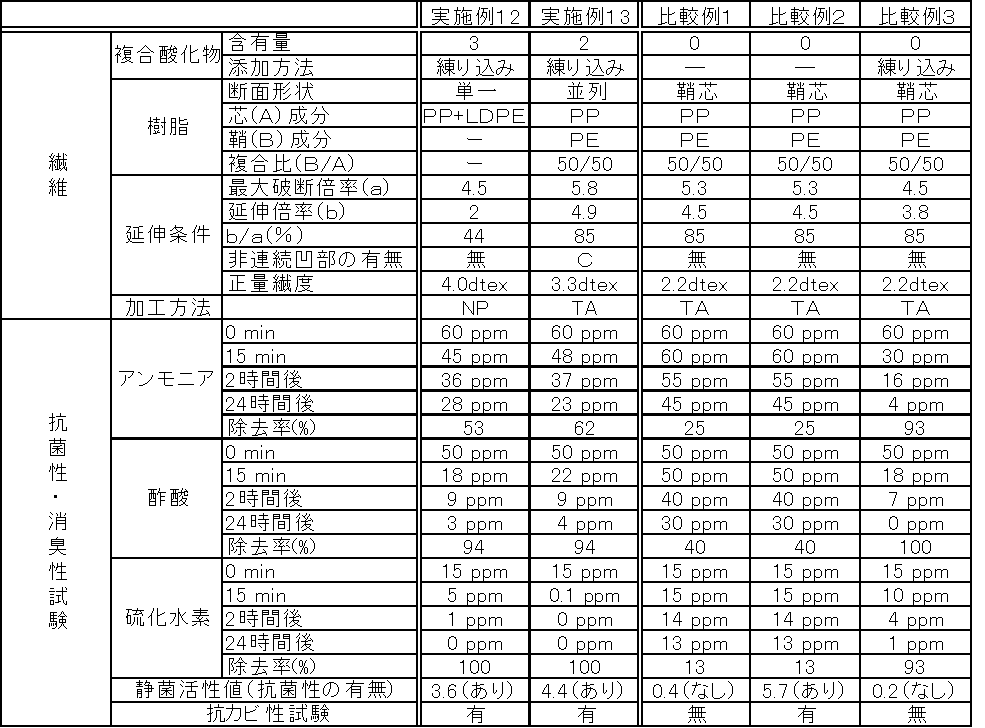
本発明の抗菌・消臭性繊維は、繊維中に2価金属及び/または3価金属からなる複合酸化物を含有させる事により、細菌、かびに対する増殖抑制及び、消臭性能を有する繊維を得る事が出来る。
また、繊維軸方向に非連続な亀裂及び/又は断裂による凹部分(非連続凹部)を混在させる事により、より多くの複合酸化物が繊維表面に露出される為、更に優れた抗菌・消臭性能を発現する事が出来る。かつアンモニア、アミン等の塩基性臭気物質、酢酸等の酸性臭気物質及び、硫化水素等の硫黄系臭気物質にも幅広く対応可能な充分な消臭性能を有しており、特に酢酸等の酸性臭気物質及び、硫化水素等の硫黄系臭気物質に対して優れた巾広い消臭性能を発現する。
更に、本発明の抗菌・消臭性繊維から得られる繊維成形物は優れた抗菌性、消臭性能を有しているので、例えば、おむつ、ナプキン、失禁パット等の吸収性物品、ガウン、術衣等の医療衛生材、壁用シート、床材等の室内内装材、カバークロス、生ゴミ用カバー等の生活関連材、使い捨てトイレ、トイレ用カバー等のトイレタリー製品、ペットシート、ペット用おむつ、ペット用タオル等のペット用品、一般医療材、寝装材、フィルター材、介護用品など様々な用途であっても、良好な消臭性能を発揮できる。
The antibacterial / deodorant fiber of the present invention obtains a fiber having growth suppression and deodorant performance against bacteria and fungi by containing a complex oxide composed of a divalent metal and / or a trivalent metal in the fiber. I can do it.
In addition, since more complex oxides are exposed on the fiber surface by mixing the discontinuities due to discontinuous cracks and / or tears in the fiber axis direction (non-continuous recesses), even better antibacterial and deodorant Performance can be expressed. In addition, it has sufficient deodorizing performance that can be applied to a wide range of basic odorous substances such as ammonia and amines, acidic odorous substances such as acetic acid, and sulfur-based odorous substances such as hydrogen sulfide, especially acidic odorous substances such as acetic acid. Exhibits a wide range of deodorizing performance with respect to substances and sulfur-based odorous substances such as hydrogen sulfide.
Furthermore, since the fiber molded product obtained from the antibacterial / deodorant fiber of the present invention has excellent antibacterial and deodorant performances, for example, absorbent articles such as diapers, napkins, incontinence pads, gowns, surgical procedures, etc. Medical hygiene materials such as clothing, indoor interior materials such as wall sheets and flooring materials, cover cloths, life-related materials such as covers for garbage, disposable toilets, toiletries such as toilet covers, pet sheets, pet diapers, Good deodorization performance can be exhibited even in various applications such as pet supplies such as pet towels, general medical materials, bedding materials, filter materials, and care products.
Claims (10)
M2+ (1-x)M3+ x-δO
(M2+は亜鉛又は亜鉛を必須成分とする2価金属を示し、M3+はAl,Fe,Ceから選ばれる3価金属を示し、xは0<x≦0.5の範囲の数を示し、δはカチオン格子欠陥を示す) A fiber made of a thermoplastic resin contains 0.1 to 10% by weight of a composite oxide represented by the following general formula made of a divalent metal and / or a trivalent metal based on the weight of the fiber. Antibacterial and deodorant fiber
M 2+ (1-x) M 3+ x-δ O
(M 2+ represents zinc or a divalent metal containing zinc as an essential component, M 3+ represents a trivalent metal selected from Al, Fe, and Ce, and x is a number in the range of 0 <x ≦ 0.5. Where δ is a cationic lattice defect)
M2+ (1-x)M3+ x-δO
(M2+は亜鉛又は亜鉛を必須成分とする2価金属を示し、M3+はAl,Fe,Ceから選ばれる3価金属を示し、xは0<x≦0.5の範囲の数を示し、δはカチオン格子欠陥を示す) A composite oxide composed of a divalent metal and / or a trivalent metal represented by the following general formula is mixed with a thermoplastic resin in an amount of 0.1 to 10% by weight. A method for producing antibacterial and deodorant fibers, characterized by stretching at 50 to 95%.
M 2+ (1-x) M 3+ x-δ O
(M 2+ represents zinc or a divalent metal containing zinc as an essential component, M 3+ represents a trivalent metal selected from Al, Fe, and Ce, and x is a number in the range of 0 <x ≦ 0.5. Where δ is a cationic lattice defect)
Priority Applications (1)
| Application Number | Priority Date | Filing Date | Title |
|---|---|---|---|
| JP2004119145A JP4321335B2 (en) | 2004-04-14 | 2004-04-14 | Antibacterial / deodorant fiber, method for producing the same, and fiber molded article using the same |
Applications Claiming Priority (1)
| Application Number | Priority Date | Filing Date | Title |
|---|---|---|---|
| JP2004119145A JP4321335B2 (en) | 2004-04-14 | 2004-04-14 | Antibacterial / deodorant fiber, method for producing the same, and fiber molded article using the same |
Publications (2)
| Publication Number | Publication Date |
|---|---|
| JP2005299036A true JP2005299036A (en) | 2005-10-27 |
| JP4321335B2 JP4321335B2 (en) | 2009-08-26 |
Family
ID=35330932
Family Applications (1)
| Application Number | Title | Priority Date | Filing Date |
|---|---|---|---|
| JP2004119145A Expired - Fee Related JP4321335B2 (en) | 2004-04-14 | 2004-04-14 | Antibacterial / deodorant fiber, method for producing the same, and fiber molded article using the same |
Country Status (1)
| Country | Link |
|---|---|
| JP (1) | JP4321335B2 (en) |
Cited By (4)
| Publication number | Priority date | Publication date | Assignee | Title |
|---|---|---|---|---|
| JP2005330641A (en) * | 2004-04-23 | 2005-12-02 | Chisso Corp | Deodorant fiber and fiber molded body and fiber product using the same |
| JP2008075231A (en) * | 2006-09-25 | 2008-04-03 | Mitsui Chemicals Inc | Nonwoven fabric made of split composite fiber |
| US8236291B2 (en) | 2007-04-04 | 2012-08-07 | Es Fiber Visions Co., Ltd. | Antibacterial and deodorant fiber, fiber formed article, and fiber product |
| US9233392B2 (en) | 2011-11-16 | 2016-01-12 | Selim Fiber Co., Ltd. | Artificial hair filament having antibacterial and antifungal properties, method and device for preparing the same |
-
2004
- 2004-04-14 JP JP2004119145A patent/JP4321335B2/en not_active Expired - Fee Related
Cited By (4)
| Publication number | Priority date | Publication date | Assignee | Title |
|---|---|---|---|---|
| JP2005330641A (en) * | 2004-04-23 | 2005-12-02 | Chisso Corp | Deodorant fiber and fiber molded body and fiber product using the same |
| JP2008075231A (en) * | 2006-09-25 | 2008-04-03 | Mitsui Chemicals Inc | Nonwoven fabric made of split composite fiber |
| US8236291B2 (en) | 2007-04-04 | 2012-08-07 | Es Fiber Visions Co., Ltd. | Antibacterial and deodorant fiber, fiber formed article, and fiber product |
| US9233392B2 (en) | 2011-11-16 | 2016-01-12 | Selim Fiber Co., Ltd. | Artificial hair filament having antibacterial and antifungal properties, method and device for preparing the same |
Also Published As
| Publication number | Publication date |
|---|---|
| JP4321335B2 (en) | 2009-08-26 |
Similar Documents
| Publication | Publication Date | Title |
|---|---|---|
| JP5040405B2 (en) | Antibacterial and deodorant fibers, fiber molded products and fiber products using the same | |
| JP4780519B2 (en) | Antibacterial and deodorant fibers, fiber molded products and fiber products having hydrophilicity | |
| CN105274733B (en) | Non-woven fibre web of dimensionally stable and production and preparation method thereof | |
| JP5298383B2 (en) | Heat-adhesive conjugate fiber excellent in bulkiness and flexibility and fiber molded article using the same | |
| AU2014396148B2 (en) | Hollow porous fibers | |
| CN100457193C (en) | Bacterial Adhesion Products | |
| US20040067710A1 (en) | Elastic nonwoven fabric and fiber products munufactured therefrom | |
| EP3152348B1 (en) | Hollow porous fibers | |
| JPH10511748A (en) | Dispersible compositions and dispersible articles and methods of disposing such compositions and articles | |
| US20140170922A1 (en) | Low Density Fibers and Methods for Forming Same | |
| JP2008188791A (en) | Antibacterial and dustproof fabric | |
| JP2008188082A (en) | mask | |
| EP0894159A1 (en) | High strength spunbond fabric from high melt flow rate polymers | |
| JPWO2010001872A1 (en) | Liquid storage material and storage method | |
| US8216559B2 (en) | Deodorant fiber and fibrous article and product made thereof | |
| JP5564934B2 (en) | Antibacterial organic polymer products | |
| JP4321335B2 (en) | Antibacterial / deodorant fiber, method for producing the same, and fiber molded article using the same | |
| JP2571738B2 (en) | Non-woven | |
| JP4525443B2 (en) | Deodorant fiber and fiber molded body and fiber product using the same | |
| JP6324789B2 (en) | Irregular cross-section fiber | |
| Islam | Application of nanotechnology for wool and wool blends in medical textiles utilising biopolymers | |
| JP2004049540A (en) | Antimicrobial adhesive film and first aid bandage using the same | |
| JPH04194079A (en) | Antibacterial, mildew-proofing and deodorizing nonwoven fabric having hydrophilicity | |
| KR20040032524A (en) | Process for preparing sea-island type composite fibers having excellent antimicrobial property and wash durability | |
| HK1233575A1 (en) | Interlaced filtration barrier |
Legal Events
| Date | Code | Title | Description |
|---|---|---|---|
| A621 | Written request for application examination |
Free format text: JAPANESE INTERMEDIATE CODE: A621 Effective date: 20061102 |
|
| A977 | Report on retrieval |
Free format text: JAPANESE INTERMEDIATE CODE: A971007 Effective date: 20090105 |
|
| A131 | Notification of reasons for refusal |
Free format text: JAPANESE INTERMEDIATE CODE: A131 Effective date: 20090113 |
|
| A521 | Written amendment |
Free format text: JAPANESE INTERMEDIATE CODE: A523 Effective date: 20090310 |
|
| A131 | Notification of reasons for refusal |
Free format text: JAPANESE INTERMEDIATE CODE: A131 Effective date: 20090331 |
|
| A521 | Written amendment |
Free format text: JAPANESE INTERMEDIATE CODE: A523 Effective date: 20090407 |
|
| TRDD | Decision of grant or rejection written | ||
| A01 | Written decision to grant a patent or to grant a registration (utility model) |
Free format text: JAPANESE INTERMEDIATE CODE: A01 Effective date: 20090512 |
|
| A01 | Written decision to grant a patent or to grant a registration (utility model) |
Free format text: JAPANESE INTERMEDIATE CODE: A01 |
|
| A61 | First payment of annual fees (during grant procedure) |
Free format text: JAPANESE INTERMEDIATE CODE: A61 Effective date: 20090525 |
|
| R150 | Certificate of patent or registration of utility model |
Ref document number: 4321335 Country of ref document: JP Free format text: JAPANESE INTERMEDIATE CODE: R150 Free format text: JAPANESE INTERMEDIATE CODE: R150 |
|
| FPAY | Renewal fee payment (event date is renewal date of database) |
Free format text: PAYMENT UNTIL: 20120612 Year of fee payment: 3 |
|
| S531 | Written request for registration of change of domicile |
Free format text: JAPANESE INTERMEDIATE CODE: R313531 |
|
| FPAY | Renewal fee payment (event date is renewal date of database) |
Free format text: PAYMENT UNTIL: 20120612 Year of fee payment: 3 |
|
| R350 | Written notification of registration of transfer |
Free format text: JAPANESE INTERMEDIATE CODE: R350 |
|
| S111 | Request for change of ownership or part of ownership |
Free format text: JAPANESE INTERMEDIATE CODE: R313117 |
|
| FPAY | Renewal fee payment (event date is renewal date of database) |
Free format text: PAYMENT UNTIL: 20120612 Year of fee payment: 3 |
|
| R350 | Written notification of registration of transfer |
Free format text: JAPANESE INTERMEDIATE CODE: R350 |
|
| FPAY | Renewal fee payment (event date is renewal date of database) |
Free format text: PAYMENT UNTIL: 20120612 Year of fee payment: 3 |
|
| S533 | Written request for registration of change of name |
Free format text: JAPANESE INTERMEDIATE CODE: R313533 |
|
| FPAY | Renewal fee payment (event date is renewal date of database) |
Free format text: PAYMENT UNTIL: 20120612 Year of fee payment: 3 |
|
| R360 | Written notification for declining of transfer of rights |
Free format text: JAPANESE INTERMEDIATE CODE: R360 |
|
| FPAY | Renewal fee payment (event date is renewal date of database) |
Free format text: PAYMENT UNTIL: 20120612 Year of fee payment: 3 |
|
| FPAY | Renewal fee payment (event date is renewal date of database) |
Free format text: PAYMENT UNTIL: 20120612 Year of fee payment: 3 |
|
| R370 | Written measure of declining of transfer procedure |
Free format text: JAPANESE INTERMEDIATE CODE: R370 |
|
| FPAY | Renewal fee payment (event date is renewal date of database) |
Free format text: PAYMENT UNTIL: 20120612 Year of fee payment: 3 |
|
| S533 | Written request for registration of change of name |
Free format text: JAPANESE INTERMEDIATE CODE: R313533 |
|
| R250 | Receipt of annual fees |
Free format text: JAPANESE INTERMEDIATE CODE: R250 |
|
| FPAY | Renewal fee payment (event date is renewal date of database) |
Free format text: PAYMENT UNTIL: 20130612 Year of fee payment: 4 |
|
| R350 | Written notification of registration of transfer |
Free format text: JAPANESE INTERMEDIATE CODE: R350 |
|
| R250 | Receipt of annual fees |
Free format text: JAPANESE INTERMEDIATE CODE: R250 |
|
| R250 | Receipt of annual fees |
Free format text: JAPANESE INTERMEDIATE CODE: R250 |
|
| R250 | Receipt of annual fees |
Free format text: JAPANESE INTERMEDIATE CODE: R250 |
|
| R250 | Receipt of annual fees |
Free format text: JAPANESE INTERMEDIATE CODE: R250 |
|
| R250 | Receipt of annual fees |
Free format text: JAPANESE INTERMEDIATE CODE: R250 |
|
| R250 | Receipt of annual fees |
Free format text: JAPANESE INTERMEDIATE CODE: R250 |
|
| R250 | Receipt of annual fees |
Free format text: JAPANESE INTERMEDIATE CODE: R250 |
|
| R250 | Receipt of annual fees |
Free format text: JAPANESE INTERMEDIATE CODE: R250 |
|
| LAPS | Cancellation because of no payment of annual fees |