JP2005298974A - Electrolytic method for producing borohydride - Google Patents
Electrolytic method for producing borohydride Download PDFInfo
- Publication number
- JP2005298974A JP2005298974A JP2005114236A JP2005114236A JP2005298974A JP 2005298974 A JP2005298974 A JP 2005298974A JP 2005114236 A JP2005114236 A JP 2005114236A JP 2005114236 A JP2005114236 A JP 2005114236A JP 2005298974 A JP2005298974 A JP 2005298974A
- Authority
- JP
- Japan
- Prior art keywords
- cathode
- borohydride
- solution
- solvent
- contact
- Prior art date
- Legal status (The legal status is an assumption and is not a legal conclusion. Google has not performed a legal analysis and makes no representation as to the accuracy of the status listed.)
- Granted
Links
Classifications
-
- C—CHEMISTRY; METALLURGY
- C25—ELECTROLYTIC OR ELECTROPHORETIC PROCESSES; APPARATUS THEREFOR
- C25B—ELECTROLYTIC OR ELECTROPHORETIC PROCESSES FOR THE PRODUCTION OF COMPOUNDS OR NON-METALS; APPARATUS THEREFOR
- C25B1/00—Electrolytic production of inorganic compounds or non-metals
- C25B1/01—Products
- C25B1/28—Per-compounds
- C25B1/30—Peroxides
-
- C—CHEMISTRY; METALLURGY
- C25—ELECTROLYTIC OR ELECTROPHORETIC PROCESSES; APPARATUS THEREFOR
- C25B—ELECTROLYTIC OR ELECTROPHORETIC PROCESSES FOR THE PRODUCTION OF COMPOUNDS OR NON-METALS; APPARATUS THEREFOR
- C25B1/00—Electrolytic production of inorganic compounds or non-metals
-
- C—CHEMISTRY; METALLURGY
- C25—ELECTROLYTIC OR ELECTROPHORETIC PROCESSES; APPARATUS THEREFOR
- C25B—ELECTROLYTIC OR ELECTROPHORETIC PROCESSES FOR THE PRODUCTION OF COMPOUNDS OR NON-METALS; APPARATUS THEREFOR
- C25B1/00—Electrolytic production of inorganic compounds or non-metals
- C25B1/01—Products
- C25B1/14—Alkali metal compounds
Landscapes
- Chemical & Material Sciences (AREA)
- Inorganic Chemistry (AREA)
- Engineering & Computer Science (AREA)
- Chemical Kinetics & Catalysis (AREA)
- Electrochemistry (AREA)
- Materials Engineering (AREA)
- Metallurgy (AREA)
- Organic Chemistry (AREA)
- Electrolytic Production Of Non-Metals, Compounds, Apparatuses Therefor (AREA)
Abstract
Description
本発明は、水素化ホウ素の電解合成方法に関する。 The present invention relates to a method for electrolytic synthesis of borohydride.
水素化ホウ素製造の電解プロセスは、クーパーの米国特許第3,734,842号に開示されている。しかしながら、クーパーにより開示された出発物質は、種々のホウ酸塩に限定されている。更に、Journal of Applied Electrochemistry、第28巻、1147〜51頁(1998年)において記録されているE.L.GyengeおよびC.W.Olomanによる研究により、クーパーの方法ならびに幾つかの他の発表されている水素化ホウ素の電解合成は測定可能な量の水素化ホウ素を現実には生成しないことが立証された。 An electrolysis process for borohydride production is disclosed in Cooper's US Pat. No. 3,734,842. However, the starting materials disclosed by Cooper are limited to various borates. Furthermore, the E.C. recorded in Journal of Applied Electrochemistry, Vol. 28, pages 1147-51 (1998). L. Gynge and C.I. W. Studies by Oloman have demonstrated that the Cooper method as well as some other published electrosynthesis of borohydrides do not actually produce measurable amounts of borohydride.
本発明により取り組まれる課題は、水素化ホウ素の電気化学的合成の需要についてである。 The problem addressed by the present invention is the demand for the electrochemical synthesis of borohydride.
本発明は、水素化ホウ素を製造する方法に関する。本方法は電解セル中の陽極と陰極との間に電流を流すことを含み、ここで水素化トリアルコキシホウ素(trialkoxyborohydride)溶液が陰極と接触している。 The present invention relates to a method for producing borohydride. The method includes passing an electric current between an anode and a cathode in an electrolysis cell, wherein a trialkoxyborohydride solution is in contact with the cathode.
本発明は、更に水素化ホウ素を製造する方法に関する。本方法は、a)電解セル中の陽極と陰極との間に電流を流し(ここでホウ酸エステル溶液が陰極と接触している)、それにより水素化トリアルコキシホウ素溶液を製造する工程;およびb)第二電解セル中の第二陽極と第二陰極との間に電流を流す(ここで水素化トリアルコキシホウ素溶液が第二陰極と接触している)工程を含む。 The invention further relates to a method for producing borohydride. The method comprises the steps of: a) passing an electric current between an anode and a cathode in an electrolysis cell (where the borate solution is in contact with the cathode), thereby producing a trialkoxyboron hydride solution; b) passing a current between the second anode and the second cathode in the second electrolysis cell (where the trialkoxyborohydride solution is in contact with the second cathode).
この出願において使用される場合、「水素化ホウ素」はテトラヒドリドホウ酸イオン、BH4 −を意味する。用語「ホウ酸エステル」は、ホウ酸トリアルキル、B(OR)3を意味し、ここでRはヒドロキシまたはアルコキシにより任意に置換され、かつ、好ましくは1〜8の炭素原子を有するアルキル基である。一態様において、Rはメチルまたはエチルである。「水素化トリアルコキシホウ素」は式BH(OR)3 −を有するイオンであり、ここでRは1〜8の炭素原子、好ましくは1〜6の炭素原子、より好ましくは1〜4の炭素原子を有するアルキル基である。一態様において、Rは1または2の炭素原子を有する。 As used in this application, “borohydride” means the tetraborohydride ion, BH 4 — . The term “borate ester” means a trialkyl borate, B (OR) 3 , wherein R is optionally substituted by hydroxy or alkoxy and is preferably an alkyl group having 1 to 8 carbon atoms. is there. In one embodiment, R is methyl or ethyl. “Hydroxyalkoxyborohydride” is an ion having the formula BH (OR) 3 — , where R is 1 to 8 carbon atoms, preferably 1 to 6 carbon atoms, more preferably 1 to 4 carbon atoms. It is an alkyl group having In one embodiment, R has 1 or 2 carbon atoms.
水素化トリアルコキシホウ素は、水素化トリメトキシホウ素ナトリウム(STB)および水素化ホウ素ナトリウム(SBH)についての下記の化学式において記載されるように、電気分解により還元されて水素化ホウ素となり得る。 Trialkoxyboron hydride can be reduced by electrolysis to borohydride as described in the following chemical formulas for sodium trimethoxyborohydride (STB) and sodium borohydride (SBH).
本発明の一態様において、電気分解は、水素ガスの存在下で遂行される。好ましくは、陰極は、水素化触媒として活性を有する金属、たとえば、Pd、Pt、Au、Ir、Co、Rh、Ag、グラファイトまたはそれらの組み合わせを含む。最も好ましくは、陰極は、PdまたはPtを含む。 In one embodiment of the invention, the electrolysis is performed in the presence of hydrogen gas. Preferably, the cathode comprises a metal having activity as a hydrogenation catalyst, such as Pd, Pt, Au, Ir, Co, Rh, Ag, graphite or combinations thereof. Most preferably, the cathode comprises Pd or Pt.
本発明の一態様において、再生可能なレドックス種が、陰極付近に存在する。再生可能なレドックス種は、電子を他の種に移動する(それにより元の分子へ再生する)ことが可能な種に電解的に還元され得る分子である。再生可能レッドクス種の例としては、多環式芳香族炭化水素、たとえば、ナフタレン、1−および2−アルキルナフタレン、アントラセン、1−および2−アルキルアントラセン、フェナントレン、クリセン、イソキノリン、ならびにこれらの組合わせが挙げられる。最も好ましくは、再生可能レドックス種はナフタレン、または1−または2−アルキルナフタレンである。再生可能レドックス種と組み合わされて使用される好ましい陰極材料としては、たとえば固体、布およびフェルトおよびガラス状炭素を含む種々の形態の炭素およびグラファイトが挙げられる。好ましくは、再生可能レドックス種が使用される場合、溶媒の水分含量は0.1%未満である。 In one embodiment of the invention, a renewable redox species is present near the cathode. A renewable redox species is a molecule that can be reduced electrolytically to a species that can transfer electrons to another species (and thereby regenerate to the original molecule). Examples of renewable Redx species include polycyclic aromatic hydrocarbons such as naphthalene, 1- and 2-alkylnaphthalene, anthracene, 1- and 2-alkylanthracene, phenanthrene, chrysene, isoquinoline, and combinations thereof Is mentioned. Most preferably, the renewable redox species is naphthalene or 1- or 2-alkylnaphthalene. Preferred cathode materials used in combination with renewable redox species include various forms of carbon and graphite including, for example, solids, cloths and felts and glassy carbon. Preferably, when a renewable redox species is used, the water content of the solvent is less than 0.1%.
本発明の一態様において、電解反応は水素化ホウ素が可溶である非水性溶媒、たとえば、C1〜C4脂肪族アルコール、たとえば、メタノール、エタノール;アンモニア;C1〜C4脂肪族アミン;グリコール;グリコールエーテル;および極性非プロトン性溶媒、たとえば、ジメチルホルムアミド(DMF)、ジメチルアセトアミド(DMAc)、ジメチルスルホキシド、ヘキサメチルホスホルアミド(HMPA)およびこれらの組合わせ中で起こる。好ましくは、非水性溶媒は、メタノール、エタノール、DMF、HMPAまたはこれらの組合わせである。好ましくは、非水性溶媒中に存在する水の量は、1%未満、より好ましくは0.1%未満、より好ましくは100ppm未満であり、および最も好ましくは、非水性溶媒は実質的に水を含まない。 In one aspect of the present invention, the non-aqueous solvent electrolyte reactions which borohydride is soluble, e.g., C 1 -C 4 aliphatic alcohols, such as methanol, ethanol; ammonia; C 1 -C 4 aliphatic amines; Glycols; glycol ethers; and polar aprotic solvents such as dimethylformamide (DMF), dimethylacetamide (DMAc), dimethyl sulfoxide, hexamethylphosphoramide (HMPA) and combinations thereof. Preferably the non-aqueous solvent is methanol, ethanol, DMF, HMPA or a combination thereof. Preferably, the amount of water present in the non-aqueous solvent is less than 1%, more preferably less than 0.1%, more preferably less than 100 ppm, and most preferably the non-aqueous solvent contains substantially water. Not included.
他の態様において、電解反応は、水性溶媒中または、1%を超える水を有する水性/有機溶媒混合物中において起こる。水性/有機溶媒混合物中において使用される有機溶媒は、溶液を形成するために十分な水に対する溶解度を有するものである。 In other embodiments, the electrolysis reaction occurs in an aqueous solvent or an aqueous / organic solvent mixture having greater than 1% water. The organic solvent used in the aqueous / organic solvent mixture is one that has sufficient water solubility to form a solution.
好ましくは、プロトン性溶媒が使用される場合、特に水、メタノールまたはエタノールの場合、水素化ホウ素を安定化させるためにアルカリが存在し、好ましくは少なくとも0.1Nのアルカリが存在する。 Preferably, when a protic solvent is used, especially in the case of water, methanol or ethanol, an alkali is present to stabilize the borohydride, preferably at least 0.1N alkali is present.
HMPAが溶媒として使用される一態様において、好ましい陰極材料としては、たとえば固体、布およびフェルトおよびガラス状炭素を含む種々の形態における炭素およびグラファイトが挙げられる。 In one embodiment where HMPA is used as a solvent, preferred cathode materials include carbon and graphite in various forms including, for example, solids, cloths and felts and glassy carbon.
本発明の一態様において、非水性溶媒は、その溶媒に可溶な比較的非反応性の塩、たとえば、過塩素酸塩、p−トルエンスルホン酸リチウム、メタンスルホン酸リチウム、テトラフルオロホウ酸リチウムまたはナトリウムおよび同様なアニオンのテトラアルキルアンモニウム塩を含有する。 In one embodiment of the invention, the non-aqueous solvent is a relatively non-reactive salt that is soluble in the solvent, such as perchlorate, lithium p-toluenesulfonate, lithium methanesulfonate, lithium tetrafluoroborate. Or tetraalkylammonium salts of sodium and similar anions.
水素化トリアルコキシホウ素の不均化は、電気分解との競合的反応として起こり得る。不均化は、STBについての次の反応式によって記載されるように生じる。 Disproportionation of trialkoxyboron hydride can occur as a competitive reaction with electrolysis. Disproportionation occurs as described by the following reaction equation for STB.
いくらかの水素化ホウ素は、このプロセスにより必然的に生じる。400%の電流効率を報告する表1における最初の記載事項の場合は、いくらかの水素化ホウ素は明らかにこの道筋により発生した。この実験は、0.0117モルのSTBで出発して、0.0029モルのSBHの不均化からの理論的な収率を与える。ヨウ素溶液での滴定の結果は、0.0034モルのSBHが実際に形成されたことを示した。それ故、0.0034−0.0029、すなわち0.0005モルのSBHは、電気分解によって発生されたに違いない。理論的および実際に通過したクーロンを基準にすると、実際の電流効率は、60%であった。 Some borohydride is inevitably produced by this process. In the case of the first entry in Table 1 reporting 400% current efficiency, some borohydride was clearly generated by this path. This experiment gives a theoretical yield from disproportionation of 0.0029 mol SBH starting with 0.0117 mol STB. Titration results with iodine solution indicated that 0.0034 moles of SBH was actually formed. Therefore, 0.0034-0.0029, or 0.0005 moles of SBH must have been generated by electrolysis. Based on theoretical and actual coulombs passed, the actual current efficiency was 60%.
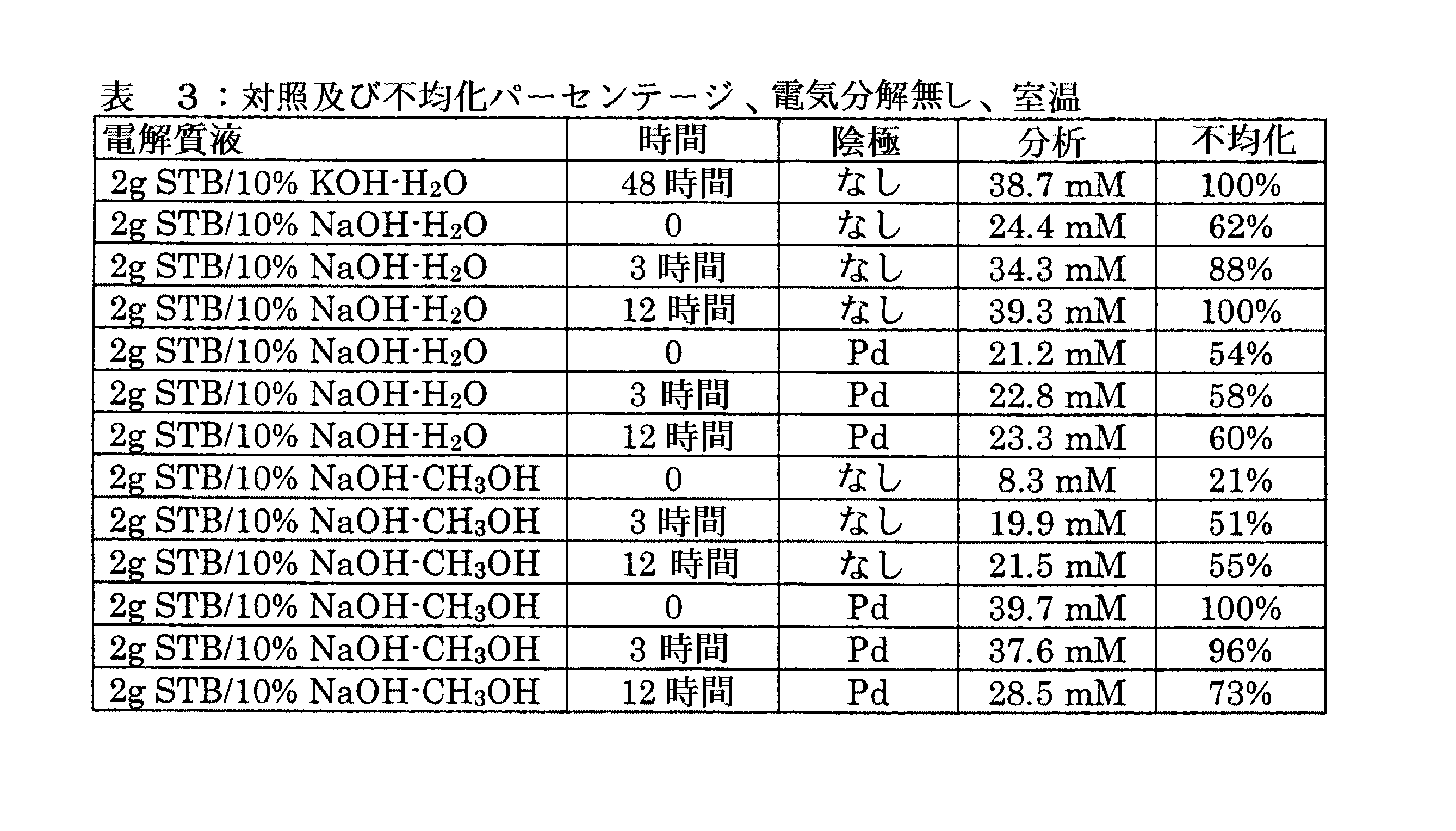
幾つかの手段による、水素化トリアルコキシホウ素から水素化ホウ素への電気還元は、競合する不均化反応より優れている可能性がある。反応溶媒の選択は、反応経路に影響を及ぼすことができる。アルカリ性メタノールは、HMPAよりも、より高い収率を生む。混合アルコール/アミンまたは水/アミン溶媒もまた、不均化を減少させる。アルカリの量もまた、高いレベルは不均化を有利にするので、重要である。ホウ素水素化反応物および生成物を安定化させるのに十分なだけのアルカリを使用するのが好ましい。表3は、10%アルカリを含有する一連の溶液に対し時間依存性の不均化の結果を記載する。たとえばイソプロピル、t−ブチルまたはトリメチロールプロピルをはじめとする水素化トリアルコキシホウ素中のヒンダードアルキル基もまた、不均化を減少させることができる。 Electroreduction from trialkoxyborohydride to borohydride by several means may be superior to competing disproportionation reactions. The choice of reaction solvent can affect the reaction pathway. Alkaline methanol produces higher yields than HMPA. Mixed alcohol / amine or water / amine solvents also reduce disproportionation. The amount of alkali is also important because high levels favor disproportionation. It is preferred to use only enough alkali to stabilize the boron hydrogenation reactants and products. Table 3 lists the results of time-dependent disproportionation for a series of solutions containing 10% alkali. Hindered alkyl groups in trialkoxyborohydrides including, for example, isopropyl, t-butyl or trimethylolpropyl can also reduce disproportionation.
水素化トリアルコキシホウ素を、STBについて下記に図示されるように、水素化金属およびホウ酸トリアルキルから調製することができる: A trialkoxy boron hydride can be prepared from a metal hydride and a trialkyl borate as illustrated below for STB:
この転化は、J.Am.Chem.Soc.、第75巻、192頁(1953年)およびJ.Am.Chem.Soc.、第79巻、5400頁(1957年)においてH.C.ブラウンらにより記載された。反応は、溶媒の不存在下で迅速に起こり、STBを生じさせる。あるいは、水素化トリメトキシホウ素を、ホウ酸エステルの電気分解により調製することができる。 This conversion is described in J. Org. Am. Chem. Soc. 75, 192 (1953) and J. Am. Am. Chem. Soc. 79, 5400 (1957). C. Described by Brown et al. The reaction takes place rapidly in the absence of solvent to give STB. Alternatively, trimethoxy boron hydride can be prepared by electrolysis of borate esters.
ホウ酸塩より製造される水素化トリアルコキシホウ素溶液は、任意に水素化トリアルコキシホウ素を製造するのに使用されるものと異なる条件下で、直接にSBHに電気分解され得るか、または水素化トリアルコキシホウ素溶液は電解セルから取出され、異なる電解セルにおいてSBHに変換され得る。好ましくは、水素化トリアルコキシホウ素を製造する電気分解は、たとえばDMF等の極性非プロトン性溶媒中において遂行される。任意に、アルカリ金属塩素酸塩またはフルオロホウ酸塩が存在する。好ましい陰極材料には、グラファイトおよびニッケルが包含される。 Hydrogenated trialkoxyboron solutions made from borates can be electrolyzed directly to SBH, optionally under conditions different from those used to produce trialkoxyborohydride or hydrogenated The trialkoxyboron solution can be removed from the electrolysis cell and converted to SBH in a different electrolysis cell. Preferably, the electrolysis to produce trialkoxyborohydride is carried out in a polar aprotic solvent such as DMF. Optionally, an alkali metal chlorate or fluoroborate is present. Preferred cathode materials include graphite and nickel.
SBHへのSTB電気分解のための一般的手順
対応するガラスカバーを有する三つの区画(アノード液、カソード液および参照)からなるフリット分離ガラスH−セルに、陰極、および、グラファイトロッド陽極(5cm2電極面積;溶液に暴露される残余の電極領域はPTFEテープでマスクされた)が装着された。飽和カロメル参照電極は、参照区画中に挿入された。カソード溶液はカソード液区画に添加され、10重量%水酸化ナトリウム水溶液が陽極区画(35mL)および参照区画(10mL)に添加された。電極は、エレクトロシンセシスCo.410ポテンシオスタット、420A DC電源および640クーロメータからなるポテンシオスタット系に接続された。セルは、一定の温度を維持するため室温水浴中に垂下され、磁気撹拌器が陰極区画を良く撹拌された状態に維持するため利用された。作用電極(陰極)のための電位および初期電流が、その後セットされた。
General procedure for STB electrolysis to SBH A frit-separated glass H-cell consisting of three compartments (anolyte, catholyte and reference) with a corresponding glass cover, cathode and graphite rod anode (5 cm 2 Electrode area; the remaining electrode area exposed to the solution was masked with PTFE tape). A saturated calomel reference electrode was inserted into the reference compartment. The catholyte solution was added to the catholyte compartment and a 10 wt% aqueous sodium hydroxide solution was added to the anode compartment (35 mL) and the reference compartment (10 mL). The electrodes are electrosynthetic Co. It was connected to a potentiostat system consisting of a 410 potentiostat, a 420A DC power supply and a 640 coulometer. The cell was suspended in a room temperature water bath to maintain a constant temperature, and a magnetic stirrer was utilized to keep the cathode compartment well agitated. The potential and initial current for the working electrode (cathode) was then set.
SBHへのSTB電気分解のための手順、およびNMR測定(表1における最後の二つの記載事項)
(A)10%水酸化ナトリウム100mLおよびSTBを2gからなるカソード液を使用して、上記一般的手順に従った。陰極の電位は、カロメル参照に対して−1.5Vにセットされた。初期電流は、550mA(110mA/cm2電流密度)であった。定電位において7225クーロンの電荷(0.0750モルの電子)が通過した後、反応を停止した。水素化ホウ素ナトリウム製造についての6−電子プロセス(six−electron process)に基づいて、100%効率で12.5ミリモルまでの水素化ホウ素ナトリウムが形成され得た。反応混合物中の水素化ホウ素ナトリウムの実際の濃度を明確にするために、ホウ素−11NMRピーク強度を使用して異なる濃度の一連の水素化ホウ素カリウム試料により検量曲線が作成された。直線のキャリブレーションが4.5ミリモル/L〜13.5ミリモル/Lの濃度範囲で得られた。この曲線に基づいて、実験試料の濃度は、18.3ミリモル/Lであった。これは1.83ミリモルの全SBHに相当し、15%の電流効率を示している。
Procedure for STB electrolysis to SBH and NMR measurements (last two entries in Table 1)
(A) The above general procedure was followed using a catholyte consisting of 100 mL of 10% sodium hydroxide and 2 g of STB. The cathode potential was set to -1.5V relative to the calomel reference. The initial current was 550 mA (110 mA / cm 2 current density). The reaction was stopped after 7225 coulombs of charge (0.0750 moles of electrons) passed at a constant potential. Based on a six-electron process for sodium borohydride production, up to 12.5 mmol sodium borohydride could be formed with 100% efficiency. To clarify the actual concentration of sodium borohydride in the reaction mixture, a calibration curve was generated with a series of potassium borohydride samples at different concentrations using boron-11 NMR peak intensity. Linear calibration was obtained in the concentration range of 4.5 mmol / L to 13.5 mmol / L. Based on this curve, the concentration of the experimental sample was 18.3 mmol / L. This corresponds to 1.83 mmol total SBH, indicating a current efficiency of 15%.
(B)膜分離ガラスH−セルが、表1に記載されたように、フリット分離セルの代わりに、この実験において使用された。10%水酸化ナトリウム100mLおよび2gのSTBからなるカソード液を使用して上記一般的手順に従った。陰極の電位は、カロメル参照電極に対して−1.3Vにセットされた。初期電流は、500mA(100mA/cm2電流密度)であった。定電位において2500クーロンの電荷(0.0259モルの電子)が通過した後で、反応を停止した。水素化ホウ素ナトリウム製造についての6−電子プロセスに基づいて、100%効率で4.3ミリモルまでの水素化ホウ素ナトリウムが形成され得た。反応混合物中の水素化ホウ素ナトリウムの実際の濃度を明確にするために、上記(A)で記載されたように、ホウ素−11NMRピーク強度を使用して異なる濃度の一連の水素化ホウ素カリウム試料により検量曲線が作成された。この曲線に基づいて、実験試料の濃度は、20.2ミリモル/Lであった。これは2.02ミリモルの全SBHに相当し、47%の電流効率を示している。 (B) A membrane separation glass H-cell was used in this experiment instead of a frit separation cell as described in Table 1. The above general procedure was followed using a catholyte consisting of 100 mL 10% sodium hydroxide and 2 g STB. The cathode potential was set to -1.3 V relative to the calomel reference electrode. The initial current was 500 mA (100 mA / cm 2 current density). The reaction was stopped after 2500 coulomb charges (0.0259 moles of electrons) passed at constant potential. Based on a 6-electronic process for sodium borohydride production, up to 4.3 mmol sodium borohydride could be formed with 100% efficiency. In order to clarify the actual concentration of sodium borohydride in the reaction mixture, as described in (A) above, boron-11 NMR peak intensity was used to determine the concentration of a series of potassium borohydride samples. A calibration curve was created. Based on this curve, the concentration of the experimental sample was 20.2 mmol / L. This corresponds to a total SBH of 2.02 mmol and shows a current efficiency of 47%.
更に結果は、表1〜3に記入されている。表1は、水素化ホウ素が製造される実験を記載している。記載事項1〜3および8についての水素化ホウ素分析は、過剰の標準ヨウ素溶液で、生成物溶液のアリコートを急冷し、引き続き、標準重亜硫酸溶液で残存ヨウ素が滴定されることによって行われた。記載事項1〜8の水素化ホウ素生成物の存在は、11B NMR分析で確認された。記載事項9〜19の水素化ホウ素分析は、既知の標準水素化ホウ素溶液と比較して、11B NMR分析で確認された。表2は、水素化ホウ素を生じなかった多くの実験を記載している。表3は、電気分解なしでの、経時的な、STBの水素化ホウ素への不均化を示す一連の対照実験を記載している。 Further results are entered in Tables 1-3. Table 1 describes the experiments in which borohydride is produced. Boron hydride analysis for entries 1-3 and 8 was performed by quenching an aliquot of the product solution with excess standard iodine solution, followed by titration of residual iodine with standard bisulfite solution. The presence of the borohydride product of entries 1-8 was confirmed by 11 B NMR analysis. The borohydride analysis of entries 9-19 was confirmed by 11 B NMR analysis compared to known standard borohydride solutions. Table 2 describes a number of experiments that did not yield borohydride. Table 3 describes a series of control experiments showing disproportionation of STB to borohydride over time without electrolysis.
STBへのホウ酸トリメチル(TMB)の転化
相当するガラスカバーを有する三つの区画(アノード液、カソード液および参照)からなるフリット分離ガラスH−セルに、陰極、および、グラファイトロッド陽極(5cm2電極面積;溶液に暴露される残余の電極領域はPTFEテープでマスクされた)が装着された。飽和カロメル参照電極は、参照区画中に挿入された。カソード液は、100mLのDMF中、0.5M過塩素酸リチウム、5mLのTMB(4.6g、44.3ミリモル)であった。アノード液は、0.5M過塩素酸リチウム/DMF(35mL)であった。電極は、エレクトロシンセシスCo.410ポテンシオスタット、420A DC電源および640クーロメータからなるポテンシオスタット系に接続された。セルは、一定の温度を維持するため室温水浴中に垂下され、磁気撹拌器が陰極区画を良く撹拌された状態に維持するため利用された。定電位は、−3.90Vにセットされ、初期電流は150mAであり、通過した電荷は1390クーロンであった。第二の実験において、ニッケルロッドに取り付けられたニッケルフラグ陰極(5cm2)が使用された。定電位は、−3.5Vにセットされ、初期電流は85mAであり、通過した電荷は1054クーロンであった。ホウ素NMR分析により、一種のホウ素水素化物種に対し予期された領域における約0.17ppmのダブレットの存在が示されたが、水素化ホウ素について予期された位置ではなかった。
Conversion of trimethyl borate (TMB) to STB
Frit-separated glass H-cell consisting of three compartments (anolyte, catholyte and reference) with corresponding glass covers, cathode and graphite rod anode (5 cm 2 electrode area; remaining electrode area exposed to solution Was masked with PTFE tape). A saturated calomel reference electrode was inserted into the reference compartment. The catholyte was 0.5 M lithium perchlorate, 5 mL TMB (4.6 g, 44.3 mmol) in 100 mL DMF. The anolyte was 0.5M lithium perchlorate / DMF (35 mL). The electrodes are electrosynthetic Co. It was connected to a potentiostat system consisting of a 410 potentiostat, a 420A DC power supply and a 640 coulometer. The cell was suspended in a room temperature water bath to maintain a constant temperature, and a magnetic stirrer was utilized to keep the cathode compartment well agitated. The constant potential was set at -3.90 V, the initial current was 150 mA, and the charge passed was 1390 coulombs. In the second experiment, a nickel flag cathode (5 cm 2 ) attached to a nickel rod was used. The constant potential was set to -3.5 V, the initial current was 85 mA, and the charge passed was 1054 coulomb. Boron NMR analysis showed the presence of about 0.17 ppm doublet in the expected region for one boron hydride species, but not the expected position for borohydride.
Claims (6)
b)第二電解セル中の第二陽極と第二陰極との間に電流を流す(ここで水素化トリアルコキシホウ素溶液が第二陰極と接触している)工程
を含む水素化ホウ素を製造する方法。 a) passing a current between the anode and cathode in the electrolysis cell (where the borate solution is in contact with the cathode), thereby producing a trialkoxyboron hydride solution; and b) second A method for producing borohydride, comprising a step of passing a current between a second anode and a second cathode in an electrolytic cell (where a trialkoxyborohydride solution is in contact with the second cathode).
The method of claim 5, wherein the solvent in contact with the cathode and the second cathode comprises a non-aqueous solvent.
Applications Claiming Priority (1)
| Application Number | Priority Date | Filing Date | Title |
|---|---|---|---|
| US56160304P | 2004-04-13 | 2004-04-13 |
Publications (2)
| Publication Number | Publication Date |
|---|---|
| JP2005298974A true JP2005298974A (en) | 2005-10-27 |
| JP4303215B2 JP4303215B2 (en) | 2009-07-29 |
Family
ID=34940713
Family Applications (1)
| Application Number | Title | Priority Date | Filing Date |
|---|---|---|---|
| JP2005114236A Expired - Fee Related JP4303215B2 (en) | 2004-04-13 | 2005-04-12 | Electrolytic method for producing borohydride |
Country Status (7)
| Country | Link |
|---|---|
| US (1) | US7638029B2 (en) |
| EP (1) | EP1586677A1 (en) |
| JP (1) | JP4303215B2 (en) |
| KR (1) | KR100729987B1 (en) |
| CN (1) | CN1690250B (en) |
| CA (1) | CA2503297C (en) |
| TW (1) | TWI310369B (en) |
Cited By (2)
| Publication number | Priority date | Publication date | Assignee | Title |
|---|---|---|---|---|
| JP2009525939A (en) * | 2006-02-08 | 2009-07-16 | ロス アラモス ナショナル セキュリティ,リミテッド ライアビリテイ カンパニー | Energy efficient synthesis of boranes |
| JP2010069399A (en) * | 2008-09-17 | 2010-04-02 | Toshiba Corp | Boron separation system |
Families Citing this family (2)
| Publication number | Priority date | Publication date | Assignee | Title |
|---|---|---|---|---|
| US20060102491A1 (en) * | 2004-11-10 | 2006-05-18 | Kelly Michael T | Processes for separating metals from metal salts |
| US8021536B2 (en) * | 2006-04-13 | 2011-09-20 | Air Products And Chemical, Inc. | Method and apparatus for achieving maximum yield in the electrolytic preparation of group IV and V hydrides |
Family Cites Families (6)
| Publication number | Priority date | Publication date | Assignee | Title |
|---|---|---|---|---|
| US3734842A (en) * | 1971-05-05 | 1973-05-22 | H Cooper | Electrolytic process for the production of alkali metal borohydrides |
| US4808282A (en) * | 1987-01-05 | 1989-02-28 | The Dow Chemical Company | Alkaline earth metal compounds and alkali metal substances via electrochemical process |
| US4904357A (en) * | 1989-05-30 | 1990-02-27 | Southwestern Analytical | Production of quaternary ammonium and quaternary phosphonium borohydrides |
| US4931154A (en) * | 1989-07-17 | 1990-06-05 | Southwestern Analytical Chemicals, Inc. | Production of metal borohydrides and organic onium borohydrides |
| US5804329A (en) * | 1995-12-28 | 1998-09-08 | National Patent Development Corporation | Electroconversion cell |
| JP2003247088A (en) | 2002-02-22 | 2003-09-05 | Nissan Motor Co Ltd | Method and apparatus for producing borohydride compound |
-
2005
- 2005-03-31 CA CA002503297A patent/CA2503297C/en not_active Expired - Fee Related
- 2005-03-31 TW TW094110369A patent/TWI310369B/en not_active IP Right Cessation
- 2005-04-05 EP EP05252119A patent/EP1586677A1/en not_active Withdrawn
- 2005-04-12 JP JP2005114236A patent/JP4303215B2/en not_active Expired - Fee Related
- 2005-04-12 CN CN2005100650176A patent/CN1690250B/en not_active Expired - Fee Related
- 2005-04-12 US US11/104,121 patent/US7638029B2/en not_active Expired - Fee Related
- 2005-04-13 KR KR1020050030542A patent/KR100729987B1/en not_active Expired - Fee Related
Cited By (2)
| Publication number | Priority date | Publication date | Assignee | Title |
|---|---|---|---|---|
| JP2009525939A (en) * | 2006-02-08 | 2009-07-16 | ロス アラモス ナショナル セキュリティ,リミテッド ライアビリテイ カンパニー | Energy efficient synthesis of boranes |
| JP2010069399A (en) * | 2008-09-17 | 2010-04-02 | Toshiba Corp | Boron separation system |
Also Published As
| Publication number | Publication date |
|---|---|
| US20050224364A1 (en) | 2005-10-13 |
| TW200538392A (en) | 2005-12-01 |
| TWI310369B (en) | 2009-06-01 |
| CA2503297C (en) | 2009-10-20 |
| CN1690250A (en) | 2005-11-02 |
| KR20060045643A (en) | 2006-05-17 |
| CA2503297A1 (en) | 2005-10-13 |
| US7638029B2 (en) | 2009-12-29 |
| EP1586677A1 (en) | 2005-10-19 |
| JP4303215B2 (en) | 2009-07-29 |
| CN1690250B (en) | 2013-09-25 |
| KR100729987B1 (en) | 2007-06-20 |
Similar Documents
| Publication | Publication Date | Title |
|---|---|---|
| CN111286748A (en) | Method for electrochemically synthesizing carbazole compounds | |
| JP2010529033A (en) | Ionic liquid as electrolyte | |
| US11359295B2 (en) | Electrohydrogenation of nitriles | |
| JP2012528825A (en) | Process for producing an asymmetric biaryl alcohol | |
| JP2017522265A (en) | Porphyrin molecular catalyst for selective electrochemical reduction of CO2 to CO | |
| US4131521A (en) | Electrochemical synthesis of organic carbonates | |
| JP4303215B2 (en) | Electrolytic method for producing borohydride | |
| Zhao et al. | Influences of the operative parameters and the nature of the substrate on the electrocarboxylation of benzophenones | |
| US20200385333A1 (en) | Method for preparing primary diamines by kolbe electrolysis coupling reaction | |
| JP6495925B2 (en) | Molten carboxylate electrolyte for electrochemical decarboxylation process | |
| US6419814B1 (en) | Methods for electrochemical synthesis of organoiodonium salts and derivatives | |
| García-Cruz et al. | Surprising electrooxidation of propargyl alcohol to (Z)-3-(2-propynoxy)-2-propenoic acid at a NiOOH electrode in alkaline medium | |
| Du et al. | Reduction of 1-(2-Chloroethyl)-2-nitrobenzene and 1-(2-Bromoethyl)-2-nitrobenzene at Carbon Cathodes: Electrosynthetic Routes to 1-Nitro-2-vinylbenzene and 1 H-Indole | |
| JP4587329B2 (en) | Method for producing primary amines having a primary amino group and a cyclopropyl unit bonded to an aliphatic or alicyclic C-atom | |
| CN119194469B (en) | A method for electrochemically synthesizing amine compounds | |
| US9206515B2 (en) | Method of producing coupled radical products via desulfoxylation | |
| Gallardo et al. | One-pot electrosynthesis of substituted imidazolinium and tetrahydropyrimidinium salts from secondary alkyldiamines: an electrochemical route toward ionic liquids | |
| JP2632832B2 (en) | Method for producing polyfluorobenzyl alcohol | |
| Shamsipur et al. | Electrochemical oxidation of catechols in the presence of ethyl‐2‐chloroacetoacetate. Synthesis and mechanistic study | |
| JPS62294191A (en) | Production of alkoxy acetate | |
| Perovic et al. | Efficient hydrogen production using ternary NieCueMo ionic activator | |
| WO2020203638A1 (en) | Hydride ion-containing composition, method for producing hydride ion-containing composition, and hydride reduction method for compound | |
| WO2014138252A1 (en) | Method of producing coupled radical products via desulfoxylation | |
| ES2239910A1 (en) | PROCEDURE FOR THE SYNTHESIS OF L-HISTIDINOL DICHLORHYDRATE VIA THE ELECTROCHEMICAL VIA. |
Legal Events
| Date | Code | Title | Description |
|---|---|---|---|
| RD02 | Notification of acceptance of power of attorney |
Free format text: JAPANESE INTERMEDIATE CODE: A7422 Effective date: 20061017 |
|
| A977 | Report on retrieval |
Free format text: JAPANESE INTERMEDIATE CODE: A971007 Effective date: 20071015 |
|
| A131 | Notification of reasons for refusal |
Free format text: JAPANESE INTERMEDIATE CODE: A131 Effective date: 20071112 |
|
| A601 | Written request for extension of time |
Free format text: JAPANESE INTERMEDIATE CODE: A601 Effective date: 20080208 |
|
| A521 | Request for written amendment filed |
Free format text: JAPANESE INTERMEDIATE CODE: A523 Effective date: 20080226 |
|
| RD02 | Notification of acceptance of power of attorney |
Free format text: JAPANESE INTERMEDIATE CODE: A7422 Effective date: 20080226 |
|
| A602 | Written permission of extension of time |
Free format text: JAPANESE INTERMEDIATE CODE: A602 Effective date: 20080215 |
|
| A601 | Written request for extension of time |
Free format text: JAPANESE INTERMEDIATE CODE: A601 Effective date: 20080312 |
|
| A602 | Written permission of extension of time |
Free format text: JAPANESE INTERMEDIATE CODE: A602 Effective date: 20080317 |
|
| A521 | Request for written amendment filed |
Free format text: JAPANESE INTERMEDIATE CODE: A523 Effective date: 20080411 |
|
| A131 | Notification of reasons for refusal |
Free format text: JAPANESE INTERMEDIATE CODE: A131 Effective date: 20081125 |
|
| A521 | Request for written amendment filed |
Free format text: JAPANESE INTERMEDIATE CODE: A523 Effective date: 20090218 |
|
| TRDD | Decision of grant or rejection written | ||
| A01 | Written decision to grant a patent or to grant a registration (utility model) |
Free format text: JAPANESE INTERMEDIATE CODE: A01 Effective date: 20090402 |
|
| A01 | Written decision to grant a patent or to grant a registration (utility model) |
Free format text: JAPANESE INTERMEDIATE CODE: A01 |
|
| A61 | First payment of annual fees (during grant procedure) |
Free format text: JAPANESE INTERMEDIATE CODE: A61 Effective date: 20090423 |
|
| FPAY | Renewal fee payment (event date is renewal date of database) |
Free format text: PAYMENT UNTIL: 20120501 Year of fee payment: 3 |
|
| R150 | Certificate of patent or registration of utility model |
Free format text: JAPANESE INTERMEDIATE CODE: R150 |
|
| FPAY | Renewal fee payment (event date is renewal date of database) |
Free format text: PAYMENT UNTIL: 20130501 Year of fee payment: 4 |
|
| R250 | Receipt of annual fees |
Free format text: JAPANESE INTERMEDIATE CODE: R250 |
|
| R250 | Receipt of annual fees |
Free format text: JAPANESE INTERMEDIATE CODE: R250 |
|
| LAPS | Cancellation because of no payment of annual fees |