JP2005296002A - Raw material powder manufacturing method suitable for low-moisture processed foods - Google Patents
Raw material powder manufacturing method suitable for low-moisture processed foods Download PDFInfo
- Publication number
- JP2005296002A JP2005296002A JP2005064457A JP2005064457A JP2005296002A JP 2005296002 A JP2005296002 A JP 2005296002A JP 2005064457 A JP2005064457 A JP 2005064457A JP 2005064457 A JP2005064457 A JP 2005064457A JP 2005296002 A JP2005296002 A JP 2005296002A
- Authority
- JP
- Japan
- Prior art keywords
- raw material
- root vegetables
- low
- material powder
- moisture processed
- Prior art date
- Legal status (The legal status is an assumption and is not a legal conclusion. Google has not performed a legal analysis and makes no representation as to the accuracy of the status listed.)
- Granted
Links
Images
Landscapes
- Preparation Of Fruits And Vegetables (AREA)
Abstract
【課題】 含澱粉根菜類乾燥粉末を低水分加工食品へ利用した際、焦げや変色、異臭、えぐ味の発生が起こりにくく、また膨化性に優れ、その加工食品が硬くなりにくく、歯への付着性が少ないことを特徴とする低水分加工食品に適した原料粉末の製造方法の提供。
【解決手段】 細断した根菜を加温水で晒し、晒した根菜を凍結解凍処理して根菜植物体組織を軟化・破壊させ、固液分離処理によって滲出した汁液を取り除き、得られたケークを減圧乾燥した後、乾燥フレークを粉砕する。
【選択図】 図1PROBLEM TO BE SOLVED: To use a dried starch-containing root vegetable powder for a low-moisture processed food, which is less likely to cause scorching, discoloration, off-flavor, and savory taste, is excellent in swelling property, and the processed food is hard to be hardened. Providing a method for producing a raw material powder suitable for low moisture processed foods characterized by low adhesion.
SOLUTION: Shredded root vegetables are exposed to warm water, and the exposed root vegetables are frozen and thawed to soften and destroy the root vegetable plant tissue, and the exudate obtained by solid-liquid separation is removed, and the resulting cake is decompressed. After drying, the dried flakes are crushed.
[Selection] Figure 1
Description
本発明は、膨化食品やクッキー等に代表される低水分加工食品に適した原料粉末を澱粉を含む根菜類から製造する方法に関する。 The present invention relates to a method for producing a raw material powder suitable for low-moisture processed foods such as puffed foods and cookies from root vegetables containing starch.
従来、低水分加工食品に使用される原料粉末の製造は、サツマイモやジャガイモなど澱粉を含む生の根菜類の場合、一般に二つの方法がある。第一例は前記根菜を適当なサイズに細断した後、通風や熱風などで乾燥処理し、粉砕・粉末化する方法である。第二例は、前記根菜を加熱処理して含有する澱粉を充分に糊化させたものを、ドラムドライヤーなどで乾燥処理し、粉砕・粉末化する方法である。 Conventionally, there are two methods for producing raw powders used in low-moisture processed foods in the case of raw root vegetables containing starch such as sweet potato and potato. The first example is a method in which the root vegetables are shredded to an appropriate size, dried by ventilation or hot air, and pulverized and powdered. The second example is a method in which the starch containing the root vegetables is sufficiently gelatinized and then dried with a drum dryer or the like, and pulverized and powdered.
しかしながら、上記方法で製造された原料粉末をエクストルーダ等の装置で膨化処理を施して膨化食品を製造すると、上記第一例の方法で製造された原料粉末の膨化食品は、原料とする根菜類が有している酸化酵素やポリフェノール等により変色や異臭、えぐ味が発生しやすく、併せて強固な植物体組織により非常に硬い食感を持つ膨化性の悪い加工食品が得られるという問題を有している。また上記第二例の方法で製造された原料粉末の膨化食品は、加熱処理工程によって生じた糖類のため、膨化処理時に焦げが生じやすく、また食した際に歯に著しく付着するという問題を有している。 However, when the raw material powder produced by the above method is subjected to a puffing process using an apparatus such as an extruder to produce a puffed food, the puffed food of the raw material powder produced by the method of the first example has a root vegetable as a raw material. Discoloration, off-flavor, and pungent taste are likely to occur due to the oxidase and polyphenols, etc., and there is a problem that a processed food with poor swelling and a very hard texture can be obtained with a strong plant tissue ing. In addition, the puffed food of the raw material powder produced by the method of the second example has a problem that it is easily burnt during the puffing process due to the saccharides produced by the heat treatment process, and it adheres significantly to the teeth when eaten. doing.
従来の方法で製造された原料粉末を主原料として用いてクッキー等の低水分加工食品を製造すると、上記膨化食品の場合とほぼ同様の問題を有し、また焼成前の生地の状態においてヒビ割れが生じるという問題がある。 When low-moisture processed foods such as cookies are produced using raw powders produced by conventional methods as the main raw materials, there are almost the same problems as in the case of the above-mentioned expanded foods, and cracks in the state of the dough before baking There is a problem that occurs.
従って本発明は低水分加工食品へ利用した際、焦げや変色、異臭、えぐ味の発生が起こりにくく、また膨化性に優れ、その加工食品が硬くなりにくく、歯への付着性が少ないことを特徴とする低水分加工食品に適した原料粉末の製造方法を提供することを目的としたものである。 Therefore, when used in low-moisture processed foods, the present invention is less likely to cause scorching, discoloration, off-flavours, and savory tastes, and is excellent in swelling property, so that the processed foods are hard to harden and have little adhesion to teeth. It aims at providing the manufacturing method of the raw material powder suitable for the low-moisture processed food characterized.
上記従来の技術関連の開示情報として、たとえば特許文献1では、根菜粉末とその製造方法として、根菜類を切断し、加熱して臭みをとり、乾燥後粉砕する方法が開示されているが、前記したように、本発明の目的とする加工利用時の焦げの抑制や歯への非付着性などは加熱したものでは得られないことは前記したとおりである。また、特許文献2では野菜の薄切りと洗浄を同時に行う方法が開示されているが、その後のプロセスについてはなんら触れられておらず、本発明の目的を達成することはできない。さらに、特許文献3ではサツマイモの糖化乾燥物の製造方法として、蒸したサツマイモを砕き麦芽を乾燥粉末にしたものを加え糖化させ、火力または天日で乾燥、粉砕する方法が開示されているが、同様に本発明の目的とは異なるものである。
For example,
そこで本発明者らは、澱粉を含む根菜類などの原料粉末を加工利用した際、焦げや変色、異臭、えぐ味の発生及び歯への付着性を抑制するためには、根菜類中の酸化酵素を不活性化させること、糖やポリフェノールをできるだけ除去することが重要であり、更に、硬くなりにくく、膨化性に優れた加工食品を製造する原料粉末とするためには、植物体組織をある程度軟化・破壊させておくこと、根菜類中の澱粉をできるだけ糊化させない処理工程及び処理条件であること、植物体組織の収縮をできるだけ抑えること、が重要であるとの考えを基に研究を重ねた。 Therefore, the present inventors, when processing and using raw powder such as root vegetables containing starch, in order to suppress the generation of charring, discoloration, off-flavor, gummy taste and adhesion to teeth, oxidation in root vegetables It is important to inactivate the enzyme and to remove sugar and polyphenol as much as possible. Furthermore, in order to obtain a raw material powder for producing processed foods that are hard to harden and have excellent expansibility, the plant body tissue is used to some extent. Based on the idea that it is important to soften and break down, it is a treatment process and treatment conditions that do not gelatinize the starch in root vegetables as much as possible, and to suppress the shrinkage of plant tissue as much as possible. It was.
上記研究の結果、原料粉末の処理工程として酸化酵素を不活性化させるには、加温水で晒す処理が必要であること、糖やポリフェノールをできるだけ除去するには、固液分離処理が必要であること、植物体組織をある程度軟化・破壊するには、凍結解凍処理が必要で、固液分離処理の前に実施することが必要であること、乾燥時に植物体組織の収縮をできるだけ抑制するには、減圧乾燥処理が必要であること、という知見を得た。 As a result of the above research, in order to inactivate oxidase as a raw material powder processing step, it is necessary to perform a treatment with heated water, and to remove sugar and polyphenol as much as possible, a solid-liquid separation treatment is required. In order to soften and destroy plant tissue to some extent, it is necessary to perform freeze-thaw treatment, which must be performed before solid-liquid separation treatment, and to suppress the contraction of plant tissue during drying as much as possible The present inventors have found that a vacuum drying treatment is necessary.
従って本発明の低水分加工食品に適した原料粉末の製造方法は、澱粉を含む根菜を細断し、乾燥し、粉砕して低水分加工食品に適した原料粉末を製造する方法において、細断した根菜を加温水で晒し、晒した根菜を凍結解凍処理して根菜植物体組織を軟化・破壊させ、固液分離処理によって滲出した汁液を取り除き、得られたケークを減圧乾燥した後、該乾燥フレークを粉砕することを特徴とする。 Therefore, the method for producing a raw material powder suitable for the low-moisture processed food of the present invention is a method of chopping a root vegetable containing starch, drying and pulverizing to produce a raw material powder suitable for the low-moisture processed food. The root vegetables are exposed to warm water, and the exposed root vegetables are frozen and thawed to soften and destroy the root vegetable plant tissue. It is characterized by pulverizing flakes.
また本発明で用いる根菜の水で晒す工程は、根菜が有する酸化酵素を不活性化させるために湯温が水の沸騰点近傍であり、かつできるだけ澱粉の糊化を抑えるため不活性化に必要な最短の時間で晒す必要があること、凍結解凍処理は晒した根菜を完全に凍結させた後、澱粉を糊化させないためにその根菜が含有する澱粉の糊化温度よりも低い温度帯で解凍処理を行う必要があること、減圧乾燥処理は澱粉をできるだけ糊化させないためにその根菜が含有する澱粉の糊化温度よりも低い温度帯で、更に植物体組織の収縮を抑える為に減圧下で乾燥処理する必要があること、という知見を得た。 Further, the step of exposing the root vegetables used in the present invention to water is necessary for inactivation in order to inactivate the oxidase contained in the root vegetables so that the hot water temperature is in the vicinity of the boiling point of water and to suppress starch gelatinization as much as possible. It is necessary to expose in the shortest possible time, and the freezing and thawing treatment is to freeze the exposed root vegetables completely and then thaw in a temperature range lower than the gelatinization temperature of the starch contained in the root vegetables in order not to gelatinize the starch In order to prevent starch from being gelatinized as much as possible, it is necessary to carry out the treatment, and in a temperature range lower than the gelatinization temperature of the starch contained in the root vegetables, and under reduced pressure to further suppress the shrinkage of the plant tissue. The knowledge that it was necessary to dry-process was acquired.
よって、本発明の低水分加工食品に適した原料粉末の製造方法は、更に前記水で晒す工程の湯温が水の沸騰点近傍で更に根菜が有する酸化酵素を不活性化させるのに必要な最短の時間で晒すことを特徴とする。 Therefore, the method for producing the raw material powder suitable for the low-moisture processed food of the present invention is necessary for further inactivating the oxidase contained in the root vegetables in the vicinity of the boiling point of the water when the hot water temperature in the step of exposing to water is further increased. It is characterized by exposure in the shortest time.
更に、本発明の低水分加工食品に適した原料粉末の製造方法では、前記凍結解凍処理する工程は、晒した根菜を完全に凍結させた後、その根菜が含有する澱粉の糊化温度よりも低い温度帯で解凍処理を施すことを特徴とする。 Furthermore, in the method for producing a raw material powder suitable for the low-moisture processed food of the present invention, the step of freezing and thawing is performed after the exposed root vegetables are completely frozen and then the gelatinization temperature of the starch contained in the root vegetables. The thawing process is performed in a low temperature zone.
更に、本発明の低水分加工食品に適した原料粉末の製造方法では、前記減圧乾燥する工程は、その根菜が含有する澱粉の糊化温度よりも低い温度帯に加温して、固液分離処理後に得られたケークを減圧下で乾燥処理させることを特徴とする。 Furthermore, in the method for producing a raw material powder suitable for the low-moisture processed food of the present invention, the step of drying under reduced pressure is performed by heating to a temperature range lower than the gelatinization temperature of the starch contained in the root vegetables, and solid-liquid separation The cake obtained after the treatment is dried under reduced pressure.
以上説明したように、本発明によれば、根菜類を加温水で晒す処理を施すことで、根菜類に含まれる酸化酵素を不活性化し加工食品に利用した際に見られる異臭や変色、えぐ味の発生を抑えることができる。また固液分離処理することで、根菜類中に含まれる糖やポリフェノールを低減し加工食品に利用した際に見られる焦げや変色、異臭、えぐ味、歯への付着を抑えることができる。更に凍結解凍処理を施すことで植物体組織を軟化・破壊し、加えて減圧乾燥処理を施すことで植物体組織の収縮を抑え、加工食品に利用した際の加工食品の硬さを改善することができる。また凍結解凍処理、減圧乾燥処理において根菜類が含む澱粉をできるだけ糊化させないような温度帯で処理することで膨化性を良くすることができる、といった特徴を有し、低水分加工食品に適した原料粉末の製造が可能となる。 As described above, according to the present invention, by performing a treatment of exposing root vegetables with heated water, the oxidase contained in the root vegetables is inactivated and used for processed foods. Taste generation can be suppressed. In addition, by performing the solid-liquid separation treatment, it is possible to reduce the sugar and polyphenol contained in the root vegetables and to suppress the burning, discoloration, off-flavor, gummy taste, and adhesion to the teeth that are seen when used in processed foods. Furthermore, softening and destroying the plant tissue by applying freeze-thaw treatment, and additionally reducing the shrinkage of the plant tissue by applying reduced-pressure drying treatment to improve the hardness of the processed food when used in processed food Can do. It is also suitable for low-moisture processed foods because it has a feature that it can be expanded in a temperature range where the starch contained in root vegetables is not gelatinized as much as possible in freeze-thaw processing and vacuum drying processing. Raw material powder can be manufactured.
以下、本発明の好適な実施例を例示的に詳しく説明する。但しこの実施例に記載されている方法の条件などについては特定的な記載がない限りは、この発明の範囲をそれに限定する趣旨ではなく、単なる説明例に過ぎない。 Hereinafter, exemplary embodiments of the present invention will be described in detail by way of example. However, as long as there is no specific description about the conditions of the method described in this embodiment, the scope of the present invention is not intended to be limited to that, but is merely an illustrative example.
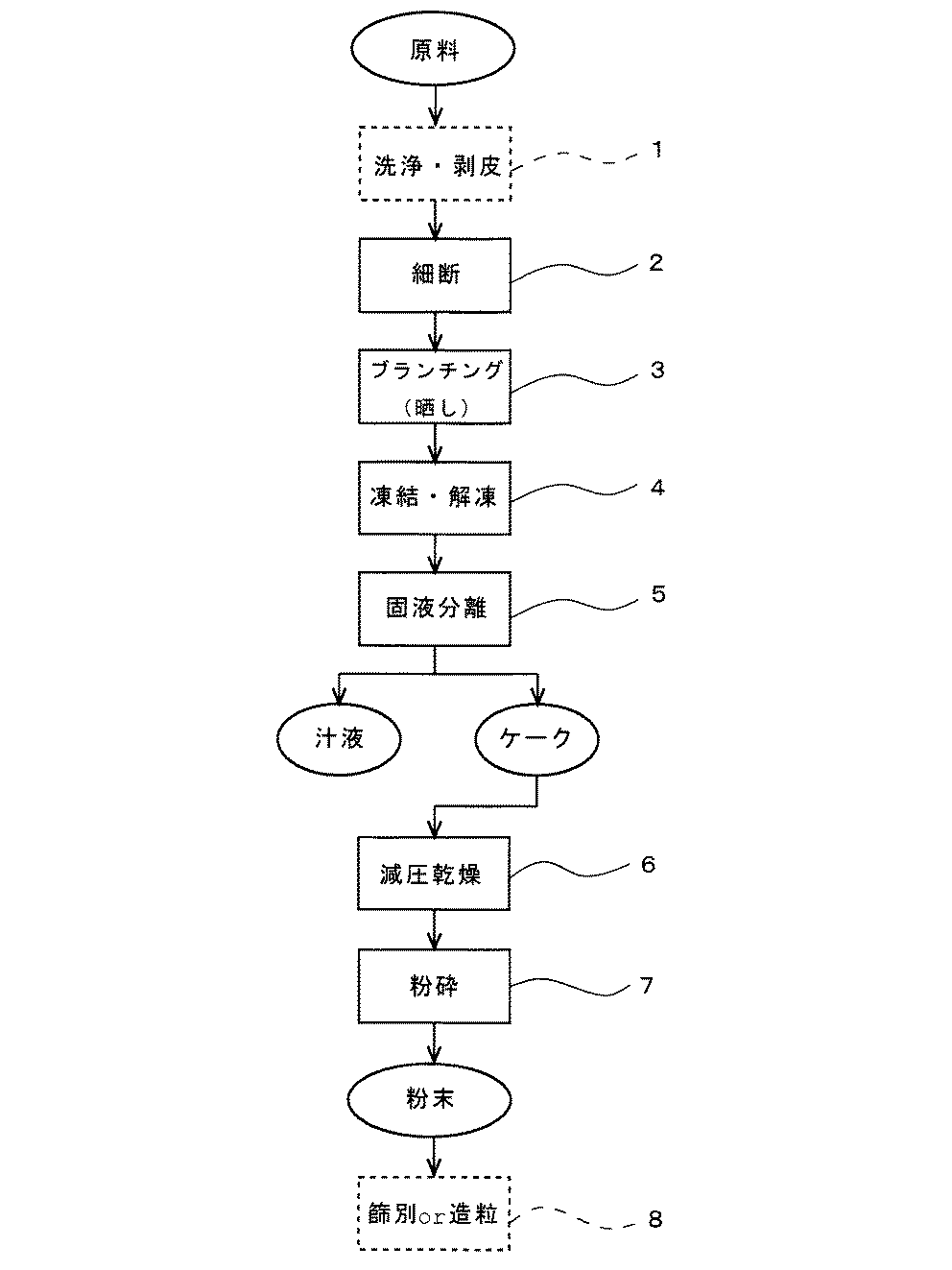
図1は、本発明の工程フローを示したブロック図である。図において、本発明で用いる原料は、サツマイモやジャガイモ、レンコンなど澱粉を含む生の根菜類農産物である。 FIG. 1 is a block diagram showing a process flow of the present invention. In the figure, the raw material used in the present invention is raw root vegetables agricultural products containing starch such as sweet potato, potato, lotus root and the like.
原料は、公知の野菜調理器などを用いて細断処理(2)する。原料の形状やサイズは、熱を均一に伝導させるためにサツマイモやジャガイモなどの場合は太さ3mm〜5mmの細切り状とし、レンコンのように内部に空洞があるものは、厚さ2mm〜3mmのスライス状にする。またスライス状にする場合は必要により、これを細かくカットしてもよい。なお細断処理した原料片は変色しやすいので水に浸すことが望ましい。なお細断処理前は必要により原料をよく洗浄(1)し、表面の根や泥などを除くことが望ましく、また場合によっては両端を切除し、剥皮・トリミング(1)をすればよい。更に剥皮したサツマイモやジャガイモなどは変色しやすいので、水に浸すことが望ましい。 The raw material is shredded (2) using a known vegetable cooker or the like. The shape and size of the raw material is 3 mm to 5 mm in thickness for sweet potatoes and potatoes in order to conduct heat uniformly, and 2 cm to 3 mm in thickness when there is a cavity inside such as lotus root. Make slices. Moreover, when making it into a slice form, you may cut this finely as needed. The shredded raw material pieces are likely to discolor, so it is desirable to immerse them in water. Before the shredding treatment, it is desirable to clean the raw material as necessary (1) and remove the roots and mud on the surface. In some cases, both ends may be cut and peeled and trimmed (1). Furthermore, since peeled sweet potatoes and potatoes are likely to discolor, it is desirable to immerse them in water.
細断処理した原料片は、加温水に晒してブランチング(3)する。ブランチング中の湯温が95℃を下回らず全片に均一に熱が通るよう、30秒〜60秒間完全に浸漬する。なお浸漬時間は原料の種類や品種によって異なり、サツマイモの場合、ベニサツマ及びハヤトイモは40秒程度、コガネセンガン及びアヤムラサキは50秒程度、ジャガイモの場合は30秒程度、レンコンの場合は40秒程度が好ましい。またブランチング処理後は余熱による澱粉の糊化を防ぐ為、冷水などで直ちに冷却することが望ましい。 The shredded raw material pieces are blanched (3) by being exposed to warm water. Completely immerse for 30 to 60 seconds so that the hot water temperature during blanching does not drop below 95 ° C. and the heat passes uniformly to all pieces. The soaking time varies depending on the type and variety of the raw material. In the case of sweet potatoes, it is preferable to have about 40 seconds for potato sweetweed and sweet potato, about 50 seconds for Koganesengan and Ayamurasaki, about 30 seconds for potatoes, and about 40 seconds for lotus roots. In addition, after the blanching treatment, it is desirable to immediately cool with cold water or the like in order to prevent starch gelatinization due to residual heat.
ブランチング処理後の原料片は公知の方法にて凍結処理(4)し、原料片を完全に凍結させる。なお次工程の固液分離処理を容易にするためには、凍結処理は緩慢凍結が望ましい。また凍結処理の際は、原料片表面が乾燥しないよう、合成樹脂製あるいはフィルム包材などにて空気をできるだけ抜いた状態で被覆または充填密封するとよい。 The raw material pieces after the blanching treatment are subjected to a freezing process (4) by a known method to completely freeze the raw material pieces. In order to facilitate the solid-liquid separation process in the next step, the freezing process is preferably slow freezing. Further, during the freezing treatment, the raw material piece surface may be covered or filled and sealed with a synthetic resin or a film wrapping material with the air removed as much as possible.
凍結処理した原料片を公知の方法で解凍処理(4)する。この際、原料が含有する澱粉の糊化温度よりも低い温度帯で解凍処理する。なお空気解凍においては解凍時間が長いため、原料片表面の乾燥や微生物の繁殖に注意することが望ましい。 The frozen raw material piece is thawed (4) by a known method. At this time, the thawing treatment is performed in a temperature range lower than the gelatinization temperature of the starch contained in the raw material. In air thawing, since the thawing time is long, it is desirable to pay attention to the drying of the raw material piece surface and the growth of microorganisms.
凍結解凍処理した原料片は、圧搾機や遠心分離機など公知の方法で固液分離処理(5)により原料片から滲出した汁液を除き、ケークを得る。なおその際は、原料片重量に対して30%以上の汁液を除くことが望ましい。 The raw material pieces that have been subjected to freeze-thaw treatment are subjected to a solid-liquid separation process (5) by a known method such as a squeezing machine or a centrifuge to remove the juice that has exuded from the raw material pieces to obtain a cake. In this case, it is desirable to remove 30% or more of the juice from the raw material piece weight.
固液分離処理をして得られたケークは、真空乾燥器など公知の方法で減圧乾燥処理(6)する。この際、原料が含有する澱粉の糊化温度より低い温度帯で、更に操作圧力は4000Pa以下の減圧下で乾燥させることが望ましい。 The cake obtained by the solid-liquid separation treatment is dried under reduced pressure (6) by a known method such as a vacuum dryer. At this time, it is desirable to dry under a reduced pressure of 4000 Pa or less in a temperature range lower than the gelatinization temperature of the starch contained in the raw material.
乾燥処理した乾燥フレークは、公知の方法で粉砕処理(7)し、粉末化する。なお粉砕処理を行う際は、摩擦などによる発熱を考慮し、原料が含有する澱粉の糊化温度よりも低い温度帯で粉砕処理することが望ましい。更に必要に応じて、篩別(8)したり造粒(8)したりして粉体の粒度を揃えるのが好ましい。以下、本発明で得られた原料粉末を用いて、低水分加工食品を製造した場合の例を示す。 The dried dried flakes are pulverized (7) by a known method and pulverized. When performing the pulverization process, it is desirable to perform the pulverization process in a temperature range lower than the gelatinization temperature of the starch contained in the raw material in consideration of heat generation due to friction or the like. Furthermore, it is preferable to make the particle size of the powder uniform by sieving (8) or granulating (8) as necessary. Hereinafter, the example at the time of manufacturing a low moisture processed food using the raw material powder obtained by this invention is shown.
ベニサツマやコガネセンガン、アヤムラサキ及びハヤトイモの計四品種の生サツマイモを原料として、本発明による製造方法で低水分加工食品原料粉末を製造した。この粉末を用いてエクストルーダにて直接膨化処理を行い、膨化食品を製造したところ、従来の技術で製造された原料粉末の膨化食品に比べて、焦げや変色が少なく、異臭やえぐ味がない、また歯にあまり付着せず、硬くならず食感のよい、よく膨化した膨化食品が得られた。 Low-moisture processed food raw material powders were produced by the production method according to the present invention using raw sweet potatoes of a total of four varieties of Benicatsuma, Koganesengan, Ayamurasaki and Hayatoimo. Using this powder, it was directly expanded with an extruder to produce a puffed food, and compared to the puffed food of the raw material powder produced by the conventional technology, there was less burning and discoloration, and there was no off-flavor or taste. In addition, a well-expanded puffed food was obtained that did not adhere much to the teeth and did not become hard and had a good texture.
生のジャガイモやレンコンを原料として本発明による方法で低水分加工食品原料粉末を製造し、実施例1と同様の方法で膨化食品を製造したところ、実施例1記載と同様の結果となった。 When raw potato or lotus root was used as a raw material to produce a low-moisture processed food raw material powder by the method according to the present invention, and a puffed food was produced by the same method as in Example 1, the same results as described in Example 1 were obtained.
実施例1で製造した低水分加工食品原料粉末を用いて、表1の配合でクッキーを製造したところ、小麦粉のみを用いたクッキーと比べて、まったく遜色の無い膨張率、食感をもつクッキーが得られた。また本発明で製造した低水分加工食品原料粉末を用いたクッキーは、従来の技術で製造された原料粉末を用いたクッキーと比べて、焼成前の生地のヒビ割れや焼成時の焦げや変色が少なく、異臭やえぐ味がない、また歯にあまり付着せず、硬くならず食感のよい、よく膨化したクッキーが得られた。 Using the low-moisture processed food raw material powder produced in Example 1, a cookie having the composition shown in Table 1 was produced. Compared to a cookie using only wheat flour, a cookie having an expansion rate and texture that is completely inferior. Obtained. In addition, the cookie using the low-moisture processed food raw material powder produced in the present invention has cracks in the dough before baking and the charring and discoloration during baking compared to the cookie using the raw material powder produced by the conventional technology. A well-expanded cookie with little smell, no pungent taste, less stickiness on the teeth, not hard and textured was obtained.
生のジャガイモを原料として本発明による方法で低水分加工食品原料粉末を製造し、表2の配合でクッキーを製造したところ、実施例3記載と同様の結果となった。 When raw potato was used as a raw material to produce a low-moisture processed food raw material powder by the method according to the present invention and a cookie was produced according to the formulation shown in Table 2, the same results as described in Example 3 were obtained.
本発明の低水分加工食品原料粉末を食品産業に利用することにより、加工食品の品質を高め、加工食品原材料の多様性を齎すので、食品産業にとって有用な技術である。 Since the low-moisture processed food raw material powder of the present invention is used in the food industry, the quality of the processed food is improved and the diversity of processed food raw materials is increased, which is a useful technique for the food industry.
1 洗浄・剥皮工程
2 細断工程
3 ブランチング(晒し)工程
4 凍結・解凍工程
5 固液分離工程
6 減圧乾燥工程
7 粉砕工程
8 篩別又は造粒工程
DESCRIPTION OF
Claims (4)
Priority Applications (1)
| Application Number | Priority Date | Filing Date | Title |
|---|---|---|---|
| JP2005064457A JP4200141B2 (en) | 2004-03-16 | 2005-03-08 | Raw material powder manufacturing method suitable for low-moisture processed foods |
Applications Claiming Priority (2)
| Application Number | Priority Date | Filing Date | Title |
|---|---|---|---|
| JP2004074942 | 2004-03-16 | ||
| JP2005064457A JP4200141B2 (en) | 2004-03-16 | 2005-03-08 | Raw material powder manufacturing method suitable for low-moisture processed foods |
Publications (2)
| Publication Number | Publication Date |
|---|---|
| JP2005296002A true JP2005296002A (en) | 2005-10-27 |
| JP4200141B2 JP4200141B2 (en) | 2008-12-24 |
Family
ID=35328293
Family Applications (1)
| Application Number | Title | Priority Date | Filing Date |
|---|---|---|---|
| JP2005064457A Expired - Lifetime JP4200141B2 (en) | 2004-03-16 | 2005-03-08 | Raw material powder manufacturing method suitable for low-moisture processed foods |
Country Status (1)
| Country | Link |
|---|---|
| JP (1) | JP4200141B2 (en) |
Citations (4)
| Publication number | Priority date | Publication date | Assignee | Title |
|---|---|---|---|---|
| JPS6196966A (en) * | 1984-10-18 | 1986-05-15 | Tochigi Pref Gov | Preparation of formable food material using bottle gourd |
| JPS61152258A (en) * | 1984-12-26 | 1986-07-10 | Nagatanien Honpo:Kk | Preparation of dehydrated potato |
| JPH06296471A (en) * | 1992-04-20 | 1994-10-25 | Kagoshima Pref Gov Keizai Nogyo Kyodo Kumiai Rengokai | Method for manufacturing 100% sweet potato flour noodles |
| JPH0723729A (en) * | 1992-05-22 | 1995-01-27 | Kimie Miyazaki | Method for processing plant |
-
2005
- 2005-03-08 JP JP2005064457A patent/JP4200141B2/en not_active Expired - Lifetime
Patent Citations (4)
| Publication number | Priority date | Publication date | Assignee | Title |
|---|---|---|---|---|
| JPS6196966A (en) * | 1984-10-18 | 1986-05-15 | Tochigi Pref Gov | Preparation of formable food material using bottle gourd |
| JPS61152258A (en) * | 1984-12-26 | 1986-07-10 | Nagatanien Honpo:Kk | Preparation of dehydrated potato |
| JPH06296471A (en) * | 1992-04-20 | 1994-10-25 | Kagoshima Pref Gov Keizai Nogyo Kyodo Kumiai Rengokai | Method for manufacturing 100% sweet potato flour noodles |
| JPH0723729A (en) * | 1992-05-22 | 1995-01-27 | Kimie Miyazaki | Method for processing plant |
Also Published As
| Publication number | Publication date |
|---|---|
| JP4200141B2 (en) | 2008-12-24 |
Similar Documents
| Publication | Publication Date | Title |
|---|---|---|
| KR101131848B1 (en) | Sweetpotato powder and its products using the same | |
| CN104872581A (en) | Potato raw flour preparing process by vacuum drying method | |
| MX2013003226A (en) | Method of reducing acrylamide by treating a food product. | |
| JP4175448B2 (en) | Cooking potatoes with free skin, methods for making cooked potatoes with free skin and methods for releasing peels of cut potatoes with skin | |
| TR201909990T4 (en) | Fabricated food product made from fresh mashed potatoes. | |
| KR102573191B1 (en) | potato snack and manufacturing methods of sweet potato snack | |
| JP2010284148A (en) | Sheet or block of vegetable and/or fruit | |
| KR101056595B1 (en) | Manufacturing method of dried persimmon powder | |
| JP4200141B2 (en) | Raw material powder manufacturing method suitable for low-moisture processed foods | |
| RU2292166C1 (en) | Method for producing of powder from sugar beet | |
| JP7100458B2 (en) | A method for producing a texture improving agent for frozen cooked noodles, a method for producing frozen cooked noodles with an improved texture, and a method for improving the texture of frozen cooked noodles. | |
| KR101570077B1 (en) | The manufacturing method of a korean cracker containing the powder of a sweet persimmon and the korean cracker made by the method | |
| KR102720085B1 (en) | Method for Manufacturing Thermostable Peach Jam | |
| US4645675A (en) | Starch-based dry product in the form of flakes, bits, or grains in porous bags for making dumplings | |
| JP5563235B2 (en) | Process for producing processed vegetable ingredients and processed vegetable ingredients | |
| KR102527247B1 (en) | Manufacturing method of roasted peeled sweet potatoes of bite size distributable at room temperature | |
| KR100448647B1 (en) | method for making a ginseng into a boogak and a ginseng- boogak which is made by the method | |
| US4770883A (en) | Segmenting and dehydration process for sugar beets | |
| JP2003023996A (en) | Powder of root vegetables and method for producing the same | |
| JP7124488B2 (en) | Baked sweet potato having two-layer structure and method for producing the same | |
| US2006146A (en) | Potato food product | |
| KR101610909B1 (en) | Method for manufacture of honeycomb-type potato and honeycomb-type potato thereby | |
| AU2003288634B2 (en) | Process for the preparation of instant soup mix from Indian dill (Anethum Sowa) | |
| JP2024049260A (en) | Date soybean and production method of the same | |
| JP2006212022A (en) | Vegetable and fruit granule meltable in water, and method for producing the same |
Legal Events
| Date | Code | Title | Description |
|---|---|---|---|
| A621 | Written request for application examination |
Free format text: JAPANESE INTERMEDIATE CODE: A621 Effective date: 20051031 |
|
| A977 | Report on retrieval |
Free format text: JAPANESE INTERMEDIATE CODE: A971007 Effective date: 20080218 |
|
| A131 | Notification of reasons for refusal |
Free format text: JAPANESE INTERMEDIATE CODE: A131 Effective date: 20080229 |
|
| A521 | Request for written amendment filed |
Free format text: JAPANESE INTERMEDIATE CODE: A523 Effective date: 20080430 |
|
| A131 | Notification of reasons for refusal |
Free format text: JAPANESE INTERMEDIATE CODE: A131 Effective date: 20080530 |
|
| A521 | Request for written amendment filed |
Free format text: JAPANESE INTERMEDIATE CODE: A523 Effective date: 20080729 |
|
| TRDD | Decision of grant or rejection written | ||
| A01 | Written decision to grant a patent or to grant a registration (utility model) |
Free format text: JAPANESE INTERMEDIATE CODE: A01 Effective date: 20080919 |
|
| A01 | Written decision to grant a patent or to grant a registration (utility model) |
Free format text: JAPANESE INTERMEDIATE CODE: A01 |
|
| A61 | First payment of annual fees (during grant procedure) |
Free format text: JAPANESE INTERMEDIATE CODE: A61 Effective date: 20081006 |
|
| FPAY | Renewal fee payment (event date is renewal date of database) |
Free format text: PAYMENT UNTIL: 20111010 Year of fee payment: 3 |
|
| R150 | Certificate of patent or registration of utility model |
Ref document number: 4200141 Country of ref document: JP Free format text: JAPANESE INTERMEDIATE CODE: R150 Free format text: JAPANESE INTERMEDIATE CODE: R150 |
|
| FPAY | Renewal fee payment (event date is renewal date of database) |
Free format text: PAYMENT UNTIL: 20111010 Year of fee payment: 3 |
|
| S111 | Request for change of ownership or part of ownership |
Free format text: JAPANESE INTERMEDIATE CODE: R313113 |
|
| FPAY | Renewal fee payment (event date is renewal date of database) |
Free format text: PAYMENT UNTIL: 20111010 Year of fee payment: 3 |
|
| R350 | Written notification of registration of transfer |
Free format text: JAPANESE INTERMEDIATE CODE: R350 |
|
| R250 | Receipt of annual fees |
Free format text: JAPANESE INTERMEDIATE CODE: R250 |
|
| R250 | Receipt of annual fees |
Free format text: JAPANESE INTERMEDIATE CODE: R250 |
|
| R250 | Receipt of annual fees |
Free format text: JAPANESE INTERMEDIATE CODE: R250 |
|
| R250 | Receipt of annual fees |
Free format text: JAPANESE INTERMEDIATE CODE: R250 |
|
| R250 | Receipt of annual fees |
Free format text: JAPANESE INTERMEDIATE CODE: R250 |
|
| R250 | Receipt of annual fees |
Free format text: JAPANESE INTERMEDIATE CODE: R250 |
|
| R250 | Receipt of annual fees |
Free format text: JAPANESE INTERMEDIATE CODE: R250 |
|
| R250 | Receipt of annual fees |
Free format text: JAPANESE INTERMEDIATE CODE: R250 |
|
| R250 | Receipt of annual fees |
Free format text: JAPANESE INTERMEDIATE CODE: R250 |
|
| R250 | Receipt of annual fees |
Free format text: JAPANESE INTERMEDIATE CODE: R250 |
|
| EXPY | Cancellation because of completion of term |