JP2005292218A - Fixing roller - Google Patents
Fixing roller Download PDFInfo
- Publication number
- JP2005292218A JP2005292218A JP2004103367A JP2004103367A JP2005292218A JP 2005292218 A JP2005292218 A JP 2005292218A JP 2004103367 A JP2004103367 A JP 2004103367A JP 2004103367 A JP2004103367 A JP 2004103367A JP 2005292218 A JP2005292218 A JP 2005292218A
- Authority
- JP
- Japan
- Prior art keywords
- silicone rubber
- density
- roller
- rubber
- sleeve
- Prior art date
- Legal status (The legal status is an assumption and is not a legal conclusion. Google has not performed a legal analysis and makes no representation as to the accuracy of the status listed.)
- Pending
Links
- 229920002379 silicone rubber Polymers 0.000 claims abstract description 81
- 239000004945 silicone rubber Substances 0.000 claims abstract description 57
- 229920000049 Carbon (fiber) Polymers 0.000 claims abstract description 25
- 239000004917 carbon fiber Substances 0.000 claims abstract description 25
- 229910052751 metal Inorganic materials 0.000 claims abstract description 15
- 239000002184 metal Substances 0.000 claims abstract description 15
- VNWKTOKETHGBQD-UHFFFAOYSA-N methane Chemical compound C VNWKTOKETHGBQD-UHFFFAOYSA-N 0.000 claims abstract description 14
- 239000004944 Liquid Silicone Rubber Substances 0.000 claims description 20
- 229920001973 fluoroelastomer Polymers 0.000 claims 1
- 230000037303 wrinkles Effects 0.000 abstract description 25
- 230000008602 contraction Effects 0.000 abstract description 6
- VYPSYNLAJGMNEJ-UHFFFAOYSA-N Silicium dioxide Chemical compound O=[Si]=O VYPSYNLAJGMNEJ-UHFFFAOYSA-N 0.000 description 47
- 229920001971 elastomer Polymers 0.000 description 31
- 239000005060 rubber Substances 0.000 description 31
- 239000010410 layer Substances 0.000 description 23
- 239000000377 silicon dioxide Substances 0.000 description 19
- 239000000945 filler Substances 0.000 description 17
- 238000010438 heat treatment Methods 0.000 description 16
- 239000000203 mixture Substances 0.000 description 14
- 238000000034 method Methods 0.000 description 11
- 238000004073 vulcanization Methods 0.000 description 11
- 230000000052 comparative effect Effects 0.000 description 10
- 239000000843 powder Substances 0.000 description 8
- 239000002344 surface layer Substances 0.000 description 8
- OKTJSMMVPCPJKN-UHFFFAOYSA-N Carbon Chemical compound [C] OKTJSMMVPCPJKN-UHFFFAOYSA-N 0.000 description 7
- 238000007906 compression Methods 0.000 description 7
- 230000006835 compression Effects 0.000 description 7
- 229920001296 polysiloxane Polymers 0.000 description 7
- PNEYBMLMFCGWSK-UHFFFAOYSA-N aluminium oxide Inorganic materials [O-2].[O-2].[O-2].[Al+3].[Al+3] PNEYBMLMFCGWSK-UHFFFAOYSA-N 0.000 description 6
- 239000003795 chemical substances by application Substances 0.000 description 5
- 239000010439 graphite Substances 0.000 description 5
- 229910002804 graphite Inorganic materials 0.000 description 5
- 239000007788 liquid Substances 0.000 description 5
- -1 silicon halides Chemical class 0.000 description 5
- VTYYLEPIZMXCLO-UHFFFAOYSA-L Calcium carbonate Chemical compound [Ca+2].[O-]C([O-])=O VTYYLEPIZMXCLO-UHFFFAOYSA-L 0.000 description 4
- QAOWNCQODCNURD-UHFFFAOYSA-N Sulfuric acid Chemical compound OS(O)(=O)=O QAOWNCQODCNURD-UHFFFAOYSA-N 0.000 description 4
- XLOMVQKBTHCTTD-UHFFFAOYSA-N Zinc monoxide Chemical compound [Zn]=O XLOMVQKBTHCTTD-UHFFFAOYSA-N 0.000 description 4
- 238000009472 formulation Methods 0.000 description 4
- 235000012239 silicon dioxide Nutrition 0.000 description 4
- 239000000243 solution Substances 0.000 description 4
- YMWUJEATGCHHMB-UHFFFAOYSA-N Dichloromethane Chemical compound ClCCl YMWUJEATGCHHMB-UHFFFAOYSA-N 0.000 description 3
- 239000000463 material Substances 0.000 description 3
- 238000000465 moulding Methods 0.000 description 3
- 239000002245 particle Substances 0.000 description 3
- 230000000704 physical effect Effects 0.000 description 3
- 229920000642 polymer Polymers 0.000 description 3
- 229920005989 resin Polymers 0.000 description 3
- 239000011347 resin Substances 0.000 description 3
- 229910002012 Aerosil® Inorganic materials 0.000 description 2
- XKRFYHLGVUSROY-UHFFFAOYSA-N Argon Chemical compound [Ar] XKRFYHLGVUSROY-UHFFFAOYSA-N 0.000 description 2
- CURLTUGMZLYLDI-UHFFFAOYSA-N Carbon dioxide Chemical compound O=C=O CURLTUGMZLYLDI-UHFFFAOYSA-N 0.000 description 2
- VYZAMTAEIAYCRO-UHFFFAOYSA-N Chromium Chemical compound [Cr] VYZAMTAEIAYCRO-UHFFFAOYSA-N 0.000 description 2
- XTHFKEDIFFGKHM-UHFFFAOYSA-N Dimethoxyethane Chemical compound COCCOC XTHFKEDIFFGKHM-UHFFFAOYSA-N 0.000 description 2
- YCKRFDGAMUMZLT-UHFFFAOYSA-N Fluorine atom Chemical compound [F] YCKRFDGAMUMZLT-UHFFFAOYSA-N 0.000 description 2
- UQSXHKLRYXJYBZ-UHFFFAOYSA-N Iron oxide Chemical compound [Fe]=O UQSXHKLRYXJYBZ-UHFFFAOYSA-N 0.000 description 2
- UFWIBTONFRDIAS-UHFFFAOYSA-N Naphthalene Chemical compound C1=CC=CC2=CC=CC=C21 UFWIBTONFRDIAS-UHFFFAOYSA-N 0.000 description 2
- PXHVJJICTQNCMI-UHFFFAOYSA-N Nickel Chemical compound [Ni] PXHVJJICTQNCMI-UHFFFAOYSA-N 0.000 description 2
- BQCADISMDOOEFD-UHFFFAOYSA-N Silver Chemical compound [Ag] BQCADISMDOOEFD-UHFFFAOYSA-N 0.000 description 2
- KEAYESYHFKHZAL-UHFFFAOYSA-N Sodium Chemical compound [Na] KEAYESYHFKHZAL-UHFFFAOYSA-N 0.000 description 2
- 239000004115 Sodium Silicate Substances 0.000 description 2
- 239000000853 adhesive Substances 0.000 description 2
- 230000001070 adhesive effect Effects 0.000 description 2
- TZCXTZWJZNENPQ-UHFFFAOYSA-L barium sulfate Chemical compound [Ba+2].[O-]S([O-])(=O)=O TZCXTZWJZNENPQ-UHFFFAOYSA-L 0.000 description 2
- 229910000019 calcium carbonate Inorganic materials 0.000 description 2
- 239000003599 detergent Substances 0.000 description 2
- 230000000694 effects Effects 0.000 description 2
- 239000011737 fluorine Substances 0.000 description 2
- 229910052731 fluorine Inorganic materials 0.000 description 2
- 239000000314 lubricant Substances 0.000 description 2
- 238000004519 manufacturing process Methods 0.000 description 2
- 239000010445 mica Substances 0.000 description 2
- 229910052618 mica group Inorganic materials 0.000 description 2
- 150000001451 organic peroxides Chemical class 0.000 description 2
- 230000003647 oxidation Effects 0.000 description 2
- 238000007254 oxidation reaction Methods 0.000 description 2
- 230000002093 peripheral effect Effects 0.000 description 2
- BASFCYQUMIYNBI-UHFFFAOYSA-N platinum Chemical compound [Pt] BASFCYQUMIYNBI-UHFFFAOYSA-N 0.000 description 2
- 238000000197 pyrolysis Methods 0.000 description 2
- 230000003014 reinforcing effect Effects 0.000 description 2
- 239000012763 reinforcing filler Substances 0.000 description 2
- 238000004904 shortening Methods 0.000 description 2
- 229910052710 silicon Inorganic materials 0.000 description 2
- 239000010703 silicon Substances 0.000 description 2
- NTHWMYGWWRZVTN-UHFFFAOYSA-N sodium silicate Chemical compound [Na+].[Na+].[O-][Si]([O-])=O NTHWMYGWWRZVTN-UHFFFAOYSA-N 0.000 description 2
- 229910052911 sodium silicate Inorganic materials 0.000 description 2
- 239000011787 zinc oxide Substances 0.000 description 2
- 235000014692 zinc oxide Nutrition 0.000 description 2
- DMWVYCCGCQPJEA-UHFFFAOYSA-N 2,5-bis(tert-butylperoxy)-2,5-dimethylhexane Chemical compound CC(C)(C)OOC(C)(C)CCC(C)(C)OOC(C)(C)C DMWVYCCGCQPJEA-UHFFFAOYSA-N 0.000 description 1
- 229910002016 Aerosil® 200 Inorganic materials 0.000 description 1
- QGZKDVFQNNGYKY-UHFFFAOYSA-N Ammonia Chemical compound N QGZKDVFQNNGYKY-UHFFFAOYSA-N 0.000 description 1
- 229910052582 BN Inorganic materials 0.000 description 1
- PZNSFCLAULLKQX-UHFFFAOYSA-N Boron nitride Chemical compound N#B PZNSFCLAULLKQX-UHFFFAOYSA-N 0.000 description 1
- 239000004215 Carbon black (E152) Substances 0.000 description 1
- RYGMFSIKBFXOCR-UHFFFAOYSA-N Copper Chemical compound [Cu] RYGMFSIKBFXOCR-UHFFFAOYSA-N 0.000 description 1
- 239000005909 Kieselgur Substances 0.000 description 1
- BPQQTUXANYXVAA-UHFFFAOYSA-N Orthosilicate Chemical compound [O-][Si]([O-])([O-])[O-] BPQQTUXANYXVAA-UHFFFAOYSA-N 0.000 description 1
- 229910052581 Si3N4 Inorganic materials 0.000 description 1
- XUIMIQQOPSSXEZ-UHFFFAOYSA-N Silicon Chemical group [Si] XUIMIQQOPSSXEZ-UHFFFAOYSA-N 0.000 description 1
- WYURNTSHIVDZCO-UHFFFAOYSA-N Tetrahydrofuran Chemical compound C1CCOC1 WYURNTSHIVDZCO-UHFFFAOYSA-N 0.000 description 1
- GWEVSGVZZGPLCZ-UHFFFAOYSA-N Titan oxide Chemical compound O=[Ti]=O GWEVSGVZZGPLCZ-UHFFFAOYSA-N 0.000 description 1
- YKTSYUJCYHOUJP-UHFFFAOYSA-N [O--].[Al+3].[Al+3].[O-][Si]([O-])([O-])[O-] Chemical compound [O--].[Al+3].[Al+3].[O-][Si]([O-])([O-])[O-] YKTSYUJCYHOUJP-UHFFFAOYSA-N 0.000 description 1
- 230000002159 abnormal effect Effects 0.000 description 1
- 239000006230 acetylene black Substances 0.000 description 1
- 230000003213 activating effect Effects 0.000 description 1
- XAGFODPZIPBFFR-UHFFFAOYSA-N aluminium Chemical compound [Al] XAGFODPZIPBFFR-UHFFFAOYSA-N 0.000 description 1
- DIZPMCHEQGEION-UHFFFAOYSA-H aluminium sulfate (anhydrous) Chemical compound [Al+3].[Al+3].[O-]S([O-])(=O)=O.[O-]S([O-])(=O)=O.[O-]S([O-])(=O)=O DIZPMCHEQGEION-UHFFFAOYSA-H 0.000 description 1
- 229910052786 argon Inorganic materials 0.000 description 1
- 235000012241 calcium silicate Nutrition 0.000 description 1
- 229910052918 calcium silicate Inorganic materials 0.000 description 1
- OYACROKNLOSFPA-UHFFFAOYSA-N calcium;dioxido(oxo)silane Chemical compound [Ca+2].[O-][Si]([O-])=O OYACROKNLOSFPA-UHFFFAOYSA-N 0.000 description 1
- 239000006229 carbon black Substances 0.000 description 1
- 239000001569 carbon dioxide Substances 0.000 description 1
- 229910002092 carbon dioxide Inorganic materials 0.000 description 1
- 239000003054 catalyst Substances 0.000 description 1
- 229910000420 cerium oxide Inorganic materials 0.000 description 1
- 229910052804 chromium Inorganic materials 0.000 description 1
- 239000011651 chromium Substances 0.000 description 1
- 239000004927 clay Substances 0.000 description 1
- 239000003086 colorant Substances 0.000 description 1
- 238000001816 cooling Methods 0.000 description 1
- 229920001577 copolymer Polymers 0.000 description 1
- 229910052802 copper Inorganic materials 0.000 description 1
- 239000010949 copper Substances 0.000 description 1
- PMHQVHHXPFUNSP-UHFFFAOYSA-M copper(1+);methylsulfanylmethane;bromide Chemical compound Br[Cu].CSC PMHQVHHXPFUNSP-UHFFFAOYSA-M 0.000 description 1
- 238000000354 decomposition reaction Methods 0.000 description 1
- 230000007423 decrease Effects 0.000 description 1
- 230000007547 defect Effects 0.000 description 1
- 238000005238 degreasing Methods 0.000 description 1
- 229910003460 diamond Inorganic materials 0.000 description 1
- 239000010432 diamond Substances 0.000 description 1
- 239000004205 dimethyl polysiloxane Substances 0.000 description 1
- 235000013870 dimethyl polysiloxane Nutrition 0.000 description 1
- 230000002349 favourable effect Effects 0.000 description 1
- 229920002313 fluoropolymer Polymers 0.000 description 1
- 229910021485 fumed silica Inorganic materials 0.000 description 1
- PCHJSUWPFVWCPO-UHFFFAOYSA-N gold Chemical compound [Au] PCHJSUWPFVWCPO-UHFFFAOYSA-N 0.000 description 1
- 238000007542 hardness measurement Methods 0.000 description 1
- 239000001307 helium Substances 0.000 description 1
- 229910052734 helium Inorganic materials 0.000 description 1
- SWQJXJOGLNCZEY-UHFFFAOYSA-N helium atom Chemical compound [He] SWQJXJOGLNCZEY-UHFFFAOYSA-N 0.000 description 1
- 229930195733 hydrocarbon Natural products 0.000 description 1
- 150000002430 hydrocarbons Chemical class 0.000 description 1
- 125000004435 hydrogen atom Chemical group [H]* 0.000 description 1
- 239000011261 inert gas Substances 0.000 description 1
- 238000002347 injection Methods 0.000 description 1
- 239000007924 injection Substances 0.000 description 1
- 239000011256 inorganic filler Substances 0.000 description 1
- 229910003475 inorganic filler Inorganic materials 0.000 description 1
- 239000003273 ketjen black Substances 0.000 description 1
- 239000000395 magnesium oxide Substances 0.000 description 1
- CPLXHLVBOLITMK-UHFFFAOYSA-N magnesium oxide Inorganic materials [Mg]=O CPLXHLVBOLITMK-UHFFFAOYSA-N 0.000 description 1
- 239000000391 magnesium silicate Substances 0.000 description 1
- 229910052919 magnesium silicate Inorganic materials 0.000 description 1
- 235000019792 magnesium silicate Nutrition 0.000 description 1
- AXZKOIWUVFPNLO-UHFFFAOYSA-N magnesium;oxygen(2-) Chemical compound [O-2].[Mg+2] AXZKOIWUVFPNLO-UHFFFAOYSA-N 0.000 description 1
- ZADYMNAVLSWLEQ-UHFFFAOYSA-N magnesium;oxygen(2-);silicon(4+) Chemical compound [O-2].[O-2].[O-2].[Mg+2].[Si+4] ZADYMNAVLSWLEQ-UHFFFAOYSA-N 0.000 description 1
- 239000006082 mold release agent Substances 0.000 description 1
- CWQXQMHSOZUFJS-UHFFFAOYSA-N molybdenum disulfide Chemical compound S=[Mo]=S CWQXQMHSOZUFJS-UHFFFAOYSA-N 0.000 description 1
- 229910052982 molybdenum disulfide Inorganic materials 0.000 description 1
- 229910052759 nickel Inorganic materials 0.000 description 1
- 239000011368 organic material Substances 0.000 description 1
- 150000003961 organosilicon compounds Chemical class 0.000 description 1
- TWNQGVIAIRXVLR-UHFFFAOYSA-N oxo(oxoalumanyloxy)alumane Chemical compound O=[Al]O[Al]=O TWNQGVIAIRXVLR-UHFFFAOYSA-N 0.000 description 1
- BMMGVYCKOGBVEV-UHFFFAOYSA-N oxo(oxoceriooxy)cerium Chemical compound [Ce]=O.O=[Ce]=O BMMGVYCKOGBVEV-UHFFFAOYSA-N 0.000 description 1
- 238000010060 peroxide vulcanization Methods 0.000 description 1
- 150000002978 peroxides Chemical class 0.000 description 1
- 238000007747 plating Methods 0.000 description 1
- 229910052697 platinum Inorganic materials 0.000 description 1
- 229920000435 poly(dimethylsiloxane) Polymers 0.000 description 1
- 238000006116 polymerization reaction Methods 0.000 description 1
- 239000010453 quartz Substances 0.000 description 1
- 150000003839 salts Chemical class 0.000 description 1
- 239000004576 sand Substances 0.000 description 1
- 238000000926 separation method Methods 0.000 description 1
- 125000005372 silanol group Chemical class 0.000 description 1
- HQVNEWCFYHHQES-UHFFFAOYSA-N silicon nitride Chemical compound N12[Si]34N5[Si]62N3[Si]51N64 HQVNEWCFYHHQES-UHFFFAOYSA-N 0.000 description 1
- 229920002050 silicone resin Polymers 0.000 description 1
- 229910052709 silver Inorganic materials 0.000 description 1
- 239000004332 silver Substances 0.000 description 1
- 230000003068 static effect Effects 0.000 description 1
- 239000000126 substance Substances 0.000 description 1
- 150000005846 sugar alcohols Polymers 0.000 description 1
- 238000004381 surface treatment Methods 0.000 description 1
- 239000000454 talc Substances 0.000 description 1
- 229910052623 talc Inorganic materials 0.000 description 1
- 238000010998 test method Methods 0.000 description 1
- OGIDPMRJRNCKJF-UHFFFAOYSA-N titanium oxide Inorganic materials [Ti]=O OGIDPMRJRNCKJF-UHFFFAOYSA-N 0.000 description 1
- 125000000391 vinyl group Chemical group [H]C([*])=C([H])[H] 0.000 description 1
- 230000000007 visual effect Effects 0.000 description 1
- XLYOFNOQVPJJNP-UHFFFAOYSA-N water Substances O XLYOFNOQVPJJNP-UHFFFAOYSA-N 0.000 description 1
- 239000013585 weight reducing agent Substances 0.000 description 1
- 239000010456 wollastonite Substances 0.000 description 1
- 229910052882 wollastonite Inorganic materials 0.000 description 1
- GFQYVLUOOAAOGM-UHFFFAOYSA-N zirconium(iv) silicate Chemical compound [Zr+4].[O-][Si]([O-])([O-])[O-] GFQYVLUOOAAOGM-UHFFFAOYSA-N 0.000 description 1
Images
Landscapes
- Fixing For Electrophotography (AREA)
- Rolls And Other Rotary Bodies (AREA)
Abstract
Description
本発明は、電子複写機やレーザービームプリンタ(以下、LBPという)の定着部における加圧ローラあるいは加熱ローラ等の定着器用ローラに関する。 The present invention relates to a roller for a fixing device such as a pressure roller or a heating roller in a fixing unit of an electronic copying machine or a laser beam printer (hereinafter referred to as LBP).
従来、電子複写機やLBPの定着部における加圧ローラあるいは加熱ローラとしてトナーの離型性を良くするために、芯金入りのゴムローラの外周にふっ素樹脂スリーブを被覆した定着器用ローラが知られている。そして、従来のこの種の定着器用ローラは、例えば特公昭50−7097号公報あるいは特公昭51−27276号公報に示されているように、円筒金型の内周面の内側に装填した円筒金型の内径より外径の小さいふっ素樹脂スリーブの両端を、芯金を保持する側型に固定し、この状態で芯金とスリーブ間の環状空間内にゴム材料を高圧で注入充填し、その充填圧力でスリーブを拡張させながら円筒金型の内周面に密着させるとともに、ゴム材料にスリーブを一体化させるという方法で製造されている。 Conventionally, in order to improve toner releasability as a pressure roller or a heating roller in a fixing unit of an electronic copying machine or LBP, a roller for a fixing device in which a fluororesin sleeve is coated on the outer periphery of a rubber roller containing a cored bar is known. Yes. A conventional roller for this type of fixing device is, for example, a cylindrical metal loaded inside the inner peripheral surface of a cylindrical mold as disclosed in Japanese Patent Publication No. 50-7097 or Japanese Patent Publication No. 51-27276. Fix both ends of the fluororesin sleeve whose outer diameter is smaller than the inner diameter of the mold to the side mold that holds the core metal, and in this state, inject and fill the rubber material into the annular space between the core metal and the sleeve at high pressure. While the sleeve is expanded by pressure, the sleeve is brought into close contact with the inner peripheral surface of the cylindrical mold, and the sleeve is integrated with a rubber material.
近年、定着器用ローラを使用するローラ定着装置を有する電子複写機やLBPの軽量化が進む中、定着部として消費電力の削減やウォームアップタイムを短縮することなどを目的とし、熱伝導率が1.0W/m・K以上の熱伝導性に優れたシリコーンゴムにより形成された薄肉(厚さが2mm以下、場合によっては1mm以下)の弾性体層と、ふっ素樹脂スリーブにより形成された薄肉(厚さが0.1mm以下、好ましくは0.05mm以下)の離型層を有する加圧ローラや加熱ローラなどの定着器用ローラが求められている。 In recent years, as the weight of electronic copying machines and LBPs having a roller fixing device using a fixing unit roller has been reduced, the thermal conductivity is 1 for the purpose of reducing the power consumption and the warm-up time as a fixing unit. Thin-walled (thickness) formed of a thin-walled (thickness 2 mm or less, in some cases 1 mm or less) elastic body layer made of silicone rubber with excellent thermal conductivity of 0.0 W / m · K or more and a fluororesin sleeve There is a demand for a roller for a fixing device such as a pressure roller or a heating roller having a release layer of 0.1 mm or less, preferably 0.05 mm or less.
シリコーンゴムに多量のシリカやアルミナ等の充填剤を添加して高熱伝導率としたシリコーンゴム組成物を得たものがある(特許文献1参照)。
しかしながら、前述した定着器用ローラは消費電力の削減やウォームアップタイムを短縮することなどを目的として、熱伝導性の良好なシリカやアルミナ等の充填剤を多量に添加したシリコーンゴムを使用しているため、密度が大きくなり軽量化に貢献できていない。 However, the fixing roller described above uses silicone rubber to which a large amount of a filler such as silica or alumina having good thermal conductivity is added for the purpose of reducing power consumption and shortening the warm-up time. For this reason, the density has increased, and it has not contributed to weight reduction.
熱伝導性の良好な充填剤としては上記の他に各種無機粉体が知られており、ダイヤモンド粉、金粉、銀粉、アルミニウム粉、窒化ホウ素粉、窒化アルミニウム粉、窒化ケイ素粉、酸化亜鉛粉などが例示できる。また、これらを粒子径の異なる複数の充填剤を組み合わせて使用することもできるが、用途が定着器用ローラであることや安定性、コスト面等を考慮すると前記したシリカやアルミナが好適であるといえる。通常、シリコーンゴムの熱伝導率を1.0W/m・K程度にするには多量の充填剤を必要とするため、シリカやアルミナを主とした場合、選択した充填剤の添加量と密度にもよるがシリコーンゴムの密度は2.00〜2.20g/cm3程度になる。 In addition to the above, various inorganic powders are known as fillers with good thermal conductivity, such as diamond powder, gold powder, silver powder, aluminum powder, boron nitride powder, aluminum nitride powder, silicon nitride powder, zinc oxide powder, etc. Can be illustrated. Further, these can be used in combination with a plurality of fillers having different particle diameters, but the above-mentioned silica and alumina are preferable in consideration of the use of the roller for a fixing device, stability, cost, etc. I can say that. Usually, a large amount of filler is required to make the thermal conductivity of silicone rubber about 1.0 W / m · K. Therefore, when silica or alumina is the main component, the amount and density of the selected filler to be added However, the density of the silicone rubber is about 2.00 to 2.20 g / cm 3 .
ところが、充填剤を多量に添加するとシリコーンゴムの圧縮永久歪みが悪くなり、ローラ定着装置内で定着ローラの形状が変形してしまい、安定した画像が得られないといった不具合が発生したり、シリコーンゴムとふっ素樹脂スリーブ間において接着剥離が発生するといった不具合も確認されている。更には、肉厚が0.1mm以下の薄肉のふっ素樹脂スリーブの軸方向にシワが入り易いという欠点があり、定着ローラを安定供給できない場合があった。 However, when a large amount of filler is added, the compression set of the silicone rubber is deteriorated, the shape of the fixing roller is deformed in the roller fixing device, and there is a problem that a stable image cannot be obtained. There has also been a problem that adhesive peeling occurs between the resin sleeve and the fluororesin sleeve. Furthermore, there is a drawback that wrinkles are easily formed in the axial direction of a thin fluororesin sleeve having a thickness of 0.1 mm or less, and there is a case where the fixing roller cannot be stably supplied.
このふっ素樹脂スリーブのシワ発生に対する方策については従来例として特許第2975307公報を例示することができる。上記の公報には加圧ローラのシワの発生が熱膨張と収縮が繰り返されることが原因によるものであることから、弾性体層に使用するシリコーンゴムの線収縮率と表層のふっ素樹脂スリーブに発生するシワに相関関係があり、この線収縮率が2.0%以下であるシリコーンゴムを用いることにより、加圧ローラ表層に発生するシワを回避できることが開示されている。 Japanese Patent No. 2975307 can be exemplified as a conventional example of a measure against wrinkling of the fluororesin sleeve. In the above publication, wrinkles on the pressure roller are caused by repeated thermal expansion and contraction. Therefore, the linear shrinkage rate of the silicone rubber used for the elastic layer and the fluororesin sleeve on the surface layer are generated. It is disclosed that wrinkles generated on the pressure roller surface layer can be avoided by using a silicone rubber having a linear shrinkage rate of 2.0% or less.
本発明はこれらの点に鑑みてなされたものであり、画像不良のない高品位の画像を形成させることができ、耐久性も極めて優れた加圧ローラや加熱ローラ等の定着器用ローラを提供することを目的とする。 The present invention has been made in view of these points, and provides a roller for a fixing device such as a pressure roller and a heating roller that can form a high-quality image free from image defects and is extremely excellent in durability. For the purpose.
本発明に係る定着器用ローラは、前記の目的を達成するために,芯金の外周に被覆したシリコーンゴム層の外周に、厚さが0.1mm以下のフッ素樹脂スリーブを被覆した定着器用ローラにおいて前記シリコーンゴムに密度が2.20g/cm3以上の炭素繊維を含有せしめ、該シリコーンゴム層の熱伝導率が1.0W/mK以上で密度が1.50g/cm3以下としたことをその特徴とするものであり、本発明においては、前記したように、芯金の外周に被覆するシリコーンゴムは、付加型液状シリコーンゴムであり、また、その付加型液状シリコーンゴムに密度が2.20g/cm3以上のピッチ系炭素繊維を20〜40重量%含有させることで、圧縮永久歪み及び接着性に優れ、更にはゴムの線収縮率が著しく小さく、ふっ素樹脂スリーブにシワが発生し難くなることを見出し、本発明を完成させるに至った。 In order to achieve the above-described object, the fixing device roller according to the present invention is a fixing device roller in which the outer periphery of a silicone rubber layer coated on the outer periphery of a core metal is coated with a fluororesin sleeve having a thickness of 0.1 mm or less. The silicone rubber contains carbon fibers having a density of 2.20 g / cm 3 or more, and the silicone rubber layer has a thermal conductivity of 1.0 W / mK or more and a density of 1.50 g / cm 3 or less. In the present invention, as described above, the silicone rubber coated on the outer periphery of the core metal is an addition type liquid silicone rubber, and the density of the addition type liquid silicone rubber is 2.20 g. / cm 3 or more that is contained 20 to 40 wt% pitch-based carbon fibers excellent in compression set and adhesion, even small remarkably linear shrinkage of rubber, wrinkles fluoroplastic sleeve It found that hardly occurs, thereby completing the present invention.
炭素繊維にはPAN系とピッチ系があり、PAN系は軽量で弾性率や強度に優れているが熱伝導性がピッチ系と比べて小さい。一方、ピッチ系は高弾性率で熱伝導性、導電性に優れており、これまでもシリコーンゴムには、導電性を付与する目的で使用されている。しかしながら、前記したように付加型液状シリコーンゴムに密度が2.20g/cm3以上のピッチ系炭素繊維を20〜40重量%含有させることで、各種問題を全て解決することができ、これまでにない効果を得ることができた。
ここで、使用するピッチ系炭素繊維の長さは、金型にゴムを充填する時に発生する分離を防ぐため好ましくは200μm以下、より好ましくは150μm以下である。
Carbon fibers are classified into PAN and pitch systems. PAN systems are lightweight and excellent in elastic modulus and strength, but have a lower thermal conductivity than pitch systems. On the other hand, the pitch system has a high elastic modulus and is excellent in thermal conductivity and conductivity, and so far, it has been used for the purpose of imparting conductivity to silicone rubber. However, as described above, by adding 20 to 40% by weight of pitch-based carbon fiber having a density of 2.20 g / cm 3 or more to the addition type liquid silicone rubber, all the various problems can be solved. I could get no effect.
Here, the length of the pitch-based carbon fiber used is preferably 200 μm or less, more preferably 150 μm or less in order to prevent separation that occurs when the mold is filled with rubber.
本発明は、シリコーンゴム層の外周には離型層として、厚さ0.1mm以下のふっ素樹脂スリーブが被覆することを特徴とするが、この厚みは一般に市販されているサイズである。最近の定着ローラは低硬度化が進んでおり、好ましくは0.02〜0.07mm、より好ましくは0.03〜0.05mmの厚さが適当である。
更に、軽量化や消費電力の削減、ウォームアップタイムを短縮することなどを目的としているため、シリコーンゴム層の厚さは2mm以下が好ましく、更には0.2〜1mmの厚さにすることがより好ましい。
The present invention is characterized in that the outer periphery of the silicone rubber layer is covered with a fluororesin sleeve having a thickness of 0.1 mm or less as a release layer, and this thickness is generally a commercially available size. The recent fixing roller has been reduced in hardness, and a suitable thickness is preferably 0.02 to 0.07 mm, more preferably 0.03 to 0.05 mm.
Furthermore, since the purpose is to reduce weight, reduce power consumption, and shorten the warm-up time, the thickness of the silicone rubber layer is preferably 2 mm or less, and more preferably 0.2 to 1 mm. More preferred.
ここで、シワの発生する原因について説明すると、ローラの成型時に加熱成型されたローラが室温にまで冷却された後、続いて200℃程度の温度条件にて二次加硫を受けることにより、ローラが加熱冷却を繰り返されるために熱膨張と収縮を受け、表層のふっ素樹脂が組成変形し、ふっ素樹脂スリーブ層とシリコーンゴム層とは接着されているため、その接着面でゴムが収縮できず90度方向に異常収縮してふっ素樹脂スリーブ層にシワが発生するものと考えられる。 Here, the cause of the occurrence of wrinkles will be described. After the roller formed by heating at the time of forming the roller is cooled to room temperature, the roller is then subjected to secondary vulcanization under a temperature condition of about 200 ° C. Is subjected to thermal expansion and contraction due to repeated heating and cooling, the composition of the fluororesin on the surface layer is deformed, and the fluororesin sleeve layer and the silicone rubber layer are bonded together, so that the rubber cannot contract on the bonding surface. It is considered that wrinkles occur in the fluororesin sleeve layer due to abnormal shrinkage in the direction of the angle.
前記したように、シワの発生が熱膨張と収縮が繰り返されることが原因によるものであることから、ゴムの熱収縮を小さくすることによりローラのシリコーンゴム層が熱膨張と収縮を受け難くなるので、表層のふっ素樹脂スリーブ層に発生するシワを回避できるものと考えられる。
上記の熱収縮の度合いを測定する試験方法として、JIS
K 6249には線収縮率試験を規定しており、これに準拠して線収縮率を測定したものである。
As described above, the generation of wrinkles is caused by repeated thermal expansion and contraction. Therefore, the silicone rubber layer of the roller is less susceptible to thermal expansion and contraction by reducing the thermal contraction of rubber. It is considered that wrinkles generated in the surface fluororesin sleeve layer can be avoided.
As a test method for measuring the degree of thermal shrinkage, JIS
K 6249 defines a linear shrinkage rate test, and the linear shrinkage rate is measured based on this test.
本発明は、定着装置に使用される加圧ローラや加熱ローラ等の定着器用ローラの芯金の外周に被覆するシリコーンゴム層として、密度が2.20g/cm3以上のピッチ系炭素繊維を20〜40重量%含有させた付加型液状シリコーンゴムを使用することで、熱伝導率が1.0W/m・K以上と高い値においても、密度が1.50g/cm3以下と小さくなり、定着装置の軽量化と消費電力の削減及びウォームアップタイムの短縮に大きく貢献でき、且つ圧縮永久歪み及び接着性に優れシワが発生し難い定着器用ローラとしての十分な耐久性を有するローラを提供することができる。 In the present invention, pitch-based carbon fibers having a density of 2.20 g / cm 3 or more are used as a silicone rubber layer covering the outer periphery of a core metal of a roller for a fixing device such as a pressure roller or a heating roller used in a fixing device. By using addition-type liquid silicone rubber containing -40% by weight, the density is reduced to 1.50 g / cm 3 or less, even when the thermal conductivity is as high as 1.0 W / m · K or higher. To provide a roller having sufficient durability as a roller for a fixing device, which can greatly contribute to reducing the weight of the apparatus, reducing power consumption, and shortening the warm-up time, and has excellent compression set and adhesion, and hardly causes wrinkles. Can do.
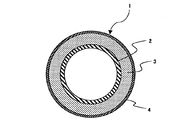
以下、本発明の実施の形態を図1について説明する。
図1は、本発明の一実施の形態を示し、複写機の定着装置に用いられる加熱ローラに適用されたものである。
この加熱ローラ1はその金属芯金2の外周にシリコーンゴム層3が被覆され、さらにこのシリコーンゴム層3の外周にPFA(テトラフルオロエチレン−パーフルオロアルキルビニルエーテル共重合体)からなるふっ素樹脂スリーブ4が被覆されている。そして、本実施の形態においては、前記のシリコーンゴム層として密度が2.20g/cm3以上のピッチ系炭素繊維を20〜40重量%含有させた熱伝導率が1.0W/m・K以上で密度が1.50g/cm3以下の付加型液状シリコーンゴムを使用してなるものである。
An embodiment of the present invention will be described below with reference to FIG.
FIG. 1 shows an embodiment of the present invention, which is applied to a heating roller used in a fixing device of a copying machine.
This heating roller 1 has a silicone rubber layer 3 coated on the outer periphery of the metal core 2, and a fluororesin sleeve 4 made of PFA (tetrafluoroethylene-perfluoroalkyl vinyl ether copolymer) on the outer periphery of the silicone rubber layer 3. Is covered. In the present embodiment, the silicone rubber layer has a thermal conductivity of 1.0 W / m · K or more containing 20 to 40% by weight of pitch-based carbon fibers having a density of 2.20 g / cm 3 or more. And an addition type liquid silicone rubber having a density of 1.50 g / cm 3 or less.
ここで、シリコーンゴム層3の硬さ、熱伝導率及び密度は特に限定されるものではないが、ピッチ系炭素繊維を添加する前の付加型液状シリコーンゴムの加硫後の密度は1.30g/cm3以下が好ましく、ピッチ系炭素繊維の添加量により任意に選定できる。
従来より、熱伝導性の良好な充填剤の添加量と熱伝導率とは正相関関係があることが知られており、シリコーンゴムに付与したい熱伝導率が決まると、充填剤の添加量も決まることになる。同様に硬さについても充填剤の添加量で決まることから、元になる付加型液状シリコーンゴムを選定することで、ねらった硬さのゴムを得ることができる。
また、線収縮率や圧縮永久歪みについては値がより小さい付加型液状シリコーンゴムを選定することによって、添加後も前記物性値が小さくなるといえる。
Here, the hardness, thermal conductivity and density of the silicone rubber layer 3 are not particularly limited, but the density after vulcanization of the addition-type liquid silicone rubber before adding the pitch-based carbon fiber is 1.30 g. / cm 3 or less is preferable, and can be arbitrarily selected depending on the amount of pitch-based carbon fiber added.
Conventionally, it has been known that there is a positive correlation between the amount of filler added with good thermal conductivity and thermal conductivity, and once the thermal conductivity desired to be applied to the silicone rubber is determined, the amount of filler added is also It will be decided. Similarly, since the hardness is determined by the addition amount of the filler, a rubber having a desired hardness can be obtained by selecting the original addition-type liquid silicone rubber.
Moreover, it can be said that the physical property value is reduced even after addition by selecting an addition-type liquid silicone rubber having a smaller value for the linear shrinkage rate and compression set.
本実施の形態において、シリコーンゴム層のゴム種は白金触媒及びビニル基を含有したポリオルガノシロキサンとケイ素原子結合水素原子を有するオルガノポリシロキサンとからなる付加型液状シリコーンゴムである。この付加型液状シリコーンゴムの充填剤の配合処方は、加硫障害を生じさせない限り特に制限されるものではないが、通常はベースのポリオルガノシロキサン100重量%に対して、通常、補強充填剤及び増量充填剤が10〜300重量%程度添加される。 In this embodiment, the rubber type of the silicone rubber layer is an addition-type liquid silicone rubber comprising a platinum catalyst and a polyorganosiloxane containing a vinyl group and an organopolysiloxane having a silicon atom-bonded hydrogen atom. The addition formulation of the addition type liquid silicone rubber filler is not particularly limited as long as it does not cause a vulcanization hindrance, but is usually 100% by weight of the base polyorganosiloxane. About 10 to 300% by weight of filler is added.
しかしながら、本実施の形態においては、シリコーンゴム組成物に密度が2.20g/cm3以上のピッチ系炭素繊維を20〜40重量%含有させた後、シリコーンゴムの密度が1.50g/cm3以下と小さくなることを目的としており、前記ピッチ系炭素繊維を添加する前の補強充填剤及び増量充填剤の添加量は、オルガノポリシロキサン100重量%に対して10〜80重量%程度であることが好ましい。 However, in the present embodiment, after the silicone rubber composition contains 20 to 40% by weight of pitch-based carbon fibers having a density of 2.20 g / cm 3 or more, the density of the silicone rubber is 1.50 g / cm 3. The purpose is to reduce the following, and the addition amount of the reinforcing filler and the increasing filler before adding the pitch-based carbon fiber is about 10 to 80% by weight with respect to 100% by weight of the organopolysiloxane. Is preferred.
補強性充填材としては湿式シリカや乾式シリカ(煙霧状シリカ)が一般的である。ここでいう湿式シリカとは、二酸化けい素(SiO2 )からなる補強性シリカのことで、製造方法としては、けい酸ナトリウムを直接硫酸で分解する直接法や、けい酸ナトリウムを塩類と反応させてけい酸塩を生成させ、次に硫酸または炭酸ガスで分解する間接法など種々の方法がある。代表的な湿式シリカとしては、ニップシル(Nipsil) VN3 (日本シリカ工業株式会社製商品名)、カープレックスCS−5(シオノギ製薬株式会社製商品名)、スターシルS(神島化学工業株式会社製商品名)、トクシールUS(株式会社トクヤマ製商品名)、シルトンR−2(水沢化学工業株式会社製商品名)、ハイシル(Hisil)223 (PPG社(米国)製商品名)、ウルトラシル(Ultrasil) VN3 (デグッザ社(ドイツ)製商品名)、バルカシル(Vulkasil) S(バイエル社(ドイツ)製商品名)などが例示され、平均粒径が30μm以下、好ましくは5μm以下のグレードが使用される。 As the reinforcing filler, wet silica or dry silica (fumed silica) is generally used. As used herein, wet silica refers to reinforcing silica made of silicon dioxide (SiO2). As a manufacturing method, a direct method of directly decomposing sodium silicate with sulfuric acid, or reacting sodium silicate with salts. There are various methods such as an indirect method in which silicate is produced and then decomposed with sulfuric acid or carbon dioxide. Typical wet silicas include Nipsil VN3 (trade name, manufactured by Nippon Silica Industry Co., Ltd.), Carplex CS-5 (trade name, manufactured by Shionogi Pharmaceutical Co., Ltd.), Starsil S (trade name, manufactured by Kamishima Chemical Co., Ltd.). ), Toxeal US (trade name, manufactured by Tokuyama Corporation), Shilton R-2 (trade name, manufactured by Mizusawa Chemical Co., Ltd.), Hisil 223 (trade name, manufactured by PPG (USA)), Ultrasil VN3 (Degussa (Germany) product name), Vulkasil S (Bayer (Germany) product name), etc. are exemplified, and grades having an average particle size of 30 μm or less, preferably 5 μm or less are used.
乾式シリカは、ハロゲン化けい素の熱分解法やけい砂を加熱還元し、気化したSiOの空気酸化法、有機けい素化合物の熱分解法等により製造される二酸化けい素からなる補強性シリカで、アエロジル200やアエロジルR972(日本アエロジル株式会社製商品名)、キャボシル(Cab−O−Sil) MS−5(キャボット社(米国)製商品名)、レオロシールQS102(株式会社トクヤマ製商品名)が例示される。本実施の形態においては必要に応じて湿式シリカと乾式シリカとを適時併用して使用してもよい。さらにシリカ表面の活性による二次結合の防止を目的として、潤滑剤(ウエッタ)を添加してもよく、潤滑剤としては、シリコーンレジン類、アルコキシシランおよびシロキサン類、ヒドロキシシランおよびシロキサン類、シラザン類、有機酸エステル類、多価アルコール類などが例示される。 Dry silica is a reinforcing silica made of silicon dioxide produced by pyrolysis of silicon halides, heat reduction of silica sand, air oxidation of vaporized SiO, pyrolysis of organosilicon compounds, etc. , Aerosil 200, Aerosil R972 (trade name, manufactured by Nippon Aerosil Co., Ltd.), Cabosil (Cab-O-Sil) MS-5 (trade name, manufactured by Cabot Corporation (USA)), Leorosil QS102 (trade name, manufactured by Tokuyama Corporation) Is done. In the present embodiment, if necessary, wet silica and dry silica may be used in combination in a timely manner. Furthermore, for the purpose of preventing secondary bonds due to the activity of the silica surface, a lubricant (wetter) may be added. Examples of the lubricant include silicone resins, alkoxysilanes and siloxanes, hydroxysilanes and siloxanes, and silazanes. And organic acid esters and polyhydric alcohols.
また、増量充填剤は、ゴムの機械特性、すなわち物理強度、ゴム硬度、圧縮永久歪みなど弾性体層3として機能上欠くべからざる特性を保持するために必要な成分であり、炭酸カルシウム、石英粉、けいそう土、けい酸ジルコニウム、クレー(けい酸アルミニウム)、タルク(含水けい酸マグネシウム)、ウォラストナイト(メタけい酸カルシウム)、酸化チタン、酸化亜鉛、酸化マグネシウム、アルミナ(酸化アルミニウム)、酸化クロム、ベンガラ(酸化鉄)、硫酸アルミニウム、硫酸バリウム、リトポン、二硫化モリブデン、マイカ(雲母粉)、グラファイトなどが例示される。 The bulking filler is a component necessary for maintaining the mechanical properties of rubber, that is, physical properties such as physical strength, rubber hardness, compression set, and the like that are indispensable for the elastic layer 3, and are calcium carbonate, quartz powder. , Diatomaceous earth, zirconium silicate, clay (aluminum silicate), talc (hydrous magnesium silicate), wollastonite (calcium metasilicate), titanium oxide, zinc oxide, magnesium oxide, alumina (aluminum oxide), oxidation Examples include chromium, bengara (iron oxide), aluminum sulfate, barium sulfate, lithopone, molybdenum disulfide, mica (mica powder), and graphite.
また、弾性体層3に導電性を付与させるために、充填剤として各種の導電性付与剤を使用して体積固有抵抗を1013Ω・cm以下にしてもよく、これら導電性付与剤としてはアセチレンブラックやケッチェンブラックの如き導電性カーボンブラック、グラファイト、銀、銅、ニッケルなどの金属粉、導電性亜鉛華、導電性炭酸カルシウム、炭素繊維などが例示されるがカーボンブラックが一般的である。
また、酸化セリウムのような耐熱剤を添加してもよい。
通常、シリコーンゴムからなる定着ローラはベンガラ色に着色して供給されることが多く、この場合には着色剤としてベンガラを使用するのが一般的である。ベンガラの種類としては、SRIS1108(日本ゴム協会標準規格)に規定されたゴム用ベンガラが適用でき、加工時のゴム内における配向性に留意する必要がある場合には、バイフェロックス130M(バイエル社(ドイツ)製商品名)のような平均粒径が0.3μm以下の球状のグレードをシリコーンゴムに対して0.2〜2重量%程度添加させればよい。
本実施の形態はシリコーンゴムの中でも付加型液状シリコーンゴムに限定したが、有機過酸化物を用いたミラブル型シリコーンゴムと比較して低硬度の組成物を得やすいこと、なお且つシワの発生を回避するためには線収縮率の観点から収縮し難いことがあげられる。
Further, in order to impart conductivity to the elastic body layer 3, various conductivity imparting agents may be used as fillers so that the volume specific resistance may be 10 13 Ω · cm or less. As these conductivity imparting agents, Examples include conductive carbon black such as acetylene black and ketjen black, metal powder such as graphite, silver, copper, nickel, conductive zinc white, conductive calcium carbonate, carbon fiber, etc., but carbon black is common. .
A heat-resistant agent such as cerium oxide may be added.
Usually, a fixing roller made of silicone rubber is often supplied in a red color, and in this case, a red color is generally used as a colorant. As the type of bengara, the bengara for rubber stipulated in SRIS1108 (Japan Rubber Association Standard) can be applied. When it is necessary to pay attention to the orientation in the rubber during processing, Bayferrox 130M (Bayer) A spherical grade having an average particle diameter of 0.3 μm or less (such as a trade name (made in Germany)) may be added to the silicone rubber in an amount of about 0.2 to 2% by weight.
Although this embodiment is limited to addition-type liquid silicone rubber among silicone rubbers, it is easy to obtain a composition having a low hardness as compared with millable silicone rubber using organic peroxide, and wrinkles are generated. In order to avoid this, it is difficult to shrink from the viewpoint of linear shrinkage.
一般に、ゴムの収縮率を決定する重要因子としては、加硫温度、加硫系、ゴム中のフリーボリューム分率が上げられる。先ず、加硫温度の影響であるが、一般には加硫温度(成型温度)が高いほど直線的に収縮率が大きくなる。また、加硫系の影響では、ポリマーの架橋鎖長が短く、コンパクトな構造の方が収縮し難い。このことは過酸化物加硫系であるミラブル型シリコーンゴムと付加型加硫系である液状シリコーンゴムとでは、付加型加硫系シリコーンゴムの方が収縮し難いといえる。 In general, important factors that determine the shrinkage ratio of rubber include the vulcanization temperature, the vulcanization system, and the free volume fraction in the rubber. First, regarding the influence of the vulcanization temperature, generally, the higher the vulcanization temperature (molding temperature), the greater the shrinkage rate. In addition, due to the influence of the vulcanization system, the cross-linked chain length of the polymer is short, and the compact structure is less likely to shrink. This can be said that the addition-type vulcanized silicone rubber is less likely to shrink between the millable silicone rubber that is a peroxide vulcanization system and the liquid silicone rubber that is an addition-type vulcanization system.
過酸化物加硫系のシリコーンゴムは、2,5−ジメチル−2,5−ジ−(t−ブチルパーオキシ)−ヘキサンの如き有機過酸化物を加硫剤として利用するが、有機過酸化物の分解温度の関係では160〜210℃程度の高温で成型される。それに対し付加型加硫系のシリコーンゴムでは、加硫速度が速いので通常は90〜140℃程度の温度で成型され、過酸化物加硫系よりも約70℃程度低い温度で成型できるので、成型温度の観点からは付加型加硫系シリコーンゴムの方が収縮し難いということができる。更に、シリコーンゴムに使用されるポリマーは、大部分がジメチルポリシロキサンであり、その平均重合度は付加型加硫系シリコーンゴムに使用される液状タイプの場合には100〜1,000、過酸化物加硫系シリコーンゴムに使用されるミラブルタイプの場合には6,000〜10,000程度の線状ポリマーであることから、分子構造上からも付加型液状シリコーンゴムの方が収縮し難いということができる。また、前記のフリーボリュームは実質上、ゴム組成物の有機物質部分に依存するから、無機充填剤の量を増やせば収縮率は小さくなることになる。これらのことから成型温度や加硫系が同じシリコーンゴムの線収縮率は、一般には充填剤の量によって決定されるものであり、それ故に、熱伝導の良好なアルミナやシリカ等の充填剤を多量に使用し、熱伝導率が1.0W/m・K以上になるように配合した付加型液状シリコーンゴムは、通常のものと比較して密度は大きくなり、それなりに線収縮率も小さくなるものである。 Peroxide-vulcanized silicone rubber uses an organic peroxide such as 2,5-dimethyl-2,5-di- (t-butylperoxy) -hexane as a vulcanizing agent. In relation to the decomposition temperature of the product, it is molded at a high temperature of about 160 to 210 ° C. On the other hand, addition type vulcanized silicone rubber is usually molded at a temperature of about 90 to 140 ° C. because the vulcanization speed is high, and can be molded at a temperature about 70 ° C. lower than that of the peroxide vulcanized system. From the viewpoint of molding temperature, it can be said that addition-type vulcanized silicone rubber is less likely to shrink. Furthermore, most of the polymers used for silicone rubber are dimethylpolysiloxane, and the average degree of polymerization is 100 to 1,000 for the liquid type used for addition-type vulcanized silicone rubber. In the case of the millable type used in the product vulcanized silicone rubber, it is a linear polymer of about 6,000 to 10,000, so that the addition type liquid silicone rubber is less likely to shrink in terms of molecular structure. be able to. In addition, since the free volume substantially depends on the organic material portion of the rubber composition, the shrinkage rate decreases as the amount of the inorganic filler is increased. From these facts, the linear shrinkage rate of silicone rubber with the same molding temperature and vulcanization system is generally determined by the amount of the filler. Therefore, a filler such as alumina or silica having good thermal conductivity is used. Addition type liquid silicone rubber, which is used in a large amount and formulated to have a thermal conductivity of 1.0 W / m · K or more, has a higher density and a smaller linear shrinkage rate than normal. Is.
しかしながら、本実施の形態における定着器用ローラに使用する付加型液状シリコーンゴムは、密度が2.20g/cm3以上のピッチ系炭素繊維を20〜40重量%含有させることにより、熱伝導率が1.0W/m・K以上で密度が1.50g/cm3以下と小さいにもかかわらず、線収縮率が著しく小さいことから本発明に至ったものである。 However, the addition-type liquid silicone rubber used for the fixing device roller in the present embodiment has a thermal conductivity of 1 by containing 20 to 40% by weight of pitch-based carbon fibers having a density of 2.20 g / cm 3 or more. Although the density is 0.0 W / m · K or more and the density is as small as 1.50 g / cm 3 or less, the linear shrinkage rate is remarkably small.
次に、本実施の形態におけるローラの表層に使用するふっ素樹脂スリーブ4の素材としては、厚さが0.1mm以下のPFAが一般的である。また、必要に応じてPFAに前述の導電性カーボンブラックなどの導電性付与剤を添加して、体積固有抵抗が1013Ω・cm以下の導電性フッ素樹脂とし、定着ローラを形成してもよい。
本実施の形態におけるふっ素樹脂スリーブ4とシリコーンゴム3との接着は、内面処理を施したふっ素樹脂スリーブ4の内面にプライマーDY39−067(東レ・ダウコーニング・シリコーン株式会社製商品名)のようなシリコーン系プライマーを塗布し、シリコーンゴム3と加硫することにより、強固に接着させ使用に供することができるが、必ずしもプライマーを使用する必要はない。このときPFAなどのふっ素樹脂スリーブの内面処理方法としては、特開平2−191641号にて開示されているが如き、THF(テトラヒドロフラン)もしくはエチレングリコールジメチルエーテルに金属ナトリウムとナフタリンを溶解させた溶液で化学処理する方法、特公平7−68381号にて開示されているが如き、液体アンモニアに金属ナトリウムを溶解させて溶液で化学処理する方法、特開2000−178369号にて開示されているが如き放電処理法、特開平6−285365号や特開平10−273546号にて開示されているが如き、ヘリウムやアルゴンのような不活性ガスプラズマで処理する大気圧グロー放電方法、特開平8−238687号にて開示されているが如き、エキシマレーザにより処理する方法などが例示される。
Next, as a material of the fluororesin sleeve 4 used for the surface layer of the roller in the present embodiment, PFA having a thickness of 0.1 mm or less is generally used. Further, if necessary, a conductivity-imparting agent such as the aforementioned conductive carbon black may be added to PFA to form a conductive fluororesin having a volume resistivity of 10 13 Ω · cm or less to form a fixing roller. .
In the present embodiment, the fluorine resin sleeve 4 and the silicone rubber 3 are bonded to each other on the inner surface of the fluorine resin sleeve 4 subjected to the inner surface treatment using a primer DY39-067 (trade name, manufactured by Toray Dow Corning Silicone Co., Ltd.). By applying a silicone-based primer and vulcanizing with the silicone rubber 3, it can be firmly adhered and used, but it is not always necessary to use a primer. At this time, as a method for treating the inner surface of a fluororesin sleeve such as PFA, as disclosed in Japanese Patent Laid-Open No. 2-191641, a chemical solution in which sodium metal and naphthalene are dissolved in THF (tetrahydrofuran) or ethylene glycol dimethyl ether is used. A method of treating, as disclosed in JP-B-7-68381, a method of dissolving sodium metal in liquid ammonia and chemically treating it with a solution, as disclosed in JP 2000-178369 A Treatment method, as disclosed in JP-A-6-285365 and JP-A-10-273546, an atmospheric pressure glow discharge method of treating with an inert gas plasma such as helium or argon, JP-A-8-238687 The method of processing with an excimer laser as disclosed in FIG. It is shown.
また、芯金2とシリコーンゴム層3の接着は、例えばプライマーNo.101A/B(信越化学工業株式会社製商品名)のような付加型シリコーゴム用系のプライマーを使用することによって、より強固な接着を得ることができ、このとき金属芯金2は、予めサンドブラスト等で表面を活性化した後、メチレンクロライドや炭化水素系洗浄剤あるいは水系洗浄剤等で脱脂した後、プライマーが塗布され、必要に応じて120℃乃至170℃で30分乃至1時間程度、焼成して使用される。 Further, the adhesion between the core metal 2 and the silicone rubber layer 3 is, for example, primer No. By using an addition type silicone rubber primer such as 101A / B (trade name, manufactured by Shin-Etsu Chemical Co., Ltd.), stronger adhesion can be obtained. At this time, the metal core 2 is preliminarily sandblasted or the like. After activating the surface with degreasing with methylene chloride, hydrocarbon-based detergent or water-based detergent, a primer is applied, and if necessary, baked at 120 ° C to 170 ° C for 30 minutes to 1 hour. Used.
本発明において使用される金型は、ハードクロムメッキなどを施して表面を不活性にすることが肝要で、モールドスパットMR−K681(旭硝子株式会社製商品名)の如き離型剤とともに使用に供される。 It is important that the mold used in the present invention is subjected to hard chrome plating to inactivate the surface, and is used together with a mold release agent such as Mold Spat MR-K681 (trade name, manufactured by Asahi Glass Co., Ltd.). Is done.
以下、実施例を用いて本発明を具体的に説明する。なお、本発明は記載の実施例のみに限定されるものではなく、必要に応じて変更を実施することができる。
そして、実施例及び比較例中のシリコーンゴムの物性値であるタイプAデュロメータによる硬さ〔6mm厚のテストピース〕と密度、線収縮率、圧縮永久歪み〔温度180℃で25%圧縮〕はJIS
K 6249に準拠して測定したものである。
また、アスカーC硬度計(高分子計器株式会社製商品名)〔6mm厚のテストピース2枚重ね〕の硬さ測定は、タイプAデュロメータで10未満の低硬度シリコーンゴムを使用しているため実施したものであり、熱伝導率は迅速熱伝導率計QTM−500(京都電子工業株式会社製商品名)にて測定したものである。
Hereinafter, the present invention will be specifically described with reference to examples. In addition, this invention is not limited only to the Example of description, A change can be implemented as needed.
The hardness (6 mm thickness test piece), density, linear shrinkage rate, compression set (25% compression at a temperature of 180 ° C.) measured by a type A durometer, which are physical properties of silicone rubbers in Examples and Comparative Examples, are JIS.
Measured according to K 6249.
In addition, the hardness measurement of Asker C hardness tester (trade name, manufactured by Kobunshi Keiki Co., Ltd.) [two test pieces of 6 mm thickness] was carried out because low hardness silicone rubber of less than 10 was used with a type A durometer. The thermal conductivity was measured with a rapid thermal conductivity meter QTM-500 (trade name, manufactured by Kyoto Electronics Industry Co., Ltd.).
代表的な付加型液状シリコーンゴムであるKE−1384A&B(信越化学工業株式会社商品名)のA液10kgをホバートミキサーにとり、ピッチ系炭素繊維としてXN−100(日本グラファイトファイバー株式会社製商品名)〔密度2.23g/cm3〕を2kg添加し、2時間混合した。次にこの組成物を20リッター容量ペール缶に入れた後、真空チャンバー中で16時間脱泡して実施例に使用するA液を作製した。同様の手順でKE−1384のB液10kgにXN−100を2kg添加し、実施例1に使用するB液を作製した。 10 kg of A liquid of KE-1384A & B (trade name, Shin-Etsu Chemical Co., Ltd.), which is a typical addition-type liquid silicone rubber, is placed in a Hobart mixer and used as pitch-based carbon fiber XN-100 (trade name, manufactured by Nippon Graphite Fiber Co., Ltd.) 2 kg of density 2.23 g / cm 3 ] was added and mixed for 2 hours. Next, this composition was put into a 20 liter pail and then defoamed in a vacuum chamber for 16 hours to prepare a liquid A used in the examples. In the same procedure, 2 kg of XN-100 was added to 10 kg of KE-1384 B solution to prepare B solution used in Example 1.
次に、予め接着剤を塗布した外形48mmの金属シャフトを予め接着剤を内面に塗布した内径49mm、肉厚30μmのPFAスリーブをそれぞれ100本用意し、この金属シャフトを側型に保持した後、PFAスリーブに挿入し、両端をチャッキングしてから内径50mm、長さ310mmの円筒金型に室温にてシャフトと共に装着した。次に、上記組成物の入ったペール缶をペールポンプにセットし、前記のA液とB液をスタティックミキサーで混合しながら側型のゴム注入口より液状シリコーンゴムを充填した。 Next, after preparing 100 PFA sleeves each having an inner diameter of 49 mm and a wall thickness of 30 μm, in which a metal shaft having an outer diameter of 48 mm previously coated with an adhesive was previously coated on the inner surface, and holding the metal shaft on the side mold, After being inserted into a PFA sleeve and chucked at both ends, it was mounted together with a shaft at room temperature on a cylindrical mold having an inner diameter of 50 mm and a length of 310 mm. Next, a pail can containing the above composition was set in a pail pump, and liquid silicone rubber was filled from a side-type rubber injection port while mixing the liquid A and liquid B with a static mixer.
次に、この金型を130℃の熱風炉で1時間加熱して加硫させた後、金型から加熱ローラを脱着した。続いて同様の手順で加熱ローラを100本成型し、更に該加熱ローラを高温槽にて200℃で4時間加熱した後、高温槽から取り出し、表層のPFAスリーブのシワの発生率を求めた。実施例1の組成物では100本中0本の発生率であり、シワが全く発生しないことが分かった。
また、シワ発生の有無を確認した後、加熱ローラの両端及び中央部合計3ヵ所に幅10mmで周方向にPFAスリーブとシリコーンゴムにカットを入れ、25mm/minの速さで90°方向にPFAスリーブを引張り、PFAスリーブ上のゴム剥離状態を確認しゴム残率を求めた。実施例1の組成物では100本中100本全てのゴム残率が100%であり良好であることが分かった。
Next, the mold was heated in a hot air oven at 130 ° C. for 1 hour to vulcanize, and then the heating roller was detached from the mold. Subsequently, 100 heating rollers were molded in the same procedure, and the heating roller was further heated at 200 ° C. for 4 hours in a high-temperature bath, and then taken out from the high-temperature bath, and the occurrence rate of wrinkles on the surface PFA sleeve was determined. In the composition of Example 1, the incidence was 0 out of 100, and it was found that no wrinkle was generated.
In addition, after confirming the presence or absence of wrinkles, the PFA sleeve and silicone rubber were cut in the circumferential direction in a total of 3 places on both ends and the central part of the heating roller, and PFA sleeves and silicone rubber were cut in a 90 ° direction at a speed of 25 mm / min. The sleeve was pulled, the rubber peeled state on the PFA sleeve was confirmed, and the rubber remaining rate was determined. In the composition of Example 1, the rubber residual ratio of all 100 rubbers out of 100 was 100%, which was found to be favorable.
実施例2〜6については、表1に示した配合を用いた以外は実施例1と同様に加熱ローラを100本作製し、表層のPFAスリーブのシワ発生率とゴム残率を求めた。実施例2、5で使用したピッチ系炭素繊維は前記のXN−100、実施例3、4,6で使用したピッチ系炭素繊維はXN−90(日本グラファイトファイバー株式会社製商品名)〔密度2.20g/cm3〕である。また、実施例5、6では代表的な付加型液状シリコーンゴムであるDY35−1105A&B(東レ・ダウコーニング・シリコーン株式会社商品名)を使用した。
表1の結果から分かるように実施例2〜6ではシワの発生はなく、ゴム残率が100%であることが分かった。
For Examples 2 to 6, 100 heating rollers were prepared in the same manner as in Example 1 except that the formulation shown in Table 1 was used, and the wrinkle generation rate and the rubber residual rate of the PFA sleeve on the surface layer were obtained. The pitch-based carbon fibers used in Examples 2 and 5 are the above-mentioned XN-100, and the pitch-based carbon fibers used in Examples 3, 4 and 6 are XN-90 (trade name, manufactured by Nippon Graphite Fiber Co., Ltd.) [Density 2 .20 g / cm 3 ]. In Examples 5 and 6, DY35-1105A & B (trade name of Toray Dow Corning Silicone Co., Ltd.), which is a typical addition type liquid silicone rubber, was used.
As can be seen from the results in Table 1, in Examples 2 to 6, no wrinkle was generated, and the rubber residual ratio was found to be 100%.
比較例1〜9については、表1に示した配合を用いた以外は実施例1〜6と同様に加熱ローラ100本を作製し、表層のPFAスリーブのシワ発生率とゴム残率を求めた。使用したピッチ系炭素繊維は前記したものと同じであり、比較例6〜7に使用したピッチ系炭素繊維はXN−80(日本グラファイトファイバー株式会社製商品名)〔密度2.17g/cm3〕である。比較例1〜2ではシワ発生率は高率であり、目視にてはっきりと確認できる大きなものが多発した。比較例3〜4では熱伝導率が目標値よりも小さく、また実施例1〜6に比べ線収縮率がやや大きくなったことから、わずかではあるが小さなシワが発生することが分かった。比較例5と7ではシワの発生はなかったものの、ゴム残率が90%となりPFA面にゴム剥離が発生することが分かった。比較例6では熱伝導率が目標値に達していないことが分かった。 For Comparative Examples 1 to 9, 100 heating rollers were prepared in the same manner as in Examples 1 to 6 except that the formulation shown in Table 1 was used, and the wrinkle generation rate and the rubber residual rate of the PFA sleeve on the surface layer were obtained. . The pitch-based carbon fiber used was the same as described above, and the pitch-based carbon fiber used in Comparative Examples 6 to 7 was XN-80 (trade name, manufactured by Nippon Graphite Fiber Co., Ltd.) [density 2.17 g / cm 3 ]. It is. In Comparative Examples 1 and 2, the wrinkle generation rate was high, and many large ones that could be clearly confirmed by visual observation occurred. In Comparative Examples 3 and 4, the thermal conductivity was smaller than the target value, and the linear shrinkage rate was slightly larger than that in Examples 1 to 6, so it was found that small wrinkles were generated. In Comparative Examples 5 and 7, no wrinkle was generated, but the rubber residual ratio was 90%, and it was found that rubber peeling occurred on the PFA surface. In Comparative Example 6, it was found that the thermal conductivity did not reach the target value.
比較例8〜9は高熱伝導付加型液状シリコーンゴムであるX−34−2426A&B(信越化学工業株式会社商品名)とDY35−4072A&B(東レ・ダウコーニング・シリコーン株式会社商品名)を同様に確認したところ、シワの発生が見られPFA面に大きなゴム剥離が確認された。 In Comparative Examples 8 to 9, X-34-2426A & B (trade name of Shin-Etsu Chemical Co., Ltd.) and DY35-4072A & B (trade name of Toray Dow Corning Silicone Co., Ltd.), which are high thermal conductivity addition type liquid silicone rubbers, were confirmed in the same manner. However, generation | occurrence | production of wrinkles was seen and big rubber peeling was confirmed on the PFA surface.
実施例7〜12については、代表的な導電性付加型液状シリコーンゴムであるKE−1366A&B(信越化学工業株式会社商品名:体積固有抵抗1×10⁴Ω・cm程度)とDY35−1214A&B(東レ・ダウコーニング・シリコーン株式会社商品名:体積固有抵抗1×10⁶Ω・cm程度)を使用し、表2に示した配合を用いた以外は実施例1〜6と同様に加圧ローラを100本作製し、表層のPFAスリーブのシワ発生率とゴム残率を求めた。使用したピッチ系炭素繊維は前記したものと同じである。 About Examples 7-12, KE-1366A & B (Shin-Etsu Chemical Co., Ltd. trade name: volume resistivity of about 1 × 10 4 Ω · cm) and DY35-1214A & B (Toray) are typical conductive addition type liquid silicone rubbers. · Dow Corning · Silicone Co., Ltd. trade name: Volume resistivity 1 × 10 6 Ω · cm), and the pressure roller is 100 as in Examples 1 to 6 except that the composition shown in Table 2 is used. The wrinkle generation rate and the rubber remaining rate of the PFA sleeve of the surface layer were obtained. The pitch-based carbon fibers used are the same as described above.
比較例10〜11については、表2に示した配合を用いた以外は実施例1〜6と同様に加熱ローラを100本作製し、表層のPFAスリーブのシワ発生率とゴム残率を求めた。使用したピッチ系炭素繊維は前記したものと同じである。比較例10〜11ではシワ発生率は高率であった。 For Comparative Examples 10 to 11, 100 heating rollers were prepared in the same manner as in Examples 1 to 6 except that the formulation shown in Table 2 was used, and the wrinkle generation rate and the rubber residual rate of the PFA sleeve on the surface layer were obtained. . The pitch-based carbon fibers used are the same as described above. In Comparative Examples 10 to 11, the wrinkle generation rate was high.
1 定着期用ローラ
2 芯金
3 シリコーンゴム層
4 ふっ素樹脂スリーブ
1 Roller for fixing period 2 Core metal 3 Silicone rubber layer 4 Fluororesin sleeve
Claims (4)
The fixing roller according to claim 1, wherein the silicone rubber is an addition type liquid silicone rubber.
Priority Applications (1)
| Application Number | Priority Date | Filing Date | Title |
|---|---|---|---|
| JP2004103367A JP2005292218A (en) | 2004-03-31 | 2004-03-31 | Fixing roller |
Applications Claiming Priority (1)
| Application Number | Priority Date | Filing Date | Title |
|---|---|---|---|
| JP2004103367A JP2005292218A (en) | 2004-03-31 | 2004-03-31 | Fixing roller |
Publications (1)
| Publication Number | Publication Date |
|---|---|
| JP2005292218A true JP2005292218A (en) | 2005-10-20 |
Family
ID=35325254
Family Applications (1)
| Application Number | Title | Priority Date | Filing Date |
|---|---|---|---|
| JP2004103367A Pending JP2005292218A (en) | 2004-03-31 | 2004-03-31 | Fixing roller |
Country Status (1)
| Country | Link |
|---|---|
| JP (1) | JP2005292218A (en) |
Cited By (16)
| Publication number | Priority date | Publication date | Assignee | Title |
|---|---|---|---|---|
| JP2006259712A (en) * | 2005-02-21 | 2006-09-28 | Canon Inc | Heat fixing member and heat fixing device |
| JP2008020561A (en) * | 2006-07-11 | 2008-01-31 | Ricoh Co Ltd | Elastic member, fixing member, fixing device, and image forming apparatus |
| JP2008197585A (en) * | 2007-02-15 | 2008-08-28 | Ricoh Co Ltd | Heating member, heating roller, fixing device, image forming apparatus, and heating member manufacturing method |
| US7457577B2 (en) * | 2005-02-21 | 2008-11-25 | Canon Kabushiki Kaisha | Heat fixing member and heat fixing assembly |
| JP2008303947A (en) * | 2007-06-06 | 2008-12-18 | Swcc Showa Device Technology Co Ltd | Roller |
| US7593680B2 (en) | 2006-01-31 | 2009-09-22 | Ricoh Company, Ltd. | Image forming apparatus including a fixing apparatus capable of effectively maintaining fixability for an extended period of use |
| WO2009116607A1 (en) * | 2008-03-21 | 2009-09-24 | Ricoh Company, Ltd. | Fixing member, manufacturing method of fixing member, rotational body of fixing member, fixing device, and image forming apparatus |
| WO2010074320A1 (en) * | 2008-12-24 | 2010-07-01 | Canon Kabushiki Kaisha | Image heating apparatus, pressure roller to be used in the image heating apparatus, and manufacturing method for the pressure roller |
| JP2011227512A (en) * | 2011-06-27 | 2011-11-10 | Ricoh Co Ltd | Fixing member, method for manufacturing fixing member, fixing rotating body, fixing device, and image forming apparatus |
| US8290418B2 (en) | 2009-02-19 | 2012-10-16 | Samsung Electronics Co., Ltd. | Heating member using carbon nanotube and fixing unit using the heating member |
| US8380113B2 (en) | 2008-11-21 | 2013-02-19 | Ricoh Company, Ltd. | Fixing member, and fixing device and image forming apparatus using same |
| US9195191B2 (en) | 2013-01-11 | 2015-11-24 | Ricoh Company, Ltd. | Fixing member for electrophotographic fixing, fixing device, and image forming apparatus |
| JP2016102881A (en) * | 2014-11-28 | 2016-06-02 | 住友理工株式会社 | Roll for electrophotographic apparatus and manufacturing method thereof |
| US10228644B2 (en) | 2017-01-30 | 2019-03-12 | Canon Kabushiki Kaisha | Addition-curable liquid silicone rubber mixture, electrophotographic member, method for producing the same, and fixing apparatus |
| JP2022181638A (en) * | 2021-05-26 | 2022-12-08 | 富士フイルムビジネスイノベーション株式会社 | Fixing belt, fixing device, and image forming apparatus |
| JP2022181639A (en) * | 2021-05-26 | 2022-12-08 | 富士フイルムビジネスイノベーション株式会社 | Fixing belt, fixing device, and image forming apparatus |
-
2004
- 2004-03-31 JP JP2004103367A patent/JP2005292218A/en active Pending
Cited By (27)
| Publication number | Priority date | Publication date | Assignee | Title |
|---|---|---|---|---|
| US7979015B2 (en) | 2005-02-21 | 2011-07-12 | Canon Kabushiki Kaisha | Heat fixing member and heat fixing assembly |
| US7457577B2 (en) * | 2005-02-21 | 2008-11-25 | Canon Kabushiki Kaisha | Heat fixing member and heat fixing assembly |
| JP2006259712A (en) * | 2005-02-21 | 2006-09-28 | Canon Inc | Heat fixing member and heat fixing device |
| US7593680B2 (en) | 2006-01-31 | 2009-09-22 | Ricoh Company, Ltd. | Image forming apparatus including a fixing apparatus capable of effectively maintaining fixability for an extended period of use |
| JP2008020561A (en) * | 2006-07-11 | 2008-01-31 | Ricoh Co Ltd | Elastic member, fixing member, fixing device, and image forming apparatus |
| JP2008197585A (en) * | 2007-02-15 | 2008-08-28 | Ricoh Co Ltd | Heating member, heating roller, fixing device, image forming apparatus, and heating member manufacturing method |
| JP2008303947A (en) * | 2007-06-06 | 2008-12-18 | Swcc Showa Device Technology Co Ltd | Roller |
| WO2009116607A1 (en) * | 2008-03-21 | 2009-09-24 | Ricoh Company, Ltd. | Fixing member, manufacturing method of fixing member, rotational body of fixing member, fixing device, and image forming apparatus |
| CN101978325B (en) * | 2008-03-21 | 2013-05-15 | 株式会社理光 | Fixing member, manufacturing method of fixing member, rotational body of fixing member, fixing device, and image forming apparatus |
| JP2009229616A (en) * | 2008-03-21 | 2009-10-08 | Ricoh Co Ltd | Fixing member, method of manufacturing fixing member, rotating body for fixing, fixing unit and image forming apparatus |
| US8369764B2 (en) | 2008-03-21 | 2013-02-05 | Ricoh Company, Ltd. | Fixing member, fixing device, and image forming apparatus |
| KR101180014B1 (en) * | 2008-03-21 | 2012-09-06 | 가부시키가이샤 리코 | Fixing member, manufacturing method of fixing member, rotating body of fixing member, fixing device and image forming machine |
| US8380113B2 (en) | 2008-11-21 | 2013-02-19 | Ricoh Company, Ltd. | Fixing member, and fixing device and image forming apparatus using same |
| CN102257441A (en) * | 2008-12-24 | 2011-11-23 | 佳能株式会社 | Image heating apparatus, pressure roller to be used in the image heating apparatus, and manufacturing method for the pressure roller |
| JP2010151960A (en) * | 2008-12-24 | 2010-07-08 | Canon Inc | Image heating apparatus, pressure roller used to be used in the image heating apparatus, and manufacturing method for the pressure roller |
| WO2010074320A1 (en) * | 2008-12-24 | 2010-07-01 | Canon Kabushiki Kaisha | Image heating apparatus, pressure roller to be used in the image heating apparatus, and manufacturing method for the pressure roller |
| US8626046B2 (en) | 2008-12-24 | 2014-01-07 | Canon Kabushiki Kaisha | Image heating apparatus, pressure roller to be used in the image heating apparatus, and manufacturing method for the pressure roller |
| CN102257441B (en) * | 2008-12-24 | 2014-03-12 | 佳能株式会社 | Image heating apparatus, pressure roller to be used in image heating apparatus, and manufacturing method for pressure roller |
| US8290418B2 (en) | 2009-02-19 | 2012-10-16 | Samsung Electronics Co., Ltd. | Heating member using carbon nanotube and fixing unit using the heating member |
| JP2011227512A (en) * | 2011-06-27 | 2011-11-10 | Ricoh Co Ltd | Fixing member, method for manufacturing fixing member, fixing rotating body, fixing device, and image forming apparatus |
| US9195191B2 (en) | 2013-01-11 | 2015-11-24 | Ricoh Company, Ltd. | Fixing member for electrophotographic fixing, fixing device, and image forming apparatus |
| JP2016102881A (en) * | 2014-11-28 | 2016-06-02 | 住友理工株式会社 | Roll for electrophotographic apparatus and manufacturing method thereof |
| US10228644B2 (en) | 2017-01-30 | 2019-03-12 | Canon Kabushiki Kaisha | Addition-curable liquid silicone rubber mixture, electrophotographic member, method for producing the same, and fixing apparatus |
| JP2022181638A (en) * | 2021-05-26 | 2022-12-08 | 富士フイルムビジネスイノベーション株式会社 | Fixing belt, fixing device, and image forming apparatus |
| JP2022181639A (en) * | 2021-05-26 | 2022-12-08 | 富士フイルムビジネスイノベーション株式会社 | Fixing belt, fixing device, and image forming apparatus |
| JP7613271B2 (en) | 2021-05-26 | 2025-01-15 | 富士フイルムビジネスイノベーション株式会社 | Fixing belt, fixing device, and image forming apparatus |
| JP7613270B2 (en) | 2021-05-26 | 2025-01-15 | 富士フイルムビジネスイノベーション株式会社 | Fixing belt, fixing device, and image forming apparatus |
Similar Documents
| Publication | Publication Date | Title |
|---|---|---|
| JPS62296178A (en) | Fixing member for electrostatic photographic copying equipment | |
| JP3072055B2 (en) | Pressure roller | |
| JP4412485B2 (en) | Monolithic composite of silicone rubber and substrate and method for producing the same | |
| JP2002072728A (en) | Thermal conductive liquid silicone rubber composition for fixing roll and fluorine resin-coated fixing roll | |
| EP2075646A1 (en) | Pressing roller and method of producing the same | |
| CN108373855A (en) | Addition curable liquid silastic mixture, electrophotography component and its production method and fixation facility | |
| JP4433172B2 (en) | Thermal fixing roller | |
| JP3679780B2 (en) | roller | |
| JP2975307B2 (en) | Pressure roller and method of manufacturing the same | |
| JP3904744B2 (en) | Low hardness silicone rubber fixing roll | |
| JP2794546B2 (en) | roller | |
| JP3539767B2 (en) | Pressure roller for fuser | |
| JP3686874B2 (en) | Surface treatment method for fluororesin and method for producing elastic composite material | |
| JP4134220B2 (en) | Method for producing fluororesin or fluorine latex coated silicone rubber fixing roll | |
| JPH11231706A (en) | Fixing roller | |
| JP2963635B2 (en) | Pressure roller | |
| JP3145051B2 (en) | Fixing roller | |
| JP4425434B2 (en) | Pressure roller | |
| JP2756918B2 (en) | Pressure roller | |
| JP2015129800A (en) | fixing belt | |
| JP2957437B2 (en) | roller | |
| JP2944457B2 (en) | Pressure roller | |
| JP3120055B2 (en) | Fixing roller and method of manufacturing the same | |
| JPH08238687A (en) | Roller | |
| JP2002139943A (en) | Pressure roller |
Legal Events
| Date | Code | Title | Description |
|---|---|---|---|
| A621 | Written request for application examination |
Effective date: 20051118 Free format text: JAPANESE INTERMEDIATE CODE: A621 |
|
| A977 | Report on retrieval |
Free format text: JAPANESE INTERMEDIATE CODE: A971007 Effective date: 20080428 |
|
| A131 | Notification of reasons for refusal |
Free format text: JAPANESE INTERMEDIATE CODE: A131 Effective date: 20080520 |
|
| A02 | Decision of refusal |
Effective date: 20081007 Free format text: JAPANESE INTERMEDIATE CODE: A02 |