JP2005290583A - Degradation retarder for biodegradable material and degradation-retarding treatment for biodegradable material - Google Patents
Degradation retarder for biodegradable material and degradation-retarding treatment for biodegradable material Download PDFInfo
- Publication number
- JP2005290583A JP2005290583A JP2004104066A JP2004104066A JP2005290583A JP 2005290583 A JP2005290583 A JP 2005290583A JP 2004104066 A JP2004104066 A JP 2004104066A JP 2004104066 A JP2004104066 A JP 2004104066A JP 2005290583 A JP2005290583 A JP 2005290583A
- Authority
- JP
- Japan
- Prior art keywords
- retarder
- chitosan
- biodegradable material
- degradation
- complex salt
- Prior art date
- Legal status (The legal status is an assumption and is not a legal conclusion. Google has not performed a legal analysis and makes no representation as to the accuracy of the status listed.)
- Granted
Links
- 239000000463 material Substances 0.000 title claims abstract description 83
- 230000015556 catabolic process Effects 0.000 title claims abstract description 48
- 238000006731 degradation reaction Methods 0.000 title claims abstract description 48
- 230000006866 deterioration Effects 0.000 claims abstract description 101
- 229920001661 Chitosan Polymers 0.000 claims abstract description 70
- 238000006065 biodegradation reaction Methods 0.000 claims abstract description 22
- 229920003002 synthetic resin Polymers 0.000 claims abstract description 21
- 239000000057 synthetic resin Substances 0.000 claims abstract description 21
- 239000000835 fiber Substances 0.000 claims abstract description 16
- XEEYBQQBJWHFJM-UHFFFAOYSA-N Iron Chemical compound [Fe] XEEYBQQBJWHFJM-UHFFFAOYSA-N 0.000 claims abstract description 14
- PXHVJJICTQNCMI-UHFFFAOYSA-N Nickel Chemical compound [Ni] PXHVJJICTQNCMI-UHFFFAOYSA-N 0.000 claims abstract description 14
- 229910052751 metal Inorganic materials 0.000 claims abstract description 14
- 239000002184 metal Substances 0.000 claims abstract description 14
- 150000003839 salts Chemical class 0.000 claims abstract description 11
- RYGMFSIKBFXOCR-UHFFFAOYSA-N Copper Chemical compound [Cu] RYGMFSIKBFXOCR-UHFFFAOYSA-N 0.000 claims abstract description 8
- HCHKCACWOHOZIP-UHFFFAOYSA-N Zinc Chemical compound [Zn] HCHKCACWOHOZIP-UHFFFAOYSA-N 0.000 claims abstract description 8
- 229910052802 copper Inorganic materials 0.000 claims abstract description 8
- 239000010949 copper Substances 0.000 claims abstract description 8
- 229910052725 zinc Inorganic materials 0.000 claims abstract description 8
- 239000011701 zinc Substances 0.000 claims abstract description 8
- ZOKXTWBITQBERF-UHFFFAOYSA-N Molybdenum Chemical compound [Mo] ZOKXTWBITQBERF-UHFFFAOYSA-N 0.000 claims abstract description 7
- 229910052742 iron Inorganic materials 0.000 claims abstract description 7
- 229910052750 molybdenum Inorganic materials 0.000 claims abstract description 7
- 239000011733 molybdenum Substances 0.000 claims abstract description 7
- 229910052759 nickel Inorganic materials 0.000 claims abstract description 7
- 229910052709 silver Inorganic materials 0.000 claims abstract description 7
- 239000004332 silver Substances 0.000 claims abstract description 7
- BQCADISMDOOEFD-UHFFFAOYSA-N Silver Chemical compound [Ag] BQCADISMDOOEFD-UHFFFAOYSA-N 0.000 claims abstract description 6
- 239000003513 alkali Substances 0.000 claims abstract description 6
- -1 metal complex salt Chemical class 0.000 claims description 60
- 239000007864 aqueous solution Substances 0.000 claims description 28
- 239000000843 powder Substances 0.000 claims description 17
- 239000002253 acid Substances 0.000 claims description 13
- 238000000034 method Methods 0.000 claims description 10
- 238000002156 mixing Methods 0.000 claims description 6
- 238000005297 material degradation process Methods 0.000 claims 1
- 229920000297 Rayon Polymers 0.000 description 38
- 239000002964 rayon Substances 0.000 description 34
- QTBSBXVTEAMEQO-UHFFFAOYSA-N Acetic acid Chemical compound CC(O)=O QTBSBXVTEAMEQO-UHFFFAOYSA-N 0.000 description 29
- 230000000052 comparative effect Effects 0.000 description 26
- XLYOFNOQVPJJNP-UHFFFAOYSA-N water Substances O XLYOFNOQVPJJNP-UHFFFAOYSA-N 0.000 description 24
- 239000004745 nonwoven fabric Substances 0.000 description 16
- 238000003756 stirring Methods 0.000 description 15
- 230000001747 exhibiting effect Effects 0.000 description 14
- 229960000583 acetic acid Drugs 0.000 description 13
- 239000008213 purified water Substances 0.000 description 13
- 239000004744 fabric Substances 0.000 description 11
- 239000002689 soil Substances 0.000 description 11
- 239000000243 solution Substances 0.000 description 11
- 239000012362 glacial acetic acid Substances 0.000 description 10
- ORTQZVOHEJQUHG-UHFFFAOYSA-L copper(II) chloride Chemical compound Cl[Cu]Cl ORTQZVOHEJQUHG-UHFFFAOYSA-L 0.000 description 8
- 229920005989 resin Polymers 0.000 description 8
- 239000011347 resin Substances 0.000 description 8
- 230000000694 effects Effects 0.000 description 7
- 150000002500 ions Chemical group 0.000 description 7
- HEMHJVSKTPXQMS-UHFFFAOYSA-M Sodium hydroxide Chemical compound [OH-].[Na+] HEMHJVSKTPXQMS-UHFFFAOYSA-M 0.000 description 6
- 230000002378 acidificating effect Effects 0.000 description 6
- DQXBYHZEEUGOBF-UHFFFAOYSA-N but-3-enoic acid;ethene Chemical compound C=C.OC(=O)CC=C DQXBYHZEEUGOBF-UHFFFAOYSA-N 0.000 description 5
- 238000006243 chemical reaction Methods 0.000 description 5
- 238000001035 drying Methods 0.000 description 5
- 239000000839 emulsion Substances 0.000 description 5
- 239000005038 ethylene vinyl acetate Substances 0.000 description 5
- 238000001782 photodegradation Methods 0.000 description 5
- 229920001200 poly(ethylene-vinyl acetate) Polymers 0.000 description 5
- 239000004631 polybutylene succinate Substances 0.000 description 5
- 229920002961 polybutylene succinate Polymers 0.000 description 5
- 229960003280 cupric chloride Drugs 0.000 description 4
- 230000006196 deacetylation Effects 0.000 description 4
- 238000003381 deacetylation reaction Methods 0.000 description 4
- 230000003111 delayed effect Effects 0.000 description 4
- 238000002845 discoloration Methods 0.000 description 4
- 239000002440 industrial waste Substances 0.000 description 4
- 244000005700 microbiome Species 0.000 description 4
- 239000000126 substance Substances 0.000 description 4
- MUBZPKHOEPUJKR-UHFFFAOYSA-N Oxalic acid Chemical compound OC(=O)C(O)=O MUBZPKHOEPUJKR-UHFFFAOYSA-N 0.000 description 3
- KWYUFKZDYYNOTN-UHFFFAOYSA-M Potassium hydroxide Chemical compound [OH-].[K+] KWYUFKZDYYNOTN-UHFFFAOYSA-M 0.000 description 3
- 238000010521 absorption reaction Methods 0.000 description 3
- KRKNYBCHXYNGOX-UHFFFAOYSA-N citric acid Chemical compound OC(=O)CC(O)(C(O)=O)CC(O)=O KRKNYBCHXYNGOX-UHFFFAOYSA-N 0.000 description 3
- 150000002739 metals Chemical class 0.000 description 3
- 229920000747 poly(lactic acid) Polymers 0.000 description 3
- 239000004626 polylactic acid Substances 0.000 description 3
- VEXZGXHMUGYJMC-UHFFFAOYSA-M Chloride anion Chemical compound [Cl-] VEXZGXHMUGYJMC-UHFFFAOYSA-M 0.000 description 2
- 241000238557 Decapoda Species 0.000 description 2
- VEXZGXHMUGYJMC-UHFFFAOYSA-N Hydrochloric acid Chemical compound Cl VEXZGXHMUGYJMC-UHFFFAOYSA-N 0.000 description 2
- NHNBFGGVMKEFGY-UHFFFAOYSA-N Nitrate Chemical compound [O-][N+]([O-])=O NHNBFGGVMKEFGY-UHFFFAOYSA-N 0.000 description 2
- NBIIXXVUZAFLBC-UHFFFAOYSA-N Phosphoric acid Chemical compound OP(O)(O)=O NBIIXXVUZAFLBC-UHFFFAOYSA-N 0.000 description 2
- QAOWNCQODCNURD-UHFFFAOYSA-L Sulfate Chemical compound [O-]S([O-])(=O)=O QAOWNCQODCNURD-UHFFFAOYSA-L 0.000 description 2
- 230000002411 adverse Effects 0.000 description 2
- 150000001450 anions Chemical group 0.000 description 2
- 230000002421 anti-septic effect Effects 0.000 description 2
- 125000002091 cationic group Chemical group 0.000 description 2
- 150000004696 coordination complex Chemical class 0.000 description 2
- 230000000593 degrading effect Effects 0.000 description 2
- 230000001934 delay Effects 0.000 description 2
- 238000007598 dipping method Methods 0.000 description 2
- 238000003912 environmental pollution Methods 0.000 description 2
- 230000000749 insecticidal effect Effects 0.000 description 2
- 150000007524 organic acids Chemical class 0.000 description 2
- 238000006303 photolysis reaction Methods 0.000 description 2
- 230000015843 photosynthesis, light reaction Effects 0.000 description 2
- 238000010298 pulverizing process Methods 0.000 description 2
- 239000003340 retarding agent Substances 0.000 description 2
- 238000009987 spinning Methods 0.000 description 2
- 241000238421 Arthropoda Species 0.000 description 1
- 229920002101 Chitin Polymers 0.000 description 1
- 241000238424 Crustacea Species 0.000 description 1
- 241000238631 Hexapoda Species 0.000 description 1
- 229910002651 NO3 Inorganic materials 0.000 description 1
- GRYLNZFGIOXLOG-UHFFFAOYSA-N Nitric acid Chemical compound O[N+]([O-])=O GRYLNZFGIOXLOG-UHFFFAOYSA-N 0.000 description 1
- 229920000331 Polyhydroxybutyrate Polymers 0.000 description 1
- 238000000862 absorption spectrum Methods 0.000 description 1
- 238000009825 accumulation Methods 0.000 description 1
- 150000008043 acidic salts Chemical class 0.000 description 1
- 229910000147 aluminium phosphate Inorganic materials 0.000 description 1
- 150000001805 chlorine compounds Chemical class 0.000 description 1
- 239000011248 coating agent Substances 0.000 description 1
- 238000000576 coating method Methods 0.000 description 1
- 238000002485 combustion reaction Methods 0.000 description 1
- 239000003814 drug Substances 0.000 description 1
- 230000009982 effect on human Effects 0.000 description 1
- 238000000855 fermentation Methods 0.000 description 1
- 230000004151 fermentation Effects 0.000 description 1
- 239000012634 fragment Substances 0.000 description 1
- 150000004676 glycans Chemical class 0.000 description 1
- 229940093915 gynecological organic acid Drugs 0.000 description 1
- 238000010438 heat treatment Methods 0.000 description 1
- 238000007654 immersion Methods 0.000 description 1
- 238000005470 impregnation Methods 0.000 description 1
- 238000002386 leaching Methods 0.000 description 1
- 244000144972 livestock Species 0.000 description 1
- 238000005259 measurement Methods 0.000 description 1
- 229910021645 metal ion Inorganic materials 0.000 description 1
- 150000007522 mineralic acids Chemical class 0.000 description 1
- 238000000465 moulding Methods 0.000 description 1
- 229910017604 nitric acid Inorganic materials 0.000 description 1
- 235000005985 organic acids Nutrition 0.000 description 1
- 235000006408 oxalic acid Nutrition 0.000 description 1
- 239000002245 particle Substances 0.000 description 1
- 239000008188 pellet Substances 0.000 description 1
- 235000021018 plums Nutrition 0.000 description 1
- 239000005015 poly(hydroxybutyrate) Substances 0.000 description 1
- 229920001610 polycaprolactone Polymers 0.000 description 1
- 239000004632 polycaprolactone Substances 0.000 description 1
- 229920000642 polymer Polymers 0.000 description 1
- 229920001282 polysaccharide Polymers 0.000 description 1
- 239000005017 polysaccharide Substances 0.000 description 1
- 230000008929 regeneration Effects 0.000 description 1
- 238000011069 regeneration method Methods 0.000 description 1
- 230000000979 retarding effect Effects 0.000 description 1
- 229920002994 synthetic fiber Polymers 0.000 description 1
- 239000012209 synthetic fiber Substances 0.000 description 1
- 238000002834 transmittance Methods 0.000 description 1
- 238000005406 washing Methods 0.000 description 1
- 239000002759 woven fabric Substances 0.000 description 1
Landscapes
- Compositions Of Macromolecular Compounds (AREA)
- Biological Depolymerization Polymers (AREA)
- Treatments For Attaching Organic Compounds To Fibrous Goods (AREA)
- Paper (AREA)
Abstract
Description
本発明は、生分解性合成樹脂など生分解性材料が微生物や光で分解される際の劣化を遅延させる劣化遅延剤及び、この劣化遅延剤を用いた生分解性材料の劣化遅延処理法に関するものである。 The present invention relates to a degradation retarder that delays degradation when a biodegradable material such as a biodegradable synthetic resin is decomposed by microorganisms or light, and a degradation delay treatment method for a biodegradable material using the degradation retarder. Is.
合成樹脂は一般に自然界での耐久性が高く、これは合成樹脂の優れた特性の一つでもある。そして合成樹脂製品などを産業廃棄物として廃棄するにあたって焼却処理を行なうと、合成樹脂は燃焼時の発熱量が高いために焼却炉を損傷する等の問題がある。そこで産業廃棄物は地中に埋立て処理されることが多い。しかし、産業廃棄物に含まれる合成樹脂は地中で自然に分解されることはないので、いつまでも地中に残存し、埋立地の寿命が短くなる等の問題がある。 Synthetic resins generally have high durability in nature, which is one of the excellent properties of synthetic resins. When the incineration process is performed when the synthetic resin product or the like is discarded as industrial waste, there is a problem that the incinerator is damaged because the synthetic resin generates a large amount of heat during combustion. Therefore, industrial waste is often landfilled underground. However, since the synthetic resin contained in the industrial waste is not naturally decomposed in the ground, there is a problem that it remains in the ground forever and the life of the landfill is shortened.
このため、生分解される生分解性合成樹脂が従来から種々提供されている(例えば特許文献1等参照)。この生分解性合成樹脂は、使用する際には通常の合成樹脂と変わらない機能を果たすが、使用を終えて廃棄した場合、自然界に生息する微生物などの各種の生物や、水、光などにより容易に分解され、自然界に残存することなく消失するものであり、自然界における産業廃棄物の大量蓄積の問題を解決することができるものである。 For this reason, various biodegradable synthetic resins that are biodegradable have been conventionally provided (see, for example, Patent Document 1). This biodegradable synthetic resin performs the same function as a normal synthetic resin when used, but when it is used and discarded, it is exposed to various organisms such as microorganisms that inhabit the natural world, water, light, etc. It is easily decomposed and disappears without remaining in nature, and can solve the problem of mass accumulation of industrial waste in nature.
また、このような生分解性合成樹脂の他に、レーヨンのような再生繊維や紙も生分解される材料であるので、用途によっては合成樹脂の代りにこれらの再生繊維や紙が積極的に使用されている。
上記の生分解性合成樹脂、再生繊維、紙のような生分解性材料は、通常、速やかに生分解されることを主たる目的としているので、これらを屋外などで使用する場合には、生分解が早過ぎて、所定の期間は通常の状態で使用した後、期間終了後に速やかに生分解して環境中に残存させないようにするといった使用時間の制御が難しい。例えば、土木工事等で使用される土嚢袋、農業用のマルチシート、公園、屋上、道路や河川の法面緑化用資材などは、使用期間を過ぎた後は自然界の作用により消失することが望ましいために、これらの用途に生分解性材料を利用することが望ましいが、上記のように生分解性材料は生分解の進行が速すぎて、使用目的を達成する前に生分解を受けて劣化してしまい、実用的な使用に耐えないことが多い。そのため、やむなく旧来の合成樹脂や合成繊維などを使用しているのが現状であり、これらは生分解を受けないために使用目的期間を経過した後も土壌中等に長く残存し、環境汚染や美観的汚染を引き起こす結果になっている。特に、農業用マルチシートにいたっては、土壌中に残存する断片が農業耕作機器に巻き込まれるなどの悪影響を引き起こしている。 Biodegradable materials such as the above biodegradable synthetic resins, recycled fibers, and paper are usually intended to be biodegraded quickly, so when they are used outdoors, they are biodegradable. However, it is difficult to control the use time such that the product is used in a normal state for a predetermined period and then rapidly biodegraded after the period and is not left in the environment. For example, sandbag bags, agricultural multi-sheets, parks, rooftops, road and river slope greening materials used in civil engineering work, etc., should be lost by the action of nature after the period of use. Therefore, it is desirable to use biodegradable materials for these applications. However, as described above, biodegradable materials progress too quickly and deteriorate due to biodegradation before the intended purpose is achieved. In many cases, it cannot withstand practical use. For this reason, it is unavoidable to use conventional synthetic resins and synthetic fibers, and these are not subject to biodegradation, so they remain in the soil for a long time after the intended period of use, causing environmental pollution and aesthetics. As a result, it causes environmental pollution. In particular, in the agricultural multi-sheet, fragments remaining in the soil cause adverse effects such as being caught in agricultural cultivation equipment.
そこで、生分解性材料を化学合成薬剤で処理し、生分解速度を抑制することによって劣化を遅延させ、所定の期間は通常の状態で使用した後、期間終了後に速やかに生分解して環境中に残存させないようにすることが考えられるが、この場合には化学合成薬剤によって土壌などの環境が汚染されるおそれがあるという問題が生じる。 Therefore, the biodegradable material is treated with a chemically synthesized chemical, and the degradation is delayed by suppressing the biodegradation rate. However, in this case, there is a problem that the environment such as soil may be contaminated by the chemically synthesized chemical.
本発明は上記の点に鑑みてなされたものであり、環境を汚染するようなことなく、生分解性材料の生分解や光分解を抑制して劣化を遅延させることができ、生分解性材料を所定の期間通常の状態で使用した後、期間終了後に速やかに生分解させて環境中に残存させないようにすることができる生分解性材料の劣化遅延剤及び生分解性材料の劣化遅延処理法を提供することを目的とするものである。 The present invention has been made in view of the above points, and can suppress the biodegradation and photolysis of the biodegradable material without delaying the environment, thereby delaying the degradation. Is used in a normal state for a predetermined period, and then biodegradable immediately after the end of the period so that it does not remain in the environment and a degradation delay treatment method for the biodegradable material Is intended to provide.
本発明の請求項1に係る生分解性材料の劣化遅延剤は、キトサンと銅、亜鉛、銀、鉄、ニッケル、モリブテンから選ばれる金属との錯塩と、この錯塩をアルカリで処理して得られる弱アルカリ性を有するキトサンの金属錯塩の、少なくとも一方を主体とし、生分解性合成樹脂、再生繊維、紙から選ばれる生分解性材料に適用されることを特徴とするものである。 The biodegradable material deterioration retarder according to claim 1 of the present invention is obtained by treating a complex salt of chitosan with a metal selected from copper, zinc, silver, iron, nickel, and molybdenum, and treating the complex salt with an alkali. It is characterized by being mainly composed of at least one metal complex salt of chitosan having weak alkalinity and applied to a biodegradable material selected from biodegradable synthetic resins, recycled fibers, and paper.
この発明によれば、キトサンの金属錯塩に含有される金属錯塩の作用で生分解性材料の生分解や光分解を抑制して、劣化を遅延させることができるものであり、生分解性材料を所定の期間通常の状態で使用した後、期間終了後に速やかに生分解させて環境中に残存させないようにすることができる。そしてキトサンの金属錯塩はカチオン性を有し生分解性材料のアニオン基と強固に結合し、しかも水不溶性であって、生分解性材料から水に溶出するようなおそれがなく、水分の多い土壌中などにおいても劣化遅延の作用を有効に発揮する。特に弱アルカリ性を有するキトサンの金属錯塩は、キトサンの金属錯塩に結合している酸性イオンが除去されており、酸性を呈することによって生分解性材料の強度を低下させることを防ぐことができる。しかも、キトサンはそれ自体が生分解されるものであり、環境を汚染するようなおそれはない。 According to the present invention, the biodegradable material can be suppressed by delaying degradation by the action of the metal complex salt contained in the metal complex salt of chitosan, and the biodegradable material can be delayed. After being used in a normal state for a predetermined period, it can be rapidly biodegraded after the period to prevent it from remaining in the environment. And the metal complex salt of chitosan has a cationic property and strongly binds to the anion group of the biodegradable material, and is insoluble in water, so there is no risk of leaching from the biodegradable material into water, and there is a lot of moisture. It effectively demonstrates the effect of delaying deterioration even in the middle. In particular, the metal complex salt of chitosan having weak alkalinity has acid ions bonded to the metal complex salt of chitosan removed, and it can be prevented that the strength of the biodegradable material is lowered due to the acidity. Moreover, chitosan itself is biodegradable and there is no risk of polluting the environment.
本発明の請求項2に係る生分解性材料の劣化遅延処理法は、キトサンの金属錯塩と、弱アルカリ性を有するキトサンの金属錯塩の少なくとも一方からなる請求項1に記載の劣化遅延剤を微粉末に調製し、請求項1に記載の生分解性材料にこの微粉末を混合することを特徴とするものである。 The degradation retarding method for biodegradable material according to claim 2 of the present invention is a fine powder of the degradation retarding agent according to claim 1 comprising at least one of a metal complex salt of chitosan and a metal complex salt of chitosan having weak alkalinity. And the fine powder is mixed with the biodegradable material according to claim 1.
この発明によれば、上記の請求項1の劣化遅延剤の粉末を生分解性材料に混合することによって、生分解性材料に劣化遅延剤を均一に含有させることができ、劣化遅延剤による生分解性材料の劣化遅延を効果的に達成することができる。また劣化遅延剤の混合量の調整によって劣化遅延を調整することができ、生分解性材料の使用期間を制御することができる。 According to the present invention, by mixing the deterioration retarder powder of claim 1 into the biodegradable material, the biodegradable material can be uniformly incorporated with the deterioration retarder, and The degradation delay of the degradable material can be effectively achieved. Further, the deterioration delay can be adjusted by adjusting the mixing amount of the deterioration retarder, and the use period of the biodegradable material can be controlled.
本発明の請求項3に係る生分解性材料の劣化遅延処理法は、キトサンの金属錯塩と、弱アルカリ性を有するキトサンの金属錯塩の少なくとも一方からなる請求項1に記載の劣化遅延剤を弱酸の存在下で水溶液に調製し、請求項1に記載の生分解性材料にこの水溶液を含浸させることを特徴とするものである。 According to a third aspect of the present invention, there is provided a method for delaying degradation of a biodegradable material, wherein the degradation retarder according to claim 1 comprises at least one of a metal complex salt of chitosan and a metal complex salt of chitosan having weak alkalinity. The biodegradable material according to claim 1 is impregnated with an aqueous solution prepared in the presence of an aqueous solution.
この発明によれば、上記の請求項1の劣化遅延剤を水溶性に調製して生分解性材料に含浸させることによって、生分解性材料に劣化遅延剤を均一に含有させることができ、劣化遅延剤による生分解性材料の劣化遅延を効果的に達成することができる。また劣化遅延剤の含浸量の調整によって劣化遅延を調整することができ、生分解性材料の使用期間を制御することができる。 According to the present invention, the degradation retardant of the above-mentioned claim 1 is prepared to be water-soluble and impregnated in the biodegradable material, so that the degradation retardant can be uniformly contained in the biodegradable material. The deterioration delay of the biodegradable material by the retarder can be effectively achieved. Further, the deterioration delay can be adjusted by adjusting the impregnation amount of the deterioration retarder, and the period of use of the biodegradable material can be controlled.
本発明によれば、自身が生分解性を有するキトサンの金属錯塩に含有される金属錯塩の作用で生分解性材料の生分解や光分解を抑制することができ、環境を汚染するようなことなく、生分解性材料の劣化を遅延させることができるものであり、生分解性材料を所定の期間通常の状態で使用した後、期間終了後に速やかに生分解させて環境中に残存させないようにすることができるものである。 According to the present invention, biodegradation and photolysis of biodegradable materials can be suppressed by the action of the metal complex salt contained in the metal complex salt of chitosan that is biodegradable, and the environment is polluted. It is possible to delay the degradation of the biodegradable material, and after using the biodegradable material in a normal state for a predetermined period, immediately biodegrade after the period so that it does not remain in the environment. Is something that can be done.
以下、本発明を実施するための最良の形態を説明する。 Hereinafter, the best mode for carrying out the present invention will be described.
キトサンはカニ、エビ等の甲殻類や、昆虫などの節足動物あるいは微生物による発酵等、自然界に豊富に存在する天然多糖類のキチンを脱アセチル化することによって得られるものである。本発明においてキトサンは、脱アセチル化度70〜90、分子量2000以上のものであれば特に制限することなく使用することができるが、脱アセチル化度75〜87、分子量20000〜100000のものが好ましく、特に分子量については30000〜50000のものがより好ましい。 Chitosan is obtained by deacetylation of chitin, a natural polysaccharide that is abundant in nature, such as crustaceans such as crabs and shrimps, arthropods such as insects, and fermentation by microorganisms. In the present invention, chitosan can be used without particular limitation as long as it has a deacetylation degree of 70 to 90 and a molecular weight of 2000 or more, but preferably has a deacetylation degree of 75 to 87 and a molecular weight of 20000 to 100,000. In particular, a molecular weight of 30,000 to 50,000 is more preferable.
またキトサンと錯塩を形成する金属としては、自然界にごく普通に存在し、微生物や微小動物に対する防腐、防虫効果が極めて優れていると一般に認められ、しかも人畜や周辺植物への悪影響の少ないと考えられる銅、亜鉛、銀や、これらの金属と比べて防腐、防虫効果はやや落ちるが、鉄、ニッケル、モリブテン等を用いることができる。これら銅、亜鉛、銀、鉄、ニッケル、モリブテンは1種類を単独で用いる他、2種類以上を併用することもできる。キトサンとこれら金属との金属錯塩は、キトサンに金属塩を反応させることによって得ることができるものであり、金属塩としては通常、銅、亜鉛、鉄、ニッケル、モリブテンでは塩化物、銅、亜鉛では硫酸塩、銀では硝酸塩を使用することができる。 The metal that forms a complex salt with chitosan is generally found in nature, and is generally recognized as having excellent antiseptic and insecticidal effects against microorganisms and micro-animals, and has little adverse effect on human livestock and surrounding plants. Copper, zinc, silver, and the like, and the antiseptic and insecticidal effects are slightly lower than those of these metals, but iron, nickel, molybdenum and the like can be used. These copper, zinc, silver, iron, nickel and molybdenum may be used alone or in combination of two or more. Metal complexes of chitosan and these metals can be obtained by reacting metal salts with chitosan. Usually, copper, zinc, iron, nickel and molybdenum are chlorides, and copper and zinc are metal salts. Nitrate can be used for sulfate and silver.
キトサンの金属錯塩を調製するにあたっては、例えば、金属塩を塩濃度として5〜15質量%になるよう水に溶解させ、次にこれとほぼ同量のキトサンを添加して、45〜60℃に水温を保ちながら攪拌を続けて反応させることによって行なうことができる。この反応に要する時間は2〜4時間であるが、より望ましくは3〜4時間である。このようにして得られたキトサンの金属錯塩の金属濃度は5〜25質量%であるが、同時に5〜10質量%の塩素イオン、硫酸イオンあるいは硝酸イオンなどの酸性イオンを含有している。 In preparing the metal complex salt of chitosan, for example, the metal salt is dissolved in water so as to have a salt concentration of 5 to 15% by mass, and then approximately the same amount of chitosan is added to 45 to 60 ° C. The reaction can be carried out by continuing stirring while maintaining the water temperature. The time required for this reaction is 2 to 4 hours, more preferably 3 to 4 hours. The metal concentration of the metal complex salt of chitosan thus obtained is 5 to 25% by mass, but at the same time contains 5 to 10% by mass of acidic ions such as chloride ion, sulfate ion or nitrate ion.
生分解性合成樹脂などの生分解性材料においては、この状態のキトサンの金属錯塩を本発明に係る劣化遅延剤として使用することが可能である。 In a biodegradable material such as a biodegradable synthetic resin, the metal complex salt of chitosan in this state can be used as the deterioration retarder according to the present invention.
しかし、このキトサンの金属錯塩で処理した後に水分が作用すると、酸性イオンが遊離することにより強酸性を呈し、しかもこれら酸性を示すイオンがいずれも非揮発性であるため、水分の作用が繰り返される度に酸性を呈することになり、生分解性材料が再生繊維や紙のようにセルロース系などの場合には、やがて単繊維が切断され、生分解性材料としての強度を低下させるおそれがある。このような生分解性材料に対しては、上記により得られたキトサンの金属錯塩をアルカリで処理することによって、酸性イオンを中和除去し、弱アルカリ性に調整した状態で劣化遅延剤として使用することが望ましい。 However, when water acts after treatment with the metal complex salt of chitosan, acidic ions are liberated to exhibit strong acidity, and since all these ions that are acidic are non-volatile, the action of moisture is repeated. When the biodegradable material is a cellulosic material such as recycled fiber or paper, the single fiber is eventually cut and the strength as the biodegradable material may be reduced. For such biodegradable materials, the metal complex salt of chitosan obtained as described above is treated with alkali to neutralize and remove acidic ions and used as a deterioration retarder in a state adjusted to weak alkalinity. It is desirable.
キトサンの金属錯塩に含有される酸性イオンを中和除去するためには、水酸化ナトリウムあるいは水酸化カリウムなどに代表される強アルカリを用い、キトサンと金属塩との反応終了時点で、このアルカリを反応水溶液のpHが7.0〜8.0になるように、より好ましくはpHが7.0〜7.2になるまで攪拌を続けながら添加し、さらに1時間程度の攪拌を続けた後、十分に水洗することによって行なうことができるものであり、pHがこの範囲の弱アルカリ性を呈するキトサンの金属錯塩を劣化遅延剤として使用することができるものである。 In order to neutralize and remove the acidic ions contained in the metal complex of chitosan, a strong alkali represented by sodium hydroxide or potassium hydroxide is used, and this alkali is removed at the end of the reaction between chitosan and the metal salt. It was added while continuing stirring until the pH of the aqueous reaction solution became 7.0 to 8.0, more preferably 7.0 to 7.2, and after further stirring for about 1 hour, It can be carried out by thoroughly washing with water, and a metal complex salt of chitosan exhibiting weak alkalinity in the pH range of this range can be used as a deterioration retarder.
そして本発明において、上記の劣化遅延剤を用いて、生分解や光劣化を遅延させる生分解性材料としては、ポリ乳酸、ポリカプロラクトン、ポリブチレンサクシネート、ポリヒドロキシブチレートなどの生分解性合成樹脂や、レーヨンのような再生繊維、パルプの再生により得られる各種紙類である。 In the present invention, biodegradable materials such as polylactic acid, polycaprolactone, polybutylene succinate, and polyhydroxybutyrate are used as biodegradable materials that delay biodegradation and photodegradation using the above-described degradation retarder. These are various papers obtained by regeneration of resin, recycled fiber such as rayon, and pulp.
そして上記のようにして得られたキトサンの金属錯塩あるいは弱アルカリ性を呈するキトサンの金属錯塩は、有機酸あるいは無機酸を用いて容易に水溶性に調製することができる。従って、このように水溶性に調製したキトサンの金属錯塩あるいは弱アルカリ性を呈するキトサンの金属錯塩を水に溶解した水溶液を劣化遅延剤として使用することができるものである。ただし、弱アルカリ性を呈するキトサンの金属錯塩を水溶性に調製するために使用する酸としては、酢酸等に代表される揮発性の弱酸が好ましい。塩酸や硝酸のような無機強酸を使用すると、酸性イオンが再び金属イオンと結合して、キトサンの金属錯塩がもとの酸性塩に戻るおそれがある。また、リン酸、シュウ酸、クエン酸などの非揮発性の有機酸を使用すると、処理した生分解性材料中に酸が残存し、使用期間中などに水分の供給があると、この残存した酸により単繊維が切断されるおそれがある。酢酸等の揮発性の有する弱酸を使用する場合も、当初は生分解性材料中で酸性を呈するが、速やかに揮散するため、酸によって単繊維が切断されるようなことはないものであり、また使用期間中に水分の供給があった場合も、内部に酸が残存しないために、短繊維が切断されることはないものである。酢酸等の揮発性酸は、通常1.0〜5.0質量%濃度の水溶液、より好ましくは1.0〜3.0質量%濃度の水溶液として用いられるものであり、この揮発性酸の水溶液に、キトサンの金属錯塩あるいは弱アルカリ性を呈するキトサンの金属錯塩を1.0〜6.0質量%の範囲で溶解して、水溶液を調製するのが望ましい。 The metal complex salt of chitosan obtained as described above or the metal complex salt of weakly alkaline chitosan can be easily prepared water-soluble using an organic acid or an inorganic acid. Therefore, an aqueous solution in which the metal complex salt of chitosan prepared in this way or the metal complex salt of chitosan exhibiting weak alkalinity is dissolved in water can be used as the deterioration retarder. However, as an acid used for preparing a water-soluble metal complex salt of chitosan exhibiting weak alkalinity, a volatile weak acid typified by acetic acid or the like is preferable. If an inorganic strong acid such as hydrochloric acid or nitric acid is used, acidic ions may be combined with metal ions again, and the metal complex salt of chitosan may return to the original acidic salt. In addition, when non-volatile organic acids such as phosphoric acid, oxalic acid, and citric acid are used, the acid remains in the treated biodegradable material, and this remains when water is supplied during the period of use. The single fiber may be cut by the acid. When using a volatile weak acid such as acetic acid, it initially exhibits acidity in the biodegradable material, but since it volatilizes quickly, the single fiber is not cut by the acid, Even when moisture is supplied during the period of use, the short fibers are not cut because no acid remains inside. A volatile acid such as acetic acid is usually used as an aqueous solution having a concentration of 1.0 to 5.0% by mass, more preferably an aqueous solution having a concentration of 1.0 to 3.0% by mass. In addition, it is desirable to prepare an aqueous solution by dissolving a metal complex salt of chitosan or a metal complex salt of weakly alkaline chitosan in the range of 1.0 to 6.0% by mass.
あるいは、上記のようにして得られたキトサンの金属錯塩あるいは弱アルカリ性を呈するキトサンの金属錯塩を乾燥して粉砕することによって、微細な粉末の状態で劣化遅延剤として使用することができる。このように微粉末として使用する場合には、水溶性に調製する場合のように酸を用いる必要がないので、酸によって単繊維を切断させるようなことがなくなるものである。キトサンの金属錯塩あるいは弱アルカリ性を呈するキトサンの金属錯塩の粉砕は、乾式あるいは湿式ボールミル、ロッドミルあるいはハンマーミル粉砕、凍結粉砕等で行なうことができる。粉砕後の粒径は50μm以下、より好ましくは10μm以下、さらに好ましくは3μm以下が望ましい。 Alternatively, the metal complex salt of chitosan obtained as described above or the metal complex salt of chitosan exhibiting weak alkalinity can be dried and pulverized to be used as a deterioration retarder in a fine powder state. In this way, when used as a fine powder, it is not necessary to use an acid as in the case of preparing it to be water-soluble, so that the single fiber is not cut by the acid. The metal complex salt of chitosan or the metal complex salt of weakly alkaline chitosan can be pulverized by dry or wet ball mill, rod mill or hammer mill, freeze pulverization, or the like. The particle size after pulverization is desirably 50 μm or less, more preferably 10 μm or less, and still more preferably 3 μm or less.
上記のように本発明に係る劣化遅延剤を水溶液として調製する場合には、例えば劣化遅延剤の水溶液に生分解性材料を浸漬等することによって、生分解性材料に劣化遅延剤を含浸させて、生分解性材料の劣化遅延処理を行なうことができる。 When the deterioration retarder according to the present invention is prepared as an aqueous solution as described above, the biodegradable material is impregnated with the deterioration retarder, for example, by immersing the biodegradable material in an aqueous solution of the deterioration retarder. In addition, it is possible to perform a degradation delay process of the biodegradable material.
また上記のように本発明に係る劣化遅延剤を微粉末として調製する場合には、生分解性材料を加工する際に、生分解性材料に劣化遅延剤の微粉末を混合して加工を行なうことによって、生分解性材料の劣化遅延処理を行なうことができる。この場合、成形する段階、紡糸する段階、紡織する段階などで、生分解性材料に劣化遅延剤の微粉末を混合することが望ましいが、生分解性材料を調製する段階で劣化遅延剤の微粉末を混合するようにすることもできる。 Further, when the deterioration retarder according to the present invention is prepared as a fine powder as described above, when the biodegradable material is processed, the biodegradable material is mixed with the fine powder of the deterioration retarder and processed. As a result, it is possible to perform the degradation delay treatment of the biodegradable material. In this case, it is desirable to mix the fine powder of the deterioration retarder with the biodegradable material in the molding step, spinning step, spinning step, etc., but in the step of preparing the biodegradable material, the fine powder of the deterioration retarder may be mixed. It is also possible to mix the powder.
そして上記のように本発明に係る劣化遅延剤で生分解性材料を処理することによって、キトサンの金属錯塩に含有される金属錯塩の作用で、生分解性材料が生分解されまた光の作用で分解されて劣化することを抑制し、生分解性材料の劣化を遅延させることができるものである。従って、劣化を遅延させて生分解性材料を所定の期間、通常の状態で使用することができるようにすることができるものであり、劣化遅延剤による劣化の遅延が終了した後に、生分解性材料を速やかに生分解させて環境中に残存させないようにすることができるものである。そして、劣化遅延剤による劣化遅延の期間は、生分解性材料に対する劣化遅延剤の処理量によって調整することができるものであり、目的等に応じた使用期間の制御を任意に行なうことができるものである。 Then, by treating the biodegradable material with the degradation retarder according to the present invention as described above, the biodegradable material is biodegraded by the action of the metal complex salt contained in the metal complex salt of chitosan and by the action of light. It is possible to suppress degradation of the biodegradable material by degrading and degrading the biodegradable material. Therefore, the biodegradable material can be used in a normal state for a predetermined period of time by delaying the degradation. After the degradation delay by the degradation retarder is completed, the biodegradable material can be used. The material can be rapidly biodegraded so that it does not remain in the environment. The period of deterioration delay by the deterioration retarder can be adjusted by the amount of deterioration retarder treated with respect to the biodegradable material, and the use period can be arbitrarily controlled according to the purpose. It is.
ここで、キトサンの金属錯塩はカチオン性を有し生分解性材料のアニオン基と強固に結合し、しかも水不溶性であるので、生分解性材料からキトサンの金属錯塩が水に溶出するようなことはない。従って、劣化遅延剤で処理した生分解性材料を水分の多い土壌中などで使用しても、劣化遅延剤による劣化遅延の作用を有効に発揮させることができるものである。そしてキトサンはそれ自体が生分解されるものであり、また銅、亜鉛、銀、鉄、ニッケル、モリブテンは自然界に存在する金属であり、本発明に係る劣化遅延剤で環境を汚染するようなおそれはないものである。 Here, the metal complex salt of chitosan has a cationic property and strongly binds to the anion group of the biodegradable material and is insoluble in water, so that the metal complex salt of chitosan elutes into water from the biodegradable material. There is no. Therefore, even when a biodegradable material treated with a deterioration retarder is used in soil with a high amount of moisture, the effect of delaying deterioration due to the deterioration retarder can be effectively exhibited. And chitosan itself is biodegradable, and copper, zinc, silver, iron, nickel, molybdenum are metals that exist in nature, and there is no risk of polluting the environment with the deterioration retarder according to the present invention. There is nothing.
次に、本発明を実施例により具体的に説明する。 Next, the present invention will be specifically described with reference to examples.
(実施例1)
精製水1000gに塩化第二銅(キシダ化学株式会社製:純度95.5質量%)を25g投入し、攪拌しながら常温で完全に溶解した。次に、これを40〜45℃に加熱しながらキトサン(甲陽ケミカル株式会社製「キトサンSK−10」:脱アセチル化度86.9、平均分子量50000、灰分0.27質量%)を25g投入して、4時間反応させた。次に日本薬局方ガーゼ(白十字株式会社製「タイプ1」)を2枚重ねにしたものを用いてろ別し、精製水で十分に洗浄することによって、未反応の塩化第二銅を除去し、キトサンの金属錯塩を得た。
(Example 1)
25 g of cupric chloride (manufactured by Kishida Chemical Co., Ltd .: purity 95.5% by mass) was added to 1000 g of purified water and completely dissolved at room temperature while stirring. Next, 25 g of chitosan (“Kitosan SK-10” manufactured by Koyo Chemical Co., Ltd .: Deacetylation degree 86.9, average molecular weight 50000, ash content 0.27% by mass) was charged while heating this to 40 to 45 ° C. For 4 hours. Next, it is filtered by using two layers of Japanese Pharmacopoeia gauze (“Type 1” manufactured by White Cross Co., Ltd.) and washed thoroughly with purified water to remove unreacted cupric chloride. A metal complex salt of chitosan was obtained.
(実施例2)
実施例1と同様にして塩化第二銅とキトサンを4時間反応させた後、0.1N(0.1モル/L)に調整した水酸化ナトリウム水溶液を、反応溶液のpHが7.1になるまで攪拌しながら少しずつ滴下した。その後、日本薬局方ガーゼ(白十字株式会社製「タイプ1」)を2枚重ねにしたものを用いてろ別し、精製水で十分に洗浄することによって、キトサンの金属錯塩内に含有する塩素イオンならびに未反応の塩化第二銅を中和除去し、弱アルカリ性を有するキトサンの金属錯塩を得た。
(Example 2)
After reacting cupric chloride and chitosan for 4 hours in the same manner as in Example 1, a sodium hydroxide aqueous solution adjusted to 0.1 N (0.1 mol / L) was added to adjust the pH of the reaction solution to 7.1. The solution was added dropwise little by little while stirring. After that, by using two layers of Japanese Pharmacopoeia Gauze (“Type 1” manufactured by White Cross Co., Ltd.), it is filtered and washed thoroughly with purified water, so that the chloride ions contained in the metal complex of chitosan In addition, the unreacted cupric chloride was neutralized and removed to obtain a metal complex salt of chitosan having weak alkalinity.
上記のようにして実施例1で得られたキトサンの金属錯塩、ならびに実施例2で得られた弱アルカリ性を有するキトサンの金属錯塩を、55±5℃に調整された循環式乾燥機によって約48時間乾燥させ、これらをそれぞれ3g取り、精製水94gに氷酢酸3gを溶解させたものに投入し、攪拌溶解させることによって、劣化遅延剤の水溶液を得た。 The metal complex salt of chitosan obtained in Example 1 as described above and the metal complex salt of chitosan having weak alkalinity obtained in Example 2 were about 48 by a circulation dryer adjusted to 55 ± 5 ° C. After drying for 3 hours, 3 g of each was taken, put into a solution of 3 g of glacial acetic acid in 94 g of purified water, and dissolved by stirring to obtain an aqueous solution of a deterioration retarder.
次に、生分解性材料としてレーヨン織物(ダイワボウレーヨン株式会社製:縦糸横糸共に6番レーヨン単糸100%)を用い、実施例1及び実施例2で得た劣化遅延剤の水溶液にこのレーヨン織物を5分間浸漬し、ロール式絞り機にて強圧と弱圧の2方法にて絞り、余分な劣化遅延剤を除去した。劣化遅延剤による処理前と後の質量測定より、それぞれの劣化遅延剤の処理量を求めたところ、実施例1の劣化遅延剤については、84質量%と162質量%の処理量、実施例2の劣化遅延剤については、85質量%と161質量%の処理量であった。この後、劣化遅延剤を含浸させたレーヨン織物を40±5℃の循環式乾燥機で24時間乾燥させた。 Next, a rayon woven fabric (manufactured by Daiwabo Rayon Co., Ltd .: both warp and weft 100% rayon single yarn) is used as a biodegradable material, and this rayon fabric is added to the aqueous solution of the deterioration retarder obtained in Example 1 and Example 2. Was soaked for 5 minutes and squeezed with a roll-type squeezing machine by two methods of high pressure and low pressure to remove excess deterioration retarder. From the mass measurement before and after the treatment with the degradation retarder, the treatment amount of each degradation retarder was obtained. As for the degradation retarder of Example 1, the treatment amounts of 84% by mass and 162% by mass, Example 2 were obtained. As for the deterioration retarders, the treatment amounts were 85% by mass and 161% by mass. Thereafter, the rayon fabric impregnated with the deterioration retarder was dried for 24 hours in a circulation dryer at 40 ± 5 ° C.
そして、このように劣化遅延剤で処理したレーヨン織物を、鳥取県八頭郡河原町の山林ならびに大阪府貝貝塚市二色中町の工業団地内の土壌中表面から約5cmに埋設した。3ケ月後、これらを掘り出し、生分解状況を肉眼的に観察した後、幅25mm、長さ150mmに切断して、引張り強度測定(定速伸長型試験機、L−1096法)を行った。結果を表1に示す。 Then, the rayon fabric treated with the deterioration retarding agent in this manner was buried about 5 cm from the surface in the soil in the industrial park of Kawaramachi, Yagami-gun, Tottori Prefecture, and Nishikinaka-cho, Kaizuka-shi, Osaka Prefecture. Three months later, these were dug out and the state of biodegradation was visually observed, then cut into a width of 25 mm and a length of 150 mm, and the tensile strength was measured (constant speed extension type tester, L-1096 method). The results are shown in Table 1.
(比較例1)
尚、比較例1として、実施例1や実施例2のような劣化遅延剤で全く処理しないレーヨン織物についても、同様に試験を行った。
(Comparative Example 1)
As Comparative Example 1, a rayon fabric that was not treated with a deterioration retarder as in Example 1 or Example 2 was also tested in the same manner.
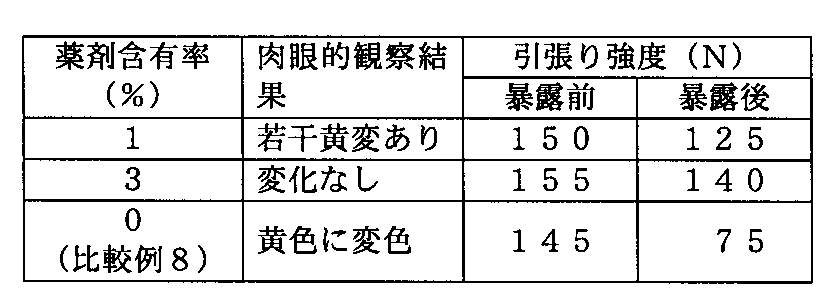
表1にみられるように、劣化遅延剤で処理をしていない比較例1のレーヨン織物は、土壌埋設後わずか3ケ月で全く形状が確認できない状態まで消失していた。一方、キトサンの金属錯塩からなる実施例1の劣化遅延剤や、弱アルカリ性を有するキトサンの金属錯塩からなる実施例2の劣化遅延剤で処理したレーヨン織物は、消失しておらず、生分解を遅延することができることが確認される。また、劣化遅延剤による処理量が約4.8%質量%のものでは、わずかな生分解で留まったのに対して、劣化遅延剤による処理量が約2.5%と半減すると20%程度の劣化がみられた。このことから、劣化遅延剤の処理量を変化させることによって、レーヨンの劣化速度を調整することが可能であり、所定の時間の経過とともに完全に生分解により消失させるように制御することが可能であることが確認される。 As can be seen in Table 1, the rayon fabric of Comparative Example 1 that was not treated with the deterioration retarder had disappeared to a state where the shape could not be confirmed at all in only 3 months after burying the soil. On the other hand, the rayon fabric treated with the deterioration retarder of Example 1 composed of a metal complex salt of chitosan or the degradation retarder of Example 2 composed of a metal complex salt of chitosan having weak alkalinity did not disappear and biodegraded. It is confirmed that it can be delayed. In addition, when the treatment amount with the deterioration retarder was about 4.8% by mass, the biodegradation remained slightly, but when the treatment amount with the deterioration retarder was about 2.5%, it was about 20%. Degradation was observed. From this, it is possible to adjust the deterioration rate of the rayon by changing the processing amount of the deterioration retarder, and it can be controlled to disappear completely by biodegradation with the passage of a predetermined time. It is confirmed that there is.
(実施例3)
実施例2と同様にして弱アルカリ性を呈するキトサンの金属錯塩を調製し、さらに実施例2と同様にして乾燥した。これを3g取り、精製水95.5gに氷酢酸1.5gを溶解させたものに投入し、攪拌溶解させることによって、劣化遅延剤の水溶液を得た。
(Example 3)
A metal complex salt of chitosan exhibiting weak alkalinity was prepared in the same manner as in Example 2, and further dried in the same manner as in Example 2. 3 g of this was taken, put into a solution obtained by dissolving 1.5 g of glacial acetic acid in 95.5 g of purified water, and dissolved by stirring to obtain an aqueous solution of a deterioration retarder.
次に、生分解性材料としてレーヨン(ダイワボウレーヨン株式会社製:縦糸横糸共に6番レーヨン単糸100%)を用い、劣化遅延剤の水溶液にこのレーヨンを10分間浸漬処理した後、ロール式絞り機にて余分な劣化遅延剤を除去し、さらに40±5℃の循環式乾燥機で24時間乾燥させることによって、レーヨンを劣化遅延剤で処理した。 Next, rayon (manufactured by Daiwabo Rayon Co., Ltd .: No. 6 rayon single yarn 100% for both warp and weft) is used as a biodegradable material. The excess deterioration retarder was removed at, and the rayon was treated with the degradation retarder by drying in a circulating dryer at 40 ± 5 ° C. for 24 hours.
そしてこの劣化遅延剤で処理したレーヨンを、大阪府河内長野市、大阪府立花の文化園内に植栽されているウメおよびサザンカの支柱横木に巻き付け、6ケ月間放置した後、肉眼で生分解及び光劣化の程度を観察し、また幅25mm、長さ150mmに切断して引張り強度の測定を行なった。結果を表2に示す。尚、ウメとサザンカを選択した目的は落葉樹と常緑樹との違いによるレーヨンに対する直射日光の照度に差があるとの配慮からである。 Then, the rayon treated with this deterioration retarder is wrapped around the plums of Ume and Sasanka planted in Kawachinagano City, Osaka Prefectural Flower Garden, and left for 6 months. The extent of photodegradation was observed, and the tensile strength was measured after cutting into a width of 25 mm and a length of 150 mm. The results are shown in Table 2. The purpose of selecting ume and sasanqua is to consider that there is a difference in the illuminance of direct sunlight against rayon due to the difference between deciduous and evergreen trees.
(比較例2)
尚、比較例2として、実施例3のような劣化遅延剤で全く処理しないレーヨンについても、同様に試験を行った。
(Comparative Example 2)
As Comparative Example 2, a rayon that was not treated with a deterioration retarder as in Example 3 was also tested in the same manner.
表2にみられるように、劣化遅延剤で処理をしなかった比較例2では、光の当たる部分のレーヨンに顕著な変色が見られ、しかも初期強度が30〜40%程度低下しており、生分解及び光の作用による分解で大きな劣化が発生しているものであった。一方、実施例3の劣化遅延剤で処理されたレーヨンにおいては、変色が全く見られず、しかも強度低下もわずかであることが判明した。このことから、劣化遅延剤には生分解性材料が光劣化することを抑制する効果のあることが確認される。 As can be seen in Table 2, in Comparative Example 2 in which the treatment with the deterioration retarder was not performed, significant discoloration was observed in the rayon in the area exposed to light, and the initial intensity was reduced by about 30 to 40%. There was significant degradation due to biodegradation and degradation by the action of light. On the other hand, in the rayon treated with the degradation retarder of Example 3, it was found that no discoloration was observed and the strength was slightly reduced. From this, it is confirmed that the deterioration retarder has an effect of suppressing the photodegradation of the biodegradable material.
(実施例4〜7)
実施例2と同様にして弱アルカリ性を呈するキトサンの金属錯塩を調製し、さらに実施例2と同様に乾燥した。これを2.1g取り、精製水94.9gに氷酢酸3gを溶解させたものに投入し、攪拌溶解させることによって、劣化遅延剤の水溶液を得た。これを実施例4の劣化遅延剤とした。
(Examples 4 to 7)
A metal complex salt of chitosan exhibiting weak alkalinity was prepared in the same manner as in Example 2, and further dried in the same manner as in Example 2. 2.1 g of this was taken, put into a solution obtained by dissolving 3 g of glacial acetic acid in 94.9 g of purified water, and dissolved by stirring to obtain an aqueous solution of a deterioration retarder. This was used as the deterioration retarder of Example 4.
同様に弱アルカリ性を呈するキトサンの金属錯塩の乾燥したものを3g取り、精製水94gに氷酢酸3gを溶解させたものに投入し、攪拌溶解させることによって、劣化遅延剤の水溶液を得た。これを実施例5の劣化遅延剤とした。 Similarly, 3 g of a dried metal complex salt of chitosan exhibiting weak alkalinity was taken, put into 94 g of purified water in which 3 g of glacial acetic acid was dissolved, and dissolved by stirring to obtain an aqueous solution of a deterioration retarder. This was used as the deterioration retarder of Example 5.
また、同様に弱アルカリ性を呈するキトサンの金属錯塩の乾燥したものを4.5g取り、精製水92.5gに氷酢酸3gを溶解させたものに投入し、攪拌溶解させることによって、劣化遅延剤の水溶液を得た。これを実施例6の劣化遅延剤とした。 Similarly, 4.5 g of a dried metal complex salt of chitosan exhibiting weak alkalinity is taken, put into 92.5 g of purified water in which 3 g of glacial acetic acid is dissolved, and dissolved by stirring, whereby a deterioration retarder An aqueous solution was obtained. This was used as the deterioration retarder of Example 6.
さらに同様に弱アルカリ性を呈するキトサンの金属錯塩の乾燥したものを6g取り、精製水91gに氷酢酸3gを溶解させたものに投入し、攪拌溶解させることによって、劣化遅延剤の水溶液を得た。これを実施例7の劣化遅延剤とした。 Similarly, 6 g of a dried metal complex salt of chitosan exhibiting weak alkalinity was taken, poured into a solution of 3 g of glacial acetic acid in 91 g of purified water, and dissolved by stirring to obtain an aqueous solution of a deterioration retarder. This was used as the deterioration retarder of Example 7.
そして、生分解性材料としてレーヨン織物(ダイワボウレーヨン株式会社製:縦糸横糸共に6番レーヨン単糸100%)を用い、これら実施例4〜7の劣化遅延剤の水溶液にレーヨン織物を10分間浸漬処理した後、ロール式絞り機にて余分な薬剤を除去し、さらに40±5℃の循環式乾燥機で24時間乾燥させることによって、レーヨン織物を劣化遅延剤で処理した。 And, using a rayon fabric (manufactured by Daiwabo Rayon Co., Ltd .: No. 6 rayon single yarn 100% for both warp and weft) as a biodegradable material, the rayon fabric is dipped in an aqueous solution of the deterioration retarder of Examples 4 to 7 for 10 minutes. After that, the excess medicine was removed with a roll-type squeezer and further dried with a circulation dryer at 40 ± 5 ° C. for 24 hours to treat the rayon fabric with the deterioration retarder.
この劣化遅延剤で処理したレーヨン織物について、紫外線吸収スペクトル(株式会社島津製作所製「UVmini−1240」)によって、250nm〜800nmの範囲における光の透過率を測定した。結果を表3に示す。 About the rayon fabric processed with this deterioration retarder, the light transmittance in the range of 250 nm-800 nm was measured by the ultraviolet absorption spectrum ("UVmini-1240" by Shimadzu Corporation). The results are shown in Table 3.
(比較例3)
尚、比較例3として、実施例4〜7のような劣化遅延剤で全く処理しないレーヨンについても、同様に試験を行った。
(Comparative Example 3)
As Comparative Example 3, a rayon that was not treated with a deterioration retarder as in Examples 4 to 7 was also tested in the same manner.
表3にみられるように、実施例4〜7の劣化遅延剤で処理されたレーヨン織物では、未処理の比較例3に比べ、特に紫外線領域(250nm、300nm)において強い吸収が見られ、近赤外線領域(800nm)においても紫外線領域ほどではないまでも弱い吸収が見られた。このことを実施例3の結果と合わせ考えると、このように劣化遅延剤が紫外線を強く吸収することによって、生分解性材料が紫外線による劣化を受けることを劣化遅延剤が阻止していると考えられる。また、近赤外線領域における吸収は、これを農業用マルチシートとして使用するにあたって、特に冬季における土壌の保温効果に役立つことを意味している。 As seen in Table 3, the rayon fabric treated with the deterioration retarder of Examples 4 to 7 showed strong absorption particularly in the ultraviolet region (250 nm, 300 nm), compared with the untreated Comparative Example 3, Weak absorption was observed even in the infrared region (800 nm), but not as much as in the ultraviolet region. Considering this together with the result of Example 3, it is considered that the deterioration retarder prevents the biodegradable material from being deteriorated by the ultraviolet rays because the deterioration retarder strongly absorbs the ultraviolet rays. It is done. Absorption in the near-infrared region means that it is useful for the heat-retaining effect of the soil, especially in winter, when it is used as an agricultural multi-sheet.
(実施例8)
実施例2と同様にして弱アルカリ性を呈するキトサンの金属錯塩を調製し、さらに実施例2と同様に乾燥した。これを3g取り、精製水94gに氷酢酸3gを溶解させたものに投入し、攪拌溶解させることによって、劣化遅延剤の水溶液を得た。
(Example 8)
A metal complex salt of chitosan exhibiting weak alkalinity was prepared in the same manner as in Example 2, and further dried in the same manner as in Example 2. 3 g of this was taken, put into a solution obtained by dissolving 3 g of glacial acetic acid in 94 g of purified water, and dissolved by stirring to obtain an aqueous solution of a deterioration retarder.
そして、生分解性材料としてポリ乳酸系生分解性合成樹脂繊維であるラクトロン(カネボウ合繊株式会社製)の糸を使い製織した不織布を用い、実施例8の劣化遅延剤の水溶液にラクトロン不織布を5分間浸漬し、ロール式絞り機にて余分な劣化遅延剤を除去し、さらに40±5℃の循環式乾燥機で24時間乾燥させることによって、ラクトロン不織布を劣化遅延剤で処理した。 Then, as a biodegradable material, a non-woven fabric woven using the yarn of lactolone (manufactured by Kanebo Gosei Co., Ltd.), which is a polylactic acid-based biodegradable synthetic resin fiber, is used. The lactron nonwoven fabric was treated with the degradation retarder by dipping for a minute, removing the excess degradation retarder with a roll-type squeezer, and further drying with a circulation dryer at 40 ± 5 ° C. for 24 hours.
この劣化遅延剤で処理したラクトロン不織布を鳥取県八頭郡河原町の山林、大阪府貝貝塚市二色中町の工業団地内の土壌中表面から約5cmに埋設した。1年後、これらを掘り出し、生分解状況を肉眼で観察し、また質量減少率を求めた。結果を表4に示す。 The lactron nonwoven fabric treated with this deterioration retarder was embedded approximately 5 cm from the surface of the soil in the industrial park in the forest of Kawaramachi, Yagami-gun, Tottori Prefecture, and Nishikinaka-cho, Kaizuka-shi, Osaka. One year later, they were dug out, the state of biodegradation was observed with the naked eye, and the mass reduction rate was determined. The results are shown in Table 4.
(比較例4)
尚、比較例4として、実施例8のような劣化遅延剤で全く処理しないラクトロン不織布についても、同様に試験を行った。
(Comparative Example 4)
In addition, as Comparative Example 4, a lactron nonwoven fabric that was not treated with a deterioration retarder as in Example 8 was also tested in the same manner.
(実施例9)
実施例2と同様にして弱アルカリ性を呈するキトサンの金属錯塩を調製し、さらに実施例2と同様に乾燥した。これを3g取り、精製水94gに氷酢酸3gを溶解させたものに投入し、攪拌溶解させることによって、劣化遅延剤の水溶液を得た。
Example 9
A metal complex salt of chitosan exhibiting weak alkalinity was prepared in the same manner as in Example 2, and further dried in the same manner as in Example 2. 3 g of this was taken, put into a solution obtained by dissolving 3 g of glacial acetic acid in 94 g of purified water, and dissolved by stirring to obtain an aqueous solution of a deterioration retarder.
そして、生分解性材料としてポリ乳酸系生分解性合成樹脂繊維であるテラマック(ユニチカ株式会社製)の糸を使い製織した不織布を用い、実施例9の劣化遅延剤の水溶液にテラマック不織布を5分間浸漬し、ロール式絞り機にて余分な薬剤を除去し、さらに40±5℃の循環式乾燥機で24時間乾燥させることによって、テラマック不織布を劣化遅延剤で処理した。 Then, using a nonwoven fabric woven using Terramac (manufactured by Unitika Ltd.), which is a polylactic acid-based biodegradable synthetic resin fiber, as the biodegradable material, the Terramac nonwoven fabric is added to the aqueous solution of the deterioration retarder of Example 9 for 5 minutes. The terramac nonwoven fabric was treated with a deterioration retarder by dipping, removing excess chemicals with a roll squeezer, and further drying with a circulation dryer at 40 ± 5 ° C. for 24 hours.
この劣化遅延剤で処理したテラマック不織布を鳥取県八頭郡河原町の山林の土壌中表面から約5cmに埋設した。1年後、これらを掘り出し、生分解状況を肉眼で観察し、また質量減少率を求めた。結果を表4に示す。 A Terramac nonwoven fabric treated with this deterioration retarder was embedded approximately 5 cm from the surface of the forest in the forest of Kawaramachi, Yagami-gun, Tottori Prefecture. One year later, they were dug out, the state of biodegradation was observed with the naked eye, and the mass reduction rate was determined. The results are shown in Table 4.
(比較例5)
尚、比較例5として、実施例9のような劣化遅延剤で全く処理しないテラマック不織布についても、同様に試験を行った。
(Comparative Example 5)
As Comparative Example 5, the same test was performed on a Terramac nonwoven fabric that was not treated with a deterioration retarder as in Example 9.
表4にみられるように、実施例8と比較例4、実施例9と比較例5の比較から、劣化遅延剤が生分解性合成樹脂繊維に対しても生分解を遅延させていることが確認される。 As seen in Table 4, it can be seen from the comparison between Example 8 and Comparative Example 4, Example 9 and Comparative Example 5 that the degradation retarder also delays biodegradation of biodegradable synthetic resin fibers. It is confirmed.
(実施例10)
実施例1と同様にしてキトサンの金属錯塩を調製し、さらに実施例1と同様に乾燥し、これをボールミル式粉砕機により3μm以下の大きさまで粉砕して、劣化遅延剤の微粉末を得た。
(Example 10)
A metal complex salt of chitosan was prepared in the same manner as in Example 1, and further dried in the same manner as in Example 1. This was pulverized to a size of 3 μm or less with a ball mill pulverizer to obtain a fine powder of a deterioration retarder. .
そして生分解性材料として生分解性合成樹脂であるポリブチレンサクシネートを用い、ポリブチレンサクシネートの樹脂ペレットに上記の劣化遅延剤を1質量%の添加量で混合した後、シート状に溶融成形した。また、同様に上記の劣化遅延剤を2質量%の添加量、3質量%の添加量で混合し、シート状に溶融成形した。 Then, polybutylene succinate, which is a biodegradable synthetic resin, is used as a biodegradable material, and the above-described deterioration retarder is mixed with a resin pellet of polybutylene succinate at an addition amount of 1% by mass, and then melt-molded into a sheet shape. did. Similarly, the deterioration retarder was mixed in an addition amount of 2% by mass and an addition amount of 3% by mass, and melt-molded into a sheet.
この劣化遅延剤を混合して処理したポリブチレンサクシネートのシートを鳥取県八頭郡河原町の山林の土壌中表面から約5cmに埋設した。1年後、これらを掘り出し、生分解状況を肉眼で観察し、また質量減少率を求めた。結果を表5に示す。 A sheet of polybutylene succinate treated by mixing this deterioration retarder was embedded about 5 cm from the surface of the soil in the forest of Kawaramachi, Yagami-gun, Tottori Prefecture. One year later, they were dug out, the state of biodegradation was observed with the naked eye, and the mass reduction rate was determined. The results are shown in Table 5.
(比較例6)
尚、比較例6として、実施例10のような劣化遅延剤を混合しないポリブチレンサクシネートのシートについても、同様に試験を行った。
(Comparative Example 6)
As Comparative Example 6, the same test was performed on a sheet of polybutylene succinate not mixed with a deterioration retarder as in Example 10.
表5において、土壌埋設1年にして比較例6のものは生分解によって完全に消失していた。一方、実施例10のものについては、生分解性材料の劣化遅延剤の添加量が1質量%、2質量%、3質量%と増加するに従い、生分解の程度が小さくなるというように顕著な差がみられた。このことから、劣化遅延剤の添加量を変化させることによって、生分解性材料の寿命を調整できることが確認される。この事実は表1の実施例1及び2の結果とも一致する。 In Table 5, the thing of the comparative example 6 was completely lose | disappeared by biodegradation in 1 year of soil embedding. On the other hand, as for Example 10, the degree of biodegradation becomes remarkable as the addition amount of the degradation retarder of the biodegradable material increases to 1% by mass, 2% by mass and 3% by mass. There was a difference. From this, it is confirmed that the life of the biodegradable material can be adjusted by changing the addition amount of the deterioration retarder. This fact is consistent with the results of Examples 1 and 2 in Table 1.
(実施例11、12)
実施例2と同様にして弱アルカリ性を呈するキトサンの金属錯塩を調製し、さらに実施例2と同様に乾燥した。これを1g取り、精製水97.5gに氷酢酸1.5gを溶解させたものに投入し、攪拌溶解させることによって、劣化遅延剤の水溶液を得た。これを実施例11の劣化遅延剤とした。
(Examples 11 and 12)
A metal complex salt of chitosan exhibiting weak alkalinity was prepared in the same manner as in Example 2, and further dried in the same manner as in Example 2. 1 g of this was taken, put into a solution obtained by dissolving 1.5 g of glacial acetic acid in 97.5 g of purified water, and dissolved by stirring to obtain an aqueous solution of a deterioration retarder. This was used as the deterioration retarder of Example 11.
同様に弱アルカリ性を呈するキトサンの金属錯塩の乾燥したものを3g取り、精製水95.5gに氷酢酸1.5gを溶解させたものに投入し、攪拌溶解させることによって、劣化遅延剤の水溶液を得た。これを実施例12の劣化遅延剤とした。 Similarly, 3 g of a dried metal complex salt of chitosan exhibiting weak alkalinity is taken, put into a solution obtained by dissolving 1.5 g of glacial acetic acid in 95.5 g of purified water, and dissolved by stirring to obtain an aqueous solution of a deterioration retarder. Obtained. This was used as the deterioration retarder of Example 12.
そして生分解性材料として鳥取県特産の因州和紙(鳥取県気高郡青谷町産)を用い、実施例11及び実施例12の劣化遅延剤の水溶液にこの和紙を3分間浸漬し、ロール式絞り機にて余分な薬剤を除去し、さらに40±5℃の循環式乾燥機で24時間乾燥させることによって、和紙を劣化遅延剤で処理した。 Then, Inshu Japanese paper (Aoya-cho, Ketaka-gun, Tottori Prefecture) is used as a biodegradable material, and the Japanese paper is immersed in an aqueous solution of the deterioration retarder of Example 11 and Example 12 for 3 minutes. Excess chemicals were removed with, and the paper was further treated with a deterioration retarder by drying in a circulating dryer at 40 ± 5 ° C. for 24 hours.
この劣化遅延剤で処理した和紙を鳥取県八頭郡河原町の山林の土壌中表面から約5cmに埋設した。半年後、これらを掘り出し、生分解状況を肉眼で観察し、また質量減少率を求めた。結果を表6に示す。 Japanese paper treated with this deterioration retarder was buried approximately 5 cm from the surface of the soil in the forest of Kawaramachi, Yagami-gun, Tottori Prefecture. Half a year later, they were dug out, the state of biodegradation was observed with the naked eye, and the mass reduction rate was determined. The results are shown in Table 6.
(比較例7)
尚、比較例7として、劣化遅延剤で処理しない和紙についても、同様に試験を行った。
(Comparative Example 7)
As Comparative Example 7, the same test was performed on Japanese paper not treated with the deterioration retarder.
表6にみられるように、劣化遅延剤で処理しない比較例7の和紙は大きく生分解を受けており、一方、実施例12の劣化遅延剤で処理した和紙は殆ど生分解を受けおらず、また実施例11の劣化遅延剤で処理した和紙は、比較例7の半分程度の生分解に抑制されていた。このことから、劣化遅延剤で処理することによって和紙の生分解を抑制し、あるいは生分解速度を遅延できることが確認され、劣化遅延剤の濃度を調整して、劣化遅延剤による処理量を調整することによって、和紙の劣化の遅延の程度を調整できることが確認される。
(実施例13)
実施例2と同様にして弱アルカリ性を呈するキトサンの金属錯塩を調製し、さらに実施例2と同様に乾燥した。これをボールミル式粉砕機により3μm以下の大きさまで粉砕して、劣化遅延剤の微粉末を得た。
As seen in Table 6, the Japanese paper of Comparative Example 7 that was not treated with the degradation retarder was greatly biodegraded, while the Japanese paper treated with the degradation retarder of Example 12 was hardly biodegraded, In addition, the Japanese paper treated with the deterioration retarder of Example 11 was suppressed to about half biodegradation of Comparative Example 7. From this, it was confirmed that the biodegradation of Japanese paper can be suppressed or the biodegradation rate can be delayed by treating with the degradation retarder, and the treatment amount by the degradation retarder is adjusted by adjusting the concentration of the degradation retarder. This confirms that the degree of delay in the deterioration of Japanese paper can be adjusted.
(Example 13)
A metal complex salt of chitosan exhibiting weak alkalinity was prepared in the same manner as in Example 2, and further dried in the same manner as in Example 2. This was pulverized to a size of 3 μm or less by a ball mill type pulverizer to obtain a fine powder of a deterioration retarder.
そしてエチレン酢酸ビニルエマルジョン樹脂(昭和高分子株式会社製「ポリゾール」)の50質量%水溶液に対して1質量%になるように劣化遅延剤の粉末を混合した後、拡散している段階で直ちに、レーヨン不織布(ダイワボウレーヨン株式会社製)を5分間浸漬させ、さらに48時間風乾することによって、レーヨン不織布を劣化遅延剤で処理した。 And after mixing the powder of a deterioration retarder so that it might become 1 mass% with respect to 50 mass% aqueous solution of ethylene vinyl acetate emulsion resin (Showa Polymer Co., Ltd. "Polysol"), immediately in the stage which has diffused, A rayon nonwoven fabric (manufactured by Daiwabo Rayon Co., Ltd.) was immersed for 5 minutes and further air-dried for 48 hours, whereby the rayon nonwoven fabric was treated with a deterioration retarder.
またエチレン酢酸ビニルエマルジョン樹脂の50質量%水溶液に対して3質量%になるように劣化遅延剤の粉末を混合した後、同様にレーヨン不織布を浸漬して風乾することによって、レーヨン不織布を劣化遅延剤で処理した。 In addition, after mixing the deterioration retarder powder so that it becomes 3% by mass with respect to the 50% by mass aqueous solution of the ethylene vinyl acetate emulsion resin, the rayon nonwoven fabric is dipped in the same manner and air-dried. Was processed.
この劣化遅延剤で処理したレーヨン不織布を大阪市西区境川のビル屋上(7階建)の南向き側手すりに吊るした。半年後、これを取り外し、肉眼的に観察し、またこれを幅25mm、長さ150mm切断して強度測定を行った。結果を表7に示す。 The rayon nonwoven fabric treated with this deterioration retarder was hung on a handrail facing south on the building roof (7 stories) in Sakaigawa, Nishi-ku, Osaka. Half a year later, it was removed and visually observed, and the strength was measured by cutting it 25 mm wide and 150 mm long. The results are shown in Table 7.
(比較例8)
尚、比較例8として、劣化遅延剤を混合しないエチレン酢酸ビニルエマルジョン樹脂に同様に浸漬したレーヨン不織布についても、同様に試験を行なった。
(Comparative Example 8)
As Comparative Example 8, a rayon nonwoven fabric similarly immersed in an ethylene vinyl acetate emulsion resin not mixed with a deterioration retarder was similarly tested.
表7にみられるように、劣化遅延剤を含有しないエチレン酢酸ビニルエマルジョン樹脂で被覆処理を行なった比較例8のレーヨン不織布では、光の当たる部分のレーヨンに顕著な変色が見られ、しかも初期強度が約48%程度低下しているものであった。一方、劣化遅延剤を含有するエチレン酢酸ビニルエマルジョン樹脂で被覆処理したレーヨン不織布においては、劣化遅延剤の含有率に応じて程度に差はあるものの、変色や強度のいずれも比較例8より優れており、光劣化を抑制できることが確認された。そして劣化遅延剤の含有率1質量%に比べて、含有率3質量%では特に効果が高いものであり、このことから劣化遅延剤の含有率を変化させることによって、光劣化速度を調整できることが確認される。また、劣化遅延剤による光劣化遅延効果は、実施例3における劣化遅延剤を溶解した水溶液への浸漬処理だけに留まらず、微粉としてこれを樹脂等に分散させたものを表面に被覆するだけでも十分な効果を発揮することが判明した。 As seen in Table 7, in the rayon nonwoven fabric of Comparative Example 8 that was coated with an ethylene vinyl acetate emulsion resin that did not contain a deterioration retarder, significant discoloration was observed in the rayon in the area exposed to light, and the initial strength Was about 48% lower. On the other hand, in the rayon nonwoven fabric coated with an ethylene vinyl acetate emulsion resin containing a deterioration retarder, although there is a difference depending on the content of the deterioration retarder, both discoloration and strength are superior to Comparative Example 8. It was confirmed that photodegradation can be suppressed. The content rate of 3% by mass is particularly effective compared to the content rate of 1% by mass of the retarder, and from this, the photodegradation rate can be adjusted by changing the content rate of the retarder. It is confirmed. Moreover, the light deterioration delay effect by the deterioration retarder is not limited to the immersion treatment in the aqueous solution in which the deterioration retarder is dissolved in Example 3, but only by coating the surface with a fine powder dispersed in a resin or the like. It has been found that it exhibits a sufficient effect.
Claims (3)
Priority Applications (1)
| Application Number | Priority Date | Filing Date | Title |
|---|---|---|---|
| JP2004104066A JP3827240B2 (en) | 2004-03-31 | 2004-03-31 | Degradation delay treatment using degradation retarders for biodegradable synthetic resins |
Applications Claiming Priority (1)
| Application Number | Priority Date | Filing Date | Title |
|---|---|---|---|
| JP2004104066A JP3827240B2 (en) | 2004-03-31 | 2004-03-31 | Degradation delay treatment using degradation retarders for biodegradable synthetic resins |
Publications (2)
| Publication Number | Publication Date |
|---|---|
| JP2005290583A true JP2005290583A (en) | 2005-10-20 |
| JP3827240B2 JP3827240B2 (en) | 2006-09-27 |
Family
ID=35323836
Family Applications (1)
| Application Number | Title | Priority Date | Filing Date |
|---|---|---|---|
| JP2004104066A Expired - Fee Related JP3827240B2 (en) | 2004-03-31 | 2004-03-31 | Degradation delay treatment using degradation retarders for biodegradable synthetic resins |
Country Status (1)
| Country | Link |
|---|---|
| JP (1) | JP3827240B2 (en) |
Cited By (2)
| Publication number | Priority date | Publication date | Assignee | Title |
|---|---|---|---|---|
| JP2007302590A (en) * | 2006-05-10 | 2007-11-22 | Ikuo Furukawa | Manufacturing method of noxious organism-controlling agent |
| US11525086B2 (en) | 2019-05-06 | 2022-12-13 | Gpcp Ip Holdings Llc | Paper sheet mulches and methods of making the same |
-
2004
- 2004-03-31 JP JP2004104066A patent/JP3827240B2/en not_active Expired - Fee Related
Cited By (2)
| Publication number | Priority date | Publication date | Assignee | Title |
|---|---|---|---|---|
| JP2007302590A (en) * | 2006-05-10 | 2007-11-22 | Ikuo Furukawa | Manufacturing method of noxious organism-controlling agent |
| US11525086B2 (en) | 2019-05-06 | 2022-12-13 | Gpcp Ip Holdings Llc | Paper sheet mulches and methods of making the same |
Also Published As
| Publication number | Publication date |
|---|---|
| JP3827240B2 (en) | 2006-09-27 |
Similar Documents
| Publication | Publication Date | Title |
|---|---|---|
| KR101970536B1 (en) | Biodegradable coating compositions for mulching and mulching sites | |
| DE69434574T2 (en) | MODIFIED POLYSACCHARIDES WITH ABSORPTION PROPERTIES AND METHOD FOR THE PRODUCTION THEREOF | |
| Ibrahim et al. | Advanced materials and technologies for antimicrobial finishing of cellulosic textiles | |
| WO2002015698A1 (en) | Preparation of articles having a contact biocidal property | |
| EP2732872A1 (en) | Method of producing agent for removing dissolved phosphorus compounds from water and agent for removing dissolved phosphorus compounds from water | |
| RU2002128624A (en) | METHOD FOR PRODUCING CELLULOSE FIBER WITH IMPROVED BIO RESISTANCE AND SUBSTANCES OBTAINED BY THIS METHOD | |
| US7943158B2 (en) | Absorbent systems providing antimicrobial activity | |
| Wei et al. | Sodium alginate-carboxymethyl chitosan hydrogels loaded with difenoconazole for pH-responsive release to control wheat crown rot | |
| JP3827240B2 (en) | Degradation delay treatment using degradation retarders for biodegradable synthetic resins | |
| JP4132993B2 (en) | Water absorbent resin and method for producing the same | |
| DE3873061T2 (en) | COMPOSED MATERIAL OF CELLULOSE FIBERS AND CHITOSAN AND METHOD FOR THE PRODUCTION THEREOF. | |
| EP1404267A2 (en) | Absorbent material and method for the production of the same | |
| JP4903777B2 (en) | Deodorant fiber fabric and method for producing the same | |
| Velusamy et al. | Recent advances in the development of antimicrobial nanotextiles for prevention of infectious diseases transmission in healthcare workers | |
| KR100862991B1 (en) | Hanji and its manufacturing method | |
| CN118308911A (en) | A multifunctional paper-based film and its preparation method and application | |
| JP3830035B2 (en) | Plant fiber preservative | |
| AU4124397A (en) | Lyocell fabrics and their treatment | |
| Dip et al. | Polysaccharide applications in functional textiles and textile wastewater treatment | |
| DE60315466D1 (en) | IMPROVED WASH OIL RINSE-CONTAINING DOSAGE UNIT WITH A DISINTEGRATION AGENT FOR USE IN A WASHING PROCESS | |
| KR100462566B1 (en) | Charcoal paint for Flexible textile with Charcoal | |
| CN220555267U (en) | Antibacterial polyester staple fiber | |
| Tanasa et al. | Highly specialized textiles with antimicrobial functionality—advances and challenges. Textiles. 2023; 3: 219–245 | |
| KR20250029331A (en) | Manufacturing method of composite sheet for interior use using loofah fruit | |
| JP4575900B2 (en) | Method for producing pest control agent |
Legal Events
| Date | Code | Title | Description |
|---|---|---|---|
| A711 | Notification of change in applicant |
Free format text: JAPANESE INTERMEDIATE CODE: A711 Effective date: 20051004 |
|
| A521 | Written amendment |
Free format text: JAPANESE INTERMEDIATE CODE: A821 Effective date: 20051004 |
|
| A977 | Report on retrieval |
Free format text: JAPANESE INTERMEDIATE CODE: A971007 Effective date: 20060209 |
|
| A131 | Notification of reasons for refusal |
Free format text: JAPANESE INTERMEDIATE CODE: A131 Effective date: 20060214 |
|
| A521 | Written amendment |
Free format text: JAPANESE INTERMEDIATE CODE: A523 Effective date: 20060417 |
|
| A131 | Notification of reasons for refusal |
Free format text: JAPANESE INTERMEDIATE CODE: A131 Effective date: 20060502 |
|
| A521 | Written amendment |
Free format text: JAPANESE INTERMEDIATE CODE: A523 Effective date: 20060529 |
|
| TRDD | Decision of grant or rejection written | ||
| A01 | Written decision to grant a patent or to grant a registration (utility model) |
Free format text: JAPANESE INTERMEDIATE CODE: A01 Effective date: 20060613 |
|
| A61 | First payment of annual fees (during grant procedure) |
Free format text: JAPANESE INTERMEDIATE CODE: A61 Effective date: 20060630 |
|
| R150 | Certificate of patent or registration of utility model |
Free format text: JAPANESE INTERMEDIATE CODE: R150 |
|
| FPAY | Renewal fee payment (event date is renewal date of database) |
Free format text: PAYMENT UNTIL: 20150714 Year of fee payment: 9 |
|
| LAPS | Cancellation because of no payment of annual fees |