JP2005290124A - Polyphenylene ether resin composition - Google Patents
Polyphenylene ether resin composition Download PDFInfo
- Publication number
- JP2005290124A JP2005290124A JP2004105061A JP2004105061A JP2005290124A JP 2005290124 A JP2005290124 A JP 2005290124A JP 2004105061 A JP2004105061 A JP 2004105061A JP 2004105061 A JP2004105061 A JP 2004105061A JP 2005290124 A JP2005290124 A JP 2005290124A
- Authority
- JP
- Japan
- Prior art keywords
- polyphenylene ether
- group
- resin composition
- weight
- ether resin
- Prior art date
- Legal status (The legal status is an assumption and is not a legal conclusion. Google has not performed a legal analysis and makes no representation as to the accuracy of the status listed.)
- Pending
Links
- 0 Cc(c(*)c1*)c(*)c(*)c1OC Chemical compound Cc(c(*)c1*)c(*)c(*)c1OC 0.000 description 1
Landscapes
- Compositions Of Macromolecular Compounds (AREA)
Abstract
【課題】溶解性・相溶性が良好で、かつ耐熱性の優れたポリフェニレンエーテル樹脂組成物を提供する。
【解決手段】低分子量ポリフェニレンエーテルと少量の高分子量ポリフェニレンエーテルからなる樹脂組成物。
【選択図】選択図なしDisclosed is a polyphenylene ether resin composition having good solubility and compatibility and excellent heat resistance.
A resin composition comprising a low molecular weight polyphenylene ether and a small amount of a high molecular weight polyphenylene ether.
[Selection] No selection
Description
本発明は、電子材料用途に有用なポリフェニレンエーテル樹脂組成物に関する。 The present invention relates to a polyphenylene ether resin composition useful for electronic materials.
ポリフェニレンエーテルはその優れた誘電特性や低い吸水性から、銅張り積層板を始めとする電子材料用途で注目されているが、その溶解性の点でワニスにする時の溶剤の種類が限定されるという問題点があった。また仮に溶解したとしても、流動性が悪いためガラスクロス等の基材に含浸させることが非常に困難であった。溶解性と流動性を解決する方法のひとつとして、ポリフェニレンエーテルの分子量を小さくする検討がなされている(例えば特許文献1参照)。しかしながら分子量の低下に伴い耐熱性の低下が避けられなかった。 Polyphenylene ether is attracting attention for electronic materials such as copper-clad laminates due to its excellent dielectric properties and low water absorption, but the type of solvent used for varnish is limited due to its solubility. There was a problem. Even if it is dissolved, it is very difficult to impregnate a substrate such as glass cloth due to poor fluidity. As one method for solving the solubility and fluidity, studies have been made to reduce the molecular weight of polyphenylene ether (for example, see Patent Document 1). However, a decrease in heat resistance is inevitable with a decrease in molecular weight.
また、低分子量の未変性ポリフェニレンエーテル45〜60wt%と変性された通常分子量のポリフェニレンエーテル40〜55wt%の樹脂組成物が開示されている(例えば、特許文献2参照)が、ポリフェニレンエーテルは一般に分子量が大きくなるとワニス溶媒として汎用されるケトン系溶媒に溶解しない。昨今環境への配慮から鉛フリーハンダの使用が加速しておりより高い耐熱性が要求されている中で、ワニス溶剤として汎用されているケトン系溶剤に室温で改善された溶解性と硬化性樹脂と混合した際に良好な相溶性・流動性を示すのみならず、この樹脂液から溶媒を除去して硬化した際に優れた誘電特性、耐熱性をも兼ね備えているポリフェニレンエーテル樹脂組成物が希求されている。
本発明は、ワニス溶剤として汎用されているケトン系溶剤に室温で改善された溶解性と硬化性樹脂と混合した際に良好な相溶性・流動性を示すのみならず、この樹脂液から溶媒を除去して硬化した際に優れた耐熱性を兼ね備えているポリフェニレンエーテル樹脂組成物を提供することを目的とする。 The present invention shows not only good solubility and fluidity when mixed with a curable resin, which is improved in room temperature in a ketone solvent widely used as a varnish solvent, but also a solvent from this resin liquid. It is an object of the present invention to provide a polyphenylene ether resin composition having excellent heat resistance when removed and cured.
本発明者らは、上記課題を解決するために鋭意検討した結果、低分子量のポリフェニレンエーテルに少量の高分子量のポリフェニレンエーテルを添加した組成物がケトン系溶媒に対しても室温で改善された溶解性を示し、かつ硬化性樹脂と混合した際に良好な相溶性・流動性を示すのみならず、この樹脂液から溶媒を除去して硬化させた硬化物が優れた誘電特性、耐熱性及び機械特性をも兼ね備えていることを見出し、本発明を完成した。 As a result of intensive studies to solve the above problems, the present inventors have found that a composition obtained by adding a small amount of a high molecular weight polyphenylene ether to a low molecular weight polyphenylene ether is improved in a ketone solvent at room temperature. In addition to exhibiting good compatibility and fluidity when mixed with a curable resin, the cured product obtained by removing the solvent from the resin liquid and curing it has excellent dielectric properties, heat resistance and machinery The present invention was completed by finding out that it also has characteristics.
すなわち本発明は下記の通りである。
(1)数平均分子量が2,000から8,000未満であるポリフェニレンエーテル(a)、数平均分子量が8,000から50,000であるポリフェニレンエーテル(b)及び硬化性樹脂(c)からなるポリフェニレンエーテル樹脂組成物において(a)成分100重量部に対し(b)成分が0.1から10重量部であることを特徴とするポリフェニレンエーテル樹脂組成物。
(2)(a)成分が、エポキシ基、シアネート基、アミノ基、アシル基、カルボキシル基および炭素―炭素三重結合基から選ばれる少なくとも1種以上の官能基で変性されていることを特徴とする上記(1)に記載のポリフェニレンエーテル樹脂組成物。
(3)(a)成分がエポキシ基、シアネート基、アミノ基、アシル基、カルボキシル基および炭素―炭素三重結合基から選ばれる少なくとも1種以上の官能基で変性されており、かつ(b)成分がエポキシ基、シアネート基、アミノ基、アシル基、カルボキシル基および炭素―炭素三重結合基から選ばれる少なくとも1種以上の官能基で変性されていることを特徴とする上記(1)に記載のポリフェニレンエーテル樹脂組成物。
(4)硬化剤(c)を含有していることを特徴とする(1)〜(3)のいずれかに記載のポリフェニレンエーテル樹脂組成物。
(5)上記(4)のポリフェニレンエーテル樹脂組成物を硬化して得られるポリフェニレンエーテル樹脂組成物硬化体。
That is, the present invention is as follows.
(1) It consists of a polyphenylene ether (a) having a number average molecular weight of 2,000 to less than 8,000, a polyphenylene ether (b) having a number average molecular weight of 8,000 to 50,000, and a curable resin (c). The polyphenylene ether resin composition, wherein the component (b) is 0.1 to 10 parts by weight with respect to 100 parts by weight of the component (a) in the polyphenylene ether resin composition.
(2) The component (a) is modified with at least one functional group selected from an epoxy group, a cyanate group, an amino group, an acyl group, a carboxyl group, and a carbon-carbon triple bond group. The polyphenylene ether resin composition according to (1) above.
(3) The component (a) is modified with at least one functional group selected from an epoxy group, a cyanate group, an amino group, an acyl group, a carboxyl group, and a carbon-carbon triple bond group, and the component (b) Wherein the polyphenylene is modified with at least one functional group selected from an epoxy group, a cyanate group, an amino group, an acyl group, a carboxyl group, and a carbon-carbon triple bond group Ether resin composition.
(4) The polyphenylene ether resin composition according to any one of (1) to (3), which contains a curing agent (c).
(5) A cured polyphenylene ether resin composition obtained by curing the polyphenylene ether resin composition of (4).
本発明により、ケトン系の有機溶剤に対しても改善された溶解性と硬化性樹脂と混合した際に良好な相溶性・流動性を示すのみならず、この樹脂液から溶媒を除去して得られた硬化した際に優れた耐熱性を兼ね備えているポリフェニレンエーテル樹脂組成物を提供することができる。 According to the present invention, improved solubility in a ketone-based organic solvent and not only good compatibility and fluidity when mixed with a curable resin, but also obtained by removing the solvent from this resin liquid. A polyphenylene ether resin composition having excellent heat resistance when cured can be provided.
以下本発明について具体的に説明する。
本発明において使用されるポリフェニレンエーテルは下記一般式(1)
The present invention will be specifically described below.
The polyphenylene ether used in the present invention is represented by the following general formula (1)
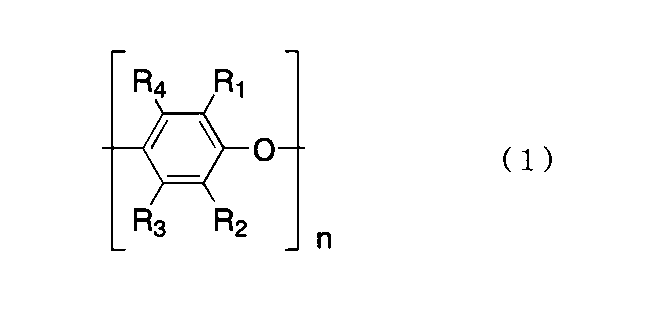
(式中、R1、R2、R3及びR4は、アルキル基、置換アルキル基、アラルキル基、置換アラルキル基、アリール基、置換アリール基、アルコキシ基、置換アルコキシ基、ハロゲンからなる群より選択される基であり互いに同一でも異なっていてもよく、nは正の整数を表す。)で表される。
このポリフェニレンエーテルの具体例としては、例えばポリ(2,6−ジメチル−1,4−フェニレンエーテル)、ポリ(2−メチル−6−エチル−1,4−フェニレンエーテル)、ポリ(2−メチル−6−フェニル−1,4−フェニレンエーテル)、ポリ(2、6−ジクロロ−1,4−フェニレンエーテル)等が挙げられ、さらに2,6−ジメチルフェノールと他のフェノール類(例えば2,3,6−トリメチルフェノール、2−メチル−6−ブチルフェノールなど)との共重合体や、ビフェノール類やビスフェノール類とカップリングさせたようなポリフェニレンエーテル共重合体も挙げられる。
(Wherein R 1 , R 2 , R 3 and R 4 are each selected from the group consisting of an alkyl group, a substituted alkyl group, an aralkyl group, a substituted aralkyl group, an aryl group, a substituted aryl group, an alkoxy group, a substituted alkoxy group and a halogen. Selected groups, which may be the same or different from each other, and n represents a positive integer.
Specific examples of the polyphenylene ether include, for example, poly (2,6-dimethyl-1,4-phenylene ether), poly (2-methyl-6-ethyl-1,4-phenylene ether), poly (2-methyl- 6-phenyl-1,4-phenylene ether), poly (2,6-dichloro-1,4-phenylene ether) and the like, and 2,6-dimethylphenol and other phenols (for example, 2,3, 6). 6-trimethylphenol, 2-methyl-6-butylphenol, etc.) and polyphenylene ether copolymers such as those coupled with biphenols and bisphenols.
本発明で使用される数平均分子量が8,000から50,000のポリフェニレンエーテルの製造方法は公知の方法で得られるものであれば特に限定されず、例えば米国特許第3306874号、同3306875号、同3257357号、同3257358号の明細書および特開昭50−51197号、同63−152628号の各公報で開示されている方法により得ることができる。
本発明で使用される数平均分子量が2,000以上8,000未満のポリフェニレンエーテルは、公知の方法で得られるものであればよく、例えば特開2003−261674号公報で開示されている方法やJournal of organic chemistry、34、297−303(1968)に記載されている如く数平均分子量が8,000以上のポリフェニレンエーテルをラジカル開始剤の存在下、ポリフェノール化合物と反応させて再分配反応を行うことにより分子量を低下させる方法等により得ることができる。
本発明において使用される変性ポリフェニレンエーテルは、上記ポリフェニレンエーテルを適当な官能化剤と反応させることにより得られる。例えば、特開昭47−32097号公報や特開昭58−219217号公報等で開示されている方法等により得ることができる。
The method for producing a polyphenylene ether having a number average molecular weight of 8,000 to 50,000 used in the present invention is not particularly limited as long as it can be obtained by a known method. For example, U.S. Pat. Nos. 3,306,874 and 3,306,875, It can be obtained by the methods disclosed in the specifications of 3257357 and 3257358 and JP-A-50-51197 and 63-152628.
The polyphenylene ether having a number average molecular weight of 2,000 or more and less than 8,000 used in the present invention may be any one obtained by a known method. For example, the method disclosed in JP-A No. 2003-261654 As described in Journal of organic chemistry, 34, 297-303 (1968), a polyphenylene ether having a number average molecular weight of 8,000 or more is reacted with a polyphenol compound in the presence of a radical initiator to perform a redistribution reaction. Can be obtained by a method of reducing the molecular weight.
The modified polyphenylene ether used in the present invention can be obtained by reacting the polyphenylene ether with an appropriate functionalizing agent. For example, it can be obtained by the method disclosed in JP-A-47-32097 and JP-A-58-219217.
本発明における(c)成分;硬化性樹脂は、例えばエポキシ樹脂、シアネート樹脂、ビスマレイミド樹脂、ポリイミド樹脂、ベンゾシクロブテン樹脂、架橋性ポリイミド樹脂、不飽和ポリエステル樹脂、ビニル樹脂、アリル樹脂等が挙げられる。中でもエポキシ樹脂が好ましく、具体的にはビスフェノールA型エポキシ樹脂、ビスフェノールF型エポキシ樹脂、ビスフェノールS型エポキシ樹脂、ビフェニル型エポキシ樹脂等の2官能エポキシ樹脂、ノボラック型エポキシ樹脂、イソシアヌレート型エポキシ樹脂、脂環型エポキシ樹脂等の多官能エポキシ樹脂およびこれらをハロゲン化したエポキシ樹脂等が挙げられる。また、これらの混合物も好んで用いられる。
上述硬化性樹脂の配合比は、混合ポリフェニレンエーテルエーテル成分(即ち(a)+(b)成分)1から99重量部に対し99から1重量部、好ましくは10から80重量部に対し90から20重量部である。
Component (c) in the present invention; examples of the curable resin include epoxy resins, cyanate resins, bismaleimide resins, polyimide resins, benzocyclobutene resins, crosslinkable polyimide resins, unsaturated polyester resins, vinyl resins, and allyl resins. It is done. Among them, epoxy resins are preferable, specifically, bifunctional epoxy resins such as bisphenol A type epoxy resins, bisphenol F type epoxy resins, bisphenol S type epoxy resins, biphenyl type epoxy resins, novolac type epoxy resins, isocyanurate type epoxy resins, Examples thereof include polyfunctional epoxy resins such as alicyclic epoxy resins and halogenated epoxy resins. A mixture of these is also preferably used.
The blending ratio of the curable resin is 99 to 1 part by weight, preferably 90 to 20 parts by weight, for 1 to 99 parts by weight of the mixed polyphenylene ether ether component (ie, (a) + (b) component). Parts by weight.
本発明の樹脂組成物は、その用途に応じて所望の性能を付与する目的で、本来の性質を損なわない範囲の量で添加剤を配合しても構わない。このような添加剤としては、難燃剤、難燃助剤、熱安定剤、酸化防止剤、UV吸収剤、界面活性剤、顔料、充填剤、離型剤等が挙げられる。難燃剤としては、例えば結晶水を含有する水酸化マグネシウムや水酸化アルミニウム、アルミン酸カルシウム等の金属水酸化物、トリフェニルホスフェート、トリクレジルホスフェート、トリキシレニルホスフェート、クレジルジフェニルホスフェート、キシレニルジフェニルホスフェート、ジキシレニルフェニルホスフェート、ヒドロキシノンビスフェノール、レゾルシノールビスホスフェート、ビスフェノールAビスホスフェート等の燐酸エステル類、ホスファゼン化合物、ホスフィン酸金属塩、ホスフィン酸アミド等のホスフィン酸塩、ホスホン酸塩、トリアリールホスフィン類、トリアリールホスフィンオキシド等のリン化合物、メラミン、メロン、メレム、メラム、トリアジン化合物、メラミンシアヌレート、グアニジン化合物、メラミン樹脂、トリアリールアミン等の含窒素化合物、ホウ酸亜鉛化合物、スズ酸亜鉛化合物、さらにはシリカ、カオリンクレー、タルクなどの無機ケイ素化合物が挙げられる。これらの難燃剤の中で、電気特性、難燃性と環境面の点から燐系化合物が好ましく、さらに燐酸エステル類、ホスファゼン化合物がより好ましい。これらの難燃剤は単独で用いてもよいし併用して用いてもよい。 The resin composition of the present invention may be blended with additives in an amount that does not impair the original properties for the purpose of imparting desired performance depending on the application. Examples of such additives include flame retardants, flame retardant aids, heat stabilizers, antioxidants, UV absorbers, surfactants, pigments, fillers, mold release agents, and the like. Examples of the flame retardant include metal hydroxides containing crystal water such as magnesium hydroxide, aluminum hydroxide, and calcium aluminate, triphenyl phosphate, tricresyl phosphate, trixylenyl phosphate, cresyl diphenyl phosphate, xylate. Phosphoric acid esters such as nildiphenyl phosphate, dixylenyl phenyl phosphate, hydroxynon bisphenol, resorcinol bisphosphate, bisphenol A bisphosphate, phosphazene compounds, phosphinic acid metal salts, phosphinic acid salts such as phosphinic acid amides, phosphonic acid salts, tria Reel phosphines, phosphorus compounds such as triarylphosphine oxide, melamine, melon, melem, melam, triazine compound, melamine cyanurate, guanidine compound, Ramin resin, nitrogen-containing compounds such as triarylamine, zinc borate compound, zinc stannate compound, more silica, kaolin clay, and inorganic silicon compounds such as talc. Among these flame retardants, phosphorous compounds are preferable from the viewpoint of electrical characteristics, flame retardancy and environmental aspects, and phosphoric esters and phosphazene compounds are more preferable. These flame retardants may be used alone or in combination.
本発明の樹脂組成物硬化体は、上述樹脂ワニスを硬化することにより得られる。硬化の方法は任意であり、熱、光、電子線等公知の手段などによる方法を採用することができる。
本発明の樹脂組成物は、その用途に応じて成形してもよい。その成形方法は特に限定されないが、通常は樹脂組成物を溶媒に溶解または分散させて樹脂ワニスとした後キャストして好みの形に成形する方法、樹脂ワニスにガラスクロス等の補強剤を含浸させた後もしくは樹脂ワニスを補強材に塗布した後乾燥して成形する方法、樹脂ワニスから得られる樹脂組成物を加熱溶融して好みの形に成形する方法が用いられる。
なお、数分子量測定は以下の方法に従って行った。
The cured resin composition of the present invention is obtained by curing the above resin varnish. The curing method is arbitrary, and a method using a known means such as heat, light, or electron beam can be employed.
You may shape | mold the resin composition of this invention according to the use. The molding method is not particularly limited. Usually, the resin composition is dissolved or dispersed in a solvent to form a resin varnish, and then cast into a desired shape. The resin varnish is impregnated with a reinforcing agent such as glass cloth. Or a method in which a resin varnish is applied to a reinforcing material and then dried and molded, or a method in which a resin composition obtained from a resin varnish is heated and melted and molded into a desired shape is used.
The number molecular weight was measured according to the following method.
<数平均分子量測定方法>
ゲルパーミェーションクロマトグラフィー(昭和電工(株)製 SHODEX・GPCsystem21)で標準ポリスチレンを用いて検量線を作成し、変性ポリフェニレンエーテルの数平均分子量を測定した。測定サンプルはクロロホルムに溶解し測定に供した。以下に測定条件を示す。
カラム:SHODEX K802.5を直列に2本つないだもの。
展開溶媒:クロロホルム
流量:1.0mL/min
カラム温度:40℃
検出器:UV検出器
波長:標準ポリスチレン 254nm
ポリフェニレンエーテル 283nm
<Number average molecular weight measurement method>
A calibration curve was prepared using standard polystyrene by gel permeation chromatography (SHODEX / GPC system 21 manufactured by Showa Denko KK), and the number average molecular weight of the modified polyphenylene ether was measured. The measurement sample was dissolved in chloroform and used for measurement. The measurement conditions are shown below.
Column: Two SHODEX K802.5s connected in series.
Developing solvent: Chloroform Flow rate: 1.0 mL / min
Column temperature: 40 ° C
Detector: UV detector Wavelength: Standard polystyrene 254 nm
Polyphenylene ether 283nm
次に実施例を挙げて詳細に説明するが、本発明はこれらの例に制限されるものではない。
本発明に使用した数平均分子量が2,000以上8,000未満のポリフェニレンエーテルは、特開2003−261674号公報で開示されている方法で作成した。即ち、反応器底部に酸素含有ガス導入の為のスパージャー、攪拌タービン翼及びバッフル、反応器上部のベントガスラインに還流冷却器を備えた1.5リットルのジャケット付き反応器に、0.2512gの塩化第二銅2水和物、1.1062gの35%塩酸、3.6179gのジ−n−ブチルアミン、9.5937gのN,N,N‘,N’−テトラメチルプロパンジアミン、106gのメタノール及び600gのn−ブタノール、5モル%の2,2−ビス(3,5−ジメチル−4−ヒドロキシフェニル)プロパンを含む2,6−ジメチルフェノール180.0gを入れた。使用した溶媒の組成重量比はn−ブタノール:メタノール=85:15である。
EXAMPLES Next, although an Example is given and demonstrated in detail, this invention is not restrict | limited to these examples.
The polyphenylene ether having a number average molecular weight of 2,000 or more and less than 8,000 used in the present invention was prepared by the method disclosed in Japanese Patent Application Laid-Open No. 2003-261647. That is, in a 1.5 liter jacketed reactor equipped with a sparger for introducing an oxygen-containing gas at the bottom of the reactor, a stirring turbine blade and baffle, and a reflux condenser in the vent gas line at the top of the reactor, 0.2512 g Cupric chloride dihydrate, 1.1062 g of 35% hydrochloric acid, 3.6179 g of di-n-butylamine, 9.5937 g of N, N, N ′, N′-tetramethylpropanediamine, 106 g of methanol and 180.0 g of 2,6-dimethylphenol containing 600 g n-butanol, 5 mol% 2,2-bis (3,5-dimethyl-4-hydroxyphenyl) propane was added. The composition weight ratio of the solvent used is n-butanol: methanol = 85: 15.
次いで激しく攪拌しながら反応器へ180ml/minの速度で酸素をスパージャーより導入を始めると同時に、重合温度は40℃を保つようにジャケットに熱媒を通して調節した。重合液は次第にスラリーの様態を呈した。酸素を導入し始めてから120分後、酸素含有ガスの通気をやめ、得られた重合混合物を50℃に温めた。次いでハイドロキノン(和光純薬社製試薬)を少量ずつ添加し、スラリー状のポリフェニレンエーテルが白色となるまで、50℃での保温を続けた。
次いで6.5wt%の36%塩酸を含むメタノール溶液720gを添加し、濾過して更にメタノールで繰り返し洗浄し、湿潤ポリフェニレンエーテルを得た。次いで100℃で真空乾燥し乾燥ポリフェニレンエーテルを得た。この乾燥ポリフェニレンエーテルの数平均分子量をゲルパーミェーションクロマトグラフィーにて測定したところ、3,000であった。
Next, oxygen was introduced from the sparger into the reactor at a rate of 180 ml / min with vigorous stirring, and at the same time, the polymerization temperature was adjusted by passing a heating medium through the jacket so as to maintain 40 ° C. The polymerization solution gradually became a slurry. 120 minutes after starting to introduce oxygen, the oxygen-containing gas was stopped from flowing, and the resulting polymerization mixture was warmed to 50 ° C. Subsequently, hydroquinone (a reagent manufactured by Wako Pure Chemical Industries, Ltd.) was added little by little, and the temperature was kept at 50 ° C. until the slurry polyphenylene ether became white.
Next, 720 g of a methanol solution containing 6.5 wt% 36% hydrochloric acid was added, filtered, and repeatedly washed with methanol to obtain wet polyphenylene ether. Then, it was vacuum dried at 100 ° C. to obtain dry polyphenylene ether. The number average molecular weight of the dried polyphenylene ether was measured by gel permeation chromatography and found to be 3,000.
[実施例1]
数平均分子量3,000のポリフェニレンエーテル樹脂99重量部に、数平均分子量16,000のポリフェニレンエーテル1重量部をメチルエチルケトン300重量部に室温で溶解させたところ問題なく溶解した。さらにビスフェノールA型エポキシ樹脂(旭化成エポキシ(株)製 AER250)400重量部を加えたところ、良好な相溶性を示した。この樹脂組成物からメチルエチルケトンを除去してm−キシレン−α、α´−ジアミン(和光純薬工業(株)製)74重量部を加え十分攪拌後、圧縮成型機((株)神藤金属工業所製 YSR-10)により100℃、4MPaで15分間加熱プレスすることにより硬化樹脂板を作成した。この硬化樹脂板の熱変形温度(HDT)をASTM D468に基づき、1/8インチの試験片を用い4.6kg重荷重にて測定したところ、111℃であった。
[Example 1]
When 99 parts by weight of a polyphenylene ether resin having a number average molecular weight of 3,000 and 1 part by weight of polyphenylene ether having a number average molecular weight of 16,000 were dissolved in 300 parts by weight of methyl ethyl ketone at room temperature, it was dissolved without any problem. Furthermore, when 400 parts by weight of bisphenol A type epoxy resin (AER250 manufactured by Asahi Kasei Epoxy Co., Ltd.) was added, good compatibility was exhibited. After removing methyl ethyl ketone from this resin composition and adding 74 parts by weight of m-xylene-α, α′-diamine (manufactured by Wako Pure Chemical Industries, Ltd.) and stirring sufficiently, a compression molding machine (Shinto Metal Industries Co., Ltd.) A cured resin plate was prepared by heating and pressing at 100 ° C. and 4 MPa for 15 minutes using YSR-10). The heat distortion temperature (HDT) of this cured resin plate was measured at a heavy load of 4.6 kg using a 1/8 inch test piece based on ASTM D468 and found to be 111 ° C.
[実施例2]
数平均分子量3,000のポリフェニレンエーテル99重量部と数平均分子量19,000のポリフェニレンエーテル1重量部を十分混合した。該混合物をビスフェノールA型エポキシ樹脂(旭化成エポキシ(株)製 AER250)に190℃、攪拌下にて徐々に添加した。添加終了後さらに1時間攪拌した。冷却後粉砕することにより変性ポリフェニレンエーテルを得た。ビスフェノールA型エポキシ樹脂と添加した混合ポリフェニレンエーテルの重量比はビスフェノールA型エポキシ樹脂/混合ポリフェニレンエーテル=40/60である。該変性ポリフェニレンエーテル167重量部をメチルエチルケトン300重量部に室温で溶解させたところ問題なく溶解した。
[Example 2]
99 parts by weight of polyphenylene ether having a number average molecular weight of 3,000 and 1 part by weight of polyphenylene ether having a number average molecular weight of 19,000 were sufficiently mixed. The mixture was gradually added to bisphenol A type epoxy resin (AER250 manufactured by Asahi Kasei Epoxy Co., Ltd.) at 190 ° C. with stirring. The mixture was further stirred for 1 hour after the addition. Modified polyphenylene ether was obtained by grinding after cooling. The weight ratio of the bisphenol A type epoxy resin and the added mixed polyphenylene ether is bisphenol A type epoxy resin / mixed polyphenylene ether = 40/60. When 167 parts by weight of the modified polyphenylene ether was dissolved in 300 parts by weight of methyl ethyl ketone at room temperature, it was dissolved without any problem.
さらにビスフェノールA型エポキシ樹脂(旭化成エポキシ(株)製 AER250)333重量部を加えたところ良好な相溶性を示した。この樹脂組成物からメチルエチルケトンを除去してm−キシレン−α、α´−ジアミン(和光純薬工業(株)製)74重量部を加え十分攪拌後、圧縮成型機((株)神藤金属工業所製 YSR−10)により100℃、4MPaで15分間加熱プレスすることにより硬化樹脂板を作成した。
この硬化樹脂板の熱変形温度(HDT)をASTM D468に基づき、1/8インチの試験片を用い4.6kg重荷重にて測定したところ、113℃であった。
実施例1〜2は、本発明の必須用件を満たしているため良好なメチルエチルケトン溶解性及びエポキシ樹脂相溶性を示すと同時に、耐熱性に優れたポリフェニレンエーテル系硬化物を得ることができる。
Furthermore, when 333 parts by weight of bisphenol A type epoxy resin (AER250 manufactured by Asahi Kasei Epoxy Co., Ltd.) was added, good compatibility was exhibited. After removing methyl ethyl ketone from this resin composition and adding 74 parts by weight of m-xylene-α, α′-diamine (manufactured by Wako Pure Chemical Industries, Ltd.) and stirring sufficiently, a compression molding machine (Shinto Metal Industries Co., Ltd.) A cured resin plate was prepared by hot pressing at 100 ° C. and 4 MPa for 15 minutes according to YSR-10).
The heat distortion temperature (HDT) of this cured resin plate was measured at a heavy load of 4.6 kg using a 1/8 inch test piece based on ASTM D468, and found to be 113 ° C.
Since Examples 1 and 2 satisfy the essential requirements of the present invention, they exhibit good methyl ethyl ketone solubility and epoxy resin compatibility, and at the same time, can obtain a polyphenylene ether-based cured product having excellent heat resistance.
[比較例1]
数平均分子量3,000のポリフェニレンエーテル100重量部をメチルエチルケトン300重量部に室温で溶解させたところ、問題なく溶解した。さらにビスフェノールA型エポキシ樹脂(旭化成エポキシ(株)製 AER250)400重量部を加えたところ良好な相溶性を示した。この樹脂組成物からメチルエチルケトンを除去してm−キシレン−α、α´−ジアミン(和光純薬工業(株)製)74重量部を加え十分攪拌後、圧縮成型機((株)神藤金属工業所製 YSR-10)により100℃、4MPaで15分間加熱プレスすることにより硬化樹脂板を作成した。この硬化樹脂板の熱変形温度(HDT)をASTM D468に基づき、1/8インチの試験片を用い4.6kg重荷重にて測定したところ、103℃と不十分なものであった。
[Comparative Example 1]
When 100 parts by weight of polyphenylene ether having a number average molecular weight of 3,000 was dissolved in 300 parts by weight of methyl ethyl ketone at room temperature, it was dissolved without any problem. Furthermore, when 400 parts by weight of bisphenol A type epoxy resin (AER250 manufactured by Asahi Kasei Epoxy Co., Ltd.) was added, good compatibility was exhibited. After removing methyl ethyl ketone from this resin composition and adding 74 parts by weight of m-xylene-α, α′-diamine (manufactured by Wako Pure Chemical Industries, Ltd.) and stirring sufficiently, a compression molding machine (Shinto Metal Industries Co., Ltd.) A cured resin plate was prepared by heating and pressing at 100 ° C. and 4 MPa for 15 minutes using YSR-10). When the heat distortion temperature (HDT) of this cured resin plate was measured under a heavy load of 4.6 kg using a 1/8 inch test piece based on ASTM D468, it was insufficient at 103 ° C.
[比較例2]
数平均分子量16,000のポリフェニレンエーテル100重量部をメチルエチルケトン300重量部に25℃で溶解させたところ、不溶沈殿物がみられた。さらにビスフェノールA型エポキシ樹脂(旭化成エポキシ(株)製 AER250)400重量部を加えたところ不溶分がみられた。この樹脂組成物からメチルエチルケトンを除去してm−キシレン−α、α´−ジアミン(和光純薬工業(株)製)74重量部を加え十分攪拌後、圧縮成型機((株)神藤金属工業所製 YSR-10)により100℃、4MPaで15分間加熱プレスすることにより硬化樹脂板を作成しようとしたが、作成することができなかった。
比較例1、2は本発明の必須用件を満たしていないため、良好なメチルエチルケトン溶
解性・良好なエポキシ樹脂相溶性・耐熱性を同時に全て満足することができない。
[Comparative Example 2]
When 100 parts by weight of polyphenylene ether having a number average molecular weight of 16,000 was dissolved in 300 parts by weight of methyl ethyl ketone at 25 ° C., an insoluble precipitate was observed. Furthermore, when 400 parts by weight of bisphenol A type epoxy resin (AER250 manufactured by Asahi Kasei Epoxy Co., Ltd.) was added, insoluble matter was observed. After removing methyl ethyl ketone from this resin composition and adding 74 parts by weight of m-xylene-α, α′-diamine (manufactured by Wako Pure Chemical Industries, Ltd.) and stirring sufficiently, a compression molding machine (Shinto Metal Industries Co., Ltd.) An attempt was made to produce a cured resin plate by heating and pressing at 100 ° C. and 4 MPa for 15 minutes using YSR-10), but it could not be produced.
Since Comparative Examples 1 and 2 do not satisfy the essential requirements of the present invention, they cannot satisfy all of good methyl ethyl ketone solubility, good epoxy resin compatibility and heat resistance at the same time.
本発明のポリフェニレンエーテル樹脂組成物は、ケトン系の有機溶剤にも室温で良好な溶解性を示すのみならず、硬化後に優れた耐熱性を兼ね備えているため電子材料用途に好適である。 The polyphenylene ether resin composition of the present invention is suitable for use in electronic materials because it has not only good solubility in a ketone-based organic solvent at room temperature but also excellent heat resistance after curing.
Claims (4)
Priority Applications (1)
| Application Number | Priority Date | Filing Date | Title |
|---|---|---|---|
| JP2004105061A JP2005290124A (en) | 2004-03-31 | 2004-03-31 | Polyphenylene ether resin composition |
Applications Claiming Priority (1)
| Application Number | Priority Date | Filing Date | Title |
|---|---|---|---|
| JP2004105061A JP2005290124A (en) | 2004-03-31 | 2004-03-31 | Polyphenylene ether resin composition |
Publications (1)
| Publication Number | Publication Date |
|---|---|
| JP2005290124A true JP2005290124A (en) | 2005-10-20 |
Family
ID=35323433
Family Applications (1)
| Application Number | Title | Priority Date | Filing Date |
|---|---|---|---|
| JP2004105061A Pending JP2005290124A (en) | 2004-03-31 | 2004-03-31 | Polyphenylene ether resin composition |
Country Status (1)
| Country | Link |
|---|---|
| JP (1) | JP2005290124A (en) |
Cited By (6)
| Publication number | Priority date | Publication date | Assignee | Title |
|---|---|---|---|---|
| JP2007231229A (en) * | 2006-03-03 | 2007-09-13 | Asahi Kasei Chemicals Corp | Resin composition |
| WO2012081705A1 (en) * | 2010-12-16 | 2012-06-21 | 旭化成イーマテリアルズ株式会社 | Curable resin composition |
| WO2014199473A1 (en) * | 2013-06-12 | 2014-12-18 | 株式会社日立製作所 | Resin composition, and method for manufacturing insulated electric wire using same |
| US9051465B1 (en) | 2012-02-21 | 2015-06-09 | Park Electrochemical Corporation | Thermosetting resin composition containing a polyphenylene ether and a brominated fire retardant compound |
| US9243164B1 (en) | 2012-02-21 | 2016-01-26 | Park Electrochemical Corporation | Thermosetting resin composition containing a polyphenylene ether and a brominated fire retardant compound |
| EP3290201A1 (en) | 2016-08-26 | 2018-03-07 | Shin-Etsu Chemical Co., Ltd. | Silicon resin substrate, metal layer-formed silicone resin substrate, cured silicone resin substrate, and metal layer-formed cured-silicone resin substrate |
-
2004
- 2004-03-31 JP JP2004105061A patent/JP2005290124A/en active Pending
Cited By (8)
| Publication number | Priority date | Publication date | Assignee | Title |
|---|---|---|---|---|
| JP2007231229A (en) * | 2006-03-03 | 2007-09-13 | Asahi Kasei Chemicals Corp | Resin composition |
| WO2012081705A1 (en) * | 2010-12-16 | 2012-06-21 | 旭化成イーマテリアルズ株式会社 | Curable resin composition |
| TWI418594B (en) * | 2010-12-16 | 2013-12-11 | Asahi Kasei E Materials Corp | Hardened resin composition |
| US8703277B2 (en) | 2010-12-16 | 2014-04-22 | Asahi Kasei E-Materials Corporation | Curable resin composition |
| US9051465B1 (en) | 2012-02-21 | 2015-06-09 | Park Electrochemical Corporation | Thermosetting resin composition containing a polyphenylene ether and a brominated fire retardant compound |
| US9243164B1 (en) | 2012-02-21 | 2016-01-26 | Park Electrochemical Corporation | Thermosetting resin composition containing a polyphenylene ether and a brominated fire retardant compound |
| WO2014199473A1 (en) * | 2013-06-12 | 2014-12-18 | 株式会社日立製作所 | Resin composition, and method for manufacturing insulated electric wire using same |
| EP3290201A1 (en) | 2016-08-26 | 2018-03-07 | Shin-Etsu Chemical Co., Ltd. | Silicon resin substrate, metal layer-formed silicone resin substrate, cured silicone resin substrate, and metal layer-formed cured-silicone resin substrate |
Similar Documents
| Publication | Publication Date | Title |
|---|---|---|
| JP5540573B2 (en) | Bismaleamic acid, bismaleimide and cured products thereof | |
| CN101550221B (en) | Resin composition, prepreg and foil-coated laminate | |
| US20100233486A1 (en) | Flame-retardant resin composition, and prepreg, resin sheet and molded article using the same | |
| JP4753336B2 (en) | Novel allyl compound and process for producing the same | |
| JP2005264154A (en) | Novel cyanate ester compound, flame retardant resin composition, and cured product thereof | |
| JP7082454B2 (en) | Prepregs, laminates and printed wiring boards | |
| JPWO2017170844A1 (en) | Thermosetting resin composition, prepreg and cured product thereof | |
| EP2069420B1 (en) | Brominated flame retardant | |
| JP7631797B2 (en) | Curable resin, curable resin composition, and cured product | |
| JP5170510B2 (en) | Reactive group-containing cyclic phosphazene compound and process for producing the same | |
| JP3879831B2 (en) | Thermosetting PPE oligomer | |
| JP5177732B2 (en) | Reactive group-containing cyclic phosphazene compound and process for producing the same | |
| US8680341B2 (en) | Arylalkenyl ether oligomers and polymers and their use in the production of flame retardants | |
| JP5013401B2 (en) | Flame retardant comprising reactive group-containing cyclic phosphazene compound and method for producing the same | |
| JP2004331958A (en) | Epoxy resin composition cured product | |
| JP5553245B2 (en) | Cyclic phosphazene compounds | |
| JP2003155340A (en) | Oligomer of thermosetting PPE | |
| JP2005105009A (en) | Flame retardant curable resin composition | |
| JP2004091748A (en) | Flame retardant curable resin composition | |
| JP4403509B2 (en) | Amino group-containing triazine-modified novolak resin borate, method for producing the same, and flame-retardant resin composition | |
| JP7422046B2 (en) | prepreg | |
| JP4359746B2 (en) | Curable resin composition and cured product thereof | |
| JP3874096B2 (en) | Thermosetting PPE oligomer | |
| JP2017075223A (en) | Prepreg | |
| JPH0255722A (en) | Resin composition useful for manufacture of printed circuit board |