JP2005290099A - Method for drying and producing solid catalyst component for olefin polymerization - Google Patents
Method for drying and producing solid catalyst component for olefin polymerization Download PDFInfo
- Publication number
- JP2005290099A JP2005290099A JP2004104343A JP2004104343A JP2005290099A JP 2005290099 A JP2005290099 A JP 2005290099A JP 2004104343 A JP2004104343 A JP 2004104343A JP 2004104343 A JP2004104343 A JP 2004104343A JP 2005290099 A JP2005290099 A JP 2005290099A
- Authority
- JP
- Japan
- Prior art keywords
- drying
- catalyst component
- solid catalyst
- olefin polymerization
- solvent
- Prior art date
- Legal status (The legal status is an assumption and is not a legal conclusion. Google has not performed a legal analysis and makes no representation as to the accuracy of the status listed.)
- Withdrawn
Links
Landscapes
- Transition And Organic Metals Composition Catalysts For Addition Polymerization (AREA)
Abstract
Description
本発明は、チーグラー・ナッタ触媒に使用されるオレフィン重合用固体触媒成分の乾燥方法および製造方法に関する。 The present invention relates to a drying method and a production method of a solid catalyst component for olefin polymerization used for a Ziegler-Natta catalyst.
エチレン、プロピレン、ブテン−1などのオレフィンの重合体を製造する方法として、周期律表の第4〜6族の遷移金属化合物を用いて調製されるオレフィン重合用固体触媒成分(以下、単に固体触媒成分ということがある)と、第1〜3族の有機金属化合物とからなるいわゆるチーグラー・ナッタ触媒を使用することは、よく知られている。
かかる固体触媒成分については、保存性や運搬性を容易にするため、付着している溶媒を除去したほうがよいことがある。そのような場合には、特許文献1のような減圧乾燥や加熱乾燥等がなされることが多かった。
As a method for producing a polymer of olefins such as ethylene, propylene, and butene-1, a solid catalyst component for olefin polymerization (hereinafter simply referred to as a solid catalyst) prepared using a transition metal compound of Groups 4 to 6 in the periodic table. It is well known to use a so-called Ziegler-Natta catalyst consisting of an organic metal compound of Group 1 to 3).
For such a solid catalyst component, it may be better to remove the attached solvent in order to facilitate storage and transportability. In such a case, vacuum drying or heat drying as in Patent Document 1 is often performed.
しかしながら、特許文献1に記載のような簡単な減圧乾燥では、十分な乾燥ができていないことがあった。また、その他の乾燥方法では、乾燥時に活性の低下を招くことがあった。本発明の目的は、活性の低下を抑えつつ、付着している溶媒の量をより少なくするオレフィン重合用固体触媒成分の乾燥方法、および付着している溶媒の量がより少なく高活性なオレフィン重合用固体触媒成分の製造方法を提供することにある。 However, simple drying under reduced pressure as described in Patent Document 1 sometimes fails to achieve sufficient drying. In addition, in other drying methods, the activity may be reduced during drying. An object of the present invention is to provide a method for drying a solid catalyst component for olefin polymerization in which the amount of adhering solvent is reduced while suppressing a decrease in activity, and a highly active olefin polymerization in which the amount of adhering solvent is less Another object of the present invention is to provide a method for producing a solid catalyst component.
本発明は、チタン原子、マグネシウム原子およびハロゲン原子を含有するオレフィン重合用固体触媒成分であって溶媒が付着しているものについて、減率乾燥期の終点温度が88℃以下となる条件で不活性気体気流下に加熱する通気乾燥を行い、次いで12時間以上減圧乾燥するオレフィン重合用固体触媒成分の乾燥方法にかかるものであり、また本発明は、該乾燥方法を行う工程を含むオレフィン重合用固体触媒成分の製造方法にかかるものである。 The present invention is an inert olefin polymerization catalyst component containing a titanium atom, a magnesium atom and a halogen atom, to which a solvent is attached, under the condition that the end point temperature in the decreasing rate of drying is 88 ° C. or less. The present invention relates to a method for drying a solid catalyst component for olefin polymerization which is subjected to aeration drying heated in a gas stream and then dried under reduced pressure for 12 hours or more. The present invention also includes a solid for olefin polymerization comprising a step of performing the drying method. This relates to a method for producing a catalyst component.
本発明によれば、活性の低下を抑えつつ、付着している溶媒の量をより少なくするオレフィン重合用固体触媒成分の乾燥方法、および付着している溶媒の量がより少なく高活性なオレフィン重合用固体触媒成分の製造方法が提供される。 ADVANTAGE OF THE INVENTION According to this invention, the drying method of the solid catalyst component for olefin polymerization which lessens the amount of solvent adhering, suppressing the fall of activity, and the highly active olefin polymerization with less amount of solvent adhering A method for producing a solid catalyst component is provided.
本発明に適用する固体触媒成分としては、公知のチタン原子、マグネシウム原子およびハロゲン原子を含有するオレフィン重合用固体触媒成分が使用される。 As the solid catalyst component applied to the present invention, a known solid catalyst component for olefin polymerization containing a titanium atom, a magnesium atom and a halogen atom is used.
かかるチタン原子、マグネシウム原子およびハロゲン原子を含有する固体触媒成分としては、例えば、特公昭46−34092号公報、特公昭47−41676号公報、特公昭55−23561号公報、特公昭57−24361号公報、特公昭52−39431号公報、特公昭52−36786号公報、特公平1−28049号公報、特公平3−43283号公報、特開平4−80044号公報、特開昭55−52309号公報、特開昭58−21405号公報、特開昭61−181807号公報、特開昭63−142008号公報、特開平5−339319号公報、特開昭54−148093号公報、特開平4−227604号公報、特開平6−2933号公報、特開昭64−6006号公報、特開平6−179720号公報、特公平7−116252号公報、特開平8−134124号公報、特開平9−31119号公報、特開平11−228628号公報、特開平11−80234号公報、特開平11−322833号公報等に記載された固体触媒成分が挙げられる。なかでも、チタン原子、マグネシウム原子およびハロゲン原子のほかにさらに電子供与体を含有する固体触媒成分が好ましい。 Examples of the solid catalyst component containing a titanium atom, a magnesium atom, and a halogen atom include, for example, Japanese Patent Publication No. 46-34092, Japanese Patent Publication No. 47-41676, Japanese Patent Publication No. 55-23561, and Japanese Patent Publication No. 57-24361. Gazette, Japanese Patent Publication No. 52-39431, Japanese Patent Publication No. 52-36786, Japanese Patent Publication No. 1-28049, Japanese Patent Publication No. 3-43283, Japanese Patent Publication No. 4-80044, Japanese Patent Publication No. 55-52309. JP-A-58-21405, JP-A-61-181807, JP-A-63-142008, JP-A-5-339319, JP-A-54-148093, JP-A-4-227604. No. 6, JP-A-6-2933, JP-A 64-6006, JP-A-6-179720, JP-B-7- Solid catalysts described in JP 16252, JP 8-134124, JP 9-31119, JP 11-228628, JP 11-80234, JP 11-322833, and the like. Ingredients. Of these, a solid catalyst component containing an electron donor in addition to a titanium atom, a magnesium atom and a halogen atom is preferred.
かかる固体触媒成分は、溶媒の存在下に調製されていたり、溶媒による洗浄を施されて、溶媒が付着した状態のものが得られる。
付着している溶媒が沸点の高いものである場合は、低沸点溶媒で洗浄してから乾燥を施すのが好ましい。かかる低沸点溶媒としては、ペンタン、ヘキサンなどの低級脂肪族飽和炭化水素や、シクロブタン、シクロペンタン、シクロヘキサンなどの低級脂環式飽和炭化水素が通常用いられ、ペンタンまたはヘキサンが好ましく用いられる。
Such a solid catalyst component is prepared in the presence of a solvent, or is washed with a solvent, and a solid catalyst component is obtained.
When the adhering solvent has a high boiling point, it is preferable to perform drying after washing with a low boiling point solvent. As such a low boiling point solvent, lower aliphatic saturated hydrocarbons such as pentane and hexane and lower alicyclic saturated hydrocarbons such as cyclobutane, cyclopentane and cyclohexane are usually used, and pentane or hexane is preferably used.
その操作方法は、例えば、固体触媒成分 1kgに対して、3リットル以上、より好ましくは5リットル以上の低沸点溶媒を予め加圧下で10℃〜110℃、好ましくは50℃〜90℃に加熱して使用する。固体触媒成分の入った濾過装置に加熱した低沸点溶媒を全量投入後、攪拌により均一なスラリー状態とし、加圧下で10分間〜20分間、攪拌を継続後、濾過操作を行う。
濾過操作は、加圧濾過が操作効率上好ましい。
この処理は、濾液中の高沸点溶媒濃度が、容量比で1/50以下、より好ましくは1/1000以下となるまで、複数回行うのが好適である。
通常この洗浄処理を2回以上、好ましくは4回以上行う。
The operating method is, for example, that a low boiling point solvent of 3 liters or more, more preferably 5 liters or more is preliminarily heated to 10 ° C. to 110 ° C., preferably 50 ° C. to 90 ° C., per 1 kg of the solid catalyst component. To use. After the whole amount of the low-boiling solvent heated in the filtration apparatus containing the solid catalyst component is charged, the mixture is made into a uniform slurry state by stirring, and stirring is continued for 10 to 20 minutes under pressure, followed by filtration.
The filtration operation is preferably pressure filtration in terms of operation efficiency.
This treatment is preferably performed a plurality of times until the high boiling point solvent concentration in the filtrate is 1/50 or less, more preferably 1/1000 or less in volume ratio.
Usually, this washing treatment is performed twice or more, preferably four times or more.
本発明は、かかる固体触媒成分であって溶媒が付着しているものについて、まず、減率乾燥期の終点温度が88℃以下となる条件で不活性気体気流下に加熱する通気乾燥を行う。
不活性気体気流下に加熱する通気乾燥においては通常、操作開始後、時間の経過とともに温度が低下していく恒率乾燥期と、その後、時間の経過とともに温度が上昇していく減率乾燥期とが存在する。本発明においては、時間の経過とともに温度が上昇していく減率乾燥期において、終点温度が88℃以下となる条件で通気乾燥を行う。該終点温度が高すぎると、乾燥後に得られる固体触媒成分の活性が低下する。該終点温度は、好ましくは85℃以下であり、さらに好ましくは80℃以下であり、特に好ましくは77℃以下である。該終点温度は低すぎると、十分な乾燥が困難となることがあるため、該終点温度は好ましくは50℃以上であり、より好ましくは55℃以上であり、さらに好ましくは60℃以上であり、特に好ましくは70℃以上である。
In the present invention, the solid catalyst component, to which the solvent is attached, is first subjected to aeration drying by heating in an inert gas stream under the condition that the end point temperature in the decreasing rate drying period is 88 ° C. or less.
In aeration drying, which is heated under an inert gas stream, usually after the start of operation, a constant rate drying period in which the temperature decreases with the passage of time, and then a decreasing rate drying period in which the temperature increases with the passage of time. And exist. In the present invention, aeration drying is performed under the condition that the end point temperature is 88 ° C. or lower in the rate-decreasing drying period in which the temperature increases with time. If the end point temperature is too high, the activity of the solid catalyst component obtained after drying decreases. The end point temperature is preferably 85 ° C. or lower, more preferably 80 ° C. or lower, and particularly preferably 77 ° C. or lower. If the end point temperature is too low, sufficient drying may be difficult. Therefore, the end point temperature is preferably 50 ° C. or higher, more preferably 55 ° C. or higher, and further preferably 60 ° C. or higher. Especially preferably, it is 70 degreeC or more.
本発明においては、通気乾燥の開始前にあらかじめ固体触媒成分を加熱しておくことが好ましい。そのときの温度は前記(減率乾燥機の)終点温度と同様である。
該通気乾燥時や該通気乾燥開始前に加熱する手段としては、乾燥機の周囲に装着したジャケットにより加熱する方法、や、装置内部に配管を設置し、熱媒体等をその配管内に流通させる方法等が挙げられる。
また該通気乾燥時に加熱する手段としては、温度の高い不活性気体を使用することも好ましく、上記加熱手段と温度の高い不活性気体を使用する方法とを併用することが好ましい。不活性気体の温度として好ましくは、80〜100℃である。
In the present invention, it is preferable to heat the solid catalyst component in advance before the start of aeration drying. The temperature at that time is the same as the end point temperature (of the rate-decreasing dryer).
As a means of heating at the time of the air-drying or before the start of the air-drying, a method of heating with a jacket mounted around the dryer, or a pipe is installed inside the apparatus and a heat medium or the like is circulated in the pipe Methods and the like.
Further, as the means for heating during the air drying, it is also preferable to use an inert gas having a high temperature, and it is preferable to use the heating means in combination with a method using an inert gas having a high temperature. The temperature of the inert gas is preferably 80 to 100 ° C.
本発明における通気乾燥に使用される不活性気体としては、固体触媒成分の性質に悪影響を与えない気体が使用され、特に窒素ガスが好ましく使用される。
本発明において、不活性気体気流の流速は通常、装置内の空筒樋速度基準で、5〜15cm/秒であり、好ましくは7〜12cm/秒である。
As the inert gas used for aeration drying in the present invention, a gas that does not adversely affect the properties of the solid catalyst component is used, and nitrogen gas is particularly preferably used.
In the present invention, the flow rate of the inert gas flow is usually 5 to 15 cm / second, preferably 7 to 12 cm / second, based on the empty rod speed in the apparatus.
通気乾燥に用いられる装置としては、本発明の通気乾燥を実施できるものを適宜選択して用いればよく、攪拌機、装置周囲に配していて加熱媒体を導入できるジャケット、外部から装置底部へ不活性気体を導入するノズルを備え、攪拌機回転速度数制御、装置周囲のジャケット内を通す加熱媒体の圧力制御装置、乾燥対象物の温度測定が可能な温度計、通気ガスの流量制御装置、および通気ガス加温制御装置を併設する乾燥装置が好ましく用いられる。 As an apparatus used for aeration drying, an apparatus capable of performing aeration drying of the present invention may be appropriately selected and used. A stirrer, a jacket arranged around the apparatus and capable of introducing a heating medium, and inert from the outside to the bottom of the apparatus A nozzle that introduces a gas and controls the rotational speed of the agitator, a pressure control device for a heating medium that passes through a jacket around the device, a thermometer that can measure the temperature of an object to be dried, a flow control device for the aeration gas, and the aeration gas A drying device provided with a heating control device is preferably used.
また、乾燥機内部を、静電容量式露点計で露点−65℃以下の不活性気体で充分乾燥、置換を行った後、ジャケットに加熱媒体(蒸気等)を導き、圧力制御装置で、乾燥中は一定圧力となるよう制御するのが好適である。制御する圧力は、1ないし70KpaG(ゲージ圧)、より好ましくは3ないし20KpaG、さらに好ましくは5ないし10KpaGである。該圧力が低すぎると、乾燥時間が長く掛かり効率的ではなく、高すぎる圧力は、余熱により、乾燥終了後の温度上昇を招くので、好適ではない。 Also, after the inside of the dryer is sufficiently dried and replaced with an inert gas with a dew point of -65 ° C or less with a capacitance dew point meter, a heating medium (steam, etc.) is introduced into the jacket, and dried with a pressure controller. It is preferable to control the inside so that the pressure is constant. The pressure to be controlled is 1 to 70 KpaG (gauge pressure), more preferably 3 to 20 KpaG, still more preferably 5 to 10 KpaG. If the pressure is too low, the drying time is long and not efficient, and an excessively high pressure causes an increase in temperature after completion of drying due to residual heat.
通気乾燥に用いられる不活性気体は静電容量式露点計で露点−65℃以下の不活性気体が好ましく用いられ、好ましくは30ないし85℃に加熱し、乾燥装置内に通気する。通気量は通常、乾燥対象とする固体触媒成分 1Kg、1時間あたり、0.01ないし0.6Nm3 である。また、不活性気体の装置内空筒速度は、2cm/秒以下であることが好ましい。 As the inert gas used for aeration drying, an inert gas having a dew point of −65 ° C. or lower is preferably used with a capacitance type dew point meter, preferably heated to 30 to 85 ° C. and ventilated in the drying apparatus. The amount of aeration is usually 0.01 to 0.6 Nm 3 per hour for 1 Kg of the solid catalyst component to be dried. Moreover, it is preferable that the in-apparatus empty cylinder speed | velocity | rate of an inert gas is 2 cm / sec or less.
乾燥中、固体触媒成分を攪拌することが好ましいが、連続した攪拌や、断続的であっても回転速度が速い攪拌や頻繁な攪拌は、固体触媒成分の粒子が砕け微粉化するために、得策ではない。1時間以内の間隔で、5分間以下、5RPM以下の回転数で、断続的に攪拌することが好適である。また乾燥中、乾燥装置の圧力は、装置内に圧力が篭らないようにする。 It is preferable to stir the solid catalyst component during drying. However, continuous stirring or intermittent stirring with high rotational speed or frequent stirring may cause the solid catalyst component particles to break up and become fine powder. is not. It is preferable to intermittently stir at a rotation speed of 5 minutes or less and 5 RPM or less at intervals of 1 hour or less. Also, during drying, the pressure of the drying device is such that no pressure is introduced into the device.
本発明においては、上記通気乾燥を行ったのちに、12時間以上、好ましくは15時間以上、さらに好ましくは17時間以上減圧乾燥する。減圧乾燥の時間はかなり長くてもよいが、あまり長くしても期待するほどの効果が得られなくなってくるので、効率を考慮すると、好ましくは24時間以下であり、より好ましくは20時間以下である。 In the present invention, after performing the above-mentioned aeration drying, it is vacuum-dried for 12 hours or more, preferably 15 hours or more, more preferably 17 hours or more. The time for drying under reduced pressure may be quite long, but if it is too long, the expected effect cannot be obtained. Therefore, considering efficiency, it is preferably 24 hours or less, more preferably 20 hours or less. is there.
本発明においては、減圧乾燥を加熱下に実施するのが好ましい。減圧乾燥時の温度として好ましくは、60〜80℃である。
該減圧乾燥において加熱する手段としては、乾燥機の周囲に装着したジャケットにより加熱する方法、や、装置内部に配管を設置し、熱媒体等をその配管内に流通させる方法等が挙げられる。
In the present invention, the drying under reduced pressure is preferably carried out under heating. The temperature during drying under reduced pressure is preferably 60 to 80 ° C.
Examples of means for heating in the reduced-pressure drying include a method of heating with a jacket mounted around the dryer, a method of installing a pipe inside the apparatus, and circulating a heat medium or the like in the pipe.
減圧乾燥に用いられる乾燥機としては、攪拌機、装置周囲に配していて加熱媒体を導入できるジャケット、乾燥対象物の温度測定が可能な温度計および内部圧力計、吸引ポンプを併設する減圧乾燥装置が好ましく用いられる。このような乾燥装置としては、例えば、神鋼パンテック社製SVミキサーなどが挙げられる。 As a dryer used for drying under reduced pressure, a stirrer, a jacket which is arranged around the apparatus and can introduce a heating medium, a thermometer and an internal pressure gauge capable of measuring the temperature of an object to be dried, and a vacuum drying apparatus provided with a suction pump Is preferably used. Examples of such a drying apparatus include an SV mixer manufactured by Shinko Pantech Co., Ltd.
通常、乾燥機内部を、静電容量式露点計で露点−65℃以下の不活性ガスで充分乾燥、置換を行った後、ジャケットに温水を通じさせる等により加熱する。加熱温度は通気乾燥と同様の観点から、70ないし85℃とする。 Usually, the inside of the dryer is sufficiently dried and replaced with an inert gas having a dew point of −65 ° C. or less with a capacitance type dew point meter, and then heated by passing warm water through the jacket or the like. The heating temperature is set to 70 to 85 ° C. from the same viewpoint as the ventilation drying.
この状態で通気乾燥を終了した固体触媒成分を減圧乾燥機に投入し、吸引ポンプにて吸引し、乾燥機内部を減圧状態とする。内部圧力は、700PaA(絶対値)以下、好ましくは200PaA以下である。 In this state, the solid catalyst component that has been subjected to the aeration drying is put into a vacuum dryer and sucked with a suction pump, whereby the interior of the dryer is brought into a vacuum state. The internal pressure is 700 PaA (absolute value) or less, preferably 200 PaA or less.
乾燥中の攪拌は、2時間以内の間隔で、10分間以下で、断続的に攪拌することが好適である。 It is preferable that stirring during drying is intermittently performed at intervals of 2 hours or less for 10 minutes or less.
減圧乾燥を終えたのちには通常、不活性気体で常圧に戻す。該不活性気体としては、前記通気乾燥に用いられるものと同様のものが使用される。 After drying under reduced pressure, the pressure is usually returned to normal pressure with an inert gas. As the inert gas, the same one as that used for the ventilation drying is used.
以下に、実施例に基づいて本発明を具体的に説明するが、もとより本発明はこの実施例に限定されるものではない。
実施例における重合体の各種物性の評価方法を、下記(1)、(2)、(3)に示す。
EXAMPLES The present invention will be specifically described below based on examples, but the present invention is not limited to these examples.
The evaluation methods of various physical properties of the polymer in the examples are shown in the following (1), (2), and (3).
(1)固体触媒成分中に単独で存在する溶媒含量の分析
固体触媒成分中に単独で存在する溶媒の含量は、定量した固体触媒成分を定量のアセトンに溶解させ、更にクメンを内部標準物質として加えた物を試料とし、充填剤を液相PEG6000(10%)、担体をシマライト60〜80メッシュとしたFID付ガスクロマトグラフィーによる分析で行った。固体触媒成分中に単独で存在する溶媒含量の成分とは、脂肪族炭化水素、芳香族炭化水素、脂環式炭化水素成分の内、固体触媒成分の乾燥状態により、その量が変化するものを示す。
(1) Analysis of the content of the solvent present alone in the solid catalyst component The content of the solvent present alone in the solid catalyst component is obtained by dissolving the quantified solid catalyst component in a fixed amount of acetone and using cumene as an internal standard substance. The added product was used as a sample, and analysis was performed by gas chromatography with FID using a liquid phase PEG 6000 (10%) as a filler and a carrier of Shimalite 60-80 mesh. The solvent content component present alone in the solid catalyst component is an aliphatic hydrocarbon, aromatic hydrocarbon or alicyclic hydrocarbon component whose amount varies depending on the dry state of the solid catalyst component. Show.
(2)固体触媒成分の活性測定
3リットルのかき混ぜ式ステンレス製オートクレーブをアルゴン置換し、固体触媒成分 1mgあたり トリエチルアルミニウムを0.46 ミリモル、シクロヘキシルエチルジメトキシシランを0.046ミリモルの割合で仕込み、0.33kg/cm2 の分圧に相当する水素を加えた。次いで780gの液化プロピレンを仕込み、オートクレーブの温度を80℃に昇温し、攪拌しながら80℃で1時間重合を行う。
固体触媒成分は、5ないし6mg程度とした。
活性の表し方は、重合によって得られたポリプロピレンパウダー量を投入した固体触媒成分の量で除したものとした。ただし、固体触媒成分中に単独で存在する溶媒含量が異なる際、活性値を比較する上で障害となるので、計算時の固体触媒成分量は、含有する溶媒分を差し引いた値を用いた。
(2) Measurement of activity of solid catalyst component A 3 liter stirred stainless steel autoclave was replaced with argon, and 0.46 mmol of triethylaluminum and cyclohexylethyldimethoxysilane were charged at a rate of 0.046 mmol per 1 mg of the solid catalyst component. Hydrogen corresponding to a partial pressure of 33 kg / cm 2 was added. Next, 780 g of liquefied propylene is charged, the temperature of the autoclave is raised to 80 ° C., and polymerization is carried out at 80 ° C. for 1 hour while stirring.
The solid catalyst component was about 5 to 6 mg.
The activity was expressed by dividing the amount of polypropylene powder obtained by polymerization by the amount of the solid catalyst component added. However, when the content of the solvent present alone in the solid catalyst component is different, it becomes an obstacle to compare the activity values. Therefore, the amount of the solid catalyst component at the time of calculation was a value obtained by subtracting the solvent content.
(3)20℃キシレン可溶部(以下CXSと略す)の測定
1gのポリマー粉体を200mlの沸騰キシレンに溶解したのち、50℃まで徐冷し、次いで氷水に浸し撹拌しながら20℃まで冷却し、20℃で3時間放置したのち、析出したポリマーを濾別する。濾液からキシレンを蒸発させ、60℃で減圧乾燥して20℃のキシレンに可溶なポリマーを回収・秤量し、全ポリマーに対する重量%を求める。CXSは値が小さいほど、無定形重合体が少なく、高立体規則性であることを示す。
(3) Measurement of 20 ° C. xylene soluble part (hereinafter abbreviated as CXS) 1 g of polymer powder was dissolved in 200 ml of boiling xylene, gradually cooled to 50 ° C., then immersed in ice water and cooled to 20 ° C. with stirring. And left at 20 ° C. for 3 hours, and the precipitated polymer is filtered off. Xylene is evaporated from the filtrate, dried under reduced pressure at 60 ° C., and a polymer soluble in xylene at 20 ° C. is collected and weighed, and the weight percentage with respect to the total polymer is determined. CXS indicates that the smaller the value, the less the amorphous polymer and the higher the stereoregularity.
実施例1 オレフィン重合用固体触媒成分の合成
(1)滴下設備を備えたジャケット付撹拌槽(以下単に攪拌槽と呼ぶ)を静電容量式露点計による測定で露点−65℃の窒素で十分置換した後、ヘキサンを投入した。このとき投入したヘキサン重量を基準量とする。次いで、テトラブトキシチタン 0.08重量比、およびテトラエトキシシラン 0.77重量比、フタル酸ジイソブチル 0.03重量比を投入し、攪拌して均一溶液とした。攪拌層の内部温度を8℃に保ち、攪拌しながら、n−ブチルマグネシウムクロライドのジ−n−ブチルエーテル溶液(有機合成薬品社製、n−ブチルマグネシウムクロライド濃度2.1mmol/ml)1.67重量比を、滴下設備から5時間かけて徐々に滴下し、微粒子粉体を得た。滴下終了後、攪拌槽の内部温度を8℃に温度を保ったままさらに1時間撹拌した後、20℃に昇温し、さらに1時間攪拌した。
Example 1 Synthesis of Solid Catalyst Component for Olefin Polymerization (1) A jacketed stirred tank equipped with a dripping facility (hereinafter simply referred to as a stirred tank) was sufficiently replaced with nitrogen having a dew point of -65 ° C as measured by a capacitance dew point meter. After that, hexane was added. The weight of hexane added at this time is used as a reference amount. Next, 0.08 weight ratio of tetrabutoxy titanium, 0.77 weight ratio of tetraethoxysilane and 0.03 weight ratio of diisobutyl phthalate were added and stirred to obtain a uniform solution. 1.67 weight of n-butylmagnesium chloride di-n-butyl ether solution (Organic Synthetic Chemicals Co., Ltd., n-butylmagnesium chloride concentration 2.1 mmol / ml) while maintaining the internal temperature of the stirring layer at 8 ° C. The ratio was gradually dropped from the dropping equipment over 5 hours to obtain fine particle powder. After completion of the dropwise addition, the mixture was further stirred for 1 hour while maintaining the internal temperature of the stirring tank at 8 ° C., then heated to 20 ° C. and further stirred for 1 hour.
(2)次いで、焼結金属フィルターを備えた濾過洗浄槽(以下単に濾過槽と呼ぶ)の内部を静電容量式露点計による測定で露点−65℃の窒素で置換し、(1)のスラリーを濾過槽へ窒素圧によって移送(以下、圧送という)し、濾過操作によって固液分離し、さらにトルエン 2.12重量比を投入して撹拌後に濾過するという洗浄操作(以下、この洗浄操作を濾過洗浄という)を3回行った。この固体の組成分析の結果、チタン原子が2.0重量%、エトキシ基が36.5重量%、ブトキシ基が4.0重量%含有されていた。トルエン 0.71重量比を投入してスラリーとした。 (2) Next, the inside of a filtration washing tank (hereinafter simply referred to as a filtration tank) equipped with a sintered metal filter was replaced with nitrogen having a dew point of −65 ° C. as measured by a capacitance dew point meter, and the slurry of (1) Is transferred to a filtration tank by nitrogen pressure (hereinafter referred to as pressure feeding), separated into solid and liquid by filtration, and further washed with a toluene 2.12 weight ratio and filtered after stirring (hereinafter this washing operation is filtered). This was called washing 3 times. As a result of the composition analysis of this solid, it was found that the titanium atom contained 2.0% by weight, the ethoxy group 36.5% by weight, and the butoxy group 4.0% by weight. A 0.71 weight ratio of toluene was added to form a slurry.
(3)次いで、(2)のスラリーを攪拌槽へ圧送し、トルエンを適量加え、スラリー濃度 0.2g−固体/ミリリットル−溶媒(以下、スラリー濃度は単にg/mlと記す)になるように調整し、フタル酸ジイソブチル 0.49重量比を投入し、95℃の温度で30分間攪拌しながら処理した。 (3) Next, the slurry of (2) is pumped to a stirring tank, and an appropriate amount of toluene is added, so that the slurry concentration becomes 0.2 g-solid / milliliter-solvent (hereinafter, the slurry concentration is simply referred to as g / ml). Then, 0.49 weight ratio of diisobutyl phthalate was added, and the mixture was treated at a temperature of 95 ° C. with stirring for 30 minutes.
(4)次いで、(3)のスラリーを濾過槽へ圧送し、トルエン 2.12重量比で濾過洗浄を行った。その後、トルエン 0.71重量比を投入してスラリーとした。 (4) Next, the slurry of (3) was pumped to a filtration tank and filtered and washed at a toluene 2.12 weight ratio. Thereafter, 0.71 weight ratio of toluene was added to make a slurry.
(5)上記(4)で得たスラリーを攪拌槽に圧送し、さらにトルエンを適量加えてスラリー濃度を0.40g/mlとし、攪拌しながら、ジブチルエーテル 0.04重量比、四塩化チタン 1.62重量比、フタル酸ジイソブチル 0.03重量比の混合液を供給し、攪拌槽を110℃まで昇温し、この温度で3時間反応を行った。 (5) The slurry obtained in the above (4) was pumped to a stirring tank, and an appropriate amount of toluene was added to make the slurry concentration 0.40 g / ml. While stirring, dibutyl ether 0.04 weight ratio, titanium tetrachloride 1 A mixed liquid of .62 weight ratio and 0.03 weight ratio of diisobutyl phthalate was supplied, the temperature of the stirring tank was raised to 110 ° C., and the reaction was performed at this temperature for 3 hours.
(6)上記(5)で得たスラリーを濾過槽に圧送し、濾過操作によって固液分離し、さらに固体分についてトルエン 2.12重量比で濾過洗浄を3回行った。その後、トルエン 0.71重量比を投入してスラリーとした。 (6) The slurry obtained in the above (5) was pumped to a filtration tank, and solid-liquid separation was performed by filtration. Further, the solid content was filtered and washed three times with a toluene 2.12 weight ratio. Thereafter, 0.71 weight ratio of toluene was added to make a slurry.
(7)上記(6)で得たスラリーを攪拌層へ圧送し、さらにトルエンを適量加えてスラリー濃度を0.40g/mlとし、攪拌しながら、ジブチルエーテル 0.04重量比と四塩化チタン 0.81重量比との混合液を供給後、110℃まで昇温し、この温度で1時間反応を行った。 (7) The slurry obtained in (6) above is pumped to the stirring layer, and an appropriate amount of toluene is added to make the slurry concentration 0.40 g / ml. While stirring, the dibutyl ether 0.04 weight ratio and titanium tetrachloride 0 Then, the mixture was heated to 110 ° C. and reacted at this temperature for 1 hour.
(8)上記(7)で得たスラリーを、濾過槽に圧送し、濾過操作によって固液分離し、さらに固体分についてトルエン 2.12重量比で濾過洗浄を3回行い、次いでヘキサン 1.49重量比での濾過洗浄を3回行った。その後、ヘキサン 0.71重量比を投入してスラリーとした。 (8) The slurry obtained in the above (7) is pumped to a filtration tank, and solid-liquid separation is performed by a filtration operation. Further, the solid content is filtered and washed three times with a toluene 2.12 weight ratio, and then hexane 1.49. Filtration washing by weight ratio was performed 3 times. Thereafter, 0.71 weight ratio of hexane was added to prepare a slurry.
(9)予め静電容量式露点計による測定で露点−65℃以下の窒素で通気乾燥機を乾燥させ、乾燥機周囲に配していて加熱媒体を導入して乾燥器内を加熱できるジャケットに蒸気を通じ、ジャケットの圧力を5KpaGに制御した。さらに、この窒素を70℃に加温し、固体触媒成分 1Kg、1時間あたり、約0.15Nm3 (標準状態)の窒素を乾燥機の下方のガス分散装置を併設したノズルより乾燥機内に導いた。この時の通気乾燥装置内の窒素ガスの空筒速度は、約1cm/sであった。
上記状態の通気乾燥機に、(8)の固体触媒成分スラリーを全量圧送し、乾燥機内に設置された温度計で、75℃となるまで乾燥した。乾燥中は30分間に1度の割合で、5分間 5RPM(1分間に5回転)断続的に攪拌を行い、流動性の良い固体触媒成分を得た。この得られた固体触媒成分は、通気乾燥触媒サンプルとし、性能等の評価に供した。
(9) A jacket in which a ventilation dryer is dried with nitrogen having a dew point of −65 ° C. or less as measured by a capacitance type dew point meter, and is placed around the dryer and a heating medium is introduced to heat the inside of the dryer. The pressure of the jacket was controlled to 5 KpaG through steam. Further, this nitrogen is heated to 70 ° C., and about 0.15 Nm 3 (standard state) of nitrogen per 1 hour of the solid catalyst component is introduced into the dryer through a nozzle provided with a gas dispersion device below the dryer. It was. At this time, the cylinder speed of the nitrogen gas in the ventilation drying apparatus was about 1 cm / s.
The whole amount of the solid catalyst component slurry of (8) was pressure-fed into the above-described ventilation dryer, and dried to 75 ° C. with a thermometer installed in the dryer. During drying, stirring was intermittently performed at a rate of once every 30 minutes for 5 minutes at 5 RPM (5 rotations per minute) to obtain a solid catalyst component having good fluidity. The obtained solid catalyst component was used as an air-drying catalyst sample for evaluation of performance and the like.
(10)予め静電容量式露点計による測定で露点−65℃以下の窒素で減圧乾燥機を乾燥させ、乾燥機周囲に配していて加熱媒体を導入して乾燥器内を加熱できるジャケットに80℃の温水を通水させた。この状態の減圧乾燥機に(9)の通気乾燥を終了した固体触媒成分を全量移送した後、吸引ポンプにて吸引し、乾燥機内部を200PaA(絶対圧)の減圧状態とし、この状態で17時間乾燥を行った。 乾燥中の攪拌は、2時間以内の間隔で、10分間以下の間、断続的に攪拌した。乾燥終了後、流動性の良い固体触媒成分を得た。得られた固体触媒成分は、減圧乾燥触媒サンプルとし、チタン原子 2.0重量%、マグネシウム原子 19重量%、塩素原子 66重量%、フタル酸エステル類 11重量%を含んでいた。さらに、このサンプルの性能等の評価に供した。 (10) A jacket that allows drying in a vacuum dryer with nitrogen at a dew point of -65 ° C or less as measured with a capacitance dew point meter, and is placed around the dryer to introduce a heating medium and heat the interior of the dryer. 80 ° C. warm water was passed through. After the entire amount of the solid catalyst component (9) which has been subjected to the air-drying in (9) is transferred to the vacuum dryer in this state, the solid catalyst component is sucked with a suction pump, and the interior of the dryer is brought to a vacuum state of 200 PaA (absolute pressure). Time drying was performed. Stirring during the drying was intermittently performed at intervals of 2 hours or less for 10 minutes or less. After drying, a solid catalyst component with good fluidity was obtained. The obtained solid catalyst component was a vacuum dried catalyst sample and contained 2.0% by weight of titanium atoms, 19% by weight of magnesium atoms, 66% by weight of chlorine atoms, and 11% by weight of phthalates. Furthermore, it used for evaluation, such as the performance of this sample.
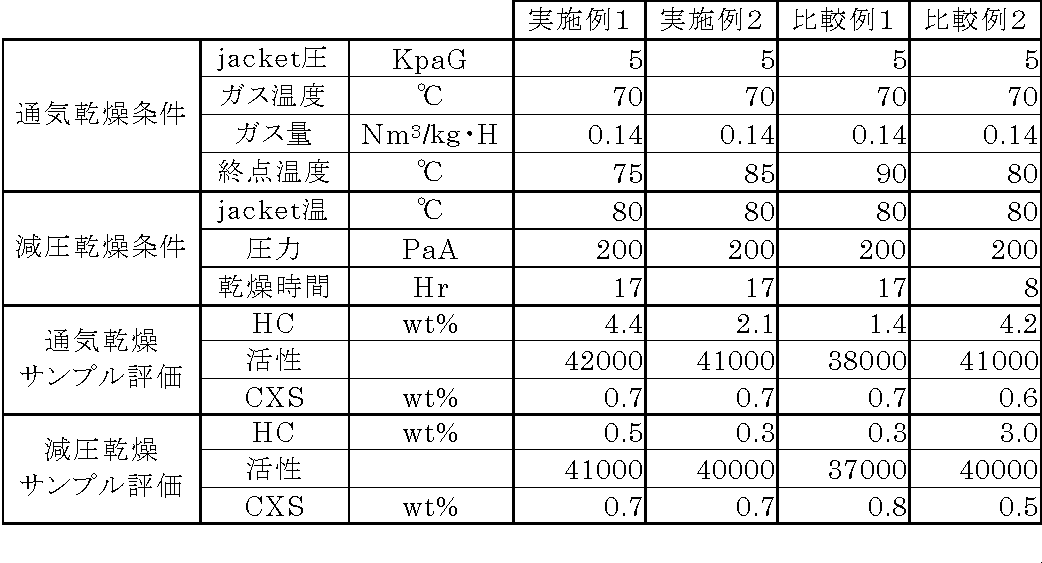
実施例1の通気および減圧乾燥時の条件と(9)および(10)で得たサンプルの評価結果を表1に示す。 Table 1 shows the conditions for ventilation and vacuum drying in Example 1 and the evaluation results of the samples obtained in (9) and (10).
実施例2
実施例1の(9)で乾燥終了温度を85℃とした以外は、実施例1と全て同じとし、各工程でサンプリングし、その性能を評価した。結果を表1に示す。
Example 2
Except for the drying end temperature of 85 ° C. in Example 1 (9), all the same as in Example 1, sampling in each step, and the performance was evaluated. The results are shown in Table 1.
比較例1
実施例1の(9)での乾燥終了温度を90℃とした以外は、実施例1と全て同じとし、各工程でサンプリングし、その性能を評価した。結果を表1に示す。
Comparative Example 1
Except that the drying end temperature in (9) of Example 1 was 90 ° C., all were the same as in Example 1, sampled at each step, and the performance was evaluated. The results are shown in Table 1.
比較例2
実施例1の(10)での、乾燥時間を8時間とした以外は、実施例1と全て同じとし、各工程でサンプリングし、その性能を評価した。結果を表1に示す。
Comparative Example 2
Except that the drying time in Example 1 (10) was set to 8 hours, all of them were the same as those in Example 1, and the performance was evaluated by sampling at each step. The results are shown in Table 1.
比較例3
実施例1の(10)で、ジャケットに通水させる温水の温度を60℃に変更し、減圧乾燥の時間を10時間に変更した以外は、全て実施例1と同じに行った。減圧乾燥終了後、固体触媒成分中に単独で存在する溶媒の量は、2.6wt%であった。
Comparative Example 3
The same procedure as in Example 1 was conducted except that the temperature of warm water passed through the jacket in Example 10 was changed to 60 ° C. and the drying time under reduced pressure was changed to 10 hours. After the drying under reduced pressure, the amount of the solvent present alone in the solid catalyst component was 2.6 wt%.
実施例3
実施例1と同じに行い、静電容量式露点計による測定で露点−65℃以下の窒素雰囲気、常温下で、8ヶ月保管した固体触媒成分について、その性能を評価したところ、固体触媒成分中に単独で存在する溶媒含量は0.5wt%で、活性は39000で、CXSは0.6wt%であった。
Example 3
When the performance of a solid catalyst component stored for 8 months in a nitrogen atmosphere at room temperature with a dew point of −65 ° C. or less as measured by a capacitance type dew point meter was evaluated in the same manner as in Example 1, the performance was evaluated. The solvent content present alone was 0.5 wt%, the activity was 39000, and CXS was 0.6 wt%.
以上詳述したように、本発明によれば、活性の低下を抑えつつ、付着している溶媒の量をより少なくするオレフィン重合用固体触媒成分の乾燥方法、および付着している溶媒の量がより少なく高活性なオレフィン重合用固体触媒成分の製造方法が提供される。本発明によれば、予備重合などの特別な加工や添加物を加えずとも、長期にわたって重合活性の維持が可能な固体触媒成分が得られるなど、産業上の有用性の高いものである。
As described above in detail, according to the present invention, the method for drying the solid catalyst component for olefin polymerization that reduces the amount of the adhering solvent while suppressing the decrease in the activity, and the amount of the adhering solvent A process for producing a less highly active solid catalyst component for olefin polymerization is provided. According to the present invention, a solid catalyst component capable of maintaining the polymerization activity over a long period of time can be obtained without adding special processing such as pre-polymerization or additives, and therefore, it is highly industrially useful.
Claims (2)
The manufacturing method of the solid catalyst component for olefin polymerization including the process of performing the drying method of Claim 1.
Priority Applications (1)
| Application Number | Priority Date | Filing Date | Title |
|---|---|---|---|
| JP2004104343A JP2005290099A (en) | 2004-03-31 | 2004-03-31 | Method for drying and producing solid catalyst component for olefin polymerization |
Applications Claiming Priority (1)
| Application Number | Priority Date | Filing Date | Title |
|---|---|---|---|
| JP2004104343A JP2005290099A (en) | 2004-03-31 | 2004-03-31 | Method for drying and producing solid catalyst component for olefin polymerization |
Publications (1)
| Publication Number | Publication Date |
|---|---|
| JP2005290099A true JP2005290099A (en) | 2005-10-20 |
Family
ID=35323408
Family Applications (1)
| Application Number | Title | Priority Date | Filing Date |
|---|---|---|---|
| JP2004104343A Withdrawn JP2005290099A (en) | 2004-03-31 | 2004-03-31 | Method for drying and producing solid catalyst component for olefin polymerization |
Country Status (1)
| Country | Link |
|---|---|
| JP (1) | JP2005290099A (en) |
-
2004
- 2004-03-31 JP JP2004104343A patent/JP2005290099A/en not_active Withdrawn
Similar Documents
| Publication | Publication Date | Title |
|---|---|---|
| RU2348638C2 (en) | Alcohol adduct of magnesium halide, its obtainment and application | |
| JP2598881B2 (en) | Method for producing solid Ziegler catalyst using multifunctional, swivelable and tiltable reactor and apparatus therefor | |
| CN1726080A (en) | Magnesium chloride-based adducts and catalyst components prepared therefrom | |
| CN102203139A (en) | A polyolefin preparation process with reduced tendency to reactor fouling | |
| BRPI0611761A2 (en) | catalyst compositions comprising small silica support materials and methods of use in polymerization reactions | |
| JP2021518263A (en) | Metal-supported powder catalyst matrix and polyphase chemical reaction method | |
| WO2006033512A1 (en) | Method of preparation of spherical support for olefin polymerization catalyst | |
| JP2009114457A (en) | Propylene polymerization catalyst | |
| CN102344508B (en) | A kind of ethylene polymerization catalyst containing ether compound and its preparation and application | |
| JP2004515614A (en) | Continuous production method of solid catalyst component for α-olefin polymerization | |
| CN104031183B (en) | A kind of for the catalytic component of olefinic polymerization, preparation method and application thereof | |
| JP4443403B2 (en) | Process for producing poly-1-olefins in the presence of a Ziegler catalyst | |
| JP2005290099A (en) | Method for drying and producing solid catalyst component for olefin polymerization | |
| CN107987190A (en) | A kind of alkoxyl magnesium particle and its application | |
| TWI302478B (en) | Preparation method of solid titanium catalyst for olefin polymerization | |
| CN1181092A (en) | Components and catalysts for olefin polymerization | |
| CN105085734B (en) | A kind of preparation method of catalytic component for olefinic polymerization | |
| BR112014002801B1 (en) | MAGNESIUM DICHLORIDE-ETHANOL MAGNESIUM ADDUCTION PRODUCTS, ITS PREPARATION PROCESS AND PROCESS FOR THE POLYMERIZATION OF OLEFINS USING SUCH PRODUCTS | |
| CN105777953A (en) | Main catalyst component and preparation method of propylene polymerization | |
| CN105542037A (en) | Unsaturated copolymer hydrogenation method | |
| CN109232778A (en) | A kind of synthetic method of ultra-high molecular weight polyethylene | |
| CN102321206B (en) | A kind of ethylene polymerization catalyst and its preparation and application | |
| CN105085737B (en) | A kind of preparation method of catalytic component for olefinic polymerization | |
| CN109071569B (en) | Catalyst carrier and its use | |
| CN116925269B (en) | Catalyst component for ethylene polymerization, catalyst and preparation method |
Legal Events
| Date | Code | Title | Description |
|---|---|---|---|
| A621 | Written request for application examination |
Free format text: JAPANESE INTERMEDIATE CODE: A621 Effective date: 20061017 |
|
| RD05 | Notification of revocation of power of attorney |
Free format text: JAPANESE INTERMEDIATE CODE: A7425 Effective date: 20080130 |
|
| RD05 | Notification of revocation of power of attorney |
Effective date: 20080513 Free format text: JAPANESE INTERMEDIATE CODE: A7425 |
|
| A977 | Report on retrieval |
Free format text: JAPANESE INTERMEDIATE CODE: A971007 Effective date: 20080811 |
|
| A131 | Notification of reasons for refusal |
Free format text: JAPANESE INTERMEDIATE CODE: A131 Effective date: 20080819 |
|
| A761 | Written withdrawal of application |
Free format text: JAPANESE INTERMEDIATE CODE: A761 Effective date: 20080916 |