JP2005290034A - Composite fine particles containing target components - Google Patents
Composite fine particles containing target components Download PDFInfo
- Publication number
- JP2005290034A JP2005290034A JP2004102670A JP2004102670A JP2005290034A JP 2005290034 A JP2005290034 A JP 2005290034A JP 2004102670 A JP2004102670 A JP 2004102670A JP 2004102670 A JP2004102670 A JP 2004102670A JP 2005290034 A JP2005290034 A JP 2005290034A
- Authority
- JP
- Japan
- Prior art keywords
- component
- fine particles
- target component
- containing composite
- composite fine
- Prior art date
- Legal status (The legal status is an assumption and is not a legal conclusion. Google has not performed a legal analysis and makes no representation as to the accuracy of the status listed.)
- Pending
Links
Landscapes
- Compositions Of Macromolecular Compounds (AREA)
- Polyurethanes Or Polyureas (AREA)
- Paints Or Removers (AREA)
- Adhesives Or Adhesive Processes (AREA)
- Sealing Material Composition (AREA)
Abstract
Description
この発明は、特定の樹脂内に目的成分を含有する複合化された微粒子に関する。 The present invention relates to composite fine particles containing a target component in a specific resin.
防虫剤等は、揮散性が大きいため、薬効を長期間保持させるため、徐放性を付与することが好ましい。防虫剤等に徐放性を付与する方法としては、エマルジョンのオイル部に溶解させ、周りの水によって揮散を抑制する方法が知られている。 Since insect repellents and the like have high volatility, it is preferable to impart sustained release properties in order to maintain their medicinal effects for a long time. As a method for imparting sustained release properties to insect repellents and the like, a method is known in which volatilization is suppressed by surrounding water by dissolving in an oil part of an emulsion.
しかし、防虫剤等の成分の中には、エマルジョンを凝集し、良好な分散状態を保持させないものもあり、必ずしも有効な方法ではなかった。 However, some of the components such as insect repellents do not coagulate the emulsion and do not maintain a good dispersion state, which is not always an effective method.
これに対し、防虫剤等の成分をカプセル等に入れる方法が知られている。例えば、多価イソシアネートと多価アルコールからなる、所定条件の界面張力を有する重合物をカプセルとし、防虫剤等の成分を内包させる徐放剤が特許文献1に記載されている。 On the other hand, a method of putting a component such as an insect repellent in a capsule or the like is known. For example, Patent Document 1 discloses a sustained release agent comprising a polymer composed of a polyisocyanate and a polyhydric alcohol and having a predetermined condition of interfacial tension as a capsule and encapsulating components such as an insect repellent.
しかしながら、上記のカプセル粒子では、乳化剤を使用しているため、耐水性が低く、接着剤、コーティング剤、塗料に使用した場合に問題となる。このような問題を回避するために、カプセル粒子を粉末として取り出す場合に、洗浄工程が必要となり、洗浄中に目的成分が失われたりするので好ましくない。たとえ取り出すことができたとしても、接着剤、コーティング剤、塗料に使用する場合には、バインダーの添加が必要になったりする。 However, since the above-mentioned capsule particles use an emulsifier, the water resistance is low, which causes a problem when used in adhesives, coating agents, and paints. In order to avoid such a problem, when taking out capsule particle | grains as a powder, a washing | cleaning process is needed, and since a target component is lost during washing | cleaning, it is not preferable. Even if it can be taken out, it may be necessary to add a binder when used in adhesives, coating agents, and paints.
そこで、この発明は、目的成分の徐放を可能とし、耐水性が良好で、かつ、水分散物をそのまま塗布しても、良好な塗布物が得られるというバインダー効果を有する目的成分含有複合化微粒子を提供することを目的とする。 Therefore, the present invention enables the sustained release of the target component, has good water resistance, and has a binder effect that has a binder effect that a good coating can be obtained even if the aqueous dispersion is applied as it is. An object is to provide fine particles.
この発明は、(A)ポリウレタンと(B)ビニル重合体との複合樹脂によって、(C)目的成分を含有複合した粒子であり、上記の(A)成分、(B)成分及び(C)成分の組成比率(重量比)が下記の式(1)及び(2)を満たす目的成分含有複合微粒子を用いることにより、上記課題を解決したのである。
0.1≦(A)/((B)+(C))≦10 (1)
10/90≦(B)/(C)≦90/10 (2)
This invention is a particle containing (C) the target component by a composite resin of (A) polyurethane and (B) vinyl polymer, and the components (A), (B) and (C) described above. The above-mentioned problems were solved by using target component-containing composite fine particles in which the composition ratio (weight ratio) satisfies the following formulas (1) and (2).
0.1 ≦ (A) / ((B) + (C)) ≦ 10 (1)
10/90 ≦ (B) / (C) ≦ 90/10 (2)
特定の複合樹脂を用いてコアシェル的構造を構成し、ここに目的成分を含有させるので、目的成分の急速な揮散が抑制され、徐放性を発揮することができる。
また、特定の複合樹脂を用いてコアシェル的構造を構成し、ここに目的成分を含有させるので、これを水に分散させても、十分に分散性が保持される。
さらに、コアシェル的構造部分を構成する樹脂として、特定の複合樹脂を用い、これと目的成分との量比を所定範囲内に限定するので、得られる微粒子の粒子径を小さくすることができる。このため、水に分散させて塗膜化したときに透明性を発揮することができる。
Since a core-shell structure is formed using a specific composite resin and the target component is contained therein, rapid volatilization of the target component is suppressed and sustained release can be exhibited.
In addition, since a core-shell structure is formed using a specific composite resin and the target component is contained therein, the dispersibility is sufficiently maintained even if it is dispersed in water.
Furthermore, since a specific composite resin is used as the resin constituting the core-shell structure portion and the quantity ratio between this and the target component is limited within a predetermined range, the particle diameter of the obtained fine particles can be reduced. For this reason, transparency can be exhibited when dispersed in water to form a coating film.
この発明にかかる目的成分含有複合微粒子は、ポリウレタン(以下、「(A)成分」と称する。)とビニル重合体(以下、「(B)成分」と称する。)との複合樹脂によって、目的成分(以下、「(C)成分」と称する。)を含有させ、複合化させた粒子である。 The target component-containing composite fine particles according to the present invention include a target resin by a composite resin of polyurethane (hereinafter referred to as “component (A)”) and a vinyl polymer (hereinafter referred to as “component (B)”). (Hereinafter referred to as “component (C)”).
上記(A)成分を構成するポリウレタンは、ポリイソシアネートとポリオールとの重合体である。上記ポリイソシアネートとしては、各種の脂肪族、脂環式、芳香族等の有機系のジイソシアネート化合物等の多価イソシアネート化合物を用いることができる。このジイソシアネート化合物の具体例としては、ジシクロへキシルメタンジイソシアネート、1,6−ヘキサメチレンジイソシアネート、イソホロンジイソシアネート、1,3−シクロヘキシレンジイソシアネート、1,4−シクロヘキシレンジイソシアネート、2,4−トリレンジイソシアネート、2,6−トリレンジイソシアネート、4,4’−ジフェニルメタンジイソシアネート、2,4’−ジフェニルメタンジイソシアネート、2,2’−ジフェニルメタンジイソシアネート等を挙げることができる。 The polyurethane constituting the component (A) is a polymer of polyisocyanate and polyol. As said polyisocyanate, polyvalent isocyanate compounds, such as various aliphatic, alicyclic, and aromatic organic diisocyanate compounds, can be used. Specific examples of the diisocyanate compound include dicyclohexylmethane diisocyanate, 1,6-hexamethylene diisocyanate, isophorone diisocyanate, 1,3-cyclohexylene diisocyanate, 1,4-cyclohexylene diisocyanate, 2,4-tolylene diisocyanate, Examples include 2,6-tolylene diisocyanate, 4,4′-diphenylmethane diisocyanate, 2,4′-diphenylmethane diisocyanate, and 2,2′-diphenylmethane diisocyanate.
上記ポリオールとしては、エチレングリコール、プロピレングリコール、1,3−プロパンジオール、1,3−ブタンジオール、1,4−ブタンジオール、1,5−ペンタンジオール、3−メチル−1,5−ペンタンジオール、1,6−ヘキサンジオール、ネオペンチルグリコール、ジエチレングリコール、トリメチレングリコール、トリエチレングリコール、テトラエチレングリコール、ジプロピレングリコール、トリプロピレングリコール、シクロヘキサンジメタノール、メチルペンタンジオールアジペート等の比較的低分子量のジオールの他、ポリエステルジオール、ポリエーテルジオール、ポリカーボネートジオール等を用いることができる。 Examples of the polyol include ethylene glycol, propylene glycol, 1,3-propanediol, 1,3-butanediol, 1,4-butanediol, 1,5-pentanediol, 3-methyl-1,5-pentanediol, Of relatively low molecular weight diols such as 1,6-hexanediol, neopentyl glycol, diethylene glycol, trimethylene glycol, triethylene glycol, tetraethylene glycol, dipropylene glycol, tripropylene glycol, cyclohexanedimethanol, methylpentanediol adipate In addition, polyester diol, polyether diol, polycarbonate diol and the like can be used.
ところで、上記(A)成分としては、カルボキシル基を含有するものが好ましい。上記(A)成分にカルボキシル基を導入する方法としては、上記ポリオールの一部として、カルボキシル基を有するジオール化合物を用いることが好ましい。このカルボキシル基を有するジオール化合物としては、ジメチロールプロピオン酸、ジメチロールブタン酸等のジメチロールアルカン酸があげられる。 By the way, as said (A) component, what contains a carboxyl group is preferable. As a method for introducing a carboxyl group into the component (A), it is preferable to use a diol compound having a carboxyl group as a part of the polyol. Examples of the diol compound having a carboxyl group include dimethylol alkanoic acids such as dimethylolpropionic acid and dimethylolbutanoic acid.
また、上記(A)成分の酸価は、10(単位:mgKOH/g、以下同じ。)以上が好ましく、15以上がより好ましく、18以上が更に好ましい。上記(A)成分の酸価が低すぎると、後工程における水への分散状態が悪くなって水分散液が得られなくなる場合がある。一方、上記(A)成分の酸価の上限は、通常、60以下であるが、50以下が好ましい。酸価が高すぎると、十分な耐溶剤性が得られない場合がある。 The acid value of the component (A) is preferably 10 (unit: mg KOH / g, the same shall apply hereinafter) or more, more preferably 15 or more, and still more preferably 18 or more. If the acid value of the component (A) is too low, the dispersion state in water in the subsequent step may deteriorate and an aqueous dispersion may not be obtained. On the other hand, the upper limit of the acid value of the component (A) is usually 60 or less, preferably 50 or less. If the acid value is too high, sufficient solvent resistance may not be obtained.
上記(A)成分の製造は、無溶剤下でも行い得るが、反応を均一に行わせるために、ジオキサン、アセトン、メチルエチルケトン、ジメチルホルムアミド、ジメチルアセトアミド、N−メチル−2−ピロリドン等のイソシアネート基に対して不活性で水との親和性の大きい有機溶剤を使用してもよい。また、イソシアネート基に対して反応性のないビニルモノマーの存在下に製造する場合にも、反応系が希釈されて反応を均一に行うことができる。 The production of the component (A) can be carried out in the absence of a solvent. In contrast, an organic solvent which is inert and has a high affinity with water may be used. Moreover, also when manufacturing in presence of the vinyl monomer which is not reactive with an isocyanate group, a reaction system can be diluted and reaction can be performed uniformly.
上記のポリオールとポリイソシアネートとの使用割合は、当量比で、ポリオール:ポリイソシアネート=1:1.1〜2.5がよく、1:1.2〜2.0が好ましい。ポリオールが少なすぎると、未反応のイソシアネートが多く残留し、水分散時に、凝集したり、粗大粒子を生成することがある。一方、ポリオールが多すぎると、反応時の粘度が高くなり、水への良好な分散が困難となることがある。 The use ratio of the above-mentioned polyol and polyisocyanate is an equivalent ratio, preferably polyol: polyisocyanate = 1: 1.1 to 2.5, and preferably 1: 1.2 to 2.0. If the amount of polyol is too small, a large amount of unreacted isocyanate remains and may aggregate or produce coarse particles during water dispersion. On the other hand, when there are too many polyols, the viscosity at the time of reaction will become high, and the favorable dispersion | distribution to water may become difficult.
上記(A)成分の反応は、通常、30〜120℃で0.1〜20時間、好ましくは、50〜100℃で0.5〜10時間行なえばよい。 The reaction of the component (A) is usually performed at 30 to 120 ° C. for 0.1 to 20 hours, preferably at 50 to 100 ° C. for 0.5 to 10 hours.
上記(B)成分を構成するビニル重合体とは、ビニル基を有する単量体、すなわち、ラジカル重合性単量体の重合体をいう。特に、活性水素を含まないラジカル重合性単量体を用いると、目的外のイソシアネート基の消費がおきにくい点でより好ましい。 The vinyl polymer constituting the component (B) refers to a monomer having a vinyl group, that is, a polymer of a radical polymerizable monomer. In particular, it is more preferable to use a radically polymerizable monomer that does not contain active hydrogen, because it is difficult to consume an undesired isocyanate group.
このラジカル重合性単量体としては、官能基として1つのビニル基のみを有する単官能性不飽和単量体でもよく、官能基としてビニル基を2つ以上有する多官能性不飽和単量体でもよい。さらに、多官能性不飽和単量体と単官能性不飽和単量体の混合物を用いてもよい。 The radical polymerizable monomer may be a monofunctional unsaturated monomer having only one vinyl group as a functional group, or may be a polyfunctional unsaturated monomer having two or more vinyl groups as a functional group. Good. Further, a mixture of a polyfunctional unsaturated monomer and a monofunctional unsaturated monomer may be used.
上記の単官能性不飽和単量体としては、(メタ)アクリル系単量体、ハロゲン化ビニル系化合物、芳香族ビニル化合物等があげられる。なお、この明細書において、「(メタ)アクリル」とは、「アクリル又はメタクリル」を意味する。 Examples of the monofunctional unsaturated monomer include (meth) acrylic monomers, vinyl halide compounds, and aromatic vinyl compounds. In this specification, “(meth) acryl” means “acryl or methacryl”.
上記(メタ)アクリル系単量体とは、(メタ)アクリル酸又はそのエステル化合物等を言い、(メタ)アクリル酸アルキルエステル、(メタ)アクリル酸、(メタ)アクリル酸アルコキシアルキルエステル等があげられ、重合に際しては、その1種を用いても、それらの2種以上の混合物を用いてもよい。 The (meth) acrylic monomer refers to (meth) acrylic acid or an ester compound thereof, and includes (meth) acrylic acid alkyl ester, (meth) acrylic acid, (meth) acrylic acid alkoxyalkyl ester, and the like. In the polymerization, one kind thereof or a mixture of two or more kinds thereof may be used.
上記(メタ)アクリル酸アルキルエステルとしては、(メタ)アクリル酸メチル、(メタ)アクリル酸エチル、(メタ)アクリル酸プロピル、(メタ)アクリル酸ブチル、(メタ)アクリル酸2−エチルヘキシル、(メタ)アクリル酸シクロヘキシル、(メタ)アクリル酸ベンジル、(メタ)アクリル酸ラウリル、(メタ)アクリル酸ステアリル、(メタ)アクリル酸イソボルニル等があげられる。 Examples of the (meth) acrylic acid alkyl ester include methyl (meth) acrylate, ethyl (meth) acrylate, propyl (meth) acrylate, butyl (meth) acrylate, 2-ethylhexyl (meth) acrylate, (meth ) Cyclohexyl acrylate, benzyl (meth) acrylate, lauryl (meth) acrylate, stearyl (meth) acrylate, isobornyl (meth) acrylate, and the like.
上記(メタ)アクリル酸アルコキシアルキルエステルとしては、(メタ)アクリル酸2−メトキシエチル、(メタ)アクリル酸2−エトキシエチル、(メタ)アクリル酸2−ブトキシエチル等があげられる。 Examples of the alkoxyalkyl ester of (meth) acrylic acid include 2-methoxyethyl (meth) acrylate, 2-ethoxyethyl (meth) acrylate, 2-butoxyethyl (meth) acrylate, and the like.
上記ハロゲン化ビニル系化合物としては、塩化ビニル、塩化ビニリデン、臭化ビニル、フッ化ビニル等があげられ、芳香族ビニル化合物としては、スチレン、α−メチルスチレン、o−メチルスチレン、m−メチルスチレン、p−メチルスチレン等があげられる。 Examples of the vinyl halide compound include vinyl chloride, vinylidene chloride, vinyl bromide, and vinyl fluoride. Examples of the aromatic vinyl compound include styrene, α-methylstyrene, o-methylstyrene, and m-methylstyrene. , P-methylstyrene and the like.
また、上記多官能性不飽和単量体としては、ジビニルベンゼン、ジビニルナフタレン及びそれらの誘導体等等の芳香族ジビニル化合物等があげられる。 Examples of the polyfunctional unsaturated monomer include aromatic divinyl compounds such as divinylbenzene, divinylnaphthalene, and derivatives thereof.
さらに、上記の他、N,N−ジビニルアニリン、ジビニルエーテル、ジビニルスルフィド、ジビニルスルホンや、3個以上のビニル基を持つ化合物があげられる。
なお、上記のビニル基を有する単量体は、単独で用いてもよく、2種以上を混合して用いてもよい。
Further, in addition to the above, N, N-divinylaniline, divinyl ether, divinyl sulfide, divinyl sulfone, and compounds having three or more vinyl groups can be mentioned.
In addition, the monomer which has said vinyl group may be used independently, and 2 or more types may be mixed and used for it.
これらの中でも、(B)成分としては、アクリル酸エステル、メタクリル酸エステル、及びスチレンからなる群から選ばれる少なくとも一種の単量体の重合体、すなわち、アクリル酸エステルの単独重合体又は共重合体、メタクリル酸エステルの単独重合体又は共重合体、アクリル酸エステルとメタクリル酸エステルとの共重合体、スチレンの単独重合体、アクリル酸エステル及び/又はメタクリル酸エステルと、スチレンとの共重合体がより好ましい。 Among these, as the component (B), a polymer of at least one monomer selected from the group consisting of acrylic acid ester, methacrylic acid ester, and styrene, that is, a homopolymer or copolymer of acrylic acid ester Methacrylic acid ester homopolymer or copolymer, acrylic acid ester and methacrylic acid ester copolymer, styrene homopolymer, acrylic acid ester and / or methacrylic acid ester and styrene copolymer More preferred.
上記(C)成分である目的成分は、この発明によって徐放効果を付与される揮散性成分をいい、防虫剤、抗菌防カビ剤、芳香剤等があげられる。 The target component which is the component (C) is a volatile component to which a sustained release effect is imparted by the present invention, and examples thereof include an insect repellent, an antibacterial and antifungal agent, and an aromatic.
次に、この発明にかかる目的成分含有複合微粒子の好ましい製造方法について説明する。
まず、(A)成分たるポリウレタンを製造する工程として、ラジカル重合性単量体及び/又は目的成分の存在下、ポリオールとポリイソシアネートとを反応させる(イ)工程が行われる。
Next, a preferred method for producing the target component-containing composite fine particles according to the present invention will be described.
First, as the step of producing polyurethane as component (A), step (a) is performed in which a polyol and polyisocyanate are reacted in the presence of a radical polymerizable monomer and / or a target component.
上記ラジカル重合性単量体としては、活性水素を含まない単量体が好ましい。また、上記ポリオールとして、カルボキシル基を有するポリオールを一部又は全部に用いるのが好ましい。 As the radical polymerizable monomer, a monomer containing no active hydrogen is preferable. Moreover, it is preferable to use the polyol which has a carboxyl group as the said polyol for part or all.
カルボキシル基を有するポリオールを用いる場合、その含有割合は、前述した(A)成分の好ましい酸価範囲となるようにするのが好適である。 When using the polyol which has a carboxyl group, it is suitable for the content rate to make it the preferable acid value range of (A) component mentioned above.
上記(イ)工程における反応は、ラジカル重合性単量体及び/又は目的成分の存在下で反応を行うのがよい。これにより、反応時の粘度を低くして、反応を均一に進めることができる。 The reaction in the step (a) is preferably performed in the presence of a radical polymerizable monomer and / or a target component. Thereby, the viscosity at the time of reaction can be made low and reaction can be advanced uniformly.
次に、上記(イ)工程で得られた混合液は、(ロ)工程で、水に分散させて水分散液を得、次いで、(ハ)工程で、この水分散液を用いて、これに含まれるラジカル重合性単量体を重合させる重合工程に供される。 Next, the mixed solution obtained in the step (a) is dispersed in water in the step (b) to obtain an aqueous dispersion, and then the aqueous dispersion is used in the step (c). Is subjected to a polymerization step of polymerizing the radically polymerizable monomer contained in the polymer.
ところで、上記(ハ)工程での重合時の量比に合わせるために、(イ)工程と(ロ)工程の間に、(ニ)工程として、必要な成分を添加する工程を行い、この(ニ)工程で得られる混合物を上記(ロ)工程において、反応液のかわりに用いることが好ましい。これは、(イ)工程で得られる反応液には、ラジカル重合性単量体及び目的成分のどちらかが存在しない場合、又は存在しても、量的に不足する場合があるからである。なお、上記ラジカル重合性単量体は、活性水素を含まない単量体がより好ましい。 By the way, in order to match the amount ratio at the time of polymerization in the step (c), a step of adding necessary components is performed as the step (d) between the step (b) and the step (b). It is preferable to use the mixture obtained in step d) in place of the reaction solution in step (b). This is because the reaction liquid obtained in the step (a) may be insufficient in quantity when either the radical polymerizable monomer or the target component is not present or is present. The radical polymerizable monomer is more preferably a monomer that does not contain active hydrogen.
上記(イ)工程で得られる反応液、又は(ニ)工程で得られる混合物中の各成分の混合比は、後述する(ハ)工程を経て得られるこの発明にかかる目的成分含有複合微粒子を構成する(A)成分、(B)成分及び(C)成分が下記の式(1)及び(2)を満たす組成比率(重量比)を有するような混合比が好ましい。
0.1≦(A)/((B)+(C))≦10 (1)
10/90≦(B)/(C)≦90/10 (2)
The mixing ratio of each component in the reaction liquid obtained in the step (a) or the mixture obtained in the step (d) constitutes the target component-containing composite fine particles according to the present invention obtained through the step (c) described later. A mixing ratio such that the component (A), the component (B), and the component (C) have a composition ratio (weight ratio) that satisfies the following formulas (1) and (2) is preferable.
0.1 ≦ (A) / ((B) + (C)) ≦ 10 (1)
10/90 ≦ (B) / (C) ≦ 90/10 (2)
すなわち、(B)成分と(C)成分の合計量に対する(A)成分の含有比(重量比)は、0.1以上であり、0.3以上が好ましい。0.1より小さいと、水への分散が困難となる。一方、この(A)成分の含有比(重量比)の上限は、10であり、7とするのが好ましい。10より大きいと、含有複合される目的成分の量が少なくなり、十分な効果が得られない場合がある。 That is, the content ratio (weight ratio) of the component (A) to the total amount of the components (B) and (C) is 0.1 or more, and preferably 0.3 or more. If it is less than 0.1, it will be difficult to disperse in water. On the other hand, the upper limit of the content ratio (weight ratio) of the component (A) is 10 and is preferably 7. When the ratio is larger than 10, the amount of the target component contained is reduced, and a sufficient effect may not be obtained.
また、(B)成分と(C)成分との混合比(重量比)は、(B)/(C)で10/90以上であり、30/70以上がより好ましい。10/90より小さいと、良好な水分散液が得がたくなる傾向がある。一方、この混合比の上限は、90/10であり、80/20が好ましい。90/10より大きいと、含有複合化される目的成分の量が少なくなり、十分な効果が得られない場合がある。 Moreover, the mixing ratio (weight ratio) of the component (B) and the component (C) is 10/90 or more in terms of (B) / (C), and more preferably 30/70 or more. If it is smaller than 10/90, a good aqueous dispersion tends to be difficult to obtain. On the other hand, the upper limit of the mixing ratio is 90/10, and preferably 80/20. When the ratio is larger than 90/10, the amount of the target component to be contained is reduced, and a sufficient effect may not be obtained.
上記(イ)工程で得られる反応液、又は(ニ)工程で得られた混合物は、水に分散させる(ロ)工程が行われ、次いで、この(ロ)工程で得られた水分散液を用いて、これに含まれるラジカル重合性単量体を重合させる(ハ)工程が行われ、この発明にかかる目的成分含有複合粒子が得られる。 The reaction solution obtained in the step (a) or the mixture obtained in the step (d) is dispersed in water (b), and then the aqueous dispersion obtained in the step (b) is used. And a step (c) of polymerizing the radical polymerizable monomer contained therein is performed, and the target component-containing composite particles according to the present invention are obtained.
上記(ロ)工程において、必要に応じて、乳化剤が用いられる。この乳化剤としては、例えば、アニオン性、カチオン性、両イオン性等のイオン性界面活性剤、ノニオン性界面活性剤等があげられる。 In the step (b), an emulsifier is used as necessary. Examples of the emulsifier include ionic surfactants such as anionic, cationic and amphoteric, nonionic surfactants, and the like.
また、ポリオールとして、カルボキシル基を有するポリオールを用いる場合、この(ロ)工程で、このポリオールの中のカルボキシル基を中和することが好ましい。これにより、得られる水分散液がより安定化する。 Moreover, when using the polyol which has a carboxyl group as a polyol, it is preferable to neutralize the carboxyl group in this polyol at this (b) process. Thereby, the obtained aqueous dispersion is further stabilized.
上記(ハ)工程において、乳化重合は、重合開始剤を添加して行われる。この重合開始剤としては、通常の乳化重合で使用される重合開始剤を特に限定することなく使用することができる。この重合開始剤の例としては、過硫酸アンモニウム、過硫酸カリウム、過硫酸ナトリウム等の過硫酸塩、2,2’−アゾビスイソブチロニトリル、2,2’−アゾビス(2,4−ジメチルバレロニトリル)等のアゾ化合物、過酸化水素、t−ブチルハイドロパーオキサイド等のハイドロパーオキサイド類、ベンゾイルパーオキサイド、ラウロイルパーオキサイド等の過酸化物等のラジカル重合開始剤があげられ、これらは単独で又は2種以上を混合して用いることができる。また、これらラジカル重合開始剤と、例えば亜硫酸ナトリウム、亜硫酸水素ナトリウム、チオ硫酸ナトリウム、酒石酸、L−アスコルビン酸等の還元剤とを併用してレドックス系重合開始剤として用いることもできる。 In the step (c), emulsion polymerization is performed by adding a polymerization initiator. As this polymerization initiator, a polymerization initiator used in ordinary emulsion polymerization can be used without any particular limitation. Examples of this polymerization initiator include persulfates such as ammonium persulfate, potassium persulfate, sodium persulfate, 2,2′-azobisisobutyronitrile, 2,2′-azobis (2,4-dimethylvalero). Nitrile) and other azo compounds, hydrogen peroxide, hydroperoxides such as t-butyl hydroperoxide, radical polymerization initiators such as peroxides such as benzoyl peroxide and lauroyl peroxide, and these are independent. Or 2 or more types can be mixed and used. These radical polymerization initiators can be used as a redox polymerization initiator in combination with a reducing agent such as sodium sulfite, sodium hydrogen sulfite, sodium thiosulfate, tartaric acid, L-ascorbic acid or the like.
上記乳化重合の重合温度は、通常50〜100℃程度、反応時間は、通常2〜16時間程度とすることが好ましい。 The polymerization temperature of the emulsion polymerization is preferably about 50 to 100 ° C., and the reaction time is usually preferably about 2 to 16 hours.
このようにして得られた目的成分含有複合微粒子は、水に分散されたエマルジョンとなっており、そのまま、又は必要に応じて、水をさらに加えて、エマルジョンとして使用することができる。さらに、得られたエマルジョンから目的成分含有複合微粒子を分取し、別の水に分散させて、エマルジョンとしてもよい。 The target component-containing composite microparticles thus obtained are in an emulsion dispersed in water, and can be used as an emulsion as it is or with further addition of water as required. Furthermore, the target component-containing composite fine particles may be collected from the obtained emulsion and dispersed in another water to form an emulsion.
上記の方法で得られるエマルジョン中の目的成分含有複合微粒子の平均粒子径は、10nm以上がよく、50nm以上が好ましい。10nmより小さいと、水分散性の粘度が高くなって、取扱いが困難になることがある。一方、平均粒子径の上限は、1000nm以下がよく、700nm以下が好ましい。1000nmより大きいと、得られた目的成分含有複合微粒子を用いて塗膜を形成した場合、透明性が不十分となる場合がある。 The average particle size of the target component-containing composite fine particles in the emulsion obtained by the above method is preferably 10 nm or more, and preferably 50 nm or more. If it is smaller than 10 nm, the water-dispersible viscosity becomes high and handling may be difficult. On the other hand, the upper limit of the average particle diameter is preferably 1000 nm or less, and preferably 700 nm or less. When it is larger than 1000 nm, transparency may be insufficient when a coating film is formed using the obtained target component-containing composite fine particles.
上記の方法で得られた目的成分含有複合微粒子又はこれを含有するエマルジョンは、接着剤組成物、塗料組成物、コーティング剤組成物、シーリング剤組成物に加えることにより、接着剤、塗料、コーティング剤又はシーリング剤等として使用することができる。 The target component-containing composite fine particles obtained by the above method or the emulsion containing the same are added to the adhesive composition, paint composition, coating composition, and sealing agent composition, whereby the adhesive, paint, coating agent Or it can be used as a sealing agent.
以下、本発明を、実施例を用いてより詳細に説明するが、本発明は、その要旨を超えない限り、以下の実施例により限定されるものではない。まず、評価方法及び使用した原材料について説明する。 EXAMPLES Hereinafter, although this invention is demonstrated in detail using an Example, this invention is not limited by a following example, unless the summary is exceeded. First, the evaluation method and the raw materials used will be described.
(評価方法)
[平均粒子径]
大塚電子(株)製:ELS−8000を用い、動的光散乱法により、25℃で測定し、体積平均粒子径として示した。
(Evaluation methods)
[Average particle size]
Otsuka Electronics Co., Ltd .: ELS-8000 was used and measured by a dynamic light scattering method at 25 ° C. and indicated as a volume average particle size.
[分散性]
水分散中の凝集の有無を目視で判定した。
[Dispersibility]
The presence or absence of aggregation during water dispersion was visually determined.
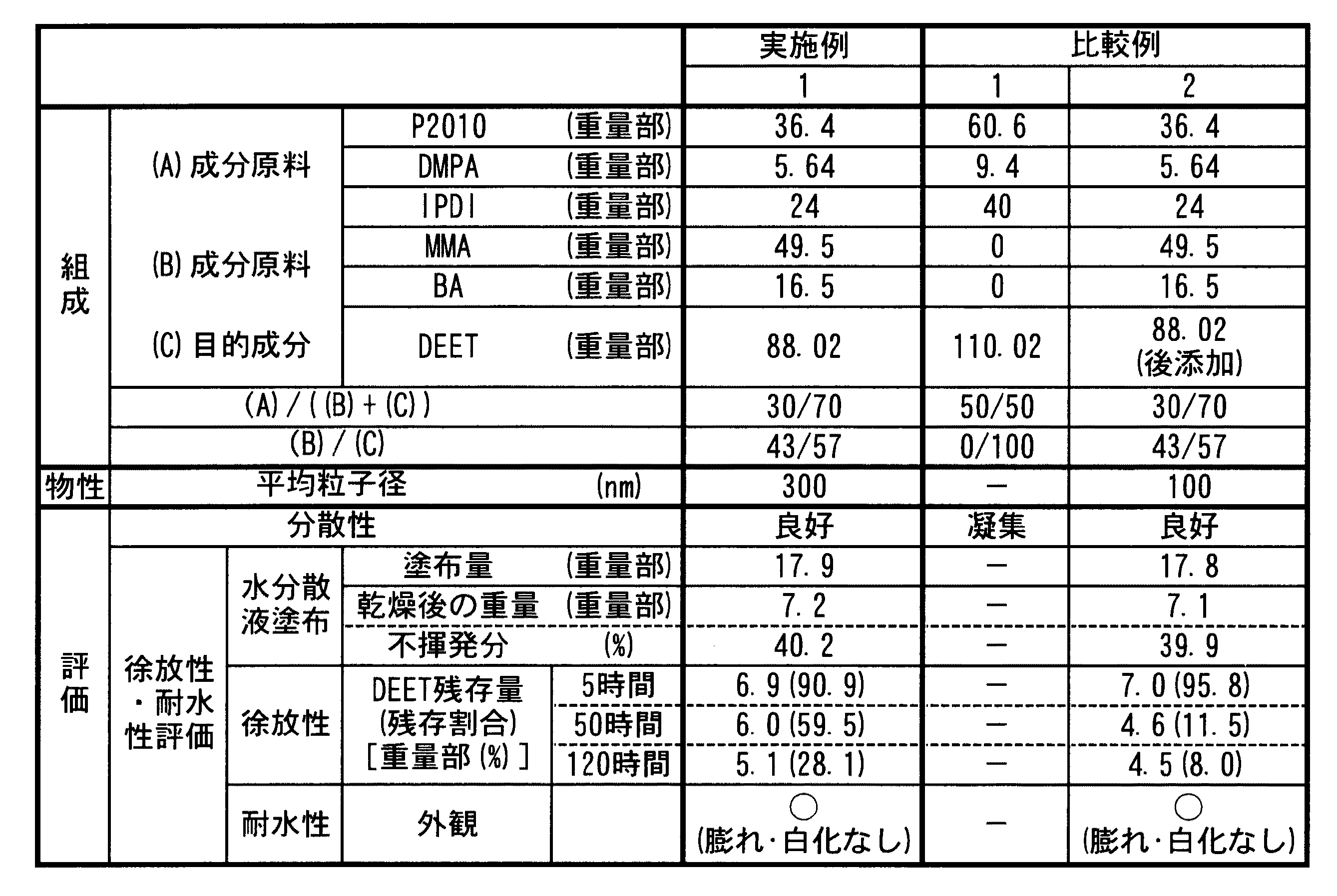
[徐放性及び耐水性の評価]
(1)皮膜の作成
18cm×18cmのテフロンシート上に表1に記載の量の水分散液を塗布し、室温で10時間乾燥した。
[Evaluation of sustained release and water resistance]
(1) Preparation of film An aqueous dispersion of the amount shown in Table 1 was applied on an 18 cm x 18 cm Teflon sheet and dried at room temperature for 10 hours.
(2)徐放性評価
上記皮膜を、50℃のオーブンに入れ、5,50,120時間経過後の重量を測定し、DEETの残量及び残存割合を計算した。
DEET残存割合(%)=(皮膜の重量−ポリウレタン重量−ポリアクリレート重量)/DEET初期重量
なお、水分散液中のポリウレタン成分を12重量%、ポリアクリレート成分を12重量%、初期DEET成分を16重量%とした。
(2) Sustained release evaluation The above-mentioned film was put in an oven at 50 ° C., the weight after 5, 50, 120 hours elapsed was measured, and the remaining amount of DEET and the remaining ratio were calculated.
DEET residual ratio (%) = (weight of film−polyurethane weight−polyacrylate weight) / DEET initial weight 12% by weight of the polyurethane component in the aqueous dispersion, 12% by weight of the polyacrylate component, and 16% of the initial DEET component % By weight.
(3)耐水性評価
上記皮膜を、室温下で、イオン水中に2時間浸漬し、外観を目視にて観察した。
(3) Water resistance evaluation The film was immersed in ionic water for 2 hours at room temperature, and the appearance was visually observed.
(原材料)
[ポリオール成分]
・メチルペンタンジオールアジペート…(株)クラレ製:クラレポリオールP−2010、OHV:56.1mgKOH/g、以下、「P2010」と称する。
(raw materials)
[Polyol component]
-Methylpentanediol adipate: Kuraray Co., Ltd .: Kuraray polyol P-2010, OHV: 56.1 mgKOH / g, hereinafter referred to as “P2010”.
[カルボキシル基含有ジオール化合物]
・ジメチロールプロピオン酸…マリンクロット ケミカル(Mallinckrodt Chemical Inc)社製、以下、「DMPA」と称する。
[Carboxyl group-containing diol compound]
Dimethylolpropionic acid: manufactured by Mallinckrodt Chemical Inc., hereinafter referred to as “DMPA”.
[ポリイソシアネート成分]
・イソホロンジイソシアネート…(株)テグサジャパン製:ベスタナートIPDI、以下、「IPDI」と称する。
[Polyisocyanate component]
Isophorone diisocyanate: manufactured by Tegusa Japan Co., Ltd .: Bestanato IPDI, hereinafter referred to as “IPDI”.
[重合触媒]
・ジブチルチンジラウレート…和光純薬工業(株)製:試薬
[重合安定剤]
・ハイドロキノン…和光純薬工業(株)製:試薬、以下、「HQ」と称する。
[Polymerization catalyst]
・ Dibutyltin dilaurate: Wako Pure Chemical Industries, Ltd .: Reagent [Polymerization stabilizer]
Hydroquinone: Wako Pure Chemical Industries, Ltd .: Reagent, hereinafter referred to as “HQ”.
[ラジカル重合性単量体]
・メタクリル酸メチル…三菱レイヨン(株)製、以下、「MMA」と称する。
・アクリル酸ブチル…三菱化学(株)製、以下、「BA」と称する。
[Radically polymerizable monomer]
-Methyl methacrylate: Mitsubishi Rayon Co., Ltd., hereinafter referred to as "MMA".
・ Butyl acrylate: manufactured by Mitsubishi Chemical Corporation, hereinafter referred to as “BA”.
[目的成分]
・N,N−ジエチルトリアミド(防虫剤)…三菱ガス化学(株)製、以下、「DEET」と称する。
[Target ingredient]
N, N-diethyltriamide (insect repellent): manufactured by Mitsubishi Gas Chemical Co., Ltd., hereinafter referred to as “DEET”.
(実施例1)
温度計、撹拌装置及び還流冷却管を備えた4つ口フラスコに、ジオール成分としてP2010を36.4重量部、DMPAを5.64重量部、MMAを49.5重量部、BAを16.5重量部、及びHQを0.02重量部加えた。そして、内温50℃とし、IPDIを24重量部、及びジブチルチンジラウレート0.02重量部を加えた。次に、内温を90℃に加温し、この温度で5時間反応させて、(A)成分であるウレタンプレポリマーを得た。
(Example 1)
In a four-necked flask equipped with a thermometer, a stirrer and a reflux condenser, 36.4 parts by weight of P2010, 5.64 parts by weight of DMPA, 49.5 parts by weight of MMA, and 16.5 parts of BA as diol components. Part by weight and 0.02 part by weight of HQ were added. And internal temperature was 50 degreeC, 24 weight part of IPDI, and 0.02 weight part of dibutyltin dilaurate were added. Next, the internal temperature was heated to 90 ° C. and reacted at this temperature for 5 hours to obtain a urethane prepolymer as component (A).
得られたウレタンプレポリマー溶液に、(C)成分としてDEETの88.02重量部を、60℃で10分間にわたって滴下して混合物を得た。次に、50℃にて、トリエチルアミン4.32重量部を加えて、この反応生成物中のカルボキシル基を中和した。
そして、この溶液に蒸留水304.6重量部を50℃で15分間かけて滴下し、乳白色透明性のある分散液を得た。
To the obtained urethane prepolymer solution, 88.02 parts by weight of DEET as component (C) was added dropwise at 60 ° C. over 10 minutes to obtain a mixture. Next, at 50 ° C., 4.32 parts by weight of triethylamine was added to neutralize the carboxyl group in the reaction product.
And 304.6 weight part of distilled water was dripped at this solution over 15 minutes at 50 degreeC, and the dispersion liquid with milky white transparency was obtained.
得られた分散液を50℃に保温し、この温度で、7重量%t−ブチルハイドロパーオキサイド水溶液4.6重量部と、1重量%アスコルビン酸水溶液16.6重量部からなるレドックス開始剤を添加して、ラジカル重合性単量体の重合を開始した。発熱終了後、さらに80℃に昇温して2時間保持することによって、(A)成分であるポリウレタンと(B)成分であるビニル重合体とを含む水分散液を得た。また、得られた水分散液の平均粒子径は300nmであった。そして、分散性、徐放性及び耐水性を上記の基準で評価した。その結果を表1に示す。 The obtained dispersion was kept at 50 ° C., and at this temperature, a redox initiator consisting of 4.6 parts by weight of a 7% by weight t-butyl hydroperoxide aqueous solution and 16.6 parts by weight of a 1% by weight ascorbic acid aqueous solution was added. Upon addition, polymerization of the radical polymerizable monomer was initiated. After completion of heat generation, the mixture was further heated to 80 ° C. and held for 2 hours to obtain an aqueous dispersion containing the component (A) polyurethane and the component (B) vinyl polymer. Moreover, the average particle diameter of the obtained aqueous dispersion was 300 nm. And dispersibility, sustained-release property, and water resistance were evaluated by said reference | standard. The results are shown in Table 1.
(比較例1)
P2010を60.6重量部、DMPAを9.4重量部、MMA及びBAを0重量部、IPDIを40重量部とした以外は実施例1と同様にして、ウレタンプレポリマーを含有する溶液を得た。
次に、DEET110.02重量部、トリエチルアミン7.21重量部、蒸留水332.85重量部を用いた以外は実施例1と同様にして、乳白色透明性のある分散液を得ようとしたが、凝集が生じてしまった。
(Comparative Example 1)
A solution containing a urethane prepolymer was obtained in the same manner as in Example 1 except that 60.6 parts by weight of P2010, 9.4 parts by weight of DMPA, 0 parts by weight of MMA and BA, and 40 parts by weight of IPDI were used. It was.
Next, an attempt was made to obtain a milky white transparent dispersion in the same manner as in Example 1 except that 110.02 parts by weight of DEET, 7.21 parts by weight of triethylamine, and 332.85 parts by weight of distilled water were used. Aggregation has occurred.
(比較例2)
得られたウレタンプレポリマー溶液に、(C)成分としてDEETを滴下しなかった以外は、実施例1と同様にして、(A)成分であるポリウレタンと(B)成分であるビニル重合体とを含む水分散液を得た。得られた水分散液の平均粒子径は100nmであった。
次に、30℃にまで冷却し、(C)成分としてDEETの88.02重量部を滴下混合し、均一な分散液を得た。そして、分散性、徐放性及び耐水性を上記の基準で評価した。その結果を表1に示す。
(Comparative Example 2)
In the same manner as in Example 1 except that DEET was not dropped as the component (C) in the obtained urethane prepolymer solution, the polyurethane as the component (A) and the vinyl polymer as the component (B) were added. An aqueous dispersion containing was obtained. The average particle diameter of the obtained aqueous dispersion was 100 nm.
Next, it cooled to 30 degreeC and 88.02 weight part of DEET was dripped and mixed as (C) component, and the uniform dispersion liquid was obtained. And dispersibility, sustained-release property, and water resistance were evaluated by said reference | standard. The results are shown in Table 1.
Claims (8)
上記の(A)成分、(B)成分及び(C)成分の組成比率(重量比)が下記の式(1)及び(2)を満たす目的成分含有複合微粒子。
0.1≦(A)/((B)+(C))≦10 (1)
10/90≦(B)/(C)≦90/10 (2) (A) Particles containing and compounding (C) the target component by a composite resin of polyurethane and (B) vinyl polymer,
The target component-containing composite fine particles in which the composition ratio (weight ratio) of the components (A), (B) and (C) satisfies the following formulas (1) and (2).
0.1 ≦ (A) / ((B) + (C)) ≦ 10 (1)
10/90 ≦ (B) / (C) ≦ 90/10 (2)
(イ)活性水素を含まないラジカル重合性単量体及び/又は目的成分の存在下、ポリオールとポリイソシアネートとを反応させて、(A)成分たるポリウレタンを製造する工程、
(ロ)前工程で得られた反応液を水に分散させる工程、
(ハ)前工程で得られた水分散液を用いて、これに含まれるラジカル重合性単量体を重合させる工程。 The manufacturing method of the target component containing composite microparticle which manufactures the target component containing composite microparticle in any one of Claims 1 thru | or 3 by performing each process of following (I)-(C) sequentially.
(A) a step of producing a polyurethane as a component (A) by reacting a polyol and a polyisocyanate in the presence of a radical polymerizable monomer not containing active hydrogen and / or a target component;
(B) a step of dispersing the reaction solution obtained in the previous step in water;
(C) A step of polymerizing a radical polymerizable monomer contained in the aqueous dispersion obtained in the previous step.
(ニ)上記(イ)工程で得られた反応液を用いて、(A)成分たるポリウレタン、活性水素を含まないラジカル重合性単量体、及び目的成分の混合物を得る工程。 Between step (a) and step (b), the following operation is performed as step (d), and the mixture obtained in step (d) is used instead of the reaction solution in step (b). The manufacturing method of the objective component containing composite microparticle of Claim 6.
(D) A step of obtaining a mixture of (A) component polyurethane, a radical polymerizable monomer not containing active hydrogen, and a target component, using the reaction solution obtained in the step (a).
Priority Applications (1)
| Application Number | Priority Date | Filing Date | Title |
|---|---|---|---|
| JP2004102670A JP2005290034A (en) | 2004-03-31 | 2004-03-31 | Composite fine particles containing target components |
Applications Claiming Priority (1)
| Application Number | Priority Date | Filing Date | Title |
|---|---|---|---|
| JP2004102670A JP2005290034A (en) | 2004-03-31 | 2004-03-31 | Composite fine particles containing target components |
Publications (1)
| Publication Number | Publication Date |
|---|---|
| JP2005290034A true JP2005290034A (en) | 2005-10-20 |
Family
ID=35323344
Family Applications (1)
| Application Number | Title | Priority Date | Filing Date |
|---|---|---|---|
| JP2004102670A Pending JP2005290034A (en) | 2004-03-31 | 2004-03-31 | Composite fine particles containing target components |
Country Status (1)
| Country | Link |
|---|---|
| JP (1) | JP2005290034A (en) |
Cited By (4)
| Publication number | Priority date | Publication date | Assignee | Title |
|---|---|---|---|---|
| JP2011068066A (en) * | 2009-09-28 | 2011-04-07 | Sumitomo Bakelite Co Ltd | Noncombustible decorative sheet |
| JP2011079297A (en) * | 2009-09-14 | 2011-04-21 | Sumitomo Bakelite Co Ltd | Surface layer material and melamine decorative sheet |
| WO2012086032A1 (en) * | 2010-12-22 | 2012-06-28 | 住友ベークライト株式会社 | Surface layer material and melamine decorative laminate |
| JP2018075897A (en) * | 2016-11-08 | 2018-05-17 | 住友ゴム工業株式会社 | Pneumatic tire |
-
2004
- 2004-03-31 JP JP2004102670A patent/JP2005290034A/en active Pending
Cited By (5)
| Publication number | Priority date | Publication date | Assignee | Title |
|---|---|---|---|---|
| JP2011079297A (en) * | 2009-09-14 | 2011-04-21 | Sumitomo Bakelite Co Ltd | Surface layer material and melamine decorative sheet |
| JP2011068066A (en) * | 2009-09-28 | 2011-04-07 | Sumitomo Bakelite Co Ltd | Noncombustible decorative sheet |
| WO2012086032A1 (en) * | 2010-12-22 | 2012-06-28 | 住友ベークライト株式会社 | Surface layer material and melamine decorative laminate |
| US9511570B2 (en) | 2010-12-22 | 2016-12-06 | Sumitomo Bakelite Co., Ltd. | Surface layer material and melamine decorative laminate |
| JP2018075897A (en) * | 2016-11-08 | 2018-05-17 | 住友ゴム工業株式会社 | Pneumatic tire |
Similar Documents
| Publication | Publication Date | Title |
|---|---|---|
| JP6421972B2 (en) | Active energy ray-curable composition, cured film thereof, and article having the cured film | |
| JP5015414B2 (en) | Polyurethane-vinyl polymer composite resin aqueous dispersion | |
| JP4132416B2 (en) | Method for producing composite resin emulsion | |
| JP4004678B2 (en) | Method for producing composite resin emulsion | |
| JP6295184B2 (en) | Dispersion, film, and method for producing film | |
| JP2005290034A (en) | Composite fine particles containing target components | |
| JP4226755B2 (en) | Method for producing composite resin emulsion | |
| JP3661047B2 (en) | Method for producing aqueous polymer dispersion | |
| JPH05132636A (en) | Method of forming coating film | |
| JP6739204B2 (en) | UV absorber-urethane resin composite dispersion | |
| JP5085911B2 (en) | Polyurethane-vinyl polymer composite resin aqueous dispersion | |
| KR102691778B1 (en) | Method for preparing emulsion, and emulsion thereof | |
| JP2001302714A (en) | Method for producing composite resin emulsion | |
| JP5173980B2 (en) | Polyurethane-vinyl polymer composite resin aqueous dispersion | |
| JP7132994B2 (en) | Wax-containing urethane composite particles | |
| JP4184122B2 (en) | Aqueous dispersion and method for producing the same | |
| JP2003313429A (en) | Active energy beam-curable aqueous emulsion composition | |
| JPH10298251A (en) | Water-base resin dispersion | |
| JP2014047232A (en) | Composition for structural color expression and structural color expression membrane | |
| JP2000327733A (en) | Composite resin emulsion | |
| CN104744660A (en) | Waterborne polyurethane resin and its manufacturing method and its application in synthetic leather | |
| JP6503668B2 (en) | Curable resin composition, cured product thereof, and laminate | |
| JP2017165806A (en) | Wax-containing urethane composite particles | |
| JP6474635B2 (en) | Method for producing urethane / (meth) acrylic composite resin particles | |
| JP2001040048A (en) | Emulsion resin such as urethanesiliconacrylic emulsion, its production and dispersion |
Legal Events
| Date | Code | Title | Description |
|---|---|---|---|
| A621 | Written request for application examination |
Free format text: JAPANESE INTERMEDIATE CODE: A621 Effective date: 20070115 |
|
| A977 | Report on retrieval |
Free format text: JAPANESE INTERMEDIATE CODE: A971007 Effective date: 20090421 |
|
| A131 | Notification of reasons for refusal |
Free format text: JAPANESE INTERMEDIATE CODE: A131 Effective date: 20090428 |
|
| A521 | Written amendment |
Free format text: JAPANESE INTERMEDIATE CODE: A523 Effective date: 20090605 |
|
| A131 | Notification of reasons for refusal |
Free format text: JAPANESE INTERMEDIATE CODE: A131 Effective date: 20090630 |
|
| A02 | Decision of refusal |
Free format text: JAPANESE INTERMEDIATE CODE: A02 Effective date: 20091027 |