【0001】
【発明の属する技術分野】
本発明は熱水可溶性ポリエステル組成物およびそれからなる繊維に関するものである。詳しくは、スルホイソフタル酸金属塩を共重合し、かつ特定分子量のポリアルキレンオキサイドを含有することを特徴とする熱水可溶性ポリエステル組成物およびそれからなる繊維に関するものである。上記熱水可溶性ポリエステル組成物は熱水に対する溶解性が高いために、溶出成分として用いた場合に高次工程での工程通過性が良好になることや溶出時間の短縮によるコストの低減につながるため、成形品や繊維製品に好適に使用することができる。
【0002】
【従来の技術】
ポリエチレンテレフタレートを始めとするポリエステルを水溶性化あるいは親水性化する技術は公知であり、従来技術として比較的多量のスルホイソフタル酸金属塩を共重合したり、ポリアルキレングリコールや陰イオン界面活性剤を含有させることが知られている(例えば特許文献1〜2参照)。また、テレフタル酸の代わりにイソフタル酸を共重合することでポリエステルの分子構造を疎にし、水溶性や熱水可溶性を向上させる試みもなされている(例えば特許文献3〜8参照)。しかしながら、特許文献1〜8ではスルホン酸金属塩だけでなく、比較的低分子量のポリアルキレングリコールを多量に共重合あるいは配合し、場合によってはイソフタル酸等も共重合しているために得られるポリマーが冷水に対しても溶出しやすい。このため重縮合反応後の溶融ポリマーは吐出後、通常の水を用いた冷却によるシート化やガット化にあたって水中にポリマーの一部が溶出してしまい、チップ化が難しい。また、熱水への溶出速度も遅いといった問題があった。そこでこれまでの問題を解決するために本願発明者らが鋭意検討した結果、特定量のスルホイソフタル酸金属塩を共重合し、かつ比較的高い分子量のポリアルキレンオキサイドを含有するポリエステル組成物を用いると、冷水に対する溶出を抑制でき、かつ熱水への溶解性が著しく向上することを見出した。
【0003】
【特許文献1】
特開昭55−7865号公報(第2頁)
【0004】
【特許文献2】
特開昭58−37028号公報(第2頁)
【0005】
【特許文献3】
特開昭61−296120号公報(第3頁)
【0006】
【特許文献4】
特開昭63−152624号公報(第3頁)
【0007】
【特許文献5】
特開昭63−159525号公報(第2頁)
【0008】
【特許文献6】
特開平8−109521号公報(第3頁)
【0009】
【特許文献7】
特開2001−123331号公報(第3頁)
【0010】
【特許文献8】
特開平8−134730号公報(第4頁)
【0011】
【発明が解決しようとする課題】
本発明の課題は、前記問題点を解消することにあり、生産効率を低下させることなくポリエステルに十分な熱水可溶性を付与し得るポリエステル組成物およびそれからなる繊維を提供することにある。
【0012】
【課題を解決するための手段】
上述した課題は、スルホイソフタル酸金属塩を7〜20モル%共重合し、かつ数平均分子量6万以上のポリアルキレンオキサイドを1〜20重量%含有することを特徴とする熱水可溶性ポリエステル組成物およびそれからなる繊維によって達成することができる。
【0013】
【発明の実施の形態】
本発明のポリエステル組成物はスルホイソフタル酸金属塩を7〜20モル%共重合していることが必要である。ここで言うスルホイソフタル酸金属塩としては、スルホイソフタル酸のアルカリ金属塩やアルカリ土類金属塩、ホスホニウム塩、さらにそれらの誘導体のことを指し、具体的には5−ナトリウムスルホイソフタル酸およびその誘導体、5−カリウムスルホイソフタル酸およびその誘導体、5−リチウムスルホイソフタル酸およびその誘導体、5−(テトラアルキル)ホスホニウムスルホイソフタル酸およびその誘導体等が挙げられが、好ましくは5−ナトリウムスルホイソフタル酸およびその誘導体である。
【0014】
スルホイソフタル酸金属塩の共重合量が7モル%未満の場合には十分な熱水可溶性をポリエステルに付与することができず、20モル%を越えると重合後のポリマーを吐出する際に冷却水中に溶け出しやすく、またチップ化しにくくなる。好ましいスルホイソフタル酸金属塩の共重合量としては8〜15モル%であり、さらに好ましくは10〜13モル%である。
【0015】
本発明のポリエステル組成物は数平均分子量6万以上のポリアルキレンオキサイドを1〜20重量%含有することが必要である。ここでいうポリアルキレンオキサイドとは、実質的にポリエステルと共重合せず、ポリエステルに対して非相溶な比較的高分子量のものを指す。ポリエステルと実質的に共重合しないことで繊維等に成形して熱水処理した際にポリエステルに非相溶状態で存在しているポリアルキレンオキサイドが溶出し、成形体が熱水に接触できる表面積を増大させることで特異的に溶解度が向上するという効果が得られる。ポリアルキレンオキサイドの添加量が1重量%未満の場合には十分な熱水可溶性をポリエステルに付与することができず、20重量%を越えると重合時にポリマーの熱分解が起こり、ポリマーを得ることが困難になる。ポリアルキレンオキサイドの好ましい添加量としては5〜15重量%、さらに好ましくは8〜12重量%である。また、ポリアルキレンオキサイドの数平均分子量としてはあまり大きすぎても熱水への溶解度が低下することから、数平均分子量としては6万〜500万が好ましく、より好ましくは10万〜200万、さらに好ましくは15万〜100万である。ポリアルキレンオキサイドの具体例としては、ポリエチレンオキサイド、ポリプロピレンオキサイド、ポリブチレンオキサイドならびにそれらの誘導体を挙げることができ、熱水への溶出性の観点からはポリエチレンオキサイドが最も好ましい。
【0016】
本発明のポリエステル組成物は後述する測定方法にしたがって、100℃の熱水中に浸漬したときに60分以内で完全に溶解することが好ましい。60分以内で溶解することで、本発明のポリエステル組成物を成形品や繊維として用いた場合に、溶出処理時間の短縮によって溶出段階での工程通過性やコスト的にも優れた製品を得ることができる。40分以内に完全溶解することがより好ましく、25分以内に完全溶解することがさらに好ましい。
【0017】
本発明のポリエステル組成物はチタン化合物を触媒として用いて製造されたものであることが好ましい。チタン化合物を用いることで、異物が少ないポリエステル組成物を得ることができ、例えば本発明のポリエステル組成物を用いて繊維にした際の口金汚れを低減することができ、異物に起因する糸切れ等を抑制することができる。
【0018】
本発明の触媒としてのチタン化合物は特に限定はないが、例えばチタン酸化物やチタン化合物の置換基がアルコキシ基、フェノキシ基、アシレート基、アミノ基、水酸基のいずれか1種または2種であるチタン化合物が挙げられる。
【0019】
具体的なアルコキシ基には、テトラエトキシド、テトラプロポキシド、テトライソプロポキシド、テトラブトキシド、テトラ−2−エチルヘキソキシド等のチタンテトラアルコキシド、アセチルアセトン等のβ−ジケトン系化合物、乳酸、リンゴ酸、酒石酸、サリチル酸、クエン酸等のヒドロキシ多価カルボン酸系化合物、アセト酢酸メチル、アセト酢酸エチル等のケトエステル系化合物が挙げられる。また、フェノキシ基には、フェノキシ、クレシレイト等が挙げられる。また、アシレート基には、ラクテート、ステアレート等のテトラアシレート基、フタル酸、トリメリット酸、トリメシン酸、ヘミメリット酸、ピロメリット酸、シュウ酸、マロン酸、コハク酸、グルタル酸、アジピン酸、セバシン酸、マレイン酸、フマル酸、シクロヘキサンジカルボン酸またはそれらの無水物等の多価カルボン酸系化合物、エチレンジアミン四酢酸、ニトリロ三プロピオン酸、カルボキシイミノ二酢酸、カルボキシメチルイミノ二プロピオン酸、ジエチレントリアミノ五酢酸、トリエチレンテトラミノ六酢酸、イミノ二酢酸、イミノ二プロピオン酸、ヒドロキシエチルイミノ二酢酸、ヒドロキシエチルイミノ二プロピオン酸、メトキシエチルイミノ二酢酸等の含窒素多価カルボン酸が挙げられる。また、アミノ基には、アニリン、フェニルアミン、ジフェニルアミン等が挙げられる。また、これらの置換基を2種含んでなるジイソプロポキシビスアセチルアセトンやトリエタノールアミネートイソプロポキシド等が挙げられる。
【0020】
またチタン酸化物としては、例えば主たる金属元素がチタン及びケイ素からなる複合酸化物や超微粒子酸化チタンが挙げられる。
【0021】
なお、本発明の触媒とは、ジカルボン酸またはそのエステル形成性誘導体及びジオールまたはそのエステル形成性誘導体から合成されるポリマーにおいて、以下の(1)〜(3)の反応全てまたは一部の反応の促進に実質的に寄与する化合物を指す。
(1)ジカルボン酸成分とジオール成分との反応であるエステル化反応
(2)ジカルボン酸のエステル形成性誘導体成分とジオール成分との反応であるエステル交換反応
(3)実質的にエステル反応またはエステル交換反応が終了し、得られたポリエチレンテレフタレート低重合体を脱ジオール反応にて高重合度化せしめる重縮合反応
主たる金属元素がチタン及びケイ素からなる複合酸化物及び超微粒子酸化チタンの製造方法は、特に限定されないが、例えば、チタンのアルコキシド化合物を原料として、加水分解反応により製造する方法において、この加水分解の速度を制御することによって得られる。具体的には、例えば主原料であるチタンアルコキシド化合物に対して、ケイ素やジルコニウム等の少量の他の金属アルコキシド化合物や多価アルコール化合物を共存させ、両者の共沈法、部分加水分解法、配位化学ゾル・ゲル法等によって合成することができる。ここで共沈法とは2種あるいはそれ以上の成分を含有する所定の組成の溶液を調製し、その組成のまま加水分解反応を進行させる方法である。また、部分加水分解法とは、一方の成分をあらかじめ加水分解した状態としておき、そこへもう一方の成分を加えさらに加水分解を進行させる方法である。また、配位化学ゾル・ゲル法とは、チタンアルコキシド原料とともに分子内に官能基を複数持つ多価アルコール化合物等を共存させ、両者の間であらかじめ反応物を形成させることによって、その後の加水分解反応の速度を制御しようとするものである。以上のような化合物の合成方法は、例えば、上野ら、「金属アルコキシドを用いる触媒調製」、アイピーシー(1993)等に記載されている。なお、触媒として用いる超微粒子酸化チタンは分子量が100000(g/mol)より小さいと触媒活性、異物抑制の点で好ましい。超微粒子酸化チタンの分子量はより好ましくは500〜100000(g/mol)、更に好ましくは1000〜50000(g/mol)、特に好ましくは1500〜20000(g/mol)である。
【0022】
本発明における触媒としてのチタン化合物は得られるポリマーに対してチタン原子換算で0.5〜150ppm添加すると重合活性が高く、得られるポリマーの熱安定性や色調も良好となり好ましい。より好ましくは1〜100ppm、更に好ましくは3〜50ppmである。
【0023】
本発明のポリエステル組成物はアルカリ金属の塩化物、硫酸塩、硝酸塩の群から選ばれる少なくとも1つの無機塩を1.5〜30重量%含有することが好ましい。無機塩を含有することで、ポリエステルを熱水で処理した時の溶解性がさらに向上する。上記無機塩の好ましい含有量としては2〜15重量%、さらに好ましくは5〜10重量%である。
【0024】
また、上記無機塩がポリマー中で5nm以上、1μm以下の平均粒径の粒子として存在していることが好ましい。粒子として存在することによって、繊維等に成形して熱水処理した際にポリエステルに粒子状で存在している無機塩が溶出し、成形体が熱水に接触できる表面積を増大させることで特異的に溶解度が向上するという効果が得られる。より好ましい無機塩の粒径としては0.01μm以上、0.5μm以下である。
【0025】
本発明のポリエステル組成物は、繊維等に成形した際の強度の観点から、その80モル%以上がアルキレンテレフタレート繰り返し単位からなるものが好ましい。例えばエチレンテレフタレート、プロピレンテレフタレート、ブチレンテレフタレートを主たる繰り返し単位とするポリエステルが強度、耐光性が良好なことから好適な例として挙げることができる。
【0026】
上記ポリエステルは本発明の目的を損なわない範囲で他の第三成分が共重合されていてもよい。このような化合物として例えば、イソフタル酸、2,6−ナフタレンジカルボン酸、ジフェニルジカルボン酸、アジピン酸、セバシン酸、1,4−シクロヘキサンジカルボン酸等の、芳香族、脂肪族、脂環族ジカルボン酸およびそれらの誘導体を挙げることができる。またジオール化合物としては、プロピレングリコール、テトラメチレングリコール、1,4−シクロヘキサンジメタノール、ジエチレングリコール、ネオペンチルグリコール、ポリアルキレングリコール、ビスフェノールA、ビスフェノールSのような芳香族、脂肪族、脂環族のジオール化合物等を挙げることができる。
【0027】
また、本発明のポリエステル組成物には、本発明の目的を損なわない範囲で酸化チタン、カーボンブラック等の顔料、アルキルベンゼンスルホン酸塩等の界面活性剤、ワックスや親水性高分子化合物からなる可塑剤、従来公知の抗酸化剤、着色防止剤、耐光剤、帯電防止剤、微細孔形成剤等を含有していてもよい。
【0028】
本発明のポリエステル組成物を用いた繊維の製法としては従来公知の方法で製造することができる。
【0029】
本発明のポリエステル繊維の断面形状は丸ばかりでなく、三角、偏平、多葉型、多角、H型、Π型などの異形断面でもよい。また、該繊維の糸状形態は、フィラメント、ステープルのどちらでもよく、用途によって適宜選定される。例えば前記熱水可溶性ポリエステル組成物を単独糸とし、その他の天然繊維や合成繊維と混紡や後混繊して織物、編物、不織布などの布帛形態にした後に熱水処理によって溶出させることで、布帛を軽量化できるとともに布帛へのふくらみ感を付与することができる。
【0030】
また、前記熱水可溶ポリエステル組成物を複合成分の1成分として用いた複合繊維は、芯鞘型、海島型、多層型等の複合繊維として好適に用いることができる。例えば前記熱水可溶ポリエステル組成物を芯鞘糸の芯成分として用いた場合には、芯成分を溶出することによって高中空率の軽量繊維を得ることができる。また、前記熱水可溶ポリエステル組成物を海島糸や分割糸の溶出成分として用いた場合には、熱水処理による溶出時間を大幅に短縮できることからコスト的に優位な製品の創出が可能となる。
【0031】
【実施例】
以下本発明を実施例により、さらに詳細に説明する。なお、実施例中の各特性は次の方法によって求めた。
A.ポリエステルの極限粘度
オルソクロロフェノール溶液とし、25℃で求めた。
B.スルホン酸金属塩化合物の定量
蛍光X線元素分析装置(堀場製作所製、MESA−500W型)により、ポリエステル中の硫黄原子の含有量から求めた。
C.ポリアルキレンオキサイドの定量
ポリエステル組成物をモノエタノールアミンで分解し、ヘキサフルオロイソプロパノールに溶解した後、ゲル浸透クロマトグラフ(WATERS製、GPC−201D)により求めた。
D.無機塩の定量
ポリエステル組成物を硫酸および過塩素酸により湿式酸化分解した後、水で定容とし、原子吸光/フレーム分光光度計(島津製作所製、AA680)を用いて金属原子の含有量から求めた。尚、スルホン酸金属塩化合物中の金属量もカウントされることから、上記B項の結果により補正した。
E.チップ溶解時間の測定
三角フラスコに水100gを入れ、100℃に加熱した。重合後にストランド状に押出してカッティングした長径3mm、短径2mm、長さ3mmの大きさのチップ2gを前記三角フラスコ中の熱水に浸漬し、マグネティックスターラーで攪拌しながら、浸漬を開始した時間から目視でチップが完全に溶解するまでの時間を溶解時間とした。
F.無機塩の平均粒径
ポリエステルをオルソクロロフェノールに溶解し、粒径分布測定装置(堀場製作所製、LA−900)により求めた。
【0032】
実施例1
ポリエステルとして、ジメチルテレフタル酸8.7Kg、ジメチル5−スルホイソフタル酸ナトリウム1.5Kg、エチレングリコール5.9Kg、酢酸マンガン1.5g、酢酸リチウム50gを加え、140〜230℃でメタノールを留出しつつエステル交換反応を行い、その後、リン酸1.0gのエチレングリコール溶液を添加した。さらにシリコーンオイルTSF−433(GE東芝シリコーン製)13g、イルガノックス1010(チバガイギー製)10g、数平均分子量14万のポリエチレンオキサイド(明成化学製:R−150)1.1Kgのエチレングリコールスラリー、クエン酸キレートチタン化合物を得られるポリマーに対してチタン原子換算で10ppmとなるように加え、徐々に0.1kPa以下まで減圧し、それと共に290℃まで昇温し、重合反応が終了した時点で口金からストランド状(直径2〜3mm)に押出して水槽中で冷却、カッティングしてポリエステルチップを得た。このポリエステルチップの5−スルホイソフタル酸(以下SSIA)の共重合量は10モル%、ポリエチレンオキサイド(以下PEO)の含有量は10重量%であった。
【0033】
このチップの熱水への溶解時間を測定したところ表1に示した時間で完全に溶解し、目的とした熱水可溶ポリエステルを得ることができた。
【0034】
実施例2〜8および比較例1〜4
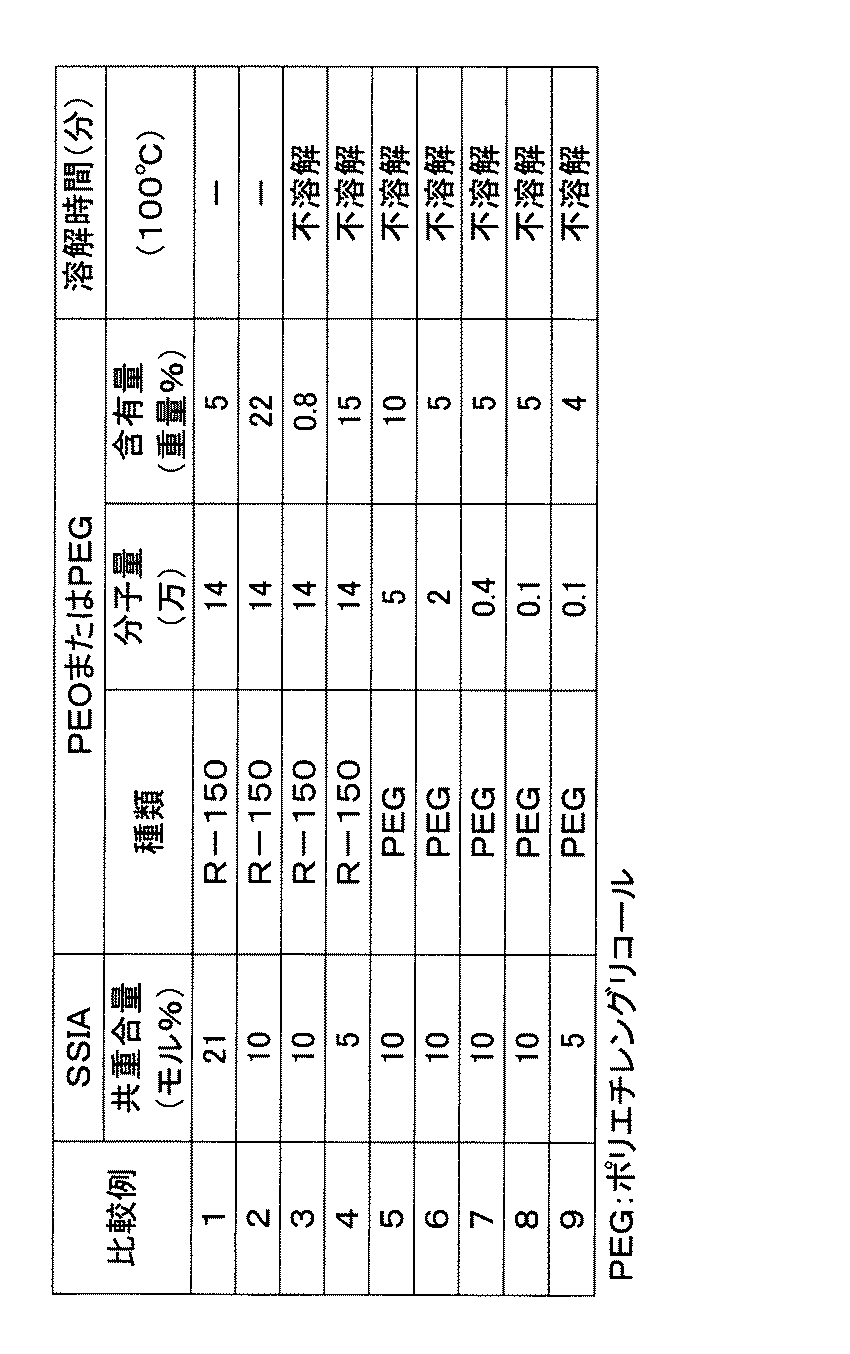
SSIAの共重合量とPEOの添加量を変更した以外は実施例1と同様な方法でポリエステルを得た。表3に示したように、比較例1においてはSSIAの共重合量が多すぎるためにストランド状に押出し水槽中で冷却した際に溶け出してポリエステルチップを得ることができなかった。比較例2においては、PEOの含有量が多すぎるためにポリマーの熱分解が起こり、ポリエステルを得ることができなかった。また、比較例3および4においては表3に示したようにSSIA共重合量とPEOの含有量が請求範囲外であるために溶解しなかった。
【0035】
比較例5〜8
PEOの代わりに比較例5では数平均分子量5万、比較例6では数平均分子量2万、比較例7では数平均分子量4000、比較例8では数平均分子量1000のポリエチレングリコール(以下PEG)を、表3に示した共重合量にした以外は実施例1と同様な方法でポリエステルチップを得た。実施例5〜8においては表3に示したように溶解しなかった。
【0036】
比較例9
SSIAの共重合量を5モル%、数平均分子量1000のPEGの共重合量を4重量%にした以外は実施例1と同様な方法でポリエステルを得た。熱水への溶解時間を評価したが、溶解しなかった。
【0037】
実施例9〜11
SSIAの共重合量を12モル%とし、数平均分子量の異なるPEO(E−30、E−60、E−240:いずれも明成化学製)を用いた以外は実施例1と同様な方法でポリエステルを得た。熱水可溶性を評価したところ表1に示したように目的とした良好な熱水可溶性を示すポリエステルを得ることができた。
【0038】
実施例12〜20
表2に示したように、SSIAの共重合量を変更してポリエステルとしてエステル交換反応を行い、その後、リン酸1.0gのエチレングリコール溶液を添加した。さらにシリコーンオイルTSF−433(GE東芝シリコーン製)13g、イルガノックス1010(チバガイギー製)10g、および表2に示した含有量になるように数平均分子量14万のポリエチレンオキサイド(明成化学製:R−50)のエチレングリコールスラリー、クエン酸キレートチタン化合物を得られるポリマーに対してチタン原子換算で10ppmとなるように加えた。表2の実施例12〜20に示した無機塩の水あるいはエチレングリコール溶液をそれぞれの実施例に応じた含有量となるように添加した後、徐々に0.1kPa以下まで減圧し、それと共に290℃まで昇温し、重合反応が終了した時点で口金からストランド状(直径2〜3mm)に押出して水槽中で冷却、カッティングしてポリエステルチップを得た。
【0039】
このチップの熱水への溶解時間を測定したところ表2に示した時間で完全に溶解し、目的とした熱水可溶ポリエステルを得ることができた。
【0040】
実施例21
ポリエステルの重合触媒としてのクエン酸キレートチタン化合物の代わりに、三酸化アンチモンを得られるポリマーに対してアンチモン原子換算で200ppmとなるように添加した以外は実施例1と同様にしてポリエステルチップを得た。実施例1および実施例21で得られたポリエステルチップをそれぞれ290℃で溶融し、吐出量25g/分で同心円口金から吐出して1500m/分の紡糸速度で14日間連続紡糸した結果、実施例21の場合には口金汚れが起こりやすく、糸切れ回数も1回/日であったが、実施例1の場合には口金汚れが起こりにくく、糸切れ回数も0.2回/日と非常に少なかった。
【0041】
実施例22
極限粘度0.65のポリエチレンテレフタレート(以下PET)を海成分とし、実施例1で得られた熱水可溶性ポリエステルを島成分として用い、それぞれを個別に溶融押出し、島数が12島、複合比率が海/島=60/40の条件でノズル孔0.30mmφ、24ホール丸孔ノズルから紡糸温度290℃で溶融紡出した。紡糸口金直下には長さ1.0mの横吹き付け型の冷却風吹き付け装置を設置しておき、口金から紡出した複合繊維を直ちにその冷却風吹き付け装置に導入して、温度25℃、湿度65%RH%に調整した冷却空気を0.5m/秒の速度で紡出繊維に吹き付けて、繊維を50℃以下にまで冷却した。冷却後の複合繊維を紡糸口金直下から1.1mの位置に設置した長さ1.0m、内径30mmのチューブヒーター(内壁温度160℃)に導入してチューブヒーターで延伸糸た後、チューブヒーターから出てきた繊維にガイドオイリング方式で油剤を付与し、引き続いて1対(2個)の引取りローラーを介して3000m/分の引取り速度で巻き取って、延伸した84dtex、24フィラメントの複合繊維を得た。得られた延伸糸を経糸および緯糸として用いて平織物を作製した。その生機密度は経糸95本/25.4mm、緯糸86本/25.4mmであった。この生機織物を炭酸ナトリウムを2g/Lの割合で含む水溶液中に80℃で30分間浸漬して糊抜きした後、170℃で約40秒間プレセットを行なった。次にイントールMTコンク(アニオン活性剤:明成化学製)1g/Lを含む水溶液にて浴比50:1、温度100℃で時間40分間の熱水処理を行ない、中空繊維を得た。
【0042】
【表1】
【0043】
【表2】
【0044】
【表3】
【0045】
【発明の効果】
本発明によって得られたポリエステルは熱水への溶解速度が速いために、例えば極細繊維や中空繊維を製造する際の溶出成分等に用いることで、操業性とコストパフォーマンスに優れた製品の創出が可能となる。[0001]
TECHNICAL FIELD OF THE INVENTION
The present invention relates to a hot water-soluble polyester composition and a fiber comprising the same. More specifically, the present invention relates to a hot water-soluble polyester composition obtained by copolymerizing a metal sulfoisophthalate and containing a polyalkylene oxide having a specific molecular weight, and a fiber comprising the same. Since the hot water-soluble polyester composition has high solubility in hot water, when used as an eluting component, the process passage in a high-order process is improved and the cost is reduced by shortening the elution time. It can be suitably used for molded articles and fiber products.
[0002]
[Prior art]
Techniques for making polyesters such as polyethylene terephthalate water-soluble or hydrophilic are known, and as a conventional technique, a relatively large amount of a metal salt of sulfoisophthalic acid is copolymerized, or a polyalkylene glycol or an anionic surfactant is used. It is known to contain (for example, see Patent Documents 1 and 2). In addition, attempts have been made to copolymerize isophthalic acid in place of terephthalic acid to make the molecular structure of the polyester sparse and improve water solubility or hot water solubility (for example, see Patent Documents 3 to 8). However, in Patent Documents 1 to 8, polymers obtained by copolymerizing or blending not only a metal sulfonate but also a polyalkylene glycol having a relatively low molecular weight in a large amount, and in some cases copolymerizing isophthalic acid and the like. But also easily eluted in cold water. For this reason, when the molten polymer after the polycondensation reaction is discharged, a part of the polymer is eluted in water when the sheet or gut is formed by cooling using ordinary water, and it is difficult to form a chip. There is also a problem that the dissolution rate into hot water is low. Therefore, as a result of intensive studies by the present inventors to solve the problems so far, a specific amount of metal sulfoisophthalate is copolymerized, and a polyester composition containing a polyalkylene oxide having a relatively high molecular weight is used. It was found that the dissolution into cold water can be suppressed and the solubility in hot water is remarkably improved.
[0003]
[Patent Document 1]
JP-A-55-7865 (page 2)
[0004]
[Patent Document 2]
JP-A-58-37028 (page 2)
[0005]
[Patent Document 3]
JP-A-61-296120 (page 3)
[0006]
[Patent Document 4]
JP-A-63-152624 (page 3)
[0007]
[Patent Document 5]
JP-A-63-159525 (page 2)
[0008]
[Patent Document 6]
JP-A-8-109521 (page 3)
[0009]
[Patent Document 7]
JP 2001-123331 A (page 3)
[0010]
[Patent Document 8]
JP-A-8-134730 (page 4)
[0011]
[Problems to be solved by the invention]
An object of the present invention is to solve the above problems, and to provide a polyester composition and a fiber comprising the same, which can impart sufficient hot water solubility to polyester without lowering production efficiency.
[0012]
[Means for Solving the Problems]
The above-mentioned object is to provide a hot-water-soluble polyester composition comprising 7 to 20 mol% of a metal sulfoisophthalate and containing 1 to 20 wt% of a polyalkylene oxide having a number average molecular weight of 60,000 or more. And a fiber consisting thereof.
[0013]
BEST MODE FOR CARRYING OUT THE INVENTION
In the polyester composition of the present invention, it is necessary that 7 to 20 mol% of a metal sulfoisophthalate is copolymerized. As used herein, the metal sulfoisophthalate refers to alkali metal salts, alkaline earth metal salts, phosphonium salts, and derivatives thereof of sulfoisophthalic acid, and specifically, 5-sodium sulfoisophthalic acid and derivatives thereof. , 5-potassium sulfoisophthalic acid and its derivatives, 5-lithium sulfoisophthalic acid and its derivatives, 5- (tetraalkyl) phosphonium sulfoisophthalic acid and its derivatives, and the like, preferably 5-sodium sulfoisophthalic acid and its derivatives It is a derivative.
[0014]
If the copolymerization amount of the metal sulfoisophthalate is less than 7 mol%, sufficient hot water solubility cannot be imparted to the polyester, and if it exceeds 20 mol%, the polymer after polymerization is discharged when the polymer is discharged. It is easy to dissolve into water and it is difficult to make chips. The preferred copolymerization amount of the metal sulfoisophthalate is 8 to 15 mol%, and more preferably 10 to 13 mol%.
[0015]
It is necessary that the polyester composition of the present invention contains 1 to 20% by weight of a polyalkylene oxide having a number average molecular weight of 60,000 or more. The term "polyalkylene oxide" as used herein refers to a relatively high molecular weight material which does not substantially copolymerize with the polyester and is incompatible with the polyester. Polyalkylene oxide, which is present in an incompatible state with the polyester when it is molded into fibers or the like and subjected to hot water treatment by not substantially copolymerizing with polyester, elutes, and the surface area at which the molded body can contact hot water By increasing it, the effect of specifically improving the solubility can be obtained. If the added amount of the polyalkylene oxide is less than 1% by weight, sufficient hot water solubility cannot be imparted to the polyester, and if it exceeds 20% by weight, the polymer is thermally decomposed at the time of polymerization and the polymer may be obtained. It becomes difficult. The preferable addition amount of the polyalkylene oxide is 5 to 15% by weight, more preferably 8 to 12% by weight. Further, since the solubility in hot water is reduced even if the number average molecular weight of the polyalkylene oxide is too large, the number average molecular weight is preferably 60,000 to 5,000,000, more preferably 100,000 to 2,000,000, and furthermore Preferably it is 150,000-1,000,000. Specific examples of the polyalkylene oxide include polyethylene oxide, polypropylene oxide, polybutylene oxide, and derivatives thereof. From the viewpoint of elution into hot water, polyethylene oxide is most preferable.
[0016]
The polyester composition of the present invention is preferably completely dissolved within 60 minutes when immersed in hot water at 100 ° C. according to the measurement method described below. By dissolving within 60 minutes, when the polyester composition of the present invention is used as a molded article or fiber, a product excellent in process passability and cost in the elution stage can be obtained by shortening the elution treatment time. Can be. It is more preferable to completely dissolve within 40 minutes, and even more preferable to completely dissolve within 25 minutes.
[0017]
The polyester composition of the present invention is preferably produced using a titanium compound as a catalyst. By using a titanium compound, it is possible to obtain a polyester composition with a small amount of foreign matter, for example, it is possible to reduce stains on a die when a fiber is formed using the polyester composition of the present invention, and it is possible to reduce thread breakage caused by the foreign matter. Can be suppressed.
[0018]
The titanium compound as the catalyst of the present invention is not particularly limited. For example, a titanium oxide or a titanium compound in which the substituent of the titanium compound is any one or two of an alkoxy group, a phenoxy group, an acylate group, an amino group, and a hydroxyl group Compounds.
[0019]
Specific alkoxy groups include titanium ethoxides such as tetraethoxide, tetrapropoxide, tetraisopropoxide, tetrabutoxide, tetra-2-ethylhexoxide, β-diketone compounds such as acetylacetone, lactic acid, apple Examples include hydroxy polycarboxylic acid compounds such as acid, tartaric acid, salicylic acid, and citric acid, and keto ester compounds such as methyl acetoacetate and ethyl acetoacetate. The phenoxy group includes phenoxy, cresylate and the like. In addition, the acylate group includes tetraacylate groups such as lactate and stearate, phthalic acid, trimellitic acid, trimesic acid, hemi-mellitic acid, pyromellitic acid, oxalic acid, malonic acid, succinic acid, glutaric acid, and adipic acid. , Polybasic carboxylic compounds such as sebacic acid, maleic acid, fumaric acid, cyclohexanedicarboxylic acid or their anhydrides, ethylenediaminetetraacetic acid, nitrilotripropionic acid, carboximinodiacetic acid, carboxymethyliminodipropionic acid, diethylenetriamino Nitrogen-containing polycarboxylic acids such as pentaacetic acid, triethylenetetraminohexaacetic acid, iminodiacetic acid, iminodipropionic acid, hydroxyethyliminodiacetic acid, hydroxyethyliminodipropionic acid, and methoxyethyliminodiacetic acid. The amino group includes aniline, phenylamine, diphenylamine and the like. Further, diisopropoxybisacetylacetone, triethanolaminate isopropoxide and the like containing two of these substituents may be mentioned.
[0020]
Examples of the titanium oxide include a composite oxide in which the main metal element is titanium and silicon and ultrafine titanium oxide.
[0021]
The catalyst of the present invention refers to a polymer synthesized from a dicarboxylic acid or an ester-forming derivative thereof and a diol or an ester-forming derivative thereof, in which all or some of the following reactions (1) to (3) are performed. Refers to a compound that substantially contributes to acceleration.
(1) Esterification reaction which is a reaction between a dicarboxylic acid component and a diol component (2) Ester exchange reaction which is a reaction between an ester-forming derivative component of a dicarboxylic acid and a diol component (3) Substantially esterification or transesterification The reaction is completed, polycondensation reaction to increase the degree of polymerization of the resulting polyethylene terephthalate low polymer by a diol reaction The main metal element is a composite oxide comprising titanium and silicon and a method for producing ultrafine titanium oxide, Although not limited, for example, it can be obtained by controlling the rate of this hydrolysis in a method of producing a titanium alkoxide compound as a raw material by a hydrolysis reaction. Specifically, for example, a small amount of another metal alkoxide compound such as silicon or zirconium or a polyhydric alcohol compound is allowed to coexist with a titanium alkoxide compound as a main raw material, and a coprecipitation method, a partial hydrolysis method, It can be synthesized by a chemical sol-gel method. Here, the coprecipitation method is a method in which a solution having a predetermined composition containing two or more components is prepared, and the hydrolysis reaction proceeds with the composition. The partial hydrolysis method is a method in which one component is previously hydrolyzed, the other component is added thereto, and the hydrolysis is further advanced. The coordination chemical sol-gel method is a method in which a titanium alkoxide raw material and a polyhydric alcohol compound having a plurality of functional groups in a molecule coexist, and a reactant is formed between the two in advance, thereby performing a subsequent hydrolysis. It is intended to control the rate of the reaction. Methods for synthesizing the above compounds are described, for example, in Ueno et al., "Preparation of Catalyst Using Metal Alkoxide", IPC (1993), and the like. The ultrafine titanium oxide used as a catalyst preferably has a molecular weight of less than 100,000 (g / mol) in terms of catalytic activity and foreign matter suppression. The molecular weight of the ultrafine titanium oxide is more preferably 500 to 100,000 (g / mol), still more preferably 1,000 to 50,000 (g / mol), and particularly preferably 1500 to 20,000 (g / mol).
[0022]
When the titanium compound as a catalyst in the present invention is added in an amount of 0.5 to 150 ppm in terms of titanium atom with respect to the obtained polymer, the polymerization activity is high, and the heat stability and color tone of the obtained polymer are favorable, which is preferable. More preferably, it is 1 to 100 ppm, still more preferably 3 to 50 ppm.
[0023]
The polyester composition of the present invention preferably contains 1.5 to 30% by weight of at least one inorganic salt selected from the group consisting of alkali metal chlorides, sulfates and nitrates. By containing the inorganic salt, the solubility when the polyester is treated with hot water is further improved. The preferred content of the inorganic salt is 2 to 15% by weight, more preferably 5 to 10% by weight.
[0024]
Further, it is preferable that the inorganic salt is present as particles having an average particle size of 5 nm or more and 1 μm or less in the polymer. By being present as particles, the inorganic salts present in the polyester in the form of particles are eluted when formed into fibers, etc. and subjected to hot water treatment, and the specific surface area is increased by increasing the surface area where the molded body can contact hot water Has the effect of improving solubility. More preferably, the particle size of the inorganic salt is 0.01 μm or more and 0.5 μm or less.
[0025]
From the viewpoint of the strength of the polyester composition of the present invention when formed into fibers or the like, it is preferable that 80 mol% or more of the polyester composition is composed of an alkylene terephthalate repeating unit. For example, polyesters containing ethylene terephthalate, propylene terephthalate, or butylene terephthalate as a main repeating unit have good strength and light resistance, and can be mentioned as a preferred example.
[0026]
The above polyester may have another third component copolymerized within a range not to impair the object of the present invention. Such compounds include, for example, isophthalic acid, 2,6-naphthalenedicarboxylic acid, diphenyldicarboxylic acid, adipic acid, sebacic acid, 1,4-cyclohexanedicarboxylic acid and the like, aromatic, aliphatic, alicyclic dicarboxylic acids and the like. Derivatives thereof can be mentioned. Examples of the diol compound include aromatic, aliphatic and alicyclic diols such as propylene glycol, tetramethylene glycol, 1,4-cyclohexanedimethanol, diethylene glycol, neopentyl glycol, polyalkylene glycol, bisphenol A and bisphenol S. And the like.
[0027]
Further, the polyester composition of the present invention includes a titanium oxide, a pigment such as carbon black, a surfactant such as an alkylbenzene sulfonate, a plasticizer made of wax or a hydrophilic polymer compound, as long as the object of the present invention is not impaired. And a conventionally known antioxidant, anti-coloring agent, light-proofing agent, antistatic agent, fine pore-forming agent and the like.
[0028]
Fibers using the polyester composition of the present invention can be produced by a conventionally known method.
[0029]
The cross-sectional shape of the polyester fiber of the present invention is not limited to a circle, but may be an irregular cross-section such as a triangle, a flat, a multilobe, a polygon, an H-shape, and a Π-shape. The thread form of the fiber may be either filament or staple, and is appropriately selected depending on the application. For example, the hot-water-soluble polyester composition is used as a single yarn, blended with other natural fibers or synthetic fibers, and then mixed to form a fabric such as a woven fabric, a knitted fabric, or a non-woven fabric. Can be reduced in weight and a swelling feeling to the fabric can be imparted.
[0030]
Further, the composite fiber using the hot-water-soluble polyester composition as one of the composite components can be suitably used as a composite fiber of a core-sheath type, a sea-island type, a multilayer type and the like. For example, when the hot water-soluble polyester composition is used as a core component of a core-sheath yarn, a light fiber having a high hollow ratio can be obtained by eluting the core component. Further, when the hot-water-soluble polyester composition is used as an elution component of sea-island yarn or split yarn, the elution time by hot water treatment can be significantly reduced, so that a product superior in cost can be created. .
[0031]
【Example】
Hereinafter, the present invention will be described in more detail with reference to Examples. Each characteristic in the examples was obtained by the following method.
A. The intrinsic viscosity of the polyester was determined as an orthochlorophenol solution at 25 ° C.
B. Quantitative determination of sulfonic acid metal salt compounds was determined from the sulfur atom content in the polyester by a fluorescent X-ray elemental analyzer (MESA-500W type manufactured by Horiba, Ltd.).
C. Quantitative determination of polyalkylene oxide The polyester composition was decomposed with monoethanolamine, dissolved in hexafluoroisopropanol, and determined by gel permeation chromatography (manufactured by WATERS, GPC-201D).
D. Determination of inorganic salt After the polyester composition is wet-oxidized and decomposed with sulfuric acid and perchloric acid, the volume is made constant with water, and determined from the content of metal atoms using an atomic absorption / flame spectrophotometer (AA680, manufactured by Shimadzu Corporation). Was. In addition, since the amount of metal in the sulfonic acid metal salt compound was also counted, it was corrected based on the result of the above section B.
E. FIG. Measurement of chip dissolution time 100 g of water was placed in an Erlenmeyer flask and heated to 100 ° C. 2 g of a chip having a major axis of 3 mm, a minor axis of 2 mm, and a length of 3 mm, which was extruded and cut into a strand shape after polymerization, was immersed in hot water in the Erlenmeyer flask, and stirred with a magnetic stirrer while starting immersion. The time until the chip was completely dissolved visually was defined as the dissolution time.
F. The average particle size polyester of the inorganic salt was dissolved in orthochlorophenol, and determined by a particle size distribution analyzer (LA-900, manufactured by Horiba, Ltd.).
[0032]
Example 1
As a polyester, 8.7 kg of dimethyl terephthalic acid, 1.5 kg of sodium dimethyl 5-sulfoisophthalate, 5.9 kg of ethylene glycol, 1.5 g of manganese acetate, and 50 g of lithium acetate were added. An exchange reaction was performed, and then a 1.0 g solution of phosphoric acid in ethylene glycol was added. Furthermore, 13 g of silicone oil TSF-433 (manufactured by GE Toshiba Silicone), 10 g of Irganox 1010 (manufactured by Ciba-Geigy), polyethylene oxide slurry of 1.1 kg of polyethylene oxide having a number average molecular weight of 140,000 (manufactured by Meisei Chemical: R-150), citric acid The chelate titanium compound is added to the polymer to be obtained so that the amount becomes 10 ppm in terms of titanium atoms, and the pressure is gradually reduced to 0.1 kPa or less, and the temperature is raised to 290 ° C. at the same time. The mixture was extruded into a shape (2 to 3 mm in diameter), cooled in a water bath, and cut to obtain a polyester chip. In this polyester chip, the copolymerization amount of 5-sulfoisophthalic acid (hereinafter, SSIA) was 10 mol%, and the content of polyethylene oxide (hereinafter, PEO) was 10% by weight.
[0033]
When the dissolution time of the chip in hot water was measured, the chip was completely dissolved in the time shown in Table 1, and the desired hot water-soluble polyester could be obtained.
[0034]
Examples 2 to 8 and Comparative Examples 1 to 4
A polyester was obtained in the same manner as in Example 1 except that the amount of SSIA copolymerized and the amount of PEO added were changed. As shown in Table 3, in Comparative Example 1, since the copolymerization amount of SSIA was too large, it was extruded into a strand shape when cooled in a water bath, so that polyester chips could not be obtained. In Comparative Example 2, the polymer was thermally decomposed because the content of PEO was too large, and a polyester could not be obtained. Further, in Comparative Examples 3 and 4, as shown in Table 3, the SSIA copolymerization amount and the content of PEO were out of the range of the claims, so that they did not dissolve.
[0035]
Comparative Examples 5 to 8
Instead of PEO, polyethylene glycol (hereinafter referred to as PEG) having a number average molecular weight of 50,000 in Comparative Example 5, 20,000 in Comparative Example 6, 4,000 in Comparative Example 7, and 1000 in Comparative Example 8, A polyester chip was obtained in the same manner as in Example 1 except that the copolymerization amounts shown in Table 3 were used. In Examples 5 to 8, it did not dissolve as shown in Table 3.
[0036]
Comparative Example 9
A polyester was obtained in the same manner as in Example 1, except that the copolymerization amount of SSIA was 5 mol% and the copolymerization amount of PEG having a number average molecular weight of 1000 was 4 wt%. The dissolution time in hot water was evaluated, but did not dissolve.
[0037]
Examples 9 to 11
A polyester was prepared in the same manner as in Example 1 except that the copolymerization amount of SSIA was 12 mol% and PEOs having different number average molecular weights (E-30, E-60, E-240: all manufactured by Meisei Chemical) were used. Got. When the solubility in hot water was evaluated, as shown in Table 1, the desired polyester having good hot water solubility was obtained.
[0038]
Examples 12 to 20
As shown in Table 2, a transesterification reaction was performed as a polyester by changing the copolymerization amount of SSIA, and then a solution of 1.0 g of phosphoric acid in ethylene glycol was added. Further, 13 g of silicone oil TSF-433 (manufactured by GE Toshiba Silicone), 10 g of Irganox 1010 (manufactured by Ciba Geigy), and polyethylene oxide having a number average molecular weight of 140,000 so as to have the content shown in Table 2 (manufactured by Meisei Chemical: R- 50) The ethylene glycol slurry and the citric acid chelate titanium compound were added so as to be 10 ppm in terms of titanium atoms with respect to the polymer obtained. After adding the water or ethylene glycol solution of the inorganic salt shown in Examples 12 to 20 of Table 2 so as to have a content according to each example, the pressure was gradually reduced to 0.1 kPa or less, and the When the polymerization reaction was completed, the mixture was extruded from a die into a strand (2 to 3 mm in diameter), cooled and cut in a water bath to obtain a polyester chip.
[0039]
When the dissolution time of this chip in hot water was measured, it was completely dissolved in the time shown in Table 2, and the desired hot water-soluble polyester could be obtained.
[0040]
Example 21
A polyester chip was obtained in the same manner as in Example 1 except that antimony trioxide was added in an amount of 200 ppm in terms of an antimony atom to a polymer from which antimony trioxide was obtained, instead of the titanium citrate chelate compound as a polyester polymerization catalyst. . The polyester chips obtained in Example 1 and Example 21 were melted at 290 ° C., respectively, discharged from a concentric die at a discharge rate of 25 g / min, and continuously spun at a spinning speed of 1500 m / min for 14 days. In the case of (1), the die was easily stained and the number of thread breaks was 1 / day, but in the case of Example 1, the stain was hardly generated and the number of thread breaks was very small at 0.2 / day. Was.
[0041]
Example 22
Using polyethylene terephthalate (hereinafter referred to as PET) having an intrinsic viscosity of 0.65 as a sea component, and using the hot water-soluble polyester obtained in Example 1 as an island component, each is melt-extruded individually, and the number of islands is 12 and the composite ratio is Melt spinning was performed at a spinning temperature of 290 ° C. from a 24-hole round hole nozzle with a nozzle hole of 0.30 mmφ under the condition of sea / island = 60/40. Immediately below the spinneret, a 1.0 m-long side-blowing type cooling air blowing device is installed, and the conjugate fiber spun from the spinneret is immediately introduced into the cooling air blowing device to obtain a temperature of 25 ° C and a humidity of 65 ° C. % RH% was blown onto the spun fiber at a speed of 0.5 m / sec to cool the fiber to 50 ° C or lower. The conjugated fiber after cooling is introduced into a tube heater (inner wall temperature: 160 ° C.) having a length of 1.0 m and an inner diameter of 30 mm which is installed at a position 1.1 m below the spinneret and having an inner diameter of 30 mm. An oil agent is applied to the emerged fiber by a guide oiling method, subsequently wound up at a take-up speed of 3000 m / min through a pair of (two) take-up rollers, and stretched into a 84 dtex, 24-filament composite fiber. Got. Plain fabrics were produced using the obtained drawn yarns as warps and wefts. The greige density was 95 warp / 25.4 mm and 86 weft / 25.4 mm. The greige fabric was immersed in an aqueous solution containing sodium carbonate at a rate of 2 g / L at 80 ° C. for 30 minutes to desizing, and then pre-set at 170 ° C. for about 40 seconds. Next, hot water treatment was performed with an aqueous solution containing 1 g / L of Intol MT Conc (anion activator: manufactured by Meisei Chemical Co., Ltd.) at a bath ratio of 50: 1 at a temperature of 100 ° C. for 40 minutes to obtain hollow fibers.
[0042]
[Table 1]
[Table 2]
[Table 3]
【The invention's effect】
Since the polyester obtained by the present invention has a high dissolution rate in hot water, for example, by using it as an elution component when producing ultrafine fibers or hollow fibers, it is possible to create a product excellent in operability and cost performance. It becomes possible.