ES2868024T3 - Ligand H3 tetrahydrate, its preparation process and pharmaceutical compositions that comprise it - Google Patents
Ligand H3 tetrahydrate, its preparation process and pharmaceutical compositions that comprise it Download PDFInfo
- Publication number
- ES2868024T3 ES2868024T3 ES18711350T ES18711350T ES2868024T3 ES 2868024 T3 ES2868024 T3 ES 2868024T3 ES 18711350 T ES18711350 T ES 18711350T ES 18711350 T ES18711350 T ES 18711350T ES 2868024 T3 ES2868024 T3 ES 2868024T3
- Authority
- ES
- Spain
- Prior art keywords
- disorders
- tetrahydrate
- compound
- tetrahydrate form
- cognitive
- Prior art date
- Legal status (The legal status is an assumption and is not a legal conclusion. Google has not performed a legal analysis and makes no representation as to the accuracy of the status listed.)
- Active
Links
- 150000004685 tetrahydrates Chemical class 0.000 title claims abstract description 56
- 239000008194 pharmaceutical composition Substances 0.000 title claims description 7
- 238000002360 preparation method Methods 0.000 title description 5
- 239000003446 ligand Substances 0.000 title description 4
- 150000001875 compounds Chemical class 0.000 claims abstract description 61
- ACQXFQGMLFJXEI-KRWDZBQOSA-N 4-[4-[3-[(3s)-3-methylpiperidin-1-yl]propoxy]phenyl]-1-oxidopyridin-1-ium Chemical compound C1[C@@H](C)CCCN1CCCOC1=CC=C(C=2C=C[N+]([O-])=CC=2)C=C1 ACQXFQGMLFJXEI-KRWDZBQOSA-N 0.000 claims abstract description 10
- 208000037265 diseases, disorders, signs and symptoms Diseases 0.000 claims description 29
- 208000035475 disorder Diseases 0.000 claims description 23
- XLYOFNOQVPJJNP-UHFFFAOYSA-N water Substances O XLYOFNOQVPJJNP-UHFFFAOYSA-N 0.000 claims description 20
- CSCPPACGZOOCGX-UHFFFAOYSA-N Acetone Chemical compound CC(C)=O CSCPPACGZOOCGX-UHFFFAOYSA-N 0.000 claims description 10
- 238000000034 method Methods 0.000 claims description 10
- 230000002265 prevention Effects 0.000 claims description 10
- 206010041349 Somnolence Diseases 0.000 claims description 8
- 239000000546 pharmaceutical excipient Substances 0.000 claims description 8
- 208000007590 Disorders of Excessive Somnolence Diseases 0.000 claims description 7
- 239000000843 powder Substances 0.000 claims description 7
- 208000006096 Attention Deficit Disorder with Hyperactivity Diseases 0.000 claims description 6
- 208000018737 Parkinson disease Diseases 0.000 claims description 6
- 230000001149 cognitive effect Effects 0.000 claims description 6
- 208000001797 obstructive sleep apnea Diseases 0.000 claims description 6
- 208000011117 substance-related disease Diseases 0.000 claims description 6
- 238000002844 melting Methods 0.000 claims description 5
- 230000008018 melting Effects 0.000 claims description 5
- 230000036651 mood Effects 0.000 claims description 5
- 201000009032 substance abuse Diseases 0.000 claims description 5
- 231100000736 substance abuse Toxicity 0.000 claims description 5
- 208000007848 Alcoholism Diseases 0.000 claims description 4
- 206010012289 Dementia Diseases 0.000 claims description 4
- 208000013738 Sleep Initiation and Maintenance disease Diseases 0.000 claims description 4
- 206010001584 alcohol abuse Diseases 0.000 claims description 4
- 208000025746 alcohol use disease Diseases 0.000 claims description 4
- 201000003631 narcolepsy Diseases 0.000 claims description 4
- 208000019116 sleep disease Diseases 0.000 claims description 4
- 230000036626 alertness Effects 0.000 claims description 3
- 208000010877 cognitive disease Diseases 0.000 claims description 3
- 238000004519 manufacturing process Methods 0.000 claims description 3
- 208000024827 Alzheimer disease Diseases 0.000 claims description 2
- 208000036864 Attention deficit/hyperactivity disease Diseases 0.000 claims description 2
- 206010003805 Autism Diseases 0.000 claims description 2
- 208000020706 Autistic disease Diseases 0.000 claims description 2
- 208000017164 Chronobiology disease Diseases 0.000 claims description 2
- 241000282412 Homo Species 0.000 claims description 2
- 208000009829 Lewy Body Disease Diseases 0.000 claims description 2
- 201000002832 Lewy body dementia Diseases 0.000 claims description 2
- 208000001145 Metabolic Syndrome Diseases 0.000 claims description 2
- 208000008589 Obesity Diseases 0.000 claims description 2
- 208000006199 Parasomnias Diseases 0.000 claims description 2
- 206010062519 Poor quality sleep Diseases 0.000 claims description 2
- 208000010340 Sleep Deprivation Diseases 0.000 claims description 2
- 206010040981 Sleep attacks Diseases 0.000 claims description 2
- 208000007271 Substance Withdrawal Syndrome Diseases 0.000 claims description 2
- 201000004810 Vascular dementia Diseases 0.000 claims description 2
- 208000012886 Vertigo Diseases 0.000 claims description 2
- 206010048010 Withdrawal syndrome Diseases 0.000 claims description 2
- 201000000690 abdominal obesity-metabolic syndrome Diseases 0.000 claims description 2
- 230000006978 adaptation Effects 0.000 claims description 2
- 208000015802 attention deficit-hyperactivity disease Diseases 0.000 claims description 2
- 230000002490 cerebral effect Effects 0.000 claims description 2
- 230000007278 cognition impairment Effects 0.000 claims description 2
- 239000012141 concentrate Substances 0.000 claims description 2
- 230000003001 depressive effect Effects 0.000 claims description 2
- 206010012601 diabetes mellitus Diseases 0.000 claims description 2
- 206010015037 epilepsy Diseases 0.000 claims description 2
- 230000002267 hypothalamic effect Effects 0.000 claims description 2
- 210000000987 immune system Anatomy 0.000 claims description 2
- 206010022437 insomnia Diseases 0.000 claims description 2
- 201000003152 motion sickness Diseases 0.000 claims description 2
- 235000020824 obesity Nutrition 0.000 claims description 2
- 230000007170 pathology Effects 0.000 claims description 2
- 230000001817 pituitary effect Effects 0.000 claims description 2
- 230000000506 psychotropic effect Effects 0.000 claims description 2
- 230000029058 respiratory gaseous exchange Effects 0.000 claims description 2
- 230000028327 secretion Effects 0.000 claims description 2
- 231100000889 vertigo Toxicity 0.000 claims description 2
- 238000002425 crystallisation Methods 0.000 claims 2
- 230000008025 crystallization Effects 0.000 claims 2
- 208000032140 Sleepiness Diseases 0.000 claims 1
- 230000001747 exhibiting effect Effects 0.000 claims 1
- 230000037321 sleepiness Effects 0.000 claims 1
- 239000000203 mixture Substances 0.000 description 18
- 238000001035 drying Methods 0.000 description 10
- 239000000047 product Substances 0.000 description 8
- 239000002552 dosage form Substances 0.000 description 7
- VEXZGXHMUGYJMC-UHFFFAOYSA-N Hydrochloric acid Chemical compound Cl VEXZGXHMUGYJMC-UHFFFAOYSA-N 0.000 description 6
- 239000002585 base Substances 0.000 description 6
- 201000010099 disease Diseases 0.000 description 6
- VEXZGXHMUGYJMC-UHFFFAOYSA-M Chloride anion Chemical compound [Cl-] VEXZGXHMUGYJMC-UHFFFAOYSA-M 0.000 description 5
- 239000003814 drug Substances 0.000 description 5
- 238000001704 evaporation Methods 0.000 description 5
- 230000008020 evaporation Effects 0.000 description 5
- 238000009472 formulation Methods 0.000 description 5
- 239000007788 liquid Substances 0.000 description 5
- 239000007787 solid Substances 0.000 description 5
- 229940079593 drug Drugs 0.000 description 4
- 230000001225 therapeutic effect Effects 0.000 description 4
- 238000004448 titration Methods 0.000 description 4
- 239000003981 vehicle Substances 0.000 description 4
- SPOLCPORTSDTGD-HNNXBMFYSA-N 2-[2-[(1s)-1-[3-cyclopropyloxy-4-(difluoromethoxy)phenyl]-2-(1-oxidopyridin-1-ium-3-yl)ethyl]-1,3-thiazol-5-yl]-1,1,1,3,3,3-hexafluoropropan-2-ol Chemical compound S1C(C(O)(C(F)(F)F)C(F)(F)F)=CN=C1[C@H](C=1C=C(OC2CC2)C(OC(F)F)=CC=1)CC1=CC=C[N+]([O-])=C1 SPOLCPORTSDTGD-HNNXBMFYSA-N 0.000 description 3
- 230000015556 catabolic process Effects 0.000 description 3
- 238000006731 degradation reaction Methods 0.000 description 3
- 239000000839 emulsion Substances 0.000 description 3
- 239000012458 free base Substances 0.000 description 3
- RAXXELZNTBOGNW-UHFFFAOYSA-N imidazole Natural products C1=CNC=N1 RAXXELZNTBOGNW-UHFFFAOYSA-N 0.000 description 3
- 150000003891 oxalate salts Chemical class 0.000 description 3
- 238000000634 powder X-ray diffraction Methods 0.000 description 3
- 230000008569 process Effects 0.000 description 3
- 150000003839 salts Chemical class 0.000 description 3
- 239000000243 solution Substances 0.000 description 3
- 230000000699 topical effect Effects 0.000 description 3
- IJGRMHOSHXDMSA-UHFFFAOYSA-N Atomic nitrogen Chemical compound N#N IJGRMHOSHXDMSA-UHFFFAOYSA-N 0.000 description 2
- NTYJJOPFIAHURM-UHFFFAOYSA-N Histamine Chemical compound NCCC1=CN=CN1 NTYJJOPFIAHURM-UHFFFAOYSA-N 0.000 description 2
- 239000004480 active ingredient Substances 0.000 description 2
- 238000004458 analytical method Methods 0.000 description 2
- 230000015572 biosynthetic process Effects 0.000 description 2
- 230000008859 change Effects 0.000 description 2
- 238000012512 characterization method Methods 0.000 description 2
- 238000000354 decomposition reaction Methods 0.000 description 2
- 238000004452 microanalysis Methods 0.000 description 2
- 238000011170 pharmaceutical development Methods 0.000 description 2
- SQGYOTSLMSWVJD-UHFFFAOYSA-N silver(1+) nitrate Chemical compound [Ag+].[O-]N(=O)=O SQGYOTSLMSWVJD-UHFFFAOYSA-N 0.000 description 2
- 238000007920 subcutaneous administration Methods 0.000 description 2
- 239000000725 suspension Substances 0.000 description 2
- 238000003786 synthesis reaction Methods 0.000 description 2
- 238000012360 testing method Methods 0.000 description 2
- YFGHCGITMMYXAQ-UHFFFAOYSA-N 2-[(diphenylmethyl)sulfinyl]acetamide Chemical compound C=1C=CC=CC=1C(S(=O)CC(=O)N)C1=CC=CC=C1 YFGHCGITMMYXAQ-UHFFFAOYSA-N 0.000 description 1
- DYPZQMXWIKNBDP-RMRYJAPISA-N 4-[4-[3-[(3S)-3-methylpiperidin-1-yl]propoxy]phenyl]-1-oxidopyridin-1-ium dihydrochloride Chemical compound Cl.Cl.C[C@H]1CCCN(CCCOc2ccc(cc2)-c2cc[n+]([O-])cc2)C1 DYPZQMXWIKNBDP-RMRYJAPISA-N 0.000 description 1
- WTDRDQBEARUVNC-LURJTMIESA-N L-DOPA Chemical compound OC(=O)[C@@H](N)CC1=CC=C(O)C(O)=C1 WTDRDQBEARUVNC-LURJTMIESA-N 0.000 description 1
- WTDRDQBEARUVNC-UHFFFAOYSA-N L-Dopa Natural products OC(=O)C(N)CC1=CC=C(O)C(O)=C1 WTDRDQBEARUVNC-UHFFFAOYSA-N 0.000 description 1
- 241001465754 Metazoa Species 0.000 description 1
- MUBZPKHOEPUJKR-UHFFFAOYSA-N Oxalic acid Chemical compound OC(=O)C(O)=O MUBZPKHOEPUJKR-UHFFFAOYSA-N 0.000 description 1
- BKRGVLQUQGGVSM-KBXCAEBGSA-N Revanil Chemical compound C1=CC(C=2[C@H](N(C)C[C@H](C=2)NC(=O)N(CC)CC)C2)=C3C2=CNC3=C1 BKRGVLQUQGGVSM-KBXCAEBGSA-N 0.000 description 1
- 239000013543 active substance Substances 0.000 description 1
- 239000002671 adjuvant Substances 0.000 description 1
- 230000002411 adverse Effects 0.000 description 1
- 230000000172 allergic effect Effects 0.000 description 1
- 229940035678 anti-parkinson drug Drugs 0.000 description 1
- 239000012296 anti-solvent Substances 0.000 description 1
- 229940124435 antinarcoleptic drug Drugs 0.000 description 1
- 239000003963 antioxidant agent Substances 0.000 description 1
- 239000000939 antiparkinson agent Substances 0.000 description 1
- 208000010668 atopic eczema Diseases 0.000 description 1
- 230000004071 biological effect Effects 0.000 description 1
- 239000008280 blood Substances 0.000 description 1
- 210000004369 blood Anatomy 0.000 description 1
- 229960002802 bromocriptine Drugs 0.000 description 1
- OZVBMTJYIDMWIL-AYFBDAFISA-N bromocriptine Chemical compound C1=CC(C=2[C@H](N(C)C[C@@H](C=2)C(=O)N[C@]2(C(=O)N3[C@H](C(N4CCC[C@H]4[C@]3(O)O2)=O)CC(C)C)C(C)C)C2)=C3C2=C(Br)NC3=C1 OZVBMTJYIDMWIL-AYFBDAFISA-N 0.000 description 1
- 239000000872 buffer Substances 0.000 description 1
- QXDMQSPYEZFLGF-UHFFFAOYSA-L calcium oxalate Chemical compound [Ca+2].[O-]C(=O)C([O-])=O QXDMQSPYEZFLGF-UHFFFAOYSA-L 0.000 description 1
- 239000002775 capsule Substances 0.000 description 1
- 150000005829 chemical entities Chemical class 0.000 description 1
- 238000006243 chemical reaction Methods 0.000 description 1
- 238000007906 compression Methods 0.000 description 1
- 230000006835 compression Effects 0.000 description 1
- 229940124301 concurrent medication Drugs 0.000 description 1
- 238000007796 conventional method Methods 0.000 description 1
- 229910052802 copper Inorganic materials 0.000 description 1
- 239000010949 copper Substances 0.000 description 1
- 239000006071 cream Substances 0.000 description 1
- 230000001186 cumulative effect Effects 0.000 description 1
- 238000011161 development Methods 0.000 description 1
- 238000000113 differential scanning calorimetry Methods 0.000 description 1
- 239000003085 diluting agent Substances 0.000 description 1
- 229940000406 drug candidate Drugs 0.000 description 1
- 239000003937 drug carrier Substances 0.000 description 1
- 238000001914 filtration Methods 0.000 description 1
- 239000000499 gel Substances 0.000 description 1
- 239000007903 gelatin capsule Substances 0.000 description 1
- 230000002068 genetic effect Effects 0.000 description 1
- 238000011194 good manufacturing practice Methods 0.000 description 1
- 239000008187 granular material Substances 0.000 description 1
- 230000036541 health Effects 0.000 description 1
- 230000003862 health status Effects 0.000 description 1
- 229960001340 histamine Drugs 0.000 description 1
- 239000007943 implant Substances 0.000 description 1
- 239000004615 ingredient Substances 0.000 description 1
- 238000002347 injection Methods 0.000 description 1
- 239000007924 injection Substances 0.000 description 1
- 238000007918 intramuscular administration Methods 0.000 description 1
- 238000001990 intravenous administration Methods 0.000 description 1
- 229960004502 levodopa Drugs 0.000 description 1
- 229960003587 lisuride Drugs 0.000 description 1
- 239000006210 lotion Substances 0.000 description 1
- 238000005259 measurement Methods 0.000 description 1
- 239000000155 melt Substances 0.000 description 1
- 238000002156 mixing Methods 0.000 description 1
- 229960001165 modafinil Drugs 0.000 description 1
- 229910052757 nitrogen Inorganic materials 0.000 description 1
- 239000002674 ointment Substances 0.000 description 1
- 238000007911 parenteral administration Methods 0.000 description 1
- 230000003389 potentiating effect Effects 0.000 description 1
- 239000002244 precipitate Substances 0.000 description 1
- 230000004044 response Effects 0.000 description 1
- -1 ropinorol Chemical compound 0.000 description 1
- 229910001961 silver nitrate Inorganic materials 0.000 description 1
- 239000002904 solvent Substances 0.000 description 1
- 238000001179 sorption measurement Methods 0.000 description 1
- 241000894007 species Species 0.000 description 1
- 238000010561 standard procedure Methods 0.000 description 1
- 239000000126 substance Substances 0.000 description 1
- 239000000375 suspending agent Substances 0.000 description 1
- 208000024891 symptom Diseases 0.000 description 1
- 239000003826 tablet Substances 0.000 description 1
- WVSZBAHKLHXQFN-UHFFFAOYSA-N tetrahydrate;dihydrochloride Chemical compound O.O.O.O.Cl.Cl WVSZBAHKLHXQFN-UHFFFAOYSA-N 0.000 description 1
- 230000004797 therapeutic response Effects 0.000 description 1
- 230000008719 thickening Effects 0.000 description 1
- 239000002562 thickening agent Substances 0.000 description 1
Classifications
-
- A—HUMAN NECESSITIES
- A61—MEDICAL OR VETERINARY SCIENCE; HYGIENE
- A61K—PREPARATIONS FOR MEDICAL, DENTAL OR TOILETRY PURPOSES
- A61K31/00—Medicinal preparations containing organic active ingredients
- A61K31/33—Heterocyclic compounds
- A61K31/395—Heterocyclic compounds having nitrogen as a ring hetero atom, e.g. guanethidine or rifamycins
- A61K31/435—Heterocyclic compounds having nitrogen as a ring hetero atom, e.g. guanethidine or rifamycins having six-membered rings with one nitrogen as the only ring hetero atom
- A61K31/44—Non condensed pyridines; Hydrogenated derivatives thereof
- A61K31/445—Non condensed piperidines, e.g. piperocaine
- A61K31/4523—Non condensed piperidines, e.g. piperocaine containing further heterocyclic ring systems
- A61K31/4545—Non condensed piperidines, e.g. piperocaine containing further heterocyclic ring systems containing a six-membered ring with nitrogen as a ring hetero atom, e.g. pipamperone, anabasine
-
- A—HUMAN NECESSITIES
- A61—MEDICAL OR VETERINARY SCIENCE; HYGIENE
- A61P—SPECIFIC THERAPEUTIC ACTIVITY OF CHEMICAL COMPOUNDS OR MEDICINAL PREPARATIONS
- A61P25/00—Drugs for disorders of the nervous system
-
- A—HUMAN NECESSITIES
- A61—MEDICAL OR VETERINARY SCIENCE; HYGIENE
- A61P—SPECIFIC THERAPEUTIC ACTIVITY OF CHEMICAL COMPOUNDS OR MEDICINAL PREPARATIONS
- A61P25/00—Drugs for disorders of the nervous system
- A61P25/18—Antipsychotics, i.e. neuroleptics; Drugs for mania or schizophrenia
-
- C—CHEMISTRY; METALLURGY
- C07—ORGANIC CHEMISTRY
- C07D—HETEROCYCLIC COMPOUNDS
- C07D401/00—Heterocyclic compounds containing two or more hetero rings, having nitrogen atoms as the only ring hetero atoms, at least one ring being a six-membered ring with only one nitrogen atom
- C07D401/02—Heterocyclic compounds containing two or more hetero rings, having nitrogen atoms as the only ring hetero atoms, at least one ring being a six-membered ring with only one nitrogen atom containing two hetero rings
- C07D401/12—Heterocyclic compounds containing two or more hetero rings, having nitrogen atoms as the only ring hetero atoms, at least one ring being a six-membered ring with only one nitrogen atom containing two hetero rings linked by a chain containing hetero atoms as chain links
-
- C—CHEMISTRY; METALLURGY
- C07—ORGANIC CHEMISTRY
- C07B—GENERAL METHODS OF ORGANIC CHEMISTRY; APPARATUS THEREFOR
- C07B2200/00—Indexing scheme relating to specific properties of organic compounds
- C07B2200/13—Crystalline forms, e.g. polymorphs
Landscapes
- Chemical & Material Sciences (AREA)
- Health & Medical Sciences (AREA)
- Organic Chemistry (AREA)
- Animal Behavior & Ethology (AREA)
- Medicinal Chemistry (AREA)
- Life Sciences & Earth Sciences (AREA)
- Pharmacology & Pharmacy (AREA)
- General Health & Medical Sciences (AREA)
- Public Health (AREA)
- Veterinary Medicine (AREA)
- Engineering & Computer Science (AREA)
- Bioinformatics & Cheminformatics (AREA)
- Neurosurgery (AREA)
- Neurology (AREA)
- Chemical Kinetics & Catalysis (AREA)
- General Chemical & Material Sciences (AREA)
- Nuclear Medicine, Radiotherapy & Molecular Imaging (AREA)
- Biomedical Technology (AREA)
- Epidemiology (AREA)
- Psychiatry (AREA)
- Pharmaceuticals Containing Other Organic And Inorganic Compounds (AREA)
- Plural Heterocyclic Compounds (AREA)
- Hydrogenated Pyridines (AREA)
- Acyclic And Carbocyclic Compounds In Medicinal Compositions (AREA)
- Pyridine Compounds (AREA)
Abstract
Forma de tetrahidrato del compuesto de fórmula (A): **(Ver fórmula)** (A): (3S)-4-{4-[3-(3-metilpiperidin-1-il)propoxi]fenil}piridina 1-óxido, diclorhidratoTetrahydrate form of compound of formula (A): ** (See formula) ** (A): (3S) -4- {4- [3- (3-methylpiperidin-1-yl) propoxy] phenyl} pyridine 1 -oxide, dihydrochloride
Description
DESCRIPCIÓNDESCRIPTION
Tetrahidrato de ligando H3, su procedimiento de preparación y composiciones farmacéuticas que lo comprendenLigand H3 tetrahydrate, its preparation process and pharmaceutical compositions that comprise it
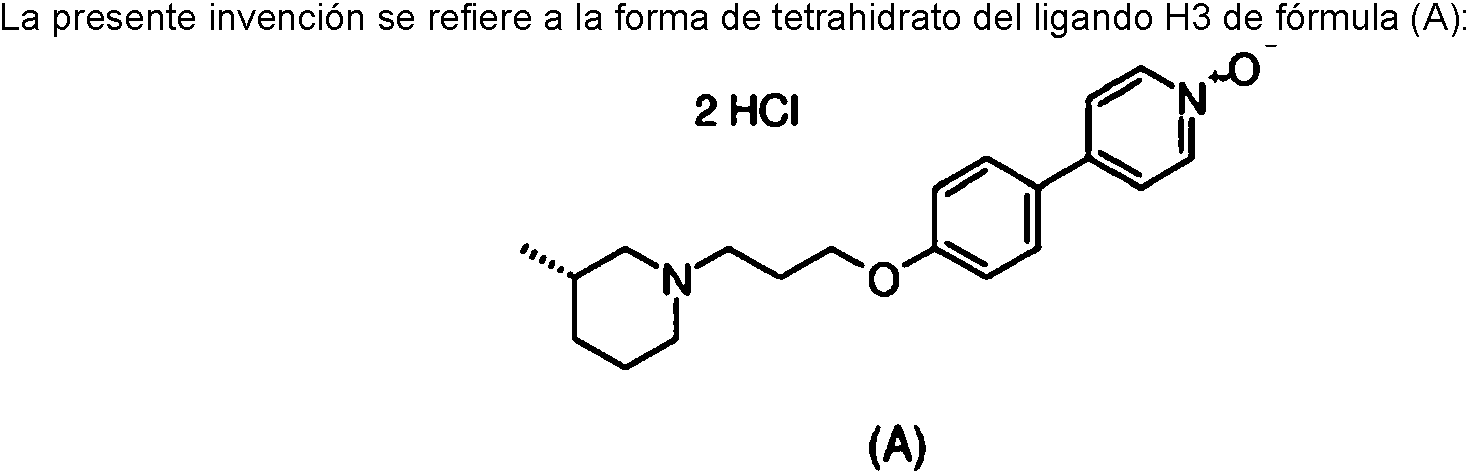
La invención también se refiere al proceso de preparación de dicha tetrahidrato del compuesto (A), las composiciones farmacéuticas que contienen el mismo, y sus usos terapéuticos.The invention also relates to the process for the preparation of said tetrahydrate of compound (A), the pharmaceutical compositions containing the same, and its therapeutic uses.
El compuesto de fórmula (A) es (3S)-4-{4-[3-(3-metilpiperidin-1 -il)propoxi]fenil}piridina 1-óxido, diclorhidrato.The compound of formula (A) is (3S) -4- {4- [3- (3-methylpiperidin-1-yl) propoxy] phenyl} pyridine 1-oxide, dihydrochloride.
Se describe junto con su forma de base libre, su oxalato y clorhidrato en el documento WO 2006/117609, donde se describen muchos otros ligandos H3 de histamina no de imidazol y sus usos terapéuticos.It is described together with its free base form, its oxalate and hydrochloride in WO 2006/117609, where many other non-imidazole histamine H3 ligands and their therapeutic uses are described.
Entre los ligandos H3 descritos, se ha encontrado que el (3S)-4-{4-[3-(3-metilpiperidin-1-il) propoxi] fenil} piridina 1-óxido es muy potente. Sin embargo, es líquido y no se favorece para usos farmacéuticos.Among the disclosed H3 ligands, (3S) -4- {4- [3- (3-methylpiperidin-1-yl) propoxy] phenyl} pyridine 1-oxide has been found to be very potent. However, it is liquid and is not favored for pharmaceutical uses.
La sal de oxalato del mismo no es adecuada, ya sea como candidato a fármaco, ya que las sales de oxalato pueden conducir a depósitos de oxalato de calcio.The oxalate salt thereof is not suitable either as a drug candidate, as oxalate salts can lead to calcium oxalate deposits.
La sal de monoclorhidrato del mismo se funde a 74 °C y es probable que se funda durante la compresión en la preparación de pastillas. Por lo tanto, se espera que tampoco sea adecuada para un desarrollo posterior.The monohydrochloride salt thereof melts at 74 ° C and is likely to melt during compression in tabletting. Therefore, it is expected that it will not be suitable for further development either.
Se encontró que la sal de diclorhidrato es demasiado higroscópica para satisfacer los requisitos de estabilidad para los productos farmacéuticos.The dihydrochloride salt was found to be too hygroscopic to meet the stability requirements for pharmaceuticals.
Por lo tanto, ninguna de las formas de compuesto (A) es adecuada para usos farmacéuticos. Inesperadamente, se encontró que el tetrahidrato del compuesto (A) era altamente estable y cristalino, con un alto punto de fusión, cumpliendo así los requisitos necesarios para un fármaco candidato.Therefore, none of the forms of compound (A) are suitable for pharmaceutical uses. Unexpectedly, the tetrahydrate of compound (A) was found to be highly stable and crystalline, with a high melting point, thus meeting the necessary requirements for a candidate drug.
Según un primer objetivo, la presente invención se refiere, por lo tanto, a la forma de tetrahidrato del compuesto de fórmula (A).According to a first objective, the present invention therefore relates to the tetrahydrate form of the compound of formula (A).
La expresión "tetrahidrato del compuesto (A)" se refiere a la entidad química que comprende una molécula del compuesto (A) y cuatro moléculas de agua.The term "tetrahydrate of compound (A)" refers to the chemical entity comprising one molecule of compound (A) and four molecules of water.
La "base del compuesto (A)" se refiere al siguiente compuesto:The "base of compound (A)" refers to the following compound:

La forma de tetrahidrato del compuesto (A) puede existir en una forma cristalina.The tetrahydrate form of compound (A) may exist in a crystalline form.
Según una realización, la presente invención, por tanto, también se refiere a la forma cristalina del tetrahidrato del compuesto (A).According to one embodiment, the present invention therefore also relates to the crystalline form of the tetrahydrate of the compound (A).
La forma cristalina del tetrahidrato del compuesto (A) está generalmente en forma de un polvo, las características de la cual se mejoran en comparación con la forma de base libre o de otras sales del compuesto (A). El tetrahidrato del compuesto (A) es estable para una humedad relativa que varía de al menos 30% a 70%, que es una propiedad mejorada en comparación con la naturaleza higroscópica del diclorhidrato anteriormente descrito. El tetrahidrato del compuesto (A) también es estable a temperaturas que varían entre 20 ° C y 40 ° C.The crystalline form of the tetrahydrate of the compound (A) is generally in the form of a powder, the characteristics of which are improved compared to the free base or other salt form of the compound (A). The tetrahydrate of compound (A) is stable at a relative humidity ranging from at least 30% to 70%, which is a property improved compared to the hygroscopic nature of the above-described dihydrochloride. The tetrahydrate of compound (A) is also stable at temperatures ranging from 20 ° C to 40 ° C.
El tetrahidrato del compuesto (A) presenta una o más de las siguientes características: según una realización, la forma de tetrahidrato del compuesto (A) exhibe un pico de fusión alrededor de 191 °C cuando se mide mediante el procedimiento de tubo capilar.The tetrahydrate of compound (A) exhibits one or more of the following characteristics: According to one embodiment, the tetrahydrate form of compound (A) exhibits a melting peak around 191 ° C when measured by the capillary tube method.
Según otra realización, el análisis por calorimetría diferencial de barrido muestra dos eventos endotérmicos con inicio alrededor de 53 °C y 83 °C, que corresponden a la pérdida de cuatro moléculas de agua; se observa un último evento con un inicio alrededor de los 191 °C.According to another embodiment, the analysis by differential scanning calorimetry shows two endothermic events with onset around 53 ° C and 83 ° C, corresponding to the loss of four water molecules; a last event is observed with an onset around 191 ° C.
Según otra realización, el contenido de agua del tetrahidrato del compuesto (A) está comprendido entre 14 y 16%, generalmente aproximadamente 15,3 ± 0,7% en peso.According to another embodiment, the water content of the tetrahydrate of compound (A) is between 14 and 16%, generally about 15.3 ± 0.7% by weight.
Según otra realización, la forma de tetrahidrato del compuesto (A) presenta una o más de las líneas del difractograma de rayos X en polvo que se describen a continuación:According to another embodiment, the tetrahydrate form of compound (A) exhibits one or more of the lines of the X-ray powder diffractogram described below:

Más particularmente, los siguientes picos:More particularly, the following peaks:

Según un objetivo adicional, la presente invención también se refiere a procedimientos de preparación de la forma tetrahidrato del compuesto (A). El tetrahidrato del compuesto (A) se puede preparar mediante procedimientos habituales, tales como insolubilización a partir de un disolvente por concentración, adición de un antidisolvente o bajando la temperatura.According to a further objective, the present invention also relates to processes for the preparation of the form tetrahydrate of compound (A). The tetrahydrate of compound (A) can be prepared by standard procedures, such as insolubilization from a solvent by concentration, adding an antisolvent, or lowering the temperature.
Según una realización, el procedimiento de preparación de la forma tetrahidrato del compuesto (A) comprende las siguientes etapas:According to one embodiment, the process for preparing the tetrahydrate form of compound (A) comprises the following steps:
- disolver el compuesto (A) en agua;- dissolve compound (A) in water;
- concentrar hasta que el sólido se separe; y- concentrate until the solid separates; and
- secar el sólido hasta el contenido de agua final deseado, tal como 14-16%, particularmente aproximadamente 15,3 ± 0,7% en peso.- drying the solid to the desired final water content, such as 14-16%, particularly about 15.3 ± 0.7% by weight.
La concentración se puede lograr generalmente mediante evaporación.Concentration can generally be achieved by evaporation.
Según otra realización, el proceso comprende las siguientes etapas:According to another embodiment, the process comprises the following steps:
- añadir ácido clorhídrico acuoso a la forma básica del compuesto (A);- adding aqueous hydrochloric acid to the basic form of compound (A);
- añadir acetona y sembrar hasta que el sólido se separe;- add acetone and sow until the solid separates;
- filtrar; y- filter; and
- secar el sólido hasta el contenido de agua final deseado, tal como 14-16%, particularmente aproximadamente 15,3 ± 0,7% en peso.- drying the solid to the desired final water content, such as 14-16%, particularly about 15.3 ± 0.7% by weight.
El compuesto (A) se puede preparar tal como se describe en el documento WO 2006/117609.Compound (A) can be prepared as described in WO 2006/117609.
La presente invención también se refiere al tetrahidrato del compuesto (A) para su uso para tratar y/o prevenir en un paciente humano trastornos seleccionados de la enfermedad de Alzheimer; atención; trastornos de la vigilia y la memorización; déficits cognitivos en patologías psiquiátricas; trastornos cognitivos, del estado de ánimo y de la vigilancia, en particular en personas mayores; estados depresivos o asténicos; enfermedad de Parkinson; apnea obstructiva del sueño; demencia con cuerpos de Lewy; demencia vascular; vértigo; cinetosis; obesidad; diabetes y síndrome metabólico; trastornos del sueño; estrés; trastornos psicotrópicos; epilepsia; depresión; narcolepsia con o sin cataplejía; trastornos cognitivos en el autismo; abuso de sustancias, en particular trastornos por abuso de alcohol; prevención de síndromes de abstinencia por abuso de sustancias; fatiga posterior a accidente cerebrovascular; trastornos de atención y vigilancia del trastorno por déficit de atención con hiperactividad (TDAH) en niños o adultos; trastornos de la secreción hipotálamohipofisaria, la circulación cerebral y/o el sistema inmunológico; somnolencia diurna excesiva, tal como somnolencia diurna excesiva y fatiga asociada con la enfermedad de Parkinson, apnea obstructiva del sueño o demencia; y/o para facilitar los trabajos nocturnos o la adaptación al cambio de hora en humanos sanos,The present invention also relates to the tetrahydrate of compound (A) for use in treating and / or preventing selected disorders of Alzheimer's disease in a human patient; attention; wakefulness and memorization disorders; cognitive deficits in psychiatric pathologies; cognitive, mood and alertness disorders, particularly in older people; depressive or asthenic states; Parkinson's disease; obstructive sleep apnea; Lewy body dementia; vascular dementia; Vertigo; motion sickness; obesity; diabetes and metabolic syndrome; sleep disorders; stress; psychotropic disorders; epilepsy; depression; narcolepsy with or without cataplexy; cognitive disorders in autism; substance abuse, particularly alcohol abuse disorders; substance abuse withdrawal syndromes prevention; post-stroke fatigue; attention deficit hyperactivity disorder (ADHD) attention deficit hyperactivity disorder (ADHD) in children or adults; disorders of the hypothalamic pituitary secretion, cerebral circulation and / or the immune system; excessive daytime sleepiness, such as excessive daytime sleepiness and fatigue associated with Parkinson's disease, obstructive sleep apnea, or dementia; and / or to facilitate night work or adaptation to the change of time in healthy humans,
donde dicho uso comprende la administración del tetrahidrato de (A) en un ser humano a una dosis comprendida entre 10 y 90 |jg al día (con respecto a la base del compuesto (A)).wherein said use comprises the administration of the tetrahydrate of (A) in a human being at a dose comprised between 10 and 90 µg per day (with respect to the base of compound (A)).
Según una realización, el uso es para el tratamiento y/o prevención de trastornos del sueño, tales como insomnio, trastornos del inicio y el mantenimiento del sueño, la fragmentación del sueño, parasomnias, respiración alterada durante el sueño, trastornos del ritmo circadiano, la narcolepsia con o sin cataplexia, somnolencia diurna excesiva (incluidos "ataques de sueño"), tales como somnolencia diurna excesiva asociada con la enfermedad de Parkinson, apnea obstructiva del sueño o demencia. Otro uso es para el tratamiento y/o prevención de trastornos por abuso de sustancias, en particular el abuso de alcohol. Otro uso es para el tratamiento y/o prevención de trastornos del estado de ánimo, cognitivos y de la vigilancia asociados con el accidente cerebrovascular. Otro uso es para el tratamiento y/o prevención de trastornos cognitivos y de atención en el TDAH.According to one embodiment, the use is for the treatment and / or prevention of sleep disorders, such as insomnia, sleep initiation and maintenance disorders, sleep fragmentation, parasomnias, disturbed breathing during sleep, circadian rhythm disorders, narcolepsy with or without cataplexy, excessive daytime sleepiness (including "sleep attacks"), such as excessive daytime sleepiness associated with Parkinson's disease, obstructive sleep apnea, or dementia. Another use is for the treatment and / or prevention of substance use disorders, particularly alcohol abuse. Another use is for the treatment and / or prevention of mood, cognitive and vigilance disorders associated with stroke. Another use is for the treatment and / or prevention of cognitive and attention disorders in ADHD.
También se describe en este documento un procedimiento de prevención y/o tratamiento de los trastornos anteriores que comprende la administración del tetrahidrato del compuesto (A) a una dosis de la base comprendida entre 10 y 90 |ig al día (con respecto a la base del compuesto (A)), con un portador o excipiente farmacéuticamente aceptable, a un paciente que lo necesite. Según una realización, la dosis diaria de tetrahidrato de (A) para la administración a un ser humano está comprendida entre 20 y 50 jg al día, preferiblemente de 30 a 45 jg (con respecto a la base del compuesto (A)) al día.Also described in this document is a method of prevention and / or treatment of the above disorders that comprises the administration of the tetrahydrate of compound (A) at a dose of the base between 10 and 90 µg per day (with respect to the base of compound (A)), with a pharmaceutically acceptable carrier or excipient, to a patient in need thereof. According to one embodiment, the daily dose of (A) tetrahydrate for administration to a human is between 20 and 50 µg per day, preferably 30 to 45 µg (based on compound (A)) per day. .
Según otra realización, el procedimiento descrito en el presente documento puede comprender la administración del tetrahidrato del compuesto (A), a una frecuencia comprendida entre una vez cada tres días: una vez cada dos días (qod), una vez al día (qd). Preferiblemente, la administración puede tener lugar por tanto una vez al día.According to another embodiment, the method described herein may comprise the administration of the tetrahydrate of compound (A), at a frequency comprised between once every three days: once every two days (qod), once a day (qd) . Preferably, the administration can therefore take place once a day.
Se ha de entender que la dosis de la invención es la dosis acumulativa de cada dosis de administración administrada dentro de un día.The dose of the invention is to be understood to be the cumulative dose of each administration dose administered within one day.
La identificación de los sujetos que están en necesidad de tratamiento de enfermedades y afecciones descritas en el presente documento está dentro de la capacidad y conocimiento de un experto en la maeria. Un médico experto en la materia puede identificar fácilmente, mediante el uso de pruebas clínicas, examen físico, pruebas genéticas y antecedentes médicos/familiares, aquellos sujetos que necesitan dicho tratamiento. Identification of subjects who are in need of treatment for the diseases and conditions described herein is within the ability and knowledge of one of ordinary skill in the art. A physician skilled in the art can easily identify, through the use of clinical tests, physical examination, genetic testing, and medical / family history, those subjects in need of such treatment.
Los niveles de dosificación reales del tetrahidrato del compuesto de fórmula (A) de la invención pueden variarse para obtener una cantidad de principio activo que sea eficaz para obtener una respuesta terapéutica deseada para una composición y procedimiento de administración particulares. Por tanto, el nivel de dosificación seleccionado depende del efecto terapéutico deseado, de la vía de administración, de la duración deseada del tratamiento y de otros factores, por ejemplo, el estado del paciente.Actual dosage levels of the tetrahydrate of the compound of formula (A) of the invention can be varied to obtain an amount of active ingredient that is effective to obtain a desired therapeutic response for a particular composition and method of administration. Thus, the selected dosage level depends on the desired therapeutic effect, the route of administration, the desired duration of treatment, and other factors, eg, the condition of the patient.
Una cantidad terapéuticamente eficaz puede determinarse fácilmente por el médico tratante, como experto en la materia, mediante el uso de técnicas convencionales y observando los resultados obtenidos en circunstancias análogas. Al determinar la cantidad terapéuticamente eficaz, el médico que realiza el diagnóstico considera una serie de factores, que incluyen, pero no se limitan a: la especie del sujeto; su tamaño, edad y salud general; la enfermedad específica involucrada; el grado de afectación o la gravedad de la enfermedad; la respuesta del sujeto individual; el compuesto particular administrado; el modo de administración; la biodisponibilidad característica del preparado administrado; el régimen de dosis seleccionado; el uso de medicación concomitante; y otras circunstancias relevantes. A therapeutically effective amount can easily be determined by the treating physician, skilled in the art, by using conventional techniques and observing the results obtained under analogous circumstances. In determining the therapeutically effective amount, the diagnosing physician considers a number of factors, including, but not limited to: the species of the subject; your size, age, and general health; the specific disease involved; the degree of involvement or severity of the disease; the response of the individual subject; the particular compound administered; the mode of administration; the characteristic bioavailability of the administered preparation; the selected dose regimen; the use of concomitant medication; and other relevant circumstances.
La cantidad de tetrahidrato del compuesto (A) que se requiere para conseguir el efecto biológico deseado variará dependiendo de una serie de factores, incluyendo la dosificación del fármaco a administrar, el tipo de enfermedad, el estado de enfermedad del paciente y la vía de administración.The amount of tetrahydrate of compound (A) that is required to achieve the desired biological effect will vary depending on a number of factors, including the dosage of the drug to be administered, the type of disease, the disease state of the patient, and the route of administration. .
En términos generales, es probable que la dosis preferida del fármaco a administrar dependa de variables, tales como el tipo y grado de progresión de la enfermedad o trastorno, el estado de salud general del paciente particular, la eficacia biológica relativa del compuesto seleccionado y la formulación del excipiente del compuesto y su vía de administración. La dosis diaria del tetrahidrato del compuesto (A) será generalmente inferior a 90 |jg al día por paciente. Generally speaking, the preferred dose of drug to be administered is likely to depend on variables, such as the type and degree of progression of the disease or disorder, the general health status of the particular patient, the relative biological efficacy of the selected compound, and the formulation of the compound excipient and its route of administration. The daily dose of the tetrahydrate of compound (A) will generally be less than 90 µg per day per patient.
Según una realización adicional, el procedimiento descrito en el presente documento también comprende la administración de uno o más principios activos, seleccionados entre fármacos anti-Parkinson, tales como levodopa, ropinorol, lisurida, bromocriptina, pramixepole o seleccionado de fármacos antinarcolépticos o supuestamente antinarcolépticos de otra clase, incluido el modafinilo.According to a further embodiment, the method described herein also comprises the administration of one or more active principles, selected from anti-Parkinson drugs, such as levodopa, ropinorol, lisuride, bromocriptine, pramixepole or selected from antinarcoleptic or supposedly antinarcoleptic drugs from another class, including Modafinil.
El tetrahidrato del compuesto (A) se puede formular en composiciones farmacéuticas mediante mezcla con uno o más excipientes farmacéuticamente aceptables.The tetrahydrate of compound (A) can be formulated into pharmaceutical compositions by mixing with one or more pharmaceutically acceptable excipients.
Las composiciones pueden administrarse convenientemente en forma de dosificación unitaria y pueden prepararse mediante cualquiera de los procedimientos bien conocidos en la técnica farmacéutica, por ejemplo, tal como se describe en Remington: The Science and Practice of Pharmacy, 20a ed.; Gennaro, AR, Ed.; Lippincott Williams y Wilkins: Filadelfia, PA, 2000.The compositions can conveniently be administered in unit dosage form and can be prepared by any of the procedures well known in the art of pharmacy, eg, as described in Remington: The Science and Practice of Pharmacy, 20th ed .; Gennaro, AR, Ed .; Lippincott Williams and Wilkins: Philadelphia, PA, 2000.
El tetrahidrato del compuesto (A) se puede administrar mediante diversas vías de administración, tales como por vía oral; parenteral, incluyendo subcutánea, intramuscular, intravenosa; sublingual, tópica; local; intratraqueal; intranasal; transdérmica o rectal, combinándose el principio activo con un excipiente o vehículo farmacéuticamente aceptable en una composición farmacéutica.The tetrahydrate of compound (A) can be administered by various routes of administration, such as orally; parenteral, including subcutaneous, intramuscular, intravenous; sublingual, topical; local; intratracheal; intranasal; transdermal or rectal, the active ingredient being combined with a pharmaceutically acceptable excipient or vehicle in a pharmaceutical composition.
Según otro objeto, la presente invención también se refiere a la composición farmacéutica que comprende el tetrahidrato del compuesto (A) y un excipiente o vehículo farmacéuticamente aceptable.According to another object, the present invention also relates to the pharmaceutical composition comprising the tetrahydrate of compound (A) and a pharmaceutically acceptable excipient or vehicle.
Según una realización, dicha composición es para uso en el tratamiento y/o prevención de los trastornos anteriores. According to one embodiment, said composition is for use in the treatment and / or prevention of the above disorders.
Según una realización, dicha composición es adecuada para la administración del tetrahidrato del compuesto (A) a una dosis comprendida entre 10 y 90 |ig (con relación a la base del compuesto (A)) al día.According to one embodiment, said composition is suitable for the administration of the tetrahydrate of compound (A) at a dose comprised between 10 and 90 µg (relative to the base of compound (A)) per day.
Para la aplicación tópica, las composiciones de la invención pueden formularse como cremas, geles, pomadas o lociones.For topical application, the compositions of the invention can be formulated as creams, gels, ointments, or lotions.
En particular, las formulaciones adecuadas para la administración parenteral son estériles e incluyen emulsiones, suspensiones, soluciones acuosas y no acuosas de inyección, que pueden contener agentes de suspensión y agentes espesantes y antioxidantes, tampones, bacteriostáticos y solutos que hacen que la formulación sea isotónica, y tengan un pH adecuadamente ajustado, con la sangre del receptor previsto.In particular, formulations suitable for parenteral administration are sterile and include emulsions, suspensions, aqueous and non-aqueous injection solutions, which may contain suspending agents and thickening and antioxidant agents, buffers, bacteriostats, and solutes that render the formulation isotonic. , and have a suitably adjusted pH, with the blood of the intended recipient.
Según la invención, se utiliza ventajosamente la administración oral del compuesto o composición en una formulación apropiada. Las formulaciones que son adecuadas para administrarse por vía oral a un paciente incluyen unidades discretas, tales como cápsulas, tales como cápsulas de gelatina blanda o dura, comprimidos, conteniendo cada una de las cuales una cantidad predeterminada del tetrahidrato del compuesto de fórmula (A). También incluyen polvos o gránulos; soluciones o suspensiones en un líquido acuoso o un líquido no acuoso; o como una emulsión líquida de aceite en agua o una emulsión líquida de agua en aceite.According to the invention, oral administration of the compound or composition in an appropriate formulation is advantageously used. Formulations that are suitable for oral administration to a patient include discrete units, such as capsules, such as soft or hard gelatin capsules, tablets, each containing a predetermined amount of the tetrahydrate of the compound of formula (A) . They also include powders or granules; solutions or suspensions in an aqueous liquid or a non-aqueous liquid; or as an oil-in-water liquid emulsion or a water-in-oil liquid emulsion.
"Farmacéuticamente" o "farmacéuticamente aceptable" se refieren a entidades moleculares y composiciones que no producen una reacción adversa, alérgica u otra cuando se administra a un animal, o un ser humano, según sea apropiado."Pharmaceutically" or "pharmaceutically acceptable" refer to molecular entities and compositions that do not produce an adverse, allergic, or other reaction when administered to an animal, or a human, as appropriate. appropriate.
Tal como se usa en el presente documento, "excipiente, vehículo o portador farmacéuticamente aceptable" incluye, en particular, diluyentes, adyuvantes, excipientes o vehículos. El uso de tales ingredientes para sustancias farmacéuticas activas es bien conocido en la técnica.As used herein, "pharmaceutically acceptable excipient, vehicle or carrier" includes, in particular, diluents, adjuvants, excipients or vehicles. The use of such ingredients for pharmaceutical active substances is well known in the art.
En el contexto de la invención, el término "tratar" o "tratamiento", tal como se usa en este documento, significa revertir, aliviar, inhibir el progreso de, o prevenir el trastorno o afección al que se aplica dicho término, o uno o más síntomas de dicho trastorno o afección.In the context of the invention, the term "treat" or "treatment", as used herein, means to reverse, alleviate, inhibit the progress of, or prevent the disorder or condition to which said term applies, or a or more symptoms of said disorder or condition.
"Cantidad terapéuticamente eficaz" significa una cantidad de un compuesto/medicamento según la presente invención eficaz para producir el efecto terapéutico deseado."Therapeutically effective amount" means an amount of a compound / drug according to the present invention effective to produce the desired therapeutic effect.
Según la invención, el término "paciente" o "paciente en necesidad del mismo", está destinado a un mamífero humano o no humano afectado o susceptible de ser afectado con los trastornos anteriores. Preferiblemente, el paciente es un ser humano.According to the invention, the term "patient" or "patient in need thereof" is intended for a human or non-human mammal affected or susceptible to being affected with the above disorders. Preferably the patient is human.
El tetrahidrato del compuesto (A) puede administrarse en formas de dosificación unitaria, en donde el término "dosis unitaria" significa una dosis única que se puede administrar a un paciente, y que se puede manipular y envasar fácilmente, permaneciendo como una dosis unitaria físicamente y químicamente estable que comprende el propio compuesto activo o como una composición farmacéuticamente aceptable.The tetrahydrate of compound (A) can be administered in unit dosage forms, wherein the term "unit dose" means a single dose that can be administered to a patient, and that can be easily handled and packaged, remaining physically a unit dose. and chemically stable comprising the active compound itself or as a pharmaceutically acceptable composition.
Las formas de dosificación unitarias apropiadas comprenden las formas orales, las formas sublingual, bucal, intratraqueal, intraocular intranasal, las formas por inhalación, las formas tópica, transdérmica, subcutánea, las formas parenterales, las formas rectales y los implantes.Appropriate unit dosage forms include oral forms, sublingual, buccal, intratracheal, intraocular intranasal, inhalation forms, topical, transdermal, subcutaneous forms, parenteral forms, rectal forms, and implants.
La dosis diaria de entre 10 y 90 |ig (con relación a la base del compuesto (A)) según la presente invención se puede lograr mediante la administración de la mitad de una forma de dosificación unitaria, una forma de dosificación unitaria individual o dos o más formas de dosificación unitaria según la forma de dosificación unitaria comercializada, la dosis diaria a administrar y la frecuencia de administración prescrita por el médico.The daily dose of between 10 and 90 µg (relative to the base of the compound (A)) according to the present invention can be achieved by administering half a unit dosage form, a single unit dosage form or two or more unit dosage forms according to the marketed unit dosage form, the daily dose to be administered and the frequency of administration prescribed by the doctor.
FIGURASFIGURES
La figura 1 ilustra el difractograma de rayos X (polvo) del compuesto obtenido en el Ejemplo 1 (tetrahidrato del compuesto (A)).Figure 1 illustrates the X-ray diffractogram (powder) of the compound obtained in Example 1 (tetrahydrate of compound (A)).
La Figura 2 ilustra el difractograma de rayos X (polvo) del compuesto (A).Figure 2 illustrates the X-ray (powder) diffractogram of compound (A).
Los siguientes ejemplos se proporcionan para realizaciones ilustrativas, no limitantes, de la presente invención. EJEMPLOS The following examples are provided for illustrative, non-limiting embodiments of the present invention. EXAMPLES
Ejemplo 1: Síntesis de (3S)-4-l4-r3-(3-met¡lp¡per¡d¡n-1-¡l)propox¡lfen¡l}p¡r¡dina 1-óxido. diclorhidrato, tetrahidratoExample 1: Synthesis of (3S) -4-l4-r3- (3-met¡lp¡per¡d¡n-1-¡l) propoxylfen¡l} pyridine 1-oxide. dihydrochloride, tetrahydrate
Se cargan 210 ± 15 g de compuesto (A) y 200 ± 10 g de agua en el recipiente de evaporación. La temperatura del baño en el sistema de evaporación se ajusta a aproximadamente 40 °C y la mezcla se agita hasta que se disuelve todo el precipitado. El agua se evapora hasta que el producto se separa en forma sólida.210 ± 15 g of compound (A) and 200 ± 10 g of water are charged into the evaporation vessel. The bath temperature in the evaporation system is adjusted to about 40 ° C and the mixture is stirred until all the precipitate is dissolved. The water evaporates until the product separates into a solid form.
El recipiente de evaporación que contiene el producto se transfiere a un secador de vacío en bandeja y el producto se seca a 30 °C. El producto se transfiere del recipiente de evaporación al recipiente de secado real y se continúa el secado a 30 °C hasta que el contenido de agua del producto es del 15,3 ± 0,7 % en peso. Finalmente el producto se muele y se envasa.The evaporation vessel containing the product is transferred to a tray vacuum dryer and the product is dried at 30 ° C. The product is transferred from the evaporation vessel to the actual drying vessel and drying is continued at 30 ° C until the water content of the product is 15.3 ± 0.7% by weight. Finally the product is ground and packaged.
Ejemplo 2: Síntesis de (3S)-4-l4-r3-(3-met¡lp¡per¡d¡n-1-¡l)propox¡lfen¡l}p¡r¡dina 1-óxido. diclorhidrato. tetrahidratoExample 2: Synthesis of (3S) -4-l4-r3- (3-met¡lp¡per¡d¡n-1-¡l) propoxylfen¡l} pyridine 1-oxide. dihydrochloride. tetrahydrate
Se disuelven 2,5 kg de (3S)-4-{4-[3-(3-metilpiperidin-1 -il)propoxi]fenil}piridina 1-óxido en una solución de ácido clorhídrico y la temperatura se ajusta a 22-30 °C. Se agrega acetona en el reactor, la mezcla se siembra y se agita. Se añade más acetona a 22-30 °C hasta que la cantidad total añadida es de 20,0 kg. La temperatura de la mezcla se ajusta a 18-24 °C y la mezcla se agita durante 1,0-2,0 h. El producto se aísla mediante filtración y se lava con una mezcla de agua y acetona. El producto se seca bajo un flujo constante de nitrógeno a 20-30 °C, se muele y se envasa.2.5 kg of (3S) -4- {4- [3- (3-methylpiperidin-1-yl) propoxy] phenyl} pyridine 1-oxide are dissolved in a hydrochloric acid solution and the temperature is adjusted to 22- 30 ° C. Acetone is added to the reactor, the mixture is seeded and stirred. More acetone is added at 22-30 ° C until the total amount added is 20.0 kg. The temperature of the mixture is adjusted to 18-24 ° C and the mixture is stirred for 1.0-2.0 h. The product is isolated by filtration and washed with a mixture of water and acetone. The product is dried under a constant flow of nitrogen at 20-30 ° C, ground and packed.
Ejemplo 3: Difracción de rayos X en polvoExample 3: X-ray powder diffraction
La difracción de rayos X en polvo se registró en (3S)-4-{4-[3-(3-metilpiperidin-1-il)propoxi]fenil}piridina 1-óxido diclorhidrato, tetrahidrato (Ejemplo 1) en forma de polvo.X-ray powder diffraction was recorded on (3S) -4- {4- [3- (3-methylpiperidin-1-yl) propoxy] phenyl} pyridine 1-oxide dihydrochloride, tetrahydrate (Example 1) in powder form.
- Difractómetros Bruker D5000 Matic Difractometer;- Bruker D5000 Matic Difractometer;
- Ánodo de cobre, voltaje de 40 KV, intensidad de 40 mA- Copper anode, 40 KV voltage, 40 mA current
- Configuración 0-0, muestra fija- Setting 0-0, fixed sample
- Temperatura ambiente- Room temperature
- Intervalo de medición: 3° a 30° (2 theta)- Measuring range: 3 ° to 30 ° (2 theta)
- Incremento de etapa: 0,04°- Stage increase: 0.04 °
- Tiempo de medición por etapa: 4s- Measurement time per stage: 4s
- Sin referencia interna- No internal reference
- Tratamiento experimental del datos mediante software EVA (v 11.0)- Experimental data treatment using EVA software (v 11.0)
Un difractograma típico de (3S)-4-{4-[3-(3-metilpiperidin-1-il)propoxi]fenil}piridina 1-óxido, diclorhidrato, tetrahidrato se representa en la figura 1, que es claramente diferente de la forma no tetrahidratada de (3S)-4-{4-[3-(3-metilpiperidin-1 -il)propoxi]fenil}piridina 1-óxido, diclorhidrato, mostrada en la Figura 2.A typical diffractogram of (3S) -4- {4- [3- (3-methylpiperidin-1-yl) propoxy] phenyl} pyridine 1-oxide, dihydrochloride, tetrahydrate is depicted in Figure 1, which is clearly different from the Non-tetrahydrated form of (3S) -4- {4- [3- (3-methylpiperidin-1-yl) propoxy] phenyl} pyridine 1-oxide, dihydrochloride, shown in Figure 2.
Los picos de caracterización de (3S)-4-{4-[3-(3-metilpiperidin-1-il)propoxi]fenil}piridina 1-óxido, diclorhidrato, tetrahidrato incluyen:Characterization peaks of (3S) -4- {4- [3- (3-methylpiperidin-1-yl) propoxy] phenyl} pyridine 1-oxide, dihydrochloride, tetrahydrate include:

Ejemplo 4: Caracterización de (3S)-4-l4-r3-(3-met¡lp¡per¡d¡n-1-¡l)propox¡lfen¡l}p¡r¡dina 1-óxido, diclorhidrato. tetrahidratoExample 4: Characterization of (3S) -4-14-r3- (3-methylp¡per¡d¡n-1-¡l) propoxylfen¡l} pyridine 1-oxide, dihydrochloride. tetrahydrate
MicroanálisisMicroanalysis
La sal de diclorhidrato descrita en el Ejemplo 52 del documento WO 2006/117609 se ha analizado mediante microanálisis. Los resultados se pueden comparar con los valores teóricos para el diclorhidrato anhidro y tetrahidratado:The dihydrochloride salt described in Example 52 of WO 2006/117609 has been analyzed by microanalysis. The results can be compared with the theoretical values for anhydrous and tetrahydrated dihydrochloride:

Los valores medidos se ajustan bien con los teóricos para el diclorhidrato anhidro y son claramente diferentes de los del diclorhidrato tetrahidrato.The measured values fit well with the theoretical for anhydrous dihydrochloride and are clearly different from those for tetrahydrohydrochloride.
El compuesto descrito en el ejemplo 52 del documento WO 2006/117609, por tanto, no está en una forma de tetrahidrato.The compound described in example 52 of WO 2006/117609 is therefore not in a tetrahydrate form.
Valoración de cloruroChloride titration
La valoración de cloruro con nitrato de plata se llevó a cabo para el presente ejemplo 1 y el anterior ejemplo 52 del documento WO 2006/117609.Chloride titration with silver nitrate was carried out for the present example 1 and the previous example 52 of WO 2006/117609.
El contenido de cloruro para el presente ejemplo 1 fue de 15,0 % al igual que el valor teórico. El contenido de cloruro para el ejemplo 52 del documento WO 2006/117609 fue del 17,8 % para un valor teórico del 17,75 %.The chloride content for the present example 1 was 15.0% as was the theoretical value. The chloride content for example 52 of WO 2006/117609 was 17.8% for a theoretical value of 17.75%.
El ejemplo 1 es diferente de los compuestos descritos previamente en el ejemplo 50 (la base libre y la sal de oxalato que no contienen cloruro) y el ejemplo 52 del documento WO 2006/117609.Example 1 is different from the compounds previously described in Example 50 (the free base and oxalate salt containing no chloride) and Example 52 of WO 2006/117609.
Puntos de fusiónMelting points

La comparación de los puntos de fusión evidencia que el presente Ejemplo 1 es distinto del Ejemplo 51 del documento WO 2006/117609.Comparison of melting points shows that this Example 1 is different from Example 51 of WO 2006/117609.
Valoración de agua (por Karl Fischer)Water titration (by Karl Fischer)

La valoración de agua muestra claramente que la nueva fase es un tetrahidrato mientras que el Ejemplo 52 del documento WO 2006/117609 no lo era.The water titration clearly shows that the new phase is a tetrahydrate whereas Example 52 of WO 2006/117609 was not.
Ejemplo 5: EstabilidadExample 5: Stability
Estabilidad del ejemplo 52 del documento WO 2006/117609 Stability of Example 52 of WO 2006/117609
Los estudios de estabilidad se han realizado según ICH.Stability studies have been performed according to ICH.
A 40 °C/75 % de humedad relativa, se observa cierta degradación:At 40 ° C / 75% relative humidity, some degradation is observed:

Se obtuvieron resultados similares para la muestra de 3 meses a 30 °C/65 % de humedad relativa:Similar results were obtained for the 3-month sample at 30 ° C / 65% relative humidity:

Los estudios de estabilidad muestran de este modo una tendencia a la descomposición del Ejemplo 52. La sustancia permanece dentro de las especificaciones 98,0 - 102,0%, pero la disminución de la pureza es significativa y podría conducir a una vida útil reducida.Stability studies thus show a tendency to decomposition of Example 52. The substance remains within specification 98.0-102.0%, but the decrease in purity is significant and could lead to a shortened shelf life.
Estabilidad del presente ejemplo 1Stability of the present example 1
La estabilidad ha sido evaluada en condiciones ICH. Stability has been evaluated under ICH conditions.
Los resultados a 40 °C/75 % de humedad relativa se muestran en la siguiente tabla: no se observa degradación:The results at 40 ° C / 75 % relative humidity are shown in the following table: no degradation is observed:

No hay ninguna variación significativa de la pureza con el tiempo. El diclorhidrato de tetrahidrato es más estable que la fase descrita anteriormente (Ejemplo 52 del documento WO 2006/117609) que perdió un 2 % en seis meses. Además, el análisis de presente Ejemplo 1 por sorción dinámica de vapores y la difracción de rayos X en polvo mostró que la forma de tetrahidrato muestra una buena estabilidad para la humedad relativa del 10 al 90 % a 25 °C.There is no significant variation in purity over time. Tetrahydrate dihydrochloride is more stable than the phase described above (Example 52 of WO 2006/117609) which lost 2% in six months. Furthermore, analysis of present Example 1 by dynamic vapor sorption and X-ray powder diffraction showed that the tetrahydrate form shows good stability for relative humidity of 10 to 90% at 25 ° C.
Ejemplo 6: HigroscopiaExample 6: Hygroscopy
Ejemplo 52 del documento WO 2006/117609Example 52 from WO 2006/117609
Este compuesto es higroscópico. Capta agua durante el tiempo.This compound is hygroscopic. Capture water over time.
Un lote se preparó y se almacenó bajo buenas prácticas de fabricación y se encontró que mostraba cantidades crecientes de contenido de agua con el tiempo:One batch was prepared and stored under good manufacturing practices and was found to show increasing amounts of water content over time:

No se pudo curar mediante secado ya que se encontró que lleva a cierta degradación, tal como se muestra en las tablas siguientes.It could not be cured by drying as it was found to lead to some degradation, as shown in the tables below.
El secado no se completó a 60 °C durante 24 horas. El secado a 80 °C o 100 °C permitió la eliminación completa del agua, pero se produjo cierta descomposición.Drying was not completed at 60 ° C for 24 hours. Drying at 80 ° C or 100 ° C allowed complete removal of the water, but some decomposition did occur.
Secado a 60 °CDrying at 60 ° C

Secado a 80 °CDrying at 80 ° C

Secado a 100 °CDrying at 100 ° C

Presente ejemplo 1Present example 1
El ejemplo 1 no es higroscópico.Example 1 is not hygroscopic.
A 40 °C/75 % de humedad relativa, no se observa modificación del contenido de agua: At 40 ° C / 75% relative humidity, no change in water content is observed:

La forma de tetrahidrato de (3S)-4-{4-[3-(3-metilpiperidin-1 -il)propoxi] fenil}piridina 1-óxido, diclorhidrato es por lo tanto más estable que el (3S)-4-{4-[3-(3-metilpiperidin-1 -il)propoxi]fenil} piridina 1-óxido, diclorhidrato.The tetrahydrate form of (3S) -4- {4- [3- (3-methylpiperidin-1-yl) propoxy] phenyl} pyridine 1-oxide, dihydrochloride is therefore more stable than (3S) -4- {4- [3- (3-methylpiperidin-1-yl) propoxy] phenyl} pyridine 1-oxide, dihydrochloride.
El tetrahidrato muestras propiedades mejoradas para el desarrollo farmacéutico y muestra propiedades mejoradas para el desarrollo farmacéutico. The tetrahydrate shows improved properties for pharmaceutical development and shows improved properties for pharmaceutical development.
Claims (10)

Applications Claiming Priority (2)
| Application Number | Priority Date | Filing Date | Title |
|---|---|---|---|
| EP17305310.9A EP3378858A1 (en) | 2017-03-21 | 2017-03-21 | Tetrahydrate of h3 ligand, its process of preparation and pharmaceutical compositions comprising the same |
| PCT/EP2018/056999 WO2018172344A1 (en) | 2017-03-21 | 2018-03-20 | Tetrahydrate of h3 ligand, its process of preparation and pharmaceutical compositions comprising the same |
Publications (1)
| Publication Number | Publication Date |
|---|---|
| ES2868024T3 true ES2868024T3 (en) | 2021-10-21 |
Family
ID=58488932
Family Applications (1)
| Application Number | Title | Priority Date | Filing Date |
|---|---|---|---|
| ES18711350T Active ES2868024T3 (en) | 2017-03-21 | 2018-03-20 | Ligand H3 tetrahydrate, its preparation process and pharmaceutical compositions that comprise it |
Country Status (23)
| Country | Link |
|---|---|
| US (1) | US11078183B2 (en) |
| EP (2) | EP3378858A1 (en) |
| JP (1) | JP7235671B2 (en) |
| KR (1) | KR102608265B1 (en) |
| CN (1) | CN110891948B (en) |
| AU (1) | AU2018238260B2 (en) |
| CA (1) | CA3056490A1 (en) |
| CY (1) | CY1124114T1 (en) |
| DK (1) | DK3601252T3 (en) |
| ES (1) | ES2868024T3 (en) |
| HR (1) | HRP20210312T1 (en) |
| HU (1) | HUE053710T2 (en) |
| IL (1) | IL269360B2 (en) |
| LT (1) | LT3601252T (en) |
| MA (1) | MA48971B1 (en) |
| MX (1) | MX389167B (en) |
| NZ (1) | NZ757340A (en) |
| PL (1) | PL3601252T3 (en) |
| PT (1) | PT3601252T (en) |
| RS (1) | RS61511B1 (en) |
| SM (1) | SMT202100278T1 (en) |
| WO (1) | WO2018172344A1 (en) |
| ZA (1) | ZA201906202B (en) |
Families Citing this family (2)
| Publication number | Priority date | Publication date | Assignee | Title |
|---|---|---|---|---|
| EP3378477A1 (en) * | 2017-03-21 | 2018-09-26 | BIOPROJET Pharma | New therapeutical use of h3-ligands |
| DK3598975T3 (en) | 2018-07-27 | 2020-11-02 | Bioprojet Soc Civ | Novel combinations of an H3 antagonist and a noradrenaline reuptake inhibitor, and their therapeutic uses |
Family Cites Families (7)
| Publication number | Priority date | Publication date | Assignee | Title |
|---|---|---|---|---|
| CA2485430C (en) * | 2002-05-14 | 2011-12-06 | Xenova Limited | Process for the preparation of a hydrate of an anthranilic acid derivative |
| JPWO2006059778A1 (en) | 2004-12-01 | 2008-06-05 | 萬有製薬株式会社 | Substituted pyridone derivatives |
| EP1717235A3 (en) | 2005-04-29 | 2007-02-28 | Bioprojet | Phenoxypropylpiperidines and -pyrrolidines and their use as histamine H3-receptor ligands |
| JP6098892B2 (en) | 2011-12-08 | 2017-03-22 | 大正製薬株式会社 | Phenylpyrrole derivatives |
| WO2013100054A1 (en) | 2011-12-27 | 2013-07-04 | 大正製薬株式会社 | Phenyltriazole derivative |
| EP3378477A1 (en) * | 2017-03-21 | 2018-09-26 | BIOPROJET Pharma | New therapeutical use of h3-ligands |
| DK3598975T3 (en) * | 2018-07-27 | 2020-11-02 | Bioprojet Soc Civ | Novel combinations of an H3 antagonist and a noradrenaline reuptake inhibitor, and their therapeutic uses |
-
2017
- 2017-03-21 EP EP17305310.9A patent/EP3378858A1/en not_active Withdrawn
-
2018
- 2018-03-20 PL PL18711350T patent/PL3601252T3/en unknown
- 2018-03-20 ES ES18711350T patent/ES2868024T3/en active Active
- 2018-03-20 EP EP18711350.1A patent/EP3601252B1/en active Active
- 2018-03-20 AU AU2018238260A patent/AU2018238260B2/en active Active
- 2018-03-20 SM SM20210278T patent/SMT202100278T1/en unknown
- 2018-03-20 HU HUE18711350A patent/HUE053710T2/en unknown
- 2018-03-20 CN CN201880028499.3A patent/CN110891948B/en active Active
- 2018-03-20 WO PCT/EP2018/056999 patent/WO2018172344A1/en not_active Ceased
- 2018-03-20 JP JP2019552006A patent/JP7235671B2/en active Active
- 2018-03-20 LT LTEP18711350.1T patent/LT3601252T/en unknown
- 2018-03-20 MA MA48971A patent/MA48971B1/en unknown
- 2018-03-20 NZ NZ757340A patent/NZ757340A/en unknown
- 2018-03-20 HR HRP20210312TT patent/HRP20210312T1/en unknown
- 2018-03-20 MX MX2019011264A patent/MX389167B/en unknown
- 2018-03-20 PT PT187113501T patent/PT3601252T/en unknown
- 2018-03-20 CA CA3056490A patent/CA3056490A1/en active Pending
- 2018-03-20 KR KR1020197027549A patent/KR102608265B1/en active Active
- 2018-03-20 DK DK18711350.1T patent/DK3601252T3/en active
- 2018-03-20 RS RS20210249A patent/RS61511B1/en unknown
- 2018-03-20 US US16/496,013 patent/US11078183B2/en active Active
-
2019
- 2019-09-15 IL IL269360A patent/IL269360B2/en unknown
- 2019-09-19 ZA ZA2019/06202A patent/ZA201906202B/en unknown
-
2021
- 2021-03-04 CY CY20211100186T patent/CY1124114T1/en unknown
Also Published As
Similar Documents
| Publication | Publication Date | Title |
|---|---|---|
| ES2956087T3 (en) | RIP1 inhibitory compounds and methods for preparing and using the same | |
| US10829443B2 (en) | Solvate form of (R)-2-amino-3-phenylpropyl carbamate | |
| ES2940911T3 (en) | 2,4-diamino-pyrimidine compounds and their use as IRAK4 inhibitors | |
| ES2332009T3 (en) | CRYSTAL FORMS OF HYDROCLORIDE OF (R) -8-CHLORO-1-METHYL-2,3,4,5-TETRAHYDRO-1H-3-BENZAZEPINA. | |
| ES2591110T3 (en) | Therapeutic uses of compounds having combined SERT, 5-HT3 and 5-HT1A activity | |
| ES2971063T3 (en) | New therapeutic uses of H3 ligands | |
| TWI419681B (en) | Use of urethane for the manufacture of a medicament for the treatment of excessive daytime sleepiness (EDS) | |
| ES2696708T3 (en) | Use of benzimidazole-proline derivatives | |
| JP2019504016A (en) | Alkyldihydroquinolinesulfonamide compounds | |
| US11078183B2 (en) | Tetrahydrate of H3 ligand, its process of preparation and pharmaceutical compositions comprising the same | |
| ES2587064T3 (en) | Novel fumarate salts of a histamine H3 receptor antagonist | |
| CA3142963A1 (en) | Use of aminothiol compounds as cerebral nerve or heart protective agent | |
| RU2771753C2 (en) | H3-ligand tetrahydrate, its production method, and pharmaceutical compositions containing it | |
| US20230064189A1 (en) | 1h-pyrazolo[3,4-d]pyrimidine compounds useful for the treatment of platinum-resistant cancer | |
| TW201818939A (en) | Composition comprising combination of trh analog with arundic acid, and pharmaceutically acceptable salt of arundic acid | |
| BR112019019643B1 (en) | Tetrahydrate form, preparation processes of the tetrahydrate form, pharmaceutical composition and uses of the tetrahydrate form. | |
| HK40017174B (en) | Tetrahydrate of h3 ligand, its process of preparation and pharmaceutical compositions comprising the same | |
| HK40017174A (en) | Tetrahydrate of h3 ligand, its process of preparation and pharmaceutical compositions comprising the same | |
| HK40013330A (en) | New therapeutical use of h3-ligands | |
| HK40013330B (en) | New therapeutical use of h3-ligands | |
| BR122021006155B1 (en) | PRODUCT COMPRISING SUBTYPE 2 METABOTROPIC GLUTAMATERGIC RECEPTOR POSITIVE ALLOSTERIC MODULATOR OR SYNAPTIC VESICLE PROTEIN 2A LIGAND |