ES2772074T3 - Procedure for the reduction of the chlorine content of organomophosphites using dimethylaminobutane, triethylamine or triethanolamine - Google Patents
Procedure for the reduction of the chlorine content of organomophosphites using dimethylaminobutane, triethylamine or triethanolamine Download PDFInfo
- Publication number
- ES2772074T3 ES2772074T3 ES15721626T ES15721626T ES2772074T3 ES 2772074 T3 ES2772074 T3 ES 2772074T3 ES 15721626 T ES15721626 T ES 15721626T ES 15721626 T ES15721626 T ES 15721626T ES 2772074 T3 ES2772074 T3 ES 2772074T3
- Authority
- ES
- Spain
- Prior art keywords
- alkyl
- aryl
- solution
- acetonitrile
- solvent
- Prior art date
- Legal status (The legal status is an assumption and is not a legal conclusion. Google has not performed a legal analysis and makes no representation as to the accuracy of the status listed.)
- Active
Links
- 238000000034 method Methods 0.000 title claims abstract description 72
- ZMANZCXQSJIPKH-UHFFFAOYSA-N Triethylamine Chemical compound CCN(CC)CC ZMANZCXQSJIPKH-UHFFFAOYSA-N 0.000 title claims abstract description 58
- 229910052801 chlorine Inorganic materials 0.000 title claims abstract description 57
- 239000000460 chlorine Substances 0.000 title claims abstract description 57
- ZAMOUSCENKQFHK-UHFFFAOYSA-N Chlorine atom Chemical compound [Cl] ZAMOUSCENKQFHK-UHFFFAOYSA-N 0.000 title claims abstract description 55
- DJEQZVQFEPKLOY-UHFFFAOYSA-N N,N-dimethylbutylamine Chemical compound CCCCN(C)C DJEQZVQFEPKLOY-UHFFFAOYSA-N 0.000 title claims abstract description 15
- GSEJCLTVZPLZKY-UHFFFAOYSA-N Triethanolamine Chemical compound OCCN(CCO)CCO GSEJCLTVZPLZKY-UHFFFAOYSA-N 0.000 title claims abstract description 8
- WEVYAHXRMPXWCK-UHFFFAOYSA-N Acetonitrile Chemical compound CC#N WEVYAHXRMPXWCK-UHFFFAOYSA-N 0.000 claims abstract description 108
- XLYOFNOQVPJJNP-UHFFFAOYSA-N water Substances O XLYOFNOQVPJJNP-UHFFFAOYSA-N 0.000 claims abstract description 38
- XEKOWRVHYACXOJ-UHFFFAOYSA-N Ethyl acetate Chemical compound CCOC(C)=O XEKOWRVHYACXOJ-UHFFFAOYSA-N 0.000 claims abstract description 36
- CSCPPACGZOOCGX-UHFFFAOYSA-N Acetone Chemical compound CC(C)=O CSCPPACGZOOCGX-UHFFFAOYSA-N 0.000 claims abstract description 33
- 239000002904 solvent Substances 0.000 claims abstract description 32
- RTZKZFJDLAIYFH-UHFFFAOYSA-N ether Substances CCOCC RTZKZFJDLAIYFH-UHFFFAOYSA-N 0.000 claims abstract description 15
- 125000002496 methyl group Chemical group [H]C([H])([H])* 0.000 claims abstract description 9
- 125000000217 alkyl group Chemical group 0.000 claims abstract description 8
- 150000001298 alcohols Chemical class 0.000 claims abstract description 5
- 150000001491 aromatic compounds Chemical class 0.000 claims abstract description 5
- 125000001495 ethyl group Chemical group [H]C([H])([H])C([H])([H])* 0.000 claims abstract description 4
- 125000004123 n-propyl group Chemical group [H]C([H])([H])C([H])([H])C([H])([H])* 0.000 claims abstract description 3
- 230000001376 precipitating effect Effects 0.000 claims abstract description 3
- YXFVVABEGXRONW-UHFFFAOYSA-N Toluene Chemical compound CC1=CC=CC=C1 YXFVVABEGXRONW-UHFFFAOYSA-N 0.000 claims description 66
- LFQSCWFLJHTTHZ-UHFFFAOYSA-N Ethanol Chemical compound CCO LFQSCWFLJHTTHZ-UHFFFAOYSA-N 0.000 claims description 27
- OKKJLVBELUTLKV-UHFFFAOYSA-N Methanol Chemical compound OC OKKJLVBELUTLKV-UHFFFAOYSA-N 0.000 claims description 21
- KFZMGEQAYNKOFK-UHFFFAOYSA-N Isopropanol Chemical compound CC(C)O KFZMGEQAYNKOFK-UHFFFAOYSA-N 0.000 claims description 13
- CTQNGGLPUBDAKN-UHFFFAOYSA-N O-Xylene Chemical group CC1=CC=CC=C1C CTQNGGLPUBDAKN-UHFFFAOYSA-N 0.000 claims description 12
- RDOXTESZEPMUJZ-UHFFFAOYSA-N anisole Chemical compound COC1=CC=CC=C1 RDOXTESZEPMUJZ-UHFFFAOYSA-N 0.000 claims description 12
- 150000001335 aliphatic alkanes Chemical class 0.000 claims description 6
- 229960004592 isopropanol Drugs 0.000 claims description 6
- UZKWTJUDCOPSNM-UHFFFAOYSA-N methoxybenzene Substances CCCCOC=C UZKWTJUDCOPSNM-UHFFFAOYSA-N 0.000 claims description 6
- 125000004400 (C1-C12) alkyl group Chemical group 0.000 claims description 5
- BDERNNFJNOPAEC-UHFFFAOYSA-N propan-1-ol Chemical compound CCCO BDERNNFJNOPAEC-UHFFFAOYSA-N 0.000 claims description 5
- LYCAIKOWRPUZTN-UHFFFAOYSA-N Ethylene glycol Chemical compound OCCO LYCAIKOWRPUZTN-UHFFFAOYSA-N 0.000 claims description 4
- WYURNTSHIVDZCO-UHFFFAOYSA-N Tetrahydrofuran Chemical compound C1CCOC1 WYURNTSHIVDZCO-UHFFFAOYSA-N 0.000 claims description 4
- 229910052736 halogen Inorganic materials 0.000 claims description 3
- 229910006069 SO3H Inorganic materials 0.000 claims description 2
- 125000003178 carboxy group Chemical group [H]OC(*)=O 0.000 claims description 2
- WGCNASOHLSPBMP-UHFFFAOYSA-N hydroxyacetaldehyde Natural products OCC=O WGCNASOHLSPBMP-UHFFFAOYSA-N 0.000 claims description 2
- YLQBMQCUIZJEEH-UHFFFAOYSA-N tetrahydrofuran Natural products C=1C=COC=1 YLQBMQCUIZJEEH-UHFFFAOYSA-N 0.000 claims description 2
- 238000004090 dissolution Methods 0.000 claims 1
- 125000001797 benzyl group Chemical group [H]C1=C([H])C([H])=C(C([H])=C1[H])C([H])([H])* 0.000 abstract 2
- HIXDQWDOVZUNNA-UHFFFAOYSA-N 2-(3,4-dimethoxyphenyl)-5-hydroxy-7-methoxychromen-4-one Chemical compound C=1C(OC)=CC(O)=C(C(C=2)=O)C=1OC=2C1=CC=C(OC)C(OC)=C1 HIXDQWDOVZUNNA-UHFFFAOYSA-N 0.000 abstract 1
- -1 organo diphosphites Chemical class 0.000 description 42
- 239000003446 ligand Substances 0.000 description 24
- 239000007787 solid Substances 0.000 description 23
- 239000000047 product Substances 0.000 description 20
- 238000003786 synthesis reaction Methods 0.000 description 20
- 230000015572 biosynthetic process Effects 0.000 description 19
- 238000003756 stirring Methods 0.000 description 18
- 239000000203 mixture Substances 0.000 description 14
- 150000002903 organophosphorus compounds Chemical class 0.000 description 13
- 239000012535 impurity Substances 0.000 description 12
- 238000000746 purification Methods 0.000 description 11
- 238000005481 NMR spectroscopy Methods 0.000 description 10
- 238000006243 chemical reaction Methods 0.000 description 9
- DQTRYXANLKJLPK-UHFFFAOYSA-N chlorophosphonous acid Chemical compound OP(O)Cl DQTRYXANLKJLPK-UHFFFAOYSA-N 0.000 description 8
- BVKZGUZCCUSVTD-UHFFFAOYSA-L Carbonate Chemical compound [O-]C([O-])=O BVKZGUZCCUSVTD-UHFFFAOYSA-L 0.000 description 7
- 150000001805 chlorine compounds Chemical class 0.000 description 7
- 150000001875 compounds Chemical class 0.000 description 7
- 239000000706 filtrate Substances 0.000 description 7
- FAIAAWCVCHQXDN-UHFFFAOYSA-N phosphorus trichloride Chemical compound ClP(Cl)Cl FAIAAWCVCHQXDN-UHFFFAOYSA-N 0.000 description 7
- 238000012545 processing Methods 0.000 description 7
- 125000001424 substituent group Chemical group 0.000 description 7
- VEXZGXHMUGYJMC-UHFFFAOYSA-M Chloride anion Chemical compound [Cl-] VEXZGXHMUGYJMC-UHFFFAOYSA-M 0.000 description 6
- IMNFDUFMRHMDMM-UHFFFAOYSA-N N-Heptane Chemical compound CCCCCCC IMNFDUFMRHMDMM-UHFFFAOYSA-N 0.000 description 6
- 125000002252 acyl group Chemical group 0.000 description 6
- 125000004453 alkoxycarbonyl group Chemical group 0.000 description 6
- 125000003118 aryl group Chemical group 0.000 description 6
- 229910052731 fluorine Inorganic materials 0.000 description 6
- 238000007037 hydroformylation reaction Methods 0.000 description 6
- 150000008301 phosphite esters Chemical group 0.000 description 6
- 229910052698 phosphorus Inorganic materials 0.000 description 6
- YXFVVABEGXRONW-JGUCLWPXSA-N toluene-d8 Chemical compound [2H]C1=C([2H])C([2H])=C(C([2H])([2H])[2H])C([2H])=C1[2H] YXFVVABEGXRONW-JGUCLWPXSA-N 0.000 description 6
- 238000001556 precipitation Methods 0.000 description 5
- 238000002360 preparation method Methods 0.000 description 5
- YMWUJEATGCHHMB-UHFFFAOYSA-N Dichloromethane Chemical compound ClCCl YMWUJEATGCHHMB-UHFFFAOYSA-N 0.000 description 4
- PXGOKWXKJXAPGV-UHFFFAOYSA-N Fluorine Chemical compound FF PXGOKWXKJXAPGV-UHFFFAOYSA-N 0.000 description 4
- IMHDGJOMLMDPJN-UHFFFAOYSA-N biphenyl-2,2'-diol Chemical compound OC1=CC=CC=C1C1=CC=CC=C1O IMHDGJOMLMDPJN-UHFFFAOYSA-N 0.000 description 4
- 239000011737 fluorine Substances 0.000 description 4
- 125000005842 heteroatom Chemical group 0.000 description 4
- 238000004255 ion exchange chromatography Methods 0.000 description 4
- 238000004519 manufacturing process Methods 0.000 description 4
- 238000005259 measurement Methods 0.000 description 4
- 125000006413 ring segment Chemical group 0.000 description 4
- 125000003107 substituted aryl group Chemical group 0.000 description 4
- 238000004679 31P NMR spectroscopy Methods 0.000 description 3
- ZMXDDKWLCZADIW-UHFFFAOYSA-N N,N-Dimethylformamide Chemical compound CN(C)C=O ZMXDDKWLCZADIW-UHFFFAOYSA-N 0.000 description 3
- 125000002178 anthracenyl group Chemical group C1(=CC=CC2=CC3=CC=CC=C3C=C12)* 0.000 description 3
- 229910052799 carbon Inorganic materials 0.000 description 3
- 125000004432 carbon atom Chemical group C* 0.000 description 3
- 125000000753 cycloalkyl group Chemical group 0.000 description 3
- ZJIPHXXDPROMEF-UHFFFAOYSA-N dihydroxyphosphanyl dihydrogen phosphite Chemical class OP(O)OP(O)O ZJIPHXXDPROMEF-UHFFFAOYSA-N 0.000 description 3
- 238000001035 drying Methods 0.000 description 3
- 125000000592 heterocycloalkyl group Chemical group 0.000 description 3
- 238000007172 homogeneous catalysis Methods 0.000 description 3
- 230000007062 hydrolysis Effects 0.000 description 3
- 238000006460 hydrolysis reaction Methods 0.000 description 3
- 125000001624 naphthyl group Chemical group 0.000 description 3
- 125000001997 phenyl group Chemical group [H]C1=C([H])C([H])=C(*)C([H])=C1[H] 0.000 description 3
- 230000035484 reaction time Effects 0.000 description 3
- 125000006707 (C3-C12) heterocycloalkyl group Chemical group 0.000 description 2
- 125000006736 (C6-C20) aryl group Chemical group 0.000 description 2
- KUFFULVDNCHOFZ-UHFFFAOYSA-N 2,4-xylenol Chemical compound CC1=CC=C(O)C(C)=C1 KUFFULVDNCHOFZ-UHFFFAOYSA-N 0.000 description 2
- OKTJSMMVPCPJKN-UHFFFAOYSA-N Carbon Chemical compound [C] OKTJSMMVPCPJKN-UHFFFAOYSA-N 0.000 description 2
- 239000002879 Lewis base Substances 0.000 description 2
- OAICVXFJPJFONN-UHFFFAOYSA-N Phosphorus Chemical compound [P] OAICVXFJPJFONN-UHFFFAOYSA-N 0.000 description 2
- 125000003545 alkoxy group Chemical group 0.000 description 2
- 150000001412 amines Chemical class 0.000 description 2
- 239000002585 base Substances 0.000 description 2
- 229910052794 bromium Inorganic materials 0.000 description 2
- 239000003153 chemical reaction reagent Substances 0.000 description 2
- 125000001309 chloro group Chemical group Cl* 0.000 description 2
- 230000000052 comparative effect Effects 0.000 description 2
- 238000002425 crystallisation Methods 0.000 description 2
- 230000008025 crystallization Effects 0.000 description 2
- 150000002009 diols Chemical class 0.000 description 2
- 238000000605 extraction Methods 0.000 description 2
- 125000001153 fluoro group Chemical group F* 0.000 description 2
- BHEPBYXIRTUNPN-UHFFFAOYSA-N hydridophosphorus(.) (triplet) Chemical compound [PH] BHEPBYXIRTUNPN-UHFFFAOYSA-N 0.000 description 2
- 238000010348 incorporation Methods 0.000 description 2
- 229910001504 inorganic chloride Inorganic materials 0.000 description 2
- 229910052740 iodine Inorganic materials 0.000 description 2
- 150000007527 lewis bases Chemical class 0.000 description 2
- 229910052757 nitrogen Inorganic materials 0.000 description 2
- AQSJGOWTSHOLKH-UHFFFAOYSA-N phosphite(3-) Chemical class [O-]P([O-])[O-] AQSJGOWTSHOLKH-UHFFFAOYSA-N 0.000 description 2
- OJMIONKXNSYLSR-UHFFFAOYSA-N phosphorous acid Chemical compound OP(O)O OJMIONKXNSYLSR-UHFFFAOYSA-N 0.000 description 2
- 239000011574 phosphorus Substances 0.000 description 2
- 239000011541 reaction mixture Substances 0.000 description 2
- 238000007086 side reaction Methods 0.000 description 2
- 239000000126 substance Substances 0.000 description 2
- 125000005346 substituted cycloalkyl group Chemical group 0.000 description 2
- 239000000725 suspension Substances 0.000 description 2
- DYHSDKLCOJIUFX-UHFFFAOYSA-N tert-butoxycarbonyl anhydride Chemical compound CC(C)(C)OC(=O)OC(=O)OC(C)(C)C DYHSDKLCOJIUFX-UHFFFAOYSA-N 0.000 description 2
- 125000004169 (C1-C6) alkyl group Chemical group 0.000 description 1
- 125000006652 (C3-C12) cycloalkyl group Chemical group 0.000 description 1
- 0 *C(Oc1c(*)c(*)c(*)c(*)c1-c(c(*)c(*)c(*)c1*)c1OP(O*)O*)=O Chemical compound *C(Oc1c(*)c(*)c(*)c(*)c1-c(c(*)c(*)c(*)c1*)c1OP(O*)O*)=O 0.000 description 1
- 125000005919 1,2,2-trimethylpropyl group Chemical group 0.000 description 1
- 125000005918 1,2-dimethylbutyl group Chemical group 0.000 description 1
- CMZYGFLOKOQMKF-UHFFFAOYSA-N 1-(3,5-dimethylphenyl)-3,5-dimethylbenzene Chemical group CC1=CC(C)=CC(C=2C=C(C)C=C(C)C=2)=C1 CMZYGFLOKOQMKF-UHFFFAOYSA-N 0.000 description 1
- 125000006218 1-ethylbutyl group Chemical group [H]C([H])([H])C([H])([H])C([H])([H])C([H])(*)C([H])([H])C([H])([H])[H] 0.000 description 1
- GVQAJJUPWDZQGD-UHFFFAOYSA-N 1-tert-butyl-3-(3-tert-butyl-5-methoxyphenyl)-5-methoxybenzene Chemical compound CC(C)(C)C1=CC(OC)=CC(C=2C=C(C=C(OC)C=2)C(C)(C)C)=C1 GVQAJJUPWDZQGD-UHFFFAOYSA-N 0.000 description 1
- 238000005160 1H NMR spectroscopy Methods 0.000 description 1
- YBYIRNPNPLQARY-UHFFFAOYSA-N 1H-indene Natural products C1=CC=C2CC=CC2=C1 YBYIRNPNPLQARY-UHFFFAOYSA-N 0.000 description 1
- GIXFOJJEFBLNSY-UHFFFAOYSA-N 2-chloro-4,4,5,5-tetraphenyl-1,3,2-dioxaphospholane Chemical compound C=1C=CC=CC=1C1(C=2C=CC=CC=2)OP(Cl)OC1(C=1C=CC=CC=1)C1=CC=CC=C1 GIXFOJJEFBLNSY-UHFFFAOYSA-N 0.000 description 1
- 125000004493 2-methylbut-1-yl group Chemical group CC(C*)CC 0.000 description 1
- 125000005916 2-methylpentyl group Chemical group 0.000 description 1
- 125000003542 3-methylbutan-2-yl group Chemical group [H]C([H])([H])C([H])(*)C([H])(C([H])([H])[H])C([H])([H])[H] 0.000 description 1
- 125000005917 3-methylpentyl group Chemical group 0.000 description 1
- WUFGFUAXCBPGOL-UHFFFAOYSA-N 6-[2-(2-benzo[d][1,3,2]benzodioxaphosphepin-6-yloxy-3-tert-butyl-5-methoxyphenyl)-6-tert-butyl-4-methoxyphenoxy]benzo[d][1,3,2]benzodioxaphosphepine Chemical compound O1C=2C=CC=CC=2C2=CC=CC=C2OP1OC=1C(C(C)(C)C)=CC(OC)=CC=1C1=CC(OC)=CC(C(C)(C)C)=C1OP(OC1=CC=CC=C11)OC2=C1C=CC=C2 WUFGFUAXCBPGOL-UHFFFAOYSA-N 0.000 description 1
- UHOVQNZJYSORNB-UHFFFAOYSA-N Benzene Chemical compound C1=CC=CC=C1 UHOVQNZJYSORNB-UHFFFAOYSA-N 0.000 description 1
- BBSPXGJFFPPTPZ-UHFFFAOYSA-N CC(C)(C)c(cc(cc1-c(cc(cc2C(C)(C)C)OC)c2OP(Cl)Cl)OC)c1OC(OC(C)(C)C)=O Chemical compound CC(C)(C)c(cc(cc1-c(cc(cc2C(C)(C)C)OC)c2OP(Cl)Cl)OC)c1OC(OC(C)(C)C)=O BBSPXGJFFPPTPZ-UHFFFAOYSA-N 0.000 description 1
- IYVAQBHJBOKOMX-UHFFFAOYSA-N CC1=CC=CC=C1.CC(C)(C)[O-].C(O)(O)=O.[K+] Chemical compound CC1=CC=CC=C1.CC(C)(C)[O-].C(O)(O)=O.[K+] IYVAQBHJBOKOMX-UHFFFAOYSA-N 0.000 description 1
- 239000004215 Carbon black (E152) Substances 0.000 description 1
- UGFAIRIUMAVXCW-UHFFFAOYSA-N Carbon monoxide Chemical compound [O+]#[C-] UGFAIRIUMAVXCW-UHFFFAOYSA-N 0.000 description 1
- XBDTZNMRTRPDKH-UHFFFAOYSA-N Cc(cc1-c(cc(C)cc2C)c2O)cc(C)c1O Chemical compound Cc(cc1-c(cc(C)cc2C)c2O)cc(C)c1O XBDTZNMRTRPDKH-UHFFFAOYSA-N 0.000 description 1
- XMHTUHZQDJLUSJ-UHFFFAOYSA-N Cl.OP(O)O Chemical class Cl.OP(O)O XMHTUHZQDJLUSJ-UHFFFAOYSA-N 0.000 description 1
- ISWSIDIOOBJBQZ-UHFFFAOYSA-N Phenol Chemical compound OC1=CC=CC=C1 ISWSIDIOOBJBQZ-UHFFFAOYSA-N 0.000 description 1
- 229910000831 Steel Inorganic materials 0.000 description 1
- 239000012963 UV stabilizer Substances 0.000 description 1
- 238000009825 accumulation Methods 0.000 description 1
- 239000002253 acid Substances 0.000 description 1
- 150000007513 acids Chemical class 0.000 description 1
- 125000005073 adamantyl group Chemical group C12(CC3CC(CC(C1)C3)C2)* 0.000 description 1
- 239000002671 adjuvant Substances 0.000 description 1
- 238000006136 alcoholysis reaction Methods 0.000 description 1
- 229910052783 alkali metal Inorganic materials 0.000 description 1
- 229910001617 alkaline earth metal chloride Inorganic materials 0.000 description 1
- 125000003277 amino group Chemical group 0.000 description 1
- 239000003963 antioxidant agent Substances 0.000 description 1
- ZEFSGHVBJCEKAZ-UHFFFAOYSA-N bis(2,4-ditert-butyl-6-methylphenyl) ethyl phosphite Chemical compound CC=1C=C(C(C)(C)C)C=C(C(C)(C)C)C=1OP(OCC)OC1=C(C)C=C(C(C)(C)C)C=C1C(C)(C)C ZEFSGHVBJCEKAZ-UHFFFAOYSA-N 0.000 description 1
- 239000006227 byproduct Substances 0.000 description 1
- 150000001721 carbon Chemical group 0.000 description 1
- 229910002091 carbon monoxide Inorganic materials 0.000 description 1
- 150000004649 carbonic acid derivatives Chemical class 0.000 description 1
- 230000015556 catabolic process Effects 0.000 description 1
- 239000003054 catalyst Substances 0.000 description 1
- 238000006555 catalytic reaction Methods 0.000 description 1
- 238000012512 characterization method Methods 0.000 description 1
- 239000013522 chelant Substances 0.000 description 1
- 239000007795 chemical reaction product Substances 0.000 description 1
- 239000003795 chemical substances by application Substances 0.000 description 1
- 125000002676 chrysenyl group Chemical group C1(=CC=CC=2C3=CC=C4C=CC=CC4=C3C=CC12)* 0.000 description 1
- 238000002485 combustion reaction Methods 0.000 description 1
- 238000010276 construction Methods 0.000 description 1
- 238000011109 contamination Methods 0.000 description 1
- 238000001816 cooling Methods 0.000 description 1
- 125000003336 coronenyl group Chemical group C1(=CC2=CC=C3C=CC4=CC=C5C=CC6=CC=C1C1=C6C5=C4C3=C21)* 0.000 description 1
- 238000005260 corrosion Methods 0.000 description 1
- 230000007797 corrosion Effects 0.000 description 1
- 125000001995 cyclobutyl group Chemical group [H]C1([H])C([H])([H])C([H])(*)C1([H])[H] 0.000 description 1
- 125000000582 cycloheptyl group Chemical group [H]C1([H])C([H])([H])C([H])([H])C([H])([H])C([H])(*)C([H])([H])C1([H])[H] 0.000 description 1
- 125000000113 cyclohexyl group Chemical group [H]C1([H])C([H])([H])C([H])([H])C([H])(*)C([H])([H])C1([H])[H] 0.000 description 1
- 125000000640 cyclooctyl group Chemical group [H]C1([H])C([H])([H])C([H])([H])C([H])([H])C([H])(*)C([H])([H])C([H])([H])C1([H])[H] 0.000 description 1
- 125000001511 cyclopentyl group Chemical group [H]C1([H])C([H])([H])C([H])([H])C([H])(*)C1([H])[H] 0.000 description 1
- 125000001559 cyclopropyl group Chemical group [H]C1([H])C([H])([H])C1([H])* 0.000 description 1
- 125000002704 decyl group Chemical group [H]C([H])([H])C([H])([H])C([H])([H])C([H])([H])C([H])([H])C([H])([H])C([H])([H])C([H])([H])C([H])([H])C([H])([H])* 0.000 description 1
- 238000006731 degradation reaction Methods 0.000 description 1
- 238000013461 design Methods 0.000 description 1
- 125000000532 dioxanyl group Chemical group 0.000 description 1
- 238000004821 distillation Methods 0.000 description 1
- 239000003814 drug Substances 0.000 description 1
- 230000000694 effects Effects 0.000 description 1
- 238000001914 filtration Methods 0.000 description 1
- 239000003063 flame retardant Substances 0.000 description 1
- 125000003983 fluorenyl group Chemical group C1(=CC=CC=2C3=CC=CC=C3CC12)* 0.000 description 1
- 239000000417 fungicide Substances 0.000 description 1
- 239000007789 gas Substances 0.000 description 1
- 239000004009 herbicide Substances 0.000 description 1
- 239000002815 homogeneous catalyst Substances 0.000 description 1
- 229930195733 hydrocarbon Natural products 0.000 description 1
- 238000005669 hydrocyanation reaction Methods 0.000 description 1
- 229910052739 hydrogen Inorganic materials 0.000 description 1
- 239000001257 hydrogen Substances 0.000 description 1
- 125000004435 hydrogen atom Chemical class [H]* 0.000 description 1
- 150000004679 hydroxides Chemical class 0.000 description 1
- 125000003454 indenyl group Chemical group C1(C=CC2=CC=CC=C12)* 0.000 description 1
- 239000002917 insecticide Substances 0.000 description 1
- 239000000543 intermediate Substances 0.000 description 1
- 125000000959 isobutyl group Chemical group [H]C([H])([H])C([H])(C([H])([H])[H])C([H])([H])* 0.000 description 1
- 125000004491 isohexyl group Chemical group C(CCC(C)C)* 0.000 description 1
- 125000001972 isopentyl group Chemical group [H]C([H])([H])C([H])(C([H])([H])[H])C([H])([H])C([H])([H])* 0.000 description 1
- 125000001449 isopropyl group Chemical group [H]C([H])([H])C([H])(*)C([H])([H])[H] 0.000 description 1
- 239000003041 laboratory chemical Substances 0.000 description 1
- 238000004895 liquid chromatography mass spectrometry Methods 0.000 description 1
- 239000000155 melt Substances 0.000 description 1
- 229910052751 metal Inorganic materials 0.000 description 1
- 239000002184 metal Substances 0.000 description 1
- KHGSIITYVUGTTQ-UHFFFAOYSA-N methane;toluene Chemical compound C.CC1=CC=CC=C1 KHGSIITYVUGTTQ-UHFFFAOYSA-N 0.000 description 1
- 229940087646 methanolamine Drugs 0.000 description 1
- 238000002156 mixing Methods 0.000 description 1
- 125000002950 monocyclic group Chemical group 0.000 description 1
- 125000004108 n-butyl group Chemical group [H]C([H])([H])C([H])([H])C([H])([H])C([H])([H])* 0.000 description 1
- 125000003136 n-heptyl group Chemical group [H]C([H])([H])C([H])([H])C([H])([H])C([H])([H])C([H])([H])C([H])([H])C([H])([H])* 0.000 description 1
- 125000001280 n-hexyl group Chemical group C(CCCCC)* 0.000 description 1
- 125000000740 n-pentyl group Chemical group [H]C([H])([H])C([H])([H])C([H])([H])C([H])([H])C([H])([H])* 0.000 description 1
- 125000001971 neopentyl group Chemical group [H]C([*])([H])C(C([H])([H])[H])(C([H])([H])[H])C([H])([H])[H] 0.000 description 1
- 125000001400 nonyl group Chemical group [H]C([*])([H])C([H])([H])C([H])([H])C([H])([H])C([H])([H])C([H])([H])C([H])([H])C([H])([H])C([H])([H])[H] 0.000 description 1
- 150000002902 organometallic compounds Chemical class 0.000 description 1
- 239000002245 particle Substances 0.000 description 1
- 125000003538 pentan-3-yl group Chemical group [H]C([H])([H])C([H])([H])C([H])(*)C([H])([H])C([H])([H])[H] 0.000 description 1
- 125000001792 phenanthrenyl group Chemical group C1(=CC=CC=2C3=CC=CC=C3C=CC12)* 0.000 description 1
- 150000003003 phosphines Chemical class 0.000 description 1
- 150000008300 phosphoramidites Chemical class 0.000 description 1
- 230000000704 physical effect Effects 0.000 description 1
- 239000004014 plasticizer Substances 0.000 description 1
- 239000002798 polar solvent Substances 0.000 description 1
- 229920000642 polymer Polymers 0.000 description 1
- LPNYRYFBWFDTMA-UHFFFAOYSA-N potassium tert-butoxide Chemical compound [K+].CC(C)(C)[O-] LPNYRYFBWFDTMA-UHFFFAOYSA-N 0.000 description 1
- 239000002244 precipitate Substances 0.000 description 1
- 230000002035 prolonged effect Effects 0.000 description 1
- 125000001436 propyl group Chemical group [H]C([*])([H])C([H])([H])C([H])([H])[H] 0.000 description 1
- 125000001725 pyrenyl group Chemical group 0.000 description 1
- 238000001953 recrystallisation Methods 0.000 description 1
- 238000010992 reflux Methods 0.000 description 1
- 150000003839 salts Chemical class 0.000 description 1
- 229920006395 saturated elastomer Polymers 0.000 description 1
- 125000002914 sec-butyl group Chemical group [H]C([H])([H])C([H])([H])C([H])(*)C([H])([H])[H] 0.000 description 1
- 238000004513 sizing Methods 0.000 description 1
- 229910001220 stainless steel Inorganic materials 0.000 description 1
- 239000010959 steel Substances 0.000 description 1
- 239000013589 supplement Substances 0.000 description 1
- 125000000999 tert-butyl group Chemical group [H]C([H])([H])C(*)(C([H])([H])[H])C([H])([H])[H] 0.000 description 1
- 125000001973 tert-pentyl group Chemical group [H]C([H])([H])C([H])([H])C(*)(C([H])([H])[H])C([H])([H])[H] 0.000 description 1
- 150000003512 tertiary amines Chemical class 0.000 description 1
- 125000001935 tetracenyl group Chemical group C1(=CC=CC2=CC3=CC4=CC=CC=C4C=C3C=C12)* 0.000 description 1
- 125000003718 tetrahydrofuranyl group Chemical group 0.000 description 1
- 125000001412 tetrahydropyranyl group Chemical group 0.000 description 1
- 125000003507 tetrahydrothiofenyl group Chemical group 0.000 description 1
- 238000004448 titration Methods 0.000 description 1
- 125000003944 tolyl group Chemical group 0.000 description 1
- 238000005809 transesterification reaction Methods 0.000 description 1
- ILWRPSCZWQJDMK-UHFFFAOYSA-N triethylazanium;chloride Chemical compound Cl.CCN(CC)CC ILWRPSCZWQJDMK-UHFFFAOYSA-N 0.000 description 1
- 238000010626 work up procedure Methods 0.000 description 1
Classifications
-
- C—CHEMISTRY; METALLURGY
- C07—ORGANIC CHEMISTRY
- C07F—ACYCLIC, CARBOCYCLIC OR HETEROCYCLIC COMPOUNDS CONTAINING ELEMENTS OTHER THAN CARBON, HYDROGEN, HALOGEN, OXYGEN, NITROGEN, SULFUR, SELENIUM OR TELLURIUM
- C07F9/00—Compounds containing elements of Groups 5 or 15 of the Periodic Table
- C07F9/02—Phosphorus compounds
- C07F9/06—Phosphorus compounds without P—C bonds
- C07F9/062—Organo-phosphoranes without P-C bonds
-
- C—CHEMISTRY; METALLURGY
- C07—ORGANIC CHEMISTRY
- C07F—ACYCLIC, CARBOCYCLIC OR HETEROCYCLIC COMPOUNDS CONTAINING ELEMENTS OTHER THAN CARBON, HYDROGEN, HALOGEN, OXYGEN, NITROGEN, SULFUR, SELENIUM OR TELLURIUM
- C07F9/00—Compounds containing elements of Groups 5 or 15 of the Periodic Table
- C07F9/02—Phosphorus compounds
- C07F9/547—Heterocyclic compounds, e.g. containing phosphorus as a ring hetero atom
- C07F9/6564—Heterocyclic compounds, e.g. containing phosphorus as a ring hetero atom having phosphorus atoms, with or without nitrogen, oxygen, sulfur, selenium or tellurium atoms, as ring hetero atoms
- C07F9/6571—Heterocyclic compounds, e.g. containing phosphorus as a ring hetero atom having phosphorus atoms, with or without nitrogen, oxygen, sulfur, selenium or tellurium atoms, as ring hetero atoms having phosphorus and oxygen atoms as the only ring hetero atoms
- C07F9/6574—Esters of oxyacids of phosphorus
- C07F9/65744—Esters of oxyacids of phosphorus condensed with carbocyclic or heterocyclic rings or ring systems
-
- B—PERFORMING OPERATIONS; TRANSPORTING
- B01—PHYSICAL OR CHEMICAL PROCESSES OR APPARATUS IN GENERAL
- B01J—CHEMICAL OR PHYSICAL PROCESSES, e.g. CATALYSIS OR COLLOID CHEMISTRY; THEIR RELEVANT APPARATUS
- B01J31/00—Catalysts comprising hydrides, coordination complexes or organic compounds
- B01J31/16—Catalysts comprising hydrides, coordination complexes or organic compounds containing coordination complexes
- B01J31/18—Catalysts comprising hydrides, coordination complexes or organic compounds containing coordination complexes containing nitrogen, phosphorus, arsenic or antimony as complexing atoms, e.g. in pyridine ligands, or in resonance therewith, e.g. in isocyanide ligands C=N-R or as complexed central atoms
- B01J31/1845—Catalysts comprising hydrides, coordination complexes or organic compounds containing coordination complexes containing nitrogen, phosphorus, arsenic or antimony as complexing atoms, e.g. in pyridine ligands, or in resonance therewith, e.g. in isocyanide ligands C=N-R or as complexed central atoms the ligands containing phosphorus
-
- C—CHEMISTRY; METALLURGY
- C07—ORGANIC CHEMISTRY
- C07F—ACYCLIC, CARBOCYCLIC OR HETEROCYCLIC COMPOUNDS CONTAINING ELEMENTS OTHER THAN CARBON, HYDROGEN, HALOGEN, OXYGEN, NITROGEN, SULFUR, SELENIUM OR TELLURIUM
- C07F9/00—Compounds containing elements of Groups 5 or 15 of the Periodic Table
- C07F9/02—Phosphorus compounds
- C07F9/025—Purification; Separation; Stabilisation; Desodorisation of organo-phosphorus compounds
-
- C—CHEMISTRY; METALLURGY
- C07—ORGANIC CHEMISTRY
- C07F—ACYCLIC, CARBOCYCLIC OR HETEROCYCLIC COMPOUNDS CONTAINING ELEMENTS OTHER THAN CARBON, HYDROGEN, HALOGEN, OXYGEN, NITROGEN, SULFUR, SELENIUM OR TELLURIUM
- C07F9/00—Compounds containing elements of Groups 5 or 15 of the Periodic Table
- C07F9/02—Phosphorus compounds
- C07F9/06—Phosphorus compounds without P—C bonds
- C07F9/08—Esters of oxyacids of phosphorus
- C07F9/141—Esters of phosphorous acids
- C07F9/145—Esters of phosphorous acids with hydroxyaryl compounds
-
- C—CHEMISTRY; METALLURGY
- C07—ORGANIC CHEMISTRY
- C07F—ACYCLIC, CARBOCYCLIC OR HETEROCYCLIC COMPOUNDS CONTAINING ELEMENTS OTHER THAN CARBON, HYDROGEN, HALOGEN, OXYGEN, NITROGEN, SULFUR, SELENIUM OR TELLURIUM
- C07F9/00—Compounds containing elements of Groups 5 or 15 of the Periodic Table
- C07F9/02—Phosphorus compounds
- C07F9/547—Heterocyclic compounds, e.g. containing phosphorus as a ring hetero atom
- C07F9/6564—Heterocyclic compounds, e.g. containing phosphorus as a ring hetero atom having phosphorus atoms, with or without nitrogen, oxygen, sulfur, selenium or tellurium atoms, as ring hetero atoms
- C07F9/6571—Heterocyclic compounds, e.g. containing phosphorus as a ring hetero atom having phosphorus atoms, with or without nitrogen, oxygen, sulfur, selenium or tellurium atoms, as ring hetero atoms having phosphorus and oxygen atoms as the only ring hetero atoms
- C07F9/6574—Esters of oxyacids of phosphorus
- C07F9/65742—Esters of oxyacids of phosphorus non-condensed with carbocyclic rings or heterocyclic rings or ring systems
-
- C—CHEMISTRY; METALLURGY
- C07—ORGANIC CHEMISTRY
- C07F—ACYCLIC, CARBOCYCLIC OR HETEROCYCLIC COMPOUNDS CONTAINING ELEMENTS OTHER THAN CARBON, HYDROGEN, HALOGEN, OXYGEN, NITROGEN, SULFUR, SELENIUM OR TELLURIUM
- C07F9/00—Compounds containing elements of Groups 5 or 15 of the Periodic Table
- C07F9/02—Phosphorus compounds
- C07F9/547—Heterocyclic compounds, e.g. containing phosphorus as a ring hetero atom
- C07F9/6564—Heterocyclic compounds, e.g. containing phosphorus as a ring hetero atom having phosphorus atoms, with or without nitrogen, oxygen, sulfur, selenium or tellurium atoms, as ring hetero atoms
- C07F9/6571—Heterocyclic compounds, e.g. containing phosphorus as a ring hetero atom having phosphorus atoms, with or without nitrogen, oxygen, sulfur, selenium or tellurium atoms, as ring hetero atoms having phosphorus and oxygen atoms as the only ring hetero atoms
- C07F9/6574—Esters of oxyacids of phosphorus
- C07F9/65748—Esters of oxyacids of phosphorus the cyclic phosphorus atom belonging to more than one ring system
Landscapes
- Chemical & Material Sciences (AREA)
- Organic Chemistry (AREA)
- Health & Medical Sciences (AREA)
- Life Sciences & Earth Sciences (AREA)
- Biochemistry (AREA)
- General Health & Medical Sciences (AREA)
- Molecular Biology (AREA)
- Inorganic Chemistry (AREA)
- Engineering & Computer Science (AREA)
- Materials Engineering (AREA)
- Chemical Kinetics & Catalysis (AREA)
- Organic Low-Molecular-Weight Compounds And Preparation Thereof (AREA)
Abstract
Procedimiento para la reducción del contenido en cloro en un organomonofosfito de una de las fórmulas generales I, II, III, IV, V, VI, VII, VIII, IX o X: **(Ver fórmula)** en las que los restos R1, R2, R3, R4, R5, R6, R7, R8, R21, R22, R23, R24, R25, R31, R32, R33, R34 R35, R41, 5 R42, R43, R44, R45 se seleccionan en cada caso independientemente entre sí de: -H, -alquilo (C1-C12), -O-alquilo (C1-C12), -O-arilo (C6-C20), -arilo (C6-C20); y R10 representa -alquilo (C1-C12); y T se selecciona de: -CH3, -CF3, -CH2C6H5; y Q se selecciona de: -alquil (C1-C12)-, -C(CH3)3; y V se selecciona de: -CH2CH2COCH3, -C(CH3)3, -C6H5; y W se selecciona de: -Me, -CH2CH3, -CH2CH2CH3, -CH2-ciclo-C3H5, -CH(CH3)2, -ciclo-C6H11, -C(CH3)3, -CH2C6H5,-CH2C6H3-2,4-(CH3)2; y X e Y se seleccionan en cada caso independientemente entre sí de: -alquilo (C1-C12), -arilo (C6-C20), -aril (C6-C20)-alquilo (C1-C12), -alquil (C1-C12)-arilo (C6-C20); y Z se selecciona de: -alquil (C1-C12)-, -aril (C6-C20)-, -aril (C6-C20)-aril (C6-C20)-; y dichos alquil-, cicloalquil- y aril- pueden estar sustituidos; que comprende las etapas de procedimiento: a) disolver parcial o completamente el organomonofosfito en una primera disolución, que comprende un primer disolvente, que se selecciona de compuestos aromáticos, alcoholes, acetona, acetato de etilo, acetonitrilo, éter, agua; comprendiendo la primera disolución dimetilaminobutano o trietilamina o trietanolamina; c) hacer precipitar el organomonofosfito purificado.Procedure for the reduction of the chlorine content in an organomonophosphite of one of the general formulas I, II, III, IV, V, VI, VII, VIII, IX or X: ** (See formula) ** in which the residues R1, R2, R3, R4, R5, R6, R7, R8, R21, R22, R23, R24, R25, R31, R32, R33, R34 R35, R41, 5 R42, R43, R44, R45 are selected in each case independently of one another from: -H,-(C1-C12) alkyl, -O-(C1-C12) alkyl, -O-aryl (C6-C20), -aryl (C6-C20); and R10 represents-(C1-C12) alkyl; and T is selected from: -CH3, -CF3, -CH2C6H5; and Q is selected from:-(C1-C12) alkyl -, -C (CH3) 3; and V is selected from: -CH2CH2COCH3, -C (CH3) 3, -C6H5; and W is selected from: -Me, -CH2CH3, -CH2CH2CH3, -CH2-cyclo-C3H5, -CH (CH3) 2, -cyclo-C6H11, -C (CH3) 3, -CH2C6H5, -CH2C6H3-2,4 - (CH3) 2; and X and Y are each independently selected from:-(C1-C12) alkyl, -aryl (C6-C20), -aryl (C6-C20) -alkyl (C1-C12), -alkyl (C1- C12) -aryl (C6-C20); and Z is selected from:-(C1-C12) alkyl -, -aryl (C6-C20) -, -aryl (C6-C20) -aryl (C6-C20) -; and said alkyl-, cycloalkyl- and aryl- may be substituted; comprising the process steps: a) partially or completely dissolving the organomonophosphite in a first solution, comprising a first solvent, which is selected from aromatic compounds, alcohols, acetone, ethyl acetate, acetonitrile, ether, water; the first solution comprising dimethylaminobutane or triethylamine or triethanolamine; c) precipitating the purified organomonophosphite.
Description
DESCRIPCIÓNDESCRIPTION
Procedimiento para la reducción del contenido en cloro de organomonofosfitos usando dimetilaminobutano, trietilamina o trietanolaminaProcedure for the reduction of the chlorine content of organomonophosphites using dimethylaminobutane, triethylamine or triethanolamine
La invención se refiere a un procedimiento que pueda utilizarse de manera universal para la reducción del contenido en cloro de organomonofosfitos usando dimetilaminobutano o trietilamina.The invention relates to a method that can be used universally for the reduction of the chlorine content of organomonophosphites using dimethylaminobutane or triethylamine.
Los compuestos de organofósforo han alcanzado debido a su amplio espectro de aplicación una importancia industrial considerable. Se utilizan directamente como plastificantes, agentes ignifugantes, estabilizadores UV o como antioxidantes. Además, representan productos intermedios importantes en la producción de fungicidas, herbicidas, insecticidas y productos farmacéuticos.Organophosphorus compounds have achieved considerable industrial importance due to their broad spectrum of application. They are used directly as plasticizers, flame retardants, UV stabilizers or as antioxidants. Furthermore, they represent important intermediates in the production of fungicides, herbicides, insecticides, and pharmaceuticals.
Un campo de aplicación especial de los compuestos de organofósforo es la catálisis:A special field of application of organophosphorus compounds is catalysis:
Así, en particular se usan fosfinas, fosfitos y fosforamiditas como ligandos en complejos de catalizador, que se usan a su vez para la catálisis homogénea de procesos que se hacen funcionar a escala industrial. A este respecto, debe mencionarse en particular la hidroformilación de compuestos insaturados con monóxido de carbono e hidrógeno, que por regla general tiene lugar en presencia de un sistema de catalizador homogéneo, que presenta un metal, así como al menos un compuesto de organofósforo como ligando.Thus, in particular phosphines, phosphites and phosphoramidites are used as ligands in catalyst complexes, which are in turn used for the homogeneous catalysis of processes operated on an industrial scale. In this connection, mention should be made in particular of the hydroformylation of unsaturated compounds with carbon monoxide and hydrogen, which generally takes place in the presence of a homogeneous catalyst system, which has a metal, as well as at least one organophosphorus compound as ligand. .
Una introducción a la hidroformilación catalizada de manera homogénea la ofrecen: B. CORNILS, W. A. HERRMANN: Applied Homogeneous Catalysis with Organometallic Compounds. Vol. 1 y 2, VCH, Weinheim, Nueva York, 1996; R. Franke, D. Selent, A. Borner: Applied Hydroformylation. Chem. Rev., 2012, D0I:10.1021/cr3001803. La síntesis de ligandos que contienen fósforo se describe múltiples veces en la bibliografía. Un buen resumen se encuentra en: “Phosphorous(NI) Ligands in Homogeneous Catalysis - Design and Synthesis” de Paul C.J. Kamer y Piet W.N.M. van Leeuwen; John Wiley and Sons, 2012.An introduction to homogeneously catalyzed hydroformylation is provided by: B. CORNILS, W. A. HERRMANN: Applied Homogeneous Catalysis with Organometallic Compounds. Vol. 1 and 2, VCH, Weinheim, New York, 1996; R. Franke, D. Selent, A. Borner: Applied Hydroformylation. Chem. Rev., 2012, D0I: 10.1021 / cr3001803. The synthesis of phosphorus-containing ligands is described multiple times in the literature. A good summary can be found in: "Phosphorous (NI) Ligands in Homogeneous Catalysis - Design and Synthesis" by Paul C.J. Kamer and Piet W.N.M. van Leeuwen; John Wiley and Sons, 2012.
En la síntesis de estos ligandos se usan con frecuencia reactivos que contienen cloro. Así, en la síntesis de ligandos de fosfito en la mayoría de los casos se utiliza tricloruro de fósforo (PCh).Chlorine-containing reagents are often used in the synthesis of these ligands. Thus, in the synthesis of phosphite ligands, in most cases, phosphorus trichloride (PCh) is used.
Los compuestos de cloro utilizados en la producción de compuestos de organofósforo provocan durante el uso o el procesamiento adicional normales del compuesto de organofósforo muchas dificultades:Chlorine compounds used in the production of organophosphorus compounds cause during normal use or further processing of the organophosphorus compound many difficulties:
Así, el compuesto de organofósforo deseado nunca se obtiene inmediatamente de manera pura, sino siempre contaminado como producto de organofósforo, que además del compuesto de organofósforo deseado también contiene impurezas. En el caso de las impurezas se trata de reactivos sin reaccionar o que no han reaccionado completamente, de adyuvantes o de productos de reacciones secundarias. A este respecto, en particular las impurezas en forma de compuestos de cloro provocan dificultades:Thus, the desired organophosphorus compound is never immediately obtained in a pure manner, but always contaminated as an organophosphorus product, which in addition to the desired organophosphorus compound also contains impurities. The impurities are unreacted or not fully reacted reagents, adjuvants, or side reaction products. In this regard, in particular impurities in the form of chlorine compounds cause difficulties:
Si las impurezas que contienen cloro junto con el compuesto de organofósforo usado como ligando llegan a un reactor a presión de acero, entonces este está expuesto debido al cloruro a una corrosión aumentada. Esto es válido muy especialmente para procesos que se hacen funcionar de manera continua, en los que el compuesto de organofósforo se dosifica adicionalmente en el transcurso de la reacción. Este es el caso, por ejemplo, en el caso de usar el compuesto de organofósforo como ligando en la hidroformilación a gran escala. Mediante la dosificación adicional se produce obligatoriamente también una acumulación de los componentes secundarios en el reactor. Esto es en particular crítico, cuando el cloruro representa uno de los componentes secundarios, dado que el cloruro ataca incluso aceros inoxidables (véase el folleto informativo 893 “Edelstahl rostfrei für die Wasserwirtschaft”, 1a edición 2007, ed. Informationsstelle Edelstahl Rostfrei, Düsseldorf).If the chlorine-containing impurities together with the organophosphorus compound used as a ligand reach a steel pressure reactor, then this is exposed due to the chloride to increased corrosion. This is especially true for processes that are operated continuously, in which the organophosphorus compound is metered in further in the course of the reaction. This is the case, for example, in the case of using the organophosphorus compound as a ligand in large-scale hydroformylation. Due to the additional metering, an accumulation of the secondary components must also occur in the reactor. This is particularly critical when chloride represents one of the secondary components, since chloride attacks even stainless steels (see information leaflet 893 "Edelstahl rostfrei für die Wasserwirtschaft", 1st edition 2007, ed. Informationsstelle Edelstahl Rostfrei, Düsseldorf) .
Una clase importante de los compuestos de organofósforo son los organomonofosfitos o abreviados como monofosfitos.An important class of organophosphorus compounds are the organomonophosphites or abbreviated as monophosphites.
En la hidroformilación, estos representan un papel destacado (véase R. Franke, D. Selent, A. Borner: Applied Hydroformylation. Chem. Rev., 2012, D0I:10.1021/cr3001803).In hydroformylation, they play a prominent role (see R. Franke, D. Selent, A. Borner: Applied Hydroformylation. Chem. Rev., 2012, D0I: 10.1021 / cr3001803).
El contenido en cloruro puede determinarse analíticamente de manera sencilla; por ejemplo, mediante titulación acuosa. Mas extensa es la determinación del contenido en cloro total, que además de los cloruros también comprenden el cloro unido de otro modo. Tener en cuenta el contenido en cloro total también es pertinente en el sentido de que no puede descartarse que también el cloro unido de otro modo pueda dañar el reactor. Sin embargo, en el dimensionamiento del valor límite para el cloro total el porcentaje de cloruro sigue siendo decisivo.The chloride content can be determined analytically in a simple way; for example, by aqueous titration. More extensive is the determination of the total chlorine content, which in addition to chlorides also includes chlorine bound in another way. Taking the total chlorine content into account is also relevant in the sense that it cannot be ruled out that chlorine also otherwise bound may damage the reactor. However, when sizing the limit value for total chlorine the percentage of chloride remains decisive.
En la bibliografía de patentes se conocen diferentes métodos para la reducción del contenido en cloro total de ligandos de organofósforo a continuación de la verdadera síntesis. Different methods are known from the patent literature for reducing the total chlorine content of organophosphorus ligands following actual synthesis.
El documento WO 2013/098368 A1 describe la purificación de organodifosfitos, comprendiendo las impurezas que deben eliminarse no solo iones cloruro, sino sobre todo dioles, impurezas básicas, mono- y dióxidos, así como organofosfitos secundarios. Debido a la construcción estructural diferente y a las propiedades químicas y físicas diferentes asociadas a ello, tales como las solubilidades de monofosfitos y difosfitos, el procedimiento de purificación descrito en este documento anterior no puede extrapolarse a la purificación de organomonofosfitos.Document WO 2013/098368 A1 describes the purification of organo diphosphites, the impurities to be removed comprise not only chloride ions, but above all diols, basic impurities, mono- and dioxides, as well as secondary organophosphites. Due to the different structural construction and the different chemical and physical properties associated with it, such as the solubilities of monophosphites and diphosphites, the purification procedure described in this previous document cannot be extrapolated to the purification of organomonophosphites.
En el documento DE 10 2011 002 640 A1 se describe un procedimiento para la purificación de Biphephos, un bisfosfito, (6,6’-[(3,3’-di-terc-butil-5,5’-dimetoxi-1, 1 ’-bifenil-2,2’-diil)bis(oxi)]bis(dibenzo[d,f][1,3,2]dioxafosfepina)). Con el procedimiento descrito en el mismo pretende reducirse el contenido en cloro del Biphephos. Esto tiene lugar porque el Biphephos se lava con un disolvente seleccionado de acetato de etilo, anisol, orto-xileno, tolueno, acetona, 2-propanol y alcanos C5-C10 o se recristaliza en un disolvente de este tipo. Sin embargo, a este respecto es susceptible de mejora el largo tiempo que es necesario para la precipitación o cristalización del producto. La precipitación del ligando tiene lugar durante la noche, es decir se necesitan > 8 horas. Además, en los ejemplos se avisa que a continuación de la precipitación durante la noche tiene que añadirse de nuevo un disolvente, para complementar la precipitación (ejemplo 2 del documento DE 102011 002640 A1). Estos largos tiempos de reacción son problemáticos en las síntesis a gran escala, dado que largos tiempos de permanencia y con ello en última instancia largos tiempos de producción para el ligando conducen a un encarecimiento del mismo.In DE 10 2011 002 640 A1 a process for the purification of Biphephos, a bisphosphite, (6,6 '- [(3,3'-di-tert-butyl-5,5'-dimethoxy-1, 1'-biphenyl-2,2'-diyl) bis (oxy)] bis (dibenzo [d, f] [1,3,2] dioxaphosphepine)). The procedure described therein is intended to reduce the chlorine content of Biphephos. This occurs because the Biphephos is washed with a solvent selected from ethyl acetate, anisole, ortho-xylene, toluene, acetone, 2-propanol and C5-C10 alkanes or is recrystallized from such a solvent. However, in this respect, the long time required for the precipitation or crystallization of the product can be improved. Ligand precipitation takes place overnight, ie> 8 hours are required. Furthermore, the examples indicate that following the overnight precipitation, a solvent has to be added again to supplement the precipitation (example 2 of DE 102011 002640 A1). These long reaction times are problematic in large-scale syntheses, since long residence times and thus ultimately long production times for the ligand lead to an increase in the price of the ligand.
El documento EP 0 285 136 reivindica un procedimiento para la purificación de organofosfitos terciarios de compuestos de organofósforo pentavalentes, que se generan como productos secundarios de la síntesis o también como productos de degradación o de hidrólisis de los organofosfitos terciarios. El procedimiento prevé un tratamiento del organofosfito contaminado disuelto con agua a temperatura elevada en presencia de una base de Lewis. Como bases de Lewis se utilizan sales inorgánicas (carbonatos, hidróxidos, óxidos), aminas terciarias y polímeros, que portan grupos amina. Una desventaja del procedimiento descrito en el documento EP 0 285 136 radica en el tratamiento con agua. No solo las impurezas que deben eliminarse, sino también los propios organofosfitos terciarios reaccionan en dichas condiciones, de modo que, según la estabilidad a la hidrólisis de los organofosfitos, se pierde una parte del producto de valor. A este respecto, esto es especialmente crítico, dado que se lava con agua, es decir se utiliza en altas concentraciones.Document EP 0 285 136 claims a process for the purification of tertiary organophosphites from pentavalent organophosphorus compounds, which are generated as secondary products of the synthesis or else as degradation or hydrolysis products of tertiary organophosphites. The procedure provides for a treatment of the dissolved contaminated organophosphite with water at elevated temperature in the presence of a Lewis base. Inorganic salts (carbonates, hydroxides, oxides), tertiary amines and polymers are used as Lewis bases, which carry amine groups. A disadvantage of the process described in EP 0 285 136 lies in the treatment with water. Not only the impurities to be removed, but also the tertiary organophosphites themselves react under these conditions, so that, depending on the hydrolysis stability of the organophosphites, a part of the valuable product is lost. In this regard, this is especially critical, since it is washed with water, i.e. it is used in high concentrations.
El documento DE 10 2004 049 339 describe un procedimiento para la purificación de ligandos de quelatos que contienen fósforo por medio de extracción usando un agente de extracción polar. A este respecto, el ligando bruto se extrajo seis veces con un disolvente polar y presenta a continuación un contenido en base de amina, hidrocloruro de amina o sus mezclas de menos de 100 ppm. Sin embargo, en este tipo de purificación se necesitan cantidades enormes de disolvente, lo que es susceptible de mejora desde el punto de vista económico y ecológico.DE 10 2004 049 339 describes a process for the purification of phosphorus-containing chelate ligands by means of extraction using a polar extraction agent. In this regard, the crude ligand was extracted six times with a polar solvent and then had a content of amine base, amine hydrochloride or their mixtures of less than 100 ppm. However, enormous amounts of solvent are required in this type of purification, which is susceptible to improvement from the economic and ecological point of view.
En el documento WO 01/21579 A1 se describe un procedimiento para la hidrocianación. A este respecto, se utilizan ligandos de fosfito multidentados.A process for hydrocyanation is described in WO 01/21579 A1. In this regard, multidentate phosphite ligands are used.
En el documento WO 2013/098368 A1 se describe un procedimiento para la purificación de compuestos de difosfito orgánicos. A este respecto, el difosfito orgánico bruto se disuelve al menos parcialmente en un primer disolvente y se hace precipitar mediante el mezclado con un segundo disolvente.In WO 2013/098368 A1 a process for the purification of organic diphosphite compounds is described. In this regard, the crude organic diphosphite is at least partially dissolved in a first solvent and precipitated by mixing with a second solvent.
El objetivo de la presente invención era ahora desarrollar un procedimiento de purificación para organomonofosfitos, en el que se reduzca el contenido en cloro, sin que este procedimiento presente las desventajas descritas anteriormente.The aim of the present invention was now to develop a purification process for organomonophosphites, in which the chlorine content is reduced, without this process presenting the disadvantages described above.
En particular, el objetivo consistía en purificar con el procedimiento organomonofosfitos con un contenido en cloro de más de desde 1.000 ppm hasta 100.000 ppm y en particular desde 5.000 ppm hasta 100.000 ppm en el organomonofosfito hasta un contenido en cloro de menos de 1.000 ppm en el organomonofosfito. Preferiblemente, el contenido en cloro debería reducirse hasta menos de 500 ppm en el organomonofosfito, y de manera especialmente preferible hasta menos de 200 ppm en el organomonofosfito. Los contenidos en cloro indicados se entienden como contenidos en cloro total.In particular, the objective was to purify with the process organomonophosphites with a chlorine content of more than from 1,000 ppm to 100,000 ppm and in particular from 5,000 ppm to 100,000 ppm in the organomonophosphite to a chlorine content of less than 1,000 ppm in the organomonophosphite. Preferably, the chlorine content should be reduced to less than 500 ppm in the organomonophosphite, and especially preferably to less than 200 ppm in the organomonophosphite. The indicated chlorine contents are understood as total chlorine contents.
El contenido en cloro total se determina según Wickbold: preparación de muestras según la norma DIN 51408 y medición mediante cromatografía iónica según la norma DIN EN ISO 10304.The total chlorine content is determined according to Wickbold: sample preparation according to DIN 51408 and measurement by ion chromatography according to DIN EN ISO 10304.
El organomonofosfito contaminado puede contener cloruros orgánicos y/o cloruros inorgánicos. Los cloruros orgánicos contienen al menos un átomo de carbono, mientras que los cloruros inorgánicos no presentan ningún carbono. Contaminaciones del producto de organofósforo mediante los siguientes cloruros son especialmente probables, dado que estos compuestos que contienen cloro o bien se necesitan en la síntesis de compuestos de organofósforo o bien se producen inevitablemente como productos secundarios: tricloruro de fósforo, fosfitos de cloro, fosfitos de dicloro, hidrocloruros de aminas, hidrocloruros de metales alcalinos, cloruros de metales alcalinotérreos, ácidos que contienen cloro que pueden obtenerse de la hidrólisis de tricloruro de fósforo. Por tanto, el organomonofosfito contaminado presenta por regla general al menos uno de los cloruros enumerados.The contaminated organomonophosphite may contain organic chlorides and / or inorganic chlorides. Organic chlorides contain at least one carbon atom, while inorganic chlorides do not have any carbon. Contaminations of the organophosphorus product by the following chlorides are especially likely, since these chlorine-containing compounds are either required in the synthesis of organophosphorus compounds or are inevitably produced as by-products: phosphorus trichloride, chlorine phosphites, phosphites of dichloride, amine hydrochlorides, alkali metal hydrochlorides, alkaline earth metal chlorides, chlorine-containing acids that can be obtained from the hydrolysis of phosphorous trichloride. Therefore, the contaminated organomonophosphite generally has at least one of the listed chlorides.
Este objetivo se alcanza mediante un procedimiento según la reivindicación 1. This objective is achieved by a method according to claim 1.
Los procedimientos para la reducción del contenido en cloro en un organomonofosfito de una de las fórmulas generales I, II, III, IV, V, VI, VII, VIII, IX o X: The procedures for the reduction of the chlorine content in an organomonophosphite of one of the general formulas I, II, III, IV, V, VI, VII, VIII, IX or X:


en las que los restos
-H, -alquilo (C1-C12), -O-alquilo (C1-C12), -O-arilo (C6-C20), -arilo (C6-C20);-H,-(C1-C12) alkyl, -O-(C1-C12) alkyl, -O-aryl (C6-C20), -aryl (C6-C20);
y R10 representa -alquilo (C1-C12);and R 10 represents-(C1-C12) alkyl;
y T se selecciona de:and T is selected from:
-CH3, -CF3, -CH2C6H5 ;-CH 3 , -CF 3 , -CH 2 C 6 H 5 ;
y Q se selecciona de:and Q is selected from:
-alquil (C1-C12)-, -C(CH3)3 ;-C1-C12 alkyl -, -C (CH 3 ) 3 ;
y V se selecciona de:and V is selected from:
-CH2CH2COCH3, -C(CH3)3, -C6H5 ; -CH 2 CH 2 COCH 3 , -C (CH 3 ) 3 , -C 6 H 5 ;
y W se selecciona de:and W is selected from:
-Me, -CH2CH3, -CH2CH2CH3, -CH2-CÍCI0-C3H5, -CH(CH3)2, -ciclo-C6Hi i , -C(CH3)3, -CH2C6H5,-CH2C6H3-2,4-(CH3)2 ; y X e Y se seleccionan en cada caso independientemente entre sí de:-Me, -CH2CH3, -CH2CH2CH3, -CH2-CÍCI0-C3H5, -CH (CH 3 ) 2 , -cyclo-C 6 Hi i, -C (CH 3 ) 3 , -CH 2 C 6 H 5 , -CH 2 C 6 H 3 -2.4- (CH 3 ) 2 ; and X and Y are selected in each case independently of each other from:
-alquilo (C1-C12), -arilo (C6-C20), - aril (C6-C20)-alquilo (C1-C12), -alquil (C1-C12)-arilo (C6-C20);-C1-C12 alkyl, -aryl (C6-C20), -aryl (C6-C20) -alkyl (C1-C12), -alkyl (C1-C12) -aryl (C6-C20);
y Z se selecciona de:and Z is selected from:
-alquil (C1-C12)-, -aril (C6-C20)-, -aril (C6-C20)-aril (C6-C20)-;-(C1-C12) alkyl -, -aryl (C6-C20) -, -aryl (C6-C20) -aryl (C6-C20) -;
y dichos alquil-, cicloalquil- y aril- pueden estar sustituidos;and said alkyl-, cycloalkyl- and aryl- may be substituted;
comprenden las etapas de procedimiento:comprise the procedural steps:
a) disolver parcial o completamente el organomonofosfito en una primera disolución, que comprende un primer disolvente, que se selecciona de compuestos aromáticos, alcoholes, acetona, acetato de etilo, acetonitrilo, éter, agua;a) partially or completely dissolving the organomonophosphite in a first solution, which comprises a first solvent, which is selected from aromatic compounds, alcohols, acetone, ethyl acetate, acetonitrile, ether, water;
comprendiendo la primera disolución dimetilaminobutano o trietilamina o trietanolamina;the first solution comprising dimethylaminobutane or triethylamine or triethanolamine;
c) hacer precipitar el organomonofosfito purificado.c) precipitating the purified organomonophosphite.
Mediante el dimetilaminobutano, la trietilamina o la trietanolamina se suprimen reacciones secundarias no deseadas, tal como, por ejemplo, una alcoholisis o una transesterificación. Una ventaja adicional es que el cloro unido contenido originariamente en el monofosfito se disuelve mejor en la disolución mediante el dimetilaminobutano presente en la disolución.Dimethylaminobutane, triethylamine or triethanolamine suppress unwanted side reactions, such as, for example, alcoholysis or transesterification. An additional advantage is that the bound chlorine originally contained in the monophosphite dissolves better in the solution by the dimethylaminobutane present in the solution.
El alquilo (C1-C12) y O-alquilo (C1-C12) pueden estar en cada caso no sustituidos o sustituidos con uno o varios restos iguales o diferentes, que se seleccionan de cicloalquilo (C3-C12), heterocicloalquilo (C3-C12), arilo (C6-C20), flúor, cloro, ciano, formilo, acilo o alcoxicarbonilo.The alkyl (C1-C12) and O-alkyl (C1-C12) can in each case be unsubstituted or substituted with one or more identical or different residues, which are selected from cycloalkyl (C3-C12), heterocycloalkyl (C3-C12 ), aryl (C6-C20), fluorine, chlorine, cyano, formyl, acyl or alkoxycarbonyl.
El cicloalquilo (C3-C12) y heterocicloalquilo (C3-C12) pueden estar en cada caso no sustituidos o sustituidos con uno o varios restos iguales o diferentes, que se seleccionan de alquilo (C1-C12), alcoxi (C1-C12), cicloalquilo (C3-C12), heterocicloalquilo (C3-C12), arilo (C6-C20), flúor, cloro, ciano, formilo, acilo o alcoxicarbonilo.The cycloalkyl (C3-C12) and heterocycloalkyl (C3-C12) can be in each case unsubstituted or substituted with one or more identical or different residues, which are selected from alkyl (C1-C12), alkoxy (C1-C12), (C3-C12) cycloalkyl, (C3-C12) heterocycloalkyl, (C6-C20) aryl, fluoro, chloro, cyano, formyl, acyl, or alkoxycarbonyl.
El arilo (C6-C20) pueden estar en cada caso no sustituidos o sustituidos con uno o varios restos iguales o diferentes, que se seleccionan de alquilo (C1-C12), alcoxi (C1-C12), cicloalquilo (C3-C12), heterocicloalquilo (C3-C12), arilo (C6-C20), flúor, cloro, ciano, formilo, acilo o alcoxicarbonilo.The aryl (C6-C20) can be in each case unsubstituted or substituted with one or more identical or different residues, which are selected from alkyl (C1-C12), alkoxy (C1-C12), cycloalkyl (C3-C12), (C3-C12) heterocycloalkyl, (C6-C20) aryl, fluoro, chloro, cyano, formyl, acyl, or alkoxycarbonyl.
En el marco de la invención, la expresión -alquilo (C1-C12) comprende grupos alquilo de cadena lineal y ramificados. A este respecto, preferiblemente se trata de grupos -alquilo (C1-C8) y muy preferiblemente -alquilo (C1-C6) de cadena lineal o ramificados no sustituidos. Ejemplos de grupos -alquilo (C1-C12) son en particular metilo, etilo, propilo, isopropilo, n-butilo, iso-butilo, sec-butilo, terc-butilo, n-pentilo, 2-pentilo, 2-metilbutilo, 3-metilbutilo, 1,2-dimetilpropilo, 1, 1 -dimetilpropilo, 2,2-dimetilpropilo, 1 -etilpropilo, n-hexilo, 2-hexilo, 2-metilpentilo, 3-metilpentilo, 4-metilpentilo, 1,1-dimetilbutilo, 1,2-dimetilbutilo, 2,2-dimetilbutilo, 1,3-dimetilbutilo, 2,3-dimetilbutilo, 3,3-dimetilbutilo, 1,1,2-trimetilpropilo, 1,2,2-trimetilpropilo, 1 -etilbutilo, 1 -etil-2-metilpropilo, n-heptilo, 2-heptilo, 3-heptilo, 2-etilpentilo, 1-propilbutilo, n-octilo, 2-etilhexilo, 2-propilheptilo, nonilo, decilo.In the context of the invention, the term-(C1-C12) alkyl comprises straight-chain and branched alkyl groups. In this connection, they are preferably unsubstituted straight-chain or branched-(C1-C8) alkyl and most preferably-(C1-C6) alkyl groups. Examples of-(C1-C12) alkyl groups are in particular methyl, ethyl, propyl, isopropyl, n-butyl, iso-butyl, sec-butyl, tert-butyl, n-pentyl, 2-pentyl, 2-methylbutyl, 3 -methylbutyl, 1,2-dimethylpropyl, 1,1-dimethylpropyl, 2,2-dimethylpropyl, 1-ethylpropyl, n-hexyl, 2-hexyl, 2-methylpentyl, 3-methylpentyl, 4-methylpentyl, 1,1-dimethylbutyl , 1,2-dimethylbutyl, 2,2-dimethylbutyl, 1,3-dimethylbutyl, 2,3-dimethylbutyl, 3,3-dimethylbutyl, 1,1,2-trimethylpropyl, 1,2,2-trimethylpropyl, 1-ethylbutyl , 1-ethyl-2-methylpropyl, n-heptyl, 2-heptyl, 3-heptyl, 2-ethylpentyl, 1-propylbutyl, n-octyl, 2-ethylhexyl, 2-propylheptyl, nonyl, decyl.
Las explicaciones con respecto a la expresión -alquilo (C1-C12) son válidas también para los grupos alquilo en -O alquilo (C1-C12), es decir en -alcoxi (C1-C12). A este respecto, preferiblemente se trata de grupos -alcoxi (C1-C6) de cadena lineal o ramificados no sustituidos.The explanations regarding the term-(C1-C12) alkyl also apply to alkyl groups in -O (C1-C12) alkyl, that is to say in-(C1-C12) alkoxy. In this connection, they are preferably unsubstituted straight-chain or branched -alkoxy (C1-C6) groups.
Los -grupos alquilo (C1-C12) sustituidos y grupos -alcoxi (C1-C12) sustituidos pueden presentar en función de su longitud de cadena uno o varios sustituyentes. Los sustituyentes se seleccionan de manera preferible independientemente entre sí de -cicloalquilo (C3-C12), -heterocicloalquilo (C3-C12), -arilo (C6-C20), flúor, cloro, ciano, formilo, acilo o alcoxicarbonilo.The substituted-(C1-C12) alkyl groups and substituted-(C1-C12) alkoxy groups can have one or more substituents, depending on their chain length. The substituents are preferably independently selected from one another from -cycloalkyl (C3-C12), -heterocycloalkyl (C3-C12), -aryl (C6-C20), fluorine, chlorine, cyano, formyl, acyl or alkoxycarbonyl.
La expresión -cicloalquilo (C3-C12) comprende en el sentido de la presente invención restos hidrocarbonados mono-, bi- o tricíclicos con de 3 a 12, en particular de 5 a 12 átomos de carbono. A estos pertenecen ciclopropilo, ciclobutilo, ciclopentilo, ciclohexilo, cicloheptilo, ciclooctilo, ciclododecilo, ciclopentadecilo, norbonilo o adamantilo.The term -cycloalkyl (C3-C12) comprises, for the purposes of the present invention, mono-, bi- or tricyclic hydrocarbon radicals with from 3 to 12, in particular from 5 to 12 carbon atoms. These include cyclopropyl, cyclobutyl, cyclopentyl, cyclohexyl, cycloheptyl, cyclooctyl, cyclododecyl, cyclopentadecyl, norbonyl or adamantyl.
La expresión grupos -heterocicloalquilo (C3-C12) comprende en el sentido de la presente invención grupos cicloalifáticos no aromáticos, saturados o parcialmente insaturados con de 3 a 12, en particular de 5 a 12, átomos de carbono. Los grupos -heterocicloalquilo (C3-C12) presentan preferiblemente de 3 a 8, de manera especialmente preferible 5 o 6, átomos de anillo. En los grupos heterocicloalquilo, a diferencia de los grupos cicloalquilo, 1, 2, 3 o 4 de los átomos de carbono de anillo están sustituidos por heteroátomos o grupos que contienen heteroátomos. Los heteroátomos o los grupos que contienen heteroátomos se seleccionan preferiblemente de -O-, -S-, -N-, -N(=O)-, -C(=O)- o -S(=O)-. Ejemplos de grupos -heterocicloalquilo (C3-C12) son tetrahidrotiofenilo, tetrahidrofurilo, tetrahidropiranilo y dioxanilo.The term -heterocycloalkyl (C3-C12) groups comprises in the sense of the present invention non-aromatic, saturated or partially unsaturated cycloaliphatic groups with from 3 to 12, in particular from 5 to 12, carbon atoms carbon. The -heterocycloalkyl (C3-C12) groups preferably have 3 to 8, particularly preferably 5 or 6, ring atoms. In heterocycloalkyl groups, unlike cycloalkyl groups, 1, 2, 3 or 4 of the ring carbon atoms are substituted by heteroatoms or groups containing heteroatoms. Heteroatoms or groups containing heteroatoms are preferably selected from -O-, -S-, -N-, -N (= O) -, -C (= O) - or -S (= O) -. Examples of -heterocycloalkyl (C3-C12) groups are tetrahydrothiophenyl, tetrahydrofuryl, tetrahydropyranyl, and dioxanyl.
Los grupos -cicloalquilo (C3-C12) sustituidos y grupos -heterocicloalquilo (C3-C12) sustituidos pueden presentar, en función de su tamaño de anillo, uno o varios (por ejemplo, 1, 2, 3, 4 o 5) sustituyentes adicionales. Estos sustituyentes se seleccionan de manera preferible independientemente entre sí de -alquilo (C1-C12), -alcoxi (C1-C12), -cicloalquilo (C3-C12), -heterocicloalquilo (C3-C12), -arilo (C6-C20), flúor, cloro, ciano, formilo, acilo o alcoxicarbonilo. Los grupos -cicloalquilo (C3-C12) sustituidos portan preferiblemente uno o varios grupos -alquilo (C1-C6). Los grupos -heterocicloalquilo (C3-C12) sustituidos portan preferiblemente uno o varios grupos -alquilo (C1-C6).The substituted -cycloalkyl (C3-C12) groups and -heterocycloalkyl (C3-C12) substituted groups can have, depending on their ring size, one or more (for example, 1, 2, 3, 4 or 5) additional substituents . These substituents are preferably independently selected from-(C1-C12) alkyl, -alkoxy (C1-C12), -cycloalkyl (C3-C12), -heterocycloalkyl (C3-C12), -aryl (C6-C20) , fluorine, chlorine, cyano, formyl, acyl or alkoxycarbonyl. The substituted -cycloalkyl (C3-C12) groups preferably carry one or more -alkyl (C1-C6) groups. The substituted -heterocycloalkyl (C3-C12) groups preferably carry one or more -alkyl (C1-C6) groups.
La expresión -arilo (C6-C20) comprende en el sentido de la presente invención restos hidrocarbonados aromáticos mono- o policíclicos. Estos presentan de 6 a 20 átomos de anillo, de manera especialmente preferible de 6 a 14 átomos de anillo, en particular de 6 a 10 átomos de anillo. Arilo representa preferiblemente -arilo (C6-C10). Arilo representa en particular fenilo, naftilo, indenilo, fluorenilo, antracenilo, fenantrenilo, naftacenilo, crisenilo, pirenilo, coronenilo. En particular, arilo representa fenilo, naftilo y antracenilo.The term -aryl (C6-C20) comprises in the sense of the present invention mono- or polycyclic aromatic hydrocarbon radicals. They have 6 to 20 ring atoms, particularly preferably 6 to 14 ring atoms, in particular 6 to 10 ring atoms. Aryl preferably represents -aryl (C6-C10). Aryl represents in particular phenyl, naphthyl, indenyl, fluorenyl, anthracenyl, phenanthrenyl, naphthacenyl, chrysenyl, pyrenyl, coronenyl. In particular, aryl represents phenyl, naphthyl, and anthracenyl.
Los grupos -arilo (C6-C20) sustituidos pueden presentar, en función del tamaño de anillo, uno o varios (por ejemplo, 1,2, 3, 4 o 5) sustituyentes. Estos sustituyentes se seleccionan de manera preferible independientemente entre sí de -alquilo (C1-C12), -alcoxi (C1-C12), -cicloalquilo (C3-C12), -heterocicloalquilo (C3-C12), -arilo (C6-C20), flúor, cloro, ciano, formilo, acilo o alcoxicarbonilo.The substituted -aryl (C6-C20) groups can have, depending on the ring size, one or more (for example, 1,2, 3, 4 or 5) substituents. These substituents are preferably independently selected from-(C1-C12) alkyl, -alkoxy (C1-C12), -cycloalkyl (C3-C12), -heterocycloalkyl (C3-C12), -aryl (C6-C20) , fluorine, chlorine, cyano, formyl, acyl or alkoxycarbonyl.
Los grupos -arilo (C6-C20) sustituidos son preferiblemente grupos -arilo (C6-C10) sustituidos, en particular fenilo sustituido o naftilo sustituido o antracenilo sustituido. Los grupos -arilo (C6-C20) sustituidos portan preferiblemente uno o varios, por ejemplo, 1, 2, 3, 4 o 5 sustituyentes, seleccionados de grupos -arilo (C1-C12), grupos -alcoxi (C1-C12).The substituted -aryl (C6-C20) groups are preferably substituted -aryl (C6-C10) groups, in particular substituted phenyl or substituted naphthyl or substituted anthracenyl. The substituted -aryl (C6-C20) groups preferably bear one or more, for example 1, 2, 3, 4 or 5 substituents, selected from -aryl (C1-C12) groups, -alkoxy (C1-C12) groups.
En una variante del procedimiento, este comprende la etapa de procedimiento adicional de:In a variant of the method, it comprises the additional process step of:
b) incorporar la primera disolución a una segunda disolución, que comprende un segundo disolvente, que se selecciona de compuestos aromáticos, alcanos C5-C10, alcoholes, acetona, acetato de etilo, acetonitrilo, éter, agua. En una variante del procedimiento, la primera disolución comprende dimetilaminobutano.b) incorporating the first solution to a second solution, which comprises a second solvent, which is selected from aromatic compounds, C5-C10 alkanes, alcohols, acetone, ethyl acetate, acetonitrile, ether, water. In a variant of the process, the first solution comprises dimethylaminobutane.
En una variante del procedimiento, el primer disolvente se selecciona de: acetato de etilo, anisol, orto-xileno, tolueno, acetona, metanol, etanol, propanol, iso-propanol, acetonitrilo, agua.In a variant of the process, the first solvent is selected from: ethyl acetate, anisole, ortho-xylene, toluene, acetone, methanol, ethanol, propanol, iso-propanol, acetonitrile, water.
Preferiblemente, el primer disolvente se selecciona de: acetato de etilo, anisol, orto-xileno, tolueno, agua.Preferably, the first solvent is selected from: ethyl acetate, anisole, ortho-xylene, toluene, water.
De manera especialmente preferible, el primer disolvente es tolueno.Especially preferably the first solvent is toluene.
En una variante del procedimiento, el segundo disolvente se selecciona de:In a variant of the process, the second solvent is selected from:
acetato de etilo, anisol, orto-xileno, tolueno, acetona, metanol, etanol, propanol, iso-propanol, acetonitrilo, tetrahidrofurano, dietil éter, glicol, alcanos C5-C10, agua.ethyl acetate, anisole, ortho-xylene, toluene, acetone, methanol, ethanol, propanol, iso-propanol, acetonitrile, tetrahydrofuran, diethyl ether, glycol, C5-C10 alkanes, water.
Preferiblemente, el segundo disolvente se selecciona de: acetato de etilo, acetona, metanol, etanol, propanol, isopropanol, acetonitrilo, alcanos C5-C10.Preferably, the second solvent is selected from: ethyl acetate, acetone, methanol, ethanol, propanol, isopropanol, acetonitrile, C5-C10 alkanes.
De manera especialmente preferible, el segundo disolvente es acetonitrilo.Especially preferably, the second solvent is acetonitrile.
En una variante del procedimiento, la segunda disolución comprende dimetilaminobutano o trietilamina.In a variant of the process, the second solution comprises dimethylaminobutane or triethylamine.
En una variante del procedimiento, la segunda disolución comprende dimetilaminobutano.In a variant of the process, the second solution comprises dimethylaminobutane.
En una variante del procedimiento, en la etapa de procedimiento a) el organomonofosfito se disuelve completamente en la primera disolución.In a variant of the process, in process step a) the organomonophosphite is completely dissolved in the first solution.
En una variante del procedimiento, la incorporación en la etapa de procedimiento b) tiene lugar por medio de goteo. En otra variante del procedimiento, la incorporación en la etapa de procedimiento b) tiene lugar por medio de dosificación. In a variant of the process, the incorporation in process step b) takes place by means of dripping. In another variant of the process, the incorporation in process step b) takes place by means of metering.
En una variante del procedimiento, el organomonofosfito presenta en el caso de la incorporación en la etapa de procedimiento b) un contenido en cloro de desde 1.500 ppm hasta 100.000 ppm.In a variant of the process, the organomonophosphite has a chlorine content of from 1,500 ppm to 100,000 ppm when it is incorporated in process step b).
Preferiblemente, el organomonofosfito presenta en el caso de la incorporación en la etapa de procedimiento b) un contenido en cloro de desde 5.000 ppm hasta 100.000 ppm.Preferably, the organomonophosphite has a chlorine content of from 5,000 ppm to 100,000 ppm when incorporated in process step b).
Los contenidos en cloro indicados se entienden como contenidos en cloro total.The indicated chlorine contents are understood as total chlorine contents.
El contenido en cloro total se determina según Wickbold: preparación de muestras según la norma DIN 51408 y medición mediante cromatografía iónica según la norma DIN EN ISO 10304.The total chlorine content is determined according to Wickbold: sample preparation according to DIN 51408 and measurement by ion chromatography according to DIN EN ISO 10304.
En una variante del procedimiento se lleva la segunda disolución hasta una temperatura en el intervalo de desde -202C hasta 120°C, antes de que en la etapa de procedimiento b) se incorpore la primera disolución a la segunda disolución. A este respecto, la temperatura del disolvente debería seleccionarse de tal manera que este no experimente ebullición. Es decir, la temperatura depende de la elección del disolvente.In a variant of the process, the second solution is brought to a temperature in the range from -202C to 120 ° C, before the first solution is incorporated into the second solution in process step b). In this regard, the temperature of the solvent should be selected such that it does not boil. That is, the temperature depends on the choice of solvent.
Preferiblemente, la segunda disolución se lleva hasta una temperatura en el intervalo de desde -10°C hasta 80°C, antes de que en la etapa de procedimiento b) se incorpore la primera disolución a la segunda disolución.Preferably, the second solution is brought to a temperature in the range of from -10 ° C to 80 ° C, before in process step b) the first solution is incorporated into the second solution.
En una variante del procedimiento, el organomonofosfito presenta una de las fórmulas generales I, II, III o IV: In a variant of the procedure, the organomonophosphite has one of the general formulas I, II, III or IV:

En una variante del procedimiento, R1, R2, R3, R4, R5, R6, R7 , R8 se seleccionan en cada caso independientemente entre sí de: -H, -alquilo (C1-C12), -O-alquilo (C1-C12), -O-arilo (C6-C20), -arilo (C6-C20);In a variant of the method, R 1 , R 2 , R 3 , R 4 , R 5 , R 6 , R 7 , R 8 are each independently selected from: -H,-(C1-C12) alkyl, -O-(C1-C12) alkyl, -O-(C6-C20) aryl, -aryl (C6-C20);
y W representa -CH3;and W represents -CH3;
y Q representa -C(CH3)3.and Q represents -C (CH 3 ) 3 .
En una variante del procedimiento Z representa: In a variant of the procedure Z represents:
En una variante del procedimiento Z representa:In a variant of the procedure Z represents:

en la que R11, R12, R13, R14, R15, R16, R17, R18 se seleccionan en cada caso independientemente entre sí de:wherein R11, R12, R13, R14, R15, R16, R17, R18 are each independently selected from:
-H, -alquilo (C1-C12), -O-alquilo (C1-C12), -O-arilo (C6-C20), -arilo (C6-C20), -halógeno (tal como Cl, F, Br, I), -COO-alquilo (C1-C12), -CONH-alquilo (C1-C12), -aril (C6-C20)-CON[alquilo (C1-C12)]2, -CO-alquilo (C1-C12), -CO-arilo (C6-C20), -COOH, -OH, -SO3H, -SO3Na, -NO2, -CN, -NH2, -N[alquilo (C1-C12)]2.-H,-(C1-C12) alkyl, -O-(C1-C12) alkyl, -O-aryl (C6-C20), -aryl (C6-C20), -halogen (such as Cl, F, Br, I), -COO-(C1-C12) alkyl, -CONH-(C1-C12) alkyl, -aryl (C6-C20) -CON [(C1-C12) alkyl] 2, -CO-(C1-C12) alkyl ), -CO-(C6-C20) aryl, -COOH, -OH, -SO3H, -SO3Na, -NO2, -CN, -NH2, -N [(C1-C12) alkyl] 2.
En una variante del procedimiento, los restos R11, R12, R13, R14, R15, R16, R17, R18 se seleccionan en cada caso independientemente entre sí de:In a variant of the method, the radicals R11, R12, R13, R14, R15, R16, R17, R18 are independently selected from each other in each case:
-H, -alquilo (C1-C12), -O-alquilo (C1-C12), -O-arilo (C6-C20), -arilo (C6-C20), -halógeno (tal como Cl, F, Br, I).-H,-(C1-C12) alkyl, -O-(C1-C12) alkyl, -O-aryl (C6-C20), -aryl (C6-C20), -halogen (such as Cl, F, Br, I).
En una variante del procedimiento, los restos R11, R12, R13, R14, R15, R16, R17, R18 se seleccionan en cada caso independientemente entre sí de:In a variant of the method, the radicals R11, R12, R13, R14, R15, R16, R17, R18 are independently selected from each other in each case:
-H, -alquilo (C1-C12), -O-alquilo (C1-C12).-H,-(C1-C12) alkyl, -O-(C1-C12) alkyl.
De manera especialmente preferible, el procedimiento según la invención sirve para la purificación de monofosfitos de una de las fórmulas estructurales XI, XII, XIII, XIV, XV y XVI: Especially preferably, the process according to the invention is used for the purification of monophosphites of one of the structural formulas XI, XII, XIII, XIV, XV and XVI:


Antes del procedimiento reivindicado puede haber también etapas de procedimiento, tal como, por ejemplo, la síntesis de los ligandos. Estas etapas de procedimiento tienen lugar entonces antes de la etapa de procedimiento a). En una síntesis del ligando anterior a la etapa de procedimiento a) puede aislarse el organomonofosfito tras haber tenido lugar la cristalización. Esto tiene lugar normalmente mediante la separación por filtrado y, opcionalmente, el secado del organomonofosfito separado por filtrado. Resulta especialmente ventajoso que determinadas combinaciones de disolventes, que resultan de la síntesis de ligandos (acetonitrilo (ACN), N,N’-dimetilaminobutano (DMAB) o trietilamina (NEt3)), puedan usarse tras una destilación única para la recristalización. De este modo, la mezcla usada de la síntesis puede utilizarse de nuevo, lo que resulta ventajoso desde el punto de vista ecológico y económico. Además, también puede prescindirse de la adición de un adyuvante de filtración.Before the claimed process there may also be process steps, such as, for example, the synthesis of the ligands. These process steps then take place before process step a). In a synthesis of the ligand prior to process step a), the organomonophosphite can be isolated after crystallization has taken place. This normally takes place by filtering off and optionally drying the filtered organomonophosphite. It is especially advantageous that certain solvent combinations resulting from the synthesis of ligands (acetonitrile (ACN), N, N'-dimethylaminobutane (DMAB) or triethylamine (NEt3)), can be used after a single distillation for recrystallization. In this way, the used synthesis mixture can be used again, which is advantageous from an ecological and economic point of view. Furthermore, the addition of a filter aid can also be dispensed with.
Por consiguiente, se trata de un procedimiento especialmente sencillo y eficiente. A este respecto, resulta además especialmente ventajoso que este procedimiento pueda realizarse de manera muy rápida, es decir que el organomonofosfito purificado precipite o cristalice de nuevo tras un tiempo de reacción corto y que por consiguiente el procedimiento presente buenos rendimientos espacio-tiempo. Esto resulta ventajoso en particular para una síntesis a gran escala, dado que los tiempos de reacción prolongados tienen igualmente un efecto sobre el precio del compuesto. La buena posibilidad de una utilización a gran escala es un criterio importante, dado que el esfuerzo de producción y asociados con ello los costes producidos solo pueden ser tan altos que además se garantice la rentabilidad de todo el proceso.Consequently, it is a particularly simple and efficient procedure. In this connection, it is furthermore particularly advantageous that this process can be carried out very quickly, that is to say that the purified organomonophosphite precipitates or crystallizes again after a short reaction time and that the process therefore has good space-time yields. This is particularly advantageous for large-scale synthesis, since long reaction times also have an effect on the price of the compound. The good possibility of a large-scale use is an important criterion, since the production effort and associated with it the costs produced can only be so high that the profitability of the entire process is also guaranteed.
A continuación, se explicará más detalladamente la invención mediante ejemplos de realización.The invention will be explained in more detail below by means of exemplary embodiments.
Instrucciones de trabajo generalesGeneral work instructions
El contenido en cloro total indicado en relación con esta invención se determina según Wickbold: preparación de muestras según la norma DIN 51408 y medición mediante cromatografía iónica según la norma DIN EN ISO 10304. Todas las preparaciones siguientes se realizaron con la técnica de recipiente Schlenk convencional bajo gas protector. Los disolventes se secaron antes de uso a través de medios de secado adecuados (Purification of Laboratory Chemicals, W. L. F. Armarego (Autor), Christina Chai (Autor), Butterworth Heinemann (Elsevier), 6a edición, Oxford 2009).The total chlorine content indicated in connection with this invention is determined according to Wickbold: sample preparation according to DIN 51408 and measurement by ion chromatography according to DIN EN ISO 10304. All the following preparations were carried out with the conventional Schlenk vessel technique under shielding gas. The solvents were dried prior to use through suitable drying means (Purification of Laboratory Chemicals, W. L. F. Armarego (Author), Christina Chai (Author), Butterworth Heinemann (Elsevier), 6th edition, Oxford 2009).
La caracterización de los productos tuvo lugar por medio de espectroscopía de RMN. Los desplazamientos químicos se indican en ppm.The characterization of the products took place by means of NMR spectroscopy. Chemical shifts are indicated in ppm.
La referenciación de las señales de 31P-RMN tuvo lugar según: SR31P = SR1H * (BF31P / BF1H) = SR1H * 0,4048. (Robin K. Harris, Edwin D. Becker, Sonia M. Cabral de Menezes, Robin Goodfellow y Pierre Granger, Pure Appl. Chem., 2001, 73, 1795-1818; Robin K. Harris, Edwin D. Becker, Sonia M. Cabral de Menezes, Pierre Granger, Roy E. Hoffman y Kurt W. Zilm, Pure Appl. Chem., 2008, 80, 59-84). La determinación del cloro tuvo lugar como combustión según Wickbold; con preparación de muestras según la norma DIN 51408 y medición mediante cromatografía iónica según la norma DIN EN ISO 10304.The referencing of the 31 P-NMR signals took place according to: SR31P = SR1H * (BF31P / BF1H) = SR1H * 0.4048. (Robin K. Harris, Edwin D. Becker, Sonia M. Cabral de Menezes, Robin Goodfellow and Pierre Granger, Pure Appl. Chem., 2001, 73, 1795-1818; Robin K. Harris, Edwin D. Becker, Sonia M Cabral de Menezes, Pierre Granger, Roy E. Hoffman and Kurt W. Zilm, Pure Appl. Chem., 2008, 80, 59-84). Chlorine determination took place as combustion according to Wickbold; with sample preparation according to DIN 51408 and measurement by ion chromatography according to DIN EN ISO 10304.
Ejemplo 1: Síntesis de (XI):Example 1: Synthesis of (XI):
Esquema de reacción: Reaction scheme:
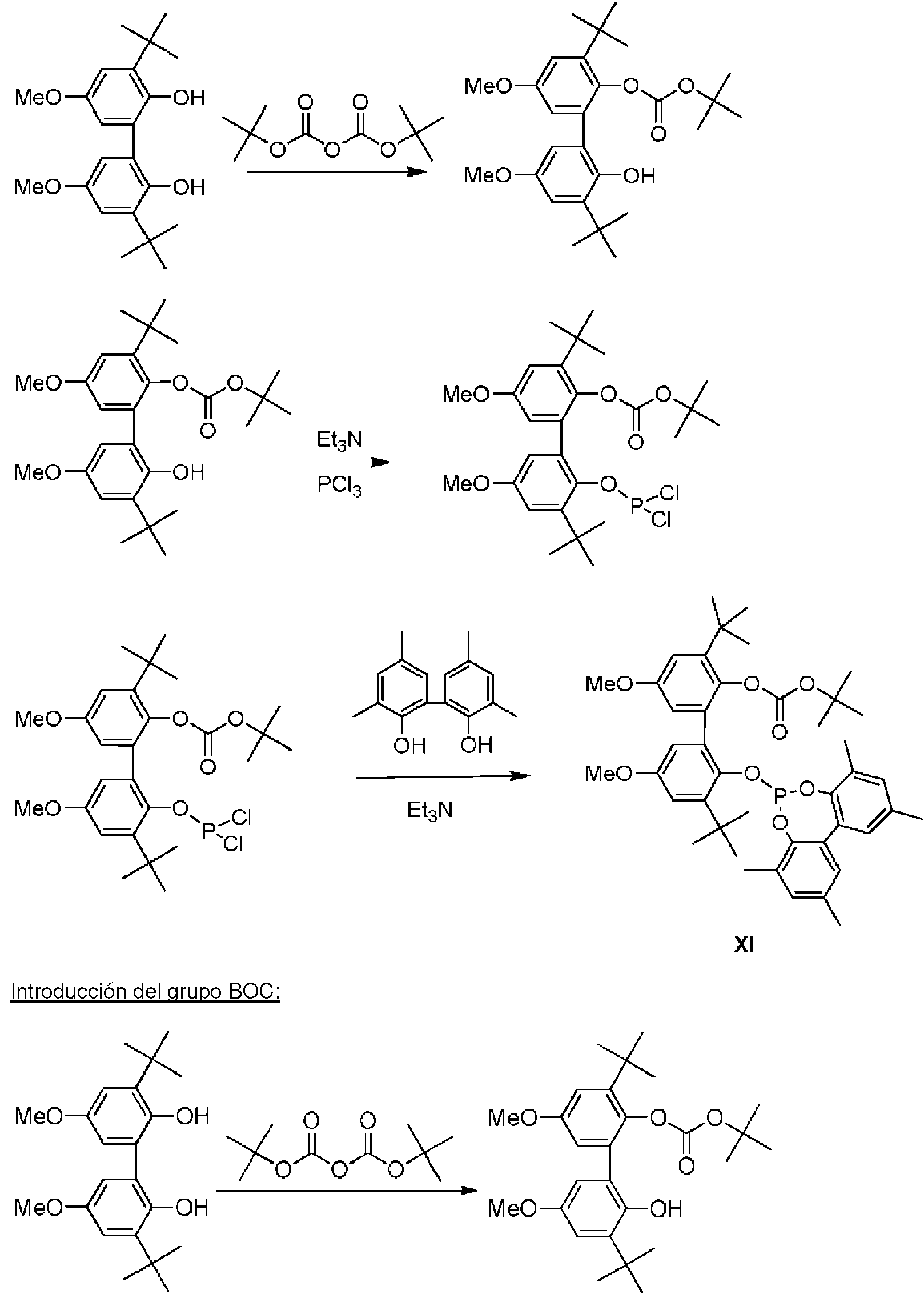
En un matraz Schlenk de 2 l se disuelven 400 mmol (143,8 g) del 3,3’-di-terc-butil-5,5’-dimetoxi-[1,1’-bifenil]-2,2’-diol y 40 mmol (4,8 g) de W,W-dimetilaminopiridina (DMAP) en 900 ml de CH2Cl2. A continuación se disolvieron a temperatura ambiente 400 mmol (88 g) de dicarbonato de di-terc-butilo en 280 ml de CH2Cl2, se pasaron a un embudo de goteo de 500 ml y en el plazo de una hora a 32°C se añadieron gota a gota a la disolución de bifenol/DMAP. La disolución se agitó durante la noche a temperatura ambiente. A la mañana siguiente se eliminó el disolvente a presión reducida. El residuo rojizo, ligeramente ceroso, se mezcló con 800 ml de n-heptano y se agitó durante la noche. A este respecto, se obtuvo un residuo blanco, que se separó por filtrado, se lavó adicionalmente dos veces con 50 ml de n-heptano y entonces se secó. El producto objetivo pudo obtenerse como sólido blanco (161,6 g, 84%). 1H-RMN (tolueno-d8): 95% e impurezas adicionales.In a 2 L Schlenk flask, 400 mmol (143.8 g) of 3,3'-di-tert-butyl-5,5'-dimethoxy- [1,1'-biphenyl] -2,2'- are dissolved diol and 40 mmol (4.8 g) of W, W-dimethylaminopyridine (DMAP) in 900 ml of CH2Cl2. Then 400 mmol (88 g) of di-tert-butyl dicarbonate were dissolved in 280 ml of CH2Cl2 at room temperature, transferred to a 500 ml dropping funnel and added within one hour at 32 ° C. dropwise to the biphenol / DMAP solution. The solution was stirred overnight at room temperature. The next morning the solvent was removed under reduced pressure. The slightly waxy, reddish residue was mixed with 800 ml of n-heptane and stirred overnight. In this regard, a white residue was obtained, which was filtered off, further washed twice with 50 ml of n-heptane and then dried. The target product could be obtained as a white solid (161.6 g, 84%). 1 H-NMR (toluene-d 8 ): 95% and additional impurities.
Reacción de carbonato de terc-butil-(3.3’-di-terc-butil-2’-hidroxi-5.5’-dimetoxi-[1.1’-bifenil1-2-ilo) con tricloruro de fósforo: Reaction of tert-butyl- (3.3'-di-tert-butyl-2'-hydroxy-5.5'-dimethoxy- [1.1'-biphenyl-1-2-yl) with phosphorous trichloride:

En un matraz Schlenk de 250 ml sin trazas de aire y de agua se disolvieron 12 g (0,026 mol) de carbonato de tercbutil-(3,3’-di-terc-butil-2’-hidroxi-5,5’-dimetoxi-[1,1’-bifenil]-2-ilo) con agitación en 120 ml de tolueno secado y 12,8 ml (0,091 mol) de trietilamina.In a 250 ml Schlenk flask without traces of air and water, 12 g (0.026 mol) of tert-butyl- (3,3'-di-tert-butyl-2'-hydroxy-5,5'-dimethoxy carbonate were dissolved - [1,1'-biphenyl] -2-yl) with stirring in 120 ml of dried toluene and 12.8 ml (0.091 mol) of triethylamine.
En un segundo matraz Schlenk de 500 ml se agitaron en primer lugar 100 ml de tolueno secado con 8,1 ml (0,091 mol) de tricloruro de fósforo. A continuación, se añadió gota a gota la disolución de tricloruro de fósforotolueno a la disolución de carbonato-amina-tolueno producida anteriormente en el plazo de 30 minutos a temperatura ambiente. Tras la adición completa se calentó durante 30 minutos hasta 80°C y se enfrió durante la noche hasta temperatura ambiente.In a second 500 ml Schlenk flask, 100 ml of dried toluene was first stirred with 8.1 ml (0.091 mol) of phosphorous trichloride. Then, the phosphorotoluene trichloride solution was added dropwise to the carbonate-amine-toluene solution produced above within 30 minutes at room temperature. After complete addition it was heated for 30 minutes to 80 ° C and cooled overnight to room temperature.
A la mañana siguiente se filtró la mezcla, se lavó adicionalmente con 50 ml de tolueno secado y se concentró el filtrado hasta sequedad. El producto objetivo pudo obtenerse como sólido (13,1 g, 89%). 31P-RMN (202,4 MHz, tolueno-d8): 203,2 y 203,3 ppm (100%).The next morning the mixture was filtered, further washed with 50 ml of dried toluene and the filtrate was concentrated to dryness. The target product could be obtained as a solid (13.1 g, 89%). 31P-NMR (202.4 MHz, toluene-d8): 203.2 and 203.3 ppm (100%).
Reacción de carbonato de terc-butil-(3.3’-di-terc-butil-2’-((diclorofosfino)oxi)-5.5’-dimetoxi-[1.1’-bifenil1-2-ilo) con 3.3’.5.5’-tetrametil-(1.1 ’-bifenil)-2.2’-diolReaction of tert-butyl- (3.3'-di-tert-butyl-2 '- ((dichlorophosphino) oxy) -5.5'-dimethoxy- [1.1'-biphenyl-1-2-yl) carbonate with 3.3'.5.5'- tetramethyl- (1.1'-biphenyl) -2.2'-diol

En un matraz Schlenk de 1 l sin trazas de aire y de agua se disolvieron 24,7 g (0,044 mol) de carbonato de terc-butil-(3,3’-di-terc-butil-2’-((diclorofosfino)oxi)-5,5’-dimetoxi-[1,1’-bifenil]-2-ilo) en 400 ml de acetonitrilo. En un segundo matraz Schlenk sin trazas de aire y de agua (1 l) se disolvieron 10,8 g (0,044 mol) de 3,3’,5,5’-tetrametil-(1, 1 ’-bifenil)-2,2’-diol en 200 ml de acetonitrilo y 13,1 ml (0,011 mol) de trietilamina secada con agitación. A continuación, se añadió gota a gota a la disolución de bifenol-trietilamina lentamente la disolución de clorofosfito y se agitó durante la noche.24.7 g (0.044 mol) of tert-butyl- (3,3'-di-tert-butyl-2 '- ((dichlorophosphino) carbonate were dissolved in a 1 L Schlenk flask without traces of air and water oxy) -5,5'-dimethoxy- [1,1'-biphenyl] -2-yl) in 400 ml of acetonitrile. In a second Schlenk flask without traces of air and water (1 l), 10.8 g (0.044 mol) of 3,3 ', 5,5'-tetramethyl- (1, 1'-biphenyl) -2, were dissolved. 2'-diol in 200 ml of acetonitrile and 13.1 ml (0.011 mol) of triethylamine dried with stirring. Then, the chlorophosphite solution was added dropwise to the biphenol-triethylamine solution slowly and stirred overnight.
La mezcla básica se filtró después y el residuo se lavó dos veces con 15 ml de acetonitrilo. El filtrado se concentró a presión reducida hasta que precipitó un depósito. Este se filtró y se secó. El producto objetivo (XI) pudo obtenerse como sólido blanco (28,5 g, 87%). 31P-RMN (202,4 MHz, tolueno-d8): 139,4 ppm (98,5%).The basic mixture was then filtered and the residue was washed twice with 15 ml of acetonitrile. The filtrate was concentrated under reduced pressure until a deposit precipitated. This was filtered and dried. The target product (XI) could be obtained as a white solid (28.5 g, 87%). 31 P-NMR (202.4 MHz, toluene-d 8 ): 139.4 ppm (98.5%).
Ejemplo 2: Síntesis de (XII):Example 2: Synthesis of (XII):
Reacción de carbonato de terc-butil-(3.3’-di-terc-butil-2’-hidroxi-5.5’-dimetoxi-[1.1’-bifenil1-2-ilo) con 2-cloro-4.4.5.5-tetrafenil-1.3.2-dioxafosfolano Reaction of tert-butyl- (3.3'-di-tert-butyl-2'-hydroxy-5.5'-dimethoxy- [1.1'-biphenyl-1-2-yl) with 2-chloro-4.4.5.5-tetraphenyl-1.3 .2-dioxaphospholane

En un matraz Schlenk de 250 ml sin trazas de aire y de agua se disolvieron 9,1 g (0,021 mol) de 2-cloro-4,4,5,5-tetrafenil-1,3,2-dioxafosfolano en 75 ml de tolueno secado.In a 250 ml Schlenk flask without traces of air and water, 9.1 g (0.021 mol) of 2-chloro-4,4,5,5-tetraphenyl-1,3,2-dioxaphospholane were dissolved in 75 ml of dried toluene.
En un segundo matraz de Schlenk (250 ml) se disolvieron 9,2 g (0,02 mol) de carbonato de terc-butil-(3,3’-di-tercbutil-2’-hidroxi-5,5’-dimetoxi-[1,1 ’-bifenil]-2-ilo) y 2,3 g (0,02 mol) de terc-butilato de potasio con agitación en 75 ml de tolueno secado.In a second Schlenk flask (250 ml), 9.2 g (0.02 mol) of tert-butyl- (3,3'-di-tert-butyl-2'-hydroxy-5,5'-dimethoxy carbonate were dissolved - [1,1'-biphenyl] -2-yl) and 2.3 g (0.02 mol) of potassium tert-butylate with stirring in 75 ml of dried toluene.
A continuación, se goteó a la disolución de clorofosfito lentamente a temperatura ambiente la mezcla de carbonatoterc-butilato de potasio-tolueno y se agitó durante la noche a temperatura ambiente.Then, the mixture of potassium carbonate-tert-butylate-toluene was slowly dripped into the chlorophosphite solution at room temperature and stirred overnight at room temperature.
A continuación, se eliminó el disolvente a presión reducida. El residuo obtenido se agitó 5 horas en 75 ml de acetonitrilo secado. El sólido se filtró, se lavó adicionalmente con acetonitrilo secado y se secó. El producto objetivo (XII) pudo obtenerse como sólido blanco (15,3 g, 90%). 31P-RMN (202,4 MHz, t-tolueno-d8): 147,0 ppm (99%).Then the solvent was removed under reduced pressure. The residue obtained was stirred for 5 hours in 75 ml of dried acetonitrile. The solid was filtered, further washed with dried acetonitrile, and dried. The target product (XII) could be obtained as a white solid (15.3 g, 90%). 31 P-NMR (202.4 MHz, t-toluene-d 8 ): 147.0 ppm (99%).
Ejemplo 3: Síntesis de (XIII):Example 3: Synthesis of (XIII):
Reacción de carbonato de terc-butil-(3,3’-di-terc-butil-2’((diclorofosfino)oxi)-5,5’-dimetoxi-[1,1’-bifenil1-2-ilo) con 2,2’-bifenolReaction of tert-butyl- (3,3'-di-tert-butyl-2 '((dichlorophosphino) oxy) -5,5'-dimethoxy- [1,1'-biphenyl-1-2-yl) carbonate with 2 , 2'-biphenol

En un matraz Schlenk de 250 ml sin trazas de aire y de agua se disolvieron 10,5 g (0,019 mol) de carbonato de tercbutil-(3,3’-di-terc-butil-2’-((diclorofosfino)oxi)-5,5’-dimetoxi-[1,1’-bifenil]-2-ilo) con agitación en 50 ml de acetonitrilo desgasificado.In a 250 ml Schlenk flask with no traces of air and water, 10.5 g (0.019 mol) of tert-butyl- (3,3'-di-tert-butyl-2 '- ((dichlorophosphino) oxy) carbonate were dissolved -5,5'-dimethoxy- [1,1'-biphenyl] -2-yl) with stirring in 50 ml of degassed acetonitrile.
En un segundo matraz Schlenk sin trazas de aire y de agua (250 ml) se disolvieron 3,6 g (0,019 mol) de 2,2’-bifenol en 40 ml de acetonitrilo desgasificado y 6,3 ml (0,045 mol) de trietilamina secada con agitación. A continuación, se añadió gota a gota a la disolución de bifenol-trietilamina lentamente a temperatura ambiente la mezcla de clorofosfito y se agitó durante la noche a temperatura ambiente. El sólido obtenido se filtró y se secó. El producto objetivo (XIII) pudo obtenerse como sólido blanco (11,5 g, 90%). 31P-RMN (202,4 MHz, tolueno-d8): 146,2 ppm (100%). In a second Schlenk flask without traces of air and water (250 ml), 3.6 g (0.019 mol) of 2,2'-biphenol were dissolved in 40 ml of degassed acetonitrile and 6.3 ml (0.045 mol) of triethylamine dried with shaking. Then, the chlorophosphite mixture was added dropwise to the biphenol-triethylamine solution slowly at room temperature and stirred overnight at room temperature. The solid obtained was filtered and dried. The target product (XIII) could be obtained as a white solid (11.5 g, 90%). 31 P-NMR (202.4 MHz, toluene-d 8 ): 146.2 ppm (100%).
Ejemplo 4: Síntesis de (XIV):Example 4: Synthesis of (XIV):
Reacción de carbonato de terc-butil-(3.3’-di-terc-butil-2’-((diclorofosfino)oxi)-5.5’-dimetoxi-[1.1’-bifenil1-2-ilo) con 3.3.5.5-tetra-terc-butil-bifenolReaction of tert-butyl- (3.3'-di-tert-butyl-2 '- ((dichlorophosphino) oxy) -5.5'-dimethoxy- [1.1'-biphenyl-1-2-yl) carbonate with 3.3.5.5-tetra- tert-butyl-biphenol

En un matraz Schlenk de 250 ml sin trazas de aire y de agua se disolvieron 7.0 g (0.0125 mol) de carbonato de tercbutil-(3.3’-di-terc-butil-2’-((diclorofosfino)oxi)-5.5’-dimetoxi-[1.1 ’-bifenil]-2-ilo) en 100 ml de acetonitrilo secado.7.0 g (0.0125 mol) of tert-butyl- (3.3'-di-tert-butyl-2 '- ((dichlorophosphino) oxy) -5.5'- carbonate were dissolved in a 250 ml Schlenk flask without traces of air and water. dimethoxy- [1.1'-biphenyl] -2-yl) in 100 ml of dried acetonitrile.
En un segundo matraz Schlenk sin trazas de aire y de agua (100 ml) se disolvieron 5.1 g (0.0125 mol) de 3.3’.5.5’-tetra-terc-butil-bifenol en 60 ml de acetonitrilo secado y 4.2 ml (0.03 mol) de trietilamina secada con agitación. A continuación. se goteó la disolución de bifenol-trietilamina lentamente a temperatura ambiente a la disolución de clorofosfito y se agitó durante la noche. Una parte del disolvente se eliminó a presión reducida. El sólido precipitado se filtró y se secó. El producto objetivo (XIV) pudo obtenerse como sólido blanco (10.2 g. 91%). 31P-RMN (202.4 MHz. tolueno-de): 142.7 ppm (100%).In a second Schlenk flask without traces of air and water (100 ml), 5.1 g (0.0125 mol) of 3.3'.5.5'-tetra-tert-butyl-biphenol were dissolved in 60 ml of dried acetonitrile and 4.2 ml (0.03 mol ) of triethylamine dried with stirring. Then. The biphenol-triethylamine solution was slowly dropped at room temperature into the chlorophosphite solution and stirred overnight. A part of the solvent was removed under reduced pressure. The precipitated solid was filtered and dried. The target product (XIV) could be obtained as a white solid (10.2 g. 91%). 31P-NMR (202.4 MHz. Toluene-de): 142.7 ppm (100%).
Ejemplo 5: Síntesis de (XV):Example 5: Synthesis of (XV):
Reacción de carbonato de terc-butil-(3.3’-di-terc-butil-2’-((diclorofosfino)oxi)-5.5’-dimetoxi-[1.1’-bifenil1-2-ilo) con 3.3-di-terc-butil-5.5-dimetoxi-bifenolReaction of tert-butyl- (3.3'-di-tert-butyl-2 '- ((dichlorophosphino) oxy) -5.5'-dimethoxy- [1.1'-biphenyl-1-2-yl) carbonate with 3.3-di-tert- butyl-5.5-dimethoxy-biphenol

En un matraz Schlenk de 250 ml sin trazas de aire y de agua se disolvieron 7 g (0.0125 mol) de carbonato de tercbutil-(3.3’-di-terc-butil-2’-((diclorofosfino)oxi)-5.5’-dimetoxi-[1.1 ’-bifenil]-2-ilo) en 100 ml de acetonitrilo secado.In a 250 ml Schlenk flask without traces of air and water, 7 g (0.0125 mol) of carbonate of tert-butyl- (3.3'-di-tert-butyl-2 '- ((dichlorophosphino) oxy) -5.5'- dimethoxy- [1.1'-biphenyl] -2-yl) in 100 ml of dried acetonitrile.
En un segundo matraz Schlenk sin trazas de aire y de agua (100 ml) se disolvieron 4.5 g (0.0125 mol) de 3.3-di-tercbutil-5.5-dimetoxi-bifenol en 60 ml de acetonitrilo secado y 4.2 ml (0.03 mol) de trietilamina desgasificada. A continuación. se goteó la disolución de bifenol-trietilamina lentamente a 40°C a la disolución de clorofosfito y se calentó la mezcla de reacción hasta 80°C y se agitó durante 6 h a esta temperatura. A continuación. se filtró en caliente.In a second Schlenk flask without traces of air and water (100 ml), 4.5 g (0.0125 mol) of 3.3-di-tert-butyl-5.5-dimethoxy-biphenol were dissolved in 60 ml of dried acetonitrile and 4.2 ml (0.03 mol) of degassed triethylamine. Then. The biphenol-triethylamine solution was slowly dropped at 40 ° C into the chlorophosphite solution and the reaction mixture was heated to 80 ° C and stirred for 6 h at this temperature. Then. leaked hot.
Una parte del disolvente se eliminó a presión reducida. El sólido precipitado se filtró y se secó. El producto objetivo (XV) pudo obtenerse como sólido blanco (10.5 g. 96%). 31P-RMN (202.4 MHz. tolueno-de): 140.9 ppm (95.2%) e impurezas adicionales (impurezas adicionales = compuestos de P-H. compuestos de óxido. clorofosfito que todavía no ha reaccionado completamente). A part of the solvent was removed under reduced pressure. The precipitated solid was filtered and dried. The target product (XV) could be obtained as a white solid (10.5 g, 96%). 31 P-NMR (202.4 MHz. Toluene-de): 140.9 ppm (95.2%) and additional impurities (additional impurities = PH compounds. Oxide compounds. Chlorophosphite that has not yet fully reacted).
Ejemplo 6: Síntesis de (XVI):Example 6: Synthesis of (XVI):
Reacción de carbonato de terc-butil-(3.3’-di-terc-butil-2’-((diclorofosfino)oxi)-5.5’-dimetoxi-[1.1’-bifenil1-2-ilo) con 2.4-dimetilfenolReaction of tert-butyl- (3.3'-di-tert-butyl-2 '- ((dichlorophosphino) oxy) -5.5'-dimethoxy- [1.1'-biphenyl-1-2-yl) carbonate with 2.4-dimethylphenol

En un matraz Schlenk de 500 ml sin trazas de aire y de agua se disolvieron 6.8 g (0.012 mol) de carbonato de tercbutil-(3.3’-di-terc-butil-2’-((diclorofosfino)oxi)-5.5’-dimetoxi-[1.1 ’-bifenil]-2-ilo) en 100 ml de acetonitrilo secado.6.8 g (0.012 mol) of tert-butyl- (3.3'-di-tert-butyl-2 '- ((dichlorophosphino) oxy) -5.5'- carbonate were dissolved in a 500 ml Schlenk flask without traces of air and water. dimethoxy- [1.1'-biphenyl] -2-yl) in 100 ml of dried acetonitrile.
En un segundo matraz Schlenk sin trazas de aire y de agua (250 ml) se disolvieron 6 g (6 ml; 0.048 mol) de 2.4-dimetilfenol en 100 ml de acetonitrilo secado y 5 g (7 ml; 0.059 mol) de trietilamina desgasificada. A continuación. se goteó la disolución de bifenol-trietilamina lentamente a temperatura ambiente a la disolución de clorofosfito y se agitó durante la noche a temperatura ambiente y se enfrió a la mañana siguiente en baño de hielo.In a second Schlenk flask without traces of air and water (250 ml) 6 g (6 ml; 0.048 mol) of 2.4-dimethylphenol were dissolved in 100 ml of dried acetonitrile and 5 g (7 ml; 0.059 mol) of degassed triethylamine . Then. The biphenol-triethylamine solution was slowly dripped at room temperature into the chlorophosphite solution and stirred overnight at room temperature and cooled the next morning in an ice bath.
Una parte del disolvente se eliminó a presión reducida. A este respecto. se produjo una disolución mucilaginosa. que tras un secado prolongado se convirtió en sólida. El producto objetivo (XVI) pudo obtenerse como sólido blanco (11.8 g. 62%). 31P-RMN (202.4 MHz. tolueno-d8): 139.1 ppm (92.8%) e impurezas adicionales (impurezas adicionales = compuestos de P-H. compuestos de óxido. clorofosfito que todavía no ha reaccionado completamente).A part of the solvent was removed under reduced pressure. In this regard. a mucilaginous solution was produced. which after prolonged drying became solid. The target product (XVI) could be obtained as a white solid (11.8 g, 62%). 31P-NMR (202.4 MHz. Toluene-d8): 139.1 ppm (92.8%) and additional impurities (additional impurities = P-H compounds. Oxide compounds. Chlorophosphite that has not yet fully reacted).
Ejemplo 7: Síntesis de etilfosfito de bis(2,4-di-terc-butil-6-metilfenilo)Example 7: Synthesis of bis (2,4-di-tert-butyl-6-methylphenyl) ethylphosphite

En un matraz Schlenk de 250 ml con agitador magnético. pieza sobrepuesta. embudo de goteo y enfriador de reflujo se colocaron previamente 22.5 g (0.1 mol) de 2.4-di-terc-butil-6-metilfenol (4.6-di-terc-butil-orto-cresol) y se calentó hasta 55°C para fundir el fenol. A la masa fundida se le añadieron 0.13 ml (0.0015 mol) de dimetilformamida desgasificada. secada. A continuación. se añadieron gota a gota en el plazo de 2 horas 5.7 ml (0.065 mol) de tricloruro de fósforo. Tras terminar la adición se calentó la mezcla de reacción en el plazo de 3 horas hasta 140°C y se agitó 1 hora a esta temperatura. Entonces se agitó a vacío 1 hora a 130°C. Después se enfrió la masa fundida amarilla-naranja transparente obtenida (= bis(2.4-di-terc-butil-6-metil)-fosforocloridita) durante la noche hasta 80°C y se diluyó con 75 ml de bencina desgasificada (80-110°C). Tras el enfriamiento de la disolución hasta -5°C se añadieron en el plazo de 15 minutos 9.1 ml (0.0665 mol) de trietilamina desgasificada. A continuación. se añadieron gota a gota en el plazo de 2 horas 4.4 ml (0.075 mol) de etanol secado y desgasificado. no aumentando la temperatura por encima de 5°C. Esta mezcla se calentó con agitación lentamente durante la noche hasta temperatura ambiente.In a 250 ml Schlenk flask with a magnetic stirrer. overlay piece. dropping funnel and reflux cooler, 22.5 g (0.1 mol) of 2.4-di-tert-butyl-6-methylphenol (4.6-di-tert-butyl-ortho-cresol) were previously placed and heated to 55 ° C to melt phenol. 0.13 ml (0.0015 mol) of degassed dimethylformamide was added to the melt. dried. Then. 5.7 ml (0.065 mol) of phosphorous trichloride were added dropwise within 2 hours. After completion of the addition, the reaction mixture was heated to 140 ° C within 3 hours and stirred at this temperature for 1 hour. Then it was stirred under vacuum for 1 hour at 130 ° C. The obtained clear yellow-orange melt (= bis (2,4-di-tert-butyl-6-methyl) -phosphorochloridite) was then cooled overnight to 80 ° C and diluted with 75 ml of degassed benzine (80-110 ° C). After cooling the solution to -5 ° C, 9.1 ml (0.0665 mol) of degassed triethylamine were added within 15 minutes. Then. 4.4 ml (0.075 mol) of dried and degassed ethanol were added dropwise within 2 hours. not increasing the temperature above 5 ° C. This mixture was heated with stirring slowly overnight to room temperature.
A la mañana siguiente se separó por filtrado el hidrocloruro de trietilamina precipitado y se concentró el filtrado a presión reducida. Se produjo un residuo blanco. que se recristalizó en 60 ml de etanol desgasificado. El producto pudo obtenerse así con un rendimiento del 73.9% (19.03 g) como sólido blanco con una pureza del 98% según CL-EM. The next morning the precipitated triethylamine hydrochloride was filtered off and the filtrate was concentrated under reduced pressure. A white residue was produced. which was recrystallized from 60 ml of degassed ethanol. The product could thus be obtained in a yield of 73.9% (19.03 g) as a white solid with a purity of 98% according to LC-MS.
Reducción del cloroChlorine reduction
Ejemplo 8: Reducción del cloro de (XI)Example 8: Chlorine reduction of (XI)
a) Tolueno-DMAB/acetonitrilo-DMABa) Toluene-DMAB / acetonitrile-DMAB
En un matraz Schlenk de 500 ml sin trazas de aire y de agua se calentaron 10 g de ligando bruto (XI) con un índice de cloro de partida del 5,7% en peso en 40 ml de tolueno desgasificado y 10 ml de W,W'-dimetilaminobutano con agitación hasta 1052C.In a 500 ml Schlenk flask with no traces of air and water, 10 g of crude ligand (XI) with a starting chlorine number of 5.7% by weight were heated in 40 ml of degassed toluene and 10 ml of W, W'-dimethylaminobutane with stirring until 1052C.
En un segundo matraz Schlenk de 500 ml sin trazas de aire y de agua se colocaron previamente con agitación 90 ml de acetonitrilo desgasificado y 10 ml de W,W'-dimetilaminobutano. A continuación, se goteó en el plazo de un par de minutos con agitación la disolución de ligando/tolueno/amina a temperatura ambiente a la disolución de acetonitriloamina. Para frenar el porcentaje de sólidos insolubles se goteó a través de una frita.In a second 500 ml Schlenk flask without traces of air and water, 90 ml of degassed acetonitrile and 10 ml of W, W'-dimethylaminobutane were previously placed with stirring. The ligand / toluene / amine solution at room temperature was then dripped into the acetonitriloamine solution within a couple of minutes with stirring. To stop the percentage of insoluble solids it was dripped through a frit.
Tras agitar la disolución transparente durante 12 horas se eliminó el disolvente a presión reducida. A continuación, se mezcló el sólido obtenido con 40 ml de acetonitrilo desgasificado y se agitó a temperatura ambiente durante 12 horas. Entonces se filtró la mezcla y se secó. El producto pudo obtenerse con un rendimiento del 67% (5,9 g).After stirring the clear solution for 12 hours, the solvent was removed under reduced pressure. Then, the solid obtained was mixed with 40 ml of degassed acetonitrile and stirred at room temperature for 12 hours. The mixture was then filtered and dried. The product could be obtained in a yield of 67% (5.9 g).
Resultado de RMN: 100% P 139,3 ppm (tolueno-d8).NMR result: 100% P 139.3 ppm (toluene-d8).
Resultado de la determinación doble de cloro según Wickbold: 65/65 mg/kg (ppm)Result of double chlorine determination according to Wickbold: 65/65 mg / kg (ppm)
Para la precisión se analizaron los índices de cloro en una determinación doble.For precision the chlorine indices were analyzed in a double determination.
b) Tolueno-DMAB/acetonitrilob) Toluene-DMAB / acetonitrile
En un matraz Schlenk de 2 l sin trazas de aire y de agua se calentaron 115,6 g de ligando bruto (XI) con un índice de cloro de partida del 5,7% en peso en 460 ml de tolueno desgasificado y 100 ml de W,W'-dimetilaminobutano con agitación hasta 105°C y se agitó aproximadamente 10 min a esta temperatura.In a 2 l Schlenk flask without traces of air and water, 115.6 g of crude ligand (XI) with a starting chlorine number of 5.7% by weight were heated in 460 ml of degassed toluene and 100 ml of W, W'-dimethylaminobutane with stirring up to 105 ° C and stirring for approximately 10 min at this temperature.
Para el procesamiento adicional se enfrió la mezcla hasta temperatura ambiente y se filtró a través de una frita. Entonces se concentró el filtrado obtenido por medio de presión reducida hasta sequedad. A continuación, se mezcló el sólido obtenido con 290 ml de acetonitrilo desgasificado, se agitó 15 min a 78°C, se enfrió de nuevo hasta temperatura ambiente y se agitó a temperatura ambiente durante la noche. Por la mañana se separó por filtrado el sólido, se lavó adicionalmente con 50 ml de acetonitrilo desgasificado, se secó. El producto pudo obtenerse con un rendimiento del 61,8%.For further processing the mixture was cooled to room temperature and filtered through a frit. Then the obtained filtrate was concentrated under reduced pressure to dryness. Subsequently, the solid obtained was mixed with 290 ml of degassed acetonitrile, stirred for 15 min at 78 ° C, cooled again to room temperature and stirred at room temperature overnight. In the morning the solid was filtered off, washed further with 50 ml of degassed acetonitrile, dried. The product could be obtained in a yield of 61.8%.
Resultado de RMN: 100% P 139,3 ppm (tolueno-d8).NMR result: 100% P 139.3 ppm (toluene-d8).
Resultado de la determinación doble de cloro según Wickbold: 75/80 mg/kg (ppm)Result of double chlorine determination according to Wickbold: 75/80 mg / kg (ppm)
c) Tolueno-DMAB/acetonitriloc) Toluene-DMAB / acetonitrile
En un matraz Schlenk de 2 l sin trazas de aire y de agua se calentaron 189,6 g de ligando bruto (XI) con un índice de cloro de partida del 1,1% en peso en 760 ml de tolueno desgasificado y 165 ml de W,W'-dimetilaminobutano con agitación hasta 105°C y se agitó aproximadamente durante 10 min a esta temperatura.In a 2 l Schlenk flask without traces of air and water, 189.6 g of crude ligand (XI) with a starting chlorine number of 1.1% by weight were heated in 760 ml of degassed toluene and 165 ml of W, W'-dimethylaminobutane with stirring up to 105 ° C and stirring for approximately 10 min at this temperature.
Para el procesamiento adicional se enfrió la mezcla hasta temperatura ambiente y se filtró a través de una frita. Entonces se concentró el filtrado obtenido por medio de presión reducida hasta sequedad, se mezcló con 475 ml de acetonitrilo desgasificado, se agitó durante 15 min a 75°C y entonces se enfrió durante la noche con agitación de nuevo hasta temperatura ambiente. Por la mañana se separó por filtrado el sólido, se lavó adicionalmente con 50 ml de acetonitrilo desgasificado, se secó.For further processing the mixture was cooled to room temperature and filtered through a frit. The filtrate obtained was then concentrated to dryness under reduced pressure, mixed with 475 ml of degassed acetonitrile, stirred for 15 min at 75 ° C and then cooled overnight with stirring again to room temperature. In the morning the solid was filtered off, washed further with 50 ml of degassed acetonitrile, dried.
El producto pudo obtenerse con un rendimiento del 86% (160 g).The product could be obtained in 86% yield (160 g).
Resultado de RMN: 100% P 139,3 ppm (tolueno-d8).NMR result: 100% P 139.3 ppm (toluene-d8).
Resultado de cloro según Wickbold: <10 mg/kg (ppm)Chlorine result according to Wickbold: <10 mg / kg (ppm)
d) Procesamiento por medio de tolueno/metanol/trietanolamina (ejemplo comparativo) d) Processing by means of toluene / methanol / triethanolamine (comparative example)
En un matraz Schlenk de 100 ml sin trazas de aire y de agua se pesaron 10,06 g (XI) con un índice de cloro de partida del 1,1% en peso y se mezclaron con 45 ml de tolueno desgasificado. Esta suspensión se calentó hasta 102°C y se dejó agitar durante 20 minutos. A este respecto, la mayor parte se disolvió. Solo pocas partículas eran insolubles. Después se filtró en caliente la disolución ligeramente enturbiada y se concentró el filtrado transparente a presión reducida a temperatura ambiente hasta sequedad.10.06 g (XI) with a starting chlorine number of 1.1% by weight were weighed into a 100 ml Schlenk flask without traces of air and water and mixed with 45 ml of degassed toluene. This suspension was heated to 102 ° C and allowed to stir for 20 minutes. In this regard, most of it dissolved. Only few particles were insoluble. The slightly cloudy solution was then filtered hot and the clear filtrate was concentrated under reduced pressure at room temperature to dryness.
A la mañana siguiente se añadieron 150 ml de metanol desgasificado y 15 ml de trietanolamina desgasificada al sólido del filtrado concentrado y se agitó 3 h. Se produjo una suspensión blanca. A continuación, se separó por filtrado y se secó el sólido.The next morning 150 ml of degassed methanol and 15 ml of degassed triethanolamine were added to the solid of the concentrated filtrate and stirred for 3 h. A white suspension was produced. Then it was filtered off and the solid was dried.
El producto pudo obtenerse con un rendimiento del 98% (9,8 g).The product could be obtained in a 98% yield (9.8 g).
Resultado de RMN: 100% P 139,3 ppm (tolueno-d8).NMR result: 100% P 139.3 ppm (toluene-d8).
Resultado de cloro según Wickbold: 120 mg/kg (ppm)Chlorine result according to Wickbold: 120 mg / kg (ppm)
Ejemplo 9: Reducción del cloro de (XV)Example 9: Reduction of chlorine from (XV)
a) Procesamiento por medio de etanol desgasificado 1% de agua desgasificada 5% de DMAB desgasificado a 0°Ca) Processing by means of degassed ethanol 1% degassed water 5% degassed DMAB at 0 ° C
Para el procesamiento se añadieron al ligando bruto (XV) con un índice de cloro de partida del 1,3% en peso con agitación en primer lugar 300 ml de etanol desgasificado y 15 ml de W,W'-dimetilaminobutano desgasificado y se agitó durante 2 h. Después se añadieron 3 ml de agua desmineralizada desgasificada, se enfrió hasta 0°C y se agitó la mezcla durante 2 h. Entonces se separó por filtrado el sólido, se lavó adicionalmente dos veces con 40 ml de etanol desgasificado, frío, y se secó.For work-up, 300 ml of degassed ethanol and 15 ml of degassed W, W'-dimethylaminobutane were added to the crude ligand (XV) with a starting chlorine number of 1.3% by weight with stirring and the mixture was stirred for 2 h. Then 3 ml of degassed demineralized water was added, cooled to 0 ° C and the mixture was stirred for 2 h. The solid was then filtered off, further washed twice with 40 ml of cold, degassed ethanol, and dried.
Resultado de la determinación doble de cloro según Wickbold: 20/20 mg/kg (ppm)Result of double chlorine determination according to Wickbold: 20/20 mg / kg (ppm)
Rendimiento: 68,01 g corresponden al 68,9%Yield: 68.01 g corresponds to 68.9%
b) Procesamiento por medio de agua/acetonitrilo/W,W'-dimetilaminobutano (10:10:1)b) Processing by means of water / acetonitrile / W, W'-dimethylaminobutane (10: 10: 1)
Para el procesamiento adicional se disolvió el ligando bruto (XV) con un índice de cloro de partida del 1,3% en peso con agitación en 40 ml de ACN desgasificado y 4 ml de W,W'-dimetilaminobutano desgasificado (5%). A continuación se agitó durante la noche a TA. Tras aproximadamente 1 h pudieron observarse las primeras precipitaciones. Por la mañana se añadieron a la mezcla 40 ml de agua desmineralizada desgasificada. La mezcla se agitó durante 30 min. A continuación se separó por filtrado el sólido, se lavó adicionalmente con poca agua desgasificada y se secó. Resultado de la determinación doble de cloro según Wickbold: 50/55 mg/kg (ppm)For further processing the crude ligand (XV) with a starting chlorine number of 1.3% by weight was dissolved with stirring in 40 ml of degassed ACN and 4 ml of degassed W, W'-dimethylaminobutane (5%). It was then stirred at RT overnight. After about 1 h the first precipitations could be observed. In the morning, 40 ml of degassed demineralized water was added to the mixture. The mixture was stirred for 30 min. The solid was then filtered off, washed further with a little degassed water and dried. Result of double chlorine determination according to Wickbold: 50/55 mg / kg (ppm)
Rendimiento 16,6 g corresponden al 64,02%Yield 16.6 g correspond to 64.02%
Tabla 1: Índices de cloroTable 1: Chlorine indices
1er disolvente 18 base 2° dis Índice de cloro, valor medio [ppm] 8a) tolueno DMAB aceto 651st solvent 18 base 2nd dis Chlorine number, mean value [ppm] 8a) toluene DMAB aceto 65
8b) tolueno DMAB aceto 77,58b) toluene DMAB aceto 77.5
8c) tolueno DMAB aceto < 108c) toluene DMAB aceto <10
8d)* tolueno metan 1208d) * toluene methane 120
9a) etanol 
9b) acetonitrilo DMAB H2O 
* ejemplo comparativo* comparative example
DMAB: dimetilaminobutanoDMAB: dimethylaminobutane
Los ejemplos anteriores muestran que mediante la utilización de dimetilaminobutano pudo reducirse el calor de cloro hasta un valor de menos de 100 ppm. The above examples show that by using dimethylaminobutane the heat of chlorine could be reduced to a value of less than 100 ppm.
Claims (13)


Applications Claiming Priority (7)
| Application Number | Priority Date | Filing Date | Title |
|---|---|---|---|
| DE102014209534.4A DE102014209534A1 (en) | 2014-05-20 | 2014-05-20 | New monophosphite ligands with a carbonate group |
| DE102014209536.0A DE102014209536A1 (en) | 2014-05-20 | 2014-05-20 | Production of high-quality oxo alcohols from unstable raw material sources |
| DE102014209532.8A DE102014209532A1 (en) | 2014-05-20 | 2014-05-20 | New monophosphite ligands with a tert-butyloxycarbonyl group |
| DE102014209533.6A DE102014209533A1 (en) | 2014-05-20 | 2014-05-20 | Mixtures of monophosphite ligand and their use to catalyze a hydroformylation reaction |
| DE102014209535 | 2014-05-20 | ||
| DE102015202722.8A DE102015202722A1 (en) | 2014-05-20 | 2015-02-16 | Process for the catalytic production of aldehydes from olefins using monophosphite mixtures |
| PCT/EP2015/059290 WO2015176929A1 (en) | 2014-05-20 | 2015-04-29 | Method for reducing the chlorine content of organomonophosphites using dimethylaminobutane, triethylamine or triethanolamine |
Publications (1)
| Publication Number | Publication Date |
|---|---|
| ES2772074T3 true ES2772074T3 (en) | 2020-07-07 |
Family
ID=53039422
Family Applications (3)
| Application Number | Title | Priority Date | Filing Date |
|---|---|---|---|
| ES15721626T Active ES2772074T3 (en) | 2014-05-20 | 2015-04-29 | Procedure for the reduction of the chlorine content of organomophosphites using dimethylaminobutane, triethylamine or triethanolamine |
| ES15720942T Active ES2724352T3 (en) | 2014-05-20 | 2015-04-29 | Procedure for the production of monophosphites |
| ES15719705T Active ES2715677T3 (en) | 2014-05-20 | 2015-04-29 | Procedure to reduce the chlorine content of organomonophosphites using two solutions |
Family Applications After (2)
| Application Number | Title | Priority Date | Filing Date |
|---|---|---|---|
| ES15720942T Active ES2724352T3 (en) | 2014-05-20 | 2015-04-29 | Procedure for the production of monophosphites |
| ES15719705T Active ES2715677T3 (en) | 2014-05-20 | 2015-04-29 | Procedure to reduce the chlorine content of organomonophosphites using two solutions |
Country Status (10)
| Country | Link |
|---|---|
| US (2) | US9751904B2 (en) |
| EP (3) | EP3145940B1 (en) |
| JP (1) | JP6490717B2 (en) |
| KR (1) | KR101898369B1 (en) |
| CN (1) | CN106414467A (en) |
| ES (3) | ES2772074T3 (en) |
| PL (1) | PL3145940T4 (en) |
| SG (1) | SG11201609677WA (en) |
| TW (3) | TW201602126A (en) |
| WO (3) | WO2015176929A1 (en) |
Families Citing this family (10)
| Publication number | Priority date | Publication date | Assignee | Title |
|---|---|---|---|---|
| DE102014201756A1 (en) | 2014-01-31 | 2015-08-06 | Evonik Degussa Gmbh | Purification of chlorine-contaminated organophosphorus compounds |
| DE102014202500A1 (en) | 2014-02-12 | 2015-08-13 | Evonik Degussa Gmbh | Process for reducing the chlorine content of organobisphosphites |
| EP3029013B1 (en) * | 2014-12-04 | 2018-06-13 | Evonik Degussa GmbH | Monophosphites with structural unit 4,4,5,5-Tetraphenyl-1,3,2-dioxaphospholan as ligands for hydroformylation catalysts |
| DE102015207864A1 (en) | 2015-04-29 | 2016-11-03 | Evonik Degussa Gmbh | New monophosphite compounds with an ether group |
| DE102015207860A1 (en) | 2015-04-29 | 2016-11-03 | Evonik Degussa Gmbh | New monophosphite compounds with a methyl group |
| EP3147291A1 (en) | 2015-09-28 | 2017-03-29 | Evonik Degussa GmbH | Method for reducing the chlorine content of organo tetraphosphites |
| EP3176174A1 (en) * | 2015-12-03 | 2017-06-07 | Evonik Degussa GmbH | Method for reducing the chlorine content of organo tetraphosphites |
| TWI874467B (en) | 2019-11-05 | 2025-03-01 | 美商陶氏科技投資有限公司 | Process for the recovery of rhodium from a catalyst purge stream from a c6 or higher olefin hydroformylation process |
| EP4393927B1 (en) * | 2022-12-27 | 2025-07-02 | Evonik Oxeno GmbH & Co. KG | Process for the preparation of a phosphoramidite and its further conversion to monophosphite |
| ES3041474T3 (en) | 2022-12-27 | 2025-11-12 | Evonik Oxeno Gmbh & Co Kg | Process for the preparation of monophosphites |
Family Cites Families (17)
| Publication number | Priority date | Publication date | Assignee | Title |
|---|---|---|---|---|
| FR2259104B1 (en) * | 1974-01-25 | 1976-11-26 | Rhone Poulenc Ind | |
| US4835299A (en) | 1987-03-31 | 1989-05-30 | Union Carbide Corporation | Process for purifying tertiary organophosphites |
| ATE203044T1 (en) * | 1992-10-05 | 2001-07-15 | Ciba Sc Holding Ag | METHOD FOR STABILIZING TRIVALUENT PHOSPHORUS COMPOUNDS WITH AMINES |
| US5440067A (en) | 1994-11-18 | 1995-08-08 | E. I. Dupont De Nemours And Company | Catalyzed gas phase isomerization of nonconjugated 2-alkyl-3-monoalkenenitriles |
| US5449807A (en) | 1994-11-18 | 1995-09-12 | E. I. Du Pont De Nemours And Company | Catalyzed vapor phase hydrocyanation of diolefinic compounds |
| US5962744A (en) | 1998-03-27 | 1999-10-05 | The Research Foundation Of State University Of New York | Process for hydrocarbonylations in supercritical carbon dioxide |
| DE19853748A1 (en) * | 1998-11-21 | 2000-05-25 | Studiengesellschaft Kohle Mbh | Production of chiral aldehyde by enantioselective hydroformylation, useful e.g. as intermediate for pharmaceuticals, uses transition metal catalyst complex containing phosphine-phosphite ligand |
| US6380421B1 (en) * | 1999-09-20 | 2002-04-30 | E. I. Du Pont De Nemours And Company | Multidentate phosphite ligands, catalytic compositions containing such ligands and catalytic processes utilizing such catalytic compositions |
| DE19953058A1 (en) | 1999-11-03 | 2001-05-10 | Basf Ag | Phosphites |
| DE102004049339A1 (en) | 2004-10-08 | 2006-04-13 | Basf Ag | Process for the purification of phosphorus-containing chelate ligands |
| GB0519651D0 (en) | 2005-09-27 | 2005-11-02 | Univ Nottingham | Ferrocenyl phosphite ligands for asymmetric catalysis and a method for their production |
| DE102006058682A1 (en) | 2006-12-13 | 2008-06-19 | Evonik Oxeno Gmbh | Bisphosphite ligands for transition metal-catalyzed hydroformylation |
| DE102008043584A1 (en) | 2008-11-07 | 2010-05-12 | Evonik Oxeno Gmbh | Process for the preparation of 6-chlorodibenzo (d, f) (1,3,2) -dioxaphosphepin |
| DE102011002640B4 (en) | 2011-01-13 | 2021-10-07 | Evonik Operations Gmbh | Process for the purification of Biphephos |
| DE102011085883A1 (en) * | 2011-11-08 | 2013-05-08 | Evonik Oxeno Gmbh | New organophosphorus compounds based on anthracentriol |
| US9108988B2 (en) * | 2011-12-30 | 2015-08-18 | Basf Se | Method of purifying organic diphosphite compounds |
| MX363617B (en) | 2011-12-30 | 2019-03-28 | Basf Se | Method for purifying organic diphosphite compounds. |
-
2015
- 2015-04-29 SG SG11201609677WA patent/SG11201609677WA/en unknown
- 2015-04-29 WO PCT/EP2015/059290 patent/WO2015176929A1/en not_active Ceased
- 2015-04-29 EP EP15719705.4A patent/EP3145940B1/en active Active
- 2015-04-29 WO PCT/EP2015/059289 patent/WO2015176928A1/en not_active Ceased
- 2015-04-29 EP EP15721626.8A patent/EP3145941B1/en active Active
- 2015-04-29 ES ES15721626T patent/ES2772074T3/en active Active
- 2015-04-29 PL PL15719705T patent/PL3145940T4/en unknown
- 2015-04-29 KR KR1020167035144A patent/KR101898369B1/en active Active
- 2015-04-29 WO PCT/EP2015/059278 patent/WO2015176927A1/en not_active Ceased
- 2015-04-29 ES ES15720942T patent/ES2724352T3/en active Active
- 2015-04-29 EP EP15720942.0A patent/EP3145938B1/en not_active Not-in-force
- 2015-04-29 JP JP2016568535A patent/JP6490717B2/en active Active
- 2015-04-29 CN CN201580025885.3A patent/CN106414467A/en active Pending
- 2015-04-29 US US15/312,024 patent/US9751904B2/en active Active
- 2015-04-29 US US15/311,996 patent/US9840524B2/en active Active
- 2015-04-29 ES ES15719705T patent/ES2715677T3/en active Active
- 2015-05-18 TW TW104115795A patent/TW201602126A/en unknown
- 2015-05-18 TW TW104115798A patent/TW201607953A/en unknown
- 2015-05-18 TW TW104115799A patent/TW201609778A/en unknown
Also Published As
| Publication number | Publication date |
|---|---|
| TW201607953A (en) | 2016-03-01 |
| US20170088570A1 (en) | 2017-03-30 |
| US9751904B2 (en) | 2017-09-05 |
| CN106414467A (en) | 2017-02-15 |
| TW201609778A (en) | 2016-03-16 |
| US9840524B2 (en) | 2017-12-12 |
| EP3145941A1 (en) | 2017-03-29 |
| KR101898369B1 (en) | 2018-09-12 |
| EP3145940B1 (en) | 2018-12-12 |
| EP3145938B1 (en) | 2018-12-26 |
| EP3145941B1 (en) | 2019-12-18 |
| EP3145940A1 (en) | 2017-03-29 |
| KR20170007428A (en) | 2017-01-18 |
| US20170121355A1 (en) | 2017-05-04 |
| EP3145938A1 (en) | 2017-03-29 |
| JP6490717B2 (en) | 2019-03-27 |
| TW201602126A (en) | 2016-01-16 |
| WO2015176927A1 (en) | 2015-11-26 |
| JP2017515874A (en) | 2017-06-15 |
| WO2015176929A1 (en) | 2015-11-26 |
| ES2715677T3 (en) | 2019-06-05 |
| SG11201609677WA (en) | 2016-12-29 |
| PL3145940T3 (en) | 2019-05-31 |
| ES2724352T3 (en) | 2019-09-10 |
| PL3145940T4 (en) | 2019-05-31 |
| WO2015176928A1 (en) | 2015-11-26 |
Similar Documents
| Publication | Publication Date | Title |
|---|---|---|
| ES2772074T3 (en) | Procedure for the reduction of the chlorine content of organomophosphites using dimethylaminobutane, triethylamine or triethanolamine | |
| CN103370328B (en) | Method for producing biphephos | |
| KR101138511B1 (en) | Method for producing trivalent organophosphorus compounds | |
| US9650401B2 (en) | Method for reducing the chlorine content of organobisphosphites | |
| ES2708393T3 (en) | Procedure for the purification of organic diphosphite compounds | |
| CN101684130B (en) | Preparation method of phosphite ester | |
| ES2746318T3 (en) | Bisphosphites with 2,4-tert-butylphenyl units and their use as ligands in hydroformylation | |
| TW201542576A (en) | Purification of chlorine-contaminated organophosphorus compounds | |
| CN1898256B (en) | Process for preparing organic acyl phosphite ester | |
| TWI630211B (en) | Process for reducing the chlorine content of organotetraphosphites | |
| ES2672568T3 (en) | Process for the preparation of 6,6 '- ((3,3'-di-tert-butyl-5,5'-dimethoxy- [1,1'-biphenyl] -2,2'-diyl) bis (oxy )) - bis (2,4,8,10-tetramethyldibenzo [d, f] [1,3,2] dioxaphosphepine | |
| US9701697B2 (en) | Process for reducing the chlorine content of organotetraphosphites | |
| Juribasic et al. | Unexpected course of Kabachnik-Fields reaction in the microwave synthesis of quinoline-based α-aminophosphonates | |
| JP4084095B2 (en) | Method for producing pentaerythritol diphosphonate | |
| Lemport et al. | Direct phosphorylation in the synthesis of new bis (phosphorylamino) pyridine ligands | |
| Garje et al. | Synthesis and characterization of triorganoarsenic (V) and-antimony (V) diphenylphosphinates |