EP4583584A1 - Drahtloses kommunikationssystem und verfahren dafür - Google Patents
Drahtloses kommunikationssystem und verfahren dafür Download PDFInfo
- Publication number
- EP4583584A1 EP4583584A1 EP23859713.2A EP23859713A EP4583584A1 EP 4583584 A1 EP4583584 A1 EP 4583584A1 EP 23859713 A EP23859713 A EP 23859713A EP 4583584 A1 EP4583584 A1 EP 4583584A1
- Authority
- EP
- European Patent Office
- Prior art keywords
- wireless
- mobile station
- ground
- station
- communication system
- Prior art date
- Legal status (The legal status is an assumption and is not a legal conclusion. Google has not performed a legal analysis and makes no representation as to the accuracy of the status listed.)
- Pending
Links
Images



Classifications
-
- H—ELECTRICITY
- H04—ELECTRIC COMMUNICATION TECHNIQUE
- H04W—WIRELESS COMMUNICATION NETWORKS
- H04W36/00—Hand-off or reselection arrangements
- H04W36/0005—Control or signalling for completing the hand-off
- H04W36/0083—Determination of parameters used for hand-off, e.g. generation or modification of neighbour cell lists
- H04W36/00838—Resource reservation for handover
-
- H—ELECTRICITY
- H04—ELECTRIC COMMUNICATION TECHNIQUE
- H04W—WIRELESS COMMUNICATION NETWORKS
- H04W36/00—Hand-off or reselection arrangements
- H04W36/34—Reselection control
- H04W36/36—Reselection control by user or terminal equipment
Definitions
- a wireless communication system for a mobile body needs to secure a wireless coverage for covering a range in which a wireless station (mobile station) included in the mobile body moves. If the wireless coverage is too large for one base station to cover, the mobile station requires handover control to switch a base station to communicate with depending on its location.
- a wireless station mobile station
- the payload signal 103 is generated as a wireless signal by modulating a bit string constituting the data packet using various modulation schemes.
- the bit string constituting the data packet is transferred between the ground side data transfer device and the mobile station side data transfer device.
- the base station before handover and other base stations around the base station before handover constantly communicate the reference signal and the header signal on all the downlink wireless channels (202).
- the header signal includes an identifier of the base station that is the transmitter thereof.
- the mobile station measures the received power of the reference signal at the base station before handover and the peripheral base station. Since each base station uses a different frequency as shown in Fig. 3 , it is possible to estimate the received power of reference signals transmitted by a plurality of base stations by switching time or frequency for observing the reference signals at the mobile station. Based on the measurement result, the mobile station lists, for example, three base stations in the descending order of intensity of the radio wave received power (203).
- the bidirectional communication (201) on the allocated channel with respect to each wireless frame as well as transmission of the downlink reference signal and the header signal (202) are repeated.
- the mobile station transmits the list of the base station identifiers generated at 203 to the ground wireless control device via the base station in communication (204).
- the information at 204 may be included in the uplink communication in 201 or may be transmitted with a wireless channel CH other than 201 being allocated thereto.
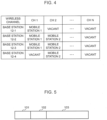
- the ground wireless control device updates the allocation of the wireless channel to the relevant mobile station as described with reference to Fig. 4 , based on the listing of the base station identifiers at 204 (205).
- the relevant mobile station transmits the allocation result of the wireless channel to the relevant mobile station, that is, a combination of the identifier of the base station and the wireless channel CH number, to the mobile station via the base station in communication as wireless channel allocation information for the number of the base stations to which the wireless channel CH is allocated (206).
- the information at 206 may be included as a part of downlink communication information about the bidirectional communication at 201, or may be notified with a wireless channel CH other than that of 201 being defined.
- the mobile station Upon receiving the information at 206, the mobile station updates information about which wireless channel CH for which base station is allocated in the mobile station (207).
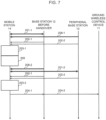
- Fig. 7 is a flowchart showing a procedure of handover by the present wireless communication system shown in Fig. 1 .
- the mobile station is allocated with the wireless channel CH at the base station before handover, and bidirectional communication is performed between the mobile station and the base station on the relevant allocated wireless channel (201-1).
- the base station before handover and other base stations around the base station before handover constantly communicate the reference signal and the header signal on all the downlink wireless channels (202).
- the header signal includes an identifier of the base station that is the transmitter thereof.
- the peripheral base station different from the base station before handover to which the wireless channel CH is already allocated in Fig. 6 transmits a downlink payload signal for the relevant mobile station (208).
- This downlink payload signal for transmission is the same as that of the base station before handover.
- the mobile station receives the payload signal of the base station before handover, and may or may not receive the payload signal of the peripheral base station.
- the mobile station When the mobile station receives the same payload signals from a plurality of base stations, the mobile station receives any one of the payload signals and destroys other payload signals due to the same content.
- the mobile station By including a sequence number in the payload signal and checking the sequence number included in each payload signal at the mobile station, when the sequence number already received at the mobile station is detected again, it is possible to determine it as the same payload signal and destroy the payload signal.
- the mobile station generates a list of handover candidate base stations based on 202 (203).
- the mobile station determines execution of handover at a timing when, for example, the received power of the reference signal of the handover candidate base station exceeds the received power of the reference signal of the base station before handover, based on comparison of the received power of the reference signals from the handover candidate base station to which the wireless channel is already allocated in Fig. 6 and the base station before handover (209).
- the mobile station After determining execution of handover, the mobile station changes a counterpart of the bidirectional communication from the base station before handover to the peripheral base station that was the handover candidate base station (201).
- the base station before handover continues to transmit the downlink payload signal since the wireless channel CH is still allocated to the relevant mobile station (208).
- the mobile station may or may not receive the downlink payload signal from the base station before handover.
- the downlink payload signal continues to be transmitted. Subsequently, as with Fig. 6 , measurement of the received power of the downlink reference signal (202), listing of the handover candidate base stations based on the measurement result (203), and transmission of the list to the ground wireless control device (204) are performed.
- the present wireless communication system can be summarized as follows.
- the mobile station 14 may preferably determine to which ground station 12 to hand over and whether to execute it or not based on the result of comparing the communication quality of the radio wave transmitted from the ground station 12 between the ground station 12 currently in communication and the handover candidate ground station 12. In such a case, the mobile station 14 starts to transmit the reference signal 101, the header signal 102, and the payload signal 103 to the ground station 12 to be handed over to using the wireless channel CH with the resource reserved for the relevant ground station 12.
- the mobile station 14 it is possible for the mobile station 14 to perform handover at the optimal timing convenient for itself. Even if the base station 12 to be handed over to fails, communication can be retained by handing over to another healthy ground station 12 based on determination by the mobile station 14 itself.
- the present wireless communication system described in the above [1] may preferably perform wireless resource reservation every time the selection of handover candidate ground station at the mobile station 14 changes without limitation on the number of times before performing handover.
- the ground stations 12 are arranged at intervals of 500 m to 1 km along a railway line to which the present wireless communication system is applied, and handover is performed once while a train being the mobile body 13 passes between them in 30 seconds.
- the wireless resource reservation is updated following the combination change, which allows for avoiding degradation in communication quality of the allocated wireless channel due to obsolescence of the wireless resource reservation.
- the present wireless communication system described in the above [1] or [2] may preferably perform communication between the ground stations 12 and the mobile station 14 on a plurality of appropriately switchable wireless channels. That is, as shown in Fig. 3 , the present wireless communication system may preferably apply frequency hopping in which the frequencies used by the base stations are changed with respect to each wireless channel CH as indicated by the numbers 1 to 4 in the table. According to such a present wireless communication system, even if the frequency used by the base station is close to the frequency used for Wi-Fi (R) or the like, it is easy to avoid the radio wave interference therewith, thereby reducing nuisance to the surroundings.
- Wi-Fi Wi-Fi
- each wireless channel of the present wireless communication system transferred on each wireless channel of the present wireless communication system are the reference signal 101 known to the receiving side, the header signal 102 referenced for the wireless signal receiving control, and the payload signal 103 for transferring information between the ground stations 12 and the mobile station 14.
- the reference signal 101 has a function of detecting a head timing of the wireless signal and a function of estimating received power of the reference signal. By performing a sliding correlation operation between a received signal and a known reference signal on the receiving side of the reference signal, the timing with the highest correlation value is determined to be a receiving timing, and the received power of the wireless signal is estimated from the correlation value of the timing.
- the mobile station 14 can measure the received power of the radio wave constantly transmitted from the base station in communication and the peripheral base station 12, it is possible to optimally operate as occasion may demand based on the measurement result. As a result, the present wireless communication system can prevent obsolescence of the wireless resource reservation caused by inability of measuring the radio wave received power.
Landscapes
- Engineering & Computer Science (AREA)
- Computer Networks & Wireless Communication (AREA)
- Signal Processing (AREA)
- Mobile Radio Communication Systems (AREA)
Applications Claiming Priority (2)
| Application Number | Priority Date | Filing Date | Title |
|---|---|---|---|
| JP2022135883 | 2022-08-29 | ||
| PCT/JP2023/016936 WO2024047942A1 (ja) | 2022-08-29 | 2023-04-28 | 無線通信システム及びその方法 |
Publications (1)
| Publication Number | Publication Date |
|---|---|
| EP4583584A1 true EP4583584A1 (de) | 2025-07-09 |
Family
ID=90099213
Family Applications (1)
| Application Number | Title | Priority Date | Filing Date |
|---|---|---|---|
| EP23859713.2A Pending EP4583584A1 (de) | 2022-08-29 | 2023-04-28 | Drahtloses kommunikationssystem und verfahren dafür |
Country Status (3)
| Country | Link |
|---|---|
| EP (1) | EP4583584A1 (de) |
| JP (1) | JPWO2024047942A1 (de) |
| WO (1) | WO2024047942A1 (de) |
Families Citing this family (1)
| Publication number | Priority date | Publication date | Assignee | Title |
|---|---|---|---|---|
| CN118233973B (zh) * | 2024-04-01 | 2024-09-06 | 北京交通大学 | 一种基于透射智能超表面的高铁越区切换方法、装置、介质及产品 |
Family Cites Families (6)
| Publication number | Priority date | Publication date | Assignee | Title |
|---|---|---|---|---|
| JPH09163431A (ja) * | 1995-12-12 | 1997-06-20 | Fujitsu Ltd | 無線チャネル割当て方法 |
| JP2001016631A (ja) * | 1999-06-30 | 2001-01-19 | Nec Corp | 移動体通信システム |
| JP2002232929A (ja) * | 2001-02-01 | 2002-08-16 | Ntt Docomo Inc | ハンドオーバ制御方法、移動局及び通信制御装置 |
| JP2005101815A (ja) * | 2003-09-24 | 2005-04-14 | Kyocera Corp | 携帯通信端末 |
| JP4628889B2 (ja) | 2005-06-29 | 2011-02-09 | 三菱電機株式会社 | 無線通信システムのハンドオーバ方法および移動端末 |
| JP6667723B2 (ja) * | 2017-05-15 | 2020-03-18 | 三菱電機株式会社 | 列車位置測定システム、車上装置、および列車位置測定方法 |
-
2023
- 2023-04-28 JP JP2024543775A patent/JPWO2024047942A1/ja active Pending
- 2023-04-28 WO PCT/JP2023/016936 patent/WO2024047942A1/ja not_active Ceased
- 2023-04-28 EP EP23859713.2A patent/EP4583584A1/de active Pending
Also Published As
| Publication number | Publication date |
|---|---|
| WO2024047942A1 (ja) | 2024-03-07 |
| JPWO2024047942A1 (de) | 2024-03-07 |
Similar Documents
| Publication | Publication Date | Title |
|---|---|---|
| KR101145847B1 (ko) | 무선 인식 환경에서 숨겨진 인컴번트 시스템을 탐지하기위한 시그널링 방법 및 상기 방법에 채용되는 채널 분할방법 | |
| CA2414384C (en) | Adaptive transmission channel allocation method and system for ism and unlicensed frequency bands | |
| JP4259897B2 (ja) | 無線データ伝送システム及び無線データ送受信装置 | |
| JP4527764B2 (ja) | 通信システムにおけるチャンネル割当方法 | |
| AU2004217201B2 (en) | System and method for performing handover operation in broadband wireless access communication system | |
| US8331852B2 (en) | Radio terminal, relay station, radio base station and communication method | |
| US7088960B2 (en) | Wireless channel setting method for mobile communication system and mobile communication control apparatus | |
| US6081714A (en) | Low traffic handoff method for CDMA cellular network using different frequencies among base stations | |
| US8295841B2 (en) | Inter-carrier member handover apparatus and method | |
| KR100697943B1 (ko) | 무선패킷 통신방법 및 무선패킷 통신장치 | |
| EP1119212A2 (de) | Einrichtung und Verfahren zur Weiterreichen von einem asynchronen nach einem sychronen Mobilkommunikationssystem | |
| US20100008247A1 (en) | Apparatus and method for transceiving data using relay device in wireless communication system of centralized mac | |
| US12389377B2 (en) | Partial sensing method and device for device-to-device communication in wireless communication system | |
| US20020160798A1 (en) | Mobile station apparatus, base station apparatus and radio communication channel assignment method | |
| KR100394405B1 (ko) | Tdma-tdd 방식 송수신 장치와 송수신 방법, 통신 단말 장치 및 기지국 장치 | |
| EP4583584A1 (de) | Drahtloses kommunikationssystem und verfahren dafür | |
| US5446769A (en) | Method for providing hand-offs in a frequency hopping communication system | |
| JP4861920B2 (ja) | 無線周波数選択方法、無線通信機並びに無線通信システム | |
| KR101181577B1 (ko) | 중앙 제어식 mac 기반의 무선통신 시스템에서 릴레이 디바이스를 이용한 데이터 송수신 장치 및 방법 | |
| US20070197223A1 (en) | Apparatus and method for transmitting/receiving forward rate control information in mobile communication system | |
| KR20020016634A (ko) | 이동국 장치, 기지국 장치 및 무선 통신 방법 | |
| US20090252115A1 (en) | Handoff Preparation Method in a Radio Communication System | |
| KR101189020B1 (ko) | 중앙 제어식 mac 기반의 무선통신 시스템에서의 데이터 송수신 장치 및 방법 | |
| JP4260171B2 (ja) | 無線データ伝送システム及び無線データ送受信装置 | |
| CN1155286C (zh) | 无线电信号传递数据的方法和控制器 |
Legal Events
| Date | Code | Title | Description |
|---|---|---|---|
| STAA | Information on the status of an ep patent application or granted ep patent |
Free format text: STATUS: THE INTERNATIONAL PUBLICATION HAS BEEN MADE |
|
| PUAI | Public reference made under article 153(3) epc to a published international application that has entered the european phase |
Free format text: ORIGINAL CODE: 0009012 |
|
| STAA | Information on the status of an ep patent application or granted ep patent |
Free format text: STATUS: REQUEST FOR EXAMINATION WAS MADE |
|
| 17P | Request for examination filed |
Effective date: 20250331 |
|
| AK | Designated contracting states |
Kind code of ref document: A1 Designated state(s): AL AT BE BG CH CY CZ DE DK EE ES FI FR GB GR HR HU IE IS IT LI LT LU LV MC ME MK MT NL NO PL PT RO RS SE SI SK SM TR |
|
| DAV | Request for validation of the european patent (deleted) | ||
| DAX | Request for extension of the european patent (deleted) |