EP4583583A2 - Nichtöffentliche drahtlose kommunikationsnetze - Google Patents
Nichtöffentliche drahtlose kommunikationsnetze Download PDFInfo
- Publication number
- EP4583583A2 EP4583583A2 EP25177578.9A EP25177578A EP4583583A2 EP 4583583 A2 EP4583583 A2 EP 4583583A2 EP 25177578 A EP25177578 A EP 25177578A EP 4583583 A2 EP4583583 A2 EP 4583583A2
- Authority
- EP
- European Patent Office
- Prior art keywords
- snpn
- list
- network
- access
- snpns
- Prior art date
- Legal status (The legal status is an assumption and is not a legal conclusion. Google has not performed a legal analysis and makes no representation as to the accuracy of the status listed.)
- Pending
Links
Images






Classifications
-
- H—ELECTRICITY
- H04—ELECTRIC COMMUNICATION TECHNIQUE
- H04W—WIRELESS COMMUNICATION NETWORKS
- H04W8/00—Network data management
- H04W8/02—Processing of mobility data, e.g. registration information at HLR [Home Location Register] or VLR [Visitor Location Register]; Transfer of mobility data, e.g. between HLR, VLR or external networks
- H04W8/08—Mobility data transfer
-
- H—ELECTRICITY
- H04—ELECTRIC COMMUNICATION TECHNIQUE
- H04W—WIRELESS COMMUNICATION NETWORKS
- H04W48/00—Access restriction; Network selection; Access point selection
- H04W48/18—Selecting a network or a communication service
-
- H—ELECTRICITY
- H04—ELECTRIC COMMUNICATION TECHNIQUE
- H04W—WIRELESS COMMUNICATION NETWORKS
- H04W36/00—Hand-off or reselection arrangements
- H04W36/0005—Control or signalling for completing the hand-off
- H04W36/0011—Control or signalling for completing the hand-off for data sessions of end-to-end connection
- H04W36/0022—Control or signalling for completing the hand-off for data sessions of end-to-end connection for transferring data sessions between adjacent core network technologies
-
- H—ELECTRICITY
- H04—ELECTRIC COMMUNICATION TECHNIQUE
- H04W—WIRELESS COMMUNICATION NETWORKS
- H04W36/00—Hand-off or reselection arrangements
- H04W36/0005—Control or signalling for completing the hand-off
- H04W36/0083—Determination of parameters used for hand-off, e.g. generation or modification of neighbour cell lists
-
- H—ELECTRICITY
- H04—ELECTRIC COMMUNICATION TECHNIQUE
- H04W—WIRELESS COMMUNICATION NETWORKS
- H04W48/00—Access restriction; Network selection; Access point selection
- H04W48/16—Discovering, processing access restriction or access information
-
- H—ELECTRICITY
- H04—ELECTRIC COMMUNICATION TECHNIQUE
- H04W—WIRELESS COMMUNICATION NETWORKS
- H04W8/00—Network data management
- H04W8/02—Processing of mobility data, e.g. registration information at HLR [Home Location Register] or VLR [Visitor Location Register]; Transfer of mobility data, e.g. between HLR, VLR or external networks
- H04W8/06—Registration at serving network Location Register, VLR or user mobility server
-
- H—ELECTRICITY
- H04—ELECTRIC COMMUNICATION TECHNIQUE
- H04W—WIRELESS COMMUNICATION NETWORKS
- H04W8/00—Network data management
- H04W8/02—Processing of mobility data, e.g. registration information at HLR [Home Location Register] or VLR [Visitor Location Register]; Transfer of mobility data, e.g. between HLR, VLR or external networks
- H04W8/08—Mobility data transfer
- H04W8/12—Mobility data transfer between location registers or mobility servers
-
- H—ELECTRICITY
- H04—ELECTRIC COMMUNICATION TECHNIQUE
- H04W—WIRELESS COMMUNICATION NETWORKS
- H04W84/00—Network topologies
- H04W84/02—Hierarchically pre-organised networks, e.g. paging networks, cellular networks, WLAN [Wireless Local Area Network] or WLL [Wireless Local Loop]
- H04W84/10—Small scale networks; Flat hierarchical networks
- H04W84/12—WLAN [Wireless Local Area Networks]
Definitions
- the present application relates to wireless communications, including providing support in mobile devices for access to and communication over non-public wireless communication networks, also referred to as private networks.
- Wireless communication systems are rapidly growing in usage.
- wireless devices such as smart phones and tablet computers have become increasingly sophisticated.
- mobile devices i.e., user equipment devices or UEs
- GPS global positioning system
- wireless communication standards include GSM, UMTS (WCDMA, TDS-CDMA), LTE, LTE Advanced (LTE-A), HSPA, 3GPP2 CDMA2000 (e.g., 1xRTT, 1xEV-DO, HRPD, eHRPD), IEEE 802.11 (WLAN or Wi-Fi), IEEE 802.16 (WiMAX), BLUETOOTH TM , etc.
- 3GPP NR otherwise known as 5G-NR for 5G New Radio, also simply referred to as NR.
- NR proposes a higher capacity for a higher density of mobile broadband users, also supporting device-to-device, ultra-reliable, and massive machine communications, as well as lower latency and lower battery consumption, than current LTE standards.
- One aspect of cellular communication systems involves communicating over licensed and unlicensed spectrum in respective networks operated by major service providers and lower tier providers, respectively. Improvements in the field are desired.
- Embodiments are presented herein of, inter alia, of methods and procedures for various devices, e.g. wireless communication devices, to connect to and communicate over private cellular networks, e.g. LTE and/or NR networks, and achieve seamlessly mobility between various wireless communication systems that include private LTE/NR networks.
- wireless communication systems containing wireless communication devices (UEs) and/or base stations and access points (APs) communicating with each other within the wireless communication systems.
- UEs wireless communication devices
- APs access points
- a UE may be operated to have access to standalone non-public networks (SNPNs) in various different locations as equivalent SNPNs (eSNPNs) which are considered by the UE to be equivalent to a home SNPN of the UE.
- the UE may obtain a list of eSNPNs corresponding to the home SNPN (e.g., a list of SNPNs considered equivalent to the home SNPN of the UE), and may access a second SNPN at a location different from a location of the home SNPN at least in response to identifying the second SNPN, and further in response to the eSNPN list including the second SNPN as an eSNPN of the home SNPN.
- SNPNs standalone non-public networks
- eSNPNs equivalent SNPNs
- the eSNPNs may include roaming eSNPNs (ReSNPNs) for accessing an enterprise NPN globally and/or at various different locations.
- the eSNPN/ReSNPN list may be maintained in a new network identifier management function (NMF).
- NMF network identifier management function
- the application function (AF) and access and mobility management function (AMF) may access and communicate with the NMF to manage, update, and provide the eSNPN/ReSNPN list to the UE.
- NPNs may also be implemented as network slice instances (NSIs) through the use of new values in the single network slice selection assistance information (S-NSSAI). Multiple SNPNs for which the UE has credentials may be prioritized for access by the UE.
- Memory Medium Any of various types of memory devices or storage devices.
- the term "memory medium” is intended to include an installation medium, e.g., a CD-ROM, floppy disks, or tape device; a computer system memory or random access memory such as DRAM, DDR RAM, SRAM, EDO RAM, Rambus RAM, etc.; a non-volatile memory such as a Flash, magnetic media, e.g., a hard drive, or optical storage; registers, or other similar types of memory elements, etc.
- the memory medium may comprise other types of memory as well or combinations thereof.
- the memory medium may be located in a first computer system in which the programs are executed, or may be located in a second different computer system which connects to the first computer system over a network, such as the Internet. In the latter instance, the second computer system may provide program instructions to the first computer system for execution.
- the term "memory medium" may include two or more memory mediums which may reside in different locations, e.g., in different computer systems that are connected over a network.
- the memory medium may store program instructions (e.g., embodied as computer programs) that may be executed by one or more processors.
- a Communication Device any of various types of computer systems or devices that perform communications, where the communications can be wired or wireless.
- a communication device can be portable (or mobile) or may be stationary or fixed at a certain location.
- a wireless device is an example of a communication device.
- a UE is another example of a communication device.
- Base Station has the full breadth of its ordinary meaning, and at least includes a wireless communication station installed at a fixed location and used to communicate as part of a wireless telephone system or radio system.
- Approximately - refers to a value that is almost correct or exact. For example, approximately may refer to a value that is within 1 to 10 percent of the exact (or desired) value. It should be noted, however, that the actual threshold value (or tolerance) may be application dependent. For example, in some aspects, “approximately” may mean within 0.1% of some specified or desired value, while in various other aspects, the threshold may be, for example, 2%, 3%, 5%, and so forth, as desired or as required by the particular application.
- Concurrent - refers to parallel execution or performance, where tasks, processes, or programs are performed in an at least partially overlapping manner.
- concurrency may be implemented using "strong” or strict parallelism, where tasks are performed (at least partially) in parallel on respective computational elements, or using "weak parallelism", where the tasks are performed in an interleaved manner, e.g., by time multiplexing of execution threads.
- Configured to - Various components may be described as “configured to” perform a task or tasks. In such contexts, “configured to” is a broad recitation generally meaning “having structure that" performs the task or tasks during operation. As such, the component can be configured to perform the task even when the component is not currently performing that task (e.g., a set of electrical conductors may be configured to electrically connect a module to another module, even when the two modules are not connected). In some contexts, “configured to” may be a broad recitation of structure generally meaning “having circuitry that" performs the task or tasks during operation. As such, the component can be configured to perform the task even when the component is not currently on. In general, the circuitry that forms the structure corresponding to "configured to” may include hardware circuits.
- Transmission Scheduling refers to the scheduling of transmissions, such as wireless transmissions.
- signal and data transmissions may be organized according to designated time units of specific duration during which transmissions take place.
- the term "slot" has the full extent of its ordinary meaning, and at least refers to a smallest (or minimum) scheduling time unit in wireless communications.
- transmissions are divided into radio frames, each radio frame being of equal (time) duration (e.g. 10ms).
- a radio frame in 3GPP LTE may be further divided into a specified number of (e.g.
- a resource element group has the full extent of its ordinary meaning and at least refers to a specified number of consecutive resource elements. In some implementations, a resource element group may not include resource elements reserved for reference signals.
- a control channel element refers to a group of a specified number of consecutive REGs.
- a resource block refers to a specified number of resource elements made up of a specified number of subcarriers per specified number of symbols. Each RB may include a specified number of subcarriers.
- a resource block group (RBG) refers to a unit including multiple RBs. The number of RBs within one RBG may differ depending on the system bandwidth.
- BWP Bandwidth Part
- a carrier bandwidth part is a contiguous set of physical resource blocks selected from a contiguous subset of the common resource blocks for a given numerology on a given carrier.
- BWP carrier bandwidth part
- a UE may be configured with up to a specified number of carrier BWPs (e.g. four BWPs, per some specifications), with one BWP per carrier active at a given time (per some specifications).
- the UE may similarly be configured with up to several (e.g. four) carrier BWPs, with one BWP per carrier active at a given time (per some specifications).
- the UE may be additionally configured with up to the specified number (e.g. four) carrier BWPs in the supplementary uplink, with one carrier BWP active at a given time (per some specifications).
- the specified number e.g. four
- a Master node is defined as a node (radio access node) that provides control plane connection to the core network in case of multi radio dual connectivity (MR-DC).
- a master node may be a master eNB (3GPP LTE) or a master gNB (3GPP NR), for example.
- a secondary node is defined as a radio access node with no control plane connection to the core network, providing additional resources to the UE in case of MR-DC.
- a Master Cell group (MCG) is defined as a group of serving cells associated with the Master Node, including the primary cell (PCell) and optionally one or more secondary cells (SCell).
- a Secondary Cell group is defined as a group of serving cells associated with the Secondary Node, including a special cell, namely a primary cell of the SCG (PSCell), and optionally including one or more SCells.
- a UE may typically apply radio link monitoring to the PCell. If the UE is configured with an SCG then the UE may also apply radio link monitoring to the PSCell. Radio link monitoring is generally applied to the active BWPs and the UE is not required to monitor inactive BWPs.
- the PCell is used to initiate initial access, and the UE may communicate with the PCell and the SCell via Carrier Aggregation (CA).
- CA Carrier Aggregation
- Amended capability means a UE may receive and/or transmit to and/or from multiple cells.
- the UE initially connects to the PCell, and one or more SCells may be configured for the UE once the UE is in a connected state.
- CN Core Network
- RAN Radio Access Network
- Figure 1 illustrates an exemplary (and simplified) wireless communication system, according to some embodiments. It is noted that the system of Figure 1 is merely one example of a possible system, and embodiments may be implemented in any of various systems, as desired.
- the exemplary wireless communication system includes base stations 102A through 102N, also collectively referred to as base station(s) 102 or base station 102.
- base station 102A communicates over a transmission medium with one or more user devices 106A through 106N.
- Each of the user devices may be referred to herein as a "user equipment” (UE) or UE device.
- UE user equipment
- the user devices 106A through 106N are referred to as UEs or UE devices, and are also collectively referred to as UE(s) 106 or UE 106.
- Various ones of the UE devices may operate to recognize and communicate over private LTE/NR networks, with the capacity to effectively move between various wireless communication systems that include private LTE/NR networks, and operate on those networks according to various aspects disclosed herein.
- the base station 102A may be a base transceiver station (BTS) or cell site, and may include hardware that enables wireless communication with the UEs 106A through 106N.
- the base station 102A may also be equipped to communicate with a network 100 (e.g., a core network of a cellular service provider, a telecommunication network such as a public switched telephone network (PSTN), and/or the Internet, neutral host or various CBRS (Citizens Broadband Radio Service) deployments, among various possibilities).
- a network 100 e.g., a core network of a cellular service provider, a telecommunication network such as a public switched telephone network (PSTN), and/or the Internet, neutral host or various CBRS (Citizens Broadband Radio Service) deployments, among various possibilities.
- PSTN public switched telephone network
- CBRS Cas Broadband Radio Service
- the cellular base station 102A may provide UEs 106 with various telecommunication capabilities, such as voice, short message service (SMS) and/or data services.
- the communication area (or coverage area) of the base station 106 may be referred to as a "cell.” It is noted that "cell” may also refer to a logical identity for a given wireless communication coverage area at a given frequency. In general, any independent cellular wireless coverage area may be referred to as a "cell".
- a base station may be situated at particular confluences of three cells. The base station, in this uniform topology, may serve three 120 degree beam width areas referenced as cells. Also, in case of carrier aggregation, small cells, relays, etc. may each represent a cell.
- a base station may serve any number of cells, and cells served by a base station may or may not be collocated (e.g. remote radio heads).
- a base station may sometimes be considered as representing the network insofar as uplink and downlink communications of the UE are concerned.
- a UE communicating with one or more base stations in the network may also be interpreted as the UE communicating with the network, and may further also be considered at least a part of the UE communicating on the network or over the network.
- the base station(s) 102 and the user devices 106 may be configured to communicate over the transmission medium using any of various radio access technologies (RATs), also referred to as wireless communication technologies, or telecommunication standards, such as GSM, UMTS (WCDMA), LTE, LTE-Advanced (LTE-A), LAA/LTE-U, 5G-NR (NR, for short), 3GPP2 CDMA2000 (e.g., 1xRTT, 1xEV-DO, HRPD, eHRPD), Wi-Fi, WiMAX etc.
- RATs radio access technologies
- GSM Global System for Mobile communications
- the base station 102A may alternately be referred to as 'gNodeB' or 'gNB'.
- the base station 102 e.g. an eNB in an LTE network or a gNB in an NR network
- the base station 102 may communicate with at least one UE having the capability to recognize and communicate over private LTE/NR networks, with the capacity to effectively move between various wireless communication systems that include private LTE/NR networks, and operate on those networks according to various aspects disclosed herein.
- some of the various different RATs may be functionally grouped according to an overall defining characteristic.
- all cellular RATs may be collectively considered as representative of a first (form/type of) RAT, while Wi-Fi communications may be considered as representative of a second RAT.
- individual cellular RATs may be considered individually as different RATs.
- first RAT may collectively refer to all cellular RATs under consideration
- second RAT may refer to Wi-Fi.
- different forms of Wi-Fi communications e.g. over 2.4 GHz vs. over 5 GHz
- cellular communications performed according to a given RAT e.g.
- LTE or NR may be differentiated from each other on the basis of the frequency spectrum in which those communications are conducted. For example, LTE or NR communications may be performed over a primary licensed spectrum as well as over a secondary spectrum such as an unlicensed spectrum and/or spectrum that was assigned to private networks. Overall, the use of various terms and expressions will always be clearly indicated with respect to and within the context of the various applications/embodiments under consideration.
- the base station 102A may also be equipped to communicate with a network 100 (e.g., a core network of a cellular service provider, a telecommunication network such as a public switched telephone network (PSTN), and/or the Internet, among various possibilities).
- a network 100 e.g., a core network of a cellular service provider, a telecommunication network such as a public switched telephone network (PSTN), and/or the Internet, among various possibilities.
- PSTN public switched telephone network
- the base station 102A may facilitate communication between the user devices 106 and/or between the user devices 106 and the network 100.
- the cellular base station 102A may provide UEs 106 with various telecommunication capabilities, such as voice, SMS and/or data services.
- UE 106 may be capable of communicating using multiple wireless communication standards.
- a UE 106 might be configured to communicate using any or all of a 3GPP cellular communication standard (such as LTE or NR) or a 3GPP2 cellular communication standard (such as a cellular communication standard in the CDMA2000 family of cellular communication standards).
- Base station 102A and other similar base stations (such as base stations 102B...102N) operating according to the same or a different cellular communication standard may thus be provided as one or more networks of cells, which may provide continuous or nearly continuous overlapping service to UE 106 and similar devices over a wide geographic area via one or more cellular communication standards.
- each one of UE(s) 106 may also be capable of receiving signals from (and may possibly be within communication range of) one or more other cells (possibly provided by base stations 102B-102N and/or any other base stations), which may be referred to as "neighboring cells".
- Such cells may also be capable of facilitating communication in-between user devices 106 and/or between user devices 106 and the network 100.
- Such cells may include "macro" cells, "micro” cells, "pico" cells, and/or cells which provide any of various other granularities of service area size.
- base stations 102A-102B illustrated in Figure 1 may be macro cells, while base station 102N may be a micro cell. Other configurations are also possible.
- base station 102A may be a next generation base station, e.g., a 5G New Radio (5G NR) base station, or "gNB".
- a gNB may be connected to a legacy evolved packet core (EPC) network and/or to a NR core (NRC) network.
- EPC legacy evolved packet core
- NRC NR core
- a gNB cell may include one or more transmission and reception points (TRPs).
- TRPs transmission and reception points
- a UE capable of operating according to 5G NR may be connected to one or more TRPs within one or more gNBs.
- the UE 106 might also or alternatively be configured to communicate using WLAN, BLUETOOTH TM , BLUETOOTH TM Low-Energy, one or more global navigational satellite systems (GNSS, e.g., GPS or GLONASS), one and/or more mobile television broadcasting standards (e.g., ATSC-M/H or DVB-H), etc.
- GNSS global navigational satellite systems
- UE 106 may also communicate with Network 100, through one or more base stations or through other devices, stations, or any appliances not explicitly shown but considered to be part of Network 100.
- UE 106 communicating with a network may therefore be interpreted as the UE(s) 106 communicating with one or more network nodes considered to be a part of the network and which may interact with the UE(s) 106 to conduct communications with the UE(s) 106 and in some cases affect at least some of the communication parameters and/or use of communication resources of the UE(s) 106.
- UEs 106D and 106E may represent vehicles communicating with each other and with base station 102, e.g. via cellular communications such as 3GPP LTE and/or 5G-NR communications, for example.
- UE 106F may represent a pedestrian who is communicating and/or interacting in a similar manner with the vehicles represented by UEs 106D and 106E.
- V2X vehicle-to-everything
- FIG. 2 illustrates an exemplary user equipment 106 (e.g., one of UEs 106A through 106N) in communication with the base station 122 and an access point 112, according to some embodiments.
- the UE 106 may be a device with both cellular communication capability and non-cellular communication capability (e.g., BLUETOOTH TM , Wi-Fi, and so forth) such as a mobile phone, a hand-held device, a computer or a tablet, or virtually any type of wireless device.
- the UE 106 may include a processor that is configured to execute program instructions stored in memory. The UE 106 may perform any of the method embodiments described herein by executing such stored instructions.
- the UE 106 may include a programmable hardware element such as an FPGA (field-programmable gate array) that is configured to perform any of the method embodiments described herein, or any portion of any of the method embodiments described herein.
- the UE 106 may be configured to communicate using any of multiple wireless communication protocols.
- the UE 106 may be configured to communicate using two or more of CDMA2000, LTE, LTE-A, NR, WLAN, or GNSS. Other combinations of wireless communication standards are also possible.
- the UE 106 may include one or more antennas for communicating using one or more wireless communication protocols according to one or more RAT standards, e.g. those previously mentioned above.
- the UE 106 may share one or more parts of a receive chain and/or transmit chain between multiple wireless communication standards.
- the shared radio may include a single antenna, or may include multiple antennas (e.g., for MIMO) for performing wireless communications.
- the UE 106 may include separate transmit and/or receive chains (e.g., including separate antennas and other radio components) for each wireless communication protocol with which it is configured to communicate.
- the UE 106 may include one or more radios or radio circuitry which are shared between multiple wireless communication protocols, and one or more radios which are used exclusively by a single wireless communication protocol.
- the UE 106 may include radio circuitries for communicating using either of LTE or CDMA2000 1xRTT or NR, and separate radios for communicating using each of Wi-Fi and BLUETOOTH TM .
- Other configurations are also possible.
- FIG. 3 illustrates a block diagram of an exemplary UE 106, according to some aspects.
- the UE 106 may include a system on chip (SOC) 300, which may include various elements/components for various purposes.
- the SOC 300 may include processor(s) 302 which may execute program instructions for the UE 106 and display circuitry 304 which may perform graphics processing and provide display signals to the display 360.
- the processor(s) 302 may also be coupled to memory management unit (MMU) 340, which may be configured to receive addresses from the processor(s) 302 and translate those addresses to locations in memory (e.g., memory 306, read only memory (ROM) 350, NAND flash memory 310) and/or to other circuits or devices, such as the display circuitry 304, radio circuitry 330, connector I/F 320, and/or display 360.
- MMU memory management unit
- the MMU 340 may be configured to perform memory protection and page table translation or set up. In some embodiments, the MMU 340 may be included as a portion of the processor(s) 302.
- the SOC 300 may be coupled to various other circuits of the UE 106.
- the UE 106 may include various types of memory (e.g., including NAND flash 310), a connector interface 320 (e.g., for coupling to the computer system), the display 360, and wireless communication circuitry (e.g., for LTE, LTE-A, NR, CDMA2000, BLUETOOTH TM , Wi-Fi, GPS, etc.).
- the UE device 106 may include at least one antenna (e.g. 335a), and possibly multiple antennas (e.g. illustrated by antennas 335a and 335b), for performing wireless communication with base stations and/or other devices.
- Antennas 335a and 335b are shown by way of example, and UE device 106 may include fewer or more antennas. Overall, the one or more antennas are collectively referred to as antenna(s) 335. For example, the UE device 106 may use antenna(s) 335 to perform the wireless communication with the aid of radio circuitry 330. As noted above, the UE may be configured to communicate wirelessly using multiple wireless communication standards in some embodiments.
- the UE 106 may include hardware and software components for implementing methods for at least UE 106 to recognize and communicate over private LTE/NR networks, with the capacity to effectively move between various wireless communication systems that include private LTE/NR networks, and operate on those networks according to various aspects disclosed herein.
- UE 106 may use, among others, information indicative of private cellular networks, to potentially connect to private networks, and switch from operating on public cellular networks to operating on private cellular networks and vice-versa.
- the processor(s) 302 of the UE device 106 may be configured to implement part or all of the methods described herein, e.g., by executing program instructions stored on a memory medium (e.g., a non-transitory computer-readable memory medium).
- processor(s) 302 may be configured as a programmable hardware element, such as an FPGA (Field Programmable Gate Array), or as an ASIC (Application Specific Integrated Circuit).
- processor(s) 302 may be coupled to and/or may interoperate with other components as shown in Figure 3 , to implement communications by UE 106 that incorporate recognizing and communicating over private LTE/NR networks, with the capacity to effectively move between various wireless communication systems that include private LTE/NR networks, and operating on those networks according to various aspects disclosed herein.
- processor(s) 302 may be coupled to and/or may interoperate with other components as shown in Figure 3 to facilitate UE 106 communicating in a manner that seeks to optimize RAT selection.
- Processor(s) 302 may also implement various other applications and/or end-user applications running on UE 106.
- radio circuitry 330 may include separate controllers dedicated to controlling communications for various respective RATs and/or RAT standards.
- radio circuitry 330 may include a Wi-Fi controller 356, a cellular controller (e.g. LTE and/or NR controller) 352, and BLUETOOTH TM controller 354, and according to at least some aspects, one or more or all of these controllers may be implemented as respective integrated circuits (ICs or chips, for short) in communication with each other and with SOC 300 (e.g. with processor(s) 302).
- ICs or chips e.g. with processor(s) 302
- Wi-Fi controller 356 may communicate with cellular controller 352 over a cell-ISM link or WCI interface, and/or BLUETOOTH TM controller 354 may communicate with cellular controller 352 over a cell-ISM link, etc. While three separate controllers are illustrated within radio circuitry 330, other embodiments may have fewer or more similar controllers for various different RATs and/or RAT standards that may be implemented in UE device 106. For example, at least one exemplary block diagram illustrative of some embodiments of cellular controller 352 is shown in Figure 5 and will be further described below.
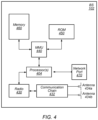
- FIG. 4 illustrates a block diagram of an exemplary base station 102, according to some embodiments. It is noted that the base station of Figure 4 is merely one example of a possible base station. As shown, the base station 102 may include processor(s) 404 which may execute program instructions for the base station 102. The processor(s) 404 may also be coupled to memory management unit (MMU) 440, which may be configured to receive addresses from the processor(s) 404 and translate those addresses to locations in memory (e.g., memory 460 and read only memory (ROM) 450) or to other circuits or devices.
- MMU memory management unit
- the base station 102 may include at least one network port 470.
- the network port 470 may be configured to couple to a telephone network and provide a plurality of devices, such as UE devices 106, access to the telephone network as described above in Figures 1 and 2 .
- the network port 470 (or an additional network port) may also or alternatively be configured to couple to a cellular network, e.g., a core network of a cellular service provider.
- the core network may provide mobility related services and/or other services to a plurality of devices, such as UE devices 106.
- the network port 470 may couple to a telephone network via the core network, and/or the core network may provide a telephone network (e.g., among other UE devices serviced by the cellular service provider).
- the base station 102 may include at least one antenna 434a, and possibly multiple antennas (e.g. illustrated by antennas 434a and 434b), for performing wireless communication with mobile devices and/or other devices.
- Antennas 434a and 434b are shown by way of example, and base station 102 may include fewer or more antennas.
- the one or more antennas which may include antenna 434a and/or antenna 434b, are collectively referred to as antenna 434 or antenna(s) 434.
- Antenna(s) 434 may be configured to operate as a wireless transceiver and may be further configured to communicate with UE devices 106 via radio circuitry 430.
- the antenna(s) 434 communicates with the radio 430 via communication chain 432.
- Communication chain 432 may be a receive chain, a transmit chain or both.
- the radio circuitry 430 may be designed to communicate via various wireless telecommunication standards, including, but not limited to, LTE, LTE-A, 5G-NR (NR) WCDMA, CDMA2000, etc.
- the processor(s) 404 of the base station 102 may be configured to implement part or all of the methods described herein, e.g., by executing program instructions stored on a memory medium (e.g., a non-transitory computer-readable memory medium), for base station 102 to communicate with a UE device capable of recognizing and communicating over private LTE/NR networks, with the capacity to effectively move between various wireless communication systems that include private LTE/NR networks, and operating on those networks.
- a memory medium e.g., a non-transitory computer-readable memory medium
- the processor(s) 404 may be configured as a programmable hardware element(s), such as an FPGA (Field Programmable Gate Array), or as an ASIC (Application Specific Integrated Circuit), or a combination thereof.
- base station 102 may be designed as an access point (AP), in which case network port 470 may be implemented to provide access to a wide area network and/or local area network (s), e.g. it may include at least one Ethernet port, and radio 430 may be designed to communicate according to the Wi-Fi standard.
- AP access point
- network port 470 may be implemented to provide access to a wide area network and/or local area network (s), e.g. it may include at least one Ethernet port
- radio 430 may be designed to communicate according to the Wi-Fi standard.
- Base station 102 may operate according to the various methods as disclosed herein for communicating with mobile devices that recognize and communicate over private LTE/NR networks and have the capacity to effectively move between various wireless communication systems that include private LTE/NR networks and operate on those networks according to various embodiments disclosed herein.
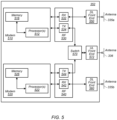
- Figure 5 illustrates an exemplary simplified block diagram illustrative of cellular controller 352, according to some embodiments. It is noted that the block diagram of the cellular communication circuitry of Figure 5 is only one example of a possible cellular communication circuit; other circuits, such as circuits including or coupled to sufficient antennas for different RATs to perform uplink activities using separate antennas, or circuits including or coupled to fewer antennas, e.g., that may be shared among multiple RATs, are also possible. According to some embodiments, cellular communication circuitry 352 may be included in a communication device, such as communication device 106 described above.
- communication device 106 may be a user equipment (UE) device, a mobile device or mobile station, a wireless device or wireless station, a desktop computer or computing device, a mobile computing device (e.g., a laptop, notebook, or portable computing device), a tablet and/or a combination of devices, among other devices.
- UE user equipment
- mobile device or mobile station e.g., a mobile device or mobile station
- wireless device or wireless station e.g., a desktop computer or computing device
- a mobile computing device e.g., a laptop, notebook, or portable computing device
- tablet e.g., a tablet and/or a combination of devices, among other devices.
- the cellular communication circuitry 352 may couple (e.g., communicatively; directly or indirectly) to one or more antennas, such as antennas 335a-b and 336 as shown.
- cellular communication circuitry 352 may include dedicated receive chains (including and/or coupled to (e.g., communicatively; directly or indirectly) dedicated processors and/or radios) for multiple RATs (e.g., a first receive chain for LTE and a second receive chain for 5G NR).
- cellular communication circuitry 352 may include a first modem 510 and a second modem 520.
- a switch 570 may couple transmit circuitry 534 to uplink (UL) front end 572.
- switch 570 may couple transmit circuitry 544 to UL front end 572.
- UL front end 572 may include circuitry for transmitting radio signals via antenna 336.
- switch 570 may be switched to a first state that allows the first modem 510 to transmit signals according to the first RAT (e.g., via a transmit chain that includes transmit circuitry 534 and UL front end 572).
- switch 570 may be switched to a second state that allows the second modem 520 to transmit signals according to the second RAT (e.g., via a transmit chain that includes transmit circuitry 544 and UL front end 572).
- processors 512, 522, in conjunction with one or more of the other components 530, 532, 534, 540, 542, 544, 550, 570, 572, 335 and 336 may be configured to implement part or all of the features described herein.
- FIG. 6 illustrates an exemplary wireless communication system 600 in which a device may communicate according to multiple radio access technologies (RATs) using different respective radio circuits for each RAT.
- System 600 is a system in which an LTE (or NR) access network and a Wi-Fi radio access network are implemented.
- the system 600 may include UE 106 and LTE (or NR) network 602 and Wi-Fi network 604.
- LTE (or NR) access network 602 is representative of some embodiments of a first RAT access and Wi-Fi access network 604 is representative of some embodiments of a second RAT access.
- LTE (or NR) access network 602 may be interfaced with a broader cellular network (e.g. LTE or NR) and Wi-Fi access network 604 may be interfaced with the Internet 612. More particularly, LTE (or NR) access network 602 may be interfaced with a serving base station (BS) 606, which may in turn provide access to broader cellular network 610.
- the Wi-Fi access network 604 may be interfaced with an access point (AP) 608, which may in turn provide access to the Internet 612.
- AP access point
- LTE (or NR) access network 602 data transfers or audio voice calls, via either or both of LTE (or NR) access network 602 and Wi-Fi access network 604.
- Figure 6 shows an LTE (or NR) access network
- other cellular networks may equally be accessed by UE 106 in a manner similar to accessing LTE (or NR) access network 602.
- Tier-1 carriers were thereby able to use the allocated spectrum as a strategic asset for 3GPP technologies, which has proven to be a barrier preventing innovation in wireless services and also slowing down service improvements.
- deployment has been focused on Tier-1 venues, leaving Tier-2/Tier-3 venues and indoor venues with poor coverage. According to some estimates, approximately 30 billion square feet of commercial floor space in the United States experiences poor cellular coverage.
- Tier-2/Tier-3 network operators, enterprises, small communities and venue owners have not been able to acquire spectrum that would allow them to improve the wireless coverage in Tier-2/Tier-3 venues and indoor private buildings, which slows the densification and installation of small cells.
- the host may lease space or access to the system to one or more operators.
- the neutral host model provides a number of attractive benefits, chief among them the increased number of providers who are able and willing to help satisfy the growing demand in the market.
- CBRS provides potential benefits of indoor and outdoor cellular services, e.g. LTE/NR services within a shared 3.5 GHz spectrum by opening up those bands for commercial use such as carrier-based cellular service extensions and private LTE/NR networks within enterprises, sports stadiums and conference centers, among others.
- CBRS band(s) can be used by cellular networks to provide private LTE/NR and neutral host networks (e.g. Wi-Fi Type deployments in buildings and enterprises) using LTE and/or 5G/NR small cells and networks.
- the international mobile subscriber identity (IMSI; used in pre-5G/NR cellular technology), and subscription permanent identifier (SUPI; used in 5G/NR cellular technology) are numbers that uniquely identify every user of a pre-5G/NR and 5G NR cellular network, respectively.
- Non-public cellular networks have been deployed in factories, for Internet of Things (IOT) devices, as enterprise information technology (IT) networks and the like.
- IOT Internet of Things
- IT enterprise information technology
- NPNs are cellular networks specific to an organization or a corporate entity, with content for that entity hosted on private data networks.
- An NPN may typically be deployed as a standalone NPN (SNPN), which may be operated by an NPN operator that does not rely on network functions provided by a PLMN, or it may be deployed as a public network integrated NPN, which may be a network slice instance of a regular PLMN, for example.
- Wireless communication devices UEs may be classified based on access capability.
- Such classification may differentiate between UEs which are only authorized to access an NPN or NPN services, UEs which are only authorized to access regular PLMN services, and UEs which may simultaneously access both NPN services as well as PLMN services.
- a UE may be configured with a SUPI and credentials for each SNPN it is authorized to access.
- Emergency services are currently not supported in SNPN access mode, but studies are being conducted regarding support enablement for emergency calls over NPN in the near future.
- a SUPI is a 5G/NR globally unique Subscription Permanent Identifier (SUPI) allocated to each subscriber and defined in 3GPP specification TS 23.501.
- the SUPI value is provisioned in USIM and Unified Data Management (UDM)/Universal Resources Management (UDR) function in 5G Core, and is usually a string of 15 decimal digits.
- a UE When switched on, a UE typically begins searching for a network. There is a possibility that there are many networks or many frequencies from different network operators to which the UE may connect. Therefore, the UE needs to synchronize to each frequency and determine to which of those frequencies it will connect. The UE performs this by undergoing an initial synchronization process. Once the UE has completed the synchronization process, it begins to use system information to establish wireless communications with(in) the network.
- System information includes the Master Information Block (MIB) and a number of System Information Blocks (SIBs).
- the MIB is broadcast on the Physical Broadcast Channel (PBCH), while SIBs are sent on the Physical Downlink Shared Channel (PDSCH) through Radio Resource Control (RRC) messages (i.e. via RRC messaging/signaling).
- PBCH Physical Broadcast Channel
- SIBs System Information Blocks
- PBCH Physical Broadcast Channel
- SIBs Physical Downlink Shared Channel
- RRC Radio Resource Control
- SNPNs are identified using a network identifier (NID) specific to the SNPN. Accordingly, an SNPN is identified overall by using a PLMN ID and an NID [PLMN ID + NID].
- the network node e.g. gNB
- the network node may broadcast the PLMN ID and a list of NIDs, which identify each unique NPN.
- the UE shall reselect to other cells which support this SNPN, e.g. to a cell identified by the broadcasted [PLMN ID + NID].
- the UE may first camp on (connect to) the cell which supports the [PLMN ID + NID] combination identifying the network that the UE is seeking to access (e.g. the SNPN for which the UE has SUPI credentials).
- the UE then performs a Non-Access Stratum (NAS) registration procedure, through the corresponding Access and Mobility Management Function (AMF) and Session Management Function (SMF), with the SNPN.
- NAS Non-Access Stratum
- AMF Access and Mobility Management Function
- SMF Session Management Function
- UAC Unified Access Control
- an SNPN is a standalone network and does not have access or visibility to other peer SNPNs.
- a UE which has credentials for a given SNPN may not be able to access other SNPNs, even though there may be reasons for the UE to access to those other SNPNs.
- different private networks may be considered part of the same entity or enterprise. For example, a company, corporate entity, or educational entity may have different branches or locations all identified by the same PLMN ID, with each branch/location having its own deployed SNPN. Under certain scenarios it may be desirable to provide a UE access to all the different branch/satellite SNPNs.
- SNPN1, SNPN2, and SNPN3 may be established.
- SNPN1, SNPN2, and SNPN3 may be established.
- a network may broadcast a list of equivalent SNPN(s) (eSNPN(s)) corresponding to a given SNPN, if such eSNPNs are available, to the UE.
- the base station in the network may broadcast such a list in an SIB.
- the UE may save the list of eSNPNs in a local database.
- a UE associated with a given home SNPN e.g. with SNPN1
- the UE may lose the access to its home SNPN and may start scanning all the SNPN networks in that location/region.
- the UE may gain access to the visited SNPN as the visited SNPN has already been indicated to the UE as an eSNPN corresponding to its home SNPN.
- eSNPN1 and eSNPN2 represent SNPNs equivalent to or corresponding to SNPN1, hence they are eSNPNs for the UE and are accessible by the UE.
- the order in which the eSNPNs are broadcast may also indicate the recommended priority of the broadcasted (listed) eSNPNs. For example, for a UE having SNPN1 as its home SNPN, eSNPN1 may have higher priority than eSNPN2. This may be especially useful when multiple eSNPNs overlap in certain deployments.
- the list of eSNPNs may be broadcast by the network in an SIB.
- the list of eSNPNs may be transmitted to the UE as part of a NAS registration accept message.
- the eSNPN list may be transmitted by the (radio access) network to the UE in the registration accept message in response to a NAS registration request.
- the registration accept message may be a unicast message targeting (or intended for) a specific UE as opposed to being transmitted as a broadcast message, thus reducing load on the network.
- multiple NPNs or SNPNs may be associated with or correspond to a single entity or enterprise, with those multiple different NPNs or SNPNs deployed at a location or locations and/or region(s) identified by the same PLMN ID.
- respective corresponding SNPNs may also be deployed in multiple locations, regions, and/or countries identified by different respective PLMN IDs.
- the UEs associated with that enterprise may be expected to have the ability to connect to those SNPNs seamlessly.
- the SNPN may again be defined/indicated as [PLMN ID + NID]. However, in this case the PLMN IDs may differ.
- the PLMN ID is based on the mobile country code (MCC), and the PLMN ID may thus be different in (or for) each different location/region/country.
- MCC mobile country code
- the NID identifying the SNPN may be the same in all location/regions/countries, as it indicates the specific entity or enterprise as opposed to indicating a specific local SNPN.
- the UE is configured to camp (remain connected) on the SNPN corresponding to enterprise A in a first location/region/country
- camp resume connected
- the UE travels to a different, second location/region/country and scans for the SNPN (for enterprise A)
- a roaming eSNPN may be introduced. Similar to the example provided above for eSNPNs based on different NIDs for different local SNPNs, a list of ReSNPNs may be provided to the UE to allow the UE to access the SNPN corresponding to the enterprise in each location/region/country where SNPNs for that enterprise have been deployed.
- enterprise A may be identified by "NID”.
- the home SNPN of enterprise A may be in a first location identified by PLMN ID1 in a country local to the UE.
- the network in which the home SNPN (SNPN1) is deployed may broadcast the list of eSNPNs and ReSNPNs in the SIB.
- the UE may save the list of eSNPNs and ReSNPNs in a local database, and utilize the information when camping on other SNPNs either on a local network or global network.
- the above methodology is equally applicable to public integrated NPNs, not only SNPNs.
- human readable enterprise names may also be the same in different countries. Accordingly, in some embodiments, human readable names may also be broadcast in the SIB, e.g. with an ASCII character string or string encoded in UTF-8 format representing the enterprise name to be broadcast.
- the enterprise may be using a global unique NID for each different SNPN deployed in different countries, with the SNPN in each country having a unique NID (e.g. in contrast to enterprise A being identified by the same NID in all countries as indicated above).
- an additional "EnID" field may be introduced in the SIB.
- EnID stands for "Enterprise ID”.
- the EnID is expected to be the same for all NPNs of a particular enterprise across the globe.
- NCF NID Management Function
- NMF network identification management function
- the NMF may implement various tasks/features related to eSNPNs and ReSNPNs.
- the NMF may be introduced as a core network function, for example in a 5G/NR network architecture (5GC), for maintaining a database of the list of SNPN(s), e.g. NID list(s) and/or [NID+PLMN] list(s).
- the NMF may also maintain the equivalent PLMN list for all the UEs registered in a given SNPN.
- FIG. 7 shows a simplified diagram of an exemplary wireless network architecture with an NMF.
- the core network functions of a wireless network include an Application Function (AF) 702 and Access and Mobility Management Function (AMF) 708, which may update the NMF 706 by adding and removing eSNPN(s) for a UE or set of UEs.
- the NMF may also be updated by the unified data management (UDM) function, which is not shown in Figure 7 .
- Other network functions include a Network Repository Function (NRF) 704, a Session Management Function (SMF) 710, and a User Plane Function (UPF) 716.
- NRF Network Repository Function
- SMF Session Management Function
- UPF User Plane Function
- UE 712 interfaces with AMF 708 and the radio access network (RAN) 714, with UPF 176 providing a link between RAN 714 and data network (DN) 718.
- the AMF 708 may query the NMF 706 to validate the credentials and retrieve the eSNPN list for UE 712.
- the NMF 706 may accept the query and map eSNPNs for UE 712.
- the list of eSNPNs may then be retrieved by AMF 708, which may transmit the eSNPN list to the UE 712 as part of the Registration Accept (RA) message.
- RA Registration Accept
- a new "eSNPN" information element may be added to the RA message.
- the NMF 706 may be implemented as SW in a Unified Data Management (UDM)/User Data Repository (UDR) module.
- AF 702 may be a cloud service which may be controlled by the enterprise entity, e.g. a corporate entity, and may populate the NMF database with new eSNPN(s). Overall, the NMF 706 may create and maintain the list of eSNPNs and/or ReSNPNs, with AF 702 and AMF 708 having access to the NMF.
- AMF 708 When AMF 708 transmits the configuration update command with the eSNPN IE, it may transmit newly added eSNPN(s) with a flag indicating that the included eSNPN(s) are to be added to an already existing list, or it may transmit the entire eSNPN list.
- Figure 8 shows a simplified diagram of an exemplary wireless network architecture with a single NMF 802.
- a first network 806 represents a home PLMN for a UE 826, while a second network 816 represents an eSNPN for UE 826.
- Network 806 operates on RAN 808 while network 816 operates on RAN 818.
- Each respective network has its own set of network functions, such as AMF (810 and 820, respectively), SMF (812 and 822, respectively), and UPF (814 and 824, respectively).
- AMF AMF
- SMF SMF
- UPF User Planet Configuration Protocol
- AMF 820 may query NMF 906 to validate the credentials of UE 826 when the UE 826 is registering on network 816 serviced AMF 820, and retrieve the eSNPN/ReSNPN list for UE 826.
- AMF 810 may query NMF 904 to validate the credentials of UE 826 when the UE 826 is registering on network 806 serviced AMF 810, and retrieve the eSNPN/ReSNPN list for UE 826.
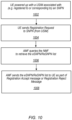
- the UE may send a registration request (RR) to the AMF servicing the SNPN, with the RR including the necessary credentials (1004).
- the AMF may query the NMF to retrieve the list(s) of eSNPNs/ReSNPNs mapped for the UE (1006).
- the NMF may forward the list(s) of eSNPNs/ReSNPNs to the AMF, and the AMF may add the data (e.g. the list(s)) received from the NMF to the RA message or a registration reject (RR) message, and transmit the list(s) to the UE as part of the RA message or RR message (1008).
- the AMF 1104 may locate the NMF 1106 via the address provided by the UE, and may provide the manufacturer credentials to NMF 1106 in a validation request to validate the subscription of the UE (1304).
- the NMF 1106 may validate the received credentials and retrieve the matching subscription data, then provide the subscription data and eSNPN/ReSNPN list(s) to the AMF 1104 in a validation response (1306).
- the AMF 1104 may forward the subscription data and eSNPN/ReSNPN list(s) to the UE 1102 as part of the RA message or as part of an RR message (1308).
- the, AMF 1104 may send a registration reject message to the UE 1102 and include the eSNPN/ReSNPN list(s) in this message, which may cause the UE 1102 to initiate a new registration procedure on a "preferred" NPN included in the eSNPN/ReSNPN list(s). This process may be referred to as "Steering of NPN roaming".
- Figure 14 shows a simplified table 1400 listing exemplary service operations that may be provided by an NMF.
- Radio access network (RAN) support may be provided for identifying SNPN specific cells.
- Cells with SNPN-only access may need to broadcast a 'reserved-for-SNPN-use' field in an SIB message to help prevent regular PLMN users from camping on SNPN-only access cells. This may be especially important in areas which have overlaying PLMN and SNPN access cells.
- NPNs may be implemented as network slices of PLMNs.
- Network slicing refers to the separation of multiple virtual networks that operate on the same physical hardware for different applications, services or purposes.
- Network slicing separates the control plane from the user plane to move user plane functionality towards the network edge.
- Each network slice may have its own architecture, provisioning management and security that supports a particular use case. With low latency connection and adequate bandwidth, the prioritization of different tasks may be performed on a software level division of the network.
- the slices that occupy a single physical network are separated, meaning traffic and security breaches from one slice cannot interfere with another slice. Identification of a network slice is performed via the Single Network Slice Selection Assistance Information (S-NSSAI).
- S-NSSAI Single Network Slice Selection Assistance Information
- 3GPP presently allows up to eight (8) S-NSSAIs in the Requested and Allowed NSSAI sent in signaling messages between the UE and the network (e.g. between the UE and a base station in the network). This means a single UE may be served by at most eight network slices at a time.
- the S-NSSAI signaled by the UE to the network assists the network in selecting a particular network slice instance.
- An S-NSSAI typically includes:
- a network slice is configured during the registration procedure, and is applicable to the entire PLMN.
- certain slicing features may only be available or authorized in some specific locations.
- the UE may assume that the slice is allowed for all UEs accessing the PLMN.
- an NPN may not be intended to be accessible to all UEs on the PLMN. Therefore, the concept of network slice support per registration/tracking area may be introduced, with a corresponding procedure for negotiation of a network slice per registration area and/or tracking area.
- the UE and network may renegotiate the list of allowed NSSAIs.
- the UE and network may renegotiate the list of allowed NSSAIs.
- the network may thus indicate to the UE whether or not the UE is allowed to access that network slice.
- the network e.g. base station in the network
- NPN network slice instance
- HPLMN home PLMN
- the UE may send a packet data unit (PDU) session establishment request with an S-NSSAI (containing the NPN NSI), and may also provide an HPLMN mapping for this S-NSSAI.
- PDU packet data unit
- S-NSSAI containing the NPN NSI
- HPLMN mapping for this S-NSSAI.
- an SD may be required for NPN.
- a hospital enterprise may contain an NPN with multiple slices or multiple instances of an S-NSSAI, with each slice serving a specific characteristic (e.g., operations, finance, doctor logins, etc.)
- the UE may receive UE route selection policy (URSP) rules with DNN, and route and traffic descriptor details about how to access each NSI of this NPN, along with the indication regarding the association of the S-NSSAI (NPN, PLMN, or both). This may help the UE identify whether the NSI is for serving the PLMN or the NPN or both.
- URSP UE route selection policy
- NPN access may be implemented in a UE having a dual-SIM setup with independent subscription.
- SIM1 may be a subscription to a normal/regular 3GPP PLMN access (e.g. a major service provider), while SIM2 may be configured for SNPN access.
- a UE supporting simultaneous connectivity to an SNPN and a PLMN may perform network selection as applicable for gaining access to the SNPN network and the PLMN network, respectively.
- Whether the UE uses SNPN or PLMN for its services may be implementation dependent. For example, certain applications executing on (or executed by) the UE may be restricted to use only the PLMN, while other apps (e.g. internal or enterprise apps) may be restricted to use only the SNPN.
- apps e.g. internal or enterprise apps
- the mapping of applications to the respective networks the applications are instructed to or expected to use may be internal in the device, e.g. with the applications mapped to respective corresponding SIMs.
- the setting for operation in SNPN access mode may be applied only to the Uu interface for connection to the SNPN. Details of the activation and deactivation of SNPN access mode may be implemented as desired for each UE. Accordingly, when invoking certain applications, the UE may use its SIM1 connection (e.g. by relying on credentials/data stored in SIM1), and when invoking applications related to the SNPN (e.g. enterprise applications), the UE may use its SIM2 connection (e.g. by relying on credentials/data stored in SIM2). The UE may need to determine if the SNPN allows access to SNS apps but is tracked by the private network. Use of SIM1 may be non-tracked.
- a UE may not select and register with SNPNs.
- a UE not set to operate in SNPN access mode may perform PLMN selection procedures as currently defined (e.g. in the 3GPP standard; clause 4.4. of TS 23.122). For example, in case an SNPN is used for office (business) communications while a PLMN is used for personal communications, the SNPN may be automatically activated/deactivated over the PLMN as follows.
- SNPN access may get enabled/activated and PLMN access may be disabled/deactivated, otherwise SNPN access may be disabled/deactivated and PLMN access may be enabled/activated.
- the enabling/disabling or activating/deactivating may be configured based on timing considerations. For example, an office time period (e.g. 9am - 6pm) may be designated, and if the UE is in an SNPN registration area during that time period, SNPN access may be (automatically) activated and PLMN access may be (automatically) deactivated. Outside the designated office time period, SNPN access may be (automatically) deactivated and PLMN access may be (automatically) activated.
- an office time period e.g. 9am - 6pm
- Network selection in SNPN access mode may be performed as follows.
- a UE When set to operate in SNPN access mode, a UE may not perform normal PLMN selection procedures as currently defined (e.g. in the current 3GPP standard; clause 4.4. of TS 23.122).
- UEs operating in SNPN access mode may read the available PLMN IDs and list of available NIDs from the broadcast system information, and take them into account during network selection. For automatic network selection, the UE may select and attempt to register with the available SNPN identified by a PLMN ID and NID for which the UE has SUPI and credentials.
- the priority order for selecting and attempting to register with SNPNs may be based on UE implementation. For example, a priority list may be maintained based on visit frequency (how often an SNPN is visited/accessed), broadcast order in SIB (e.g. top level in SIB broadcast order is highest priority and lowest level is lowest priority), and/or SUPI.
- the priority order for SNPN access when the UE has credentials for multiple SNPNs, may depend on how frequently a respective SNPN is visited within a day/week/month, the order in which the SNPNs are broadcast in the SIB, and/or the SUPI (PLMN + NID; e.g. a home country may have highest priority).
- the UE may feature a user input (UI) for a user to dynamically update the priority of the SNPNs and update the list.
- UI user input
- an enterprise may maintain multiple SNPNs for each specific project.
- An employee may have the main enterprise SNPN as the highest priority SNPN. Once the employee gets disclosure for a specific project, the corresponding SNPN (e.g. the SNPN corresponding to the project) may be added to the subscription list for the employee.
- the UE may also have the capability to set the priority of SNPNs.
- personally identifiable information should follow privacy policies and practices that are generally recognized as meeting or exceeding industry or governmental requirements for maintaining the privacy of users.
- personally identifiable information data should be managed and handled so as to minimize risks of unintentional or unauthorized access or use, and the nature of authorized use should be clearly indicated to users.
- Embodiments of the present invention may be realized in any of various forms.
- the present invention may be realized as a computer-implemented method, a computer-readable memory medium, or a computer system.
- the present invention may be realized using one or more custom-designed hardware devices such as ASICs.
- the present invention may be realized using one or more programmable hardware elements such as FPGAs.
- a non-transitory computer-readable memory medium e.g., a non-transitory memory element
- a non-transitory computer-readable memory medium may be configured so that it stores program instructions and/or data, where the program instructions, if executed by a computer system, cause the computer system to perform a method, e.g., any of a method embodiments described herein, or, any combination of the method embodiments described herein, or, any subset of any of the method embodiments described herein, or, any combination of such subsets.
- a device e.g., a UE
- a device may be configured to include a processor (or a set of processors) and a memory medium (or memory element), where the memory medium stores program instructions, where the processor is configured to read and execute the program instructions from the memory medium, where the program instructions are executable to implement any of the various method embodiments described herein (or, any combination of the method embodiments described herein, or, any subset of any of the method embodiments described herein, or, any combination of such subsets).
- the device may be realized in any of various forms.
Landscapes
- Engineering & Computer Science (AREA)
- Computer Networks & Wireless Communication (AREA)
- Signal Processing (AREA)
- Computer Security & Cryptography (AREA)
- Databases & Information Systems (AREA)
- Mobile Radio Communication Systems (AREA)
Applications Claiming Priority (3)
| Application Number | Priority Date | Filing Date | Title |
|---|---|---|---|
| US202062956472P | 2020-01-02 | 2020-01-02 | |
| US17/137,166 US11665632B2 (en) | 2020-01-02 | 2020-12-29 | Non-public wireless communication networks |
| EP20218026.1A EP3846545B1 (de) | 2020-01-02 | 2020-12-31 | Wechseln von snpn |
Related Parent Applications (2)
| Application Number | Title | Priority Date | Filing Date |
|---|---|---|---|
| EP20218026.1A Division EP3846545B1 (de) | 2020-01-02 | 2020-12-31 | Wechseln von snpn |
| EP20218026.1A Division-Into EP3846545B1 (de) | 2020-01-02 | 2020-12-31 | Wechseln von snpn |
Publications (2)
| Publication Number | Publication Date |
|---|---|
| EP4583583A2 true EP4583583A2 (de) | 2025-07-09 |
| EP4583583A3 EP4583583A3 (de) | 2025-10-08 |
Family
ID=74129973
Family Applications (2)
| Application Number | Title | Priority Date | Filing Date |
|---|---|---|---|
| EP25177578.9A Pending EP4583583A3 (de) | 2020-01-02 | 2020-12-31 | Nichtöffentliche drahtlose kommunikationsnetze |
| EP20218026.1A Active EP3846545B1 (de) | 2020-01-02 | 2020-12-31 | Wechseln von snpn |
Family Applications After (1)
| Application Number | Title | Priority Date | Filing Date |
|---|---|---|---|
| EP20218026.1A Active EP3846545B1 (de) | 2020-01-02 | 2020-12-31 | Wechseln von snpn |
Country Status (3)
| Country | Link |
|---|---|
| US (3) | US11665632B2 (de) |
| EP (2) | EP4583583A3 (de) |
| CN (2) | CN113068174B (de) |
Families Citing this family (39)
| Publication number | Priority date | Publication date | Assignee | Title |
|---|---|---|---|---|
| EP4014469A4 (de) | 2019-08-14 | 2023-09-06 | Nokia Technologies Oy | Verfahren und vorrichtung zur handhabung von nicht integritätsgeschützten ablehnungsnachrichten in nicht-öffentlichen netzen |
| US11622272B2 (en) * | 2020-01-07 | 2023-04-04 | Qualcomm Incorporated | Restricted access procedure |
| US12279125B2 (en) * | 2020-02-13 | 2025-04-15 | Telefonaktiebolaget Lm Ericsson (Publ) | Registered UE count in slice service area |
| US11438824B2 (en) | 2020-02-27 | 2022-09-06 | Cisco Technology, Inc. | Wireless authorization and access network-neutral advice of charge techniques |
| US20230179989A1 (en) * | 2020-05-21 | 2023-06-08 | Nokia Technologies Oy | Appararus, method, and computer program |
| US12376021B2 (en) | 2020-05-22 | 2025-07-29 | Qualcomm Incorporated | Human readable name per slice identifier |
| KR20230029811A (ko) * | 2020-07-20 | 2023-03-03 | 엘지전자 주식회사 | Snpn과 분리되어 있는 개체가 소유하는 자격 증명을 이용한 snpn 접속 및 이를 위한 f1 인터페이스 지원 |
| US11683749B2 (en) * | 2020-08-07 | 2023-06-20 | Mediatek Inc. | Network selection for supported standalone non-public network (S-SNPN) |
| WO2022036336A1 (en) * | 2020-08-13 | 2022-02-17 | Alibaba Group Holding Limited | Network communication method and apparatus |
| US11785456B2 (en) | 2020-08-18 | 2023-10-10 | Cisco Technology, Inc. | Delivering standalone non-public network (SNPN) credentials from an enterprise authentication server to a user equipment over extensible authentication protocol (EAP) |
| US12028710B2 (en) * | 2020-10-15 | 2024-07-02 | Mediatek Inc. | Stand-alone Non-Public Network as service provider |
| US12284518B2 (en) * | 2021-01-08 | 2025-04-22 | Intel Corporation | UE onboarding and provisioning using one way authentication |
| EP4295606A1 (de) * | 2021-02-19 | 2023-12-27 | Telefonaktiebolaget LM Ericsson (publ) | Anzeige eines bereitstellungsprotokolls für berechtigungen zum zugriff auf ein nichtöffentliches netzwerk |
| US12477453B2 (en) * | 2021-04-28 | 2025-11-18 | Interdigital Patent Holdings, Inc. | Methods and apparatus for steering a wireless/transmit receive unit between multiple wireless networks |
| CN115379535B (zh) * | 2021-05-18 | 2025-10-24 | 华为技术有限公司 | 选网策略的确定方法及装置 |
| EP4391651A4 (de) * | 2021-08-17 | 2024-07-17 | Vivo Mobile Communication Co., Ltd. | Notfalldienstverarbeitungsverfahren und -vorrichtung sowie lesbares speichermedium |
| CN113825225B (zh) * | 2021-09-10 | 2024-02-02 | 阿里巴巴达摩院(杭州)科技有限公司 | 专网的漫游注册方法、amf网元、设备及系统 |
| CN115835340B (zh) * | 2021-09-16 | 2026-04-07 | 维沃移动通信有限公司 | 网络选择方法、装置、终端及网络侧设备 |
| CN115835320A (zh) * | 2021-09-18 | 2023-03-21 | 华为技术有限公司 | 一种基于对等网络的网络选择方法及通信装置 |
| US11848909B2 (en) * | 2021-09-21 | 2023-12-19 | Nokia Technologies Oy | Restricting onboard traffic |
| KR20230051000A (ko) | 2021-10-08 | 2023-04-17 | 삼성전자주식회사 | 무선 통신 시스템에서 단말 온보딩을 위한 단말 등록의 제한에 대한 방법 및 장치 |
| KR20230062168A (ko) * | 2021-10-29 | 2023-05-09 | 삼성전자주식회사 | 무선 통신 네트워크에서 응급 콜 서비스 제공 장치 및 방법 |
| EP4432737A4 (de) * | 2021-11-08 | 2025-01-01 | Beijing Xiaomi Mobile Software Co., Ltd. | Verfahren und vorrichtung zur umschaltung des zugangsmodus, kommunikationsvorrichtung und speichermedium |
| CN118176761A (zh) * | 2021-11-10 | 2024-06-11 | 索尼集团公司 | 信息处理方法、信息处理装置和信息处理系统 |
| US20230189310A1 (en) * | 2021-11-19 | 2023-06-15 | Celona, Inc. | Load Balancing with a Multi-Radio Access Technology Access Point |
| CN116456401A (zh) * | 2022-01-06 | 2023-07-18 | 维沃移动通信有限公司 | 小区选择重选方法、装置、终端及网络侧设备 |
| KR20230120514A (ko) * | 2022-02-09 | 2023-08-17 | 삼성전자주식회사 | 무선 통신 시스템에서 nas 메시지를 이용하여 단말의 설정을 관리하는 방법 및 장치 |
| US12200614B2 (en) * | 2022-02-24 | 2025-01-14 | At&T Intellectual Property I, L.P. | Network slicing for private cellular networks |
| CN119908144A (zh) * | 2022-03-23 | 2025-04-29 | 欧芬诺有限责任公司 | 网络接入管理 |
| US20230309153A1 (en) * | 2022-03-28 | 2023-09-28 | At&T Mobility Ii Llc | Configurable extension of private mobile network access |
| US12170954B2 (en) * | 2022-04-15 | 2024-12-17 | Verizon Patent And Licensing Inc. | Systems and methods for automatic application-level network slicing over private cellular networks |
| CN114866970A (zh) * | 2022-04-29 | 2022-08-05 | 中国电信股份有限公司 | 策略控制方法、系统和相关设备 |
| US20250351210A1 (en) * | 2022-06-14 | 2025-11-13 | Qualcomm Incorporated | Standalone non-public network selection for dual access of a network |
| US12149936B2 (en) * | 2022-06-24 | 2024-11-19 | Cisco Technology, Inc. | Private 5G federation system for dynamic user equipment on-boarding |
| US20230421253A1 (en) * | 2022-06-28 | 2023-12-28 | Intel Corporation | Systems, apparatus, articles of manufacture, and methods for private network mobility management |
| CN115942428B (zh) * | 2022-11-09 | 2025-12-02 | 中国联合网络通信集团有限公司 | 接入独立非公共网络的方法、装置、设备及存储介质 |
| WO2024164945A1 (en) * | 2023-02-07 | 2024-08-15 | Mediatek Inc. | Method and apparatus for stand-alone non-public network reselection in automatic network selection |
| WO2024167219A1 (en) * | 2023-02-09 | 2024-08-15 | Samsung Electronics Co., Ltd. | Method and apparatus for managing equivalent stand-alone non-public network as hosting network in a wireless communication system |
| CN116743348B (zh) * | 2023-08-10 | 2024-01-30 | 中国电信股份有限公司 | 去中心化频谱资源处理方法、装置、系统、设备及介质 |
Family Cites Families (11)
| Publication number | Priority date | Publication date | Assignee | Title |
|---|---|---|---|---|
| US8825049B2 (en) | 2009-02-26 | 2014-09-02 | Qualcomm Incorporated | Methods and systems using unified operator and rat mapping and selection scheme |
| US20150326612A1 (en) * | 2014-05-06 | 2015-11-12 | Qualcomm Incorporated | Techniques for network selection in unlicensed frequency bands |
| US9578584B1 (en) * | 2016-03-01 | 2017-02-21 | Sprint Spectrum L.P. | Controlling tune-away of user equipment devices |
| CN109076580A (zh) * | 2016-05-12 | 2018-12-21 | 英特尔Ip公司 | 针对上行链路先听后说信道接入过程的优先级选择 |
| US10264517B2 (en) | 2017-02-17 | 2019-04-16 | At&T Mobility Ii Llc | Optimization for priority-based network identifier scans |
| CN108322908B (zh) * | 2018-02-05 | 2021-10-26 | 深圳市有方科技股份有限公司 | 一种基站搜索方法以及终端 |
| US10986602B2 (en) | 2018-02-09 | 2021-04-20 | Intel Corporation | Technologies to authorize user equipment use of local area data network features and control the size of local area data network information in access and mobility management function |
| WO2020140830A1 (en) | 2019-01-04 | 2020-07-09 | FG Innovation Company Limited | Method and apparatus for plmn selection and cell (re) selection |
| US20200245235A1 (en) | 2019-01-24 | 2020-07-30 | Lg Electronics Inc. | Method for selecting non-public network in wireless communication system and apparatus thereof |
| CN113632517A (zh) | 2019-03-29 | 2021-11-09 | Idac控股公司 | 用于无线通信中的安全接入控制的方法和装置 |
| CN110248357B (zh) * | 2019-06-24 | 2022-05-06 | 深圳市优克联新技术有限公司 | 搜网配置方法、注册方法、装置、及系统 |
-
2020
- 2020-12-29 US US17/137,166 patent/US11665632B2/en active Active
- 2020-12-31 EP EP25177578.9A patent/EP4583583A3/de active Pending
- 2020-12-31 EP EP20218026.1A patent/EP3846545B1/de active Active
- 2020-12-31 CN CN202011625130.6A patent/CN113068174B/zh active Active
- 2020-12-31 CN CN202410572467.7A patent/CN118250677A/zh active Pending
-
2023
- 2023-04-18 US US18/302,306 patent/US12075348B2/en active Active
-
2024
- 2024-07-22 US US18/779,756 patent/US20240381237A1/en active Pending
Also Published As
| Publication number | Publication date |
|---|---|
| US20230319700A1 (en) | 2023-10-05 |
| US11665632B2 (en) | 2023-05-30 |
| EP3846545A1 (de) | 2021-07-07 |
| CN118250677A (zh) | 2024-06-25 |
| CN113068174B (zh) | 2024-12-31 |
| CN113068174A (zh) | 2021-07-02 |
| US20210211975A1 (en) | 2021-07-08 |
| EP3846545B1 (de) | 2025-09-24 |
| US20240381237A1 (en) | 2024-11-14 |
| EP4583583A3 (de) | 2025-10-08 |
| US12075348B2 (en) | 2024-08-27 |
Similar Documents
| Publication | Publication Date | Title |
|---|---|---|
| US12075348B2 (en) | Non-public wireless communication networks | |
| KR102806588B1 (ko) | 감소된 능력 디바이스와 레거시 뉴 라디오 디바이스들과의 공존을 위한 네트워크 구성 옵션들 | |
| US20210297977A1 (en) | Knowledge of Slice Quota Availability for a UE | |
| US12127176B2 (en) | Uplink transmission support for reduced capability devices in wireless communications | |
| US20230125160A1 (en) | Sidelink Positioning Architecture for Wireless Communications | |
| US12267910B2 (en) | Sidelink relay selection and re-selection in wireless communication | |
| US20250374177A1 (en) | Radio Access Technology Management for Wireless Communications of Multi-Subscriber-Identification-Module (MSIM) Low Latency Hotspot Devices | |
| EP4402918A1 (de) | Sidelink-positionierungsarchitektur für drahtlose kommunikation | |
| WO2023206208A1 (en) | Downlink control information design for supporting single dci scheduling for multiple cells | |
| WO2024207193A1 (en) | System and method for determining switching period location for uplink transmit switching | |
| WO2022205070A1 (en) | Radio link failure handling in sidelink relay | |
| WO2024148539A1 (en) | Methods and apparatus for reducing layer 1 (l1) measurement delay using multi-receive-chain reception | |
| WO2024148532A1 (en) | Methods and apparatus for physical layer (l1) measurements on neighboring cells without gap | |
| WO2024156114A1 (en) | Systems and methods of inter-device coordination for sidelink positioning | |
| WO2024168683A1 (en) | Multi-access edge computing edge enabler client identifier generation and construction |
Legal Events
| Date | Code | Title | Description |
|---|---|---|---|
| PUAI | Public reference made under article 153(3) epc to a published international application that has entered the european phase |
Free format text: ORIGINAL CODE: 0009012 |
|
| STAA | Information on the status of an ep patent application or granted ep patent |
Free format text: STATUS: REQUEST FOR EXAMINATION WAS MADE |
|
| 17P | Request for examination filed |
Effective date: 20250520 |
|
| AC | Divisional application: reference to earlier application |
Ref document number: 3846545 Country of ref document: EP Kind code of ref document: P |
|
| AK | Designated contracting states |
Kind code of ref document: A2 Designated state(s): AL AT BE BG CH CY CZ DE DK EE ES FI FR GB GR HR HU IE IS IT LI LT LU LV MC MK MT NL NO PL PT RO RS SE SI SK SM TR |
|
| REG | Reference to a national code |
Ref country code: DE Ref legal event code: R079 Free format text: PREVIOUS MAIN CLASS: H04W0036140000 Ipc: H04W0048180000 |
|
| PUAL | Search report despatched |
Free format text: ORIGINAL CODE: 0009013 |
|
| AK | Designated contracting states |
Kind code of ref document: A3 Designated state(s): AL AT BE BG CH CY CZ DE DK EE ES FI FR GB GR HR HU IE IS IT LI LT LU LV MC MK MT NL NO PL PT RO RS SE SI SK SM TR |
|
| RIC1 | Information provided on ipc code assigned before grant |
Ipc: H04W 48/18 20090101AFI20250829BHEP Ipc: H04W 48/16 20090101ALN20250829BHEP |