EP4583510A2 - Lokale hash-basierte bewegungsschätzung für bildschirmfernzugriffszenarien - Google Patents
Lokale hash-basierte bewegungsschätzung für bildschirmfernzugriffszenarien Download PDFInfo
- Publication number
- EP4583510A2 EP4583510A2 EP25173275.6A EP25173275A EP4583510A2 EP 4583510 A2 EP4583510 A2 EP 4583510A2 EP 25173275 A EP25173275 A EP 25173275A EP 4583510 A2 EP4583510 A2 EP 4583510A2
- Authority
- EP
- European Patent Office
- Prior art keywords
- picture
- block
- video encoder
- current
- hash
- Prior art date
- Legal status (The legal status is an assumption and is not a legal conclusion. Google has not performed a legal analysis and makes no representation as to the accuracy of the status listed.)
- Pending
Links
Images






Classifications
-
- H—ELECTRICITY
- H04—ELECTRIC COMMUNICATION TECHNIQUE
- H04N—PICTORIAL COMMUNICATION, e.g. TELEVISION
- H04N19/00—Methods or arrangements for coding, decoding, compressing or decompressing digital video signals
- H04N19/10—Methods or arrangements for coding, decoding, compressing or decompressing digital video signals using adaptive coding
- H04N19/102—Methods or arrangements for coding, decoding, compressing or decompressing digital video signals using adaptive coding characterised by the element, parameter or selection affected or controlled by the adaptive coding
- H04N19/103—Selection of coding mode or of prediction mode
- H04N19/105—Selection of the reference unit for prediction within a chosen coding or prediction mode, e.g. adaptive choice of position and number of pixels used for prediction
-
- G—PHYSICS
- G06—COMPUTING OR CALCULATING; COUNTING
- G06V—IMAGE OR VIDEO RECOGNITION OR UNDERSTANDING
- G06V20/00—Scenes; Scene-specific elements
- G06V20/60—Type of objects
- G06V20/62—Text, e.g. of license plates, overlay texts or captions on TV images
-
- H—ELECTRICITY
- H04—ELECTRIC COMMUNICATION TECHNIQUE
- H04N—PICTORIAL COMMUNICATION, e.g. TELEVISION
- H04N19/00—Methods or arrangements for coding, decoding, compressing or decompressing digital video signals
- H04N19/10—Methods or arrangements for coding, decoding, compressing or decompressing digital video signals using adaptive coding
- H04N19/102—Methods or arrangements for coding, decoding, compressing or decompressing digital video signals using adaptive coding characterised by the element, parameter or selection affected or controlled by the adaptive coding
- H04N19/103—Selection of coding mode or of prediction mode
-
- H—ELECTRICITY
- H04—ELECTRIC COMMUNICATION TECHNIQUE
- H04N—PICTORIAL COMMUNICATION, e.g. TELEVISION
- H04N19/00—Methods or arrangements for coding, decoding, compressing or decompressing digital video signals
- H04N19/10—Methods or arrangements for coding, decoding, compressing or decompressing digital video signals using adaptive coding
- H04N19/134—Methods or arrangements for coding, decoding, compressing or decompressing digital video signals using adaptive coding characterised by the element, parameter or criterion affecting or controlling the adaptive coding
- H04N19/136—Incoming video signal characteristics or properties
-
- H—ELECTRICITY
- H04—ELECTRIC COMMUNICATION TECHNIQUE
- H04N—PICTORIAL COMMUNICATION, e.g. TELEVISION
- H04N19/00—Methods or arrangements for coding, decoding, compressing or decompressing digital video signals
- H04N19/10—Methods or arrangements for coding, decoding, compressing or decompressing digital video signals using adaptive coding
- H04N19/134—Methods or arrangements for coding, decoding, compressing or decompressing digital video signals using adaptive coding characterised by the element, parameter or criterion affecting or controlling the adaptive coding
- H04N19/136—Incoming video signal characteristics or properties
- H04N19/137—Motion inside a coding unit, e.g. average field, frame or block difference
- H04N19/139—Analysis of motion vectors, e.g. their magnitude, direction, variance or reliability
-
- H—ELECTRICITY
- H04—ELECTRIC COMMUNICATION TECHNIQUE
- H04N—PICTORIAL COMMUNICATION, e.g. TELEVISION
- H04N19/00—Methods or arrangements for coding, decoding, compressing or decompressing digital video signals
- H04N19/10—Methods or arrangements for coding, decoding, compressing or decompressing digital video signals using adaptive coding
- H04N19/169—Methods or arrangements for coding, decoding, compressing or decompressing digital video signals using adaptive coding characterised by the coding unit, i.e. the structural portion or semantic portion of the video signal being the object or the subject of the adaptive coding
- H04N19/17—Methods or arrangements for coding, decoding, compressing or decompressing digital video signals using adaptive coding characterised by the coding unit, i.e. the structural portion or semantic portion of the video signal being the object or the subject of the adaptive coding the unit being an image region, e.g. an object
- H04N19/174—Methods or arrangements for coding, decoding, compressing or decompressing digital video signals using adaptive coding characterised by the coding unit, i.e. the structural portion or semantic portion of the video signal being the object or the subject of the adaptive coding the unit being an image region, e.g. an object the region being a slice, e.g. a line of blocks or a group of blocks
-
- H—ELECTRICITY
- H04—ELECTRIC COMMUNICATION TECHNIQUE
- H04N—PICTORIAL COMMUNICATION, e.g. TELEVISION
- H04N19/00—Methods or arrangements for coding, decoding, compressing or decompressing digital video signals
- H04N19/10—Methods or arrangements for coding, decoding, compressing or decompressing digital video signals using adaptive coding
- H04N19/169—Methods or arrangements for coding, decoding, compressing or decompressing digital video signals using adaptive coding characterised by the coding unit, i.e. the structural portion or semantic portion of the video signal being the object or the subject of the adaptive coding
- H04N19/17—Methods or arrangements for coding, decoding, compressing or decompressing digital video signals using adaptive coding characterised by the coding unit, i.e. the structural portion or semantic portion of the video signal being the object or the subject of the adaptive coding the unit being an image region, e.g. an object
- H04N19/176—Methods or arrangements for coding, decoding, compressing or decompressing digital video signals using adaptive coding characterised by the coding unit, i.e. the structural portion or semantic portion of the video signal being the object or the subject of the adaptive coding the unit being an image region, e.g. an object the region being a block, e.g. a macroblock
-
- H—ELECTRICITY
- H04—ELECTRIC COMMUNICATION TECHNIQUE
- H04N—PICTORIAL COMMUNICATION, e.g. TELEVISION
- H04N19/00—Methods or arrangements for coding, decoding, compressing or decompressing digital video signals
- H04N19/42—Methods or arrangements for coding, decoding, compressing or decompressing digital video signals characterised by implementation details or hardware specially adapted for video compression or decompression, e.g. dedicated software implementation
- H04N19/43—Hardware specially adapted for motion estimation or compensation
-
- H—ELECTRICITY
- H04—ELECTRIC COMMUNICATION TECHNIQUE
- H04N—PICTORIAL COMMUNICATION, e.g. TELEVISION
- H04N19/00—Methods or arrangements for coding, decoding, compressing or decompressing digital video signals
- H04N19/50—Methods or arrangements for coding, decoding, compressing or decompressing digital video signals using predictive coding
- H04N19/503—Methods or arrangements for coding, decoding, compressing or decompressing digital video signals using predictive coding involving temporal prediction
- H04N19/51—Motion estimation or motion compensation
- H04N19/527—Global motion vector estimation
-
- H—ELECTRICITY
- H04—ELECTRIC COMMUNICATION TECHNIQUE
- H04N—PICTORIAL COMMUNICATION, e.g. TELEVISION
- H04N19/00—Methods or arrangements for coding, decoding, compressing or decompressing digital video signals
- H04N19/50—Methods or arrangements for coding, decoding, compressing or decompressing digital video signals using predictive coding
- H04N19/503—Methods or arrangements for coding, decoding, compressing or decompressing digital video signals using predictive coding involving temporal prediction
- H04N19/51—Motion estimation or motion compensation
- H04N19/537—Motion estimation other than block-based
-
- H—ELECTRICITY
- H04—ELECTRIC COMMUNICATION TECHNIQUE
- H04N—PICTORIAL COMMUNICATION, e.g. TELEVISION
- H04N19/00—Methods or arrangements for coding, decoding, compressing or decompressing digital video signals
- H04N19/50—Methods or arrangements for coding, decoding, compressing or decompressing digital video signals using predictive coding
- H04N19/503—Methods or arrangements for coding, decoding, compressing or decompressing digital video signals using predictive coding involving temporal prediction
- H04N19/51—Motion estimation or motion compensation
- H04N19/55—Motion estimation with spatial constraints, e.g. at image or region borders
Definitions
- Digital video can consume an extremely high amount of bits.
- the number of bits that is used per second of represented video content is known as the bit rate.
- Engineers use compression (also called source coding or source encoding) to reduce the bit rate of digital video. Compression decreases the cost of storing and transmitting video information by converting the information into a lower bit rate form.
- Decompression also called decoding reconstructs a version of the original information from the compressed form.
- a "codec" is an encoder/decoder system.
- an encoder When encoding a block using motion estimation and motion compensation, an encoder often computes the sample-by-sample differences (also called residual values or error values) between the sample values of the block and its motion-compensated prediction. The residual values may then be encoded. For the residual values, encoding efficiency depends on the complexity of the residual values and how much loss or distortion is introduced as part of the compression process. In general, a good motion-compensated prediction closely approximates a block, such that the residual values include few significant values, and the residual values can be efficiently encoded. On the other hand, a poor motion-compensated prediction often yields residual values that include many significant values, which are more difficult to encode efficiently.
- a video encoder can quickly perform local hash-based motion estimation ("HBME") to detect matches for new text that appears in screen capture video, while also detecting scrolling or window movement activity in screen capture video.
- HBME hash-based motion estimation
- the innovations can also be used in other video encoding scenarios.
- the video encoder can check one or more conditions that indicate whether local HBME is likely to be productive. For example, the video encoder can determine a changed region of the current picture, where the calculating the hash value for the current block and the searching are contingent on the current block being within the changed region. As another example, the video encoder can determine whether the current block contains textual content, where the calculating the hash value for the current block and the searching are contingent on the current block containing textual content. As another example, the video encoder can determine whether the current block contains a pivot point, wherein the calculating the hash value for the current block and the searching are contingent on the current block containing a pivot point.
- An arriving source picture (311) is stored in a source picture temporary memory storage area (320) that includes multiple picture buffer storage areas (321, 322, ... , 32n).
- a picture buffer (321, 322, etc.) holds one source picture in the source picture storage area (320).
- a picture selector (330) selects an individual source picture from the source picture storage area (320) to encode as the current picture (331).
- the order in which pictures are selected by the picture selector (330) for input to the video encoder (340) may differ from the order in which the pictures are produced by the video source (310), e.g., the encoding of some pictures may be delayed in order, so as to allow some later pictures to be encoded first and to thus facilitate temporally backward prediction.
- the video encoder system (300) can include a preprocessor (not shown) that performs pre-processing of the current picture (331) before encoding.
- the pre-processing can include color space conversion and resampling processing (e.g., to reduce the spatial resolution of chroma components) for encoding.
- a pixel is the set of one or more collocated sample values for a location in a picture, which may be arranged in different ways for different chroma sampling formats.
- the sample values of video are converted to a color space such as YUV, in which sample values of a luma (Y) component represent brightness or intensity values, and sample values of chroma (U, V) components represent color-difference values.
- YUV luma
- U, V chroma
- YUV indicates any color space with a luma (or luminance) component and one or more chroma (or chrominance) components, including Y'UV, YIQ, Y'IQ and YDbDr as well as variations such as YCbCr and YCoCg.
- Chroma sample values may be sub-sampled to a lower chroma sampling rate (e.g., for a YUV 4:2:0 format) in order to reduce the spatial resolution of chroma sample values, or the chroma sample values may have the same resolution as the luma sample values ( e.g., for a YUV 4:4:4 format).
- the video encoder (340) includes multiple encoding modules that perform encoding tasks such as splitting into tiles, intra-picture prediction estimation and prediction, motion estimation and compensation, frequency transforms, quantization, and entropy coding. Many of the components of the video encoder (340) are used for both intra-picture coding and inter-picture coding. The exact operations performed by the video encoder (340) can vary depending on compression format and can also vary depending on encoder-optional implementation decisions.
- the video encoder (340) can include a tiling module (410). With the tiling module (410), the video encoder (340) can split a picture into multiple tiles of the same size or different sizes. For example, the tiling module (410) splits the picture along tile rows and tile columns that, with picture boundaries, define horizontal and vertical boundaries of tiles within the picture, where each tile is a rectangular region. Tiles are often used to provide options for parallel processing.
- a picture can also be organized as one or more slices, where a slice can be an entire picture or section of the picture. A slice can be decoded independently of other slices in a picture, which improves error resilience.
- the content of a slice or tile is further split into blocks or other sets of sample values for purposes of encoding and decoding.
- Blocks may be further sub-divided at different stages, e.g., at the prediction, frequency transform and/or entropy encoding stages.
- a picture can be divided into 64x64 blocks, 32x32 blocks, or 16x16 blocks, which can in turn be divided into smaller blocks of sample values for coding and decoding.
- the video encoder (340) can split a picture into one or more slices of the same size or different sizes.
- the video encoder (340) splits the content of a picture (or slice) into 16x16 macroblocks.
- a macroblock (“MB") includes luma sample values organized as four 8x8 luma blocks and corresponding chroma sample values organized as 8x8 chroma blocks.
- a MB has a prediction mode such as inter or intra.
- a MB includes one or more prediction units (e.g., 8x8 blocks, 4x4 blocks, which may be called partitions for inter-picture prediction) for purposes of signaling of prediction information (such as prediction mode details, MV information, etc.) and/or prediction processing.
- a MB also has one or more residual data units for purposes of residual coding/decoding.
- the video encoder (340) splits the content of a picture (or slice or tile) into coding tree units.
- a coding tree unit (“CTU”) includes luma sample values organized as a luma coding tree block (“CTB”) and corresponding chroma sample values organized as two chroma CTBs. The size of a CTU (and its CTBs) is selected by the video encoder.
- a luma CTB can contain, for example, 64x64, 32x32, or 16x16 luma sample values.
- a CTU includes one or more coding units.
- a coding unit (“CU”) has a luma coding block (“CB”) and two corresponding chroma CBs.
- a CTU with a 64x64 luma CTB and two 64x64 chroma CTBs can be split into four CUs, with each CU including a 32x32 luma CB and two 32x32 chroma CBs, and with each CU possibly being split further into smaller CUs according to quadtree syntax.
- a CTU with a 64x64 luma CTB and two 32x32 chroma CTBs can be split into four CUs, with each CU including a 32x32 luma CB and two 16x16 chroma CBs, and with each CU possibly being split further into smaller CUs according to quadtree syntax.
- a CU has a prediction mode such as inter or intra.
- a CU typically includes one or more prediction units for purposes of signaling of prediction information (such as prediction mode details, displacement values, etc.) and/or prediction processing.
- a prediction unit (“PU") has a luma prediction block ("PB") and two chroma PBs.
- PB luma prediction block
- the CU can have one, two, or four PUs, where splitting into four PUs is allowed only if the CU has the smallest allowable size.
- a CU also typically has one or more transform units for purposes of residual coding/decoding, where a transform unit ("TU") has a luma transform block ("TB") and two chroma TBs.
- a CU may contain a single TU (equal in size to the CU) or multiple TUs.
- a TU can be split into four smaller TUs, which may in turn be split into smaller TUs according to quadtree syntax.
- the video encoder decides how to split video into CTUs (CTBs), CUs (CBs), PUs (PBs) and TUs (TBs).
- block can indicate a MB, residual data unit, CTB, CB, PB or TB, or some other set of sample values, depending on context.
- unit can indicate a MB, CTU, CU, PU, TU or some other set of blocks, or it can indicate a single block, depending on context.
- partition can indicate a PU or other unit used in prediction operations, or PB or other block used in prediction operations, depending on context.
- the general encoding control (420) decides whether to use intra-picture prediction or inter-picture prediction for the units of the current picture (331). If inter-picture prediction is used for a unit, in conjunction with the motion estimator (450), the general encoding control (420) decides which reference picture(s) to use for the inter-picture prediction.
- the general encoding control (420) determines which reference pictures to retain in a decoded picture buffer ("DPB") or other buffer.
- DPB decoded picture buffer
- the general encoding control (420) produces general control data (422) that indicates decisions made during encoding, so that a corresponding decoder can make consistent decisions.
- the general control data (422) is provided to the header formatter/entropy coder (490).
- a motion estimator (450) estimates the motion of blocks of sample values of the unit with respect to one or more reference pictures.
- the current picture (331) can be entirely or partially coded using inter-picture prediction.
- the multiple reference pictures can be from different temporal directions or the same temporal direction.
- the motion estimator (450) evaluates candidate MVs.
- the motion estimator (450) can evaluate different partition patterns for motion compensation for partitions of a given unit of the current picture (331) (e.g., 2Nx2N, 2NxN, Nx2N, or NxN partitions for PUs of a CU in the H.265/HEVC standard).
- the motion estimator (450) can use one or more of the features of motion estimation described below. For example, the motion estimator (450) performs global HBME for one or more blocks of a current picture and/or performs local HBME for one or more blocks of the current picture.
- the motion estimator (450) can create and update data structures that track hash values and locations of pivot points, as described below.
- the motion estimator (450) can determine global motion metadata, which can be used to guide or skip later block-based motion estimation decisions or can be signaled along with encoded data in the bitstream (495).
- the motion estimator (450) can identify regions, if any, that have changed between pictures and limits motion estimation operations to changed regions. These features of motion estimation can be used in combination or separately.
- the DPB (470) which is an example of decoded picture temporary memory storage area (360) as shown in FIG. 3 , buffers one or more reconstructed previously coded pictures for use as reference pictures.
- the motion estimator (450) produces motion data (452) as side information.
- the motion data (452) can include information that indicates whether contextual motion mode (e.g., merge mode in the H.265/HEVC standard) is used and, if so, the candidate MV for contextual motion mode (e.g., merge mode index value in the H.265/HEVC standard).
- the motion data (452) can include MV data and reference picture selection data.
- the motion estimator (450) can also produce global motion metadata (457), which is provided to the header formatter/entropy coder (490), for implementations in which global motion metadata (457) is signaled as part of the bitstream (495).
- the motion data (452) is provided to the header formatter/entropy coder (490) as well as the motion compensator (455).
- the motion compensator (455) applies MV(s) for a block to the reconstructed reference picture(s) from the DPB (470) or other buffer.
- the motion compensator (455) produces a motion-compensated prediction, which is an area of sample values in the reference picture(s) that are used to generate motion-compensated prediction values for the block.
- an intra-picture prediction estimator determines how to perform intra-picture prediction for blocks of sample values of the unit.
- the current picture (331) can be entirely or partially coded using intra-picture prediction. If the current picture (331) is entirely coded using intra-picture prediction, it is termed a "key" picture. Otherwise (the current picture (331) is at least partially coded using inter-picture prediction), the current picture (331) is termed a "non-key" picture.
- the intra-picture prediction estimator (440) determines how to spatially predict sample values of a block of the current picture (331) from previously reconstructed sample values of the current picture (331), e.g., selecting an intra-picture prediction mode. Or, for intra block copy mode, the intra-picture prediction estimator (440) determines how to predict sample values of a block of the current picture (331) using an offset (sometimes called a block vector) that indicates a previously encoded/decoded portion of the current picture (331).
- an offset sometimes called a block vector
- Intra block copy mode can be implemented as a special case of inter-picture prediction in which the reference picture is the current picture (331), and only previously encoded/decoded sample values of the current picture (331) can be used for prediction.
- the intra-picture prediction estimator (440) produces intra prediction data (442), such as the prediction mode/direction used.
- the intra prediction data (442) is provided to the header formatter/entropy coder (490) as well as the intra-picture predictor (445).
- the intra-picture predictor (445) spatially predicts sample values of a block of the current picture (331) from previously reconstructed sample values of the current picture (331), producing intra-picture predicted sample values for the block. Or, the intra-picture predictor (445) predicts sample values of the block using intra block copy prediction, using an offset (block vector) for the block.
- the intra/inter switch selects whether the predictions (458) for a given unit will be motion-compensated predictions or intra-picture predictions. Intra/inter switch decisions for units of the current picture (331) can be made using various criteria.
- the video encoder (340) can determine whether or not to encode and transmit the differences (if any) between a block's prediction values (intra or inter) and corresponding original values.
- the differences (if any) between a block of the prediction (458) and a corresponding part of the original current picture (331) of the input video signal (405) provide values of the residual (418).
- the values of the residual (418) are encoded using a frequency transform (if the frequency transform is not skipped), quantization, and entropy encoding. In some cases, no residual is calculated for a unit. Instead, residual coding is skipped, and the predicted sample values are used as the reconstructed sample values.
- a frequency transformer converts spatial-domain video information into frequency-domain (i.e., spectral, transform) data.
- the frequency transformer applies a discrete cosine transform ("DCT"), an integer approximation thereof, or another type of forward block transform (e.g., a discrete sine transform or an integer approximation thereof) to blocks of values of the residual (418) (or sample value data if the prediction (458) is null), producing blocks of frequency transform coefficients.
- DCT discrete cosine transform
- the transformer/scaler/quantizer (430) can apply a transform with variable block sizes.
- the transformer/scaler/quantizer (430) can determine which block sizes of transforms to use for the residual values for a current block. For example, in H.265/HEVC implementations, the transformer/scaler/quantizer (430) can split a TU by quadtree decomposition into four smaller TUs, each of which may in turn be split into four smaller TUs, down to a minimum TU size. In H.265/HEVC implementations, the frequency transform can be skipped. In this case, values of the residual (418) can be quantized and entropy coded.
- a scaler/quantizer scales and quantizes the transform coefficients.
- the quantizer applies dead-zone scalar quantization to the frequency-domain data with a quantization step size that varies on a picture-by-picture basis, tile-by-tile basis, slice-by-slice basis, block-by-block basis, frequency-specific basis, or other basis.
- the quantization step size can depend on a quantization parameter ("QP"), whose value is set for a picture, tile, slice, and/or other portion of video.
- QP quantization parameter
- the quantized transform coefficient data (432) is provided to the header formatter/entropy coder (490). If the frequency transform is skipped, the scaler/quantizer can scale and quantize the blocks of prediction residual data (or sample value data if the prediction (458) is null), producing quantized values that are provided to the header formatter/entropy coder (490).
- the header formatter/entropy coder (490) formats and/or entropy codes the general control data (422), quantized transform coefficient data (432), intra prediction data (442), motion data (452), global motion metadata (457) (if provided), and filter control data (462).
- the entropy coder of the video encoder (340) compresses quantized transform coefficient values as well as certain side information (e.g., MV information, QP values, mode decisions, parameter choices, filter parameters).
- Typical entropy coding techniques include Exponential-Golomb coding, Golomb-Rice coding, context-adaptive binary arithmetic coding ("CABAC”), differential coding, Huffman coding, run length coding, variable-length-to-variable-length (“V2V”) coding, variable-length-to-fixed-length (“V2F”) coding, Lempel-Ziv (“LZ”) coding, dictionary coding, and combinations of the above.
- the entropy coder can use different coding techniques for different kinds of information, can apply multiple techniques in combination ( e.g., by applying Exponential-Golomb coding or Golomb-Rice coding as binarization for CABAC), and can choose from among multiple code tables within a particular coding technique.
- the video encoder (340) produces encoded data for the coded picture (341) in an elementary bitstream, such as the coded video bitstream (495) shown in FIG. 4a .
- the header formatter/entropy coder (490) provides the encoded data in the coded video bitstream (495).
- the syntax of the elementary bitstream is typically defined in a codec standard or format, or extension or variation thereof.
- the format of the coded video bitstream (495) can be a Windows Media Video format, SMPTE 421M format, MPEG-x format (e.g., MPEG-1, MPEG-2, or MPEG-4), H.26x format (e.g., H.261, H.262, H.263, H.264, H.265), VPx format, or another format, or a variation or extension thereof.
- MPEG-x format e.g., MPEG-1, MPEG-2, or MPEG-4
- H.26x format e.g., H.261, H.262, H.263, H.264, H.265
- VPx format e.g., VPx format
- the elementary bitstream is typically packetized or organized in a container format, as explained below.
- the encoded data in the elementary bitstream includes syntax elements organized as syntax structures.
- a syntax element can be any element of data, and a syntax structure is zero or more syntax elements in the elementary bitstream in a specified order.
- the decoding process emulator (350) implements some of the functionality of a video decoder, for example, decoding tasks to reconstruct reference pictures. In a manner consistent with the MMCO/RPS information (342), the decoding process emulator (350) determines whether a given coded picture (341) needs to be reconstructed and stored for use as a reference picture in inter-picture prediction of subsequent pictures to be encoded. If a coded picture (341) needs to be stored (and possibly modified), the decoding process emulator (350) models the decoding process that would be conducted by a video decoder that receives the coded picture (341) and produces a corresponding decoded picture (351).
- modules within the video encoder system (300) and video encoder (340) indicate general flows of information in the video encoder system (300) and video encoder (340), respectively; other relationships are not shown for the sake of simplicity.
- a given module of the video encoder system (300) or video encoder (340) can be implemented by software executable on a CPU, by software controlling special-purpose hardware (e.g., graphics hardware for video acceleration), or by special-purpose hardware (e.g., in an ASIC).
- the coded data (521) that is output from the channel decoder (520) is stored in a temporary coded data area (530) until a sufficient quantity of such data has been received.
- the coded data (521) includes coded pictures (531) and MMCO/RPS information (532).
- the coded data (521) in the coded data area (530) contain, as part of the syntax of an elementary coded video bitstream, coded data for one or more pictures.
- the coded data (521) in the coded data area (530) can also include media metadata relating to the encoded video data ( e.g., as one or more parameters in one or more SEI messages or VUI messages).
- the media metadata can include global motion metadata (657) when signaled as part of the bitstream (605), as explained with reference to FIG. 6 .
- the decoded picture temporary memory storage area (560) includes multiple picture buffer storage areas (561, 562, ..., 56 n ).
- the decoded picture storage area (560) is, for example, the DPB (670).
- the decoder (550) uses the MMCO/RPS information (532) to identify a picture buffer (561, 562, etc.) in which it can store a decoded picture (551).
- the decoder (550) stores the decoded picture (551) in that picture buffer.
- the decoder (550) also determines whether to remove any reference pictures from the multiple picture buffer storage areas (561, 562, ..., 56 n ).
- modules of the video decoder system (500) and/or video decoder (550) can be added, omitted, split into multiple modules, combined with other modules, and/or replaced with like modules.
- decoder systems or decoders with different modules and/or other configurations of modules perform one or more of the described techniques.
- Specific embodiments of decoder systems typically use a variation or supplemented version of the video decoder system (500).
- Specific embodiments of video decoders typically use a variation or supplemented version of the video decoder (550).
- screen capture video shows a screen or window of a graphical user interface as it changes over time.
- text and embedded images are scrolled horizontally or vertically from time to time as a user navigates through content.
- previous content can be shifted horizontally or vertically.
- a user can also move a window including text and other content around a screen.
- previous approaches to motion estimation for screen remoting scenarios fail to detect and encode such motion effectively. Further, previous approaches to motion estimation often fail to detect matches for new text (newly exposed text from scrolling, or newly typed text), even when that new text includes patterns (of letters) that match other patterns elsewhere on the screen.
- This section describes various innovations for global HBME and various innovations for local HBME, as well as approaches to overall encoding with HBME in screen remoting scenarios.
- global HBME is adapted to detect and represent uniform motion of a large area.
- global HBME may detect uniform motion due to movement of a window or scrolling of content within a window. The entire window, or content within the window, may be exactly and efficiently represented as a large area of uniform motion, with no residuals coded for blocks in the large area.
- Global HBME can quickly detect motion for a large number of blocks.
- Global HBME may fail to detect and represent motion effectively, however, for areas with complex motion or new content.
- Section V.B describes variations of global HBME.
- Local HBME can be performed when global HBME has failed.
- local HBME is adapted to detect whether new content in a current picture matches content in a previous picture. For example, when blocks of new content appear in the current picture due to scrolling or typing of new text, local HBME can identify blocks of matching content (e.g., a matching letter, matching pattern) in the previous picture.
- local HBME is adapted to detect repeated individual letters from nearby in the same line or an adjacent line of text.
- blocks can be 4x4, 8x8, or 16x16 or another size likely to contain one character. Residual values can be encoded if the blocks in the previous picture do not exactly match the blocks of new content in the current picture.
- local HBME can be performed relatively quickly, compared to full block-matching motion estimation. Section V.C describes variations of local HBME.
- the video encoder can perform full block-matching motion estimation. Although it tends to be slow compared to HBME, full block-matching motion estimation may detect motion that HBME fails to detect.
- FIGS. 7a and 7b show a generalized technique (700) for video encoding with various modes of motion estimation in screen remoting scenarios.
- a video encoder such as the video encoder shown in FIGS. 3 , 4a , and 4b , or other video encoder, can perform the technique (700).
- the video encoder receives (710) a current picture in a video sequence.
- An input buffer can be configured to receive one or more pictures for encoding.
- the video encoder encodes (720) the current picture to produce encoded data.
- An output buffer can be configured to store the encoded data for output.
- the video encoder outputs (730) the encoded data as part of a bitstream.
- the video encoder can use intra-picture prediction or inter-picture prediction for different units of the current picture.
- FIG. 7b shows one example (721) of the encoding (720) shown in FIG. 7a for the current picture.
- the video encoder determines (722) one or more changed regions of the current picture relative to a reference picture.
- the reference picture is the previous picture in display order.
- Section V.B.7 describes ways for a video encoder to determine changed region(s) in a current picture relative to a reference picture.
- the video encoder determines the changed region(s) in some other way. In typical screen remoting scenarios, by limiting motion estimation operations to changed regions, the video encoder can speed up the overall encoding process.
- the video encoder performs (724) global HBME to identify any blocks that have uniform motion relative to the reference picture.
- the video encoder can also check one or more other conditions, such as whether the identified block(s) with uniform motion also have a size larger than a threshold size.
- Section V.B describes examples of global HBME.
- the video encoder performs global HBME in some other way. With global HBME, in typical screen remoting scenarios, the video encoder can identify large areas that have uniform motion, which leaves fewer blocks to encode with other, more complex operations.
- the video encoder performs (726) local HBME for any blocks that have distinct patterns.
- the distinct patterns can be, for example, text content or pivot points, as described below.
- Section V.C describes examples of local HBME.
- the video encoder performs local HBME in some other way. With local HBME, in typical screen remoting scenarios, the video encoder can identify blocks that have distinct content such as text, which leaves fewer blocks to encode with complex operations such as full block-matching motion estimation.
- local HBME can be selectively disabled in various scenarios.
- the video encoder selectively disables (skips) local HBME depending on the results of content classification for a picture (e.g., determining that a picture includes only natural image content).
- the video encoder selectively disables (skips) local HBME depending on available processing resources (e.g., determining insufficient processing resources are available to perform local HBME).
- the video encoder selectively disables (skips) local HBME depending on an application setting or user setting.
- the video encoder performs (728) full block-matching motion estimation.
- the full block-matching motion estimation can use a motion estimation search pattern that is relatively exhaustive.
- the full block-matching motion estimation can be selectively disabled in various scenarios. For example, the video encoder selectively disables (skips) full block-matching motion estimation depending on available processing resources (e.g., determining insufficient processing resources are available to perform full block-matching motion estimation), or depending on an application setting or user setting.
- the video encoder checks (740) whether to continue with the next picture and, if so, receives (710) the next picture in the video sequence.
- the video encoder can repeat the receiving (710), encoding (720), and outputting (730) operations for one or more other pictures in the video sequence.
- the video encoder receives one or more pictures in a video sequence, encodes the one or more pictures, and outputs the encoded data for the one or more pictures as part of a bitstream.
- HBME hash-based motion estimation
- various features of global HBME allow a video encoder to efficiently detect uniform motion in large, rectangular areas of content in screen capture video.
- the video encoder detects distinctive patterns of sample values, called pivot points, in pictures of a video sequence.
- the video encoder detects one or more matching pivot points in a previous picture.
- the video encoder can use a hashing function and data structure that tracks hash values to speed up the matching process for pivot points.
- the video encoder finds a matching area around the respective pivot points.
- a matching area can be very large, indicating global motion for many blocks in the matching area.
- blocks in the matching area are assigned MV values.
- the video encoder can quickly detect and encode large areas of exact-match blocks having uniform motion, which reduces overall latency and improves compression efficiency.
- global HBME avoids time-consuming comparisons between sample values of a current block and candidate blocks, which characterize full block-matching motion estimation.
- New features of global HBME described herein include, but are not limited to, calculating derivative sample values for global HBME operations, hashing of sample values for pivot points, creating and updating a multi-level data structure for use in hashing operations, detecting changed regions in which global HBME operations are performed, and detection and use of global motion metadata. These different features can be used in combination or separately.
- the video encoder finds one or more pivot points in the current picture.
- a pivot point is a distinctive pattern of sample values in a picture.
- Example patterns for pivot points are described in section V.B.4.
- the video encoder finds pivot points having other and/or additional patterns.
- the variable pSource represents the sixth location (with sample value " a " in FIG. 11a ), and the variable pSourcePrevLine represents the location above the sixth location.
- Variations of the first example pattern (1110) can include rotations of the example pattern (1110) by 90 degrees, 180 degrees, and/or 270 degrees, as well as mirror images of those patterns when flipped along a vertical axis of symmetry or horizontal axis of symmetry.
- Variations of the third example pattern (1130) can include rotations of the example pattern (1130) by 90 degrees, 180 degrees, and/or 270 degrees, as well as mirror images of those patterns when flipped along a vertical axis of symmetry or horizontal axis of symmetry.
- the video encoder uses a hashing function.
- the hashing function depends on implementation.
- the hashing function can yield a hash value with 32 bits, 64 bits, or some other number of bits, depending on implementation.
- the hashing function yields a hash value (hash_value) based on sample values around a pivot point as shown in the following pseudocode.
- the hash value (hash_value) is calculated from a string of sample values starting at pData, where the length of the string is len. The length can be 8, 16, or some other number of sample values.
- the video encoder uses a Cantor pairing function as the hashing function.
- a pairing function is a process to uniquely encode two natural numbers into a single natural number.
- the Cantor pairing function accepts 32-bit input values, a group of four 8-bit sample values ( e.g., in a single row or single column) can be combined into a single 32-bit value for input to the hashing function.
- the video encoder can calculate a first hash value using d0 equal to the four 8-bit sample values of the first row and d1 equal to the four 8-bit sample values of the second row, calculate a second hash value using d0 equal to the four 8-bit sample values of the third row and d1 equal to the four 8-bit sample values of the fourth row, and then calculate a third hash value with the first hash value as d0 and second hash value as d1.
- the sample values that contribute to the Cantor pairing function can, but need not, be the same as the sample values evaluated according to a pattern for the pivot point.
- the video encoder uses a murmur hashing function.
- the sample values that contribute the "key" value can, but need not, be the same as the sample values evaluated according to a pattern for the pivot point.
- the video encoder can combine sample values of the first row, second row, third row, and/or fourth row, depending on implementation, to provide the key value for the murmur hashing function.
- the seed value for the murmur hashing function can be a random value or defined value for the video encoder.
- the video encoder uses a different hashing function in global HBME.
- a video encoder Before global HBME for a current picture, a video encoder can identify one or more changed regions in the current picture relative to the previous picture. The video encoder can then limit motion estimation operations to be within the changed region(s). For example, when global HBME includes hashing of sample values for pivot points (see section V.B.2), the video encoder can find pivot points in the changed region(s) of the current picture, evaluating only sample values within the changed region(s) of the current picture and ignoring sample values outside the changed region(s) of the current picture. Other (unchanged) regions of the current picture can be encoded using inter-picture prediction without motion estimation, by copying from the previous picture.
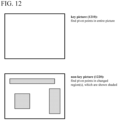
- the video encoder When it starts video encoding, or periodically during encoding, the video encoder encodes a key picture. Although the video encoder does not perform motion estimation when encoding the key picture, the video encoder can find pivot points in the key picture to use in subsequent encoding. As shown in FIG. 12 , for a key picture (1210), the video encoder finds pivot points in the entire picture. Then, for a non-key picture (1220), the video encoder detects changed regions in the picture (1220) relative to the previous picture (key picture (1210) in FIG. 12 ). The changed regions are shown as shaded regions in FIG. 12 . The video encoder finds pivot points in the changed regions and performs global HBME using the pivot points in the changed regions of the non-key picture (1220).
- the video encoder can detect changed regions in the current picture in various ways.
- the video encoder can detect changed regions using hint information provided by a rendering engine or other component of an operating system, which records the hint information when rendering images to a screen for display and capturing the images for encoding.
- the video encoder also receives the corresponding hint information for those pictures.
- the hint information can be a list of candidate changed rectangles, which might or might not include content changed from the previous picture to the current picture.
- the video encoder can detect changed regions using sample-by-sample comparisons, without using hint information provided by the operating system.
- the video encoder merges pivot points in the previous picture and current picture, keeping the pivot points in the previous picture that are outside the changed region(s) but replacing pivot points in the previous picture that are inside the changed region(s).
- the data structure includes retained pivot points for unchanged regions and newly added pivot points for the changed regions.
- a video encoder can aggregate local motion information for multiple smaller areas into global motion metadata for a larger area that includes the multiple smaller areas.
- the video encoder can successively enlarge a matching area (as described in section V.B.2) or combine multiple adjacent areas having the same motion into a larger matching area.
- the video encoder can use the global motion metadata to skip block-based motion estimation operations for multiple partitions of the current picture. For example, the video encoder assigns MVs for the multiple partitions based on the global motion metadata covering the area that includes the multiple partitions. The MVs are then encoded normally according to a standard or format. In this way, the video encoder can quickly make motion estimation decisions for the partitions while producing a bitstream that conforms to the standard or format.
- the video encoder can set syntax elements based on the global motion metadata and signal the syntax elements as part of the bitstream (e.g., in an SEI message).
- the video decoder can parse the syntax elements from the bitstream, determine the global motion metadata from the syntax elements, and assign MVs for partitions of the current picture in the area covered by the global motion metadata. Then, during regular decoding (conforming to a standard or format according to which MVs are signaled in the bitstream), the video decoder can perform motion compensation for the partitions. Signaling global motion metadata in this way potentially provides an efficient way to signal motion data for partitions of the current picture, reducing the bitrate used by the motion data.
- the video decoder can perform global motion compensation based on the global motion metadata.
- the video decoder can parse the syntax elements from the bitstream and determine the global motion metadata from the syntax elements. Then, the video decoder can perform global motion compensation for the entire area covered by the global motion metadata, potentially processing all of the partitions in the area in a single pass. The video decoder can skip motion compensation for individual partitions within the area covered by global motion metadata.
- the area covered by global motion metadata can be a rectangle that aligns with MBs (for H.264 encoding/decoding) or CUs (for H.265 encoding/decoding).
- the area covered by global motion metadata can be a rectangle that aligns with smaller units (e.g. , partitions for H.264 encoding/decoding or H.265 encoding/decoding), but is shifted relative to MB boundaries or CU boundaries.
- the rectangle can be enlarged, merged, etc. such that it aligns with arbitrary 4x4 partitions in the current picture (for H.264 encoding/decoding) or potentially smaller partitions for other standards/formats.
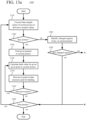
- FIGS. 13a and 13b show an example technique (1300) for video encoding that includes global HBME with hashing of derivative sample values for pivot points for changed regions of a current picture.
- a video encoder as described with reference to FIGS. 3 , 4a , and 4b or other video encoder can perform the technique (1300).
- the video encoder receives a picture (current picture) in a video sequence and converts (1310) base sample values of the current picture to derivative sample values. For example, the video encoder performs conversion operations as described in section VB. 1.
- the video encoder checks (1320) whether the current picture is a key picture. If so, the video encoder finds (1330) one or more pivot points (if any) in the current picture ( see sections V.B.2 and V.B.4). For a key picture, the video encoder assumes the entire picture is new (entire picture is a changed region) and attempts to find pivot points throughout the picture. For each of the pivot point(s) in the current picture, the video encoder calculates (1332) a hash value for the pivot point in the current picture and stores (1334) the pivot point in a data structure used for hashing ( see section V.B.3). For example, as described in section V.B.3, the video encoder calculates a hash index from the hash value (e.g.
- hash value & 0xFF determines a list of pivot points associated with the hash index, and stores the hash value and location of the pivot point in the list.
- the video encoder checks (1336) whether to continue with the next pivot point found in the current picture and, if so, calculates (1332) the hash value for that pivot point. In this way, the video encoder finds the pivot point(s) in the current picture and populates the data structure used for hashing.
- the video encoder encodes the current picture normally (with intra-picture compression) and outputs the encoded data for the current picture in a bitstream.
- the current picture is designated as the previous picture, for purposes of motion estimation of a subsequent picture.
- the video encoder checks (1390) whether to continue with the next picture in the video sequence and, if so, receives the next picture (as the current picture).
- the video encoder attempts to encode the current picture using inter-picture compression.
- the video encoder identifies (1340) changed regions, if any, in the current picture ( see section V.B.6).
- the video encoder checks (1342) whether any changed regions were identified. If no changed regions were identified, the video encoder encodes the current picture using simple inter-picture prediction without motion estimation (copying sections of the previous picture) and outputs the encoded data for the current picture in the bitstream. Then, the video encoder checks (1390) whether to continue with the next picture in the video sequence and, if so, receives the next picture (as the current picture).
- the video encoder finds (1350) one or more pivot points (if any) in the changed region(s) in the current picture ( see sections V.B.2 and V.B.4). For each of the pivot point(s) in the changed region(s) in the current picture, the video encoder calculates (1352) a hash value for the pivot point and searches (1354) for a matching area, if any, in the previous picture based at least in part on the hash value for the pivot point. As explained below, FIGS. 14a and 14b show an example technique (1400) for searching for the matching area in the previous picture during global HBME.
- the video encoder checks (1356) whether to continue with the next pivot point found in the changed region(s) in the current picture. If so (that is, there is at least one pivot point left to evaluate), the video encoder calculates (1352) the hash value for the next pivot point in the changed region(s) in the current picture and searches (1354) for a matching area. In this way, the video encoder finds the pivot point(s) in the current picture, populates the data structure used for hashing with the pivot point(s) in the current picture, and performs global HBME operations using the pivot point(s) in the data structure (from the current picture and previous picture(s)).
- the video encoder uses the results of the global HBME operations to encode the current picture with inter-picture compression (if successful) or other compression (otherwise).
- the other compression can include local HBME, full block-matching motion estimation, or intra-picture compression for different blocks of the current picture.
- the video encoder outputs the encoded data for the current picture in the bitstream.
- partitions in the matching areas are assigned MVs and encoded using motion compensation.
- partitions can be encoded using local HBME, conventional block-based motion estimation, or intra-picture compression.
- the video encoder updates (1360) the data structure used for hashing, as described in sections V.B.3 and V.B.6.
- the current picture is designated as the previous picture, for purposes of motion estimation of a subsequent picture.
- the video encoder checks (1390) whether to continue with the next picture in the video sequence and, if so, receives the next picture (as the current picture).
- the video encoder calculates (1410) a hash index from the hash value for the pivot point in the current picture (e.g. , hash value & 0xFF) and retrieves (1420) a list, if any, of candidate pivot points (in the previous picture) associated with the hash index from the data structure used for hashing.
- the video encoder checks (1422) whether a list of candidate pivot point(s) in the previous picture was retrieved. If not, the video encoder finishes searching (1354) for the pivot point in the current picture, and checks (1356) whether to continue with the next pivot point found in the changed region(s) in the current picture, as shown in FIG. 13b .
- the video encoder compares (1430) the hash value for the pivot point in the changed region(s) in the current picture against the hash value for the next candidate pivot point in the list. If the hash values match (at decision 1432), the video encoder compares (1440) sample values in an area around the pivot point in the current picture and corresponding sample values around the candidate pivot point in the previous picture, as described in section V.B.2. For example, the area for comparison of sample values is a rectangular area. If the sample values match in the area (at decision 1442), the video encoder checks (1450) whether the area overlaps another pivot point.
- the video encoder updates (1452) the pivot points in the changed region(s) in the current picture to remove a pivot point (as being unhelpful), as described in section V.B.2.
- the video encoder continues by checking (1460) whether the size of the matching area is less than a maximum size. If so, the video encoder enlarges (1462) the area and compares (1440) sample values in the enlarged area around the pivot point in the current picture and corresponding sample values around the candidate pivot point in the previous picture.
- the video encoder checks (1434) whether there is another candidate pivot point in the list. If so, the encoder compares (1430) the hash value for the pivot point in the changed region(s) in the current picture against the hash value for the next candidate pivot point in the list. Otherwise (no more candidate pivot points to evaluate in the list), the motion estimation using pivot points fails, and local HBME, conventional block-matching motion estimation, or intra-picture compression can be used instead.
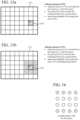
- FIGS. 15a and 15b illustrate examples of spatial constraints along lines of grid areas of a reference picture in local HBME.
- a reference picture (1510) is divided into grid areas.
- the reference picture (1510) is a 2048x1536 plane of derivative sample values or luma sample values, and the video encoder divides the reference picture (1510) into 256x256 grid areas.
- One grid area (1520) includes the collocated block for a current block of a current picture.
- the search area (shown as shaded) is the single grid area (1520) that includes the collocated block.
- FIG. 15a reference picture is divided into grid areas.
- the reference picture (1510) is a 2048x1536 plane of derivative sample values or luma sample values
- the video encoder divides the reference picture (1510) into 256x256 grid areas.
- One grid area (1520) includes the collocated block for a current block of a current picture.
- the search area (shown as shaded) is the single grid area (1520) that includes the colloc
- a reference picture (1511) is divided into grid areas, and one grid area (1521) includes the collocated block for a current block of a current picture.
- the search area (shown as shaded) is the single grid area (1521) that includes the collocated block and multiple adjacent grid areas.
- the multiple adjacent grid areas include one adjacent grid area in each direction horizontally, vertically, and diagonally. An adjacent grid area that would be outside the reference picture (1511) is not considered part of the search area.
- a video encoder can limit local HBME so that it is performed only for blocks within changed regions of the current picture. Even within a changed region of the current picture, the video encoder can further limit local HBME so that it is performed only for blocks that are likely to benefit from the local HBME. (In some examples described herein, such blocks are termed "qualifying blocks.") In this way, the video encoder can limit the resources used to compute and manage hash values for candidate blocks of a reference picture for local HBME. Similarly, the video encoder can limit the resources uses to compute hash values and search for blocks of the current picture.
- the video encoder can limit local HBME to blocks that contain text.
- the video encoder can use any of various approaches, depending on implementation. For example, the video encoder can make a decision based on hint information from an operating system component, which indicates whether a block contains text. Or, as another example, the video encoder can make a decision based on information produced during color space conversion operations for sample values of a block. The information produced during color space conversion operations can be a histogram which shows the number of distinct sample values.
- the video encoder can determine that a block contains text if it has more than one distinct sample value but less than x distinct sample values, where x is 2, 3, or some other small non-zero integer. Or, the video encoder can determine whether a block includes black and white sample values (suggesting typical textual content) by evaluating whether chroma sample values are zero or mostly zero. Or, as another example, the video encoder can apply an image classification test to sample values of the block to determine whether the block contains text. To make a decision about whether a block contains text, the video encoder can make a decision for a larger region that includes the block, and then apply the decision to the various blocks within the larger region.
- the video encoder can limit local HBME to blocks that contain pivot points.
- the video encoder can use any of various approaches, as described in section V.C.4.
- the video encoder can limit local HBME to blocks that contain text and also contain pivot points.
- the video encoder determines hash values for candidate blocks in grid areas of a reference picture. For example, for a given reference picture, the video encoder splits the reference picture into grid areas ( see section V.C.2). The video encoder checks candidate blocks in a given grid area. For a given candidate block, the video encoder checks whether the candidate block contains text content, as described above. If so, the video encoder checks whether the candidate block contains a pivot point, as described above. If the candidate block contains text content and contains a pivot point, the video encoder calculates a hash value for the candidate block and registers the candidate block in a data structure that tracks hash values for the reference picture ( see section V.C.8). The video encoder continues this process for the next candidate block in the given grid area, and then repeats the process for other grid areas of the reference picture.
- the video encoder When encoding a current picture, the video encoder checks conditions for a current block of the current picture before performing local HBME for the current block. The video encoder checks whether the current block contains text content, as described above. If so, the video encoder checks whether the current block contains a pivot point, as described above. If the current block contains text content and contains a pivot point, the video encoder performs local HBME for the current block, calculating a hash value for the current block and searching for a matching block in the reference picture. Otherwise (the current block does not contain text content and/or does not contain a pivot point), the current block is encoded in some other way (e.g., full block-matching motion estimation or intra-picture compression). The video encoder repeats this process for other blocks in the current picture.
- some other way e.g., full block-matching motion estimation or intra-picture compression
- the video encoder can calculate hash values for all blocks. In typical encoding scenarios, however, this tends to increase computational complexity without improving effectiveness of local HBME very much.
- the video encoder can search for various patterns of sample values.
- the video encoder compares sample values for the picture to one or more patterns.
- Each of the one or more patterns can be indicative of an edge, character, or other distinctive configuration of sample values.
- the sample values can be derivative sample values ( see section V.C.1) or base sample values.
- Section V.B.4 describes several examples of patterns for pivot points in global HBME. The same patterns can be used for pivot points in local HBME.
- FIG. 16 shows an example pattern (1600) for pivot points in local HBME.
- the video encoder evaluates sample values in a first row and a fourth row of a 4x4 arrangement.
- the first row includes sample values a, b, c, and d, which can be the same or different from each other.
- the fourth row includes sample values e, f, g, and h, which can be the same or different from each other.
- the video encoder aggregates sample values a, b, c, and d of the first row into a first aggregate value, aggregates sample values e, f, g, and h of the fourth row into a second aggregate value, and compares the first and second aggregate values. If the two aggregate values are different, the video encoder designates the current location ( e.g., for a current block, for a candidate block) as a pivot point.
- the video encoder designates the current location as a pivot point.
- the current location can be the first location (top-left location) of a 4x4 arrangement for a 4x4 block.
- the current location is designated as a pivot point.
- the video encoder can apply any of these patterns for pivot points when searching for candidate blocks (qualifying blocks) in regions ( e.g., grid areas) of a reference picture or when searching for qualifying blocks in the current picture. If a pivot point is found in a reference picture, the video encoder adds an entry for the pivot point (that is, for the candidate block that contains the pivot point, at the location for the pivot point) to a data structure that tracks hash values for the reference picture. If a pivot point is found in the current picture, the video encoder performs local HBME for the pivot point (that is, for the current block that contains the pivot point).
- the video encoder uses a hashing function.
- the hashing function depends on implementation.
- the hashing function can yield a hash value with 32 bits, 64 bits, or some other number of bits, depending on implementation.
- Section V.B.5 describes examples of hashing functions for global HBME.
- the same hashing functions e . g ., Cantor pairing function, murmur hashing function
- the video encoder uses another hashing function for local HBME.
- sample values that contribute to the hashing function are not necessarily the same as the sample values evaluated according to a pattern for the pivot point, but they can be the same.
- the sample values that contribute to the hashing function can selected from the 16 sample values of a 4x4 arrangement of sample values in one of the example patterns (1110, 1120, 1130, 1600) shown in FIGS. 11a, 11b, 11c , and 16 , respectively.
- hash values can be computed for larger blocks ( e.g., 8x8 blocks or 16x16 blocks).
- the hashing function for local HBME is a Cantor pairing function with 32-bit inputs d0 and d1.
- the video encoder can count all bits of sample values that are input to the hashing function. Alternatively, the video encoder can ignore one or more least significant bits of the respective sample values that are input to the hashing function. For example, the video encoder ignores the x least significant bits per sample value input to the hashing function, where x is, for example 1, 2, 3, or 4.
- the value of x defines a threshold for the hashing function and hash values. When the threshold is low, blocks may have the same hash value even when there are small differences in the respective sample values contributing to the hashing function for the blocks. When the threshold is higher, blocks may have the same hash value even when there are larger differences in the respective sample values contributing to the hashing function for the blocks.
- inputs d0 and d1 can be computed from sample values with a threshold count of least significant bits ignored per sample value.
- the video encoder can consider which regions of the current picture have changed relative to the previous picture when updating the data structure. If the data structure includes a list of one or more candidate blocks in the previous picture, the video encoder retains any of the candidate block(s) in the previous picture that is outside the changed region(s), removes any of the candidate blocks(s) in the previous picture that is inside the changed region(s), and adds at least one candidate block (from the current picture) that is inside the changed region(s). Thus, the video encoder updates hash values for changed regions by replacing obsolete entries.
- the video encoder can skip detection of changed regions, potentially performing local HBME for all parts of the current picture. This can be much slower, however, and typically does not detect much additional motion between pictures.
- the data structure (1700) includes different hash index tables for different grid areas in the previous picture (example of reference picture).
- the grid area table (1710) For each grid area in the previous picture, the grid area table (1710) includes a reference ( e . g ., pointer) to a hash index table for that grid area.
- the grid area table (1710) includes a reference to a hash index table (1720) for grid area 0.
- the grid area table (1710) includes a reference to a hash index table (1740) for grid area n .
- hash index tables for other grid areas are not shown.
- Each hash index table manages hash values for candidate blocks ( e.g., for pivot points) in one grid area, and the hash values/candidate blocks are further organized by hash index.
- each hash index table (1720, 1740) includes an entry for each possible value of hash index.
- the hash index has 8 bits, and the range of values for the hash index is 0x00 to 0xFF. Examples of ways to compute hash index values from hash values are described section V.B.2.
- An entry in the hash index table (1720, 1740) can be empty or include a reference (e.g., pointer) to a list of one or more candidate blocks ( e.g., for pivot points) in a specific grid area.
- a list of candidate block(s) initially includes entries for up to eight different candidate blocks, but can dynamically increase in size to store information for additional candidate blocks ( e.g., up to a size of 128 candidate blocks indexed 0x00 to 0x7F).
- Multiple candidate blocks represented in a given list can have different hash values that yield the same value of hash index.
- a list (1730) includes entries for three candidate blocks in grid area 0 of the previous picture.
- the three candidate blocks in the list (1730) have hash values associated with the hash index 0x03.
- an entry (not shown) in the list indicates a location in the previous picture and the hash value for the candidate block.
- each list includes entries for one or more candidate blocks in grid area n of the previous picture.
- FIG. 17 shows two lists (1750, 1751) of candidate blocks in grid area n of the previous picture. The two lists are associated with the hash indices 0x03 and 0xFF, respectively, for hash values of candidate blocks in grid area n of the previous picture.
- an entry (not shown) in the list indicates a location in the previous picture and the hash value for the candidate block.
- a video encoder Before performing location HBME for blocks of a current picture, a video encoder performs various operations to register a reference picture for local HBME, populating the multi-level data structure (1700) with entries for candidate blocks in the reference picture. For example, the video encoder splits the reference picture into multiple grid areas, as described in section V.C.2. For a given grid area, the video encoder determines whether a block at a location in the grid area qualifies as one of the candidate blocks in the reference picture. For example, the video encoder checks the content of the block ( e . g ., checking that the block contains textual content as described in section V.C.3, checking that the candidate block contains a pivot point as described in section V.C.4).
- the content of the block e . g ., checking that the block contains textual content as described in section V.C.3, checking that the candidate block contains a pivot point as described in section V.C.4
- the grid area index can be computed as (( y >> 8) * max_grid_x) + ( x >>8).
- the video encoder repeats that process for other pivot points in the previous picture.
- FIG. 18b shows one example (1821) of the encoding (1820) shown in FIG. 18a for the current picture.
- the video encoder calculates (1822) a hash value for a current block in the current picture. For example, the video encoder calculates the hash value as described in section V.C.5 or in some other way.
- the hash value for the current block can be computed using sample values subjected to a threshold ( e . g ., ignoring the x least significant bits of the sample values, respectively), as described in section V.C.6.
- the video encoder can store the hash value and location for the current block as an entry of a list in a data structure that tracks hash values for blocks of the current picture.
- the video encoder can perform limited block-matching motion estimation for the current block, starting from the possible matching block, and potentially continuing motion estimation around that candidate block according to a limited motion estimation search pattern.
- the video encoder can evaluate distortion cost and/or bit cost (for motion information, for residual values) for each of one or more blocks in the reference picture.
- the distortion cost can be measured as a sum of absolute difference of sample values between the current block and evaluated block in the reference picture, as sum of absolute transform differences for residual values, or using some other distortion metric.
- the video encoder can select the matching block based at least in part on results of the limited block-matching motion estimation.
- all blocks of the current picture may be encoded using local HBME.
- a video encoder can check various conditions that limit which blocks of the current picture may be encoded using local HBME. For example, the video encoder determines a changed region of the current picture, and the calculating (1822) the hash value for the current block and the searching (1824) are contingent on the current block being within the changed region. As another example, the video encoder determines whether the current block contains textual content, and the calculating (1822) the hash value for the current block and the searching (1824) are contingent on the current block containing textual content.
- the video encoder checks (1840) whether to continue with the next picture and, if so, receives (1810) the next picture in the video sequence.
- the video encoder can repeat the receiving (1810), encoding (1820), and outputting (1830) operations for one or more other pictures in the video sequence.
- the video encoder receives one or more pictures in a video sequence, encodes the one or more pictures, and outputs the encoded data for the one or more pictures as part of a bitstream.
- the video encoder can update the data structure that tracks hash values for the reference picture for local HBME, thereby registering the current picture into the data structure. As described in section V.C.7, the video encoder can consider which regions of the current picture have changed relative to the previous picture, and selectively update the data structure that tracks hash values for blocks in the changed region(s).
- the video encoder determines changed regions, if any, of the current picture relative to the previous picture in display order.
- the video encoder removes obsolete entries in the data structure for candidate blocks in any changed regions (for locations in the previous picture, which are in the changed regions).
- the video encoder adds entries in the data structure for candidate blocks in any changed regions of the current picture, and it retains entries in the data structure for candidate blocks in any non-changed regions.
- the candidate blocks added to the data structure may overlap, being defined at offsets for a dense configuration of candidate blocks, as described in section V.C.8.
- the video encoder checks (1920) whether the current picture is a key picture. If so, for use of the current picture as a reference picture in later local HBME, the video encoder finds (1930) one or more qualifying blocks (if any) in the current picture.
- a qualifying block is a candidate block that contains text and contains a pivot point. See sections V.C.3 and V.C.4. For a key picture, the video encoder assumes the entire picture is new (entire picture is a changed region) and attempts to find qualifying blocks throughout the picture.
Landscapes
- Engineering & Computer Science (AREA)
- Multimedia (AREA)
- Signal Processing (AREA)
- Physics & Mathematics (AREA)
- General Physics & Mathematics (AREA)
- Theoretical Computer Science (AREA)
- Compression Or Coding Systems Of Tv Signals (AREA)
- Image Analysis (AREA)
Applications Claiming Priority (3)
| Application Number | Priority Date | Filing Date | Title |
|---|---|---|---|
| US15/365,927 US11095877B2 (en) | 2016-11-30 | 2016-11-30 | Local hash-based motion estimation for screen remoting scenarios |
| PCT/US2017/063164 WO2018102224A1 (en) | 2016-11-30 | 2017-11-23 | Local hash-based motion estimation for screen remoting scenarios |
| EP17817471.0A EP3549345B1 (de) | 2016-11-30 | 2017-11-23 | Lokale hash-basierte bewegungsschätzung für bildschirmfernzugriffszenarien |
Related Parent Applications (1)
| Application Number | Title | Priority Date | Filing Date |
|---|---|---|---|
| EP17817471.0A Division EP3549345B1 (de) | 2016-11-30 | 2017-11-23 | Lokale hash-basierte bewegungsschätzung für bildschirmfernzugriffszenarien |
Publications (2)
| Publication Number | Publication Date |
|---|---|
| EP4583510A2 true EP4583510A2 (de) | 2025-07-09 |
| EP4583510A3 EP4583510A3 (de) | 2025-08-27 |
Family
ID=60703096
Family Applications (2)
| Application Number | Title | Priority Date | Filing Date |
|---|---|---|---|
| EP25173275.6A Pending EP4583510A3 (de) | 2016-11-30 | 2017-11-23 | Lokale hash-basierte bewegungsschätzung für bildschirmfernzugriffszenarien |
| EP17817471.0A Active EP3549345B1 (de) | 2016-11-30 | 2017-11-23 | Lokale hash-basierte bewegungsschätzung für bildschirmfernzugriffszenarien |
Family Applications After (1)
| Application Number | Title | Priority Date | Filing Date |
|---|---|---|---|
| EP17817471.0A Active EP3549345B1 (de) | 2016-11-30 | 2017-11-23 | Lokale hash-basierte bewegungsschätzung für bildschirmfernzugriffszenarien |
Country Status (4)
| Country | Link |
|---|---|
| US (1) | US11095877B2 (de) |
| EP (2) | EP4583510A3 (de) |
| CN (1) | CN110024398B (de) |
| WO (1) | WO2018102224A1 (de) |
Families Citing this family (36)
| Publication number | Priority date | Publication date | Assignee | Title |
|---|---|---|---|---|
| KR102197505B1 (ko) | 2013-10-25 | 2020-12-31 | 마이크로소프트 테크놀로지 라이센싱, 엘엘씨 | 비디오 및 이미지 코딩 및 디코딩에서의 해시 값을 갖는 블록의 표현 |
| US10368092B2 (en) | 2014-03-04 | 2019-07-30 | Microsoft Technology Licensing, Llc | Encoder-side decisions for block flipping and skip mode in intra block copy prediction |
| US10567754B2 (en) | 2014-03-04 | 2020-02-18 | Microsoft Technology Licensing, Llc | Hash table construction and availability checking for hash-based block matching |
| CN105706450B (zh) | 2014-06-23 | 2019-07-16 | 微软技术许可有限责任公司 | 根据基于散列的块匹配的结果的编码器决定 |
| CN105981382B (zh) | 2014-09-30 | 2019-05-28 | 微软技术许可有限责任公司 | 用于视频编码的基于散列的编码器判定 |
| US10575007B2 (en) | 2016-04-12 | 2020-02-25 | Microsoft Technology Licensing, Llc | Efficient decoding and rendering of blocks in a graphics pipeline |
| US10157480B2 (en) | 2016-06-24 | 2018-12-18 | Microsoft Technology Licensing, Llc | Efficient decoding and rendering of inter-coded blocks in a graphics pipeline |
| US10390039B2 (en) | 2016-08-31 | 2019-08-20 | Microsoft Technology Licensing, Llc | Motion estimation for screen remoting scenarios |
| US11197010B2 (en) | 2016-10-07 | 2021-12-07 | Microsoft Technology Licensing, Llc | Browser-based video decoder using multiple CPU threads |
| US11095877B2 (en) | 2016-11-30 | 2021-08-17 | Microsoft Technology Licensing, Llc | Local hash-based motion estimation for screen remoting scenarios |
| JP2018107500A (ja) * | 2016-12-22 | 2018-07-05 | キヤノン株式会社 | 符号化装置、符号化方法及びプログラム、復号装置、復号方法及びプログラム |
| JP2018107588A (ja) * | 2016-12-26 | 2018-07-05 | ルネサスエレクトロニクス株式会社 | 画像処理装置および半導体装置 |
| DE112018002117B4 (de) | 2017-04-21 | 2026-02-19 | Zenimax Media Inc. | Systeme und verfahren für verzögerte post-prozesse in der videocodierung |
| US20200014945A1 (en) | 2018-07-08 | 2020-01-09 | Mellanox Technologies, Ltd. | Application acceleration |
| US11252464B2 (en) | 2017-06-14 | 2022-02-15 | Mellanox Technologies, Ltd. | Regrouping of video data in host memory |
| US12058309B2 (en) | 2018-07-08 | 2024-08-06 | Mellanox Technologies, Ltd. | Application accelerator |
| US10812810B2 (en) * | 2018-02-06 | 2020-10-20 | Tencent America LLC | Method and apparatus for video coding in merge mode |
| CN113170133B (zh) * | 2018-11-27 | 2024-06-14 | Op方案有限责任公司 | 用于图片的基于块的空间活动度量 |
| US10880354B2 (en) | 2018-11-28 | 2020-12-29 | Netflix, Inc. | Techniques for encoding a media title while constraining quality variations |
| US10841356B2 (en) * | 2018-11-28 | 2020-11-17 | Netflix, Inc. | Techniques for encoding a media title while constraining bitrate variations |
| CN113170177B (zh) * | 2019-01-02 | 2025-06-20 | 北京字节跳动网络技术有限公司 | 基于散列的运动搜索 |
| JP7321583B2 (ja) * | 2019-04-25 | 2023-08-07 | オーピー ソリューションズ, エルエルシー | ピクチャヘッダ内の大域的運動ベクトルの信号伝達 |
| US11146823B2 (en) * | 2019-06-25 | 2021-10-12 | Qualcomm Incorporated | Signalling chroma quantization parameter (QP) mapping tables |
| US11146808B2 (en) * | 2019-06-27 | 2021-10-12 | Tencent America LLC | Method and apparatus for video coding |
| US12238273B2 (en) * | 2019-12-03 | 2025-02-25 | Mellanox Technologies, Ltd | Video coding system |
| CN111225214B (zh) * | 2020-01-22 | 2022-08-12 | 北京字节跳动网络技术有限公司 | 视频处理方法、装置及电子设备 |
| CN118337987A (zh) * | 2020-03-26 | 2024-07-12 | 阿里巴巴(中国)有限公司 | 一种非暂时性计算机可读介质 |
| CN111614961A (zh) * | 2020-05-25 | 2020-09-01 | 绍兴文理学院 | 采用不同方式计算哈希值建立哈希表进行搜索的编码方法 |
| US11202085B1 (en) | 2020-06-12 | 2021-12-14 | Microsoft Technology Licensing, Llc | Low-cost hash table construction and hash-based block matching for variable-size blocks |
| CN111814714B (zh) * | 2020-07-15 | 2024-03-29 | 前海人寿保险股份有限公司 | 基于音视频录制的图像识别方法、装置、设备及存储介质 |
| US11638040B2 (en) | 2020-08-24 | 2023-04-25 | Schmied Enterprises LLC | Eco-friendly codec-based system for low latency transmission |
| CN112422360A (zh) * | 2020-10-14 | 2021-02-26 | 锐捷网络股份有限公司 | 一种报文采样方法、装置、设备及介质 |
| US20240171780A1 (en) * | 2021-03-25 | 2024-05-23 | Nokia Technologies Oy | General region-based hash |
| US20230344891A1 (en) * | 2021-06-22 | 2023-10-26 | Meta Platforms Technologies, Llc | Systems and methods for quality measurement for videoconferencing |
| US12339902B2 (en) | 2021-10-05 | 2025-06-24 | Mellanox Technologies, Ltd | Hardware accelerated video encoding |
| CN114283091B (zh) * | 2021-12-27 | 2022-08-09 | 国网黑龙江省电力有限公司伊春供电公司 | 基于视频融合的电力设备图像恢复系统 |
Family Cites Families (211)
| Publication number | Priority date | Publication date | Assignee | Title |
|---|---|---|---|---|
| US2239538A (en) | 1939-03-30 | 1941-04-22 | Zeiss Carl Fa | Photographic teleobjective |
| US2718173A (en) | 1950-09-26 | 1955-09-20 | Cycloptic Anstalt Fur Optik Un | High intensity five component photographic objective |
| US3059528A (en) | 1957-07-02 | 1962-10-23 | Allan Ted | Panoramic motion picture camera |
| US3142236A (en) | 1961-03-08 | 1964-07-28 | American Optical Corp | Cameras and high speed optical system therefor |
| CH486707A (de) | 1968-06-14 | 1970-02-28 | Voigtlaender Ag | Lichtstarkes objektiv aus mindestens vier in Luft stehenden Gliedern vom erweiterten Triplet-typus |
| US5016980A (en) | 1985-11-12 | 1991-05-21 | Waldron Robert D | Systems for deviating and (optionally) converging radiation |
| US4918583A (en) | 1988-04-25 | 1990-04-17 | Nikon Corporation | Illuminating optical device |
| US5565921A (en) | 1993-03-16 | 1996-10-15 | Olympus Optical Co., Ltd. | Motion-adaptive image signal processing system |
| US5610841A (en) | 1993-09-30 | 1997-03-11 | Matsushita Electric Industrial Co., Ltd. | Video server |
| US5850312A (en) | 1993-10-22 | 1998-12-15 | Olympus Optical Co., Ltd. | Three-unit zoom lens |
| JP3580869B2 (ja) | 1994-09-13 | 2004-10-27 | オリンパス株式会社 | 立体視内視鏡 |
| US5613004A (en) | 1995-06-07 | 1997-03-18 | The Dice Company | Steganographic method and device |
| US5774271A (en) | 1996-07-29 | 1998-06-30 | Welch Allyn, Inc. | Lamp assembly |
| JP3869895B2 (ja) | 1996-12-27 | 2007-01-17 | キヤノン株式会社 | 防振機能を有した光学系 |
| US7206346B2 (en) | 1997-06-25 | 2007-04-17 | Nippon Telegraph And Telephone Corporation | Motion vector predictive encoding method, motion vector decoding method, predictive encoding apparatus and decoding apparatus, and storage media storing motion vector predictive encoding and decoding programs |
| US6904110B2 (en) | 1997-07-31 | 2005-06-07 | Francois Trans | Channel equalization system and method |
| US6879266B1 (en) | 1997-08-08 | 2005-04-12 | Quickshift, Inc. | Memory module including scalable embedded parallel data compression and decompression engines |
| JPH1166301A (ja) | 1997-08-15 | 1999-03-09 | Nippon Telegr & Teleph Corp <Ntt> | カラー画像分類方法及び装置及びこの方法を記録した記録媒体 |
| US6895048B2 (en) | 1998-03-20 | 2005-05-17 | International Business Machines Corporation | Adaptive encoding of a sequence of still frames or partially still frames within motion video |
| US6332092B1 (en) | 1998-07-08 | 2001-12-18 | Lifespex, Incorporated | Optical probe having and methods for uniform light irradiation and/or light collection over a volume |
| US6487440B2 (en) | 1998-07-08 | 2002-11-26 | Lifespex, Inc. | Optical probe having and methods for difuse and uniform light irradiation |
| US6400764B1 (en) | 1999-04-06 | 2002-06-04 | Koninklijke Philips Electronics N. V. | Motion estimation method featuring orthogonal-sum concurrent multi matching |
| US7216232B1 (en) | 1999-04-20 | 2007-05-08 | Nec Corporation | Method and device for inserting and authenticating a digital signature in digital data |
| US6785815B1 (en) | 1999-06-08 | 2004-08-31 | Intertrust Technologies Corp. | Methods and systems for encoding and protecting data using digital signature and watermarking techniques |
| US7430670B1 (en) | 1999-07-29 | 2008-09-30 | Intertrust Technologies Corp. | Software self-defense systems and methods |
| US6671407B1 (en) | 1999-10-19 | 2003-12-30 | Microsoft Corporation | System and method for hashing digital images |
| JP2001228401A (ja) | 2000-02-16 | 2001-08-24 | Canon Inc | 投影光学系、および該投影光学系による投影露光装置、デバイス製造方法 |
| GB0006153D0 (en) | 2000-03-14 | 2000-05-03 | Inpharmatica Ltd | Database |
| CA2304433A1 (en) | 2000-04-05 | 2001-10-05 | Cloakware Corporation | General purpose access recovery scheme |
| GB2364459B (en) | 2000-06-30 | 2004-03-31 | Nokia Mobile Phones Ltd | Video error resilience |
| US6938128B1 (en) | 2000-07-20 | 2005-08-30 | Silicon Graphics, Inc. | System and method for reducing memory latency during read requests |
| US6915387B1 (en) | 2000-07-20 | 2005-07-05 | Silicon Graphics, Inc. | System and method for handling updates to memory in a distributed shared memory system |
| US6765963B2 (en) | 2001-01-03 | 2004-07-20 | Nokia Corporation | Video decoder architecture and method for using same |
| US6920175B2 (en) | 2001-01-03 | 2005-07-19 | Nokia Corporation | Video coding architecture and methods for using same |
| GB2375673A (en) | 2001-05-14 | 2002-11-20 | Salgen Systems Ltd | Image compression method using a table of hash values corresponding to motion vectors |
| US7328153B2 (en) | 2001-07-20 | 2008-02-05 | Gracenote, Inc. | Automatic identification of sound recordings |
| DE10158658A1 (de) | 2001-11-30 | 2003-06-12 | Bosch Gmbh Robert | Verfahren zur gerichteten Prädiktion eines Bildblockes |
| US6819322B2 (en) | 2002-01-04 | 2004-11-16 | Hewlett-Packard Development Company, L.P. | Method and apparatus for detecting potential lock-up conditions in a video graphics controller |
| CA2574110A1 (en) | 2002-01-18 | 2003-07-31 | Kabushiki Kaisha Toshiba | Video encoding method and apparatus and video decoding method and apparatus |
| US6922246B2 (en) | 2002-02-22 | 2005-07-26 | Xenogen Corporation | Bottom fluorescence illumination assembly for an imaging apparatus |
| US6894289B2 (en) | 2002-02-22 | 2005-05-17 | Xenogen Corporation | Fluorescence illumination assembly for an imaging apparatus |
| JP3983573B2 (ja) | 2002-03-06 | 2007-09-26 | 富士重工業株式会社 | ステレオ画像特性検査システム |
| US6983020B2 (en) | 2002-03-25 | 2006-01-03 | Citrix Online Llc | Method and apparatus for fast block motion detection |
| JP4151374B2 (ja) | 2002-03-29 | 2008-09-17 | セイコーエプソン株式会社 | 動画像符号化装置および動画像符号化方法 |
| US7400774B2 (en) | 2002-09-06 | 2008-07-15 | The Regents Of The University Of California | Encoding and decoding of digital data using cues derivable at a decoder |
| US7181572B2 (en) | 2002-12-02 | 2007-02-20 | Silverbrook Research Pty Ltd | Cache updating method and apparatus |
| US20040174570A1 (en) | 2002-12-02 | 2004-09-09 | Plunkett Richard Thomas | Variable size dither matrix usage |
| US7792121B2 (en) | 2003-01-03 | 2010-09-07 | Microsoft Corporation | Frame protocol and scheduling system |
| JP4499370B2 (ja) | 2003-04-04 | 2010-07-07 | オリンパス株式会社 | 結像光学系及びそれを用いた撮像装置 |
| DE10316428A1 (de) | 2003-04-08 | 2004-10-21 | Carl Zeiss Smt Ag | Katadioptrisches Reduktionsobjektiv |
| HUP0301368A3 (en) | 2003-05-20 | 2005-09-28 | Amt Advanced Multimedia Techno | Method and equipment for compressing motion picture data |
| US8264489B2 (en) | 2003-07-11 | 2012-09-11 | Intel Corporation | Interface remoting |
| US7609763B2 (en) | 2003-07-18 | 2009-10-27 | Microsoft Corporation | Advanced bi-directional predictive coding of video frames |
| US20050060643A1 (en) | 2003-08-25 | 2005-03-17 | Miavia, Inc. | Document similarity detection and classification system |
| WO2005027491A2 (en) | 2003-09-05 | 2005-03-24 | The Regents Of The University Of California | Global motion estimation image coding and processing |
| EP2278287B1 (de) | 2003-10-27 | 2016-09-07 | The General Hospital Corporation | Optische Abbildungsmethode und - vorrichtung mit Frequenzbereichsinterferometrie |
| US20050105621A1 (en) | 2003-11-04 | 2005-05-19 | Ju Chi-Cheng | Apparatus capable of performing both block-matching motion compensation and global motion compensation and method thereof |
| DE602004010040T2 (de) | 2003-12-11 | 2008-09-11 | Tokendo | Messvorrichtung für eine video-endoskopische Sonde |
| US20040133548A1 (en) | 2003-12-15 | 2004-07-08 | Alex Fielding | Electronic Files Digital Rights Management. |
| US7095568B2 (en) | 2003-12-19 | 2006-08-22 | Victor Company Of Japan, Limited | Image display apparatus |
| KR100995398B1 (ko) | 2004-01-20 | 2010-11-19 | 삼성전자주식회사 | 수직 및 수평 방향의 패턴을 고려한 전역 움직임 보상순차주사화 방법 |
| US7606974B2 (en) | 2004-05-26 | 2009-10-20 | Intel Corporation | Automatic caching generation in network applications |
| US7672005B1 (en) | 2004-06-30 | 2010-03-02 | Teradici Corporation | Methods and apparatus for scan block caching |
| US20060062303A1 (en) | 2004-09-17 | 2006-03-23 | Sony Corporation | Hybrid global motion estimator for video encoding |
| US7526607B1 (en) | 2004-09-23 | 2009-04-28 | Juniper Networks, Inc. | Network acceleration and long-distance pattern detection using improved caching and disk mapping |
| CA2584121C (en) | 2004-10-15 | 2014-08-19 | The Regents Of The University Of Colorado, A Body Corporate | Revocable biometrics with robust distance metrics |
| JP2006265087A (ja) | 2004-12-13 | 2006-10-05 | Ohara Inc | 光学素子用プリフォーム |
| US20060153295A1 (en) | 2005-01-12 | 2006-07-13 | Nokia Corporation | Method and system for inter-layer prediction mode coding in scalable video coding |
| US20060224594A1 (en) | 2005-04-04 | 2006-10-05 | Oracle International Corporation | Methods and systems for identifying highly contended blocks in a database |
| CN100484233C (zh) | 2005-06-03 | 2009-04-29 | 中国科学院研究生院 | 数字电视信号安全认证装置及带有该装置的电视设备 |
| KR100716999B1 (ko) | 2005-06-03 | 2007-05-10 | 삼성전자주식회사 | 영상의 대칭성을 이용한 인트라 예측 방법, 이를 이용한영상의 복호화, 부호화 방법 및 장치 |
| US7822278B1 (en) | 2005-09-20 | 2010-10-26 | Teradici Corporation | Methods and apparatus for encoding a digital video signal |
| US8107527B1 (en) | 2005-07-28 | 2012-01-31 | Teradici Corporation | Progressive block encoding using region analysis |
| US8787460B1 (en) * | 2005-07-28 | 2014-07-22 | Teradici Corporation | Method and apparatus for motion vector estimation for an image sequence |
| US20070025442A1 (en) | 2005-07-28 | 2007-02-01 | Sanyo Electric Co., Ltd. | Coding method for coding moving images |
| KR101211665B1 (ko) | 2005-08-12 | 2012-12-12 | 삼성전자주식회사 | 영상의 인트라 예측 부호화, 복호화 방법 및 장치 |
| JP4815944B2 (ja) | 2005-08-19 | 2011-11-16 | 富士ゼロックス株式会社 | ホログラム記録方法及び装置 |
| JP2007066191A (ja) | 2005-09-01 | 2007-03-15 | Toshiba Corp | 再生装置および再生方法 |
| FR2891685B1 (fr) | 2005-10-03 | 2008-04-18 | Envivio France Entpr Uniperson | Procede et dispositif d'estimation de mouvement a references multiples, procede et dispositif de codage, produits programme d'ordinateur et moyens de stockage correspondants. |
| ATE504878T1 (de) | 2005-10-12 | 2011-04-15 | Datacastle Corp | Verfahren und system zur datensicherung |
| US7702127B2 (en) | 2005-10-21 | 2010-04-20 | Microsoft Corporation | Video fingerprinting using complexity-regularized video watermarking by statistics quantization |
| RU2298226C1 (ru) | 2005-10-28 | 2007-04-27 | Самсунг Электроникс Ко., Лтд. | Способ улучшения цифровых изображений |
| GB2431798A (en) | 2005-10-31 | 2007-05-02 | Sony Uk Ltd | Motion vector selection based on integrity |
| US7986844B2 (en) * | 2005-11-22 | 2011-07-26 | Intel Corporation | Optimized video compression using hashing function |
| US20070199011A1 (en) | 2006-02-17 | 2007-08-23 | Sony Corporation | System and method for high quality AVC encoding |
| US20070217702A1 (en) | 2006-03-14 | 2007-09-20 | Sung Chih-Ta S | Method and apparatus for decoding digital video stream |
| US7949186B2 (en) | 2006-03-15 | 2011-05-24 | Massachusetts Institute Of Technology | Pyramid match kernel and related techniques |
| KR100763917B1 (ko) | 2006-06-21 | 2007-10-05 | 삼성전자주식회사 | 고속으로 움직임을 추정하는 방법 및 장치 |
| US7636824B1 (en) | 2006-06-28 | 2009-12-22 | Acronis Inc. | System and method for efficient backup using hashes |
| DE102006045565B3 (de) | 2006-08-04 | 2008-06-26 | Leica Camera Ag | Weitwinkel-Aufstecksucher an Messsucherkameras für fotografische Aufnahmen mit unterschiedlichen Brennweiten |
| US7747584B1 (en) | 2006-08-22 | 2010-06-29 | Netapp, Inc. | System and method for enabling de-duplication in a storage system architecture |
| US8099415B2 (en) | 2006-09-08 | 2012-01-17 | Simply Hired, Inc. | Method and apparatus for assessing similarity between online job listings |
| GB0618057D0 (en) | 2006-09-14 | 2006-10-25 | Perkinelmer Ltd | Improvements in and relating to scanning confocal microscopy |
| US8443398B2 (en) | 2006-11-01 | 2013-05-14 | Skyfire Labs, Inc. | Architecture for delivery of video content responsive to remote interaction |
| US8320683B2 (en) | 2007-02-13 | 2012-11-27 | Sharp Kabushiki Kaisha | Image processing method, image processing apparatus, image reading apparatus, and image forming apparatus |
| US20080212687A1 (en) | 2007-03-02 | 2008-09-04 | Sony Corporation And Sony Electronics Inc. | High accurate subspace extension of phase correlation for global motion estimation |
| US8494234B1 (en) | 2007-03-07 | 2013-07-23 | MotionDSP, Inc. | Video hashing system and method |
| US8817878B2 (en) | 2007-11-07 | 2014-08-26 | Broadcom Corporation | Method and system for motion estimation around a fixed reference vector using a pivot-pixel approach |
| KR101365444B1 (ko) | 2007-11-19 | 2014-02-21 | 삼성전자주식회사 | 영상의 해상도의 조정을 통하여 동영상을 효율적으로부호화/복호화하는 방법 및 장치 |
| WO2009080132A1 (en) | 2007-12-21 | 2009-07-02 | Telefonaktiebolaget L M Ericsson (Publ) | Improved pixel prediction for video coding |
| US8213515B2 (en) | 2008-01-11 | 2012-07-03 | Texas Instruments Incorporated | Interpolated skip mode decision in video compression |
| KR101446771B1 (ko) | 2008-01-30 | 2014-10-06 | 삼성전자주식회사 | 영상 부호화장치 및 영상 복호화장치 |
| WO2009102013A1 (ja) | 2008-02-14 | 2009-08-20 | Nec Corporation | 移動ベクトル検出装置 |
| JP2009230537A (ja) | 2008-03-24 | 2009-10-08 | Olympus Corp | 画像処理装置、画像処理プログラム、画像処理方法、および、電子機器 |
| WO2009143120A2 (en) | 2008-05-19 | 2009-11-26 | Citrix Systems, Inc. | Systems and methods for enhanced image encoding |
| US8527482B2 (en) | 2008-06-06 | 2013-09-03 | Chrysalis Storage, Llc | Method for reducing redundancy between two or more datasets |
| GB2460844B (en) | 2008-06-10 | 2012-06-06 | Half Minute Media Ltd | Automatic detection of repeating video sequences |
| EP2299449A1 (de) | 2008-06-30 | 2011-03-23 | Fujitsu Semiconductor Limited | Speicheranordnung und speichercontroller zum steuern dieser |
| WO2010003152A1 (en) | 2008-07-03 | 2010-01-07 | Verimatrix, Inc. | Efficient watermarking approaches of compressed media |
| US9235577B2 (en) | 2008-09-04 | 2016-01-12 | Vmware, Inc. | File transfer using standard blocks and standard-block identifiers |
| US8213503B2 (en) | 2008-09-05 | 2012-07-03 | Microsoft Corporation | Skip modes for inter-layer residual video coding and decoding |
| US8831103B2 (en) | 2008-10-02 | 2014-09-09 | Sony Corporation | Image processing apparatus and method |
| US8670560B2 (en) | 2008-10-23 | 2014-03-11 | University Of Ulster | Encryption method |
| US20100119170A1 (en) | 2008-11-07 | 2010-05-13 | Yahoo! Inc. | Image compression by comparison to large database |
| US20100166073A1 (en) | 2008-12-31 | 2010-07-01 | Advanced Micro Devices, Inc. | Multiple-Candidate Motion Estimation With Advanced Spatial Filtering of Differential Motion Vectors |
| US8599929B2 (en) | 2009-01-09 | 2013-12-03 | Sungkyunkwan University Foundation For Corporate Collaboration | Distributed video decoder and distributed video decoding method |
| WO2010086548A1 (fr) | 2009-01-28 | 2010-08-05 | France Telecom | Procede et dispositif de codage d'une image, procede et dispositif de decodage, et programmes d'ordinateur correspondants |
| CA2750735C (en) | 2009-02-02 | 2018-09-18 | Calgary Scientific Inc. | Image data transmission |
| US9681142B2 (en) | 2009-02-03 | 2017-06-13 | Thomson Licensing Dtv | Methods and apparatus for motion compensation with smooth reference frame in bit depth scalability |
| US7868792B2 (en) | 2009-02-05 | 2011-01-11 | Polytechnic Institute Of New York University | Generating a boundary hash-based hierarchical data structure associated with a plurality of known arbitrary-length bit strings and using the generated hierarchical data structure for detecting whether an arbitrary-length bit string input matches one of a plurality of known arbitrary-length bit springs |
| US8838824B2 (en) | 2009-03-16 | 2014-09-16 | Onmobile Global Limited | Method and apparatus for delivery of adapted media |
| US9113169B2 (en) | 2009-05-07 | 2015-08-18 | Qualcomm Incorporated | Video encoding with temporally constrained spatial dependency for localized decoding |
| US8724707B2 (en) | 2009-05-07 | 2014-05-13 | Qualcomm Incorporated | Video decoding using temporally constrained spatial dependency |
| US8355585B2 (en) | 2009-05-12 | 2013-01-15 | Red Hat Israel, Ltd. | Data compression of images using a shared dictionary |
| US8694547B2 (en) | 2009-07-07 | 2014-04-08 | Palo Alto Research Center Incorporated | System and method for dynamic state-space abstractions in external-memory and parallel graph search |
| JP2011024066A (ja) | 2009-07-17 | 2011-02-03 | Sony Corp | 画像処理装置および方法 |
| KR101712097B1 (ko) | 2009-08-19 | 2017-03-03 | 삼성전자 주식회사 | 유연한 직교 변환에 기초한 영상 부호화, 복호화 방법 및 장치 |
| US8345750B2 (en) | 2009-09-02 | 2013-01-01 | Sony Computer Entertainment Inc. | Scene change detection |
| US8411750B2 (en) | 2009-10-30 | 2013-04-02 | Qualcomm Incorporated | Global motion parameter estimation using block-based motion vectors |
| US8633838B2 (en) | 2010-01-15 | 2014-01-21 | Neverfail Group Limited | Method and apparatus for compression and network transport of data in support of continuous availability of applications |
| CA2787696A1 (en) | 2010-01-22 | 2011-07-28 | Adam Wax | Multiple window processing schemes for spectroscopic optical coherence tomography (oct) and fourier domain low coherence interferometry |
| US9237355B2 (en) | 2010-02-19 | 2016-01-12 | Qualcomm Incorporated | Adaptive motion resolution for video coding |
| EP2365456B1 (de) | 2010-03-11 | 2016-07-20 | CompuGroup Medical SE | Computerimplementiertes Verfahren zur Erzeugung eines Pseudonyms, computerlesbares Speichermedium und Computersystem |
| US8442942B2 (en) | 2010-03-25 | 2013-05-14 | Andrew C. Leppard | Combining hash-based duplication with sub-block differencing to deduplicate data |
| US8619857B2 (en) | 2010-04-09 | 2013-12-31 | Sharp Laboratories Of America, Inc. | Methods and systems for intra prediction |
| WO2011127961A1 (en) | 2010-04-13 | 2011-10-20 | Fraunhofer-Gesellschaft zur Förderung der angewandten Forschung e. V. | Adaptive image filtering method and apparatus |
| WO2011127964A2 (en) | 2010-04-13 | 2011-10-20 | Fraunhofer-Gesellschaft zur Förderung der angewandten Forschung e.V. | Apparatus for intra predicting a block, apparatus for reconstructing a block of a picture, apparatus for reconstructing a block of a picture by intra prediction |
| KR20110123651A (ko) | 2010-05-07 | 2011-11-15 | 한국전자통신연구원 | 생략 부호화를 이용한 영상 부호화 및 복호화 장치 및 그 방법 |
| JP5668059B2 (ja) | 2010-06-01 | 2015-02-12 | Hoya株式会社 | 内視鏡用対物レンズ、及び内視鏡 |
| US8417039B2 (en) | 2010-06-03 | 2013-04-09 | Microsoft Corporation | Motion detection techniques for improved image remoting |
| CN101866366B (zh) | 2010-07-15 | 2012-01-18 | 哈尔滨工业大学 | 一种基于内容的图像格式中文文档检索方法 |
| GB2483294B (en) | 2010-09-03 | 2013-01-02 | Canon Kk | Method and device for motion estimation of video data coded according to a scalable coding structure |
| CN103098015B (zh) | 2010-09-30 | 2015-11-25 | 日本电气株式会社 | 存储系统 |
| HUE072362T2 (hu) | 2010-11-04 | 2025-11-28 | Ge Video Compression Llc | Blokkegyesítési és kihagyási módot támogató képkódolás |
| EP2647202A1 (de) | 2010-12-01 | 2013-10-09 | iMinds | Verfahren und vorrichtung für korrelationskanalschätzung |
| CN108848379A (zh) | 2010-12-07 | 2018-11-20 | 韩国电子通信研究院 | 视频编解码方法、生成比特流的方法和存储比特流的介质 |
| US20120170653A1 (en) | 2010-12-30 | 2012-07-05 | General Instrument Corporation | Block based sampling coding systems |
| KR20120095610A (ko) | 2011-02-21 | 2012-08-29 | 삼성전자주식회사 | 다시점 비디오의 부호화 방법 및 장치, 그 복호화 방법 및 장치 |
| CN103416064A (zh) | 2011-03-18 | 2013-11-27 | 索尼公司 | 图像处理设备、图像处理方法和程序 |
| US9363500B2 (en) | 2011-03-18 | 2016-06-07 | Sony Corporation | Image processing device, image processing method, and program |
| US8480743B2 (en) | 2011-03-25 | 2013-07-09 | Vicente Vanaclocha Vanaclocha | Universal disc prosthesis |
| US8582886B2 (en) | 2011-05-19 | 2013-11-12 | Microsoft Corporation | Compression of text contents for display remoting |
| US9317933B2 (en) | 2011-05-27 | 2016-04-19 | Sony Corporation | Image processing device and method |
| US9167020B2 (en) | 2011-06-10 | 2015-10-20 | Microsoft Technology Licensing, Llc | Web-browser based desktop and application remoting solution |
| US8644620B1 (en) | 2011-06-21 | 2014-02-04 | Google Inc. | Processing of matching regions in a stream of screen images |
| US9521418B2 (en) | 2011-07-22 | 2016-12-13 | Qualcomm Incorporated | Slice header three-dimensional video extension for slice header prediction |
| US11496760B2 (en) | 2011-07-22 | 2022-11-08 | Qualcomm Incorporated | Slice header prediction for depth maps in three-dimensional video codecs |
| JP5651560B2 (ja) | 2011-09-07 | 2015-01-14 | 日本放送協会 | 動きベクトル予測装置、符号化装置、復号装置、及びこれらのプログラム |
| US10031636B2 (en) | 2011-09-08 | 2018-07-24 | Microsoft Technology Licensing, Llc | Remoting desktop displays using move regions |
| US9351808B2 (en) | 2011-09-27 | 2016-05-31 | Sharon M. E. McCarthy | Apparatus for removing dental appliance and dental system |
| GB2495301B (en) | 2011-09-30 | 2018-01-17 | Advanced Risc Mach Ltd | Method of and apparatus for encoding data |
| US9357235B2 (en) | 2011-10-13 | 2016-05-31 | Qualcomm Incorporated | Sample adaptive offset merged with adaptive loop filter in video coding |
| US9609217B2 (en) | 2011-11-02 | 2017-03-28 | Mediatek Inc. | Image-based motion sensor and related multi-purpose camera system |
| US9332271B2 (en) | 2011-11-03 | 2016-05-03 | Cisco Technology, Inc. | Utilizing a search scheme for screen content video coding |
| GB201119206D0 (en) | 2011-11-07 | 2011-12-21 | Canon Kk | Method and device for providing compensation offsets for a set of reconstructed samples of an image |
| WO2013072484A1 (en) | 2011-11-18 | 2013-05-23 | Fraunhofer-Gesellschaft zur Förderung der angewandten Forschung e.V. | Multi-view coding with efficient residual handling |
| KR101874100B1 (ko) | 2011-12-02 | 2018-07-04 | 삼성전자주식회사 | 영상의 부호화 방법 및 장치, 그 복호화 방법 및 장치 |
| US9262986B2 (en) | 2011-12-07 | 2016-02-16 | Cisco Technology, Inc. | Reference frame management for screen content video coding using hash or checksum functions |
| US9223534B1 (en) | 2011-12-30 | 2015-12-29 | hopTo Inc. | Client side detection of motion vectors for cross-platform display |
| WO2013103376A1 (en) | 2012-01-05 | 2013-07-11 | Intel Corporation | Device, system and method of video encoding |
| US9235313B2 (en) | 2012-01-11 | 2016-01-12 | Google Inc. | Efficient motion estimation for remote desktop sharing |
| US9380320B2 (en) | 2012-02-10 | 2016-06-28 | Broadcom Corporation | Frequency domain sample adaptive offset (SAO) |
| US20130258052A1 (en) | 2012-03-28 | 2013-10-03 | Qualcomm Incorporated | Inter-view residual prediction in 3d video coding |
| US9154749B2 (en) | 2012-04-08 | 2015-10-06 | Broadcom Corporation | Power saving techniques for wireless delivery of video |
| US20130268621A1 (en) | 2012-04-08 | 2013-10-10 | Broadcom Corporation | Transmission of video utilizing static content information from video source |
| US9286862B2 (en) | 2012-04-09 | 2016-03-15 | Oracle International Corporation | System and method for detecting a scrolling event during a client display update |
| US9123084B2 (en) | 2012-04-12 | 2015-09-01 | Activevideo Networks, Inc. | Graphical application integration with MPEG objects |
| US20130271565A1 (en) | 2012-04-16 | 2013-10-17 | Qualcomm Incorporated | View synthesis based on asymmetric texture and depth resolutions |
| US9549180B2 (en) | 2012-04-20 | 2017-01-17 | Qualcomm Incorporated | Disparity vector generation for inter-view prediction for video coding |
| AU2012202352A1 (en) | 2012-04-20 | 2013-11-07 | Canon Kabushiki Kaisha | Method, system and apparatus for determining a hash code representing a portion of an image |
| US10051264B2 (en) | 2012-04-20 | 2018-08-14 | Qualcomm Incorporated | Marking reference pictures in video sequences having broken link pictures |
| US9479776B2 (en) | 2012-07-02 | 2016-10-25 | Qualcomm Incorporated | Signaling of long-term reference pictures for video coding |
| CA2878807C (en) | 2012-07-09 | 2018-06-12 | Vid Scale, Inc. | Codec architecture for multiple layer video coding |
| US9264713B2 (en) | 2012-07-11 | 2016-02-16 | Qualcomm Incorporated | Rotation of prediction residual blocks in video coding with transform skipping |
| US9277237B2 (en) | 2012-07-30 | 2016-03-01 | Vmware, Inc. | User interface remoting through video encoding techniques |
| US9467692B2 (en) | 2012-08-31 | 2016-10-11 | Qualcomm Incorporated | Intra prediction improvements for scalable video coding |
| US9479782B2 (en) | 2012-09-28 | 2016-10-25 | Qualcomm Incorporated | Supplemental enhancement information message coding |
| CN103841426B (zh) | 2012-10-08 | 2017-04-26 | 华为技术有限公司 | 用于运动矢量预测的运动矢量列表建立的方法、装置 |
| US9225979B1 (en) | 2013-01-30 | 2015-12-29 | Google Inc. | Remote access encoding |
| US11317123B2 (en) * | 2013-04-25 | 2022-04-26 | Vmware, Inc. | Systems and methods for using pre-calculated block hashes for image block matching |
| CN104142939B (zh) | 2013-05-07 | 2019-07-02 | 杭州智棱科技有限公司 | 一种基于运动特征信息匹配特征码的方法与设备 |
| CN103281538B (zh) | 2013-06-06 | 2016-01-13 | 上海交通大学 | 基于滚动哈希和块级别帧内预测的帧内编码方法 |
| US9210434B2 (en) | 2013-06-12 | 2015-12-08 | Microsoft Technology Licensing, Llc | Screen map and standards-based progressive codec for screen content coding |
| US20140369413A1 (en) * | 2013-06-18 | 2014-12-18 | Vmware, Inc. | Systems and methods for compressing video data using image block matching |
| US10812694B2 (en) | 2013-08-21 | 2020-10-20 | Faro Technologies, Inc. | Real-time inspection guidance of triangulation scanner |
| US20150063451A1 (en) | 2013-09-05 | 2015-03-05 | Microsoft Corporation | Universal Screen Content Codec |
| JP6212345B2 (ja) | 2013-10-02 | 2017-10-11 | ルネサスエレクトロニクス株式会社 | 動画像符号化装置およびその動作方法 |
| CN105684441B (zh) * | 2013-10-25 | 2018-09-21 | 微软技术许可有限责任公司 | 视频和图像编码中的基于散列的块匹配 |
| KR102197505B1 (ko) | 2013-10-25 | 2020-12-31 | 마이크로소프트 테크놀로지 라이센싱, 엘엘씨 | 비디오 및 이미지 코딩 및 디코딩에서의 해시 값을 갖는 블록의 표현 |
| US10567754B2 (en) | 2014-03-04 | 2020-02-18 | Microsoft Technology Licensing, Llc | Hash table construction and availability checking for hash-based block matching |
| US10368092B2 (en) | 2014-03-04 | 2019-07-30 | Microsoft Technology Licensing, Llc | Encoder-side decisions for block flipping and skip mode in intra block copy prediction |
| WO2015139165A1 (en) | 2014-03-17 | 2015-09-24 | Microsoft Technology Licensing, Llc | Encoder-side decisions for screen content encoding |
| US9715559B2 (en) * | 2014-03-17 | 2017-07-25 | Qualcomm Incorporated | Hash-based encoder search for intra block copy |
| US10091512B2 (en) | 2014-05-23 | 2018-10-02 | Futurewei Technologies, Inc. | Advanced screen content coding with improved palette table and index map coding methods |
| CN105706450B (zh) | 2014-06-23 | 2019-07-16 | 微软技术许可有限责任公司 | 根据基于散列的块匹配的结果的编码器决定 |
| CN106797458B (zh) | 2014-07-31 | 2019-03-08 | 惠普发展公司,有限责任合伙企业 | 真实对象的虚拟改变 |
| CN105981382B (zh) * | 2014-09-30 | 2019-05-28 | 微软技术许可有限责任公司 | 用于视频编码的基于散列的编码器判定 |
| GB2531811B (en) | 2014-11-03 | 2021-02-17 | Sony Europe Bv | A method, system and apparatus for providing improved audience participation |
| CN104574440A (zh) | 2014-12-30 | 2015-04-29 | 安科智慧城市技术(中国)有限公司 | 一种视频运动目标跟踪方法及装置 |
| US10390039B2 (en) * | 2016-08-31 | 2019-08-20 | Microsoft Technology Licensing, Llc | Motion estimation for screen remoting scenarios |
| US11095877B2 (en) | 2016-11-30 | 2021-08-17 | Microsoft Technology Licensing, Llc | Local hash-based motion estimation for screen remoting scenarios |
-
2016
- 2016-11-30 US US15/365,927 patent/US11095877B2/en active Active
-
2017
- 2017-11-23 CN CN201780074166.XA patent/CN110024398B/zh active Active
- 2017-11-23 EP EP25173275.6A patent/EP4583510A3/de active Pending
- 2017-11-23 EP EP17817471.0A patent/EP3549345B1/de active Active
- 2017-11-23 WO PCT/US2017/063164 patent/WO2018102224A1/en not_active Ceased
Also Published As
| Publication number | Publication date |
|---|---|
| EP4583510A3 (de) | 2025-08-27 |
| EP3549345A1 (de) | 2019-10-09 |
| CN110024398B (zh) | 2022-12-13 |
| EP3549345B1 (de) | 2025-04-30 |
| US11095877B2 (en) | 2021-08-17 |
| US20180152699A1 (en) | 2018-05-31 |
| WO2018102224A1 (en) | 2018-06-07 |
| CN110024398A (zh) | 2019-07-16 |
Similar Documents
| Publication | Publication Date | Title |
|---|---|---|
| EP3549345B1 (de) | Lokale hash-basierte bewegungsschätzung für bildschirmfernzugriffszenarien | |
| US11979601B2 (en) | Encoder-side search ranges having horizontal bias or vertical bias | |
| US12088829B2 (en) | Constraints on locations of reference blocks for intra block copy prediction | |
| US12452435B2 (en) | Hash-based encoder decisions for video coding | |
| US10390039B2 (en) | Motion estimation for screen remoting scenarios | |
| EP3114841B1 (de) | Encoderseitige entscheidungen zur blockierung von wende- und überspringungsmodus in blockinterner kopiervorhersage | |
| EP3061233B1 (de) | Darstellung von blöcken mit hash-werten in einer bild- und videocodierung und -decodierung | |
| EP3114838B1 (de) | Hash-tabellenkonstruktion und verfügbarkeitsprüfung für hash-basierte blockübereinstimmung | |
| EP3158751B1 (de) | Codiererentscheidungen auf grundlage von ergebnissen von hash-basierter blockübereinstimmung | |
| US10136140B2 (en) | Encoder-side decisions for screen content encoding | |
| US10735725B2 (en) | Boundary-intersection-based deblock filtering | |
| WO2015058395A1 (en) | Hash-based block matching in video and image coding |
Legal Events
| Date | Code | Title | Description |
|---|---|---|---|
| PUAI | Public reference made under article 153(3) epc to a published international application that has entered the european phase |
Free format text: ORIGINAL CODE: 0009012 |
|
| STAA | Information on the status of an ep patent application or granted ep patent |
Free format text: STATUS: REQUEST FOR EXAMINATION WAS MADE |
|
| 17P | Request for examination filed |
Effective date: 20250429 |
|
| AC | Divisional application: reference to earlier application |
Ref document number: 3549345 Country of ref document: EP Kind code of ref document: P |
|
| AK | Designated contracting states |
Kind code of ref document: A2 Designated state(s): AL AT BE BG CH CY CZ DE DK EE ES FI FR GB GR HR HU IE IS IT LI LT LU LV MC MK MT NL NO PL PT RO RS SE SI SK SM TR |
|
| REG | Reference to a national code |
Ref country code: DE Ref legal event code: R079 Free format text: PREVIOUS MAIN CLASS: H04N0019537000 Ipc: H04N0019176000 |
|
| PUAL | Search report despatched |
Free format text: ORIGINAL CODE: 0009013 |
|
| AK | Designated contracting states |
Kind code of ref document: A3 Designated state(s): AL AT BE BG CH CY CZ DE DK EE ES FI FR GB GR HR HU IE IS IT LI LT LU LV MC MK MT NL NO PL PT RO RS SE SI SK SM TR |
|
| RIC1 | Information provided on ipc code assigned before grant |
Ipc: H04N 19/176 20140101AFI20250721BHEP Ipc: H04N 19/103 20140101ALI20250721BHEP Ipc: H04N 19/136 20140101ALI20250721BHEP Ipc: H04N 19/174 20140101ALI20250721BHEP Ipc: H04N 19/43 20140101ALI20250721BHEP Ipc: H04N 19/527 20140101ALI20250721BHEP Ipc: H04N 19/537 20140101ALI20250721BHEP |