EP4583113A1 - Auf künstlicher intelligenz basierende vorrichtung, verfahren und programm zur vorhersage der physikalischen eigenschaft einer mischung - Google Patents
Auf künstlicher intelligenz basierende vorrichtung, verfahren und programm zur vorhersage der physikalischen eigenschaft einer mischung Download PDFInfo
- Publication number
- EP4583113A1 EP4583113A1 EP23880193.0A EP23880193A EP4583113A1 EP 4583113 A1 EP4583113 A1 EP 4583113A1 EP 23880193 A EP23880193 A EP 23880193A EP 4583113 A1 EP4583113 A1 EP 4583113A1
- Authority
- EP
- European Patent Office
- Prior art keywords
- model
- feature data
- information
- mixture
- materials
- Prior art date
- Legal status (The legal status is an assumption and is not a legal conclusion. Google has not performed a legal analysis and makes no representation as to the accuracy of the status listed.)
- Pending
Links
Images





Classifications
-
- G—PHYSICS
- G16—INFORMATION AND COMMUNICATION TECHNOLOGY [ICT] SPECIALLY ADAPTED FOR SPECIFIC APPLICATION FIELDS
- G16C—COMPUTATIONAL CHEMISTRY; CHEMOINFORMATICS; COMPUTATIONAL MATERIALS SCIENCE
- G16C60/00—Computational materials science, i.e. ICT specially adapted for investigating the physical or chemical properties of materials or phenomena associated with their design, synthesis, processing, characterisation or utilisation
-
- G—PHYSICS
- G06—COMPUTING OR CALCULATING; COUNTING
- G06F—ELECTRIC DIGITAL DATA PROCESSING
- G06F30/00—Computer-aided design [CAD]
- G06F30/20—Design optimisation, verification or simulation
- G06F30/27—Design optimisation, verification or simulation using machine learning, e.g. artificial intelligence, neural networks, support vector machines [SVM] or training a model
-
- G—PHYSICS
- G06—COMPUTING OR CALCULATING; COUNTING
- G06N—COMPUTING ARRANGEMENTS BASED ON SPECIFIC COMPUTATIONAL MODELS
- G06N20/00—Machine learning
-
- G—PHYSICS
- G06—COMPUTING OR CALCULATING; COUNTING
- G06N—COMPUTING ARRANGEMENTS BASED ON SPECIFIC COMPUTATIONAL MODELS
- G06N3/00—Computing arrangements based on biological models
- G06N3/02—Neural networks
- G06N3/04—Architecture, e.g. interconnection topology
-
- G—PHYSICS
- G06—COMPUTING OR CALCULATING; COUNTING
- G06N—COMPUTING ARRANGEMENTS BASED ON SPECIFIC COMPUTATIONAL MODELS
- G06N3/00—Computing arrangements based on biological models
- G06N3/02—Neural networks
- G06N3/04—Architecture, e.g. interconnection topology
- G06N3/044—Recurrent networks, e.g. Hopfield networks
-
- G—PHYSICS
- G06—COMPUTING OR CALCULATING; COUNTING
- G06N—COMPUTING ARRANGEMENTS BASED ON SPECIFIC COMPUTATIONAL MODELS
- G06N3/00—Computing arrangements based on biological models
- G06N3/02—Neural networks
- G06N3/04—Architecture, e.g. interconnection topology
- G06N3/045—Combinations of networks
-
- G—PHYSICS
- G06—COMPUTING OR CALCULATING; COUNTING
- G06N—COMPUTING ARRANGEMENTS BASED ON SPECIFIC COMPUTATIONAL MODELS
- G06N3/00—Computing arrangements based on biological models
- G06N3/02—Neural networks
- G06N3/08—Learning methods
-
- G—PHYSICS
- G06—COMPUTING OR CALCULATING; COUNTING
- G06N—COMPUTING ARRANGEMENTS BASED ON SPECIFIC COMPUTATIONAL MODELS
- G06N3/00—Computing arrangements based on biological models
- G06N3/02—Neural networks
- G06N3/08—Learning methods
- G06N3/084—Backpropagation, e.g. using gradient descent
-
- G—PHYSICS
- G16—INFORMATION AND COMMUNICATION TECHNOLOGY [ICT] SPECIALLY ADAPTED FOR SPECIFIC APPLICATION FIELDS
- G16C—COMPUTATIONAL CHEMISTRY; CHEMOINFORMATICS; COMPUTATIONAL MATERIALS SCIENCE
- G16C20/00—Chemoinformatics, i.e. ICT specially adapted for the handling of physicochemical or structural data of chemical particles, elements, compounds or mixtures
- G16C20/20—Identification of molecular entities, parts thereof or of chemical compositions
-
- G—PHYSICS
- G16—INFORMATION AND COMMUNICATION TECHNOLOGY [ICT] SPECIALLY ADAPTED FOR SPECIFIC APPLICATION FIELDS
- G16C—COMPUTATIONAL CHEMISTRY; CHEMOINFORMATICS; COMPUTATIONAL MATERIALS SCIENCE
- G16C20/00—Chemoinformatics, i.e. ICT specially adapted for the handling of physicochemical or structural data of chemical particles, elements, compounds or mixtures
- G16C20/30—Prediction of properties of chemical compounds, compositions or mixtures
-
- G—PHYSICS
- G16—INFORMATION AND COMMUNICATION TECHNOLOGY [ICT] SPECIALLY ADAPTED FOR SPECIFIC APPLICATION FIELDS
- G16C—COMPUTATIONAL CHEMISTRY; CHEMOINFORMATICS; COMPUTATIONAL MATERIALS SCIENCE
- G16C20/00—Chemoinformatics, i.e. ICT specially adapted for the handling of physicochemical or structural data of chemical particles, elements, compounds or mixtures
- G16C20/70—Machine learning, data mining or chemometrics
Definitions
- the present disclosure relates to a device, method, and program for analyzing a mixture. More specifically, the present disclosure relates to an artificial intelligence-based device, method, and program for predicting physical properties of the mixture.
- Embodiments disclosed in the present disclosure are directed to providing an artificial intelligence-based device, method, and program for predicting physical properties of a mixture.
- the portable terminal is, for example, a wireless communication device ensuring portability and mobility and may include all kinds of handheld-based wireless communication devices such as a personal communication system (PCS), a global system for mobile communications (GSM), a personal digital cellular (PDC), a personal handyphone system (PHS), a personal digital assistant (PDA), international mobile telecommunication-2000 (IMT-2000), code division multiple access-2000 (CDMA-2000), w-code division multiple access (W-CDMA), a wireless broadband internet (WiBro) terminal, a smart phone, and wearable devices such as a watch, a ring, a bracelet, an anklet, a necklace, glasses, contact lenses, or a head-mounted device (HMD).
- PCS personal communication system
- GSM global system for mobile communications
- PDC personal digital cellular
- PHS personal handyphone system
- PDA personal digital assistant
- IMT-2000 international mobile telecommunication-2000
- CDMA-2000 code division multiple access-2000
- W-CDMA w-code
- FIG. 1 is a schematic diagram of a system 1000 for implementing a method for predicting physical properties of a mixture including a plurality of materials according to one embodiment of the present disclosure.
- a system 1000 for implementing the method of predicting the physical properties of the mixture including the plurality of materials may include a device 100, a database 200, and an artificial intelligence (AI) model 300.
- AI artificial intelligence
- the device 100, the database 200, and the AI model 300 included in the system 1000 may perform communication via a network W.
- the network W may include a wired network and a wireless network.
- the network may include various networks such as a local area network (LAN), a metropolitan area network (MAN), and a wide area network (WAN).
- LAN local area network
- MAN metropolitan area network
- WAN wide area network
- the network W may include the well-known World Wide Web (WWW).
- WWW World Wide Web
- the network W according to the present disclosure is not limited to the above-listed networks and may include a well-known wireless data network, a well-known telephone network, or a well-known wired and wireless television network as at least a portion thereof.
- the device 100 may predict the physical properties of the mixture including the plurality of materials based on the AI model 300. That is, the device 100 may predict the physical properties of the mixture based on the AI model that may consider interaction between materials constituting the mixture.
- the device may and obtain first feature data associated with each of the corresponding materials by inputting material information of each of the plurality of materials constituting the mixture into a first AI model.
- the first feature data may include molecular feature data (e.g., a molecular feature vector, etc.) of each of the corresponding materials.
- the molecular feature data may be based on information obtained from an external device but is not limited thereto and may also be obtained through calculation (e.g., Python program, RdKit, Mordred, etc.).
- the material information may include chemical information
- the chemical information may include various types of molecular information (e.g., a simplified molecular-input line-entry system (SMILES), an international chemical identifier (INCHI), a self-referencing embedded string (SELFIES)), and the like.
- the device may obtain the first feature data associated with each of the corresponding materials by inputting molecular information of each of the plurality of materials constituting the mixture into the first AI model.
- the chemical information may include at least one of atom properties or bond properties related to the mixture.
- the device may obtain physical property prediction information associated with the mixture by inputting the first feature data into a second AI model.
- the device may obtain the physical property prediction information associated with the mixture by inputting the first feature data and component ratio information of the plurality of materials in the mixture into the second AI model.
- the physical property prediction information may include Gibbs free energy prediction information but is not limited thereto.
- the device may predict the physical properties of the mixture based on the obtained physical property prediction information (e.g., the Gibbs free energy prediction information).
- the obtained physical property prediction information e.g., the Gibbs free energy prediction information.
- the AI model 300 may include a model trained for predicting the physical properties of the mixture including the plurality of materials. Specifically, the AI model 300 may include the first AI model trained to extract the feature data of each material constituting the mixture and the second AI model trained to extract the physical property prediction information associated with the mixture.
- the first AI model and the second AI model may be trained in an end-to-end manner.
- the end-to-end training manner is a method of training an AI model to process at once from an input to an output without a pipeline network.
- the pipeline network is a partial network forming the entire network. That is, when trained in an end-to-end manner, the first AI model and the second AI model may be implemented as a single AI model.
- the device may obtain the Gibbs free energy prediction information associated with the mixture by inputting the feature data of each material constituting the mixture into the AI model trained in an end-to-end manner.
- FIG. 1 shows a case in which the AI model 300 is implemented outside the device 100 (e.g., implemented in a cloud-based manner), but the AI model 300 is not limited thereto, and may be implemented as one component of the device 100.
- the device may obtain physical property prediction information associated with the mixture (S320) by inputting the obtained first feature data into a second AI model.
- the second AI model may be trained to output the physical property prediction information for the mixture (e.g., Gibbs free energy prediction information) based on the component ratio information of the plurality of materials in the mixture and the first feature data.
- the physical property prediction information for the mixture e.g., Gibbs free energy prediction information
- the second AI model may include at least one of a multi-layer perceptron (MLP)-based model, a ResNet model, or a transformer encoder model.
- MLP multi-layer perceptron
- the device may obtain prediction information associated with the physical properties of the mixture based on the physical property prediction information (e.g., the Gibbs free energy prediction information).
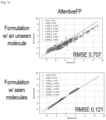
- FIGS. 7A , 7B , and 7C are diagrams for describing type-specific performance of the AI models according to one embodiment of the present disclosure.
- FIG. 7A shows an example of the result of extracting the feature data according to the first AI model when the first AI model includes the attention-based model.
- FIG. 7B shows an example of the result of extracting the feature data according to the first AI model when the first AI model is trained to update the second feature data extracted from the two-dimensional graph information of the specific material based on the third feature data extracted from the three-dimensional structural characteristics of the specific material.
- FIG. 7C shows an example of the result of extracting the feature data according to the first AI model when the first AI model includes the molecular contrastive learning-based model.
- each of FIGS. 7A , 7B , and 7C shows the result of extracting the feature data for the mixture, which was not a training target during the training process, by the first AI model.
- the lower image of each of FIGS. 7A , 7B , and 7C shows the result of extracting the feature data for the mixture, which was the training target during the training process, by the first AI model.
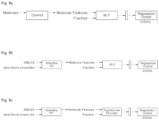
- FIGS. 8A, 8B, and 8C are diagrams illustrating structures of the AI models for predicting the physical properties of the mixture according to one embodiment of the present disclosure.
- FIGS. 9A , 9B , and 9C are diagrams illustrating training/inference methods of the AI models for predicting the physical properties of the mixture according to an embodiment of the present disclosure.
- the first AI model may be implemented as an AI model that may extract feature data of a material, such as the molecular contrastive learning-based model.
- the operations of inputting, into the first AI model, the molecular information e.g., a SMILES, an INCHI, or a SELFIES
- the molecular information e.g., a SMILES, an INCHI, or a SELFIES
- the input data for the first AI model may be composed of only the material information.
- At least one of the atom properties or the bond properties for the mixture may be selectively input into the first AI model.
- at least one of the atom properties or the bond properties for the mixture may be obtained based on the molecular information.
- the second AI model e.g., the transformer encoder
- the second AI model may output various types of the physical property prediction information.
- FIG. 8A shows a process of extracting the physical property prediction information associated with the mixture through a one hot encoding model and the MLP-based model.
- the one hot encoding model may be trained to output molecular feature data mapped to the input material information.
- the one hot encoding model may be trained to output information pre-mapped to the chemical information, rather than extracting the feature data from the material information (e.g., the chemical information) of the materials constituting the mixture.
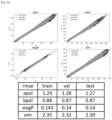
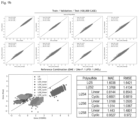
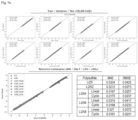
- FIGS. 9A , 9B , and 9C show result data according to FIGS. 8A, 8B, and 8C .
- the performance difference that occurs due to utilizing the feature data extracted from the molecular information (e.g., a SMILES, an INCHI, or a SELFIES) of the materials constituting the mixture can be confirmed.
- difference values between actual physical property information (e.g., Gibbs free energy) and the physical property prediction information (e.g., predicted Gibbs free energy information) obtained through the AI model may decrease.
- the performance difference between the MLP-based model and the transformer encoder model can be confirmed.
- more accurate prediction information can be output than when utilizing the MLP-based model.
- disclosed embodiments may be implemented in the form of a recording medium in which computer-executable commands are stored.
- the commands may be stored in the form of program code, and when executed by a processor, program modules are generated to perform operations of the disclosed embodiments.
- the recording medium may be implemented as a computer-readable recording medium.
- the computer-readable recording medium includes all types of recording media in which computer-decodable commands are stored.
- recording media there may be a ROM, a RAM, a magnetic tape, a magnetic disk, a flash memory, an optical data storage device, and the like.
Landscapes
- Engineering & Computer Science (AREA)
- Theoretical Computer Science (AREA)
- Physics & Mathematics (AREA)
- Computing Systems (AREA)
- Life Sciences & Earth Sciences (AREA)
- Evolutionary Computation (AREA)
- Software Systems (AREA)
- Artificial Intelligence (AREA)
- Data Mining & Analysis (AREA)
- General Health & Medical Sciences (AREA)
- Health & Medical Sciences (AREA)
- Bioinformatics & Computational Biology (AREA)
- Bioinformatics & Cheminformatics (AREA)
- General Physics & Mathematics (AREA)
- General Engineering & Computer Science (AREA)
- Crystallography & Structural Chemistry (AREA)
- Chemical & Material Sciences (AREA)
- Mathematical Physics (AREA)
- Biophysics (AREA)
- Biomedical Technology (AREA)
- Computational Linguistics (AREA)
- Molecular Biology (AREA)
- Computer Vision & Pattern Recognition (AREA)
- Medical Informatics (AREA)
- Databases & Information Systems (AREA)
- Spectroscopy & Molecular Physics (AREA)
- Computer Hardware Design (AREA)
- Geometry (AREA)
- Management, Administration, Business Operations System, And Electronic Commerce (AREA)
Applications Claiming Priority (2)
| Application Number | Priority Date | Filing Date | Title |
|---|---|---|---|
| KR1020220134293A KR102949687B1 (ko) | 2022-10-18 | 2022-10-18 | 인공지능 기반의 혼합물 물성 예측 장치, 방법 및 프로그램 |
| PCT/KR2023/016080 WO2024085616A1 (ko) | 2022-10-18 | 2023-10-17 | 인공지능 기반의 혼합물 물성 예측 장치, 방법 및 프로그램 |
Publications (1)
| Publication Number | Publication Date |
|---|---|
| EP4583113A1 true EP4583113A1 (de) | 2025-07-09 |
Family
ID=90738210
Family Applications (1)
| Application Number | Title | Priority Date | Filing Date |
|---|---|---|---|
| EP23880193.0A Pending EP4583113A1 (de) | 2022-10-18 | 2023-10-17 | Auf künstlicher intelligenz basierende vorrichtung, verfahren und programm zur vorhersage der physikalischen eigenschaft einer mischung |
Country Status (5)
| Country | Link |
|---|---|
| US (1) | US20250258980A1 (de) |
| EP (1) | EP4583113A1 (de) |
| JP (1) | JP2025536948A (de) |
| KR (1) | KR102949687B1 (de) |
| WO (1) | WO2024085616A1 (de) |
Family Cites Families (5)
| Publication number | Priority date | Publication date | Assignee | Title |
|---|---|---|---|---|
| EP3614389B1 (de) * | 2018-08-23 | 2023-10-11 | Tata Consultancy Services Limited | Systeme und verfahren zur vorhersage der struktur und der eigenschaften von atomelementen und legierungsmaterialien davon |
| JP7396082B2 (ja) | 2020-02-04 | 2023-12-12 | 住友金属鉱山株式会社 | 予測方法、リチウムイオン二次電池用正極活物質の製造方法及び予測システム |
| KR102392500B1 (ko) * | 2020-03-13 | 2022-04-29 | 고려대학교 산학협력단 | 기계 학습 기반 분자의 분광 특성 예측 시스템 및 그 방법 |
| KR20220060346A (ko) | 2020-11-04 | 2022-05-11 | 주식회사 엘지화학 | 머신러닝 알고리즘을 이용한 고무 컴파운드의 물성 예측 시스템 |
| CN114512203A (zh) * | 2021-12-29 | 2022-05-17 | 东北电力大学 | 一种钴、铁、重稀土三元系非晶合金的成分设计方法 |
-
2022
- 2022-10-18 KR KR1020220134293A patent/KR102949687B1/ko active Active
-
2023
- 2023-10-17 WO PCT/KR2023/016080 patent/WO2024085616A1/ko not_active Ceased
- 2023-10-17 EP EP23880193.0A patent/EP4583113A1/de active Pending
- 2023-10-17 JP JP2025522601A patent/JP2025536948A/ja active Pending
-
2025
- 2025-04-18 US US19/183,509 patent/US20250258980A1/en active Pending
Also Published As
| Publication number | Publication date |
|---|---|
| US20250258980A1 (en) | 2025-08-14 |
| KR102949687B1 (ko) | 2026-04-09 |
| KR20240054041A (ko) | 2024-04-25 |
| WO2024085616A1 (ko) | 2024-04-25 |
| JP2025536948A (ja) | 2025-11-12 |
Similar Documents
| Publication | Publication Date | Title |
|---|---|---|
| JP6640893B2 (ja) | 文字を入力する方法及び装置 | |
| KR20230147492A (ko) | 딥러닝 기반으로 브레인 mr 이미지에서 뇌종양 영역을 분할하는 방법 및 이를 위한 장치 | |
| CN111625710A (zh) | 推荐内容的处理方法、装置、电子设备及可读存储介质 | |
| EP4583113A1 (de) | Auf künstlicher intelligenz basierende vorrichtung, verfahren und programm zur vorhersage der physikalischen eigenschaft einer mischung | |
| TW201926968A (zh) | 程式、資訊處理方法及資訊處理裝置 | |
| KR20260055345A (ko) | 인공지능 기반의 혼합물 물성 예측 장치, 방법 및 프로그램 | |
| US20250272871A1 (en) | Apparatus and method for predicting three-dimensional pose | |
| EP4546354B1 (de) | Vorrichtung, verfahren und programm zur erfassung von merkmalsdaten für materialzusammensetzungsinformationen auf der basis von künstlicher intelligenz | |
| KR102578864B1 (ko) | 철강 제조 작업자의 모션 데이터를 이용한 인공신경망 학습 장치 및 방법 | |
| KR20250015933A (ko) | 거대 언어 모델 기반 화학 연구 정보를 제공하는 서버 및 그의 학습 방법 | |
| KR102936712B1 (ko) | 적분 영상 처리를 위한 영상 처리 장치, 방법 및 기록 매체 | |
| KR102914684B1 (ko) | 복수의 손실 함수 기반의 인공지능 모델을 이용하여 종양 악성도를 예측하는 방법 및 장치 | |
| US20250174312A1 (en) | System, method and program for predicting properties of material having multi-phase using artificail intelligence | |
| KR102783777B1 (ko) | 구축된 차트 정보를 포함하는 데이터 세트를 이용한 차트 디-렌더링 인공지능 모델의 성능 평가 또는 학습 시스템, 방법, 및 프로그램 | |
| KR102764485B1 (ko) | 인공 지능 알고리즘 기반의 당뇨병 발병 예측 모델을 학습시키는 장치 및 그의 제어 방법 | |
| US20250131976A1 (en) | Device for predecting protein interaction of hla-peptide complex based on artificial intelligence and method using the same | |
| CN112882635A (zh) | 流程数据处理方法、装置、计算机设备和存储介质 | |
| US20250131975A1 (en) | Protein interaction prediction device for utilizing unobserved protein complex to generate antigen presentation model and method using the same | |
| KR20240125735A (ko) | 원격 근무자의 업무 수행 분석 장치, 방법, 시스템 및 프로그램 | |
| KR20230125570A (ko) | 인공지능 기반의 북극 해빙 예측 방법 및 장치 | |
| EP4648026A1 (de) | Diagramm-de-rendering-system, verfahren und programm zum extrahieren von metainformationen und dateninformationen aus einem diagramm unter verwendung von künstlicher intelligenz | |
| KR20250111415A (ko) | 다회용기 이용 고객의 서비스 우선순위를 조정하는 방법 및 장치 | |
| CN121039676A (zh) | 基于指令调优的构建ai模型学习用数据集的系统、方法以及程序 | |
| KR20240021635A (ko) | 인공 지능 알고리즘 기반의 당뇨병 합병증 발병 예측 모델을 학습시키는 장치 및 그의 제어 방법 | |
| KR20250058441A (ko) | 인공지능을 기반으로 mhc-펩타이드 복합체의 활성을 예측하는 결합 예측 장치 및 이를 이용한 방법 |
Legal Events
| Date | Code | Title | Description |
|---|---|---|---|
| STAA | Information on the status of an ep patent application or granted ep patent |
Free format text: STATUS: THE INTERNATIONAL PUBLICATION HAS BEEN MADE |
|
| PUAI | Public reference made under article 153(3) epc to a published international application that has entered the european phase |
Free format text: ORIGINAL CODE: 0009012 |
|
| STAA | Information on the status of an ep patent application or granted ep patent |
Free format text: STATUS: REQUEST FOR EXAMINATION WAS MADE |
|
| 17P | Request for examination filed |
Effective date: 20250402 |
|
| AK | Designated contracting states |
Kind code of ref document: A1 Designated state(s): AL AT BE BG CH CY CZ DE DK EE ES FI FR GB GR HR HU IE IS IT LI LT LU LV MC ME MK MT NL NO PL PT RO RS SE SI SK SM TR |
|
| DAV | Request for validation of the european patent (deleted) | ||
| DAX | Request for extension of the european patent (deleted) |