EP4583045A1 - Verfahren, lernmodellbewertungssystem und programm - Google Patents
Verfahren, lernmodellbewertungssystem und programm Download PDFInfo
- Publication number
- EP4583045A1 EP4583045A1 EP23860401.1A EP23860401A EP4583045A1 EP 4583045 A1 EP4583045 A1 EP 4583045A1 EP 23860401 A EP23860401 A EP 23860401A EP 4583045 A1 EP4583045 A1 EP 4583045A1
- Authority
- EP
- European Patent Office
- Prior art keywords
- contour
- information
- subject
- condition
- contour information
- Prior art date
- Legal status (The legal status is an assumption and is not a legal conclusion. Google has not performed a legal analysis and makes no representation as to the accuracy of the status listed.)
- Pending
Links
Images





Classifications
-
- G—PHYSICS
- G06—COMPUTING OR CALCULATING; COUNTING
- G06V—IMAGE OR VIDEO RECOGNITION OR UNDERSTANDING
- G06V10/00—Arrangements for image or video recognition or understanding
- G06V10/40—Extraction of image or video features
- G06V10/46—Descriptors for shape, contour or point-related descriptors, e.g. scale invariant feature transform [SIFT] or bags of words [BoW]; Salient regional features
-
- G—PHYSICS
- G06—COMPUTING OR CALCULATING; COUNTING
- G06V—IMAGE OR VIDEO RECOGNITION OR UNDERSTANDING
- G06V10/00—Arrangements for image or video recognition or understanding
- G06V10/70—Arrangements for image or video recognition or understanding using pattern recognition or machine learning
- G06V10/74—Image or video pattern matching; Proximity measures in feature spaces
- G06V10/75—Organisation of the matching processes, e.g. simultaneous or sequential comparisons of image or video features; Coarse-fine approaches, e.g. multi-scale approaches; using context analysis; Selection of dictionaries
- G06V10/752—Contour matching
-
- G—PHYSICS
- G06—COMPUTING OR CALCULATING; COUNTING
- G06V—IMAGE OR VIDEO RECOGNITION OR UNDERSTANDING
- G06V10/00—Arrangements for image or video recognition or understanding
- G06V10/70—Arrangements for image or video recognition or understanding using pattern recognition or machine learning
- G06V10/77—Processing image or video features in feature spaces; using data integration or data reduction, e.g. principal component analysis [PCA] or independent component analysis [ICA] or self-organising maps [SOM]; Blind source separation
- G06V10/776—Validation; Performance evaluation
Definitions
- the present invention relates to a method, a learning model evaluation system, and a program.
- an inspection of a product is made to determine whether the product is a non-defective product or a defective product from the appearance of the product.
- the appearance inspection there is a method in which the inspection is carried out by imaging a subject and performing image processing on the image of the subject by a computer.
- PTL 1 describes an image processing method for an appearance inspection using contour lines of an inspection image and a teaching image.
- segmentation processing for identifying pixels in which a subject exists may be performed. Segmentation processing allows for, for example, non-defective product determination based on the shape, contours, or the like of the subject.
- the segmentation processing may be performed using, for example, a learning model obtained by machine learning.
- a learning model for segmentation processing operates so as to output a result of classification indicating which object a pixel belongs to with regard to a certain input image. At this time, it is necessary to evaluate whether the classification by the learning model is appropriately performed. Examples of evaluation metrics for evaluating a learning model include a metric referred to as mean Intersection over Union (mloU) based on an area in which pixels of a correct image and pixels predicted by the learning model overlap with regard to a certain classification.
- miU mean Intersection over Union
- the mask may stick out from the subject to be detected or a discontinuity of the mask may occur.
- the performance of the learning model used to generate the mask it is difficult to appropriately evaluate the performance of the learning model used to generate the mask. This is because, for example, even in a case where part of the elongated object is missing, the metric of mloU is unlikely to largely degrade when the mask sufficiently overlaps the subject to be detected.
- the present disclosure in one aspect, has been made in view of the above-described circumstances, and a subject thereof is to provide a method, a learning model evaluation system, and a program that can appropriately evaluate a learning model for identifying a subject to be detected.
- a method includes: by a computer, inputting a subject image in which at least one subject to be detected is imaged to a learning model and acquiring first contour information indicating a contour of the at least one subject to be detected in the subject image; acquiring second contour information indicating a contour of the at least one subject to be detected and serving as a reference for evaluating the first contour information; acquiring a condition to be satisfied by the first contour information; and generating, based on the first contour information, the second contour information, and the condition, evaluation information in which performance of the learning model is evaluated.
- the first contour information indicating the contour of the subject to be detected is evaluated based on the predetermined condition using the second contour information serving as the reference. Since the learning model can be evaluated based on the information regarding the contour of the subject to be detected, the learning model can be appropriately evaluated even when a prediction of a pixel corresponding to the subject to be detected by the learning model sticks out from the subject to be detected or is discontinued, for example.
- the generating evaluation information may include: calculating, based on the first contour information and the second contour information, first inter-contour distance information indicating a distance from an individual point of at least one first contour indicated by the first contour information toward at least one second contour indicated by the second contour information and second inter-contour distance information indicating a distance from an individual point of the at least one second contour toward the at least one first contour; and generating the evaluation information based on the condition provided for inter-contour distance information based on the first inter-contour distance information and the second inter-contour distance information.
- this method based on the first inter-contour distance information with respect to the correct second contour viewed from the predicted first contour and the second inter-contour distance information with respect to the predicted first contour viewed from the correct second contour, it is possible to carry out an evaluation using both the correct answer viewed from the prediction and the prediction viewed from the correct answer. This makes it possible to appropriately evaluate the learning model.
- the generating evaluation information may include: calculating a mean value and a standard deviation of distance data in the inter-contour distance information; and generating the evaluation information by taking the condition as a condition for the mean value and the standard deviation.
- condition for the mean value and the standard deviation may be the number of pixels indicating an allowable difference between the first contour and the second contour.
- acquiring second contour information may include acquiring the second contour information stored in a storage unit as information indicating a contour of at least one reference subject in an acquired image.
- the evaluator can set the second contour information in advance, thereby improving the convenience of the evaluator.
- the acquiring second contour information may include acquiring the second contour information acquired from the user through the condition setting screen.
- the method according to one aspect may further include generating output screen information for displaying, for the user, an output screen including the subject image, a predicted image based on the first contour information, and the evaluation information.
- the generating evaluation information may further include generating comparison information indicating a difference between the first contour information and the second contour information.
- a learning model evaluation system includes: a first contour information acquisition unit configured to input a subject image in which at least one subject to be detected is imaged to a learning model and acquire first contour information indicating a contour of the at least one subject to be detected in the subject image; a second contour information acquisition unit configured to acquire second contour information indicating a contour of the at least one subject to be detected and serving as a reference for evaluating the first contour information; a condition acquisition unit configured to acquire a condition to be satisfied by the first contour information; and an evaluation unit configured to generate, based on the first contour information, the second contour information, and the condition, evaluation information in which performance of the learning model is evaluated.
- a program causes a computer to execute: inputting a subject image in which at least one subject to be detected is imaged to a learning model and acquiring first contour information indicating a contour of the at least one subject to be detected in the subject image; acquiring second contour information indicating a contour of the at least one subject to be detected and serving as a reference for evaluating the first contour information; acquiring a condition to be satisfied by the first contour information; and generating, based on the first contour information, the second contour information, and the condition, evaluation information in which performance of the learning model is evaluated.
- the present invention can provide a method, a learning model evaluation system, and a program that can appropriately evaluate a learning model for identifying a subject to be detected.
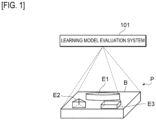
- the learning model evaluation system 101 causes an imaging device to image a product and evaluates performance of a learning model for classifying a subject to be detected in the imaged image.
- imaging of the product is not essential, and a separately imaged image of the product may be used.
- the learning model evaluation system 101 includes a storage unit 201, a communication unit 202, a display unit 203, an imaging unit 204, and a control unit 205.
- the storage unit 201 is, for example, an auxiliary storage device such as a hard disk drive or a solid state drive, and stores a program executed for processing by the control unit 205 and various types of information used in the learning model evaluation system 101.
- the communication unit 202 is configured as, for example, an information processing unit that performs connection and data exchange with another system or information processing apparatus connected to the learning model evaluation system 101 through a network.
- the communication unit 202 is, for example, a wired local area network (LAN) module or a wireless LAN module, and is an interface for performing wired or wireless communication via a network.
- the communication unit 202 can transmit, for example, a determination result of a subject to another system or information processing apparatus under the control of the control unit 205.
- the display unit 203 is, for example, a device for performing output, such as a display or a speaker.
- the imaging unit 204 is, for example, an imaging device including an imaging element such as a complementary MOS (CMOS) or a charge coupled device (CCD).
- CMOS complementary MOS
- CCD charge coupled device
- the first contour information acquisition unit 2051 includes a region specifying part 20511.
- the region specifying part 20511 acquires a subject image of the subject to be detected imaged by the imaging unit 204 and inputs the subject image to a learning model 20512.
- the learning model 20512 is, for example, a learning model that performs semantic segmentation or instance segmentation.
- the learning model 20512 is trained so as to identify a body corresponding to each pixel.
- the learning model 20512 specifies regions (pixels) corresponding to the elements E1, E2, and E3.
- the first contour information acquisition unit 2051 acquires first contour information as information indicating pixels corresponding to respective contours of the elements E1, E2, and E3 based on the regions specified by the region specifying part 20511.
- the learning model 20512 is illustrated in association with the region specifying part 20511 in FIG. 2 , but may be stored in, for example, the storage unit 201.
- the learning model 20512 may be stored in another information processing apparatus connected to the learning model evaluation system 101 through the network.
- the second contour information acquisition unit 2052 acquires second contour information indicating the contours of the subject to be detected and serving as a reference for evaluating the first contour information.
- the second contour information acquisition unit 2052 acquires the second contour information stored in advance in the storage unit 201 as information indicating pixels corresponding to the contours of a reference subject in the acquired image, for example.
- the second contour information acquisition unit 2052 may acquire the second contour information set by the user through a condition setting screen to be described later.
- the condition acquisition unit 2053 acquires a condition to be satisfied by the first contour information.
- the condition acquisition unit 2053 acquires the condition from the user through the condition setting screen, for example.
- the condition acquisition unit 2053 may acquire a predetermined condition stored in the storage unit 201.
- the condition is provided with respect to the relationship between the first contour information and the second contour information, for example.
- the condition is a condition related to a distance between the contours based on the first contour information and the second contour information, and is, for example, a condition based on a mean value and a standard deviation calculated based on the distance between the contours.
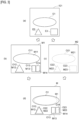
- FIG. 3(a) illustrates a subject image IG1 acquired by the first contour information acquisition unit 2051.
- the subject image IG1 includes the elements E1, E2, and E3 as the subjects to be detected.
- the first contour information acquisition unit 2051 generates a mask M1 (first contour information) corresponding to the elements E1, E2, and E3, as illustrated in FIG. 3(b) , through the processing by the first contour information acquisition unit 2051.
- the mask M1 includes instance masks M11, M12, M13, and M14.
- the instance masks are regions on the image, where the bodies included in the subject image IG1 are respectively identified.
- the instance masks M11, M12, M13, and M14 have contours O11 (first contour), O12, O13, and O14, respectively.
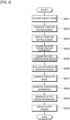
- step S401 the first contour information acquisition unit 2051 acquires a subject image from the imaging unit 204 or the storage unit 201.
- step S402 the screen information generation unit 2055 generates setting screen information for displaying the condition setting screen.
- step S403 the display unit 203 displays the condition setting screen.
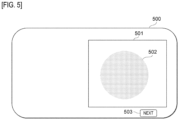
- FIG. 5 illustrates an example of a condition setting screen 500.
- the condition setting screen 500 includes a subject image display region 501, and an image including a subject to be detected 502 is displayed in the subject image display region 501.
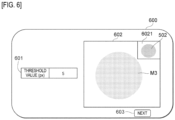
- the condition setting screen 600 includes a threshold value input region 601, a mask display region 602, and a button 603.
- the expression “threshold value (px)” is displayed in the threshold value input region 601, and the user can input any number of pixels as the threshold value. In the example of FIG. 6 , “ 5 " pixels are input.
- the mask display region 602 includes a subject image display region 6021.
- an image of the subject to be detected 502 is displayed.
- the user can set an instance mask M3 corresponding to the subject to be detected 502 by performing an annotation operation of selecting a predetermined region in the subject to be detected 502.
- the user can set the instance mask M3 while referring to the image of the subject to be detected 502 displayed in the subject image display region 6021.
- As the instance mask M3, a mask stored in advance in the storage unit 201 may be displayed.
- the user selects the button 603.
- step S404 the second contour information acquisition unit 2052 acquires the second contour information based on the instance mask M3 and stores the acquired second contour information in the storage unit 201.
- step S405 the condition acquisition unit 2053 acquires a threshold value related to an inter-contour distance set through the condition setting screen 600 and stores the acquired threshold value in the storage unit 201.
- step S406 the first contour information acquisition unit 2051 and the evaluation unit 2054 execute an evaluation information generation process.
- the evaluation information generation process will be described.
- step S701 the first contour information acquisition unit 2051 inputs the subject image to the learning model 20512.
- step S702 the first contour information acquisition unit 2051 acquires the first contour information from the region specifying part 20511.
- step S703 the evaluation unit 2054 refers to the second contour information acquired by the second contour information acquisition unit 2052.
- step S704 the evaluation unit 2054 refers to the threshold value related to the inter-contour distance stored in the storage unit 201.
- step S705 the evaluation unit 2054 calculates determination values based on inter-contour distance information regarding all sets (instance pairs) of a contour of a correct instance mask and a contour of a predicted instance mask. This process will be described below with reference to FIGS. 8 to 11 .
- the evaluation unit 2054 calculates determination values for all sets of a contour of a correct instance mask and a contour of a predicted instance mask. For example, as illustrated in FIG. 8(a) , the predicted instance mask M21 is combined with the instance masks M11, M12, M13, and M14, and a determination value is calculated for each set.
- the evaluation unit 2054 selects a correct instance mask in the second contour information. For example, in the mask M2 illustrated in FIG. 3(c) , the correct instance mask is selected as the instance mask M21.
- the evaluation unit 2054 selects a predicted instance mask in the first contour information. For example, in the mask M1 illustrated in FIG. 3(b) , the predicted instance mask is selected as the instance mask M11.
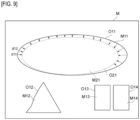
- the evaluation unit 2054 calculates first inter-contour distance information from each point of the contour of the selected predicted instance mask to the contour of the selected correct instance mask. For example, a distance from each point of the contour O11 of the instance mask M11 to the contour O21 of the instance mask M21 is calculated. As illustrated in FIG. 9 , the evaluation unit 2054 calculates a distance from each point (pixel) corresponding to the contour O11 to a point (pixel) at the shortest position corresponding to the contour O21. This calculation result is the first inter-contour distance information. In FIG. 9 and subsequent FIGS. 10 and 11 , the instance masks M22, M23, and M24 are not illustrated.
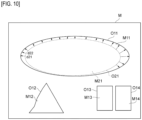
- the evaluation unit 2054 calculates second inter-contour distance information from each point of the contour of the selected correct instance mask to the contour of the selected predicted instance mask. As illustrated in FIG. 10 , the evaluation unit 2054 calculates a distance from each point (pixel) corresponding to the contour O21 to a point (pixel) at the shortest position corresponding to the contour O11. This calculation result is the second inter-contour distance information.
- the points on the contours O11 and O21 may be selected at equal intervals or may be selected at optional intervals in accordance with the shapes.
- the evaluation unit 2054 generates the inter-contour distance information obtained by combining the first inter-contour distance information and the second inter-contour distance information, based on the first inter-contour distance information and the second inter-contour distance information. For example, in the example of FIG. 9 , assume that the distances from N points on the contour O11 to the contour O21 are respectively obtained as (d11, d12, ... d1N). In the example of FIG. 10 , assume that the distances from M points on the contour O21 to the contour O11 are respectively obtained as (d21, d22, ... d2M). At this time, the inter-contour distance information is generated as distance data referred to as (d11, d12, ... d1N, d21, d22, ... d2M).
- the evaluation unit 2054 calculates determination values based on the inter-contour distance information. For example, the evaluation unit 2054 calculates a value of (mean value + 2 ⁇ standard deviation) as the determination value with regard to the distance data indicated by the inter-contour distance information.
- the evaluation unit 2054 repeats the calculation of the determination value for one instance pair and consequently calculates the determination values of all the instance pairs. For example, as illustrated in FIG. 11 , inter-contour distance information with regard to instance pairs of the instance mask M21 and the instance mask M12 is similarly generated, and determination values are calculated.
- the inter-contour distance information with regard to the contour O21 and contour O12 is generated based on, for example, distances (d31, d32, d33, ...) from respective points on the contour O21 to the contour O12 and distances (d41, d42, d43, ...) from the respective points on the contour O12 to the contour O21.
- the inter-contour distance information (d31, d32, d33, ..., d41, d42, d43, ... ) has a larger distance value and larger variance than the inter-contour distance information (d11, d12, ... d1N, d21, d22, ... d2M) of the instance pair of O11 and O21. Accordingly, the determination value based on the inter-contour distance information of the instance pair of the contour O21 and the contour O12 is larger than the determination value based on the inter-contour distance information of the instance pair of the contour O21 and the contour O11.
- the evaluation unit 2054 repeats the calculation of the determination value for each instance pair. In the example illustrated in FIG. 8 , since there are four correct instance masks and three predicted instance masks, twelve instance pairs are generated, and twelve determination values are calculated.
- step S706 the evaluation unit 2054 generates a list on which the instance pairs are sorted in ascending order of the determination values.
- a list L as schematically illustrated in FIG. 12 , is generated.
- an instance pair P1 of the instance mask M21 and the instance mask M11, an instance pair P2 of the instance mask M22 and the instance mask M12, an instance pair P3 of the instance mask M23 and the instance mask M13, and an instance pair P4 of the instance mask M23 and the instance mask M14 are indicated.
- the instance pairs P1, P2, P3, and P4 are arranged in ascending order of the determination values. Twelve instance pairs are arranged on the list L.
- step S707 the evaluation unit 2054 selects an instance pair at the top of the list.
- step S708 the evaluation unit 2054 judges whether the determination value of the selected instance pair is equal to or less than the threshold value. In this case, assume that the determination values of the instance pairs P1 and P2 are equal to or less than the threshold value, and the determination values of the instance pairs P3 and P4 are larger than the threshold value.
- step S709 the evaluation unit 2054 takes the selected instance pair as a corresponding instance pair and adds one to a value of true positive (TP).
- step S710 the evaluation unit 2054 updates the list by excluding the corresponding instance pair from the list.
- the instance pair P1 when the instance pair P1 is selected, one is added to the value of TP by the processing in step S709. Subsequently, the instance pair P1 is deleted from the list L, and the instance pair P2 is moved up to the top of the list.
- step S711 the evaluation unit 2054 judges whether the list is empty. When negative judgment is made in step S711, pieces of processing from step S707 are repeated. When affirmative judgment is made in step S711, it is considered that the determination of all the instance pairs on the list is completed, and the process proceeds to step S712 and subsequent steps to be described later.
- step S711 when the instance pair P2 is present at the top of the list L, negative judgment is made in step S711.
- the instance pair P2 is selected.
- step S708 it is judged whether the determination value of the instance pair P2 is equal to or less than the threshold value. Since the determination value of the instance pair P2 is less than or equal to the threshold value, one is further added to the value of true positive in step S709.
- step S710 the instance pair P2 is deleted from the list L and the instance pair P2 is moved up to the top of the list.
- step S708 it is judged whether the determination value of the instance pair P3 is equal to or less than the threshold value. Since the determination value of the instance pair P3 is larger than the threshold value, negative judgment is made in step S708.
- step S708 pieces of processing in step S712 and subsequent steps are carried out. Since the list is generated while sorting the instance pairs in ascending order of the determination values in step S706, the determination values of the instance pairs arranged after the instance pair P3 are also larger than the threshold value. Accordingly, once negative judgment is made in step S708, among the instance pairs on the list, no instance pair having true positive is included in the list. As discussed above, by the pieces of processing repeated until the determination value of the instance pair becomes larger than the threshold value, the totalizing of the true-positive instance pairs whose determination values are equal to or less than the threshold value is completed.
- step S713 the evaluation unit 2054 takes a value obtained by dividing the value of TP from the number of correct instance masks as a value of false negative (FN). For example, in the examples of FIGS. 8 and 12 , since the number of correct instance masks is "3", the value of FN is "1".
- step S712 the evaluation unit 2054 calculates, as the evaluation information, an F1 score for evaluating the learning model 20512, which predicts the first contour information with respect to the subject image.
- step S407 the screen information generation unit 2055 generates a predicted image indicating the instance mask including the first contour predicted by the region specifying part 20511 based on the first contour information acquired by the first contour information acquisition unit 2051 from the region specifying part 20511.
- a learning model evaluation system including:
- 101 Learning model evaluation system 101 Storage unit, 202 Communication unit, 203 Display unit, 204 Imaging unit, 205 Control unit, 2051 First contour information acquisition unit, 2052 Second contour information acquisition unit, 2053 Condition acquisition unit, 2054 Evaluation unit, 2055 Screen information generation unit
Landscapes
- Engineering & Computer Science (AREA)
- Theoretical Computer Science (AREA)
- Computer Vision & Pattern Recognition (AREA)
- Multimedia (AREA)
- General Physics & Mathematics (AREA)
- Physics & Mathematics (AREA)
- Evolutionary Computation (AREA)
- General Health & Medical Sciences (AREA)
- Medical Informatics (AREA)
- Software Systems (AREA)
- Health & Medical Sciences (AREA)
- Databases & Information Systems (AREA)
- Computing Systems (AREA)
- Artificial Intelligence (AREA)
- Image Analysis (AREA)
Applications Claiming Priority (2)
| Application Number | Priority Date | Filing Date | Title |
|---|---|---|---|
| JP2022139811A JP2024035387A (ja) | 2022-09-02 | 2022-09-02 | 方法、学習モデル評価システム、及びプログラム |
| PCT/JP2023/031462 WO2024048639A1 (ja) | 2022-09-02 | 2023-08-30 | 方法、学習モデル評価システム、及びプログラム |
Publications (1)
| Publication Number | Publication Date |
|---|---|
| EP4583045A1 true EP4583045A1 (de) | 2025-07-09 |
Family
ID=90099644
Family Applications (1)
| Application Number | Title | Priority Date | Filing Date |
|---|---|---|---|
| EP23860401.1A Pending EP4583045A1 (de) | 2022-09-02 | 2023-08-30 | Verfahren, lernmodellbewertungssystem und programm |
Country Status (5)
| Country | Link |
|---|---|
| US (1) | US20260087789A1 (de) |
| EP (1) | EP4583045A1 (de) |
| JP (1) | JP2024035387A (de) |
| CN (1) | CN119678183A (de) |
| WO (1) | WO2024048639A1 (de) |
Family Cites Families (1)
| Publication number | Priority date | Publication date | Assignee | Title |
|---|---|---|---|---|
| US10997466B2 (en) * | 2019-06-21 | 2021-05-04 | Straxciro Pty. Ltd. | Method and system for image segmentation and identification |
-
2022
- 2022-09-02 JP JP2022139811A patent/JP2024035387A/ja active Pending
-
2023
- 2023-08-30 EP EP23860401.1A patent/EP4583045A1/de active Pending
- 2023-08-30 CN CN202380061175.0A patent/CN119678183A/zh active Pending
- 2023-08-30 WO PCT/JP2023/031462 patent/WO2024048639A1/ja not_active Ceased
- 2023-08-30 US US19/106,493 patent/US20260087789A1/en active Pending
Also Published As
| Publication number | Publication date |
|---|---|
| CN119678183A (zh) | 2025-03-21 |
| WO2024048639A1 (ja) | 2024-03-07 |
| JP2024035387A (ja) | 2024-03-14 |
| US20260087789A1 (en) | 2026-03-26 |
Similar Documents
| Publication | Publication Date | Title |
|---|---|---|
| JP6924413B2 (ja) | データ生成装置、データ生成方法及びデータ生成プログラム | |
| JP6693938B2 (ja) | 外観検査装置 | |
| EP3767582A1 (de) | Inspektionssystem, unterscheidungssystem und lerndatengenerator | |
| EP3483833B1 (de) | Datenerzeugungsvorrichtung, datenerzeugungsverfahren und datenerzeugungsprogramm | |
| JP2017062713A (ja) | 識別器作成装置、識別器作成方法、およびプログラム | |
| CN108256431A (zh) | 一种手部位置标识方法及装置 | |
| US20030078758A1 (en) | Analytical model preparing method and analytical model preparing apparatus | |
| JP6584250B2 (ja) | 画像分類方法、分類器の構成方法および画像分類装置 | |
| CN111445440A (zh) | 一种医学图像分析方法、设备和存储介质 | |
| JP2020042754A (ja) | 分類装置、分類方法、分類プログラム、及び検査装置 | |
| JP2019159820A (ja) | 検査装置、画像識別装置、識別装置、検査方法、及び検査プログラム | |
| JP2020064364A (ja) | 学習装置、画像生成装置、学習方法、及び学習プログラム | |
| JP7270454B2 (ja) | 設計支援システム、設計支援方法および設計支援プログラム | |
| JP2019132668A (ja) | 伸長判定装置、伸長判定方法、及びコンピュータプログラム | |
| CN110796156B (zh) | 信息处理方法及信息处理系统 | |
| EP4583045A1 (de) | Verfahren, lernmodellbewertungssystem und programm | |
| JP2020024665A (ja) | 情報処理方法、及び情報処理システム | |
| CN116310651A (zh) | 分割模型训练方法、曲面确定方法、装置、设备及介质 | |
| US20250054270A1 (en) | Labeled training data creation assistance device and labeled training data creation assistance method | |
| CN115115919A (zh) | 一种电网设备热缺陷识别方法及装置 | |
| JP7584073B2 (ja) | 画像判定装置、画像判定方法、及び、プログラム | |
| JPWO2021100191A5 (de) | ||
| US20240404245A1 (en) | Similar image set creating apparatus, method and storage medium | |
| JP7685374B2 (ja) | プラント点群分類システム、プラント点群分類方法 | |
| JP2007198968A (ja) | 画像分類方法及び画像分類装置 |
Legal Events
| Date | Code | Title | Description |
|---|---|---|---|
| STAA | Information on the status of an ep patent application or granted ep patent |
Free format text: STATUS: THE INTERNATIONAL PUBLICATION HAS BEEN MADE |
|
| PUAI | Public reference made under article 153(3) epc to a published international application that has entered the european phase |
Free format text: ORIGINAL CODE: 0009012 |
|
| STAA | Information on the status of an ep patent application or granted ep patent |
Free format text: STATUS: REQUEST FOR EXAMINATION WAS MADE |
|
| 17P | Request for examination filed |
Effective date: 20250228 |
|
| AK | Designated contracting states |
Kind code of ref document: A1 Designated state(s): AL AT BE BG CH CY CZ DE DK EE ES FI FR GB GR HR HU IE IS IT LI LT LU LV MC ME MK MT NL NO PL PT RO RS SE SI SK SM TR |
|
| DAV | Request for validation of the european patent (deleted) | ||
| DAX | Request for extension of the european patent (deleted) |