EP4582802A2 - Digitale partikelanalyse - Google Patents
Digitale partikelanalyse Download PDFInfo
- Publication number
- EP4582802A2 EP4582802A2 EP25171971.2A EP25171971A EP4582802A2 EP 4582802 A2 EP4582802 A2 EP 4582802A2 EP 25171971 A EP25171971 A EP 25171971A EP 4582802 A2 EP4582802 A2 EP 4582802A2
- Authority
- EP
- European Patent Office
- Prior art keywords
- solid particles
- particle size
- particle
- parameter
- particles
- Prior art date
- Legal status (The legal status is an assumption and is not a legal conclusion. Google has not performed a legal analysis and makes no representation as to the accuracy of the status listed.)
- Pending
Links
Images



Classifications
-
- C—CHEMISTRY; METALLURGY
- C04—CEMENTS; CONCRETE; ARTIFICIAL STONE; CERAMICS; REFRACTORIES
- C04B—LIME, MAGNESIA; SLAG; CEMENTS; COMPOSITIONS THEREOF, e.g. MORTARS, CONCRETE OR LIKE BUILDING MATERIALS; ARTIFICIAL STONE; CERAMICS; REFRACTORIES; TREATMENT OF NATURAL STONE
- C04B28/00—Compositions of mortars, concrete or artificial stone, containing inorganic binders or the reaction product of an inorganic and an organic binder, e.g. polycarboxylate cements
- C04B28/02—Compositions of mortars, concrete or artificial stone, containing inorganic binders or the reaction product of an inorganic and an organic binder, e.g. polycarboxylate cements containing hydraulic cements other than calcium sulfates
- C04B28/04—Portland cements
-
- C—CHEMISTRY; METALLURGY
- C04—CEMENTS; CONCRETE; ARTIFICIAL STONE; CERAMICS; REFRACTORIES
- C04B—LIME, MAGNESIA; SLAG; CEMENTS; COMPOSITIONS THEREOF, e.g. MORTARS, CONCRETE OR LIKE BUILDING MATERIALS; ARTIFICIAL STONE; CERAMICS; REFRACTORIES; TREATMENT OF NATURAL STONE
- C04B40/00—Processes, in general, for influencing or modifying the properties of mortars, concrete or artificial stone compositions, e.g. their setting or hardening ability
- C04B40/0028—Aspects relating to the mixing step of the mortar preparation
- C04B40/0032—Controlling the process of mixing, e.g. adding ingredients in a quantity depending on a measured or desired value
-
- G—PHYSICS
- G01—MEASURING; TESTING
- G01N—INVESTIGATING OR ANALYSING MATERIALS BY DETERMINING THEIR CHEMICAL OR PHYSICAL PROPERTIES
- G01N15/00—Investigating characteristics of particles; Investigating permeability, pore-volume or surface-area of porous materials
- G01N15/02—Investigating particle size or size distribution
- G01N15/0205—Investigating particle size or size distribution by optical means
- G01N15/0227—Investigating particle size or size distribution by optical means using imaging; using holography
-
- G—PHYSICS
- G01—MEASURING; TESTING
- G01N—INVESTIGATING OR ANALYSING MATERIALS BY DETERMINING THEIR CHEMICAL OR PHYSICAL PROPERTIES
- G01N33/00—Investigating or analysing materials by specific methods not covered by groups G01N1/00 - G01N31/00
- G01N33/24—Earth materials
-
- G—PHYSICS
- G01—MEASURING; TESTING
- G01N—INVESTIGATING OR ANALYSING MATERIALS BY DETERMINING THEIR CHEMICAL OR PHYSICAL PROPERTIES
- G01N15/00—Investigating characteristics of particles; Investigating permeability, pore-volume or surface-area of porous materials
- G01N15/02—Investigating particle size or size distribution
- G01N2015/0277—Average size only
-
- G—PHYSICS
- G01—MEASURING; TESTING
- G01N—INVESTIGATING OR ANALYSING MATERIALS BY DETERMINING THEIR CHEMICAL OR PHYSICAL PROPERTIES
- G01N15/00—Investigating characteristics of particles; Investigating permeability, pore-volume or surface-area of porous materials
- G01N15/02—Investigating particle size or size distribution
- G01N2015/0294—Particle shape
Definitions
- the invention relates to a computer-implemented method for characterization of solid particles, especially sand particles, as well as systems with means to carry out the method, and a computer-readable medium comprising instructions for carrying out the method. Further aspects of the invention are related to methods for providing a formulation of a curable composition and a method for producing a curable composition.
- curable compositions are widely used for various applications.
- examples of such compositions are mortar, concrete, grout, or screed compositions.
- These compositions typically comprise binders in combination with solid aggregates.
- Binders might be selected from mineral binders, such as e.g. hydraulic binders, as well as organic binders, e.g. curable polymer compositions. Aggregates are chosen depending on the desired properties of the curable compositions. Typically aggregates include sand, gravel, rock flour, and/or polymeric particles.
- the behavior of sand in curable compositions depends inter alia on the crushing technique, particle shape, surface texture, fines content, mineral contamination, and grading curve.
- Grading curves of sand and aggregates is a key element to calculate the grading of a concrete mix design to ensure a dense packing of sand and aggregates.
- the particle shape which in turn depends on the production method or the sand and/or aggregate source, typically influences the needed grading of the concrete mix design.
- the particle shape i.e. the above-mentioned item (ii)
- the core of the present invention is related to a computer-implemented method for characterization of solid particles, especially sand particles, comprising the steps of:
- the inventive method is a unique approach which can be implemented on conventional mobile devices, such as e.g. smartphones. Thus, there is no need for complex and expensive analysis equipment.
- the method furthermore allows for a very fast, flexible and accurate digital characterization of solid particles, both in terms of size and shape. Thereby, solid particles of different nature and size can easily be characterized with one and the same hardware devices.
- the method can be implemented in various ways, e.g. in the form of a standalone application running on the mobile device without need for any further resources such as for example server systems. This is in particular helpful in areas with limited access to communication networks, e.g. far away from urban centers or underground.
- the method can be implemented as well in a distributed computing environment, e.g. comprising the mobile device as a client in combination with a dedicated server as a storage unit and a specialized processing unit.
- inventive method can be implemented in a flexible manner with known software architectures, e.g. as native application, a progressive web application (PWA), or a hybrid application (combination of native and PWA).
- software architectures e.g. as native application, a progressive web application (PWA), or a hybrid application (combination of native and PWA).
- PWA progressive web application
- hybrid application hybrid application
- helpful internet links to tutorials or support sites as well as sharing functions e.g. via e-mail, Bluetooth, Airdrop, or others communication means
- inventive method can be implemented in one single application or it may be divided into two or more separate applications with appropriate software interfaces for data exchange between the applications.
- the application(s) can be extended with additional functions in a flexible manner.
- Applications can be implemented for any kind of operating systems such as e.g. iOS, Android, Microsoft Windows and/or Linux.
- the applications can be made available easily for anyone via different distribution channels, such as e.g. public download centers (for example Apple ® Store and Google Play ® ) private company operated websites and/or dedicated download sites.
- public download centers for example Apple ® Store and Google Play ®
- private company operated websites for example Facebook, Twitter, etc.
- dedicated download sites for example, Facebook, Twitter, etc.
- a first aspect of the present invention is directed to a computer-implemented method for characterization of solid particles, especially sand particles, comprising the steps of:
- a mobile computer device in particular is meant to be a handheld computer, i.e. a computer small enough to hold and operate in the hand of a human.
- the mobile computer device comprises a human interface device, especially comprising an input device and a display, and, preferably a communication interface, most preferably a wireless communication interface.
- the mobile computer device in particular is selected from a mobile phone, a mobile computer or a portable computer.
- the mobile computer device is selected from a smartphone, a phablet, a tablet computer, a portable computer, a smartwatch, and/or a head-mounted display with camera.
- Highly preferred are mobile phones and/or smartphones.
- Mobile phones and smartphones typically are equipped with high resolution cameras, an input device and a display. Thereby the input device and the display typically are combined in a touch sensitive display. Therefore, mobile phones and smartphones provide all of the hardware components required for performing the inventive method. Furthermore, such kind of devices can be held stably in the hand, which makes them highly suitable for taking images. At the same time mobile phones and smartphones typically have displays that are large enough for displaying complex data in well readable manner.
- a camera of a mobile computer device is meant to be an internal camera, which is integrated in the mobile computer device.
- a camera connected to a mobile computer device means an external camera, which is a separate device connected to the mobile computer device.
- the external camera is a camera attachable to the mobile computer device or a standalone camera.
- the connection between the external camera and the mobile computer device can be a wired and/or a wireless connection.
- the camera is a camera for taking images in the visible spectrum, especially color images.
- Color images allow for considering color properties of the solid particles and/or the predefined sample area in step c) of the inventive method.
- the at least one digital image taken in step b) is a color image.
- other cameras e.g. monochromatic cameras, can be used as well.
- the image is a monochromatic image, e.g. a black-and-white image.
- a camera for taking images outside the visible spectrum, e.g. in the infrared and/or ultraviolet range of the electromagnetic spectrum.
- Such cameras can be used alternatively or in addition to other cameras.
- the properties of the solid particles in spectral ranges outside the visible spectrum can be considered in step c).
- the camera has a resolution of at least 2 megapixels, especially at least 5 megapixels, preferably at least 8 megapixels, particularly at least 12 megapixels, highly preferred at least 20 megapixels, even more preferred at least 50 megapixels or at least more than 100 megapixels.
- the camera has a resolution of at least 3'800 pixels ⁇ at least 2'100 pixels or a so called 4K, preferably 8K, more preferably 12K, especially 16K resolution. The higher the resolution the smaller solid particles can be identified in the sample area. However, for special embodiments, cameras with lower resolutions might be suitable as well.
- the mobile computer device is configured for automatically recognizing the camera resolution.
- a size of the optical sensor of the camera is at least 1/3", in particular at least 1/2.5", preferably at least 1/1.7", preferably at least 2/3", particularly at least 1/1.33" or at least 1/1.2". Particularly, a size of the optical sensor of the camera is from 1/3" to 1".
- a size of the optical sensor of the camera in terms of width ⁇ height preferably is at least 4.8 mm ⁇ 3.6 mm, in particular at least 5.7 mm ⁇ 4.2 mm, preferably at least 7.6 mm ⁇ 5.7 mm, preferably at least 8.8 mm ⁇ 6.6 mm, particularly at least 9.6 mm ⁇ 7.2 mm or at least 10.6 mm ⁇ 8.0 mm.
- a size of the optical sensor of the camera in terms of width ⁇ height is from 4.8 mm ⁇ 3.6 mm to 13.2mm ⁇ 8.8 mm.
- the predefined sample area comprises a reference scale and/or has a known size.
- a reference scale might for example be a character, a geometrical form, a ruler and/or a reference object of known size in the sample area. This allows for a precise determination of the size of the predefined sample area and a precise extraction of particle size parameters in step c).
- the mobile computer device is configured for automatically determining the size of the predefined sample area, especially the two-dimensional sample area, based on the reference scale.
- the predefined sample area especially the two-dimensional sample area, has a predefined known size.
- the mobile computer device is configured for setting a predefined size, e.g. from a list of predefined sizes. In this case, no reference scale is required.
- the predefined sample area in particular the thin sheet material, has a specific color different from the color of the solid particles. This helps to identify individual solid particles in step c) because the grain dimensions and the identification of particles close to the limit of the camera resolution can be identified better.
- the imaging particle analysis comprises a step of subtracting a specific background color.
- the predefined sample area especially the two-dimensional sample area, in particular the thin sheet material
- the predefined sample area is placed on a surface, which in all directions of space is larger than the predefined sample area, especially the two-dimensional sample area, and that has a color that is different than the color of the predefined sample area.
- the color of the surface is chosen to show a high contrast with regard to the predefined sample area, especially the two-dimensional sample area. For example, if the color of the predefined sample area is white, the color of the surface is black.
- a light table pad in particular a light pad, is used as the predefined sample area.
- a light table comprises a flat and luminous surface to be oriented horizontally that is illuminated with a light source from the backside.
- the luminous surface consists of a translucent layer that is illuminated from the backside with the light source.
- the sample of solid particles is arranged on top of the luminous surface, especially on the frontside of the luminous surface.
- the luminous surface is illuminated such that it emits a color different than the color of the solid particles, preferably the luminous surface is illuminated such that it emits white light.
- the light source is an LED light source. Compared to other light sources, this allows for minimizing heat evolution on the translucent surface or in the sample area, respectively. This reduces the risk of thermally induced changes of the sample.
- Temporal light modulation is a change in the luminous quantity or spectral distribution of light over time. Such modulations may result in undesirable visual perceptions such as flickering, stroboscopic effects and phantom array effects. Such effects are also known as temporal light artefacts. Such effects are described for example by J.A. Veitch et al in "On the state of knowledge concerning the effects of temporal light modulation" 20 Lighting Res. Technol. 2021, 53, 89-92 . It is preferable within the present context, to avoid such temporal light modulation and effects resulting therefrom. Thus, according to some embodiments, the light source is configured to avoid effects resulting from temporal light modulation.
- the light emitting luminous surface is configured such that the light intensity of the luminous surface can be adjusted, especially continuously or in discrete steps.
- the light emitting luminous surface, especially the light table or the light pad is configured such that the light intensity can be switched between 2 - 5, especially 3 - 4, different light intensities.
- the light emitting luminous surface is configured such that it emits polarized light.
- This can e.g. be achieved by using a light source producing polarized light and/or a polarization filter arranged behind, on top of and/or within the luminous surface.
- a polarization filter can e.g. be selected from a foil. Polarized light can be used to further enhance the determination of the particle parameters and shapes.
- a foil can also be a colored foil.
- the emitted light is such that it does not cause interferences.
- Taking the at least one digital image of the sample of solid particles with the camera preferably is performed under daylight conditions and/or with a light source, e.g. a flashlight, for illuminating the solid particles.
- a light source e.g. a flashlight
- the light used for illuminating the solid particles preferably is well dispersed in order to avoid shadows and light inhomogeneities.
- the mobile computer device preferably is configured for automatically adjusting light conditions in order to obtain a balanced exposure.
- the camera is aligned plane-parallel, especially horizontally, to the predefined sample area, especially the two-dimensional sample area.
- the mobile computer device is configured for automatically warning the user and/or for preventing taking the at least one image as long as there is a non-plane-parallel alignment.
- the mobile computer device preferably comprises at least one position sensor which can be assessed when performing the inventive method.
- the camera is aligned horizontally, in particular horizontally and plane-parallel to the predefined sample area, when taking the at least one digital image of the sample of solid particles in step b).
- the predefined sample area is a horizontal area and/or it is aligned horizontally.
- Horizontal alignment can be conducted manually or by using a supporting function that are known to the skilled person.
- the camera is aligned horizontally if its optical axis runs vertically.
- the optical axis is an imaginary line that defines the path along which light propagates through the camera system.
- the method can be implemented as well with a non-plane-parallel alignment of the camera.
- the solid particles of the sample remain motionless. This significantly improves the image quality and the imaging particle analysis in step c).
- step c) is performed with the at least two digital images. This can be helpful for increasing the number of statistical counts and for more precisely determining the at least one particle size parameter and at least one particle shape parameter.
- step c) the at least two digital images are superimposed.
- a minimum detectable particle size is calculated, preferably by taking into account the resolution of the camera, the area share of the sample area in the total area of the image, and the real size of the sample area.
- the mobile computer device is configured accordingly.
- the particle size distribution may be extrapolated based on the extracted particle size distribution.
- polynomial extrapolation is used, especially based on Lagrange interpolation or using Newton's method of finite differences to create a Newton series that fits the extracted particle size distribution.
- the at least one particle shape parameter is extracted with regard to particles of a predetermined size only, especially to particles larger than a given threshold size.
- the particle shape of solid particles affects the properties of curable compositions less.
- the at least one particle shape parameter is extracted with regard to particles > 0.5 mm, in particular > 1 mm.
- the at least one particle shape parameter with regard to particles larger than a given lower threshold size and particles smaller than a given upper threshold size.
- at least two, at least three or more different particle shape parameters can be extracted simultaneously within the range between the lower threshold and the upper threshold.
- At least one individual particle shape parameter is extracted for each size fraction.
- at least one individual mean value of the at least one particle shape parameter is extracted for each size fraction. This allows for providing detailed information about the size dependent distribution of the particle shape parameters.
- a mean value of the at least one particle shape parameter is provided for each of the least two or more predefined particle size fractions, e.g. sieve size fractions, separately.
- the particle counts per size fraction can be normalized by the volume of the particles considered, e.g. in order to obtain data comparable to particle size distributions.
- at least two, at least three or more different particle shape parameters can be provided simultaneously.
- Such data can e.g. be presented in a bar plot with the predefined particle size fractions as categories and the corresponding mean values of the at least one particle shape parameters in the form of bars with heights or lengths proportional to the values that they represent.
- the mean value of the at least one particle shape parameter with regard to particles in several selected size fractions, e.g. particles being present in size fractions above and/or below a given fraction threshold. Similar to the above, this allows for identifying shape parameters of particles in size fractions, which are for example known to affect certain properties of interest of curable compositions.
- step b) at least two, preferably at least three, in particular at least five or at least ten, digital images are taken and for each image a particle analysis is performed in step c), and by taking into account each of the at least one particle size parameter and/or the at least one particle shape parameter individually extracted from the at least two images, a deviation, especially the standard deviation, of the at least one particle size parameter and/or the at least one particle shape parameter is determined.
- the deviation can serve as tool to evaluate the quality of the digital images and/or the analysis performed.
- the inventive method further comprises the step of assigning at least one attribute of the sample of solid particles.
- the attribute is selected from:
- the "manufactured" particles are meant to be aggregates as defined e.g. in the Annual review 2018-2019 of the European Aggregates Association, on page 5.
- the mobile computer device is configured to query the at least one attribute of the sample of solid particles attributes, especially before, during and/or after steps a) to b).
- the complete characterization can take place on the mobile computer device without requiring any communication network.
- the at least one digital image, preferably together with the at least one attribute can be stored on the mobile computer device, e.g. for sharing, recalling and/or further evaluation.
- the data is made available via a user interface, this can be done directly on the mobile computer device and/or an external computer device.
- the at least one particle size parameter and the at least one particle shape parameter are plotted in a graph, e.g. the particle size distribution, and/or presented in an animated plot, e.g. in a roundness versus sphericity plot or the bar plot of mean particle size parameter versus sieve opening.
- Making available the data via a machine interface allows for transferring the data to an external computer device, e.g. a server and/or a desktop computer.
- an external computer device e.g. a server and/or a desktop computer.
- a data storage medium e.g. on an internal data storage medium of the mobile computer device, a storage device attached to the mobile computer device and/or on a storage device of an external computer.
- the at least one particle size parameter and the at least one particle shape parameter are written in a data file with predefined file format.
- the file format is chosen from json, csv, txt and/or pdf.
- other file formats can be used as well.
- the data file does not include the at least one image. This helps to reduce the file size.
- the data file is transferred to another application, a further mobile computer device and/or an external computer device.
- Transfer can be effected by any kind of communication means, e.g. wireless communication and/or wired communication.
- the mobile computer device is configured for transferring a data file to another application, a further mobile computer device and/or an external computer device.
- a size of the solid particles for example ranges from >0 to 125 mm, preferably from 10 ⁇ m to 32 mm, more preferably from 0.063 mm to 16 mm, especially from 0.1 mm to 2 mm.
- Such kind of particles are typically used in curable compositions.
- the method can be used for characterization of other particles as well.
- the solid particles of the sample are selected from sand, aggregates, fibers and/or glass spheres.
- other solid particles can be used as well, especially sand replacements, manufactured sands, crushed and/or recycled construction materials, bio aggregates, natural or synthetic fibers and/or polymeric particles.
- a further aspect of the present invention is a method for providing a formulation of a curable composition comprising at least a binder and solid particles, whereby the method comprises the steps of (i) characterizing a sample of the solid particles with the method as described above and (ii) determining nature and/or proportion of at least one component of the formulation, especially of the solid particles and/or of an additive in the formulation, by taking into account the at least one particle size parameter and/or the at least one particle shape parameter.
- the solid particles are different from the binder, especially the solid particles do not comprise or consist of any binder.
- the formulation is made available via a user interface, via a machine interface and/or on a data storage medium.
- This method for providing a formulation of a curable composition can for example be implemented in an independent software application or it may be included in the same software application which is configured for characterizing the sample of solid particles as described above.
- the curable composition preferably is mineral binder composition, e.g. a mortar or a concrete composition.
- mineral binder means in particular a binder which in the presence of water reacts in a hydration reaction to give solid hydrates or hydrate phases.
- This can by way of example be a hydraulic binder (e.g. cement or hydraulic lime), a latently hydraulic binder (e.g. slag), a pozzolanic binder (e.g. fly ash), or a non-hydraulic binder (e.g. gypsum or white lime).
- the entire mineral binder advantageously comprises a proportion of at least 5% by weight of the hydraulic binder, in particular at least 20% by weight, preferably at least 50% by weight, specifically at least 75% by weight.
- the mineral binder comprises at least 95% by weight of hydraulic binder, in particular cement.
- the mineral binder in particular comprises a hydraulic binder, preferably cement. Particular preference is given to Portland cement, in particular of the type CEM I, II, III, or IV (in accordance with the standard EN 197-1).
- the binder composition comprises, in addition or instead of a hydraulic binder, other binders. These are in particular latently hydraulic binders and/or pozzolanic binders. Examples of suitable latently hydraulic binders and/or pozzolanic binders are slag, fly ash, and/or silica dust.
- the mineral binder comprises from 5 to 95% by weight, in particular from 20 to 50% by weight, of latently hydraulic binders and/or pozzolanic binders.
- the mineral binder comprises a mixture of calcined clay, limestone, and Portland cement.
- clay refers to a solid material composed to at least 30 wt.-%, preferably to at least 35 wt.-%, especially to at least 75 wt.-%, each relative to its dry weight, of clay minerals.
- a calcined clay is a clay material that has been put to a heat treatment, preferably at a temperature between 500 - 900 °C, or in a flash calcination process at temperatures between 800 - 1100 °C. According to especially preferred embodiments of the present invention, the calcined clay is metakaolin.
- the chemical compositions of limestone and Portland cement are as defined in standard EN 197-1:2011.
- limestone may also stand for magnesium carbonate, dolomite, and or mixtures of magnesium carbonate, dolomite, and/or calcium carbonate. It is especially preferred that limestone within the present context is a naturally occurring limestone mainly consisting of calcium carbonate (typically calcite and/or aragonite) but typically also containing some magnesium carbonate and/or dolomite. Limestone may also be a naturally occurring marl.
- Portland cement is of type CEM I.
- the Portland clinker content in a Portland cement of the present invention is at least 35 w%, preferably at least 65 wt.-%, especially at least 95 wt.- %, each based on the total dry weight of the cement.
- the mineral binder comprises calcined clay, limestone, and Portland cement in the following weight ratios:
- the mineral binder consists to at least 65 wt.-%, preferably at least 80 wt.-%, more preferably at least 92 wt.-%, in each case relative to the total dry weight of the mineral binder, of calcined clay, limestone, and Portland cement.
- a mineral binder comprises a mixture of
- the solid particles in these cases preferably are selected from aggregates such as sand, gravel, stone, powdered quartz, and/or limestone.
- An additive can be selected from materials conventionally used, such as concrete plasticizers, for example lignosulfonates, sulfonated naphthalene-formaldehyde condensates, sulfonated melamine-formaldehyde condensates, or polycarboxylate ethers (PCE), accelerators; corrosion inhibitors; retarders; shrinkage reducers; antifoams, and/or foam-formers.
- concrete plasticizers for example lignosulfonates, sulfonated naphthalene-formaldehyde condensates, sulfonated melamine-formaldehyde condensates, or polycarboxylate ethers (PCE), accelerators; corrosion inhibitors; retarders; shrinkage reducers; antifoams, and/or foam-formers.
- PCE polycarboxylate ethers
- a still further aspect is directed to a system comprising a mobile computer device, and optionally an additional separate computer device, whereby the system comprises:
- Another aspect of the invention is related to a system comprising a computer device, whereby the system comprises means for receiving at least one digital image of a sample of solid particles and means for carrying out at least steps c) and/or d) of the method as described above.
- the invention is concerned with a computer-readable medium comprising instructions which, when executed by a mobile computer device, cause the mobile computer device to carry out at least the steps a) and b), in particular a) and b) and d), especially steps a) to d), of the method as described above.
- the invention is related to a computer-readable medium comprising instructions which, when executed by a computer device, cause the computer device to receive at least one digital image, optionally together with at least one attribute, and perform at least steps c) and/or d) of the method as described above.
- the first application can forward the at least one particle size parameter and the at least one particle shape parameter, and optionally the attributes, to the mix design application 27 via an appropriate application interface.
- the data to be sent to the mix design application 27 can be provided and transferred to the mix design application 27 in the form of a data file.
- the mix design application can be configured for loading this data from the data storage 29 and/or in the form of a data file.
- the file 50 comprises a two-dimensional plot 55 indicating the mean particle shape (for example roundness or sphericity) with a marker 55a. Additionally, the file 50 comprises a bar plot 57 displaying the mean value of selected particle shape parameters (for example roundness, sphericity and aspect ratio) per particle sieve size fraction. A more detailed view of the bar plot 57 is shown in Fig. 6 .
- mix design application 27 This can be achieved with a mix design application as described above, i.e. mix design application 27.
- This application is configured for making available the formulation provided on the display 24, sending it via the communication interface 28 to another computer system, e.g. server 21a, or to a further smartphone 40, and/or save it on the data storage 29 for later sharing, recalling and/or further evaluation.
- Fig. 7 shows an outline plot overlaid over the corresponding digital image.
- the outline plot can be used in addition to check the quality of the digital image and/or the analysis performed.
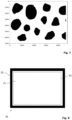
- Fig. 8 shows a schematic view of a light pad 70 which can be used as the two dimensional sample area 30 instead of the sheet of paper used in the setup of Fig. 3 .
- the light pad comprises of a light emitting luminous surface 71 made of a translucent layer that is illuminated with a white LED light source 73 (indicated by a dashed rectangle) from the backside.
- the light emitting luminous surface 71 has a size of a DIN A4 paper and is fully surrounded by a black frame 72.
- Fig. 9 shows a sample of particles on the non-illuminated surface of the light pad 70 of Fig. 8 (left side) and the same sample of particles on the illuminated surface of the light pad 70 of Fig. 8 (right side). As evident from the comparison, the contrast on the right side is clearly better and there are no shadows visible.
- the data shown in Fig. 10 was obtained with the method and the system described in Fig. 1 and 2 .
- the application 26 used in this method may be further configured to calculate an overall mean value of the particle shape parameters for a selectable range of particle sieve size fractions, e.g. from a lower threshold of 4 mm to an upper threshold of 8 mm or alternatively from a lower threshold of 1 mm up the maximum sieve size fraction of 16 mm.
- the application 26 can be configured as a standalone application capable of executing all of the steps 11, 12, 13, 14 and optionally 15a of the method of Fig. 1 .
- the method can as well be used for characterizing solid particles other than sands.
- system 20 with mix design application 27 but without application 26.
- Such a system is for example suitable for performing the method as shown in Fig. 5 .
- the at least one particle size parameter and the at least one particle shape parameter can be inputted manually and/or being read from the data storage 29 and/or any other data storage, e.g. data storage 29a of server 21.
Landscapes
- Chemical & Material Sciences (AREA)
- Engineering & Computer Science (AREA)
- Ceramic Engineering (AREA)
- Life Sciences & Earth Sciences (AREA)
- Health & Medical Sciences (AREA)
- Biochemistry (AREA)
- Analytical Chemistry (AREA)
- General Health & Medical Sciences (AREA)
- General Physics & Mathematics (AREA)
- Immunology (AREA)
- Pathology (AREA)
- Physics & Mathematics (AREA)
- Materials Engineering (AREA)
- Structural Engineering (AREA)
- Organic Chemistry (AREA)
- Dispersion Chemistry (AREA)
- Chemical Kinetics & Catalysis (AREA)
- Inorganic Chemistry (AREA)
- Environmental & Geological Engineering (AREA)
- General Life Sciences & Earth Sciences (AREA)
- Geology (AREA)
- Remote Sensing (AREA)
- Food Science & Technology (AREA)
- Medicinal Chemistry (AREA)
- Investigating Or Analysing Materials By Optical Means (AREA)
- Analysing Materials By The Use Of Radiation (AREA)
- Image Analysis (AREA)
Applications Claiming Priority (4)
| Application Number | Priority Date | Filing Date | Title |
|---|---|---|---|
| PCT/EP2021/065367 WO2022258155A1 (en) | 2021-06-08 | 2021-06-08 | Digital particle analysis |
| EP22153044 | 2022-01-24 | ||
| PCT/EP2022/065601 WO2022258715A1 (en) | 2021-06-08 | 2022-06-08 | Digital particle analysis |
| EP22731712.0A EP4237822B1 (de) | 2021-06-08 | 2022-06-08 | Digitale partikelanalyse |
Related Parent Applications (2)
| Application Number | Title | Priority Date | Filing Date |
|---|---|---|---|
| EP22731712.0A Division EP4237822B1 (de) | 2021-06-08 | 2022-06-08 | Digitale partikelanalyse |
| EP22731712.0A Division-Into EP4237822B1 (de) | 2021-06-08 | 2022-06-08 | Digitale partikelanalyse |
Publications (2)
| Publication Number | Publication Date |
|---|---|
| EP4582802A2 true EP4582802A2 (de) | 2025-07-09 |
| EP4582802A3 EP4582802A3 (de) | 2026-03-04 |
Family
ID=82115870
Family Applications (2)
| Application Number | Title | Priority Date | Filing Date |
|---|---|---|---|
| EP25171971.2A Pending EP4582802A3 (de) | 2021-06-08 | 2022-06-08 | Digitale partikelanalyse |
| EP22731712.0A Active EP4237822B1 (de) | 2021-06-08 | 2022-06-08 | Digitale partikelanalyse |
Family Applications After (1)
| Application Number | Title | Priority Date | Filing Date |
|---|---|---|---|
| EP22731712.0A Active EP4237822B1 (de) | 2021-06-08 | 2022-06-08 | Digitale partikelanalyse |
Country Status (12)
| Country | Link |
|---|---|
| US (1) | US20240280460A1 (de) |
| EP (2) | EP4582802A3 (de) |
| JP (1) | JP2024527468A (de) |
| KR (1) | KR20240018426A (de) |
| AU (1) | AU2022289241A1 (de) |
| BR (1) | BR112023022658A2 (de) |
| CA (1) | CA3221176A1 (de) |
| CO (1) | CO2023017979A2 (de) |
| ES (1) | ES3039448T3 (de) |
| MX (1) | MX2023014675A (de) |
| WO (1) | WO2022258715A1 (de) |
| ZA (1) | ZA202311464B (de) |
Families Citing this family (4)
| Publication number | Priority date | Publication date | Assignee | Title |
|---|---|---|---|---|
| AU2022491309A1 (en) * | 2022-12-22 | 2025-05-15 | Sika Technology Ag | Method to set desired properties of curable binder compositions |
| WO2025016519A1 (en) * | 2023-07-20 | 2025-01-23 | ParticleTech ApS | A method for transverse photographic analysis of dry particulate substances while suspended in a fluid |
| CN116755588B (zh) * | 2023-08-18 | 2023-11-07 | 成都建工第三建筑工程有限公司 | 一种基于抹灰机器人的数据可视化与交互系统及方法 |
| EP4632670A1 (de) | 2024-04-08 | 2025-10-15 | Sika Technology AG | Computerimplementiertes verfahren zur analyse von bildern, insbesondere im baubereich |
Family Cites Families (5)
| Publication number | Priority date | Publication date | Assignee | Title |
|---|---|---|---|---|
| US6379031B1 (en) * | 2000-01-20 | 2002-04-30 | Aggregate Research Industries, Llc | Method for manufacturing concrete |
| US8619256B1 (en) * | 2012-09-14 | 2013-12-31 | Halliburton Energy Services, Inc. | Systems and methods for monitoring the properties of a fluid cement composition in a flow path |
| GB2524130B (en) * | 2014-09-24 | 2016-02-24 | Lpw Technology Ltd | Analysing Apparatus |
| US10497536B2 (en) * | 2016-09-08 | 2019-12-03 | Rockwell Collins, Inc. | Apparatus and method for correcting arrayed astigmatism in a multi-column scanning electron microscopy system |
| US11060855B2 (en) * | 2019-04-24 | 2021-07-13 | King Abdullah University Of Science And Technology | Angle of repose system and method |
-
2022
- 2022-06-08 AU AU2022289241A patent/AU2022289241A1/en active Pending
- 2022-06-08 KR KR1020237038280A patent/KR20240018426A/ko active Pending
- 2022-06-08 CA CA3221176A patent/CA3221176A1/en active Pending
- 2022-06-08 BR BR112023022658A patent/BR112023022658A2/pt unknown
- 2022-06-08 MX MX2023014675A patent/MX2023014675A/es unknown
- 2022-06-08 JP JP2023575441A patent/JP2024527468A/ja active Pending
- 2022-06-08 ES ES22731712T patent/ES3039448T3/es active Active
- 2022-06-08 WO PCT/EP2022/065601 patent/WO2022258715A1/en not_active Ceased
- 2022-06-08 US US18/568,320 patent/US20240280460A1/en active Pending
- 2022-06-08 EP EP25171971.2A patent/EP4582802A3/de active Pending
- 2022-06-08 EP EP22731712.0A patent/EP4237822B1/de active Active
-
2023
- 2023-12-13 ZA ZA2023/11464A patent/ZA202311464B/en unknown
- 2023-12-20 CO CONC2023/0017979A patent/CO2023017979A2/es unknown
Non-Patent Citations (2)
| Title |
|---|
| BLOTTPYE, SEDIMENTOLOGY, vol. 55, 2008, pages 31 - 63 |
| J.A. VEITCH ET AL.: "On the state of knowledge concerning the effects of temporal light modulation", 20 LIGHTING RES. TECHNOL., vol. 53, 2021, pages 89 - 92 |
Also Published As
| Publication number | Publication date |
|---|---|
| AU2022289241A1 (en) | 2023-12-14 |
| WO2022258715A1 (en) | 2022-12-15 |
| JP2024527468A (ja) | 2024-07-25 |
| ES3039448T3 (en) | 2025-10-21 |
| US20240280460A1 (en) | 2024-08-22 |
| EP4582802A3 (de) | 2026-03-04 |
| KR20240018426A (ko) | 2024-02-13 |
| EP4237822B1 (de) | 2025-07-02 |
| EP4237822A1 (de) | 2023-09-06 |
| EP4237822C0 (de) | 2025-07-02 |
| MX2023014675A (es) | 2024-01-12 |
| ZA202311464B (en) | 2025-09-25 |
| CO2023017979A2 (es) | 2024-01-15 |
| CA3221176A1 (en) | 2022-12-15 |
| BR112023022658A2 (pt) | 2024-01-16 |
Similar Documents
| Publication | Publication Date | Title |
|---|---|---|
| EP4582802A2 (de) | Digitale partikelanalyse | |
| CN109856029B (zh) | 一种基于图像分析的孔隙度评价方法 | |
| WO2022258155A1 (en) | Digital particle analysis | |
| JP2009036533A (ja) | 地盤材料の粒度計測システム及びプログラム | |
| CN110349123A (zh) | 一种清水混凝土表观质量的定量评价方法 | |
| Tuan et al. | Automatic stereo vision-based inspection system for particle shape analysis of coarse aggregates | |
| Yu et al. | A rapid gradation detection system for earth and stone materials based on digital image | |
| AU2023389300A1 (en) | Digital analysis of heterogeneous materials | |
| Gaboreau et al. | Quantitative mineralogical mapping of hydrated low pH concrete | |
| Li et al. | Use of a novel description method in characterization of traces on hard rock pillar surfaces | |
| Lerma | Automatic plotting of architectural facades with multispectral images | |
| CN117242328A (zh) | 数字颗粒分析 | |
| CN117269164A (zh) | 一种云母含量检测装置及方法 | |
| Mertens et al. | Quantitative composition of ancient mortars from the Notre Dame Cathedral in Tournai (Belgium) | |
| Razali et al. | Quantitative weathering assessment of rock slope using CIELAB color space and image analysis technique | |
| Chakrabarti et al. | Shrinkage behaviour of crushed basaltic rock and residual clay mixture stabilized with cementitious binders | |
| Aughenbaugh | Fly ash-based geopolymers: identifying reactive glassy phases in potential raw materials | |
| CN106442539A (zh) | 利用图像信息测量工件表面缺陷的方法 | |
| Lin et al. | Characterising the stone artefact raw materials at Liang Bua, Indonesia | |
| Blair et al. | Photometric stereo data for the validation of a structural health monitoring test rig | |
| Levytskyi et al. | The accuracy of determination of natural stone cracks parameters based on terrestrial laser scanning and dense image matching data | |
| Midtgaard et al. | Replicating medieval wall painting plaster using the hot-mix technique | |
| Santos et al. | Study of size effect using digital image correlation | |
| Zbíral et al. | Computer Vision-Based Algorithms for Recognition of Construction and Demolition Waste Materials | |
| Corrêa et al. | Investigation of mortars from historical tiles in the mortuary architecture of the Nossa senhora da Soledade cemetery: Characteristics and Luso-Brazilian cultural heritage |
Legal Events
| Date | Code | Title | Description |
|---|---|---|---|
| PUAI | Public reference made under article 153(3) epc to a published international application that has entered the european phase |
Free format text: ORIGINAL CODE: 0009012 |
|
| STAA | Information on the status of an ep patent application or granted ep patent |
Free format text: STATUS: THE APPLICATION HAS BEEN PUBLISHED |
|
| AC | Divisional application: reference to earlier application |
Ref document number: 4237822 Country of ref document: EP Kind code of ref document: P |
|
| AK | Designated contracting states |
Kind code of ref document: A2 Designated state(s): AL AT BE BG CH CY CZ DE DK EE ES FI FR GB GR HR HU IE IS IT LI LT LU LV MC MK MT NL NO PL PT RO RS SE SI SK SM TR |
|
| REG | Reference to a national code |
Ref country code: DE Ref legal event code: R079 Free format text: PREVIOUS MAIN CLASS: G01N0033240000 Ipc: G01N0015020000 |
|
| RIC1 | Information provided on ipc code assigned before grant |
Ipc: G01N 15/02 20240101AFI20250918BHEP Ipc: C04B 28/04 20060101ALI20250918BHEP Ipc: C04B 40/00 20060101ALN20250918BHEP Ipc: G01N 33/24 20060101ALN20250918BHEP |
|
| PUAL | Search report despatched |
Free format text: ORIGINAL CODE: 0009013 |
|
| AK | Designated contracting states |
Kind code of ref document: A3 Designated state(s): AL AT BE BG CH CY CZ DE DK EE ES FI FR GB GR HR HU IE IS IT LI LT LU LV MC MK MT NL NO PL PT RO RS SE SI SK SM TR |
|
| RIC1 | Information provided on ipc code assigned before grant |
Ipc: G01N 15/02 20240101AFI20260123BHEP Ipc: C04B 28/04 20060101ALI20260123BHEP Ipc: C04B 40/00 20060101ALN20260123BHEP Ipc: G01N 33/24 20060101ALN20260123BHEP |