EP4582178A1 - Adsorbent - Google Patents
Adsorbent Download PDFInfo
- Publication number
- EP4582178A1 EP4582178A1 EP23859861.9A EP23859861A EP4582178A1 EP 4582178 A1 EP4582178 A1 EP 4582178A1 EP 23859861 A EP23859861 A EP 23859861A EP 4582178 A1 EP4582178 A1 EP 4582178A1
- Authority
- EP
- European Patent Office
- Prior art keywords
- magnesium silicate
- silicate compound
- alkali metal
- adsorbent
- adsorption
- Prior art date
- Legal status (The legal status is an assumption and is not a legal conclusion. Google has not performed a legal analysis and makes no representation as to the accuracy of the status listed.)
- Pending
Links
Images

Classifications
-
- B—PERFORMING OPERATIONS; TRANSPORTING
- B01—PHYSICAL OR CHEMICAL PROCESSES OR APPARATUS IN GENERAL
- B01J—CHEMICAL OR PHYSICAL PROCESSES, e.g. CATALYSIS OR COLLOID CHEMISTRY; THEIR RELEVANT APPARATUS
- B01J20/00—Solid sorbent compositions or filter aid compositions; Sorbents for chromatography; Processes for preparing, regenerating or reactivating thereof
- B01J20/02—Solid sorbent compositions or filter aid compositions; Sorbents for chromatography; Processes for preparing, regenerating or reactivating thereof comprising inorganic material
- B01J20/10—Solid sorbent compositions or filter aid compositions; Sorbents for chromatography; Processes for preparing, regenerating or reactivating thereof comprising inorganic material comprising silica or silicate
-
- B—PERFORMING OPERATIONS; TRANSPORTING
- B01—PHYSICAL OR CHEMICAL PROCESSES OR APPARATUS IN GENERAL
- B01D—SEPARATION
- B01D15/00—Separating processes involving the treatment of liquids with solid sorbents; Apparatus therefor
-
- B—PERFORMING OPERATIONS; TRANSPORTING
- B01—PHYSICAL OR CHEMICAL PROCESSES OR APPARATUS IN GENERAL
- B01D—SEPARATION
- B01D15/00—Separating processes involving the treatment of liquids with solid sorbents; Apparatus therefor
- B01D15/08—Selective adsorption, e.g. chromatography
-
- B—PERFORMING OPERATIONS; TRANSPORTING
- B01—PHYSICAL OR CHEMICAL PROCESSES OR APPARATUS IN GENERAL
- B01J—CHEMICAL OR PHYSICAL PROCESSES, e.g. CATALYSIS OR COLLOID CHEMISTRY; THEIR RELEVANT APPARATUS
- B01J20/00—Solid sorbent compositions or filter aid compositions; Sorbents for chromatography; Processes for preparing, regenerating or reactivating thereof
- B01J20/02—Solid sorbent compositions or filter aid compositions; Sorbents for chromatography; Processes for preparing, regenerating or reactivating thereof comprising inorganic material
- B01J20/04—Solid sorbent compositions or filter aid compositions; Sorbents for chromatography; Processes for preparing, regenerating or reactivating thereof comprising inorganic material comprising compounds of alkali metals, alkaline earth metals or magnesium
-
- B—PERFORMING OPERATIONS; TRANSPORTING
- B01—PHYSICAL OR CHEMICAL PROCESSES OR APPARATUS IN GENERAL
- B01J—CHEMICAL OR PHYSICAL PROCESSES, e.g. CATALYSIS OR COLLOID CHEMISTRY; THEIR RELEVANT APPARATUS
- B01J20/00—Solid sorbent compositions or filter aid compositions; Sorbents for chromatography; Processes for preparing, regenerating or reactivating thereof
- B01J20/02—Solid sorbent compositions or filter aid compositions; Sorbents for chromatography; Processes for preparing, regenerating or reactivating thereof comprising inorganic material
- B01J20/10—Solid sorbent compositions or filter aid compositions; Sorbents for chromatography; Processes for preparing, regenerating or reactivating thereof comprising inorganic material comprising silica or silicate
- B01J20/103—Solid sorbent compositions or filter aid compositions; Sorbents for chromatography; Processes for preparing, regenerating or reactivating thereof comprising inorganic material comprising silica or silicate comprising silica
-
- B—PERFORMING OPERATIONS; TRANSPORTING
- B01—PHYSICAL OR CHEMICAL PROCESSES OR APPARATUS IN GENERAL
- B01J—CHEMICAL OR PHYSICAL PROCESSES, e.g. CATALYSIS OR COLLOID CHEMISTRY; THEIR RELEVANT APPARATUS
- B01J20/00—Solid sorbent compositions or filter aid compositions; Sorbents for chromatography; Processes for preparing, regenerating or reactivating thereof
- B01J20/28—Solid sorbent compositions or filter aid compositions; Sorbents for chromatography; Processes for preparing, regenerating or reactivating thereof characterised by their form or physical properties
-
- B—PERFORMING OPERATIONS; TRANSPORTING
- B01—PHYSICAL OR CHEMICAL PROCESSES OR APPARATUS IN GENERAL
- B01J—CHEMICAL OR PHYSICAL PROCESSES, e.g. CATALYSIS OR COLLOID CHEMISTRY; THEIR RELEVANT APPARATUS
- B01J20/00—Solid sorbent compositions or filter aid compositions; Sorbents for chromatography; Processes for preparing, regenerating or reactivating thereof
- B01J20/28—Solid sorbent compositions or filter aid compositions; Sorbents for chromatography; Processes for preparing, regenerating or reactivating thereof characterised by their form or physical properties
- B01J20/28054—Solid sorbent compositions or filter aid compositions; Sorbents for chromatography; Processes for preparing, regenerating or reactivating thereof characterised by their form or physical properties characterised by their surface properties or porosity
- B01J20/28057—Surface area, e.g. B.E.T specific surface area
-
- B—PERFORMING OPERATIONS; TRANSPORTING
- B01—PHYSICAL OR CHEMICAL PROCESSES OR APPARATUS IN GENERAL
- B01J—CHEMICAL OR PHYSICAL PROCESSES, e.g. CATALYSIS OR COLLOID CHEMISTRY; THEIR RELEVANT APPARATUS
- B01J20/00—Solid sorbent compositions or filter aid compositions; Sorbents for chromatography; Processes for preparing, regenerating or reactivating thereof
- B01J20/28—Solid sorbent compositions or filter aid compositions; Sorbents for chromatography; Processes for preparing, regenerating or reactivating thereof characterised by their form or physical properties
- B01J20/28054—Solid sorbent compositions or filter aid compositions; Sorbents for chromatography; Processes for preparing, regenerating or reactivating thereof characterised by their form or physical properties characterised by their surface properties or porosity
- B01J20/28057—Surface area, e.g. B.E.T specific surface area
- B01J20/28061—Surface area, e.g. B.E.T specific surface area being in the range 100-500 m2/g
-
- B—PERFORMING OPERATIONS; TRANSPORTING
- B01—PHYSICAL OR CHEMICAL PROCESSES OR APPARATUS IN GENERAL
- B01J—CHEMICAL OR PHYSICAL PROCESSES, e.g. CATALYSIS OR COLLOID CHEMISTRY; THEIR RELEVANT APPARATUS
- B01J20/00—Solid sorbent compositions or filter aid compositions; Sorbents for chromatography; Processes for preparing, regenerating or reactivating thereof
- B01J20/28—Solid sorbent compositions or filter aid compositions; Sorbents for chromatography; Processes for preparing, regenerating or reactivating thereof characterised by their form or physical properties
- B01J20/28054—Solid sorbent compositions or filter aid compositions; Sorbents for chromatography; Processes for preparing, regenerating or reactivating thereof characterised by their form or physical properties characterised by their surface properties or porosity
- B01J20/28057—Surface area, e.g. B.E.T specific surface area
- B01J20/28064—Surface area, e.g. B.E.T specific surface area being in the range 500-1000 m2/g
-
- B—PERFORMING OPERATIONS; TRANSPORTING
- B01—PHYSICAL OR CHEMICAL PROCESSES OR APPARATUS IN GENERAL
- B01J—CHEMICAL OR PHYSICAL PROCESSES, e.g. CATALYSIS OR COLLOID CHEMISTRY; THEIR RELEVANT APPARATUS
- B01J20/00—Solid sorbent compositions or filter aid compositions; Sorbents for chromatography; Processes for preparing, regenerating or reactivating thereof
- B01J20/28—Solid sorbent compositions or filter aid compositions; Sorbents for chromatography; Processes for preparing, regenerating or reactivating thereof characterised by their form or physical properties
- B01J20/28054—Solid sorbent compositions or filter aid compositions; Sorbents for chromatography; Processes for preparing, regenerating or reactivating thereof characterised by their form or physical properties characterised by their surface properties or porosity
- B01J20/28069—Pore volume, e.g. total pore volume, mesopore volume, micropore volume
-
- B—PERFORMING OPERATIONS; TRANSPORTING
- B01—PHYSICAL OR CHEMICAL PROCESSES OR APPARATUS IN GENERAL
- B01J—CHEMICAL OR PHYSICAL PROCESSES, e.g. CATALYSIS OR COLLOID CHEMISTRY; THEIR RELEVANT APPARATUS
- B01J20/00—Solid sorbent compositions or filter aid compositions; Sorbents for chromatography; Processes for preparing, regenerating or reactivating thereof
- B01J20/30—Processes for preparing, regenerating, or reactivating
- B01J20/3085—Chemical treatments not covered by groups B01J20/3007 - B01J20/3078
-
- C—CHEMISTRY; METALLURGY
- C01—INORGANIC CHEMISTRY
- C01B—NON-METALLIC ELEMENTS; COMPOUNDS THEREOF; METALLOIDS OR COMPOUNDS THEREOF NOT COVERED BY SUBCLASS C01C
- C01B33/00—Silicon; Compounds thereof
- C01B33/20—Silicates
- C01B33/22—Magnesium silicates
-
- C—CHEMISTRY; METALLURGY
- C01—INORGANIC CHEMISTRY
- C01P—INDEXING SCHEME RELATING TO STRUCTURAL AND PHYSICAL ASPECTS OF SOLID INORGANIC COMPOUNDS
- C01P2006/00—Physical properties of inorganic compounds
- C01P2006/12—Surface area
-
- C—CHEMISTRY; METALLURGY
- C01—INORGANIC CHEMISTRY
- C01P—INDEXING SCHEME RELATING TO STRUCTURAL AND PHYSICAL ASPECTS OF SOLID INORGANIC COMPOUNDS
- C01P2006/00—Physical properties of inorganic compounds
- C01P2006/14—Pore volume
-
- C—CHEMISTRY; METALLURGY
- C01—INORGANIC CHEMISTRY
- C01P—INDEXING SCHEME RELATING TO STRUCTURAL AND PHYSICAL ASPECTS OF SOLID INORGANIC COMPOUNDS
- C01P2006/00—Physical properties of inorganic compounds
- C01P2006/90—Other properties not specified above
Definitions
- the present invention relates to a novel adsorbent to be used for adsorption of substances to be adsorbed, such as alkali metals.
- adsorbents capable of adsorption removal of alkali metal-containing basic catalysts are commonly used during production of polyether polyols.
- the adsorbents commonly used include, but are not particularly limited to, synthetic products such as molecular sieves, activated alumina, synthetic magnesium silicate, synthetic aluminum silicate and activated carbon; natural products; and processed natural products such as acid clay and activated white clay.
- PTL 1 discloses an adsorbent which is capable of adsorption removal of alkali metal-containing basic catalysts, the adsorbent consisting of an amorphous synthetic hydrous magnesium silicate compound having specified ranges for the chemical formula, BET specific surface area, alkali metal content and mean particle size.
- the present inventors have conducted avid experimentation with the aim of achieving this object, and as a result have found that the adsorption capacity of an adsorbent for metal ions such as K + , Na + and Ni + is improved by using an amorphous magnesium silicate compound with a low alkali metal content and high solid acid value.
- the present disclosure has been completed based on this finding and includes the following aspects.
- the first disclosure is an adsorbent comprising an amorphous magnesium silicate compound.
- the magnesium silicate compound has an alkali metal content of 1.20 mass% or lower.
- the magnesium silicate compound has a solid acid amount of 0.70 mmol/g or greater.
- the fourth disclosure is any one of the first to third disclosures wherein the total pore volume of the magnesium silicate compound is 0.40 cm 3 /g to 1.50 cm 3 /g.
- the fifth disclosure is a method of reducing the alkali metal content in a polyether polyol.
- the method includes contacting an adsorbent according to any one of the first to fourth disclosures with a polyether polyol comprising an alkali metal-containing basic catalyst.
- the adsorbent according to one embodiment of the invention comprises an amorphous magnesium silicate compound.
- the magnesium silicate compound has an alkali metal content of 1.20 mass% or lower.
- the magnesium silicate compound also has a solid acid amount of 0.70 mmol/g or greater.
- the adsorbent of the embodiment comprising the aforementioned amorphous magnesium silicate compound with a low alkali metal content and high solid acid value, can thereby exhibit excellent adsorption capacity for metal ions such as K + , Na + and Ni + . Because the adsorption capacity is extremely high compared to conventional adsorbents that comprise magnesium silicate compounds, it is possible to drastically reduce the amount of usage of the adsorbent of the embodiment compared to conventional adsorbents.
- the adsorbent of the embodiment is a novel adsorbent with extremely high adsorption capacity compared to conventional adsorbents that comprise magnesium silicate compounds, allowing it to be used in a lower amount for adsorption of substances to be adsorbed.
- the adsorbent of the embodiment can significantly contribute to reduction in energy consumption and waste treatment, and can aid in efforts to achieve the SDGs (Sustainable Development Goals) adopted by the United Nations.
- the adsorbent according to one embodiment of the invention comprises an amorphous magnesium silicate compound, as mentioned above.
- amorphous magnesium silicate compound means a magnesium silicate compound exhibiting an amorphous powder X-ray diffraction pattern.
- the alkali metal content of the magnesium silicate compound is 1.20 mass% or lower.
- the method for producing the magnesium silicate compound to form the adsorbent according to one embodiment of the invention will now be explained using a method for producing the aforementioned hydrous magnesium silicate compound as an example.
- the magnesium silicate compound to be used as the adsorbent of the invention may be produced by any method and under any conditions, so long as it is amorphous, having an alkali metal content at or below the specified amount and a high solid acid amount at or above the specified amount.
- the hydrous magnesium silicate compound can be synthesized by reaction using a water-soluble magnesium compound and a water-soluble silicic acid compound.
- water-soluble magnesium compounds include magnesium chloride, magnesium sulfate and magnesium nitrate.
- the water-soluble silicic acid compound used is most preferably No. 3 water glass.
- the reaction may be a batch reaction in which a fixed amount of an aqueous magnesium compound solution and a fixed amount of an aqueous silicic acid compound solution are simultaneously loaded into a reaction tank, or a continuous reaction in which a fixed amount of an aqueous magnesium compound solution and a fixed amount of an aqueous silicic acid compound solution are continuously loaded into a reaction tank to continuously obtain a reaction slurry. Continuous reaction is advantageous from the viewpoint of production efficiency.
- the reaction temperature is not particularly restricted and may be a temperature of 15°C to 60°C, for example.
- the reaction tank may be placed in a thermostatic bath controlled to a constant temperature for reaction, or a container holding the aqueous magnesium compound solution and a container holding the aqueous silicic acid compound solution may be placed in a thermostatic bath controlled to a constant temperature, using a metering pump from each container for loading into the reaction tank.
- the reaction pH is 7 to 10, for example, and preferably 8.5 to 9.5.
- the reaction slurry obtained by the synthesis step may be aged by heating and stirring.
- the aging temperature is 60°C to 120°C, for example, and is preferably 70°C to 110°C and more preferably 80°C to 100°C.
- the aging time is 0.5 hours to 18 hours, for example, preferably 1 hour to 12 hours and more preferably 2 hours to 6 hours. If the synthesized hydrous magnesium silicate compound is heat aged under these specific conditions, the specific surface area of the hydrous magnesium silicate compound will increase and the number of adsorption sites will also increase, thus improving the adsorption capacity.
- the synthesized hydrous magnesium silicate compound may be subjected to acid treatment using an inorganic acid.
- acid treatment the alkali metal components in the synthesized hydrous magnesium silicate compound are replaced by protons of the inorganic acid, thus increasing the solid acid value of the hydrous magnesium silicate compound and consequently allowing the adsorption capacity for alkali metal ions to be improved.
- Alkali metal components are sodium and potassium from the starting material, for example.
- the inorganic acid to be used in the acid treatment step is not particularly restricted, and sulfuric acid, hydrochloric acid and nitric acid may be mentioned as examples.
- One specific method for the acid treatment step i.e. one specific method for replacing the alkali metal components in the synthesized hydrous magnesium silicate compound with protons of an inorganic acid
- a method in which the reaction slurry is processed by solid-liquid separation, and the solid is washed with a diluted inorganic acid, and then further washed with water for example.
- Another method is a method in which the reaction slurry is processed by solid-liquid separation and the solid is suspended in a diluted inorganic acid, stirred for a certain time and dehydrated, after which it is washed with water.
- the concentration of the inorganic acid may be 0.01 mol/L to 0.5 mol/L, for example, and is preferably 0.02 mol/L to 0.2 mol/L. If the concentration of the diluted inorganic acid is 0.01 mol/L or higher, replacement between the protons of the inorganic acid and the alkali metal components will be sufficient. If the concentration of the diluted inorganic acid is 0.5 mol/L or lower, on the other hand, sulfate ions, chloride ions or nitrate ions of the inorganic acid will be less likely to remain as impurities in the solid. If the concentration of the diluted inorganic acid is 0.5 mol/L or lower the magnesium in the magnesium silicate will be less likely to be dissolved by the inorganic acid.
- the drying method for the synthesized hydrous magnesium silicate compound is not particularly restricted, and for example, it may be a shelf drying method in which the dehydrated solid is placed in a stainless steel vat and dried with hot air.
- Another drying method is the spray-drying method in which the dehydrated solid is formed into a slurry at a concentration of 100 g/L to 500 g/L in terms of solid content, optionally with adjustment of the dry shape by processing with a wet grinder such as a ball mill, colloid mill, SC mill or Dyno-Mill, and then dried with a spray drier.
- the drying method used is most preferably a spray-drying method from the viewpoint of facilitating granulation of the hydrous magnesium silicate compound into spheres. Granulation of the hydrous magnesium silicate compound into spheres is advantageous for aiding separation and removal after adsorption treatment.
- the magnesium silicate compound obtained by the production method described above is amorphous, due to the reaction conditions during synthesis and on the heat aging step and/or acid treatment step after synthesis, and it has an alkali metal content at or below the specified amount as well as a high solid acid amount at or above the specified amount.
- the magnesium silicate compound can be used as an adsorbent for a variety of industrial purposes, and as mentioned above, it is especially useful as an adsorbent for adsorption removal of alkali metal-containing basic catalysts during production of polyether polyols.
- Another embodiment of the invention is a method of reducing the alkali metal content in a polyether polyol.
- the method includes contacting an adsorbent comprising an amorphous magnesium silicate compound having an alkali metal content at or below the specified amount and a high solid acid amount at or above the specified amount, with a polyether polyol comprising an alkali metal-containing basic catalyst.
- this method provides very excellent adsorption capacity and allows adsorption of different metal ions with a smaller amount of adsorbent, it is possible to increase the polyether polyol yield and to reduce the amount of waste generated after purification.
- One specific method for adsorption removal of a residual alkali metal-containing basic catalyst in a polyether polyol is a method of adding the aforementioned magnesium silicate compound as an adsorbent to the polyether polyol and mixing, and then separating and removing the adsorbent.
- the amount of adsorbent to be added will depend on the amount of residual alkali metal-containing basic catalyst, but for example, it may be 0.1 mass% to 10.0 mass% and preferably 0.5 mass% to 5.0 mass%, with respect to the mass of the polyether polyol.
- neutralizing reaction Before adding the adsorbent to the polyether polyol, neutralizing reaction may be carried out by addition of one or more from among inorganic acids, inorganic acid salts and organic acids, such as phosphoric acid, sulfuric acid, sodium hydrogen pyrophosphate or oxalic acid. In this case the adsorbent is added after completion of the neutralizing reaction.
- the SiO 2 /MgO molar ratio and alkali metal content of each magnesium silicate compound were measured using a "ZSX Primus IV" Scanning fluorescent X-ray analyzer by Rigaku Corp.
- the BET specific surface area and total pore volume of each magnesium silicate compound was measured using a "BELSORP-MAX" High precision specific surface area/pore distribution measuring device by MicrotracBel.
- the liquid pH of the magnesium silicate compound was measured in the following manner. After placing 2.0 g of dry magnesium silicate compound and 40 mL of ion-exchanged water in a beaker, the mixture was stirred for 5 minutes with a magnetic stirrer, and then No.5C filter paper was used for filtration and the pH of the filtrate was measured. The filtrate pH was recorded as the liquid pH of the magnesium silicate compound.
- the mean particle size of the magnesium silicate compound was measured using a "MICROTRAC MT3000II Series" particle size distribution analyzer by Nikkiso Co., Ltd. Specifically, first 70 mL of a 2.0 g/L aqueous sodium hexametaphosphate solution was added to 0.7 g of the dry magnesium silicate compound, and the mixture was stirred with a magnetic stirrer. After then adding 2 to 4 mL of the dispersion to a 2.0 g/L aqueous sodium hexametaphosphate solution and circulating the dispersion for 1 minute, the particle size distribution analyzer was used to measure the particle size distribution. The mean particle size was determined from the resulting 50% cumulative value (median diameter).
- a 1.17 mol/L aqueous magnesium sulfate solution and a No. 3 water glass solution comprising 0.46 mol/L Na 2 O and 1.44 mol/L SiO 2 were continuously loaded into a continuous reaction tank at a fixed rate for coprecipitation reaction.
- the reaction temperature was 40°C.
- the pH of the obtained reaction slurry was 8.9.
- the mean particle size of the particles as the reaction product was 8.2 ⁇ m.
- the reaction slurry was also suction filtered with a Nutsche filter to remove the water, and the solid was washed with a 20-fold amount of ion-exchanged water with respect to the weight of the solid.
- the obtained solid was formed into a slurry to a concentration of 250 g/L and spray-dried with a spray drier.
- the physical properties of the dry magnesium silicate compound of Example 1 obtained in this manner were measured.
- the SiO 2 /MgO molar ratio of the magnesium silicate compound of Example 1 was thus found to be 3.5.
- the alkali metal content of the magnesium silicate compound of Example 1 was 1.00 mass%.
- the BET specific surface area of the magnesium silicate compound of Example 1 was 295 m 2 /g.
- the total pore volume of the magnesium silicate compound of Example 1 was 0.47 cm 3 /g.
- the liquid pH of the magnesium silicate compound of Example 1 was 9.8.
- the solid acid amount of the magnesium silicate compound of Example 1 was 0.73 mmol/g.
- the mean particle size of the magnesium silicate compound of Example 1 was 42.2 ⁇ m.
- the powder X-ray diffraction pattern of the magnesium silicate compound of Example 1 indicated an amorphous form.
- a 1.17 mol/L aqueous magnesium sulfate solution and a No. 3 water glass solution comprising 0.46 mol/L Na 2 O and 1.44 mol/L SiO 2 were continuously loaded into a continuous reaction tank at a fixed rate for coprecipitation reaction.
- the reaction temperature was 40°C.
- the pH of the obtained reaction slurry was 8.9.
- the mean particle size of the particles as the reaction product was 8.2 ⁇ m.
- the physical properties of the dry magnesium silicate compound of Example 2 obtained in this manner were measured.
- the SiO 2 /MgO molar ratio of the magnesium silicate compound of Example 2 was thus found to be 3.9.
- the alkali metal content of the magnesium silicate compound of Example 2 was 0.17 mass%.
- the BET specific surface area of the magnesium silicate compound of Example 2 was 259 m 2 /g.
- the total pore volume of the magnesium silicate compound of Example 2 was 0.56 cm 3 /g.
- the liquid pH of the magnesium silicate compound of Example 2 was 9.1.
- the solid acid amount of the magnesium silicate compound of Example 2 was 0.90 mmol/g.
- the mean particle size of the magnesium silicate compound of Example 2 was 43.8 ⁇ m.
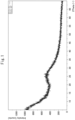
- the powder X-ray diffraction pattern of the magnesium silicate compound of Example 2 indicated an amorphous form as shown in Fig. 1 .
- a 1.35 mol/L aqueous magnesium sulfate solution and a No. 3 water glass solution comprising 0.55 mol/L Na 2 O and 1.73 mol/L SiO 2 were continuously loaded into a continuous reaction tank at a fixed rate for coprecipitation reaction.
- the reaction temperature was 40°C.
- the pH of the obtained reaction slurry was 9.3.
- the mean particle size of the particles as the reaction product was 12.8 ⁇ m.
- the reaction slurry was also suction filtered with a Nutsche filter to remove the water, and the solid was washed with a 20-fold amount of ion-exchanged water with respect to the weight of the solid.
- the obtained solid was formed into a slurry to a concentration of 250 g/L and spray-dried with a spray drier.
- the physical properties of the dry magnesium silicate compound of Comparative Example 1 obtained in this manner were measured.
- the SiO 2 /MgO molar ratio of the magnesium silicate compound of Comparative Example 1 was thus found to be 3.6.
- the alkali metal content of the magnesium silicate compound of Comparative Example 1 was 1.60 mass%.
- the BET specific surface area of the magnesium silicate compound of Comparative Example 1 was 126 m 2 /g.
- the total pore volume of the magnesium silicate compound of Comparative Example 1 was 0.24 cm 3 /g.
- the liquid pH of the magnesium silicate compound of Comparative Example 1 was 10.1.
- the solid acid amount of the magnesium silicate compound of Comparative Example 1 was 0.61 mmol/g.
- the mean particle size of the magnesium silicate compound of Comparative Example 1 was 40.6 ⁇ m.
- the powder X-ray diffraction pattern of the magnesium silicate compound of Comparative Example 1 indicated an amorphous form.
- Example 1 Example 2
- Example 3 Comp.
- Example 1 Mean particle size of reaction product particles ( ⁇ m) 8.2 8.2 8.2 8.2 12.8 Treatment conditions Water washing alone Acid treatment Heat aging Heat aging/ acid treatment Water washing alone Molar ratio (SiO 2 /MgO) 3.5 3.9 3.4 4.0 3.6 Alkali metal content (mass%) 1.00 0.17 0.98 0.08 1.60 BET specific surface area (m 2 /g) 295 259 714 702 126 Total pore volume (cm 3 /g) 0.47 0.56 1.05 1.07 0.24 Liquid pH 9.8 9.1 9.6 8.4 10.1 Solid acid amount (mmol/g) 0.73 0.90 1.65 1.62 0.61 Mean particle size ( ⁇ m) 42.2 43.8 39.8 39.8 40.6
- Adsorption test [K : 1400 ppm] Residual K amount [0.25 phr addition] (ppm) 209 211 123 162 424 Residual K amount [0.35 phr addition] (pp
- the adsorbents comprising the magnesium silicate compounds of Examples 1 to 4 had low residual K amounts in the adsorption test, and exhibited very excellent adsorption performance for alkali metals.
- the adsorbent comprising the magnesium silicate compound of Comparative Example 1 had a high residual K amount in the adsorption test, and the adsorption performance for alkali metals was insufficient.
Landscapes
- Chemical & Material Sciences (AREA)
- Organic Chemistry (AREA)
- Analytical Chemistry (AREA)
- Chemical Kinetics & Catalysis (AREA)
- Inorganic Chemistry (AREA)
- Solid-Sorbent Or Filter-Aiding Compositions (AREA)
- Silicates, Zeolites, And Molecular Sieves (AREA)
- Compositions Of Macromolecular Compounds (AREA)
Applications Claiming Priority (2)
| Application Number | Priority Date | Filing Date | Title |
|---|---|---|---|
| JP2022137075 | 2022-08-30 | ||
| PCT/JP2023/025909 WO2024048091A1 (ja) | 2022-08-30 | 2023-07-13 | 吸着剤 |
Publications (1)
| Publication Number | Publication Date |
|---|---|
| EP4582178A1 true EP4582178A1 (en) | 2025-07-09 |
Family
ID=90099435
Family Applications (1)
| Application Number | Title | Priority Date | Filing Date |
|---|---|---|---|
| EP23859861.9A Pending EP4582178A1 (en) | 2022-08-30 | 2023-07-13 | Adsorbent |
Country Status (5)
| Country | Link |
|---|---|
| EP (1) | EP4582178A1 (https=) |
| JP (2) | JPWO2024048091A1 (https=) |
| KR (1) | KR20250038765A (https=) |
| CN (1) | CN119744196A (https=) |
| WO (1) | WO2024048091A1 (https=) |
Families Citing this family (1)
| Publication number | Priority date | Publication date | Assignee | Title |
|---|---|---|---|---|
| KR20260026301A (ko) * | 2024-08-19 | 2026-02-26 | 주식회사 자이언트케미칼 | 마그네슘 실리케이트를 포함하는 암모니아 흡착제 및 이의 제조방법 |
Family Cites Families (5)
| Publication number | Priority date | Publication date | Assignee | Title |
|---|---|---|---|---|
| JPH03195728A (ja) * | 1989-12-25 | 1991-08-27 | Mitsui Toatsu Chem Inc | ポリオキシアルキレンポリオールの精製法 |
| JPH07258403A (ja) * | 1994-03-25 | 1995-10-09 | Sanyo Chem Ind Ltd | ポリエーテルの精製方法 |
| JP2001261813A (ja) * | 2000-03-15 | 2001-09-26 | Mitsui Chemicals Inc | ポリオキシアルキレンポリオール及びその製造方法 |
| US7247699B2 (en) | 2002-06-18 | 2007-07-24 | Kyowa Chemical Industry Co., Ltd. | Process for purification of crude polyether and adsorbent |
| CA3057293A1 (en) * | 2017-03-23 | 2018-09-27 | The Dallas Group Of America, Inc. | Purification of crude polyalkylene oxide polymers with acid functionalized silicas and metal silicates |
-
2023
- 2023-07-13 WO PCT/JP2023/025909 patent/WO2024048091A1/ja not_active Ceased
- 2023-07-13 EP EP23859861.9A patent/EP4582178A1/en active Pending
- 2023-07-13 JP JP2024544009A patent/JPWO2024048091A1/ja active Pending
- 2023-07-13 CN CN202380061207.7A patent/CN119744196A/zh active Pending
- 2023-07-13 KR KR1020257005355A patent/KR20250038765A/ko active Pending
-
2025
- 2025-02-20 JP JP2025026179A patent/JP2025071257A/ja active Pending
Also Published As
| Publication number | Publication date |
|---|---|
| JPWO2024048091A1 (https=) | 2024-03-07 |
| WO2024048091A1 (ja) | 2024-03-07 |
| JP2025071257A (ja) | 2025-05-02 |
| CN119744196A (zh) | 2025-04-01 |
| KR20250038765A (ko) | 2025-03-19 |
Similar Documents
| Publication | Publication Date | Title |
|---|---|---|
| EP1894620B2 (en) | Method to produce a porous zirconia powder | |
| US8435483B2 (en) | Method for making ammonium metatungstate | |
| EP2042235B1 (en) | Method for producing regeneration catalyst for working solution usable for hydrogen peroxide production | |
| US3223483A (en) | Method of producing active alumina | |
| JPH11169714A (ja) | メタノールをスチーム改質するための触媒 | |
| KR910004834B1 (ko) | 희토류 원소 산화물의 수득방법 및 수득된 생성물 | |
| KR102381148B1 (ko) | 이산화티타늄 졸, 그 제조 방법 및 이로부터 수득되는 생성물 | |
| EP4582178A1 (en) | Adsorbent | |
| US3676367A (en) | Adsorbent for beverages | |
| CN106276992A (zh) | 一种叶片状纳米γ-氧化铝的制备方法 | |
| JP4035084B2 (ja) | 粗製ポリエーテルの精製方法および吸着剤 | |
| EP0010871B1 (en) | Carboxylated cellulose ion-exchange materials, process for their preparation and their use in removing heavy metal ions from aqueous solutions | |
| EP2952478B1 (en) | Method for the production of free flowing synthetic calcium fluoride and use thereof | |
| EP2938431B1 (en) | Preparation of silica-alumina composition | |
| JP2603713B2 (ja) | 水酸化アルミニウムの製造方法および焼結品の形成方法 | |
| EP3067320A1 (en) | Method for producing aqueous zirconium chloride solution | |
| KR101033660B1 (ko) | 젖산 에스테르의 탈수 반응용 인산칼슘-실리카 촉매 및 그의 제조방법 및 이를 이용하여 젖산 에스테르로부터 아크릴계 화합물을 제조하는 방법 | |
| RU2729612C1 (ru) | Гранулированный активный оксид алюминия | |
| US4366090A (en) | Process for the preparation of adsorbent materials | |
| EP0394948A2 (en) | Stabilized synthetic zeolite and a process for the preparation thereof | |
| KR101722954B1 (ko) | 황화수소 제거제 및 이의 제조방법 | |
| EP1314696B1 (en) | Method for preparing aluminum sulfate | |
| EP3924299B1 (en) | Method for preparing high purity aluminum monohydrate and alpha alumina | |
| JP3467970B2 (ja) | 二酸化ケイ素及びその製造方法並びにビールの安定化処理剤 | |
| CN115246793B (zh) | 一种二异氰酸酯三聚体的制备方法、催化剂及其制备方法 |
Legal Events
| Date | Code | Title | Description |
|---|---|---|---|
| STAA | Information on the status of an ep patent application or granted ep patent |
Free format text: STATUS: THE INTERNATIONAL PUBLICATION HAS BEEN MADE |
|
| PUAI | Public reference made under article 153(3) epc to a published international application that has entered the european phase |
Free format text: ORIGINAL CODE: 0009012 |
|
| STAA | Information on the status of an ep patent application or granted ep patent |
Free format text: STATUS: REQUEST FOR EXAMINATION WAS MADE |
|
| 17P | Request for examination filed |
Effective date: 20250307 |
|
| AK | Designated contracting states |
Kind code of ref document: A1 Designated state(s): AL AT BE BG CH CY CZ DE DK EE ES FI FR GB GR HR HU IE IS IT LI LT LU LV MC ME MK MT NL NO PL PT RO RS SE SI SK SM TR |
|
| DAV | Request for validation of the european patent (deleted) | ||
| DAX | Request for extension of the european patent (deleted) |