EP4582166A1 - Acid gas collection method - Google Patents
Acid gas collection method Download PDFInfo
- Publication number
- EP4582166A1 EP4582166A1 EP23860329.4A EP23860329A EP4582166A1 EP 4582166 A1 EP4582166 A1 EP 4582166A1 EP 23860329 A EP23860329 A EP 23860329A EP 4582166 A1 EP4582166 A1 EP 4582166A1
- Authority
- EP
- European Patent Office
- Prior art keywords
- acid gas
- gas
- desorption
- adsorption
- adsorption device
- Prior art date
- Legal status (The legal status is an assumption and is not a legal conclusion. Google has not performed a legal analysis and makes no representation as to the accuracy of the status listed.)
- Pending
Links
Images



Classifications
-
- B—PERFORMING OPERATIONS; TRANSPORTING
- B01—PHYSICAL OR CHEMICAL PROCESSES OR APPARATUS IN GENERAL
- B01D—SEPARATION
- B01D53/00—Separation of gases or vapours; Recovering vapours of volatile solvents from gases; Chemical or biological purification of waste gases, e.g. engine exhaust gases, smoke, fumes, flue gases, aerosols
- B01D53/02—Separation of gases or vapours; Recovering vapours of volatile solvents from gases; Chemical or biological purification of waste gases, e.g. engine exhaust gases, smoke, fumes, flue gases, aerosols by adsorption, e.g. preparative gas chromatography
- B01D53/04—Separation of gases or vapours; Recovering vapours of volatile solvents from gases; Chemical or biological purification of waste gases, e.g. engine exhaust gases, smoke, fumes, flue gases, aerosols by adsorption, e.g. preparative gas chromatography with stationary adsorbents
- B01D53/0407—Constructional details of adsorbing systems
-
- B—PERFORMING OPERATIONS; TRANSPORTING
- B01—PHYSICAL OR CHEMICAL PROCESSES OR APPARATUS IN GENERAL
- B01D—SEPARATION
- B01D53/00—Separation of gases or vapours; Recovering vapours of volatile solvents from gases; Chemical or biological purification of waste gases, e.g. engine exhaust gases, smoke, fumes, flue gases, aerosols
- B01D53/34—Chemical or biological purification of waste gases
- B01D53/46—Removing components of defined structure
- B01D53/62—Carbon oxides
-
- B—PERFORMING OPERATIONS; TRANSPORTING
- B01—PHYSICAL OR CHEMICAL PROCESSES OR APPARATUS IN GENERAL
- B01D—SEPARATION
- B01D53/00—Separation of gases or vapours; Recovering vapours of volatile solvents from gases; Chemical or biological purification of waste gases, e.g. engine exhaust gases, smoke, fumes, flue gases, aerosols
- B01D53/34—Chemical or biological purification of waste gases
- B01D53/74—General processes for purification of waste gases; Apparatus or devices specially adapted therefor
- B01D53/81—Solid phase processes
- B01D53/82—Solid phase processes with stationary reactants
-
- B—PERFORMING OPERATIONS; TRANSPORTING
- B01—PHYSICAL OR CHEMICAL PROCESSES OR APPARATUS IN GENERAL
- B01D—SEPARATION
- B01D53/00—Separation of gases or vapours; Recovering vapours of volatile solvents from gases; Chemical or biological purification of waste gases, e.g. engine exhaust gases, smoke, fumes, flue gases, aerosols
- B01D53/34—Chemical or biological purification of waste gases
- B01D53/96—Regeneration, reactivation or recycling of reactants
-
- B—PERFORMING OPERATIONS; TRANSPORTING
- B01—PHYSICAL OR CHEMICAL PROCESSES OR APPARATUS IN GENERAL
- B01D—SEPARATION
- B01D2253/00—Adsorbents used in seperation treatment of gases and vapours
- B01D2253/10—Inorganic adsorbents
- B01D2253/102—Carbon
-
- B—PERFORMING OPERATIONS; TRANSPORTING
- B01—PHYSICAL OR CHEMICAL PROCESSES OR APPARATUS IN GENERAL
- B01D—SEPARATION
- B01D2253/00—Adsorbents used in seperation treatment of gases and vapours
- B01D2253/10—Inorganic adsorbents
- B01D2253/104—Alumina
-
- B—PERFORMING OPERATIONS; TRANSPORTING
- B01—PHYSICAL OR CHEMICAL PROCESSES OR APPARATUS IN GENERAL
- B01D—SEPARATION
- B01D2253/00—Adsorbents used in seperation treatment of gases and vapours
- B01D2253/10—Inorganic adsorbents
- B01D2253/106—Silica or silicates
-
- B—PERFORMING OPERATIONS; TRANSPORTING
- B01—PHYSICAL OR CHEMICAL PROCESSES OR APPARATUS IN GENERAL
- B01D—SEPARATION
- B01D2253/00—Adsorbents used in seperation treatment of gases and vapours
- B01D2253/10—Inorganic adsorbents
- B01D2253/106—Silica or silicates
- B01D2253/108—Zeolites
-
- B—PERFORMING OPERATIONS; TRANSPORTING
- B01—PHYSICAL OR CHEMICAL PROCESSES OR APPARATUS IN GENERAL
- B01D—SEPARATION
- B01D2253/00—Adsorbents used in seperation treatment of gases and vapours
- B01D2253/20—Organic adsorbents
- B01D2253/202—Polymeric adsorbents
-
- B—PERFORMING OPERATIONS; TRANSPORTING
- B01—PHYSICAL OR CHEMICAL PROCESSES OR APPARATUS IN GENERAL
- B01D—SEPARATION
- B01D2253/00—Adsorbents used in seperation treatment of gases and vapours
- B01D2253/20—Organic adsorbents
- B01D2253/204—Metal organic frameworks (MOF's)
-
- B—PERFORMING OPERATIONS; TRANSPORTING
- B01—PHYSICAL OR CHEMICAL PROCESSES OR APPARATUS IN GENERAL
- B01D—SEPARATION
- B01D2253/00—Adsorbents used in seperation treatment of gases and vapours
- B01D2253/30—Physical properties of adsorbents
- B01D2253/302—Dimensions
- B01D2253/306—Surface area, e.g. BET-specific surface
-
- B—PERFORMING OPERATIONS; TRANSPORTING
- B01—PHYSICAL OR CHEMICAL PROCESSES OR APPARATUS IN GENERAL
- B01D—SEPARATION
- B01D2257/00—Components to be removed
- B01D2257/20—Halogens or halogen compounds
- B01D2257/204—Inorganic halogen compounds
- B01D2257/2045—Hydrochloric acid
-
- B—PERFORMING OPERATIONS; TRANSPORTING
- B01—PHYSICAL OR CHEMICAL PROCESSES OR APPARATUS IN GENERAL
- B01D—SEPARATION
- B01D2257/00—Components to be removed
- B01D2257/30—Sulfur compounds
- B01D2257/302—Sulfur oxides
-
- B—PERFORMING OPERATIONS; TRANSPORTING
- B01—PHYSICAL OR CHEMICAL PROCESSES OR APPARATUS IN GENERAL
- B01D—SEPARATION
- B01D2257/00—Components to be removed
- B01D2257/30—Sulfur compounds
- B01D2257/304—Hydrogen sulfide
-
- B—PERFORMING OPERATIONS; TRANSPORTING
- B01—PHYSICAL OR CHEMICAL PROCESSES OR APPARATUS IN GENERAL
- B01D—SEPARATION
- B01D2257/00—Components to be removed
- B01D2257/30—Sulfur compounds
- B01D2257/306—Organic sulfur compounds, e.g. mercaptans
-
- B—PERFORMING OPERATIONS; TRANSPORTING
- B01—PHYSICAL OR CHEMICAL PROCESSES OR APPARATUS IN GENERAL
- B01D—SEPARATION
- B01D2257/00—Components to be removed
- B01D2257/40—Nitrogen compounds
- B01D2257/404—Nitrogen oxides other than dinitrogen oxide
-
- B—PERFORMING OPERATIONS; TRANSPORTING
- B01—PHYSICAL OR CHEMICAL PROCESSES OR APPARATUS IN GENERAL
- B01D—SEPARATION
- B01D2257/00—Components to be removed
- B01D2257/50—Carbon oxides
- B01D2257/504—Carbon dioxide
-
- B—PERFORMING OPERATIONS; TRANSPORTING
- B01—PHYSICAL OR CHEMICAL PROCESSES OR APPARATUS IN GENERAL
- B01D—SEPARATION
- B01D2258/00—Sources of waste gases
- B01D2258/06—Polluted air
-
- B—PERFORMING OPERATIONS; TRANSPORTING
- B01—PHYSICAL OR CHEMICAL PROCESSES OR APPARATUS IN GENERAL
- B01D—SEPARATION
- B01D2259/00—Type of treatment
- B01D2259/40—Further details for adsorption processes and devices
- B01D2259/40083—Regeneration of adsorbents in processes other than pressure or temperature swing adsorption
- B01D2259/40088—Regeneration of adsorbents in processes other than pressure or temperature swing adsorption by heating
- B01D2259/4009—Regeneration of adsorbents in processes other than pressure or temperature swing adsorption by heating using hot gas
-
- C—CHEMISTRY; METALLURGY
- C01—INORGANIC CHEMISTRY
- C01B—NON-METALLIC ELEMENTS; COMPOUNDS THEREOF; METALLOIDS OR COMPOUNDS THEREOF NOT COVERED BY SUBCLASS C01C
- C01B32/00—Carbon; Compounds thereof
- C01B32/50—Carbon dioxide
-
- Y—GENERAL TAGGING OF NEW TECHNOLOGICAL DEVELOPMENTS; GENERAL TAGGING OF CROSS-SECTIONAL TECHNOLOGIES SPANNING OVER SEVERAL SECTIONS OF THE IPC; TECHNICAL SUBJECTS COVERED BY FORMER USPC CROSS-REFERENCE ART COLLECTIONS [XRACs] AND DIGESTS
- Y02—TECHNOLOGIES OR APPLICATIONS FOR MITIGATION OR ADAPTATION AGAINST CLIMATE CHANGE
- Y02C—CAPTURE, STORAGE, SEQUESTRATION OR DISPOSAL OF GREENHOUSE GASES [GHG]
- Y02C20/00—Capture or disposal of greenhouse gases
- Y02C20/40—Capture or disposal of greenhouse gases of CO2
Definitions
- the present invention relates to a method of capturing an acid gas.
- the pellet-like carbon dioxide adsorption materials adsorb CO 2 from a gas fluid passing through the adsorption material layers at a predetermined adsorption temperature, and, when heated to a desorption temperature exceeding the adsorption temperature, desorb the adsorbed CO 2 .
- one of CO 2 desorption reactions of amine which is a typical CO 2 adsorption material, is: HCO 3 - +NH 2 + R 1 R 2 ⁇ NHR 1 R 2 +CO 2 +H 2 O.
- a CO 2 release reaction becomes slower or a desorption temperature rises.
- the desorption amount of CO 2 may be reduced.
- carbamate which can be generated by the reaction of amine being a CO 2 adsorption material and CO 2 , is often present in a state mixed with water, which has high polarity.
- a CO 2 release reaction becomes slower or a desorption temperature rises.
- the desorption amount of CO 2 may be reduced.
- a primary object of the present invention is to provide a method of capturing an acid gas, which enables achievement of an increase in desorption amount of acid gas from an acid gas adsorption material.
- the second desorption step of supplying the second desorption gas with lower humidity than that of the first desorption gas to the acid gas adsorption device is performed.
- the humidity of the surface of the acid gas adsorption material and in the vicinity thereof can be temporarily decreased in the second desorption step.
- an acid gas that has not been desorbed in the first desorption step can be smoothly desorbed.
- an increase in desorption amount of acid gas from the acid gas adsorption material can be achieved in the desorption step as a whole, and hence the acid gas can be efficiently captured.
- the humidity of the second desorption gas is lower than the humidity of the first desorption gas. Lower humidity of the second desorption gas is more preferred.
- the humidity of the first desorption gas is defined as 100%
- the humidity of the second desorption gas is, for example, 80% or less, preferably 50% or less.
- the volumetric humidity of the second desorption gas is, for example, 2,800 g/m 3 or less, preferably 450 g/m 3 or less, more preferably 380 g/m 3 or less.
- nitrogen-containing compounds methyldiethylamine, monoethanolamine, a cyclic amine, diethanolamine, tetraethylenepentamine, ethyleneimine, a linear polyethyleneimine, a branched polyethyleneimine, and an organic/inorganic compound having imparted thereto an amino group as a substituent are preferred.
- the ionic liquid is a "salt" of a liquid formed only of an ion (an anion or a cation), and is in a liquid state under normal temperature and normal pressure (23°C, 0.1 MPaA (absolute pressure)).
- a cation of the ionic liquid include: an ammonium-based ion, such as an imidazolium salt or a pyridinium salt; a phosphonium-based ion; a sulfonium salt; and an inorganic ion.
- anion of the ionic liquid examples include: a halogen-based ion, such as a bromide ion or a triflate ion; a boron-based ion such as a tetraphenylborate ion; a phosphorus-based ion such as a hexafluorophosphate ion; and a sulfur-based ion such as an alkyl sulfonate ion.
- a halogen-based ion such as a bromide ion or a triflate ion
- a boron-based ion such as a tetraphenylborate ion
- a phosphorus-based ion such as a hexafluorophosphate ion
- sulfur-based ion such as an alkyl sulfonate ion.
- the ionic liquid is used, more preferably, in combination with a carbon dioxide adsorption material other than the ionic liquid (hereinafter referred to as "another carbon dioxide adsorption material").
- the ionic liquid coats another carbon dioxide adsorption material (for example, a nitrogen-containing compound).
- a carbon dioxide adsorption material for example, a nitrogen-containing compound.
- the content ratio of the ionic liquid is, for example, 0.000001 part by mass or more, preferably 0.00001 part by mass or more, and is, for example, 0.1 part by mass or less, preferably 0.05 part by mass or less with respect to 1 part by mass of the other carbon dioxide adsorption material.
- the content ratio of the ionic liquid falls within the above-mentioned ranges, an improvement in performance of the carbon dioxide adsorption material and an increase in lifetime thereof can be stably achieved.
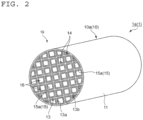
- the carbon dioxide adsorption layer 15a further includes a porous carrier in addition to the above-mentioned carbon dioxide adsorption material.
- the carbon dioxide adsorption material is typically supported by the porous carrier to face the gas flow passage.
- the carbon dioxide adsorption layer includes the porous carrier, the escape of the carbon dioxide adsorption material from the carbon dioxide adsorption layer can be prevented in the adsorption step and/or the desorption step.
- the porous carrier may form mesopores in the carbon dioxide adsorption layer.
- the porous carrier include: metal organic frameworks (MOF), such as MOF-74, MOF-200, and MOF-210; activated carbon; nitrogen-doped carbon; mesoporous silica; mesoporous alumina; zeolite; a carbon nanotube; and a fluorinated resin such as polyvinylidene fluoride (PVDF).
- MOF metal organic frameworks
- PVDF activated carbon
- zeolite mesoporous silica
- mesoporous alumina zeolite
- mesoporous alumina zeolite
- a carbon nanotube a fluorinated resin
- PVDF polyvinylidene fluoride
- Those porous carriers may be used alone or in combination thereof.
- a material different from that of the carbon dioxide absorption layer is preferably adopted for the porous carrier.
- the BET specific surface area of the porous carrier is, for example, 50 m 2 /g or more, preferably 500 m 2 /g or more.
- the surface area of the porous carrier is equal to or more than the above-mentioned lower limits, the carbon dioxide adsorption material can be stably supported, and hence an increase in CO 2 capture rate can be achieved.
- the upper limit of the BET specific surface area of the porous carrier is typically 2,000 m 2 /g or less.
- the content ratio of the total of the carbon dioxide adsorption material and the porous carrier in the carbon dioxide adsorption layer is, for example, 30 mass% or more, preferably 50 mass% or more, and is, for example, 100 mass% or less, preferably 99 mass% or less.
- the content ratio of the carbon dioxide adsorption material in the carbon dioxide adsorption layer is, for example, 30 mass% or more, preferably 50 mass% or more, and is, for example, 99 mass% or less.
- the content ratio of the porous carrier is, for example, 0.01 part by mass or more, preferably 0.3 part by mass or more, and is, for example, 0.7 part by mass or less, preferably 0.5 part by mass or less with respect to 1 part by mass of the carbon dioxide adsorption material.
- the content ratio of the porous carrier falls within the above-mentioned ranges, the carbon dioxide adsorption material can be more stably supported.
- the carbon dioxide adsorption layer may be formed only of the carbon dioxide adsorption material.
- the carbon dioxide adsorption material is directly supported by the partition wall 13 to face the gas flow passage.
- the content ratio of the carbon dioxide adsorption material in the carbon dioxide adsorption layer is typically 95.0 mass% or more and 100 mass% or less.
- an excellent CO 2 capture rate can be stably ensured.
- Such a carbon dioxide adsorption layer is typically produced by the following method.
- a solution of the carbon dioxide adsorption material is prepared by dissolving the above-mentioned acid gas adsorption material in a solvent. Further, the above-mentioned porous carrier is added to the solvent as required. The order of addition of the carbon dioxide adsorption material and the porous carrier is not limited to any particular order.
- the solution of the carbon dioxide adsorption material is applied onto the base material (specifically, the partition walls), and the coating film is then dried, and is sintered as required. Thus, the carbon dioxide adsorption layer is formed.
- a dispersion liquid including the carbon dioxide adsorption material except the ionic liquid and the porous carrier is applied onto the base material, and the coating film is then dried, and is sintered as required. After that, only the ionic liquid is applied to the base material. Thus, the carbon dioxide adsorption layer is formed.
- the acid gas adsorption device 1 may include a heating member in addition to the base material 10 and the acid gas adsorption layers 15.
- the heating member can heat the base material 10.
- the heating member is typically in contact with the base material 10.
- the temperature of the acid gas adsorption device can be smoothly raised to the desorption temperature in the desorption step.
- the acid gas adsorption device 1 and the acid gas adsorption device 7 may each further include a case.
- the case has a tubular shape (hollow shape) that allows passage of a gas, and houses the acid gas adsorption part 19 therein.
- the tubular shape include a cylindrical shape and a rectangular tubular shape.
- the acid gas adsorption part 19 is typically supported inside the case so as to be immovable relative thereto.
- the second desorption gas is typically supplied to the entirety of the acid gas adsorption part 19 that is supported inside the case so as to be immovable relative thereto.
- the supply of the second desorption gas becomes nonuniform due to the presence of a boundary portion for separating the first desorption step and the second desorption step from each other.
- the acid gas adsorption part 19 in the vicinity of the boundary portion cannot be placed under a low-humidity environment, and hence an acid gas desorption amount from the acid gas adsorption part 19 may decrease.
- the entirety of the acid gas adsorption part can be uniformly placed under a low-humidity environment owing to the absence of the boundary portion.
- an increase in acid gas desorption amount from the acid gas adsorption material 19 can be achieved.
- An acid gas capture system 100 of the illustrated example includes an acid gas supply fan 2, a first desorption gas supply unit 5, a second desorption gas supply unit 3, a capture unit 4, a hygrometer 8, and a control part 9 in addition to the acid gas adsorption device.
- the acid gas capture system 100 of the illustrated example includes one of each of the acid gas adsorption device 1, the acid gas supply fan 2, the first desorption gas supply unit 5, the second desorption gas supply unit 3, the capture unit 4, the hygrometer 8, and the control part 9.
- the number of each of those components is not limited to any particular number as long as the number is one or more.
- the acid gas capture system 100 is a carbon dioxide capture system 100a including the carbon dioxide adsorption device 1a as an example of the acid gas adsorption device 1.
- the acid gas capture system 100 may include the acid gas adsorption device 7 (carbon dioxide adsorption device 7a) in place of the acid gas adsorption device 1 (carbon dioxide adsorption device 1a).
- the first desorption gas supply unit 5 is configured to supply the above-mentioned first desorption gas to the acid gas adsorption device 1 (typically, the acid gas adsorption part 19) in the first desorption step.
- the first desorption gas supply unit 5 of the illustrated example includes a first desorption gas supply line 51 and a first on-off valve 52.
- the first desorption gas supply line 51 is typically a pipe that allows the supply of the above-mentioned first desorption gas to the acid gas adsorption device 1.
- a downstream end portion of the first desorption gas supply line 51 in a direction of supply of the desorption gas is connected to a part between the acid gas supply fan 2 and the acid gas adsorption device 1.
- the second desorption gas supply unit 3 is configured to supply the above-mentioned second desorption gas to the acid gas adsorption device 1 (typically, the acid gas adsorption part 19) in the second desorption step.
- the second desorption gas supply unit 3 of the illustrated example includes a dehumidifier 30, a second desorption gas supply line 31, and a second on-off valve 32.
- the dehumidifier 30 can adjust the humidity of the above-mentioned second desorption gas.
- the second desorption gas supply line 31 is typically a pipe that allows the supply of the above-mentioned second desorption gas from the dehumidifier 30 to the acid gas adsorption device 1.
- the second on-off valve 32 is provided to the second desorption gas supply line 31, and can open and close the second desorption gas supply line 31.
- the second on-off valve 32 is, for example, similar to the first on-off valve 52 described above.
Landscapes
- Engineering & Computer Science (AREA)
- Chemical & Material Sciences (AREA)
- Environmental & Geological Engineering (AREA)
- Analytical Chemistry (AREA)
- General Chemical & Material Sciences (AREA)
- Oil, Petroleum & Natural Gas (AREA)
- Chemical Kinetics & Catalysis (AREA)
- Health & Medical Sciences (AREA)
- Biomedical Technology (AREA)
- Sustainable Development (AREA)
- Life Sciences & Earth Sciences (AREA)
- Treating Waste Gases (AREA)
- Separation Of Gases By Adsorption (AREA)
Applications Claiming Priority (2)
| Application Number | Priority Date | Filing Date | Title |
|---|---|---|---|
| JP2022139538 | 2022-09-01 | ||
| PCT/JP2023/031180 WO2024048567A1 (ja) | 2022-09-01 | 2023-08-29 | 酸性ガスの回収方法 |
Publications (1)
| Publication Number | Publication Date |
|---|---|
| EP4582166A1 true EP4582166A1 (en) | 2025-07-09 |
Family
ID=90099589
Family Applications (1)
| Application Number | Title | Priority Date | Filing Date |
|---|---|---|---|
| EP23860329.4A Pending EP4582166A1 (en) | 2022-09-01 | 2023-08-29 | Acid gas collection method |
Country Status (7)
| Country | Link |
|---|---|
| US (1) | US20250242304A1 (https=) |
| EP (1) | EP4582166A1 (https=) |
| JP (1) | JPWO2024048567A1 (https=) |
| CN (1) | CN119698320A (https=) |
| AU (1) | AU2023334811A1 (https=) |
| TW (1) | TW202417102A (https=) |
| WO (1) | WO2024048567A1 (https=) |
Families Citing this family (1)
| Publication number | Priority date | Publication date | Assignee | Title |
|---|---|---|---|---|
| WO2026014060A1 (ja) * | 2024-07-11 | 2026-01-15 | 日本碍子株式会社 | 燃料製造システム |
Family Cites Families (7)
| Publication number | Priority date | Publication date | Assignee | Title |
|---|---|---|---|---|
| JPS52114568A (en) * | 1976-03-24 | 1977-09-26 | Hitachi Ltd | Recovery of organic solvent |
| JPS6369525A (ja) * | 1986-09-10 | 1988-03-29 | Sumitomo Heavy Ind Ltd | 炭酸ガス除去装置に於ける再生時直後の残留ガスの排出方法 |
| JP3571672B2 (ja) * | 2001-06-19 | 2004-09-29 | エア・ウォーター株式会社 | 燃焼排ガス中の炭酸ガスを濃縮する方法 |
| NO2986357T3 (https=) | 2013-04-18 | 2018-07-14 | ||
| JP6427098B2 (ja) * | 2013-06-25 | 2018-11-21 | 川崎重工業株式会社 | 二酸化炭素分離回収システム及び方法 |
| JP7123749B2 (ja) * | 2018-10-30 | 2022-08-23 | 川崎重工業株式会社 | 二酸化炭素分離回収システム及び方法 |
| JP7716237B2 (ja) * | 2021-06-09 | 2025-07-31 | 株式会社豊田中央研究所 | 二酸化炭素回収装置 |
-
2023
- 2023-08-29 EP EP23860329.4A patent/EP4582166A1/en active Pending
- 2023-08-29 AU AU2023334811A patent/AU2023334811A1/en active Pending
- 2023-08-29 CN CN202380059128.2A patent/CN119698320A/zh active Pending
- 2023-08-29 WO PCT/JP2023/031180 patent/WO2024048567A1/ja not_active Ceased
- 2023-08-29 JP JP2024544275A patent/JPWO2024048567A1/ja active Pending
- 2023-08-31 TW TW112132921A patent/TW202417102A/zh unknown
-
2025
- 2025-02-21 US US19/059,662 patent/US20250242304A1/en active Pending
Also Published As
| Publication number | Publication date |
|---|---|
| CN119698320A (zh) | 2025-03-25 |
| US20250242304A1 (en) | 2025-07-31 |
| AU2023334811A1 (en) | 2025-03-13 |
| WO2024048567A1 (ja) | 2024-03-07 |
| TW202417102A (zh) | 2024-05-01 |
| JPWO2024048567A1 (https=) | 2024-03-07 |
Similar Documents
| Publication | Publication Date | Title |
|---|---|---|
| US20250229213A1 (en) | Acid gas adsorption device | |
| US20250242292A1 (en) | Acid gas capture system | |
| CN104540584B (zh) | 选定的蜂窝通道表面上的不可渗透的聚合物涂层 | |
| US20140271394A1 (en) | Impermeable polymer coating on selected honeycomb channel surfaces | |
| US20250242304A1 (en) | Method of capturing an acid gas | |
| US20250242289A1 (en) | Method of capturing an acid gas | |
| US20250186931A1 (en) | Acid gas adsorption device | |
| TWI922928B (zh) | 酸性氣體回收系統及酸性氣體之回收方法 | |
| EP4582171A1 (en) | Acidic-gas adsorption device | |
| TWI916798B (zh) | 酸性氣體回收系統及酸性氣體之回收方法 | |
| US20260001026A1 (en) | Acid gas capture system and acid gas capture method | |
| US20260001027A1 (en) | Acid gas capture system and acid gas capture method | |
| WO2025088956A1 (ja) | 酸性ガス吸着装置 | |
| AU2024368117A1 (en) | Acidic gas adsorption device |
Legal Events
| Date | Code | Title | Description |
|---|---|---|---|
| STAA | Information on the status of an ep patent application or granted ep patent |
Free format text: STATUS: THE INTERNATIONAL PUBLICATION HAS BEEN MADE |
|
| PUAI | Public reference made under article 153(3) epc to a published international application that has entered the european phase |
Free format text: ORIGINAL CODE: 0009012 |
|
| STAA | Information on the status of an ep patent application or granted ep patent |
Free format text: STATUS: REQUEST FOR EXAMINATION WAS MADE |
|
| 17P | Request for examination filed |
Effective date: 20250401 |
|
| AK | Designated contracting states |
Kind code of ref document: A1 Designated state(s): AL AT BE BG CH CY CZ DE DK EE ES FI FR GB GR HR HU IE IS IT LI LT LU LV MC ME MK MT NL NO PL PT RO RS SE SI SK SM TR |
|
| DAV | Request for validation of the european patent (deleted) | ||
| DAX | Request for extension of the european patent (deleted) |