EP4582011A2 - Suture based closure device for use with endoscope - Google Patents
Suture based closure device for use with endoscope Download PDFInfo
- Publication number
- EP4582011A2 EP4582011A2 EP25157846.4A EP25157846A EP4582011A2 EP 4582011 A2 EP4582011 A2 EP 4582011A2 EP 25157846 A EP25157846 A EP 25157846A EP 4582011 A2 EP4582011 A2 EP 4582011A2
- Authority
- EP
- European Patent Office
- Prior art keywords
- needle
- distal
- suture
- sleeve
- shuttle
- Prior art date
- Legal status (The legal status is an assumption and is not a legal conclusion. Google has not performed a legal analysis and makes no representation as to the accuracy of the status listed.)
- Pending
Links
Images











Classifications
-
- A—HUMAN NECESSITIES
- A61—MEDICAL OR VETERINARY SCIENCE; HYGIENE
- A61B—DIAGNOSIS; SURGERY; IDENTIFICATION
- A61B17/00—Surgical instruments, devices or methods
- A61B17/04—Surgical instruments, devices or methods for suturing wounds; Holders or packages for needles or suture materials
- A61B17/0469—Suturing instruments for use in minimally invasive surgery, e.g. endoscopic surgery
-
- A—HUMAN NECESSITIES
- A61—MEDICAL OR VETERINARY SCIENCE; HYGIENE
- A61B—DIAGNOSIS; SURGERY; IDENTIFICATION
- A61B1/00—Instruments for performing medical examinations of the interior of cavities or tubes of the body by visual or photographical inspection, e.g. endoscopes; Illuminating arrangements therefor
- A61B1/00064—Constructional details of the endoscope body
- A61B1/00071—Insertion part of the endoscope body
- A61B1/0008—Insertion part of the endoscope body characterised by distal tip features
- A61B1/00087—Tools
-
- A—HUMAN NECESSITIES
- A61—MEDICAL OR VETERINARY SCIENCE; HYGIENE
- A61B—DIAGNOSIS; SURGERY; IDENTIFICATION
- A61B1/00—Instruments for performing medical examinations of the interior of cavities or tubes of the body by visual or photographical inspection, e.g. endoscopes; Illuminating arrangements therefor
- A61B1/012—Instruments for performing medical examinations of the interior of cavities or tubes of the body by visual or photographical inspection, e.g. endoscopes; Illuminating arrangements therefor characterised by internal passages or accessories therefor
- A61B1/018—Instruments for performing medical examinations of the interior of cavities or tubes of the body by visual or photographical inspection, e.g. endoscopes; Illuminating arrangements therefor characterised by internal passages or accessories therefor for receiving instruments
-
- A—HUMAN NECESSITIES
- A61—MEDICAL OR VETERINARY SCIENCE; HYGIENE
- A61B—DIAGNOSIS; SURGERY; IDENTIFICATION
- A61B17/00—Surgical instruments, devices or methods
- A61B17/04—Surgical instruments, devices or methods for suturing wounds; Holders or packages for needles or suture materials
- A61B17/0482—Needle or suture guides
-
- A—HUMAN NECESSITIES
- A61—MEDICAL OR VETERINARY SCIENCE; HYGIENE
- A61B—DIAGNOSIS; SURGERY; IDENTIFICATION
- A61B17/00—Surgical instruments, devices or methods
- A61B17/04—Surgical instruments, devices or methods for suturing wounds; Holders or packages for needles or suture materials
- A61B17/0491—Sewing machines for surgery
-
- A—HUMAN NECESSITIES
- A61—MEDICAL OR VETERINARY SCIENCE; HYGIENE
- A61B—DIAGNOSIS; SURGERY; IDENTIFICATION
- A61B17/00—Surgical instruments, devices or methods
- A61B17/04—Surgical instruments, devices or methods for suturing wounds; Holders or packages for needles or suture materials
- A61B17/06—Needles ; Sutures; Needle-suture combinations; Holders or packages for needles or suture materials
- A61B17/06004—Means for attaching suture to needle
-
- A—HUMAN NECESSITIES
- A61—MEDICAL OR VETERINARY SCIENCE; HYGIENE
- A61B—DIAGNOSIS; SURGERY; IDENTIFICATION
- A61B17/00—Surgical instruments, devices or methods
- A61B17/04—Surgical instruments, devices or methods for suturing wounds; Holders or packages for needles or suture materials
- A61B17/06—Needles ; Sutures; Needle-suture combinations; Holders or packages for needles or suture materials
- A61B17/06066—Needles, e.g. needle tip configurations
-
- A—HUMAN NECESSITIES
- A61—MEDICAL OR VETERINARY SCIENCE; HYGIENE
- A61B—DIAGNOSIS; SURGERY; IDENTIFICATION
- A61B17/00—Surgical instruments, devices or methods
- A61B17/04—Surgical instruments, devices or methods for suturing wounds; Holders or packages for needles or suture materials
- A61B17/06—Needles ; Sutures; Needle-suture combinations; Holders or packages for needles or suture materials
- A61B17/062—Needle manipulators
- A61B17/0625—Needle manipulators the needle being specially adapted to interact with the manipulator, e.g. being ridged to snap fit in a hole of the manipulator
-
- A—HUMAN NECESSITIES
- A61—MEDICAL OR VETERINARY SCIENCE; HYGIENE
- A61B—DIAGNOSIS; SURGERY; IDENTIFICATION
- A61B17/00—Surgical instruments, devices or methods
- A61B17/04—Surgical instruments, devices or methods for suturing wounds; Holders or packages for needles or suture materials
- A61B17/06—Needles ; Sutures; Needle-suture combinations; Holders or packages for needles or suture materials
- A61B17/06166—Sutures
-
- A—HUMAN NECESSITIES
- A61—MEDICAL OR VETERINARY SCIENCE; HYGIENE
- A61B—DIAGNOSIS; SURGERY; IDENTIFICATION
- A61B17/00—Surgical instruments, devices or methods
- A61B2017/00004—(bio)absorbable, (bio)resorbable or resorptive
-
- A—HUMAN NECESSITIES
- A61—MEDICAL OR VETERINARY SCIENCE; HYGIENE
- A61B—DIAGNOSIS; SURGERY; IDENTIFICATION
- A61B17/00—Surgical instruments, devices or methods
- A61B17/00234—Surgical instruments, devices or methods for minimally invasive surgery
- A61B2017/00292—Surgical instruments, devices or methods for minimally invasive surgery mounted on or guided by flexible, e.g. catheter-like, means
- A61B2017/00296—Surgical instruments, devices or methods for minimally invasive surgery mounted on or guided by flexible, e.g. catheter-like, means mounted on an endoscope
-
- A—HUMAN NECESSITIES
- A61—MEDICAL OR VETERINARY SCIENCE; HYGIENE
- A61B—DIAGNOSIS; SURGERY; IDENTIFICATION
- A61B17/00—Surgical instruments, devices or methods
- A61B17/00234—Surgical instruments, devices or methods for minimally invasive surgery
- A61B2017/00292—Surgical instruments, devices or methods for minimally invasive surgery mounted on or guided by flexible, e.g. catheter-like, means
- A61B2017/0034—Surgical instruments, devices or methods for minimally invasive surgery mounted on or guided by flexible, e.g. catheter-like, means adapted to be inserted through a working channel of an endoscope
-
- A—HUMAN NECESSITIES
- A61—MEDICAL OR VETERINARY SCIENCE; HYGIENE
- A61B—DIAGNOSIS; SURGERY; IDENTIFICATION
- A61B17/00—Surgical instruments, devices or methods
- A61B2017/0046—Surgical instruments, devices or methods with a releasable handle; with handle and operating part separable
- A61B2017/00473—Distal part, e.g. tip or head
-
- A—HUMAN NECESSITIES
- A61—MEDICAL OR VETERINARY SCIENCE; HYGIENE
- A61B—DIAGNOSIS; SURGERY; IDENTIFICATION
- A61B17/00—Surgical instruments, devices or methods
- A61B17/04—Surgical instruments, devices or methods for suturing wounds; Holders or packages for needles or suture materials
- A61B17/0469—Suturing instruments for use in minimally invasive surgery, e.g. endoscopic surgery
- A61B2017/047—Suturing instruments for use in minimally invasive surgery, e.g. endoscopic surgery having at least one proximally pointing needle located at the distal end of the instrument, e.g. for suturing trocar puncture wounds starting from inside the body
-
- A—HUMAN NECESSITIES
- A61—MEDICAL OR VETERINARY SCIENCE; HYGIENE
- A61B—DIAGNOSIS; SURGERY; IDENTIFICATION
- A61B17/00—Surgical instruments, devices or methods
- A61B17/04—Surgical instruments, devices or methods for suturing wounds; Holders or packages for needles or suture materials
- A61B17/0469—Suturing instruments for use in minimally invasive surgery, e.g. endoscopic surgery
- A61B2017/0472—Multiple-needled, e.g. double-needled, instruments
-
- A—HUMAN NECESSITIES
- A61—MEDICAL OR VETERINARY SCIENCE; HYGIENE
- A61B—DIAGNOSIS; SURGERY; IDENTIFICATION
- A61B17/00—Surgical instruments, devices or methods
- A61B17/04—Surgical instruments, devices or methods for suturing wounds; Holders or packages for needles or suture materials
- A61B17/06—Needles ; Sutures; Needle-suture combinations; Holders or packages for needles or suture materials
- A61B17/06004—Means for attaching suture to needle
- A61B2017/06047—Means for attaching suture to needle located at the middle of the needle
-
- A—HUMAN NECESSITIES
- A61—MEDICAL OR VETERINARY SCIENCE; HYGIENE
- A61B—DIAGNOSIS; SURGERY; IDENTIFICATION
- A61B17/00—Surgical instruments, devices or methods
- A61B17/04—Surgical instruments, devices or methods for suturing wounds; Holders or packages for needles or suture materials
- A61B17/06—Needles ; Sutures; Needle-suture combinations; Holders or packages for needles or suture materials
- A61B17/06066—Needles, e.g. needle tip configurations
- A61B2017/0609—Needles, e.g. needle tip configurations having sharp tips at both ends, e.g. shuttle needle alternately retained and released by first and second facing jaws of a suturing instrument
-
- A—HUMAN NECESSITIES
- A61—MEDICAL OR VETERINARY SCIENCE; HYGIENE
- A61B—DIAGNOSIS; SURGERY; IDENTIFICATION
- A61B90/00—Instruments, implements or accessories specially adapted for surgery or diagnosis and not covered by any of the groups A61B1/00 - A61B50/00, e.g. for luxation treatment or for protecting wound edges
- A61B90/08—Accessories or related features not otherwise provided for
- A61B2090/0801—Prevention of accidental cutting or pricking
-
- A—HUMAN NECESSITIES
- A61—MEDICAL OR VETERINARY SCIENCE; HYGIENE
- A61B—DIAGNOSIS; SURGERY; IDENTIFICATION
- A61B90/00—Instruments, implements or accessories specially adapted for surgery or diagnosis and not covered by any of the groups A61B1/00 - A61B50/00, e.g. for luxation treatment or for protecting wound edges
- A61B90/08—Accessories or related features not otherwise provided for
- A61B2090/0807—Indication means
- A61B2090/0811—Indication means for the position of a particular part of an instrument with respect to the rest of the instrument, e.g. position of the anvil of a stapling instrument
-
- A—HUMAN NECESSITIES
- A61—MEDICAL OR VETERINARY SCIENCE; HYGIENE
- A61M—DEVICES FOR INTRODUCING MEDIA INTO, OR ONTO, THE BODY; DEVICES FOR TRANSDUCING BODY MEDIA OR FOR TAKING MEDIA FROM THE BODY; DEVICES FOR PRODUCING OR ENDING SLEEP OR STUPOR
- A61M2205/00—General characteristics of the apparatus
- A61M2205/50—General characteristics of the apparatus with microprocessors or computers
- A61M2205/502—User interfaces, e.g. screens or keyboards
Definitions
- the disclosure is directed to devices for suturing tissue and more particularly to devices that work with an endoscope or similar device for endoscopically suturing tissue.
- endoscopic treatments may result in defects (or wounds) that are too large for known closure methods.
- endoscopic treatments include removal of large lesions, tunneling under the mucosal layer, full thickness removal of tissue, treating other organs by passing outside of the gastrointestinal tract, and post-surgical repairs such as post-surgical leaks.
- Endoscopic treatments also include bariatric revision procedures.
- endoscopically closing large defects each has certain advantages and disadvantages.
- the disclosure is directed to several alternative designs, materials and methods of devices for endoscopically closing large defects.
- An example is a suture device for use in combination with an endoscope.
- the suture device includes a needle that is configured to carry a suture, the needle having a distal end.
- a needle cap is configured to releasably fit over the distal end of the needle.
- the suture device for use in combination with an endoscope having a working channel and a distal end.
- the suture device includes a needle that is configured to carry a suture, the needle including a distal end and a distal detent near the distal end.
- a needle cap is configured to releasably fit over the distal end of the needle.
- a distal shuttle is configured to releasably secure the needle.
- a sleeve is disposable over the distal shuttle and is movable between a locked position in which the needle is secured to the distal shuttle and an unlocked position in which the needle is releasable from the distal shuttle.
- the needle cap may be formed of a biocompatible polymer.
- the needle cap may be formed of a biosorbable polymer.
- the needle cap may include a cylindrical needle cap body defining a void that is configured to fit over the needle and an atraumatic distal tip.
- the needle cap may further include one or more elongate slots extending axially within the cylindrical needle cap body.
- the needle cap may further include one or more convex protuberances extending in to the void, the one or more convex protuberances configured to fit into the distal detent of the needle.
- the needle cap may be configured to be pushed off of the needle by moving the sleeve distally.
- the suture device for use in combination with an endoscope having a working channel and a distal end.
- the suture device includes a translation assembly that is configured to be axially translatable within the working channel and that includes a needle configured to carry a suture, a distal shuttle that is configured to releasably secure the needle and a sleeve that is disposable over the distal shuttle.
- the sleeve is movable between a locked position in which the needle is secured to the distal shuttle and an unlocked position in which the needle is releasable from the distal shuttle, the sleeve including an elongate groove extending axially along the sleeve, the elongate groove configured to accommodate the suture extending therethrough.
- the suture device includes a distal endcap that is securable to the distal end of the endoscope and is configured to engage the needle when the needle is advanced distally into the distal endcap and to release the needle when the needle is locked to the distal shuttle and the distal shuttle is withdrawn proximally.
- the distal shuttle may include a distal needle opening that is configured to accommodate the needle when the distal shuttle is advanced distally over the needle, one or more bearing ball openings arranged orthogonal to the distal needle opening such that the one or more bearing ball openings align with a proximal detent of the needle when the needle is secured to the distal shuttle, and one or more bearing balls that are disposed within the one or more bearing ball openings and disposable within the proximal detent when the needle is secured to the distal shuttle.
- the sleeve may include one or more sleeve openings that are smaller in diameter than the one or more bearing balls.
- the one or more sleeve openings When in the locked position, the one or more sleeve openings are misaligned with the one or more bearing ball openings such that the one or more bearing balls engage the proximal detent of the needle, and when in the unlocked position, the one or more sleeve openings are aligned with the one or more bearing ball openings such that the one or more bearing balls can move radially outward a distance sufficient to permit the one or more bearing balls to clear the proximal detent of the needle.
- the suture device for use in combination with a delivery system including a lumen extending through the delivery system.
- the suture device includes a suture translation assembly that is configured to be axially translatable within the lumen of the delivery system and that includes a needle usable to carry a suture and a distal shuttle configured to releasably secure the needle.
- a sleeve is disposable over the distal shuttle and is movable relative to the sleeve between a locked position in which the needle is locked to the distal shuttle and an unlocked position in which the needle is releasable from the distal shuttle.
- a suture catheter is operably coupled to the sleeve and a control wire is operably coupled to the distal shuttle.
- a distal endcap is configured to be securable to the distal end of the delivery system and to releasably engage and disengage the needle, the endcap configured to engage the needle when the needle is advanced distally into the endcap, and to release the needle when the needle is locked to the distal shuttle and the distal shuttle is withdrawn proximally.
- moving the control wire proximally may cause the distal shuttle to move proximally relative to the sleeve, thereby locking the needle to the distal shuttle.
- a member 20 may be disposed over the distal shuttle 18 and, as will be shown in subsequent Figures, is movable between a locked position in which the needle 16 is secured to the distal shuttle 18 and an unlocked position in which the needle 16 is releasable from the distal shuttle 18.
- the member 20 may be a sleeve 20.
- a user interface may extend proximally from the distal shuttle 18 and the sleeve 20, and may be configured to move the sleeve 20 between the locked position and the unlocked position.
- a shaft 28 may extend distally to the suture translation assembly 12, and may in particular be coupled to the sleeve 20.
- the user interface may take a number of different forms.
- the user interface may be the user interface 22 as described and illustrated in U.S. Patent Application Publication No.2018/0235604 , which publication is incorporated by reference herein in its entirety.
- the user interface may be as described in a provisional application Serial No. 62/794,075 filed January 18, 2019 and entitled ENDOSCOPIC SUTURING CONTROL HANDLE, which application is incorporated by reference herein in its entirety.
- the user interface may be as described in a provisional application filed on the even date herewith, Attorney Docket No. 2001.2051100 entitled CONTROL HANDLE FOR ENDOSCOPIC SUTURING, which application is incorporated by reference herein in its entirety.
- the distal assembly 14 includes a body 29 having a proximal connector 30 that may be configured to be coupled to the distal end of an endoscope or other delivery system.
- the proximal connector 30 may include a fixation feature 401.
- the fixation feature 401 which may in some embodiments be considered as being a fixation flange 401, helps to secure the distal assembly 14 to the distal end of an endoscope or other delivery system using a split ring attachment mechanism.
- the body 29 includes an arm 32 that extends to an endcap 34.
- the endcap 34 may be configured to releasably engage and disengage the needle 16.
- the endcap 34 may be configured to engage the needle 16 when the needle 16 is advanced distally into the endcap 34, and to release the needle 16 when the needle 16 is locked into the distal shuttle 18 (as will be discussed) and the distal shuttle 18 is withdrawn proximally.
- the distal assembly 14 may be considered as including a guide member 36 that may be secured to or integrally formed with the body 29, and may permit the suture translation assembly 12 to extend through the guide member 36 and to translate relative to the guide member 36.
- the suture device 10 will have a proximal handle (not shown) that allows the user to create relative movement between the sleeve 20 and the distal shuttle 18.
- the proximal handle may provide an indication to the user of the relative position of the sleeve 20 and the distal shuttle 18.
- the proximal handle may include a soft detent or other feature that informs the user when the needle 16 is locked relative to the distal shuttle 18 and when the needle 16 is not locked relative to the distal shuttle 18.
- the active connection to the needle 16 provided by the distal shuttle 18 and the sleeve 20 requires action to move the sleeve 20, relative to the distal shuttle 18, between the locked position and the unlocked position.
- the user interface provides a mechanism for positively moving the sleeve 20 between the locked and unlocked positions.
- the side-saddled attachment element 120 (and accompanying flexible lumen 130) may be used as a secondary working channel and may contain the suture used in the procedure. In some embodiments, it may be large enough to accommodate secondary tools for use during the procedure for tissue acquisition or manipulation allowing secondary tool use without requiring a dedicated dual-channel delivery system such as a dual channel endoscope. If desired, a dual-channel delivery system could be used to provide even more options in a procedure.
- the side-saddled attachment element 120 may have an exit port in the distal assembly 14a such that secondary tools extend along an axis suitable for tissue manipulation. This axis may cross the axis of the suture carrying element, allowing a secondary tool to pull tissue into the suture carrying element's projected path. For example, this could be used to pull tissue in line with a needle to assist in driving the needle 16 through the tissue. Maintaining tension on the suture through the side-saddled attachment element 120 may keep the suture from interfering with the procedure.
- Figure 10 is a perspective view of a distal assembly 14b that includes a shorter side-saddled lumen attachment element 120a that may be pivotally secured to the body 29 via one or more pegs 122a that extend into the pin apertures 31a, 31b.
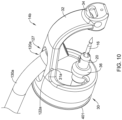
- a lumen 130a coupled with the side-saddled lumen attachment element 120a to provide a working channel through which the suture or other tools may be extended.
- FIG 11 and Figure 12 are views of a tissue release mechanism 150 that may fit over the arm 32.
- the tissue release mechanism 150 may assist in a procedure by helping to remove tissue that may otherwise become stuck on the needle 16.
- the tissue release mechanism 150 may be spring-loaded to engage the needle 16, or may be separately and independently actuated.
- the tissue release mechanism 150 includes a cross-bar 152 that provides an additional surface that can push tissue off of the needle 16.
- the distal assembly 14 may be secured to a delivery device such as an endoscope.
- an attachment enabler such as a flexible silicone tube, may be unrolled along the delivery device in order to hold the distal assembly 14 in place and to prevent rotation of the distal assembly 14 relative to the delivery device.
- the side-saddled lumen attachment element 120 (or 120a) may be secured to the distal assembly 14.
- the suture may be passed through the needle 16, and fed back towards the user interface.
- the device 10 may be extended through the body to the defect site.
- FIG 13 is a perspective view of a distal assembly 14c that may, for example, be usable in the suture device 10 shown in Figure 1 .
- the distal assembly 14c is similar to the distal assembly 14 shown in previous Figures, but includes several modifications that may be useful, particularly in bariatric revision procedures.
- a bariatric procedure commonly refers to a procedure in which the effective useful volume of a patient's stomach may be surgically reduced in order to effect long-term weight loss for the patient and may be performed laparoscopically.
- a bariatric revision procedure is a procedure, performed endoscopically, in which changes may be made to what was originally done to the patient's stomach.
- the distal assembly 14c may also be used in other suturing procedures, such as but not limited to full tissue thickness repairs and/or partial tissue thickness repairs.
- the distal assembly 14c may include a body 29a having a proximal connector 30a that may be configured to be coupled to the distal end of an endoscope or other delivery system, for example.
- the proximal connector 30a may include a fixation feature such as a fixation flange 401.
- the body 29a includes an arm 32a that extends to an endcap 34a.
- the body 29a, including the arm 32a may be similar to the body 29 and arm 32 referenced previously with respect to the distal assembly 14, the distal assembly 14a and the distal assembly 14b.
- the guide member 36a includes a channel 300.
- the channel 300 permits a suture to pass between the suture translation assembly 12, 12a, 12b and a working channel of the endoscope or other delivery device to which the distal assembly 14c is attached.
- the channel 300 may, for example, be designed to include a lead in that would help to align the suture with the channel 300 when passing the suture translation assembly 12, 12a, 12b through the working channel of the endoscope or other delivery device.
- the securement opening 40a may have a diameter that is greater than an overall diameter of the securement 42a and the securement opening 40a may taper to a diameter on an opposing side (not seen) that is about the same as the diameter of the securement 42a.
- the securement 42a may be welded, soldered, adhesively secured or otherwise attached at the left side of the securement opening 40a, and may be free to move somewhat at the right side of the securement opening 40a.
- the distal assembly 14c may include an opening 302 that is orthogonal to the securement opening 40a. The opening 302 may be threaded in order to threadedly engage a set screw 304.
- the opening 302 may be offset closer to the right side of the securement opening 40a, away from the secured end of the securement 42a, such that the set screw 304 may be considered as supporting the free end of the securement 42a.
- Rotating the set screw 304 in a first direction such as clockwise, may cause the set screw 304 to translate towards the securement 42a, thereby increasing an interference between the securement 42a and the needle 16 and increasing a retentive force that can be applied to the needle 16.
- rotating the set screw in a second direction such as counter-clockwise, may cause the set screw 304 to translate away from the securement 42a, thereby decreasing the retentive force that can be applied to the needle 16. This may help to adjust for manufacturing tolerances, for example.
- the distal assembly 14c may be used in combination with the suture translation assembly 12 discussed previously with respect to Figure 5 , for example.
- the distal assembly 14c may also be used with a suture translation assembly 12a, shown in Figure 14 through Figure 18 , as well as with a suture translation assembly 12b, shown in Figure 19 through Figure 22 .
- Figure 14 is a perspective view of the suture translation assembly 12a, shown holding the needle 16, while Figure 15 is a partially exploded view of the suture translation assembly 12a.
- the suture translation assembly 12a includes an inner member 310 that hold the needle 16.
- a locking member 312 is slidingly disposed over the inner member 310.
- the inner member 310 includes a pin 314 that extends radially outwardly from the inner member 310 and extends through a corresponding slot 316 that is formed in the locking member 312.
- the pin 314 serves to prevent relative rotation between the inner member 310 and the locking member 312.
- the pin 314 also serves to limit translation of the locking member 312 relative to the inner member 310.
- a control member 318 is secured relative to a proximal end 320 of the locking member 312, and extends distally to a handle such as a translating handle. As a result, the locking member 312 may be translated distally and/or proximally relative to the inner member 310.
- the suture translation assembly 12a includes an outer sleeve 330 that may be pinned via the pin 314 to the inner member 310.
- the outer sleeve 330 may be coupled with a coil 332, for example.
- the outer sleeve 330 may be a single tubular member.
- the arms 322 are free to move radially outwardly, thereby releasing the curved tabs 324 from the detents in the needle 16, and allowing the needle 16 to move distally relative to the inner member 310.
- Figure 19 is a perspective view of a suture translation assembly 12b that may be used in combination with any of the distal assembly 14, the distal assembly 14a, the distal assembly 14b and/or the distal assembly 14c.
- Figure 20 is a perspective view of the suture translation assembly 12b with outer portions such as an outer sleeve 350 ( Figure 19 ) removed to reveal an inner member 340 that holds a needle 16a.
- the outer sleeve 350 may be a single tubular member.
- the outer sleeve 350 may include several elements, such as described with respect to the outer sleeve 330 ( Figure 15 ).
- the needle 16a has a distal detent 342 and a proximal detent 344 (visible in Figure 21 ) that are shaped differently than the corresponding detents in the needle 16.
- the suture translation assembly 12b includes a locking member 346 that is slidingly disposable relative to the inner member 340.
- the pin 352 is attached to the inner member 340 and extends through a corresponding slot 354 formed in the locking member 342.
- the pin 352 limits translation of the locking member 342 relative to the inner member 340, and also prevents relative rotational movement of the locking member 342.
- the locking member 342 is secured to the control member 318, which extends distally to a handle such as a translating handle. As a result, the locking member 342 may be translated distally and/or proximally relative to the inner member 340.
Landscapes
- Health & Medical Sciences (AREA)
- Life Sciences & Earth Sciences (AREA)
- Surgery (AREA)
- Molecular Biology (AREA)
- General Health & Medical Sciences (AREA)
- Biomedical Technology (AREA)
- Heart & Thoracic Surgery (AREA)
- Medical Informatics (AREA)
- Nuclear Medicine, Radiotherapy & Molecular Imaging (AREA)
- Animal Behavior & Ethology (AREA)
- Engineering & Computer Science (AREA)
- Public Health (AREA)
- Veterinary Medicine (AREA)
- Physics & Mathematics (AREA)
- Biophysics (AREA)
- Optics & Photonics (AREA)
- Pathology (AREA)
- Radiology & Medical Imaging (AREA)
- Surgical Instruments (AREA)
Abstract
Description
- This application claims the benefit of priority to
U.S. Provisional Application Serial No. 62/848,985 filed May 16, 2019 - The disclosure is directed to devices for suturing tissue and more particularly to devices that work with an endoscope or similar device for endoscopically suturing tissue.
- A variety of endoscopic treatments may result in defects (or wounds) that are too large for known closure methods. Examples of such endoscopic treatments include removal of large lesions, tunneling under the mucosal layer, full thickness removal of tissue, treating other organs by passing outside of the gastrointestinal tract, and post-surgical repairs such as post-surgical leaks. Endoscopic treatments also include bariatric revision procedures. Of the known devices and methods for endoscopically closing large defects, each has certain advantages and disadvantages.
- The disclosure is directed to several alternative designs, materials and methods of devices for endoscopically closing large defects. An example is a suture device for use in combination with an endoscope. The suture device includes a needle that is configured to carry a suture, the needle having a distal end. A needle cap is configured to releasably fit over the distal end of the needle.
- Another example is a suture device for use in combination with an endoscope having a working channel and a distal end. The suture device includes a needle that is configured to carry a suture, the needle including a distal end and a distal detent near the distal end. A needle cap is configured to releasably fit over the distal end of the needle. A distal shuttle is configured to releasably secure the needle. A sleeve is disposable over the distal shuttle and is movable between a locked position in which the needle is secured to the distal shuttle and an unlocked position in which the needle is releasable from the distal shuttle.
- Alternatively or additionally, the needle cap may be formed of a biocompatible polymer.
- Alternatively or additionally, the needle cap may be formed of a biosorbable polymer.
- Alternatively or additionally, the needle cap may include a cylindrical needle cap body defining a void that is configured to fit over the needle and an atraumatic distal tip.
- Alternatively or additionally, the needle cap may further include one or more elongate slots extending axially within the cylindrical needle cap body.
- Alternatively or additionally, the needle cap may further include one or more convex protuberances extending in to the void, the one or more convex protuberances configured to fit into the distal detent of the needle.
- Alternatively or additionally, the needle cap may be configured to be pushed off of the needle by moving the sleeve distally.
- Another example is a suture device for use in combination with an endoscope having a working channel and a distal end. The suture device includes a translation assembly that is configured to be axially translatable within the working channel and that includes a needle configured to carry a suture, a distal shuttle that is configured to releasably secure the needle and a sleeve that is disposable over the distal shuttle. The sleeve is movable between a locked position in which the needle is secured to the distal shuttle and an unlocked position in which the needle is releasable from the distal shuttle, the sleeve including an elongate groove extending axially along the sleeve, the elongate groove configured to accommodate the suture extending therethrough. The suture device includes a distal endcap that is securable to the distal end of the endoscope and is configured to engage the needle when the needle is advanced distally into the distal endcap and to release the needle when the needle is locked to the distal shuttle and the distal shuttle is withdrawn proximally.
- Alternatively or additionally, the distal shuttle may include a distal needle opening that is configured to accommodate the needle when the distal shuttle is advanced distally over the needle, one or more bearing ball openings arranged orthogonal to the distal needle opening such that the one or more bearing ball openings align with a proximal detent of the needle when the needle is secured to the distal shuttle, and one or more bearing balls that are disposed within the one or more bearing ball openings and disposable within the proximal detent when the needle is secured to the distal shuttle.
- Alternatively or additionally, the sleeve may include one or more sleeve openings that are smaller in diameter than the one or more bearing balls. When in the locked position, the one or more sleeve openings are misaligned with the one or more bearing ball openings such that the one or more bearing balls engage the proximal detent of the needle, and when in the unlocked position, the one or more sleeve openings are aligned with the one or more bearing ball openings such that the one or more bearing balls can move radially outward a distance sufficient to permit the one or more bearing balls to clear the proximal detent of the needle.
- Another example is a suture device for use in combination with a delivery system including a lumen extending through the delivery system. The suture device includes a suture translation assembly that is configured to be axially translatable within the lumen of the delivery system and that includes a needle usable to carry a suture and a distal shuttle configured to releasably secure the needle. A sleeve is disposable over the distal shuttle and is movable relative to the sleeve between a locked position in which the needle is locked to the distal shuttle and an unlocked position in which the needle is releasable from the distal shuttle. A suture catheter is operably coupled to the sleeve and a control wire is operably coupled to the distal shuttle. A distal endcap is configured to be securable to the distal end of the delivery system and to releasably engage and disengage the needle, the endcap configured to engage the needle when the needle is advanced distally into the endcap, and to release the needle when the needle is locked to the distal shuttle and the distal shuttle is withdrawn proximally.
- Alternatively or additionally, moving the control wire proximally may cause the distal shuttle to move proximally relative to the sleeve, thereby locking the needle to the distal shuttle.
- Alternatively or additionally, moving the control wire distally may cause the distal shuttle to move distally relative to the sleeve, thereby releasing the needle from the distal shuttle.
- Alternatively or additionally, the needle may include a distal region and a proximal region, the distal region including a distal detent for releasably engaging the distal endcap and the proximal region including a proximal detent for releasably engaging the distal shuttle.
- Alternatively or additionally, the distal shuttle may include one or more bearing ball openings that are arranged to align with the proximal detent when the needle is secured to the distal shuttle and one or more bearing balls that are disposed within the one or more bearing ball openings and are disposable within the proximal detent when the needle is secured to the distal shuttle.
- Alternatively or additionally, the sleeve may include one or more sleeve openings smaller in diameter than the one or more bearing balls. When in the locked position, the one or more sleeve openings are misaligned with the one or more bearing ball openings such that the one or more bearing balls engage the proximal detent of the needle and when in the unlocked position, the one or more sleeve openings are aligned with the one or more bearing ball openings such that the one or more bearing balls can move radially outward a distance sufficient to permit the one or more bearing balls to clear the proximal detent of the needle.
- Alternatively or additionally, the suture device may further include a yoke that is operably coupled to the control wire, the yoke coupling the control wire to the distal shuttle via a pin that extends through the yoke and translates along a pair of slots formed in the sleeve.
- Alternatively or additionally, the suture catheter may include a coil, and the coil is operably coupled to the sleeve.
- Alternatively or additionally, the sleeve may be welded to the coil.
- Alternatively or additionally, the control wire may extend through the suture catheter.
- Alternatively or additionally, the suture device may further include a user interface that is operably coupled to the suture catheter and the control wire, the user interface configured to permit a user to move the control wire, and thus the distal shuttle, relative to the suture catheter.
- Another example is a suture device for use in combination with a delivery system including a lumen extending through the delivery system. The suture device includes a needle usable to carry a suture and a distal shuttle that is configured to releasably secure the needle. A sleeve is disposable over the distal shuttle and the distal shuttle is movable relative to the sleeve between a locked position in which the needle is locked to the distal shuttle and an unlocked position in which the needle is releasable from the distal shuttle. A shaft is operably coupled to the sleeve and a control wire extends through the shaft and is operably coupled to the distal shuttle. A distal endcap is configured to be securable to a distal end of the delivery system and to releasably engage and disengage the needle, the endcap configured to engage the needle when the needle is advanced distally into the endcap, and to release the needle when the needle is locked to the distal shuttle and the distal shuttle is withdrawn proximally.
- Alternatively or additionally, the suture device may further include a user interface that is configured to allow a user to manipulate the control wire relative to the shaft in order to move the distal shuttle between its locked position and its unlocked position.
- The above summary of some embodiments is not intended to describe each disclosed embodiment or every implementation of the present disclosure. The Figures, and Detailed Description, which follow, more particularly exemplify these embodiments.
- The disclosure may be more completely understood in consideration of the following description of in connection with the accompanying drawings, in which:
-
Figure 1 is a perspective view of an illustrative suture device in accordance with an example of the disclosure; -
Figure 2 is a perspective view of a distal assembly forming part of the illustrative suture device ofFigure 1 , shown in an extended position; -
Figure 3 is a perspective view of the distal assembly ofFigure 2 , shown in a retracted position; -
Figure 4 is a cross-sectional view of the distal assembly ofFigure 2 , taken along the line 4-4; -
Figure 5 is an exploded view of a portion of a suture translation assembly forming part of the illustrative suture device ofFigure 1 ; -
Figure 6 is a side view of a distal shuttle and a member forming part of the suture translation assembly, with the member shown extended in a locked position; -
Figure 7 is a side view of the distal shuttle and the member ofFigure 6 , with the member shown retracted in an unlocked position; -
Figure 8 is a side view of a distal assembly usable in the suture device ofFigure 1 in accordance with an example of the disclosure; -
Figure 9 is a side view of the distal assembly ofFigure 8 in combination with an attached flexible lumen; -
Figure 10 is a side view of a distal assembly usable in the suture device ofFigure 1 , shown with an attached lumen, in accordance with an example of the disclosure; -
Figure 11 and 12 are views of a tissue release mechanism that may be used in combination with the distal assemblies ofFigures 1 and8 in accordance with an example of the disclosure; -
Figure 13 is a perspective view of a distal assembly usable in the suture device ofFigure 1 in accordance with an example of the disclosure; -
Figure 14 is a perspective view of a suture translation assembly usable in the suture device ofFigure 1 in accordance with an example of the disclosure; -
Figure 15 is a partially exploded perspective view of the suture translation assembly ofFigure 14 in accordance with an example of the disclosure; -
Figure 16 is a perspective view of an inner member forming a portion of the suture translation assembly ofFigure 14 in accordance with an example of the disclosure: -
Figure 17 is a perspective view of a portion of the suture translation assembly ofFigure 14 , shown in a locked configuration in accordance with an example of the disclosure; -
Figure 18 is a perspective view of a portion of the suture translation assembly ofFigure 14 , shown in an unlocked configuration in accordance with an example of the disclosure; -
Figure 19 is a perspective view of a suture translation assembly usable in the suture device ofFigure 1 in accordance with an example of the disclosure; -
Figure 20 is a perspective view of the suture translation assembly ofFigure 19 , shown with some elements removed to show internal structure, with the suture translation assembly shown in a locked configuration in accordance with an example of the disclosure; -
Figure 21 is a side view of a portion of the suture translation assembly ofFigure 19 , showing how a locking member engages an inner member of the suture translation assembly and a needle in the locked configuration as shown inFigure 20 and in accordance with an example of the disclosure; -
Figure 22 is a perspective view of the suture translation assembly ofFigure 19 , shown in an unlocked configuration in accordance with an example of the disclosure; -
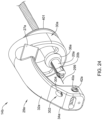
Figure 23 is a perspective view of a sleeve usable as part of a suture translation assembly; -
Figure 24 is a perspective view of a distal assembly utilizing the sleeve ofFigure 23 and usable in the suture device ofFigure 1 in accordance with an example of the disclosure; -
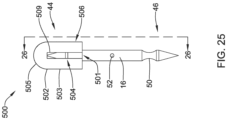
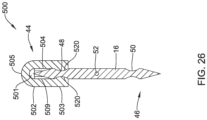
Figure 25 is a view of a needle bearing a needle cap in accordance with an example of the disclosure; -
Figure 26 is a cross-sectional view of the needle and needle cap ofFigure 25 , taken along the line 26-26; -
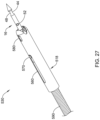
Figure 27 is a perspective view of a suture translation assembly with a needle shown in an unlocked position in accordance with an example of the disclosure; -
Figure 28 is a perspective view of the suture translation assembly ofFigure 27 , with the needle shown in a locked position in accordance with an example of the disclosure; -
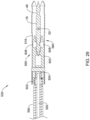
Figure 29 is a cross-sectional view of the suture translation assembly ofFigure 28 , taken along the line 29-29; and -
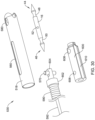
Figure 30 is a partial exploded view of the suture translation assembly ofFigure 28 . - While the disclosure is amenable to various modifications and alternative forms, specifics thereof have been shown by way of example in the drawings and will be described in detail. It should be understood, however, that the intention is not to limit the invention to the particular embodiments described. On the contrary, the intention is to cover all modifications, equivalents, and alternatives falling within the spirit and scope of the disclosure.
- For the following defined terms, these definitions shall be applied, unless a different definition is given in the claims or elsewhere in this specification.
- Definitions of certain terms are provided below and shall be applied, unless a different definition is given in the claims or elsewhere in this specification.
- All numeric values are herein assumed to be modified by the term "about", whether or not explicitly indicated. The term "about" generally refers to a range of numbers that one of skill in the art would consider equivalent to the recited value (i.e., having the same function or result). In many instances, the term "about" may be indicative as including numbers that are rounded to the nearest significant figure.
- The recitation of numerical ranges by endpoints includes all numbers within that range (e.g., 1 to 5 includes 1, 1.5, 2, 2.75, 3, 3.80, 4, and 5).
- Although some suitable dimensions, ranges and/or values pertaining to various components, features and/or specifications are disclosed, one of skill in the art, incited by the present disclosure, would understand desired dimensions, ranges and/or values may deviate from those expressly disclosed.
- As used in this specification and the appended claims, the singular forms "a," "an," and "the" include or otherwise refer to singular as well as plural referents, unless the content clearly dictates otherwise. As used in this specification and the appended claims, the term "or" is generally employed to include "and/or," unless the content clearly dictates otherwise.
- The following detailed description should be read with reference to the drawings in which similar elements in different drawings are numbered the same. The detailed description and the drawings, which are not necessarily to scale, depict illustrative embodiments and are not intended to limit the scope of the disclosure. The illustrative embodiments depicted are intended only as exemplary. Selected features of any illustrative embodiment may be incorporated into an additional embodiment unless clearly stated to the contrary.
- The disclosure pertains to devices that are configured to be used in combination with an endoscope or a similar delivery device for closing wounds within the body. In some instances, the suture devices described herein may be configured such that they may be used within a single working or available channel of an endoscope, and in some embodiments may be operated by a single individual, although in some embodiments a second individual may be involved. In some embodiments, the suture devices described herein may be considered as operating along a single line of operation. The device itself may be translatable distally and proximally within a working channel, and a handle portion may itself be translatable distally and proximally along the same line of operation in locking and unlocking a needle to be able to pass the needle back and forth between an active portion of the suture device and a passive portion of the suture device. The device may be configured to enable the needle to be selectively locked into either of a more distal position or a more proximal position, and the device may itself be translated distally or proximally with the needle locked in place in order to move the needle, and hence a suture, relative to the tissue being repaired.
-
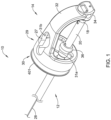
Figure 1 is a perspective view of asuture device 10 that may be considered as being configured for use in combination with a delivery system including a lumen that extends through the delivery system. For example, the delivery system may be an endoscope having a working channel. The delivery system may also be a catheter. It will be appreciated that there is a change in scale on either side of the break line shown. In some embodiments, thesuture device 10 may be considered as including asuture translation assembly 12 that is configured to be axially translatable within the lumen of the delivery system and adistal assembly 14 that is configured to be secured to a distal end of the delivery system. Thesuture translation assembly 12 extends into thedistal assembly 14 and includes aneedle 16 that may be used to carry a suture as well as adistal shuttle 18 that is configured to releasably secure theneedle 16. - A
member 20 may be disposed over thedistal shuttle 18 and, as will be shown in subsequent Figures, is movable between a locked position in which theneedle 16 is secured to thedistal shuttle 18 and an unlocked position in which theneedle 16 is releasable from thedistal shuttle 18. In some embodiments, for example, themember 20 may be asleeve 20. A user interface may extend proximally from thedistal shuttle 18 and thesleeve 20, and may be configured to move thesleeve 20 between the locked position and the unlocked position. Ashaft 28 may extend distally to thesuture translation assembly 12, and may in particular be coupled to thesleeve 20. The user interface may take a number of different forms. For examples, the user interface may be the user interface 22 as described and illustrated inU.S. Patent Application Publication No.2018/0235604 , which publication is incorporated by reference herein in its entirety. In some embodiments, the user interface may be as described in a provisional application Serial No.62/794,075 filed January 18, 2019 - In some embodiments, the
distal assembly 14 includes abody 29 having aproximal connector 30 that may be configured to be coupled to the distal end of an endoscope or other delivery system. In some embodiments, as illustrated, theproximal connector 30 may include afixation feature 401. As will be discussed with respect to subsequent Figures, thefixation feature 401, which may in some embodiments be considered as being afixation flange 401, helps to secure thedistal assembly 14 to the distal end of an endoscope or other delivery system using a split ring attachment mechanism. - The
body 29 includes anarm 32 that extends to anendcap 34. As will be discussed, theendcap 34 may be configured to releasably engage and disengage theneedle 16. In some embodiments, for example, theendcap 34 may be configured to engage theneedle 16 when theneedle 16 is advanced distally into theendcap 34, and to release theneedle 16 when theneedle 16 is locked into the distal shuttle 18 (as will be discussed) and thedistal shuttle 18 is withdrawn proximally. Thedistal assembly 14 may be considered as including aguide member 36 that may be secured to or integrally formed with thebody 29, and may permit thesuture translation assembly 12 to extend through theguide member 36 and to translate relative to theguide member 36. In some embodiments, thebody 29 may include anaperture 27 that may enable other devices to be inserted through theaperture 27. In some instances, as will be discussed with respect to subsequent Figures, theaperture 27 may be configured to accommodate a side-saddled lumen attachment element. In some embodiments, theaperture 27 may include one or more of apin aperture 31a and apin aperture 31b that may, for example, be used to mount the aforementioned side-saddled lumen attachment element, or possibly other features as well. -
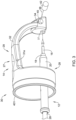
Figure 2 andFigure 3 show thesuture translation assembly 12 extended through theguide member 36 and into thedistal assembly 14. InFigure 2 , thesuture translation assembly 12 is shown in an extended position in which theneedle 16 extends into theendcap 34 while inFigure 3 , thesuture translation assembly 12 is shown in a retracted position in which theneedle 16 has been withdrawn proximally from theendcap 34. In some embodiments, as can be seen, theendcap 34 includes aproximal needle opening 37 that is configured to help guide theneedle 16 into theproximal needle opening 37 as well as to accommodate theneedle 16 when theneedle 16 is advanced distally into theendcap 34. In some embodiments, theproximal needle opening 37 may extend all the way through theendcap 34 while in other cases theproximal needle opening 37 may not pass all the way through theendcap 34. In some instances, as shown, theproximal needle opening 37 may be considered as being aligned with alongitudinal axis 38 of the needle 16 (as shown inFigure 3 ). - One or
more securement openings 40 may be arranged orthogonal to theproximal needle opening 37 and one or more securements 42 that are configured to be disposed within the one ormore securement openings 40, and which are configured to releasably engage the distal detent (as will be discussed) of theneedle 16. In some embodiments, there may be a pair ofsecurement openings 40, one on either side of theendcap 34. In some embodiments, there may be a pair ofsecurements 42, with one disposed within each of the pair ofsecurement openings 40. In some embodiments, while shown schematically, the one or more securements 42 may be springs or coils, for example. -
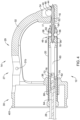
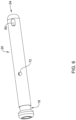
Figure 4 is a cross-sectional view of thedistal assembly 14, with thesuture translation assembly 12 disposed within thedistal assembly 14.Figure 5 is an exploded view of thesuture translation assembly 12. Theneedle 16 may be considered as including adistal region 44 and aproximal region 46. In some embodiments, thedistal region 44 may include adistal detent 48 for releasably engaging theendcap 34 and theproximal region 46 may include aproximal detent 50 for releasably engaging thedistal shuttle 18. Theneedle 16 may, as shown, include anaperture 52 for accommodating a suture line passing therethrough. - In some embodiments, the
distal shuttle 18 may be considered as including adistal needle opening 54 that is configured to accommodate theneedle 16 when thedistal shuttle 18 is advanced distally over theneedle 16 and that is aligned with thelongitudinal axis 38 of theneedle 16. One or morebearing ball openings 56 may be arranged orthogonal to thedistal needle opening 54 such that the one or morebearing ball openings 56 align with theproximal detent 50 when theneedle 16 is secured to thedistal shuttle 18. In some embodiments, one ormore bearing balls 58 may be disposed within the one or morebearing ball openings 56 and may be configured to be disposed within theproximal detent 50 when the needle is secured to thedistal shuttle 18. - In some embodiments, the
distal shuttle 18 includes aninternal void 60 and asleeve capture member 62 that is slidingly disposed within theinternal void 60. In some embodiments, thesleeve capture member 62 may be coupled to acable 64 extending distally within theshaft 28 and into acable aperture 66 and secured via a crimp or othermechanical connection 68. In some embodiments, thesleeve capture member 62 may be coupled to thesleeve 20 via apin 70 that extends through first and secondsleeve connection apertures aperture 76 extending through thesleeve capture member 62 as well as extending through theinternal void 60. - In some embodiments, the
sleeve 20 includes one ormore sleeve openings 80 that may be smaller in diameter, or smaller in width, than the diameter of the one ormore bearing balls 58. In some embodiments, thesleeve 20 may include a pair ofsleeve openings 80, corresponding to a pair of bearingball openings 56 and a pair of bearingballs 58. When thesleeve 20 is in the locked position, as shown for example inFigure 6 , the one ormore sleeve openings 80 are misaligned with, or do not align with, the one or morebearing ball openings 56, and so the one ormore bearing balls 58 engage theproximal detent 50 of theneedle 16. Thesleeve 20 prevents the one ormore bearing balls 58 from being pushed out of theproximal detent 50. - Conversely, when the
sleeve 20 is in the unlocked position, as shown for example inFigure 7 , the one ormore sleeve openings 80 are aligned with the one or morebearing ball openings 56. This permits the one ormore bearing balls 58 to move radially out, into the one ormore sleeve openings 80, a distance sufficient to permit the one ormore bearing balls 58 to clear theproximal detent 50 of theneedle 16 in response to a force applied to the one ormore bearing balls 58 by theneedle 16. With reference toFigure 4 , while thesuture translation assembly 12 is shown advanced into thedistal assembly 14, thesleeve 20 is in the unlocked position relative to thedistal shuttle 18, and thus the one ormore bearing balls 58 may be seen as extending partially into the one ormore sleeve openings 80. - In some cases, the
suture device 10 will have a proximal handle (not shown) that allows the user to create relative movement between thesleeve 20 and thedistal shuttle 18. The proximal handle may provide an indication to the user of the relative position of thesleeve 20 and thedistal shuttle 18. In some cases, the proximal handle may include a soft detent or other feature that informs the user when theneedle 16 is locked relative to thedistal shuttle 18 and when theneedle 16 is not locked relative to thedistal shuttle 18. - In some cases, the
sleeve 20 and thedistal shuttle 18 may be modified to provide a more robust indication of when theneedle 16 is locked to thedistal shuttle 18 and when theneedle 16 is not locked to thedistal shuttle 18. In particular reference toFigure 5 , in some cases thesleeve openings 80 may be moved a short distance proximally relative to the position shown inFigure 5 . In some cases, theinternal void 60, which is formed within thedistal shuttle 18, may be shortened. In combination, these two changes can provide a more robust indication of when theneedle 16 is locked to thedistal shuttle 18 and when theneedle 16 is not locked to thedistal shuttle 18. Moving thesleeve 20 fully in one direction means that theneedle 16 is locked to thedistal shuttle 18. Moving thesleeve 20 fully in the opposite direction means that theneedle 16 is not locked to thedistal shuttle 18. This can provide a simple, binary locked/unlocked indication to the user. - In some embodiments, it will be appreciated that the
distal shuttle 18, and thesleeve 20, in combination, provide an active connection to theneedle 16 while thedistal endcap 34 provides a passive connection to theneedle 16. If theneedle 16 is moved distally into thedistal endcap 34, thedistal endcap 34 will grab onto theneedle 16, with the one or more securements 42 engaging thedistal detent 48. If theneedle 16 is subsequently moved proximally, the axial force applied overcomes any resistance provided by the one or more securements 42, and theneedle 16 is able to move proximally. In contrast, the active connection to theneedle 16 provided by thedistal shuttle 18 and thesleeve 20, however, requires action to move thesleeve 20, relative to thedistal shuttle 18, between the locked position and the unlocked position. The user interface provides a mechanism for positively moving thesleeve 20 between the locked and unlocked positions. -
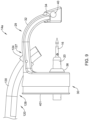
Figure 8 is a side view of adistal assembly 14a that may, for example, be usable in thesuture device 10 shown inFigure 1 . Thedistal assembly 14a is similar to thedistal assembly 14 shown in previous Figures, but includes a side-saddledlumen attachment element 120 that is coupled to thebody 29 of thedistal assembly 14a. In some embodiments, the side-saddledlumen attachment element 120 may include one or twopegs 122 that fit into thepin apertures pin aperture 31a is visible in this view) and thus enable the side-saddledlumen attachment element 120 to pivot relative to thebody 29 of thedistal assembly 14a. In some embodiments, the side-saddledlumen attachment element 120 includes aring 124, from which thepegs 122 extend, adistal region 126 and abody 128 that in some instances has a curvature to it. - In some embodiments, the
distal region 126 and thebody 128 have a semicircular profile in order to accommodate a lumen such as aflexible lumen 130 that may engage within the side-saddledlumen attachment element 120 via a frictional or compressive fit as shown inFigure 9 . Theflexible lumen 130 may be polymeric or metallic. A polymeric lumen may, for example, be expanded to a full working dimension by extending a mandrel through theflexible lumen 130 after theflexible lumen 130 has been placed relative to the side-saddledlumen attachment element 120. - In some embodiments, the side-saddled attachment element 120 (and accompanying flexible lumen 130) may be used as a secondary working channel and may contain the suture used in the procedure. In some embodiments, it may be large enough to accommodate secondary tools for use during the procedure for tissue acquisition or manipulation allowing secondary tool use without requiring a dedicated dual-channel delivery system such as a dual channel endoscope. If desired, a dual-channel delivery system could be used to provide even more options in a procedure. The side-saddled
attachment element 120 may have an exit port in thedistal assembly 14a such that secondary tools extend along an axis suitable for tissue manipulation. This axis may cross the axis of the suture carrying element, allowing a secondary tool to pull tissue into the suture carrying element's projected path. For example, this could be used to pull tissue in line with a needle to assist in driving theneedle 16 through the tissue. Maintaining tension on the suture through the side-saddledattachment element 120 may keep the suture from interfering with the procedure. -
Figure 10 is a perspective view of adistal assembly 14b that includes a shorter side-saddledlumen attachment element 120a that may be pivotally secured to thebody 29 via one ormore pegs 122a that extend into thepin apertures lumen 130a coupled with the side-saddledlumen attachment element 120a to provide a working channel through which the suture or other tools may be extended. -
Figure 11 and Figure 12 are views of atissue release mechanism 150 that may fit over thearm 32. In some embodiments, thetissue release mechanism 150 may assist in a procedure by helping to remove tissue that may otherwise become stuck on theneedle 16. In some instances, thetissue release mechanism 150 may be spring-loaded to engage theneedle 16, or may be separately and independently actuated. In some instances, thetissue release mechanism 150 includes a cross-bar 152 that provides an additional surface that can push tissue off of theneedle 16. - In preparing the
suture device 10 for use, thedistal assembly 14 may be secured to a delivery device such as an endoscope. In some embodiments, an attachment enabler, such as a flexible silicone tube, may be unrolled along the delivery device in order to hold thedistal assembly 14 in place and to prevent rotation of thedistal assembly 14 relative to the delivery device. In some embodiments, if desired, the side-saddled lumen attachment element 120 (or 120a) may be secured to thedistal assembly 14. The suture may be passed through theneedle 16, and fed back towards the user interface. Thedevice 10 may be extended through the body to the defect site. -
Figure 13 is a perspective view of adistal assembly 14c that may, for example, be usable in thesuture device 10 shown inFigure 1 . Thedistal assembly 14c is similar to thedistal assembly 14 shown in previous Figures, but includes several modifications that may be useful, particularly in bariatric revision procedures. A bariatric procedure commonly refers to a procedure in which the effective useful volume of a patient's stomach may be surgically reduced in order to effect long-term weight loss for the patient and may be performed laparoscopically. A bariatric revision procedure is a procedure, performed endoscopically, in which changes may be made to what was originally done to the patient's stomach. In some embodiments, thedistal assembly 14c may also be used in other suturing procedures, such as but not limited to full tissue thickness repairs and/or partial tissue thickness repairs. - The
distal assembly 14c may include abody 29a having aproximal connector 30a that may be configured to be coupled to the distal end of an endoscope or other delivery system, for example. In some embodiments, as illustrated, theproximal connector 30a may include a fixation feature such as afixation flange 401. Thebody 29a includes anarm 32a that extends to anendcap 34a. In some embodiments, thebody 29a, including thearm 32a, may be similar to thebody 29 andarm 32 referenced previously with respect to thedistal assembly 14, thedistal assembly 14a and thedistal assembly 14b. In some instances, however, thebody 29a and thearm 32a may be adapted to accommodate thicker tissue, which may for example mean a change in the overall shape of thebody 29a and/or thearm 32a relative to thebody 29 and/or thearm 32. In some embodiments, thebody 29a and/or thearm 32a may simply be larger in order to accommodate thicker tissue. Thedistal assembly 14c may be considered as including aguide member 36a that may be secured to or integrally formed with thebody 29a, and may be configured to permit a suture translation assembly (such as thesuture translation assembly 12, asuture translation assembly 12a, shown inFigure 14 through Figure 18 , or asuture translation assembly 12b, shown inFigure 19 through Figure 22 ) to extend through theguide member 36a and to translate relative to theguide member 36a. - In some embodiments, as illustrated, the
guide member 36a includes achannel 300. In some embodiments, thechannel 300 permits a suture to pass between thesuture translation assembly distal assembly 14c is attached. Thechannel 300 may, for example, be designed to include a lead in that would help to align the suture with thechannel 300 when passing thesuture translation assembly suture translation assembly - In some instances, the
distal assembly 14c includes aguide structure 27a that is attached to or integrally formed with thebody 29a. In some embodiments, theguide structure 27a may instead be pivotably attached to thebody 29a. Theguide structure 27a may be configured to accommodate a polymeric tubular member attached thereof, in order to guide tools through the endoscope and into position relative to the working site. In some instances, theguide structure 27a may be configured to accommodate a metallic tubular member attached thereto. In some embodiments, for example, theguide structure 27a and accompanying tubular member (not illustrated) may accommodate a graspers or similar tool that allows a user to grasp tissue and pull it into position so that theneedle 16 may be passed through the tissue. In some embodiments, the relative position, or offset of theguide structure 27a, relative to the relative position or offset illustrated with respect to thedistal assembly 14, thedistal assembly 14a or thedistal assembly 14b, may be greater in order to provide more room for tools and/or to accommodate larger and/or thicker portions of tissue. - The
end cap 34a includes one ormore securement openings 40a that may be, as can be seen, be arranged orthogonally to a proximal needle opening (not illustrated), such as theproximal needle opening 37 illustrated for example inFigure 3 . One ormore securements 42a may correspondingly be disposed within the one ormore securement openings 40a. In some embodiments, the one ormore securements 42a may be a coil spring that is disposed within the one ormore securement openings 40a. Thesecurement 42a may releasably engage a detent on theneedle 16, as discussed with respect to thedistal assembly 14. - In some embodiments, the
securement opening 40a may have a diameter that is greater than an overall diameter of thesecurement 42a and thesecurement opening 40a may taper to a diameter on an opposing side (not seen) that is about the same as the diameter of thesecurement 42a. In some embodiments, thesecurement 42a may be welded, soldered, adhesively secured or otherwise attached at the left side of thesecurement opening 40a, and may be free to move somewhat at the right side of thesecurement opening 40a. In some instances, thedistal assembly 14c may include anopening 302 that is orthogonal to thesecurement opening 40a. Theopening 302 may be threaded in order to threadedly engage aset screw 304. In some embodiments, as illustrated, theopening 302 may be offset closer to the right side of thesecurement opening 40a, away from the secured end of thesecurement 42a, such that theset screw 304 may be considered as supporting the free end of thesecurement 42a. Rotating theset screw 304 in a first direction, such as clockwise, may cause theset screw 304 to translate towards thesecurement 42a, thereby increasing an interference between thesecurement 42a and theneedle 16 and increasing a retentive force that can be applied to theneedle 16. Conversely, rotating the set screw in a second direction, such as counter-clockwise, may cause theset screw 304 to translate away from thesecurement 42a, thereby decreasing the retentive force that can be applied to theneedle 16. This may help to adjust for manufacturing tolerances, for example. - As noted, the
distal assembly 14c may be used in combination with thesuture translation assembly 12 discussed previously with respect toFigure 5 , for example. Thedistal assembly 14c may also be used with asuture translation assembly 12a, shown inFigure 14 through Figure 18 , as well as with asuture translation assembly 12b, shown inFigure 19 through Figure 22 .Figure 14 is a perspective view of thesuture translation assembly 12a, shown holding theneedle 16, whileFigure 15 is a partially exploded view of thesuture translation assembly 12a. As better seen inFigure 15 , thesuture translation assembly 12a includes aninner member 310 that hold theneedle 16. A lockingmember 312 is slidingly disposed over theinner member 310. As can be seen, theinner member 310 includes apin 314 that extends radially outwardly from theinner member 310 and extends through acorresponding slot 316 that is formed in the lockingmember 312. Thepin 314 serves to prevent relative rotation between theinner member 310 and the lockingmember 312. Thepin 314 also serves to limit translation of the lockingmember 312 relative to theinner member 310. - A
control member 318 is secured relative to aproximal end 320 of the lockingmember 312, and extends distally to a handle such as a translating handle. As a result, the lockingmember 312 may be translated distally and/or proximally relative to theinner member 310. As seen inFigure 14 , thesuture translation assembly 12a includes anouter sleeve 330 that may be pinned via thepin 314 to theinner member 310. Theouter sleeve 330 may be coupled with acoil 332, for example. In some embodiments, theouter sleeve 330 may be a single tubular member. In some embodiments, as shown for example inFigure 15 , theouter sleeve 330 may actually include one or more of anouter sleeve 334, a slottedsleeve 336, and an innerouter sleeve 338. The slottedsleeve 336 may be configured to permit a suture to pass therethrough. This is merely illustrative, and is not intended to be limiting in any fashion. - The
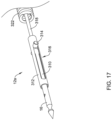
inner member 310 includesseveral arms 322 that, as seen inFigure 16 , which shows the distal portion of theinner member 310, includecurved tabs 324 that are configured to engage corresponding detents within theneedle 16. While a total of fourarms 322 are shown, it will be appreciated that theinner member 310 may include any number ofarms 322. It will be appreciated that thearms 322 are relatively long in length, and as a result may be considered as being relatively flexible. With the lockingmember 312 extended distally into a locking configuration, as shown for example inFigure 17 , the lockingmember 312 prevents outward movement of thearms 322. As a result, thecurved tabs 324 remain in engagement with the corresponding detents of theneedle 16, and theneedle 16 remains locked to thesuture translation assembly 12a. With the lockingmember 312 retracted proximally into an unlocked configuration, as shown for example inFigure 18 , thearms 322 are free to move radially outwardly, thereby releasing thecurved tabs 324 from the detents in theneedle 16, and allowing theneedle 16 to move distally relative to theinner member 310. -
Figure 19 is a perspective view of asuture translation assembly 12b that may be used in combination with any of thedistal assembly 14, thedistal assembly 14a, thedistal assembly 14b and/or thedistal assembly 14c.Figure 20 is a perspective view of thesuture translation assembly 12b with outer portions such as an outer sleeve 350 (Figure 19 ) removed to reveal aninner member 340 that holds aneedle 16a. In some embodiments, theouter sleeve 350 may be a single tubular member. In some instances, theouter sleeve 350 may include several elements, such as described with respect to the outer sleeve 330 (Figure 15 ). - In some embodiments, as illustrated, the
needle 16a has adistal detent 342 and a proximal detent 344 (visible inFigure 21 ) that are shaped differently than the corresponding detents in theneedle 16. Thesuture translation assembly 12b includes a lockingmember 346 that is slidingly disposable relative to theinner member 340. Thepin 352 is attached to theinner member 340 and extends through acorresponding slot 354 formed in the lockingmember 342. Thepin 352 limits translation of the lockingmember 342 relative to theinner member 340, and also prevents relative rotational movement of the lockingmember 342. The lockingmember 342 is secured to thecontrol member 318, which extends distally to a handle such as a translating handle. As a result, the lockingmember 342 may be translated distally and/or proximally relative to theinner member 340. - In some embodiments, the
outer sleeve 350 may define aslot 370 including an axially extendingslot portion 372 and a shorter radially extendingslot portion 374. In some embodiments, the axially extendingslot portion 372 permits thepin 352 to move within the axially extendingslot portion 372 in order to permit theneedle 16a to be fully withdrawn into thesuture translation assembly 12b for advancement through an endoscope or other delivery device. Once thesuture translation assembly 12b has been advanced through the endoscope or other delivery device, theinner member 340 and the lockingmember 342 may be advanced distally through theouter sleeve 350 until thepin 352 aligns with the radially extendingslot portion 374. By rotating a translating handle, thepin 352 may be rotated into position within the radially extendingslot portion 374 so that the lockingmember 342 may be translated relative to theinner member 340. - In some embodiments, as illustrated, the locking
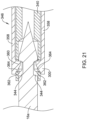
member 342 includes a pair ofarms 358 that extend distally from the lockingmember 342. As seen for example inFigure 21 , thearms 358 includetabs 360 that, when thesuture translation assembly 12b is in a locked configuration as shown inFigures 20 and21 , thetabs 360 extend throughslots 362 formed within theinner member 340. As a result, thetabs 360 are able to extend through theslots 362 and engage theproximal detent 344 of theneedle 16a. While a pair ofarms 358 are illustrated, it will be appreciated that the lockingmember 342 may include any number ofarms 358, and of course a corresponding number ofslots 362. - In order to move the
suture translation assembly 12b into an unlocked configuration, as shown for example inFigure 22 , the lockingmember 342 may be moved distally relative to theinner member 340. As can be seen inFigure 22 , thetabs 360 have moved out of the slots 362 (only oneslot 362 is seen), and theneedle 16a is free to move relative to thesuture translation assembly 12b. As the lockingmember 342 moves distally,angled surfaces 364 push against theslots 362 and are moved outwardly. - In some embodiments, and with respect to
Figure 13 , theguide member 36a includes achannel 300 that is configured to permit a suture to pass between thesuture translation assembly distal assembly 14c is attached. Thechannel 300 may, for example, be designed to include a lead in that would help to align the suture with thechannel 300 when passing thesuture translation assembly suture translation assembly - In some instances, as shown for example in
Figure 23 , instead of putting achannel 300 in theguide member 36a, thesuture translation assembly suture translation assembly Figure 23 is a perspective view of asleeve 20a that may be used in forming a part of thesuture translation assembly sleeve 20a includes agroove 20b that extends a length of thesleeve 20a.Figure 24 shows thesleeve 20a extending through theguide member 36a, with a suture 299 extending through thegroove 20b. - In some embodiments, there may be a desire to protect the distal end of the
needle 16 when advancing thesuture translation assembly needle 16 may otherwise be able to damage a working channel with the endoscope, for example. In some instances, there may be a desire to protect theneedle 16 itself from becoming damaged. In some embodiments, thesleeve needle 16 and the distal shuttle 18 (Figures 1-5 ) may be dislodged proximally during loading, resulting in possible exposure of theneedle 16. In some embodiments, it may be difficult to load through a bend in the working channel of the endoscope when thesleeve needle 16. -
Figures 25 and26 illustrate an example in which aneedle cap 500 has been placed over thedistal region 44 of theneedle 16.Figure 25 is a side view whileFigure 26 is a cross-sectional view taken along line 26-26 ofFigure 25 . In some embodiments, theneedle cap 500 may be removed outside of the patient, after thesuture translation assembly needle cap 500 may be pushed off of theneedle 16 inside the patient. When performing a procedure utilizing multiple needles and sutures, such as but not limited to endoscopic sleeve gastroplasty, it may be desirable to remove theneedle cap 500 with the endoscope inside the patient so that the endoscope does not have to be removed and inserted multiple times. In some embodiments, theneedle cap 500 can be pushed off of theneedle 16 by moving thesleeve needle cap 500 may be configured to split when theneedle cap 500 contacts thedistal endcap - The
needle cap 500 includes a cylindricalneedle cap body 503 that defines a void 501 that is configured to fit over theneedle 16. Theneedle cap 500 also includes anatraumatic tip 505 that is integrally molded with or otherwise attached to the cylindricalneedle cap body 503. In some embodiments, theneedle cap 500 includes one or moreelongate slots 509 that extend axially along the cylindricalneedle cap body 503 and provide sufficient flexibility to allow theneedle cap 500 to flex enough to be advanced onto theneedle 16. In some embodiments, there may be twoslots 509, although only one is visible inFigures 25 and26 . Theneedle cap 500 includes one or moreconvex protuberances 520 that are configured to fit into thedistal detent 48 of theneedle 16. While the cylindricalneedle cap body 503 is shown as having parallel sides, in some cases theneedle cap 500 may have flared sides that can compress for delivery. Extending theneedle 16 distally can allow the flared sides of theneedle cap 500 to expand. The needle can then be withdrawn proximally to push theneedle cap 500 off of theneedle 16. -
Figures 27 through 30 illustrate another way of protecting theneedle 16, either from damaging the interior of an endoscope or from becoming damaged itself.Figures 27 through 30 are various views of asuture translation assembly 530 that provides a reduced overall length that facilitates loading into an endoscope. In some instances, thesuture translation assembly 530 is short enough to permit easy passage through an endoscope with the sleeve in place over the needle. In some embodiments, control of thesuture translation assembly 530 is reversed relative to thesuture translation assemblies Figure 27 shows thesuture translation assembly 530 in an unlocked position, in which theneedle 16 is unlocked relative to the distal shuttle and can be passed to thedistal endcap Figure 28 shows thesuture translation assembly 530 in a locked position, in which theneedle 16 is locked to the distal shuttle. As seen, thesuture translation assembly 530 includes asleeve 518 and asuture catheter 590. In some embodiments, as illustrated, thesuture catheter 590 is a coil. Thesleeve 518 has a pair of slots 560 (only oneslot 560 is visible in the illustrated orientation) in order to accommodate movement of a distal shuttle, as will be discussed. Thesleeve 518 also includes a pair of sleeve openings 580 (only one visible) that permit bearing balls 58 (not shown) to move in and out relative to a distal shuttle, thereby locking and unlocking theneedle 16. - The internal structure of the
suture translation assembly 530 is better seen inFigure 29 , which is a cross-sectional view taken along the line 29-29 ofFigure 28 , as well asFigure 30 , which is a partially exploded view ofFigure 28 . As can be seen, acontrol wire 592 extends through thesuture catheter 590 and terminates within ayoke 604. Thesleeve 518 is coupled to thesuture catheter 590 via acoupler 602. In some embodiments, thesleeve 518 may be welded to thesuture catheter 590, either directly or by being welded to thecoupler 602. As a result, thesleeve 518 does not move relative to thesuture catheter 590. - A
pin 570 extends through theyoke 602 and intoapertures 606 that are formed within adistal shuttle 600, thereby operably coupling thecontrol wire 592 to thedistal shuttle 600. Thepin 570 extends to and is guided by a pair ofslots 560 that are formed in thesleeve 518. This prevents rotation of thedistal shuttle 600 relative to thesleeve 518. In some embodiments, thedistal shuttle 600 includes agroove 610 that allows a suture to extend from theneedle 16 and extend axially through thesleeve 518. - The
distal shuttle 600 also includes a pair of bearingball openings 608. As discussed previously, when the bearingball openings 608 are aligned with thesleeve openings 580, the bearing balls 58 (not shown) are free to move radially outwardly sufficiently to clear theproximal detent 50 of theneedle 16, thereby unlocking theneedle 16 from thedistal shuttle 600. Conversely, when the bearingball openings 608 are misaligned with thesleeve openings 580, the bearing balls 58 (not shown) are not able to clear theproximal detent 50 of theneedle 16, and theneedle 16 remains locked to thedistal shuttle 600. Accordingly, moving thecontrol wire 592 in a proximal direction moves thedistal shuttle 600 in a proximal direction relative to thesleeve 518. This causes thesleeve openings 580 to misalign with the bearingball openings 608 and locks theneedle 16 to thesleeve 518. Conversely, moving thecontrol wire 592 in a distal direction moves thedistal shuttle 600 in a distal direction relative to thesleeve 518. - It will be appreciated that a variety of different materials may be used in forming the devices described herein. In some embodiments, a variety of different metals may be used. Illustrative but non-limiting examples of suitable metals include titanium, stainless steel, magnesium, cobalt chromium and others. In some embodiments, for example, the devices described herein may include any suitable polymeric material, including biocompatible materials such as polyurethane or silicone. Other suitable polymers include but are not limited to polytetrafluoroethylene (PTFE), ethylene tetrafluoroethylene (ETFE), fluorinated ethylene propylene (FEP), polyoxymethylene (POM, for example, DELRIN® available from DuPont), polyether block ester, polyurethane (for example, Polyurethane 85A), polypropylene (PP), polyvinylchloride (PVC), polyether-ester (for example, ARNITEL® available from DSM Engineering Plastics), ether or ester based copolymers (for example, butylene/poly(alkylene ether) phthalate and/or other polyester elastomers such as HYTREL® available from DuPont), polyamide (for example, DURETHAN® available from Bayer or CRISTAMID® available from Elf Atochem), elastomeric polyamides, block polyamide/ethers, polyether block amide (PEBA, for example available under the trade name PEBAX®), ethylene vinyl acetate copolymers (EVA), silicones, polyethylene (PE), Marlex high-density polyethylene, Marlex low-density polyethylene, linear low density polyethylene (for example REXELL®), polyester, polybutylene terephthalate (PBT), polyethylene terephthalate (PET), polytrimethylene terephthalate, polyethylene naphthalate (PEN), polyetheretherketone (PEEK), polyimide (PI), polyetherimide (PEI), polyphenylene sulfide (PPS), polyphenylene oxide (PPO), poly paraphenylene terephthalamide (for example, KEVLAR®), polysulfone, nylon, nylon-12 (such as GRILAMID® available from EMS American Grilon), perfluoro(propyl vinyl ether) (PFA), ethylene vinyl alcohol, polyolefin, polystyrene, epoxy, polyvinylidene chloride (PVdC), poly(styrene-b-isobutylene-b-styrene) (for example, SIBS and/or SIBS 50A), polycarbonates, ionomers, biocompatible polymers, other suitable materials, or mixtures, combinations, copolymers thereof, polymer/metal composites, and the like.
- Those skilled in the art will recognize that the present disclosure may be manifested in a variety of forms other than the specific embodiments described and contemplated herein. Accordingly, departure in form and detail may be made without departing from the scope and spirit of the present disclosure as described in the appended claims.
- The following aspects are preferred embodiments of the invention.
- 1. A suture device for use in combination with an endoscope having a working channel and a distal end, the suture device comprising:
- a needle configured to carry a suture, the needle including a distal end and a distal detent near the distal end;
- a needle cap configured to releasably fit over the distal end of the needle
- a distal shuttle configured to releasably secure the needle; and
- a sleeve disposable over the distal shuttle, the sleeve movable between a locked position in which the needle is secured to the distal shuttle and an unlocked position in which the needle is releasable from the distal shuttle.
- 2. The suture device of aspect 1, wherein the needle cap includes a cylindrical needle cap body defining a void that is configured to fit over the needle and an atraumatic distal tip.
- 3. The suture device of aspect 2, wherein the needle cap further comprises one or more elongate slots extending axially within the cylindrical needle cap body.
- 4. The suture device of any one of aspects 2 or 3, further comprising one or more convex protuberances extending in to the void, the one or more convex protuberances configured to fit into the distal detent of the needle.
- 5. A suture device for use in combination with a delivery system including a lumen extending through the delivery system, the suture device comprising:
- a suture translation assembly configured to be axially translatable within the lumen of the delivery system, the delivery system including a distal end, the suture translation assembly including:
- a needle usable to carry a suture;
- a distal shuttle configured to releasably secure the needle;
- a sleeve disposable over the distal shuttle, the distal shuttle movable relative to the sleeve between a locked position in which the needle is locked to the distal shuttle and an unlocked position in which the needle is releasable from the distal shuttle;
- a suture catheter operably coupled to the sleeve;
- a control wire operably coupled to the distal shuttle; and
- a distal endcap configured to be securable to the distal end of the delivery system, the distal endcap configured to releasably engage and disengage the needle, the endcap configured to engage the needle when the needle is advanced distally into the endcap, and to release the needle when the needle is locked to the distal shuttle and the distal shuttle is withdrawn proximally.
- a suture translation assembly configured to be axially translatable within the lumen of the delivery system, the delivery system including a distal end, the suture translation assembly including:
- 6. The suture device of aspect 5, wherein:
- moving the control wire proximally causes the distal shuttle to move proximally relative to the sleeve, thereby locking the needle to the distal shuttle; and
- moving the control wire distally causes the distal shuttle to move distally relative to the sleeve, thereby releasing the needle from the distal shuttle.
- 7. The suture device of any one of aspects 5 or 6, wherein the needle comprises a distal region and a proximal region, the distal region including a distal detent for releasably engaging the distal endcap, the proximal region including a proximal detent for releasably engaging the distal shuttle.
- 8. The suture device of any one of aspects 5 to 7, wherein the distal shuttle includes:
- one or more bearing ball openings arranged to align with the proximal detent when the needle is secured to the distal shuttle; and
- one or more bearing balls disposed within the one or more bearing ball openings and disposable within the proximal detent when the needle is secured to the distal shuttle.
- 9. The suture device of aspect 8, wherein the sleeve comprises one or more sleeve openings smaller in diameter than the one or more bearing balls;
- wherein when in the locked position, the one or more sleeve openings are misaligned with the one or more bearing ball openings such that the one or more bearing balls engage the proximal detent of the needle; and
- wherein when in the unlocked position, the one or more sleeve openings are aligned with the one or more bearing ball openings such that the one or more bearing balls can move radially outward a distance sufficient to permit the one or more bearing balls to clear the proximal detent of the needle.
- 10. The suture device of any one of aspects 8 or 9, further comprising a yoke that is operably coupled to the control wire, the yoke coupling the control wire to the distal shuttle via a pin that extends through the yoke and translates along a pair of slots formed in the sleeve.
- 11. The suture device of any one of aspects 8 to 10, wherein the suture catheter includes a coil, and the coil is operably coupled to the sleeve.
- 12. The suture device of any one of aspects 9 to 11, wherein the control wire extends through the suture catheter.
- 13. The suture device of any one of aspects 8 to 12, further comprising a user interface that is operably coupled to the suture catheter and the control wire, the user interface configured to permit a user to move the control wire, and thus the distal shuttle, relative to the suture catheter.
- 14. A suture device for use in combination with a delivery system including a lumen extending through the delivery system, the suture device comprising:
- a needle usable to carry a suture;
- a distal shuttle configured to releasably secure the needle;
- a sleeve disposable over the distal shuttle, the distal shuttle movable relative to the sleeve between a locked position in which the needle is locked to the distal shuttle and an unlocked position in which the needle is releasable from the distal shuttle;
- a shaft operably coupled to the sleeve;
- a control wire extending through the shaft and operably coupled to the distal shuttle; and
- a distal endcap configured to be securable to the distal end of the delivery system, the distal endcap configured to releasably engage and disengage the needle, the endcap configured to engage the needle when the needle is advanced distally into the endcap, and to release the needle when the needle is locked to the distal shuttle and the distal shuttle is withdrawn proximally.
- 15. The suture device of
aspect 14, further comprising a user interface configured to allow a user to manipulate the control wire relative to the shaft in order to move the distal shuttle between its locked position and its unlocked position.
Claims (15)
- A suture device for use in combination with an endoscope having a working channel and a distal end, the suture device comprising:a needle configured to carry a suture, the needle including a distal end and a distal detent near the distal end;a needle cap configured to releasably fit over the distal end of the needle, wherein the needle cap includes a cylindrical needle cap body defining a void that is configured to fit over the needle and an atraumatic distal tip;a distal shuttle configured to releasably secure the needle; anda sleeve disposable over the distal shuttle, the sleeve movable between a locked position in which the needle is secured to the distal shuttle and an unlocked position in which the needle is releasable from the distal shuttle;wherein the needle cap is configured to be pushed off the needle inside of a patient by moving the sleeve distally.
- The suture device of claim 1, wherein the needle cap is formed of a biocompatible polymer and/or of a biosorbable polymer.
- The suture device of claim 1 or claim 2, further comprising a distal endcap configured to be securable to a distal end of the endoscope, the distal endcap configured to releasably engage and disengage the needle, the distal endcap configured to engage the needle when the needle is advanced distally into the distal endcap, and to release the needle when the needle is locked to the distal shuttle and the distal shuttle is withdrawn proximally.
- The suture device of claim 3, wherein the distal endcap is part of a distal assembly that is configured to be secured to a distal end of the endoscope.
- The suture device of claim 4, wherein the distal assembly further comprises a body and an arm that extends into the distal endcap.
- The suture device of claim 5, further comprising a suture translation assembly that is configured to be axially translatable within the working channel and that includes the needle, the distal shuttle, and the sleeve.
- The suture device of claim 6, wherein the suture translation assembly extends into the distal assembly.
- The suture device of claim 7, wherein the distal assembly includes a guide member that is secured to or integrally formed with the body and permits the suture translation assembly to extend through the guide member and to translate relative to the guide member.
- The suture device of any one of claims 3 to 8, wherein the needle cap is configured to split upon contacting the distal endcap to be removed from the needle.
- The suture device of any one of claims 1 to 9, wherein the needle cap further comprises one or more elongate slots extending axially within the cylindrical needle cap body.
- The suture device of any one of claims 1 to 10, further comprising one or more convex protuberances extending into the void, the one or more convex protuberances configured to fit into the distal detent of the needle.
- The suture device of any one of claims 1 to 11,
further comprising a control wire operably coupled to the distal shuttle, wherein:moving the control wire proximally causes the distal shuttle to move proximally relative to the sleeve, thereby locking the needle to the distal shuttle; andmoving the control wire distally causes the distal shuttle to move distally relative to the sleeve, thereby releasing the needle from the distal shuttle. - The suture device of any one claims 3 to 12, wherein the needle comprises a distal region and a proximal region, the distal region including the distal detent for releasably engaging the distal endcap, the proximal region including a proximal detent for releasably engaging the distal shuttle.
- The suture device of claim 13, wherein the distal shuttle includes:one or more bearing ball openings arranged to align with the proximal detent when the needle is secured to the distal shuttle; andone or more bearing balls disposed within the one or more bearing ball openings and disposable within the proximal detent when the needle is secured to the distal shuttle.
- The suture device of claim 14, wherein the sleeve comprises one or more sleeve openings smaller in diameter than the one or more bearing balls;wherein when in the locked position, the one or more sleeve openings are misaligned with the one or more bearing ball openings such that the one or more bearing balls engage the proximal detent of the needle; andwherein when in the unlocked position, the one or more sleeve openings are aligned with the one or more bearing ball openings such that the one or more bearing balls can move radially outward a distance sufficient to permit the one or more bearing balls to clear the proximal detent of the needle.
Applications Claiming Priority (3)
| Application Number | Priority Date | Filing Date | Title |
|---|---|---|---|
| US201962848985P | 2019-05-16 | 2019-05-16 | |
| PCT/US2020/033179 WO2020232369A1 (en) | 2019-05-16 | 2020-05-15 | Suture based closure device for use with endoscope |
| EP20730863.6A EP3968867B1 (en) | 2019-05-16 | 2020-05-15 | Suture based closure device for use with endoscope |
Related Parent Applications (2)
| Application Number | Title | Priority Date | Filing Date |
|---|---|---|---|
| EP20730863.6A Division-Into EP3968867B1 (en) | 2019-05-16 | 2020-05-15 | Suture based closure device for use with endoscope |
| EP20730863.6A Division EP3968867B1 (en) | 2019-05-16 | 2020-05-15 | Suture based closure device for use with endoscope |
Publications (2)
| Publication Number | Publication Date |
|---|---|
| EP4582011A2 true EP4582011A2 (en) | 2025-07-09 |
| EP4582011A3 EP4582011A3 (en) | 2025-08-20 |
Family
ID=70978629
Family Applications (2)
| Application Number | Title | Priority Date | Filing Date |
|---|---|---|---|
| EP25157846.4A Pending EP4582011A3 (en) | 2019-05-16 | 2020-05-15 | Suture based closure device for use with endoscope |
| EP20730863.6A Active EP3968867B1 (en) | 2019-05-16 | 2020-05-15 | Suture based closure device for use with endoscope |
Family Applications After (1)
| Application Number | Title | Priority Date | Filing Date |
|---|---|---|---|
| EP20730863.6A Active EP3968867B1 (en) | 2019-05-16 | 2020-05-15 | Suture based closure device for use with endoscope |
Country Status (5)
| Country | Link |
|---|---|
| US (3) | US11918202B2 (en) |
| EP (2) | EP4582011A3 (en) |
| JP (1) | JP7279201B2 (en) |
| CN (2) | CN114126500B (en) |
| WO (1) | WO2020232369A1 (en) |
Families Citing this family (11)
| Publication number | Priority date | Publication date | Assignee | Title |
|---|---|---|---|---|
| WO2018156603A1 (en) * | 2017-02-22 | 2018-08-30 | Boston Scientific Scimed, Inc. | Suture based closure device |
| DE102018208564A1 (en) | 2018-05-30 | 2019-12-05 | Kardion Gmbh | Controllable introducer sheath |
| DE102018208555A1 (en) | 2018-05-30 | 2019-12-05 | Kardion Gmbh | Apparatus for anchoring a cardiac assist system in a blood vessel, method of operation, and method of making a device and cardiac assist system |
| DE102018208537A1 (en) | 2018-05-30 | 2019-12-05 | Kardion Gmbh | Device for connecting a cardiac assist system to an insertion device and method for producing a device for connecting a cardiac assist system to an insertion device |
| DE102018211297A1 (en) | 2018-07-09 | 2020-01-09 | Kardion Gmbh | Cardiac support system and method for monitoring the integrity of a support structure of a cardiac support system |
| EP4582011A3 (en) * | 2019-05-16 | 2025-08-20 | Boston Scientific Scimed, Inc. | Suture based closure device for use with endoscope |
| US12589237B2 (en) | 2020-11-20 | 2026-03-31 | Kardion Gmbh | Mechanical circulatory support system with guidewire aid |
| US12011161B2 (en) * | 2021-01-21 | 2024-06-18 | Ethicon, Inc. | Suture needle adaptors for delivering suture needles through cannulas while simultaneously visualizing the delivery of the suture needles through the cannulas |
| CN113069159B (en) * | 2021-03-26 | 2023-03-03 | 象山县第一人民医院医疗健康集团 | A stapler for lung surgery |
| CN115429353A (en) * | 2022-08-24 | 2022-12-06 | 武汉拓扑转化医学研究中心有限公司 | Suturing system |
| JP2026509821A (en) | 2023-03-09 | 2026-03-25 | ノア メディカル コーポレーション | System and method for robotic intraluminal suturing device |
Citations (1)
| Publication number | Priority date | Publication date | Assignee | Title |
|---|---|---|---|---|
| US20180235604A1 (en) | 2017-02-22 | 2018-08-23 | Boston Scientific Scimed, Inc. | Suture based closure device |
Family Cites Families (104)
| Publication number | Priority date | Publication date | Assignee | Title |
|---|---|---|---|---|
| EP0595892B1 (en) * | 1991-07-23 | 1995-12-20 | Forschungszentrum Karlsruhe GmbH | Surgical stitching instrument |
| GB9218754D0 (en) | 1992-09-04 | 1992-10-21 | Univ London | Device for use in securing a thread |
| US5503634A (en) * | 1993-04-28 | 1996-04-02 | Christy; William J. | Surgical stab wound closure device and method |
| US5474543A (en) * | 1993-05-17 | 1995-12-12 | Mckay; Hunter A. | Single needle apparatus and method for performing retropublic urethropexy |
| US5478344A (en) | 1993-10-08 | 1995-12-26 | United States Surgical Corporation | Surgical suturing apparatus with loading mechanism |
| US5468251A (en) * | 1993-10-12 | 1995-11-21 | Advanced Surgical, Inc. | Surgical suturing device |
| CA2134746A1 (en) | 1993-11-03 | 1995-05-04 | Karl W. Brennan | Surgical needle tip/cutting edge protection |
| GB9405790D0 (en) * | 1994-03-23 | 1994-05-11 | Univ London | Sewing device |
| US6086608A (en) | 1996-02-22 | 2000-07-11 | Smith & Nephew, Inc. | Suture collet |
| US5865836A (en) * | 1996-09-20 | 1999-02-02 | United States Surgical Corporation | Needle-suture combination |
| US5904692A (en) * | 1997-04-14 | 1999-05-18 | Mitek Surgical Products, Inc. | Needle assembly and method for passing suture |
| US5817110A (en) * | 1997-05-06 | 1998-10-06 | Kronner; Richard F. | Abdominal incision suturing apparatus |
| US6200329B1 (en) | 1998-08-31 | 2001-03-13 | Smith & Nephew, Inc. | Suture collet |
| US6835200B2 (en) | 1999-06-22 | 2004-12-28 | Ndo Surgical. Inc. | Method and devices for tissue reconfiguration |
| US6663639B1 (en) | 1999-06-22 | 2003-12-16 | Ndo Surgical, Inc. | Methods and devices for tissue reconfiguration |
| US6821285B2 (en) | 1999-06-22 | 2004-11-23 | Ndo Surgical, Inc. | Tissue reconfiguration |
| US6494888B1 (en) | 1999-06-22 | 2002-12-17 | Ndo Surgical, Inc. | Tissue reconfiguration |
| US6506196B1 (en) | 1999-06-22 | 2003-01-14 | Ndo Surgical, Inc. | Device and method for correction of a painful body defect |
| US8287554B2 (en) | 1999-06-22 | 2012-10-16 | Ethicon Endo-Surgery, Inc. | Method and devices for tissue reconfiguration |
| US7846180B2 (en) | 1999-06-22 | 2010-12-07 | Ethicon Endo-Surgery, Inc. | Tissue fixation devices and methods of fixing tissue |
| ATE329531T1 (en) | 1999-07-02 | 2006-07-15 | Quickpass Inc | SURGICAL SEWING DEVICE |
| AU1233301A (en) | 1999-10-26 | 2001-05-08 | H. Randall Craig | Helical suture instrument |
| US7993368B2 (en) | 2003-03-13 | 2011-08-09 | C.R. Bard, Inc. | Suture clips, delivery devices and methods |
| EP1284661B1 (en) | 2000-05-19 | 2013-08-14 | C.R. Bard, Inc. | Tissue capturing and suturing device |
| US7220266B2 (en) | 2000-05-19 | 2007-05-22 | C. R. Bard, Inc. | Tissue capturing and suturing device and method |
| US6554845B1 (en) | 2000-09-15 | 2003-04-29 | PARÉ Surgical, Inc. | Suturing apparatus and method |
| US6719763B2 (en) | 2000-09-29 | 2004-04-13 | Olympus Optical Co., Ltd. | Endoscopic suturing device |
| US6755843B2 (en) | 2000-09-29 | 2004-06-29 | Olympus Optical Co., Ltd. | Endoscopic suturing device |
| US7232445B2 (en) | 2000-12-06 | 2007-06-19 | Id, Llc | Apparatus for the endoluminal treatment of gastroesophageal reflux disease (GERD) |
| US6569085B2 (en) | 2001-08-16 | 2003-05-27 | Syntheon, Llc | Methods and apparatus for delivering a medical instrument over an endoscope while the endoscope is in a body lumen |
| US7727246B2 (en) | 2000-12-06 | 2010-06-01 | Ethicon Endo-Surgery, Inc. | Methods for endoluminal treatment |
| US8062314B2 (en) | 2000-12-06 | 2011-11-22 | Ethicon Endo-Surgery, Inc. | Methods for the endoluminal treatment of gastroesophageal reflux disease (GERD) |
| US8313496B2 (en) | 2001-02-02 | 2012-11-20 | Lsi Solutions, Inc. | System for endoscopic suturing |
| US7235086B2 (en) | 2001-02-02 | 2007-06-26 | Lsi Solutions, Inc. | Crimping instrument with motion limiting feature |
| US6997931B2 (en) | 2001-02-02 | 2006-02-14 | Lsi Solutions, Inc. | System for endoscopic suturing |
| US6808491B2 (en) | 2001-05-21 | 2004-10-26 | Syntheon, Llc | Methods and apparatus for on-endoscope instruments having end effectors and combinations of on-endoscope and through-endoscope instruments |
| US7144401B2 (en) | 2001-06-07 | 2006-12-05 | Olympus Optical Co., Ltd. | Suturing device for endoscope |
| US7918867B2 (en) | 2001-12-07 | 2011-04-05 | Abbott Laboratories | Suture trimmer |
| US8211123B2 (en) | 2001-12-21 | 2012-07-03 | Abbott Laboratories | Suture trimmer |
| US6746457B2 (en) | 2001-12-07 | 2004-06-08 | Abbott Laboratories | Snared suture trimmer |
| US7094246B2 (en) | 2001-12-07 | 2006-08-22 | Abbott Laboratories | Suture trimmer |
| US6740030B2 (en) | 2002-01-04 | 2004-05-25 | Vision Sciences, Inc. | Endoscope assemblies having working channels with reduced bending and stretching resistance |
| US7618425B2 (en) | 2002-01-30 | 2009-11-17 | Olympus Corporation | Endoscopic suturing system |
| US7530985B2 (en) | 2002-01-30 | 2009-05-12 | Olympus Corporation | Endoscopic suturing system |
| US7344545B2 (en) | 2002-01-30 | 2008-03-18 | Olympus Corporation | Endoscopic suturing system |
| JP3890589B2 (en) | 2002-04-15 | 2007-03-07 | ニプロ株式会社 | Intracardiac suture device |
| US6923807B2 (en) | 2002-06-27 | 2005-08-02 | Ethicon, Inc. | Helical device and method for aiding the ablation and assessment of tissue |
| JP4373146B2 (en) | 2002-07-11 | 2009-11-25 | オリンパス株式会社 | Endoscopic suturing device |
| US6936054B2 (en) | 2002-07-22 | 2005-08-30 | Boston Scientific Scimed, Inc. | Placing sutures |
| US6908427B2 (en) | 2002-12-30 | 2005-06-21 | PARÉ Surgical, Inc. | Flexible endoscope capsule |
| US7517357B2 (en) | 2003-01-09 | 2009-04-14 | Linvatec Biomaterials | Knotless suture anchor |
| WO2004103189A1 (en) * | 2003-05-16 | 2004-12-02 | C.R. Bard, Inc. | Single intubation, multi-stitch endoscopic suturing system |
| EP1667749B1 (en) | 2003-09-15 | 2009-08-05 | Super Dimension Ltd. | System of accessories for use with bronchoscopes |
| JP4505244B2 (en) | 2003-09-30 | 2010-07-21 | オリンパス株式会社 | Endoscopic forceps adapter |
| US7481826B2 (en) * | 2003-09-30 | 2009-01-27 | Ethicon, Inc. | Fluid emitting suture needle |
| US7347863B2 (en) | 2004-05-07 | 2008-03-25 | Usgi Medical, Inc. | Apparatus and methods for manipulating and securing tissue |
| US7361180B2 (en) | 2004-05-07 | 2008-04-22 | Usgi Medical, Inc. | Apparatus for manipulating and securing tissue |
| JP4643328B2 (en) | 2004-04-07 | 2011-03-02 | オリンパス株式会社 | Medical ligature suturing device |
| US8057511B2 (en) | 2004-05-07 | 2011-11-15 | Usgi Medical, Inc. | Apparatus and methods for positioning and securing anchors |
| US20050250985A1 (en) | 2004-05-07 | 2005-11-10 | Usgi Medical Inc. | Self-locking removable apparatus and methods for manipulating and securing tissue |
| US9247952B2 (en) * | 2004-10-15 | 2016-02-02 | Amendia, Inc. | Devices and methods for tissue access |
| US7766925B2 (en) | 2005-06-13 | 2010-08-03 | Ethicon Endo-Surgery, Inc. | Surgical suturing apparatus |
| US20070118151A1 (en) * | 2005-11-21 | 2007-05-24 | The Brigham And Women's Hospital, Inc. | Percutaneous cardiac valve repair with adjustable artificial chordae |
| DE202005022017U1 (en) | 2005-12-22 | 2012-05-10 | Hugh S., jun. West | Bone Anchor with threaded structure optimized for fixation in cortical bone tissue and cancellous bone tissue |
| US8105355B2 (en) | 2006-05-18 | 2012-01-31 | C.R. Bard, Inc. | Suture lock fastening device |
| US20070270908A1 (en) | 2006-05-19 | 2007-11-22 | Stokes Michael J | Suture locking method |
| CA2659326C (en) | 2006-08-01 | 2011-02-15 | Wilson-Cook Medical Inc. | Improved system and method for endoscopic treatment of tissue |
| US20080086148A1 (en) | 2006-10-04 | 2008-04-10 | Endogastric Solutions, Inc. | Assemblies for deploying fasteners in tissue and snares for use in such assemblies |
| US8226667B2 (en) | 2006-10-05 | 2012-07-24 | Tyco Healthcare Group Lp | Axial stitching device |
| US8702729B2 (en) | 2006-10-13 | 2014-04-22 | Boston Scientific Scimed, Inc. | Placing multiple sutures |
| WO2008098124A1 (en) | 2007-02-07 | 2008-08-14 | Boston Scientific Scimed, Inc. | Attachment clamp |
| JP5498935B2 (en) | 2007-03-30 | 2014-05-21 | クック メディカル テクノロジーズ エルエルシー | Endoscope fixation system |
| US20090012538A1 (en) * | 2007-07-03 | 2009-01-08 | Justin Saliman | Methods and devices for continuous suture passing |
| WO2009052438A2 (en) | 2007-10-19 | 2009-04-23 | Guided Delivery Systems Inc. | Devices for termination of tethers |
| WO2009089101A2 (en) | 2008-01-03 | 2009-07-16 | Wilson-Cook Medical, Inc. | Medical systems, devices and methods for endoscopically suturing perforations |
| US20090259105A1 (en) | 2008-04-10 | 2009-10-15 | Miyano Hiromichi | Medical treatment system and suturing method |
| JP5763531B2 (en) | 2008-06-17 | 2015-08-12 | アポロ エンドサージェリー,インコーポレイティド | Endoscopic suture system |
| US9486126B2 (en) | 2008-06-17 | 2016-11-08 | Apollo Endosurgery, Inc. | Endoscopic helix tissue grasping device |
| US9867610B2 (en) | 2008-06-17 | 2018-01-16 | Apollo Endosurgery Us, Inc. | Endoscopic suturing system with retained end cap |
| CA2738426C (en) | 2008-09-29 | 2016-03-15 | C.R. Bard, Inc. | Endoscopic suturing device |
| US20100137681A1 (en) | 2008-11-21 | 2010-06-03 | Usgi Medical, Inc. | Endoscopic instrument management system |
| BRPI1006941A2 (en) * | 2009-01-26 | 2016-09-27 | Synthes Gmbh | "bidirectional suture puller" |
| US20110098725A1 (en) | 2009-09-03 | 2011-04-28 | Usgi Medical, Inc. | Devices and methods for endolumenal weight loss treatments |
| US20110172706A1 (en) * | 2010-01-13 | 2011-07-14 | Boston Scientific Scimed, Inc. | Tool delivery systems and methods of use |
| BR112012027381A2 (en) * | 2010-05-06 | 2017-07-18 | Synthes Gmbh | soft tissue injury device and related method |
| US8709022B2 (en) | 2011-05-24 | 2014-04-29 | Biomet Sports Medicine, Llc | Method and apparatus for passing a suture |
| WO2012068005A1 (en) | 2010-11-15 | 2012-05-24 | Ethicon Endo-Surgery, Inc. | Needle for laparoscopic suturing instrument |
| US8540735B2 (en) | 2010-12-16 | 2013-09-24 | Apollo Endosurgery, Inc. | Endoscopic suture cinch system |
| US9579096B2 (en) | 2011-01-25 | 2017-02-28 | National University Corporation Kagawa University | Suturing apparatus |
| US10448946B2 (en) | 2013-03-12 | 2019-10-22 | Apollo Endosurgery Us, Inc. | Endoscopic suture cinch |
| WO2014164955A2 (en) | 2013-03-12 | 2014-10-09 | Apollo Endosurgery, Inc. | Endoscopic suture cinch system with replaceable cinch |
| BR102013024695A2 (en) * | 2013-09-26 | 2015-09-15 | Antonio Talvane Torres De Oliveira | needle-tipped flexible tip adapter for circular stapler warhead |
| US20150126983A1 (en) | 2013-11-05 | 2015-05-07 | Apollo Endosurgery, Inc. | Incisionless Endoluminal Gastric Tissue Approximation for the Treatment Of Obesity |
| JP6518797B2 (en) | 2015-06-11 | 2019-05-22 | ボストン サイエンティフィック サイムド,インコーポレイテッドBoston Scientific Scimed,Inc. | Flexible biopsy needle |
| JP6563586B2 (en) * | 2015-09-29 | 2019-08-21 | ボストン サイエンティフィック サイムド,インコーポレイテッドBoston Scientific Scimed,Inc. | Tissue occlusion device and system for twisting a needle |
| US10639028B2 (en) | 2015-10-29 | 2020-05-05 | Apollo Endosurgery Us, Inc. | Endoscopic suture loop anchors and methods |
| US10932654B2 (en) | 2015-11-20 | 2021-03-02 | Boston Scientific Scimed, Inc. | Devices and methods for securing auxiliary tools to minimally invasive introduction tools |
| US11051800B2 (en) | 2016-08-10 | 2021-07-06 | Apollo Endosurgery Us, Inc. | Endoscopic suturing system having external instrument channel |
| US11141147B2 (en) | 2016-08-10 | 2021-10-12 | Apollo Endosurgery Us, Inc. | Endoscopic suturing system having external instrument channel |
| US11129519B2 (en) | 2016-08-25 | 2021-09-28 | OTU Medical Inc. | Single-use endoscope with built-in optical fibers and fixtures |
| US10426457B2 (en) | 2017-02-07 | 2019-10-01 | Apollo Endosurgery Us, Inc. | Surgical fastener deployment system |
| WO2019246266A1 (en) * | 2018-06-19 | 2019-12-26 | Boston Scientific Scimed, Inc. | Endoscopic handle attachment for use with suture based closure device |
| CN112638284A (en) * | 2018-06-27 | 2021-04-09 | 波士顿科学国际有限公司 | Endoscopic attachment mechanism for use with suture-based closure device |
| EP4582011A3 (en) * | 2019-05-16 | 2025-08-20 | Boston Scientific Scimed, Inc. | Suture based closure device for use with endoscope |
-
2020
- 2020-05-15 EP EP25157846.4A patent/EP4582011A3/en active Pending
- 2020-05-15 EP EP20730863.6A patent/EP3968867B1/en active Active
- 2020-05-15 WO PCT/US2020/033179 patent/WO2020232369A1/en not_active Ceased
- 2020-05-15 CN CN202080050802.7A patent/CN114126500B/en active Active
- 2020-05-15 CN CN202411925523.7A patent/CN119867843A/en active Pending
- 2020-05-15 US US16/875,343 patent/US11918202B2/en active Active
- 2020-05-15 JP JP2021568321A patent/JP7279201B2/en active Active
-
2024
- 2024-01-16 US US18/413,450 patent/US12440205B2/en active Active
-
2025
- 2025-09-22 US US19/335,293 patent/US20260013852A1/en active Pending
Patent Citations (1)
| Publication number | Priority date | Publication date | Assignee | Title |
|---|---|---|---|---|
| US20180235604A1 (en) | 2017-02-22 | 2018-08-23 | Boston Scientific Scimed, Inc. | Suture based closure device |
Also Published As
| Publication number | Publication date |
|---|---|
| EP3968867A1 (en) | 2022-03-23 |
| EP3968867B1 (en) | 2025-04-16 |
| US12440205B2 (en) | 2025-10-14 |
| CN114126500A (en) | 2022-03-01 |
| US20200360011A1 (en) | 2020-11-19 |
| US20260013852A1 (en) | 2026-01-15 |
| EP4582011A3 (en) | 2025-08-20 |
| JP7279201B2 (en) | 2023-05-22 |
| US11918202B2 (en) | 2024-03-05 |
| US20240148374A1 (en) | 2024-05-09 |
| WO2020232369A1 (en) | 2020-11-19 |
| JP2022532406A (en) | 2022-07-14 |
| CN119867843A (en) | 2025-04-25 |
| CN114126500B (en) | 2025-01-07 |
Similar Documents
| Publication | Publication Date | Title |
|---|---|---|
| US12440205B2 (en) | Suture based closure device for use with endoscope | |
| US12569245B2 (en) | Suture based closure device | |
| US11399821B2 (en) | Control handle for endoscopic suturing | |
| US12471910B2 (en) | Suture based closure device for use with endoscope | |
| US12171424B2 (en) | Endoscope attachment mechanism for use with suture based closure device |
Legal Events
| Date | Code | Title | Description |
|---|---|---|---|
| PUAI | Public reference made under article 153(3) epc to a published international application that has entered the european phase |
Free format text: ORIGINAL CODE: 0009012 |
|
| STAA | Information on the status of an ep patent application or granted ep patent |
Free format text: STATUS: REQUEST FOR EXAMINATION WAS MADE |
|
| 17P | Request for examination filed |
Effective date: 20250312 |
|
| AC | Divisional application: reference to earlier application |
Ref document number: 3968867 Country of ref document: EP Kind code of ref document: P |
|
| AK | Designated contracting states |
Kind code of ref document: A2 Designated state(s): AL AT BE BG CH CY CZ DE DK EE ES FI FR GB GR HR HU IE IS IT LI LT LU LV MC MK MT NL NO PL PT RO RS SE SI SK SM TR |
|
| REG | Reference to a national code |
Ref country code: DE Ref legal event code: R079 Free format text: PREVIOUS MAIN CLASS: A61B0001018000 Ipc: A61B0017040000 |
|
| PUAL | Search report despatched |
Free format text: ORIGINAL CODE: 0009013 |
|
| AK | Designated contracting states |
Kind code of ref document: A3 Designated state(s): AL AT BE BG CH CY CZ DE DK EE ES FI FR GB GR HR HU IE IS IT LI LT LU LV MC MK MT NL NO PL PT RO RS SE SI SK SM TR |
|
| RIC1 | Information provided on ipc code assigned before grant |
Ipc: A61B 17/04 20060101AFI20250711BHEP Ipc: A61B 17/06 20060101ALI20250711BHEP Ipc: A61B 1/00 20060101ALI20250711BHEP Ipc: A61B 17/062 20060101ALI20250711BHEP Ipc: A61B 1/018 20060101ALI20250711BHEP Ipc: A61B 17/00 20060101ALN20250711BHEP Ipc: A61B 90/00 20160101ALN20250711BHEP |