EP4580302A2 - Procédé et appareil de communication - Google Patents
Procédé et appareil de communication Download PDFInfo
- Publication number
- EP4580302A2 EP4580302A2 EP25158634.3A EP25158634A EP4580302A2 EP 4580302 A2 EP4580302 A2 EP 4580302A2 EP 25158634 A EP25158634 A EP 25158634A EP 4580302 A2 EP4580302 A2 EP 4580302A2
- Authority
- EP
- European Patent Office
- Prior art keywords
- terminal
- identifier
- relay device
- layer
- link
- Prior art date
- Legal status (The legal status is an assumption and is not a legal conclusion. Google has not performed a legal analysis and makes no representation as to the accuracy of the status listed.)
- Pending
Links
Images






Classifications
-
- H—ELECTRICITY
- H04—ELECTRIC COMMUNICATION TECHNIQUE
- H04W—WIRELESS COMMUNICATION NETWORKS
- H04W76/00—Connection management
- H04W76/10—Connection setup
- H04W76/15—Setup of multiple wireless link connections
-
- H—ELECTRICITY
- H04—ELECTRIC COMMUNICATION TECHNIQUE
- H04W—WIRELESS COMMUNICATION NETWORKS
- H04W76/00—Connection management
- H04W76/10—Connection setup
- H04W76/14—Direct-mode setup
-
- H—ELECTRICITY
- H04—ELECTRIC COMMUNICATION TECHNIQUE
- H04W—WIRELESS COMMUNICATION NETWORKS
- H04W76/00—Connection management
- H04W76/10—Connection setup
- H04W76/11—Allocation or use of connection identifiers
-
- H—ELECTRICITY
- H04—ELECTRIC COMMUNICATION TECHNIQUE
- H04W—WIRELESS COMMUNICATION NETWORKS
- H04W76/00—Connection management
- H04W76/20—Manipulation of established connections
- H04W76/23—Manipulation of direct-mode connections
-
- H—ELECTRICITY
- H04—ELECTRIC COMMUNICATION TECHNIQUE
- H04W—WIRELESS COMMUNICATION NETWORKS
- H04W88/00—Devices specially adapted for wireless communication networks, e.g. terminals, base stations or access point devices
- H04W88/02—Terminal devices
- H04W88/04—Terminal devices adapted for relaying to or from another terminal or user
-
- H—ELECTRICITY
- H04—ELECTRIC COMMUNICATION TECHNIQUE
- H04W—WIRELESS COMMUNICATION NETWORKS
- H04W92/00—Interfaces specially adapted for wireless communication networks
- H04W92/16—Interfaces between hierarchically similar devices
- H04W92/18—Interfaces between hierarchically similar devices between terminal devices
Definitions
- This application relates to the communication field, and more specifically, to a communication method and apparatus.
- D2D communication allows direct communication between user equipments (user equipment, UE), and the user equipments may share spectrum resources with cell users under control of a cell network, so that utilization of the spectrum resources is effectively improved.
- UE user equipment
- D2D communication allows direct communication between user equipments (user equipment, UE), and the user equipments may share spectrum resources with cell users under control of a cell network, so that utilization of the spectrum resources is effectively improved.
- assistance may be performed by using relay UE (relay UE).
- the source UE is UE that can discover the target UE by using the relay UE, and the target UE is UE that is discovered by the source UE by using the relay UE.
- a PCS link (denoted as a PCS link 1) is established between the source terminal and the relay device.
- a PCS link (denoted as a PCS link 2) is established between the relay device and the target terminal 1.
- the PCS link 1 between the relay device and the source terminal is only used to transmit data between the source terminal and the target terminal 1
- the PCS link 2 between the relay device and the source terminal is only used to transmit data between the source terminal and the target terminal 1.
- the relay device forwards data by using link mapping (link mapping), for example, mapping between the PCS link 1 and the PCS link 2.
- a PCS link (denoted as a PCS link 3) is established between the source terminal and the relay device, and a PCS link (denoted as a PCS link 4) is established between the relay device and the target terminal 2.
- the relay device forwards data between the source terminal and the target terminal 2 according to a correspondence between the PCS link 3 and the PCS link 4.
- the first terminal sends the data packet to the relay device on the reused first transmission link, and the relay device forwards the data packet to the second terminal based on the identifier of the second terminal.
- the first transmission link is reused, and a quantity of transmission links can be reduced, to reduce overheads for maintaining the transmission link.
- the relay device can distinguish, based on the identifier of the second terminal, that a target terminal of the data packet is the second terminal, so that different target terminal data is distinguished between the first terminal and the relay device on a same first transmission link.
- the relay device can determine, based on whether the data packet includes the identifier of the terminal, whether the target terminal of the data packet sent by the first terminal is the relay device.
- that the relay device sends a second data packet to the second terminal based on the identifier of the second terminal through a second transmission link includes: The relay device obtains identification information of the second transmission link based on the identifier of the second terminal and a correspondence; and the relay device sends the second data packet to the second terminal through the second transmission link based on the identification information of the second transmission link.
- the correspondence includes:
- that the relay device obtains identification information of the second transmission link based on the identifier of the second terminal and a correspondence includes: An access stratum AS layer of the relay device obtains the identification information of the second transmission link based on the identifier of the second terminal and the correspondence.
- the method further includes: A proximity-based service ProSe layer of the relay device provides the identifier of the second terminal and the identification information of the second transmission link for the AS layer of the relay device; and the AS layer of the relay device establishes the correspondence.
- the first data packet further includes the layer 2 identifier of the relay device.
- the identifier of the second terminal includes: the layer 2 identifier of the second terminal; a temporary identifier allocated by the relay device to the second terminal; an application layer identifier of the second terminal; or a temporary identifier allocated by the first terminal to the second terminal.
- a communication method includes: A first terminal sends a first data packet to a relay device through a first transmission link, where the first data packet includes an identifier of a second terminal and data to be sent to the second terminal, and the first transmission link is a transmission link between the first terminal and the relay device; and the first transmission link is used by the first terminal to communicate with at least two communication devices, and the at least two communication devices include the second terminal.
- the method further includes: The first terminal generates the first data packet.
- that the first terminal generates the first data packet includes: An access stratum AS layer of the first terminal generates the first data packet based on the identifier of the second terminal and the data to be sent to the second terminal.
- the first data packet further includes a layer 2 identifier of the relay device.
- the method further includes: The AS layer of the first terminal receives an identifier of a quality of service QoS flow, where the QoS flow is used to carry the data to be sent to the second terminal, and the first transmission link includes the QoS flow; and the AS layer of the first terminal obtains the identifier of the second terminal based on a correspondence between the identifier of the QoS flow and the identifier of the second terminal.
- the method further includes: A proximity-based service ProSe layer of the first terminal provides the identifier of the second terminal and the identifier of the QoS flow for the AS layer of the first terminal; and the AS layer of the first terminal establishes the correspondence between the identifier of the QoS flow and the identifier of the second terminal.
- the method further includes: The ProSe layer of the first terminal determines the identifier of the second terminal; and the ProSe layer of the first terminal provides the identifier of the second terminal and the data to be sent to the second terminal to the AS layer of the first terminal.
- the identifier of the second terminal includes: the layer 2 identifier of the second terminal; a temporary identifier allocated by the relay device to the second terminal; an application layer identifier of the second terminal; or a temporary identifier allocated by the first terminal to the second terminal.
- the method further includes: The first terminal sends the identifier of the second terminal to the relay device.
- the identifier of the second terminal is carried in a link modification request message or a direct communication accept message.
- the method further includes: The first terminal receives the identifier of the second terminal from the relay device.
- the identifier of the second terminal is carried in a direct communication request message or a link modification request message.
- the method further includes: The first terminal receives the identifier of the relay device from the relay device, where the identifier of the relay device is a temporary identifier allocated by the relay device to the relay device, a layer 2 identifier of the relay device, or an application layer identifier of the relay device; or the first terminal sends the identifier of the relay device to the relay device, where the identifier of the relay device is a temporary identifier allocated by the first terminal to the relay device.
- the apparatus further includes a first processing unit.
- the first receiving unit is further configured to receive a seventh data packet from the first terminal through the first transmission link; and if the seventh data packet does not include an identifier of any terminal, or the seventh data packet includes an identifier of the relay device, the first processing unit is configured to obtain data in the seventh data packet.
- the first sending unit sends a second data packet to the second terminal based on the identifier of the second terminal through a second transmission link includes: The first processing unit obtains identification information of the second transmission link based on the identifier of the second terminal and a correspondence; and the first sending unit sends the second data packet to the second terminal through the second transmission link based on the identification information of the second transmission link, where the correspondence includes: a correspondence between the identifier of the second terminal and the identification information of the second transmission link; or a correspondence between the identifier of the second terminal, a layer 2 identifier of the relay device, and the identification information of the second transmission link.
- the identification information of the second transmission link includes a layer 2 identifier of the second terminal corresponding to the second transmission link.
- the first processing unit obtains identification information of the second transmission link based on the identifier of the second terminal and a correspondence includes: An access stratum AS layer of the first processing unit obtains the identification information of the second transmission link based on the identifier of the second terminal and the correspondence.
- the first processing unit is further configured to: a proximity-based service ProSe layer of the first processing unit provides the identifier of the second terminal and the identification information of the second transmission link for the AS layer of the first processing unit; and the AS layer of the first processing unit establishes the correspondence.
- a proximity-based service ProSe layer of the first processing unit provides the identifier of the second terminal and the identification information of the second transmission link for the AS layer of the first processing unit; and the AS layer of the first processing unit establishes the correspondence.
- the first processing unit is further configured to: a ProSe layer of the first processing unit provides the identifier of the second terminal, the layer 2 identifier of the relay device, and the identification information of the second transmission link for the AS layer of the first processing unit; and the AS layer of the first processing unit establishes the correspondence.
- the first sending unit is further configured to send the identifier of the first terminal to the second terminal, where the identifier of the first terminal is the temporary identifier allocated by the relay device to the first terminal, a layer 2 identifier of the first terminal, or an application layer identifier of the first terminal.
- the identifier of the second terminal is carried in a direct communication request message or a link modification request message.
- a global system for mobile communications global system for mobile communications
- code division multiple access code division multiple access
- CDMA code division multiple access
- WCDMA wideband code division multiple access
- general packet radio service general packet radio service
- GPRS general packet radio service
- LTE long term evolution
- LTE frequency division duplex frequency division duplex
- TDD time division duplex
- UMTS universal mobile telecommunications system
- WiMAX worldwide interoperability for microwave access
- WiMAX worldwide interoperability for microwave access
- NR future new radio
- the terminal may alternatively be a cellular phone, a cordless phone, a session initiation protocol (session initiation protocol, SIP) phone, a wireless local loop (wireless local loop, WLL) station, a personal digital assistant (personal digital assistant, PDA), a handheld device having a wireless communication function, a computing device or another processing device connected to a wireless modem, a vehicle-mounted device, a wearable device, a terminal in a 5G network, a terminal in a future evolved public land mobile network (public land mobile network, PLMN), a communication module carried on an unmanned aerial vehicle, or the like. This is not limited in this application.
- the relay device may be configured to provide a relay service for the terminal. It should be noted that the relay device mentioned in this application may be the terminal mentioned above, or may be another device having a relay function. This is not limited.
- the vehicle-mounted device may communicate with an access network device by using a roadside unit (road side unit, RSU), that is, the roadside unit provides a relay service for the vehicle-mounted device.
- RSU road side unit
- the roadside unit is a relay device
- the vehicle-mounted device is a terminal (which may also be referred to as a remote terminal).
- mutual communication between the terminal and the access network device may be performed by using a specific air interface technology (for example, an NR or LTE technology).
- a specific air interface technology for example, an NR or LTE technology
- mutual communication between the terminals, mutual communication between the terminal and the relay device, mutual communication between the relay device and the access network device, and mutual communication between the relay devices may all be performed by using the specific air interface technology (for example, the NR or LTE technology).
- the air interface technology may alternatively be a communication technology other than the NR and LTE technologies.
- the terminal or the relay device may include a processor and a memory.
- the memory is configured to store program code
- the processor is configured to execute the program code stored in the memory, so that the terminal or the relay device implements the methods in embodiments of this application.
- the processor may be a central processing unit (central processing unit, CPU), and the memory may be a memory (also referred to as main storage), or the like.
- the terminal or the relay device may further include a memory management unit (memory management unit, MMU).
- the terminal or the relay device may further include an operating system running on the processor, the memory, or the memory management unit, and an application layer running on the operating system.
- the application layer includes applications such as a browser, an address book, word processing software, and instant messaging software.
- a specific structure of an execution body of the method provided in embodiments of this application is not specifically limited in embodiments of this application, provided that a program that records code of the method provided in embodiments of this application can be run to perform communication according to the method provided in embodiments of this application.
- the method provided in embodiments of this application may be performed by the terminal or a functional module that is in the terminal and that can invoke and execute the program.
- aspects or features of this application may be implemented as a method, an apparatus, or a product that uses standard programming and/or engineering technologies.
- the computer-readable storage medium is configured to store program code, and the program code may be used to implement the method in embodiments of this application.
- the computer-readable storage medium may include but is not limited to a magnetic storage device (for example, a hard disk, a floppy disk, or a magnetic tape), an optical disc (for example, a compact disc (compact disc, CD) or a digital versatile disc (digital versatile disc, DVD)), or a smart card and a flash memory device (for example, an erasable programmable read-only memory (erasable programmable read-only memory, EPROM), a card, a stick, or a key drive).
- a magnetic storage device for example, a hard disk, a floppy disk, or a magnetic tape
- an optical disc for example, a compact disc (compact disc, CD) or a digital versatile disc (digital versatile disc, DVD)
- a smart card and a flash memory device for example, an erasable programmable read-only memory (erasable programmable read-only memory, EPROM), a card, a stick, or a key drive).
- EPROM erasable
- various storage media described in this specification may represent one or more devices and/or other machine-readable storage media that are configured to store information.
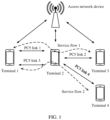
- FIG. 1 is a schematic diagram of a network architecture to which an embodiment of this application is applicable.
- the network architecture may be used for communication between two terminals.
- the network architecture may be referred to as a D2D communication network architecture.
- the network architecture includes: an access network device, and a terminal 1 to a terminal 4.
- the network architecture may be applied to a 4G communication system, or may be applied to a 5G communication system. It is clearly that the network architecture may also be applied to a subsequent communication system.
- the access network device is a device that is in a network and that is configured to connect the terminal device to a wireless network.
- the access network device may be a node in a radio access network, may also be referred to as a base station, or may be referred to as a radio access network (radio access network, RAN) node (or device).
- the network device may include an evolved NodeB (NodeB, eNB or e-NodeB, evolutional NodeB) in a long term evolution (long term evolution) system or an LTE-advanced (LTE-Advanced, LTE-A) system, for example, a conventional macro eNB (eNB) and a micro eNB (eNB) in a heterogeneous network scenario.
- NodeB evolved NodeB
- eNB evolved NodeB
- e-NodeB evolutional NodeB
- LTE-advanced LTE-Advanced
- the network device may include a next generation NodeB (next generation NodeB, gNB) in a fifth generation mobile communication technology (5th generation, 5G) new radio (new radio, NR) system; or may include a radio network controller (radio network controller, RNC), a NodeB (NodeB, NB), a base station controller (base station controller, BSC), a base transceiver station (base transceiver station, BTS), a transmission reception point (transmission reception point, TRP), a home base station (for example, a home evolved NodeB, or a home NodeB, HNB), a baseband unit (base band unit, BBU), a baseband pool BBU pool, a Wi-Fi access point (access point, AP), or the like; or may include a central unit (centralized unit, CU) and a distributed unit (distributed unit, DU) in a cloud radio access network (cloud radio access network, Cloud RAN) system.
- RNC radio network controller
- NodeB
- a relay device may be used for assistance.
- the relay device may also be referred to as relay user equipment (relay UE).
- relay UE relay user equipment
- D2D communication between the terminal 1 and the terminal 3 is assisted by using the terminal 2, that is, the terminal 2 is a relay device between the terminal 1 and the terminal 3.
- D2D communication between the terminal 1 and the terminal 4 is assisted by using the terminal 2, that is, the terminal 2 is a relay device between the terminal 1 and the terminal 4.
- the communication between the terminal 1 and the terminal 2 and the communication between the terminal 2 and the terminal 3 may be performed through an interface.
- the interface may be used for information transmission on a data plane and a control plane.
- the interface may be a PC5 (proximity communication 5, proximity communication 5) interface or a sidelink (sidelink) interface.
- PC5 proximity communication 5, proximity communication 5
- sidelink sidelink
- a PCS link is established between the terminal 1 and the terminal 2, and is denoted as a PC5 link 1.
- a PC5 link is established between the terminal 2 and the terminal 3, and is denoted as a PC5 link 2.
- the terminal 2 After the terminal 2 has established the PC5 link between the terminal 2 and the terminal 1, and the PC5 link between the terminal 2 and the terminal 3, the terminal 2 maintains a mapping relationship between the PC5 link 1 and the PCS link 2.
- the terminal 2 can forward, through the PC5 link 2, data received from the PC5 link 1 to the terminal 3, and can send, through the PCS link 1, data received from the PCS link 2 to the terminal 1, and the PCS link 1 and the PC5 link 2 are only used to transmit the data between the terminal 1 and the terminal 3.
- a new PCS link is established between the terminal 1 and the terminal 2, and is denoted as a PC5 link 3.
- a new PC5 link is established between the terminal 2 and the terminal 4, and is denoted as a PC5 link 4.
- the terminal 2 can transmit data between the terminal 1 and the terminal 4 according to a correspondence between the PCS link 3 and the PCS link 4.
- the service flow 1 between the terminal 1 and the terminal 3 and the service flow 2 between the terminal 1 and the terminal 4 are relay flows, that is, the relay flow refers to a service flow for communication between the terminals.
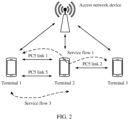
- FIG. 2 uses the same network architecture as FIG. 1 .
- a terminal 1 communicates with a terminal 2
- a PC5 link is established between the terminal 1 and the terminal 2, and is denoted as a PC5 link 5.
- Communication between the terminal 1 and the terminal 2 is denoted as a service flow 3.
- the service flow 3 is a non-relay flow, that is, the non-relay flow refers to a service flow for communication between the terminal and a relay device.
- FIG. 2 there already is a PC5 link 1 between the terminal 1 and the terminal 2, and a new PC5 link 5 needs to be established for communication between the terminal 1 and the terminal 2. States of different PCS links need to be maintained between the terminal 1 and the terminal 2, resulting in high signaling overheads.
- this application provides a communication method.
- this method can support reusing transmission of a relay flow and a non-relay flow on a same PCS link, reusing of a PC5 link between the relay device and a source terminal when there are a plurality of target terminals, and reusing of a PCS link between the relay device and a target terminal when there are a plurality of source terminals, thereby resolving a problem of high signaling overheads for maintaining a plurality of PCS links.
- the M source terminals communicate with the N target terminals by using one relay device.
- the M source terminals send data to the N target terminals by using one relay device.
- the N target terminals send data to the M source terminals by using one relay device.
- the source terminal may also be referred to as source remote user equipment (source remote UE).
- the target terminal may also be referred to as target remote user equipment (target remote UE), or may also be referred to as destination remote user equipment (destination remote UE).
- the relay device may also be referred to as a user equipment-to-user equipment relay device (UE-to-UE relay UE).
- the first terminal may be a source terminal
- the second terminal may be a target terminal.
- a first transmission link is a first PCS link
- a second transmission link is a second PCS link
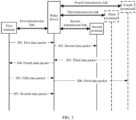
- the relay device receives a first data packet from a first terminal through a first PC5 link.
- the first PC5 link may be a PCS link between the relay device and the first terminal.
- the relay device may forward not only a data flow sent by the first terminal, but also a data flow sent to the first terminal.
- different data flows may reuse a same first PC5 link, thereby saving transmission resources, and reducing signaling overheads caused by maintaining the transmission link.
- the at least two communication devices further include a fourth terminal, and the foregoing method further includes content related to steps 305 and 306 described below.
- a fourth transmission link is a fourth PCS link is used for description.
- the identifier of the fourth terminal may be used to identify the fourth terminal.
- the relay device may identify, by using the identifier, that a target terminal of the fifth data packet is the fourth terminal.
- the fourth PC5 link is a PC5 link between the relay device and the fourth terminal.
- the first terminal may reuse a same transmission link (for example, the first PC5 link) between the first terminal and the relay device, to save transmission resources and reduce signaling overheads caused by maintaining the transmission link.
- the relay device can identify a target terminal of a data packet based on an identifier of the target terminal in the data packet, so that the first terminal and the relay device send data to different target terminals through the same transmission link.
- the relay device receives a seventh data packet from the first terminal through the first PC5 link.
- the relay device obtains data in the seventh data packet.
- the seventh data packet belongs to a non-relay flow between the first terminal and the relay device.
- the identifier of the relay device is used to identify the relay device. Specifically, the relay device may identify, by using the identifier, that a target terminal of the seventh data packet is the relay device.
- the identifier of the relay device may be a layer 2 identifier of the relay device, may be an application layer identifier of the relay device, may be a temporary identifier allocated by the relay device to the relay device, or may be a temporary identifier allocated by the first terminal to the relay device.
- the relay device can determine, based on whether the data packet includes the identifier of the terminal, whether the target terminal of the data packet sent by the first terminal on the reused first PCS link is the relay device.
- the relay device sends the identifier of the second terminal to the first terminal, and the relay device sends the identifier of the first terminal to the second terminal.
- the first terminal sends the identifier of the second terminal to the relay device
- the second terminal sends the identifier of the first terminal to the relay device.
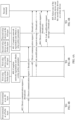
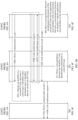
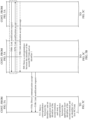
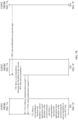
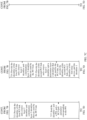
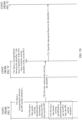
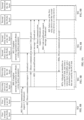
- FIG. 4A , FIG. 4B , FIG. 4C , FIG. 4D , and FIG. 4E show only a case in which there are two relay devices, that is, a first relay device and a second relay device.
- the first relay device and the second relay device are collectively referred to as relay devices.
- the method shown in FIG. 4A , FIG. 4B , FIG. 4C , FIG. 4D , and FIG. 4E may include at least a part of the following content.
- the first relay device indicates a relay capability when registering with a network
- the network side delivers the relay policy parameter based on the relay capability
- the relay policy parameter may include at least one of the following: a public land mobile network (public land mobile network, PLMN) that allows the first relay device to relay data, or a service for which the first relay device allows relay.
- PLMN public land mobile network
- the second relay device completes network registration and obtains a relay policy parameter.
- a specific step is the same as step 400. Details are not described herein again.
- the first terminal separately sends a direct communication request (direct communication request, DCR) message to the first relay device and the second relay device.
- DCR direct communication request
- the direct communication request message is used by the first terminal to request to communicate with the second terminal.
- the direct communication request message may include an application layer identifier of the first terminal and an application layer identifier of the second terminal.
- the application layer identifier of the first terminal may be an identifier used in a specific application of the first terminal.
- the application layer identifier of the first terminal may be a WeChat name used in WeChat in the first terminal.
- the application layer identifier of the second terminal may also be an identifier used in a specific application of the second terminal.
- the first terminal may send the direct communication request message in a broadcast manner, which is denoted as a direct communication request message 1.
- the first relay device receives the direct communication request message 1
- the second relay device receives the direct communication request message 1.
- the first relay device allows, based on the relay policy parameter, the relay service to send a direct communication request message to the second terminal, which is denoted as a direct communication request message 2.
- the direct communication request message 2 may include an identifier of the first terminal, which is denoted as an identifier 2.
- the identifier of the first terminal may be an application layer identifier of the first terminal.
- the identifier of the first terminal is a temporary identifier allocated by the first relay device to the first terminal, or a layer 2 identifier of the first terminal.
- the direct communication request message 2 may further include an application layer identifier of the second terminal and an application layer identifier of the first relay device.
- the direct communication request message 2 may further include an application layer identifier of the first terminal, an application layer identifier of the second terminal, and an application layer identifier of the first relay device.
- the first relay device may send the direct communication request message 2 in a broadcast manner.
- the second terminal receives the direct communication request message 2.
- the second relay device allows, based on the relay policy parameter, the relay service to send a direct communication request message to the second terminal, which is denoted as a direct communication request message 3.
- the direct communication request message 3 may include an identifier of the first terminal, which is denoted as an identifier 3.
- the identifier of the first terminal may be an application layer identifier of the first terminal.
- the identifier of the first terminal is a temporary identifier allocated by the first relay device to the first terminal, or a layer 2 identifier of the first terminal.
- the direct communication request message 2 may further include an application layer identifier of the second terminal and an application layer identifier of the first relay device.
- the direct communication request message 2 may further include an application layer identifier of the first terminal, an application layer identifier of the second terminal, and an application layer identifier of the first relay device.
- the first relay device may send the direct communication request message 3 in a broadcast manner.
- the second terminal receives the direct communication request message 3.
- the second terminal selects one relay device from the first relay device and the second relay device as the relay device used by the second terminal to communicate with the first terminal.
- a manner of selecting the relay device is in the conventional technology. Details are not described herein again.
- the second terminal After the second terminal selects the first relay device to communicate with the first terminal, the second terminal determines whether there is a PC5 link between the second terminal and the first relay device.
- a specific determining manner may be as follows: The second terminal may determine, based on whether an overview of an established PCS link includes the application layer identifier of the first relay device, whether there is the PCS link between the second terminal and the first relay device. If the overview of the PC5 link includes the application layer identifier of the first relay device, there is the PC5 link between the second terminal and the first relay device. If the overview of the PCS link does not include the application layer identifier of the first relay device, there is no PC5 link between the second terminal and the first relay device.
- the second terminal determines whether there is the PC5 link between the second terminal and the first relay device.
- Case 1 There is no PCS link between the second terminal and the first relay device, and steps 406a and 407a are performed.
- the second terminal After receiving the direct communication request message 2 sent by the first relay device, the second terminal sends a direct communication accept (direct communication accept, DCA) message to the first relay device.
- a direct communication accept direct communication accept, DCA
- the first relay device After the first relay device receives the direct communication accept message sent by the second terminal, that is, the first relay device learns that the second terminal communicates with the first terminal by using the first relay device.
- the first relay device After receiving the direct communication accept message sent by the second terminal, the first relay device completes establishment of a link between the first relay device and the second terminal.
- the link between the first relay device and the second terminal is referred to as a second PCS link.
- the second PC5 link is a newly established PC5 link between the first relay device and the second terminal, and the second PCS link is used by the second terminal to communicate with the first terminal by using the first relay device.
- the first relay device may allocate an identifier of the second PCS link to the second PC5 link, and store a source layer 2 identifier and a destination layer 2 identifier that are used by the PCS link.
- the source layer 2 identifier herein is a layer 2 identifier of the first relay device
- the destination layer 2 identifier is a layer 2 identifier of the second terminal.
- the second terminal After receiving the direct communication request message 2 sent by the first relay device, the second terminal sends a link modification request (link modification request) message to the first relay device.
- the first relay device After the first relay device receives the link modification request message sent by the second terminal, that is, the first relay device learns that the second terminal communicates with the first terminal by using the first relay device.
- the link modification request message may include an application layer identifier of the first terminal.
- the link modification request message indicates the first relay device to transmit data of the first terminal through the second PCS link.
- the second PCS link is used for communication between the first relay device and the second terminal.
- the first relay device then sends a link modification accept message to the second terminal.
- the second terminal after the second terminal receives a link modification request message 1 sent by the first relay device, and there already is the second PCS link between the first relay device and the second terminal, the second terminal sends the link modification accept message (link modification accept) to the first relay device, that is, step 408 is performed.
- step 409 is performed.
- the second PCS link is used by the second terminal to communicate with the first terminal by using the first relay device.
- the second terminal stores a correspondence between identification information of the second PC5 link and the application layer identifier of the first terminal, and the second terminal may determine, according to the correspondence, that the second terminal sends data to the first terminal through the second PCS link.
- the second terminal further stores a correspondence between the identifier 2 and the application layer identifier of the first terminal.
- the data packet may include the identifier 2.
- the first relay device After the first relay device receives the direct communication accept message (refer to step 406a) or the link modification request message (refer to step 406b) sent by the second terminal, the first relay device determines whether there is a PCS link between the first relay device and the first terminal.
- a specific determining manner is the same as the manner in which the second terminal determines whether there already is the PC5 link between the second terminal and the first relay device. Details are not described herein again.
- the first relay device sends a direct communication accept message to the first terminal.
- the direct communication accept message includes an identifier of the second terminal, which is denoted as an identifier 1.
- the identifier of the second terminal may be a layer 2 identifier of the second terminal.
- the identifier of the second terminal may be a temporary identifier allocated by the first relay device to the second terminal.
- the identifier of the second terminal may be an application layer identifier of the second terminal.
- the first terminal After receiving the direct communication accept message sent by the first relay device, the first terminal completes establishment of a link between the first terminal and the first relay device.
- the PCS link is denoted as a first PC5 link.
- the first PC5 link is a newly established PC5 link between the first relay device and the first terminal, and the first PCS link is used by the first terminal to communicate with the second terminal by using the first relay device.
- step 410b If there already is the PCS link between the first relay device and the first terminal, step 410b is performed.
- the first relay device sends a link modification request message to the first terminal.
- the link modification request message includes an identifier 1.
- the link modification request message indicates the first relay device to transmit data of the first terminal through the first PCS link.
- the first PCS link is used by the first terminal to communicate with the second terminal by using the first relay device.
- the first relay device stores a correspondence between the identifier 2 and identification information of the first PC5 link.
- the first relay device determines the correspondence between the identifier 2 and the identification information of the first PC5 link based on that the first terminal communicates with the second terminal through the first PCS link.
- the first relay device may store a correspondence between the identifier 2, the layer 2 identifier of the first relay device, and the identification information of the first PCS link.
- the identification information of the first PC5 link may include the layer 2 identifier of the first terminal corresponding to the first PCS link.
- the first relay device stores a correspondence between the identifier 1 and the identification information of the second PCS link.
- the first relay device determines the correspondence between the identifier 1 and the identification information of the second PC5 link based on that the second terminal communicates with the first terminal through the second PCS link.
- the first relay device may store a correspondence between the identifier 1, the layer 2 identifier of the first relay device, and the identification information of the second PCS link.
- the identification information of the second PC5 link may include the layer 2 identifier of the second terminal corresponding to the second PCS link.
- a ProSe layer of the first terminal stores a correspondence between the application layer identifier of the second terminal and the identifier 1.
- the first terminal may include the identifier 1 in the sent data packet.
- the first terminal also stores, at the ProSe layer, a correspondence between the application layer identifier of the second terminal and the identification information of the first PC5 link, and the first terminal determines, according to the correspondence, that the first terminal sends data to the second terminal through the first PCS link.
- the second relay device when the second terminal determines that there is the PC5 link between the first relay device and the second terminal, and when the second relay device determines that the application layer identifier of the second terminal in the direct communication request message 1 is inconsistent with the application layer identifier of the second relay device, in step 404, the second relay device sends the link modification request message 2 to the second terminal.
- the second relay device determines whether there is the PC5 link between the second relay device and the second terminal is the same as the manner in which the first relay device determines whether there is the PC5 link between the first relay device and the second terminal. Details are not described herein again.
- the link modification request message 2 may include an identifier of the first terminal, which is denoted as an identifier 3.
- the identifier of the first terminal may be an application layer identifier of the first terminal.
- the link modification request message 2 may further include an application layer identifier of the second terminal and an application layer identifier of the first relay device.
- the link modification request message 2 may further include an application layer identifier of the first terminal, an application layer identifier of the second terminal, and an application layer identifier of the first relay device.
- step 402 to step 413 include message interaction between the proximity-based service (ProSe) layer of the first terminal, a ProSe layer of the first relay device, and a ProSe layer of the second terminal, and information storage at a ProSe layer of each terminal.
- ProSe proximity-based service
- steps 414 and 415 shown in FIG. 4A , FIG. 4B , FIG. 4C , FIG. 4D , and FIG. 4E are performed.
- the ProSe layer of the first terminal provides an identifier of the first PC5 link and a source layer 2 identifier and a destination layer 2 identifier that are used by the PCS link for the AS layer of the first terminal.
- step 414 is not performed.
- the ProSe layer of the first relay device provides an identifier of the first PC5 link and a source layer 2 identifier and a destination layer 2 identifier that are used by the PCS link for the AS layer of the first terminal.
- the source layer 2 identifier herein is a layer 2 identifier of the first terminal, and the destination layer 2 identifier is a layer 2 identifier of the first relay device.
- step 415 is not performed.
- the ProSe layer of the first relay device provides the identification information of the second PC5 link and the identifier 1 for the AS layer of the first relay device.
- the ProSe layer of the first relay device provides the identification information of the second PCS link, the layer 2 identifier of the first relay device, and the identifier 1 for the AS layer of the first relay device.
- the ProSe layer of the first relay device When the second PCS link is newly established between the second terminal and the first relay device, the ProSe layer of the first relay device further provides the identification information of the second PCS link and the source layer 2 identifier and the destination layer 2 identifier that are used by the PC5 link for the AS layer of the first relay device.
- the source layer 2 identifier herein is a layer 2 identifier of the first relay device, and the destination layer 2 identifier is a layer 2 identifier of the second terminal.
- the AS layer of the first relay device stores the correspondence between the identifier 1 and the identification information of the second PC5 link.
- the AS layer of the first relay device stores a correspondence between the identifier 1, the layer 2 identifier of the first relay device, and the identification information of the second PCS link.
- the AS layer of the first relay device When the second PCS link is newly established between the second terminal and the first relay device, the AS layer of the first relay device further stores a correspondence between the identifier of the second PCS link and the source layer 2 identifier and the destination layer 2 identifier that are used by the second PCS link.
- the ProSe layer of the first terminal provides the identifier 1, a PC5 QoS flow identifier (PCS QoS flow identifier, PFI), and a PC5 QoS parameter corresponding to the PFI for the AS layer of the first terminal.
- PCS QoS flow identifier PCS QoS flow identifier
- the first terminal transmits data of the second terminal based on the QoS flow corresponding to the PFI, and provides the identifier 1 and the PFI for the AS layer of the first terminal.
- the first terminal determines, according to a QoS rule of the QoS flow, where the QoS rule includes the application layer identifier of the second terminal or the layer 2 identifier of the second terminal, that the QoS flow is used to transmit the data of the second terminal.
- the AS layer of the first terminal stores a correspondence between the PFI and the identifier 1.
- a process of performing data transmission after the PC5 link between the first terminal and the first relay device and the PCS link between the first relay device and the second terminal are established, as described below, includes step 420 to step 422.
- the ProSe layer of the first terminal provides the identification information of the first PC5 link and the PFI along with the data packet for the AS layer of the first terminal.
- the ProSe layer of the first terminal receives the data packet from the application layer, and the ProSe layer of the first terminal provides the data packet for the AS layer of the first terminal.
- the ProSe layer of the first terminal determines an identifier of the first PC5 link corresponding to the application layer identifier of the second terminal.
- the first terminal determines the identifier of the first PC5 link according to a correspondence that is between the application layer identifier of the second terminal and the identifier of the first PCS link and that is stored at the ProSe layer.
- the ProSe layer of the first terminal determines the PFI according to the QoS rule, where the QoS rule includes the application layer identifier of the second terminal or the layer 2 identifier of the second terminal.
- the application layer carries the application layer identifier of the second terminal along with the data packet
- the first terminal may determine, based on the application layer identifier of the second terminal, that a target terminal of the data packet is the second terminal.
- the AS layer of the first terminal determines a source layer 2 identifier and a destination layer 2 identifier based on the identifier of the first PC5 link, where the source layer 2 identifier is a layer 2 identifier of the first terminal, and the destination layer 2 identifier is a layer 2 identifier of the first relay device, and adds the layer 2 identifier of the first terminal and the layer 2 identifier of the first relay device to the header of the data packet.
- the AS layer of the first terminal determines an AS layer configuration based on information about the PFI, and the AS layer uses the layer 2 identifier of the first terminal and the layer 2 identifier of the first relay device, and the AS layer configuration to send corresponding data.
- the AS layer of the first terminal sends the data packet to the first relay device based on the layer 2 identifier of the first terminal and the layer 2 identifier of the first relay device, and the data packet carries the identifier 1.
- the ProSe layer of the first terminal does not need to send the correspondence between the PFI and the identifier 1 to the AS layer of the first terminal by using step 415, but when the ProSe layer of the first terminal sends the data packet to the AS layer of the first terminal, the identifier of the first PCS link, the PFI, and the identifier 1 are carried along with the data packet.
- the first relay device forwards the data packet based on the identifier 1.
- the first relay device receives the data packet sent by the first terminal, and the first relay device sends a second data packet to the second terminal through the second PC5 link by using the identifier (the identifier 1) of the second terminal in the data packet.
- the first relay device may obtain the identification information of the second PC5 link according to a correspondence between the identifier 1 and the identifier of the second PCS link.
- the first relay device sends the second data packet to the second terminal through the second PCS link based on the identification information of the second PCS link.
- the first relay device may obtain the identification information of the second PCS link according to a correspondence between the identifier 1, the layer 2 identifier of the first relay device, and the layer 2 identifier of the second terminal.
- the first relay device sends the second data packet to the second terminal through the second PCS link based on the identification information of the second PC5 link.
- the first relay device replaces a layer 2 identifier of the data packet with the layer 2 identifier of the first relay device and the layer 2 identifier of the second terminal that correspond to the second PCS link.
- the first relay device receives the data packet sent by the first terminal, and the AS layer of the first relay device determines whether the layer 2 identifier of the first relay device of the data packet is a layer 2 identifier allocated by the first relay device to the first relay device. If no, the first relay device discards the data packet; and if yes, the first relay device further needs to distinguish whether the received data packet from the first terminal is a data packet sent to the first relay device or a data packet that needs to be forwarded by the first relay device.
- the first relay device further needs to distinguish whether the received data packet from the first terminal is the data packet sent by the first terminal or the data packet that needs to be forwarded by the first relay device. There are the following two distinguishing manners.
- Manner 1 Distinguish based on whether the data packet sent by the first terminal to the first relay device includes the information about the identifier 1.
- the data packet is the data packet sent by the first terminal to the first relay device. If a header of the data packet sent by the first terminal to the first relay device carries the identifier 1, the data packet is the data packet sent by the first terminal to a terminal identified by the identifier 1.
- the first relay device determines whether the identifier included in the data packet is the identifier of the first relay device.
- the first relay device may send the identifier 3 of the first relay device when sending the identifier 1 of the second terminal to the first terminal (as shown in step 410a or 410b in FIG. 4A , FIG. 4B , FIG. 4C , FIG. 4D , and FIG. 4E ).
- the identifier 3 may be included in the direct communication accept message or the link modification request message sent by the first relay device to the first terminal.
- the first relay device sends the identifier 3 of the first relay device to the first terminal.
- the data packet sent by the first terminal to the first relay device includes information about the identifier 3, it indicates that a target terminal of the data packet is the first relay device. If the data packet sent by the first terminal to the first relay device does not include information about the identifier 3, it indicates that the data packet is a data packet that needs to be forwarded by the first relay device to another target terminal.
- the first terminal when sending data to different target terminals by using the first relay device, the first terminal reuses the PCS link between the first terminal and the first relay device, thereby reducing a quantity of PC5 links that need to be established, reducing signaling overheads for maintaining the PCS link, and saving communication resources.
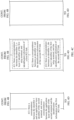
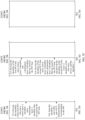
- FIG. 5A , FIG. 5B , FIG. 5C , and FIG. 5D are a schematic flowchart of another communication method according to this application.
- FIG. 5A , FIG. 5B , FIG. 5C , and FIG. 5D describe a case in which the identifier of the second terminal is sent by the first terminal to the relay device, and the identifier of the first terminal is sent by the second terminal to the relay device.
- the first terminal and the second terminal may communicate with each other by using N relay devices.
- FIG. 5A , FIG. 5B , FIG. 5C , and FIG. 5D show only a case in which there are two relay devices, that is, a first relay device and a second relay device.
- the first relay device and the second relay device are collectively referred to as relay devices.
- the method shown in FIG. 5A , FIG. 5B , FIG. 5C , and FIG. 5D may include at least a part of the following content.
- Step 500 and step 501 are the same as step 400 and step 401 in FIG. 4A , FIG. 4B , FIG. 4C , FIG. 4D , and FIG. 4E . Details are not described herein again.
- the first terminal separately sends a direct communication request message to the first relay device and the second relay device.
- the direct communication request message is used by the first terminal to request to communicate with the second terminal.
- the direct communication request message may include an application layer identifier of the second terminal and an identifier of the second terminal, which is denoted as an identifier 1.
- the identifier of the second terminal may be a layer 2 identifier of the second terminal, or a temporary identifier allocated by the first relay device to the second terminal.
- the identifier of the second terminal may be the application layer identifier of the second terminal.
- the direct communication request message may further include only the application layer identifier of the second terminal.
- the first terminal may send the direct communication request message in a broadcast manner, which is denoted as a direct communication request message 1.
- the first relay device receives the direct communication request message 1
- the second relay device receives the direct communication request message 1.
- Steps 503 to 505 are the same as steps 403 to 405. Details are not described herein again.
- the first relay device can detect uniqueness of the identifier of the second terminal.
- a detection manner is specifically as follows:
- the first relay device stores an identifier of another terminal.
- the another terminal refers to a terminal that transmits relay data by using the first relay device.
- the first relay device compares the identifier of the second terminal with the identifier of the another terminal.
- the first relay device may indicate the first terminal to re-determine the identifier 1 for the second terminal, or the first relay device re-determines the identifier 1 for the second terminal.
- the second terminal selects the first relay device to communicate with the first terminal. There are two cases in which the second terminal determines whether there is a PCS link between the second terminal and the first relay device.
- Case 1 There is no PCS link between the first relay device and the second terminal, and steps 506a and 507a are performed.
- Step 506a is similar to step 406a in FIG. 4A , FIG. 4B , FIG. 4C , FIG. 4D , and FIG. 4E , and a difference lies in that the direct communication accept message sent by the second terminal to the first relay device includes an identifier of the first terminal, which is denoted as an identifier 2, and the identifier 2 is used to distinguish data of different M first terminals.
- the direct communication accept message sent by the second terminal to the first relay device includes an identifier of the first terminal, which is denoted as an identifier 2, and the identifier 2 is used to distinguish data of different M first terminals.
- Step 507a is the same as step 407a in FIG. 4A , FIG. 4B , FIG. 4C , FIG. 4D , and FIG. 4E . Details are not described herein again.
- Step 506b is similar to step 406b in FIG. 4A , FIG. 4B , FIG. 4C , FIG. 4D , and FIG. 4E , and a difference lies in that the link modification request message sent by the second terminal to the first relay device includes the identifier of the first terminal.
- Step 507b is the same as step 407b in FIG. 4A , FIG. 4B , FIG. 4C , FIG. 4D , and FIG. 4E . Details are not described herein again.
- Step 508 is the same as step 408 in FIG. 4A , FIG. 4B , FIG. 4C , FIG. 4D , and FIG. 4E . Details are not described herein again.
- step 509 is performed.
- the second PCS link is used by the second terminal to communicate with the first terminal by using the first relay device.
- the first relay device stores a correspondence between the identifier 1 and the identifier of the second PCS link.
- the first relay device After the first relay device receives the direct communication accept message (refer to step 506a) or the link modification request message (refer to step 506b) sent by the second terminal, the first relay device determines whether there is a PCS link between the first relay device and the first terminal.
- a specific determining manner is the same as the manner in which the second terminal determines whether there already is the PC5 link between the second terminal and the first relay device. Details are not described herein again.
- Step 510a is similar to step 410a in FIG. 4A , FIG. 4B , FIG. 4C , FIG. 4D , and FIG. 4E , and a difference lies in that the direct communication accept message sent by the first relay device to the first terminal does not include the identifier 1.
- step 510b If there already is the PC5 link between the first relay device and the first terminal, step 510b is performed.
- the first relay device sends a link modification request message to the first terminal.
- the link modification request message may include an application layer identifier of the second terminal.
- the link modification request message indicates the first relay device to transmit data of the first terminal through the first PCS link.
- the first PCS link is used by the first terminal to communicate with the second terminal by using the first relay device.
- a ProSe layer of the first terminal stores a correspondence between the application layer identifier of the second terminal and the identifier 1.
- the first terminal may include the identifier 1 in the sent data packet.
- the first terminal also stores, at the ProSe layer, a correspondence between the application layer identifier of the second terminal and identification information of the first PCS link.
- the first terminal sends data to the second terminal through the first PC5 link according to the correspondence.
- Step 512 and step 513 are the same as step 414 and step 415 in FIG. 4A , FIG. 4B , FIG. 4C , FIG. 4D , and FIG. 4E . Details are not described herein again.
- the ProSe layer of the first relay device provides the identifier of the second PC5 link and a source layer 2 identifier and a destination layer 2 identifier that are used by the PC5 link for an AS layer of the first relay device.
- the source layer 2 identifier herein is a layer 2 identifier of the first relay device
- the destination layer 2 identifier is a layer 2 identifier of the second terminal.
- the ProSe layer of the first relay device may further provide the identifier of the second PCS link, the layer 2 identifier of the first relay device, and the identifier 1 for the AS layer of the first relay device.
- step 514 is not performed.
- the AS layer of the first relay device stores a correspondence between the identifier 1, the layer 2 identifier of the first relay device, and the identifier of the second PCS link.
- Step 516 to step 520 are similar to steps 418 to 422 in FIG. 4A , FIG. 4B , FIG. 4C , FIG. 4D , and FIG. 4E . Details are not described herein again.
- the first terminal when sending data to different target terminals by using the first relay device, the first terminal reuses the PC5 link between the first terminal and the first relay device, thereby reducing a quantity of PCS links that need to be established, and reducing signaling overheads for maintaining the PC5 link.
- FIG. 4A , FIG. 4B , FIG. 4C , FIG. 4D , and FIG. 4E and FIG. 5A , FIG. 5B , FIG. 5C , and FIG. 5D discovery of the relay device and selection of the relay device are already performed in the connection establishment process, that is, a separate discovery process of the relay device is not required.
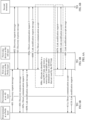
- FIG. 6A , FIG. 6B , FIG. 6C , and FIG. 6D and FIG. 7A , FIG. 7B , FIG. 7C , and FIG. 7D describe cases in which the discovery process and the connection establishment process of the relay device are performed separately.
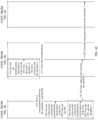
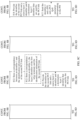
- FIG. 6A , FIG. 6B , FIG. 6C , and FIG. 6D are a schematic flowchart of another communication method according to this application.
- a discovery process of a relay device is first performed before connection establishment and data transmission, the relay device is selected in the discovery process of the relay device, and then a first terminal completes a connection establishment process with a second terminal by using the selected relay device.
- the selected relay device sends an identifier of the second terminal to the first terminal, and the selected relay device sends an identifier of the first terminal to the second terminal.
- the first relay device in FIG. 4A , FIG. 4B , FIG. 4C , FIG. 4D , and FIG. 4E or FIG. 5A , FIG. 5B , FIG. 5C , and FIG. 5D may be a candidate relay device described below, and the second relay device may also be the candidate relay device described below.
- a process of establishing a link between the first terminal and the second terminal is initiated by the first terminal.
- the first terminal sends a discovery request message in a broadcast form.
- the discovery request message includes an application layer identifier of the first terminal and an application layer identifier of a target terminal (that is, an application layer identifier of the second terminal).
- a candidate relay device After receiving the discovery request message, a candidate relay device broadcasts the discovery request message.
- the candidate relay device may be the first relay device or may be the second relay device shown in FIG. 6A , FIG. 6B , FIG. 6C , and FIG. 6D . This is not limited in this application.
- the discovery request message includes an application layer identifier of the first terminal, an application layer identifier of the target terminal (that is, the application layer identifier of the second terminal), and an application layer identifier of the candidate relay device.
- the candidate relay device uses a layer 2 address of the candidate relay device as a source layer 2 identifier.
- the second terminal selects one relay device from candidate relay devices to communicate with the first terminal.
- the second terminal measures signal strength of the received discovery request message, and selects a relay device with high signal strength as the relay device communicating with the first terminal.
- the second terminal selects the first relay device to communicate with the first terminal.
- the second terminal receives the discovery request message, and sends a discovery response message to the first relay device.
- the first relay device After the first relay device receives the discovery response message, the first relay device sends the discovery response message to the first terminal.
- Step 601 to step 604 are the discovery and selection process of the relay device. After the relay device is selected, a connection is established between the first terminal and the second terminal by using the relay device. A specific process is described below.
- the first terminal determines whether there is a PC5 link between the first terminal and the first relay device. There are two cases in which whether there is the PCS link between the first terminal and the first relay device.
- the first terminal sends a direct communication request message 1 to the first relay device.
- the first relay device receives the direct communication request message 1.
- the direct communication request message 1 is used by the first terminal to request to communicate with the second terminal.
- the direct communication request message 1 includes an application layer identifier of the second terminal.
- the first terminal sends a link modification request message 1 to the first relay device.
- the first relay device receives the link modification request message 1.
- the link modification request message 1 includes an application layer identifier of the second terminal.
- the first relay device determines whether there is a PCS link between the first relay device and the second terminal.
- the first relay device sends a direct communication request message 2 to the second terminal.
- the direct communication request message 2 may include the application layer identifier of the first terminal, the application layer identifier of the second terminal, and the application layer identifier of the first relay device.
- the first relay device sends the link modification request message 1 to the second terminal.
- the link modification request message 1 may include an identifier of the first terminal, which is denoted as an identifier 2.
- the identifier of the first terminal may be an application layer identifier of the first terminal.
- the identifier of the first terminal is a temporary identifier allocated by the first relay device to the first terminal, or a layer 2 identifier of the first terminal.
- the link modification request message 1 may further include an application layer identifier of the second terminal and an application layer identifier of the first relay device.
- the link modification request message 1 may further include an application layer identifier of the first terminal, an application layer identifier of the second terminal, and an application layer identifier of the first relay device.
- Step 607 and step 623 are the same as step 406 and step 422 in FIG. 4A , FIG. 4B , FIG. 4C , FIG. 4D , and FIG. 4E . Details are not described herein again.
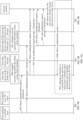
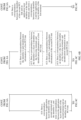
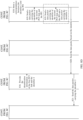
- FIG. 7A , FIG. 7B , FIG. 7C , and FIG. 7D are a schematic flowchart of another communication method according to this application.
- a discovery process of a relay device is first performed, and the relay device is selected in the discovery process of the relay device.
- a first terminal completes a connection establishment process with a second terminal by using the selected relay device, and the first terminal sends an identifier of the second terminal to the first relay device.
- the second terminal sends an identifier of the first terminal to the first relay device.
- Step 701 to step 704 are the same as step 601 to step 604. Details are not described herein again.
- the first terminal sends a direct communication request message to the first relay device.
- the direct communication request message is used by the first terminal to request to communicate with the second terminal.
- the direct communication request message may include an application layer identifier of the second terminal and an identifier of the second terminal, which is denoted as an identifier 1.
- the identifier of the second terminal may be a layer 2 identifier of the second terminal, or a temporary identifier allocated by the first relay device to the second terminal.
- the identifier of the second terminal may be the application layer identifier of the second terminal.
- the direct communication request message may further include only the application layer identifier of the second terminal.
- Step 706 is the same as step 503. Details are not described herein again.
- Steps 707 to 721 are the same as steps 506 to 520. Details are not described herein again.
- FIG. 3 to FIG. 7A , FIG. 7B , FIG. 7C , and FIG. 7D describe the specific process in which the first terminal sends the data to the second terminal by using the first relay device.
- the second terminal may further send data to the first terminal by using the first relay device, as shown in FIG. 8A , FIG. 8B , FIG. 8C , and FIG. 8D .
- the identifier of the second terminal is sent by the relay device to the first terminal, and the identifier of the first terminal is sent by the relay device to the second terminal.
- a connection establishment process in step 800 to step 813 is the same as that in step 400 to step 413 in FIG. 4A , FIG. 4B , FIG. 4C , FIG. 4D , and FIG. 4E . Details are not described herein again.
- a first PC5 link is newly established between the second terminal and the first relay device, and the ProSe layer of the second terminal provides an identifier of the second PCS link and a source layer 2 identifier and a destination layer 2 identifier that are used by the PCS link for an AS layer of the second terminal.
- the source layer 2 identifier herein is a layer 2 identifier of the first relay device
- the destination layer 2 identifier is a layer 2 identifier of the second terminal.
- step 814 is not performed.
- the ProSe layer of the first relay device provides an identifier of the second PC5 link and a source layer 2 identifier and a destination layer 2 identifier that are used by the PC5 link for an AS layer of the first relay device.
- the source layer 2 identifier herein is a layer 2 identifier of the first relay device
- the destination layer 2 identifier is a layer 2 identifier of the second terminal.
- step 815 is not performed.
- the ProSe layer of the first relay device provides identification information of the first PC5 link, a source layer 2 identifier and a destination layer 2 identifier that are used by the PCS link, and the identifier 2 for an AS layer of the first relay device.
- the source layer 2 identifier herein is a layer 2 identifier of the first terminal
- the destination layer 2 identifier is a layer 2 identifier of the first relay device.
- the ProSe layer of the first relay device provides the identification information of the first PC5 link and the identifier 2 for the AS layer of the first relay device.
- the ProSe layer of the second terminal provides the identifier 2, a PFI, and a PC5 QoS parameter corresponding to the PFI for the AS layer of the second terminal.
- the second terminal is used to transmit data of the first terminal based on the QoS flow corresponding to the PFI, and provides the identifier 2 and the PFI for the AS layer of the second terminal.
- the second terminal determines, according to a QoS rule of the QoS flow, where the QoS rule includes the application layer identifier of the first terminal or the layer 2 identifier of the first terminal, that the QoS flow is used to transmit the data of the first terminal.
- the AS layer of the second terminal stores a correspondence between the PFI and the identifier 2.
- a process of performing data transmission after the PC5 link between the first terminal and the first relay device and the PCS link between the first relay device and the second terminal are established, as described below, includes step 819 to step 821.
- the ProSe layer of the second terminal receives a data packet from the application layer, and the ProSe layer of the second terminal provides the data packet for the AS layer of the second terminal.
- the data packet includes the identifier of the second PC5 link and the PFI.
- the identifier of the second PC5 link and the PFI are also sent to the AS layer of the second terminal along with the data packet.
- the application layer carries the application layer identifier of the first terminal along with the data packet
- the second terminal may determine, based on the application layer identifier of the first terminal, that a target terminal of the data packet is the first terminal.
- the second terminal may receive a data packet sent through an inherent channel between the first terminal and the application layer, to determine that a target terminal of the data packet is the first terminal.
- the inherent channel is used only for communication between the first terminal and the second terminal.
- the ProSe layer of the second terminal determines an identifier of a PC5 link corresponding to the application layer identifier of the first terminal. Specifically, the second terminal determines the identifier of the second PCS link according to the correspondence that is between the application layer identifier of the first terminal and the identifier of the second PCS link and that is stored at the ProSe layer. It should be understood that the identifier of the PCS link herein refers to the identifier of the second PCS link, that is, data of the first terminal is transmitted through the second PCS link.
- the ProSe layer of the second terminal determines the QFI according to a QoS rule, where the QoS rule includes the application layer identifier of the first terminal or the layer 2 identifier of the first terminal.
- the ProSe layer of the second terminal receives the data packet from the application layer, and the ProSe layer of the second terminal sends the data packet to the AS layer of the second terminal.
- the identifier of the second PC5 link, the PFI, and the identifier 2 are also sent to the AS layer of the second terminal along with the data packet.
- the second terminal determines the identifier 1 according to the correspondence, stored in step 806, between the application layer identifier of the first terminal and the identifier 2.
- the application layer carries the application layer identifier of the first terminal along with the data packet.
- the AS layer of the second terminal sends a data packet carrying the identifier 2.
- the AS layer of the second terminal adds information about the identifier 2 to a header of the sent data packet according to the correspondence between the PFI and the identifier 2 or based on the identifier 2 received along with the data packet.
- the AS layer of the second terminal determines a source layer 2 identifier and a destination layer 2 identifier based on the identifier of the second PCS link, where the source layer 2 identifier is a layer 2 identifier of the second terminal, and the destination layer 2 identifier is a layer 2 identifier of the first relay device, and adds the layer 2 identifier of the second terminal and the layer 2 identifier of the first relay device to the header of the data packet.
- the AS layer of the second terminal determines an AS layer configuration based on information about the PFI, and the AS layer uses the layer 2 identifier of the second terminal and the layer 2 identifier of the first relay device, and the AS layer configuration to send corresponding data.
- the AS layer includes an RLC layer and a MAC layer, and may further include an adaptation layer.
- the adaptation layer (Adaptation layer) may be introduced between the RLC layer (Radio Link Control layer) and the MAC layer (Multiple Access Control layer), and the adaptation layer adds information about the identifier 2 to the data packet.
- the AS layer of the second terminal sends the data packet to the AS layer of the first relay device based on the layer 2 identifier of the second terminal and the layer 2 identifier of the first relay device, and the data packet carries the identifier 2.
- the ProSe layer of the second terminal does not need to send the correspondence between the PFI and the identifier 2 to the AS layer of the second terminal by using step 811, but when the ProSe layer of the second terminal sends the data packet to the AS layer of the second terminal, the identifier of the second PC5 link, the PFI, and the identifier 2 are carried along with the data packet.
- the first relay device forwards the data packet based on the identifier 2.
- the first relay device receives the data packet sent by the second terminal, and the AS layer of the first relay device determines whether the layer 2 identifier of the first relay device of the data packet is a layer 2 identifier allocated by the first relay device to the first relay device. If no, the first relay device discards the data packet; and if yes, the first relay device further needs to distinguish whether the received data packet from the second terminal is a data packet sent to the first relay device or a data packet that needs to be forwarded by the first relay device.
- the data packet received by the first relay device is the data packet that needs to be forwarded by the first relay device.
- a determining manner is the same as that described in FIG. 4A , FIG. 4B , FIG. 4C , FIG. 4D , and FIG. 4E . Details are not described herein again.
- the discovery process of the relay device may be first performed, the relay device is selected in the discovery process of the relay device, and then a communication link is established by using the selected relay device. Further, the second terminal transmits data to the first terminal by using the selected relay device, and the selected relay device sends the identifier of the first terminal to the second terminal.
- the first terminal when the second terminal sends data to the first terminal, the first terminal may further send the identifier of the second terminal to the first relay device.
- FIG. 9 is a link splitting process between the first terminal and the second terminal after the first terminal sends the data to the second terminal by using the first relay device.
- the splitting process is as follows.
- the first terminal sends a link modification request message to the first relay device.
- the first relay device receives the link modification request message.
- the message includes an identifier of the second terminal, or the message includes an application layer identifier of the second terminal.
- the message is used to request the relay device to delete context information related to the second terminal. Alternatively, the message is used to request the relay device to delete context information related to communication between the first terminal and the second terminal.
- the first relay device After receiving the link modification request message, the first relay device deletes context information related to the second terminal.
- the context information related to the second terminal includes at least one of the following: a first correspondence, stored in the first relay device, between an identifier 1 and identification information of the second PCS link, and a second correspondence, stored in the first relay device, between an identifier 1, a layer 2 identifier of the first relay device, and identification information of the second PCS link.
- the first relay device after receiving the link modification request message, the first relay device further deletes context information related to the first terminal.
- the context information related to the first terminal includes at least one of the following: a correspondence between an identifier of the first terminal, a layer 2 identifier of the first relay device, and an identifier of the first PCS link, or a correspondence between an identifier of the first terminal and an identifier of the first PCS link.
- the first relay device sends a link modification request message to the second terminal.
- the second terminal receives the link modification request message.
- the message includes an identifier of the first terminal or an application layer identifier of the first terminal.
- the message is used to request the second terminal to delete context information related to the first terminal, or the message is used to request to release a PC5 link used for communication with the first terminal.
- the context information includes at least one of the following: a correspondence between an identifier of the first terminal and identification information of the second PC5 link, a correspondence between an application layer identifier of the first terminal and an identifier of the second PCS link, or a correspondence between an identifier of the first terminal and an application layer identifier of the first terminal.
- the second terminal After receiving the link modification request message, the second terminal deletes the context information related to the first terminal.
- the context information includes at least one of the following: a correspondence between an identifier of the first terminal and identification information of the second PC5 link, a correspondence between an application layer identifier of the first terminal and an identifier of the second PCS link, or a correspondence between an identifier of the first terminal and an application layer identifier of the first terminal.
- the second terminal sends a link modification accept message to the first relay device.
- step 902 may be performed after step 905.
- step 902 after receiving the link modification request message, the first relay device deletes only the context information related to the second terminal. After step 905, the first relay device deletes the context information related to the first terminal.
- the first relay device sends a link modification accept message to the first terminal.
- the first terminal After the first terminal receives the link modification accept message sent by the first relay device, the first terminal deletes the context information related to the second terminal.
- the context information includes a correspondence between an application layer identifier of the second terminal and an identifier of the second terminal, and a correspondence between an application layer identifier of the second terminal and an identifier of the first PC5 link.
- the ProSe layer of the first relay device requests the AS layer of the first relay device to delete context information related to the identifier of the second terminal and context information related to the identifier of the first terminal.
- the context information related to the identifier of the second terminal includes: a correspondence between an identifier of the second terminal, a layer 2 identifier of the first relay device, and an identifier of the second PCS link, or a correspondence between an identifier of the second terminal and an identifier of the second PCS link.
- the context information related to the identifier of the first terminal includes: a correspondence between an identifier of the first terminal, a layer 2 identifier of the first relay device, and an identifier of the first PCS link, or a correspondence between an identifier of the first terminal and an identifier of the first PC5 link.
- the ProSe layer of the first terminal requests the AS layer of the first relay device to delete context information related to the identifier of the second terminal.
- the context information includes a correspondence between an identifier of the second terminal and a QFI.
- the AS layer of the first terminal releases the related context information.
- the second terminal can communicate with the first terminal by using the first relay device.
- the link splitting process is similar to the process described in FIG. 8A , FIG. 8B , FIG. 8C , and FIG. 8D .
- inter-layer interaction is mainly performed between the second terminal and the first relay device. Details are not described herein again.
- FIG. 10 is a schematic block diagram of a communication apparatus 1000 according to an embodiment of this application. As shown in FIG. 10 , the communication apparatus 1000 includes a processing unit 1010 and a transceiver unit 1020.
- the communication apparatus 1000 may correspond to the first terminal, the first relay device, the second relay device, or the second terminal in the foregoing method embodiments, for example, may be the first terminal, the first relay device, the second relay device, or the second terminal, or a component (such as a circuit, a chip, or a chip system) configured in the first terminal, the first relay device, the second relay device, or the second terminal.
- a component such as a circuit, a chip, or a chip system
- the communication apparatus 1000 may include units configured to perform the methods performed by the first terminal, the first relay device, the second relay device, or the second terminal in the methods shown in FIG. 3 to FIG. 10 .
- units in the communication apparatus 1000 are used to implement corresponding procedures of the methods shown in FIG. 3 to FIG. 10 .
- the processing unit may be configured to perform steps other than receiving and sending steps, and the transceiver unit performs the receiving and sending steps.
- the following uses an example to describe a case in which the communication apparatus 1000 corresponds to the first terminal in the foregoing method embodiment.
- the transceiver unit 1020 may be configured to perform step 301, 305, or 307.
- the processing unit 1010 may be configured to perform steps 413 and 419
- the transceiver unit 1020 may be configured to perform steps 402, 410, 414, 418, 420, and 421.
- the processing unit 1010 may be configured to perform steps 511 and 517
- the transceiver unit 1020 may be configured to perform steps 502, 510, 512, 516, 518, and 519.
- the processing unit 1010 may be configured to perform steps 614 and 620
- the transceiver unit 1020 may be configured to perform steps 601, 604, 605, 611, 615, 619, 621, and 622.
- the processing unit 1010 may be configured to perform steps 712 and 718
- the transceiver unit 1020 may be configured to perform steps 701, 704, 711, 713, 717, 719, and 720.
- the processing unit 1010 may be configured to perform step 813, and the transceiver unit 1020 may be configured to perform steps 802, 810a, 810b, and 821.
- the processing unit 1010 may be configured to perform steps 907 and 911, and the transceiver unit 1020 may be configured to perform steps 901, 906, and 910.
- the following uses an example to describe a case in which the communication apparatus 1000 corresponds to the first relay device in the foregoing method embodiment.
- the processing unit 1010 may be configured to perform steps 407a, 411 and 412, and 417, and the transceiver unit 1020 may be configured to perform steps 402, 403, 404, 415 and 416, and 421 and 422.
- the processing unit 1010 may be configured to perform steps 507a, 509, and 515
- the transceiver unit 1020 may be configured to perform steps 502, 503, 506a, 507b, 508, 513 and 514, and 519 and 520.
- the processing unit 1010 may be configured to perform steps 608a, 612 and 613, and 618
- the transceiver unit 1020 may be configured to perform steps 601 to 604, 605a and 605b, 606a and 606b, 607a, 607b, 608b, 609, 617 and 618, and 622 and 623.
- the processing unit 1010 may be configured to perform steps 708a and 716.
- the transceiver unit 1020 may be configured to perform steps 701 to 704, 706a, 707a, 707b, 708b, 709, 714 and 715, and 720 and 721.
- the processing unit 1010 may be configured to perform steps 807a, and 811 and 812.
- the transceiver unit 1020 may be configured to perform steps 803, 806a and 806b, 807b, 808, 815 and 816, and 820.
- the processing unit 1010 may be configured to perform steps 902 and 909, and the transceiver unit 1020 may be configured to perform steps 901 to 906, and 908.
- the following uses an example to describe a case in which the communication apparatus 1000 corresponds to the second terminal in the foregoing method embodiment.
- the transceiver unit 1020 may be configured to perform step 302.
- the processing unit 1010 may be configured to perform steps 405 and 409
- the transceiver unit 1020 may be configured to perform steps 403 and 404, 406a, 406b, 407b, 408, and 422.
- the processing unit 1010 may be configured to perform step 505
- the transceiver unit 1020 may be configured to perform steps 503 and 504, 506a, 506b, 507b, 508, and 520.
- the processing unit 1010 may be configured to perform step 610.
- the transceiver unit 1020 may be configured to perform steps 602 and 603, 606a, 606b, 607a, 607b, 608b, 609, and 623.
- the transceiver unit 1020 may be configured to perform steps 702, 703, 706, 707a, 707b, 708b, 709, and 721.
- the processing unit 1010 may be configured to perform steps 809 and 818.
- the transceiver unit 1020 may be configured to perform steps 803, 806a, 807b, 814, 817, and 819 and 820.
- the processing unit 1010 may be configured to perform step 904, and the transceiver unit 1020 may be configured to perform steps 903 and 905.
- the transceiver unit 1020 in the communication apparatus 1000 may be implemented by using a transceiver, and the processing unit 1010 may be implemented by using at least one processor.
- the transceiver unit 1020 in the communication apparatus 1000 may be implemented by using an input/output interface, a circuit, or the like.
- the processing unit 1010 may be implemented by using a processor, a microprocessor, an integrated circuit, or the like integrated in the chip or a chip system.
- FIG. 11 is another schematic block diagram of a communication apparatus 1100 according to an embodiment of this application.
- the communication apparatus 1100 includes a processor 1110 and an interface circuit 1120.
- the processor 1110 and the interface circuit 1120 are coupled to each other.
- the interface circuit 1120 may be a transceiver or an input/output interface.
- the processor 1110 is configured to execute the function of the processing unit 1010
- the interface circuit 1020 is configured to execute the function of the transceiver unit 1120.
- the communication apparatus 1100 may further include a memory 1130 for storing instructions executed by the processor 1110, or input data required by the processor 1110 to run the instructions, or data generated after the processor 1110 runs the instructions.
- the processor in embodiments of this application may be a central processing unit (Central Processing Unit, CPU), may be another general-purpose processor, a digital signal processor (Digital Signal Processor, DSP), an application-specific integrated circuit (Application-Specific Integrated Circuit, ASIC), a field programmable gate array (Field Programmable Gate Array, FPGA), another programmable logic device, a transistor logic device, a hardware component, or any combination thereof.
- the general-purpose processor may be a microprocessor or any regular processor or the like.
- Embodiment 1 A communication method, comprising: receiving, by a relay device, a first data packet from a first terminal through a first transmission link, wherein the first data packet comprises an identifier of a second terminal and data to be sent to the second terminal, the first transmission link is a transmission link between the relay device and the first terminal, the first transmission link is used by the first terminal to communicate with at least two communication devices, and the at least two communication devices comprise the second terminal; and sending, by the relay device, a second data packet to the second terminal through a second transmission link based on the identifier of the second terminal, wherein the second data packet comprises the data to be sent to the second terminal, and the second transmission link is a transmission link between the relay device and the second terminal.
- Embodiment 2 The method according to embodiment 1, wherein the at least two communication devices further comprise a third terminal, and the method further comprises: receiving, by the relay device, a third data packet from the third terminal through a third transmission link, wherein the third data packet comprises an identifier of the first terminal and data to be sent to the first terminal, and the third transmission link is a transmission link between the relay device and the third terminal; and sending, by the relay device, a fourth data packet to the first terminal through the first transmission link based on the identifier of the first terminal, wherein the fourth data packet comprises the data to be sent to the first terminal.
- Embodiment 3 The method according to embodiment 1 or 2, wherein the at least two communication devices further comprise a fourth terminal, and the method further comprises: receiving, by the relay device, a fifth data packet from the first terminal through the first transmission link, wherein the fifth data packet comprises an identifier of the fourth terminal and data to be sent to the fourth terminal; and sending, by the relay device, a sixth data packet to the fourth terminal through a fourth transmission link based on the identifier of the fourth terminal, wherein the sixth data packet comprises the data to be sent to the fourth terminal, and the fourth transmission link is a transmission link between the relay device and the fourth terminal.
- Embodiment 4 The method according to any one of embodiments 1 to 3, wherein the at least two communication devices further comprise the relay device, and the method further comprises: receiving, by the relay device, a seventh data packet from the first terminal through the first transmission link; and if the seventh data packet does not comprise an identifier of any terminal, or the seventh data packet comprises an identifier of the relay device, obtaining, by the relay device, data in the seventh data packet.
- Embodiment 5 The method according to any one of embodiments 1 to 4, wherein the sending, by the relay device, a second data packet to the second terminal through a second transmission link based on the identifier of the second terminal comprises: obtaining, by the relay device, identification information of the second transmission link based on the identifier of the second terminal and a correspondence; and sending, by the relay device, the second data packet to the second terminal through the second transmission link based on the identification information of the second transmission link, wherein the correspondence comprises:
- Embodiment 6 The method according to embodiment 5, wherein the identification information of the second transmission link comprises a layer 2 identifier of the second terminal corresponding to the second transmission link.
- Embodiment 7 The method according to embodiment 5 or 6, wherein the obtaining, by the relay device, identification information of the second transmission link based on the identifier of the second terminal and a correspondence comprises: obtaining, by an access stratum AS layer of the relay device, the identification information of the second transmission link based on the identifier of the second terminal and the correspondence.
- Embodiment 8 The method according to any one of embodiments 5 to 7, wherein the method further comprises: providing, by a proximity-based service ProSe layer of the relay device, the identifier of the second terminal and the identification information of the second transmission link for the AS layer of the relay device; and establishing, by the AS layer of the relay device, the correspondence.
- Embodiment 9 The method according to any one of embodiments 5 to 7, wherein the method further comprises: providing, by a ProSe layer of the relay device, the identifier of the second terminal, the layer 2 identifier of the relay device, and the identification information of the second transmission link for the AS layer of the relay device; and establishing, by the AS layer of the relay device, the correspondence.
- Embodiment 10 The method according to any one of embodiments 1 to 9, wherein the first data packet further comprises the layer 2 identifier of the relay device.
- Embodiment 11 The method according to any one of embodiments 1 to 10, wherein the identifier of the second terminal comprises:
- Embodiment 12 The method according to any one of embodiments 1 to 11, wherein the method further comprises: sending, by the relay device, the identifier of the second terminal to the first terminal.
- Embodiment 13 The method according to embodiment 12, wherein the identifier of the second terminal is carried in a link modification request message or a direct communication accept message.
- Embodiment 14 The method according to any one of embodiments 1 to 11, wherein the method further comprises: receiving, by the relay device, the identifier of the second terminal from the first terminal.
- Embodiment 15 The method according to embodiment 14, wherein the identifier of the second terminal is carried in a direct communication request message or a link modification request message.
- Embodiment 16 The method according to any one of embodiments 1 to 15, wherein the method further comprises: sending, by the relay device, the identifier of the relay device to the first terminal, wherein the identifier of the relay device is a temporary identifier allocated by the relay device to the relay device, the layer 2 identifier of the relay device, or an application layer identifier of the relay device; or receiving, by the relay device, the identifier of the relay device from the first terminal, wherein the identifier of the relay device is a temporary identifier allocated by the first terminal to the relay device.
- Embodiment 17 The method according to any one of embodiments 1 to 16, wherein the method further comprises: sending, by the relay device, the identifier of the first terminal to the second terminal, wherein the identifier of the first terminal is the temporary identifier allocated by the relay device to the first terminal, a layer 2 identifier of the first terminal, or an application layer identifier of the first terminal.
- Embodiment 18 The method according to embodiment 17, wherein the identifier of the first terminal is carried in the direct communication request message or the link modification request message.
- Embodiment 19 A communication method, comprising: sending, by a first terminal, a first data packet to a relay device through a first transmission link, wherein the first data packet comprises an identifier of a second terminal and data to be sent to the second terminal, and the first transmission link is a transmission link between the first terminal and the relay device; and the first transmission link is used by the first terminal to communicate with at least two communication devices, and the at least two communication devices comprise the second terminal.
- Embodiment 20 The method according to embodiment 19, wherein the method further comprises: receiving, by the first terminal, a fourth data packet from the relay device through the first transmission link, wherein the fourth data packet comprises data to be sent to the first terminal.
- Embodiment 21 The method according to embodiment 19 or 20, wherein the at least two communication devices further comprise a fourth terminal, and the method further comprises: sending, by the first terminal, a fifth data packet to the relay device through the first transmission link, wherein the fifth data packet comprises an identifier of the fourth terminal and data to be sent to the fourth terminal.
- Embodiment 22 The method according to any one of embodiments 19 to 21, wherein the at least two communication devices further comprise the relay device, and the method further comprises: sending, by the first terminal, a seventh data packet to the relay device through the first transmission link, wherein the seventh data packet comprises data to be sent to the relay device; or the seventh data packet comprises an identifier of the relay device and data to be sent to the relay device.
- Embodiment 23 The method according to any one of embodiments 19 to 22, wherein the method further comprises: generating, by the first terminal, the first data packet.
- Embodiment 24 The method according to embodiment 23, wherein the generating, by the first terminal, the first data packet comprises: generating, by an access stratum AS layer of the first terminal, the first data packet based on the identifier of the second terminal and the data to be sent to the second terminal.
- Embodiment 25 The method according to embodiment 23 or 24, wherein the first data packet further comprises a layer 2 identifier of the relay device.
- Embodiment 26 The method according to embodiment 24, wherein the method further comprises: receiving, by the AS layer of the first terminal, an identifier of a quality of service QoS flow, wherein the QoS flow is used to carry the data to be sent to the second terminal, and the first transmission link comprises the QoS flow; and obtaining, by the AS layer of the first terminal, the identifier of the second terminal based on a correspondence between the identifier of the QoS flow and the identifier of the second terminal.
- Embodiment 27 The method according to embodiment 26, wherein the method further comprises: providing, by a proximity-based service ProSe layer of the first terminal, the identifier of the second terminal and the identifier of the QoS flow for the AS layer of the first terminal; and establishing, by the AS layer of the first terminal, the correspondence between the identifier of the QoS flow and the identifier of the second terminal.
- Embodiment 28 The method according to embodiment 26, wherein the method further comprises: determining, by the ProSe layer of the first terminal, the identifier of the second terminal; and providing, by the ProSe layer of the first terminal, the identifier of the second terminal and the data to be sent to the second terminal to the AS layer of the first terminal.
- Embodiment 29 The method according to any one of embodiments 19 to 28, wherein the identifier of the second terminal comprises:
- Embodiment 30 The method according to any one of embodiments 19 to 29, wherein the method further comprises: sending, by the first terminal, the identifier of the second terminal to the relay device.
- Embodiment 31 The method according to embodiment 30, wherein the identifier of the second terminal is carried in a link modification request message or a direct communication accept message.
- Embodiment 32 The method according to any one of embodiments 19 to 29, wherein the method further comprises: receiving, by the first terminal, the identifier of the second terminal from the relay device.
- Embodiment 33 The method according to embodiment 32, wherein the identifier of the second terminal is carried in a direct communication request message or a link modification request message.
- Embodiment 34 The method according to any one of embodiments 19 to 33, wherein the method further comprises: receiving, by the first terminal, the identifier of the relay device from the relay device, wherein the identifier of the relay device is a temporary identifier allocated by the relay device to the relay device, a layer 2 identifier of the relay device, or an application layer identifier of the relay device; or sending, by the first terminal, the identifier of the relay device to the relay device, wherein the identifier of the relay device is a temporary identifier allocated by the first terminal to the relay device.
- Embodiment 35 A communication apparatus, wherein the apparatus is configured to perform the method according to any one of embodiments 1 to 18.
- Embodiment 36 A communication apparatus, wherein the apparatus is configured to perform the method according to any one of embodiments 19 to 34.
- Embodiment 37 A computer-readable storage medium, wherein the computer-readable storage medium stores a computer program executed by a device, and the computer program comprises program instructions for performing the method according to any one of embodiments 1 to 34.
- Embodiment 38 A chip, wherein the chip comprises a processor and a data interface, and the processor reads, through the data interface, program instructions stored in a memory, to perform the method according to any one of embodiments 1 to 34.
- Embodiment 39 A communication system, wherein the system comprises a relay device and a first terminal; the relay device is configured to perform the method according to any one of embodiments 1 to 19; and the first terminal is configured to perform the method according to any one of embodiments 20 to 34.
- a component may be, but is not limited to, a process that runs on a processor, a processor, an object, an executable file, an execution thread, a program, and/or a computer.
- a computing device and an application that runs on the computing device may be components.
- One or more components may reside within a process and/or a thread of execution, and a component may be located on one computer and/or distributed between two or more computers.
- these components may be executed from various computer-readable media that store various data structures.
- the components may communicate by using a local and/or remote process and based on, for example, a signal having one or more data packets (for example, data from two components interacting with another component in a local system, a distributed system, and/or across a network such as the Internet interacting with other systems by using the signal).
- a signal having one or more data packets (for example, data from two components interacting with another component in a local system, a distributed system, and/or across a network such as the Internet interacting with other systems by using the signal).
- the disclosed system, apparatus and method may be implemented in other manners.
- the described apparatus embodiment is merely an example.
- division into the units is merely logical function division and may be other division in actual implementation.
- a plurality of units or components may be combined or integrated into another system, or some features may be ignored or not performed.
- the displayed or discussed mutual couplings or direct couplings or communication connections may be implemented through some interfaces.
- the indirect couplings or communication connections between the apparatuses or units may be implemented in electrical, mechanical, or another form.
- the units described as separate parts may or may not be physically separate, and parts displayed as units may or may not be physical units, may be located in one position, or may be distributed on a plurality of network units. Some or all of the units may be selected based on actual requirements to achieve the objective of the solutions of embodiments.
- the functions When the functions are implemented in the form of a software functional unit and sold or used as an independent product, the functions may be stored in a computer-readable storage medium. Based on such an understanding, the technical solutions of this application essentially, or the part contributing to the conventional technology, or some of the technical solutions may be implemented in a form of a software product.
- the computer software product is stored in a storage medium, and includes several instructions for instructing a computer device (which may be a personal computer, a server, a network device, or the like) to perform all or some of the steps of the methods described in embodiments of this application.
- the foregoing storage medium includes any medium that can store program code, such as a USB flash drive, a removable hard disk, a read-only memory (Read-Only Memory, ROM), a random access memory (Random Access Memory, RAM), a magnetic disk, or an optical disc.
- program code such as a USB flash drive, a removable hard disk, a read-only memory (Read-Only Memory, ROM), a random access memory (Random Access Memory, RAM), a magnetic disk, or an optical disc.
Landscapes
- Engineering & Computer Science (AREA)
- Computer Networks & Wireless Communication (AREA)
- Signal Processing (AREA)
- Mobile Radio Communication Systems (AREA)
Priority Applications (1)
| Application Number | Priority Date | Filing Date | Title |
|---|---|---|---|
| EP25158634.3A EP4580302A3 (fr) | 2021-02-04 | 2021-02-04 | Procédé et appareil de communication |
Applications Claiming Priority (3)
| Application Number | Priority Date | Filing Date | Title |
|---|---|---|---|
| PCT/CN2021/075312 WO2022165719A1 (fr) | 2021-02-04 | 2021-02-04 | Procédé et appareil de communication |
| EP21923744.3A EP4262322B1 (fr) | 2021-02-04 | 2021-02-04 | Procédé et appareil de communication |
| EP25158634.3A EP4580302A3 (fr) | 2021-02-04 | 2021-02-04 | Procédé et appareil de communication |
Related Parent Applications (2)
| Application Number | Title | Priority Date | Filing Date |
|---|---|---|---|
| EP21923744.3A Division EP4262322B1 (fr) | 2021-02-04 | 2021-02-04 | Procédé et appareil de communication |
| EP21923744.3A Division-Into EP4262322B1 (fr) | 2021-02-04 | 2021-02-04 | Procédé et appareil de communication |
Publications (2)
| Publication Number | Publication Date |
|---|---|
| EP4580302A2 true EP4580302A2 (fr) | 2025-07-02 |
| EP4580302A3 EP4580302A3 (fr) | 2025-07-30 |
Family
ID=82740786
Family Applications (2)
| Application Number | Title | Priority Date | Filing Date |
|---|---|---|---|
| EP21923744.3A Active EP4262322B1 (fr) | 2021-02-04 | 2021-02-04 | Procédé et appareil de communication |
| EP25158634.3A Pending EP4580302A3 (fr) | 2021-02-04 | 2021-02-04 | Procédé et appareil de communication |
Family Applications Before (1)
| Application Number | Title | Priority Date | Filing Date |
|---|---|---|---|
| EP21923744.3A Active EP4262322B1 (fr) | 2021-02-04 | 2021-02-04 | Procédé et appareil de communication |
Country Status (4)
| Country | Link |
|---|---|
| US (1) | US20230371094A1 (fr) |
| EP (2) | EP4262322B1 (fr) |
| CN (1) | CN116746275A (fr) |
| WO (1) | WO2022165719A1 (fr) |
Families Citing this family (3)
| Publication number | Priority date | Publication date | Assignee | Title |
|---|---|---|---|---|
| KR102865093B1 (ko) * | 2022-01-04 | 2025-09-26 | 아서스테크 컴퓨터 인코포레이션 | 무선 통신 시스템에서 다른 원격 ue와의 연결을 지원하는 릴레이 ue에 대한 방법 및 장치 |
| CN118317393A (zh) * | 2023-01-09 | 2024-07-09 | 维沃移动通信有限公司 | 链路处理方法、装置及终端 |
| GB2627257A (en) * | 2023-02-17 | 2024-08-21 | Nokia Technologies Oy | Method and apparatus for relayed connection between nodes |
Family Cites Families (5)
| Publication number | Priority date | Publication date | Assignee | Title |
|---|---|---|---|---|
| JP6265611B2 (ja) * | 2013-03-27 | 2018-01-24 | 株式会社Nttドコモ | 通信システム、中継装置及び通信方法 |
| EP3121974B1 (fr) * | 2015-07-24 | 2019-11-27 | Panasonic Intellectual Property Corporation of America | Activation ue de relais de prose améliorée |
| EP3148284B1 (fr) * | 2015-09-25 | 2020-10-21 | ASUSTek Computer Inc. | Procedes et appareil destines a resoudre un defaut d'appariement entre un rapport d'etat de tampon de liaison laterale (bsr) et une transmission de liaison laterale disponible dans un systeme de communication sans fil |
| CN110602801B (zh) * | 2019-08-09 | 2022-04-05 | 北京紫光展锐通信技术有限公司 | 链路配置方法及装置 |
| CN121418946A (zh) * | 2020-02-13 | 2026-01-27 | 中兴通讯股份有限公司 | sidelink中继通信方法、通信设备及存储介质 |
-
2021
- 2021-02-04 EP EP21923744.3A patent/EP4262322B1/fr active Active
- 2021-02-04 EP EP25158634.3A patent/EP4580302A3/fr active Pending
- 2021-02-04 CN CN202180089845.0A patent/CN116746275A/zh active Pending
- 2021-02-04 WO PCT/CN2021/075312 patent/WO2022165719A1/fr not_active Ceased
-
2023
- 2023-07-28 US US18/360,847 patent/US20230371094A1/en active Pending
Also Published As
| Publication number | Publication date |
|---|---|
| EP4262322A4 (fr) | 2024-02-14 |
| US20230371094A1 (en) | 2023-11-16 |
| EP4580302A3 (fr) | 2025-07-30 |
| EP4262322A1 (fr) | 2023-10-18 |
| EP4262322B1 (fr) | 2025-04-09 |
| WO2022165719A1 (fr) | 2022-08-11 |
| CN116746275A (zh) | 2023-09-12 |
Similar Documents
| Publication | Publication Date | Title |
|---|---|---|
| US10973000B2 (en) | Message sending method and apparatus | |
| US11457331B2 (en) | Positioning method and related device | |
| US20230199550A1 (en) | Relay Management Method and Communication Apparatus | |
| US12418825B2 (en) | Communication method and apparatus | |
| CN111698755B (zh) | 基于ursp规则的应用数据路由方法及用户设备 | |
| CN110662308B (zh) | 一种通信方法及装置 | |
| US20230371094A1 (en) | Communication method and apparatus | |
| CN104813725A (zh) | 数据传输装置和方法 | |
| EP3758312B1 (fr) | Procédé et système pour la création d'un groupe multidiffusion | |
| CN111404814A (zh) | 一种数据传输的方法及通信装置 | |
| CN103841616B (zh) | 一种应用数据包处理方法、装置及系统 | |
| EP3324680B1 (fr) | Procédés d'indication de capacité, terminal mobile, et dispositif de réseau | |
| CN114079934B (zh) | 一种中继通信方法及通信装置 | |
| US20220272577A1 (en) | Communication method and communication apparatus | |
| JP2023531845A (ja) | 時刻同期方法、電子設備および記憶媒体 | |
| CN110087269B (zh) | 用户设备接入网络的方法和接入设备 | |
| EP3457758B1 (fr) | Procédés et dispositifs de transmission de données | |
| WO2018145292A1 (fr) | Procédé, dispositif, et système de communication | |
| CN107409383A (zh) | 一种载波配置方法及设备 | |
| CN115278930B (zh) | Ma pdu会话的处理方法及其用户设备 | |
| WO2022213779A1 (fr) | Procédé de configuration de paramètre, dispositif de terminal et dispositif de réseau | |
| EP4418697A1 (fr) | Procédé de communication de diffusion/multidiffusion et appareil associé | |
| WO2022222748A1 (fr) | Procédé et appareil de communication par relais | |
| WO2023015474A1 (fr) | Procédé pour appareil de communication sans fil, et appareil, support d'enregistrement et système de puce | |
| WO2024032041A1 (fr) | Procédé de communication et appareil de communication |
Legal Events
| Date | Code | Title | Description |
|---|---|---|---|
| PUAI | Public reference made under article 153(3) epc to a published international application that has entered the european phase |
Free format text: ORIGINAL CODE: 0009012 |
|
| STAA | Information on the status of an ep patent application or granted ep patent |
Free format text: STATUS: THE APPLICATION HAS BEEN PUBLISHED |
|
| PUAL | Search report despatched |
Free format text: ORIGINAL CODE: 0009013 |
|
| AC | Divisional application: reference to earlier application |
Ref document number: 4262322 Country of ref document: EP Kind code of ref document: P |
|
| AK | Designated contracting states |
Kind code of ref document: A2 Designated state(s): AL AT BE BG CH CY CZ DE DK EE ES FI FR GB GR HR HU IE IS IT LI LT LU LV MC MK MT NL NO PL PT RO RS SE SI SK SM TR |
|
| AK | Designated contracting states |
Kind code of ref document: A3 Designated state(s): AL AT BE BG CH CY CZ DE DK EE ES FI FR GB GR HR HU IE IS IT LI LT LU LV MC MK MT NL NO PL PT RO RS SE SI SK SM TR |
|
| RIC1 | Information provided on ipc code assigned before grant |
Ipc: H04W 76/14 20180101AFI20250626BHEP Ipc: H04W 76/15 20180101ALI20250626BHEP Ipc: H04W 76/11 20180101ALN20250626BHEP Ipc: H04W 76/23 20180101ALN20250626BHEP Ipc: H04W 88/04 20090101ALN20250626BHEP Ipc: H04W 92/18 20090101ALN20250626BHEP |
|
| STAA | Information on the status of an ep patent application or granted ep patent |
Free format text: STATUS: REQUEST FOR EXAMINATION WAS MADE |