EP4580282A1 - Verfahren und vorrichtung zur konfiguration von frequenzressourcen für vollduplexkommunikation in einem drahtloskommunikationssystem - Google Patents
Verfahren und vorrichtung zur konfiguration von frequenzressourcen für vollduplexkommunikation in einem drahtloskommunikationssystem Download PDFInfo
- Publication number
- EP4580282A1 EP4580282A1 EP23873194.7A EP23873194A EP4580282A1 EP 4580282 A1 EP4580282 A1 EP 4580282A1 EP 23873194 A EP23873194 A EP 23873194A EP 4580282 A1 EP4580282 A1 EP 4580282A1
- Authority
- EP
- European Patent Office
- Prior art keywords
- subband
- bwp
- resource
- uplink
- index
- Prior art date
- Legal status (The legal status is an assumption and is not a legal conclusion. Google has not performed a legal analysis and makes no representation as to the accuracy of the status listed.)
- Pending
Links
Images







Classifications
-
- H—ELECTRICITY
- H04—ELECTRIC COMMUNICATION TECHNIQUE
- H04L—TRANSMISSION OF DIGITAL INFORMATION, e.g. TELEGRAPHIC COMMUNICATION
- H04L27/00—Modulated-carrier systems
- H04L27/26—Systems using multi-frequency codes
- H04L27/2601—Multicarrier modulation systems
- H04L27/2602—Signal structure
- H04L27/26025—Numerology, i.e. varying one or more of symbol duration, subcarrier spacing, Fourier transform size, sampling rate or down-clocking
-
- H—ELECTRICITY
- H04—ELECTRIC COMMUNICATION TECHNIQUE
- H04L—TRANSMISSION OF DIGITAL INFORMATION, e.g. TELEGRAPHIC COMMUNICATION
- H04L27/00—Modulated-carrier systems
- H04L27/26—Systems using multi-frequency codes
- H04L27/2601—Multicarrier modulation systems
- H04L27/2602—Signal structure
-
- H—ELECTRICITY
- H04—ELECTRIC COMMUNICATION TECHNIQUE
- H04L—TRANSMISSION OF DIGITAL INFORMATION, e.g. TELEGRAPHIC COMMUNICATION
- H04L5/00—Arrangements affording multiple use of the transmission path
- H04L5/14—Two-way operation using the same type of signal, i.e. duplex
-
- H—ELECTRICITY
- H04—ELECTRIC COMMUNICATION TECHNIQUE
- H04W—WIRELESS COMMUNICATION NETWORKS
- H04W72/00—Local resource management
- H04W72/04—Wireless resource allocation
- H04W72/044—Wireless resource allocation based on the type of the allocated resource
- H04W72/0453—Resources in frequency domain, e.g. a carrier in FDMA
-
- H—ELECTRICITY
- H04—ELECTRIC COMMUNICATION TECHNIQUE
- H04W—WIRELESS COMMUNICATION NETWORKS
- H04W72/00—Local resource management
- H04W72/20—Control channels or signalling for resource management
- H04W72/23—Control channels or signalling for resource management in the downlink direction of a wireless link, i.e. towards a terminal
Definitions
- the disclosure relates to operations of a terminal and a base station in a wireless communication system. Specifically, the disclosure relates to a communication method and device for full-duplex communication in a wireless communication system.
- 5G mobile communication technologies define broad frequency bands such that high transmission rates and new services are possible, and can be implemented not only in “Sub 6GHz” bands such as 3.5GHz, but also in “Above 6GHz” bands referred to as mmWave including 28GHz and 39GHz.
- 6G mobile communication technologies referred to as Beyond 5G systems
- terahertz bands for example, 95GHz to 3THz bands
- IIoT Industrial Internet of Things
- IAB Integrated Access and Backhaul
- DAPS Dual Active Protocol Stack
- 5G baseline architecture for example, service based architecture or service based interface
- NFV Network Functions Virtualization
- SDN Software-Defined Networking
- MEC Mobile Edge Computing
- multi-antenna transmission technologies such as Full Dimensional MIMO (FD-MIMO), array antennas and large-scale antennas, metamaterial-based lenses and antennas for improving coverage of terahertz band signals, high-dimensional space multiplexing technology using OAM (Orbital Angular Momentum), and RIS (Reconfigurable Intelligent Surface), but also full-duplex technology for increasing frequency efficiency of 6G mobile communication technologies and improving system networks, AI-based communication technology for implementing system optimization by utilizing satellites and AI (Artificial Intelligence) from the design stage and internalizing end-to-end AI support functions, and next-generation distributed computing technology for implementing services at levels of complexity exceeding the limit of UE operation capability by utilizing ultra-high-performance communication and computing resources.
- FD-MIMO Full Dimensional MIMO
- OAM Organic Angular Momentum
- RIS Reconfigurable Intelligent Surface
- the disclosure provides a device and a method capable of effectively providing services in a mobile communication system.
- the disclosure provides a method and a device for efficiently configuring/allocating a frequency resource for full-duplex communication in a wireless communication system.
- the disclosure provides a method and a device for allocating a subband non-overlapping full duplex (SBFD) subband resource in a wireless communication system supporting SBFD communication.
- SBFD subband non-overlapping full duplex
- a method performed by a terminal in a wireless communication system supporting full-duplex communication includes receiving, from a base station, configuration information including information on at least one of a maximum frequency bandwidth and a minimum frequency bandwidth for an uplink (UL) subband for subband non-overlapping full duplex (SBFD) communication, identifying, based on the configuration information, an index of at least one resource block (RB) corresponding to an available uplink subband in a downlink bandwidth part (BWP), and transmitting, based on the identified index of the at least one RB, an uplink signal by using the available uplink subband in the downlink BWP.
- configuration information including information on at least one of a maximum frequency bandwidth and a minimum frequency bandwidth for an uplink (UL) subband for subband non-overlapping full duplex (SBFD) communication
- identifying, based on the configuration information an index of at least one resource block (RB) corresponding to an available uplink subband in a downlink bandwidth part (BWP)
- BWP downlink bandwidth part
- a method performed by a terminal in a wireless communication system supporting full-duplex communication includes receiving configuration information for a downlink bandwidth part (BWP) and an uplink BWP, identifying, based on the configuration information and a subcarrier spacing, a nominal downlink (DL) subband in the downlink BWP and a nominal downlink (DL) subband in the uplink BWP, and identifying an actual DL subband available in the nominal downlink subband and an actual UL subband available in the nominal uplink subband.
- BWP downlink bandwidth part
- DL nominal downlink
- DL nominal downlink
- a method performed by a base station in a wireless communication system includes transmitting configuration information including information on at least one of a maximum frequency bandwidth and a minimum frequency bandwidth for an uplink (UL) subband for SBFD communication, identifying, based on the configuration information, an index of at least one resource block (RB) corresponding to an available uplink subband in a downlink bandwidth part (BWP), and receiving, from a terminal, based on the identified index of the at least one RB, an uplink signal by using the available uplink subband in the downlink BWP.
- configuration information including information on at least one of a maximum frequency bandwidth and a minimum frequency bandwidth for an uplink (UL) subband for SBFD communication
- BWP downlink bandwidth part
- a base station in a wireless communication system supporting full-duplex communication includes a transceiver and a processor configured to transmit, through the transceiver, configuration information including information on at least one of a maximum frequency bandwidth and a minimum frequency bandwidth for an uplink (UL) subband for SBFD communication, identify, based on the configuration information, an index of at least one resource block (RB) corresponding to an available uplink subband in a downlink bandwidth part (BWP), and receive, based on the identified index of the at least one RB, an uplink signal from a terminal by using the available uplink subband in the downlink BWP.
- configuration information including information on at least one of a maximum frequency bandwidth and a minimum frequency bandwidth for an uplink (UL) subband for SBFD communication
- BWP downlink bandwidth part
- a base station is an entity that allocates resources to terminals, and may be at least one of a gNode B, an eNode B, a Node B, a base station (BS), a wireless access unit, a base station controller, and a node on a network.
- a terminal may include a user equipment (UE), a mobile station (MS), a cellular phone, a smartphone, a computer, or a multimedia system capable of performing a communication function.
- a "downlink (DL)” refers to a radio link via which a base station transmits a signal to a terminal
- an "uplink (UL)” refers to a radio link via which a terminal transmits a signal to a base station.
- LTE or LTE-A systems may be described by way of example, but the embodiments of the disclosure may also be applied to other communication systems having similar technical backgrounds or channel types.
- Examples of such communication systems may include 5th generation mobile communication technologies (5G, new radio, and NR) developed beyond LTE-A, and in the following description, the "5G" may be the concept that covers the exiting LTE, LTE-A, and other similar services.
- 5G 5th generation mobile communication technologies
- the disclosure may also be applied to other communication systems through some modifications without significantly departing from the scope of the disclosure.
- each block of the flowchart illustrations, and combinations of blocks in the flowchart illustrations can be implemented by computer program instructions.
- These computer program instructions can be provided to a processor of a general-purpose computer, special purpose computer, or other programmable data processing apparatus to produce a machine, such that the instructions, which execute via the processor of the computer or other programmable data processing apparatus, create means for implementing the functions specified in the flowchart block or blocks.
- These computer program instructions may also be stored in a computer usable or computer-readable memory that can direct a computer or other programmable data processing apparatus to function in a particular manner, such that the instructions stored in the computer usable or computer-readable memory produce an article of manufacture including instruction means that implement the function specified in the flowchart block or blocks.
- the computer program instructions may also be loaded onto a computer or other programmable data processing apparatus to cause a series of operational steps to be performed on the computer or other programmable apparatus to produce a computer implemented process such that the instructions that execute on the computer or other programmable apparatus provide steps for implementing the functions specified in the flowchart block or blocks.
- each block in the flowchart illustrations may represent a module, segment, or portion of code, which includes one or more executable instructions for implementing the specified logical function(s). It should also be noted that in some alternative implementations, the functions noted in the blocks may occur out of the order. For example, two blocks shown in succession may in fact be executed substantially concurrently or the blocks may sometimes be executed in the reverse order, depending upon the functionality involved.
- the elements and functions provided by the "unit” may be either combined into a smaller number of elements, or a “unit”, or divided into a larger number of elements, or a “unit”. Moreover, the elements and “units” may be implemented to reproduce one or more CPUs within a device or a security multimedia card. Furthermore, the "unit” in embodiments may include one or more processors.
- each of such phrases as “A or B,” “at least one of A and B,” “at least one of A or B,” “A, B, or C,” “at least one of A, B, and C,” and “at least one of A, B, or C,” may include all possible combinations of the items enumerated together in a corresponding one of the phrases.
- Such terms as “a first,” “a second,” “the first,” and “the second” may be used to simply distinguish a corresponding element from another, and does not limit the elements in other aspect (e.g., importance or order).
- a wireless communication system is advancing to a broadband wireless communication system for providing high-speed and high-quality packet data services using communication standards, such as high-speed packet access (HSPA) of 3GPP, LTE (long-term evolution or evolved universal terrestrial radio access (E-UTRA)), LTE-Advanced (LTE-A), LTE-Pro, high-rate packet data (HRPD) of 3GPP2, ultra-mobile broadband (UMB), IEEE 802.16e, and the like, as well as typical voice-based services.
- HSPA high-speed packet access
- LTE long-term evolution or evolved universal terrestrial radio access
- LTE-A LTE-Advanced
- LTE-Pro LTE-Pro
- HRPD high-rate packet data
- UMB ultra-mobile broadband
- IEEE 802.16e IEEE 802.16e
- an LTE system employs an orthogonal frequency division multiplexing (OFDM) scheme in a downlink (DL) and employs a single carrier frequency division multiple access (SC-FDMA) scheme in an uplink (UL).
- the uplink refers to a radio link via which a user equipment (UE) or a mobile station (MS) transmits data or control signals to a base station (BS) or eNode B
- the downlink refers to a radio link via which the base station transmits data or control signals to the UE.
- the above multiple access scheme may separate data or control information of respective users by allocating and operating time-frequency resources for transmitting the data or control information for each user so as to avoid overlapping each other, that is, so as to establish orthogonality.
- a base station is an entity that allocates resources to terminals, and may be at least one of a gNode B, a gNB, an eNode B, an eNB, a Node B, a wireless access unit, a base station controller, and a node on a network.
- the base station may be a network entity including at least one of an integrated access and backhaul-donor (IAB-donor) which is a gNB providing network access to a UE(s) via a network of backhaul and access links, and an IAB-node which is an RAN node supporting an NR access link(s) to a UE(s) and supporting NR backhaul links to the IAB-donor or any other IAB-node.
- a user equipment (UE) may be at least one of a terminal, a mobile station (MS), a cellular phone, a smartphone, a computer, or a multimedia system capable of performing a communication function.
- a terminal may perform radio access via an IAB-node and transmit/receive data to/from an IAB-donor connected to at least one IAB-node via a backhaul link.
- a 5G communication system which is a post-LTE communication system, must freely reflect various requirements of users, service providers, and the like, services satisfying various requirements must be supported.
- the services considered in the 5G communication system include enhanced mobile broadband (eMBB) communication, massive machine-type communication (mMTC), ultra-reliability low-latency communication (URLLC), and the like.
- eMBB aims at providing a data rate higher than that supported by existing LTE, LTE-A, or LTE-Pro.
- eMBB must provide a peak data rate of 20 Gbps in the downlink and a peak data rate of 10 Gbps in the uplink for a single base station.
- the 5G communication system must provide an increased user-perceived data rate to the UE, as well as the maximum data rate.
- transmission/reception technologies including a further enhanced multi-input multi-output (MIMO) transmission technique are required to be improved.
- MIMO multi-input multi-output
- the data rate required for the 5G communication system may be obtained using a frequency bandwidth more than 20 MHz in a frequency band of 3 to 6 GHz or 6 GHz or more, instead of transmitting signals using a transmission bandwidth up to 20 MHz in a band of 2 GHz used in LTE.
- mMTC is being considered to support application services such as the Internet of Things (IoT) in the 5G communication system.
- IoT Internet of Things
- mMTC has requirements, such as support of connection of a large number of UEs in a cell, enhancement coverage of UEs, improved battery time, a reduction in the cost of a UE, and the like, in order to effectively provide the Internet of Things. Since the Internet of Things provides communication functions while being provided to various sensors and various devices, it must support a large number of UEs (e.g., 1,000,000 UEs/km 2 ) in a cell.
- the UEs supporting mMTC may require wider coverage than those of other services provided by the 5G communication system because the UEs are likely to be located in a shadow area, such as a basement of a building, which is not covered by the cell due to the nature of the service.
- the UE supporting mMTC must be configured to be inexpensive, and may require a very long battery life-time such as 10 to 15 years because it is difficult to frequently replace the battery of the UE.
- URLLC is a cellular-based mission-critical wireless communication service.
- URLLC may be used for services such as remote control for robots or machines, industrial automation, unmanned aerial vehicles, remote health care, and emergency alert.
- URLLC must provide communication with ultra-low latency and ultra-high reliability.
- a service supporting URLLC must satisfy an air interface latency of less than 0.5 ms, and may also requires a packet error rate of 10 -5 or less. Therefore, for the services supporting URLLC, a 5G system must provide a transmit time interval (TTI) shorter than those of other services, and also may require a design for assigning a large number of resources in a frequency band in order to secure reliability of a communication link.
- TTI transmit time interval
- the three services in 5G may be multiplexed and transmitted in a single system.
- different transmission/reception techniques and transmission/reception parameters may be used between services in order to satisfy different requirements of the respective services.
- 5G is not limited to the three services described above.
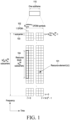
- FIG. 1 illustrates a basic structure of a time-frequency domain, which is a radio resource domain used to transmit data or control channels, in a 5G system.
- the horizontal axis denotes a time domain
- the vertical axis denotes a frequency domain.
- the basic unit of resources in the time-frequency domain is a resource element (RE) 101, which may be defined as one orthogonal frequency division multiplexing (OFDM) symbol 102 on the time axis and one subcarrier 103 on the frequency axis.
- OFDM orthogonal frequency division multiplexing
- N SC RB for example, 12
- consecutive REs may constitute one resource block (RB) 104.
- ⁇ is the number of OFDM symbols per subframe 110 for subcarrier spacing configuration ( ⁇ ), and the resource structure in the 5G system may make reference to the TS 38 211 section 4 standard.
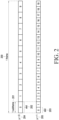
- FIG. 2 illustrates a structure of a frame, a subframe, and a slot in a wireless communication system according to an embodiment of the disclosure.
- FIG. 2 An example of a structure of a frame 200, a subframe 201, and a slot 202 is illustrated in FIG. 2 .
- One frame 200 may be defined as 10ms.
- One subframe 201 may be defined as 1ms, and thus one frame 200 may include a total of ten subframes 201.
- One subframe 201 may include one or multiple slots 202 and 203, and the number of slots 202 and 203 per one subframe 201 may vary depending on configuration values ⁇ for the subcarrier spacing 204 or 205. The example in FIG.
- N slot subframe , ⁇ and N slot frame , ⁇ may be defined according to each subcarrier spacing configuration value ⁇ as in Table 1 below. [Table 1] ⁇ N symb slot N slot frame , ⁇ N slot subframe , ⁇ 0 14 10 1 1 14 20 2 2 14 40 4 3 14 80 8 4 14 160 16 5 14 320 32
- bandwidth part (BWP) configuration in a 5G communication system will be described in detail with reference to the accompanying drawings.
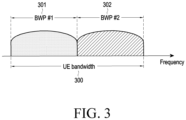
- FIG. 3 illustrates an example of a bandwidth part configuration in a wireless communication system according to an embodiment of the disclosure.
- FIG. 3 illustrates an example in which a UE bandwidth 300 is configured to include two bandwidth parts, that is, bandwidth part #1 (BWP#1) 301 and bandwidth part #2 (BWP#2) 302.
- a base station may configure one or multiple bandwidth parts for a UE, and may configure the following pieces of information with regard to each bandwidth part as given in Table 2 below.
- locationAndBandwidth refers to the location and bandwidth of a corresponding bandwidth part in the frequency domain
- subcarrierSpacing refers to a subcarrier spacing to be used in the corresponding bandwidth part
- cyclicPrefix refers to whether ab extended cyclic prefix (CP) is used for the corresponding bandwidth part.
- the base station may transfer the configuration information to the UE through upper layer signaling, for example, radio resource control (RRC) signaling.
- RRC radio resource control
- One configured bandwidth part or at least one bandwidth part among multiple configured bandwidth parts may be activated. Whether or not the configured bandwidth part is activated may be transferred from the base station to the UE semi-statically through RRC signaling, or dynamically through downlink control information (DCI).
- DCI downlink control information
- the bandwidth part-related configuration supported by 5G may be used for various purposes.
- DCI downlink control information
- DCI format 0_1 may be used as non-fallback DCI for scheduling a PUSCH, and in this case, the CRC may be scrambled by a C-RNTI.
- DCI format 0_1 in which the CRC is scrambled by a C-RNTI may include the following pieces of information given in Table 5 below, for example.
- - Frequency hopping flag - 0 or 1 bit, only for resource allocation type 1. * 0 bit if only resource allocation type 0 is configured; * 1 bit otherwise.
- - Modulation and coding scheme - 5 bits - New data indicator - 1 bit - Redundancy version - 2 bits - HARQ process number - 4 bits - 1st downlink assignment index- 1 or 2 bits * 1 bit for semi-static HARQ-ACK codebook; * 2 bits for dynamic HARQ-ACK codebook with single HARQ-ACK codebook.
- DCI format 1_1 may be used as non-fallback DCI for scheduling a PDSCH, and in this case, the CRC may be scrambled by a C-RNTI.
- DCI format 1_1 in which the CRC is scrambled by a C-RNTI may include the following pieces of information given in Table 7 below, for example.
- ZP Zero power
- CSI channel state information
- RS reference signal
- transport block 2 - Modulation and coding scheme - 5 bits - New data indicator - 1 bit - Redundancy version - 2 bits - HARQ process number - 4 bits - Downlink assignment index - 0 or 2 or 4 bits - TPC command for scheduled PUCCH - 2 bits - PUCCH resource indicator - 3 bits - PDSCH-to-HARQ_feedback timing indicator - 3 bits - Antenna ports - 4, 5 or 6 bits - Transmission configuration indication - 0 or 3 bits - SRS request -
- tci-StatesPDCCH (simply referred to as transmission configuration indication (TCI) state) configuration information may include information of one or multiple SS/PBCH block indexes or channel state information reference signal (CSI-RS) indexes, which are quasi-co-located (OCLed) with a DMRS transmitted in a corresponding CORESET.
- TCI transmission configuration indication
- CSI-RS channel state information reference signal
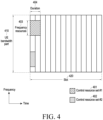
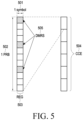
- FIG. 5 illustrates an example of a basic unit of time and frequency resources constituting a downlink control channel available in a 5G system.
- the basic unit of time and frequency resources constituting a control channel may be referred to as a resource element group (REG) 503, and the REG 503 may be defined by one OFDM symbol 501 along the time axis and one physical resource block (PRB) 502, that is, 12 subcarriers, along the frequency axis.
- the base station may configure a downlink control channel allocation unit by concatenating the REGs 503.
- one CCE 504 may include multiple REGs 503.
- the REG 503 may include 12 REs, and if one CCE 504 includes six REGs 503, one CCE 504 may then include 72 REs.
- a downlink control resource set once configured, may include multiple CCEs 504, and a specific downlink control channel may be mapped to one or multiple CCEs 504 and then transmitted according to the aggregation level (AL) in the control resource set.
- the CCEs 504 in the control resource set are distinguished by numbers, and the numbers of CCEs 504 may be allocated according to a logical mapping scheme.
- the basic unit of the downlink control channel illustrated in FIG. 5 may include both REs to which DCI is mapped, and an area to which a reference signal (DMRS 505) for decoding the same is mapped.
- DMRS 505 reference signal
- three DRMSs 503 may be transmitted inside one REG 505.
- the number of CCEs necessary to transmit a PDCCH may be 1, 2, 4, 8, or 16 according to the aggregation level (AL), and different number of CCEs may be used to implement link adaption of the downlink control channel.
- AL aggregation level
- one downlink control channel may be transmitted through L CCEs.
- the UE needs to detect a signal while being no information regarding the downlink control channel, and thus a search space indicating a set of CCEs has been defined for blind decoding.
- the search space is a set of downlink control channel candidates including CCEs which the UE needs to attempt to decode at a given AL, and since 1, 2, 4, 8, or 16 CCEs may constitute a bundle at various ALs, the UE may have multiple search spaces.
- a search space set may be defined as a set of search spaces at all configured aggregation levels.
- Search spaces may be classified into common search spaces and UE-specific search spaces.
- a group of UEs or all UEs may search a common search space of the PDCCH in order to receive cell-common control information such as dynamic scheduling regarding system information or a paging message.
- cell-common control information such as dynamic scheduling regarding system information or a paging message.
- PDSCH scheduling allocation information for transmitting an SIB including a cell operator information or the like may be received by searching the common search space of the PDCCH.
- a common search space a group of UEs or all UEs need to receive the PDCCH, and the common search space may thus be defined as a predetermined set of CCEs.
- Scheduling allocation information regarding a UE-specific PDSCH or PUSCH may be received by searching the UE-specific search space of the PDCCH.
- the UE-specific search space may be defined UE-specifically as a function of various system parameters and the identity of the UE.
- parameters for a search space regarding a PDCCH may be configured for the UE by the base station through upper layer signaling (for example, SIB, MIB, or RRC signaling).
- the base station may provide the UE with configurations such as the number of PDCCH candidates at each aggregation level L, the monitoring cycle regarding the search space, the monitoring occasion with regard to each symbol in a slot regarding the search space, the search space type (common search space or UE-specific search space), a combination of an RNTI and a DCI format to be monitored in the corresponding search space, a control resource set index for monitoring the search space, and the like.
- configuration information for the search space regarding the PDCCH may include the following pieces of information given in Table 9 below.
- the base station may configure one or multiple search space sets for the UE.
- the base station may configure search space set 1 and search space set 2 for the UE, may configure DCI format A scrambled by an X-RNTI to be monitored in a common search space in search space set 1, and may configure DCI format B scrambled by a Y-RNTI to be monitored in a UE-specific search space in search space set 2.
- X-RNTI and Y-RNTI "X" and "Y” may correspond to one of various RNTIs described in the disclosure.
- Combinations of DCI formats and RNTIs given below may be monitored in a common search space. Obviously, the examples given below are not limiting.
- Enumerated RNTIs may follow the definition and usage given below.
- the search space at aggregation level L in connection with control resource set p and search space set s may be expressed by Equation 1 below.
- the Y p , n s , f ⁇ value may correspond to 0 in the case of a common search space.
- the Y p , n s , f ⁇ value may correspond to a value changed by the UE's identity (C-RNTI or ID configured for the UE by the base station) and the time index in the case of a UE-specific search space.
- multiple search space sets may be configured by different parameters (for example, parameters in Table 9), and the group of search space sets monitored by the UE at each timepoint may differ accordingly. For example, if search space set #1 is configured at X-slot periodicity, if search space set #2 is configured at Y-slot periodicity, and if X and Y are different, the UE may monitor search space set #1 and search space set #2 both in a specific slot, and may monitor one of search space set #1 and search space set #2 both in another specific slot.
- search space sets configured for a UE
- the following conditions may be considered in connection with a method for determining a search space set to be monitored by the UE.
- the UE defines maximum values regarding the number of PDCCH candidates that can be monitored and the number of CCEs constituting the entire search space (as used herein, the entire search space refers to the entire CCE set corresponding to a union domain of multiple search space sets) with regard to each slot.
- the UE may select search space sets configured as UE-specific search spaces. If there are multiple search space sets configured as UE-specific search spaces, a search space set having a lower search space set index may have a higher priority. UE-specific search space sets may be selected as long as condition A is satisfied, in consideration of the priority.
- the UE may receive symbol sequence A based on an assumption that the same has been successively mapped to remaining resources ⁇ resource#1, resource#2, resource#4 ⁇ other than ⁇ resource#3 ⁇ (corresponding to resource C) among resource A. Consequently, the UE may perform a series of following receiving operations based on an assumption that symbol sequence ⁇ symbol#1, symbol#2, symbol#4 ⁇ has been transmitted after being mapped to ⁇ resource#1, resource#2, resource#4 ⁇ , respectively.
- the base station may map symbol sequence A to the entire resource A, but may not perform transmission in the resource area corresponding to resource C, and may perform transmission with regard to only the remaining resource area other than resource C among resource A.
- the UE may assume that symbol sequence A ⁇ symbol#1, symbol#2, symbol#3, symbol4 ⁇ is mapped to resource A ⁇ resource#1, resource#2, resource#3, resource#4 ⁇ , respectively, but ⁇ symbol#3 ⁇ mapped to ⁇ resource#3 ⁇ (corresponding to resource C) is not transmitted, and based on the assumption that symbol sequence ⁇ symbol#1, symbol#2, symbol#4 ⁇ corresponding to remaining resources ⁇ resource#1, resource#2, resource#4 ⁇ other than ⁇ resource#3 ⁇ (corresponding to resource C) among resource A has been mapped and transmitted, the UE may receive the same. Consequently, the base station may transmit symbol sequence ⁇ symbol#1, symbol#2, symbol#4 ⁇ after mapping the same to
- the UE may assess resource A and resource B from scheduling information regarding symbol sequence A from the base station, thereby assessing resource C (region in which resource A and resource B overlap).
- the UE may receive symbol sequence A, based on an assumption that symbol sequence A has been mapped to the entire resource A but transmitted only in the remaining area other than resource C among the resource area A.
- the UE may assume that symbol sequence A ⁇ symbol#1, symbol#2, symbol#3, symbol4 ⁇ is mapped to resource A ⁇ resource#1, resource#2, resource#3, resource#4 ⁇ , respectively, but ⁇ symbol#3 ⁇ mapped to ⁇ resource#3 ⁇ (corresponding to resource C) is not transmitted, and based on the assumption that symbol sequence ⁇ symbol#1, symbol#2, symbol#4 ⁇ corresponding to remaining resources ⁇ resource#1, resource#2, resource#4 ⁇ other than ⁇ resource#3 ⁇ (corresponding to resource C) among resource A has been mapped and transmitted, the UE may receive the same. Consequently, the UE may perform a series of following receiving operations based on an assumption that symbol sequence ⁇ symbol#1,
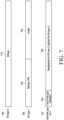
- the base station may rate-match and transmit the PDSCH 602 in a rate matching resource 601 part, and the UE may perform reception and decoding after assuming that the PDSCH 602 has been rate-matched in a rate matching resource 601 part.
- the UE may have a maximum of four RateMatchPatterns configured per each bandwidth part through upper layer signaling, and one RateMatchPattern may include the following contents.
- the UE may have the following contents configured through upper layer signaling.
- the pattern of cell-specific reference signal (CRS) of LTE may be configured for an NR UE. More specifically, the CRS pattern may be provided by RRC signaling including at least one parameter inside ServingCellConfig IE (information element) or ServingCellConfigCommon IE.
- Examples of the parameter may include lte-CRS-ToMatchAround, lte-CRS-PatternList1-r16, lte-CRS-PatternList2-r16, crs-RateMatch-PerCORESETPoolIndex-r16, and the like.
- Table 11 shows a ServingCellConfig IE including the CRS patterns
- Table 12 shows a RateMatchPatternLTE-CRS IE including at least one parameter regarding CRS patterns.
- partial downlink control information (DCI) for allocating a PDSCH to the UE includes a bitmap 715 including NRBG bits.
- N RBG refers to the number of resource block groups (RBGs) determined according to the BWP size allocated by a BWP indicator and upper layer parameter rbg-Size, as in Table 17 below, and data is transmitted in RBGs indicated as "1" by the bitmap.
- RBGs resource block groups
- partial DCI includes frequency domain resource allocation information including log 2 N RB DL , BWP N RB DL , BWP + 1 / 2 bits. The conditions for this will be described again later.
- the base station may thereby configure a starting virtual resource block (starting VRB) 720 and the length 725 of a frequency domain resource allocated continuously therefrom.
- starting VRB starting virtual resource block
- partial DCI for allocating a PDSCH to the corresponding UE includes frequency domain resource allocation information including as many bits as the larger value %n between the payload 715 for configuring resource type 0 and the payload 720 and 725 for configuring resource type 1.
- MSB foremost part
- a base station may configure a table for time domain resource allocation information regarding a physical downlink shared channel (PDSCH) and a physical uplink shared channel (PUSCH) for a UE through upper layer signaling (for example, RRC signaling).
- PDSCH physical downlink shared channel
- PUSCH physical uplink shared channel
- the time domain resource allocation information may include PDCCH-to-PDSCH slot timing (for example, corresponding to a slot-unit time interval between a timepoint at which a PDCCH is received and a timepoint at which a PDSCH scheduled by the received PDCCH is transmitted; labeled K0), PDCCH-to-PUSCH slot timing (for example, corresponding to a slot-unit time interval between a timepoint at which a PDCCH is received and a timepoint at which a PUSCH scheduled by the received PDCCH is transmitted; hereinafter, labeled K2), information regarding the location and length of the start symbol by which a PDSCH or PUSCH is scheduled inside a slot, the mapping type of a PDSCH or PUSCH, and the like. For example, information such as in Table 18 or Table 19 below may be transmitted from the base station to the UE.
- the base station may notify the UF of one of the entries of the table regarding time domain resource allocation information described above through L1 signaling (for example, DCI) (for example, "time domain resource allocation" field in DCI may indicate the same).
- the UE may acquire time domain resource allocation information regarding a PDSCH or PUSCH, based on the DCI acquired from the base station.
- PUSCH transmission may be dynamically scheduled through DCI format 0_0 or 0_1, and may be semi-statically configured by a configured grant. If a codebook-based PUSCH is dynamically scheduled through DCI format 0_1 or configured semi-statically by a configured grant, the UE determines a precoder for PUSCH transmission, based on an SRS resource indicator (SRI), a transmission precoding matrix indicator (TPMI), and a transmission rank (the number of PUSCH transmission layers).
- SRI SRS resource indicator
- TPMI transmission precoding matrix indicator
- the UE transmits, to the base station, one or multiple SRS resources included in the SRS resource set wherein the value of usage is configured as "codebook" according to upper signaling, and the base station selects one from the SRS resources transmitted by the UE and indicates the UE to be able to transmit a PUSCH by using transmission beam information of the corresponding SRS resource.
- the SRI is used as information for selecting the index of one SRS resource, and is included in DCI.
- the base station adds information indicating the rank and TPMI to be used by the UE for PUSCH transmission to the DCI.
- the UE applies, in performing PUSCH transmission, the precoder indicated by the rank and TPMI indicated based on the transmission beam of the corresponding SRS resource, thereby performing PUSCH transmission.
- the connected NZP CSI-RS may be indicated through associatedCSI-RS inside SRS-ResourceSet (upper signaling).
- the UE does not expect that spatialRelationInfo which is upper signaling regarding the SRS resource and associatedCSI-RS inside SRS-ResourceSet (upper signaling) will be configured together.
- the UE may determine a precoder to be applied to PUSCH transmission and the transmission rank, based on an SRI indicated by the base station.
- the SRI may be indicated through the SRS resource indicator (a field inside DCI) or configured through srs-ResourceIndicator (upper signaling).
- the SRS resource indicated by the corresponding SRI refers to the SRS resource corresponding to the SRI, among SRS resources transmitted prior to the PDCCH including the corresponding SRI.
- the UE may use one or multiple SRS resources for SRS transmission, and the maximum number of SRS resources that can be transmitted simultaneously in the same symbol inside one SRS resource set and the maximum number of SRS resources are determined by UE capability reported to the base station by the UE. SRS resources simultaneously transmitted by the UE occupy the same RB.
- the UE configures one SRS port for each SRS resource. There may be only one configured SRS resource set wherein the value of usage inside SRS-ResourceSet (upper signaling) is "nonCodebook", and a maximum of four SRS resources may be configured for non-codebook-based PUSCH transmission.
- the base station may transmit one NZP-CSI-RS connected to the SRS resource set to the UE, and the UE may calculate the precoder to be used when transmitting one or multiple SRS resources inside the corresponding SRS resource set, based on the result of measurement when the corresponding NZP-CSI-RS is received.
- the UE applies the calculated precoder when transmitting, to the base station, one or multiple SRS resources inside the SRS resource set wherein the configured usage value is "nonCodebook", and the base station selects one or multiple SRS resources from the received one or multiple SRS resources.
- the SRI indicates an index that may express one SRS resource or a combination of multiple SRS resources, and the SRI is included in DCI.
- the number of SRS resources indicated by the SRI transmitted by the base station may be the number of transmission layers of the PUSCH, and the UE transmits the PUSCH by applying the precoder applied to SRS resource transmission to each layer.
- a PUSCH preparation procedure time will be described. If a base station schedules a UE so as to transmit a PUSCH by using DCI format 0_0, 0_1, or 0_2, the UE may require a PUSCH preparation procedure time such that a PUSCH is transmitted by applying a transmission method (SRS resource transmission precoding method, the number of transmission layers, spatial domain transmission filter) indicated through DCI.
- the PUSCH preparation procedure time is defined in NR in consideration thereof.
- the PUSCH preparation procedure time of the UE may follow Equation 2 given below.
- T proc , 2 max N 2 + d 2 , 1 + d 2 2048 + 144 ⁇ 2 ⁇ ⁇ T c + T ext + T switch , d 2 , 2
- Equation 2 Each parameter in T proc,2 described above in Equation 2 may have the following meaning.
- the base station and the UE determine that the PUSCH preparation procedure time is insufficient if the first symbol of a PUSCH starts earlier than the first uplink symbol in which a CP starts after Tproc,2 from the last symbol of a PDCCH including DCI that schedules the PUSCH, in view of the influence of timing advance between the uplink and the downlink and time domain resource mapping information of the PUSCH scheduled through the DCI. Otherwise, the base station and the UE determine that the PUSCH preparation procedure time is sufficient. The UE may transmit the PUSCH only if the PUSCH preparation procedure time is sufficient, and may ignore the DCI that schedules the PUSCH if the PUSCH preparation procedure time is insufficient.
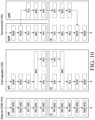
- FIG. 10 illustrates radio protocol structures of a base station and a UE in single cell, carrier aggregation, and dual connectivity situations according to an embodiment of the disclosure.
- a radio protocol of a mobile communication system includes an NR service data adaptation protocol (SDAP) S25 or S70, an NR packet data convergence protocol (PDCP) S30 or S65, an NR radio link control (RLC) S35 or S60, and an NR medium access controls (MAC) S40 or S55, on each of UE and NR base station sides.
- SDAP NR service data adaptation protocol
- PDCP packet data convergence protocol
- RLC radio link control
- MAC medium access controls
- the main functions of the NR SDAP S25 or S70 may include some of functions below.
- the UE may be configured, through an RRC message, whether to use the header of the SDAP layer device or whether to use functions of the SDAP layer device for each PDCP layer device or each bearer or each logical channel, and if an SDAP header is configured, the non-access stratum (NAS) QoS reflection configuration 1-bit indicator (NAS reflective QoS) and the AS QoS reflection configuration 1-bit indicator (AS reflective QoS) of the SDAP header may be indicated so that the UE can update or reconfigure mapping information regarding the QoS flow and data bearer of the uplink and downlink.
- the SDAP header may include QoS flow ID information indicating the QoS.
- the QoS information may be used as data processing priority, scheduling information, etc. for smoothly supporting services.
- the main functions of the NR PDCP S30 or S65 may include some of functions below.
- the above-mentioned reordering of the NR PDCP device refers to a function of reordering PDCP PDUs received from a lower layer in an order based on the PDCP sequence number (SN), and may include a function of transferring data to an upper layer in the reordered sequence.
- the reordering of the NR PDCP device may include a function of instantly transferring data without considering the order, may include a function of recording PDCP PDUs lost as a result of reordering, may include a function of reporting the state of the lost PDCP PDUs to the transmitting side, and may include a function of requesting retransmission of the lost PDCP PDUs.
- the main functions of the NR RLC S35 or S60 may include some of functions below.
- the in-sequence delivery of the NR RLC refers to a function of delivering RLC SDUs, received from the lower layer, to the upper layer in sequence.
- the in-sequence delivery of the NR RLC may include a function of reassembling and delivering multiple RLC SDUs received, into which one original RLC SDU has been segmented, may include a function of reordering the received RLC PDUs with reference to the RLC sequence number (SN) or PDCP sequence number (SN), may include a function of recording RLC PDUs lost as a result of reordering, may include a function of reporting the state of the lost RLC PDUs to the transmitting side, and may include a function of requesting retransmission of the lost RLC PDUs.
- the in-sequence delivery function of the NR RLC may include a function of, if there is a lost RLC SDU, successively delivering only RLC SDUs before the lost RLC SDU to the upper layer, and may include a function of, if a predetermined timer has expired although there is a lost RLC SDU, successively delivering all RLC SDUs received before the timer was started to the upper layer.
- the in-sequence delivery of the NR RLC device may include a function of, if a predetermined timer has expired although there is a lost RLC SDU, successively delivering all currently received RLC SDUs to the upper layer.
- the in-sequence delivery of the NR RLC device may include a function of processing RLC PDUs in the received order (regardless of the sequence number order, in the order of arrival) and delivering same to the PDCP device regardless of the order (out-of-sequence delivery), and may include a function of, in the case of segments, receiving segments which are stored in a buffer or which are to be received later, reconfiguring same into one complete RLC PDU, processing, and delivering same to the PDCP device.
- the NR RLC layer may include no concatenation function, which may be performed in the NR MAC layer or replaced with a multiplexing function of the NR MAC layer.
- the out-of-sequence delivery of the NR RLC refers to a function of instantly delivering RLC SDUs received from the lower layer to the upper layer regardless of the order, may include a function of, if multiple RLC SDUs received, into which one original RLC SDU has been segmented, are received, reassembling and delivering the same, and may include a function of storing the RLC SN or PDCP SN of received RLC PDUs, and recording RLC PDUs lost as a result of reordering.
- the NR MAC S40 or S55 may be connected to multiple NR RLC layer devices configured in one UE, and the main functions of the NR MAC may include some of functions below.
- An NR PHY layer S45 or S50 may perform operations of channel-coding and modulating upper layer data, thereby obtaining OFDM symbols, and delivering the same through a radio channel, or demodulating OFDM symbols received through the radio channel, channel-decoding the same, and delivering the same to the upper layer.
- the detailed structure of the radio protocol structure may be variously changed according to the carrier (or cell) operating scheme.
- the base station and the UE use a protocol structure having a single structure with regard to each layer, such as reference numeral 1010 in FIG. 10 .
- the base station and the UE may use a protocol structure which has a single structure up to the RLC, but multiplexes the PHY layer through a MAC layer, such as reference numeral 1020 in FIG. 10 .
- the base station and the UE may use a protocol structure which has a single structure up to the RLC, but multiplexes the PHY layer through a MAC layer, such as reference numeral 1030 in FIG. 10 .
- FIG. 11 illustrates an example of allocating a PUCCH resource through a PDCCH according to an embodiment of the disclosure.
- the base station may allocate a PUCCH resource 1110 by using DCI transmitted through a PDCCH 1100.
- the UE may receive the DCI by blind-decoding multiple PDCCH candidates 1105 including CCEs in a search space, and may transmit the PUCCH by using a resource allocated through the DCI.
- upper signaling is a method for transferring signals from a base station to a UE by using a downlink data channel of a physical layer, or from the UE to the base station by using an uplink data channel of the physical layer, and may also be referred to as "RRC signaling", “PDCP signaling”, or “medium access control (MAC) control element (MAC CE)".
- RRC signaling PDCP signaling
- MAC CE medium access control control element
- the UE may use various methods to determine whether or not to apply cooperative communication, for example, PDCCH(s) that allocates a PDSCH to which cooperative communication is applied have a specific format, or PDCCH(s) that allocates a PDSCH to which cooperative communication is applied include a specific indicator indicating whether or not to apply cooperative communication, or PDCCH(s) that allocates a PDSCH to which cooperative communication is applied are scrambled by a specific RNTI, or cooperative communication application is assumed in a specific range indicated by an upper layer.
- NC-JT case refers to a case in which the UE receives a PDSCH to which cooperative communication is applied, based on conditions similar to those described above.
- determining priority between A and B may be variously described as, for example, selecting an entity having a higher priority according to a predetermined priority rule and performing an operation corresponding thereto, or omitting or dropping operations regarding an entity having a lower priority.
- upper layer signaling may refer to signaling corresponding to at least one signaling among the following signaling, or a combination of one or more thereof.
- L1 signaling may refer to signaling corresponding to at least one signaling method among signaling methods using the following physical layer channels or signaling, or a combination of one or more thereof.
- determining priority between A and B may be variously described as, for example, selecting an entity having a higher priority according to a predetermined priority rule and performing an operation corresponding thereto, or omitting or dropping operations regarding an entity having a lower priority.
- SBFD subband non-overlapping full duplex
- TDD band spectrum of a frequency equal to or lower than 6 GHz, or equal to or higher than 6 GHz.
- the uplink coverage of a UE may be expanded as much as the amount of increased uplink transmission resources, and a base station may receive feedback relating to downlink transmission from the UE in the expanded uplink resources, so as to reduce feedback delay.
- the UE may receive, from the base station, information on whether SBFD is supported, and a UE capable of performing uplink transmission in some of downlink resources may be referred to as an SBFD UE (SBFD-capable UE) for convenience.
- the SBFD scheme may be defined in the standard, and the following schemes may be considered for the SBFD UE to determine whether SBFD is supported in a specific cell (or a frequency or a frequency band).
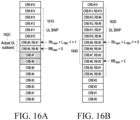
- This example describes a method for indicating frequency resource information of an SBFD subband with a maximum number of RBs limited to L RBs max within a DL BWP having a size of L RBs max PRB by using a frequency resource transmission start virtual RB (RB start ) and an RB length (L RBs ) of the subband.
- RB start frequency resource transmission start virtual RB
- L RBs RB length
- the length of one RB constituting an SBFD UL subband may be determined according to a numerology of the SBFD UL subband.
- the numerology of the SBFD UL subband may need to be selected based on SBFD subband configuration information such as a DL subband and a UL region.
- the following first and second embodiments may be given as a method for configuring a numerology of an SBFD UL subband.
- This example describes a method capable of configuring a numerology of an SBFD subband when a partial bandwidth-specific SBFD system is operated.
- An SBFD UE in an RRC_CONNECTED state may operate as a partial bandwidth-specific SBFD system, and SBFD configuration information may be received by the SBFD UE through a dedicated RRC signal.
- a reference point of an RIV may be the smallest VRB value of a DL BWP.
- a DL subband sharing the same time resource as an SBFD UL subband and a UL region used only for UL transmission may use a different numerology.
- the SBFD UL subband may prevent the occurrence of a resource grid alignment problem by using a larger numerology among the two numerologies used. In this case, it may be configured to the total number of RBs constituting the DL BWP.
- FIG. 17 illustrates a structure of a UE in a wireless communication system according to an embodiment of the disclosure.
- the UE may include a transceiver, which refers to a UE receiver 1700 and a UE transmitter 1710 as a whole, a memory (not illustrated), and a UE processor 1705 (or UE controller or processor).
- the UE transceiver 1700 and 1710, the memory, and the UE processor 1705 may operate according to the above-described communication methods of the UE.
- the UE processor 1705 may control operations of the UE according to not only the above-described respective embodiments in FIG. 1 to FIG. 16B but also combinations of at least one thereof.
- Components of the UE are not limited to the above-described example.
- the UE may include a larger or smaller number of components than the above-described components.
- the transceiver, the memory, and the processor may be implemented in the form of a single chip.
- the transceiver may transmit/receive signals with the base station.
- the signals may include control information and data.
- the transceiver may include an RF transmitter configured to up-convert and amplify the frequency of transmitted signals, an RF receiver configured to low-noise-amplify received signals and down-convert the frequency thereof, and the like.
- this is only an embodiment of the transceiver, and the components of the transceiver are not limited to the RF transmitter and the RF receiver.
- the transceiver may receive signals through a radio channel, output the same to the processor, and transmit signals output from the processor through the radio channel.
- the memory may store programs and data necessary for operations of the UE.
- the memory may store control information or data included in signals transmitted/received by the UE.
- the memory may include a storage medium such as a ROM, a RAM, a hard disk, a CD-ROM, or a DVD, or a combination of storage media.
- the memory may include multiple memories.
- the processor may control a series of processes such that the UE can operate according to the above-described embodiments.
- the processor may control components of the UE to receive DCI configured in two layers so as to simultaneously receive multiple PDSCHs.
- the processor may include multiple processors, and the processor may perform operations of controlling the components of the UE by executing programs stored in the memory.
- FIG. 18 illustrates a structure of a base station in a wireless communication system according to an embodiment of the disclosure.
- the base station may include a transceiver, which refers to a base station receiver 1800 and a base station transmitter 1810 as a whole, a memory (not illustrated), and a base station processor 1805 (or base station controller or processor).
- the base station transceiver 1800 and 1810, the memory, and the base station processor 1805 may operate according to the above-described communication methods of the base station.
- the base station processor 1705 may control operations of the base station according to not only the above-described respective embodiments in FIG. 1 to FIG.16B but also combinations of at least one thereof.
- components of the base station are not limited to the above-described example.
- the base station may include a larger or smaller number of components than the above-described components.
- the transceiver, the memory, and the processor may be implemented in the form of a single chip.
- the transceiver may transmit/receive signals with the UE.
- the signals may include control information and data.
- the transceiver may include an RF transmitter configured to up-convert and amplify the frequency of transmitted signals, an RF receiver configured to low-noise-amplify received signals and down-convert the frequency thereof, and the like.
- this is only an embodiment of the transceiver, and the components of the transceiver are not limited to the RF transmitter and the RF receiver.
- the transceiver may receive signals through a radio channel, output the same to the processor, and transmit signals output from the processor through the radio channel.
- the memory may store programs and data necessary for operations of the base station.
- the memory may store control information or data included in signals transmitted/received by the base station.
- the memory may include storage media such as a ROM, a RAM, a hard disk, a CD-ROM, and a DVD, or a combination of storage media.
- the memory may include multiple memories.
- the processor may control a series of processes such that the base station can operate according to the above-described embodiments of the disclosure.
- the processor may control components of the base station to configure DCI configured in two layers including allocation information regarding multiple PDSCHs and to transmit the same.
- the processor may include multiple processors, and the processor may perform operations of controlling the components of the base station by executing programs stored in the memory.
- a computer-readable storage medium for storing one or more programs (software modules) may be provided.
- the one or more programs stored in the computer-readable storage medium may be configured for execution by one or more processors within the electronic device.
- the at least one program includes instructions that cause the electronic device to perform the methods according to various embodiments of the disclosure as defined by the appended claims and/or disclosed herein.
- These programs may be stored in non-volatile memories including a random access memory and a flash memory, a read only memory (ROM), an electrically erasable programmable read only memory (EEPROM), a magnetic disc storage device, a compact disc-ROM (CD-ROM), digital versatile discs (DVDs), or other type optical storage devices, or a magnetic cassette.
- ROM read only memory
- EEPROM electrically erasable programmable read only memory
- CD-ROM compact disc-ROM
- DVDs digital versatile discs
- any combination of some or all of them may form a memory in which the program is stored.
- a plurality of such memories may be included in the electronic device.
- the programs may be stored in an attachable storage device which can access the electronic device through communication networks such as the Internet, Intranet, Local Area Network (LAN), Wide LAN (WLAN), and Storage Area Network (SAN) or a combination thereof.
- a storage device may access the electronic device via an external port.
- a separate storage device on the communication network may access a portable electronic device.
- an element included in the disclosure is expressed in the singular or the plural according to presented detailed embodiments.
- the singular form or plural form is selected appropriately to the presented situation for the convenience of description, and the disclosure is not limited by elements expressed in the singular or the plural. Therefore, either an element expressed in the plural may also include a single element or an element expressed in the singular may also include multiple elements.
Landscapes
- Engineering & Computer Science (AREA)
- Signal Processing (AREA)
- Computer Networks & Wireless Communication (AREA)
- Physics & Mathematics (AREA)
- Mathematical Physics (AREA)
- Mobile Radio Communication Systems (AREA)
Applications Claiming Priority (2)
| Application Number | Priority Date | Filing Date | Title |
|---|---|---|---|
| KR1020220125864A KR20240045920A (ko) | 2022-09-30 | 2022-09-30 | 무선 통신 시스템에서 전이중 통신을 위한 주파수 자원을 설정하는 방법 및 장치 |
| PCT/KR2023/015001 WO2024072085A1 (ko) | 2022-09-30 | 2023-09-27 | 무선 통신 시스템에서 전이중 통신을 위한 주파수 자원을 설정하는 방법 및 장치 |
Publications (2)
| Publication Number | Publication Date |
|---|---|
| EP4580282A1 true EP4580282A1 (de) | 2025-07-02 |
| EP4580282A4 EP4580282A4 (de) | 2025-12-24 |
Family
ID=90478634
Family Applications (1)
| Application Number | Title | Priority Date | Filing Date |
|---|---|---|---|
| EP23873194.7A Pending EP4580282A4 (de) | 2022-09-30 | 2023-09-27 | Verfahren und vorrichtung zur konfiguration von frequenzressourcen für vollduplexkommunikation in einem drahtloskommunikationssystem |
Country Status (4)
| Country | Link |
|---|---|
| EP (1) | EP4580282A4 (de) |
| KR (1) | KR20240045920A (de) |
| CN (1) | CN119923927A (de) |
| WO (1) | WO2024072085A1 (de) |
Families Citing this family (2)
| Publication number | Priority date | Publication date | Assignee | Title |
|---|---|---|---|---|
| WO2025208621A1 (en) * | 2024-04-05 | 2025-10-09 | Nokia Shanghai Bell Co., Ltd. | Frequency structure determination for sbfd |
| WO2025234768A1 (ko) * | 2024-05-10 | 2025-11-13 | 현대자동차주식회사 | Sbfd 동작을 지원하는 통신 시스템에서 자원 할당의 방법 및 장치 |
Family Cites Families (2)
| Publication number | Priority date | Publication date | Assignee | Title |
|---|---|---|---|---|
| WO2022072506A1 (en) * | 2020-09-29 | 2022-04-07 | Ofinno, Llc | Frequency hopping operation for new radio |
| US11997052B2 (en) * | 2020-10-05 | 2024-05-28 | Qualcomm Incorporated | Interleaved uplink-downlink transmissions in full-duplex using unlicensed resources |
-
2022
- 2022-09-30 KR KR1020220125864A patent/KR20240045920A/ko active Pending
-
2023
- 2023-09-27 CN CN202380068308.7A patent/CN119923927A/zh active Pending
- 2023-09-27 EP EP23873194.7A patent/EP4580282A4/de active Pending
- 2023-09-27 WO PCT/KR2023/015001 patent/WO2024072085A1/ko not_active Ceased
Also Published As
| Publication number | Publication date |
|---|---|
| EP4580282A4 (de) | 2025-12-24 |
| CN119923927A (zh) | 2025-05-02 |
| WO2024072085A1 (ko) | 2024-04-04 |
| KR20240045920A (ko) | 2024-04-08 |
Similar Documents
| Publication | Publication Date | Title |
|---|---|---|
| EP4503833A1 (de) | Verfahren und vorrichtung für direktzugriff in einem drahtloskommunikationssystem | |
| US20250267667A1 (en) | Method and apparatus for transmitting uplink control channel in wireless communication system | |
| EP4072057A1 (de) | Verfahren und gerät zum senden oder empfangen eines referenzsignals in einem drahtlosen kommunikationssystem | |
| EP4287725A1 (de) | Verfahren und vorrichtung zur zeit- und phasensynchronisation zwischen basisstationen in einer kooperativen netzwerkkommunikation | |
| US12177792B2 (en) | Method and apparatus for reporting uplink power headroom in wireless communication system | |
| US12439407B2 (en) | Method and apparatus for data transmission in network cooperative communications | |
| US12549301B2 (en) | Method and apparatus for transmitting/receiving uplink data repetitions for network cooperative communications | |
| US20230007504A1 (en) | Method and apparatus for selection of radio link monitoring reference resource in network cooperative communications | |
| EP4580081A1 (de) | Verfahren und vorrichtung zur auswahl eines antennenmodus für vollduplexkommunikation in einem drahtloskommunikationssystem | |
| US20240267919A1 (en) | Method and apparatus for performing sbfd based communication in wireless communication systems | |
| US20250274961A1 (en) | Method and device for uplink simultaneous transmission with multi-panel in wireless communication system | |
| EP4580282A1 (de) | Verfahren und vorrichtung zur konfiguration von frequenzressourcen für vollduplexkommunikation in einem drahtloskommunikationssystem | |
| EP4598219A1 (de) | Planungsverfahren und -vorrichtung für vollduplexkommunikation in einem drahtloskommunikationssystem | |
| EP4568384A1 (de) | Planungsverfahren und -vorrichtung für vollduplexkommunikation in einem drahtloskommunikationssystem | |
| US20240251423A1 (en) | Method and apparatus of antenna switching in wireless communication systems | |
| US12452868B2 (en) | Method and apparatus for receiving physical downlink control channel and transmitting uplink control channel in wireless communication systems | |
| US20250133563A1 (en) | Method and apparatus for transmitting uplink control information in wireless communication systems | |
| EP4651579A1 (de) | Verfahren und vorrichtung zur energieeinsparung einer basisstation in einem drahtloskommunikationssystem | |
| US20240373441A1 (en) | Method and apparatus for determining resource block set in wireless communication systems | |
| EP4366221A1 (de) | Verfahren und vorrichtung für wiederholungsschema für downlink-datenkanal in kommunikationssystemen | |
| US20230345484A1 (en) | Method and apparatus for multi-cell scheduling and harq-ack transmission in wireless communication system | |
| EP4604436A1 (de) | Verfahren und vorrichtung für referenzsignalübertragung/-empfang und ratenanpassung für vollduplexkommunikation in einem drahtloskommunikationssystem | |
| EP4645987A1 (de) | Verfahren und vorrichtung zum senden und empfangen eines downlink-datenkanals in einer kooperativen netzwerkkommunikation | |
| EP4598189A1 (de) | Verfahren und vorrichtung zur konfiguration einer zeitressource für vollduplexkommunikation in einem drahtloskommunikationssystem | |
| EP4601231A1 (de) | Verfahren und vorrichtung zum senden/empfangen eines datenkanals für vollduplexkommunikation in einem drahtloskommunikationssystem |
Legal Events
| Date | Code | Title | Description |
|---|---|---|---|
| STAA | Information on the status of an ep patent application or granted ep patent |
Free format text: STATUS: THE INTERNATIONAL PUBLICATION HAS BEEN MADE |
|
| PUAI | Public reference made under article 153(3) epc to a published international application that has entered the european phase |
Free format text: ORIGINAL CODE: 0009012 |
|
| STAA | Information on the status of an ep patent application or granted ep patent |
Free format text: STATUS: REQUEST FOR EXAMINATION WAS MADE |
|
| 17P | Request for examination filed |
Effective date: 20250325 |
|
| AK | Designated contracting states |
Kind code of ref document: A1 Designated state(s): AL AT BE BG CH CY CZ DE DK EE ES FI FR GB GR HR HU IE IS IT LI LT LU LV MC ME MK MT NL NO PL PT RO RS SE SI SK SM TR |
|
| A4 | Supplementary search report drawn up and despatched |
Effective date: 20251120 |
|
| RIC1 | Information provided on ipc code assigned before grant |
Ipc: H04W 72/04 20230101AFI20251114BHEP Ipc: H04L 5/14 20060101ALI20251114BHEP Ipc: H04L 27/26 20060101ALI20251114BHEP |
|
| DAV | Request for validation of the european patent (deleted) | ||
| DAX | Request for extension of the european patent (deleted) |