EP4580262A1 - Kommunikationsverfahren und -vorrichtung, speichermedium und chipsystem - Google Patents
Kommunikationsverfahren und -vorrichtung, speichermedium und chipsystem Download PDFInfo
- Publication number
- EP4580262A1 EP4580262A1 EP23870587.5A EP23870587A EP4580262A1 EP 4580262 A1 EP4580262 A1 EP 4580262A1 EP 23870587 A EP23870587 A EP 23870587A EP 4580262 A1 EP4580262 A1 EP 4580262A1
- Authority
- EP
- European Patent Office
- Prior art keywords
- time period
- channel
- type
- terminal apparatus
- pdcch
- Prior art date
- Legal status (The legal status is an assumption and is not a legal conclusion. Google has not performed a legal analysis and makes no representation as to the accuracy of the status listed.)
- Pending
Links
Images


Classifications
-
- H—ELECTRICITY
- H04—ELECTRIC COMMUNICATION TECHNIQUE
- H04W—WIRELESS COMMUNICATION NETWORKS
- H04W52/00—Power management, e.g. Transmission Power Control [TPC] or power classes
- H04W52/02—Power saving arrangements
- H04W52/0209—Power saving arrangements in terminal devices
- H04W52/0251—Power saving arrangements in terminal devices using monitoring of local events, e.g. events related to user activity
- H04W52/0258—Power saving arrangements in terminal devices using monitoring of local events, e.g. events related to user activity controlling an operation mode according to history or models of usage information, e.g. activity schedule or time of day
-
- H—ELECTRICITY
- H04—ELECTRIC COMMUNICATION TECHNIQUE
- H04W—WIRELESS COMMUNICATION NETWORKS
- H04W72/00—Local resource management
- H04W72/20—Control channels or signalling for resource management
- H04W72/23—Control channels or signalling for resource management in the downlink direction of a wireless link, i.e. towards a terminal
-
- H—ELECTRICITY
- H04—ELECTRIC COMMUNICATION TECHNIQUE
- H04W—WIRELESS COMMUNICATION NETWORKS
- H04W72/00—Local resource management
- H04W72/04—Wireless resource allocation
- H04W72/11—Semi-persistent scheduling
-
- H—ELECTRICITY
- H04—ELECTRIC COMMUNICATION TECHNIQUE
- H04W—WIRELESS COMMUNICATION NETWORKS
- H04W52/00—Power management, e.g. Transmission Power Control [TPC] or power classes
- H04W52/02—Power saving arrangements
-
- H—ELECTRICITY
- H04—ELECTRIC COMMUNICATION TECHNIQUE
- H04W—WIRELESS COMMUNICATION NETWORKS
- H04W72/00—Local resource management
- H04W72/12—Wireless traffic scheduling
-
- H—ELECTRICITY
- H04—ELECTRIC COMMUNICATION TECHNIQUE
- H04W—WIRELESS COMMUNICATION NETWORKS
- H04W74/00—Wireless channel access
- H04W74/08—Non-scheduled access, e.g. ALOHA
- H04W74/0833—Random access procedures, e.g. with 4-step access
-
- H—ELECTRICITY
- H04—ELECTRIC COMMUNICATION TECHNIQUE
- H04W—WIRELESS COMMUNICATION NETWORKS
- H04W76/00—Connection management
- H04W76/20—Manipulation of established connections
- H04W76/28—Discontinuous transmission [DTX]; Discontinuous reception [DRX]
-
- H—ELECTRICITY
- H04—ELECTRIC COMMUNICATION TECHNIQUE
- H04W—WIRELESS COMMUNICATION NETWORKS
- H04W72/00—Local resource management
- H04W72/12—Wireless traffic scheduling
- H04W72/1263—Mapping of traffic onto schedule, e.g. scheduled allocation or multiplexing of flows
- H04W72/1268—Mapping of traffic onto schedule, e.g. scheduled allocation or multiplexing of flows of uplink data flows
-
- H—ELECTRICITY
- H04—ELECTRIC COMMUNICATION TECHNIQUE
- H04W—WIRELESS COMMUNICATION NETWORKS
- H04W72/00—Local resource management
- H04W72/12—Wireless traffic scheduling
- H04W72/1263—Mapping of traffic onto schedule, e.g. scheduled allocation or multiplexing of flows
- H04W72/1273—Mapping of traffic onto schedule, e.g. scheduled allocation or multiplexing of flows of downlink data flows
Definitions
- This application relates to the field of communication technologies, and in particular, to a communication method and apparatus, a storage medium, and a chip system.
- discontinuous reception can be configured for the terminal device, so that the terminal device detects a physical downlink control channel (physical downlink control channel, PDCCH) only in a specified time period.
- PDCCH physical downlink control channel
- An existing DRX mechanism of the terminal device cannot meet a requirement on low power consumption of the network apparatus. In view of this, a solution is urgently needed to reduce power consumption of the network device.
- This application provides a communication method and apparatus, a storage medium, and a chip system, to reduce power consumption of a network device.
- the second time period may be considered as a time period in active time or active time in one cycle in the DRX mechanism of the network apparatus and/or the DTX mechanism of the network apparatus. Because the uplink channel transmission and/or downlink channel transmission is allowed in the second time period, the terminal apparatus may perform channel transmission in the second time period based on the first information, to meet a service requirement of the terminal apparatus.
- the first time period and the second time period are two time periods in one cycle, and the second time period is before the first time period.
- the first condition includes one or more of the following: in the second time period, indication information for scheduling downlink data or uplink data transmission is received; in the second time period, indication information for activating an aperiodic signal is received; in the second time period, information indicating to start a first timer is received, where an intersection of a time period indicated by the first timer and the first time period is the third time period; or a preset type of uplink channel is sent in the second time period.
- the second type may include one or more of an uplink channel corresponding to a first PDCCH or a configured granted CG PUSCH.
- the first PDCCH includes one or more of a PDCCH scrambled by a C-RNTI, a PDCCH scrambled by a CS-RNTI, a PDCCH scrambled by an MCS-C-RNT, and a PDCCH scrambled by an SP-CSI-RNTI.
- the second PDCCH includes one or more of a PDCCH scrambled by a C-RNTI, a PDCCH scrambled by a CS-RNTI, and a PDCCH scrambled by an MCS-C-RNT.
- the network apparatus and/or the terminal apparatus may be configured with the DTX mechanism of the network apparatus and the DRX mechanism of the network apparatus.
- a channel type included in the second type includes a downlink channel type and an uplink channel type. It can be learned that, in the DRX mechanism of the network apparatus, a type of a downlink channel and a type of an uplink channel that are transmitted between the terminal apparatus and the network apparatus can be controlled, so that a quantity of channels transmitted by the terminal apparatus and/or the network apparatus in the first time period can be reduced. This can reduce power consumption of the terminal apparatus and/or the network apparatus.
- the first information indicates at least one of a first cycle, first starting time, first closing time, starting duration, or closing duration.
- the first starting time is a start moment of the second time period in the first cycle
- the first closing time is a start moment of the first time period in the first cycle
- the starting duration is duration of the second time period
- the closing duration is duration of the first time period. Therefore, the solution is more compatible with the current technology.
- this application provides a communication method.
- the communication method may be performed by a terminal apparatus.
- the terminal apparatus in this application may be a terminal device, or a chip, a unit, or a module inside a terminal device.
- the terminal apparatus may be a communication apparatus having a function of a terminal device, or a chip, a unit, or a module inside a communication apparatus having a function of a terminal device.
- the terminal apparatus is a network device that may be considered as a terminal device, or a chip, a unit, or a module inside a network device that may be considered as a terminal device.
- Transmission of the first type of channel is allowed in the first time period.
- some requirements of the terminal apparatus and the network apparatus can be met.
- the terminal apparatus and/or the network apparatus do/does not need to transmit a large quantity of channels in the first time period.
- a quantity of channels transmitted by the terminal apparatus and/or the network apparatus in the first time period is reduced. This can reduce power consumption of the terminal apparatus and/or the network apparatus.
- the terminal apparatus after receiving the first information from the network apparatus, the terminal apparatus, based on the first information, skips transmitting a non-first-type of channel in the first time period.
- a quantity of channels transmitted by the terminal apparatus and/or the network apparatus in the first time period can be reduced. This reduces power consumption of the terminal apparatus and/or the network apparatus.
- a channel type included in the first type is an uplink channel type. It can be learned that, in the DRX mechanism of the network apparatus, a type of an uplink channel transmitted between the terminal apparatus and the network apparatus can be controlled, so that a quantity of channels transmitted by the terminal apparatus and/or the network apparatus in the first time period can be reduced. This can reduce power consumption of the terminal apparatus and/or the network apparatus.
- the first type includes one or more of a CG PUSCH, a HARQ-ACK for an SPS PDSCH, an SR, a PRACH, and a random access message 3.
- the network apparatus and/or the terminal apparatus may be configured with a DTX mechanism of the network apparatus.
- a channel type included in the first type is a downlink channel type. It can be learned that, in the DRX mechanism of the network apparatus, a type of a downlink channel transmitted between the terminal apparatus and the network apparatus can be controlled, so that a quantity of channels transmitted by the terminal apparatus and/or the network apparatus in the first time period can be reduced. This can reduce power consumption of the terminal apparatus and/or the network apparatus.
- the first type includes one or more of a PDCCH of a radio network temporary identifier for a network power saving cell, a PDCCH scrambled by a power saving radio network temporary identifier PS-RNTI, a synchronization signal/physical broadcast channel block SSB, system information, a paging message, a random access message 2, a random access message 4, a random access message B, beam failure recovery BFR, and a semi-persistent scheduling physical downlink shared channel SPS PDSCH.
- a PDCCH of a radio network temporary identifier for a network power saving cell a PDCCH scrambled by a power saving radio network temporary identifier PS-RNTI, a synchronization signal/physical broadcast channel block SSB, system information, a paging message, a random access message 2, a random access message 4, a random access message B, beam failure recovery BFR, and a semi-persistent scheduling physical downlink shared channel SPS PDSCH.
- the network apparatus and/or the terminal apparatus may be configured with the DTX mechanism of the network apparatus and the DRX mechanism of the network apparatus.
- a channel type included in the first type includes a downlink channel type and an uplink channel type. It can be learned that, in the DRX mechanism of the network apparatus, a type of a downlink channel and a type of an uplink channel that are transmitted between the terminal apparatus and the network apparatus can be controlled, so that a quantity of channels transmitted by the terminal apparatus and/or the network apparatus in the first time period can be reduced. This can reduce power consumption of the terminal apparatus and/or the network apparatus.
- the first information further indicates that uplink channel transmission and/or downlink channel transmission are/is allowed in a second time period.
- the terminal apparatus sends the uplink channel in the second time period.
- the terminal apparatus receives the downlink channel in the second time period.
- the second time period may be considered as a time period in active time or active time in one cycle in the DRX mechanism of the network apparatus and/or the DTX mechanism of the network apparatus. Because the uplink channel transmission and/or downlink channel transmission is allowed in the second time period, the terminal apparatus may perform channel transmission in the second time period based on the first information, to meet a service requirement of the terminal apparatus.
- the network apparatus and/or the terminal apparatus are/is configured with the DRX mechanism of the network apparatus, and the first time period and the second time period are two time periods in one cycle in the DRX mechanism of the network apparatus. There is no intersection of the second time period and the first time period in one cycle.
- a union set of the first time period and the second time period may be a universal set of one cycle in the DRX mechanism of the network apparatus.
- the terminal apparatus when a preset first condition is met, transmits a second type of channel in a third time period that is in the first time period.
- the terminal apparatus may not start the first timer, or may start the first timer.
- the terminal apparatus may start the first timer when the first condition is met, where start time of the first timer is before the second time period expires. There is the intersection of the time indicated by the first timer and the first time period, and the intersection is the third time period. Duration of the first timer may be configured by the network apparatus by using signaling or may be preset.
- the second type of channel may be the uplink channel, or may be the downlink channel, or may include the uplink channel and the downlink channel.
- the second type of channel may be the uplink channel, or may be the downlink channel, or may include the uplink channel and the downlink channel.
- the first information indicates at least one of a first cycle, first starting time, first closing time, starting duration, or closing duration.
- the first starting time is a start moment of the second time period in the first cycle
- the first closing time is a start moment of the first time period in the first cycle
- the starting duration is duration of the second time period
- the closing duration is duration of the first time period. Therefore, the solution is more compatible with the current technology.
- this application provides a communication method.
- the communication method may be performed by a terminal apparatus.
- the terminal apparatus in this application may be a terminal device, or a chip, a unit, or a module inside a terminal device.
- the terminal apparatus may be a communication apparatus having a function of a terminal device, or a chip, a unit, or a module inside a communication apparatus having a function of a terminal device.
- the terminal apparatus is a network device that may be considered as a terminal device, or a chip, a unit, or a module inside a network device that may be considered as a terminal device.
- a processing apparatus including an interface circuit and a processing circuit.
- the interface circuit may include an input circuit and an output circuit.
- the processing circuit is configured to: receive a signal by using the input circuit, and transmit a signal by using the output circuit, so that any one of the first aspect to the sixth aspect or any one of the possible implementations of the first aspect to the sixth aspect is implemented.
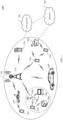
- the access network device and/or the terminal may be fixed, or may be movable.
- the access network device and the terminal may be deployed terrestrially, including an indoor device or an outdoor device, a handheld device, or a vehicle-mounted device; or may be deployed on the water; or may be deployed on an airplane, a balloon, and a satellite in the air.
- An application scenario of the access network device and the terminal is not limited in embodiments of this application.
- the access network device and the terminal device may be deployed in a same scenario or different scenarios. For example, the access network device and the terminal device are both deployed on the land; or the access network device is deployed on the land, and the terminal device is deployed on the water. Examples are not provided one by one.
- each element in the communication system may be considered as a network element in the communication system.
- a helicopter or an uncrewed aerial vehicle (the terminal 120i) in FIG. 1 may be configured as a mobile access network device.
- the terminal 120i For the terminal device 120j that accesses the radio access network 100 through the terminal 120i, the terminal 120i is an access network device.
- the terminal 120i is a terminal device.
- the access network device 110a communicates with the terminal 120i by using a radio air interface protocol.
- the access network device 110a and the terminal 120i may alternatively communicate with each other by using an interface protocol between access network devices. In this case, compared with the access network device 110a, the terminal 120i is also an access network device.
- both the access network device and the terminal device may be collectively referred to as a communication apparatus.
- the access network device 110a and the access network device 110b in FIG. 1 may be referred to as communication apparatuses having functions of the access network device, and the terminal 120a to the terminal 120j in FIG. 1 may be referred to as communication apparatuses having functions of the terminal device.
- the communication apparatus having the function of the access network device may be an access network device, a module (for example, a chip, a chip system, or a software module) in an access network device, or a control subsystem including the function of the access network device.
- the control subsystem including the function of the access network device may be a control center in a scenario in which a terminal may be used, like a smart grid, industrial control, smart transportation, or a smart city.
- the protocol layer structure may include a control plane protocol layer structure and a user plane protocol layer structure.
- the control plane protocol layer structure may include at least one of the following: a radio resource control (radio resource control, RRC) layer, a packet data convergence protocol (packet data convergence protocol, PDCP) layer, a radio link control (radio link control, RLC) layer, a media access control (media access control, MAC) layer, a physical (physical, PHY) layer, or the like.
- the user plane protocol layer structure may include at least one of the following: a service data adaptation protocol (service data adaptation protocol, SDAP) layer, a PDCP layer, an RLC layer, a MAC layer, a physical layer, or the like.
- the access network device may include a central unit (central unit, CU) and a distributed unit (distributed unit, DU). This design may be referred to as CU and DU separation.
- a plurality of DUs may be controlled by one CU in a centralized manner.
- an interface between the CU and the DU is referred to as an F1 interface.
- a control plane (control plane, CP) interface may be F1-C
- a user plane (user plane, UP) interface may be F1-U.
- a specific name of each interface is not limited in embodiments of this application. Division may be performed for the CU and the DU based on protocol layers of a wireless network.
- functions of the PDCP layer and protocol layers (such as the RRC layer and the SDAP layer) above the PDCP layer are set on the CU, and functions of protocol layers (such as the RLC layer, the MAC layer, and the PHY layer) below the PDCP layer are set on the DU.
- functions of protocol layers above the PDCP layer are set on the CU, and functions of the PDCP layer and protocol layers below the PDCP layer are set on the DU. This is not limited.
- the CU may have one or more functions of the core network.
- a radio unit (radio unit, RU) of the DU may be remotely disposed.
- the RU has a radio frequency function.
- the DU and the RU may be divided at the PHY layer.
- the DU may implement a higher-layer function of the PHY layer
- the RU may implement a lower-layer function of the PHY layer.
- functions of the PHY layer may include at least one of the following: cyclic redundancy check (cyclic redundancy check, CRC) bit addition, channel coding, rate matching, scrambling, modulation, layer mapping, precoding, resource mapping, physical antenna mapping, or a radio frequency sending function.
- functions of the PHY layer may include at least one of the following: CRC check, channel decoding, rate de-matching, descrambling, demodulation, layer demapping, channel detection, resource demapping, physical antenna demapping, or a radio frequency receiving function.
- the higher-layer functions of the PHY layer may include a part of functions of the PHY layer. For example, the part of functions are closer to the MAC layer.
- the lower-layer functions of the PHY layer may include another part of functions of the PHY layer. For example, the part of functions are closer to a radio frequency function.
- functions of the CU may be further divided, and the control plane and the user plane are separated and implemented by using different entities.
- Separated entities are a control plane CU entity (namely, a CU-CP entity) and a user plane CU entity (namely, a CU-UP entity).
- the CU-CP entity and the CU-UP entity may be separately connected to the DU.
- the entity may be understood as a module or a unit, and may exist in a form of a hardware structure, a software module, or a combination of a hardware structure and a software module. This is not limited.
- any one of the CU, the CU-CP, the CU-UP, the DU, and the RU may be a software module, a hardware structure, or a combination of the software module and the hardware structure.
- the CU, the CU-CP, the CU-UP, and the DU are software modules
- the RU is a hardware structure.
- all possible combination forms are not enumerated herein.
- These modules and methods performed by these modules also fall within the protection scope of embodiments of this application.
- the method when the method in embodiments of this application is performed by the access network device, the method may be specifically performed by at least one of the CU, the CU-CP, the CU-UP, or the DU.
- Embodiments of this application provide several possible communication methods.
- the communication methods are performed by a network apparatus and a terminal apparatus as an example for description.
- the network apparatus in embodiments of this application may be a network device, or a chip, a unit, or a module inside a network device.
- the network apparatus may be the access network device 110a or the access network device 110b in FIG. 1 .
- the network apparatus may be a communication apparatus having a network device function, or a chip, a unit, or a module inside a communication apparatus having a network device function.
- the terminal apparatus in embodiments of this application may be a terminal device, or a chip, a unit, or a module inside a terminal device, for example, may be any terminal 120 shown in FIG. 1 .
- the terminal apparatus monitors a PDCCH to check whether there is DCI from a serving cell, to perform signal transmission with a network apparatus. In many cases, the terminal apparatus does not always perform effective information exchange with a network. In this case, if the terminal apparatus continuously monitors the PDCCH, relatively large power consumption is caused. To reduce power consumption of the terminal apparatus and ensure effective data transmission, a DRX mechanism is introduced in NR. The DRX mechanism may also be understood as a DRX mechanism of the terminal apparatus. The terminal apparatus may periodically monitor the PDCCH in some time periods by using the DRX mechanism, and does not monitor the PDCCH in another time period. This implements power saving of the terminal apparatus.
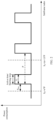
- FIG. 2 shows an example of the DRX mechanism of the terminal apparatus.
- the DRX mechanism relates to the following parameters: a DRX long cycle start offset drx-LongCycleStartOffset, a DRX slot offset drx-SlotOffset, and a DRX on duration timer drx-onDurationTimer.
- the drx-LongCycleStartOffset is used to configure a time window of a long DRX cycle (Long DRX cycle), including a period P (also referred to as a DRX period) of each time window and a start subframe offset S sf .
- the two may be in a unit of a subframe (subframe).
- the drx-SlotOffset is used to configure a start slot offset value S slot in on duration (on Duration) in a start subframe, and may be counted in a unit of a slot (Slot).
- the drx-onDurationTimer is used to configure duration T 1 of on Duration starting from a start moment, and a unit may be millisecond (ms).
- the terminal apparatus enters active time (active time) at a start moment of a start slot of a start subframe of each time window.
- active time may also be referred to as an active period, active time, or the like.
- the terminal apparatus is in an active state in the active time.
- inactive time may also be referred to as inactive time, an inactive period, or the like.
- the terminal apparatus is in an inactive state in the inactive time.
- the terminal apparatus When the terminal apparatus is configured with the DRX mechanism, and each DRX cycle arrives, the terminal apparatus first enters the active time/On Duration, and starts a DRX on duration timer (drx-onDurationTimer). After the DRX on duration timer expires, the terminal apparatus enters the inactive time. If a PDCCH for scheduling data transmission is detected in the On Duration, the terminal apparatus starts or restarts a DRX inactivity timer (drx-InactivityTimer). When the DRX inactivity timer runs, the terminal apparatus is in the active time.
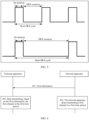
- FIG. 3 is an example of a diagram of a DRX mechanism of a terminal apparatus according to an embodiment of this application.
- the DRX mechanism has two cycle configurations: a long DRX cycle (Long DRX cycle) and a short DRX cycle (Short DRX cycle).
- DRX Command media access control channel element
- MAC CE media access control channel element
- the DTX mechanism of the network apparatus may be used, to reduce power consumption of the network apparatus.
- cell radio network temporary identifier used for data scheduling
- modulation and coding scheme cell radio network temporary identifier modulation and coding scheme cell radio network temporary identifier, MCS-C-RNTI
- configured scheduling radio network temporary identifier configured scheduling radio network temporary identifier, CS-RNTI
- the DRX mechanism of the network apparatus includes an active period and an inactive period.
- the network apparatus may normally receive information in the active period of the DRX mechanism of the network apparatus, and does not receive information at all in the inactive period of the DRX mechanism of the network apparatus.
- the terminal apparatus may normally send information in the active period of the DRX mechanism of the network apparatus, or the terminal apparatus may not send information at all in the inactive period of the DRX mechanism of the network apparatus, so that power consumption of the network apparatus and the terminal apparatus can be reduced.
- the DTX mechanism of the network apparatus includes an active period and an inactive period.
- the network apparatus may normally send information in the active period of the DTX mechanism of the network apparatus, and does not send information at all in the inactive period of the DTX mechanism of the network apparatus.
- the terminal apparatus may normally send information in the active period of the DTX mechanism of the network apparatus, or the terminal apparatus may not receive information at all in the inactive period of the DTX mechanism of the network apparatus, so that power consumption of the network apparatus and the terminal apparatus can be reduced.
- Implementation B1 When the network apparatus and/or the terminal apparatus are/is configured with the DRX mechanism of the network apparatus, in the inactive period of the DRX mechanism of the network apparatus, the network apparatus is allowed to receive some information of specified types, and the network apparatus is not allowed to receive information that does not belong to the specified types. In this way, the terminal apparatus may also normally send information in the active period of the DRX mechanism of the network apparatus, and send the information of the specified types in the inactive period corresponding to the DRX mechanism of the network apparatus, so that power consumption of the terminal apparatus and the network apparatus is reduced.
- Implementation B2 When the network apparatus and/or the terminal apparatus are/is configured with the DTX mechanism of the network apparatus, in the inactive period of the DTX mechanism of the network apparatus, the network apparatus is allowed to send some information of specified types, and the network apparatus is not allowed to send information that does not belong to the specified types. In this way, the terminal apparatus may normally send information in the active period of the DTX mechanism of the network apparatus, and the terminal apparatus may also receive the information of the specified types in the inactive period of the DTX mechanism of the network apparatus, so that power consumption of the terminal apparatus and the network apparatus is reduced.
- Implementation A1 may be implemented simultaneously with Implementation A2 or Implementation B2, or Implementation A2 may be implemented simultaneously with Implementation A1 or Implementation B1.
- Implementation A1, Implementation A2, Implementation B1, and Implementation B2 may alternatively be separately implemented.
- the terminal apparatus when the network apparatus and/or the terminal apparatus are/is configured with the DRX mechanism of the network apparatus and/or the DTX mechanism of the network apparatus, the terminal apparatus may not be configured with the DRX mechanism of the terminal apparatus, or the terminal apparatus may be configured with the DRX mechanism of the terminal apparatus.
- the DRX mechanism of the network apparatus and/or the DTX mechanism of the network apparatus may conflict with the DRX mechanism of the terminal apparatus.
- the terminal apparatus may perform data transmission with reference to the DRX mechanism of the network apparatus and/or the DTX mechanism of the network apparatus and the DRX of the terminal apparatus.
- the terminal apparatus adjusts the DRX mechanism of the terminal apparatus with reference to the DRX mechanism of the network apparatus and/or the DTX mechanism of the network apparatus.
- An adjusted DRX mechanism of the terminal apparatus may also be referred to as an enhanced DRX mechanism of the terminal apparatus.
- the network apparatus may also perform data transmission with reference to the DRX mechanism of the network apparatus and/or the DTX mechanism of the network apparatus and the DRX of the terminal apparatus.
- the DRX mechanism of the network apparatus in embodiments of this application and a first DRX mechanism may alternatively be replaced with each other, and the DTX mechanism of the network apparatus in embodiments of this application and the first DTX mechanism may alternatively be replaced with each other.
- the DRX mechanism of the terminal apparatus in embodiments of this application and a second DRX mechanism may alternatively be replaced with each other.
- FIG. 4 shows an example of a possible schematic flowchart of a communication method according to an embodiment of this application.
- a solution in FIG. 4 is described by using an example in which a network apparatus and a terminal apparatus interact with each other for execution.
- the network apparatus and the terminal apparatus refer to the foregoing content. Details are not described again.
- the method includes the following steps.
- Step 401 The network apparatus sends first information to the terminal apparatus.
- the terminal apparatus receives the first information from the network apparatus.
- the first information indicates that transmission of a first channel is not allowed in a first time period, and the first channel includes all uplink channels and/or all downlink channels.
- the network apparatus is configured with one or more of the DRX mechanism of the network apparatus and the DTX mechanism of the network apparatus
- the terminal apparatus is configured with one or more of the DRX mechanism of the network apparatus and the DTX mechanism of the network apparatus.
- the terminal apparatus may learn of (or is configured with) the DRX mechanism of the network apparatus and/or the DTX mechanism of the network apparatus by receiving the first information.
- the DRX mechanism of the network apparatus in this embodiment of this application may include a cycle.
- one cycle in the DRX mechanism of the network apparatus is used as an example for description.
- Duration of the cycle in the DRX mechanism of the network apparatus may include active time and inactive time, and in the DRX mechanism of the network apparatus, the active time and the inactive time may repeatedly appear in a form of the duration of the cycle.
- the DTX mechanism of the network apparatus in this embodiment of this application may include one cycle, and cycle duration of any two cycles is equal.
- One cycle in the DTX mechanism of the network apparatus may include active time and inactive time, and in the DTX mechanism of the network apparatus, the active time and the inactive time may repeatedly appear in a form of duration of the cycle.
- the first time period may be considered as a time period in one cycle in the DRX mechanism of the network apparatus and/or the DTX mechanism of the network apparatus, for example, may be considered as inactive time or a time period in the inactive time in one cycle in the DRX mechanism of the network apparatus and/or the DTX mechanism of the network apparatus.
- the first time period may be less than duration of one cycle in the DRX mechanism of the network apparatus and/or the DTX mechanism of the network apparatus.
- the first time period may include one or more time units. For related descriptions of the time unit, refer to the foregoing content. Details are not described again.
- the first information further indicates that uplink channel transmission and/or downlink channel transmission are/is allowed in a second time period.
- the first information may also be referred to as configuration information, for example, configuration information of the DRX mechanism of the network apparatus and/or configuration information of the DTX mechanism of the network apparatus.
- the second time period may be considered as a time period in one cycle in the DRX mechanism of the network apparatus and/or the DTX mechanism of the network apparatus, for example, may be considered as active time or a time period in the active time in one cycle in the DRX mechanism of the network apparatus and/or the DTX mechanism of the network apparatus.
- the network apparatus and/or the terminal apparatus are/is configured with the DRX mechanism of the network apparatus, and the first time period and the second time period are two time periods in one cycle in the DRX mechanism of the network apparatus. There is no intersection of the second time period and the first time period in the cycle.
- a union set of the first time period and the second time period may be a universal set of one cycle in the DRX mechanism of the network apparatus.
- the network apparatus and/or the terminal apparatus are/is configured with the DTX mechanism of the network apparatus, and the first time period and the second time period are two time periods in one cycle in the DTX mechanism of the network apparatus. There is no intersection of the second time period and the first time period in the cycle.
- a union set of the first time period and the second time period may be a universal set of one cycle in the DTX mechanism of the network apparatus.
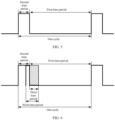
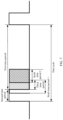
- FIG. 5 shows an example of a possible relationship between the first time period and the second time period.
- one cycle shown in FIG. 5 may be one cycle in the DRX mechanism of the network apparatus.
- the second time period may represent active time in the DRX mechanism of the network apparatus
- the first time period may represent inactive time in the DRX mechanism of the network apparatus.
- One cycle shown in FIG. 5 may alternatively be one cycle in the DTX mechanism of the network apparatus.
- the second time period may represent active time in the DTX mechanism of the network apparatus
- the first time period may represent inactive time in the DTX mechanism of the network apparatus.
- the first information in this embodiment of this application indicates at least one of a first cycle, first starting time, first closing time, starting duration, or closing duration.
- the first starting time is a start moment of the second time period in the first cycle
- the first closing time is a start moment of the first time period in the first cycle
- the starting duration is duration of the second time period
- the closing duration is duration of the first time period.
- the first information includes the configuration information of the DRX mechanism of the network apparatus
- the first information may indicate a time domain pattern in one cycle, and the time domain pattern indicates active time in the DRX mechanism of the network apparatus. In the cycle, all time other than the active time in the DRX mechanism of the network apparatus belongs to inactive time.
- the first information includes the configuration information of the DTX mechanism of the network apparatus, the first information may indicate a time domain pattern in one cycle, and the time domain pattern indicates active time in the DTX mechanism of the network apparatus. In the cycle, all time other than the active time in the DTX mechanism of the network apparatus belongs to inactive time.
- Step 402 The network apparatus skips transmitting the first channel in the first time period.
- step 402 it may also be understood as that the terminal apparatus skips transmitting the first channel in the first time period.
- the first channel may include all the uplink channels and/or all the downlink channels.
- Implementation C1 The network apparatus and/or the terminal apparatus are/is configured with the DRX mechanism of the network apparatus, and the network apparatus is not allowed to receive any uplink channel in the inactive time in the DRX mechanism of the network apparatus. It may also be understood as that the network apparatus notifies the terminal apparatus of the DRX mechanism of the network apparatus, or the terminal apparatus is configured with the DRX mechanism of the network apparatus, and the terminal apparatus is not allowed to send any uplink channel in the inactive time in the DRX mechanism of the network apparatus.
- the first time period may be considered as the inactive time in the DRX mechanism of the network apparatus.
- the network apparatus may not receive all the uplink channels in the inactive time in the DRX mechanism of the network apparatus.
- the terminal apparatus may not send all the uplink channels in the inactive time in the DRX mechanism of the network apparatus.
- the network apparatus may shut down, in the first time period, a channel used to receive the uplink channel, and/or the network apparatus may turn off, in the first time period, a radio frequency processing component configured to receive the uplink channel, and/or the network apparatus may turn off, in the first time period, an intermediate frequency processing component configured to receive the uplink channel, and/or the network apparatus may turn off, in the first time period, a baseband processing component configured to receive the uplink channel.
- a radio frequency processing component configured to receive the uplink channel
- an intermediate frequency processing component configured to receive the uplink channel
- a baseband processing component configured to receive the uplink channel
- the first information further indicates that the uplink channel transmission is allowed in the second time period. It may also be understood as that the network apparatus is allowed to receive all types of uplink channels in the second time period. It may also be understood as that the terminal apparatus is allowed to send all the types of uplink channels in the second time period.
- the second time period may be considered as the active time in the DRX mechanism of the network apparatus
- the network apparatus is allowed to receive all the types of uplink channels in the active time in the DRX mechanism of the network apparatus
- the network apparatus may receive all the types of uplink channels in the active time in the DRX mechanism of the network apparatus.
- the terminal apparatus may send all the types of uplink channels in the active time in the DRX mechanism of the network apparatus.
- the DTX mechanism of the network apparatus may be configured or may not be configured.
- an occasion on which the network apparatus sends the downlink channel may not be limited.
- the network apparatus may be always in a state in which the downlink channel can be normally sent, that is, the network apparatus can send the downlink channel at any time, or the network apparatus may determine, based on another configuration, an occasion on which the downlink channel is sent.
- the terminal apparatus is not configured with the DTX mechanism of the network apparatus, and the terminal apparatus may be always in a state in which the downlink channel can be normally received, or may receive the downlink channel based on a DRX mechanism that is of the terminal apparatus and that is configured for the terminal apparatus, or may determine, based on another configuration, an occasion on which the downlink channel is received.
- Implementation C2 The network apparatus and/or the terminal apparatus are/is configured with the DTX mechanism of the network apparatus, and the network apparatus is not allowed to send any downlink channel in the inactive time in the DTX mechanism of the network apparatus. It may also be understood as that the network apparatus notifies the terminal apparatus of the DTX mechanism of the network apparatus, or the terminal apparatus is configured with the DTX mechanism of the network apparatus, and the terminal apparatus is not allowed to receive any downlink channel in the inactive time in the DTX mechanism of the network apparatus.
- the first time period may be considered as the inactive time in the DTX mechanism of the network apparatus, and the network apparatus may not send all the downlink channels in the inactive time in the DTX mechanism of the network apparatus.
- the terminal apparatus may not receive all the downlink channels in the inactive time in the DTX mechanism of the network apparatus.
- the network apparatus may shut down, in the first time period, a channel used to send the downlink channel.
- the network apparatus may turn off, in the first time period, a radio frequency processing component configured to send the downlink channel.
- the network apparatus may turn off, in the first time period, an intermediate frequency processing component configured to send the downlink channel.
- the network apparatus may turn off, in the first time period, a baseband processing component configured to send the downlink channel. In this way, power consumption of the network apparatus can be reduced.
- the terminal apparatus may shut down, in the first time period, a channel used to receive the downlink channel.
- the terminal apparatus may turn off, in the first time period, a radio frequency processing component configured to receive the downlink channel.
- the terminal apparatus may turn off, in the first time period, an intermediate frequency processing component configured to receive the downlink channel.
- the terminal apparatus may turn off, in the first time period, a baseband processing component configured to receive the downlink channel. In this way, power consumption of the terminal apparatus can be reduced.
- the second time period may be considered as the active time in the DTX mechanism of the network apparatus
- the network apparatus is allowed to send all the types of downlink channels in the active time in the DTX mechanism of the network apparatus
- the network apparatus and/or the terminal apparatus may send all the types of downlink channels in the active time in the DTX mechanism of the network apparatus.
- the terminal apparatus is not configured with the DRX mechanism of the network apparatus, and the terminal apparatus may be always in a state in which the uplink channel can be normally sent, or may determine, based on another configuration, an occasion on which the uplink channel is sent.
- the terminal apparatus may determine, based on the first information, that all the types of downlink channels can be received in the active time (for example, the second time period) in the DTX mechanism of the network apparatus, and then the terminal apparatus may normally receive the downlink channel in the active time (for example, the second time period) in the DTX mechanism of the network apparatus.
- the active time for example, the second time period
- the terminal apparatus may normally receive the downlink channel in the active time (for example, the second time period) in the DTX mechanism of the network apparatus.
- the terminal apparatus may be configured with the DRX mechanism of the network apparatus and the DTX mechanism of the network apparatus. If there is an intersection of the inactive time in the DRX mechanism of the network apparatus and the inactive time in the DTX mechanism of the network apparatus, the terminal apparatus may not send all the downlink channels or may not receive all the uplink channels in the intersection of the inactive time in the DRX mechanism of the network apparatus and the inactive time in the DTX mechanism of the network apparatus. In this way, power consumption of the network apparatus can be reduced.
- the active time in the cycle in the DTX mechanism of the network apparatus may overlap the active time in the cycle in the DRX mechanism of the network apparatus
- the inactive time in the cycle in the DTX mechanism of the network apparatus may overlap the inactive time in the cycle in the DRX mechanism of the network apparatus.
- the cycle in the DTX mechanism of the network apparatus is the same as the cycle in the DRX mechanism of the network apparatus.
- active time in one cycle is the active time in the DTX mechanism of the network apparatus, and is also the active time in the DRX mechanism of the network apparatus.
- Inactive time in one cycle is the inactive time in the DTX mechanism of the network apparatus, and is also the inactive time in the DRX mechanism of the network apparatus.
- the terminal apparatus may not transmit the first channel in the first time period, so that power consumption of the network apparatus can be reduced, and power consumption of the terminal apparatus can also be reduced.
- the feedback information of the PDSCH does not belong to the second type of channel, the feedback information of the PDSCH has an association relationship with the PDSCH sent by the terminal apparatus in the third time period, and the feedback information of the PDSCH is also allowed to be transmitted in the third time period.
- the second type of channel includes a PUSCH.
- the terminal apparatus may further receive a PDCCH, where the PDCCH may be used to schedule the PUSCH.
- the PDCCH may not belong to the second type of channel, the PDCCH may belong to a channel having an association relationship with the PUSCH sent by the terminal apparatus in the third time period, and the PDCCH is also allowed to be transmitted in the third time period. In this way, information transmission requirements of the terminal apparatus and the network apparatus can be met.
- the first time period and the second time period are two time periods in one cycle, and the second time period is before the first time period.
- the first condition includes one or more of Condition D1, Condition D2, Condition D3, Condition D4, and Condition D5.
- Condition D1 The terminal apparatus receives, in the second time period, indication information for scheduling downlink data or uplink data transmission.
- indication information for scheduling downlink data or uplink data includes: The terminal apparatus receives, in the second time period, a PDCCH for scheduling PDSCH or PUSCH transmission. That the terminal apparatus receives, in the second time period, indication information for scheduling downlink data or uplink data transmission may also include: The terminal apparatus receives, in the second time period, a PDCCH for activating an SPS PDSCH or a CG PUSCH.
- Condition D2 The terminal apparatus receives, in the second time period, indication information for activating an aperiodic signal.
- the terminal apparatus receives, in the second time period, indication information for activating aperiodic SRS transmission.
- the terminal apparatus receives, in the second time period, indication information for activating aperiodic CSI reporting.
- the terminal apparatus receives, in the second time period, information indicating to start a first timer, where an intersection of a time period indicated by the first timer and the first time period is the third time period.
- the terminal apparatus receives the information indicating to start the first timer, and may start the first timer based on the information.
- Time indicated by the first timer may be understood as extension time of the active time in the DTX mechanism of the network apparatus and/or the DRX mechanism of the network apparatus. Duration indicated by the first timer may be preset, or may be indicated by the network apparatus.
- Condition D4 The terminal apparatus sends a preset type of uplink channel in the second time period.
- the preset type of uplink channel may include, for example, an uplink scheduling request, a PRACH, an uplink signal used to notify the base station of a next CG PUSCH sending occasion and that the terminal apparatus needs to send uplink data, an uplink wake-up signal, and the like.
- the network apparatus needs to configure the PRACH for the terminal apparatus to access a system. Because the terminal apparatus moves, a distance between the terminal apparatus and the network apparatus is uncertain. Therefore, if the terminal apparatus needs to send a message to the base station, uplink synchronization needs to be maintained and managed in real time.
- a purpose of the PRACH is to implement uplink synchronization, establish an uplink synchronization relationship between the terminal apparatus and the network apparatus, and request the network apparatus to allocate a dedicated resource to the terminal apparatus, so that the terminal apparatus normally accesses the network apparatus for service transmission.
- the terminal apparatus first sends a message 1 (Msg1), namely, the PRACH.
- the terminal apparatus After sending the PRACH, the terminal apparatus receives a message 2 (Msg2), and sends a message 3 (Msg3). If the terminal apparatus performs contention-based random access, the terminal apparatus further receives a message 4 (Msg4). Therefore, after the terminal apparatus sends the PRACH, the network apparatus may learn that the terminal apparatus is performing a random access procedure, and there are transmission requirements of the Msg2, the Msg3, and the Msg4 subsequently.
- Msg2 message 2
- Msg3 message 3
- Msg4 message 4
- the terminal apparatus may request, by sending an uplink scheduling request (Scheduling Request, SR), the network apparatus to schedule uplink transmission, for example, request the network apparatus to schedule a PUSCH.
- SR uplink scheduling request
- the network apparatus may learn that the terminal apparatus has an uplink transmission requirement.
- the base station configures a CG PUSCH resource, and on the CG PUSCH resource, the terminal apparatus may directly send the uplink data without receiving scheduling information (for example, a PDCCH).
- the CG PUSCH resource includes a periodically configured CG PUSCH sending occasion. Therefore, even if the terminal apparatus does not have the uplink data to be sent, the network apparatus still needs to perform receiving on each CG PUSCH sending occasion, and perform subsequent operations such as decoding and coding. This wastes energy. Therefore, before each CG PUSCH sending occasion, the terminal apparatus may send indication information to indicate whether the terminal apparatus sends the uplink data on the next CG PUSCH sending occasion. After the terminal apparatus sends the indication information indicating that the uplink data needs to be sent on the next CG PUSCH sending occasion, the network apparatus may learn that there is data that needs to be sent on the next CG PUSCH sending occasion.
- the terminal apparatus can send a preset signal when there is a signal transmission requirement, and then the network apparatus and/or the terminal apparatus can be out of an inactive state in the third time period after the preset signal is sent, to perform channel transmission.
- Condition D5 The terminal apparatus receives, in the second time period, indication information indicating to extend the second time period, where the indication information indicates to extend the third time period after the second time period.
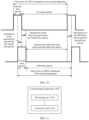
- the terminal apparatus may use a time point at which the first condition is met as a start point of a sixth time period (the start point of the sixth time period may be time in the second time period).
- the terminal apparatus may use a time point after a time point at which the first condition is met (for example, duration between the time point and the time point at which the condition is met may be specified duration) as the start point of the sixth time period.
- Duration of the sixth time period may be a preset value, and an end point of the sixth time period may be time in the first time period.
- the sixth time period may be understood as extension time of active time in one cycle in the DRX mechanism of the network apparatus.
- the active time in the DRX mechanism of the network apparatus is extended
- end time of extended active time in the DRX mechanism of the network apparatus is end time of the sixth time period.
- the third time period in this embodiment of this application is an intersection of the sixth time period and the first time period. In time except the third time period that is in the first time period, the terminal apparatus may still not send any type of uplink channel.
- the active time in the DTX mechanism of the network apparatus may be extended again, that is, there is another sixth time period (namely, a sixth time period 2) in the first time period.
- the cycle shown in FIG. 7 may alternatively be one DRX cycle of the network apparatus. Related content is similar to that about the cycle in the DTX mechanism. Details are not described again.
- the second PDCCH includes one or more of a PDCCH scrambled by a C-RNTI, a PDCCH scrambled by a CS-RNTI, and a PDCCH scrambled by an MCS-C-RNT.
- Implementation G3 it may also be understood as that the network apparatus and/or the terminal apparatus are/is configured with the DTX mechanism of the network apparatus and the DRX mechanism of the network apparatus. Active time in one cycle in the DTX mechanism of the network apparatus is the same as that in one cycle in the DRX mechanism of the network apparatus. Therefore, in extended active time, the network apparatus is allowed to send a downlink channel, and the network apparatus is also allowed to receive an uplink channel.
- the terminal apparatus may also receive a downlink channel, or may send an uplink channel in the extended active time, to meet a requirement of the terminal apparatus.
- the uplink channel type included in the second type is Content G1-1
- the downlink channel type included in the second type is Content G2-2.
- a burst dynamic signal sending or receiving requirement of the network apparatus causes one or more sixth time periods in one cycle in the DTX of the network apparatus and the DTX mechanism of the network apparatus. Therefore, in a possible implementation, the network apparatus may send a downlink signal dynamically scheduled/activated by a PDCCH and receive an uplink signal in an intersection of the sixth time period and the first time period, and does not send or receive another signal that is not dynamically scheduled/activated by a PDCCH. In this way, power consumption of the network apparatus can be reduced.
- the terminal apparatus may receive the downlink signal dynamically scheduled/activated by the PDCCH and send the uplink signal in the intersection of the sixth time period and the first time period, and does not receive another downlink signal that is not dynamically scheduled/activated by the PDCCH and does not send another uplink signal that is not dynamically scheduled/activated by the PDCCH. In this way, power consumption of the network apparatus can be reduced.
- the uplink channel type included in the second type is Content G1-1
- downlink channel types included in the second type are Content G2-2 and Content G2-2.
- uplink channel types included in the second type are Content G1-1 and Content G1-2
- downlink channel types included in the second type are Content G2-2, Content G2-2, and Content G2-5.
- uplink channel types included in the second type are Content G1-1, Content G1-2, Content G1-3, and Content G1-4
- downlink channel types included in the second type are Content G2-2, Content G2-2, Content G2-3, Content G2-4, and Content G2-5.
- the channel type included in the second type may include all uplink channel types and all downlink channel types.
- Implementation G4 it may also be understood as that the network apparatus and/or the terminal apparatus are/is configured with the DTX mechanism of the network apparatus and the DRX mechanism of the network apparatus. Active time in one cycle in the DTX mechanism of the network apparatus is the same as that in one cycle in the DRX mechanism of the network apparatus. Therefore, in extended active time, the network apparatus is allowed to send all downlink channels, and the network apparatus is also allowed to receive all uplink channels.
- the terminal apparatus may also receive all downlink channels, or may send all uplink channels in the extended active time, to meet a requirement of the terminal apparatus.
- Implementation G5 The second type does not include a semi-persistent signal and/or a periodic signal.
- the semi-persistent signal includes a semi-persistent CSI-RS and a semi-persistent SRS.
- the periodic signal includes one or more of an SSB, a SIB, a PRACH, a periodic CSI-RS, a periodic SRS, a CG PUSCH, and an SPS PDSCH.
- the SSB includes a primary synchronization signal (primary synchronization signal, PSS), a secondary synchronization signal (secondary synchronization signal, SSS), and a physical broadcast channel (physical broadcast channel, PBCH).
- PSS/SSS is mainly used for downlink synchronization of the terminal apparatus and obtaining a cell identifier (identifier, ID).
- the downlink synchronization includes clock synchronization, radio frame synchronization, and symbol synchronization.
- the PBCH carries a master information block (master information block, MIB).
- the MIB includes a system frame number (system frame number, SFN), a subcarrier spacing, and a PDCCH configuration for scheduling system information (system information, SI).
- the terminal apparatus when the preset first condition is met, transmits the second type of channel in the third time period that is in the first time period, and skips transmitting or transmits another non-second-type of channel. In this way, power consumption of the apparatus can be reduced.
- the non-second-type of channel may be, for example, a channel other than the second type of channel in a signal set in embodiments of this application.
- FIG. 8 shows an example of a possible schematic flowchart of a communication method according to an embodiment of this application.
- a solution in FIG. 8 is described by using an example in which a network apparatus and a terminal apparatus interact with each other for execution.
- the network apparatus and the terminal apparatus refer to the foregoing content. Details are not described again.
- a difference between the embodiment shown in FIG. 4 and the embodiment shown in FIG. 8 lies in that transmission of the first type of channel is allowed in the first time period. Based on this, the terminal apparatus and/or the network apparatus may transmit the first type of channel in the first time period. Alternatively, it may be understood as that the terminal apparatus and/or the network apparatus skip/skips transmitting a non-first-type of channel in the first time period.
- the method includes the following steps.
- Step 801 The network apparatus sends first information to the terminal apparatus.
- the terminal apparatus receives the first information from the network apparatus.
- the first information indicates that transmission of the first type of channel is allowed in the first time period.
- Step 802 The network apparatus transmits the first type of channel in the first time period.
- the network apparatus may further not transmit a non-first-type of channel in the first time period. That is, if a type of a channel that needs to be transmitted by the network apparatus in the first time period is not the first type, the network apparatus skips transmitting the channel.
- Step 803 The terminal apparatus transmits the first type of channel in the first time period based on the first information.
- the terminal apparatus may further not transmit the non-first type of channel in the first time period. That is, if a type of a channel that needs to be transmitted by the terminal apparatus in the first time period is not the first type, the terminal apparatus skips transmitting the channel. In another possible implementation, if a type of a channel that needs to be transmitted by the terminal apparatus in the first time period is not the first type, the terminal apparatus also transmits the channel.
- transmission of the first type of channel is allowed in the first time period.
- some requirements of the terminal apparatus and the network apparatus can be met.
- the terminal apparatus and/or the network apparatus do/does not need to transmit a large quantity of channels in the first time period.
- a quantity of channels transmitted by the terminal apparatus and/or the network apparatus in the first time period is reduced. This can reduce power consumption of the terminal apparatus and/or the network apparatus.
- the first type of channel may include a plurality of possible implementations.
- the first type of channel may be configured by the network apparatus by using RRC signaling, or indicated based on the first information, or predefined.
- the terminal apparatus may transmit or may not transmit the non-first type of channel in the first time period.
- the terminal apparatus may transmit, in the first time period, some channels having an association relationship with the first type of channel transmitted in the first time period.
- the first type of channel includes a PDSCH
- the terminal apparatus may further send feedback information of the PDSCH to the network apparatus.
- the feedback information of the PDSCH does not belong to the first type of channel
- the feedback information of the PDSCH has an association relationship with the PDSCH sent by the terminal apparatus in the first time period
- the feedback information of the PDSCH is also allowed to be transmitted in the first time period.
- the first type of channel includes a PUSCH.
- the terminal apparatus may further receive a PDCCH, where the PDCCH may be used to schedule the PUSCH.
- the PDCCH may not belong to the first type of channel, the PDCCH may belong to a channel having an association relationship with the PUSCH sent by the terminal apparatus in the first time period, and the PDCCH is also allowed to be transmitted in the first time period. In this way, information transmission requirements of the terminal apparatus and the network apparatus can be met.
- the terminal apparatus transmits the first type of channel in the first time period.
- the terminal apparatus skips transmitting the non-first type of channel in the first time period, that is, in this implementation, the terminal apparatus may no longer transmit the non-first type of channel. In this way, power consumption of the network apparatus and the terminal apparatus can be reduced.
Landscapes
- Engineering & Computer Science (AREA)
- Computer Networks & Wireless Communication (AREA)
- Signal Processing (AREA)
- Mobile Radio Communication Systems (AREA)
Applications Claiming Priority (2)
| Application Number | Priority Date | Filing Date | Title |
|---|---|---|---|
| CN202211216477.4A CN117812677A (zh) | 2022-09-30 | 2022-09-30 | 一种通信方法、装置、存储介质及芯片系统 |
| PCT/CN2023/120450 WO2024067355A1 (zh) | 2022-09-30 | 2023-09-21 | 一种通信方法、装置、存储介质及芯片系统 |
Publications (2)
| Publication Number | Publication Date |
|---|---|
| EP4580262A1 true EP4580262A1 (de) | 2025-07-02 |
| EP4580262A4 EP4580262A4 (de) | 2025-07-09 |
Family
ID=90425501
Family Applications (1)
| Application Number | Title | Priority Date | Filing Date |
|---|---|---|---|
| EP23870587.5A Pending EP4580262A4 (de) | 2022-09-30 | 2023-09-21 | Kommunikationsverfahren und -vorrichtung, speichermedium und chipsystem |
Country Status (4)
| Country | Link |
|---|---|
| US (1) | US20250227686A1 (de) |
| EP (1) | EP4580262A4 (de) |
| CN (1) | CN117812677A (de) |
| WO (1) | WO2024067355A1 (de) |
Families Citing this family (1)
| Publication number | Priority date | Publication date | Assignee | Title |
|---|---|---|---|---|
| WO2025208607A1 (en) * | 2024-04-05 | 2025-10-09 | Apple Inc. | Systems, methods, and devices for prach adaptation for nes enhancement |
Family Cites Families (5)
| Publication number | Priority date | Publication date | Assignee | Title |
|---|---|---|---|---|
| WO2007144956A1 (ja) * | 2006-06-16 | 2007-12-21 | Mitsubishi Electric Corporation | 移動体通信システム及び移動端末 |
| CN108184263B (zh) * | 2013-06-09 | 2020-11-17 | 南京顺盛通信科技有限责任公司 | 一种确定ue激活时间的方法及装置 |
| CN108307547A (zh) * | 2016-09-30 | 2018-07-20 | 中兴通讯股份有限公司 | 一种确定非连续接收配置信息的方法及装置 |
| US10791518B2 (en) * | 2018-04-05 | 2020-09-29 | Qualcomm Incorporated | Discontinuous reception (DRX) operations with flexible scheduling of data communications |
| WO2022115015A1 (en) * | 2020-11-24 | 2022-06-02 | Telefonaktiebolaget Lm Ericsson (Publ) | Methods for discontinuous reception (drx) in conjunction with guaranteed low-latency services |
-
2022
- 2022-09-30 CN CN202211216477.4A patent/CN117812677A/zh active Pending
-
2023
- 2023-09-21 EP EP23870587.5A patent/EP4580262A4/de active Pending
- 2023-09-21 WO PCT/CN2023/120450 patent/WO2024067355A1/zh not_active Ceased
-
2025
- 2025-03-26 US US19/090,428 patent/US20250227686A1/en active Pending
Also Published As
| Publication number | Publication date |
|---|---|
| US20250227686A1 (en) | 2025-07-10 |
| WO2024067355A1 (zh) | 2024-04-04 |
| EP4580262A4 (de) | 2025-07-09 |
| CN117812677A (zh) | 2024-04-02 |
Similar Documents
| Publication | Publication Date | Title |
|---|---|---|
| US12349207B2 (en) | Method and system for handling random access response in wireless communication system | |
| CN115174021B (zh) | 一种无线通信方法和装置 | |
| US12501352B2 (en) | Determination of active time with discontinuous reception groups | |
| US12250749B2 (en) | Method for determining an initiation of random access procedure for a user equipment configured with power savings, and network node thereof | |
| EP3031277B1 (de) | Benutzervorrichtung zur datenkommunikation und verfahren | |
| US20160174263A1 (en) | Communications system, infrastructure equipment and method | |
| WO2020221093A1 (zh) | 搜索空间的监测、配置方法及装置 | |
| KR20230146656A (ko) | 사이드링크 불연속 수신 커맨드 트리거 방법, 장치, 및 시스템 | |
| WO2023098566A1 (zh) | 一种通信方法及装置 | |
| US20250227686A1 (en) | Communication method and apparatus, storage medium, and chip system | |
| WO2020000429A1 (en) | Uplink skipping during random access procedure | |
| US20250056504A1 (en) | Method, device and computer storage medium of communication | |
| CN113826421B (zh) | 激活终端的方法及装置 | |
| WO2022028267A1 (zh) | 一种指示数据传输的方法、装置 | |
| US20250227700A1 (en) | Downlink control information transmission method and apparatus | |
| EP4429158A1 (de) | Übertragungsanweisungsverfahren und kommunikationsvorrichtung | |
| WO2020088455A1 (zh) | 通信方法和通信装置 | |
| WO2024065179A1 (en) | Methods, devices, and medium for communication | |
| WO2025031104A1 (zh) | 通信方法、装置及系统 | |
| WO2024208321A1 (zh) | 一种通信方法、装置及存储介质 | |
| WO2025218454A1 (zh) | 一种免动态授权传输的反馈方法及相关装置 | |
| WO2024067294A1 (zh) | 下行控制信息的传输方法和装置 | |
| WO2025129900A1 (zh) | 信息接收、发送方法和装置、终端、网络设备和存储介质 | |
| WO2024208043A1 (zh) | 通信方法、装置、存储介质及芯片系统 | |
| WO2025161722A1 (zh) | 一种通信方法及装置 |
Legal Events
| Date | Code | Title | Description |
|---|---|---|---|
| STAA | Information on the status of an ep patent application or granted ep patent |
Free format text: STATUS: THE INTERNATIONAL PUBLICATION HAS BEEN MADE |
|
| PUAI | Public reference made under article 153(3) epc to a published international application that has entered the european phase |
Free format text: ORIGINAL CODE: 0009012 |
|
| STAA | Information on the status of an ep patent application or granted ep patent |
Free format text: STATUS: REQUEST FOR EXAMINATION WAS MADE |
|
| REG | Reference to a national code |
Ref country code: DE Ref legal event code: R079 Free format text: PREVIOUS MAIN CLASS: H04W0052020000 Ipc: H04W0072230000 |
|
| 17P | Request for examination filed |
Effective date: 20250324 |
|
| AK | Designated contracting states |
Kind code of ref document: A1 Designated state(s): AL AT BE BG CH CY CZ DE DK EE ES FI FR GB GR HR HU IE IS IT LI LT LU LV MC ME MK MT NL NO PL PT RO RS SE SI SK SM TR |
|
| A4 | Supplementary search report drawn up and despatched |
Effective date: 20250610 |
|
| RIC1 | Information provided on ipc code assigned before grant |
Ipc: H04W 72/1273 20230101ALN20250603BHEP Ipc: H04W 72/1268 20230101ALN20250603BHEP Ipc: H04W 52/34 20090101ALI20250603BHEP Ipc: H04W 52/02 20090101ALI20250603BHEP Ipc: H04W 76/28 20180101ALI20250603BHEP Ipc: H04W 72/23 20230101AFI20250603BHEP |