EP4580161A2 - Integration von erweiterter realität in die internetansichtsplattform - Google Patents
Integration von erweiterter realität in die internetansichtsplattform Download PDFInfo
- Publication number
- EP4580161A2 EP4580161A2 EP25177016.0A EP25177016A EP4580161A2 EP 4580161 A2 EP4580161 A2 EP 4580161A2 EP 25177016 A EP25177016 A EP 25177016A EP 4580161 A2 EP4580161 A2 EP 4580161A2
- Authority
- EP
- European Patent Office
- Prior art keywords
- component
- user
- camera
- web view
- web
- Prior art date
- Legal status (The legal status is an assumption and is not a legal conclusion. Google has not performed a legal analysis and makes no representation as to the accuracy of the status listed.)
- Pending
Links
Images




Classifications
-
- G—PHYSICS
- G06—COMPUTING OR CALCULATING; COUNTING
- G06F—ELECTRIC DIGITAL DATA PROCESSING
- G06F3/00—Input arrangements for transferring data to be processed into a form capable of being handled by the computer; Output arrangements for transferring data from processing unit to output unit, e.g. interface arrangements
- G06F3/01—Input arrangements or combined input and output arrangements for interaction between user and computer
- G06F3/048—Interaction techniques based on graphical user interfaces [GUI]
-
- G—PHYSICS
- G06—COMPUTING OR CALCULATING; COUNTING
- G06T—IMAGE DATA PROCESSING OR GENERATION, IN GENERAL
- G06T15/00—Three-dimensional [3D] image rendering
- G06T15/005—General purpose rendering architectures
-
- G—PHYSICS
- G06—COMPUTING OR CALCULATING; COUNTING
- G06F—ELECTRIC DIGITAL DATA PROCESSING
- G06F3/00—Input arrangements for transferring data to be processed into a form capable of being handled by the computer; Output arrangements for transferring data from processing unit to output unit, e.g. interface arrangements
- G06F3/01—Input arrangements or combined input and output arrangements for interaction between user and computer
- G06F3/017—Gesture based interaction, e.g. based on a set of recognized hand gestures
-
- G—PHYSICS
- G06—COMPUTING OR CALCULATING; COUNTING
- G06F—ELECTRIC DIGITAL DATA PROCESSING
- G06F3/00—Input arrangements for transferring data to be processed into a form capable of being handled by the computer; Output arrangements for transferring data from processing unit to output unit, e.g. interface arrangements
- G06F3/01—Input arrangements or combined input and output arrangements for interaction between user and computer
- G06F3/048—Interaction techniques based on graphical user interfaces [GUI]
- G06F3/0487—Interaction techniques based on graphical user interfaces [GUI] using specific features provided by the input device, e.g. functions controlled by the rotation of a mouse with dual sensing arrangements, or of the nature of the input device, e.g. tap gestures based on pressure sensed by a digitiser
- G06F3/0488—Interaction techniques based on graphical user interfaces [GUI] using specific features provided by the input device, e.g. functions controlled by the rotation of a mouse with dual sensing arrangements, or of the nature of the input device, e.g. tap gestures based on pressure sensed by a digitiser using a touch-screen or digitiser, e.g. input of commands through traced gestures
-
- G—PHYSICS
- G06—COMPUTING OR CALCULATING; COUNTING
- G06T—IMAGE DATA PROCESSING OR GENERATION, IN GENERAL
- G06T13/00—Animation
- G06T13/20—Three-dimensional [3D] animation
-
- G—PHYSICS
- G06—COMPUTING OR CALCULATING; COUNTING
- G06T—IMAGE DATA PROCESSING OR GENERATION, IN GENERAL
- G06T13/00—Animation
- G06T13/80—Two-dimensional [2D] animation, e.g. using sprites
-
- G—PHYSICS
- G06—COMPUTING OR CALCULATING; COUNTING
- G06T—IMAGE DATA PROCESSING OR GENERATION, IN GENERAL
- G06T19/00—Manipulating three-dimensional [3D] models or images for computer graphics
- G06T19/006—Mixed reality
-
- H—ELECTRICITY
- H04—ELECTRIC COMMUNICATION TECHNIQUE
- H04L—TRANSMISSION OF DIGITAL INFORMATION, e.g. TELEGRAPHIC COMMUNICATION
- H04L51/00—User-to-user messaging in packet-switching networks, transmitted according to store-and-forward or real-time protocols, e.g. e-mail
- H04L51/04—Real-time or near real-time messaging, e.g. instant messaging [IM]
- H04L51/043—Real-time or near real-time messaging, e.g. instant messaging [IM] using or handling presence information
-
- H—ELECTRICITY
- H04—ELECTRIC COMMUNICATION TECHNIQUE
- H04L—TRANSMISSION OF DIGITAL INFORMATION, e.g. TELEGRAPHIC COMMUNICATION
- H04L51/00—User-to-user messaging in packet-switching networks, transmitted according to store-and-forward or real-time protocols, e.g. e-mail
- H04L51/04—Real-time or near real-time messaging, e.g. instant messaging [IM]
- H04L51/046—Interoperability with other network applications or services
-
- H—ELECTRICITY
- H04—ELECTRIC COMMUNICATION TECHNIQUE
- H04L—TRANSMISSION OF DIGITAL INFORMATION, e.g. TELEGRAPHIC COMMUNICATION
- H04L51/00—User-to-user messaging in packet-switching networks, transmitted according to store-and-forward or real-time protocols, e.g. e-mail
- H04L51/07—User-to-user messaging in packet-switching networks, transmitted according to store-and-forward or real-time protocols, e.g. e-mail characterised by the inclusion of specific contents
- H04L51/10—Multimedia information
-
- H—ELECTRICITY
- H04—ELECTRIC COMMUNICATION TECHNIQUE
- H04L—TRANSMISSION OF DIGITAL INFORMATION, e.g. TELEGRAPHIC COMMUNICATION
- H04L67/00—Network arrangements or protocols for supporting network services or applications
- H04L67/01—Protocols
- H04L67/131—Protocols for games, networked simulations or virtual reality
Definitions
- the technical problem of facilitating access to an AR component directly from a web view application is addressed by providing a web view AR system configured to load an AR component directly from a web view application.
- the web view AR system encompass various components that are being engaged in the process of permitting a user to access an AR component directly from a web view application, as well as components that are used in generating content captured using an AR component assessed directly from a web view application, generating a message that includes content captured using an AR component assessed directly from a web view application, as well as components that perform validation of data used in the process of loading the AR component.
- the output of a digital image sensor of a camera is augmented with the modification provided by the AR component.
- an AR component can be configured to detect the head position of the person being captured by the digital image sensor and overlay an image of a party hat over the detected head position, such that the viewer would see the person presented on the camera view screen as wearing the party hat.
- the web view AR system is engaged when a user activates, from a web view application executing in the messaging client, a user selectable element associated with a deep link that references an AR component.
- the web view AR system decrypts payload of the deep link to obtain identification of the AR component, performs validation of the identification and of any additional launch data, and launches a camera view user interface (UI) with the AR component loaded in the camera view UI.
- the camera view UI is displayed by the messaging client and includes graphics referencing the AR component, the output of a digital image sensor of a camera and a user selectable element actionable to capture the output of a digital image sensor of a camera, which is modified by an AR component when the AR component is loaded, or to start and stop video recording.
- Some functionality of the web view AR system is provided as part of the messaging client, specifically, as a bridge method included in a web view interface component responsible for launching and hosting a web view in the messaging client.
- the web view interface bridges the SDK included in a web view application and a validation service residing at the backend of the messaging client, and also provides launch parameters of an AR component to the camera view UI.
- the web view interface receives from the SDK a request that includes a deep link to an AR component and passes it to the web view interface, which passes it to the validating service.
- the web view interface converts the identification of the AR component if necessary (for example, from universally unique identifier (UUID) into an identifier internal to the messaging system), unlocks the AR component to make the AR component available for loading in the camera view UI, and loads the AR component in the camera view UI.
- UUID universally unique identifier
- the validation service residing at the backend of the messaging client is also considered as part of the web view AR system.
- the camera view UI launched by the web view AR system permits access to a single AR component in order to reduce users' distraction.
- a user can capture the output of the digital image sensor modified by the AR component and activate a share flow from camera view UI, which may result in communication of the captured content from the messaging client executing at the sender computing device to the messaging client executing at another computing device or in posting the captured content to be available for viewing to at least a subset of users of the messaging system.
- the web view interface dismisses the camera view UI after at the end of share flow and resumes execution of the web view application at the point at which the web view AR system was engaged from the web application.
- the web application is provided by a distinct entity from the messaging client.
- the messaging server system 108 provides server-side functionality via the network 112 to a particular messaging client 104. While certain functions of the messaging system 100 are described herein as being performed by either a messaging client 104 or by the messaging server system 108, the location of certain functionality either within the messaging client 104 or the messaging server system 108 may be a design choice. For example, it may be technically preferable to initially deploy certain technology and functionality within the messaging server system 108 but to later migrate this technology and functionality to the messaging client 104 where a client device 102 has sufficient processing capacity.
- an Application Program Interface (API) server 116 is coupled to, and provides a programmatic interface to, application servers 114.
- the application servers 114 are communicatively coupled to a database server 120, which facilitates access to a database 126 that stores data associated with messages processed by the application servers 114.
- a web server 128 is coupled to the application servers 114, and provides web-based interfaces to the application servers 114. To this end, the web server 128 processes incoming network requests over the Hypertext Transfer Protocol (HTTP) and several other related protocols.
- HTTP Hypertext Transfer Protocol
- the Application Program Interface (API) server 116 exposes various functions supported by the application servers 114, including account registration, login functionality, the sending of messages, via the application servers 114, from a particular messaging client 104 to another messaging client 104, the sending of media files (e.g., images or video) from a messaging client 104 to a messaging server 118, and for possible access by another messaging client 104, the settings of a collection of media data (e.g., story), the retrieval of a list of friends of a user of a client device 102, the retrieval of such collections, the retrieval of messages and content, the addition and deletion of entities (e.g., friends) to an entity graph (e.g., a social graph), the location of friends within a social graph, and opening an application event (e.g., relating to the messaging client 104).
- entity graph e.g., a social graph
- an application event e.g., relating to the messaging client 104.
- the application servers 114 also include an image processing server 122 that is dedicated to performing various image processing operations, typically with respect to images or video within the payload of a message sent from or received at the messaging server 118.
- an external resource e.g., an application installed on the client device 102 or a web view application executing in the web view in the messaging client 10
- the external resource is often provided by a third party but may also be provided by the creator or provider of the messaging client 104.
- the messaging client 104 receives a user selection of an option to launch or access features of such an external resource.
- the messaging client 104 determines whether the selected external resource is a web-based external resource or a locally-installed application.
- applications that are locally installed on the client device 102 can be launched independently of and separately from the messaging client 104, such as by selecting an icon, corresponding to the application, on a home screen of the client device 102.
- Small-scale versions of such applications can be launched or accessed via the messaging client 104 and, in some examples, no or limited portions of the small-scale application can be accessed outside of the messaging client 104.
- the small-scale application can be launched by the messaging client 104 receiving, from a third-party server 110 for example, a markup-language document associated with the small-scale application and processing such a document.
- the messaging client 104 In response to determining that the external resource is a locally installed application, the messaging client 104 instructs the client device 102 to launch the external resource by executing locally stored code corresponding to the external resource. In response to determining that the external resource is a web-based resource, the messaging client 104 communicates with the third-party servers 110 (for example) to obtain a markup-language document corresponding to the selected external resource. The messaging client 104 then processes the obtained markup-language document to present the web-based external resource within a user interface of the messaging client 104.
- the third-party servers 110 for example
- the messaging client 104 can notify a user of the client device 102, or other users related to such a user (e.g., "friends"), of activity taking place in one or more external resources.
- the messaging client 104 can provide participants in a conversation (e.g., a chat session) in the messaging client 104 with notifications relating to the current or recent use of an external resource by one or more members of a group of users.
- One or more users can be invited to join in an active external resource or to launch a recently-used but currently inactive (in the group of friends) external resource.
- the external resource can provide participants in a conversation, each using respective messaging clients 104, with the ability to share an item, status, state, or location in an external resource with one or more members of a group of users into a chat session.
- the shared item may be an interactive chat card with which members of the chat can interact, for example, to launch the corresponding external resource, view specific information within the external resource, or take the member of the chat to a specific location or state within the external resource.
- response messages can be sent to users on the messaging client 104.
- the external resource can selectively include different media items in the responses, based on a current context of the external resource.
- the messaging client 104 can present a list of the available external resources to a user to launch or access a given external resource. This list can be presented in a context-sensitive menu. For example, the icons representing different ones of the web view apps can vary based on how the menu is launched by the user (e.g., from a conversation interface or from a non-conversation interface).
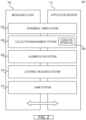
- FIG. 2 is a block diagram illustrating further details regarding the messaging system 100, according to some examples.
- the messaging system 100 is shown to comprise the messaging client 104 and the application servers 114.
- the messaging system 100 which embodies a number of subsystems that are supported on the client-side by the messaging client 104 and on the sever-side by the application servers 114, can be said to host a backend service for the messaging client 104.
- These subsystems include, for example, an ephemeral timer system 202, a collection management system 204, an augmentation system 208, a map system 210, a game system 212, and an external resource system 214.
- the ephemeral timer system 202 is responsible for enforcing the temporary or time-limited access to content by the messaging client 104 and the messaging server 118.
- the ephemeral timer system 202 incorporates a number of timers that, based on duration and display parameters associated with a message, or collection of messages (e.g., a story), selectively enable access (e.g., for presentation and display) to messages and associated content via the messaging client 104. Further details regarding the operation of the ephemeral timer system 202 are provided below.
- the collection management system 204 is responsible for managing sets or collections of media (e.g., collections of text, image video, and audio data).
- a collection of content e.g., messages, including images, video, text, and audio
- Such a collection may be made available for a specified time period, such as the duration of an event to which the content relates.
- content relating to a music concert may be made available as a "story” for the duration of that music concert.
- a collection may include content, which was generated using an AR component that was loaded directly from a web view application.
- the collection management system 204 may also be responsible for publishing an icon that provides notification of the existence of a particular collection to the user interface of the messaging client 104.
- the collection management system 204 furthermore includes a curation interface 206 that allows a collection manager to manage and curate a particular collection of content.
- the curation interface 206 enables an event organizer to curate a collection of content relating to a specific event (e.g., delete inappropriate content or redundant messages).
- the collection management system 204 employs machine vision (or image recognition technology) and content rules to automatically curate a content collection. In certain examples, compensation may be paid to a user for the inclusion of user-generated content into a collection. In such cases, the collection management system 204 operates to automatically make payments to such users for the use of their content.
- the augmentation system 208 provides various functions that enable a user to augment (e.g., annotate or otherwise modify or edit) media content associated with a message.
- the augmentation system 208 provides functions related to the generation and publishing of media overlays for messages processed by the messaging system 100.
- the augmentation system 208 operatively supplies a media overlay or augmentation (e.g., an image filter) to the messaging client 104 based on a geolocation of the client device 102.
- the augmentation system 208 operatively supplies a media overlay to the messaging client 104 based on other information, such as social network information of the user of the client device 102.
- a media overlay may include audio and visual content and visual effects.
- audio and visual content examples include pictures, texts, logos, animations, and sound effects.
- An example of a visual effect includes color overlaying.
- the audio and visual content or the visual effects can be applied to a media content item (e.g., a photo) at the client device 102.
- the media overlay may include text or image that can be overlaid on top of a photograph taken by the client device 102.
- the media overlay includes an identification of a location overlay (e.g., Venice beach), a name of a live event, or a name of a merchant overlay (e.g., Beach Coffee House).
- the augmentation system 208 uses the geolocation of the client device 102 to identify a media overlay that includes the name of a merchant at the geolocation of the client device 102.
- the media overlay may include other indicia associated with the merchant.
- the media overlays may be stored in the database 126 and accessed through the database server 120.
- the augmentation system 208 provides a user-based publication platform that enables users to select a geolocation on a map and upload content associated with the selected geolocation. The user may also specify circumstances under which a particular media overlay should be offered to other users. The augmentation system 208 generates a media overlay that includes the uploaded content and associates the uploaded content with the selected geolocation.
- the augmentation system 208 provides a merchant-based publication platform that enables merchants to select a particular media overlay associated with a geolocation via a bidding process. For example, the augmentation system 208 associates the media overlay of the highest bidding merchant with a corresponding geolocation for a predefined amount of time.
- the map system 210 provides various geographic location functions and supports the presentation of map-based media content and messages by the messaging client 104.
- the map system 210 enables the display of user icons or avatars (e.g., stored in profile data 316) on a map to indicate a current or past location of "friends" of a user, as well as media content (e.g., collections of messages including photographs and videos) generated by such friends, within the context of a map.
- a message posted by a user to the messaging system 100 from a specific geographic location may be displayed within the context of a map at that particular location to "friends" of a specific user on a map interface of the messaging client 104.
- a user can furthermore share his or her location and status information (e.g., using an appropriate status avatar) with other users of the messaging system 100 via the messaging client 104, with this location and status information being similarly displayed within the context of a map interface of the messaging client 104 to selected users.
- location and status information e.g., using an appropriate status avatar
- the game system 212 provides various gaming functions within the context of the messaging client 104.
- the messaging client 104 provides a game interface providing a list of available games that can be launched by a user within the context of the messaging client 104 and played with other users of the messaging system 100.
- the messaging system 100 further enables a particular user to invite other users to participate in the play of a specific game, by issuing invitations to such other users from the messaging client 104.
- the messaging client 104 also supports both the voice and text messaging (e.g., chats) within the context of gameplay, provides a leaderboard for the games, and also supports the provision of in-game rewards (e.g., coins and items).
- the external resource system 214 provides an interface for the messaging client 104 to communicate with remote servers (e.g., third-party servers 110) to launch or access external resources, i.e., applications or applets such as the web view application.
- Each third-party server 110 hosts, for example, a markup language (e.g., HTML5) based application or small-scale version of an application (e.g., game, utility, payment, or ride-sharing application).
- the messaging client 104 may launches a web-based resource (e.g., application) by accessing the HTML5 file from the third-party servers 110 associated with the web-based resource.
- applications hosted by third-party servers 110 are programmed in JavaScript leveraging a Software Development Kit (SDK) provided by the messaging server 118.
- SDK Software Development Kit
- the SDK includes Application Programming Interfaces (APIs) with functions that can be called or invoked by the web-based application.
- APIs Application Programming Interfaces
- a web-based resource executing in a web view of the messaging client is referred to as a web view application for the purposes of this description.
- the messaging server 118 includes a JavaScript library that provides a given external resource, a web view application for example, access to certain user data of the messaging client 104.
- HTML5 is used as an example technology for programming web view apps and games, but applications and resources programmed based on other technologies can be used.
- the SDK includes an interface that provides support for deep linking into an AR component from a web view application, as well as a method that provides support for passing attributes from a web view application to an AR component.
- the SDK is downloaded by a third-party server 110 from the messaging server 118 or is otherwise received by the third-party server 110. Once downloaded or received, the SDK is included as part of the application code of a web-based external resource. The code of the web-based resource can then call or invoke certain functions of the SDK to integrate features of the messaging client 104 into the web-based resource.
- the SDK stored on the messaging server 118 effectively provides the bridge between an external resource (e.g., a web view app) and the messaging client 104. This provides the user with a seamless experience of communicating with other users on the messaging client 104, while also preserving the look and feel of the messaging client 104.
- the SDK facilitates communication between third-party servers 110 and the messaging client 104.
- a WebViewJavaScriptBridge running on a client device 102 establishes two one-way communication channels between an external resource and the messaging client 104. Messages are sent between the external resource and the messaging client 104 via these communication channels asynchronously.
- Each SDK function invocation is sent as a message and callback.
- Each SDK function is implemented by constructing a unique callback identifier and sending a message with that callback identifier.
- each third-party server 110 provides an HTML5 file corresponding to the web-based external resource to the messaging server 118.
- the messaging server 118 can add a visual representation (such as a box art or other graphic) of the web-based external resource in the messaging client 104. Once the user selects the visual representation or instructs the messaging client 104 through a GUI of the messaging client 104 to access features of the web-based external resource, the messaging client 104 obtains the HTML5 file and instantiates the resources necessary to access the features of the web-based external resource.
- the messaging client 104 presents a graphical user interface (e.g., a landing page or title screen) for an external resource. During, before, or after presenting the landing page or title screen, the messaging client 104 determines whether the launched external resource has been previously authorized to access user data of the messaging client 104. In response to determining that the launched external resource has been previously authorized to access user data of the messaging client 104, the messaging client 104 presents another graphical user interface of the external resource that includes functions and features of the external resource.
- a graphical user interface e.g., a landing page or title screen
- the messaging client 104 slides up (e.g., animates a menu as surfacing from a bottom of the screen to a middle of or other portion of the screen) a menu for authorizing the external resource to access the user data.
- the menu identifies the type of user data that the external resource will be authorized to use.
- the messaging client 104 adds the external resource to a list of authorized external resources and allows the external resource to access user data from the messaging client 104.
- the external resource is authorized by the messaging client 104 to access the user data in accordance with an OAuth 2 framework.
- the messaging client 104 controls the type of user data that is shared with external resources based on the type of external resource being authorized. For example, external resources that include full-scale applications are provided with access to a first type of user data (e.g., only two-dimensional avatars of users with or without different avatar characteristics). As another example, external resources that include small-scale versions of applications (e.g., web-based versions of applications) are provided with access to a second type of user data (e.g., payment information, two-dimensional avatars of users, three-dimensional avatars of users, and avatars with various avatar characteristics).
- Avatar characteristics include different ways to customize a look and feel of an avatar, such as different poses, facial features, clothing, and so forth.
- FIG. 3 is a schematic diagram illustrating data structures 300, which may be stored in the database 120 of the messaging server system 108, according to certain examples. While the content of the database 120 is shown to comprise a number of tables, it will be appreciated that the data could be stored in other types of data structures (e.g., as an object-oriented database).
- the database 120 includes message data stored within a message table 302.
- This message data includes, for any particular one message, at least message sender data, message recipient (or receiver) data, and a payload.
- the payload of a message may include content generated using an AR component that was loaded directly from a web view application. Further details regarding information that may be included in a message and included within the message data stored in the message table 302 is described below with reference to FIG. 4 .
- An entity table 304 stores entity data, and is linked (e.g., referentially) to an entity graph 306 and profile data 308. Entities for which records are maintained within the entity table 304 may include individuals, corporate entities, organizations, objects, places, events, and so forth. Regardless of entity type, any entity regarding which the messaging server system 108 stores data may be a recognized entity. Each entity is provided with a unique identifier, as well as an entity type identifier (not shown).
- the entity graph 306 stores information regarding relationships and associations between entities. Such relationships may be social, professional (e.g., work at a common corporation or organization) interested-based or activity-based, merely for example. With reference to the functionality provided by the AR component, the entity graph 306 stores information that can be used, in cases where the AR component is configured to permit using a portrait image of a user other than that of the user controlling the associated client device for modifying the target media content object, to determine a further profile that is connected to the profile representing the user controlling the associated client device. As mentioned above, the portrait image of a user may be stored in a user profile representing the user in the messaging system.
- the profile data 308 stores multiple types of profile data about a particular entity.
- the profile data 308 may be selectively used and presented to other users of the messaging system 100, based on privacy settings specified by a particular entity.
- the profile data 308 includes, for example, a user's name, telephone number, address, settings (e.g., notification and privacy settings), as well as a user-selected avatar representation (or collection of such avatar representations).
- a particular user may then selectively include one or more of these avatar representations within the content of messages communicated via the messaging system 100, and on map interfaces displayed by messaging clients 104 to other users.
- the collection of avatar representations may include "status avatars," which present a graphical representation of a status or activity that the user may select to communicate at a particular time.
- the database 120 also stores augmentation data in an augmentation table 310.
- the augmentation data is associated with and applied to videos (for which data is stored in a video table 314) and images (for which data is stored in an image table 316).
- the augmentation data is used by various AR components, including the AR component.
- An example of augmentation data is a target media content object, which may be associated with an AR component and used to generate an AR experience for a user, as described above.
- AR augmented reality
- Image transformations include real-time modifications, which modify an image (e.g., a video frame) as it is captured using a digital image sensor of a client device 102.
- the modified image is displayed on a screen of the client device 102 with the modifications.
- AR tools may also be used to apply modifications to stored content, such as video clips or still images stored in a gallery.
- a user can apply different AR tools (e.g., by engaging different AR components configured to utilize different AR tools) to a single video clip to see how the different AR tools would modify the same video clip.
- multiple AR tools that apply different pseudorandom movement models can be applied to the same captured content by selecting different AR tools for the same captured content.
- real-time video capture may be used with an illustrated modification to show how video images currently being captured by a digital image sensor of a camera provided with a client device 102 would modify the captured data. Such data may simply be displayed on the screen and not stored in memory, or the content captured by digital image sensor may be recorded and stored in memory with or without the modifications (or both).
- a messaging client 104 can be configured to include a preview feature that can show how modifications produced by different AR tools will look, within different windows in a display at the same time. This can, for example, permit a user to view multiple windows with different pseudorandom animations presented on a display at the same time.
- elements to be transformed are identified by the computing device, and then detected and tracked if they are present in the frames of the video.
- the elements of the object are modified according to the request for modification, thus transforming the frames of the video stream. Transformation of frames of a video stream can be performed by different methods for different kinds of transformation. For example, for transformations of frames mostly referring to changing forms of object's elements characteristic points for each element of an object are calculated (e.g., using an Active Shape Model (ASM) or other known methods). Then, a mesh based on the characteristic points is generated for each of the at least one element of the object. This mesh used in the following stage of tracking the elements of the object in the video stream.
- ASM Active Shape Model
- the mentioned mesh for each element is aligned with a position of each element. Then, additional points are generated on the mesh.
- a first set of first points is generated for each element based on a request for modification, and a set of second points is generated for each element based on the set of first points and the request for modification.
- the frames of the video stream can be transformed by modifying the elements of the object on the basis of the sets of first and second points and the mesh.
- a background of the modified object can be changed or distorted as well by tracking and modifying the background.
- transformations changing some areas of an object using its elements can be performed by calculating characteristic points for each element of an object and generating a mesh based on the calculated characteristic points. Points are generated on the mesh, and then various areas based on the points are generated. The elements of the object are then tracked by aligning the area for each element with a position for each of the at least one element, and properties of the areas can be modified based on the request for modification, thus transforming the frames of the video stream. Depending on the specific request for modification properties of the mentioned areas can be transformed in different ways.
- Such modifications may involve changing color of areas; removing at least some part of areas from the frames of the video stream; including one or more new objects into areas which are based on a request for modification; and modifying or distorting the elements of an area or object.
- any combination of such modifications or other similar modifications may be used.
- some characteristic points can be selected as control points to be used in determining the entire state-space of options for the model animation.
- a story table 312 stores data regarding collections of messages and associated image, video, or audio data, which are compiled into a collection (e.g., a story or a gallery). The creation of a particular collection may be initiated by a particular user (e.g., each user for which a record is maintained in the entity table 304). A user may create a "personal story" in the form of a collection of content that has been created and sent/broadcast by that user. To this end, the user interface of the messaging client 104 may include an icon that is user-selectable to enable a sending user to add specific content to his or her personal story. In some examples, the story table 312 stores one or more images or videos that were created using the AR component.
- a collection may also constitute a "live story,” which is a collection of content from multiple users that is created manually, automatically, or using a combination of manual and automatic techniques.
- a "live story” may constitute a curated stream of user-submitted content from varies locations and events. Users whose client devices have location services enabled and are at a common location event at a particular time may, for example, be presented with an option, via a user interface of the messaging client 104, to contribute content to a particular live story. The live story may be identified to the user by the messaging client 104, based on his or her location. The end result is a "live story” told from a community perspective.
- a further type of content collection is known as a "location story," which enables a user whose client device 102 is located within a specific geographic location (e.g., on a college or university campus) to contribute to a particular collection.
- a contribution to a location story may require a second degree of authentication to verify that the end user belongs to a specific organization or other entity (e.g., is a student on the university campus).
- the video table 314 stores video data that, in one example, is associated with messages for which records are maintained within the message table 302.
- the image table 316 stores image data associated with messages for which message data is stored in the entity table 304.
- the entity table 304 may associate various augmentations from the augmentation table 310 with various images and videos stored in the image table 316 and the video table 314.
- FIG. 4 is a schematic diagram illustrating a structure of a message 400, according to some examples, generated by a messaging client 104 for communication to a further messaging client 104 or the messaging server 114.
- the content of a particular message 400 is used to populate the message table 302 stored within the database 120, accessible by the messaging server 114.
- the content of a message 400 is stored in memory as "in-transit” or "in-flight" data of the client device 102 or the application servers 114.
- the content of a message 400 includes an image or a video that was created using the AR component.
- a message 400 is shown to include the following example components:
- the contents (e.g., values) of the various components of message 400 may be pointers to locations in tables within which content data values are stored.
- an image value in the message image payload 406 may be a pointer to (or address of) a location within an image table 316.
- values within the message video payload 408 may point to data stored within a video table 3114
- values stored within the message augmentations 412 may point to data stored in an augmentation table 310
- values stored within the message story identifier 418 may point to data stored in a story table 312
- values stored within the message sender identifier 422 and the message receiver identifier 424 may point to user records stored within an entity table 304.
- FIG. 5 is a schematic diagram illustrating an access-limiting process 500, in terms of which access to content (e.g., an ephemeral message 502, and associated multimedia payload of data) or a content collection (e.g., an ephemeral message group 504) may be time-limited (e.g., made ephemeral).
- the content of an ephemeral message 502, in some examples, includes an image or a video that was created using an AR component that was loaded directly from a web view application.
- An ephemeral message 502 is shown to be associated with a message duration parameter 506, the value of which determines an amount of time that the ephemeral message 502 will be displayed to a receiving user of the ephemeral message 502 by the messaging client 104.
- an ephemeral message 502 is viewable by a receiving user for up to a maximum of 10 seconds, depending on the amount of time that the sending user specifies using the message duration parameter 506.
- the message duration parameter 506 and the message receiver identifier 424 are shown to be inputs to a message timer 512, which is responsible for determining the amount of time that the ephemeral message 502 is shown to a particular receiving user identified by the message receiver identifier 424. In particular, the ephemeral message 502 will only be shown to the relevant receiving user for a time period determined by the value of the message duration parameter 506.
- the message timer 512 is shown to provide output to a more generalized ephemeral timer system 202, which is responsible for the overall timing of display of content (e.g., an ephemeral message 502) to a receiving user.
- the ephemeral message 502 is shown in FIG. 5 to be included within an ephemeral message group 504 (e.g., a collection of messages in a personal story, or an event story).
- the ephemeral message group 504 has an associated group duration parameter 508, a value of which determines a time duration for which the ephemeral message group 504 is presented and accessible to users of the messaging system 100.
- the group duration parameter 508, for example, may be the duration of a music concert, where the ephemeral message group 504 is a collection of content pertaining to that concert.
- a user may specify the value for the group duration parameter 508 when performing the setup and creation of the ephemeral message group 504.
- the group duration parameter 508, group participation parameter 510, and message receiver identifier 424 each provide input to a group timer 514, which operationally determines, firstly, whether a particular ephemeral message 502 of the ephemeral message group 504 will be displayed to a particular receiving user and, if so, for how long. Note that the ephemeral message group 504 is also aware of the identity of the particular receiving user as a result of the message receiver identifier 424.
- the group timer 514 operationally controls the overall lifespan of an associated ephemeral message group 504, as well as an individual ephemeral message 502 included in the ephemeral message group 504.
- each and every ephemeral message 502 within the ephemeral message group 504 remains viewable and accessible for a time period specified by the group duration parameter 508.
- a certain ephemeral message 502 may expire, within the context of ephemeral message group 504, based on a group participation parameter 510.
- a message duration parameter 506 may still determine the duration of time for which a particular ephemeral message 502 is displayed to a receiving user, even within the context of the ephemeral message group 504. Accordingly, the message duration parameter 506 determines the duration of time that a particular ephemeral message 502 is displayed to a receiving user, regardless of whether the receiving user is viewing that ephemeral message 502 inside or outside the context of an ephemeral message group 504.
- the ephemeral timer system 202 may furthermore operationally remove a particular ephemeral message 502 from the ephemeral message group 504 based on a determination that it has exceeded an associated group participation parameter 510. For example, when a sending user has established a group participation parameter 510 of 24 hours from posting, the ephemeral timer system 202 will remove the relevant ephemeral message 502 from the ephemeral message group 504 after the specified 24 hours.
- the ephemeral timer system 202 also operates to remove an ephemeral message group 504 when either the group participation parameter 510 for each and every ephemeral message 502 within the ephemeral message group 504 has expired, or when the ephemeral message group 504 itself has expired in terms of the group duration parameter 508.
- a creator of a particular ephemeral message group 504 may specify an indefinite group duration parameter 508.
- the expiration of the group participation parameter 510 for the last remaining ephemeral message 502 within the ephemeral message group 504 will determine when the ephemeral message group 504 itself expires.
- a new ephemeral message 502, added to the ephemeral message group 504, with a new group participation parameter 510 effectively extends the life of an ephemeral message group 504 to equal the value of the group participation parameter 510.
- the ephemeral timer system 202 Responsive to the ephemeral timer system 202 determining that an ephemeral message group 504 has expired (e.g., is no longer accessible), the ephemeral timer system 202 communicates with the messaging system 100 (and, for example, specifically the messaging client 104) to cause an indicium (e.g., an icon) associated with the relevant ephemeral message group 504 to no longer be displayed within a user interface of the messaging client 104.
- an indicium e.g., an icon
- the ephemeral timer system 202 determines that the message duration parameter 506 for a particular ephemeral message 502 has expired, the ephemeral timer system 202 causes the messaging client 104 to no longer display an indicium (e.g., an icon or textual identification) associated with the ephemeral message 502.
- an indicium e.g., an icon or textual identification
- Fig. 6 is a flowchart of a method 600 for providing integration of web view applications with augmented reality components, in accordance with some examples, directly from a third-party resource.
- the described flowchart can show operations as a sequential process, many of the operations can be performed in parallel or concurrently. In addition, the order of the operations may be re-arranged.
- a process is terminated when its operations are completed.
- a process may correspond to a method, a procedure, an algorithm, and so forth.
- the operations of methods may be performed in whole or in part, may be performed in conjunction with some or all of the operations in other methods, and may be performed by any number of different systems, such as the systems described herein, or any portion thereof, such as a processor included in any of the systems.
- some or all processing logic resides at the messaging system 100 that embodies a number of subsystems, which may be supported on the client-side by the messaging client 104, and on the sever-side by the application servers 114.
- the method 600 commences at operation 610, a web view application is loaded in the messaging client executing at a sender computing device.
- the web view application includes the SDK configured to facilitate access to an AR component directly from the web application.
- the web view may include a user selectable element actionable to request that the AR component is loaded in the camera view UI of the messaging client.
- an event associated with activation of the user selectable element actionable to request that the AR component is loaded in the camera view UI is referred to as a camera share trigger event.
- the SDK included in the web view application detects a camera share trigger event and communicates the request to the bridge method included in the web view interface component responsible for launching and hosting a web view in the messaging client.
- the web view interface component communicates the request to the validation service residing at the backend of the messaging client for validation of the identification of the AR component included in the request. If validation is successful the web view interface converts the identification of the AR component into an identifier internal to the messaging system, if necessary, unlocks the AR component to make the AR component available for loading in the camera view UI, and loads the AR component in the camera view UI at operation 630.
- a user can capture the output of the digital image sensor modified by the AR component and activate a share flow from camera view UI, which may result in communication of the captured content from the messaging client executing at the sender computing device to the messaging client executing at another computing device or in posting the captured content to be available for viewing to at least a subset of users of the messaging system.
- the captured content is shared and, at operation 650, the web view interface dismisses the camera view UI after at the end of share flow and resumes execution of the web view application at the point at which the web view AR system was engaged from the web application.
- Fig. 7 is a diagrammatic representation of a web view application screen 700, in accordance with some examples.
- the web view application screen 700 represents a web view application configured to permit a user to wish happy birthday to another user by sending them an image enhanced by an AR component that adds a party to a person's head in the image and a birthday wish text.
- the AR component that adds a party to a person's head in the image and a birthday wish text can be activated by engaging a user selectable element 710.
- Fig. 8 is a diagrammatic representation of a camera view UI 800 with an AR component loaded, in accordance with some examples.
- Shown in Fig. 8 is a user selectable element 830, referred to as a shutter user selectable element, actionable to capture an image by the camera or to start and stop video recording.
- the graphics 840 depicts a party hat, which indicates that the associated AR component is loaded in the camera view UI 800.
- the modification provided by the AR component results in adding a party hat to the image of a user's head in area 810, and the caption "HAPPY BIRTHDAY, DUSTIN!
- the AR component in this example is configured to accept a launch attribute from the web view application.
- the launch attribute is the name of the user who is the intended recipient of the birthday wish, "Dustin" in this case.
- Fig. 9 is a diagrammatic representation of a recipient view 900 of content captured using an AR component loaded directly from a web view application, in accordance with some examples.
- the recipient view 900 includes, in area 910, the image of a user wearing a party hat and the caption "HAPPY BIRTHDAY, DUSTIN!
- the recipient view 900 is configured to permit the viewer to launch the web view application at their computing device in response to a predetermined action, such as swiping up.
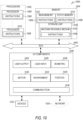
- Fig. 10 is a diagrammatic representation of the machine 1000 within which instructions 1008 (e.g., software, a program, an application, an applet, an application, or other executable code) for causing the machine 1000 to perform any one or more of the methodologies discussed herein may be executed.
- the instructions 1008 may cause the machine 1000 to execute any one or more of the methods described herein.
- the instructions 1008 transform the general, non-programmed machine 1000 into a particular machine 1000 programmed to carry out the described and illustrated functions in the manner described.
- the machine 1000 may operate as a standalone device or may be coupled (e.g., networked) to other machines.
- the machine 1000 may operate in the capacity of a server machine or a client machine in a server-client network environment, or as a peer machine in a peer-to-peer (or distributed) network environment.
- the machine 1000 may comprise, but not be limited to, a server computer, a client computer, a personal computer (PC), a tablet computer, a laptop computer, a netbook, a set-top box (STB), a personal digital assistant (PDA), an entertainment media system, a cellular telephone, a smartphone, a mobile device, a wearable device (e.g., a smartwatch), a smart home device (e.g., a smart appliance), other smart devices, a web appliance, a network router, a network switch, a network bridge, or any machine capable of executing the instructions 1008, sequentially or otherwise, that specify actions to be taken by the machine 1000.
- PC personal computer
- PDA personal digital assistant
- the machine 1000 may include processors 1002, memory 1004, and input/output I/O components 1038, which may be configured to communicate with each other via a bus 1040.
- the processors 1002 e.g., a Central Processing Unit (CPU), a Reduced Instruction Set Computing (RISC) Processor, a Complex Instruction Set Computing (CISC) Processor, a Graphics Processing Unit (GPU), a Digital Signal Processor (DSP), an Application Specific Integrated Circuit (ASIC), a RadioFrequency Integrated Circuit (RFIC), another processor, or any suitable combination thereof
- the processors 1002 may include, for example, a processor 1006 and a processor 1010 that execute the instructions 1008.
- the memory 1004 includes a main memory 1012, a static memory 1014, and a storage unit 1016, both accessible to the processors 1002 via the bus 1040.
- the main memory 1012, the static memory 1014, and storage unit 1016 store the instructions 1008 embodying any one or more of the methodologies or functions described herein.
- the instructions 1008 may also reside, completely or partially, within the main memory 1012, within the static memory 1014, within machine-readable medium 1018 within the storage unit 1016, within at least one of the processors 1002 (e.g., within the Processor's cache memory), or any suitable combination thereof, during execution thereof by the machine 1000.
- the user input components1026 may include alphanumeric input components (e.g., a keyboard, a touch screen configured to receive alphanumeric input, a photo-optical keyboard, or other alphanumeric input components), point-based input components (e.g., a mouse, a touchpad, a trackball, a joystick, a motion sensor, or another pointing instrument), tactile input components (e.g., a physical button, a touch screen that provides location and force of touches or touch gestures, or other tactile input components), audio input components (e.g., a microphone), and the like.
- alphanumeric input components e.g., a keyboard, a touch screen configured to receive alphanumeric input, a photo-optical keyboard, or other alphanumeric input components
- point-based input components e.g., a mouse, a touchpad, a trackball, a joystick, a motion sensor, or another pointing instrument
- tactile input components e.g., a physical button,
- the I/O components 1038 may include biometric components 1028, motion components 1030, environmental components 1032, or position components 1034, among a wide array of other components.
- the biometric components 1028 include components to detect expressions (e.g., hand expressions, facial expressions, vocal expressions, body gestures, or eye-tracking), measure biosignals (e.g., blood pressure, heart rate, body temperature, perspiration, or brain waves), identify a person (e.g., voice identification, retinal identification, facial identification, fingerprint identification, or electroencephalogram-based identification), and the like.
- the motion components 1030 include acceleration sensor components (e.g., accelerometer), gravitation sensor components, rotation sensor components (e.g., gyroscope).
- the environmental components 1032 include, for example, one or more cameras (with still image/photograph and video capabilities), illumination sensor components (e.g., photometer), temperature sensor components (e.g., one or more thermometers that detect ambient temperature), humidity sensor components, pressure sensor components (e.g., barometer), acoustic sensor components (e.g., one or more microphones that detect background noise), proximity sensor components (e.g., infrared sensors that detect nearby objects), gas sensors (e.g., gas detection sensors to detection concentrations of hazardous gases for safety or to measure pollutants in the atmosphere), or other components that may provide indications, measurements, or signals corresponding to a surrounding physical environment.
- illumination sensor components e.g., photometer
- temperature sensor components e.g., one or more thermometers that detect ambient temperature
- humidity sensor components e.g., pressure sensor components (e.g., barometer)
- acoustic sensor components e.g., one or more microphones that detect background noise
- proximity sensor components e.
- the client device 102 may have a camera system comprising, for example, front facing cameras on a front surface of the client device 102 and rear cameras on a rear surface of the client device 102.
- the front facing cameras may, for example, be used to capture still images and video of a user of the client device 102 (e.g., "selfies"), which may then be augmented with augmentation data (e.g., filters) described above.
- augmentation data e.g., filters
- the front facing camera is used with a viewfinder ring flash described herein
- the user has the ability to use augmented reality face filters in low light conditions, even in complete darkness, as the viewfinder ring flash illuminates the user's face without obscuring the output of the digital image sensor.
- the rear cameras may, for example, be used to capture still images and videos in a more traditional camera mode, with these images similarly being augmented with augmentation data.
- the client device 102 may also include a 360° camera for capturing 360° photographs and videos.
- the camera system of a client device 102 may include dual rear cameras (e.g., a primary camera as well as a depth-sensing camera), or even triple, quad or penta rear camera configurations on the front and rear sides of the client device 102.
- These multiple cameras systems may include a wide camera, an ultra-wide camera, a telephoto camera, a macro camera and a depth sensor, for example.
- the position components 1034 include location sensor components (e.g., a GPS receiver component), altitude sensor components (e.g., altimeters or barometers that detect air pressure from which altitude may be derived), orientation sensor components (e.g., magnetometers), and the like.
- location sensor components e.g., a GPS receiver component
- altitude sensor components e.g., altimeters or barometers that detect air pressure from which altitude may be derived
- orientation sensor components e.g., magnetometers
- the I/O components 1038 further include communication components 1036 operable to couple the machine 1000 to a network 1020 or devices 1022 via respective coupling or connections.
- the communication components 1036 may include a network interface Component or another suitable device to interface with the network 1020.
- the communication components 1036 may include wired communication components, wireless communication components, cellular communication components, Near Field Communication (NFC) components, Bluetooth ® components (e.g., Bluetooth ® Low Energy), Wi-Fi ® components, and other communication components to provide communication via other modalities.
- the devices 1022 may be another machine or any of a wide variety of peripheral devices (e.g., a peripheral device coupled via a USB).
- the communication components 636 may detect identifiers or include components operable to detect identifiers.
- the communication components 636 may include Radio Frequency Identification (RFID) tag reader components, NFC smart tag detection components, optical reader components (e.g., an optical sensor to detect one-dimensional bar codes such as Universal Product Code (UPC) bar code, multi-dimensional bar codes such as Quick Response (QR) code, Aztec code, Data Matrix, Dataglyph, MaxiCode, PDF410, Ultra Code, UCC RSS-2D bar code, and other optical codes), or acoustic detection components (e.g., microphones to identify tagged audio signals).
- RFID Radio Frequency Identification
- NFC smart tag detection components e.g., an optical sensor to detect one-dimensional bar codes such as Universal Product Code (UPC) bar code, multi-dimensional bar codes such as Quick Response (QR) code, Aztec code, Data Matrix, Dataglyph, MaxiCode, PDF410, Ultra Code, UCC RSS-2D bar code, and other optical codes
- RFID Radio Frequency
- IP Internet Protocol
- Wi-Fi ® Wireless Fidelity
- NFC beacon a variety of information may be derived via the communication components 1036, such as location via Internet Protocol (IP) geolocation, location via Wi-Fi ® signal triangulation, location via detecting an NFC beacon signal that may indicate a particular location, and so forth.
- IP Internet Protocol
- the various memories may store one or more sets of instructions and data structures (e.g., software) embodying or used by any one or more of the methodologies or functions described herein. These instructions (e.g., the instructions 1008), when executed by processors 1002, cause various operations to implement the disclosed examples.
- the operating system 1112 manages hardware resources and provides common services.
- the operating system 1112 includes, for example, a kernel 1114, services 1116, and drivers 1122.
- the kernel 1114 acts as an abstraction layer between the hardware and the other software layers.
- the kernel 1114 provides memory management, processor management (e.g., scheduling), component management, networking, and security settings, among other functionality.
- the services 1116 can provide other common services for the other software layers.
- the drivers 1122 are responsible for controlling or interfacing with the underlying hardware.
- the drivers 1122 can include display drivers, camera drivers, BLUETOOTH ® or BLUETOOTH ® Low Energy drivers, flash memory drivers, serial communication drivers (e.g., USB drivers), WI-FI ® drivers, audio drivers, power management drivers, and so forth.
- the libraries 1110 provide a common low-level infrastructure used by the applications 1106.
- the libraries 1110 can include system libraries 1118 (e.g., C standard library) that provide functions such as memory allocation functions, string manipulation functions, mathematic functions, and the like.
- the libraries 1110 can include API libraries 1124 such as media libraries (e.g., libraries to support presentation and manipulation of various media formats such as Moving Picture Experts Group-4 (MPEG4), Advanced Video Coding (H.264 or AVC), Moving Picture Experts Group Layer-3 (MP3), Advanced Audio Coding (AAC), Adaptive Multi-Rate (AMR) audio codec, Joint Photographic Experts Group (JPEG or JPG), or Portable Network Graphics (PNG)), graphics libraries (e.g., an OpenGL framework used to render in two dimensions (2D) and three dimensions (3D) in a graphic content on a display), database libraries (e.g., SQLite to provide various relational database functions), web libraries (e.g., WebKit to provide web browsing functionality), and the like.
- the frameworks 1108 provide a common high-level infrastructure that is used by the applications 1106.
- the frameworks 1108 provide various graphical user interface (GUI) functions, high-level resource management, and high-level location services.
- GUI graphical user interface
- the frameworks 1108 can provide a broad spectrum of other APIs that can be used by the applications 1106, some of which may be specific to a particular operating system or platform.
- the applications 1106 may include a home application 1136, a contacts application 1130, a browser application 1132, a book reader application 1134, a location application 1142, a media application 1144, a messaging application 1146, a game application 1148, and a broad assortment of other applications such as a third-party application 1140.
- the applications 1106 are programs that execute functions defined in the programs.
- Various programming languages can be employed to create one or more of the applications 1106, structured in a variety of manners, such as object-oriented programming languages (e.g., Objective-C, Java, or C++) or procedural programming languages (e.g., C or assembly language).
- the third-party application 1140 may be mobile software running on a mobile operating system such as IOS TM , ANDROID TM , WINDOWS ® Phone, or another mobile operating system.
- the third-party application 1140 can invoke the API calls 1150 provided by the operating system 1112 to facilitate functionality described herein.
- Carrier signal refers to any intangible medium that is capable of storing, encoding, or carrying instructions for execution by the machine, and includes digital or analog communications signals or other intangible media to facilitate communication of such instructions. Instructions may be transmitted or received over a network using a transmission medium via a network interface device.
- Client device refers to any machine that interfaces to a communications network to obtain resources from one or more server systems or other client devices.
- a client device may be, but is not limited to, a mobile phone, desktop computer, laptop, portable digital assistants (PDAs), smartphones, tablets, ultrabooks, netbooks, laptops, multi-processor systems, microprocessor-based or programmable consumer electronics, game consoles, set-top boxes, or any other communication device that a user may use to access a network.
- PDAs portable digital assistants
- smartphones tablets, ultrabooks, netbooks, laptops, multi-processor systems, microprocessor-based or programmable consumer electronics, game consoles, set-top boxes, or any other communication device that a user may use to access a network.
- Communication network refers to one or more portions of a network that may be an ad hoc network, an intranet, an extranet, a virtual private network (VPN), a local area network (LAN), a wireless LAN (WLAN), a wide area network (WAN), a wireless WAN (WWAN), a metropolitan area network (MAN), the Internet, a portion of the Internet, a portion of the Public Switched Telephone Network (PSTN), a plain old telephone service (POTS) network, a cellular telephone network, a wireless network, a Wi-Fi ® network, another type of network, or a combination of two or more such networks.
- VPN virtual private network
- LAN local area network
- WLAN wireless LAN
- WAN wide area network
- WWAN wireless WAN
- MAN metropolitan area network
- PSTN Public Switched Telephone Network
- POTS plain old telephone service
- a network or a portion of a network may include a wireless or cellular network and the coupling may be a Code Division Multiple Access (CDMA) connection, a Global System for Mobile communications (GSM) connection, or other types of cellular or wireless coupling.
- CDMA Code Division Multiple Access
- GSM Global System for Mobile communications
- the coupling may implement any of a variety of types of data transfer technology, such as Single Carrier Radio Transmission Technology (1xRTT), Evolution-Data Optimized (EVDO) technology, General Packet Radio Service (GPRS) technology, Enhanced Data rates for GSM Evolution (EDGE) technology, third Generation Partnership Project (3GPP) including 3G, fourth generation wireless (4G) networks, Universal Mobile Telecommunications System (UMTS), High Speed Packet Access (HSPA), Worldwide Interoperability for Microwave Access (WiMAX), Long Term Evolution (LTE) standard, others defined by various standard-setting organizations, other long-range protocols, or other data transfer technology.
- 1xRTT Single Carrier Radio Transmission Technology
- GPRS General Packet Radio Service
- EDGE Enhanced Data rates for GSM Evolution
- 3GPP Third Generation Partnership Project
- 4G fourth generation wireless (4G) networks
- Universal Mobile Telecommunications System (UMTS) Universal Mobile Telecommunications System
- HSPA High Speed Packet Access
- WiMAX Worldwide Interoperability for Microwave Access
- Component refers to a device, physical entity, or logic having boundaries defined by function or subroutine calls, branch points, APIs, or other technologies that provide for the partitioning or modularization of particular processing or control functions. Components may be combined via their interfaces with other components to carry out a machine process.
- a component may be a packaged functional hardware unit designed for use with other components and a part of a program that usually performs a particular function of related functions. Components may constitute either software components (e.g., code embodied on a machine-readable medium) or hardware components.
- a "hardware component” is a tangible unit capable of performing certain operations and may be configured or arranged in a certain physical manner.
- one or more computer systems may be configured by software (e.g., an application or application portion) as a hardware component that operates to perform certain operations as described herein.
- a hardware component may also be implemented mechanically, electronically, or any suitable combination thereof.
- a hardware component may include dedicated circuitry or logic that is permanently configured to perform certain operations.
- a hardware component may be a special-purpose processor, such as a field-programmable gate array (FPGA) or an application specific integrated circuit (ASIC).
- FPGA field-programmable gate array
- ASIC application specific integrated circuit
- a hardware component may also include programmable logic or circuitry that is temporarily configured by software to perform certain operations.
- a hardware component may include software executed by a general-purpose processor or other programmable processor. Once configured by such software, hardware components become specific machines (or specific components of a machine) uniquely tailored to perform the configured functions and are no longer general-purpose processors. It will be appreciated that the decision to implement a hardware component mechanically, in dedicated and permanently configured circuitry, or in temporarily configured circuitry (e.g., configured by software), may be driven by cost and time considerations.
- the phrase "hardware component”(or “hardware-implemented component”) should be understood to encompass a tangible entity, be that an entity that is physically constructed, permanently configured (e.g., hardwired), or temporarily configured (e.g., programmed) to operate in a certain manner or to perform certain operations described herein.
- hardware components are temporarily configured (e.g., programmed)
- each of the hardware components need not be configured or instantiated at any one instance in time.
- a hardware component comprises a general-purpose processor configured by software to become a special-purpose processor
- the general-purpose processor may be configured as respectively different special-purpose processors (e.g., comprising different hardware components) at different times.
- Hardware components can provide information to, and receive information from, other hardware components. Accordingly, the described hardware components may be regarded as being communicatively coupled. Where multiple hardware components exist contemporaneously, communications may be achieved through signal transmission (e.g., over appropriate circuits and buses) between or among two or more of the hardware components. In examples in which multiple hardware components are configured or instantiated at different times, communications between such hardware components may be achieved, for example, through the storage and retrieval of information in memory structures to which the multiple hardware components have access.
- one hardware component may perform an operation and store the output of that operation in a memory device to which it is communicatively coupled. A further hardware component may then, at a later time, access the memory device to retrieve and process the stored output. Hardware components may also initiate communications with input or output devices, and can operate on a resource (e.g., a collection of information).
- a resource e.g., a collection of information.
- the various operations of example methods described herein may be performed, at least partially, by one or more processors that are temporarily configured (e.g., by software) or permanently configured to perform the relevant operations. Whether temporarily or permanently configured, such processors may constitute processor-implemented components that operate to perform one or more operations or functions described herein.
- processor-implemented component refers to a hardware component implemented using one or more processors.
- the methods described herein may be at least partially processor-implemented, with a particular processor or processors being an example of hardware.
- processors 1002 or processor-implemented components may be performed by one or more processors 1002 or processor-implemented components.
- the one or more processors may also operate to support performance of the relevant operations in a "cloud computing" environment or as a "software as a service” (SaaS).
- SaaS software as a service
- the operations may be performed by a group of computers (as examples of machines including processors), with these operations being accessible via a network (e.g., the Internet) and via one or more appropriate interfaces (e.g., an API).
- the performance of certain of the operations may be distributed among the processors, not only residing within a single machine, but deployed across a number of machines.
- the processors or processor-implemented components may be located in a single geographic location (e.g., within a home environment, an office environment, or a server farm). In other examples, the processors or processor-implemented components may be distributed across a number of geographic locations.
- Computer-readable storage medium refers to both machine-storage media and transmission media. Thus, the terms include both storage devices/media and carrier waves/modulated data signals.
- machine-readable medium “computer-readable medium” and “device-readable medium” mean the same thing and may be used interchangeably in this disclosure.
- Ephemeral message refers to a message that is accessible for a time-limited duration.
- An ephemeral message may be a text, an image, a video and the like.
- the access time for the ephemeral message may be set by the message sender. Alternatively, the access time may be a default setting or a setting specified by the recipient. Regardless of the setting technique, the message is transitory.
- Machine storage medium refers to a single or multiple storage devices and media (e.g., a centralized or distributed database, and associated caches and servers) that store executable instructions, routines and data.
- the term shall accordingly be taken to include, but not be limited to, solid-state memories, and optical and magnetic media, including memory internal or external to processors.
- machine-storage media include non-volatile memory, including by way of example semiconductor memory devices, e.g., erasable programmable read-only memory (EPROM), electrically erasable programmable read-only memory (EEPROM), FPGA, and flash memory devices; magnetic disks such as internal hard disks and removable disks; magneto-optical disks; and CD-ROM and DVD-ROM disks
- semiconductor memory devices e.g., erasable programmable read-only memory (EPROM), electrically erasable programmable read-only memory (EEPROM), FPGA, and flash memory devices
- magnetic disks such as internal hard disks and removable disks
- magneto-optical disks magneto-optical disks
- CD-ROM and DVD-ROM disks CD-ROM and DVD-ROM disks
- machine-storage medium means the same thing and may be used interchangeably in this disclosure.
- the terms “machine-storage media,” “computer-storage media,” and “device-storage media” specifically exclude carrier waves
- Non-transitory computer-readable storage medium refers to a tangible medium that is capable of storing, encoding, or carrying the instructions for execution by a machine.
- Signal medium refers to any intangible medium that is capable of storing, encoding, or carrying the instructions for execution by a machine and includes digital or analog communications signals or other intangible media to facilitate communication of software or data.
- signal medium shall be taken to include any form of a modulated data signal, carrier wave, and so forth.
- modulated data signal means a signal that has one or more of its characteristics set or changed in such a matter as to encode information in the signal.
- transmission medium and “signal medium” mean the same thing and may be used interchangeably in this disclosure. Embodiments of the present disclosure can be described in view of the following clauses:
Landscapes
- Engineering & Computer Science (AREA)
- Theoretical Computer Science (AREA)
- General Engineering & Computer Science (AREA)
- General Physics & Mathematics (AREA)
- Physics & Mathematics (AREA)
- Signal Processing (AREA)
- Computer Networks & Wireless Communication (AREA)
- Human Computer Interaction (AREA)
- Computer Graphics (AREA)
- Multimedia (AREA)
- Computer Hardware Design (AREA)
- Software Systems (AREA)
- Information Transfer Between Computers (AREA)
- User Interface Of Digital Computer (AREA)
Applications Claiming Priority (3)
| Application Number | Priority Date | Filing Date | Title |
|---|---|---|---|
| US17/359,843 US12100092B2 (en) | 2021-06-28 | 2021-06-28 | Integrating augmented reality into the web view platform |
| PCT/US2022/073210 WO2023278988A1 (en) | 2021-06-28 | 2022-06-28 | Integrating augmented reality into the web view platform |
| EP22751964.2A EP4364382B1 (de) | 2021-06-28 | 2022-06-28 | Integration von erweiterter realität in die internetansichtsplattform |
Related Parent Applications (2)
| Application Number | Title | Priority Date | Filing Date |
|---|---|---|---|
| EP22751964.2A Division-Into EP4364382B1 (de) | 2021-06-28 | 2022-06-28 | Integration von erweiterter realität in die internetansichtsplattform |
| EP22751964.2A Division EP4364382B1 (de) | 2021-06-28 | 2022-06-28 | Integration von erweiterter realität in die internetansichtsplattform |
Publications (2)
| Publication Number | Publication Date |
|---|---|
| EP4580161A2 true EP4580161A2 (de) | 2025-07-02 |
| EP4580161A3 EP4580161A3 (de) | 2025-09-24 |
Family
ID=82846369
Family Applications (2)
| Application Number | Title | Priority Date | Filing Date |
|---|---|---|---|
| EP22751964.2A Active EP4364382B1 (de) | 2021-06-28 | 2022-06-28 | Integration von erweiterter realität in die internetansichtsplattform |
| EP25177016.0A Pending EP4580161A3 (de) | 2021-06-28 | 2022-06-28 | Integration von erweiterter realität in die internetansichtsplattform |
Family Applications Before (1)
| Application Number | Title | Priority Date | Filing Date |
|---|---|---|---|
| EP22751964.2A Active EP4364382B1 (de) | 2021-06-28 | 2022-06-28 | Integration von erweiterter realität in die internetansichtsplattform |
Country Status (5)
| Country | Link |
|---|---|
| US (2) | US12100092B2 (de) |
| EP (2) | EP4364382B1 (de) |
| KR (2) | KR20250174090A (de) |
| CN (1) | CN117581519A (de) |
| WO (1) | WO2023278988A1 (de) |
Families Citing this family (6)
| Publication number | Priority date | Publication date | Assignee | Title |
|---|---|---|---|---|
| US11238660B2 (en) | 2020-06-10 | 2022-02-01 | Snap Inc. | Dynamic augmented reality components |
| US11743340B2 (en) | 2020-06-10 | 2023-08-29 | Snap Inc. | Deep linking to augmented reality components |
| US12100092B2 (en) | 2021-06-28 | 2024-09-24 | Snap Inc. | Integrating augmented reality into the web view platform |
| US12489942B2 (en) * | 2023-04-18 | 2025-12-02 | Snap Inc. | Sharing of content collections |
| WO2025064612A1 (en) * | 2023-09-21 | 2025-03-27 | Snap Inc. | Live web-based special effects |
| US20250104307A1 (en) * | 2023-09-21 | 2025-03-27 | Snap Inc. | Live web-based special effects |
Family Cites Families (101)
| Publication number | Priority date | Publication date | Assignee | Title |
|---|---|---|---|---|
| US5689669A (en) | 1994-04-29 | 1997-11-18 | General Magic | Graphical user interface for navigating between levels displaying hallway and room metaphors |
| US6016147A (en) | 1995-05-08 | 2000-01-18 | Autodesk, Inc. | Method and system for interactively determining and displaying geometric relationships between three dimensional objects based on predetermined geometric constraints and position of an input device |
| CA2180899A1 (en) | 1995-07-12 | 1997-01-13 | Yasuaki Honda | Synchronous updating of sub objects in a three dimensional virtual reality space sharing system and method therefore |
| US5737533A (en) | 1995-10-26 | 1998-04-07 | Wegener Internet Projects Bv | System for generating a virtual reality scene in response to a database search |
| US6219045B1 (en) | 1995-11-13 | 2001-04-17 | Worlds, Inc. | Scalable virtual world chat client-server system |
| JPH10309381A (ja) | 1997-05-13 | 1998-11-24 | Yoshimasa Tanaka | 移動体用遊戯装置 |
| US6271843B1 (en) | 1997-05-30 | 2001-08-07 | International Business Machines Corporation | Methods systems and computer program products for transporting users in three dimensional virtual reality worlds using transportation vehicles |
| US6243091B1 (en) | 1997-11-21 | 2001-06-05 | International Business Machines Corporation | Global history view |
| US6079982A (en) | 1997-12-31 | 2000-06-27 | Meader; Gregory M | Interactive simulator ride |
| US6362817B1 (en) | 1998-05-18 | 2002-03-26 | In3D Corporation | System for creating and viewing 3D environments using symbolic descriptors |
| US6119147A (en) | 1998-07-28 | 2000-09-12 | Fuji Xerox Co., Ltd. | Method and system for computer-mediated, multi-modal, asynchronous meetings in a virtual space |
| US6414679B1 (en) | 1998-10-08 | 2002-07-02 | Cyberworld International Corporation | Architecture and methods for generating and displaying three dimensional representations |
| US6396522B1 (en) | 1999-03-08 | 2002-05-28 | Dassault Systemes | Selection navigator |
| US7119819B1 (en) | 1999-04-06 | 2006-10-10 | Microsoft Corporation | Method and apparatus for supporting two-dimensional windows in a three-dimensional environment |
| WO2000060444A1 (en) | 1999-04-06 | 2000-10-12 | Microsoft Corporation | Method and apparatus for supporting two-dimensional windows in a three-dimensional environment |
| GB9930850D0 (en) | 1999-12-24 | 2000-02-16 | Koninkl Philips Electronics Nv | 3D environment labelling |
| US6621508B1 (en) | 2000-01-18 | 2003-09-16 | Seiko Epson Corporation | Information processing system |
| US9129034B2 (en) | 2000-02-04 | 2015-09-08 | Browse3D Corporation | System and method for web browsing |
| KR20000030430A (ko) | 2000-02-29 | 2000-06-05 | 김양신 | 3차원 그래픽 가상공간을 이용한 인터넷 광고시스템 |
| JP4479051B2 (ja) | 2000-04-28 | 2010-06-09 | ソニー株式会社 | 情報処理装置および方法、並びに記録媒体 |
| US6784901B1 (en) | 2000-05-09 | 2004-08-31 | There | Method, system and computer program product for the delivery of a chat message in a 3D multi-user environment |
| US7788323B2 (en) | 2000-09-21 | 2010-08-31 | International Business Machines Corporation | Method and apparatus for sharing information in a virtual environment |
| US7168051B2 (en) | 2000-10-10 | 2007-01-23 | Addnclick, Inc. | System and method to configure and provide a network-enabled three-dimensional computing environment |
| US7176942B2 (en) | 2001-03-23 | 2007-02-13 | Dassault Systemes | Collaborative design |
| US6961055B2 (en) | 2001-05-09 | 2005-11-01 | Free Radical Design Limited | Methods and apparatus for constructing virtual environments |
| US7038694B1 (en) | 2002-03-11 | 2006-05-02 | Microsoft Corporation | Automatic scenery object generation |
| US20040113887A1 (en) | 2002-08-27 | 2004-06-17 | University Of Southern California | partially real and partially simulated modular interactive environment |
| US8458028B2 (en) | 2002-10-16 | 2013-06-04 | Barbaro Technologies | System and method for integrating business-related content into an electronic game |
| US20050128212A1 (en) | 2003-03-06 | 2005-06-16 | Edecker Ada M. | System and method for minimizing the amount of data necessary to create a virtual three-dimensional environment |
| US7467356B2 (en) | 2003-07-25 | 2008-12-16 | Three-B International Limited | Graphical user interface for 3d virtual display browser using virtual display windows |
| JP3931336B2 (ja) | 2003-09-26 | 2007-06-13 | マツダ株式会社 | 車両用情報提供装置 |
| US7382288B1 (en) | 2004-06-30 | 2008-06-03 | Rockwell Collins, Inc. | Display of airport signs on head-up display |
| US7542040B2 (en) | 2004-08-11 | 2009-06-02 | The United States Of America As Represented By The Secretary Of The Navy | Simulated locomotion method and apparatus |
| US10198521B2 (en) | 2005-06-27 | 2019-02-05 | Google Llc | Processing ambiguous search requests in a geographic information system |
| US7817150B2 (en) | 2005-09-30 | 2010-10-19 | Rockwell Automation Technologies, Inc. | Three-dimensional immersive system for representing an automation control environment |
| EP1868149B1 (de) | 2006-06-14 | 2019-08-07 | Dassault Systèmes | Computer-gestützte gemeinschaftliche Arbeit |
| KR100809479B1 (ko) | 2006-07-27 | 2008-03-03 | 한국전자통신연구원 | 혼합 현실 환경을 위한 얼굴 착용형 디스플레이 장치 |
| US20080030429A1 (en) | 2006-08-07 | 2008-02-07 | International Business Machines Corporation | System and method of enhanced virtual reality |
| JP4861105B2 (ja) | 2006-09-15 | 2012-01-25 | 株式会社エヌ・ティ・ティ・ドコモ | 空間掲示板システム |
| US20080125218A1 (en) | 2006-09-20 | 2008-05-29 | Kelly James Collins | Method of use for a commercially available portable virtual reality system |
| US20090300528A1 (en) | 2006-09-29 | 2009-12-03 | Stambaugh Thomas M | Browser event tracking for distributed web-based processing, spatial organization and display of information |
| US9387402B2 (en) | 2007-09-18 | 2016-07-12 | Disney Enterprises, Inc. | Method and system for converting a computer virtual environment into a real-life simulation environment |
| US8368721B2 (en) | 2007-10-06 | 2013-02-05 | Mccoy Anthony | Apparatus and method for on-field virtual reality simulation of US football and other sports |
| US7844724B2 (en) | 2007-10-24 | 2010-11-30 | Social Communications Company | Automated real-time data stream switching in a shared virtual area communication environment |
| US20110041083A1 (en) | 2007-12-12 | 2011-02-17 | Oz Gabai | System and methodology for providing shared internet experience |
| US8296196B2 (en) | 2008-05-15 | 2012-10-23 | International Business Machines Corporation | Tag along shopping |
| US8229800B2 (en) | 2008-09-13 | 2012-07-24 | At&T Intellectual Property I, L.P. | System and method for an enhanced shopping experience |
| US8539359B2 (en) | 2009-02-11 | 2013-09-17 | Jeffrey A. Rapaport | Social network driven indexing system for instantly clustering people with concurrent focus on same topic into on-topic chat rooms and/or for generating on-topic search results tailored to user preferences regarding topic |
| US8411086B2 (en) | 2009-02-24 | 2013-04-02 | Fuji Xerox Co., Ltd. | Model creation using visual markup languages |
| US20100274627A1 (en) | 2009-04-22 | 2010-10-28 | Mark Carlson | Receiving an announcement triggered by location data |
| US20100274567A1 (en) | 2009-04-22 | 2010-10-28 | Mark Carlson | Announcing information about payment transactions of any member of a consumer group |
| US20110010636A1 (en) | 2009-07-13 | 2011-01-13 | International Business Machines Corporation | Specification of a characteristic of a virtual universe establishment |
| US9244533B2 (en) | 2009-12-17 | 2016-01-26 | Microsoft Technology Licensing, Llc | Camera navigation for presentations |
| US8797353B2 (en) | 2010-02-12 | 2014-08-05 | Samsung Electronics Co., Ltd. | Augmented media message |
| KR101458805B1 (ko) | 2010-06-09 | 2014-11-10 | 에스케이플래닛 주식회사 | 증강 현실 메시지 송수신 방법과 그를 위한 단말기 및 컴퓨터로 읽을 수 있는 기록매체 |
| US9142062B2 (en) | 2011-03-29 | 2015-09-22 | Qualcomm Incorporated | Selective hand occlusion over virtual projections onto physical surfaces using skeletal tracking |
| US9256697B2 (en) | 2012-05-11 | 2016-02-09 | Microsoft Technology Licensing, Llc | Bidirectional mapping between applications and network content |
| US20150206349A1 (en) * | 2012-08-22 | 2015-07-23 | Goldrun Corporation | Augmented reality virtual content platform apparatuses, methods and systems |
| US9092774B2 (en) | 2012-09-14 | 2015-07-28 | William BECOREST | Augmented reality messaging system and method based on multi-factor recognition |
| KR101923723B1 (ko) | 2012-09-17 | 2018-11-29 | 한국전자통신연구원 | 사용자 간 상호작용이 가능한 메타버스 공간을 제공하기 위한 메타버스 클라이언트 단말 및 방법 |
| US9854014B2 (en) | 2013-03-14 | 2017-12-26 | Google Inc. | Motion data sharing |
| US9996797B1 (en) | 2013-10-31 | 2018-06-12 | Leap Motion, Inc. | Interactions with virtual objects for machine control |
| US10572215B1 (en) | 2014-03-31 | 2020-02-25 | Amazon Technologies, Inc. | Extendable architecture for augmented reality system |
| US20170243403A1 (en) | 2014-11-11 | 2017-08-24 | Bent Image Lab, Llc | Real-time shared augmented reality experience |
| US9696795B2 (en) | 2015-02-13 | 2017-07-04 | Leap Motion, Inc. | Systems and methods of creating a realistic grab experience in virtual reality/augmented reality environments |
| US20170185261A1 (en) | 2015-12-28 | 2017-06-29 | Htc Corporation | Virtual reality device, method for virtual reality |
| US20170289338A1 (en) | 2016-03-31 | 2017-10-05 | Microsoft Technology Licensing, Llc | Enabling stateful dynamic links in mobile applications |
| US10735691B2 (en) | 2016-11-08 | 2020-08-04 | Rockwell Automation Technologies, Inc. | Virtual reality and augmented reality for industrial automation |
| WO2018113740A1 (en) | 2016-12-21 | 2018-06-28 | Zyetric Technologies Limited | Combining virtual reality and augmented reality |
| US10909371B2 (en) | 2017-01-19 | 2021-02-02 | Samsung Electronics Co., Ltd. | System and method for contextual driven intelligence |
| US20220179665A1 (en) * | 2017-01-29 | 2022-06-09 | Yogesh Rathod | Displaying user related contextual keywords and controls for user selection and storing and associating selected keywords and user interaction with controls data with user |
| US10372784B2 (en) | 2017-02-08 | 2019-08-06 | Documensions, Inc. | Generating rich digital documents from limited instructional data |
| US10565795B2 (en) * | 2017-03-06 | 2020-02-18 | Snap Inc. | Virtual vision system |
| US11132533B2 (en) | 2017-06-07 | 2021-09-28 | David Scott Dreessen | Systems and methods for creating target motion, capturing motion, analyzing motion, and improving motion |
| GB201709199D0 (en) | 2017-06-09 | 2017-07-26 | Delamont Dean Lindsay | IR mixed reality and augmented reality gaming system |
| US11249714B2 (en) * | 2017-09-13 | 2022-02-15 | Magical Technologies, Llc | Systems and methods of shareable virtual objects and virtual objects as message objects to facilitate communications sessions in an augmented reality environment |
| US10841249B2 (en) | 2017-10-02 | 2020-11-17 | Samsung Electronics Co., Ltd. | System and method for bot platform |
| US10712811B2 (en) | 2017-12-12 | 2020-07-14 | Facebook, Inc. | Providing a digital model of a corresponding product in a camera feed |
| US10908769B2 (en) | 2018-04-09 | 2021-02-02 | Spatial Systems Inc. | Augmented reality computing environments—immersive media browser |
| US10504288B2 (en) | 2018-04-17 | 2019-12-10 | Patrick Piemonte & Ryan Staake | Systems and methods for shared creation of augmented reality |
| US10969486B2 (en) | 2018-04-26 | 2021-04-06 | SCRRD, Inc. | Augmented reality platform and method for use of same |
| WO2019212908A1 (en) | 2018-04-30 | 2019-11-07 | Krikey, Inc. | Networking in mobile augmented reality environments |
| US10740121B2 (en) | 2018-06-22 | 2020-08-11 | Sap Se | User interface for navigating multiple applications |
| US10855978B2 (en) | 2018-09-14 | 2020-12-01 | The Toronto-Dominion Bank | System and method for receiving user input in virtual/augmented reality |
| US11017217B2 (en) | 2018-10-09 | 2021-05-25 | Midea Group Co., Ltd. | System and method for controlling appliances using motion gestures |
| US10516853B1 (en) | 2018-10-10 | 2019-12-24 | Plutovr | Aligning virtual representations to inputs and outputs |
| US10678323B2 (en) | 2018-10-10 | 2020-06-09 | Plutovr | Reference frames for virtual environments |
| US10838488B2 (en) | 2018-10-10 | 2020-11-17 | Plutovr | Evaluating alignment of inputs and outputs for virtual environments |
| KR102183363B1 (ko) | 2018-11-09 | 2020-11-26 | (주)천재교육 | 증강 현실 및 복합 현실을 이용한 정보 검색 장치 및 방법 |
| WO2020132682A1 (en) | 2018-12-21 | 2020-06-25 | Streamlayer Inc. | Method and system for providing interactive content delivery and audience engagement |
| US11182963B2 (en) | 2019-04-03 | 2021-11-23 | Posnap, Inc. | Computerized system and method for providing a mobile augmented reality item display and selection experience |
| US11086959B2 (en) | 2019-05-06 | 2021-08-10 | Google Llc | Secure digital assistant integration in web pages |
| WO2021007581A1 (en) | 2019-07-11 | 2021-01-14 | Elo Labs, Inc. | Interactive personal training system |
| US11488359B2 (en) | 2019-08-28 | 2022-11-01 | Snap Inc. | Providing 3D data for messages in a messaging system |
| EP4128803B1 (de) | 2020-03-27 | 2025-06-25 | Snap Inc. | Anzeige von inhalten der erweiterten realität in nachrichtenübermittlungsanwendung |
| US11411900B2 (en) * | 2020-03-30 | 2022-08-09 | Snap Inc. | Off-platform messaging system |
| US11521334B2 (en) * | 2020-04-01 | 2022-12-06 | Snap Inc. | Augmented reality experiences of color palettes in a messaging system |
| US11238660B2 (en) | 2020-06-10 | 2022-02-01 | Snap Inc. | Dynamic augmented reality components |
| US11743340B2 (en) | 2020-06-10 | 2023-08-29 | Snap Inc. | Deep linking to augmented reality components |
| US11676317B2 (en) * | 2021-04-27 | 2023-06-13 | International Business Machines Corporation | Generation of custom composite emoji images based on user-selected input feed types associated with Internet of Things (IoT) device input feeds |
| US12100092B2 (en) | 2021-06-28 | 2024-09-24 | Snap Inc. | Integrating augmented reality into the web view platform |
-
2021
- 2021-06-28 US US17/359,843 patent/US12100092B2/en active Active
-
2022
- 2022-06-28 WO PCT/US2022/073210 patent/WO2023278988A1/en not_active Ceased
- 2022-06-28 KR KR1020257038672A patent/KR20250174090A/ko active Pending
- 2022-06-28 CN CN202280045934.XA patent/CN117581519A/zh active Pending
- 2022-06-28 EP EP22751964.2A patent/EP4364382B1/de active Active
- 2022-06-28 KR KR1020247002810A patent/KR102889586B1/ko active Active
- 2022-06-28 EP EP25177016.0A patent/EP4580161A3/de active Pending
-
2024
- 2024-08-08 US US18/798,552 patent/US20240404169A1/en active Pending
Also Published As
| Publication number | Publication date |
|---|---|
| WO2023278988A1 (en) | 2023-01-05 |
| KR20250174090A (ko) | 2025-12-11 |
| US12100092B2 (en) | 2024-09-24 |
| US20240404169A1 (en) | 2024-12-05 |
| EP4364382A1 (de) | 2024-05-08 |
| CN117581519A (zh) | 2024-02-20 |
| EP4364382B1 (de) | 2025-07-09 |
| KR102889586B1 (ko) | 2025-11-24 |
| KR20240025654A (ko) | 2024-02-27 |
| EP4580161A3 (de) | 2025-09-24 |
| US20220414969A1 (en) | 2022-12-29 |
Similar Documents
| Publication | Publication Date | Title |
|---|---|---|
| US12099703B2 (en) | Messaging system with battery level sharing | |
| EP4211577B1 (de) | Ressourcenkoordination dritter | |
| EP4364382B1 (de) | Integration von erweiterter realität in die internetansichtsplattform | |
| EP4165489A1 (de) | Visuelle suche zum starten einer anwendung | |
| US12074835B2 (en) | Generating media content items for sharing to external applications | |
| US12218893B2 (en) | User presence indication data management | |
| US20250080479A1 (en) | User presence status indicators generation and management | |
| US20250080483A1 (en) | Media gallery sharing and management | |
| WO2022212148A1 (en) | User presence indication data management | |
| US12375433B2 (en) | System for new platform awareness | |
| US12556504B2 (en) | Saving content items in chat systems | |
| EP4623570A1 (de) | Speichern von kurzlebigen medien an einen konversationsfaden | |
| US12079909B1 (en) | Showing last-seen time for friends in augmented reality (AR) |
Legal Events
| Date | Code | Title | Description |
|---|---|---|---|
| PUAI | Public reference made under article 153(3) epc to a published international application that has entered the european phase |
Free format text: ORIGINAL CODE: 0009012 |
|
| STAA | Information on the status of an ep patent application or granted ep patent |
Free format text: STATUS: THE APPLICATION HAS BEEN PUBLISHED |
|
| AC | Divisional application: reference to earlier application |
Ref document number: 4364382 Country of ref document: EP Kind code of ref document: P |
|
| AK | Designated contracting states |
Kind code of ref document: A2 Designated state(s): AL AT BE BG CH CY CZ DE DK EE ES FI FR GB GR HR HU IE IS IT LI LT LU LV MC MK MT NL NO PL PT RO RS SE SI SK SM TR |
|
| REG | Reference to a national code |
Ref country code: DE Ref legal event code: R079 Free format text: PREVIOUS MAIN CLASS: H04L0051046000 Ipc: H04L0051100000 |
|
| PUAL | Search report despatched |
Free format text: ORIGINAL CODE: 0009013 |
|
| AK | Designated contracting states |
Kind code of ref document: A3 Designated state(s): AL AT BE BG CH CY CZ DE DK EE ES FI FR GB GR HR HU IE IS IT LI LT LU LV MC MK MT NL NO PL PT RO RS SE SI SK SM TR |
|
| RIC1 | Information provided on ipc code assigned before grant |
Ipc: H04L 51/10 20220101AFI20250821BHEP Ipc: H04L 51/046 20220101ALI20250821BHEP Ipc: G06T 13/20 20110101ALI20250821BHEP |
|
| STAA | Information on the status of an ep patent application or granted ep patent |
Free format text: STATUS: REQUEST FOR EXAMINATION WAS MADE |
|
| 17P | Request for examination filed |
Effective date: 20260120 |
|
| STAA | Information on the status of an ep patent application or granted ep patent |
Free format text: STATUS: EXAMINATION IS IN PROGRESS |