EP4580000A1 - Vorrichtung zur drahtlosen stromübertragung - Google Patents
Vorrichtung zur drahtlosen stromübertragung Download PDFInfo
- Publication number
- EP4580000A1 EP4580000A1 EP23860756.8A EP23860756A EP4580000A1 EP 4580000 A1 EP4580000 A1 EP 4580000A1 EP 23860756 A EP23860756 A EP 23860756A EP 4580000 A1 EP4580000 A1 EP 4580000A1
- Authority
- EP
- European Patent Office
- Prior art keywords
- wireless power
- power transmission
- transmission device
- circuit
- frame
- Prior art date
- Legal status (The legal status is an assumption and is not a legal conclusion. Google has not performed a legal analysis and makes no representation as to the accuracy of the status listed.)
- Pending
Links
Images


Classifications
-
- H—ELECTRICITY
- H02—GENERATION; CONVERSION OR DISTRIBUTION OF ELECTRIC POWER
- H02J—ELECTRIC POWER NETWORKS; CIRCUIT ARRANGEMENTS OR SYSTEMS FOR SUPPLYING OR DISTRIBUTING ELECTRIC POWER; SYSTEMS FOR STORING ELECTRIC ENERGY
- H02J7/00—Circuit arrangements for charging or discharging batteries or for supplying loads from batteries
- H02J7/70—Circuit arrangements for charging or discharging batteries or for supplying loads from batteries characterised by the mechanical construction
- H02J7/731—Circuit arrangements for charging or discharging batteries or for supplying loads from batteries characterised by the mechanical construction specially adapted for holding portable devices containing batteries
-
- H—ELECTRICITY
- H02—GENERATION; CONVERSION OR DISTRIBUTION OF ELECTRIC POWER
- H02J—ELECTRIC POWER NETWORKS; CIRCUIT ARRANGEMENTS OR SYSTEMS FOR SUPPLYING OR DISTRIBUTING ELECTRIC POWER; SYSTEMS FOR STORING ELECTRIC ENERGY
- H02J50/00—Circuit arrangements or systems for wireless supply or distribution of electric power
- H02J50/005—Mechanical details of housing or structure aiming to accommodate the power transfer means, e.g. mechanical integration of coils, antennas or transducers into emitting or receiving devices
-
- H—ELECTRICITY
- H02—GENERATION; CONVERSION OR DISTRIBUTION OF ELECTRIC POWER
- H02J—ELECTRIC POWER NETWORKS; CIRCUIT ARRANGEMENTS OR SYSTEMS FOR SUPPLYING OR DISTRIBUTING ELECTRIC POWER; SYSTEMS FOR STORING ELECTRIC ENERGY
- H02J50/00—Circuit arrangements or systems for wireless supply or distribution of electric power
- H02J50/10—Circuit arrangements or systems for wireless supply or distribution of electric power using inductive coupling
-
- H—ELECTRICITY
- H02—GENERATION; CONVERSION OR DISTRIBUTION OF ELECTRIC POWER
- H02J—ELECTRIC POWER NETWORKS; CIRCUIT ARRANGEMENTS OR SYSTEMS FOR SUPPLYING OR DISTRIBUTING ELECTRIC POWER; SYSTEMS FOR STORING ELECTRIC ENERGY
- H02J50/00—Circuit arrangements or systems for wireless supply or distribution of electric power
- H02J50/90—Circuit arrangements or systems for wireless supply or distribution of electric power involving detection or optimisation of position, e.g. alignment
-
- H—ELECTRICITY
- H05—ELECTRIC TECHNIQUES NOT OTHERWISE PROVIDED FOR
- H05K—PRINTED CIRCUITS; CASINGS OR CONSTRUCTIONAL DETAILS OF ELECTRIC APPARATUS; MANUFACTURE OF ASSEMBLAGES OF ELECTRICAL COMPONENTS
- H05K7/00—Constructional details common to different types of electric apparatus
- H05K7/20—Modifications to facilitate cooling, ventilating, or heating
- H05K7/20009—Modifications to facilitate cooling, ventilating, or heating using a gaseous coolant in electronic enclosures
- H05K7/20136—Forced ventilation, e.g. by fans
- H05K7/20145—Means for directing air flow, e.g. ducts, deflectors, plenum or guides
Definitions
- the disclosure relates to wireless power transmission devices.
- Wireless charging technology uses wireless power transmission/reception, and is a technology that is capable of charging the battery of an electronic device (e.g., a mobile phone) without connecting a separate charging connector.
- an electronic device e.g., a mobile phone
- the absence of a connector for connecting to an external device may enhance the waterproof function.
- the wireless power transmission device may transfer power using one or more of an inductive coupling scheme based on an electromagnetic induction phenomenon by the wireless power signal and an electromagnetic resonance coupling scheme based on an electromagnetic resonance phenomenon by the wireless power signal of a specific frequency.
- An electronic device that supports wireless charging power reception may receive power from an external device through a coil and charge a battery using the input power.
- An electronic device that supports wireless charging power transmission may supply wireless power to another electronic device using the power from the battery or power input from a connected wired charger.
- the wireless charging power transmission device may generate designated power using the power from an external device (e.g., a TA adapter) or a battery and supply the generated power to the other electronic device (e.g., a smartphone, a smart watch, or a wireless earphone (e.g., true wireless stereo)) through the coil.
- a wireless power transmission device may comprise a housing including a upper enclosure and a frame surrounding at least a portion of the upper enclosure and including an edge area including a plurality of valleys and a plurality of mountains, a transmission coil disposed below the upper enclosure, a magnetic body disposed below the upper enclosure, surrounding at least a portion of the transmission coil, and spaced apart from the frame, and a fan positioned below the magnetic body.
- a wireless power transmission device may comprise a housing including an upper enclosure and a frame surrounding at least a portion of the upper enclosure, a transmission coil disposed below the upper enclosure, a magnetic body surrounding at least a portion of the transmission coil and spaced apart from the transmission coil, and a fan disposed below the transmission coil.
- the frame may include an edge area including a plurality of mountains and a plurality of valleys.
- the fan may be configured to transfer air to an outside of the wireless power transmission device through a second empty space formed by the plurality of valleys and the plurality of mountains and a first empty space between the magnetic body and the housing.
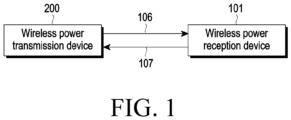
- a wireless power transmission device 200 may wirelessly transmit power 106 to a wireless power reception device 101.
- the wireless power transmission device 200 may receive information 107 from the wireless power reception device 101.
- the wireless power transmission device 200 may transmit power 106 as per an induction scheme.
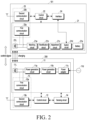
- the wireless power transmission device 200 may include at least one of, e.g., a power source, a DC-DC conversion circuit (e.g., DC/DC converter), DC-AC conversion circuit (e.g., inverter), an amplifying circuit, an impedance matching circuit, at least one capacitor, at least one coil, or a communication modulation circuit.
- the at least one capacitor together with the at least one coil may constitute a resonance circuit.
- That the wireless power transmitting device 200 or the wireless power reception device 101 performs a specific operation may mean that the controller or another hardware device triggers the specific operation as an instruction for performing the specific operation, which is stored in a storage circuit (e.g., a memory) of the wireless power transmitting device 200 or the wireless power reception device 101, is executed.
- a storage circuit e.g., a memory
- the power generation circuit 11b may convert a DC current output from the power adapter 11c into an AC current and output the AC current.
- the power generation circuit 11b may include a predetermined amplifier (not shown). If the DC voltage or current input through the power adapter 11c is less than a set gain, it may be amplified to a set value using the amplifier.
- the power generation circuit 11b may include a circuit for converting a DC current input from the power adapter 11c into an AC based on a control signal input from the control circuit 12.
- the power generation circuit 11b may include a bridge circuit including a plurality of switches.
- the coil 11L may include a plurality of coils (or coils wound multiple times), and the plurality of coils (or coils wound multiple times) may share at least a portion of the power generation circuit 11b.
- the power generation circuit 11b may convert the DC current into AC through a predetermined inverter.
- the power generation circuit 11b may include a gate driving device (not shown).
- the gate driving device may change the DC current to AC while controlling the DC current by turning on/off.
- the power generation circuit 11b may generate an AC power signal through a wireless power generator (e.g., an oscillator).
- the matching circuit 11a may perform impedance matching. For example, if the AC signal output from the power generation circuit 11b is transferred to the coil 11L, an electromagnetic field may be formed in the coil 11L by the AC signal. In an embodiment, the AC signal may be provided only to some of the plurality of coils (or coils wound multiple times), which is described below in greater detail. The frequency band of the formed electromagnetic field signal may be adjusted by adjusting the impedance of the matching circuit 11a.
- the matching circuit 11a may control the output power transmitted to the electronic device 101 through the coil 11L to have high efficiency or high power by impedance adjustment. The matching circuit 11a may adjust impedance based on the control of the control circuit 12.
- the control circuit 12 may control to wirelessly transmit power to the electronic device 101 through the power transmission circuit 11.
- the control circuit 12 may control to wirelessly transmit or receive information from the electronic device 101 through the communication circuit 13.
- the control circuit 12 may calculate the amount of power received from the electronic device 101 based on the current or voltage measured by the sensing circuit 14.
- the charging configuration information may be information related to the battery state of the electronic device 101 at a wireless charging time point between the wireless power transmission device 10 and the electronic device 101.
- the charging configuration information may include at least one of a total battery capacity, a remaining battery capacity, a number of times of charging, a battery usage amount, a charging mode, a charging method, or a radio frequency band of the electronic device 101.
- the environment information may be information obtained by measuring the charging environment of the electronic device 101 by the interface 24 of the electronic device 101, and may include, e.g., at least one of temperature data including at least one of the internal temperature or the external temperature of the electronic device 101, illuminance data indicating illuminance (brightness) around the electronic device 101, or sound data indicating sound (noise) around the electronic device 101.
- the control circuit 12 may be controlled to generate or transmit power to be transmitted to the electronic device 101 based on the charging configuration information among the received information. Alternatively, the control circuit 12 may determine or change the amount of power transmitted to the electronic device 101 based on at least some of the received information(e.g., at least one of the power amount control information, environment information, or time information). Alternatively, the matching circuit 11a may be controlled to change the impedance.
- the communication circuit 13 may communicate with the electronic device 101 in a predetermined manner.
- the communication circuit 13 may perform data communication with the communication circuit 23 of the electronic device 101.
- the communication circuit 13 may unicast, multicast, or broadcast the signal.
- the communication circuit 13 may include at least one of a first communication circuit 13a implemented as one piece of hardware with the power transmission circuit 11 to allow the wireless power transmission device 10 to perform communication in an in-band form, or a second communication circuit 13b implemented in hardware different from the power transmission circuit 11 to allow the wireless power transmission device 10 to perform communication in an out-of-band form.
- the first communication circuit 13 may receive the frequency and the signal level of an electromagnetic field signal received through the coil 11L of the power transmission circuit 11.
- the control circuit 12 may extract information received from the electronic device 101 by decoding the frequency and the signal level of the received electromagnetic field signal.
- the first communication circuit 13 may apply a signal for information about the wireless power transmission device 10 to be transmitted to the electronic device 101 to the coil 11L of the power transmission circuit 11, or may add a signal for information about the wireless power transmission device 10 to an electromagnetic field signal generated when a signal output from the matching circuit 11a is applied to the coil 11L and transmit the same to the electronic device 101.
- the control circuit 12 may control to change the state of connection to at least one of the inductor or capacitor of the matching circuit 11a and output it through on/off control of the switch device included in the matching circuit 11a.
- the second communication circuit 13b may perform communication with the communication circuit 23 of the electronic device 101 using near-field communication (NFC), Zigbee communication, infrared communication, visible light communication, Bluetooth communication, or a Bluetooth low energy (BLE) scheme.
- NFC near-field communication
- Zigbee communication Zigbee communication
- infrared communication visible light communication
- Bluetooth communication Bluetooth low energy
- the above-described communication scheme of the communication circuit 13 is merely an example, and the scope of embodiments of the disclosure are not limited to a specific communication scheme performed by the communication circuit 13.
- the electronic device 101 may include a power reception circuit 21, a control circuit 22, a communication circuit 23, or an interface 24.
- the power reception circuit 21 of the electronic device 101 may receive power from the power transmission circuit 11 of the wireless power transmission device 10.
- the power reception circuit 21 may be implemented in the form of a built-in battery, or may be implemented in the form of a power reception interface to receive power from the outside.
- the power reception circuit 21 may include a matching circuit 21a, a rectification circuit 21b, an adjustment circuit 21c, a switch circuit 21d, a battery 21e, or a coil 21L.
- the power reception circuit 21 may receive wireless power in the form of electromagnetic waves generated corresponding to the current/voltage applied to the coil 11L of the power transmission circuit 11 through the coil 21L.
- the power reception circuit 21 may receive power using the electromotive force formed in the coil 11L of the power transmission circuit 11 and the coil 21L of the power reception circuit 21.
- the matching circuit 21a may perform impedance matching. For example, power transmitted through the coil 11L of the wireless power transmission device 10 may be transferred to the coil 21L to form an electromagnetic field.
- the matching circuit 21a may adjust the frequency band of the formed electromagnetic field signal by adjusting the impedance. By adjusting the impedance, the matching circuit 21a may control the input power received from the wireless power transmission device 10 through the coil 21L to have high efficiency and high output.
- the matching circuit 21a may adjust impedance based on the control of the control circuit 22.
- the matching circuit 21a may include at least one of an inductor (e.g., a coil (or a conductive pattern)), a capacitor, or a switch device.
- the control circuit 22 may control a connection state with at least one of the inductor or the capacitor through the switch device, thereby performing impedance matching.
- the rectification circuit 21b may rectify the wireless power received by the coil 21L in the form of DC, and may be implemented in the form of, e.g., a bridge diode.
- the adjustment circuit 21c may convert the rectified power to a set voltage or current.
- the adjustment circuit 21c may include a DC/DC converter (not shown).
- the adjustment circuit 21c may convert the rectified power so that the voltage of the output terminal becomes 5V.
- a minimum value or a maximum value of a voltage that may be applied may be set at the front end of the adjustment circuit 21c.
- the switch circuit 21d may connect the adjustment circuit 21c and the battery 21e.
- the switch circuit 21d may maintain an on/off state under the control of the control circuit 52.
- the battery 21e may be charged by receiving power input from the adjustment circuit 21c.
- a charger (not shown) may be further disposed between the switch circuit 21d and the battery 21e, and the charger (not shown) may change the voltage or current of power received in a predetermined mode (e.g., a constant current (CC) mode or a constant voltage (CV) mode) and charge the battery 21e.
- a predetermined mode e.g., a constant current (CC) mode or a constant voltage (CV) mode
- the DC/DC converter of the adjustment circuit 21c may directly charge the battery 21e, or the charger (not shown) may adjust the power output from the adjustment circuit 21c once again to charge the battery 21e.
- the electronic device 101 may include a sensing circuit, and the sensing circuit may sense a state change in the power received by the electronic device 101.
- the sensing circuit may periodically or aperiodically measure the current/voltage value received in the coil 21L through a predetermined current/voltage sensor.
- the electronic device 101 may calculate the amount of power received by the electronic device 101 based on the measured current/voltage.
- the electronic device 101 may be utilized to change the matching circuit 21a based on the measured current/voltage.
- the sensing circuit may sense a change in the charging environment of the electronic device 101.
- the sensing circuit may periodically or aperiodically measure at least one of the internal temperature or the external temperature of the electronic device 101 through a predetermined temperature sensor.
- the communication circuit 23 may communicate with the wireless power transmission device 10 in a predetermined manner.
- the communication circuit 23 may perform data communication with the communication circuit 13 of the wireless power transmission device 10.
- the communication circuit 23 may exchange a control signal through data communication with the wireless power transmission device 10.
- the communication circuit 23 may operate in the same or similar manner to the communication circuit 13 of the wireless power transmission device 10.
- the control circuit 22 may transmit charging configuration information for receiving a required amount of power to the wireless power transmission device 10 based on information related to the battery state of the electronic device 101 through the communication circuit 23. For example, if the wireless power transmission device 10 capable of transmitting wireless power is identified, the control circuit 22 may transmit the charging configuration information for receiving a required amount of power to the wireless power transmission device 10 through the communication circuit 23 based on at least one of the total battery capacity, the remaining battery capacity, the number of times of charging, the battery usage, the charging mode, the charging scheme, or the radio reception frequency band of the electronic device 101.
- the control circuit 22 may transmit the power amount control information for controlling the amount of power received from the wireless power transmission device 10 to the wireless power transmission device 10 according to a change in the amount of power charged in the electronic device 101, through the communication circuit 23.
- the first communication circuit 23a may include a switch, a capacitor, or a resistor.
- the control circuit 22 may turn on/off the switch according to the binary code of the data to be transmitted based on the on/off keying modulation scheme.
- the impedance sensed by the wireless power transmission device 10 may detect a change in the magnitude of power or the magnitude of current in the power transmission circuit 11 as the switch is turned on/off, and may be demodulated into a binary code so that data to be transmitted by the electronic device 101 may be obtained.
- the electronic device 101 interface 24 may connect a TA (or an external electronic device) to the electronic device 101 through a connector.
- the interface 24 may include a USB communication module connected to the control circuit 22 or the processor through a designated system interface, e.g., an inter-integrated circuit (I2C).
- the TA may communicate with the USB communication module of the wireless power reception device 101 through the CC terminal of the USB C type.
- the USB communication module may include a USB power delivery (PD) communication module for USB power delivery (PD) communication.
- the TA may be a TA supporting a programmable power supply (PPS) standard or a general TA not supporting the PPS.
- PPS programmable power supply
- the TA supporting the PPS may variously change or adjust the output TA voltage or the output TA current under the control of the control circuit 22 of the wireless power reception device 101.
- the output TA voltage or the output TA current may be fixed.
- the interface 24 may be a wired interface.
- FIG. 2 illustrates that the wireless power transmission device 10 and the electronic device 101 include only the power transmission circuit 11 and the power reception circuit 21, respectively, each of the wireless power transmission device 10 and the electronic device 101 may include both the power transmission circuit 11 and the power reception circuit 21. Accordingly, the wireless power transmission device 10 and the electronic device 101 according to an embodiment of the disclosure may function as both the power transmission device and the electronic device.
- FIG. 3 is a perspective view illustrating a wireless power transmission device and an electronic device receiving wireless power according to an embodiment of the disclosure.
- FIG. 4 is an exploded perspective view illustrating a wireless power transmission device according to an embodiment of the disclosure.
- the wireless power transmission device 200 may supply power to the adjacent wireless power reception device 101.
- the configuration of the wireless power transmission device 200 and the wireless power reception device 101 of FIGS. 3 and 4 may be identical in whole or part to the configuration of the wireless power transmission device 200 and the wireless power reception device 101 of FIGS. 1 and/or 2.
- the irregular pattern 215a in a state in which the wireless power reception device 101 is disposed on the wireless power transmission device 200 (e.g., FIG. 2 ), there may be an empty space between the wireless power reception device 101 and the wireless power transmission device 200.
- air in the empty space positioned between the wireless power reception device 101 and the wireless power transmission device 200 may flow to the outside through the surface of the wireless power reception device 101 and the groove 216b of the irregular pattern 215a.
- the transmission coil 320 may be positioned below the upper enclosure 311.
- the transmission coil 320 may be positioned below the second surface 311c of the upper enclosure 311.
Landscapes
- Engineering & Computer Science (AREA)
- Power Engineering (AREA)
- Computer Networks & Wireless Communication (AREA)
- Microelectronics & Electronic Packaging (AREA)
- Physics & Mathematics (AREA)
- Thermal Sciences (AREA)
- Charge And Discharge Circuits For Batteries Or The Like (AREA)
Applications Claiming Priority (3)
| Application Number | Priority Date | Filing Date | Title |
|---|---|---|---|
| KR20220108735 | 2022-08-29 | ||
| KR1020220128980A KR20240030884A (ko) | 2022-08-29 | 2022-10-07 | 무선 전력 송신 장치 |
| PCT/KR2023/012362 WO2024049078A1 (ko) | 2022-08-29 | 2023-08-21 | 무선 전력 송신 장치 |
Publications (2)
| Publication Number | Publication Date |
|---|---|
| EP4580000A1 true EP4580000A1 (de) | 2025-07-02 |
| EP4580000A4 EP4580000A4 (de) | 2025-12-17 |
Family
ID=90098221
Family Applications (1)
| Application Number | Title | Priority Date | Filing Date |
|---|---|---|---|
| EP23860756.8A Pending EP4580000A4 (de) | 2022-08-29 | 2023-08-21 | Vorrichtung zur drahtlosen stromübertragung |
Country Status (3)
| Country | Link |
|---|---|
| US (1) | US20250202282A1 (de) |
| EP (1) | EP4580000A4 (de) |
| WO (1) | WO2024049078A1 (de) |
Family Cites Families (9)
| Publication number | Priority date | Publication date | Assignee | Title |
|---|---|---|---|---|
| US11309122B2 (en) * | 2016-09-12 | 2022-04-19 | Holygo Corporation | Wireless charging coil structure with function of heat dissipation |
| KR102414050B1 (ko) * | 2017-07-10 | 2022-06-28 | 주식회사 바른 | 무선 충전 장치의 휴대 단말기 직접 냉각 구조 |
| KR102202882B1 (ko) * | 2019-07-12 | 2021-01-15 | 니덱모빌리티코리아 주식회사 | 통풍 구조를 갖는 차량용 무선 충전 장치 |
| US11476706B2 (en) * | 2019-08-16 | 2022-10-18 | Aptiv Technologies Limited | Wireless device charger with cooling device |
| KR102780304B1 (ko) * | 2019-11-25 | 2025-03-14 | 삼성전자주식회사 | 냉각 팬을 제어하는 방법 및 무선 충전 장치 |
| KR20210101887A (ko) * | 2020-02-11 | 2021-08-19 | 엘지전자 주식회사 | 무선 전력 송신 시 발생하는 열을 방출할 수 있는 무선 충전 장치 |
| KR102302100B1 (ko) * | 2020-05-22 | 2021-09-13 | 김효진 | 차량용 스마트기기 무선충전기 |
| KR102432872B1 (ko) * | 2020-12-17 | 2022-08-16 | 에스케이씨 주식회사 | 무선충전 장치 및 이를 포함하는 이동 수단 |
| US20220006322A1 (en) * | 2021-08-25 | 2022-01-06 | Shenzhen Sea Star Sounds Co.,Ltd | Wireless charger with cooling function |
-
2023
- 2023-08-21 EP EP23860756.8A patent/EP4580000A4/de active Pending
- 2023-08-21 WO PCT/KR2023/012362 patent/WO2024049078A1/ko not_active Ceased
-
2025
- 2025-02-27 US US19/065,549 patent/US20250202282A1/en active Pending
Also Published As
| Publication number | Publication date |
|---|---|
| WO2024049078A1 (ko) | 2024-03-07 |
| US20250202282A1 (en) | 2025-06-19 |
| EP4580000A4 (de) | 2025-12-17 |
Similar Documents
| Publication | Publication Date | Title |
|---|---|---|
| EP3131178B1 (de) | Vorrichtung zur drahtlosen stromübertragung | |
| CN104428972B (zh) | 用于小型设备无线充电模式的系统、方法和装置 | |
| KR102441498B1 (ko) | 코일 장치 및 이를 포함하는 무선충전장치 | |
| KR101959099B1 (ko) | 다중 수신기 코일들을 갖는 무선 전력 수신기 | |
| JP6140428B2 (ja) | 電力送信コイル及び無線電力送信装置 | |
| CN101431258A (zh) | 功率传递线圈、移动终端、功率发送装置和功率传递系统 | |
| CN103765729A (zh) | 电力中继器 | |
| KR101983174B1 (ko) | 무선 전력 수신 장치 및 이를 포함하는 전자 장치 | |
| JP6186372B2 (ja) | 無線電力送信装置及び方法 | |
| KR20240033273A (ko) | 무선 전력 모드 스위칭 | |
| JPH0739077A (ja) | コードレスパワーステーション | |
| TWM461243U (zh) | 無線充電裝置 | |
| JP2015231329A (ja) | 無線電力伝送装置 | |
| KR102883158B1 (ko) | 무선 전력 송신 장치 | |
| EP4580000A1 (de) | Vorrichtung zur drahtlosen stromübertragung | |
| US10523057B2 (en) | Wireless charging module with versatile charging orientation and modularized sensing device therewith | |
| WO2026064133A1 (en) | Wireless charger device supporting multiple wireless power transfer specifications | |
| CN107710555A (zh) | 无线电力传输设备及其控制方法 | |
| CN110601382A (zh) | 微波电池管理电路及其方法 | |
| KR20240030884A (ko) | 무선 전력 송신 장치 | |
| KR20240139525A (ko) | 무선 전력 전송 장치 | |
| KR20040098819A (ko) | 무선 전원 공급장치 및 무선 전원 수신장치 | |
| CN119605054A (zh) | 磁性位移控制模块和包括该模块的电子装置 | |
| CN223729483U (zh) | 一种多功能无线充电器 | |
| KR20170139319A (ko) | 무선 전력 송신기 및 수신기 |
Legal Events
| Date | Code | Title | Description |
|---|---|---|---|
| STAA | Information on the status of an ep patent application or granted ep patent |
Free format text: STATUS: THE INTERNATIONAL PUBLICATION HAS BEEN MADE |
|
| PUAI | Public reference made under article 153(3) epc to a published international application that has entered the european phase |
Free format text: ORIGINAL CODE: 0009012 |
|
| STAA | Information on the status of an ep patent application or granted ep patent |
Free format text: STATUS: REQUEST FOR EXAMINATION WAS MADE |
|
| 17P | Request for examination filed |
Effective date: 20250326 |
|
| AK | Designated contracting states |
Kind code of ref document: A1 Designated state(s): AL AT BE BG CH CY CZ DE DK EE ES FI FR GB GR HR HU IE IS IT LI LT LU LV MC ME MK MT NL NO PL PT RO RS SE SI SK SM TR |
|
| REG | Reference to a national code |
Ref country code: DE Ref legal event code: R079 Free format text: PREVIOUS MAIN CLASS: H02J0050000000 Ipc: H02J0007000000 |
|
| DAV | Request for validation of the european patent (deleted) | ||
| DAX | Request for extension of the european patent (deleted) | ||
| A4 | Supplementary search report drawn up and despatched |
Effective date: 20251118 |
|
| RIC1 | Information provided on ipc code assigned before grant |
Ipc: H02J 7/00 20060101AFI20251112BHEP Ipc: H02J 50/10 20160101ALI20251112BHEP Ipc: H02J 50/90 20160101ALI20251112BHEP |