EP4579873A1 - Wirbelschichtreaktor und verfahren zur rückgewinnung von aktivem metall einer lithiumsekundärbatterie damit - Google Patents
Wirbelschichtreaktor und verfahren zur rückgewinnung von aktivem metall einer lithiumsekundärbatterie damit Download PDFInfo
- Publication number
- EP4579873A1 EP4579873A1 EP23865678.9A EP23865678A EP4579873A1 EP 4579873 A1 EP4579873 A1 EP 4579873A1 EP 23865678 A EP23865678 A EP 23865678A EP 4579873 A1 EP4579873 A1 EP 4579873A1
- Authority
- EP
- European Patent Office
- Prior art keywords
- fluidized bed
- reactor
- expansion chamber
- reactor body
- secondary battery
- Prior art date
- Legal status (The legal status is an assumption and is not a legal conclusion. Google has not performed a legal analysis and makes no representation as to the accuracy of the status listed.)
- Pending
Links
Images
Classifications
-
- B—PERFORMING OPERATIONS; TRANSPORTING
- B01—PHYSICAL OR CHEMICAL PROCESSES OR APPARATUS IN GENERAL
- B01J—CHEMICAL OR PHYSICAL PROCESSES, e.g. CATALYSIS OR COLLOID CHEMISTRY; THEIR RELEVANT APPARATUS
- B01J8/00—Chemical or physical processes in general, conducted in the presence of fluids and solid particles; Apparatus for such processes
- B01J8/18—Chemical or physical processes in general, conducted in the presence of fluids and solid particles; Apparatus for such processes with fluidised particles
- B01J8/1818—Feeding of the fluidising gas
-
- B—PERFORMING OPERATIONS; TRANSPORTING
- B01—PHYSICAL OR CHEMICAL PROCESSES OR APPARATUS IN GENERAL
- B01J—CHEMICAL OR PHYSICAL PROCESSES, e.g. CATALYSIS OR COLLOID CHEMISTRY; THEIR RELEVANT APPARATUS
- B01J8/00—Chemical or physical processes in general, conducted in the presence of fluids and solid particles; Apparatus for such processes
- B01J8/005—Separating solid material from the gas/liquid stream
- B01J8/0055—Separating solid material from the gas/liquid stream using cyclones
-
- B—PERFORMING OPERATIONS; TRANSPORTING
- B01—PHYSICAL OR CHEMICAL PROCESSES OR APPARATUS IN GENERAL
- B01J—CHEMICAL OR PHYSICAL PROCESSES, e.g. CATALYSIS OR COLLOID CHEMISTRY; THEIR RELEVANT APPARATUS
- B01J8/00—Chemical or physical processes in general, conducted in the presence of fluids and solid particles; Apparatus for such processes
- B01J8/18—Chemical or physical processes in general, conducted in the presence of fluids and solid particles; Apparatus for such processes with fluidised particles
-
- B—PERFORMING OPERATIONS; TRANSPORTING
- B01—PHYSICAL OR CHEMICAL PROCESSES OR APPARATUS IN GENERAL
- B01J—CHEMICAL OR PHYSICAL PROCESSES, e.g. CATALYSIS OR COLLOID CHEMISTRY; THEIR RELEVANT APPARATUS
- B01J8/00—Chemical or physical processes in general, conducted in the presence of fluids and solid particles; Apparatus for such processes
- B01J8/18—Chemical or physical processes in general, conducted in the presence of fluids and solid particles; Apparatus for such processes with fluidised particles
- B01J8/1818—Feeding of the fluidising gas
- B01J8/1827—Feeding of the fluidising gas the fluidising gas being a reactant
-
- B—PERFORMING OPERATIONS; TRANSPORTING
- B01—PHYSICAL OR CHEMICAL PROCESSES OR APPARATUS IN GENERAL
- B01J—CHEMICAL OR PHYSICAL PROCESSES, e.g. CATALYSIS OR COLLOID CHEMISTRY; THEIR RELEVANT APPARATUS
- B01J8/00—Chemical or physical processes in general, conducted in the presence of fluids and solid particles; Apparatus for such processes
- B01J8/18—Chemical or physical processes in general, conducted in the presence of fluids and solid particles; Apparatus for such processes with fluidised particles
- B01J8/1836—Heating and cooling the reactor
-
- B—PERFORMING OPERATIONS; TRANSPORTING
- B01—PHYSICAL OR CHEMICAL PROCESSES OR APPARATUS IN GENERAL
- B01J—CHEMICAL OR PHYSICAL PROCESSES, e.g. CATALYSIS OR COLLOID CHEMISTRY; THEIR RELEVANT APPARATUS
- B01J8/00—Chemical or physical processes in general, conducted in the presence of fluids and solid particles; Apparatus for such processes
- B01J8/18—Chemical or physical processes in general, conducted in the presence of fluids and solid particles; Apparatus for such processes with fluidised particles
- B01J8/1872—Details of the fluidised bed reactor
-
- B—PERFORMING OPERATIONS; TRANSPORTING
- B01—PHYSICAL OR CHEMICAL PROCESSES OR APPARATUS IN GENERAL
- B01J—CHEMICAL OR PHYSICAL PROCESSES, e.g. CATALYSIS OR COLLOID CHEMISTRY; THEIR RELEVANT APPARATUS
- B01J8/00—Chemical or physical processes in general, conducted in the presence of fluids and solid particles; Apparatus for such processes
- B01J8/18—Chemical or physical processes in general, conducted in the presence of fluids and solid particles; Apparatus for such processes with fluidised particles
- B01J8/24—Chemical or physical processes in general, conducted in the presence of fluids and solid particles; Apparatus for such processes with fluidised particles according to "fluidised-bed" technique
-
- B—PERFORMING OPERATIONS; TRANSPORTING
- B01—PHYSICAL OR CHEMICAL PROCESSES OR APPARATUS IN GENERAL
- B01J—CHEMICAL OR PHYSICAL PROCESSES, e.g. CATALYSIS OR COLLOID CHEMISTRY; THEIR RELEVANT APPARATUS
- B01J8/00—Chemical or physical processes in general, conducted in the presence of fluids and solid particles; Apparatus for such processes
- B01J8/18—Chemical or physical processes in general, conducted in the presence of fluids and solid particles; Apparatus for such processes with fluidised particles
- B01J8/24—Chemical or physical processes in general, conducted in the presence of fluids and solid particles; Apparatus for such processes with fluidised particles according to "fluidised-bed" technique
- B01J8/34—Chemical or physical processes in general, conducted in the presence of fluids and solid particles; Apparatus for such processes with fluidised particles according to "fluidised-bed" technique with stationary packing material in the fluidised bed, e.g. bricks, wire rings, baffles
-
- B—PERFORMING OPERATIONS; TRANSPORTING
- B01—PHYSICAL OR CHEMICAL PROCESSES OR APPARATUS IN GENERAL
- B01J—CHEMICAL OR PHYSICAL PROCESSES, e.g. CATALYSIS OR COLLOID CHEMISTRY; THEIR RELEVANT APPARATUS
- B01J8/00—Chemical or physical processes in general, conducted in the presence of fluids and solid particles; Apparatus for such processes
- B01J8/18—Chemical or physical processes in general, conducted in the presence of fluids and solid particles; Apparatus for such processes with fluidised particles
- B01J8/24—Chemical or physical processes in general, conducted in the presence of fluids and solid particles; Apparatus for such processes with fluidised particles according to "fluidised-bed" technique
- B01J8/44—Fluidisation grids
-
- C—CHEMISTRY; METALLURGY
- C22—METALLURGY; FERROUS OR NON-FERROUS ALLOYS; TREATMENT OF ALLOYS OR NON-FERROUS METALS
- C22B—PRODUCTION AND REFINING OF METALS; PRETREATMENT OF RAW MATERIALS
- C22B1/00—Preliminary treatment of ores or scrap
- C22B1/005—Preliminary treatment of scrap
-
- C—CHEMISTRY; METALLURGY
- C22—METALLURGY; FERROUS OR NON-FERROUS ALLOYS; TREATMENT OF ALLOYS OR NON-FERROUS METALS
- C22B—PRODUCTION AND REFINING OF METALS; PRETREATMENT OF RAW MATERIALS
- C22B1/00—Preliminary treatment of ores or scrap
- C22B1/02—Roasting processes
-
- C—CHEMISTRY; METALLURGY
- C22—METALLURGY; FERROUS OR NON-FERROUS ALLOYS; TREATMENT OF ALLOYS OR NON-FERROUS METALS
- C22B—PRODUCTION AND REFINING OF METALS; PRETREATMENT OF RAW MATERIALS
- C22B23/00—Obtaining nickel or cobalt
- C22B23/04—Obtaining nickel or cobalt by wet processes
- C22B23/0407—Leaching processes
- C22B23/0415—Leaching processes with acids or salt solutions except ammonium salts solutions
- C22B23/043—Sulfurated acids or salts thereof
-
- C—CHEMISTRY; METALLURGY
- C22—METALLURGY; FERROUS OR NON-FERROUS ALLOYS; TREATMENT OF ALLOYS OR NON-FERROUS METALS
- C22B—PRODUCTION AND REFINING OF METALS; PRETREATMENT OF RAW MATERIALS
- C22B26/00—Obtaining alkali, alkaline earth metals or magnesium
- C22B26/10—Obtaining alkali metals
- C22B26/12—Obtaining lithium
-
- C—CHEMISTRY; METALLURGY
- C22—METALLURGY; FERROUS OR NON-FERROUS ALLOYS; TREATMENT OF ALLOYS OR NON-FERROUS METALS
- C22B—PRODUCTION AND REFINING OF METALS; PRETREATMENT OF RAW MATERIALS
- C22B47/00—Obtaining manganese
-
- C—CHEMISTRY; METALLURGY
- C22—METALLURGY; FERROUS OR NON-FERROUS ALLOYS; TREATMENT OF ALLOYS OR NON-FERROUS METALS
- C22B—PRODUCTION AND REFINING OF METALS; PRETREATMENT OF RAW MATERIALS
- C22B5/00—General methods of reducing to metals
- C22B5/02—Dry methods smelting of sulfides or formation of mattes
- C22B5/12—Dry methods smelting of sulfides or formation of mattes by gases
- C22B5/14—Dry methods smelting of sulfides or formation of mattes by gases fluidised material
-
- C—CHEMISTRY; METALLURGY
- C22—METALLURGY; FERROUS OR NON-FERROUS ALLOYS; TREATMENT OF ALLOYS OR NON-FERROUS METALS
- C22B—PRODUCTION AND REFINING OF METALS; PRETREATMENT OF RAW MATERIALS
- C22B7/00—Working up raw materials other than ores, e.g. scrap, to produce non-ferrous metals and compounds thereof; Methods of a general interest or applied to the winning of more than two metals
- C22B7/001—Dry processes
-
- C—CHEMISTRY; METALLURGY
- C22—METALLURGY; FERROUS OR NON-FERROUS ALLOYS; TREATMENT OF ALLOYS OR NON-FERROUS METALS
- C22B—PRODUCTION AND REFINING OF METALS; PRETREATMENT OF RAW MATERIALS
- C22B7/00—Working up raw materials other than ores, e.g. scrap, to produce non-ferrous metals and compounds thereof; Methods of a general interest or applied to the winning of more than two metals
- C22B7/006—Wet processes
-
- H—ELECTRICITY
- H01—ELECTRIC ELEMENTS
- H01M—PROCESSES OR MEANS, e.g. BATTERIES, FOR THE DIRECT CONVERSION OF CHEMICAL ENERGY INTO ELECTRICAL ENERGY
- H01M10/00—Secondary cells; Manufacture thereof
- H01M10/54—Reclaiming serviceable parts of waste accumulators
-
- B—PERFORMING OPERATIONS; TRANSPORTING
- B01—PHYSICAL OR CHEMICAL PROCESSES OR APPARATUS IN GENERAL
- B01J—CHEMICAL OR PHYSICAL PROCESSES, e.g. CATALYSIS OR COLLOID CHEMISTRY; THEIR RELEVANT APPARATUS
- B01J2208/00—Processes carried out in the presence of solid particles; Reactors therefor
- B01J2208/00008—Controlling the process
- B01J2208/00017—Controlling the temperature
- B01J2208/00327—Controlling the temperature by direct heat exchange
- B01J2208/00336—Controlling the temperature by direct heat exchange adding a temperature modifying medium to the reactants
-
- B—PERFORMING OPERATIONS; TRANSPORTING
- B01—PHYSICAL OR CHEMICAL PROCESSES OR APPARATUS IN GENERAL
- B01J—CHEMICAL OR PHYSICAL PROCESSES, e.g. CATALYSIS OR COLLOID CHEMISTRY; THEIR RELEVANT APPARATUS
- B01J2208/00—Processes carried out in the presence of solid particles; Reactors therefor
- B01J2208/00796—Details of the reactor or of the particulate material
- B01J2208/00884—Means for supporting the bed of particles, e.g. grids, bars, perforated plates
-
- B—PERFORMING OPERATIONS; TRANSPORTING
- B01—PHYSICAL OR CHEMICAL PROCESSES OR APPARATUS IN GENERAL
- B01J—CHEMICAL OR PHYSICAL PROCESSES, e.g. CATALYSIS OR COLLOID CHEMISTRY; THEIR RELEVANT APPARATUS
- B01J2208/00—Processes carried out in the presence of solid particles; Reactors therefor
- B01J2208/00796—Details of the reactor or of the particulate material
- B01J2208/00991—Disengagement zone in fluidised-bed reactors
-
- C—CHEMISTRY; METALLURGY
- C22—METALLURGY; FERROUS OR NON-FERROUS ALLOYS; TREATMENT OF ALLOYS OR NON-FERROUS METALS
- C22B—PRODUCTION AND REFINING OF METALS; PRETREATMENT OF RAW MATERIALS
- C22B1/00—Preliminary treatment of ores or scrap
- C22B1/14—Agglomerating; Briquetting; Binding; Granulating
- C22B1/24—Binding; Briquetting ; Granulating
- C22B1/248—Binding; Briquetting ; Granulating of metal scrap or alloys
-
- C—CHEMISTRY; METALLURGY
- C22—METALLURGY; FERROUS OR NON-FERROUS ALLOYS; TREATMENT OF ALLOYS OR NON-FERROUS METALS
- C22B—PRODUCTION AND REFINING OF METALS; PRETREATMENT OF RAW MATERIALS
- C22B23/00—Obtaining nickel or cobalt
-
- Y—GENERAL TAGGING OF NEW TECHNOLOGICAL DEVELOPMENTS; GENERAL TAGGING OF CROSS-SECTIONAL TECHNOLOGIES SPANNING OVER SEVERAL SECTIONS OF THE IPC; TECHNICAL SUBJECTS COVERED BY FORMER USPC CROSS-REFERENCE ART COLLECTIONS [XRACs] AND DIGESTS
- Y02—TECHNOLOGIES OR APPLICATIONS FOR MITIGATION OR ADAPTATION AGAINST CLIMATE CHANGE
- Y02P—CLIMATE CHANGE MITIGATION TECHNOLOGIES IN THE PRODUCTION OR PROCESSING OF GOODS
- Y02P10/00—Technologies related to metal processing
- Y02P10/20—Recycling
-
- Y—GENERAL TAGGING OF NEW TECHNOLOGICAL DEVELOPMENTS; GENERAL TAGGING OF CROSS-SECTIONAL TECHNOLOGIES SPANNING OVER SEVERAL SECTIONS OF THE IPC; TECHNICAL SUBJECTS COVERED BY FORMER USPC CROSS-REFERENCE ART COLLECTIONS [XRACs] AND DIGESTS
- Y02—TECHNOLOGIES OR APPLICATIONS FOR MITIGATION OR ADAPTATION AGAINST CLIMATE CHANGE
- Y02W—CLIMATE CHANGE MITIGATION TECHNOLOGIES RELATED TO WASTEWATER TREATMENT OR WASTE MANAGEMENT
- Y02W30/00—Technologies for solid waste management
- Y02W30/50—Reuse, recycling or recovery technologies
- Y02W30/84—Recycling of batteries or fuel cells
Definitions
- the present disclosure relates to a fluidized bed reactor and a method for recovering active metals of a lithium secondary battery using the same, and more specifically, to a fluidized bed reactor capable of performing a dry reaction by flowing particles and a method for recovering active metals of a lithium secondary battery using the fluidized bed reactor.
- An object of the present disclosure is to provide a fluidized bed reactor having improved reaction yield and reaction reliability.
- Another object of the present disclosure is to provide a method for recovering active metals of a lithium secondary battery using the fluidized bed reactor.
- a cathode active material mixture may be supplied to a fluidized bed reactor including a reactor body.
- a reaction gas may be introduced from a lower portion of the fluidized bed reactor to form a fluidized bed including a preliminary precursor mixture within the reactor body.
- the fluidized bed portion that has entered the upper portion of the fluidized bed reactor may be cooled to descend it into the reactor body.
- a lithium precursor may be recovered from the preliminary precursor mixture.
- the fluidized bed reactor may include an expansion chamber communicated with the reactor body, and an intermediate part formed between the reactor body and the expansion chamber to connect them, and cooling the fluidized bed portion may be performed within the expansion chamber.
- cooling the fluidized bed portion may be performed through a cooling coil or cooling fins disposed inside the expansion chamber.
- cooling the fluidized bed portion may include directly injecting a coolant into the expansion chamber.
- the intermediate part may include an inclined side wall extending from an end of the reactor body to the expansion chamber.
- an internal temperature of the expansion chamber may be maintained lower than that of the reactor body.
- the internal temperature of the expansion chamber may be 20 to 300°C, and the internal temperature of the reactor body may be 400 to 700°C.
- cooling the fluidized bed portion that has entered the upper portion of the fluidized bed reactor may include reducing a moving velocity of particles included in the preliminary precursor mixture to a terminal velocity or less.
- a fluidized bed reactor may include a reactor body, an expansion chamber connected to an end of the reactor body and having a width greater than that of the reactor body, and a coolant injection port fixed to an upper surface of the expansion chamber to directly inject a coolant to a reactant.
- the fluidized bed reactor may further include an intermediate part which is formed between the reactor body and the expansion chamber to connect them, and includes an inclined side wall.
- an inclination angle between an imaginary vertical line extended from the inner wall of the reactor body and the inclined side wall may be 30° to 80°.
- the fluidized bed reactor may further include a reactor lower portion connected to a bottom portion of the reactor body, a fluid inlet configured to inject a reaction gas into the reactor lower portion, and a fluid outlet connected to the expansion chamber to discharge the reaction gas.
- the fluidized bed reactor may further a dispersion plate which divides the reactor lower portion and the reactor body.
- the fluidized bed reactor may use the cooling unit to cool the upper portion of the fluidized bed reactor. As the upper portion of the fluidized bed reactor is cooled, a loss of the preliminary precursor mixture to an outside of the fluidized bed reactor due to a high velocity of ascending fluidized bed may be minimized.
- the fluidized bed reactor may include an expansion chamber at the upper portion thereof.
- a movement space of the preliminary precursor mixture that has entered the expansion chamber may be expanded, such that the velocity when ascending may be decreased.
- the expansion chamber may include a cooling unit such that the temperature inside the expansion chamber may be rapidly reduced. Further, the preliminary precursor mixture may be scattered to participate again in the fluidized bed reaction. Accordingly, the reduction efficiency and the lithium precursor yield within the fluidized bed may be improved.
- the embodiments of the present disclosure provide a fluidized bed reactor which includes an upper cooling section and a method for recovering active metals of a lithium secondary battery using the fluidized bed reactor.
- the term "precursor” is used to comprehensively refer to a compound including specific metals to provide the specific metals included in the electrode active material.
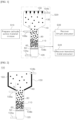
- FIG. 1 is a schematic view for describing a fluidized bed reactor and a method for recovering active metals of a lithium secondary battery using the same according to exemplary embodiments.
- FIG. 1 shows a process flowchart and a schematic cross-section of the fluidized bed reactor together.
- a cathode active material mixture may be prepared from a cathode of a lithium secondary battery (e.g., process S10).
- the lithium secondary battery may include an electrode assembly including a cathode, an anode and a separation member interposed between the cathode and the anode.
- the cathode and the anode may include a cathode active material layer and an anode active material layer coated on a cathode current collector and an anode current collector, respectively.
- a cathode active material included in the cathode active material layer may include an oxide containing lithium and a transition metal.
- the cathode active material may include a compound represented by Formula 1: [Formula 1] Li x M1 a M2 6 M3 c O y
- M1, M2 and M3 may be a transition metal selected from Ni, Co, Mn, Na, Mg, Ca, Ti, V, Cr, Cu, Zn, Ge, Sr, Ag, Ba, Zr, Nb, Mo, Al, Ga or B.
- x, y, a, b and c may satisfy 0 ⁇ x ⁇ 1.1, 2 ⁇ y ⁇ 2.02, 0 ⁇ a ⁇ 1, 0 ⁇ b ⁇ 1, 0 ⁇ c ⁇ 1, 0 ⁇ a+b+c ⁇ 1.
- the cathode active material may be an NCM-based lithium oxide including nickel, cobalt and manganese.
- the cathode may be separated from the lithium secondary battery to recover a cathode.
- the cathode includes the cathode current collector (e.g., aluminum (Al)) and the cathode active material layer as described above, and the cathode active material layer may include a conductive material and a binder together with the above-described cathode active material.
- the conductive material may include, for example, a carbon-based material such as graphite, carbon black, graphene, carbon nanotube or the like.
- the binder may include, for example, a resin material such as vinylidene fluoride-hexafluoropropylene copolymer (PVDF-co-HFP), polyvinylidene fluoride (PVDF), polyacrylonitrile, polymethyl methacrylate or the like.
- the recovered cathode may be pulverized to produce a cathode active material mixture.
- the cathode active material mixture may be manufactured in the form of powder.
- the cathode active material mixture includes powder of a lithium-transition metal oxide as described above, and may include, for example, the NCM-based lithium oxide powder (e.g., Li(NCM)O 2 ).
- the term "cathode active material mixture” may refer to a raw material which is input into a fluidized bed reaction treatment to be described below after the cathode current collector is substantially removed from the cathode.
- the cathode active material mixture may include cathode active material particles such as the NCM-based lithium oxide.
- the cathode active material mixture may also include some components derived from the binder or the conductive material.
- the cathode active material mixture may be substantially composed of the cathode active material particles.
- the cathode active material mixture may have an average particle diameter (D50) of 5 to 100 ⁇ m.
- D50 average particle diameter
- the lithium-transition metal oxide such as Li(NCM)O 2 to be recovered may be easily separated from the cathode current collector, the conductive material and the binder included in the cathode active material mixture.
- the heat treatment may be performed at a temperature of, for example, about 100 to 500°C, or about 350 to 450°C. Within the above range, while the impurities may be substantially removed, decomposition and damage of the lithium-transition metal oxide may be prevented.
- the cathode active material mixture may be reacted with a reaction gas within a fluidized bed reactor 100 to form a preliminary precursor mixture 80.
- the fluidized bed reactor 100 may include a reactor body 110, a reactor lower portion 120 and an expansion chamber 130.
- the reactor body 110 may include a heating means such as a heater, or may be integrally formed with the heating means.
- the reactor body 110 may have a cylindrical shape.
- a side wall of the reactor body 110 may be substantially vertical.
- the side wall of the reactor body 110 may be erected vertically from an upper surface of a dispersion plate 50.
- the reaction gas may be introduced into the reactor lower portion 120.
- the reactor lower portion 120 may be defined as a portion below the dispersion plate 50 of the fluidized bed reactor 100.
- the reactor body 110 and the reactor lower portion 120 may be divided by the dispersion plate 50.
- the cathode active material mixture may be supplied into the reactor body 110 through a supply passage 108a.
- the cathode active material mixture may be dropped through the supply passage 108a connected to an upper portion of the reactor body 110.
- the cathode active material mixture may also be input through a supply passage (not shown) connected to a bottom portion of the reactor body 110.
- the reaction gas may be supplied to the reactor lower portion 120.
- the reactor lower portion 120 may include a fluid inlet 104a configured to inject the reaction gas.
- the reaction gas may be introduced into the reactor lower portion 120 through the fluid inlet 104a, and supplied into the reactor body 110.
- the reaction gas may be injected from the bottom portion of the reactor body 110 through injection columns 60 included in the dispersion plate 50.
- the cathode active material mixture may react with the reaction gas while moving to the expansion chamber 130 to be converted into the preliminary precursor mixture 80.
- the reaction gas may include a reducing gas, for example, hydrogen (H 2 ).
- the cathode active material mixture may be reduced by the reaction gas to generate, for example, a preliminary lithium precursor including lithium hydroxide (LiOH), lithium oxide (for example, LiO 2 ), and a transition metal or transition metal oxide.
- a preliminary lithium precursor including lithium hydroxide (LiOH), lithium oxide (for example, LiO 2 ), and a transition metal or transition metal oxide.
- LiOH lithium hydroxide
- LiO 2 lithium oxide
- MnO transition metal or transition metal oxide
- the reduction reaction in the reactor body 110 may be performed at about 400 to 700°C, or 450 to 550°C. Within the above reaction temperature range, the reduction reaction may be facilitated without causing re-aggregation or recombination of the preliminary lithium precursor and the transition metal/transition metal oxide.
- a carrier gas may be supplied together with the reaction gas from the reactor lower portion 120.
- the carrier gas may be supplied together with the reaction gas through the fluid inlet 104a.
- the carrier gas may include an inert gas such as nitrogen (N 2 ), argon (Ar), etc.
- the carrier gas may also be supplied by injecting through the injection columns 60 of the dispersion plate to facilitate the formation of a fluidized bed in which the reduction reaction is performed. For example, the formation of cyclone through the carrier gas may be facilitated.
- the fluidized bed is formed within the reactor body 110, and may ascend to enter the upper portion of the fluidized bed reactor 100.
- the preliminary precursor mixture 80 including a preliminary lithium precursor and a preliminary transition metal precursor may be formed by the reduction reaction in the fluidized bed.
- the preliminary lithium precursor may include, for example, lithium hydroxide, lithium oxide, and/or lithium carbonate (Li carbonate).
- the fluidized bed may at least partially enter the expansion chamber 130.
- the expansion chamber 130 may have a diameter or width greater than that of the reactor body 110.
- the preliminary precursor mixture 80 particles contained in the portion of the fluidized bed moved into the expansion chamber 130 may descend back into the reactor body 110 while the velocity when ascending is reduced, as a movement space is expanded within the expansion chamber 130.
- the temperature in the expansion chamber 130 may be decreased compared to the temperature in the reactor body 110.
- the fluidized bed reactor 100 may further include a cooling unit coupled with the expansion chamber 130.
- the temperature of the fluidized bed portion moved into the expansion chamber 130 may be decreased more quickly by the cooling unit. Accordingly, the preliminary precursor mixture 80 particles scattered into the expansion chamber 130 may be quickly transferred back to the reactor body 110 to participate again in the fluidized bed reaction.
- turbulence may be formed, thereby causing the particles to diffuse into the expansion chamber 130.
- the moving velocity of the preliminary precursor mixture 80 particles may be rapidly reduced to less than the terminal velocity by the cooling unit.
- the moving velocity of the preliminary precursor mixture 80 may have a value less than a turbulence fluidizing rate corresponding to the terminal velocity in a turbulence fluidization stage to be described below, thereby effectively reducing an amount of the preliminary precursor mixture 80 flowing out of the reactor body 110.
- the amount of the preliminary precursor mixture 80 flowing out of the reactor body 110 may be effectively reduced, and the reduction reaction efficiency and lithium precursor yield in the fluidized bed may be improved.
- the temperature inside the expansion chamber 130 may be maintained lower than the temperature inside the reactor body 110 by the cooling unit.
- the temperature inside the expansion chamber 130 may be reduced to 300°C or lower, or 150°C or lower by the cooling unit. In one embodiment, the temperature inside the expansion chamber 130 may be reduced to 20°C to 100°C.
- the cooling unit may include a coolant injection port 150 attached or fixed to an inner surface of the expansion chamber 130.
- a plurality of coolant injection ports 150 may be attached or fixed to an inner upper surface of the expansion chamber 130.
- the coolant injection ports 150 may also be distributed on an inner wall of the expansion chamber 130.
- a coolant e.g., water
- water may be directly injected from the coolant injection ports 150 into the preliminary precursor mixture 80 existing in the expansion chamber 130. Accordingly, cooling efficiency may be improved while the preliminary precursor mixture 80 brings into direct contact with the coolant.
- the preliminary precursor mixture 80 may quickly descend into the reactor body 110 by a force of the coolant injected from the inner upper surface of the expansion chamber 130.
- the coolant injection port 150 may directly inject the coolant into the preliminary precursor mixture 80 that has entered the expansion chamber 130.
- the coolant may bring into direct contact with the preliminary precursor mixture 80, such that the preliminary precursor mixture 80 particles may be aggregated with each other by means of the coolant.
- cooling by the cooling unit may be performed.
- the coolant injection ports 150 may inject the coolant into the preliminary precursor mixture 80.
- the coolant injection ports 150 may inject the coolant into the preliminary precursor mixture 80.
- the preliminary precursor mixture 80 may re-enter the reactor body 110.
- volume and mass of the agglomerated preliminary precursor mixture 80 may be increased, thereby increasing the terminal velocity.
- the moving velocity of the agglomerated preliminary precursor mixture 80 may be reduced.
- the moving velocity of the agglomerated preliminary precursor mixture 80 may be rapidly reduced to less than the terminal velocity. Accordingly, the amount of the preliminary precursor mixture 80 flowing out of the reactor body 110 may be reduced, thereby effectively improving a recovery rate of the preliminary precursor mixture 80.
- the expansion chamber 130 may have a diameter larger than that of the reactor body 110.
- the diameter may be measured based on a central axis of the fluidized bed reactor 100 and an inner wall of the fluidized bed reactor 100. In this case, a deceleration effect of the preliminary precursor mixture 80 or the reaction gas moving from the reactor body 110 to the expansion chamber 130 may be maximized.
- the fluidized bed reactor 100 may further include an intermediate part 140 formed between the reactor body 110 and the expansion chamber 130 to connect them.
- the intermediate part 140 may mean a region where the diameter is gradually increased from an end of the reactor body 110 at a predetermined inclination angle a to be extended to the expansion chamber 130 as the diameter of the expansion chamber 130 becomes larger than that of the reactor body 110.
- the inclination angle (a) may be defined as the angle formed between a line extending in a direction perpendicular to the side of the reactor body (110) and the inclined surface of the intermediate portion (140).
- the inclination angle a of the intermediate part 140 may be 30 to 80°. In one embodiment, the inclination angle a of the intermediate part 140 may be 45 to 60°. When the inclination angle a satisfies the above range, an effective deceleration effect of the preliminary precursor mixture 80 may be expected within a range where the region of the expansion chamber 130 included in the fluidized bed reactor 100 is not unnecessarily increased.
- the recovery efficiency of the lithium precursor may be further improved.
- the lithium precursor may be selectively recovered from the preliminary precursor mixture 80.
- the preliminary lithium precursor may be recovered by washing the preliminary precursor mixture 80 with water.
- the preliminary lithium precursor particles in the form of lithium hydroxide (LiOH) may be substantially dissolved in water and separated from the transition metal precursor to be recovered first.
- a lithium precursor substantially composed of lithium hydroxide may be obtained through a crystallization process, etc. of the lithium hydroxide dissolved in water.
- the preliminary lithium precursor particles in the form of lithium oxide and lithium carbonate may be substantially removed through the water washing treatment.
- the preliminary lithium precursor particles in the form of lithium oxide and lithium carbonate may be at least partially converted into lithium hydroxide through the water washing treatment.
- lithium carbonate e.g., Li 2 CO 3
- a carbon-containing gas such as carbon monoxide (CO), carbon dioxide (CO 2 ), etc.
- a crystallized lithium precursor may be obtained through a reaction with the carbon-containing gas.
- lithium carbonate may be collected by injecting the carbon-containing gas together during the water washing treatment.
- a transition metal precursor may be obtained from the collected preliminary transition metal precursor.
- the preliminary lithium precursor is collected through a outlet 108b, and then the preliminary transition metal precursor may be recovered. Thereafter, the preliminary transition metal precursor may be treated with an acid solution to form precursors in the form of acid salts of each transition metal.
- sulfuric acid may be used as the acid solution.
- NiSO 4 , MnSO 4 and CoSO 4 may be recovered as the transition metal precursors, respectively.
- the lithium precursor is collected through a dry process, and then the transition metal precursors are selectively extracted using the acid solution, such that purity and selectivity of the respective metal precursors may be improved, and a load of the wet process may be decreased, thereby reducing an increase in wastewater and byproducts.
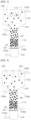
- FIGS. 2 to 5 are schematic cross-sectional views illustrating a fluidized bed reactor according to exemplary embodiments.
- the cooling unit may include a cooling jacket 160.
- the cooling jacket 160 may at least partially surround an outer wall of the expansion chamber 130. In one embodiment, the cooling jacket 160 may entirely surround the outer wall of the expansion chamber 130.
- the coolant may flow inside the cooling jacket 160 to reduce the temperature inside the expansion chamber 130. Accordingly, the moving velocity of the preliminary precursor mixture 80 may be reduced to less than the terminal velocity, thereby effectively reducing the amount of the preliminary precursor mixture 80 flowing out of the reactor body 110.
- the cooling unit may include a cooling coil 170. Also, referring to FIG. 4 , the cooling unit may include cooling fins 180.
- the cooling coil 170 or cooling fins 180 may be disposed inside the expansion chamber 130.
- the cooling coil 170 or cooling fins 180 may bring into direct contact with the preliminary precursor mixture 80 to reduce the temperature inside the expansion chamber 130. Accordingly, the moving velocity of the preliminary precursor mixture 80 may be reduced to less than the terminal velocity, thereby effectively reducing the amount of the preliminary precursor mixture 80 flowing out of the reactor body 110.
- the coolant injection ports 150 may be attached to the upper surface of the expansion chamber 130 and an inner portion of the intermediate part 140.
- the preliminary precursor mixture 80 may remain inside the intermediate part 140.
- the coolant may be directly injected from the coolant injection ports 150 formed on the inner portion of the intermediate part 140 into the preliminary precursor mixture 80 remaining inside the intermediate part 140. Accordingly, the recovery rate of the preliminary precursor mixture 80 may be further improved.
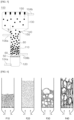
- FIG. 6 is a schematic view for describing flow characteristics within the fluidized bed reactor 100.
- reaction particles e.g., the cathode active material mixture
- reaction particles may remain in the fluidized bed reaction layer and not be scattered out of the fluidized bed reaction layer.
- the flow rate of the reaction gas may be a bubble formation fluidization velocity or more. Accordingly, the formation of a fluidized bed reaction layer with the reaction gas may be facilitated through sufficient dispersion of the cathode active material mixture having a small particle size.
- a turbulence fluidization step may be performed.
- fine particles that move individually among the reaction particles may be scattered out of the fluidized bed reaction layer.
- the reaction gas and the reaction particles may be mixed more violently and ascend to the upper portion of the fluidized bed reactor, such that it may be substantially difficult to control the reaction.
- the internal temperature of the reactor body was maintained at 450°C, and a cooling unit was installed in the expansion chamber to maintain the internal temperature of the expansion chamber at 80°C.
- a cooling unit coolant injection ports using water as a cooling medium were installed on an inner upper surface of the expansion chamber.
- the fluidized bed reactor was operated in the same manner as in Example 1, except that the cooling unit installed in the expansion chamber was a cooling jacket installed on the outer wall of the expansion chamber.
- the fluidized bed reactor was operated in the same manner as in Example 1, except that the cooling unit installed in the expansion chamber was a cooling coil installed inside the expansion chamber.
- the fluidized bed reactor was operated in the same manner as in Example 1, except that the cooling unit installed in the expansion chamber was cooling fins installed on the outer wall of the expansion chamber.
- the reaction was conducted in the same manner as in Example 1, except that the cooling unit was not installed in the expansion chamber.
- the cooling unit when the cooling unit was installed in the expansion chamber, the amount of the preliminary precursor mixture flowing out and being lost was reduced. According to the examples, when the cooling unit was installed in the expansion chamber, the amount of the preliminary precursor mixture flowing out was reduced by 70% or more compared to the case of not installing the cooling unit.
- Example 6 the temperature inside the expansion chamber was maintained at 150°C or higher. Accordingly, the amount of the preliminary precursor mixture that has flown out of the reactor was increased.
- Comparative Example 1 the cooling unit was not installed in the expansion chamber. Accordingly, the amount of the preliminary precursor mixture that has flown out of the reactor was increased compared to the examples.
Landscapes
- Chemical & Material Sciences (AREA)
- Engineering & Computer Science (AREA)
- Organic Chemistry (AREA)
- Materials Engineering (AREA)
- Manufacturing & Machinery (AREA)
- Chemical Kinetics & Catalysis (AREA)
- Metallurgy (AREA)
- Mechanical Engineering (AREA)
- Combustion & Propulsion (AREA)
- Geology (AREA)
- General Life Sciences & Earth Sciences (AREA)
- Environmental & Geological Engineering (AREA)
- Life Sciences & Earth Sciences (AREA)
- General Chemical & Material Sciences (AREA)
- Geochemistry & Mineralogy (AREA)
- Electrochemistry (AREA)
- Manufacture And Refinement Of Metals (AREA)
- Battery Electrode And Active Subsutance (AREA)
- Devices And Processes Conducted In The Presence Of Fluids And Solid Particles (AREA)
- Secondary Cells (AREA)
Applications Claiming Priority (2)
| Application Number | Priority Date | Filing Date | Title |
|---|---|---|---|
| KR1020220115012A KR20240036328A (ko) | 2022-09-13 | 2022-09-13 | 유동층 반응기 및 이를 이용한 리튬 이차 전지의 활성 금속 회수 방법 |
| PCT/KR2023/009102 WO2024058374A1 (ko) | 2022-09-13 | 2023-06-29 | 유동층 반응기 및 이를 이용한 리튬 이차 전지의 활성 금속 회수 방법 |
Publications (1)
| Publication Number | Publication Date |
|---|---|
| EP4579873A1 true EP4579873A1 (de) | 2025-07-02 |
Family
ID=90275482
Family Applications (1)
| Application Number | Title | Priority Date | Filing Date |
|---|---|---|---|
| EP23865678.9A Pending EP4579873A1 (de) | 2022-09-13 | 2023-06-29 | Wirbelschichtreaktor und verfahren zur rückgewinnung von aktivem metall einer lithiumsekundärbatterie damit |
Country Status (6)
| Country | Link |
|---|---|
| US (1) | US20250207217A1 (de) |
| EP (1) | EP4579873A1 (de) |
| JP (1) | JP2025530357A (de) |
| KR (1) | KR20240036328A (de) |
| CN (1) | CN119895626A (de) |
| WO (1) | WO2024058374A1 (de) |
Families Citing this family (1)
| Publication number | Priority date | Publication date | Assignee | Title |
|---|---|---|---|---|
| KR102856716B1 (ko) * | 2020-06-01 | 2025-09-05 | 에스케이이노베이션 주식회사 | 리튬 이차 전지의 활성 금속 회수 방법 |
Family Cites Families (5)
| Publication number | Priority date | Publication date | Assignee | Title |
|---|---|---|---|---|
| JP5859332B2 (ja) * | 2011-02-15 | 2016-02-10 | 住友化学株式会社 | 電池廃材からの活物質の回収方法 |
| KR102750747B1 (ko) * | 2019-12-16 | 2025-01-08 | 주식회사 엘지화학 | 폐양극재로부터 전이금속을 분리하는 방법 |
| KR102753512B1 (ko) * | 2019-12-30 | 2025-01-09 | 에스케이이노베이션 주식회사 | 유동층 반응기 및 이를 이용한 리튬 이차 전지의 활성 금속 회수 방법 |
| KR102831573B1 (ko) | 2020-08-18 | 2025-07-07 | 에스케이이노베이션 주식회사 | 리튬 이차 전지의 활성 금속 회수 방법 |
| KR102887897B1 (ko) * | 2020-08-24 | 2025-11-17 | 주식회사 엘지에너지솔루션 | 활물질 회수 장치 및 이를 이용한 활물질 재사용 방법 |
-
2022
- 2022-09-13 KR KR1020220115012A patent/KR20240036328A/ko active Pending
-
2023
- 2023-06-29 EP EP23865678.9A patent/EP4579873A1/de active Pending
- 2023-06-29 WO PCT/KR2023/009102 patent/WO2024058374A1/ko not_active Ceased
- 2023-06-29 JP JP2025515541A patent/JP2025530357A/ja active Pending
- 2023-06-29 CN CN202380066046.0A patent/CN119895626A/zh active Pending
-
2025
- 2025-03-13 US US19/078,298 patent/US20250207217A1/en active Pending
Also Published As
| Publication number | Publication date |
|---|---|
| JP2025530357A (ja) | 2025-09-11 |
| WO2024058374A1 (ko) | 2024-03-21 |
| US20250207217A1 (en) | 2025-06-26 |
| CN119895626A (zh) | 2025-04-25 |
| KR20240036328A (ko) | 2024-03-20 |
Similar Documents
| Publication | Publication Date | Title |
|---|---|---|
| JP7504029B2 (ja) | リチウム二次電池の活性金属の回収方法 | |
| US20220395794A1 (en) | Fluidized bed reactor and method for recovering active metal of lithium secondary battery utilizing same | |
| US12476292B2 (en) | Method for recovering active metal of lithium secondary battery | |
| US20250207217A1 (en) | Fluidized bed reactor and method for recovering active metal of lithium secondary battery by using same | |
| US20220407133A1 (en) | Fluidized bed reactor and method for recovering active metal of lithium secondary battery using same | |
| JP2023516430A (ja) | リチウム二次電池の活性金属の回収方法 | |
| KR102753512B1 (ko) | 유동층 반응기 및 이를 이용한 리튬 이차 전지의 활성 금속 회수 방법 | |
| US20220349022A1 (en) | Fluidized bed reactor and method for recovering active metal from lithium secondary battery thereby | |
| US20240006678A1 (en) | Method for regenerating lithium precursor | |
| US12407035B2 (en) | Method for recovering active metal of lithium secondary battery | |
| EP4148151A1 (de) | Verfahren zur rückgewinnung von aktiven metallen aus lithiumsekundärbatterien | |
| US20240154197A1 (en) | Method for recovering active metal of lithium secondary battery | |
| US20230420762A1 (en) | Fluidized bed reactor and method for recycling lithium precursor using same | |
| EP4578541A1 (de) | Wirbelschichtreaktor und verfahren zur rückgewinnung von aktivem metall einer lithiumsekundärbatterie damit |
Legal Events
| Date | Code | Title | Description |
|---|---|---|---|
| STAA | Information on the status of an ep patent application or granted ep patent |
Free format text: STATUS: THE INTERNATIONAL PUBLICATION HAS BEEN MADE |
|
| PUAI | Public reference made under article 153(3) epc to a published international application that has entered the european phase |
Free format text: ORIGINAL CODE: 0009012 |
|
| STAA | Information on the status of an ep patent application or granted ep patent |
Free format text: STATUS: REQUEST FOR EXAMINATION WAS MADE |
|
| 17P | Request for examination filed |
Effective date: 20250328 |
|
| AK | Designated contracting states |
Kind code of ref document: A1 Designated state(s): AL AT BE BG CH CY CZ DE DK EE ES FI FR GB GR HR HU IE IS IT LI LT LU LV MC ME MK MT NL NO PL PT RO RS SE SI SK SM TR |
|
| DAV | Request for validation of the european patent (deleted) | ||
| DAX | Request for extension of the european patent (deleted) |