EP4579799A1 - Lithiumsekundärbatterie - Google Patents
Lithiumsekundärbatterie Download PDFInfo
- Publication number
- EP4579799A1 EP4579799A1 EP23907765.4A EP23907765A EP4579799A1 EP 4579799 A1 EP4579799 A1 EP 4579799A1 EP 23907765 A EP23907765 A EP 23907765A EP 4579799 A1 EP4579799 A1 EP 4579799A1
- Authority
- EP
- European Patent Office
- Prior art keywords
- negative electrode
- active material
- electrode active
- positive electrode
- lithium secondary
- Prior art date
- Legal status (The legal status is an assumption and is not a legal conclusion. Google has not performed a legal analysis and makes no representation as to the accuracy of the status listed.)
- Pending
Links
Images




Classifications
-
- H—ELECTRICITY
- H01—ELECTRIC ELEMENTS
- H01M—PROCESSES OR MEANS, e.g. BATTERIES, FOR THE DIRECT CONVERSION OF CHEMICAL ENERGY INTO ELECTRICAL ENERGY
- H01M10/00—Secondary cells; Manufacture thereof
- H01M10/05—Accumulators with non-aqueous electrolyte
- H01M10/052—Li-accumulators
-
- H—ELECTRICITY
- H01—ELECTRIC ELEMENTS
- H01M—PROCESSES OR MEANS, e.g. BATTERIES, FOR THE DIRECT CONVERSION OF CHEMICAL ENERGY INTO ELECTRICAL ENERGY
- H01M10/00—Secondary cells; Manufacture thereof
- H01M10/04—Construction or manufacture in general
- H01M10/0431—Cells with wound or folded electrodes
-
- C—CHEMISTRY; METALLURGY
- C30—CRYSTAL GROWTH
- C30B—SINGLE-CRYSTAL GROWTH; UNIDIRECTIONAL SOLIDIFICATION OF EUTECTIC MATERIAL OR UNIDIRECTIONAL DEMIXING OF EUTECTOID MATERIAL; REFINING BY ZONE-MELTING OF MATERIAL; PRODUCTION OF A HOMOGENEOUS POLYCRYSTALLINE MATERIAL WITH DEFINED STRUCTURE; SINGLE CRYSTALS OR HOMOGENEOUS POLYCRYSTALLINE MATERIAL WITH DEFINED STRUCTURE; AFTER-TREATMENT OF SINGLE CRYSTALS OR A HOMOGENEOUS POLYCRYSTALLINE MATERIAL WITH DEFINED STRUCTURE; APPARATUS THEREFOR
- C30B29/00—Single crystals or homogeneous polycrystalline material with defined structure characterised by the material or by their shape
- C30B29/10—Inorganic compounds or compositions
- C30B29/16—Oxides
- C30B29/22—Complex oxides
-
- H—ELECTRICITY
- H01—ELECTRIC ELEMENTS
- H01M—PROCESSES OR MEANS, e.g. BATTERIES, FOR THE DIRECT CONVERSION OF CHEMICAL ENERGY INTO ELECTRICAL ENERGY
- H01M10/00—Secondary cells; Manufacture thereof
- H01M10/04—Construction or manufacture in general
- H01M10/0422—Cells or battery with cylindrical casing
-
- H—ELECTRICITY
- H01—ELECTRIC ELEMENTS
- H01M—PROCESSES OR MEANS, e.g. BATTERIES, FOR THE DIRECT CONVERSION OF CHEMICAL ENERGY INTO ELECTRICAL ENERGY
- H01M10/00—Secondary cells; Manufacture thereof
- H01M10/05—Accumulators with non-aqueous electrolyte
- H01M10/058—Construction or manufacture
- H01M10/0587—Construction or manufacture of accumulators having only wound construction elements, i.e. wound positive electrodes, wound negative electrodes and wound separators
-
- H—ELECTRICITY
- H01—ELECTRIC ELEMENTS
- H01M—PROCESSES OR MEANS, e.g. BATTERIES, FOR THE DIRECT CONVERSION OF CHEMICAL ENERGY INTO ELECTRICAL ENERGY
- H01M4/00—Electrodes
- H01M4/02—Electrodes composed of, or comprising, active material
- H01M4/13—Electrodes for accumulators with non-aqueous electrolyte, e.g. for lithium-accumulators; Processes of manufacture thereof
- H01M4/131—Electrodes based on mixed oxides or hydroxides, or on mixtures of oxides or hydroxides, e.g. LiCoOx
-
- H—ELECTRICITY
- H01—ELECTRIC ELEMENTS
- H01M—PROCESSES OR MEANS, e.g. BATTERIES, FOR THE DIRECT CONVERSION OF CHEMICAL ENERGY INTO ELECTRICAL ENERGY
- H01M4/00—Electrodes
- H01M4/02—Electrodes composed of, or comprising, active material
- H01M4/13—Electrodes for accumulators with non-aqueous electrolyte, e.g. for lithium-accumulators; Processes of manufacture thereof
- H01M4/133—Electrodes based on carbonaceous material, e.g. graphite-intercalation compounds or CFx
-
- H—ELECTRICITY
- H01—ELECTRIC ELEMENTS
- H01M—PROCESSES OR MEANS, e.g. BATTERIES, FOR THE DIRECT CONVERSION OF CHEMICAL ENERGY INTO ELECTRICAL ENERGY
- H01M4/00—Electrodes
- H01M4/02—Electrodes composed of, or comprising, active material
- H01M4/36—Selection of substances as active materials, active masses, active liquids
- H01M4/362—Composites
-
- H—ELECTRICITY
- H01—ELECTRIC ELEMENTS
- H01M—PROCESSES OR MEANS, e.g. BATTERIES, FOR THE DIRECT CONVERSION OF CHEMICAL ENERGY INTO ELECTRICAL ENERGY
- H01M4/00—Electrodes
- H01M4/02—Electrodes composed of, or comprising, active material
- H01M4/36—Selection of substances as active materials, active masses, active liquids
- H01M4/362—Composites
- H01M4/364—Composites as mixtures
-
- H—ELECTRICITY
- H01—ELECTRIC ELEMENTS
- H01M—PROCESSES OR MEANS, e.g. BATTERIES, FOR THE DIRECT CONVERSION OF CHEMICAL ENERGY INTO ELECTRICAL ENERGY
- H01M4/00—Electrodes
- H01M4/02—Electrodes composed of, or comprising, active material
- H01M4/36—Selection of substances as active materials, active masses, active liquids
- H01M4/38—Selection of substances as active materials, active masses, active liquids of elements or alloys
- H01M4/386—Silicon or alloys based on silicon
-
- H—ELECTRICITY
- H01—ELECTRIC ELEMENTS
- H01M—PROCESSES OR MEANS, e.g. BATTERIES, FOR THE DIRECT CONVERSION OF CHEMICAL ENERGY INTO ELECTRICAL ENERGY
- H01M4/00—Electrodes
- H01M4/02—Electrodes composed of, or comprising, active material
- H01M4/36—Selection of substances as active materials, active masses, active liquids
- H01M4/48—Selection of substances as active materials, active masses, active liquids of inorganic oxides or hydroxides
- H01M4/50—Selection of substances as active materials, active masses, active liquids of inorganic oxides or hydroxides of manganese
- H01M4/505—Selection of substances as active materials, active masses, active liquids of inorganic oxides or hydroxides of manganese of mixed oxides or hydroxides containing manganese for inserting or intercalating light metals, e.g. LiMn2O4 or LiMn2OxFy
-
- H—ELECTRICITY
- H01—ELECTRIC ELEMENTS
- H01M—PROCESSES OR MEANS, e.g. BATTERIES, FOR THE DIRECT CONVERSION OF CHEMICAL ENERGY INTO ELECTRICAL ENERGY
- H01M4/00—Electrodes
- H01M4/02—Electrodes composed of, or comprising, active material
- H01M4/36—Selection of substances as active materials, active masses, active liquids
- H01M4/48—Selection of substances as active materials, active masses, active liquids of inorganic oxides or hydroxides
- H01M4/52—Selection of substances as active materials, active masses, active liquids of inorganic oxides or hydroxides of nickel, cobalt or iron
- H01M4/525—Selection of substances as active materials, active masses, active liquids of inorganic oxides or hydroxides of nickel, cobalt or iron of mixed oxides or hydroxides containing iron, cobalt or nickel for inserting or intercalating light metals, e.g. LiNiO2, LiCoO2 or LiCoOxFy
-
- H—ELECTRICITY
- H01—ELECTRIC ELEMENTS
- H01M—PROCESSES OR MEANS, e.g. BATTERIES, FOR THE DIRECT CONVERSION OF CHEMICAL ENERGY INTO ELECTRICAL ENERGY
- H01M4/00—Electrodes
- H01M4/02—Electrodes composed of, or comprising, active material
- H01M4/36—Selection of substances as active materials, active masses, active liquids
- H01M4/58—Selection of substances as active materials, active masses, active liquids of inorganic compounds other than oxides or hydroxides, e.g. sulfides, selenides, tellurides, halogenides or LiCoFy; of polyanionic structures, e.g. phosphates, silicates or borates
- H01M4/583—Carbonaceous material, e.g. graphite-intercalation compounds or CFx
- H01M4/587—Carbonaceous material, e.g. graphite-intercalation compounds or CFx for inserting or intercalating light metals
-
- H—ELECTRICITY
- H01—ELECTRIC ELEMENTS
- H01M—PROCESSES OR MEANS, e.g. BATTERIES, FOR THE DIRECT CONVERSION OF CHEMICAL ENERGY INTO ELECTRICAL ENERGY
- H01M4/00—Electrodes
- H01M4/02—Electrodes composed of, or comprising, active material
- H01M2004/021—Physical characteristics, e.g. porosity, surface area
-
- H—ELECTRICITY
- H01—ELECTRIC ELEMENTS
- H01M—PROCESSES OR MEANS, e.g. BATTERIES, FOR THE DIRECT CONVERSION OF CHEMICAL ENERGY INTO ELECTRICAL ENERGY
- H01M4/00—Electrodes
- H01M4/02—Electrodes composed of, or comprising, active material
- H01M2004/026—Electrodes composed of, or comprising, active material characterised by the polarity
- H01M2004/027—Negative electrodes
-
- Y—GENERAL TAGGING OF NEW TECHNOLOGICAL DEVELOPMENTS; GENERAL TAGGING OF CROSS-SECTIONAL TECHNOLOGIES SPANNING OVER SEVERAL SECTIONS OF THE IPC; TECHNICAL SUBJECTS COVERED BY FORMER USPC CROSS-REFERENCE ART COLLECTIONS [XRACs] AND DIGESTS
- Y02—TECHNOLOGIES OR APPLICATIONS FOR MITIGATION OR ADAPTATION AGAINST CLIMATE CHANGE
- Y02E—REDUCTION OF GREENHOUSE GAS [GHG] EMISSIONS, RELATED TO ENERGY GENERATION, TRANSMISSION OR DISTRIBUTION
- Y02E60/00—Enabling technologies; Technologies with a potential or indirect contribution to GHG emissions mitigation
- Y02E60/10—Energy storage using batteries
-
- Y—GENERAL TAGGING OF NEW TECHNOLOGICAL DEVELOPMENTS; GENERAL TAGGING OF CROSS-SECTIONAL TECHNOLOGIES SPANNING OVER SEVERAL SECTIONS OF THE IPC; TECHNICAL SUBJECTS COVERED BY FORMER USPC CROSS-REFERENCE ART COLLECTIONS [XRACs] AND DIGESTS
- Y02—TECHNOLOGIES OR APPLICATIONS FOR MITIGATION OR ADAPTATION AGAINST CLIMATE CHANGE
- Y02P—CLIMATE CHANGE MITIGATION TECHNOLOGIES IN THE PRODUCTION OR PROCESSING OF GOODS
- Y02P70/00—Climate change mitigation technologies in the production process for final industrial or consumer products
- Y02P70/50—Manufacturing or production processes characterised by the final manufactured product
Definitions
- the present invention relates to a lithium secondary battery and more particularly, to a lithium secondary battery having excellent safety and electrochemical properties.
- lithium secondary batteries have been in the spotlight as an energy source for electric vehicles.
- the demand for lithium secondary batteries that can provide a longer driving range per charge and reduced quick charging time is increasing.
- Lithium secondary batteries are generally manufactured by a method including forming an electrode assembly by disposing a separator between a positive electrode including a positive electrode active material composed of a transition metal oxide containing lithium and a negative electrode including a negative electrode active material which is capable of storing lithium ions, inserting the electrode assembly in a battery case, injecting a non-aqueous electrolyte that serves as a medium for transferring lithium ions and sealing.
- the non-aqueous electrolyte is generally composed of a lithium salt, and an organic solvent which is capable of dissolving the lithium salt.
- carbon-based materials such as natural graphite and artificial graphite have been widely used.
- the carbon-based negative electrode active materials have a small capacity and a slow reaction rate with lithium, secondary batteries using them have limitations in realizing high capacity and quick charging performance.
- silicon-based material such as silicon oxide (SiOx, 0 ⁇ x ⁇ 2), which has a large theoretical capacity, mixed with a carbon-based negative electrode active material.
- the silicon-based material has a high theoretical capacity compared to the carbon-based material and has a rapid reaction rate with lithium, and if applying the silicon-based material, there are advantages of improving capacity properties and quick charging performance.
- the silicon-based material since the silicon-based material has very low electrical conductivity, its volume rapidly expands during the charging/discharging process, and as particles are broken or electrodes came off due to deterioration, battery performance rapidly decreases to be an obstacle to commercialization.
- the present invention provides a lithium secondary battery comprising: an electrode assembly comprising a positive electrode comprising a positive electrode active material, a negative electrode comprising a negative electrode active material, and a separator disposed between the positive electrode and the negative electrode; an electrolyte; and a battery case accommodating the electrode assembly and the electrolyte, wherein the positive electrode active material comprises a first lithium nickel-based oxide having at least one of a single particle type composed of one nodule and a pseudo-single particle type which is an aggregate of 30 or less nodules, in 50 wt% or more on the basis of the total weight of the positive electrode active material, and the negative electrode active material is composed of a Si/C composite and a carbon-based negative electrode active material.
- the positive electrode active material may further comprise a second lithium nickel-based oxide having a secondary particle type which is an aggregate of 40 or more primary particles.
- the negative electrode active material may be composed of a Si/C composite and a carbon-based negative electrode active material, and may comprise, for example, Si/C composite: carbon-based negative electrode active material in a weight ratio of 1: 99 - 20: 80.
- the lithium secondary battery according to the present invention includes single particles and/or pseudo-single particles in 50 wt% or more as a positive electrode active material, and the generation of gas due to particle breakage during forming an electrode and internal crack generation during charging and discharging may be minimized, and excellent safety may be achieved in large-sized batteries having increased volume.
- Words or terms used in the present description shall not be interpreted as the meaning defined in commonly used dictionaries.
- the words or terms should be interpreted as having a meaning that is consistent with the technical idea of the invention, based on the principle that an inventor may properly define the meaning of the words or terms to best explain the invention.
- a single particle is a particle composed of one single nodule.
- a pseudo-single particle means a composite particle formed by aggregating 30 or less nodules.
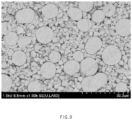
- a nodule means a particle unit body constituting the single particle and the pseudo-single particle, and the nodule may be a single crystal lacking a crystalline grain boundary, or a polycrystal with no apparent grain boundary if observed using a scanning electron microscope (SEM) at a view of 5000 to 20000 times.
- SEM scanning electron microscope
- particle as used in the present invention may include any or all of a single particle, a pseudo-single particle, a primary particle, a nodule and a secondary particle.
- D n may be measured by dispersing a target powder for measurement (for example, a positive electrode active material powder or a Si/C composite powder) in a dispersion medium, introducing the dispersion into a commercially available laser diffraction particle size measurement apparatus (for example, Microtrac MT 3000), irradiating ultrasonic waves of about 28 kHz with an output of 60W, obtaining a volume accumulated particle size distribution graph, and obtaining a particle diameter at a corresponding volume accumulation using the volume accumulated particle size distribution graph.
- a target powder for measurement for example, a positive electrode active material powder or a Si/C composite powder
- a laser diffraction particle size measurement apparatus for example, Microtrac MT 3000
- a "specific surface area" is measured by a BET method, and may particularly be computed using BELSORP-mino II of BEL Japan Co. from a nitrogen gas absorption amount at a liquid nitrogen temperature (77K).
- a "grain size” was measured by analyzing XRD data obtained through X-ray diffraction analysis of a target powder for measurement (that is, Si/C composite powder) by a Rietveld refinement method.
- a "loading amount (R, unit: g/25 cm 2 )" was obtained by measuring a weight W1 of an electrode punched to a size of 5 cm x 5 cm, and a weight W2 of an electrode current collector, and substituting them into [Equation 1] below.
- Electrode loading amount (g/25 cm 2 ) (W 1 -W 2 ) /2
- a "loading density (unit: mAh/cm 2 )" was obtained by measuring the total thickness of an electrode T total (unit: ⁇ m) and the thickness of an electrode current collector T c (unit: ⁇ m) using a thickness measurement apparatus of Tesa Co., and substitution the electrode loading amount R (unit: g/25cm 2 ), the total thickness of an electrode T total and the thickness of an electrode current collector T c in [Equation 2] below.
- Loading density (mAh/cm 2 ) [(R/25) x capacity per unit area of active material]/ ⁇ (T total -T c ) x 0.00005 ⁇
- a “porosity (%)" was obtained by vacuum drying an electrode punched into a size of 5 cm x 5 cm, measuring the total thickness of an electrode T' total (unit: ⁇ m) and the thickness of an electrode current collector T' c (unit: ⁇ m) after vacuum drying, using a thickness measurement apparatus of Tesa Co., substituting the total thickness of an electrode T' total , the thickness of an electrode current collector T' c (unit: ⁇ m), an electrode loading amount R (unit: g/25 cm 2 ) and an electrode density D (unit: g/cc) into [Equation 3] below.
- Porosity (%) (D-R/25) / [D x ⁇ (T total - T c ) x 0.00005 ⁇ ]
- the inventors of the present invention have conducted repeated research to develop a battery having high energy density and excellent safety and electrochemical properties, and as a result, found that a lithium secondary battery having high energy density and excellent resistance properties could be achieved by including single particles and/or pseudo-single particles in 50 wt% or more, as a positive electrode active material and by using a mixture of a Si/C composite and a carbon-based negative electrode active material, as a negative electrode active material, and completed the present invention.
- the lithium secondary battery according to the present invention comprises: an electrode assembly comprising a positive electrode comprising a positive electrode active material, a negative electrode comprising a negative electrode active material, and a separator disposed between the positive electrode and the negative electrode; an electrolyte; and a battery case accommodating the electrode assembly and the electrolyte, wherein the positive electrode active material comprises a first lithium nickel-based oxide having at least one of a single particle type composed of one nodule and a pseudo-single particle type which is an aggregate of 30 or less nodules, in 50 wt% or more on the basis of the total weight of the positive electrode active material, and the negative electrode active material is a mixture of a Si/C composite and a carbon-based negative electrode active material.
- the average particle diameter of the nodule is too small, the effect of restraining the generation of particle breakage during rolling may be deteriorated, and if the average particle diameter of the nodule is too large, a lithium diffusion path in the particle may become longer, resistance may increase, and output characteristics may be deteriorated.
- a lithium secondary battery having excellent energy density compared to the conventional one may be accomplished.
- the Si/C composite may have a grain size of 20 nm or less, preferably, 1 nm to 20 nm, more preferably, 1 nm to 18 nm. If the grain size of the Si/C composite satisfies the range, the improving effect of cell resistance properties and lifetime characteristics may be excellent.
- the Si/C composite may have D 50 of 1 ⁇ m to 15 ⁇ m, preferably, 2 ⁇ m to 10 ⁇ m, more preferably, 3 ⁇ m to 10 ⁇ m.
- the Si/C composite may have D 10 of 5 ⁇ m or less, preferably, 1-5 ⁇ m, and D 90 of 6 ⁇ m to 20 ⁇ m, preferably, 6 ⁇ m to 15 ⁇ m. If the particle size distribution of the Si/C composite satisfies the range, the negative electrode density may increase to accomplish high energy density.
- the carbon-based negative electrode active material may be, for example, artificial graphite, natural graphite, a graphitized carbon fiber, amorphous carbon, soft carbon, hard carbon or the like, preferably, artificial graphite, natural graphite and a combination thereof.
- the negative electrode active material of the present invention does not contain a silcon-based negative electrode active material other than the Si/C composite (for example, silicon oxide and silicon). If the silcon-based negative electrode active material other than the Si/C composite is included, capacity improving effect may become insignificant, and lifetime characteristics may be deteriorated. More preferably, the negative electrode active material according to the present invention may be formed from the Si/C composite and a carbon-based negative electrode active material.
- a silcon-based negative electrode active material other than the Si/C composite for example, silicon oxide and silicon.
- negative electrode current collectors commonly used in this technical field may be used, for example, copper, stainless steel, aluminum, nickel, titanium, baked carbon, copper or stainless steel, surface treated with carbon, nickel, titanium, silver or the like, an aluminum-cadmium alloy or the like.
- the negative electrode current collector may commonly have a thickness of 3 ⁇ m to 500 ⁇ m, and may reinforce the adhesive strength of the negative electrode active material by forming minute irregularities at the surface of the current collector like the positive electrode current collector.
- various types including a film, a sheet, a foil, a net, a porous body, a foamed body, a non-woven fabric or the like may be used.
- the conductive material is used for providing a negative electrode with conductivity, and is not specifically limited as long as it does not induce the chemical change in a constituent battery and has electron conductivity.
- Particular embodiments may include: graphite such as natural graphite and artificial graphite; carbon-based materials such as carbon black, acetylene black, Ketjen black, channel black, furnace black, lamp black, thermal black, a carbon fiber and carbon nanotube; metal powders or metal fibers of copper, nickel, aluminum, silver or the like; conductive whiskers of zinc oxide, potassium titanate or the like; conductive metal oxides such as titanium oxide;or conductive polymers such as polyphenylene derivatives, and one or a mixture of two or more thereof may be used.
- the conductive material may be included in the content of 1 to 30 wt%, preferably, 1 to 20 wt%, more preferably, 1 to 10 wt% on the basis of the total weight of the negative electrode active material layer.
- the binder may play the role of improving the adhesion among the negative electrode active material particles and the adhesive strength between the negative electrode active material and the negative electrode current collector.
- Particular embodiments may include polyvinylidene fluoride (PVDF), a polyvinylidene fluoride-hexafluoropropylene copolymer (PVDF-co-HFP), polyvinyl alcohol,polyacrylonitrile, carboxymethyl cellulose (CMC), starch, hydroxypropyl cellulose, regenerated cellulose, polyvinylpyrrolidone, polytetrafluoroethylene, polyethylene, polypropylene, an ethylene-propylene-diene monomer rubber (EPDM rubber),a sulfonated EPDM,a styrene-butadiene rubber (SBR),a fluoro rubber, and diverse copolymers thereof, and one or a mixture of two or more thereof may be used.
- the binder may be included in the content of 1 to 30wt%, preferably
- the negative electrode active material layer may have a single layer or a multilayer structure composed of two or more layers.
- the negative electrode may include a first negative electrode active material layer formed on the negative electrode current collector and a second negative electrode active material layer formed on the first negative electrode active material.
- each layer may have a different type of negative electrode active material, a different type and/or content of binder and/or conductive material.
- the first negative electrode active material layer (lower layer) and the second negative electrode active material layer (upper layer) may include a Si/C composite and a carbon-based negative electrode active material as negative electrode active materials, wherein the type of the carbon-based negative electrode active material included in the first negative electrode active material layer and the second negative electrode active material layer may be different.
- the carbon-based negative electrode active material included in the first negative electrode active material layer may be natural graphite
- the carbon-based negative electrode active material included in the second negative electrode active material layer may be artificial graphite.
- the content of the carbon-based negative electrode active material in the first negative electrode active material layer (lower layer) may be high compared to the second negative electrode active material layer (upper layer) in the total negative electrode active material, and the content of the Si/C composite in the second negative electrode active material layer may be high compared to the first negative electrode active material layer in the total negative electrode active material, or the content of the conductive material of the second negative electrode active material layer (upper layer) may be high compared to the first negative electrode active material layer (lower layer).
- the performance characteristics of a battery may be improved. For example, if the content of the conductive material or the Si/C composite in the upper layer is high compared to the lower layer, effect of improving quick charging performance may be obtained.
- the negative electrode may have a loading density of 5.70 mAh/cm 2 or more, preferably, 5.70 mAh/cm 2 to 6.50 mAh/cm 2 , more preferably, 5.70 mAh/cm 2 to 6.20 mAh/cm 2 . If the negative electrode loading density satisfies the range, high energy density may be accomplished, and capacity balance with respect to the positive electrode (N/P ratio) may be adjusted.
- the negative electrode may have a porosity of 24% to 30%, preferably, 24% to 28%, more preferably, 24.8% to 26.2%. If the porosity of the negative electrode satisfies the range, excellent capacity and output properties may be exhibited.
- the separator is for separating the negative electrode and the positive electrode and providing the moving passage of lithium ions, and uses any separators used in common lithium secondary batteries, without specific limitation.
- a porous polymer film for example, a porous polymer film formed by polyolefin-based polymers such as an ethylene homopolymer, a propylene homopolymer, an ethylene/butene copolymer, an ethylene/hexene copolymer and an ethylene/methacrylate copolymer, or a laminated structure of two or more thereof may be used.
- a common non-woven fabric for example, a non-woven fabric formed of a high melting point glass fiber, a polyethyleneterephthalate fiber or the like may be used.
- a coated separator including a ceramic component or a polymer material for securing heat resistance or mechanical strength may be used.
- the organic solvent may use any one which may play the role of a medium for moving ions involving the electrochemical reaction of a battery, without specific limitation.
- ester-based solvents such as methyl acetate, ethyl acetate, ⁇ -butyrolactone, and ⁇ -caprolactone
- ether-based solvents such as dibutyl ether and tetrahydrofuran
- ketone-based solvents such as cyclohexanone
- aromatic hydrocarbon-based solvents such as benzene and fluorobenzene
- carbonate-based solvents such as dimethylcarbonate (DMC), diethylcarbonate (DEC), methyl ethyl carbonate (MEC), ethyl methyl carbonate (EMC), ethylene carbonate (EC), and propylene carbonate (PC)
- alcohol-based solvents such as ethyl alcohol and isopropyl alcohol
- nitriles such as R-CN (R is a hydrocarbon group
- Examples of the phosphate-based compound may include one or more compounds selected from the group consisting of lithium difluoro(bisoxalato)phosphate, lithium difluorophosphate, tetramethyl trimethyl silyl phosphate, trimethyl silylphosphite, tris(2,2,2-trifluoroethyl)phosphate and tris(trifluoroethyl)phosphite.
- nitrile-based compound may include at least one or more compounds selected from the group consisting of succinonitrile, adiponitrile, acetonitrile, propionitrile, butyronitrile, valeronitrile, caprylonitrile, heptanenitrile, cyclopentane carbonitrile, cyclohexane carbonitrile, 2-fluorobenzonitrile, 4-fluorobenzonitrile, difluorobenzonitrile, trifluorobenzonitrile, phenylacetonitrile, 2-fluorophenylacetonitrile and 4-fluorophenylacetonitrile.
- Examples of the benzene-based compound may include fluorobenzene, examples of the amine-based compound may include triethanolamine or ethylenediamine, and examples of the silane-based compound may include tetravinylsilane.
- the lithium salt-based compound is a compound different from the lithium salt included in the non-aqueous electrolyte, and may include lithium difluorophosphate (LiDFP), LiPO 2 F 2 or LiBF 4 .
- LiDFP lithium difluorophosphate
- LiPO 2 F 2 LiPO 2 F 2
- LiBF 4 lithium difluorophosphate
- the additive may be included in 0.1 to 10 wt%, preferably, 0.1 to 5wt% on the basis of the total weight of the electrolyte.
- the battery case may be a prismatic case, a cylindrical case, a pouch case or the like, used in the relevant technical field and may preferably be a cylindrical case.
- the battery case may be a can-type battery case including a battery can accommodating the electrode assembly and the electrolyte, and a sealing body sealing the open end of the battery can.
- the lithium secondary battery according to the present invention may be a cylindrical battery including a cylindrical battery case, more preferably, a large-sized cylindrical battery having a form factor ratio (defined as a value obtained by dividing the diameter by the height of a cylindrical battery, i.e., the ratio of diameter ( ⁇ ) contrast to height (H)) of 0.4 or more.
- the form factor means a value representing the diameter and the height of a cylindrical battery.
- the lithium secondary battery according to the present invention includes single particle and/or pseudo-single particle type positive electrode active material, the amount of gas generated may be small, and even in a case having the form factor ratio of 0.4 or more, excellent thermal safety may be accomplished.
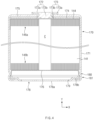
- FIG. 3 and FIG. 4 embodiments of the lithium secondary battery according to the present invention are shown.
- the lithium secondary battery according to the present invention will be explained referring to FIG. 3 and FIG. 4 .
- FIG. 3 and FIG. 4 show only embodiments of the present invention, and the structure of the battery of the present invention is not limited to the scope shown in FIG. 3 or FIG. 4 .
- the battery can (142) is a container in which an open part is formed at the top, and is made from a metal material having conductivity such as aluminum and steel.
- the battery can accommodates the electrode assembly (141) in an inner space via the open part at the top and also accommodates the electrolyte together.
- the crimping part (148) may be formed on the beading part (147) and has an extended and bent shape to surround the outer circumferential surface of a cap plate (143a) disposed on the beading part (147) and a portion of the top surface of the cap plate (143a).
- the second current collector plate (176) is electrically connected with the battery can (171).
- at least a portion of the edge portion the second current collector plate (176) may be disposed between the inner surface of the battery can (171) and the first gasket (178b) and fixed.
- the at least a portion of the edge portion of the second current collector plate (176) may be fixed at a beading part (180) formed at the bottom of the battery can (171) in a supported state on the bottom surface of the beading part (180), by welding.
- the at least a portion of the edge portion of the second current collector plate (176) may be directly welded to the inner surface of the battery can (171).
- the part (175) used as the negative electrode terminal has an approximately flat shape, a sufficient bonding area may be secured for bonding electrical connection parts such as a busbar. Accordingly, the battery (170) may lower the resistance at the bonding portion of the electrical connection parts to a desired level.
- the lithium secondary battery of the present invention as above may be used for the manufacture of a battery pack.
- the battery pack includes an assembly of electrically connected lithium secondary batteries according to the present invention and a pack housing for accommodating the same, and the pack housing may include a busbar for electrically connecting the lithium secondary batteries, a cooling unit, an external terminal or the like.
- the battery pack may be mounded on a vehicle.
- the vehicle may be, for example, an electric vehicle, a hybrid vehicle, or a plug-in hybrid vehicle.
- the vehicle includes a four-wheeled vehicle or a two-wheeled vehicle.
- Positive electrode active material porous carbon: carbon nanotube: PVDF binder were mixed in a weight ratio of 97.09: 0.6: 0.02 in N-methylpyrrolidone to prepare a positive electrode slurry.
- the positive electrode active material a mixture of single particles and pseudo-single particles of Li[Ni 0.93 Co 0.05 Mn 0.016 Al 0.004 ]O 2 coated with boron (B) was used.
- First negative electrode active material conductive material: binder: carboxymethylcellulose (CMC) were mixed in a weight ratio of 98.04: 0.06: 1: 0.9 in water to prepare a first negative electrode slurry.
- a mixture of natural graphite: Si/C composite in a weight ratio of 85: 15 was used as the first negative electrode active material
- single-walled CNT was used as the conductive material
- a styrene-butadiene rubber (SBR) was used as the binder.
- second negative electrode active material conductive material: binder: CMC were mixed in a weight ratio of 98.04: 0.06: 1: 0.9 in water to prepare a second negative electrode slurry.
- a mixture of artificial graphite: Si/C composite in a weight ratio of 85: 15 was used as the second negative electrode active material, single-walled CNT was used as the conductive material, and SBR was used as the binder.
- the first negative electrode slurry and the second negative electrode slurry were sequentially applied on the surface of a copper current collector sheet, dried at 150°C and rolled to manufacture a negative electrode.
- the loading density of the negative electrode was 283 mg/25cm 2 (5.94 mAh/cm 2 ), the porosity of the negative electrode was 25.1%, and the thickness of the negative electrode was 143 ⁇ m.
- an electrode assembly was manufactured.
- the electrode assembly thus manufactured was inserted in a cylindrical battery can, an electrolyte was injected, and sealing was performed to manufacture a 4680 cell.
- a positive electrode, a negative electrode and a lithium secondary battery were manufactured by the same method as in Example 1 except for using a mixture of natural graphite: Si/C composite in a weight ratio of 88.5: 11.5 as the first negative electrode active material, and a mixture of artificial graphite: Si/C composite in a weight ratio of 88.5: 11.5 as the second negative electrode active material.
- a positive electrode, a negative electrode and a lithium secondary battery were manufactured by the same method as in Example 3 except for using a mixture of Li[Ni 0.93 Co 0.05 Mn 0.016 Al 0.004 ]O 2 coated with boron (B), in which single particles and pseudo-single particles are mixed, and Li[Ni 0.89 Co 0.066 Mn 0.043 Al 0.001 ]O 2 coated with boron (B) as a secondary particle type in a weight ratio of 50: 50, as the positive electrode active material.
- Positive electrode active material porous carbon: carbon nanotube: PVDF binder were mixed in a weight ratio of 96.45: 0.6: 0.02 in N-methylpyrrolidone to prepare a positive electrode slurry.
- the positive electrode active material Li[Ni 0.93 Co 0.05 Mn 0.016 Al 0.004 ]O 2 coated with boron (B), in which single particles and pseudo-single particles are mixed, was used.
- the positive electrode slurry was applied on one side of an aluminum current collector, dried at 130°C and rolled to manufacture a positive electrode.
- the loading density of the positive electrode was 640mg/25cm 2 (5.29 mAh/cm 2 ), the porosity of the positive electrode was 23.0%, and the thickness of the positive electrode was 162 ⁇ m.
- First negative electrode active material conductive material: binder: CMC were mixed in a weight ratio of 98.04: 0.06: 1: 0.9 in water to prepare a first negative electrode slurry.
- a mixture of natural graphite: SiO in a weight ratio of 85: 15 was used as the first negative electrode active material
- single-walled CNT was used as the conductive material
- a styrene-butadiene rubber (SBR) was used as the binder.
- second negative electrode active material conductive material: binder: CMC were mixed in a weight ratio of 98.04: 0.06: 1: 0.9 in water to prepare a second negative electrode slurry.
- a mixture of artificial graphite: SiO in a weight ratio of 85: 15 was used as the second negative electrode active material, single-walled CNT was used as the conductive material, and SBR was used as the binder.
- the first negative electrode slurry and the second negative electrode slurry were sequentially applied on the surface of a copper current collector sheet, dried at 150°C and rolled to manufacture a negative electrode.
- the loading density of the negative electrode was 356 mg/25cm 2 (5.69 mAh/cm 2 ), the porosity of the negative electrode was 25.0%, and the thickness of the negative electrode was 179 ⁇ m.
- an electrode assembly was manufactured.
- the electrode assembly thus manufactured was inserted in a cylindrical battery can, an electrolyte was injected, and sealing was performed to manufacture a 4680 cell.
- a positive electrode, a negative electrode and a lithium secondary battery were manufactured by the same method as in Example 3 except for preparing a positive electrode slurry by mixing positive electrode active material: porous carbon: carbon nanotube: PVdF binder in a weight ratio of 97.09: 0.4: 0.02 in N-methylpyrrolidone, and using Li[Ni 0.89 Co 0.066 Mn 0.043 Al 0.001 ]O 2 coated with boron (B) in a secondary particle type as the positive electrode active material.
- a positive electrode, a negative electrode and a lithium secondary battery were manufactured by the same method as in Example 3 except for using a mixture of Li[Ni 0.93 Co 0.05 Mn 0.016 Al 0.004 ]O 2 coated with boron (B), in which single particles and pseudo-single particles are mixed, and Li[Ni 0.89 Co 0.066 Mn 0.043 Al 0.001 ]O 2 coated with boron (B) in a secondary particle type in a weight ratio of 30: 70, as the positive electrode active material.
- a positive electrode, a negative electrode and a lithium secondary battery were manufactured by the same method as in Example 1 except for using a mixture of natural graphite: SiO in a weight ratio of 88.5: 11.5 as the first negative electrode active material and a mixture of artificial graphite: SiO in a weight ratio of 88.5: 11.5 as the second negative electrode active material.
- a positive electrode, a negative electrode and a lithium secondary battery were manufactured by the same method as in Example 1 except for using a mixture of natural graphite: SiO: Si/C composite in a weight ratio of 88.5: 9.2: 2.3 as the first negative electrode active material and a mixture of artificial graphite: SiO: Si/C composite in a weight ratio of 88.5: 9.2: 2.3 as the second negative electrode active material.
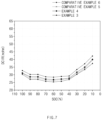
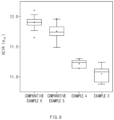
- the electrode layer resistance of the negative electrode, the interface resistance between the negative electrode current collector and the negative electrode active material layer, and the total sheet resistance of each of the lithium secondary batteries manufactured by Examples 1-3 and Comparative Examples 1-2 were measured with an MP resistor.
- FIG. 5 is a graph showing the electrode layer resistances of the lithium secondary batteries manufactured by Examples 1-3 and Comparative Examples 1-2
- FIG. 6 is a graph showing the interface resistances of the lithium secondary batteries manufactured by Examples 1-3 and Comparative Examples 1-2.
- Example 1 0.00019 0.0044 0.00063
- Example 2 0.00016 0.0039 0.0054
- Example 3 0.00015 0.0051 0.0066 Comparative Example 1 0.00032 0.0143 0.0175 Comparative Example 2 0.00030 0.0107 0.0137
- the lithium secondary batteries manufactured by Examples 3-4 and Comparative Example 4 were charged at 72°C with 0.2 C to 4.2 V, and activated by discharging with 0.2 C to 2.5 V, and then, stored at 80°C for 1 day. Immediately after the activation, and after storing at 80°C, the lithium secondary batteries were decomposed, the negative electrodes were recollected, and the eluted amounts of metal attached on the surface of the negative electrodes were measured using ICP-OES (Avio 550 MAX, Perkinelme) apparatus. The measurement results are shown in [Table 4] below.
- the lithium secondary batteries manufactured by Example 3, Comparative Example 5 and Comparative Example 6 were charged with 0.2 C to 4.25 V, and discharged with 0.2 C to 2.5 V as one cycle, the charging and discharging were repeated, and capacity retention ratios (%) and resistance increase rates (%) were measured after 100 cycles, 200 cycles and 300 cycles. The measurement results are shown in [Table 5] below.
- Example 3 Comparative Example 5 Comparative Example 6
- Capacity retentio n ratio (%) Resistan ce increas e rate (%) Capacity retentio n ratio (%) Resistan ceincre ase rate (%) Capacity retentio n ratio (%) Resistan ceincre ase rate (%)
- the lithium secondary battery of Example 3 has excellent lifetime characteristics compared to the lithium secondary batteries of Comparative Examples 5 and 6.
Landscapes
- Chemical & Material Sciences (AREA)
- Electrochemistry (AREA)
- General Chemical & Material Sciences (AREA)
- Chemical Kinetics & Catalysis (AREA)
- Engineering & Computer Science (AREA)
- Inorganic Chemistry (AREA)
- Manufacturing & Machinery (AREA)
- Composite Materials (AREA)
- Materials Engineering (AREA)
- Crystallography & Structural Chemistry (AREA)
- Organic Chemistry (AREA)
- Metallurgy (AREA)
- Battery Electrode And Active Subsutance (AREA)
Applications Claiming Priority (2)
| Application Number | Priority Date | Filing Date | Title |
|---|---|---|---|
| KR20220183756 | 2022-12-23 | ||
| PCT/KR2023/021165 WO2024136482A1 (ko) | 2022-12-23 | 2023-12-20 | 리튬 이차 전지 |
Publications (2)
| Publication Number | Publication Date |
|---|---|
| EP4579799A1 true EP4579799A1 (de) | 2025-07-02 |
| EP4579799A4 EP4579799A4 (de) | 2026-03-25 |
Family
ID=91933727
Family Applications (1)
| Application Number | Title | Priority Date | Filing Date |
|---|---|---|---|
| EP23907765.4A Pending EP4579799A4 (de) | 2022-12-23 | 2023-12-20 | Lithiumsekundärbatterie |
Country Status (3)
| Country | Link |
|---|---|
| EP (1) | EP4579799A4 (de) |
| KR (1) | KR20240101436A (de) |
| CN (1) | CN119998960A (de) |
Families Citing this family (1)
| Publication number | Priority date | Publication date | Assignee | Title |
|---|---|---|---|---|
| WO2026065421A1 (zh) * | 2024-09-30 | 2026-04-02 | 厦门新能安科技有限公司 | 一种负极极片、二次电池和用电设备 |
Family Cites Families (3)
| Publication number | Priority date | Publication date | Assignee | Title |
|---|---|---|---|---|
| CN108807974B (zh) * | 2018-06-29 | 2021-07-09 | 宁德时代新能源科技股份有限公司 | 锂离子电池 |
| KR102517419B1 (ko) * | 2019-04-04 | 2023-03-31 | 주식회사 엘지에너지솔루션 | 리튬 이차전지용 전극 |
| KR102673790B1 (ko) * | 2020-07-28 | 2024-06-07 | 주식회사 엘지에너지솔루션 | 이차전지용 음극 및 이를 포함하는 이차 전지 |
-
2023
- 2023-12-20 CN CN202380070482.5A patent/CN119998960A/zh active Pending
- 2023-12-20 KR KR1020230187328A patent/KR20240101436A/ko active Pending
- 2023-12-20 EP EP23907765.4A patent/EP4579799A4/de active Pending
Also Published As
| Publication number | Publication date |
|---|---|
| EP4579799A4 (de) | 2026-03-25 |
| CN119998960A (zh) | 2025-05-13 |
| KR20240101436A (ko) | 2024-07-02 |
Similar Documents
| Publication | Publication Date | Title |
|---|---|---|
| EP3696893B1 (de) | Anodenaktivmaterial für lithiumsekundärbatterie und herstellungsverfahren dafür | |
| EP3734714B1 (de) | Negativelektrode für eine sekundärbatterie mit einem wasserfreien elektrolyt und sekundärbatterie mit einem wasserfreien elektrolyt | |
| EP1876664B1 (de) | Positiv-elektrodenmaterial für eine lithiumionenbatterie mit wasserfreiem elektrolyt und batterie damit | |
| EP2840640B1 (de) | Lithiumsekundärbatterie | |
| EP2822083B1 (de) | Lithiumsekundärbatterie mit verbesserten frequenzeigenschaften | |
| US20100279168A1 (en) | Pouch-Type Lithium Secondary Battery | |
| KR20160110380A (ko) | 비수전해질 이차 전지용 부극재 및 부극 활물질 입자의 제조 방법 | |
| JP5614597B2 (ja) | 非水電解質二次電池 | |
| JP7443579B2 (ja) | 非水電解質電池及び電池パック | |
| EP3761427A1 (de) | Sekundärbatterie mit wasserfreiem elektrolyt | |
| JP6250998B2 (ja) | 非水電解質電池及び電池パック | |
| JP2024503460A (ja) | 円筒形バッテリー、それを含むバッテリーパック及び自動車 | |
| WO2013153619A1 (ja) | 非水電解質二次電池 | |
| KR102683205B1 (ko) | 리튬 이차전지의 제조 방법 및 이에 의하여 제조된 리튬 이차전지 | |
| EP4318669B1 (de) | Lithiumsekundärbatterie mit verbesserter sicherheit | |
| KR20230054601A (ko) | 리튬 이차 전지 | |
| EP2806491B1 (de) | Lithium-sekundärbatterie mit hervorragender leistung | |
| EP4002546A1 (de) | Batteriesystem, verfahren zur herstellung davon und batteriesatz damit | |
| EP4579799A1 (de) | Lithiumsekundärbatterie | |
| EP2811570B1 (de) | Lithium-sekundärbatterie mit hervorragender leistung | |
| KR20240101440A (ko) | 리튬 이차 전지 | |
| KR20210058489A (ko) | 코팅층이 형성된 리튬 코발트계 산화물을 포함하는 양극 활물질, 이의 제조방법, 및 이를 포함하는 이차전지 | |
| KR20240101251A (ko) | 리튬 이차 전지 | |
| EP4715907A1 (de) | Lithiumsekundärbatterie | |
| KR102930362B1 (ko) | 이차 전지용 양극 활물질, 이를 포함하는 양극 및 이를 포함하는 리튬 이차 전지 |
Legal Events
| Date | Code | Title | Description |
|---|---|---|---|
| STAA | Information on the status of an ep patent application or granted ep patent |
Free format text: STATUS: THE INTERNATIONAL PUBLICATION HAS BEEN MADE |
|
| PUAI | Public reference made under article 153(3) epc to a published international application that has entered the european phase |
Free format text: ORIGINAL CODE: 0009012 |
|
| STAA | Information on the status of an ep patent application or granted ep patent |
Free format text: STATUS: REQUEST FOR EXAMINATION WAS MADE |
|
| 17P | Request for examination filed |
Effective date: 20250324 |
|
| AK | Designated contracting states |
Kind code of ref document: A1 Designated state(s): AL AT BE BG CH CY CZ DE DK EE ES FI FR GB GR HR HU IE IS IT LI LT LU LV MC ME MK MT NL NO PL PT RO RS SE SI SK SM TR |
|
| A4 | Supplementary search report drawn up and despatched |
Effective date: 20260220 |
|
| RIC1 | Information provided on ipc code assigned before grant |
Ipc: H01M 4/36 20060101AFI20260216BHEP Ipc: H01M 4/525 20100101ALI20260216BHEP Ipc: H01M 4/505 20100101ALI20260216BHEP Ipc: H01M 4/587 20100101ALI20260216BHEP Ipc: H01M 4/38 20060101ALI20260216BHEP Ipc: H01M 10/0587 20100101ALI20260216BHEP Ipc: H01M 10/052 20100101ALI20260216BHEP Ipc: H01M 50/107 20210101ALI20260216BHEP Ipc: H01M 4/02 20060101ALI20260216BHEP Ipc: H01M 4/131 20100101ALI20260216BHEP Ipc: H01M 4/133 20100101ALI20260216BHEP Ipc: H01M 10/04 20060101ALI20260216BHEP |
|
| DAV | Request for validation of the european patent (deleted) | ||
| DAX | Request for extension of the european patent (deleted) |