EP4579657A1 - Signalverarbeitungsverfahren und akustisches system - Google Patents
Signalverarbeitungsverfahren und akustisches system Download PDFInfo
- Publication number
- EP4579657A1 EP4579657A1 EP23936958.0A EP23936958A EP4579657A1 EP 4579657 A1 EP4579657 A1 EP 4579657A1 EP 23936958 A EP23936958 A EP 23936958A EP 4579657 A1 EP4579657 A1 EP 4579657A1
- Authority
- EP
- European Patent Office
- Prior art keywords
- sound
- target
- sets
- signal
- filtering parameters
- Prior art date
- Legal status (The legal status is an assumption and is not a legal conclusion. Google has not performed a legal analysis and makes no representation as to the accuracy of the status listed.)
- Pending
Links
Images



Classifications
-
- G—PHYSICS
- G10—MUSICAL INSTRUMENTS; ACOUSTICS
- G10K—SOUND-PRODUCING DEVICES; METHODS OR DEVICES FOR PROTECTING AGAINST, OR FOR DAMPING, NOISE OR OTHER ACOUSTIC WAVES IN GENERAL; ACOUSTICS NOT OTHERWISE PROVIDED FOR
- G10K11/00—Methods or devices for transmitting, conducting or directing sound in general; Methods or devices for protecting against, or for damping, noise or other acoustic waves in general
- G10K11/16—Methods or devices for protecting against, or for damping, noise or other acoustic waves in general
- G10K11/175—Methods or devices for protecting against, or for damping, noise or other acoustic waves in general using interference effects; Masking sound
- G10K11/178—Methods or devices for protecting against, or for damping, noise or other acoustic waves in general using interference effects; Masking sound by electro-acoustically regenerating the original acoustic waves in anti-phase
- G10K11/1781—Methods or devices for protecting against, or for damping, noise or other acoustic waves in general using interference effects; Masking sound by electro-acoustically regenerating the original acoustic waves in anti-phase characterised by the analysis of input or output signals, e.g. frequency range, modes, transfer functions
- G10K11/17813—Methods or devices for protecting against, or for damping, noise or other acoustic waves in general using interference effects; Masking sound by electro-acoustically regenerating the original acoustic waves in anti-phase characterised by the analysis of input or output signals, e.g. frequency range, modes, transfer functions characterised by the analysis of the acoustic paths, e.g. estimating, calibrating or testing of transfer functions or cross-terms
- G10K11/17819—Methods or devices for protecting against, or for damping, noise or other acoustic waves in general using interference effects; Masking sound by electro-acoustically regenerating the original acoustic waves in anti-phase characterised by the analysis of input or output signals, e.g. frequency range, modes, transfer functions characterised by the analysis of the acoustic paths, e.g. estimating, calibrating or testing of transfer functions or cross-terms between the output signals and the reference signals, e.g. to prevent howling
-
- H—ELECTRICITY
- H04—ELECTRIC COMMUNICATION TECHNIQUE
- H04R—LOUDSPEAKERS, MICROPHONES, GRAMOPHONE PICK-UPS OR LIKE ACOUSTIC ELECTROMECHANICAL TRANSDUCERS; ELECTRIC HEARING AIDS; PUBLIC ADDRESS SYSTEMS
- H04R3/00—Circuits for transducers
- H04R3/005—Circuits for transducers for combining the signals of two or more microphones
-
- G—PHYSICS
- G10—MUSICAL INSTRUMENTS; ACOUSTICS
- G10K—SOUND-PRODUCING DEVICES; METHODS OR DEVICES FOR PROTECTING AGAINST, OR FOR DAMPING, NOISE OR OTHER ACOUSTIC WAVES IN GENERAL; ACOUSTICS NOT OTHERWISE PROVIDED FOR
- G10K11/00—Methods or devices for transmitting, conducting or directing sound in general; Methods or devices for protecting against, or for damping, noise or other acoustic waves in general
- G10K11/16—Methods or devices for protecting against, or for damping, noise or other acoustic waves in general
- G10K11/175—Methods or devices for protecting against, or for damping, noise or other acoustic waves in general using interference effects; Masking sound
- G10K11/178—Methods or devices for protecting against, or for damping, noise or other acoustic waves in general using interference effects; Masking sound by electro-acoustically regenerating the original acoustic waves in anti-phase
- G10K11/1785—Methods, e.g. algorithms; Devices
- G10K11/17853—Methods, e.g. algorithms; Devices of the filter
-
- H—ELECTRICITY
- H04—ELECTRIC COMMUNICATION TECHNIQUE
- H04R—LOUDSPEAKERS, MICROPHONES, GRAMOPHONE PICK-UPS OR LIKE ACOUSTIC ELECTROMECHANICAL TRANSDUCERS; ELECTRIC HEARING AIDS; PUBLIC ADDRESS SYSTEMS
- H04R1/00—Details of transducers, loudspeakers or microphones
- H04R1/10—Earpieces; Attachments therefor ; Earphones; Monophonic headphones
- H04R1/1083—Reduction of ambient noise
-
- H—ELECTRICITY
- H04—ELECTRIC COMMUNICATION TECHNIQUE
- H04R—LOUDSPEAKERS, MICROPHONES, GRAMOPHONE PICK-UPS OR LIKE ACOUSTIC ELECTROMECHANICAL TRANSDUCERS; ELECTRIC HEARING AIDS; PUBLIC ADDRESS SYSTEMS
- H04R25/00—Electric hearing aids
- H04R25/30—Monitoring or testing of hearing aids, e.g. functioning, settings, battery power
-
- H—ELECTRICITY
- H04—ELECTRIC COMMUNICATION TECHNIQUE
- H04R—LOUDSPEAKERS, MICROPHONES, GRAMOPHONE PICK-UPS OR LIKE ACOUSTIC ELECTROMECHANICAL TRANSDUCERS; ELECTRIC HEARING AIDS; PUBLIC ADDRESS SYSTEMS
- H04R3/00—Circuits for transducers
- H04R3/02—Circuits for transducers for preventing acoustic reaction, i.e. acoustic oscillatory feedback
-
- G—PHYSICS
- G10—MUSICAL INSTRUMENTS; ACOUSTICS
- G10K—SOUND-PRODUCING DEVICES; METHODS OR DEVICES FOR PROTECTING AGAINST, OR FOR DAMPING, NOISE OR OTHER ACOUSTIC WAVES IN GENERAL; ACOUSTICS NOT OTHERWISE PROVIDED FOR
- G10K2210/00—Details of active noise control [ANC] covered by G10K11/178 but not provided for in any of its subgroups
- G10K2210/10—Applications
- G10K2210/108—Communication systems, e.g. where useful sound is kept and noise is cancelled
- G10K2210/1081—Earphones, e.g. for telephones, ear protectors or headsets
-
- G—PHYSICS
- G10—MUSICAL INSTRUMENTS; ACOUSTICS
- G10K—SOUND-PRODUCING DEVICES; METHODS OR DEVICES FOR PROTECTING AGAINST, OR FOR DAMPING, NOISE OR OTHER ACOUSTIC WAVES IN GENERAL; ACOUSTICS NOT OTHERWISE PROVIDED FOR
- G10K2210/00—Details of active noise control [ANC] covered by G10K11/178 but not provided for in any of its subgroups
- G10K2210/30—Means
- G10K2210/301—Computational
- G10K2210/3055—Transfer function of the acoustic system
-
- G—PHYSICS
- G10—MUSICAL INSTRUMENTS; ACOUSTICS
- G10K—SOUND-PRODUCING DEVICES; METHODS OR DEVICES FOR PROTECTING AGAINST, OR FOR DAMPING, NOISE OR OTHER ACOUSTIC WAVES IN GENERAL; ACOUSTICS NOT OTHERWISE PROVIDED FOR
- G10K2210/00—Details of active noise control [ANC] covered by G10K11/178 but not provided for in any of its subgroups
- G10K2210/50—Miscellaneous
- G10K2210/506—Feedback, e.g. howling
-
- H—ELECTRICITY
- H04—ELECTRIC COMMUNICATION TECHNIQUE
- H04R—LOUDSPEAKERS, MICROPHONES, GRAMOPHONE PICK-UPS OR LIKE ACOUSTIC ELECTROMECHANICAL TRANSDUCERS; ELECTRIC HEARING AIDS; PUBLIC ADDRESS SYSTEMS
- H04R2225/00—Details of deaf aids covered by H04R25/00, not provided for in any of its subgroups
- H04R2225/43—Signal processing in hearing aids to enhance the speech intelligibility
-
- H—ELECTRICITY
- H04—ELECTRIC COMMUNICATION TECHNIQUE
- H04R—LOUDSPEAKERS, MICROPHONES, GRAMOPHONE PICK-UPS OR LIKE ACOUSTIC ELECTROMECHANICAL TRANSDUCERS; ELECTRIC HEARING AIDS; PUBLIC ADDRESS SYSTEMS
- H04R2430/00—Signal processing covered by H04R, not provided for in its groups
- H04R2430/20—Processing of the output signals of the acoustic transducers of an array for obtaining a desired directivity characteristic
- H04R2430/25—Array processing for suppression of unwanted side-lobes in directivity characteristics, e.g. a blocking matrix
-
- H—ELECTRICITY
- H04—ELECTRIC COMMUNICATION TECHNIQUE
- H04R—LOUDSPEAKERS, MICROPHONES, GRAMOPHONE PICK-UPS OR LIKE ACOUSTIC ELECTROMECHANICAL TRANSDUCERS; ELECTRIC HEARING AIDS; PUBLIC ADDRESS SYSTEMS
- H04R25/00—Electric hearing aids
- H04R25/45—Prevention of acoustic reaction, i.e. acoustic oscillatory feedback
- H04R25/453—Prevention of acoustic reaction, i.e. acoustic oscillatory feedback electronically
Definitions
- This application relates to the field of acoustic technology, particularly to a signal processing method and an acoustic system.
- Some acoustic systems comprise both a speaker and a sound sensor.
- the ambient sound collected by the sound sensor may comprise sound emitted from the speaker, which is detrimental to the operation of the acoustic system.
- the sound sensor collects ambient sound during operation, amplifies the gain of the ambient sound, and then plays it through the speaker to compensate for the wearer's hearing loss.
- a closed-loop circuit is formed in the acoustic system, causing the sound emitted by the speaker to be continuously amplified in the loop, leading to acoustic feedback, which results in discomfort for the wearer.
- voice signals from a remote user are played through the local speaker and are then collected by the local sound sensor along with the voice from the local user, and transmitted back to the remote end.
- the remote user may experience interference from echo.
- the present application provides a signal processing method and an acoustic system, capable of reducing or eliminating feedback sound in the acoustic system, thereby avoiding issues such as howling and echo in the acoustic system.
- the present application provides a signal processing method, comprising: obtaining M sound pickup signals, where the M sound pickup signals are respectively obtained by M sound sensors in a sound sensor module of an acoustic system collecting an ambient sound during operation, the ambient sound comprises a first sound and a second sound, the first sound is a sound from a speaker in the acoustic system, and the second sound is a sound from a target sound source, where M is an integer greater than 1; performing a filtering operation on the M sound pickup signals based on M sets of target filtering parameters to obtain M filtered signals, and performing a synthesis operation on the M filtered signals to obtain a composite signal, where the M sets of target filtering parameters are configured to minimize a signal component corresponding to the first sound in the composite signal under a target constraint; and performing a target operation on the composite signal.
- the target constraint comprises: a degree of attenuation of a signal component corresponding to the second sound in the composite signal is within a preset range.
- the M sets of target filtering parameters are obtained by: generating, based on the M first transfer functions, a first expression with a goal of minimizing the signal component corresponding to the first sound in the composite signal, where the first expression takes the M sets of target filtering parameters as unknowns; generating, based on the M second transfer functions and the target constraint, a second expression, where the second expression takes the M sets of target filtering parameters as unknowns; and using the second expression as a constraint condition and the first expression as an objective function for solving to obtain the M sets of target filtering parameters.
- the M first transfer functions are obtained by: sending a test signal to the speaker to drive the speaker to emit a test sound; obtaining M collected signals picked up by the M sound sensors from the test sound, respectively; and determining the M first transfer functions based on the test signal and the M collected signals.
- the M second transfer functions are obtained by obtaining the M second transfer functions from a preset storage space.
- the M second transfer functions are obtained by: setting an ith second transfer function as a preset function, where i is an integer less than or equal to M; and determining a jth second transfer function based on the ith second transfer function and a distance between a jth sound sensor and an ith sound sensor, where j is an integer less than or equal to M, and j is different from i.
- the target constraint comprises: the M sets of target filtering parameters are not simultaneously zero; and the M sets of target filtering parameters are obtained based on M first transfer functions, where an nth first transfer function is a transfer function between the speaker and the nth sound sensor, and n is an integer less than or equal to M.
- the M sets of target filtering parameters comprise K sets of first filtering parameters and M-K sets of second filtering parameters, where K is an integer greater than or equal to 1; and the M sets of target filtering parameters are obtained by: setting the K sets of first filtering parameters to preset non-zero values, and determining the M-K sets of second filtering parameters based on the M first transfer functions and the K sets of first filtering parameters.
- the performing of the target operation on the composite signal comprises: performing gain amplification on the composite signal, and sending a gain-amplified signal as a driving signal to the speaker to drive the speaker to produce a sound.
- the speaker and the sound sensor module are arranged on a first acoustic device, and the first acoustic device is in communication with a second acoustic device; and the performing of the target operation on the composite signal comprises: sending the composite signal to the second acoustic device to reduce an echo of the second acoustic device.
- the signal processing circuit comprises: at least one storage medium, storing at least one instruction set for signal processing; and at least one processor, in communication with the sound sensor module and the at least one storage medium, where, when the acoustic system is operating, the at least one processor reads the at least one instruction set and executes the method according to the first aspect as instructed by the at least one instruction set.
- the acoustic system is any one of a hearing aid system, a sound amplification system, a headphone system, a telephone system, or a conference system.
- the acoustic system is a hearing aid system and further comprises a housing, and the speaker module, the sound sensor module and the signal processing circuit are disposed within the housing, where when the acoustic system is worn on a user's head, a sound output end of the speaker module faces the user's head, and a sound pickup end of at least one sound sensor in the sound sensor module is located on a side of the housing away from the user's head.
- the above filtering operation can reduce or eliminate the feedback sound in the acoustic system (i.e., the sound from the speaker), thereby preventing issues such as howling or echo in the acoustic system.
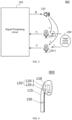
- FIG. 1 shows a schematic diagram of an application scenario provided according to some embodiments of this application.
- This scenario can be a public address scenario, an assisted listening scenario, or a hearing aid scenario.
- the application scenario 001 comprises a speaker 110-A and a sound sensor 120-A.
- the sound sensor 120-A collects the ambient sound during operation.
- the speaker 110-A is also playing sound synchronously, the sound played by the speaker 110-A will also be captured by the sound sensor 120-A.
- the ambient sound collected by the sound sensor 120-A comprises both the sound from the target sound source 160 and the sound from the speaker 110-A.
- the aforementioned ambient sound is input into a gain amplifier (such as G in FIG.
- FIG. 2 shows a schematic diagram of another application scenario provided according to some embodiments of this application.
- This scenario can be a call scenario, such as a scenario involving communication through a telephone system, a conference system, or a voice call system.
- the application scenario 002 comprises a local end and a remote end.
- the local end comprises a local user 140-A, a speaker 110-A, and a sound sensor 120-A
- the remote end comprises a remote user 140-B, a speaker 110-B, and a sound sensor 120-B.
- the local end and the remote end can be connected via a network.
- the network is a medium used to provide a communication connection between the local end and the remote end, facilitating the exchange of information or data between the two.
- the network can be any type of wired or wireless network, or a combination thereof.
- the network may comprise a cable network, a wired network, a fiber optic network, a telecommunications network, an intranet, the Internet, a local area network (LAN), a wide area network (WAN), a wireless local area network (WLAN), a metropolitan area network (MAN), a wide area network (WAN), a public switched telephone network (PSTN), a Bluetooth network, a ZigBee network, a near-field communication (NFC) network, or similar networks.
- the network may comprise one or more network access points.
- the network may comprise wired or wireless network access points, such as base stations or Internet exchange points, through which the local end and the remote end can connect to the network to exchange data or information.
- the remote voice from the remote user 140-B is collected by the sound sensor 120-B and transmitted to the local end, then played through the speaker 110-A at the local end.
- the remote voice played by the speaker 110-A, along with the local voice from the local user 140-A, is collected by the sound sensor 120-A at the local end, then transmitted back to the remote end and played through the speaker 110-B at the remote end.
- the remote user 140-B will hear own echo, thus being disturbed by this echo.
- FIG. 2 illustrates the process in which the remote user 140-B is disturbed by an echo.
- the local user 140-A may also experience echo interference, and the echo generation process at the local end is similar to that described above, which will not be elaborated herein. Such echoes can affect the normal conversation of users.
- the signal processing method and acoustic system provided by the embodiments of this application can be applied to scenarios requiring howling suppression (such as the scenario shown in FIG. 1 ) and to scenarios requiring echo cancellation (such as the scenario shown in FIG. 2 ).
- the acoustic system collects ambient sound through M sound sensors to obtain M sound pickup signals, and processes these M sound pickup signals using the signal processing method described in the embodiments of this application to generate a composite signal, reducing the signal components from the speaker in the composite signal, thereby achieving the purpose of suppressing howling or eliminating echo.
- the acoustic system 003 can be worn on the user's head; for example, it can be worn on the user's ear in an in-ear manner, an over-ear manner, or other methods.
- the sound output end of the speaker 110 faces the user's head, for instance, toward the user's ear canal opening or near the ear canal opening.
- the sound pickup end of at least one sound sensor in the sound sensor module 120 is located on the side of the housing 115 away from the user's head. This design, on one hand, facilitates the pickup of ambient sound, and on the other hand, minimizes the pickup of sound emitted by the speaker 110 as much as possible.
- the target constraint may comprise: the M sets of target filtering parameters are not all zero at the same time. That is to say, the signal processing circuit 150 solves for the target filtering parameters w 1 to w n using the above formula (4) as the objective function, while ensuring that the M sets of target filtering parameters are not all zero simultaneously.
- the M sets of target filtering parameters can be obtained based on the M first transfer functions (i.e., h 1 to h M ).
- the M sets of target filtering parameters can be obtained in the following manner: the M sets of target filtering parameters are divided into K sets of first filter parameters and M-K sets of second filter parameters, where K is an integer greater than or equal to 1.
- the K sets of first filter parameters are set to preset non-zero values, and then the M-K sets of second filter parameters are determined based on the M first transfer functions and the K sets of first filter parameters.
- the signal processing circuit 150 can use formula (4) as the objective function to solve for w 2 .
- h 2 c represents the convolution matrix of h 2
- h 2 cT represents the transpose matrix of the convolution matrix of h 2 .
- the signal processing circuit 150 by performing the filtering operation based on w 1 and w 2 , can minimize the feedback component in the composite signal y.
- the target constraint may comprise: the degree of attenuation of the signal component in the composite signal y corresponding to the second sound is within a preset range (or, in other words, the degree of attenuation is less than or equal to a preset value).
- Minimum the signal component in the composite signal y corresponding to the first sound under the above target constraint can be understood as: reducing the signal component in the composite signal y corresponding to the first sound to the greatest extent possible, under the premise of not attenuating, or minimizing the attenuation of, the signal component in the composite signal y corresponding to the second sound.
- the M sets of target filtering parameters (i.e., w 1 to w M ) can be derived based on the first transfer functions h 1 to h M and the second transfer functions d 1 to d M .
- the following provides an illustration using two possible solving approaches.
- the first expression can be represented using formula (4).
- the meaning of the first expression is: minimizing the transfer function between the first sound x and the composite signal y.
- the second expression can be represented using formula (7).
- the meaning of the second expression is: the transfer function between the second sound v and the composite signal y is equal to the second transfer function d 1 .
- the comprehensive pickup effect of the sound sensor module 120 on the second sound i.e., the signal component in the composite signal y corresponding to the second sound
- formula (7) ensures that the degree of attenuation of the signal component in the composite signal y corresponding to the second sound remains within a preset range.
- the signal processing circuit 150 can also obtain the target filtering parameters w 1 to w M in the following manner:
- the fourth expression can be represented using formula (10).
- the meaning of the fourth expression is: the difference between the transfer function from the second sound v to the composite signal y and the second transfer function d 1 .
- the smaller this difference the more it indicates that the comprehensive pickup effect of the sound sensor module 120 on the second sound (i.e., the signal component in the composite signal y corresponding to the second sound) is equivalent to the pickup effect of a single sound sensor 120-1 on the second sound.
- the degree of attenuation of the signal component in the composite signal y corresponding to the second sound is within a preset range, thus satisfying the target constraint.
- ⁇ n 1 M d n ⁇ w n ⁇ d 1
- the fourth expression is only one possible form of the fourth expression.
- the fourth expression can also take other forms.
- the d 1 in formula (10) could be modified to any one of d 2 to d M .
- the target filtering parameters w M to w m obtained from the solution can be as shown in formula (13).
- W w 1 T , w 2 T , ... , w M T T
- H h 1 c , h 2 c , ... , h M c
- D ⁇ d ⁇ 1 c , d ⁇ 2 c , ... , d ⁇ M c
- w 1 T represents the transpose matrix of w 1
- h 1 c represents the convolution matrix of h 1
- d ⁇ 1 c represents the convolution matrix of d ⁇ 1 .
- FIG. 8B illustrates a schematic diagram of the attenuation effect of the signal processing scheme shown in FIG. 7 on the sound from the target sound source.
- curve D shows the attenuation of the signal component from the target sound source 160 in the composite signal y.
- the signal processing method shown in FIG. 7 does not significantly attenuate the signal component from the target sound source 160 in the composite signal y, with the attenuation amount basically within 0.01 dB. This indicates that the signal processing method shown in FIG. 7 can, on one hand, effectively reduce the feedback component in the composite signal y, and on the other hand, avoid or minimally attenuate the signal component from the target sound source 160 in the composite signal y.
- the second transfer functions d 1 to d M can be measured based on the pickup characteristics of the acoustic system 003 for an external sound source.
- the measurement method may comprise: providing a test signal to the external sound source to drive the external sound source to emit a test sound, obtaining the collected signal generated by the sound sensor 120-1 picking up the test sound, and then determining the second transfer function d 1 between the external sound source and the sound sensor 120-1 based on the test signal and the collected signal.
- the second transfer functions d 2 to d M can be tested and obtained using a similar method as described above.
- the second transfer functions d 1 to d M obtained from the above measurements can be stored in the preset storage space. In this way, when the signal processing circuit 150 needs to use the second transfer functions d 1 to d M , it can read them from the preset storage space.
Landscapes
- Physics & Mathematics (AREA)
- Engineering & Computer Science (AREA)
- Acoustics & Sound (AREA)
- Health & Medical Sciences (AREA)
- General Health & Medical Sciences (AREA)
- Otolaryngology (AREA)
- Signal Processing (AREA)
- Neurosurgery (AREA)
- Multimedia (AREA)
- Circuit For Audible Band Transducer (AREA)
Applications Claiming Priority (1)
| Application Number | Priority Date | Filing Date | Title |
|---|---|---|---|
| PCT/CN2023/094377 WO2024234271A1 (zh) | 2023-05-15 | 2023-05-15 | 信号处理方法及声学系统 |
Publications (2)
| Publication Number | Publication Date |
|---|---|
| EP4579657A1 true EP4579657A1 (de) | 2025-07-02 |
| EP4579657A4 EP4579657A4 (de) | 2025-11-05 |
Family
ID=93518463
Family Applications (1)
| Application Number | Title | Priority Date | Filing Date |
|---|---|---|---|
| EP23936958.0A Pending EP4579657A4 (de) | 2023-05-15 | 2023-05-15 | Signalverarbeitungsverfahren und akustisches system |
Country Status (4)
| Country | Link |
|---|---|
| US (1) | US20250225970A1 (de) |
| EP (1) | EP4579657A4 (de) |
| CN (1) | CN120035860A (de) |
| WO (1) | WO2024234271A1 (de) |
Family Cites Families (7)
| Publication number | Priority date | Publication date | Assignee | Title |
|---|---|---|---|---|
| US8923530B2 (en) * | 2009-04-10 | 2014-12-30 | Avaya Inc. | Speakerphone feedback attenuation |
| CN105810202B (zh) * | 2014-12-31 | 2019-07-02 | 展讯通信(上海)有限公司 | 一种降低回声的方法、装置及通讯设备 |
| EP3563561B1 (de) * | 2016-12-30 | 2025-04-02 | Harman Becker Automotive Systems GmbH | Unterdrückung von akustischem echo |
| CN110956975B (zh) * | 2019-12-06 | 2023-03-24 | 展讯通信(上海)有限公司 | 回声消除方法及装置 |
| CN113963712B (zh) * | 2020-07-21 | 2025-07-25 | 华为技术有限公司 | 滤除回声的方法、电子设备和计算机可读存储介质 |
| CN113362843B (zh) * | 2021-06-30 | 2023-02-17 | 北京小米移动软件有限公司 | 音频信号处理方法及装置 |
| CN115691524A (zh) * | 2021-07-26 | 2023-02-03 | 深圳Tcl新技术有限公司 | 音频信号的处理方法、装置、设备及存储介质 |
-
2023
- 2023-05-15 CN CN202380071572.6A patent/CN120035860A/zh active Pending
- 2023-05-15 EP EP23936958.0A patent/EP4579657A4/de active Pending
- 2023-05-15 WO PCT/CN2023/094377 patent/WO2024234271A1/zh not_active Ceased
-
2025
- 2025-03-25 US US19/089,091 patent/US20250225970A1/en active Pending
Also Published As
| Publication number | Publication date |
|---|---|
| WO2024234271A1 (zh) | 2024-11-21 |
| EP4579657A4 (de) | 2025-11-05 |
| US20250225970A1 (en) | 2025-07-10 |
| CN120035860A (zh) | 2025-05-23 |
Similar Documents
| Publication | Publication Date | Title |
|---|---|---|
| EP2680608B1 (de) | Sprachverbesserungsverfahren und -vorrichtung für kommunikationskopfhörer sowie kommunikationskopfhörer mit rauschminderung | |
| US20210176558A1 (en) | Earphone signal processing method and system, and earphone | |
| KR101463324B1 (ko) | 오디오 등화를 위한 시스템들, 방법들, 디바이스들, 장치, 및 컴퓨터 프로그램 제품들 | |
| JP2008507926A (ja) | 雑音環境内で音声信号を分離するためのヘッドセット | |
| KR20130055650A (ko) | 다중-마이크로폰 위치 선택적 프로세싱을 위한 시스템들, 방법들, 장치, 및 컴퓨터 판독가능 매체 | |
| US11115775B2 (en) | Method and apparatus for acoustic crosstalk cancellation | |
| US20200204915A1 (en) | Method of compensating a processed audio signal | |
| CN204652616U (zh) | 一种降噪模块耳机 | |
| WO2021129197A1 (zh) | 一种语音信号处理方法及装置 | |
| EP4579657A1 (de) | Signalverarbeitungsverfahren und akustisches system | |
| CN113163152B (zh) | 一种多维拾音降噪方法、视频电话会议系统和计算机存储介质 | |
| US20250063288A1 (en) | Open wearable acoustic device and active noise reduction method | |
| US20250037695A1 (en) | Open wearable acoustic device and active noise reduction method | |
| CN115278464A (zh) | 一种回声消除方法、装置和通信设备 | |
| CN118972741A (zh) | 信号处理方法及声学系统 | |
| EP4580213A1 (de) | Signalverarbeitungsverfahren und akustisches system | |
| EP4576821A1 (de) | Signalverarbeitungsverfahren und akustisches system | |
| US20250061879A1 (en) | Open wearable acoustic device and active noise reduction method | |
| US20250006169A1 (en) | Open wearable acoustic device and active noise reduction method | |
| CN121603851A (zh) | 声学设备以及耳挂式助听设备 | |
| US20240292148A1 (en) | Headset and method for controlling directivity of call microphone | |
| WO2026036339A1 (zh) | 声学设备以及耳挂式助听设备 | |
| CN118972742A (zh) | 信号处理方法及声学系统 | |
| CN118972743A (zh) | 信号处理方法及声学系统 | |
| CN204652615U (zh) | 一种降噪话务耳机 |
Legal Events
| Date | Code | Title | Description |
|---|---|---|---|
| STAA | Information on the status of an ep patent application or granted ep patent |
Free format text: STATUS: THE INTERNATIONAL PUBLICATION HAS BEEN MADE |
|
| PUAI | Public reference made under article 153(3) epc to a published international application that has entered the european phase |
Free format text: ORIGINAL CODE: 0009012 |
|
| STAA | Information on the status of an ep patent application or granted ep patent |
Free format text: STATUS: REQUEST FOR EXAMINATION WAS MADE |
|
| 17P | Request for examination filed |
Effective date: 20250328 |
|
| AK | Designated contracting states |
Kind code of ref document: A1 Designated state(s): AL AT BE BG CH CY CZ DE DK EE ES FI FR GB GR HR HU IE IS IT LI LT LU LV MC ME MK MT NL NO PL PT RO RS SE SI SK SM TR |
|
| A4 | Supplementary search report drawn up and despatched |
Effective date: 20251007 |
|
| RIC1 | Information provided on ipc code assigned before grant |
Ipc: G10L 21/02 20130101AFI20250930BHEP Ipc: H04M 9/08 20060101ALI20250930BHEP |