EP4579601A1 - Informationsverarbeitungsvorrichtung, informationsverarbeitungssystem, informationsverarbeitungsverfahren und computerprogramm - Google Patents
Informationsverarbeitungsvorrichtung, informationsverarbeitungssystem, informationsverarbeitungsverfahren und computerprogramm Download PDFInfo
- Publication number
- EP4579601A1 EP4579601A1 EP23857232.5A EP23857232A EP4579601A1 EP 4579601 A1 EP4579601 A1 EP 4579601A1 EP 23857232 A EP23857232 A EP 23857232A EP 4579601 A1 EP4579601 A1 EP 4579601A1
- Authority
- EP
- European Patent Office
- Prior art keywords
- concealing
- target space
- target
- information processing
- data
- Prior art date
- Legal status (The legal status is an assumption and is not a legal conclusion. Google has not performed a legal analysis and makes no representation as to the accuracy of the status listed.)
- Pending
Links
Images





Classifications
-
- G—PHYSICS
- G06—COMPUTING OR CALCULATING; COUNTING
- G06T—IMAGE DATA PROCESSING OR GENERATION, IN GENERAL
- G06T19/00—Manipulating three-dimensional [3D] models or images for computer graphics
- G06T19/006—Mixed reality
-
- G—PHYSICS
- G06—COMPUTING OR CALCULATING; COUNTING
- G06F—ELECTRIC DIGITAL DATA PROCESSING
- G06F21/00—Security arrangements for protecting computers, components thereof, programs or data against unauthorised activity
- G06F21/60—Protecting data
- G06F21/62—Protecting access to data via a platform, e.g. using keys or access control rules
- G06F21/6218—Protecting access to data via a platform, e.g. using keys or access control rules to a system of files or objects, e.g. local or distributed file system or database
- G06F21/6245—Protecting personal data, e.g. for financial or medical purposes
-
- G—PHYSICS
- G06—COMPUTING OR CALCULATING; COUNTING
- G06T—IMAGE DATA PROCESSING OR GENERATION, IN GENERAL
- G06T17/00—Three-dimensional [3D] modelling for computer graphics
-
- G—PHYSICS
- G06—COMPUTING OR CALCULATING; COUNTING
- G06T—IMAGE DATA PROCESSING OR GENERATION, IN GENERAL
- G06T19/00—Manipulating three-dimensional [3D] models or images for computer graphics
-
- G—PHYSICS
- G06—COMPUTING OR CALCULATING; COUNTING
- G06T—IMAGE DATA PROCESSING OR GENERATION, IN GENERAL
- G06T19/00—Manipulating three-dimensional [3D] models or images for computer graphics
- G06T19/20—Editing of three-dimensional [3D] images, e.g. changing shapes or colours, aligning objects or positioning parts
-
- G—PHYSICS
- G06—COMPUTING OR CALCULATING; COUNTING
- G06V—IMAGE OR VIDEO RECOGNITION OR UNDERSTANDING
- G06V10/00—Arrangements for image or video recognition or understanding
- G06V10/10—Image acquisition
- G06V10/12—Details of acquisition arrangements; Constructional details thereof
- G06V10/14—Optical characteristics of the device performing the acquisition or on the illumination arrangements
- G06V10/143—Sensing or illuminating at different wavelengths
-
- G—PHYSICS
- G06—COMPUTING OR CALCULATING; COUNTING
- G06V—IMAGE OR VIDEO RECOGNITION OR UNDERSTANDING
- G06V10/00—Arrangements for image or video recognition or understanding
- G06V10/10—Image acquisition
- G06V10/17—Image acquisition using hand-held instruments
-
- G—PHYSICS
- G06—COMPUTING OR CALCULATING; COUNTING
- G06V—IMAGE OR VIDEO RECOGNITION OR UNDERSTANDING
- G06V10/00—Arrangements for image or video recognition or understanding
- G06V10/70—Arrangements for image or video recognition or understanding using pattern recognition or machine learning
- G06V10/764—Arrangements for image or video recognition or understanding using pattern recognition or machine learning using classification, e.g. of video objects
-
- G—PHYSICS
- G06—COMPUTING OR CALCULATING; COUNTING
- G06V—IMAGE OR VIDEO RECOGNITION OR UNDERSTANDING
- G06V10/00—Arrangements for image or video recognition or understanding
- G06V10/70—Arrangements for image or video recognition or understanding using pattern recognition or machine learning
- G06V10/77—Processing image or video features in feature spaces; using data integration or data reduction, e.g. principal component analysis [PCA] or independent component analysis [ICA] or self-organising maps [SOM]; Blind source separation
- G06V10/778—Active pattern-learning, e.g. online learning of image or video features
-
- G—PHYSICS
- G06—COMPUTING OR CALCULATING; COUNTING
- G06V—IMAGE OR VIDEO RECOGNITION OR UNDERSTANDING
- G06V10/00—Arrangements for image or video recognition or understanding
- G06V10/70—Arrangements for image or video recognition or understanding using pattern recognition or machine learning
- G06V10/82—Arrangements for image or video recognition or understanding using pattern recognition or machine learning using neural networks
-
- G—PHYSICS
- G06—COMPUTING OR CALCULATING; COUNTING
- G06V—IMAGE OR VIDEO RECOGNITION OR UNDERSTANDING
- G06V20/00—Scenes; Scene-specific elements
- G06V20/50—Context or environment of the image
- G06V20/52—Surveillance or monitoring of activities, e.g. for recognising suspicious objects
-
- G—PHYSICS
- G06—COMPUTING OR CALCULATING; COUNTING
- G06V—IMAGE OR VIDEO RECOGNITION OR UNDERSTANDING
- G06V20/00—Scenes; Scene-specific elements
- G06V20/60—Type of objects
- G06V20/64—Three-dimensional [3D] objects
-
- G—PHYSICS
- G06—COMPUTING OR CALCULATING; COUNTING
- G06T—IMAGE DATA PROCESSING OR GENERATION, IN GENERAL
- G06T2210/00—Indexing scheme for image generation or computer graphics
- G06T2210/04—Architectural design, interior design
Definitions
- An information processing apparatus includes: an acquisition unit configured to acquire target space data obtained by measuring an inside of a target space; and a processing unit, wherein the processing unit is configured to recognize an attribute and a position of a concealing target object based on the target space data acquired by the acquisition unit, output the attribute and the position of the concealing target object with respect to an environment of the target space in association with each other based on the target space data acquired by the acquisition unit and the attribute and the position of the concealing target object in the target space, and process concealed information of the concealing target object.
- An information processing apparatus is the information processing apparatus according to any one of the first to fourth aspects, wherein the processing unit generates the three dimensional space model including a heat generation condition of the concealing target object based on the acquired thermographic data.
- An information processing apparatus is the information processing apparatus according to any one of the first to fifth aspects, wherein the processing unit acquires from a storage unit storing the attribute of the concealing target object and impact defining data defining an impact of the concealing target object on the environment of the target space in association with each other, the impact defining data of the concealing target object, and generates the three dimensional space model based on the target space data and the impact defining data acquired.
- An information processing apparatus is the information processing apparatus according to any one of the first to sixth aspects, wherein the impact defining data includes a thermal boundary condition.
- An information processing apparatus is the information processing apparatus according to any one of the first to seventh aspects, wherein the processing unit determines whether the target space data redundantly includes the concealing target object.
- An information processing apparatus is the information processing apparatus according to any one of the first to eighth aspects, wherein upon redundantly recognizing the concealing target object included in the target space, the processing unit removes the redundant concealing target object.
- An information processing apparatus is the information processing apparatus according to any one of the first to ninth aspects, wherein the processing unit generates the three dimensional space model by replacing the concealing target object with a model object including no concealed information.
- An information processing system includes: the information processing apparatus according to any one of the first to tenth aspects; and a measurement apparatus configured to measure a physical quantity related to a shape in the target space, wherein the information processing apparatus acquires the target space data from the measurement apparatus.
- An information processing system is an information processing system including an information processing apparatus, wherein the information processing apparatus includes an acquisition unit configured to acquire target space data obtained by measuring an inside of a target space, and a processing unit, the processing unit is configured to recognize an attribute and a position of a concealing target object based on the target space data acquired by the acquisition unit, output the attribute and the position of the concealing target object with respect to an environment of the target space in association with each other based on the target space data acquired by the acquisition unit and the attribute and the position of the concealing target object in the target space, and process concealed information of the concealing target object.
- the information processing apparatus includes an acquisition unit configured to acquire target space data obtained by measuring an inside of a target space, and a processing unit, the processing unit is configured to recognize an attribute and a position of a concealing target object based on the target space data acquired by the acquisition unit, output the attribute and the position of the concealing target object with respect to an environment of the target space in association with each other based on the target space data acquired by the acquisition unit and the attribute
- the information processing system is an information processing system including the information processing apparatus.
- the information processing apparatus includes the acquisition unit configured to acquire the target space data obtained by measuring the inside of the target space; and the processing unit.
- the processing unit recognizes the attribute and the position of the concealing target object based on the target space data acquired by the acquisition unit, outputs the target space data and the attribute and the position of the concealing target object in association with each other, and processes the concealed information of the concealing target object.
- An information processing method includes: acquiring target space data obtained by measuring an inside of a target space; recognizing an attribute and a position of a concealing target object based on the target space data acquired; outputting the attribute and the position of the concealing target object with respect to an environment of the target space in association with each other based on the target space data acquired and the attribute and the position of the concealing target object in the target space; and processing concealed information of the concealing target object.
- the information processing method includes: acquiring the target space data obtained by measuring the inside of the target space; recognizing the attribute and the position of the concealing target object based on the target space data acquired; outputting the target space data and the attribute and the position of the concealing target object in association with each other; and processing the concealed information of the concealing target object.
- a computer program causes a computer to execute processing of: acquiring target space data obtained by measuring an inside of a target space; recognizing an attribute and a position of a concealing target object based on the target space data acquired; outputting the attribute and the position of the concealing target object with respect to an environment of the target space in association with each other based on the target space data acquired and the attribute and the position of the concealing target object in the target space; and processing the concealed information of the concealing target object.
- the computer program according to the fourteenth aspect of the present disclosure causes a computer to execute processing of: acquiring the target space data obtained by measuring the inside of the target space; recognizing the attribute and the position of the concealing target object based on the target space data acquired; outputting the target space data and the attribute and the position of the concealing target object in association with each other; and processing the concealed information of the concealing target object.
- a method of automatically generating a fluid calculation model is proposed.
- images are captured while walking in a space by using a handheld depth camera, camera, thermography, and smartphone-integrated module, and a depth image and an image in the space are stored in the smartphone.
- the data stored in the smartphone is transferred to an information processing apparatus 1, and three dimensional point group data is generated using software for three dimensional reconstruction.
- a floor, a wall, and a ceiling are detected from the three dimensional point group data, and a fluid calculation model, which is a space model of a surface, is generated.
- the type (air conditioner, equipment, or the like) and the position of an object are identified through image recognition, learned in advance by machine learning, on the captured image, and are reflected on the three dimensional space model.
- the image may be captured by using a vacuuming robot, a drone, or the like instead of being captured by a person using a handheld device.
- Fig. 1 is a block diagram illustrating a configuration example of an information processing system according to the present embodiment
- Fig. 2 is a perspective view illustrating a configuration example and a usage example of a measurement apparatus 2 according to the present embodiment
- the information processing system according to the present embodiment includes the information processing apparatus 1, the measurement apparatus 2, and a terminal device 3.
- the information processing system semiautomatically generates a three dimensional space model for capturing an image and measuring the distance for a space having a surface in at least a part thereof and predicting the environment of the space based on data obtained by the measurement.
- a space to be modeled is referred to as a target space.
- the target space includes one or a plurality of objects that may affect the environment of the target space.
- the object includes at least one of an object that affects the air flow in the target space, an object that affects the thermal environment in the target space, an object that affects the air quality in the target space, and an object that controls the environment in the target space.
- the object includes at least one of equipment, a fitting, a person, an industrial machine, a plant, an air conditioner, and a ventilation device.
- the equipment includes at least one of a computer, a monitor, a lighting fixture, a heater, and a chair.
- the fitting includes at least one of a window, a blind, a partition, and a door.
- the air conditioner includes an air purifier.
- the target space has a duct system for ventilation.
- the duct system includes an air inlet or an air outlet of an air conditioner or a ventilation device.
- the target space includes a pipe system of an air conditioner.
- the object includes a concealing target object with confidentiality and a non-concealing target object with no confidentiality.
- the concealing target object includes at least one of a display device, a person, an industrial machine, a document, a destination display board, a bulletin object, a whiteboard, a blackboard, a tag, and a postal item.
- the measurement apparatus 2 is an apparatus that includes an RGB sensor 21, a depth sensor 22, an IR projector 23, an infrared camera 24, a gripping part, and a terminal holding part and measures a physical quantity related to a shape in a target space.
- the gripping part is a member gripped by a user of the measurement apparatus 2.
- the gripping part is, for example, a bar-shaped member.
- the terminal holding part is a member for holding the terminal device 3.
- the RGB sensor 21 is a camera that includes an image sensor such as a CMOS sensor or a CCD sensor for example and captures a color image of a target space.
- the RGB sensor 21 can capture a moving image.
- the RGB sensor 21 outputs time-series image data (RGB data) obtained by imaging the target space. It is assumed that the time-series image data in the moving image includes time data indicating the capturing date and time.
- the depth sensor 22 measures a distance (depth) from the measurement apparatus 2 to a wall surface of the target space and various objects included in the target space.
- the depth sensor 22 outputs depth data indicating a depth obtained by the distance measurement.
- the IR projector 23 is an element for projecting infrared rays onto a target space and an object in order to obtain more accurate depth data.
- the infrared camera 24 is a camera that includes an infrared image sensor and captures an image of a target space using infrared rays.
- the infrared camera 24 outputs thermographic image data obtained by imaging the target space.
- the measurement apparatus 2 configured as described above outputs the image data, the depth data, and the thermographic image data to the terminal device 3.
- the measurement apparatus 2 may be configured to output the image data, the depth data, and the thermographic image data to an external portable storage device for storage.
- the measurement apparatus 2 may be configured to transmit the image data, the depth data, and the thermographic image data directly to the information processing apparatus 1.
- the image data and the depth data are referred to as target space data.
- the terminal device 3 is, for example, a portable information processing terminal such as a smartphone, a mobile phone, a tablet terminal, or a personal digital assistant (PDA).
- the terminal device 3 includes an input interface to which image data, depth data, a thermographic image, and azimuth data are input.
- the terminal device 3 includes an azimuth sensor 31.
- the azimuth sensor 31 is, for example, an azimuth meter such as an electronic compass, and outputs azimuth data indicating the azimuth of the measurement apparatus 2.
- the content of the azimuth data is not limited as long as the azimuth data is information with which the azimuth of the target space can be identified.
- the azimuth data may be information based on the latitude, the longitude, and the time of the target space and the position of a celestial object.
- the celestial object is an object, an image of which can be captured, existing in the universe with the position on the celestial sphere being known.
- the celestial object is, for example, the sun, the moon, an artificial satellite, or the like. If a celestial object whose position on the celestial sphere is known is included in the captured image, and the latitude and longitude of the target space the image of which is captured and the capturing time are known, the azimuth of the target space can be identified.
- the azimuth data may be information based on the latitude, the longitude, and the time of the target space, and the direction and length of an indoor shadow. Since the position of the sun is identified from the direction and length of the shadow, it is possible to identify the azimuth of the target space as described above.
- a processing unit 11 of the information processing apparatus 1 can identify the azimuth of the target space based on these pieces of information.
- the terminal device 3 causes a display device to display the image captured by the measurement apparatus 2 based on the image data input via the input interface.
- the terminal device 3 stores the input image data, depth data, and thermographic image, as well as azimuth data obtained by the azimuth sensor 31, and transmits the data to the information processing apparatus 1 at an appropriate timing.
- the terminal device 3 may be configured to store the input image data, depth data, and thermographic image, as well as the azimuth data obtained by the azimuth sensor 31 in a portable storage device.
- the user can capture an image of a wall surface, a floor surface, a ceiling surface, and an object in the target space and measure a distance to the wall surface, the floor surface, the ceiling surface, and the object from a plurality of positions and directions by moving in the target space while holding the measurement apparatus 2 and directing the measurement apparatus 2 in various directions.
- the measurement apparatus 2 provides the information processing apparatus 1 with target space data, thermographic image data, and azimuth data obtained by measuring the inside of the target space from a plurality of positions.
- the information processing apparatus 1 includes the processing unit 11, a storage unit 12, an acquisition unit 13, a display unit 14, and an operation unit 15.
- the processing unit 11 is a processor including an arithmetic circuit such as a central processing unit (CPU), a micro-processing unit (MPU), an application specific integrated circuit (ASIC), or a field-programmable gate array (FPGA), an internal storage device such as a read only memory (ROM) or a random access memory (RAM), an I/O terminal, and the like.
- the processing unit 11 may include one or a plurality of arithmetic circuits such as a graphics processing unit (GPU), a tensor processing unit (TPU), or an AI chip (semiconductor for AI) specialized for image processing related to object detection and image recognition.
- the processing unit 11 generates a three dimensional space model of the target space by reading and executing a computer program (program product) P stored in the storage unit 12.
- a computer program program product
- Each of the functional units related to the generation of the three dimensional space model may be realized by software, or some or all of the functional units may be realized by hardware.
- the learning model 16 may be configured using R-CNN, Fast R-CNN, Faster R-CNN, other CNNs, a vision transformer, or the like.
- the learning model 16 using an algorithm such as a decision tree, a random forest, or a support vector machine (SVM) may be used.
- the learning model 16 may be configured by combining a plurality of algorithms described above.
- a method of generating the diffuser determination model 17 will be described.
- training data including a plurality of pieces of diffuser image data and teacher data indicating whether each diffuser image corresponds to an air inlet or an air outlet is prepared.
- the processing unit 11 can generate the diffuser determination model 17 through optimization of a weight coefficient of the neural network using an error back propagation method, an error gradient descent method, or the like to achieve a small error (a value of a predetermined loss function or error function) between data output from the CNN in response to an input of the diffuser image in the training data to the CNN and data indicated by the teacher data.
- the learning model 16 may be used to determine the air inlet and the air outlet.
- Fig. 4 is a conceptual diagram of the object DB 18 according to the present embodiment.
- the object DB 18 stores, for example, an object class, an object type, confidentiality, a boundary condition type, and a boundary condition parameter in association with each other.
- the object type includes equipment, fitting, person, industrial machine, plant, air conditioner, ventilation device, and the like as described above.
- the confidentiality is data indicating whether the object is a concealing target object or a non-concealing target object.
- the boundary condition parameter is, for example, data indicating a Dirichlet boundary condition, a Neumann boundary condition, or the like of the temperature, the pressure, and the flow velocity on the object surface.
- the parameters include, for example, sensible heat, latent heat, air volume, wind direction, wind speed, and the like.
- the terminal device 3 sends the target space data, the thermographic image data, and the azimuth data to the information processing apparatus 1 (step S114).
- the processing unit 11 may execute arithmetic processing to convert the azimuth data into data directly indicating the azimuth.
- the processing unit 11 may calculate data indicating the azimuth of the three dimensional space based on the image data and the time data.
- a sensor provided around the target space detects the outside air temperature and the amount of sunshine, and transmits the outside air temperature time-series data and the insolation time-series data to the information processing apparatus 1.
- the processing unit 11 acquires the outside air temperature time-series data and the insolation time-series data from the sensor.
- the processing unit 11 may be configured to acquire the data described above from an external server that distributes weather information such as the outside air temperature time-series data and the insolation time-series data.
- Fig. 6 and Fig. 7 are flowcharts illustrating a processing procedure for generating the three dimensional space model.
- Fig. 8 is an explanatory view illustrating an example of three dimensional point groups and a captured image.
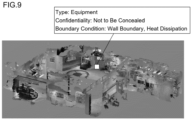
- Fig. 9 is an explanatory view illustrating an example of the three dimensional space model.
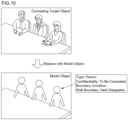
- Fig. 10 is a conceptual diagram illustrating concealing processing for a concealing target object.
- a three dimensional space model for fluid analysis is generated as follows. Specifically, image data and depth data are analyzed to generate three dimensional point group data of the target space. Then, the learning model 16 trained in advance is used for elements such as a heat source that need to be taken into consideration for the fluid analysis, to identify the type and the position of the elements in the three dimensional point group data in the captured image. The type and the position are reflected on the three dimensional space model.
- the processing unit 11 of the information processing apparatus 1 restores the three dimensional point group of the target space based on the image data and the depth data (step S131).
- the upper drawing illustrates the image data and the depth data
- the lower left drawing illustrates three dimensional point group data
- the lower right drawing illustrates image data corresponding to the three dimensional point group data.
- the processing unit 11 generates a three dimensional space model for fluid calculation using a self-position estimation technique and a line-of-sight direction estimation technique based on the three dimensional point group data (step S132).
- the processing unit 11 can identify a plane corresponding to a wall surface, a floor surface, or a ceiling surface of the target space, a plane corresponding to an outer surface of an object such as various types of devices and equipment, and the position of each plane, and generates a three dimensional space model formed by a plurality of surfaces.
- the processing unit 11 When the processing unit 11 recognizes a chair object in the target space, the processing unit 11 may assign a thermal boundary condition of a person to the chair object.
- the storage unit 12 of the information processing apparatus 1 stores typical predetermined thermal boundary condition of a human object, examples of which include sensible heat and latent heat, and the processing unit 11 may assign the thermal boundary condition to the chair object.
- the temperature or the heat amount of the object is calculated by measurement using thermography, and is reflected on the fluid calculation model.
- the method of replacing the concealing target object with the model object is an example of a method of concealing the concealing target object.
- the concealing target object may be processed by any method as long as the concealing target object can be concealed.
- the computer and timing for concealing the concealing target object are not limited.
- the method may be performed by the terminal computer or the server apparatus.
- the terminal device 3 may be configured to execute the processing of concealing the concealing target object.
- the processing unit 11 determines whether a diffuser of the air conditioner or the ventilation device is an air inlet or an air outlet by inputting the image data of the diffuser to the diffuser determination model 17 (step S138).
- a configuration may be employed in which, based on the image data of a diffuser, feature amounts related to an air inlet and an air outlet are calculated and whether the diffuser is the air inlet or the air outlet is determined based on the feature amounts calculated.
- processing unit 11 can determine the air inlet and the air outlet with a sufficient degree of reliability through the image recognition processing in step S133 using the learning model 16, the processing in steps S138 to S141 may be omitted.
- the processing unit 11 aligns the target space represented by the target space data with the duct system represented by the duct system data, based on the azimuth data related to the acquired azimuth of the target space, the information representing the outer shape of the target space based on the target space data, and the duct system diagram data (step S139).
- a configuration may be employed in which the target space and the duct system are aligned with reference to the position of an object whose precise position is objectively known and does not change, such as an elevator, a staircase, or a pillar.
- the processing unit 11 determines whether the diffuser is the air inlet or the air outlet based on the acquired duct system diagram data (step S140).
- step S140 a duct-type air inlet and air outlet, which are information that is difficult to determine by image recognition, are determined using the duct system diagram.
- the air inlet and the air outlet of the duct-type air conditioner or ventilation device since the result of the fluid calculation greatly differs depending on whether the diffuser is the air inlet or the air outlet, it is necessary to correctly determine the air inlet or the air outlet. However, since there is no great difference in appearance, it is difficult to determine the air inlet or the air outlet simply by the image recognition. In view of this, information on the air inlet and the air outlet from the duct system diagram in the target space is acquired and reflected on the three dimensional space model.
- step S140 by using the duct system diagram for generating the three dimensional space model, it is possible to recognize the duct system of the air conditioner or the ventilation device for facilitating the setting of the thermal boundary conditions of the air inlet and the air outlet.
- the processing unit 11 determines whether the diffuser is an air inlet or an air outlet based on the thermographic image data including the diffuser (step S141).
- step S141 the temperatures of the air inlet and the air outlet of the air conditioner or the ventilation device and the temperature of the ceiling surface are measured by using a thermographic image to determine the air inlet and the air outlet, and the thermal boundary conditions of the air inlet and the air outlet are reflected on the three dimensional space model.
- the processing unit 11 acquires the azimuth data related to the azimuth of the target space, and aligns the target space represented by the target space data with the pipe system represented by the pipe system diagram data, based on the acquired azimuth data, information representing the outer shape of the target space based on the target space data, and the pipe system diagram data (step S142).
- the thermal boundary condition of the air conditioner based on the pipe system diagram data acquired is assigned to the three dimensional space model (step S143). Since the pipe system of the air conditioner and the target space are aligned, the processing unit 11 can identify the relationship between the object as the air conditioner included in the target space and the pipe system. The processing unit 11 can identify information on the thermal boundary condition of the pipe system corresponding to the object as the air conditioner, and can assign the thermal boundary condition of the object to the three dimensional space model.
- step S142 and step S143 the system information of the air conditioner is important.
- sufficient information of the air conditioner cannot be obtained simply by the image recognition of the object. Therefore, by using the pipe system diagram data, the system information of the indoor unit can be reflected on the three dimensional space model.
- the pipe system diagram may be superimposed and displayed on the three dimensional space model.
- the processing unit 11 calculates the thermal transmittance of a fitting based on the thermographic image data, the outside air temperature time-series data of the target space, the insolation time-series data, and thickness data of the fitting (step S144).
- the processing unit 11 assigns the calculated thermal transmittance as the thermal boundary condition of the fitting (step S145).
- the thickness of the fitting is obtained through the image recognition processing in step S133.
- the processing unit 11 may be configured to calculate the thickness of the fitting by combining the result of the image recognition processing in step S133 and the three dimensional point group data.
- step S144 and step S145 the thermal transmittances of the fittings are calculated by measurement using thermography, and are reflected on the three dimensional space model.
- step S144 and step S145 by using the thermographic image, the outside air temperature time-series data, and the insolation time-series data, the thermal transmittances of fittings such as a wall and a window can be calculated, whereby the input of the thermal boundary condition can be facilitated.
- the processing unit 11 identifies the utilization scene of the target space based on the image data (step S146), and assigns utilization scene data indicating the identified utilization scene of the target space to the three dimensional space data (step S147). For example, an attribute is assigned to the three dimensional space data in accordance with a scene such as a hospital, a school, a factory, or an office.
- the processing unit 11 may identify an underfloor outlet included in the target space based on the image data, and assign data indicating the position of the underfloor outlet to the three dimensional space data.
- the processing unit 11 adds the acquired azimuth data or information based on the azimuth data to the three dimensional space model (step S148), and ends the processing of generating the three dimensional space model. For example, data indicating the azimuth of the three dimensional space model is added to the three dimensional space model.
- the processing unit 11 determines whether the target space data redundantly includes objects (step S121). For example, when the similarity of the shapes and the attributes of a plurality of objects is not less than a predetermined value and the distance between the plurality of objects is shorter than a predetermined distance, the processing unit 11 determines that the plurality of objects are redundant objects.
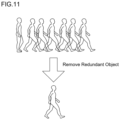
- Fig. 11 is a conceptual diagram illustrating processing of removing redundant objects.
- the processing unit 11 removes the redundant objects as illustrated in Fig. 11 (step S122).
- step S122 When the processing in step S122 ends, and when it is determined that there are no redundant objects (step S121: NO), the processing unit 11 executes editing processing for the three dimensional space model (step S123).
- the fluid calculation model can be accurately generated.
- a special surface such as glass or a mirror that transmits or reflects infrared rays may not be correctly recognized as a surface.
- the generation is manually implemented with the target surface in the three dimensional space model manually corrected.
- the correction and the generation are manually implemented. In such a case, a more accurate fluid calculation model can be generated by accepting correction and generation, while the three dimensional point group data is being displayed in a superimposed manner.
- Fig. 12 is a flowchart illustrating an object editing processing procedure.
- the processing unit 11 causes the display unit 14 to display the generated three dimensional space model with the three dimensional point group superimposed thereon (step S151).
- the processing unit 11 accepts a change on the object via the operation unit 15 (step S152), and changes the object in accordance with the accepted operation (step S153).
- the processing unit 11 accepts a change on parameters of the shape, the class, and the boundary condition of an object, and makes the change.
- the processing unit 11 accepts an increase or decrease in the number of human objects and a change in the positions of the human objects in the target space, and changes the number and the positions of the human objects.
- the processing unit 11 may be configured to acquire data related to a seat layout drawing of the target space and assign the thermal boundary condition of a person to a seat object based on the acquired data and information representing the outer shape of the target space based on the target space data.
- the seat layout drawing is data indicating the position of a seat object in the target space.
- the processing unit 11 assigns the thermal boundary condition of a human object to the seat object based on the target space represented by the target space data and the position of the seat object represented by the data related to the seat layout drawing.
- the storage unit 12 of the information processing apparatus 1 may store a typical predetermined thermal boundary condition of a human object, and the processing unit 11 may assign the thermal boundary condition to a seat object.
- Fig. 13A, Fig. 13B, and Fig. 13C are conceptual diagrams illustrating an object changing method.
- Fig. 13A illustrates a three dimensional space model of a target space including a recognized object.
- Fig. 13B illustrates a state in which an object to be edited is selected, and
- Fig. 13C illustrates a state in which the shape of the object has been changed.
- the processing unit 11 accepts addition of an object via the operation unit 15 (step S154), and adds the object in accordance with the accepted operation (step S155).
- Fig. 14A, Fig. 14B, and Fig. 14C are conceptual diagrams illustrating an object adding method.
- Fig. 14A illustrates a three dimensional space model of a target space in which an object that actually exists is not recognized.
- Fig. 14B illustrates a state in which an operation of adding the object is performed, and
- Fig. 14C illustrates a state in which the object has been added.
- the processing unit 11 accepts change and addition for a plane in the three dimensional space via the operation unit 15 (step S156), and changes or adds a plane in the three dimensional space in accordance with the accepted operation (step S157).
- the plane is a portion corresponding to a wall surface or the like in the target space.
- the user can change the position and size of the wall surface by operating the operation unit 15.
- the user can also add a wall surface that has not been reflected on the three dimensional space model by operating the operation unit 15.
- Figs. 15A, 15B, and 15C are conceptual diagrams illustrating a method of editing a plane forming a target space.
- Fig. 15A illustrates a three dimensional space model of a target space in which a wall plane that actually exists is not recognized.
- Fig. 15B illustrates a state in which an operation of adding the wall plane is performed, and
- Fig. 15C illustrates a state in which the wall plane has been added.
- the information processing apparatus 1 and the like it is possible to generate a three dimensional space model on which an impact of an object included in a target space on the environment of the target space is reflected, based on target space data obtained by measuring the inside of the target space from a plurality of positions.
- a three dimensional space model which is a fluid calculation model (an indoor model and an element model of equipment, a heat source, and the like), can be reduced.
- the measuring work for the indoor shape and the equipment is eliminated, meaning that measuring errors are eliminated.
- thermographic image it is possible to generate a three dimensional space model to which a boundary condition is assigned in consideration of the difference between the air inlet and the air outlet.
- thermographic image or the like Based on the thermographic image or the like, it is possible to generate a three dimensional space model to which the thermal transmittance of fittings such as a wall and a window is assigned.
- the user can perform the operation to edit and change the target space and the objects included in the three dimensional space model.
- the user can perform the operation to add a wall plane and an object in the target space to the three dimensional space model.
- a three dimensional space model can be generated that includes azimuth information.
- a three dimensional space model can be generated that includes data indicating a utilization scene of the target space.
- a three dimensional space model can be generated with redundant objects removed.
- a three dimensional space model can be generated with a confidential object included in the target space concealed, and with the impact of the object on the environment of the target space reflected.
- a three dimensional space model can be generated with a concealing target object replaced with a model object.
Landscapes
- Engineering & Computer Science (AREA)
- Theoretical Computer Science (AREA)
- Physics & Mathematics (AREA)
- General Physics & Mathematics (AREA)
- Software Systems (AREA)
- Multimedia (AREA)
- Health & Medical Sciences (AREA)
- Databases & Information Systems (AREA)
- General Health & Medical Sciences (AREA)
- Medical Informatics (AREA)
- Computer Graphics (AREA)
- Evolutionary Computation (AREA)
- General Engineering & Computer Science (AREA)
- Computer Hardware Design (AREA)
- Artificial Intelligence (AREA)
- Computer Vision & Pattern Recognition (AREA)
- Computing Systems (AREA)
- Bioethics (AREA)
- Computer Security & Cryptography (AREA)
- Architecture (AREA)
- Geometry (AREA)
- Processing Or Creating Images (AREA)
- Image Analysis (AREA)
- Image Processing (AREA)
Applications Claiming Priority (2)
| Application Number | Priority Date | Filing Date | Title |
|---|---|---|---|
| JP2022132597 | 2022-08-23 | ||
| PCT/JP2023/029275 WO2024043119A1 (ja) | 2022-08-23 | 2023-08-10 | 情報処理装置、情報処理システム、情報処理方法及びコンピュータプログラム |
Publications (2)
| Publication Number | Publication Date |
|---|---|
| EP4579601A1 true EP4579601A1 (de) | 2025-07-02 |
| EP4579601A4 EP4579601A4 (de) | 2025-12-03 |
Family
ID=90013203
Family Applications (1)
| Application Number | Title | Priority Date | Filing Date |
|---|---|---|---|
| EP23857232.5A Pending EP4579601A4 (de) | 2022-08-23 | 2023-08-10 | Informationsverarbeitungsvorrichtung, informationsverarbeitungssystem, informationsverarbeitungsverfahren und computerprogramm |
Country Status (4)
| Country | Link |
|---|---|
| EP (1) | EP4579601A4 (de) |
| JP (1) | JP7502698B2 (de) |
| CN (1) | CN119731701A (de) |
| WO (1) | WO2024043119A1 (de) |
Cited By (1)
| Publication number | Priority date | Publication date | Assignee | Title |
|---|---|---|---|---|
| WO2026068514A1 (de) * | 2024-09-25 | 2026-04-02 | Carpetlight Gmbh | Verfahren und system zum darstellen einer blickrichtungsabhängigen ansicht |
Family Cites Families (8)
| Publication number | Priority date | Publication date | Assignee | Title |
|---|---|---|---|---|
| JP6286902B2 (ja) * | 2013-07-10 | 2018-03-07 | 株式会社Ihi | 解析装置及び流体解析手法 |
| US9013286B2 (en) * | 2013-09-23 | 2015-04-21 | Volkswagen Ag | Driver assistance system for displaying surroundings of a vehicle |
| US9679144B2 (en) * | 2013-11-15 | 2017-06-13 | Microsoft Technology Licensing, Llc | Protecting privacy in web-based immersive augmented reality |
| JP2015148410A (ja) * | 2014-02-07 | 2015-08-20 | 株式会社東芝 | 空調制御装置、空調制御システム、空調制御方法及びプログラム |
| JP6624852B2 (ja) * | 2015-08-27 | 2019-12-25 | キヤノン株式会社 | 画像情報生成装置、画像情報生成方法、画像処理システム及びプログラム |
| US11336823B2 (en) * | 2019-09-03 | 2022-05-17 | Northwestern University | Method and system for activity detection with obfuscation |
| CN110910503B (zh) * | 2019-10-15 | 2022-04-15 | 珠海格力电器股份有限公司 | 一种空调环境的仿真方法及装置 |
| CN112944562B (zh) * | 2021-02-18 | 2022-07-26 | 格力电器(武汉)有限公司 | 一种空调控制方法、装置、存储介质及空调 |
-
2023
- 2023-07-06 JP JP2023111612A patent/JP7502698B2/ja active Active
- 2023-08-10 WO PCT/JP2023/029275 patent/WO2024043119A1/ja not_active Ceased
- 2023-08-10 CN CN202380060201.8A patent/CN119731701A/zh active Pending
- 2023-08-10 EP EP23857232.5A patent/EP4579601A4/de active Pending
Cited By (1)
| Publication number | Priority date | Publication date | Assignee | Title |
|---|---|---|---|---|
| WO2026068514A1 (de) * | 2024-09-25 | 2026-04-02 | Carpetlight Gmbh | Verfahren und system zum darstellen einer blickrichtungsabhängigen ansicht |
Also Published As
| Publication number | Publication date |
|---|---|
| JP7502698B2 (ja) | 2024-06-19 |
| EP4579601A4 (de) | 2025-12-03 |
| CN119731701A (zh) | 2025-03-28 |
| WO2024043119A1 (ja) | 2024-02-29 |
| JP2024031827A (ja) | 2024-03-07 |
Similar Documents
| Publication | Publication Date | Title |
|---|---|---|
| US12307699B2 (en) | Three-dimensional reconstruction method and three-dimensional reconstruction apparatus | |
| AU2021282413B2 (en) | System and method for generating computerized models of structures using geometry extraction and reconstruction techniques | |
| US20230138762A1 (en) | Automated Building Floor Plan Generation Using Visual Data Of Multiple Building Images | |
| CN110069972B (zh) | 自动探测真实世界物体 | |
| US10297070B1 (en) | 3D scene synthesis techniques using neural network architectures | |
| US10679046B1 (en) | Machine learning systems and methods of estimating body shape from images | |
| US20250191317A1 (en) | Information processing apparatus, information processing system information processing method, and computer program | |
| Elfarri et al. | Artificial intelligence-driven digital twin of a modern house demonstrated in virtual reality | |
| US20160125243A1 (en) | Human body part detection system and human body part detection method | |
| US12204821B2 (en) | Floorplan generation system and methods of use | |
| CN108961144A (zh) | 图像处理系统 | |
| EP4579601A1 (de) | Informationsverarbeitungsvorrichtung, informationsverarbeitungssystem, informationsverarbeitungsverfahren und computerprogramm | |
| CN115735120A (zh) | 温度分布学习装置 | |
| JP2023167502A (ja) | 学習モデルの生成方法、情報処理装置、情報処理方法、コンピュータプログラム | |
| KR102089719B1 (ko) | 기계 설비 공사 공정을 위한 제어 방법 및 장치 | |
| Lakaemper et al. | Integrating robot mapping and augmented building simulation | |
| JP7568958B1 (ja) | 情報処理装置、情報処理方法、及びコンピュータプログラム | |
| Oharazawa et al. | Resolving Shape Ambiguities using Heat Conduction and Shading | |
| JP7624787B1 (ja) | 情報処理装置、情報処理方法およびコンピュータプログラム | |
| JP7769039B1 (ja) | 情報提供装置、情報提供方法、及びプログラム | |
| Sharma et al. | Automatic Digitization and Orientation of Scanned Mesh Data for Floor Plan and 3D Model Generation | |
| Bergmann et al. | Probabilistic sensor network design | |
| JP2024016551A (ja) | 検査対象の異常を検知する方法、システム、およびプログラム | |
| Olmschenk et al. | Mobile real-time single image 3D corridor reconstruction using J-Linkage |
Legal Events
| Date | Code | Title | Description |
|---|---|---|---|
| STAA | Information on the status of an ep patent application or granted ep patent |
Free format text: STATUS: THE INTERNATIONAL PUBLICATION HAS BEEN MADE |
|
| PUAI | Public reference made under article 153(3) epc to a published international application that has entered the european phase |
Free format text: ORIGINAL CODE: 0009012 |
|
| STAA | Information on the status of an ep patent application or granted ep patent |
Free format text: STATUS: REQUEST FOR EXAMINATION WAS MADE |
|
| 17P | Request for examination filed |
Effective date: 20250210 |
|
| AK | Designated contracting states |
Kind code of ref document: A1 Designated state(s): AL AT BE BG CH CY CZ DE DK EE ES FI FR GB GR HR HU IE IS IT LI LT LU LV MC ME MK MT NL NO PL PT RO RS SE SI SK SM TR |
|
| REG | Reference to a national code |
Ref country code: DE Ref legal event code: R079 Free format text: PREVIOUS MAIN CLASS: G06T0017000000 Ipc: G06F0021620000 |
|
| DAV | Request for validation of the european patent (deleted) | ||
| DAX | Request for extension of the european patent (deleted) | ||
| A4 | Supplementary search report drawn up and despatched |
Effective date: 20251030 |
|
| RIC1 | Information provided on ipc code assigned before grant |
Ipc: G06F 21/62 20130101AFI20251024BHEP Ipc: G06T 19/00 20110101ALI20251024BHEP Ipc: G06T 7/00 20170101ALI20251024BHEP Ipc: G06T 7/70 20170101ALI20251024BHEP Ipc: G06V 10/143 20220101ALI20251024BHEP Ipc: G06V 10/10 20220101ALI20251024BHEP Ipc: G06V 10/764 20220101ALI20251024BHEP Ipc: G06V 10/778 20220101ALI20251024BHEP Ipc: G06V 10/82 20220101ALI20251024BHEP Ipc: G06V 20/52 20220101ALI20251024BHEP Ipc: G06V 20/64 20220101ALI20251024BHEP Ipc: G06T 7/50 20170101ALI20251024BHEP Ipc: G06T 19/20 20110101ALI20251024BHEP Ipc: G06T 17/00 20060101ALI20251024BHEP |