EP4575771A1 - Processor that implements indirect addressing-style conditional jump instructions, program recording medium, and method - Google Patents
Processor that implements indirect addressing-style conditional jump instructions, program recording medium, and method Download PDFInfo
- Publication number
- EP4575771A1 EP4575771A1 EP23879462.2A EP23879462A EP4575771A1 EP 4575771 A1 EP4575771 A1 EP 4575771A1 EP 23879462 A EP23879462 A EP 23879462A EP 4575771 A1 EP4575771 A1 EP 4575771A1
- Authority
- EP
- European Patent Office
- Prior art keywords
- jump
- address
- index register
- register
- index
- Prior art date
- Legal status (The legal status is an assumption and is not a legal conclusion. Google has not performed a legal analysis and makes no representation as to the accuracy of the status listed.)
- Pending
Links
Images




Classifications
-
- G—PHYSICS
- G06—COMPUTING OR CALCULATING; COUNTING
- G06F—ELECTRIC DIGITAL DATA PROCESSING
- G06F9/00—Arrangements for program control, e.g. control units
- G06F9/06—Arrangements for program control, e.g. control units using stored programs, i.e. using an internal store of processing equipment to receive or retain programs
- G06F9/30—Arrangements for executing machine instructions, e.g. instruction decode
- G06F9/30003—Arrangements for executing specific machine instructions
- G06F9/3005—Arrangements for executing specific machine instructions to perform operations for flow control
- G06F9/30058—Conditional branch instructions
-
- G—PHYSICS
- G06—COMPUTING OR CALCULATING; COUNTING
- G06F—ELECTRIC DIGITAL DATA PROCESSING
- G06F9/00—Arrangements for program control, e.g. control units
- G06F9/06—Arrangements for program control, e.g. control units using stored programs, i.e. using an internal store of processing equipment to receive or retain programs
- G06F9/30—Arrangements for executing machine instructions, e.g. instruction decode
- G06F9/30003—Arrangements for executing specific machine instructions
- G06F9/3005—Arrangements for executing specific machine instructions to perform operations for flow control
- G06F9/30054—Unconditional branch instructions
-
- G—PHYSICS
- G06—COMPUTING OR CALCULATING; COUNTING
- G06F—ELECTRIC DIGITAL DATA PROCESSING
- G06F9/00—Arrangements for program control, e.g. control units
- G06F9/06—Arrangements for program control, e.g. control units using stored programs, i.e. using an internal store of processing equipment to receive or retain programs
- G06F9/30—Arrangements for executing machine instructions, e.g. instruction decode
- G06F9/30003—Arrangements for executing specific machine instructions
- G06F9/3005—Arrangements for executing specific machine instructions to perform operations for flow control
- G06F9/30061—Multi-way branch instructions, e.g. CASE
-
- G—PHYSICS
- G06—COMPUTING OR CALCULATING; COUNTING
- G06F—ELECTRIC DIGITAL DATA PROCESSING
- G06F9/00—Arrangements for program control, e.g. control units
- G06F9/06—Arrangements for program control, e.g. control units using stored programs, i.e. using an internal store of processing equipment to receive or retain programs
- G06F9/30—Arrangements for executing machine instructions, e.g. instruction decode
- G06F9/30098—Register arrangements
-
- G—PHYSICS
- G06—COMPUTING OR CALCULATING; COUNTING
- G06F—ELECTRIC DIGITAL DATA PROCESSING
- G06F9/00—Arrangements for program control, e.g. control units
- G06F9/06—Arrangements for program control, e.g. control units using stored programs, i.e. using an internal store of processing equipment to receive or retain programs
- G06F9/30—Arrangements for executing machine instructions, e.g. instruction decode
- G06F9/32—Address formation of the next instruction, e.g. by incrementing the instruction counter
-
- G—PHYSICS
- G06—COMPUTING OR CALCULATING; COUNTING
- G06F—ELECTRIC DIGITAL DATA PROCESSING
- G06F9/00—Arrangements for program control, e.g. control units
- G06F9/06—Arrangements for program control, e.g. control units using stored programs, i.e. using an internal store of processing equipment to receive or retain programs
- G06F9/30—Arrangements for executing machine instructions, e.g. instruction decode
- G06F9/32—Address formation of the next instruction, e.g. by incrementing the instruction counter
- G06F9/322—Address formation of the next instruction, e.g. by incrementing the instruction counter for non-sequential address
-
- G—PHYSICS
- G06—COMPUTING OR CALCULATING; COUNTING
- G06F—ELECTRIC DIGITAL DATA PROCESSING
- G06F9/00—Arrangements for program control, e.g. control units
- G06F9/06—Arrangements for program control, e.g. control units using stored programs, i.e. using an internal store of processing equipment to receive or retain programs
- G06F9/30—Arrangements for executing machine instructions, e.g. instruction decode
- G06F9/32—Address formation of the next instruction, e.g. by incrementing the instruction counter
- G06F9/322—Address formation of the next instruction, e.g. by incrementing the instruction counter for non-sequential address
- G06F9/323—Address formation of the next instruction, e.g. by incrementing the instruction counter for non-sequential address for indirect branch instructions
-
- G—PHYSICS
- G06—COMPUTING OR CALCULATING; COUNTING
- G06F—ELECTRIC DIGITAL DATA PROCESSING
- G06F9/00—Arrangements for program control, e.g. control units
- G06F9/06—Arrangements for program control, e.g. control units using stored programs, i.e. using an internal store of processing equipment to receive or retain programs
- G06F9/30—Arrangements for executing machine instructions, e.g. instruction decode
- G06F9/32—Address formation of the next instruction, e.g. by incrementing the instruction counter
- G06F9/322—Address formation of the next instruction, e.g. by incrementing the instruction counter for non-sequential address
- G06F9/324—Address formation of the next instruction, e.g. by incrementing the instruction counter for non-sequential address using program counter relative addressing
-
- G—PHYSICS
- G06—COMPUTING OR CALCULATING; COUNTING
- G06F—ELECTRIC DIGITAL DATA PROCESSING
- G06F9/00—Arrangements for program control, e.g. control units
- G06F9/06—Arrangements for program control, e.g. control units using stored programs, i.e. using an internal store of processing equipment to receive or retain programs
- G06F9/30—Arrangements for executing machine instructions, e.g. instruction decode
- G06F9/34—Addressing or accessing the instruction operand or the result ; Formation of operand address; Addressing modes
- G06F9/35—Indirect addressing
Definitions
- the present disclosure relates to the technology for a processor that executes a conditional jump instruction.
- the present disclosure relates to the technology for RISC (Reduced Instruction Set Computer) architecture.
- a RISC represents a computer designed as a reduced instruction set architecture.
- the RISC represents a computer that restricts the total number, the number of types, and the formats of instructions and simplifies the processing of each instruction and the addressing of operands.
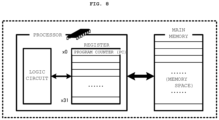
- Fig. 8 is a diagram of a configuration of processor and memory.
- a computation processing system illustrated in Fig. 8 is made up of a processor and a main memory.
- the processor may be a PLD (Programmable Logic Device), an FPGA (Field Programmable Gate Array), or an LSI (Large Scale Integration) and may be described using a hardware description language that is capable of describing a design/configuration of a circuit for semiconductor chips.
- the hardware description languages have syntax and notation similar to those of programming languages, and can describe a configuration of elements included in a circuit, operation conditions of the elements, wiring among the elements, and so forth.
- Processor chips can be manufactured by writing, into a PLD, an FPGA, or an LSI, circuit diagrams described using such a hardware description language.
- a processor is made up of a "logic circuit” serving as a combinational logic circuit, and a "register” serving as a sequential logic circuit.
- the processor functions as a finite state machine with the logic circuit and the register.
- the logic circuit is made up of a source code of a hardware description language or formed using wired logic.
- the number of registers is 32 of x0 to x31.
- the main memory is, for example, DRAM (Dynamic Random-Access Memory), and is a volatile memory in which transistors and capacitors are combined. Access speed can be maximally increased by disposing the main memory near the processor.
- DRAM Dynamic Random-Access Memory
- PTL 1 discloses a technology for converting data structures and codes of a CISC (Complex Instruction Set Computer) type processor so as to be applicable to a RISC type processor.
- machine-language instructions are fetched from a series of addresses in a memory, and the machine-language instructions are decoded.
- the address of the register that includes a target address of the jump destination (destination of the jump) is extracted.
- a machine-language instruction is fetched from the target address that the register points to, not from among the series of addresses.
- Fig. 9 is an example of assembly code including a conditional jump instruction according to the conventional art.
- the assembly code shown in Fig. 9 is a general conditional jump subroutine that uses a dispatch table in indirect addressing.
- argument fp of a branch is inputted.
- the subroutine uses registers x10 to x13 as a dispatch table including a plurality of jump destination addresses. Storing the dispatch table into registers located within the processor realizes high-speed access.
- x16 and x6 are compared by bne, and branching to L2 is performed if x16 and x6 differ. If x16 and x6 are the same, the address stored in x12 is stored into x10, which is to be the return value, and it is returned from the destination routine (jump-to routine).
- 1 is stored into x6 by li.
- x16 and x6 are compared by bne, and branching to L3 is performed if x16 and x6 differ. If x16 and x6 are the same, the address stored in x11 is stored into x10, which is to be the return value, and it is returned from the destination routine (jump-to routine). Finally, in L3, the address stored in x10 is stored into x10, which is to be the return value, and it is returned from the destination routine (jump-to routine).
- the number of callups for conditional jump subroutines is extremely great in the entire assembly code. It is not unusual for the same subroutine of conditional jump to be called up many times. As can be seen in Fig. 9 , even though there is branching to a mere four jump destinations, the assembly code using registers involves 20 or more steps.
- the logic circuit of the processor repeats instruction fetching (Instruction Fetch), decoding (Instruction Decode), executing (Execute), and writing (Memory Access & Writeback), for each step. Accordingly, reducing the number of steps of the assembly code is desirable for higher speeds of processing by the processor, as well.
- a processor including a logic circuit configured to execute a conditional jump instruction of assembly code under indirect addressing using plural registers including a program counter as a table, the processor being logically configured to execute, after storing, into an index register, an index register number that is an index to a jump-destination effective address, storing jump-destination effective addresses that differ from one another in memory space, or address offsets from a predetermined reference to jump-destination effective addresses that differ from one another, into plural reference registers, respectively, and fetching and decoding a conditional jump instruction that is one instruction that quotes the index register: a first step of acquiring a jump-destination effective address or an address offset from the reference register corresponding to the index register number that is a content of the index register; and a second step of setting the acquired jump-destination effective address, or a jump-destination effective address calculated from the acquired address offset, to a register serving as the program counter.
- the processor is logically configured to execute, after storing, into an index register, an index register number that is an index to a jump-destination effective address, storing jump-destination effective addresses that differ from one another in memory space into plural reference registers, respectively, and fetching and decoding a conditional jump instruction that is one instruction that quotes the index register: a first step of acquiring a jump-destination effective address from the reference register corresponding to the index register number that is a content of the index register; and a second step of setting the jump-destination effective address to a register serving as the program counter.
- the processor is logically configured to execute, after storing, into an index register, an index register number that is an index to a jump-destination effective address, storing address offsets from the program counter to jump-destination effective addresses that differ from one another into plural reference registers, respectively, and fetching and decoding a conditional jump instruction that is one instruction that quotes the index register: a first step of acquiring an address offset from the reference register corresponding to the index register number that is a content of the index register; and a second step of setting, to a register serving as the program counter, a jump-destination effective address that is a result of adding the address offset to the program counter.
- the processor is logically configured to execute, after storing, into a base resister, a base address in memory space, storing, into an index register, an index register number that is an index to a jump-destination effective address, storing address offsets from the base address to jump-destination effective addresses that differ from one another into plural reference registers, respectively, and fetching and decoding a conditional jump instruction that is one instruction that quotes the index register and the base resister: a first step of acquiring an address offset from the reference register corresponding to the index register number that is a content of the index register; and a second step of setting, to a register serving as the program counter, a jump-destination effective address that is a result of adding the address offset to the base address of the base resister.
- the logic circuit is configured by a source code described in a hardware description language or by wired logic.
- a non-transitory computer-readable recording medium on which is stored a program to cause a processor to function
- the processor including a logic circuit configured to execute a conditional jump instruction of assembly code under indirect addressing using plural registers including a program counter as a table, the program causing the processor to execute, as an execution of a conditional jump instruction that is one instruction that quotes an index register in a situation that an index register number that is an index to a jump-destination effective address is stored into the index register, and jump-destination effective addresses that differ from one another in memory space, or address offsets from a predetermined reference to jump-destination effective addresses that differ from one another, are stored into plural reference registers, respectively: a first step of acquiring a jump-destination effective address or an address offset from the reference register corresponding to the index register number that is a content of the index register; and a second step of setting the acquired jump-destination effective address, or a jump-destination effective address calculated from the acquired address offset, to a register
- the program causes the processor to execute, as an execution of a conditional jump instruction that is one instruction that quotes an index register in a situation that an index register number that is an index to a jump-destination effective address is stored into the index register, and jump-destination effective addresses that differ from one another in memory space are stored into plural reference registers, respectively:
- the program causes the processor to execute, as an execution of a conditional jump instruction that is one instruction that quotes an index register in a situation that an index register number that is an index to a jump-destination effective address is stored into the index register, and address offsets from the program counter to jump-destination effective addresses that differ from one another are stored into plural reference registers, respectively: a first step of acquiring an address offset from the reference register corresponding to the index register number that is a content of the index register; and a second step of setting, to a register serving as the program counter, a jump-destination effective address that is a result of adding the address offset to the program counter.
- the program causes the processor to execute, as an execution of a conditional jump instruction that is one instruction that quotes an index register and an base resister in a situation that a base address in memory space is stored into the base resister, an index register number that is an index to a jump-destination effective address is stored into the index register, and address offsets from the base address to jump-destination effective addresses that differ from one another are stored into plural reference registers, respectively: a first step of acquiring an address offset from the reference register corresponding to the index register number that is a content of the index register; and a second step of setting, to a register serving as the program counter, a jump-destination effective address that is a result of adding the address offset to the base address of the base resister.
- a method for executing a conditional jump instruction of assembly code under indirect addressing the method being implemented by a processor that includes a logic circuit configured by using plural registers including a program counter, the method comprising, as an execution of a conditional jump instruction that is one instruction that quotes an index register in a situation that an index register number that is an index to a jump-destination effective address is stored into the index register, and jump-destination effective addresses that differ from one another in memory space, or address offsets from a predetermined reference to jump-destination effective addresses that differ from one another, are stored into plural reference registers, respectively: a first step of acquiring a jump-destination effective address or an address offset from the reference register corresponding to the index register number that is a content of the index register; and a second step of setting the acquired jump-destination effective address, or a jump-destination effective address calculated from the acquired address offset, to a register serving as the program counter.
- the method for executing a conditional jump instruction comprises, as an execution of a conditional jump instruction that is one instruction that quotes an index register in a situation that an index register number that is an index to a jump-destination effective address is stored into the index register, and jump-destination effective addresses that differ from one another in memory space are stored into plural reference registers, respectively: a first step of acquiring a jump-destination effective address from the reference register corresponding to the index register number that is a content of the index register; and a second step of setting the jump-destination effective address to a register serving as the program counter.
- the method for executing a conditional jump instruction comprises, as an execution of a conditional jump instruction that is one instruction that quotes an index register in a situation that an index register number that is an index to a jump-destination effective address is stored into the index register, and address offsets from the program counter to jump-destination effective addresses that differ from one another are stored into plural reference registers, respectively: a first step of acquiring an address offset from the reference register corresponding to the index register number that is a content of the index register; and a second step of setting, to a register serving as the program counter, a jump-destination effective address that is a result of adding the address offset to the program counter.
- the method for executing a conditional jump instruction comprises, as an execution of a conditional jump instruction that is one instruction that quotes an index register and an base resister in a situation that a base address in memory space is stored into the base resister, an index register number that is an index to a jump-destination effective address is stored into the index register, and address offsets from the base address to jump-destination effective addresses that differ from one another are stored into plural reference registers, respectively: a first step of acquiring an address offset from the reference register corresponding to the index register number that is a content of the index register; and a second step of setting, to a register serving as the program counter, a jump-destination effective address that is a result of adding the address offset to the base address of the base resister.
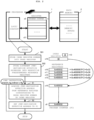
- Fig. 2 is a schematic diagram illustrating a specific example of the processor 1 and the main memory 2 according to the present disclosure, and a flowchart for the logic circuit according to the first embodiment.
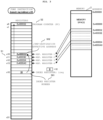
- Fig. 3 is a schematic diagram for explaining the contents of the register and the memory according to the first embodiment.
- steps S01 and S02 are the same as the steps S01 and S02 of the assembly code in Fig. 1 described earlier.
- the logic circuit of the processor 1 fetches, decodes, and executes the conditional jump instruction branch_reg_indirect x16 that is one instruction that quotes (refers to) the index register.
- a conditional jump can be realized by a subroutine with a short assembler code such as in Fig. 1 described earlier.
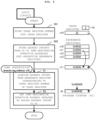
- Fig. 4 is a flowchart for the logic circuit according to the second embodiment.
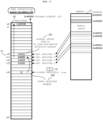
- Fig. 5 is a schematic diagram for explaining the contents of the register and the memory according to the second embodiment.
- the logic circuit of the processor 1 fetches, decodes, and executes the conditional jump instruction branch_reg_indirect x16 that is one instruction that quotes (refers to) the index register.
- conditional jump can be realized by a subroutine with a short assembler code.
- Fig. 6 is a flowchart for the logic circuit according to the third embodiment.
- Fig. 7 is a schematic diagram for explaining the contents of the register and the memory according to the third embodiment.
- the logic circuit of the processor 1 fetches, decodes, and executes the conditional jump instruction branch_reg_indirect x16 that is one instruction that quotes (refers to) the index register x16 and the base register x20.
- a conditional jump can be realized by a subroutine with a short assembler code.
- the logic circuit of the processor 1 is described using the source code of a hardware description language. Following compiling thereof, the source code is converted into an execution format by being "linked" with a plurality of libraries.
- the logic circuit of the processor 1 is not limited to being described in a hardware description language, and can be realized by using wired logic, as a matter of course.
- VM virtual machine
- Lisp machine Prolog precompiled machine-language code
- higher speeds in processing can be realized in particular with respect to interpreter of Java (registered trademark) virtual machine (VM), Lisp machine, Prolog precompiled machine-language code, and so forth. That is to say, from control information of Java virtual machine, corresponding processing routines can be dispatched with high speed.
- machine-language instructions are successively processed, and accordingly, the load becomes great and high-speed processing is difficult.
- Java virtual machine interpreter and Lisp mostly dispatch machine-language routines by referencing tag information added to data/objects.
- the machine-language instructions of the dispatched-with-tag portion can be directly generated as control information of a RISC processor, for example.
- assembly code regarding a conditional jump instruction can be reduced, by implementing, in processor, execution functions of a conditional jump instruction that is one instruction that quotes (refers to) an index register.
Landscapes
- Engineering & Computer Science (AREA)
- Software Systems (AREA)
- Theoretical Computer Science (AREA)
- Physics & Mathematics (AREA)
- General Engineering & Computer Science (AREA)
- General Physics & Mathematics (AREA)
- Executing Machine-Instructions (AREA)
Abstract
Description
- The present disclosure relates to the technology for a processor that executes a conditional jump instruction. In particular, the present disclosure relates to the technology for RISC (Reduced Instruction Set Computer) architecture.
- Priority is claimed on Japanese Patent Application No.
JP2022-169525 filed on October 21, 2022 - A RISC represents a computer designed as a reduced instruction set architecture. In particular, the RISC represents a computer that restricts the total number, the number of types, and the formats of instructions and simplifies the processing of each instruction and the addressing of operands.
-
Fig. 8 is a diagram of a configuration of processor and memory. A computation processing system illustrated inFig. 8 is made up of a processor and a main memory. The processor may be a PLD (Programmable Logic Device), an FPGA (Field Programmable Gate Array), or an LSI (Large Scale Integration) and may be described using a hardware description language that is capable of describing a design/configuration of a circuit for semiconductor chips. The hardware description languages have syntax and notation similar to those of programming languages, and can describe a configuration of elements included in a circuit, operation conditions of the elements, wiring among the elements, and so forth. Processor chips can be manufactured by writing, into a PLD, an FPGA, or an LSI, circuit diagrams described using such a hardware description language. - A processor is made up of a "logic circuit" serving as a combinational logic circuit, and a "register" serving as a sequential logic circuit. The processor functions as a finite state machine with the logic circuit and the register. In a case of a RISC-V, for example, the logic circuit is made up of a source code of a hardware description language or formed using wired logic. The number of registers is 32 of x0 to x31.
- The main memory is, for example, DRAM (Dynamic Random-Access Memory), and is a volatile memory in which transistors and capacitors are combined. Access speed can be maximally increased by disposing the main memory near the processor.
-
PTL 1, for example, discloses a technology for converting data structures and codes of a CISC (Complex Instruction Set Computer) type processor so as to be applicable to a RISC type processor. In the technology, machine-language instructions are fetched from a series of addresses in a memory, and the machine-language instructions are decoded. Next, when a jump instruction is detected from among the fetched machine-language instructions, the address of the register that includes a target address of the jump destination (destination of the jump) is extracted. Then, before executing the jump instruction, a machine-language instruction is fetched from the target address that the register points to, not from among the series of addresses. -
Fig. 9 is an example of assembly code including a conditional jump instruction according to the conventional art. - The assembly code shown in
Fig. 9 is a general conditional jump subroutine that uses a dispatch table in indirect addressing. In the subroutine, argument fp of a branch is inputted. The subroutine uses registers x10 to x13 as a dispatch table including a plurality of jump destination addresses. Storing the dispatch table into registers located within the processor realizes high-speed access. - (S01) In the example shown in
Fig. 9 , there are four jump destinations. First, argument fp of the subroutine is stored into x15, and the two lower order bits of x15 (one of 00, 01, 10, and 11) are stored into x16. Four branch destinations can be selected by x16. - (S02) The current value (=0x400000) of the program counter (x0) is written to x10 by auipc. Then, the head address 0x0032 of
routine 1 at the jump destination is added to x10, by addi, and the addition result (=0x400032) is written to x10. Next, the current value (=0x400008) of the program counter (x0) is written to x11 by auipc. Then, the head address 0x0036 ofroutine 2 at the jump destination is added to x11, by addi, and the addition result (=0x40003E) is written to x11. Next, the current value of the program counter (x0) is written to x12 (=0x4000010) by auipc. Then, the head address 0x0084 ofroutine 3 at the jump destination is added to x12, by addi, and the addition result (=0x400094) is written to x12. Next, the current value of the program counter (x0) is written to x13 (=0x400018) by auipc. Then, the head address 0x0088 ofroutine 4 at the jump destination is added to x13, by addi, and the addition result (=0x4000A0) is written to x13. - (S03) A subroutine call of destination routine (jump-to routine) <Pl_Switch_On_Term_Var_Atm_Lst> is performed by jal (Jump And Link).
- (S04) In the destination routine (jump-to routine) <Pl_Switch_On_Term_Var_Atm_Lst>, first, 3 is stored into x6 by li. Then, x16 and x6 are compared by bne, and branching to L1 is performed if x16 and x6 differ. If x16 and x6 are the same, the address stored in x13 is stored into x10, which is to be the return value, and it is returned from the destination routine (jump-to routine). Next, 2 is stored into x6 by li. Then, x16 and x6 are compared by bne, and branching to L2 is performed if x16 and x6 differ. If x16 and x6 are the same, the address stored in x12 is stored into x10, which is to be the return value, and it is returned from the destination routine (jump-to routine). Next, 1 is stored into x6 by li. Then, x16 and x6 are compared by bne, and branching to L3 is performed if x16 and x6 differ. If x16 and x6 are the same, the address stored in x11 is stored into x10, which is to be the return value, and it is returned from the destination routine (jump-to routine). Finally, in L3, the address stored in x10 is stored into x10, which is to be the return value, and it is returned from the destination routine (jump-to routine).
- (S05) After returning from the destination routine (jump-to routine) <Pl_Switch_On_Term_Var_Atm_Lst>, jumping to the address stored in x10 is performed by jr (Jump Register).
- [PTL 1]
Japanese Patent Application Laid-open No. H06-103067 - Generally, the number of callups for conditional jump subroutines is extremely great in the entire assembly code. It is not unusual for the same subroutine of conditional jump to be called up many times. As can be seen in
Fig. 9 , even though there is branching to a mere four jump destinations, the assembly code using registers involves 20 or more steps. The logic circuit of the processor repeats instruction fetching (Instruction Fetch), decoding (Instruction Decode), executing (Execute), and writing (Memory Access & Writeback), for each step. Accordingly, reducing the number of steps of the assembly code is desirable for higher speeds of processing by the processor, as well. - Accordingly, it is an object of the present disclosure to provide a processor, a program recording medium, and a method, that can reduce assembly code in an indirect-addressing-type conditional jump subroutine.
- According to the present disclosure, there is provided a processor including a logic circuit configured to execute a conditional jump instruction of assembly code under indirect addressing using plural registers including a program counter as a table, the processor being logically configured to execute, after storing, into an index register, an index register number that is an index to a jump-destination effective address, storing jump-destination effective addresses that differ from one another in memory space, or address offsets from a predetermined reference to jump-destination effective addresses that differ from one another, into plural reference registers, respectively, and fetching and decoding a conditional jump instruction that is one instruction that quotes the index register: a first step of acquiring a jump-destination effective address or an address offset from the reference register corresponding to the index register number that is a content of the index register; and a second step of setting the acquired jump-destination effective address, or a jump-destination effective address calculated from the acquired address offset, to a register serving as the program counter.
- As another embodiment of the processor in the present disclosure, it is preferable that the processor is logically configured to execute, after storing, into an index register, an index register number that is an index to a jump-destination effective address, storing jump-destination effective addresses that differ from one another in memory space into plural reference registers, respectively, and fetching and decoding a conditional jump instruction that is one instruction that quotes the index register: a first step of acquiring a jump-destination effective address from the reference register corresponding to the index register number that is a content of the index register; and a second step of setting the jump-destination effective address to a register serving as the program counter.
- As another embodiment of the processor in the present disclosure, it is preferable that the processor is logically configured to execute, after storing, into an index register, an index register number that is an index to a jump-destination effective address, storing address offsets from the program counter to jump-destination effective addresses that differ from one another into plural reference registers, respectively, and fetching and decoding a conditional jump instruction that is one instruction that quotes the index register: a first step of acquiring an address offset from the reference register corresponding to the index register number that is a content of the index register; and a second step of setting, to a register serving as the program counter, a jump-destination effective address that is a result of adding the address offset to the program counter.
- As another embodiment of the processor in the present disclosure, it is preferable that the processor is logically configured to execute, after storing, into a base resister, a base address in memory space, storing, into an index register, an index register number that is an index to a jump-destination effective address, storing address offsets from the base address to jump-destination effective addresses that differ from one another into plural reference registers, respectively, and fetching and decoding a conditional jump instruction that is one instruction that quotes the index register and the base resister: a first step of acquiring an address offset from the reference register corresponding to the index register number that is a content of the index register; and a second step of setting, to a register serving as the program counter, a jump-destination effective address that is a result of adding the address offset to the base address of the base resister.
- As another embodiment of the processor in the present disclosure, it is preferable that the logic circuit is configured by a source code described in a hardware description language or by wired logic.
- According to the present disclosure, there is provided a non-transitory computer-readable recording medium on which is stored a program to cause a processor to function, the processor including a logic circuit configured to execute a conditional jump instruction of assembly code under indirect addressing using plural registers including a program counter as a table, the program causing the processor to execute, as an execution of a conditional jump instruction that is one instruction that quotes an index register in a situation that an index register number that is an index to a jump-destination effective address is stored into the index register, and jump-destination effective addresses that differ from one another in memory space, or address offsets from a predetermined reference to jump-destination effective addresses that differ from one another, are stored into plural reference registers, respectively: a first step of acquiring a jump-destination effective address or an address offset from the reference register corresponding to the index register number that is a content of the index register; and a second step of setting the acquired jump-destination effective address, or a jump-destination effective address calculated from the acquired address offset, to a register serving as the program counter.
- As another embodiment of the recording medium in the present disclosure, it is preferable that the program causes the processor to execute, as an execution of a conditional jump instruction that is one instruction that quotes an index register in a situation that an index register number that is an index to a jump-destination effective address is stored into the index register, and jump-destination effective addresses that differ from one another in memory space are stored into plural reference registers, respectively:
- a first step of acquiring a jump-destination effective address from the reference register corresponding to the index register number that is a content of the index register; and
- a second step of setting the jump-destination effective address to a register serving as the program counter.
- As another embodiment of the recording medium in the present disclosure, it is preferable that the program causes the processor to execute, as an execution of a conditional jump instruction that is one instruction that quotes an index register in a situation that an index register number that is an index to a jump-destination effective address is stored into the index register, and address offsets from the program counter to jump-destination effective addresses that differ from one another are stored into plural reference registers, respectively: a first step of acquiring an address offset from the reference register corresponding to the index register number that is a content of the index register; and a second step of setting, to a register serving as the program counter, a jump-destination effective address that is a result of adding the address offset to the program counter.
- As another embodiment of the recording medium in the present disclosure, it is preferable that the program causes the processor to execute, as an execution of a conditional jump instruction that is one instruction that quotes an index register and an base resister in a situation that a base address in memory space is stored into the base resister, an index register number that is an index to a jump-destination effective address is stored into the index register, and address offsets from the base address to jump-destination effective addresses that differ from one another are stored into plural reference registers, respectively: a first step of acquiring an address offset from the reference register corresponding to the index register number that is a content of the index register; and a second step of setting, to a register serving as the program counter, a jump-destination effective address that is a result of adding the address offset to the base address of the base resister.
- According to the present disclosure, there is provided a method for executing a conditional jump instruction of assembly code under indirect addressing, the method being implemented by a processor that includes a logic circuit configured by using plural registers including a program counter, the method comprising, as an execution of a conditional jump instruction that is one instruction that quotes an index register in a situation that an index register number that is an index to a jump-destination effective address is stored into the index register, and jump-destination effective addresses that differ from one another in memory space, or address offsets from a predetermined reference to jump-destination effective addresses that differ from one another, are stored into plural reference registers, respectively: a first step of acquiring a jump-destination effective address or an address offset from the reference register corresponding to the index register number that is a content of the index register; and a second step of setting the acquired jump-destination effective address, or a jump-destination effective address calculated from the acquired address offset, to a register serving as the program counter.
- As another embodiment of the method for executing a conditional jump instruction in the present disclosure, it is preferable that the method for executing a conditional jump instruction comprises, as an execution of a conditional jump instruction that is one instruction that quotes an index register in a situation that an index register number that is an index to a jump-destination effective address is stored into the index register, and jump-destination effective addresses that differ from one another in memory space are stored into plural reference registers, respectively: a first step of acquiring a jump-destination effective address from the reference register corresponding to the index register number that is a content of the index register; and a second step of setting the jump-destination effective address to a register serving as the program counter.
- As another embodiment of the method for executing a conditional jump instruction in the present disclosure, it is preferable that the method for executing a conditional jump instruction comprises, as an execution of a conditional jump instruction that is one instruction that quotes an index register in a situation that an index register number that is an index to a jump-destination effective address is stored into the index register, and address offsets from the program counter to jump-destination effective addresses that differ from one another are stored into plural reference registers, respectively: a first step of acquiring an address offset from the reference register corresponding to the index register number that is a content of the index register; and a second step of setting, to a register serving as the program counter, a jump-destination effective address that is a result of adding the address offset to the program counter.
- As another embodiment of the method for executing a conditional jump instruction in the present disclosure, it is preferable that the method for executing a conditional jump instruction comprises, as an execution of a conditional jump instruction that is one instruction that quotes an index register and an base resister in a situation that a base address in memory space is stored into the base resister, an index register number that is an index to a jump-destination effective address is stored into the index register, and address offsets from the base address to jump-destination effective addresses that differ from one another are stored into plural reference registers, respectively: a first step of acquiring an address offset from the reference register corresponding to the index register number that is a content of the index register; and a second step of setting, to a register serving as the program counter, a jump-destination effective address that is a result of adding the address offset to the base address of the base resister.
- According to the processor, program recording medium, and method, of the present disclosure, assembly code in an indirect-addressing-type conditional jump subroutine can be reduced, by implementing, in the processor, execution functions of a conditional jump instruction that is one instruction that quotes (refers to) an index register.
-
-
Fig. 1 is an example of assembly code including a conditional jump instruction according to the present disclosure; -
Fig. 2 is a schematic diagram illustrating a specific example of the processor and the main memory according to the present disclosure, and a flowchart for a logic circuit according to the first embodiment; -
Fig. 3 is a schematic diagram for explaining the contents of the register and the memory according to the first embodiment; -
Fig. 4 is a flowchart of a logic circuit according to the second embodiment; -
Fig. 5 is a schematic diagram for explaining the contents of the register and the memory according to the second embodiment; -
Fig. 6 is a flowchart of a logic circuit according to the third embodiment; -
Fig. 7 is a schematic diagram for explaining the contents of the register and the memory according to the third embodiment; -
Fig. 8 is a diagram of a configuration of processor and memory; and -
Fig. 9 is an example of assembly code including a conditional jump instruction according to the conventional art. - Hereinafter, embodiments for carrying out the present disclosure will be described in detail using the drawings.
-
Fig. 1 is an example of assembly code including a conditional jump instruction according to the present disclosure. Here, the conditional jump instruction shown below is executed by aprocessor 1 illustrated inFig. 2 , which will be described later. - (S01) In the example shown in
Fig. 1 , there are four jump destinations, in the same ways as in S01 inFig. 9 . First, argument fp of the subroutine is stored into x15, and the two lower order bits of x15 (one of 00, 01, 10, and 11) are stored into x16. One of four branching destinations can be selected by x16. Here, according to the present disclosure, x16 is an index register. The index register is a register according to the content of which a branching/jump destination can be selected. Performing +10 to the index register x16 enables 10 to 13 to be expressed. By the result, reference registers x10 to x13 are identified. - (S02) According to
Fig. 1 , in the same way as S02 inFig. 9 , the current value (=0x400000) of the program counter (x0) is written to x10 by auipc. Then, the head address 0x0032 of routine 1 at the jump destination is added to x10, by addi, and the addition result (=0x400032) is written to x10. Next, the current value (=0x400008) of the program counter (x0) is written to x11 by auipc. Then, the head address 0x0036 of routine 2 at the jump destination is added to x11, by addi, and the addition result (=0x40003E) is written to x11. Next, the current value (=0x400010) of the program counter (x0) is written to x12 by auipc. Then, the head address 0x0084 of routine 3 at the jump destination is added to x12, by addi, and the addition result (=0x400094) is written to x12. Next, the current value (=0x400018) of the program counter (x0) is written to x13 by auipc. Then, the head address 0x0088 of routine 4 at the jump destination is added to x13, by addi, and the addition result (=0x4000A0) is written to x13. - (S1, S2) Executing a conditional jump instruction that is one instruction that quotes (refers to) the index register.
- branch_reg_indirect x16 #Jump to the address in the content of index register x16 Here, branch_reg_indirect is an instruction set (machine-language instructions) newly configured according to the present disclosure. The logic circuit of the
processor 1 according to the present disclosure fetches the newly-configured conditional jump instruction mentioned above, and thereafter decodes the machine-language instruction to generate control information. Next, steps S1 and S2 are executed, as will be described later, as an execution of the control information. - There are three following embodiments in the present disclosure.
- <First Embodiment>: Storing the jump-destination effective address into the reference register.
- <Second Embodiment>: Storing, into the reference register, the address offset from the program counter to the jump-destination effective address.
- <Third Embodiment>: Storing, into the reference register, the address offset from the base address to the jump-destination effective address.
-
Fig. 2 is a schematic diagram illustrating a specific example of theprocessor 1 and themain memory 2 according to the present disclosure, and a flowchart for the logic circuit according to the first embodiment.Fig. 3 is a schematic diagram for explaining the contents of the register and the memory according to the first embodiment. - (S01) Storing, into the index register x16,
index register number 10 serving as an index to a jump-destination effective address. - (S02) Next, Storing, into the reference registers x10 to x13, the jump-destination effective addresses that are different from one another in memory space, respectively.
- Reference register x10 <- 0x400032
- Reference register x11 <- 0x40003E
- Reference register x12 <- 0x400094
- Reference register x13 <- 0x4000A0
- These steps S01 and S02 are the same as the steps S01 and S02 of the assembly code in
Fig. 1 described earlier. - Next, the logic circuit of the
processor 1 fetches, decodes, and executes the conditional jump instruction branch_reg_indirect x16 that is one instruction that quotes (refers to) the index register. - (S1) Acquiring the jump-destination effective address 0x400032 from the reference register x10 corresponding to the
index register number 10 that is the content of the index register x16. (S2) Setting the jump-destination effective address 0x400032 to the register x0 that serves as a program counter. - In the first embodiment described above, a conditional jump can be realized by a subroutine with a short assembler code such as in
Fig. 1 described earlier. -
Fig. 4 is a flowchart for the logic circuit according to the second embodiment.Fig. 5 is a schematic diagram for explaining the contents of the register and the memory according to the second embodiment. - (S01) Storing, into the index register x16,
index register number 11 serving as an index to a jump-destination effective address. - (S02) Next, storing, into the reference registers x10 to x13, address offsets from the program counter to the jump-destination effective addresses that are different from one another in memory space, respectively.
- Reference register x10 <- 0x0032
- Reference register x11 <- 0x0036
- Reference register x12 <- 0x0084
- Reference register x13 <- 0x0088
- Next, the logic circuit of the
processor 1 fetches, decodes, and executes the conditional jump instruction branch_reg_indirect x16 that is one instruction that quotes (refers to) the index register. - (S1) Acquiring the address offset 0x0036 from the reference register x11 corresponding to the
index register number 11 that is the content of the index register x16. - (S2) Setting, to the register x0 that serves as a program counter, the jump-destination effective address 0x40003E that is the result of adding the address offset 0x0036 to the program counter 0x400008.
- In the second embodiment described above as well, a conditional jump can be realized by a subroutine with a short assembler code.
-
Fig. 6 is a flowchart for the logic circuit according to the third embodiment.Fig. 7 is a schematic diagram for explaining the contents of the register and the memory according to the third embodiment. - (S00) Storing a base address 0x400000 in memory space into x20, which is an arbitrarily-selected base register.
- (S01) Next, storing, into the index register x16,
index register number 12 serving as an index to the jump-destination effective address. - (S02) Storing, into the reference registers x10 to x13, address offsets from the base address 0x400000 to the jump-destination effective addresses that are different from one another, respectively.
- Reference register x10 <- 0x0032
- Reference register x11 <- 0x003E
- Reference register x12 <- 0x0094
- Reference register x13 <- 0x00A0
- Next, the logic circuit of the
processor 1 fetches, decodes, and executes the conditional jump instruction branch_reg_indirect x16 that is one instruction that quotes (refers to) the index register x16 and the base register x20. - (S1) Acquiring the address offset 0x0094 from the reference register x12 corresponding to the
index register number 12 that is the content of the index register x16. - (S2) Setting, to the register x0 that serves as a program counter, the jump-destination effective address 0x400094 that is the result of adding the address offset 0x0094 to the base address 0x400000 stored in the base register x20.
- In the third embodiment described above as well, a conditional jump can be realized by a subroutine with a short assembler code.
- Note that the logic circuit of the
processor 1 according to the present disclosure is described using the source code of a hardware description language. Following compiling thereof, the source code is converted into an execution format by being "linked" with a plurality of libraries. The logic circuit of theprocessor 1 is not limited to being described in a hardware description language, and can be realized by using wired logic, as a matter of course. - According to the present disclosure, higher speeds in processing can be realized in particular with respect to interpreter of Java (registered trademark) virtual machine (VM), Lisp machine, Prolog precompiled machine-language code, and so forth. That is to say, from control information of Java virtual machine, corresponding processing routines can be dispatched with high speed. In the interpreter system, machine-language instructions are successively processed, and accordingly, the load becomes great and high-speed processing is difficult. Java virtual machine interpreter and Lisp mostly dispatch machine-language routines by referencing tag information added to data/objects. According to the present disclosure, the machine-language instructions of the dispatched-with-tag portion can be directly generated as control information of a RISC processor, for example. Also, directly describing such control information in a reference register group serving as a table enables a branch code portion that is described for a conditional jump (or subroutine) to be realized by one conditional jump instruction. As a result, high-speed processing can be realized.
- As described above in detail, according to the processor, program, and method, according to the present disclosure, assembly code regarding a conditional jump instruction can be reduced, by implementing, in processor, execution functions of a conditional jump instruction that is one instruction that quotes (refers to) an index register.
- The foregoing embodiments are by way of examples of the present disclosure only and are not intended to limit thereto, thus many widely different alternations and modifications of the present disclosure may be constructed. Accordingly, the present disclosure is to be limited only as defined by the following claims and equivalents thereto.
-
1 processor; and 2 main memory.
Claims (13)
- A processor (1) including a logic circuit configured to execute a conditional jump instruction of assembly code under indirect addressing using plural registers including a program counter as a table,
characterized in that the processor (1) is logically configured to execute, after storing, into an index register, an index register number that is an index to a jump-destination effective address, storing jump-destination effective addresses that differ from one another in memory (2) space, or address offsets from a predetermined reference to jump-destination effective addresses that differ from one another, into plural reference registers, respectively, and fetching and decoding a conditional jump instruction that is one instruction that quotes the index register:a first step (S1) of acquiring a jump-destination effective address or an address offset from the reference register corresponding to the index register number that is a content of the index register; anda second step (S2) of setting the acquired jump-destination effective address, or a jump-destination effective address calculated from the acquired address offset, to a register serving as the program counter. - The processor (1) as claimed in claim 1, logically configured to execute, after storing, into an index register, an index register number that is an index to a jump-destination effective address, storing jump-destination effective addresses that differ from one another in memory (2) space into plural reference registers, respectively, and fetching and decoding a conditional jump instruction that is one instruction that quotes the index register:a first step (S1) of acquiring a jump-destination effective address from the reference register corresponding to the index register number that is a content of the index register; anda second step (S2) of setting the jump-destination effective address to a register serving as the program counter.
- The processor (1) as claimed in claim 1, logically configured to execute, after storing, into an index register, an index register number that is an index to a jump-destination effective address, storing address offsets from the program counter to jump-destination effective addresses that differ from one another into plural reference registers, respectively, and fetching and decoding a conditional jump instruction that is one instruction that quotes the index register:a first step (S1) of acquiring an address offset from the reference register corresponding to the index register number that is a content of the index register; anda second step (S2) of setting, to a register serving as the program counter, a jump-destination effective address that is a result of adding the address offset to the program counter.
- The processor (1) as claimed in claim 1, logically configured to execute, after storing, into a base resister, a base address in memory (2) space, storing, into an index register, an index register number that is an index to a jump-destination effective address, storing address offsets from the base address to jump-destination effective addresses that differ from one another into plural reference registers, respectively, and fetching and decoding a conditional jump instruction that is one instruction that quotes the index register and the base resister:a first step (S1) of acquiring an address offset from the reference register corresponding to the index register number that is a content of the index register; anda second step (S2) of setting, to a register serving as the program counter, a jump-destination effective address that is a result of adding the address offset to the base address of the base resister.
- The processor (1) as claimed in claim 1, wherein the logic circuit is configured by a source code described in a hardware description language or by wired logic.
- A non-transitory computer-readable recording medium on which is stored a program to cause a processor (1) to function, the processor (1) including a logic circuit configured to execute a conditional jump instruction of assembly code under indirect addressing using plural registers including a program counter as a table,
characterized in that the program causes the processor (1) to execute, as an execution of a conditional jump instruction that is one instruction that quotes an index register in a situation that an index register number that is an index to a jump-destination effective address is stored into the index register, and jump-destination effective addresses that differ from one another in memory (2) space, or address offsets from a predetermined reference to jump-destination effective addresses that differ from one another, are stored into plural reference registers, respectively:a first step (S1) of acquiring a jump-destination effective address or an address offset from the reference register corresponding to the index register number that is a content of the index register; anda second step (S2) of setting the acquired jump-destination effective address, or a jump-destination effective address calculated from the acquired address offset, to a register serving as the program counter. - The recording medium as claimed in claim 6, the program causing the processor (1) to execute, as an execution of a conditional jump instruction that is one instruction that quotes an index register in a situation that an index register number that is an index to a jump-destination effective address is stored into the index register, and jump-destination effective addresses that differ from one another in memory (2) space are stored into plural reference registers, respectively:a first step (S1) of acquiring a jump-destination effective address from the reference register corresponding to the index register number that is a content of the index register; anda second step (S2) of setting the jump-destination effective address to a register serving as the program counter.
- The recording medium as claimed in claim 6, the program causing the processor (1) to execute, as an execution of a conditional jump instruction that is one instruction that quotes an index register in a situation that an index register number that is an index to a jump-destination effective address is stored into the index register, and address offsets from the program counter to jump-destination effective addresses that differ from one another are stored into plural reference registers, respectively:a first step (S1) of acquiring an address offset from the reference register corresponding to the index register number that is a content of the index register; anda second step (S2) of setting, to a register serving as the program counter, a jump-destination effective address that is a result of adding the address offset to the program counter.
- The recording medium as claimed in claim 6, the program causing the processor (1) to execute, as an execution of a conditional jump instruction that is one instruction that quotes an index register and an base resister in a situation that a base address in memory (2) space is stored into the base resister, an index register number that is an index to a jump-destination effective address is stored into the index register, and address offsets from the base address to jump-destination effective addresses that differ from one another are stored into plural reference registers, respectively:a first step (S1) of acquiring an address offset from the reference register corresponding to the index register number that is a content of the index register; anda second step (S2) of setting, to a register serving as the program counter, a jump-destination effective address that is a result of adding the address offset to the base address of the base resister.
- A method for executing a conditional jump instruction of assembly code under indirect addressing, the method being implemented by a processor (1) that includes a logic circuit configured by using plural registers including a program counter,
characterized in that the method comprises, as an execution of a conditional jump instruction that is one instruction that quotes an index register in a situation that an index register number that is an index to a jump-destination effective address is stored into the index register, and jump-destination effective addresses that differ from one another in memory (2) space, or address offsets from a predetermined reference to jump-destination effective addresses that differ from one another, are stored into plural reference registers, respectively:a first step (S1) of acquiring a jump-destination effective address or an address offset from the reference register corresponding to the index register number that is a content of the index register; anda second step (S2) of setting the acquired jump-destination effective address, or a jump-destination effective address calculated from the acquired address offset, to a register serving as the program counter. - The method for executing a conditional jump instruction as claimed in claim 10, the method comprising, as an execution of a conditional jump instruction that is one instruction that quotes an index register in a situation that an index register number that is an index to a jump-destination effective address is stored into the index register, and jump-destination effective addresses that differ from one another in memory (2) space are stored into plural reference registers, respectively:a first step (S1) of acquiring a jump-destination effective address from the reference register corresponding to the index register number that is a content of the index register; anda second step (S2) of setting the jump-destination effective address to a register serving as the program counter.
- The method for executing a conditional jump instruction as claimed in claim 10, the method comprising, as an execution of a conditional jump instruction that is one instruction that quotes an index register in a situation that an index register number that is an index to a jump-destination effective address is stored into the index register, and address offsets from the program counter to jump-destination effective addresses that differ from one another are stored into plural reference registers, respectively:a first step (S1) of acquiring an address offset from the reference register corresponding to the index register number that is a content of the index register; anda second step (S2) of setting, to a register serving as the program counter, a jump-destination effective address that is a result of adding the address offset to the program counter.
- The method for executing a conditional jump instruction as claimed in claim 10, the method comprising, as an execution of a conditional jump instruction that is one instruction that quotes an index register and an base resister in a situation that a base address in memory (2) space is stored into the base resister, an index register number that is an index to a jump-destination effective address is stored into the index register, and address offsets from the base address to jump-destination effective addresses that differ from one another are stored into plural reference registers, respectively:a first step (S1) of acquiring an address offset from the reference register corresponding to the index register number that is a content of the index register; anda second step (S2) of setting, to a register serving as the program counter, a jump-destination effective address that is a result of adding the address offset to the base address of the base resister.
Applications Claiming Priority (2)
| Application Number | Priority Date | Filing Date | Title |
|---|---|---|---|
| JP2022169525A JP7421850B1 (en) | 2022-10-21 | 2022-10-21 | Processor, program and method for executing conditional jump instruction using indirect addressing method |
| PCT/JP2023/030696 WO2024084809A1 (en) | 2022-10-21 | 2023-08-25 | Processor that implements indirect addressing-style conditional jump instructions, program recording medium, and method |
Publications (2)
| Publication Number | Publication Date |
|---|---|
| EP4575771A1 true EP4575771A1 (en) | 2025-06-25 |
| EP4575771A4 EP4575771A4 (en) | 2025-10-22 |
Family
ID=89616071
Family Applications (1)
| Application Number | Title | Priority Date | Filing Date |
|---|---|---|---|
| EP23879462.2A Pending EP4575771A4 (en) | 2022-10-21 | 2023-08-25 | Processor for implementing indirect conditional addressing type jump instructions, program recording medium and method |
Country Status (5)
| Country | Link |
|---|---|
| US (1) | US20260010371A1 (en) |
| EP (1) | EP4575771A4 (en) |
| JP (1) | JP7421850B1 (en) |
| KR (1) | KR102830567B1 (en) |
| WO (1) | WO2024084809A1 (en) |
Family Cites Families (10)
| Publication number | Priority date | Publication date | Assignee | Title |
|---|---|---|---|---|
| JPH02287624A (en) * | 1989-04-27 | 1990-11-27 | Toshiba Corp | Data processor |
| CA2045791A1 (en) | 1990-06-29 | 1991-12-30 | Richard Lee Sites | Branch performance in high speed processor |
| JP2921259B2 (en) * | 1992-05-28 | 1999-07-19 | 富士電機株式会社 | Processing method of multi-branch instruction |
| JP4227091B2 (en) | 2004-10-01 | 2009-02-18 | 株式会社東芝 | Phase change optical recording medium |
| KR100817056B1 (en) * | 2006-08-25 | 2008-03-26 | 삼성전자주식회사 | Branch history length indicator, branch prediction system and branch prediction method |
| KR101306354B1 (en) * | 2006-09-06 | 2013-09-09 | 실리콘 하이브 비.브이. | Data processing circuit with a plurality of instruction modes |
| JP2009163624A (en) | 2008-01-09 | 2009-07-23 | Nec Electronics Corp | Processor device and conditional branch processing method |
| KR102641791B1 (en) | 2015-08-24 | 2024-03-04 | 닛토덴코 가부시키가이샤 | Optical member with surface protection film |
| GB2551548B (en) * | 2016-06-22 | 2019-05-08 | Advanced Risc Mach Ltd | Register restoring branch instruction |
| US11500643B2 (en) * | 2020-11-13 | 2022-11-15 | Centaur Technology, Inc. | Spectre fixes with indirect valid table |
-
2022
- 2022-10-21 JP JP2022169525A patent/JP7421850B1/en active Active
-
2023
- 2023-08-25 US US19/111,422 patent/US20260010371A1/en active Pending
- 2023-08-25 EP EP23879462.2A patent/EP4575771A4/en active Pending
- 2023-08-25 KR KR1020257009841A patent/KR102830567B1/en active Active
- 2023-08-25 WO PCT/JP2023/030696 patent/WO2024084809A1/en not_active Ceased
Also Published As
| Publication number | Publication date |
|---|---|
| KR20250056978A (en) | 2025-04-28 |
| JP2024061528A (en) | 2024-05-07 |
| JP7421850B1 (en) | 2024-01-25 |
| US20260010371A1 (en) | 2026-01-08 |
| EP4575771A4 (en) | 2025-10-22 |
| WO2024084809A1 (en) | 2024-04-25 |
| KR102830567B1 (en) | 2025-07-08 |
Similar Documents
| Publication | Publication Date | Title |
|---|---|---|
| AU656577B2 (en) | Branch resolution via backward symbolic execution | |
| US5721854A (en) | Method and apparatus for dynamic conversion of computer instructions | |
| US9910721B2 (en) | System and method for execution of application code compiled according to two instruction set architectures | |
| US6820252B2 (en) | Selective conversion to native code using hardware translator, software translator, and software interpreter | |
| CA2081978C (en) | Automatic flowgraph generation for program analysis and translation | |
| US7552313B2 (en) | VLIW digital signal processor for achieving improved binary translation | |
| US8196120B2 (en) | Computer emulator employing direct execution of compiled functions | |
| JPH08339304A (en) | Method and apparatus for generating platform standard object files containing machine independent code | |
| US20040139429A1 (en) | System and method for fusing instructions | |
| US11656880B2 (en) | Function evaluation using multiple values loaded into registers by a single instruction | |
| US7805718B2 (en) | Optimisation of a compiler generated program code | |
| EP0099263A2 (en) | Digital computer for executing multiple instruction sets in a simultaneous-interleaved fashion | |
| US20220113972A1 (en) | Microprocessor, and operation method therefor | |
| US5297291A (en) | System for linking program units by binding symbol vector index in the symbol table into calling image to obtain current value of the target image | |
| US6101326A (en) | Method and apparatus for frame elimination for simple procedures with tail calls | |
| US6275984B1 (en) | System and method for delaying indirect register offset resolution | |
| US20260010371A1 (en) | Processor that implements indirect addressing-style conditional jump instructions, program recording medium, and method | |
| US5875323A (en) | Processor using implicit register addressing | |
| EP4530836A1 (en) | Processor for controlling pipeline processing based on jump instruction, and program storage medium | |
| US10977012B2 (en) | Computing device for accelerating a data type check and operating method thereof | |
| CN119718552B (en) | Binary translation method, electronic device, readable storage medium, and program product | |
| KR102874824B1 (en) | Device providing translation services | |
| JPH0235349B2 (en) | RUUPUNAIHAIRETSUSHORIBEKUTORUKASHORIHOSHIKI | |
| CN121832953A (en) | Real-time compiling method, device, equipment and storage medium | |
| Lindahl | Compilation of Floating Point Arithmetic in the High Performance ERLANG Compiler. |
Legal Events
| Date | Code | Title | Description |
|---|---|---|---|
| STAA | Information on the status of an ep patent application or granted ep patent |
Free format text: STATUS: THE INTERNATIONAL PUBLICATION HAS BEEN MADE |
|
| PUAI | Public reference made under article 153(3) epc to a published international application that has entered the european phase |
Free format text: ORIGINAL CODE: 0009012 |
|
| STAA | Information on the status of an ep patent application or granted ep patent |
Free format text: STATUS: REQUEST FOR EXAMINATION WAS MADE |
|
| 17P | Request for examination filed |
Effective date: 20250306 |
|
| AK | Designated contracting states |
Kind code of ref document: A1 Designated state(s): AL AT BE BG CH CY CZ DE DK EE ES FI FR GB GR HR HU IE IS IT LI LT LU LV MC ME MK MT NL NO PL PT RO RS SE SI SK SM TR |
|
| A4 | Supplementary search report drawn up and despatched |
Effective date: 20250922 |
|
| RIC1 | Information provided on ipc code assigned before grant |
Ipc: G06F 9/32 20180101AFI20250916BHEP Ipc: G06F 9/30 20180101ALI20250916BHEP |
|
| DAV | Request for validation of the european patent (deleted) | ||
| DAX | Request for extension of the european patent (deleted) | ||
| STAA | Information on the status of an ep patent application or granted ep patent |
Free format text: STATUS: EXAMINATION IS IN PROGRESS |
|
| 17Q | First examination report despatched |
Effective date: 20260416 |