EP4575664A1 - Composant composite d'un mécanisme de régulation d'horlogerie comprenant une masse - Google Patents
Composant composite d'un mécanisme de régulation d'horlogerie comprenant une masse Download PDFInfo
- Publication number
- EP4575664A1 EP4575664A1 EP23219730.1A EP23219730A EP4575664A1 EP 4575664 A1 EP4575664 A1 EP 4575664A1 EP 23219730 A EP23219730 A EP 23219730A EP 4575664 A1 EP4575664 A1 EP 4575664A1
- Authority
- EP
- European Patent Office
- Prior art keywords
- mass
- anchor
- composite component
- composite
- maximum radial
- Prior art date
- Legal status (The legal status is an assumption and is not a legal conclusion. Google has not performed a legal analysis and makes no representation as to the accuracy of the status listed.)
- Pending
Links
Images
Classifications
-
- G—PHYSICS
- G04—HOROLOGY
- G04B—MECHANICALLY-DRIVEN CLOCKS OR WATCHES; MECHANICAL PARTS OF CLOCKS OR WATCHES IN GENERAL; TIME PIECES USING THE POSITION OF THE SUN, MOON OR STARS
- G04B15/00—Escapements
- G04B15/14—Component parts or constructional details, e.g. construction of the lever or the escape wheel
-
- G—PHYSICS
- G04—HOROLOGY
- G04B—MECHANICALLY-DRIVEN CLOCKS OR WATCHES; MECHANICAL PARTS OF CLOCKS OR WATCHES IN GENERAL; TIME PIECES USING THE POSITION OF THE SUN, MOON OR STARS
- G04B18/00—Mechanisms for setting frequency
-
- G—PHYSICS
- G04—HOROLOGY
- G04B—MECHANICALLY-DRIVEN CLOCKS OR WATCHES; MECHANICAL PARTS OF CLOCKS OR WATCHES IN GENERAL; TIME PIECES USING THE POSITION OF THE SUN, MOON OR STARS
- G04B17/00—Mechanisms for stabilising frequency
- G04B17/04—Oscillators acting by spring tension
Definitions
- the invention falls within the field of watchmaking and in particular watch movement components.
- the invention relates to a composite watch component comprising a mass.
- the composite component is a component of a regulating mechanism.
- Controlling the inertia of watch mechanism components, and in particular of regulating mechanism components, is essential because the dynamic behaviour of these components depends on their inertia.
- the oscillation frequency is partly dependent on the inertia of the anchor.
- the choice of materials concerning their interaction surfaces is important.
- the invention relates to a composite watch component of a regulating mechanism, said composite component comprising a mass making it possible to control its inertia.
- the invention relates to a composite watchmaking component of a watch regulating mechanism, comprising an anchor having a stem on which an axial bearing is arranged, said anchor being provided with pallets intended to interact intermittently with an escapement wheel.
- the composite component further comprises a mass fixed to the anchor, said mass being made of a denser material than that constituting the anchor so that the mass has a maximum radial dimension smaller than or identical to a maximum radial dimension of the anchor.
- the present invention therefore makes it possible, on the one hand, to resist the mechanical constraints undergone by the anchors of regulation mechanisms, and on the other hand to control the inertia of the composite component, while allowing it to retain reduced dimensions, and therefore to be able to be used in watch movements presenting strong space constraints.
- the invention may further comprise one or more of the following features, taken individually or in any technically possible combination.
- the mass is made of a material having a density greater than 15.
- the mass is made of a material having a density preferably greater than 19.
- the mass is made of gold, platinum or their alloys.
- the mass is arranged to bear against the axial bearing, opposite the pallets.
- the mass has a central hole through which it is driven onto the anchor rod.
- the mass comprises a stack of several revolution-shaped elements.
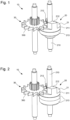
- the invention relates to a composite watch component 20 of a regulating mechanism 10 of a watch movement, arranged to be able to pivot about an axis of rotation.
- Such a regulation mechanism 10 is particularly suitable for regulating the driving of a date, for example as described in the patent EP3540524 .
- the composite component 20 comprises an anchor 21 formed in a single piece and in a single material.
- the anchor 21 has a rod 210 on which is arranged an axial bearing 211, for example of a shape of revolution around the axis of rotation D.
- the rod 210 extends along the axis of rotation of the composite mobile.
- the anchor 21 further has pallets 212, for example arranged on the bearing axial 211, intended to interact intermittently with an escape wheel 30, and in particular a toothing 300 of the latter, as illustrated in the Figure 1
- the interaction of the pallets 212 with the toothing 300 of the escapement wheel 30 defines an alternation of shocks between one and the other of the pallets 212 and the teeth of the toothing 300.
- the pallets 212 can constitute the axial bearing 211, and then extend radially from the rod 210.
- the anchor 21 is made of a suitable material, for example titanium, ceramic, copper beryllium, etc.
- the anchor 21 may also have a coating, for example within the reach of those skilled in the art, such as nickel phosphorus.
- the composite component 20 comprises a mass 213 fixed to the anchor 21.
- the mass 213 is arranged to bear against the axial bearing surface 211, opposite the pallets 212.
- the mass 213 is driven onto the anchor 21.
- the mass 213 comprises for this purpose a central hole opening through which the rod 210 of the anchor 21 is engaged when the mass 213 is driven.
- the mass 213 is made of a denser material than that constituting the anchor 21, and is chosen so that the mass 213 has a maximum radial dimension smaller than or identical to the maximum radial dimension of the anchor 21.
- the material of the mass 213 is chosen so that the maximum radial dimension of the mass 213 does not impact the maximum radial envelope of the composite component 20, taking into account the space constraints of the watch movement.
- the mass 213 advantageously has a shape of revolution around the axis of rotation of the composite component 20.
- Mass 213 is preferably made of gold, but can be made of any other material having a density greater than 15, preferably 19, for example platinum, gold or platinum alloy.
- the mass 213 is constituted by a single element of revolution shape.
- the mass 213 comprises a stack of several elements of revolution shape, as shown in the Figure 2
- This feature has the advantage of being able to adjust the volume of the mass 213, and therefore its mass, and consequently, the inertia of the composite component 20.
- the composite component 20 makes it possible to present a desired inertia according to the function that it must perform, while occupying the smallest possible useful volume.
- the composite component 20 replaces the non-ballasted base component.
Landscapes
- Physics & Mathematics (AREA)
- General Physics & Mathematics (AREA)
- Micromachines (AREA)
Abstract
Description
- L'invention s'inscrit dans le domaine de l'horlogerie et en particulier des composants de mouvements horlogers.
- L'invention concerne un composant composite d'horlogerie comprenant une masse. Le composant composite est un composant d'un mécanisme de régulation.
- La maitrise de l'inertie des composants de mécanismes d'horlogerie, et en particulier des composants de mécanismes de régulation, est essentielle car le comportement dynamique de ces composants dépend de leur inertie.
- La réalisation de composants d'horlogerie par des procédés de micro-fabrication, tels que « LIGA » (de l'allemand « Lithographische Galvano Abformung » signifiant « structuration galvanique par lithographie »), ou similaire, permet d'obtenir des composants avec une géométrie très fine, optimisant les contacts fonctionnels. Toutefois ces composants sont très légers, alors qu'une certaine inertie est souvent nécessaire, pour entretenir un mouvement, assurer une impulsion, ou autre.
- Par exemple, dans un mécanisme de régulation fonctionnant sur la base de chocs répétés entre un mobile d'échappement et une ancre, la fréquence d'oscillation est en partie dépendante de l'inertie de l'ancre. En outre, les contraintes mécaniques appliquées sur le mobile d'échappement et sur l'ancre étant relativement importantes du fait des chocs répétés, le choix des matériaux concernant leurs surfaces d'interaction est important.
- Par ailleurs, dans certaines circonstances, il est nécessaire d'obtenir une inertie particulière pour l'ancre tout en respectant des contraintes d'encombrement dans le mouvement horloger dans lequel elle est destinée à être agencée.
- L'invention concerne un composant composite d'horlogerie d'un mécanisme de régulation, ledit composant composite comprenant une masse permettant de maîtriser son inertie.
- Plus précisément, l'invention concerne un composant composite d'horlogerie d'un mécanisme de régulation d'une montre, comportant une ancre présentant une tige sur laquelle est agencée une portée axiale, ladite ancre étant dotée de palettes destinées à interagir de façon intermittente avec un mobile d'échappement. Le composant composite comporte en outre une masse fixée à l'ancre, ladite masse étant réalisée dans un matériau plus dense que celui constituant l'ancre de sorte que la masse présente une dimension radiale maximale plus faible ou identique à une dimension radiale maximale de l'ancre.
- La présente invention permet donc de pouvoir, d'une part, résister aux contraintes mécaniques subies par les ancres de mécanismes de régulation, et d'autre part de maitriser l'inertie du composant composite, tout en lui permettant de conserver des dimensions réduites, et donc de pouvoir être utilisé dans des mouvements horlogers présentant de fortes contraintes d'encombrement.
- Dans des modes particuliers de réalisation, l'invention peut comporter en outre l'une ou plusieurs des caractéristiques suivantes, prises isolément ou selon toutes les combinaisons techniquement possibles.
- Dans des modes particuliers de réalisation, la masse est réalisée dans un matériau présentant une densité supérieure à 15.
- Dans des modes particuliers de réalisation, la masse est réalisée dans un matériau présentant une densité supérieure préférentiellement à 19.
- Dans des modes particuliers de réalisation, la masse est réalisée en or, en platine ou dans leurs alliages.
- Dans des modes particuliers de réalisation, la masse est agencée en appui contre la portée axiale, de façon opposée aux palettes.
- Dans des modes particuliers de réalisation, la masse comporte un trou central débouchant par lequel elle est chassée sur la tige de l'ancre.
- Dans des modes particuliers de réalisation, la masse comprend un empilement de plusieurs éléments de forme de révolution.
- Les buts, avantages et caractéristiques de l'invention apparaîtront mieux à la lecture de la description détaillée qui va suivre, en référence aux dessins annexés, dans lesquels les
figures 1 et 2 illustre en perspective un composant composite d'horlogerie respectivement selon un exemple préféré de réalisation de la présente invention, et selon un autre exemple de réalisation de l'invention. - L'invention concerne un composant composite 20 d'horlogerie d'un mécanisme de régulation 10 d'un mouvement horloger d'une montre, agencé de façon mobile en pivotement autour d'un axe de rotation.
- Un tel mécanisme de régulation 10 est particulièrement adapté à réguler l'entrainement d'un quantième, par exemple tel que décrit dans le brevet
EP3540524 . - Comme le montre la
figure 1 , le composant composite 20 comporte une ancre 21 formé de façon monobloc et dans un unique matériau. L'ancre 21 présente une tige 210 sur laquelle est agencée une portée axiale 211, par exemple d'une forme de révolution autour de l'axe de rotation D. La tige 210 s'étend selon l'axe de rotation du mobile composite. L'ancre 21 présente en outre des palettes 212, par exemple agencées sur la portée axiale 211, destinées à interagir de façon intermittente avec un mobile d'échappement 30, et en particulier une denture 300 de ce dernier, tel qu'illustré sur lafigure 1 . L'interaction des palettes 212 avec la denture 300 du mobile d'échappement 30 définit une alternance de chocs entre l'une et l'autre des palettes 212 et les dents de la denture 300. Dans un exemple de réalisation de l'invention, les palettes 212 peuvent constituer la portée axiale 211, et s'étendent alors radialement depuis la tige 210. - Afin de résister mécaniquement aux contraintes résultant de l'interaction entre les palettes 212 et la denture 300, l'ancre 21 est réalisée dans un matériau adapté, par exemple en titane, en céramique, en cuprobéryllium, etc. L'ancre 21 peut également présenter un revêtement, par exemple à la portée de l'homme du métier, tel qu'en nickel phosphore.
- Afin de présenter une inertie appropriée pour convenir à la fonction de régulation du mécanisme de régulation 10, le composant composite 20 comporte une masse 213 fixée à l'ancre 21. En particulier, la masse 213 est agencée en appui contre la portée axiale 211, de façon opposée aux palettes 212. Par exemple, la masse 213 est chassée sur l'ancre 21. En particulier, la masse 213 comporte à cet effet un trou central débouchant par lequel la tige 210 de l'ancre 21 est engagée lors du chassage de la masse 213.
- La masse 213 est réalisée dans un matériau plus dense que celui constituant l'ancre 21, et est choisi de sorte que la masse 213 présente une dimension radiale maximale plus faible ou identique à la dimension radiale maximale de l'ancre 21. En d'autres termes, le matériau de la masse 213 est choisi de sorte que la dimension radiale maximale de la masse 213 n'impacte pas l'enveloppe radiale maximale du composant composite 20, compte tenu des contraintes d'encombrement du mouvement horloger. Comme visible sur les
figures 1 et 2 , la masse 213 présente avantageusement une forme de révolution autour de l'axe de rotation du composant composite 20. - La masse 213 est préférentiellement réalisée en or, mais peut être réalisée dans tout autre matériau présentant une densité supérieure à 15, préférentiellement à 19, par exemple en platine, en alliage d'or ou de platine.
- Dans l'exemple préféré de réalisation de l'invention représenté sur la
figure 1 , la masse 213 est constitué par un unique élément de forme de révolution. Toutefois, il est envisageable, dans un autre exemple de réalisation de l'invention, que la masse 213 comprennent un empilement de plusieurs éléments de forme de révolution, comme représenté sur lafigure 2 . Cette caractéristique présente l'avantage de pouvoir ajuster le volume de la masse 213, et donc sa masse, et par conséquent, l'inertie du composant composite 20. - En somme, grâce au fait qu'il soit composite, c'est-à-dire réalisé en deux matériaux différents, le composant composite 20 permet de présenter une inertie souhaitée selon la fonction qu'il doit réaliser, tout en occupant un volume utile le plus réduit possible.
- Avantageusement le composant composite 20 se substitue au composant de base non lesté.
Claims (7)
- Composant composite (20) d'horlogerie d'un mécanisme de régulation (10) d'une montre caractérisé en ce qu'il comporte une ancre (21) présentant une tige (210) sur laquelle est agencée une portée axiale (211), ladite ancre (21) étant dotée de palettes (212) destinées à interagir de façon intermittente avec un mobile d'échappement (30), le composant composite (20) comportant en outre une masse (213) fixée à l'ancre (21), ladite masse (213) étant réalisée dans un matériau plus dense que celui constituant l'ancre (21), de sorte que la masse (213) présente une dimension radiale maximale plus faible ou identique à une dimension radiale maximale de l'ancre (21).
- Composant composite (20) selon la revendication 1, dans lequel la masse (213) est réalisée dans un matériau présentant une densité supérieure à 15.
- Composant composite (20) selon la revendication 1, dans lequel la masse (213) est réalisée dans un matériau présentant une densité supérieure préférentiellement à 19.
- Composant composite (20) selon la revendication 1, dans lequel la masse (213) est réalisée en or, en platine ou dans leurs alliages.
- Composant composite (20) selon l'une des revendications 1 à 4, dans lequel la masse (213) est agencée en appui contre la portée axiale (211), de façon opposée aux palettes (212).
- Composant composite (20) selon l'une des revendications 1 à 5, dans lequel la masse (213) comporte à un trou central débouchant par lequel elle est chassée sur la tige (210) de l'ancre (21).
- Composant composite (20) selon l'une des revendications 1 à 6, dans lequel la masse (213) comprend un empilement de plusieurs éléments de forme de révolution.
Priority Applications (4)
| Application Number | Priority Date | Filing Date | Title |
|---|---|---|---|
| EP23219730.1A EP4575664A1 (fr) | 2023-12-22 | 2023-12-22 | Composant composite d'un mécanisme de régulation d'horlogerie comprenant une masse |
| JP2024206590A JP7848968B2 (ja) | 2023-12-22 | 2024-11-27 | 質量体を含む時計調速機構の複合部品 |
| US18/973,416 US20250208572A1 (en) | 2023-12-22 | 2024-12-09 | Composite component of a horological regulating mechanism comprising a mass |
| CN202411838208.0A CN120195953A (zh) | 2023-12-22 | 2024-12-13 | 钟表调速机构的包含质量体的复合部件 |
Applications Claiming Priority (1)
| Application Number | Priority Date | Filing Date | Title |
|---|---|---|---|
| EP23219730.1A EP4575664A1 (fr) | 2023-12-22 | 2023-12-22 | Composant composite d'un mécanisme de régulation d'horlogerie comprenant une masse |
Publications (1)
| Publication Number | Publication Date |
|---|---|
| EP4575664A1 true EP4575664A1 (fr) | 2025-06-25 |
Family
ID=89322134
Family Applications (1)
| Application Number | Title | Priority Date | Filing Date |
|---|---|---|---|
| EP23219730.1A Pending EP4575664A1 (fr) | 2023-12-22 | 2023-12-22 | Composant composite d'un mécanisme de régulation d'horlogerie comprenant une masse |
Country Status (4)
| Country | Link |
|---|---|
| US (1) | US20250208572A1 (fr) |
| EP (1) | EP4575664A1 (fr) |
| JP (1) | JP7848968B2 (fr) |
| CN (1) | CN120195953A (fr) |
Citations (5)
| Publication number | Priority date | Publication date | Assignee | Title |
|---|---|---|---|---|
| EP2320280A1 (fr) * | 2009-11-06 | 2011-05-11 | Nivarox-FAR S.A. | Ancre pour système d'échappement d'horlogerie |
| CH705357A2 (fr) * | 2011-08-12 | 2013-02-15 | Nivarox Sa | Procédé de fabrication d'une ancre métallique avec cornes polymères. |
| NL1041281B1 (en) * | 2015-04-22 | 2017-01-18 | Pelilos Holding B V | Anchor of a clock or watch movement that is balanced or poised with the aid of a counterweight. |
| EP3540524A1 (fr) | 2018-03-13 | 2019-09-18 | Montres Breguet S.A. | Mécanisme d'affichage d'horlogerie sautant et régulé |
| US20200057412A1 (en) * | 2018-08-14 | 2020-02-20 | Seiko Epson Corporation | Watch component, movement and watch |
Family Cites Families (5)
| Publication number | Priority date | Publication date | Assignee | Title |
|---|---|---|---|---|
| JPS5794875U (fr) * | 1980-12-03 | 1982-06-11 | ||
| JP5885587B2 (ja) * | 2011-06-10 | 2016-03-15 | セイコーインスツル株式会社 | デテント脱進機およびそれを組み込んだ時計 |
| JP2018163078A (ja) | 2017-03-27 | 2018-10-18 | シチズン時計株式会社 | てん輪 |
| JP2020134207A (ja) * | 2019-02-14 | 2020-08-31 | キヤノン株式会社 | 検出装置、ロボット装置、検出方法、物品の製造方法、プログラム及び記録媒体 |
| JP2020134307A (ja) | 2019-02-19 | 2020-08-31 | シチズン時計株式会社 | てん輪および機械式時計 |
-
2023
- 2023-12-22 EP EP23219730.1A patent/EP4575664A1/fr active Pending
-
2024
- 2024-11-27 JP JP2024206590A patent/JP7848968B2/ja active Active
- 2024-12-09 US US18/973,416 patent/US20250208572A1/en active Pending
- 2024-12-13 CN CN202411838208.0A patent/CN120195953A/zh active Pending
Patent Citations (5)
| Publication number | Priority date | Publication date | Assignee | Title |
|---|---|---|---|---|
| EP2320280A1 (fr) * | 2009-11-06 | 2011-05-11 | Nivarox-FAR S.A. | Ancre pour système d'échappement d'horlogerie |
| CH705357A2 (fr) * | 2011-08-12 | 2013-02-15 | Nivarox Sa | Procédé de fabrication d'une ancre métallique avec cornes polymères. |
| NL1041281B1 (en) * | 2015-04-22 | 2017-01-18 | Pelilos Holding B V | Anchor of a clock or watch movement that is balanced or poised with the aid of a counterweight. |
| EP3540524A1 (fr) | 2018-03-13 | 2019-09-18 | Montres Breguet S.A. | Mécanisme d'affichage d'horlogerie sautant et régulé |
| US20200057412A1 (en) * | 2018-08-14 | 2020-02-20 | Seiko Epson Corporation | Watch component, movement and watch |
Also Published As
| Publication number | Publication date |
|---|---|
| US20250208572A1 (en) | 2025-06-26 |
| JP2025100386A (ja) | 2025-07-03 |
| CN120195953A (zh) | 2025-06-24 |
| JP7848968B2 (ja) | 2026-04-21 |
Similar Documents
| Publication | Publication Date | Title |
|---|---|---|
| EP2596407B1 (fr) | Balancier a reglage d'inertie avec insert | |
| CH704016B1 (fr) | Assemblage d'une pièce ne comportant pas de domaine plastique. | |
| EP2482144B1 (fr) | Système d'assemblage par blocage à cliquet | |
| EP2743782A1 (fr) | Dispositif d'assemblage par déformation de bras élastiques | |
| EP2798413B1 (fr) | Ressort pour mouvement horloger | |
| EP3839651A1 (fr) | Oscillateur horloger mecanique a guidage flexible | |
| CH721457A2 (fr) | Composant composite d'un mécanisme de régulation d'horlogerie comprenant une masse | |
| CH702202A2 (fr) | Ancre pour système d'échappement d'horlogerie. | |
| CH684731B5 (fr) | Moteur piézo-électrique. | |
| EP3183618B1 (fr) | Aiguille de montre | |
| EP3483668B1 (fr) | Système de fixation d'un mouvement horloger dans une boîte de montre | |
| EP1801668B1 (fr) | Dispositif anti-galop pour échappement d'horlogerie | |
| EP3671368B1 (fr) | Palier, notamment amortisseur de choc, et mobile tournant d'un mouvement horloger | |
| EP3391154B1 (fr) | Système oscillant pour montre | |
| EP3422117B1 (fr) | Palier amortisseur de choc pour un axe d'un mobile d'une pièce d horlogerie | |
| CH704386A2 (fr) | Assemblage par blocage à cliquet et pièce d'horlogerie comportant un tel assemblage. | |
| EP3761122A1 (fr) | Mobile d'échappement horloger, mécanisme d'échappement et pièce d'horlogerie associés | |
| CH712108A1 (fr) | Masse oscillante, notamment pour pièce d'horlogerie. | |
| EP3948433A1 (fr) | Oscillateur sphérique pour mécanisme horloger | |
| CH715679A2 (fr) | Palier, notamment amortisseur de choc, et mobile tournant d'un mouvement horloger. | |
| CH712723A2 (fr) | Dispositif d'affichage pour pièce d'horlogerie. | |
| CH710007B1 (fr) | Aiguille de montre. | |
| EP4492153A1 (fr) | Dispositif d'echappement pour une piece d' horlogerie | |
| EP4575661A1 (fr) | Ensemble horloger comprenant un balancier et un arbre de balancier | |
| EP4033307A1 (fr) | Ensemble comprenant un mobile tournant en matériau amagnétique et un coussinet muni d'un cône |
Legal Events
| Date | Code | Title | Description |
|---|---|---|---|
| PUAI | Public reference made under article 153(3) epc to a published international application that has entered the european phase |
Free format text: ORIGINAL CODE: 0009012 |
|
| STAA | Information on the status of an ep patent application or granted ep patent |
Free format text: STATUS: THE APPLICATION HAS BEEN PUBLISHED |
|
| AK | Designated contracting states |
Kind code of ref document: A1 Designated state(s): AL AT BE BG CH CY CZ DE DK EE ES FI FR GB GR HR HU IE IS IT LI LT LU LV MC ME MK MT NL NO PL PT RO RS SE SI SK SM TR |
|
| P01 | Opt-out of the competence of the unified patent court (upc) registered |
Free format text: CASE NUMBER: APP_30467/2025 Effective date: 20250625 |
|
| STAA | Information on the status of an ep patent application or granted ep patent |
Free format text: STATUS: REQUEST FOR EXAMINATION WAS MADE |
|
| 17P | Request for examination filed |
Effective date: 20251218 |