EP4574101A2 - Kompakte crimpvorrichtung - Google Patents
Kompakte crimpvorrichtung Download PDFInfo
- Publication number
- EP4574101A2 EP4574101A2 EP25154385.6A EP25154385A EP4574101A2 EP 4574101 A2 EP4574101 A2 EP 4574101A2 EP 25154385 A EP25154385 A EP 25154385A EP 4574101 A2 EP4574101 A2 EP 4574101A2
- Authority
- EP
- European Patent Office
- Prior art keywords
- crimping
- jaws
- cam
- cam wheel
- guide elements
- Prior art date
- Legal status (The legal status is an assumption and is not a legal conclusion. Google has not performed a legal analysis and makes no representation as to the accuracy of the status listed.)
- Pending
Links
Images




Classifications
-
- A—HUMAN NECESSITIES
- A61—MEDICAL OR VETERINARY SCIENCE; HYGIENE
- A61F—FILTERS IMPLANTABLE INTO BLOOD VESSELS; PROSTHESES; DEVICES PROVIDING PATENCY TO, OR PREVENTING COLLAPSING OF, TUBULAR STRUCTURES OF THE BODY, e.g. STENTS; ORTHOPAEDIC, NURSING OR CONTRACEPTIVE DEVICES; FOMENTATION; TREATMENT OR PROTECTION OF EYES OR EARS; BANDAGES, DRESSINGS OR ABSORBENT PADS; FIRST-AID KITS
- A61F2/00—Filters implantable into blood vessels; Prostheses, i.e. artificial substitutes or replacements for parts of the body; Appliances for connecting them with the body; Devices providing patency to, or preventing collapsing of, tubular structures of the body, e.g. stents
- A61F2/95—Instruments specially adapted for placement or removal of stents or stent-grafts
- A61F2/9522—Means for mounting a stent or stent-graft onto or into a placement instrument
- A61F2/9524—Iris-type crimpers
-
- A—HUMAN NECESSITIES
- A61—MEDICAL OR VETERINARY SCIENCE; HYGIENE
- A61F—FILTERS IMPLANTABLE INTO BLOOD VESSELS; PROSTHESES; DEVICES PROVIDING PATENCY TO, OR PREVENTING COLLAPSING OF, TUBULAR STRUCTURES OF THE BODY, e.g. STENTS; ORTHOPAEDIC, NURSING OR CONTRACEPTIVE DEVICES; FOMENTATION; TREATMENT OR PROTECTION OF EYES OR EARS; BANDAGES, DRESSINGS OR ABSORBENT PADS; FIRST-AID KITS
- A61F2/00—Filters implantable into blood vessels; Prostheses, i.e. artificial substitutes or replacements for parts of the body; Appliances for connecting them with the body; Devices providing patency to, or preventing collapsing of, tubular structures of the body, e.g. stents
- A61F2/95—Instruments specially adapted for placement or removal of stents or stent-grafts
-
- A—HUMAN NECESSITIES
- A61—MEDICAL OR VETERINARY SCIENCE; HYGIENE
- A61F—FILTERS IMPLANTABLE INTO BLOOD VESSELS; PROSTHESES; DEVICES PROVIDING PATENCY TO, OR PREVENTING COLLAPSING OF, TUBULAR STRUCTURES OF THE BODY, e.g. STENTS; ORTHOPAEDIC, NURSING OR CONTRACEPTIVE DEVICES; FOMENTATION; TREATMENT OR PROTECTION OF EYES OR EARS; BANDAGES, DRESSINGS OR ABSORBENT PADS; FIRST-AID KITS
- A61F2/00—Filters implantable into blood vessels; Prostheses, i.e. artificial substitutes or replacements for parts of the body; Appliances for connecting them with the body; Devices providing patency to, or preventing collapsing of, tubular structures of the body, e.g. stents
- A61F2/02—Prostheses implantable into the body
- A61F2/24—Heart valves ; Vascular valves, e.g. venous valves; Heart implants, e.g. passive devices for improving the function of the native valve or the heart muscle; Transmyocardial revascularisation [TMR] devices; Valves implantable in the body
- A61F2/2412—Heart valves ; Vascular valves, e.g. venous valves; Heart implants, e.g. passive devices for improving the function of the native valve or the heart muscle; Transmyocardial revascularisation [TMR] devices; Valves implantable in the body with soft flexible valve members, e.g. tissue valves shaped like natural valves
-
- A—HUMAN NECESSITIES
- A61—MEDICAL OR VETERINARY SCIENCE; HYGIENE
- A61F—FILTERS IMPLANTABLE INTO BLOOD VESSELS; PROSTHESES; DEVICES PROVIDING PATENCY TO, OR PREVENTING COLLAPSING OF, TUBULAR STRUCTURES OF THE BODY, e.g. STENTS; ORTHOPAEDIC, NURSING OR CONTRACEPTIVE DEVICES; FOMENTATION; TREATMENT OR PROTECTION OF EYES OR EARS; BANDAGES, DRESSINGS OR ABSORBENT PADS; FIRST-AID KITS
- A61F2/00—Filters implantable into blood vessels; Prostheses, i.e. artificial substitutes or replacements for parts of the body; Appliances for connecting them with the body; Devices providing patency to, or preventing collapsing of, tubular structures of the body, e.g. stents
- A61F2/02—Prostheses implantable into the body
- A61F2/24—Heart valves ; Vascular valves, e.g. venous valves; Heart implants, e.g. passive devices for improving the function of the native valve or the heart muscle; Transmyocardial revascularisation [TMR] devices; Valves implantable in the body
- A61F2/2427—Devices for manipulating or deploying heart valves during implantation
-
- A—HUMAN NECESSITIES
- A61—MEDICAL OR VETERINARY SCIENCE; HYGIENE
- A61F—FILTERS IMPLANTABLE INTO BLOOD VESSELS; PROSTHESES; DEVICES PROVIDING PATENCY TO, OR PREVENTING COLLAPSING OF, TUBULAR STRUCTURES OF THE BODY, e.g. STENTS; ORTHOPAEDIC, NURSING OR CONTRACEPTIVE DEVICES; FOMENTATION; TREATMENT OR PROTECTION OF EYES OR EARS; BANDAGES, DRESSINGS OR ABSORBENT PADS; FIRST-AID KITS
- A61F2/00—Filters implantable into blood vessels; Prostheses, i.e. artificial substitutes or replacements for parts of the body; Appliances for connecting them with the body; Devices providing patency to, or preventing collapsing of, tubular structures of the body, e.g. stents
- A61F2/02—Prostheses implantable into the body
- A61F2/24—Heart valves ; Vascular valves, e.g. venous valves; Heart implants, e.g. passive devices for improving the function of the native valve or the heart muscle; Transmyocardial revascularisation [TMR] devices; Valves implantable in the body
- A61F2/2427—Devices for manipulating or deploying heart valves during implantation
- A61F2/243—Deployment by mechanical expansion
- A61F2/2433—Deployment by mechanical expansion using balloon catheter
-
- A—HUMAN NECESSITIES
- A61—MEDICAL OR VETERINARY SCIENCE; HYGIENE
- A61F—FILTERS IMPLANTABLE INTO BLOOD VESSELS; PROSTHESES; DEVICES PROVIDING PATENCY TO, OR PREVENTING COLLAPSING OF, TUBULAR STRUCTURES OF THE BODY, e.g. STENTS; ORTHOPAEDIC, NURSING OR CONTRACEPTIVE DEVICES; FOMENTATION; TREATMENT OR PROTECTION OF EYES OR EARS; BANDAGES, DRESSINGS OR ABSORBENT PADS; FIRST-AID KITS
- A61F2/00—Filters implantable into blood vessels; Prostheses, i.e. artificial substitutes or replacements for parts of the body; Appliances for connecting them with the body; Devices providing patency to, or preventing collapsing of, tubular structures of the body, e.g. stents
- A61F2/95—Instruments specially adapted for placement or removal of stents or stent-grafts
- A61F2/9522—Means for mounting a stent or stent-graft onto or into a placement instrument
Definitions
- the present invention relates to a crimping device and, more particularly, to a compact device for crimping devices, such as a stented prosthetic valve such as a heart valve, from a large diameter to a smaller diameter.
- a stent is a generally cylindrical prosthesis introduced into a lumen of a body vessel via a catheterization technique.
- Stents may be self-expanding or balloon expandable.
- Balloon-expandable stents are typically crimped from an initial large diameter to a smaller diameter prior to advancement to a treatment site in the body.
- a balloon expandable stent is typically placed over an expandable balloon on a catheter shaft.
- the stent is expanded and then crimped on the balloon.
- the crimping process should be performed in a sterile environment. Over the years, attempts have been made to crimp the stent on a balloon during the operation in the sterile field. However, most stents are now "pre-crimped" on a suitable balloon in the factory and then delivered to the physician ready for use.
- a crimping device for stents based on movable jaws is disclosed in U.S. Patent No. 6,360,577 to Austin .
- This crimping device uses sloped planes which force jaws to move from an open position to a closed position.
- One primary shortcoming is that the length of the sloped plane is given by a whole circle (360°) divided by the number of activated jaws.
- a long-sloped plane is preferable to reduce circumferential resistance or friction forces, but in order to achieve a smooth aperture for crimping the stent a large number of jaws is needed, which means a shorter sloped plane, less leverage and higher frictional forces. Therefore, the effectiveness of this type of device is substantially limited and may only be practical for stents which have a diameter of 1.5 to 4.0 mm in their expanded size.
- Prosthetic valves have been developed wherein a valve structure is mounted on a stent and then delivered to a treatment site via a percutaneous catheterization technique.
- Prosthetic valves are typically much larger in diameter relative to coronary stents. While a typical expanded coronary stent diameter is only 1.5 to 4.0 mm, a stented prosthetic valve diameter will typically be in the range of about 19 to 29 mm, at least 5 times larger.
- coronary stents are stand-alone metallic devices which may be crimped over a balloon prior to packaging.
- the stent functions as a scaffold to hold a valve structure which is typically made of biological materials such as pericardium valves or harvested valves.
- a preserving solution For improved function after deployment, it is often desirable to package such valves in the open (i.e., expanded) state in a preserving solution. Consequently, it is necessary to crimp the valve in the operation room a few minutes before implantation, therefore precluding pre-crimping by the manufacturer over a balloon.
- FIG. 1 Another version of a prosthetic heart valve crimper is marketed by Machine Solutions Inc. of Flagstaff, Arizona.
- the HV200 is a disposable crimper that uses multiple pivoting segments to crimp percutaneous heart valves.
- the Machine Solutions crimpers are also disclosed in U.S. Patent Nos. 6,629,350 and 6,925,847, both to Motsenbocker . These crimping devices are based on segments which rotate about pivot pins to create radial compression. Unfortunately, the pivoting design tends to concentrate stress in certain areas of the individual segments, and in the mechanism for pivoting them. Also, the user must apply significant force to close the crimper aperture around a relatively large percutaneous heart valve.
- U.S. Patent No. 7,530,253 discloses a crimping mechanism for prosthetic heart valves having linearly moving jaws which has the capacity to crimp a relatively large size valve down to a small delivery size, but is also relatively large in size.
- the present invention provides a method and apparatus for crimping expandable prosthetic heart valves having support frames and stents.
- the crimping mechanism includes a plurality of jaws configured for coordinated inward movement toward a crimping axis to reduce the size of a crimping iris around a stented valve.
- a rotating cam wheel acts on the jaws and displaces them inward.
- a number of Cartesian guide elements cooperate with the jaws to distribute forces within the crimping mechanism.
- the guide elements are located between the crimping jaws and an outer housing and are constrained by the outer housing for movement along lines that are tangential to a circle centered on the crimping axis.
- the guide elements engage at least some of the crimping jaws while the rest are in meshing engagement so as to move in synch.
- An actuation mechanism includes a lead screw, carriage assembly and a linkage to rotate the cam wheel with significant torque.
- a rotating cam wheel acts on the crimping jaws and displaces them generally radially inward, while a stationary outer housing contains the cam wheel and crimping jaws.
- a plurality of guide elements are each constrained by fixed grooves in the outer housing for movement between first and second positions along lines that are tangential to a circle around the central axis, wherein the guide elements move at least some of the crimping jaws along the lines such that all of the crimping wedges of the crimping jaws translate inward along radial lines toward the crimping axis.
- the crimping wedges are made of a different material than the rest of the crimping jaws.
- the guide elements may be separate elements from the crimping jaws.
- the guide elements are rigidly coupled to the at least some of the crimping jaws by being integrally formed therewith or fastened thereto.
- the crimping jaws each comprise an assembly of a pair of traveling blocks flanking the cam wheel and one of the crimping wedges that extends across a central orifice in the cam wheel.
- the cam wheel may include two disks having spiral cam slots that act on cams secured to each of the flanking traveling and that extend axially inward into the cam slots.
- the cam wheel disks may each have a cam lever projecting radially outward therefrom that is driven by a carriage assembly on a lead screw.
- a linkage between the cam levers and the carriage assembly increases a torque applied to the cam wheel when the carriage assembly reaches opposite ends of the lead screw.
- the present application discloses a prosthetic valve crimping device capable of reducing the diameter of an expandable prosthetic stented valve.
- the device has a plurality of crimping jaws in meshing engagement and circumferentially arranged around a crimping orifice having a central crimping axis, wherein the crimping jaws each comprise an assembly of a pair of spaced apart traveling blocks and a radially inner crimping wedge that extends therebetween.
- a rotating cam wheel acts on the crimping jaws and displaces them generally radially inward, the cam wheel including two disks having spiral cam slots that act on cams secured to each of the flanking traveling blocks and that extend axially inward into the cam slots.
- a stationary outer housing contains the cam wheel and crimping jaws, and a lower actuation mechanism including a lead screw and carriage assembly is coupled to rotate the cam wheel.
- the pair of traveling blocks of at least some of the crimping jaws are constrained by fixed grooves in the outer housing for movement along lines that are tangential to a circle around the central axis such that all of the crimping wedges of the crimping jaws translate inward along radial lines toward the crimping axis.
- the cam wheel disks each may have a cam lever projecting radially outward therefrom that is driven by the carriage assembly on the lead screw via a linkage between the cam levers and the carriage assembly that increases a torque applied to the cam wheel when the carriage assembly reaches opposite ends of the lead screw.
- a drive motor may be provided to actuate the lead screw.
- the crimping wedges may be made of a different material than the rest of the crimping jaws.
- the device of the second aspect may further include a plurality of guide elements which are each constrained by fixed grooves in the outer housing for movement between first and second positions along lines that are tangential to a circle around the central axis, the guide elements moving at least some of the crimping jaws along the lines such that all of the crimping wedges of the crimping jaws translate inward along radial lines toward the crimping axis.
- the guide elements there are half the number of guide elements as crimping jaws, such that some of the crimping jaws are driven and some are followers.
- the guide elements are rigidly connected to the traveling blocks of half of the crimping jaws by being integrally formed therewith or fastened thereto.
- each of the guide elements may comprise a rectilinear plate in an irregular diamond shape with four vertices and straight sides therebetween with an indentation on one side adjacent one of the vertices, and when the guide elements are displaced to the second positions along the lines, one of the vertices of each fits closely within the indentation on the adjacent guide member, and the nested contact between all of the guide elements in this manner provides a positive stop on further inward movement of the crimping mechanism.
- the present invention provides an improved crimper for stents or prosthetic valves.
- the particularly advantageous features of the present crimper enable reduction in diameter of relatively large stents or prosthetic valves in conjunction with a small sized crimper that generates high crimping forces to result in small final diameters.
- the crimper is especially suited for crimping prosthetic heart valves which have expanded diameters significantly larger than most stents currently in use.
- Palmaz-Genesis XD stents are designed for an expansion range of 10-18 mm, and are considered as either large or extra-large stents (see, Results and Mid-long-term Follow-up of Stent Implantation for Native and Recurrent Coarctation of the Aorta, European Heart Journal Volume 26, No. 24, Pp. 2728-2732, published online September 26, 2005 ).
- the most frequently used stents are significantly smaller, in the 3-6 mm range. Crimpers for these stents have proved inadequate for reducing in size even larger prosthetic valves, such as the stented prosthetic heart valves.
- aspects of the present crimper may be applicable for use in crimping stents as well, although certain features described herein make it particularly well-suited for crimping large diameter stents, stent grafts, and prosthetic valves.
- stented valve refers to prosthetic valves for implant, primarily prosthetic heart valves but also conceivably venous valves and the like.
- a stented valve has a support frame or stent that provides primary structural support in its expanded state.
- Such support frames are typically tubular when expanded, and may be expanded using a balloon or due to their own inherent elasticity (i.e., self-expanding) or by mechanical means.
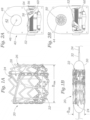
- An exemplary stented valve is illustrated with respect to Figures 1A and 1B , although the present invention may be useful for crimping other such prosthetic valves.
- FIG 1A illustrates an exemplary balloon-expandable prosthetic heart valve 20 having an inflow end 22 and an outflow end 24.
- the valve includes an outer stent or support frame 26 supporting a plurality of flexible leaflets 28 within.
- Figure 1A shows the valve 20 in its expanded or operational shape, wherein the support frame 26 generally defines a tube having a diameter D max , and there are three leaflets 28 attached thereto extending into the cylindrical space defined within to coapt against one another.
- three separate leaflets 28 are each secured to the support frame 26 and to the other two leaflets along their lines of juxtaposition, or commissures.
- a whole bioprosthetic valve such as a porcine valve could also be used.
- "leaflets” means separate leaflets or the leaflets within a whole xenograft valve.
- FIG. 1B shows the valve 20 mounted on a balloon 30 prior to inflation.
- the crimped outer diameter of the valve 20 is indicated at D min .
- the balloon 30 typically mounts on the end of a catheter 32 which is guided to the implant sites over a steerable wire 34.
- U.S. Patent No. 7,530,253 discloses a crimping mechanism for prosthetic heart valves which has the capacity to crimp a relatively large size valve down to a small delivery size.
- the mechanism in the '253 patent is relatively large due to the need to create high leverage forces to crimp the large diameter valves.
- the crimper mechanisms disclosed herein create radial jaw motion using Cartesian movement guiding elements, close to the central aperture. Consequently, the size of the crimping jaws is reduced dramatically and the stiffness (or the ability to withstand higher crimping forces) of the jaws is increased.
- the crimper mechanisms of the present application efficiently reduce the size of prosthetic valves from up to 30 mm (D max ) down to 6 mm (D min ).
- Prosthetic heart valve sizes are typically anywhere between 20 mm up to about 30 mm. The minimum reduction in size is thus around 14 mm and the maximum around 24 mm.
- typical coronary stents have an expanded diameter of between about 3-6 mm and are crimped down to a minimum diameter of between about 1.5-2 mm, for a total maximum size reduction of around 4 mm.
- the present invention provides a diameter reduction of at least 10 mm, and preferably at least 20 mm.
- the crimping mechanism 40 includes an outer housing 42 enclosing a plurality of crimping jaws 44 arranged about a central crimping axis 46. As will be described, there are preferably 12 crimping jaws 44, although other numbers of jaws are possible.
- the jaws 44 are initially shown retracted outward in Figure 2A so as not to be visible within a receiving orifice 48 sized large enough to receive an expanded heart valve 20 such as shown in Figure 1B.
- Figure 2B illustrates the crimping jaws 44 displaced radially inward in a coordinated manner to form a crimping iris 50 defined by the combined inner surfaces of the assembly of jaws.
- the crimping iris 50 has a minimum diameter small enough to completely crimp the heart valve 20 onto the balloon 30.
- the crimping operation involves placing the expanded heart valve 20 around the balloon 30 before inserting the assembly into the orifice 48 and actuating the crimping jaws 44.
- a lower portion of the outer housing 42 is cut away in both Figures 2A and 2B to expose a portion of an actuating mechanism therein.
- a relatively large diameter horizontally oriented lead screw 52 is journaled for rotation on either side of the housing 42 and perpendicular to the crimping axis 46.
- a motor in the lower part of the housing 42 is desirably connected via a power transmission to drive the lead screw 52 and increase applied forces.
- one or both ends of the lead screw 52 projects outward from the housing 42 and terminates in a nut or other such keyed element. By inserting a crank or key into one of the ends of the lead screw 52, it may be manually rotated about its axis.
- An internally threaded carriage 54 travels back and forth along the lead screw 52 when it rotates.
- the carriage 54 features a shaft stub 56 projecting from one side that is retained within a large slot 58 formed in a lever arm 60 of a cam wheel 62 (see Figures 3A and 3B ), thus preventing rotation of the carriage with the lead screw.
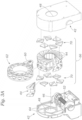
- Figure 3A is an exploded perspective view showing the inner components of the exemplary crimping mechanism 40.
- the outer housing 42 includes two molded halves that together provide the bearing mounts for the lead screw 52. Although an inside face of only one of the housing halves is shown, both include a plurality of linear guide channels 64 molded into their inner faces and disposed in a spoke-like manner tangentially around the receiving orifices 48.
- the outer housing 42 halves sandwich therebetween a crimping jaw assembly 66.
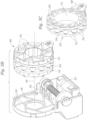
- Figure 3B is a partially exploded perspective view of the crimping mechanism 20 showing the crimping jaw assembly 66 and one of the halves of the outer housing 42 with its guide channels 64.
- the crimping jaw assembly 66 has a generally cylindrical profile that fits closely within a similarly-shaped upper portion of the outer housing 42, and is centered along the crimping axis 46.
- the crimping jaw assembly 66 is made up of the moving parts within the crimping mechanism 40, aside from the lead screw 52 and carriage 54.
- the crimping jaw assembly 66 comprises an axial sandwich of elements in the middle of which is the cam wheel 62.
- the crimping jaws 44 flank the cam wheel 62, and a number of Cartesian guide elements 70 are arranged on the outside of the crimping jaws 44.
- the crimping jaw assembly 66 is firmly located within the two halves of the housing 42, but may rotate therein.
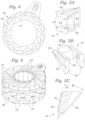
- FIG 3C is a perspective view of the exemplary cam wheel 62, which includes a pair of parallel annular discs 72 joined on their inner circular edges by an annular hub 74.
- a plurality of axially-oriented rollers 76 are journaled for rotation between the two discs 72 and circumferentially distributed in an annular space 78 defined radially outside of the hub 74.
- Each of the roller 76 projects slightly outward from the outer edges of the discs 72 so as to contact the outer housing 42 to facilitate rotation therein and provide stability to the crimping operation.
- each of the annular discs 72 includes a series of arcuate cam slots 80 formed therein which curve generally from their radially inner to their radially outer edges.
- Each of the cam slots 80 is curved so as to be radially outwardly convex.
- the arcuate cam slots 80 on the two discs 72 are aligned and have the same shape such that looking at the outer face of one disc the cam slots 80 extend radially outward in a clockwise (CW) direction (i.e., Figure 4 ), while looking at the outer face of the other disc the slots extend radially outward in a counter-clockwise (CCW) direction.
- CW clockwise
- CCW counter-clockwise
- cam slots 80 there are twelve cam slots 80 nested relatively closely to each other around each disc 72.
- Each two aligned slots 80 in the two discs 72 act on one of the jaws 44, and therefore in the preferred embodiment there are twelve jaws 44.
- the number of crimping jaws 44, and thus the number of cam slots 80 may be modified but is preferably between 8-16.
- each of the crimping jaws 44 includes a radially inner crimping wedge 82 connecting a pair of axially spaced apart, generally triangular outer traveler blocks 84.
- the elevational view of Figure 5C shows that the traveler blocks 84 each span an included angle ⁇ which varies depending on how many jaws 44 are utilized, and is preferably 30° with twelve jaws.
- the inner surfaces of the crimping wedges 82 define the aforementioned iris 50 of the crimping mechanism 40.
- the traveler blocks 84 of each of the jaws 44 closely flank the annular discs 72 of the cam wheel 62, and small cam followers 86 extending axially inward from each of the blocks insert into the arcuate cam slots 80.
- Each of the cam followers 86 has a generally rounded configuration and is angled in a manner that aligns with a tangent to the curve of the arcuate cam slots 80.
- the cam followers 86 are sized so as to be slightly smaller than the width of the cam slots 80, and may be made of a lubricious material such as Nylon or Teflon to facilitate sliding therein.
- the cam followers 86 are located at a radially outer extent of each of the traveler blocks 84.
- the crimping jaws 44 may be a molded polymer, though the inner crimping wedge 82 which contacts the article being crimped is desirably a material with high strength & stiffness along with low friction, such as reinforced Nylon. In this respect, the inner crimping wedges 82 may be inserts to the larger jaws 44.
- the cam followers 86 are preferably stiff and low friction, such as Nylon. Of course, alternatives exist and these are just exemplary materials.
- FIGS 7A and 7B are elevational views of the inner crimping mechanism 40 showing the central cam wheel 62 and crimping jaws 44 assembled thereon in both open and closed crimping jaw positions. Only one of the arcuate cam slots 80 as well as the cooperative cam follower 86 on one of the jaws 44 is shown in phantom. It should be understood that although only one each is shown, there are two cam slots 80 and two cam followers 86 associated with each jaw 44. The jaw 44 on which the cam follower 86 is shown is highlighted by extending dashed lines along respective angled edges to form angles ⁇ and ⁇ with the horizontal.
- Figures 7A and 7B show the lever arm 60 of the cam wheel 62 rotating in a clockwise (CW) direction such that the cam followers 86 on each jaw 44 are acted on by the arcuate cam slots 80. Because the cam slots 80 curve radially inward as the wheel 62 rotates clockwise, a radially inward camming force is transmitted to the cam followers 86. Because of the sliding interactions between the jaws 44, inward movement of all of the jaws 44 from their rigid connection to their respective cam followers 86 is the same. It should be noted that the highlighted crimping jaw 44 remains in the same rotational orientation while it translates radially inward and downward. That is, the angles ⁇ and ⁇ that describe the orientation of the jaw 44 relative to horizontal remain the same.
- each of the angular edges of the traveler blocks 84 cooperates with the adjacent traveler block edges in a tongue and groove fashion.
- each of the traveler blocks 84 has a sliding rail 88 thereon that mates with an oppositely-oriented sliding rail on the traveler block 84 on the adjacent jaw 44. This interaction can be seen in the perspective view of Figure 6 .
- the sliding engagement of the rails 88 helps prevent binding between the jaws 44 as they move inward together.
- each of the crimping jaws 44 and the angles of the edges of the traveler blocks 84 causes the assembly of jaws to rotate when they are cammed inward.
- each of the crimping jaws slides inward relative to one of its adjacent crimping jaws, and the resulting displaced shape seen in Figure 7B somewhat resembles a pinwheel.
- the reader will also see from comparison of Figures 7A and 7B where the highlighted crimping jaw 44 translates radially inward and downward, amounting to a clockwise rotation thereof.
- the crimping jaws 44 also have linear guide slots 90 on the outer faces of both of the traveler blocks 84. These guide slots 90 interact with the aforementioned Cartesian guide elements 70, as will be explained below. With specific reference to Figure 5C , the guide slot 90 of each jaw 44 bisects included jaw angle ⁇ .
- Figure 8 is an elevational view of an inner face of one half of the outer housing 42 showing the fixed guide channels 64.
- the guide channels 64 lie tangent to the central orifice 48 in the housing 42.
- the guide channels 64 preferably comprise axial depressions in an outer plate 92 of the housing 42, with the housing halves including the guide channels desirably being injection molded. Radially inner ends of each guide channel 64 merge with an adjacent guide channel at about a mid-point thereof. Because there are six guide channels 64 spaced equidistantly and oriented evenly around the orifice 48, the inner portions of the guide channels define vertices of a hexagon closely surrounding the orifice.
- Each guide channel 64 extends from a vertex of the hexagon past its point of tangency with the orifice 48 and outward to an outer rim 94 of the housing 48.
- the guide channels 64 interact with the Cartesian guide elements 70, as will be explained below.
- the number of guide channels depends on the number of jaws; namely, half the of number of jaws.
- Figure 9A shows a plurality of the Cartesian guide elements 70 arranged in space in the same manner as they would be when interacting with the outer housing 42
- Figure 9B shows an individual Cartesian guide element 70 in isolation
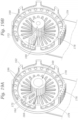
- Figures 10A and 10B superimpose the guide elements onto the outer housing and channels 64.
- Each of the guide elements 70 comprises an angular generally flat rectilinear plate 96 having a pair of raised linear bars 98a, 98b projecting from opposite inner and outer faces.
- the opposed linear bars 98a, 98b are oriented perpendicular to each other, and thus together define a right-angle cross, albeit on opposite faces of the guide elements 70.
- Outer faces of the guide elements 70 abut the outer plate of the housing 42 such that the outer linear bars 98a on that side fit closely within the fixed guide channels 64.
- the guide elements 70 contact the assembly of the crimping jaws 44, and the inner linear bars 98b fit closely within the guide slots 90 on six of the guide elements. Because the outer linear bars 98a are constrained within the guide channel 64, the guide elements 70 are also constrained to move linearly between first and second positions parallel to the guide channels.
- Figure 10A shows the locations of the guide elements 70 superimposed on the outer housing 42 when in radially outward positions (as also in Figure 9A ).
- the outer linear bars 98a extend within and are guided by the guide channels 64.
- radially outer edges of the rectilinear plates 96 are close to the outer rim 94 of the housing 42, and their radially inner edges are positioned just outside of the central orifice 48.
- Figure 10B is a similar view showing the guide elements 70 in radially inward positions.
- the outer linear bars 98a slide inward along the guide channels 64, and the rectilinear plates 96 fit closely together.
- the rectilinear plates 96 define an irregular diamond shape with generally four vertices at the outer extents of the crossed linear bars 98a, 98b. Straight sides extend between the vertices, and there is an indentation 100 on one side adjacent one of the vertices.
- the guide elements 70 are in their radially inner positions, one of the vertices of each fits closely within this indentation 100 on the next, and the nested contact between all of the guide elements 70 in this manner provides a positive stop on further inward movement of the crimping mechanism 40.
- Figures 11A and 11B are elevational views similar to Figures 7A and 7B with the crimping jaw assembly 66 in place but also showing the Cartesian guide members 70 interacting with the crimping jaws 44.
- the guide members 70 are termed "Cartesian" because of the opposite crossed linear bars 98a, 98b on each. That is, as described above, the guide member 70 are constrained to move linearly along the guide channels 64 in the outer housing 42. At the same time, interaction between the inner linear bars 98b on each member 70 and the guide slots 90 on every other crimping jaw 44 constrains those jaws to move in the direction of the associated guide member 70.
- each of the guide members 70 interacts with every other crimping jaw 44.
- the six crimping jaws 44a that interact with the guide members 70 can be termed guided jaws, while the six crimping jaws 44b that do not interact with the guide members are termed follower jaws.
- follower jaws it is important to remember that each of the crimping jaws 44 has cam followers 86 thereon, and thus each of the crimping jaws is driven directly by the cam wheel 62.
- Cartesian axes 102, 104 are superimposed over one combination of guide member 70 and its guided jaw 44a.
- a first axis 102 extends along the outer linear bar 98a on the guide member 70.
- the reader will understand that the outer linear bar 98a interacts with the guide channels 64 on the half of the outer housing which is not shown. Therefore, the guide member 70 is constrained for linear movement along the first axis 102.
- a second axis 104 extends along the inner linear bar 98b on the guide member 70, which corresponds to the guide slot 90 on the guided jaw 44a.
- the second axis 104 translates with the guide member 70, always remaining perpendicular to the first axis 102. Both the guided jaw 44a and the guide member 70 move together. This arrangement reduces frictional losses and allows an option to combine the guided jaws 44 and the guide elements 70.
- disks 72, traveler blocks 84, and guide members 70 results in a symmetric, balanced system and the stresses are reduced.
- a single disk 72 and associated crimping elements is possible, but would require a more robust structural design.
- the tip of the crimping wedge 82 on each jaw translates radially inward along a radial line 110 through the central crimping axis 46 (see Fig. 11A ). That is, the composite movement 106 is parallel to the radial line 110 through the crimper axis 46. This ensures even crimping of the stent or valve.
- the relative movements of the cooperating elements in the crimping mechanism 40 will occur regardless if there is an object being crimped or not. However, when an object such as the expanded heart valve 20 of Figure 1A is being crimped, it applies substantial resistance to the crimping mechanism 40. More specifically, the hoop strength of the expanded heart valve 20 provides a radially outward reaction force 108 directly to the crimping wedges 82 of the jaws 44, as indicated in Figure 11E .
- the mechanism is not balanced and the reaction force 108 will tend to rotate the jaws 44. Further, without the guide members 70 this reaction force would be translated through the crimping jaws 44 to the cam followers 86, and thus to the arcuate cam slots 80 of the cam wheel 62.
- the cam slots 80 are relatively robust, the cam followers 86 are not only susceptible to deformation from stress, but also binding. However, because of the contact between the guide members 70, crimping jaws 44 and fixed outer housing 42, the reaction forces from the crimping process are transferred and distributed such that the stress on the cam followers 86 is reduced. In particular, the Cartesian guide members 70 absorb a considerable amount of the stress and provide an effective companion for the crimping jaws 44.
- the radially outward reaction force 108 from the crimping process translates into a torque on the crimping jaw 44a.
- This torque is resisted primarily by the rigid constraint imposed on the guide member 70 by the outer housing guide channels 64 to move along the first axis 102.
- the clockwise torque on the guided jaw 44a would be translated directly to the corresponding guide member 70 because of the interaction between the guide slot 90 and the inner linear bar 98b, and the rotational torque within be resisted by the guide member 70 because it is fixed rotationally with respect to the outer housing 42.
- the guiding elements 70 translate the angular movement from the cam wheel 62 to a radial force, by essentially separating it into a Cartesian movement.
- the jaws 44 are moving radially similarly to the previous crimpers, and the guiding elements 70 move with them, in the tangential housing channels 64.
- the width of the crimping mechanism 40 is about 80 mm.
- a total height of the crimping mechanism 40 is about 115 mm.
- those exemplary sizes are for a mechanism capable of crimping a balloon-expandable prosthetic heart valve 20 such as shown in Figure 1A down to a delivery size shown in Figure 1B .
- the mechanism must be robust enough to crimp a stainless steel support frame of the heart valve 20 from, for example, 30 mm (D max ) down to 6 mm (D min ). Less stiff frames or less of a size reduction may enable the crimper to be even further reduced in size and, conversely, a larger size reduction may require a larger crimper.
- Figures 12A and 12B are schematic perspective views of an alternative embodiment of a crimping mechanism 120 in both open and closed positions of crimping jaws 122, respectively.
- the entire crimping mechanism 120 is not shown, but will be similar to that shown in Figures 1-11 .
- the main difference in the crimping mechanism 120 is a modification to the guide members 124. That is, rather than having a diamond-shape plate with opposing crossed linear bars, as before, the guide members 124 are simply perpendicular bars attached together.
- the inner bars will extend within guide slots 126 in the crimping jaws 122, while the outer bars will slide within fixed guide channels in an outer housing (not shown). In all other respects, the crimping mechanism 120 works the same as was described above.
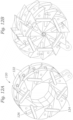
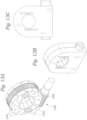
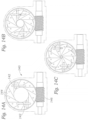
- Figures 13A-13C and 14A-14C illustrate a further crimping mechanism 140 similar to that shown in Figures 1A-12B but with fewer guide elements 142.
- the guide elements 142 are simple crossed linear bars, as described above with respect to Figures 12A and 12B . Further, there are still twelve crimping jaws 144. In contrast to the earlier embodiments, however, there are only two guide elements 142. Operation of the crimping mechanism 140 as seen in Figures 14A-14C is similar to that described above, where a lead screw 146 turns a cam wheel (not shown) which initiates the inward movement of the crimping jaws 144.
- the guide elements 142 only mesh with two of the crimping jaws 144, but still provide a reduction in stress and distributed application of force.
- Two guide elements 142 is considered a minimum, and three, four, or six are contemplated for a twelve jaw mechanism.
- a practical maximum number of guide elements 142 is six in the illustrated embodiments, or half the number of jaws. This is so that the guide elements 142 do not interfere with each other as they slide back and forth.
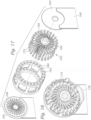
- Figures 15A-15B schematically depict a still further crimping mechanism 160 of the present application that utilizes a compressible sleeve, such as a soft elastomer, rather than a plurality of separate jaws.
- Figures 16A-16B are elevational views of the crimping mechanism 160 with a front cover removed to show internal components in the positions of Figures 15A and 15B , respectively.
- the crimping mechanism 160 features a cam wheel 162 that rotates within a pair of end plates 164 (only one shown).
- the end plates 164 are fixed over a housing 166 within which is located an actuation mechanism, much like the lead screw assembly described above.
- a compressible sleeve 168 is held rotationally still between the end plates 164 and comprises an annular elastomeric sleeve with outer axial grooves.
- An inner lumen or orifice 170 defined by the sleeve 168 constricts upon rotation of the cam wheel 162 to a smaller size orifice 170', as seen in Figures 15B and 16B .
- a plurality of linkage plates 172 are arranged for coordinated movement within the cam wheel 162. More particularly, outer ends 174 of the plates 172 are journaled for rotation in corresponding bores 180 around the outer perimeter of the cam wheel 162.
- the cam wheel 162 may have a short segment of gear teeth 176 on its lower edge which can be engaged by a moving rack, lead screw or other such gearing within the housing 166.
- FIG 17 shows the crimping mechanism 160 exploded.
- An array 182 of the linkage plates 172 and cooperating compression plates 178 includes at least 12, and preferably at least 24 of the linked plates.
- the array 182 is arranged within the cam wheel 162 which includes two series of the perimeter bores 180 within which two outer ends 174 of each linkage plate 172 are journaled for rotation. In this way, the symmetry reduces any possible misalignment forces during crimping of the prosthetic heart valve.
- Each end plate 164 has a central aperture for passage of the prosthetic heart valve into the middle of the crimping mechanism 160, as well as an array of radial slots 186 which will be described below.
- each linkage plate 172 is hinged on an inner end to a compression plate 178.
- the inner end of each compression plate 178 engages one of the axially-oriented grooves 179 around the outside of the compressible sleeve 168.
- the compression plate 178 is formed with two outer rails 188 that slide within the radial slots 186 formed in the end plates 164. Rotation of the cam wheel 162 displaces the outer ends 174 of the linkage plates 172 such that they transition from the angled orientation shown in Figure 16A to the radial orientation of Figure 16B . Because the inner ends of the linkage plates 172 are hinged to the compression plates 178, the compression plates 178 are forced radially inward.
- the crimping mechanism 160 represents an elegant solution, with a single crimping "jaw" reducing the number of moving parts and associated friction, there are limitations on the magnitude of crimping, and a series of similar crimpers may be required to reduce the size of the article in stages. Of course, if only a small amount of crimping is necessary, one crimping mechanism will be suitable.
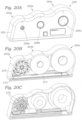
- FIGS 20A-20C are perspective and cutaway views of a multi-stage crimper 200 with an outer housing 202 enclosing a series of progressively sized crimping mechanisms 204a, 204b, 204c each with a compressible "jaw.”
- a crimping orifice 206a, 206b, 206c for the three crimping mechanisms gradually reduces the size of a prosthetic device such as the prosthetic heart valve described above.
- Figure 20B shows a front cover of the housing 202 removed to illustrate one rotating cam wheel 210 on the smallest crimping mechanism 204a.
- a lower segment of gear teeth 212 on the cam wheel 210 may be acted on by a linearly displaced rack 214 to rotate the cam wheel.
- FIG. 20C shows a front portion of the cam wheel 210 removed to expose a plurality of linked plates 216, which may be the same as those described above with respect to Figures 15-19 .
- crimp a prosthesis To crimp a prosthesis, it is first placed in the largest crimping mechanism 204c and the rack 214 displaced to reduce the size of the prosthesis a first amount. The rack 214 returns to its original position and the prosthesis is then transferred to the middle crimping mechanism 204b and its size is further reduced. Finally, the smallest crimping mechanism 204a reduces the size of the prosthesis to its final diameter.
- three crimping mechanisms are shown, a minimum of two stages and more than three may be used for sequentially crimping a prosthesis in this manner.
- FIGs 21A-21B schematically depict a still further crimping mechanism of the present application that utilizes compressible jaws 260, such as a soft elastomer.
- the jaws 260 are positioned between a series of spoke-like plates 262 which are initially angled from the radial so as to be nearly tangential to a circle defined by the inner faces 264 of each of the compressible jaws 260. Outer faces 266 of each of the jaws 260 are constrained so that they cannot expand radially outward.
- the compressible jaws 260 are squeezed by reduction in the volume between the plates 262 so that they expand inward.
- the aggregation of all of the interfaces 264 defines the crimping iris, and compresses any article therewithin. Again, with compressible jaws there are limitations on the magnitude of crimping, and a series of similar crimpers may be used to reduce the size of the article in stages, as described above with respect to Figures 20A-20C . Of course, if only a small amount of crimping is necessary, a single crimping mechanism will be suitable.
- internal components of the crimping mechanisms described herein may be formed of multiple separate connected parts, or by combining some of these parts in integral members.
- the six guided jaws 44 seen in Figures 11A and 11B are constrained to move with their corresponding guide members 70, and thus these components could be formed as single pieces.
- certain elements can be broken up into more than one piece, such as the jaws, so as to facilitate manufacturing. This latter instance is illustrated by the crimping mechanism shown in Figures 22A-22C .
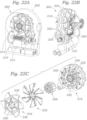
- Figure 22A is a perspective view of an alternative crimping mechanism 300 having a modified actuating mechanism and an outer housing 302 shown in phantom.
- Figure 22B shows the crimping mechanism 300 from a different perspective and without the outer housing 302, and
- Figure 22C shows a number of internal components including inner crimping wedges 306 exploded.
- the modified actuating mechanism again features a relatively large diameter horizontally oriented lead screw 310 journaled for rotation on either side of the housing 302 and perpendicular to a horizontal crimping axis.
- a motor 312 in the lower part of the housing 302 is desirably connected via a power transmission (e.g., gears or pulleys 314) to drive the lead screw 310.
- rotation of the lead screw 310 causes translation of a carriage assembly 316 which is connected to a cam wheel 318 via a linkage arm 320.
- the linkage arm 320 is journaled for rotation at opposite ends, one on the carriage assembly 316 and one on an outer lever arm 322 of the cam wheel 318.
- the cam wheel 318 has two spaced apart discs 324 each with a lever arm 322, and there are two of the linkage arms 320, one driving each lever arm. This provides an extremely balanced and robust drive system which prevents binding of the moving jaw components.
- This linkage arrangement provides an extended actuation arm that produces higher torque (linear translated to radial) results at the end of crimping process, where the maximal forces are needed.
- the stented prosthetic valve is easier to crimp at it larger diameter, and becomes progressively harder as it is constricted.
- the linkage arms 320 apply a large amount of torque to the cam wheels 318 relative to each turn of the lead screw.
- Figure 22C is an exploded view of the components of the assembly of the cam wheel 318 and jaw mechanism.
- the crimping wedges 306 are shown arranged in a generally spiral array as they would be held within a central opening 330 in the cam wheel 318.
- the crimping wedges 306 take the place of the inner crimping wedges 82 of the jaws 44 described above with reference to Figures 1A-11E .
- Flanking each side of the cam wheel 318 is a combination of a set of six generally triangular (pie-shaped) traveler blocks 332 and six guide blocks 334.
- the guide blocks 334 include essentially two components back-to-back: inner traveler blocks 336 that resemble the traveler blocks 332 and outer guide elements 338 that are similar to the Cartesian guide elements 70 described above. As seen in Figure 22B , the six traveler blocks 332 and six guide blocks 334 mesh in the same manner as the jaws 44 of Figures 1A-11E .
- the guide elements 338 have linear bars 340 that slide within fixed guide channels (not shown) in the inner faces of the housing 302.
- Each of the pie-shaped traveler blocks 332, 336 mesh with adjacent blocks in a tongue-in-groove fashion to enable smooth sliding movement therebetween.
- a crimping jaw assembly of the crimping wedges 306, six traveler blocks 332 and six guide blocks 334 is formed via a plurality of aligned through bores and bolts 342.
- spiral cam slots 350 in the cam wheel 318 move small cam pins 352 inward as the wheel rotates.
- the cam pins are held within bores (not shown) on the inner faces of each of the six traveler blocks 332 and six guide blocks 334 so that the blocks are forced along linear paths as constrained by the linear bars 340 sliding within fixed guide channels of the housing 302. This is the same as was described above.
- the end result is that the inner tips of the crimping wedges 306 translate inward along radial lines to evenly crimp a stented valve therewithin.
- Each crimping jaw per se, includes an assembly of one of the crimping wedges 306 connected at both axial ends to a pair of either the traveler blocks 332 or the guide blocks 334.
- the several components may be manufactured separately of the same or different materials and then secured together across and through the cam wheel 318 via the bolts 342.
- the crimping wedges 306 are formed of a relatively rigid metal, or just inner tips of the crimping wedges 306 may be metal.
- the sliding pieces may be metal or a hard plastic or resin.
- an assembly including a wedge 306 plus either two traveler blocks 332 or two guide blocks 334 is formed as one piece, preferably defining twelve jaw assemblies.
Landscapes
- Health & Medical Sciences (AREA)
- Engineering & Computer Science (AREA)
- Biomedical Technology (AREA)
- Cardiology (AREA)
- Oral & Maxillofacial Surgery (AREA)
- Transplantation (AREA)
- Heart & Thoracic Surgery (AREA)
- Vascular Medicine (AREA)
- Life Sciences & Earth Sciences (AREA)
- Animal Behavior & Ethology (AREA)
- General Health & Medical Sciences (AREA)
- Public Health (AREA)
- Veterinary Medicine (AREA)
- Mechanical Engineering (AREA)
- Prostheses (AREA)
Applications Claiming Priority (5)
| Application Number | Priority Date | Filing Date | Title |
|---|---|---|---|
| US201662354551P | 2016-06-24 | 2016-06-24 | |
| US15/630,711 US10716691B2 (en) | 2016-06-24 | 2017-06-22 | Compact crimping device |
| EP17816319.2A EP3474779B1 (de) | 2016-06-24 | 2017-06-23 | Kompakte crimpvorrichtung |
| PCT/US2017/039060 WO2017223486A1 (en) | 2016-06-24 | 2017-06-23 | Compact crimping device |
| EP23217909.3A EP4353202B1 (de) | 2016-06-24 | 2017-06-23 | Kompakte crimpvorrichtung |
Related Parent Applications (2)
| Application Number | Title | Priority Date | Filing Date |
|---|---|---|---|
| EP23217909.3A Division EP4353202B1 (de) | 2016-06-24 | 2017-06-23 | Kompakte crimpvorrichtung |
| EP17816319.2A Division EP3474779B1 (de) | 2016-06-24 | 2017-06-23 | Kompakte crimpvorrichtung |
Publications (2)
| Publication Number | Publication Date |
|---|---|
| EP4574101A2 true EP4574101A2 (de) | 2025-06-25 |
| EP4574101A3 EP4574101A3 (de) | 2025-08-20 |
Family
ID=60675416
Family Applications (3)
| Application Number | Title | Priority Date | Filing Date |
|---|---|---|---|
| EP25154385.6A Pending EP4574101A3 (de) | 2016-06-24 | 2017-06-23 | Kompakte crimpvorrichtung |
| EP17816319.2A Active EP3474779B1 (de) | 2016-06-24 | 2017-06-23 | Kompakte crimpvorrichtung |
| EP23217909.3A Active EP4353202B1 (de) | 2016-06-24 | 2017-06-23 | Kompakte crimpvorrichtung |
Family Applications After (2)
| Application Number | Title | Priority Date | Filing Date |
|---|---|---|---|
| EP17816319.2A Active EP3474779B1 (de) | 2016-06-24 | 2017-06-23 | Kompakte crimpvorrichtung |
| EP23217909.3A Active EP4353202B1 (de) | 2016-06-24 | 2017-06-23 | Kompakte crimpvorrichtung |
Country Status (8)
| Country | Link |
|---|---|
| US (6) | US10716691B2 (de) |
| EP (3) | EP4574101A3 (de) |
| CN (2) | CN113616382B (de) |
| CA (1) | CA3025970C (de) |
| CR (1) | CR20180577A (de) |
| ES (1) | ES2973446T3 (de) |
| SG (1) | SG11201810582QA (de) |
| WO (1) | WO2017223486A1 (de) |
Families Citing this family (43)
| Publication number | Priority date | Publication date | Assignee | Title |
|---|---|---|---|---|
| US8870950B2 (en) | 2009-12-08 | 2014-10-28 | Mitral Tech Ltd. | Rotation-based anchoring of an implant |
| WO2011111047A2 (en) | 2010-03-10 | 2011-09-15 | Mitraltech Ltd. | Prosthetic mitral valve with tissue anchors |
| US9763657B2 (en) | 2010-07-21 | 2017-09-19 | Mitraltech Ltd. | Techniques for percutaneous mitral valve replacement and sealing |
| US11653910B2 (en) | 2010-07-21 | 2023-05-23 | Cardiovalve Ltd. | Helical anchor implantation |
| US8852272B2 (en) | 2011-08-05 | 2014-10-07 | Mitraltech Ltd. | Techniques for percutaneous mitral valve replacement and sealing |
| WO2013021375A2 (en) | 2011-08-05 | 2013-02-14 | Mitraltech Ltd. | Percutaneous mitral valve replacement and sealing |
| WO2013021374A2 (en) | 2011-08-05 | 2013-02-14 | Mitraltech Ltd. | Techniques for percutaneous mitral valve replacement and sealing |
| ES2934670T3 (es) | 2013-01-24 | 2023-02-23 | Cardiovalve Ltd | Válvulas protésicas ancladas de forma ventricular |
| WO2016016899A1 (en) | 2014-07-30 | 2016-02-04 | Mitraltech Ltd. | Articulatable prosthetic valve |
| CN110141399B (zh) | 2015-02-05 | 2021-07-27 | 卡迪尔维尔福股份有限公司 | 带有轴向滑动框架的人工瓣膜 |
| US10531866B2 (en) | 2016-02-16 | 2020-01-14 | Cardiovalve Ltd. | Techniques for providing a replacement valve and transseptal communication |
| GB201613219D0 (en) | 2016-08-01 | 2016-09-14 | Mitraltech Ltd | Minimally-invasive delivery systems |
| CN120918849A (zh) | 2016-08-10 | 2025-11-11 | 卡迪尔维尔福股份有限公司 | 具有同轴框架的人工瓣膜 |
| US11052521B2 (en) * | 2016-09-28 | 2021-07-06 | Strait Access Technologies Holdings (Pty) Ltd | Crimping device |
| US10709591B2 (en) * | 2017-06-06 | 2020-07-14 | Twelve, Inc. | Crimping device and method for loading stents and prosthetic heart valves |
| US11246704B2 (en) | 2017-08-03 | 2022-02-15 | Cardiovalve Ltd. | Prosthetic heart valve |
| US12064347B2 (en) | 2017-08-03 | 2024-08-20 | Cardiovalve Ltd. | Prosthetic heart valve |
| US10888421B2 (en) | 2017-09-19 | 2021-01-12 | Cardiovalve Ltd. | Prosthetic heart valve with pouch |
| US11793633B2 (en) | 2017-08-03 | 2023-10-24 | Cardiovalve Ltd. | Prosthetic heart valve |
| US10575948B2 (en) | 2017-08-03 | 2020-03-03 | Cardiovalve Ltd. | Prosthetic heart valve |
| US10537426B2 (en) | 2017-08-03 | 2020-01-21 | Cardiovalve Ltd. | Prosthetic heart valve |
| US12458493B2 (en) | 2017-09-19 | 2025-11-04 | Cardiovalve Ltd. | Prosthetic heart valve and delivery systems and methods |
| EP3498223A1 (de) * | 2017-12-13 | 2019-06-19 | Epygon | Kräuselvorrichtung für faltbare ventile |
| GB201720803D0 (en) | 2017-12-13 | 2018-01-24 | Mitraltech Ltd | Prosthetic Valve and delivery tool therefor |
| GB201800399D0 (en) | 2018-01-10 | 2018-02-21 | Mitraltech Ltd | Temperature-control during crimping of an implant |
| CN113347949B (zh) * | 2019-01-24 | 2023-02-28 | 布洛克怀斯工程公司 | 径向压缩机器 |
| JP7621991B2 (ja) * | 2019-07-19 | 2025-01-27 | エドワーズ ライフサイエンシーズ コーポレイション | 人工心臓弁用のクリンピング装置 |
| CN110353765B (zh) * | 2019-07-29 | 2021-09-03 | 河南理工大学 | 一种具有可换刀头的超声手术刀 |
| CN111214317B (zh) * | 2020-02-24 | 2022-03-04 | 山东省立医院 | 一种主动脉大支架压缩回装装置和系统 |
| US12115089B2 (en) | 2020-03-26 | 2024-10-15 | Medtronic, Inc. | Clamshell iris-style crimper for medical devices |
| US11844713B2 (en) | 2020-08-06 | 2023-12-19 | Medtronic, Inc. | Iris-style crimpers for medical devices |
| US12357459B2 (en) | 2020-12-03 | 2025-07-15 | Cardiovalve Ltd. | Transluminal delivery system |
| CN218474674U (zh) * | 2021-07-28 | 2023-02-14 | 杭州启明医疗器械股份有限公司 | 介入器械用的压握器 |
| EP4208131B1 (de) * | 2021-11-12 | 2025-10-08 | Meril Life Sciences Pvt Ltd | Vorrichtung und verfahren zum radialen zusammenklappen medizinischer vorrichtungen |
| CN116262080A (zh) * | 2021-12-15 | 2023-06-16 | 沛嘉医疗科技(苏州)有限公司 | 一种压握装置 |
| US12233514B2 (en) * | 2022-07-22 | 2025-02-25 | Haisheng LIU | Adjustable ratchet wrench |
| WO2024054445A1 (en) * | 2022-09-06 | 2024-03-14 | The Regents Of The University Of Colorado, A Body Corporate | Crimper for prosthetic heart valves |
| CN116019599A (zh) * | 2023-02-14 | 2023-04-28 | 上海欣吉特生物科技有限公司 | 一种用于瓣膜支架的压握装置及方法 |
| WO2025075909A1 (en) * | 2023-10-02 | 2025-04-10 | Anteris Technologies Corporation | Prosthetic valve crimping devices |
| US12303388B1 (en) * | 2023-11-14 | 2025-05-20 | Nanjing Drum Tower Hospital | Valve compression apparatus |
| WO2025217476A1 (en) * | 2024-04-12 | 2025-10-16 | Legacy Unlimited Llc | Assembly for bending a tab for a container |
| CN119606603B (zh) * | 2024-12-05 | 2025-08-08 | 佰仁医疗(江苏)有限公司 | 一种卷曲机构、压握器、压握系统及应用方法 |
| CN119385722B (zh) * | 2024-12-05 | 2025-09-23 | 佰仁医疗(江苏)有限公司 | 一种钳夹单元、卷曲机构、压握器、压握系统及应用方法 |
Citations (6)
| Publication number | Priority date | Publication date | Assignee | Title |
|---|---|---|---|---|
| US6360577B2 (en) | 1999-09-22 | 2002-03-26 | Scimed Life Systems, Inc. | Apparatus for contracting, or crimping stents |
| US6629350B2 (en) | 2000-06-08 | 2003-10-07 | Tom Motsenbocker | Stent crimping apparatus and method |
| US6730118B2 (en) | 2001-10-11 | 2004-05-04 | Percutaneous Valve Technologies, Inc. | Implantable prosthetic valve |
| US6925847B2 (en) | 2002-08-31 | 2005-08-09 | Thomas Motsenbocker | Hand held stent crimping apparatus and method |
| US7530253B2 (en) | 2005-09-09 | 2009-05-12 | Edwards Lifesciences Corporation | Prosthetic valve crimping device |
| US20140343671A1 (en) | 2011-07-15 | 2014-11-20 | Edwards Lifesciences Corporation | Perivalvular sealing for transcatheter heart valve |
Family Cites Families (81)
| Publication number | Priority date | Publication date | Assignee | Title |
|---|---|---|---|---|
| DE9034C (de) | F. NIX in Neufs | Verstellbarer Schraubenschlüssel | ||
| US1438681A (en) | 1920-03-31 | 1922-12-12 | John Bath & Co Inc | Ring gauge |
| US1493515A (en) | 1923-04-07 | 1924-05-13 | Rajah Auto Supply Co | Crimping machine |
| US2079498A (en) | 1934-06-28 | 1937-05-04 | Harry A Douglas | Compressing tool |
| US2664996A (en) | 1950-02-28 | 1954-01-05 | Murex Ltd | Adjustable die |
| US2787925A (en) | 1954-06-08 | 1957-04-09 | Buchanan Electrical Prod Corp | Wire crimping tool with cam-slot actuating means |
| US2974367A (en) | 1954-09-29 | 1961-03-14 | Western Electric Co | Apparatus for making splicing-sleeve assemblies |
| US3154978A (en) | 1962-07-09 | 1964-11-03 | United Wire & Supply Corp | Tube pointer |
| DE1428630A1 (de) | 1963-10-02 | 1968-11-28 | Dynamit Nobel Ag | Einrichtung zur Beeinflussung des Druckes von Geschosstreibladungen |
| US3417598A (en) | 1966-08-19 | 1968-12-24 | Manco Mfg Co | Apparatus for pointing work pieces |
| US3695087A (en) | 1970-08-26 | 1972-10-03 | Arthur H Tuberman | Method and apparatus for pointing tubes |
| US4350036A (en) | 1980-02-07 | 1982-09-21 | Vale Industries Inc. | Apparatus for pointing work pieces |
| US4308744A (en) | 1980-02-08 | 1982-01-05 | United Wire & Supply Corporation | Tube pointer |
| US4454657A (en) | 1980-07-25 | 1984-06-19 | Japan Aviation Electronics Industry Limited | Aperture setting device |
| DE3331721C2 (de) | 1983-09-02 | 1986-06-05 | Peter 6000 Frankfurt Schröck | Radialpresse für Werkstücke mit zylindrischer Außenfläche |
| US5230352A (en) | 1992-03-04 | 1993-07-27 | American Cyanamid Company | Medical suturing device, a single-strike die mechanism, and a method of using said die mechanism for forming the medical suturing device |
| US5261263A (en) | 1992-12-21 | 1993-11-16 | Whitesell Eric J | Crimping pliers with radially opposed jaws |
| GB9226936D0 (en) | 1992-12-24 | 1993-02-17 | Hartley Bernard M | Adjustable aperature |
| US5437083A (en) | 1993-05-24 | 1995-08-01 | Advanced Cardiovascular Systems, Inc. | Stent-loading mechanism |
| DE19507347C1 (de) | 1995-03-02 | 1996-09-12 | Rennsteig Werkzeuge Gmbh | Preßzange für Aderendhülsen |
| US5626604A (en) | 1995-12-05 | 1997-05-06 | Cordis Corporation | Hand held stent crimping device |
| US5749921A (en) | 1996-02-20 | 1998-05-12 | Medtronic, Inc. | Apparatus and methods for compression of endoluminal prostheses |
| US5730118A (en) | 1996-02-27 | 1998-03-24 | Hermanson; Susan Thomas | Carrier for asthma inhaler |
| US5836952A (en) | 1996-08-21 | 1998-11-17 | Cordis Corporation | Hand-held stent crimper |
| US6007543A (en) | 1996-08-23 | 1999-12-28 | Scimed Life Systems, Inc. | Stent delivery system with stent securement means |
| US5913871A (en) | 1996-09-25 | 1999-06-22 | Medtronic, Inc. | Balloon modification for improved stent fixation and deployment |
| US7748248B2 (en) * | 2005-03-23 | 2010-07-06 | Boston Scientific Scimed, Inc. | Stent crimping mechanisms |
| US5810873A (en) | 1997-07-15 | 1998-09-22 | Advanced Cardiovascular Systems, Inc. | Stent crimping tool and method of use |
| US5918511A (en) | 1997-08-28 | 1999-07-06 | Board Of Supervisors Of Louisiana State University And Agricultural And Mechanical College | Adjustable socket wrench |
| US6167605B1 (en) | 1997-09-12 | 2001-01-02 | Advanced Cardiovascular Systems, Inc. | Collet type crimping tool |
| US5992000A (en) | 1997-10-16 | 1999-11-30 | Scimed Life Systems, Inc. | Stent crimper |
| US6769161B2 (en) | 1997-10-16 | 2004-08-03 | Scimed Life Systems, Inc. | Radial stent crimper |
| US6082990A (en) | 1998-02-17 | 2000-07-04 | Advanced Cardiovascular Systems, Inc. | Stent crimping tool |
| US6009614A (en) | 1998-04-21 | 2000-01-04 | Advanced Cardiovascular Systems, Inc. | Stent crimping tool and method of use |
| US5893852A (en) | 1998-04-28 | 1999-04-13 | Advanced Cardiovascular Systems, Inc. | Stent crimping tool and method of use |
| US6051002A (en) | 1998-10-09 | 2000-04-18 | Advanced Cardiovascular Systems, Inc. | Stent crimping device and method of use |
| US5951540A (en) | 1998-10-22 | 1999-09-14 | Medtronic, Inc. | Device and method for mounting stents |
| US6074381A (en) | 1998-10-22 | 2000-06-13 | Isostent, Inc. | Cylindrical roller stent crimper apparatus with radiation shield |
| US6125523A (en) | 1998-11-20 | 2000-10-03 | Advanced Cardiovascular Systems, Inc. | Stent crimping tool and method of use |
| US6364870B1 (en) | 1998-12-22 | 2002-04-02 | Medinol Ltd. | Apparatus and method for securing a stent on a balloon |
| US6558418B2 (en) | 1999-01-26 | 2003-05-06 | Edwards Lifesciences Corporation | Flexible heart valve |
| US7892201B1 (en) | 1999-08-27 | 2011-02-22 | Gore Enterprise Holdings, Inc. | Balloon catheter and method of mounting same |
| US6352547B1 (en) | 1999-09-22 | 2002-03-05 | Scimed Life Systems, Inc. | Stent crimping system |
| US6387117B1 (en) | 1999-09-22 | 2002-05-14 | Scimed Life Systems, Inc. | Stent crimping system |
| US6309383B1 (en) | 2000-01-20 | 2001-10-30 | Isostent, Inc. | Stent crimper apparatus with radiation shied |
| US6510722B1 (en) * | 2000-05-10 | 2003-01-28 | Advanced Cardiovascular Systems, Inc. | Stent crimping tool for producing a grooved crimp |
| US6840081B2 (en) | 2000-08-10 | 2005-01-11 | Advanced Cardiovascular Systems, Inc. | Assembly for crimping an intraluminal device or measuring the radial strength of the intraluminal device and method of use |
| US6568235B1 (en) | 2000-08-10 | 2003-05-27 | Advanced Cardiovascular Systems, Inc. | Assembly for crimping an intraluminal device or measuring the radial strength of the intraluminal device and method of use |
| US6618921B1 (en) | 2000-11-16 | 2003-09-16 | Scimed Life Systems, Inc. | Bare stent ship and crimp device |
| US6682553B1 (en) | 2000-12-28 | 2004-01-27 | Advanced Cardiovascular Systems, Inc. | System and method for stent retention |
| WO2002076700A1 (en) | 2001-03-26 | 2002-10-03 | Machine Solutions, Inc. | Balloon folding technology |
| US6931899B2 (en) | 2002-08-16 | 2005-08-23 | Machine Solutions, Inc. | Swaging technology |
| US7152452B2 (en) | 2002-12-26 | 2006-12-26 | Advanced Cardiovascular Systems, Inc. | Assembly for crimping an intraluminal device and method of use |
| US7010953B2 (en) | 2003-02-04 | 2006-03-14 | Interface Associates, Inc. | Swaging machine and method of use |
| US7487579B2 (en) | 2003-03-12 | 2009-02-10 | Boston Scientific Scimed, Inc. | Methods of making medical devices |
| US7096554B2 (en) | 2003-04-04 | 2006-08-29 | Boston Scientific Scimed, Inc. | Protective loading of stents |
| JP4245989B2 (ja) * | 2003-06-20 | 2009-04-02 | 日本発條株式会社 | リング圧縮装置およびリング圧縮方法 |
| CA2543632C (en) | 2003-11-10 | 2011-08-16 | Machine Solutions, Inc. | Radial expansion force measurement technology |
| US7284401B2 (en) | 2004-01-12 | 2007-10-23 | Boston Scientific Scimed, Inc. | Stent reducing system and device |
| US6889579B1 (en) | 2004-01-23 | 2005-05-10 | Loggerhead Tools Llc | Adjustable gripping tool |
| US7225518B2 (en) | 2004-02-23 | 2007-06-05 | Boston Scientific Scimed, Inc. | Apparatus for crimping a stent assembly |
| US7207204B2 (en) | 2004-02-26 | 2007-04-24 | Boston Scientific Scimed, Inc. | Crimper |
| US7143625B2 (en) | 2004-04-16 | 2006-12-05 | Boston Scientific Scimed, Inc. | Stent crimper |
| US7021114B2 (en) | 2004-04-16 | 2006-04-04 | Boston Scientific Scimed, Inc. | Stent crimper |
| PL1768630T3 (pl) * | 2004-06-16 | 2015-07-31 | Machine Solutions Inc | Urządzenie obciskające stenty |
| US7389670B1 (en) | 2004-07-26 | 2008-06-24 | Abbott Laboratories | Stent crimping system |
| US20060100689A1 (en) * | 2004-11-10 | 2006-05-11 | Medtronic Vascular, Inc. | Stent crimper with slit sheath |
| US8006535B2 (en) | 2007-07-12 | 2011-08-30 | Sorin Biomedica Cardio S.R.L. | Expandable prosthetic valve crimping device |
| CH699079A1 (de) * | 2008-07-04 | 2010-01-15 | Arik Zucker | Anordnung, bestehend aus einem Stent und einer Verpackung. |
| US8112857B2 (en) | 2009-01-20 | 2012-02-14 | Abbott Laboratories Vascular Enterprises Limited | Stent crimping device |
| US7967138B2 (en) | 2009-04-06 | 2011-06-28 | Medtronic Vascular, Inc. | Packaging systems for percutaneously deliverable bioprosthetic valves |
| US20100292779A1 (en) | 2009-05-15 | 2010-11-18 | Helmut Straubinger | Device for compressing a stent and a system as well as a method for loading a stent into a medical delivery system |
| JP5866668B2 (ja) * | 2009-08-28 | 2016-02-17 | メドトロニック 3エフ セラピュティックス インコーポレイテッド | クリンプ装置及び使用方法 |
| US8844113B2 (en) * | 2010-04-30 | 2014-09-30 | Abbott Cardiovascular Systems, Inc. | Methods for crimping a polymeric stent scaffold onto a delivery balloon |
| US8539663B2 (en) * | 2010-08-23 | 2013-09-24 | Abbott Cardiovascular Systems Inc. | Reducing crimping damage to polymer scaffold |
| US9155619B2 (en) | 2011-02-25 | 2015-10-13 | Edwards Lifesciences Corporation | Prosthetic heart valve delivery apparatus |
| US10010412B2 (en) * | 2011-07-27 | 2018-07-03 | Edwards Lifesciences Corporation | Conical crimper |
| EP2644158A1 (de) * | 2012-03-28 | 2013-10-02 | Sorin Group Italia S.r.l. | Kit zur Manipulation von implantierfähigen Medizingeräten |
| CN102805676B (zh) * | 2012-08-14 | 2015-06-17 | 杭州启明医疗器械有限公司 | 人造瓣膜置换装置的压缩装置 |
| DK2786817T3 (da) * | 2013-04-05 | 2019-06-03 | Lillbacka Powerco Oy | Krympemaskinesystem |
| US9757232B2 (en) * | 2014-05-22 | 2017-09-12 | Edwards Lifesciences Corporation | Crimping apparatus for crimping prosthetic valve with protruding anchors |
-
2017
- 2017-06-22 US US15/630,711 patent/US10716691B2/en active Active
- 2017-06-23 WO PCT/US2017/039060 patent/WO2017223486A1/en not_active Ceased
- 2017-06-23 CR CR20180577A patent/CR20180577A/es unknown
- 2017-06-23 CN CN202110928615.0A patent/CN113616382B/zh active Active
- 2017-06-23 EP EP25154385.6A patent/EP4574101A3/de active Pending
- 2017-06-23 EP EP17816319.2A patent/EP3474779B1/de active Active
- 2017-06-23 EP EP23217909.3A patent/EP4353202B1/de active Active
- 2017-06-23 CA CA3025970A patent/CA3025970C/en active Active
- 2017-06-23 ES ES17816319T patent/ES2973446T3/es active Active
- 2017-06-23 SG SG11201810582QA patent/SG11201810582QA/en unknown
- 2017-06-23 CN CN201780044281.2A patent/CN109475413B/zh active Active
-
2020
- 2020-07-21 US US16/935,044 patent/US11510794B2/en active Active
- 2020-12-17 US US17/247,605 patent/US11523923B2/en active Active
-
2022
- 2022-12-09 US US18/078,823 patent/US11951025B2/en active Active
-
2024
- 2024-03-27 US US18/617,784 patent/US12496202B2/en active Active
-
2025
- 2025-07-01 US US19/257,264 patent/US20250325391A1/en active Pending
Patent Citations (6)
| Publication number | Priority date | Publication date | Assignee | Title |
|---|---|---|---|---|
| US6360577B2 (en) | 1999-09-22 | 2002-03-26 | Scimed Life Systems, Inc. | Apparatus for contracting, or crimping stents |
| US6629350B2 (en) | 2000-06-08 | 2003-10-07 | Tom Motsenbocker | Stent crimping apparatus and method |
| US6730118B2 (en) | 2001-10-11 | 2004-05-04 | Percutaneous Valve Technologies, Inc. | Implantable prosthetic valve |
| US6925847B2 (en) | 2002-08-31 | 2005-08-09 | Thomas Motsenbocker | Hand held stent crimping apparatus and method |
| US7530253B2 (en) | 2005-09-09 | 2009-05-12 | Edwards Lifesciences Corporation | Prosthetic valve crimping device |
| US20140343671A1 (en) | 2011-07-15 | 2014-11-20 | Edwards Lifesciences Corporation | Perivalvular sealing for transcatheter heart valve |
Non-Patent Citations (1)
| Title |
|---|
| "Results and Mid-long-term Follow-up of Stent Implantation for Native and Recurrent Coarctation of the Aorta", EUROPEAN HEART JOURNAL, vol. 26, no. 24, 26 September 2005 (2005-09-26), pages 2728 - 2732 |
Also Published As
| Publication number | Publication date |
|---|---|
| CN113616382B (zh) | 2025-02-25 |
| CN109475413A (zh) | 2019-03-15 |
| EP3474779A1 (de) | 2019-05-01 |
| EP3474779B1 (de) | 2023-12-20 |
| SG11201810582QA (en) | 2019-01-30 |
| EP3474779A4 (de) | 2019-07-10 |
| EP4353202B1 (de) | 2025-01-29 |
| US20170367858A1 (en) | 2017-12-28 |
| CA3025970C (en) | 2025-12-30 |
| ES2973446T3 (es) | 2024-06-20 |
| US20210106446A1 (en) | 2021-04-15 |
| US20250325391A1 (en) | 2025-10-23 |
| US11951025B2 (en) | 2024-04-09 |
| US11523923B2 (en) | 2022-12-13 |
| US11510794B2 (en) | 2022-11-29 |
| WO2017223486A1 (en) | 2017-12-28 |
| US10716691B2 (en) | 2020-07-21 |
| US20230111584A1 (en) | 2023-04-13 |
| EP4353202A3 (de) | 2024-07-17 |
| EP4574101A3 (de) | 2025-08-20 |
| CN109475413B (zh) | 2021-09-03 |
| CN113616382A (zh) | 2021-11-09 |
| CA3025970A1 (en) | 2017-12-28 |
| EP4353202A2 (de) | 2024-04-17 |
| US20200345526A1 (en) | 2020-11-05 |
| US12496202B2 (en) | 2025-12-16 |
| US20240225867A1 (en) | 2024-07-11 |
| CR20180577A (es) | 2019-04-01 |
Similar Documents
| Publication | Publication Date | Title |
|---|---|---|
| US12496202B2 (en) | Crimping device | |
| CA2623409C (en) | Prosthetic valve crimping device | |
| HK40049248B (en) | Prosthetic valve crimping device | |
| HK40049248A (en) | Prosthetic valve crimping device |
Legal Events
| Date | Code | Title | Description |
|---|---|---|---|
| PUAI | Public reference made under article 153(3) epc to a published international application that has entered the european phase |
Free format text: ORIGINAL CODE: 0009012 |
|
| STAA | Information on the status of an ep patent application or granted ep patent |
Free format text: STATUS: THE APPLICATION HAS BEEN PUBLISHED |
|
| AC | Divisional application: reference to earlier application |
Ref document number: 3474779 Country of ref document: EP Kind code of ref document: P Ref document number: 4353202 Country of ref document: EP Kind code of ref document: P |
|
| AK | Designated contracting states |
Kind code of ref document: A2 Designated state(s): AL AT BE BG CH CY CZ DE DK EE ES FI FR GB GR HR HU IE IS IT LI LT LU LV MC MK MT NL NO PL PT RO RS SE SI SK SM TR |
|
| PUAL | Search report despatched |
Free format text: ORIGINAL CODE: 0009013 |
|
| AK | Designated contracting states |
Kind code of ref document: A3 Designated state(s): AL AT BE BG CH CY CZ DE DK EE ES FI FR GB GR HR HU IE IS IT LI LT LU LV MC MK MT NL NO PL PT RO RS SE SI SK SM TR |
|
| RIC1 | Information provided on ipc code assigned before grant |
Ipc: A61F 2/95 20130101AFI20250711BHEP |
|
| P01 | Opt-out of the competence of the unified patent court (upc) registered |
Free format text: CASE NUMBER: UPC_APP_2816_4574101/2025 Effective date: 20250807 |