EP4574041A1 - Electronic system and physiological monitoring method - Google Patents
Electronic system and physiological monitoring method Download PDFInfo
- Publication number
- EP4574041A1 EP4574041A1 EP24170159.8A EP24170159A EP4574041A1 EP 4574041 A1 EP4574041 A1 EP 4574041A1 EP 24170159 A EP24170159 A EP 24170159A EP 4574041 A1 EP4574041 A1 EP 4574041A1
- Authority
- EP
- European Patent Office
- Prior art keywords
- user
- emotional
- accelerator
- change signal
- level
- Prior art date
- Legal status (The legal status is an assumption and is not a legal conclusion. Google has not performed a legal analysis and makes no representation as to the accuracy of the status listed.)
- Pending
Links
Images

Classifications
-
- A—HUMAN NECESSITIES
- A61—MEDICAL OR VETERINARY SCIENCE; HYGIENE
- A61B—DIAGNOSIS; SURGERY; IDENTIFICATION
- A61B5/00—Measuring for diagnostic purposes; Identification of persons
- A61B5/16—Devices for psychotechnics; Testing reaction times ; Devices for evaluating the psychological state
- A61B5/165—Evaluating the state of mind, e.g. depression, anxiety
-
- A—HUMAN NECESSITIES
- A61—MEDICAL OR VETERINARY SCIENCE; HYGIENE
- A61B—DIAGNOSIS; SURGERY; IDENTIFICATION
- A61B5/00—Measuring for diagnostic purposes; Identification of persons
- A61B5/74—Details of notification to user or communication with user or patient; User input means
-
- G—PHYSICS
- G16—INFORMATION AND COMMUNICATION TECHNOLOGY [ICT] SPECIALLY ADAPTED FOR SPECIFIC APPLICATION FIELDS
- G16H—HEALTHCARE INFORMATICS, i.e. INFORMATION AND COMMUNICATION TECHNOLOGY [ICT] SPECIALLY ADAPTED FOR THE HANDLING OR PROCESSING OF MEDICAL OR HEALTHCARE DATA
- G16H20/00—ICT specially adapted for therapies or health-improving plans, e.g. for handling prescriptions, for steering therapy or for monitoring patient compliance
- G16H20/30—ICT specially adapted for therapies or health-improving plans, e.g. for handling prescriptions, for steering therapy or for monitoring patient compliance relating to physical therapies or activities, e.g. physiotherapy, acupressure or exercising
-
- A—HUMAN NECESSITIES
- A61—MEDICAL OR VETERINARY SCIENCE; HYGIENE
- A61B—DIAGNOSIS; SURGERY; IDENTIFICATION
- A61B5/00—Measuring for diagnostic purposes; Identification of persons
- A61B5/0002—Remote monitoring of patients using telemetry, e.g. transmission of vital signals via a communication network
-
- A—HUMAN NECESSITIES
- A61—MEDICAL OR VETERINARY SCIENCE; HYGIENE
- A61B—DIAGNOSIS; SURGERY; IDENTIFICATION
- A61B5/00—Measuring for diagnostic purposes; Identification of persons
- A61B5/0059—Measuring for diagnostic purposes; Identification of persons using light, e.g. diagnosis by transillumination, diascopy, fluorescence
- A61B5/0077—Devices for viewing the surface of the body, e.g. camera, magnifying lens
-
- A—HUMAN NECESSITIES
- A61—MEDICAL OR VETERINARY SCIENCE; HYGIENE
- A61B—DIAGNOSIS; SURGERY; IDENTIFICATION
- A61B5/00—Measuring for diagnostic purposes; Identification of persons
- A61B5/01—Measuring temperature of body parts ; Diagnostic temperature sensing, e.g. for malignant or inflamed tissue
-
- A—HUMAN NECESSITIES
- A61—MEDICAL OR VETERINARY SCIENCE; HYGIENE
- A61B—DIAGNOSIS; SURGERY; IDENTIFICATION
- A61B5/00—Measuring for diagnostic purposes; Identification of persons
- A61B5/02—Detecting, measuring or recording for evaluating the cardiovascular system, e.g. pulse, heart rate, blood pressure or blood flow
- A61B5/021—Measuring pressure in heart or blood vessels
-
- A—HUMAN NECESSITIES
- A61—MEDICAL OR VETERINARY SCIENCE; HYGIENE
- A61B—DIAGNOSIS; SURGERY; IDENTIFICATION
- A61B5/00—Measuring for diagnostic purposes; Identification of persons
- A61B5/02—Detecting, measuring or recording for evaluating the cardiovascular system, e.g. pulse, heart rate, blood pressure or blood flow
- A61B5/024—Measuring pulse rate or heart rate
-
- A—HUMAN NECESSITIES
- A61—MEDICAL OR VETERINARY SCIENCE; HYGIENE
- A61B—DIAGNOSIS; SURGERY; IDENTIFICATION
- A61B5/00—Measuring for diagnostic purposes; Identification of persons
- A61B5/145—Measuring characteristics of blood in vivo, e.g. gas concentration or pH-value ; Measuring characteristics of body fluids or tissues, e.g. interstitial fluid or cerebral tissue
- A61B5/14542—Measuring characteristics of blood in vivo, e.g. gas concentration or pH-value ; Measuring characteristics of body fluids or tissues, e.g. interstitial fluid or cerebral tissue for measuring blood gases
-
- A—HUMAN NECESSITIES
- A61—MEDICAL OR VETERINARY SCIENCE; HYGIENE
- A61B—DIAGNOSIS; SURGERY; IDENTIFICATION
- A61B5/00—Measuring for diagnostic purposes; Identification of persons
- A61B5/72—Signal processing specially adapted for physiological signals or for diagnostic purposes
- A61B5/7235—Details of waveform analysis
- A61B5/7264—Classification of physiological signals or data, e.g. using neural networks, statistical classifiers, expert systems or fuzzy systems
-
- A—HUMAN NECESSITIES
- A61—MEDICAL OR VETERINARY SCIENCE; HYGIENE
- A61B—DIAGNOSIS; SURGERY; IDENTIFICATION
- A61B5/00—Measuring for diagnostic purposes; Identification of persons
- A61B5/74—Details of notification to user or communication with user or patient; User input means
- A61B5/746—Alarms related to a physiological condition, e.g. details of setting alarm thresholds or avoiding false alarms
-
- G—PHYSICS
- G06—COMPUTING OR CALCULATING; COUNTING
- G06V—IMAGE OR VIDEO RECOGNITION OR UNDERSTANDING
- G06V10/00—Arrangements for image or video recognition or understanding
- G06V10/70—Arrangements for image or video recognition or understanding using pattern recognition or machine learning
-
- G—PHYSICS
- G06—COMPUTING OR CALCULATING; COUNTING
- G06V—IMAGE OR VIDEO RECOGNITION OR UNDERSTANDING
- G06V10/00—Arrangements for image or video recognition or understanding
- G06V10/70—Arrangements for image or video recognition or understanding using pattern recognition or machine learning
- G06V10/82—Arrangements for image or video recognition or understanding using pattern recognition or machine learning using neural networks
-
- G—PHYSICS
- G06—COMPUTING OR CALCULATING; COUNTING
- G06V—IMAGE OR VIDEO RECOGNITION OR UNDERSTANDING
- G06V20/00—Scenes; Scene-specific elements
- G06V20/50—Context or environment of the image
- G06V20/52—Surveillance or monitoring of activities, e.g. for recognising suspicious objects
-
- G—PHYSICS
- G06—COMPUTING OR CALCULATING; COUNTING
- G06V—IMAGE OR VIDEO RECOGNITION OR UNDERSTANDING
- G06V40/00—Recognition of biometric, human-related or animal-related patterns in image or video data
- G06V40/10—Human or animal bodies, e.g. vehicle occupants or pedestrians; Body parts, e.g. hands
- G06V40/15—Biometric patterns based on physiological signals, e.g. heartbeat, blood flow
-
- G—PHYSICS
- G06—COMPUTING OR CALCULATING; COUNTING
- G06V—IMAGE OR VIDEO RECOGNITION OR UNDERSTANDING
- G06V40/00—Recognition of biometric, human-related or animal-related patterns in image or video data
- G06V40/10—Human or animal bodies, e.g. vehicle occupants or pedestrians; Body parts, e.g. hands
- G06V40/16—Human faces, e.g. facial parts, sketches or expressions
-
- G—PHYSICS
- G06—COMPUTING OR CALCULATING; COUNTING
- G06V—IMAGE OR VIDEO RECOGNITION OR UNDERSTANDING
- G06V40/00—Recognition of biometric, human-related or animal-related patterns in image or video data
- G06V40/10—Human or animal bodies, e.g. vehicle occupants or pedestrians; Body parts, e.g. hands
- G06V40/16—Human faces, e.g. facial parts, sketches or expressions
- G06V40/174—Facial expression recognition
-
- G—PHYSICS
- G16—INFORMATION AND COMMUNICATION TECHNOLOGY [ICT] SPECIALLY ADAPTED FOR SPECIFIC APPLICATION FIELDS
- G16H—HEALTHCARE INFORMATICS, i.e. INFORMATION AND COMMUNICATION TECHNOLOGY [ICT] SPECIALLY ADAPTED FOR THE HANDLING OR PROCESSING OF MEDICAL OR HEALTHCARE DATA
- G16H40/00—ICT specially adapted for the management or administration of healthcare resources or facilities; ICT specially adapted for the management or operation of medical equipment or devices
- G16H40/60—ICT specially adapted for the management or administration of healthcare resources or facilities; ICT specially adapted for the management or operation of medical equipment or devices for the operation of medical equipment or devices
- G16H40/67—ICT specially adapted for the management or administration of healthcare resources or facilities; ICT specially adapted for the management or operation of medical equipment or devices for the operation of medical equipment or devices for remote operation
-
- G—PHYSICS
- G16—INFORMATION AND COMMUNICATION TECHNOLOGY [ICT] SPECIALLY ADAPTED FOR SPECIFIC APPLICATION FIELDS
- G16H—HEALTHCARE INFORMATICS, i.e. INFORMATION AND COMMUNICATION TECHNOLOGY [ICT] SPECIALLY ADAPTED FOR THE HANDLING OR PROCESSING OF MEDICAL OR HEALTHCARE DATA
- G16H50/00—ICT specially adapted for medical diagnosis, medical simulation or medical data mining; ICT specially adapted for detecting, monitoring or modelling epidemics or pandemics
- G16H50/20—ICT specially adapted for medical diagnosis, medical simulation or medical data mining; ICT specially adapted for detecting, monitoring or modelling epidemics or pandemics for computer-aided diagnosis, e.g. based on medical expert systems
-
- A—HUMAN NECESSITIES
- A61—MEDICAL OR VETERINARY SCIENCE; HYGIENE
- A61B—DIAGNOSIS; SURGERY; IDENTIFICATION
- A61B5/00—Measuring for diagnostic purposes; Identification of persons
- A61B5/01—Measuring temperature of body parts ; Diagnostic temperature sensing, e.g. for malignant or inflamed tissue
- A61B5/015—By temperature mapping of body part
Definitions
- the disclosure relates to an electronic system and a physiological monitoring method, and in particular relates to an electronic system and a physiological monitoring method configured to monitor a health status.
- An electronic system and a physiological monitoring method which may monitor a physiological status of a user and issue alerts when necessary, are provided in the disclosure.
- the electronic system of the disclosure includes a camera, an auxiliary feature sensor, and an accelerator.
- the camera is configured to take a facial image of a user.
- the auxiliary feature sensor is configured to sense an auxiliary feature of the user.
- the accelerator is configured to calculate an emotional status of the user according to the facial image. When it is determined that the emotional status meets a preset emotional status, the accelerator is configured to determine an emotional level of the user by analyzing the auxiliary feature, and determine whether to issue an alert signal accordingly.
- the physiological monitoring method of the disclosure includes the following operation.
- a facial image of a user is taken.
- An auxiliary feature of the user is sensed.
- An emotional status of the user is calculated according to the facial image.
- an emotional level of the user is determined by analyzing the auxiliary feature, and whether to issue an alert signal is determined accordingly.
- the electronic system and physiological monitoring method of the disclosure may continuously monitor the emotional and physiological status of the user, and determine whether to issue an alert signal accordingly.
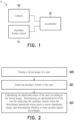
- FIG. 1 illustrates a block schematic diagram of an electronic system 1 according to an embodiment of the disclosure.
- the electronic system 1 includes a camera 10, an auxiliary feature sensor 11, and an accelerator 12.
- the camera 10 may be configured to take a facial image of a user.
- the auxiliary feature sensor 11 may be configured to sense an auxiliary feature of the same user.
- the accelerator 12 is coupled to the camera 10 and the auxiliary feature sensor 11.
- the accelerator 12 may be configured to calculate an emotional status of the user according to the facial image. When it is determined that the emotional status meets a preset emotional status, an emotional level of the user is determined by analyzing the auxiliary feature, and whether to issue an alert signal is determined accordingly.
- the accelerator 12 of the electronic system 1 may first determine the emotional status of the user according to the facial image, then assist in determining the emotional level of the user according to the auxiliary feature, and determine whether to issue an alert signal according to the emotional level in the emotional status.
- FIG. 2 illustrates a flowchart of a physiological monitoring method according to an embodiment of the disclosure.
- the physiological monitoring method shown in FIG. 2 may be applied to and executed by the electronic system 1 of FIG. 1 .
- the physiological monitoring method in FIG. 2 includes steps S20 to S22.
- step S20 the electronic system 1 may take a facial image of the user through the camera 10 and provide it to the accelerator 12.
- the auxiliary feature sensor 11 may sense the auxiliary feature of the user.
- step S22 the accelerator 12 of the electronic system 1 may calculate an emotional status of the user according to the facial image. When it is determined that the emotional status meets a preset emotional status, an emotional level of the user is determined by analyzing the auxiliary feature, and whether to issue an alert signal is determined accordingly.
- the accelerator 12 may determine the emotional status of the user through image recognition.
- the accelerator 12 may pre-store at least one image feature of a preset emotional status, and determine whether the facial image of the user belongs to a specific preset emotional status by identifying whether the facial image meets any image feature.
- the image feature stored by the accelerator 12 may be, for example, excitement, fatigue, anxiety, anger, etc., or other more agitated emotional statuses.
- the accelerator 12 may determine whether the emotion of the user falls into one of the more agitated emotional statuses by recognizing the facial image.
- the accelerator 12 may further obtain the auxiliary feature sensed by the auxiliary feature sensor 11 to determine the current emotional level of the user in that emotional status.
- the auxiliary feature sensor 11 may be, for example, an infrared camera, configured to sense an auxiliary feature such as a facial temperature change signal.
- the auxiliary feature sensor 11 may be, for example, other wearable or non-wearable sensing devices, which may be configured to sense auxiliary features such as at least one of blood pressure, blood oxygen, pulse, body temperature, or other similar parameters.
- the accelerator 12 may further refer to the facial temperature change signal to determine whether the facial temperature change of the user is too high, and further determine whether the emotional level of the user under the excitement emotion is too high, that is, an overly excited emotional status.
- the accelerator 12 may sense temperature changes in some or all areas of the face of the user, such as the forehead, cheeks, etc., or sense the average temperature change of the entire face.
- the accelerator 12 may determine whether the rising change of the facial temperature of the user is still within the normal range through the facial temperature change signal.
- the accelerator 12 may determine whether the decreasing change of the facial temperature of the user is within the normal range through the facial temperature change signal.
- the normal range of the facial temperature change signal may have a fixed or variable temperature threshold.
- the variable temperature threshold may take into account changes in the reference room temperature or other variables.
- the accelerator 12 may also refer to the rise or fall of the room temperature change. After deducting the change in facial temperature change due to the room temperature change, the emotional level is determined according to the deducted facial temperature change, thereby increasing the accuracy of determining the emotional level. In this way, the accelerator 12 may determine the emotional status of the user according to the facial image, and determine the emotional level of the user according to the auxiliary feature.
- the auxiliary feature used by the accelerator 12 to determine the emotion level may also be one of physiological change signals such as blood pressure, blood oxygen, pulse, body temperature, etc.
- the accelerator 12 may determine the emotional level of the user according to whether the physiological change signal exceeds a preset range. For example, the normal range of a pulse rate of the user should fall between 60 and 100 beats per minute. The accelerator 12 may determine the emotional level of the user by determining whether the pulse of the user exceeds the normal range or whether the pulse change quantity increases or decreases excessively.
- the accelerator 12 may determine and issue an alert signal accordingly.
- the accelerator 12 can, for example, remind the user in the form of image display, sound, vibration, etc.
- the alert signal may be sent by the electronic system 1 to the emergency contact of the user through a network. In this way, the electronic system 1 may determine whether the physiological status of the user is detrimental to health according to the calculated emotional status and the corresponding emotional level, and may issue a corresponding alert signal according to the urgency level.
- the disposition location of the accelerator 12 may be, for example, integrated on the motherboard, or separately disposed on a keyboard, mouse, connector, or peripheral device.
- the accelerator 12 may be, for example, a central processing unit (CPU), a graphics processing unit (GPU), an arithmetic logic unit (ALU), a field programmable gate array (FPGA), any other type of integrated circuit, state machine, an advanced RISC machine (ARM) based processor, other similar elements, or a combination of the above elements.
- the accelerator 12 may store a pre-trained artificial intelligence (Al) model.
- the artificial intelligence model may be trained by a data set including multiple facial images with pre-labeled emotional statuses, so that the artificial intelligence model may classify subsequent input facial images to determine whether the facial images fall into any of the preset emotional statuses.
- the accelerator 12 may perform image recognition on the facial image by executing the artificial intelligence model to determine the emotional status of the user.
- the artificial intelligence model stored in the accelerator 12 may be a machine learning model of supervised or unsupervised learning, or a deep learning model under the above classification, such as a region-based convolutional neural network (RCNN) series, which may be, for example, RCNN, fast RCNN, mask RCNN and faster RCNN, SSD and YOLO (you only look once) series (e.g., YOLO, YOLOv2, YOLO 9000 and YOLOv3) and other models.
- RCNN region-based convolutional neural network
- YOLO young only look once series
- the above-mentioned artificial intelligence model may be built based on decision trees, logistic regression, SVM (support vector machine), naive Bayes, kNN, or other suitable algorithms.
- the aforementioned deep learning model may also consider aspects such as its image preprocessing, model architecture, model depth, convolution layer parameters, pooling layer, activation function, loss function, specific architecture of each model, design philosophies, accuracy, and execution speed. By combining, adding, adjusting, and modifying these aspects, one may create a customized deep learning model.
- the auxiliary feature sensor 11 may have one or more sensors according to the requirements of the electronic system 1.
- the auxiliary feature sensor 11 includes, for example, an infrared camera to take and display the temperature change of the face of the user.
- the auxiliary feature sensor 11 may be, for example, a wearable sensing device such as a watch or bracelet, or may be a non-wearable sensing device disposed on a mouse, mouse pad, or earphones.
- FIG. 3 is a flowchart of a physiological monitoring method according to an embodiment of the disclosure.
- the physiological monitoring method shown in FIG. 3 may be applied to and executed by the electronic system 1 of FIG. 1 .
- the physiological monitoring method in FIG. 3 includes steps S30 to S37.
- the camera 10 may take a facial image of the user and provide it to the accelerator 12.
- the auxiliary feature sensor 11 may be, for example, an infrared temperature sensor, which may be configured to sense the facial temperature of the user, and provide a facial temperature change signal to the accelerator 12 accordingly.
- the auxiliary feature sensor 11 may also have other wearable or non-wearable sensing instruments for sensing physiological change signals of at least one of parameters such as blood pressure, blood oxygen, pulse, body temperature, or other similar parameters of the user, and provide them to the accelerator 12.
- the accelerator 12 may determine the emotional status of the user according to the facial image. For example, the accelerator 12 may identify the lines in the facial image through image recognition to determine the emotional status of the user. It may discern whether the user is in a state of excitement, fatigue, anxiety, anger, or other more agitated emotional statuses, or in a state of depression, fatigue, or other more negative emotional statuses. In these emotional statuses, the accelerator 12 may further determine the emotional level of the user in the emotion according to the facial temperature change signal and the physiological change signal.
- step S34 the accelerator 12 evaluates whether the emotional status and emotional level of the user reach a first alert level or a second alert level, and accordingly determines whether to proceed to step S35 to issue the first alert signal, or to proceed to steps S36 to S37 to issue the second alert signal, or, in the absence of reaching any alert level, to continuously monitor the emotional status of the user, the facial temperature change, and the physiological condition.
- the accelerator 12 may determine the emotional status of the user according to the facial image, and determine the emotional level of the user in the emotional status of the user according to the facial temperature change signal.
- the accelerator 12 may determine that the first alert level has been reached and proceed to step S35 to instruct the first alert signal to be issued.
- the accelerator 12 may also use the physiological change signal as an auxiliary to the facial temperature change signal to further confirm whether the physiological status of the user has reached the more urgent second alert status. For example, when the accelerator 12 determines that the emotional level of the user falls into the second range according to the facial temperature change signal, which may include when the emotion level is too high (e.g., higher than the second upper limit, and the second upper limit is greater than the first upper limit) or the emotion level is too low (e.g., lower than the second lower limit, and the second lower limit is less than the first lower limit), the accelerator 12 may further refer to whether the physiological change signal exceeds a preset range.
- the facial temperature change signal which may include when the emotion level is too high (e.g., higher than the second upper limit, and the second upper limit is greater than the first upper limit) or the emotion level is too low (e.g., lower than the second lower limit, and the second lower limit is less than the first lower limit).
- the accelerator 12 may determine that the emotion of the user has reached the second alert level accordingly, which means that the physiological status of the user has reached a more urgent situation, and accordingly proceed to step S36 to attempt to issue a second alert signal.
- step S36 the electronic system 1 may evaluate whether its network function is turned on or whether it has the permission to turn on the network function, and when the network function is turned on or it has the permission to enable the network function, the electronic system 1 proceeds to step S37 to issue a second alert signal to the emergency contact of the user through the network.
- the accelerator 12 gives up issuing the second alert signal.
- the electronic system and physiological monitoring method of the disclosure may perform real-time monitoring of the physiological status of the user to issue an alert signal when the physiological status of the user is critical, and effectively issue alerts for the critical status of the user caused by fatigue, excessive use of electronic devices or stress, so that the user may take emergency measures accordingly.
Landscapes
- Health & Medical Sciences (AREA)
- Engineering & Computer Science (AREA)
- Life Sciences & Earth Sciences (AREA)
- General Health & Medical Sciences (AREA)
- Physics & Mathematics (AREA)
- Medical Informatics (AREA)
- Biomedical Technology (AREA)
- Public Health (AREA)
- Biophysics (AREA)
- Pathology (AREA)
- Heart & Thoracic Surgery (AREA)
- Veterinary Medicine (AREA)
- Molecular Biology (AREA)
- Surgery (AREA)
- Animal Behavior & Ethology (AREA)
- Theoretical Computer Science (AREA)
- Multimedia (AREA)
- General Physics & Mathematics (AREA)
- Physiology (AREA)
- Cardiology (AREA)
- Psychiatry (AREA)
- Human Computer Interaction (AREA)
- Artificial Intelligence (AREA)
- Evolutionary Computation (AREA)
- Primary Health Care (AREA)
- Epidemiology (AREA)
- Oral & Maxillofacial Surgery (AREA)
- Databases & Information Systems (AREA)
- Computer Vision & Pattern Recognition (AREA)
- Educational Technology (AREA)
- Software Systems (AREA)
- Developmental Disabilities (AREA)
- Child & Adolescent Psychology (AREA)
- Hospice & Palliative Care (AREA)
- Psychology (AREA)
- Social Psychology (AREA)
- Computing Systems (AREA)
- Physical Education & Sports Medicine (AREA)
- Computer Networks & Wireless Communication (AREA)
- Data Mining & Analysis (AREA)
Abstract
Electronic system (1) and physiological monitoring method are provided. The electronic system (1) includes a camera (10), an auxiliary feature sensor (11), and an accelerator (12). The camera (10) is configured to take a facial image of a user. The auxiliary feature sensor (11) is configured to sense an auxiliary feature of the user. The accelerator (12) is configured to calculate an emotional status of the user according to the facial image. When it is determined that the emotional status meets a preset emotional status, the accelerator (12) is configured to calculate an emotional level of the user by analyzing the auxiliary feature, and determine whether to issue an alert signal accordingly.
Description
- The disclosure relates to an electronic system and a physiological monitoring method, and in particular relates to an electronic system and a physiological monitoring method configured to monitor a health status.
- In contemporary society, people often find themselves under conditions of high pressure and long working hours. In this situation, how to appropriately remind users so that they may make immediate responses or improvements is one of the most important issues to address.
- An electronic system and a physiological monitoring method, which may monitor a physiological status of a user and issue alerts when necessary, are provided in the disclosure.
- The electronic system of the disclosure includes a camera, an auxiliary feature sensor, and an accelerator. The camera is configured to take a facial image of a user. The auxiliary feature sensor is configured to sense an auxiliary feature of the user. The accelerator is configured to calculate an emotional status of the user according to the facial image. When it is determined that the emotional status meets a preset emotional status, the accelerator is configured to determine an emotional level of the user by analyzing the auxiliary feature, and determine whether to issue an alert signal accordingly.
- The physiological monitoring method of the disclosure includes the following operation. A facial image of a user is taken. An auxiliary feature of the user is sensed. An emotional status of the user is calculated according to the facial image. When it is determined that the emotional status meets a preset emotional status, an emotional level of the user is determined by analyzing the auxiliary feature, and whether to issue an alert signal is determined accordingly.
- Based on the above, the electronic system and physiological monitoring method of the disclosure may continuously monitor the emotional and physiological status of the user, and determine whether to issue an alert signal accordingly.
-
-
FIG. 1 illustrates a block schematic diagram of anelectronic system 1 according to an embodiment of the disclosure. -
FIG. 2 illustrates a flowchart of a physiological monitoring method according to an embodiment of the disclosure. -
FIG. 3 is a flowchart of a physiological monitoring method according to an embodiment of the disclosure. -
FIG. 1 illustrates a block schematic diagram of anelectronic system 1 according to an embodiment of the disclosure. As shown inFIG. 1 , theelectronic system 1 includes acamera 10, anauxiliary feature sensor 11, and anaccelerator 12. Thecamera 10 may be configured to take a facial image of a user. Theauxiliary feature sensor 11 may be configured to sense an auxiliary feature of the same user. Theaccelerator 12 is coupled to thecamera 10 and theauxiliary feature sensor 11. Theaccelerator 12 may be configured to calculate an emotional status of the user according to the facial image. When it is determined that the emotional status meets a preset emotional status, an emotional level of the user is determined by analyzing the auxiliary feature, and whether to issue an alert signal is determined accordingly. - To put it simply, in some embodiments, the
accelerator 12 of theelectronic system 1 may first determine the emotional status of the user according to the facial image, then assist in determining the emotional level of the user according to the auxiliary feature, and determine whether to issue an alert signal according to the emotional level in the emotional status. -
FIG. 2 illustrates a flowchart of a physiological monitoring method according to an embodiment of the disclosure. The physiological monitoring method shown inFIG. 2 may be applied to and executed by theelectronic system 1 ofFIG. 1 . Specifically, the physiological monitoring method inFIG. 2 includes steps S20 to S22. - In step S20, the
electronic system 1 may take a facial image of the user through thecamera 10 and provide it to theaccelerator 12. In step S21, theauxiliary feature sensor 11 may sense the auxiliary feature of the user. Finally, in step S22, theaccelerator 12 of theelectronic system 1 may calculate an emotional status of the user according to the facial image. When it is determined that the emotional status meets a preset emotional status, an emotional level of the user is determined by analyzing the auxiliary feature, and whether to issue an alert signal is determined accordingly. - Specifically, in step S22, after receiving the facial image, the
accelerator 12 may determine the emotional status of the user through image recognition. In some embodiments, theaccelerator 12 may pre-store at least one image feature of a preset emotional status, and determine whether the facial image of the user belongs to a specific preset emotional status by identifying whether the facial image meets any image feature. For example, in order to monitor the health status of the user, the image feature stored by theaccelerator 12 may be, for example, excitement, fatigue, anxiety, anger, etc., or other more agitated emotional statuses. Theaccelerator 12 may determine whether the emotion of the user falls into one of the more agitated emotional statuses by recognizing the facial image. - Furthermore, when the
accelerator 12 determines that the user falls into a preset emotional status, theaccelerator 12 may further obtain the auxiliary feature sensed by theauxiliary feature sensor 11 to determine the current emotional level of the user in that emotional status. In some embodiments, theauxiliary feature sensor 11 may be, for example, an infrared camera, configured to sense an auxiliary feature such as a facial temperature change signal. Alternatively, theauxiliary feature sensor 11 may be, for example, other wearable or non-wearable sensing devices, which may be configured to sense auxiliary features such as at least one of blood pressure, blood oxygen, pulse, body temperature, or other similar parameters. - Taking the facial temperature change as an example, when the
accelerator 12 determines that the user is likely to be in an excited status according to the facial image, theaccelerator 12 may further refer to the facial temperature change signal to determine whether the facial temperature change of the user is too high, and further determine whether the emotional level of the user under the excitement emotion is too high, that is, an overly excited emotional status. Specifically, theaccelerator 12 may sense temperature changes in some or all areas of the face of the user, such as the forehead, cheeks, etc., or sense the average temperature change of the entire face. In some embodiments, when theaccelerator 12 determines that the emotional status of the user changes to a more agitated emotional status such as excitement or anger according to the facial image, the user generally has a higher facial temperature, therefore theaccelerator 12 may determine whether the rising change of the facial temperature of the user is still within the normal range through the facial temperature change signal. On the contrary, when theaccelerator 12 determines that the emotional status of the user changes to a more negative emotional status such as depression or fatigue, the user generally has a lower facial temperature, and theaccelerator 12 may determine whether the decreasing change of the facial temperature of the user is within the normal range through the facial temperature change signal. - In some embodiments, the normal range of the facial temperature change signal may have a fixed or variable temperature threshold. For example, the variable temperature threshold may take into account changes in the reference room temperature or other variables. For example, the
accelerator 12 may also refer to the rise or fall of the room temperature change. After deducting the change in facial temperature change due to the room temperature change, the emotional level is determined according to the deducted facial temperature change, thereby increasing the accuracy of determining the emotional level. In this way, theaccelerator 12 may determine the emotional status of the user according to the facial image, and determine the emotional level of the user according to the auxiliary feature. - In some embodiments, the auxiliary feature used by the
accelerator 12 to determine the emotion level may also be one of physiological change signals such as blood pressure, blood oxygen, pulse, body temperature, etc. Specifically, similar to the above-mentioned process of determining the emotional level according to the facial temperature change, theaccelerator 12 may determine the emotional level of the user according to whether the physiological change signal exceeds a preset range. For example, the normal range of a pulse rate of the user should fall between 60 and 100 beats per minute. Theaccelerator 12 may determine the emotional level of the user by determining whether the pulse of the user exceeds the normal range or whether the pulse change quantity increases or decreases excessively. - Then, when the
accelerator 12 determines that the emotion of the user is too high or too low according to the auxiliary feature, theaccelerator 12 may determine and issue an alert signal accordingly. In some embodiments, theaccelerator 12 can, for example, remind the user in the form of image display, sound, vibration, etc. Alternatively, the alert signal may be sent by theelectronic system 1 to the emergency contact of the user through a network. In this way, theelectronic system 1 may determine whether the physiological status of the user is detrimental to health according to the calculated emotional status and the corresponding emotional level, and may issue a corresponding alert signal according to the urgency level. - In some embodiments, the disposition location of the
accelerator 12 may be, for example, integrated on the motherboard, or separately disposed on a keyboard, mouse, connector, or peripheral device. In some embodiments, theaccelerator 12 may be, for example, a central processing unit (CPU), a graphics processing unit (GPU), an arithmetic logic unit (ALU), a field programmable gate array (FPGA), any other type of integrated circuit, state machine, an advanced RISC machine (ARM) based processor, other similar elements, or a combination of the above elements. Theaccelerator 12 may store a pre-trained artificial intelligence (Al) model. The artificial intelligence model may be trained by a data set including multiple facial images with pre-labeled emotional statuses, so that the artificial intelligence model may classify subsequent input facial images to determine whether the facial images fall into any of the preset emotional statuses. Theaccelerator 12 may perform image recognition on the facial image by executing the artificial intelligence model to determine the emotional status of the user. For example, the artificial intelligence model stored in theaccelerator 12 may be a machine learning model of supervised or unsupervised learning, or a deep learning model under the above classification, such as a region-based convolutional neural network (RCNN) series, which may be, for example, RCNN, fast RCNN, mask RCNN and faster RCNN, SSD and YOLO (you only look once) series (e.g., YOLO, YOLOv2, YOLO 9000 and YOLOv3) and other models. Furthermore, the above-mentioned artificial intelligence model may be built based on decision trees, logistic regression, SVM (support vector machine), naive Bayes, kNN, or other suitable algorithms. In addition, for the aforementioned deep learning model, one may also consider aspects such as its image preprocessing, model architecture, model depth, convolution layer parameters, pooling layer, activation function, loss function, specific architecture of each model, design philosophies, accuracy, and execution speed. By combining, adding, adjusting, and modifying these aspects, one may create a customized deep learning model. - In some embodiments, the
auxiliary feature sensor 11 may have one or more sensors according to the requirements of theelectronic system 1. For example, when theaccelerator 12 needs to evaluate the emotional level based on the facial temperature change signal, theauxiliary feature sensor 11 includes, for example, an infrared camera to take and display the temperature change of the face of the user. When theaccelerator 12 determines the emotional level according to, for example, blood pressure, blood oxygen, pulse, body temperature or other similar physiological change signals, theauxiliary feature sensor 11 may be, for example, a wearable sensing device such as a watch or bracelet, or may be a non-wearable sensing device disposed on a mouse, mouse pad, or earphones. -
FIG. 3 is a flowchart of a physiological monitoring method according to an embodiment of the disclosure. The physiological monitoring method shown inFIG. 3 may be applied to and executed by theelectronic system 1 ofFIG. 1 . Specifically, the physiological monitoring method inFIG. 3 includes steps S30 to S37. - In step S30, the
camera 10 may take a facial image of the user and provide it to theaccelerator 12. In step S31, theauxiliary feature sensor 11 may be, for example, an infrared temperature sensor, which may be configured to sense the facial temperature of the user, and provide a facial temperature change signal to theaccelerator 12 accordingly. In step S32, in addition to the above-mentioned infrared temperature sensor, theauxiliary feature sensor 11 may also have other wearable or non-wearable sensing instruments for sensing physiological change signals of at least one of parameters such as blood pressure, blood oxygen, pulse, body temperature, or other similar parameters of the user, and provide them to theaccelerator 12. - In step S33, the
accelerator 12 may determine the emotional status of the user according to the facial image. For example, theaccelerator 12 may identify the lines in the facial image through image recognition to determine the emotional status of the user. It may discern whether the user is in a state of excitement, fatigue, anxiety, anger, or other more agitated emotional statuses, or in a state of depression, fatigue, or other more negative emotional statuses. In these emotional statuses, theaccelerator 12 may further determine the emotional level of the user in the emotion according to the facial temperature change signal and the physiological change signal. - In step S34, the
accelerator 12 evaluates whether the emotional status and emotional level of the user reach a first alert level or a second alert level, and accordingly determines whether to proceed to step S35 to issue the first alert signal, or to proceed to steps S36 to S37 to issue the second alert signal, or, in the absence of reaching any alert level, to continuously monitor the emotional status of the user, the facial temperature change, and the physiological condition. Specifically, theaccelerator 12 may determine the emotional status of the user according to the facial image, and determine the emotional level of the user in the emotional status of the user according to the facial temperature change signal. When theaccelerator 12 determines that the emotional level of the user falls into the first range, which may include when the emotion level is higher (e.g., higher than the first upper limit) or lower (e.g., lower than the first lower limit), theaccelerator 12 may determine that the first alert level has been reached and proceed to step S35 to instruct the first alert signal to be issued. - Furthermore, the
accelerator 12 may also use the physiological change signal as an auxiliary to the facial temperature change signal to further confirm whether the physiological status of the user has reached the more urgent second alert status. For example, when theaccelerator 12 determines that the emotional level of the user falls into the second range according to the facial temperature change signal, which may include when the emotion level is too high (e.g., higher than the second upper limit, and the second upper limit is greater than the first upper limit) or the emotion level is too low (e.g., lower than the second lower limit, and the second lower limit is less than the first lower limit), theaccelerator 12 may further refer to whether the physiological change signal exceeds a preset range. When theaccelerator 12 determines that the emotion level of the user is too high or too low, and the physiological change signal exceeds the preset range, theaccelerator 12 may determine that the emotion of the user has reached the second alert level accordingly, which means that the physiological status of the user has reached a more urgent situation, and accordingly proceed to step S36 to attempt to issue a second alert signal. - In step S36, the
electronic system 1 may evaluate whether its network function is turned on or whether it has the permission to turn on the network function, and when the network function is turned on or it has the permission to enable the network function, theelectronic system 1 proceeds to step S37 to issue a second alert signal to the emergency contact of the user through the network. When the evaluation result is negative, theaccelerator 12 gives up issuing the second alert signal. - In summary, the electronic system and physiological monitoring method of the disclosure may perform real-time monitoring of the physiological status of the user to issue an alert signal when the physiological status of the user is critical, and effectively issue alerts for the critical status of the user caused by fatigue, excessive use of electronic devices or stress, so that the user may take emergency measures accordingly.
Claims (15)
- An electronic system (1), comprising:a camera (10), configured to take a facial image of a user;an auxiliary feature sensor (11), configured to sense an auxiliary feature of the user; andan accelerator (12), configured to calculate an emotional status of the user according to the facial image, determine an emotional level of the user in the emotional status by analyzing the auxiliary feature when it is determined that the emotional status meets a preset emotional status, and determine whether to issue an alert signal accordingly.
- The electronic system (1) according to claim 1, wherein the accelerator (12) determines the emotional status of the user by recognizing the facial image through an image recognition technology.
- The electronic system (1) according to claim 2, wherein the accelerator (12) determines the emotional status of the user by performing the image recognition technology on the facial image through executing an artificial intelligence model.
- The electronic system (1) according to claim 1, wherein the auxiliary feature comprises a facial temperature change signal, and the accelerator (12) determines the emotional level of the user in the emotional status by analyzing the facial temperature change signal of the user.
- The electronic system (1) according to claim 1, wherein the auxiliary feature comprises a physiological change signal, the physiological change signal comprises at least one of blood pressure, blood oxygen, pulse, and body temperature, the accelerator (12) determines the emotional level of the user in the emotional status by analyzing the physiological change signal.
- The electronic system (1) according to claim 4, wherein the auxiliary feature further comprises a physiological change signal, the accelerator (12) determines the emotional level of the user by analyzing the facial temperature change signal, and then verifies the emotional level by analyzing the physiological change signal.
- The electronic system (1) according to claim 1, wherein the accelerator (12) instructs a first alert device to issue a first alert signal when the accelerator (12) determines that the emotion level of the user falls into a first range,
wherein the accelerator (12) issues a second alert signal through a network after confirming that a network setting of the electronic system (1) is turned on when the accelerator (12) determines that the emotion level of the user falls into a second range. - The electronic system (1) according to claim 1, wherein the accelerator (12) is disposed on a motherboard or a connector, or is disposed on an edge device connected through a connection terminal or a transmission line.
- A physiological monitoring method, comprising:taking a facial image of a user;sensing an auxiliary feature of the user; andcalculating an emotional status of the user according to the facial image, determining an emotional level of the user in the emotional status by analyzing the auxiliary feature when it is determined that the emotional status meets a preset emotional status, and determining whether to issue an alert signal accordingly.
- The physiological monitoring method according to claim 9, comprising:
determining the emotional status of the user by recognizing the facial image through an image recognition technology. - The physiological monitoring method according to claim 10, comprising:
determining the emotional status of the user by performing the image recognition technology on the facial image through executing an artificial intelligence model. - The physiological monitoring method according to claim 9, wherein the auxiliary feature comprises a facial temperature change signal, the physiological monitoring method comprises:
determining the emotional level of the user in the emotional status by analyzing the facial temperature change signal of the user. - The physiological monitoring method according to claim 9, wherein the auxiliary feature comprises a physiological change signal, the physiological change signal comprises at least one of blood pressure, blood oxygen, pulse, and body temperature, the physiological monitoring method comprises:
determining the emotional level of the user in the emotional status by analyzing the physiological change signal. - The physiological monitoring method according to claim 12, wherein the auxiliary feature further comprises a physiological change signal, the physiological monitoring method comprises:
determining the emotional level of the user by analyzing the facial temperature change signal, and then verifying the emotional level by analyzing the physiological change signal. - The physiological monitoring method according to claim 9, comprising:instructing a first alert signal to be issued when determining that the emotion level of the user falls into a first range,issuing a second alert signal through a network after confirming that a network setting is turned on when determining that the emotion level of the user falls into a second range.
Applications Claiming Priority (1)
| Application Number | Priority Date | Filing Date | Title |
|---|---|---|---|
| TW112150251A TWI883730B (en) | 2023-12-22 | 2023-12-22 | Electronic device and physiological monitoring method |
Publications (1)
| Publication Number | Publication Date |
|---|---|
| EP4574041A1 true EP4574041A1 (en) | 2025-06-25 |
Family
ID=90731359
Family Applications (1)
| Application Number | Title | Priority Date | Filing Date |
|---|---|---|---|
| EP24170159.8A Pending EP4574041A1 (en) | 2023-12-22 | 2024-04-15 | Electronic system and physiological monitoring method |
Country Status (5)
| Country | Link |
|---|---|
| US (1) | US20250210177A1 (en) |
| EP (1) | EP4574041A1 (en) |
| JP (1) | JP7696041B1 (en) |
| KR (1) | KR20250098828A (en) |
| TW (1) | TWI883730B (en) |
Citations (9)
| Publication number | Priority date | Publication date | Assignee | Title |
|---|---|---|---|---|
| US20170162072A1 (en) * | 2015-12-04 | 2017-06-08 | Saudi Arabian Oil Company | Systems, Computer Medium and Methods for Management Training Systems |
| WO2018028115A1 (en) * | 2016-08-12 | 2018-02-15 | 深圳市元征科技股份有限公司 | Fatigue driving early warning method and cloud server |
| US20180092587A1 (en) * | 2015-06-14 | 2018-04-05 | Facense Ltd. | Selecting a stressor based on thermal measurements of the face |
| CN108960022A (en) * | 2017-09-19 | 2018-12-07 | 炬大科技有限公司 | A kind of Emotion identification method and device thereof |
| WO2020104722A1 (en) * | 2018-11-21 | 2020-05-28 | Universidad Carlos Iii De Madrid | System and method for determining the emotional state of a user |
| TWI739675B (en) * | 2020-11-25 | 2021-09-11 | 友達光電股份有限公司 | Image recognition method and apparatus |
| CN114515150A (en) * | 2020-11-20 | 2022-05-20 | 常州星宇车灯股份有限公司 | Driver emotion detection device and method with facial recognition and inertial measurement |
| JP2023004253A (en) * | 2021-06-25 | 2023-01-17 | 株式会社Jvcケンウッド | Driving evaluation control device and driving evaluation control method |
| CN114626818B (en) * | 2022-03-16 | 2023-05-02 | 湖南检信智能科技有限公司 | Big data-based pre-post emotion comprehensive assessment method |
Family Cites Families (9)
| Publication number | Priority date | Publication date | Assignee | Title |
|---|---|---|---|---|
| US10869626B2 (en) * | 2010-06-07 | 2020-12-22 | Affectiva, Inc. | Image analysis for emotional metric evaluation |
| JP6985005B2 (en) * | 2015-10-14 | 2021-12-22 | パナソニック インテレクチュアル プロパティ コーポレーション オブ アメリカPanasonic Intellectual Property Corporation of America | Emotion estimation method, emotion estimation device, and recording medium on which the program is recorded. |
| CN108135491B (en) * | 2015-10-15 | 2022-01-28 | 大金工业株式会社 | Physiological state determination device and physiological state determination method |
| JP6863563B2 (en) * | 2016-03-31 | 2021-04-21 | 株式会社Triart | Stress evaluation system |
| JP2018102705A (en) * | 2016-12-27 | 2018-07-05 | 本田技研工業株式会社 | Feeling improvement device and feeling improvement method |
| CN111202534B (en) * | 2020-02-27 | 2025-09-05 | 王从海 | A method of emotion prediction based on group temperature monitoring |
| CN113143274B (en) * | 2021-03-31 | 2023-11-10 | 中国科学院心理研究所 | Camera-based emotional early warning method |
| WO2022242825A1 (en) * | 2021-05-17 | 2022-11-24 | Etone Motion Analysis Gmbh | Training system and method with emotion assessment |
| CN217825162U (en) * | 2022-05-24 | 2022-11-15 | 郑礼忠 | Real-environment-experience care system |
-
2023
- 2023-12-22 TW TW112150251A patent/TWI883730B/en active
-
2024
- 2024-03-22 US US18/613,147 patent/US20250210177A1/en active Pending
- 2024-04-15 EP EP24170159.8A patent/EP4574041A1/en active Pending
- 2024-04-15 JP JP2024065456A patent/JP7696041B1/en active Active
- 2024-05-17 KR KR1020240064616A patent/KR20250098828A/en active Pending
Patent Citations (9)
| Publication number | Priority date | Publication date | Assignee | Title |
|---|---|---|---|---|
| US20180092587A1 (en) * | 2015-06-14 | 2018-04-05 | Facense Ltd. | Selecting a stressor based on thermal measurements of the face |
| US20170162072A1 (en) * | 2015-12-04 | 2017-06-08 | Saudi Arabian Oil Company | Systems, Computer Medium and Methods for Management Training Systems |
| WO2018028115A1 (en) * | 2016-08-12 | 2018-02-15 | 深圳市元征科技股份有限公司 | Fatigue driving early warning method and cloud server |
| CN108960022A (en) * | 2017-09-19 | 2018-12-07 | 炬大科技有限公司 | A kind of Emotion identification method and device thereof |
| WO2020104722A1 (en) * | 2018-11-21 | 2020-05-28 | Universidad Carlos Iii De Madrid | System and method for determining the emotional state of a user |
| CN114515150A (en) * | 2020-11-20 | 2022-05-20 | 常州星宇车灯股份有限公司 | Driver emotion detection device and method with facial recognition and inertial measurement |
| TWI739675B (en) * | 2020-11-25 | 2021-09-11 | 友達光電股份有限公司 | Image recognition method and apparatus |
| JP2023004253A (en) * | 2021-06-25 | 2023-01-17 | 株式会社Jvcケンウッド | Driving evaluation control device and driving evaluation control method |
| CN114626818B (en) * | 2022-03-16 | 2023-05-02 | 湖南检信智能科技有限公司 | Big data-based pre-post emotion comprehensive assessment method |
Also Published As
| Publication number | Publication date |
|---|---|
| KR20250098828A (en) | 2025-07-01 |
| TWI883730B (en) | 2025-05-11 |
| TW202525237A (en) | 2025-07-01 |
| US20250210177A1 (en) | 2025-06-26 |
| JP7696041B1 (en) | 2025-06-19 |
| JP2025100284A (en) | 2025-07-03 |
Similar Documents
| Publication | Publication Date | Title |
|---|---|---|
| EP3254213A1 (en) | Pain management wearable device | |
| CN119015036B (en) | A medical restraint belt intelligent management method and system | |
| US20250210177A1 (en) | Electronic system and physiological monitoring method | |
| CN119867675B (en) | Patient real-time monitoring management system based on intelligent wrist strap | |
| CN115471824A (en) | Eye state detection method and device, electronic equipment and storage medium | |
| CN117942039B (en) | Sleep quality monitoring method and device, electronic equipment and storage medium | |
| CN120189114A (en) | Electronic system and physiological monitoring method | |
| CN113474789A (en) | Determining relative cognitive abilities of a subject | |
| US12310731B2 (en) | Method and system for determining and monitoring relative consciousness of a subject | |
| CN117017249B (en) | Blood pressure detecting device | |
| US20260073784A1 (en) | System | |
| US20260057222A1 (en) | System | |
| EP4699518A1 (en) | Generating physiological information | |
| CN121365230A (en) | Sleep quality assessment method based on biological data | |
| CN120581042A (en) | Interaction method, device and electronic equipment | |
| JP2026064047A (en) | system | |
| JP2026019101A (en) | system | |
| WO2026033555A1 (en) | Method and system for caculating driving readiness score | |
| CN120595913A (en) | Height adjustment method, device, electronic device and storage medium for scroll screen | |
| TWI696459B (en) | Eye rehabilitation system | |
| CN119937967A (en) | Display method, device and electronic equipment | |
| KR20260009168A (en) | Device for analyzing movements of infants and toddlers and method for controlling the same | |
| JP2026030193A (en) | system | |
| JP2026032864A (en) | system | |
| JP2026024758A (en) | system |
Legal Events
| Date | Code | Title | Description |
|---|---|---|---|
| PUAI | Public reference made under article 153(3) epc to a published international application that has entered the european phase |
Free format text: ORIGINAL CODE: 0009012 |
|
| STAA | Information on the status of an ep patent application or granted ep patent |
Free format text: STATUS: EXAMINATION IS IN PROGRESS |
|
| 17P | Request for examination filed |
Effective date: 20241107 |
|
| AK | Designated contracting states |
Kind code of ref document: A1 Designated state(s): AL AT BE BG CH CY CZ DE DK EE ES FI FR GB GR HR HU IE IS IT LI LT LU LV MC ME MK MT NL NO PL PT RO RS SE SI SK SM TR |