EP4568412A2 - Ressourcenkonfiguration für sidelink-kommunikation - Google Patents
Ressourcenkonfiguration für sidelink-kommunikation Download PDFInfo
- Publication number
- EP4568412A2 EP4568412A2 EP25166063.5A EP25166063A EP4568412A2 EP 4568412 A2 EP4568412 A2 EP 4568412A2 EP 25166063 A EP25166063 A EP 25166063A EP 4568412 A2 EP4568412 A2 EP 4568412A2
- Authority
- EP
- European Patent Office
- Prior art keywords
- sidelink
- information
- resource
- configuration
- qos
- Prior art date
- Legal status (The legal status is an assumption and is not a legal conclusion. Google has not performed a legal analysis and makes no representation as to the accuracy of the status listed.)
- Pending
Links
Images




Classifications
-
- H—ELECTRICITY
- H04—ELECTRIC COMMUNICATION TECHNIQUE
- H04W—WIRELESS COMMUNICATION NETWORKS
- H04W72/00—Local resource management
- H04W72/20—Control channels or signalling for resource management
- H04W72/29—Control channels or signalling for resource management between an access point and the access point controlling device
-
- H—ELECTRICITY
- H04—ELECTRIC COMMUNICATION TECHNIQUE
- H04W—WIRELESS COMMUNICATION NETWORKS
- H04W4/00—Services specially adapted for wireless communication networks; Facilities therefor
- H04W4/30—Services specially adapted for particular environments, situations or purposes
- H04W4/40—Services specially adapted for particular environments, situations or purposes for vehicles, e.g. vehicle-to-pedestrians [V2P]
-
- H—ELECTRICITY
- H04—ELECTRIC COMMUNICATION TECHNIQUE
- H04W—WIRELESS COMMUNICATION NETWORKS
- H04W4/00—Services specially adapted for wireless communication networks; Facilities therefor
- H04W4/30—Services specially adapted for particular environments, situations or purposes
- H04W4/40—Services specially adapted for particular environments, situations or purposes for vehicles, e.g. vehicle-to-pedestrians [V2P]
- H04W4/46—Services specially adapted for particular environments, situations or purposes for vehicles, e.g. vehicle-to-pedestrians [V2P] for vehicle-to-vehicle communication [V2V]
-
- H—ELECTRICITY
- H04—ELECTRIC COMMUNICATION TECHNIQUE
- H04W—WIRELESS COMMUNICATION NETWORKS
- H04W72/00—Local resource management
- H04W72/20—Control channels or signalling for resource management
-
- H—ELECTRICITY
- H04—ELECTRIC COMMUNICATION TECHNIQUE
- H04W—WIRELESS COMMUNICATION NETWORKS
- H04W76/00—Connection management
- H04W76/10—Connection setup
- H04W76/14—Direct-mode setup
-
- H—ELECTRICITY
- H04—ELECTRIC COMMUNICATION TECHNIQUE
- H04W—WIRELESS COMMUNICATION NETWORKS
- H04W92/00—Interfaces specially adapted for wireless communication networks
- H04W92/16—Interfaces between hierarchically similar devices
- H04W92/20—Interfaces between hierarchically similar devices between access points
-
- H—ELECTRICITY
- H04—ELECTRIC COMMUNICATION TECHNIQUE
- H04W—WIRELESS COMMUNICATION NETWORKS
- H04W4/00—Services specially adapted for wireless communication networks; Facilities therefor
- H04W4/06—Selective distribution of broadcast services, e.g. multimedia broadcast multicast service [MBMS]; Services to user groups; One-way selective calling services
-
- H—ELECTRICITY
- H04—ELECTRIC COMMUNICATION TECHNIQUE
- H04W—WIRELESS COMMUNICATION NETWORKS
- H04W72/00—Local resource management
- H04W72/40—Resource management for direct mode communication, e.g. D2D or sidelink
-
- H—ELECTRICITY
- H04—ELECTRIC COMMUNICATION TECHNIQUE
- H04W—WIRELESS COMMUNICATION NETWORKS
- H04W88/00—Devices specially adapted for wireless communication networks, e.g. terminals, base stations or access point devices
- H04W88/08—Access point devices
- H04W88/085—Access point devices with remote components
Definitions
- This disclosure is directed generally to digital wireless communications.
- LTE Long-Term Evolution
- 3GPP 3rd Generation Partnership Project
- LTE Advanced LTE-A
- 5G The 5th generation of wireless system, known as 5G, advances the LTE and LTE-A wireless standards and is committed to supporting higher data-rates, large number of connections, ultra-low latency, high reliability and other emerging business needs.
- a method of wireless communication includes, receiving, by a first network element, a sidelink resource request transmitted from a user equipment (UE), and communicating, via an interface between the first network element and a second network element, information about resource configuration for the UE.
- the method also includes transmitting, by the first network element, a response to the sidelink resource request.
- the first network element is a gNB-DU and the second network element is a gNB-CU.
- the sidelink resource request includes at least one of a service type, target address, destination identity, frequency of interest, subcarrier space (SCS), service QoS information, cross-RAT interest indication, or mapping relationship between (a) service type and/or target address and (b) Tx profile and/or traffic pattern corresponding to individual service type, target address, and/or destination identity.
- SCS subcarrier space
- communicating information about resource configuration for the UE comprises forwarding, by the first network element, the sidelink resource request to the second network element. In some embodiments, the forwarding is performed without decoding of the sidelink resource request by the first network element.
- the method further includes communicating sidelink communication assistance configuration information to the UE, wherein the sidelink communication assistance configuration information is included in V2X SIB
- a method for facilitating wireless communication includes receiving, by a first network element, sidelink resource request information transmitted from a second network element, wherein the sidelink resource request information includes information about a user equipment (UE). The method also includes transmitting, from the first network element to the second network element, information indicating sidelink resource configuration for the UE.
- UE user equipment
- the sidelink resource request information includes at least one of a service type, destination identity, frequency of interest, subcarrier space (SCS), service QoS information, communication type, group leader, group member, group information, cross-RAT interest indication, or mapping relationship between (a) service type and/or destination identity and (b) Tx profile and/or traffic pattern corresponding to individual service type and/or destination identity.
- SCS subcarrier space
- the sidelink resource request information includes at least one of mode 1 resource scheduling, configured grant type 2 scheduling, configured grant type 2 activation, configured grant type 2 deactivation, configured grant type 2 periodicity, mode 1 resource pool, Modulation and Coding Scheme (mcs), per destination duplication carrier sets, or mapping between (a) LCG and (b) PC5 QoS index, QFI, priority level, and/or reliability level.
- mode 1 resource scheduling configured grant type 2 scheduling, configured grant type 2 activation, configured grant type 2 deactivation, configured grant type 2 periodicity, mode 1 resource pool, Modulation and Coding Scheme (mcs), per destination duplication carrier sets, or mapping between (a) LCG and (b) PC5 QoS index, QFI, priority level, and/or reliability level.
- mcs Modulation and Coding Scheme
- the sidelink resource configuration includes at least one of a configured grant type, configured grant index; sidelink configured scheduling RNTI, periodicity, subcarrier spacing, time domain resource location, frequency domain resource location, model resource pool, resource pool for autonomous resource selection, resource pool for sidelink reception, exceptional resource pool for sidelink transmission, mapping between a sidelink logical channel and a configured grant index, scheduling request identity, PC5 5G QoS Identifier, PC5 5G QoS index, QoS Flow Identifier, priority, reliability, delay, communication range level, mapping between (a) a sidelink logical channel group identity and (b) a scheduling request identity, PC5 5G QoS Identifier, PC5 5G QoS index, QoS Flow Identifier, priority, reliability, delay, and/or communication range level, mapping between (a) a scheduling request identity and (b) a PC5 5G QoS Identifier, PC5 5G QoS index, QoS Flow Identifier, priority, reliability, delay, and/or communication range level
- the sidelink resource request information is transmitted using an F1 UE context modification request or an F1 message defined for transmitting UE sidelink information.
- the information indicating the sidelink resource configuration is transmitted using an F1 UE context modification response or an F1 message defined for transmitting UE sidelink configuration.
- the method further includes forwarding, from the first network element to the second network element, a sidelink resource request transmitted by the UE.
- the forwarding is performed using F1 UL RRC message transfer.
- the second network element generates an RRC reconfiguration message for the UE after receiving the information indicating the sidelink resource configuration. In some embodiments, the second network element transmits the RRC reconfiguration message to the first network element using F1 DL RRC message transfer. In some embodiments, the first network element transmits the RRC reconfiguration message to the UE.
- the method further includes receiving, by the first network element, V2X authorization information regarding the UE, wherein the V2X authorization information is transmitted from the second network element. In some embodiments, the method further includes storing and responding to the V2X authorization information.
- the V2X authorization information includes at least one of vehicle UE, pedestrian UE, sidelink discovery authorization, sidelink communication authorization, LTE sidelink communication authorization, NR sidelink communication authorization, sidelink cross-RAT authorization, authorization for NR sidelink unicast/groupcast/broadcast, authorization-supported service type and/or destination L2 ID list, group leader UE, group member UE, automated UE, remote driving UE, or authorization-supported service automation level.
- the V2X authorization information is transmitted using an F1 UE context setup/modification request message or another F1 message.
- the method further includes receiving, by the first network element, at least one of PC5 QoS information regarding the UE or CU part sidelink bearer configuration regarding the UE, wherein the at least one of PC5 QoS information or CU part sidelink bearer configuration is transmitted from the second network element.
- the method further includes transmitting, from the first network element to the second network element, at least one of sidelink communication assistance configuration or DU part sidelink bearer configuration.
- the PC5 QoS information includes at least one of UE PC5 AMBR, per PC5 QoS flow MFBR/GFBR/ARP, or service QoS information.
- the CU part sidelink bearer configuration includes at least one of a mapping between QFI/PC5 QoS index/priority level/reliability level/latency/communication range and SLRB/sidelink logical channel, SCS/maximum PSSCH duration of a SL LCH, whether a SL LCH is allowed to use configured grant type 1/configured grant type2/mode 1/mode 2, a threshold of duplication, duplication carrier sets of a destination, PDCP SN size, or PDCP t-reordering timer.
- the sidelink communication assistance configuration includes at least one of a mapping between QFI/PC5 QoS index/priority level/reliability level/latency/communication range and maximum PSSCH duration/SCS, a threshold of priority level or latency for using configured grant type1/type 2/mode 1/mode 2, a threshold of PER or reliability level for using RLC AM and/or PDCP duplication, or a mapping between logical channel group and priority level/reliability level.
- the DU part sidelink bearer configuration includes at least one of an RLC SN size, RLC UM mode, RLC AM mode, polling parameters, or RLC t-reassembly timer.
- the at least one of PC5 QoS information or CU part sidelink bearer configuration is transmitted using an F1 UE context setup/modification request message or another F1 message.
- the at least one of sidelink communication assistance configuration or DU part sidelink bearer configuration is transmitted using an F1 UE context setup/modification response message or another F1 message.
- the method further includes receiving, by the first network element, V2X sidelink resource pool configuration transmitted from the second network element.
- the V2X sidelink resource pool configuration includes at least one of SL BWP, reception resource pools, V2X transmission resource pool, P2X transmission resource pool, unicast/groupcast/broadcast transmission resource pool, exceptional resource pool, inter-frequency resource pools, synchronization configuration, resource selection configuration, zone configuration, threshold for sidelink transmission prioritization, anchor carrier list, CBR configuration, or PDCP duplication configuration.
- the V2X sidelink resource pool configuration is transmitted using at least one of encoded V2X SIB, CU to DU RRC container, or other F1 information element.
- the method further includes transmitting, by the first network element, V2X sidelink resource pool configuration to the second network element.
- V2X sidelink resource pool configuration is transmitted using DU to CU RRC container or other F1 information element.
- the above-described methods are embodied in the form of processor-executable code and stored in a computer-readable program medium.
- a device that is configured or operable to perform the above-described methods is disclosed.
- the Internet of Vehicles can generally refer to a large scale network system that enables wireless communication and information exchange between vehicle(s) and everything (X) according to agreed-upon communication protocol(s) and data interaction standard(s).
- X can be vehicle(s), pedestrian(s), roadside equipment, the Internet, or the like.
- vehicle can include a car, a bicycle, an electric car, a scooter, a boat, an airplane, or a train.
- Communication through IoV can help vehicles to achieve driving safety, improve traffic efficiency, and access convenience and/or entertainment information.
- IoV communication can include three different types: vehicle-to-vehicle (V2V) communication, vehicle to infrastructure / vehicle to network (V2I/V2N) communication, and vehicle to pedestrian (V2P) communication, which collectively can be referred to as vehicle to everything (V2X) communication.
- V2V vehicle-to-vehicle
- V2I/V2N vehicle to infrastructure / vehicle to network
- V2P vehicle to pedestrian
- V2X communication methods based on sidelink(s) between User Equipment (UE) are part of the V2X standard, that is, service data is not forwarded by base station(s) and the core network, but is directly transmitted from the source UE to the target UE through an air interface (e.g., sidelink).
- FIG. 1 illustrates this type of V2X communication (generally referred to as PC5-based V2X communication or V2X sidelink communication), in accordance with various embodiments of the presently disclosed technology.
- V2X communication scenario can be further extended and can have higher performance requirements.
- advanced V2X services can be divided into four main categories: vehicle platooning, extended sensors, advanced driving (semi-automated or full-automated driving), and remote driving.
- the associated performance requirements can include: packet size supporting 50 to 12000 bytes, transmission rate at 2 to 50 messages per second, maximum end-to-end delay of 3 to 500 milliseconds, reliability of 90% to 99.999%, data rate at 0.5 to 1000 Mbps, and transmission range supporting 50 to 1000 meters.
- FIG. 2 shows an example of a general architecture of a 5G RAN.
- the acronym 5GC refers to a core network of the 5G network.
- the bottom half of FIG. 2 shows a NG RAN, which is referred to as the 5G New Radio Access Technology (RAT) Radio Access Network.
- the NG-RAN consists of a set of one or more gNBs connected to the 5GC through the NG interface.
- the gNB is the base station of the 5G RAN.
- a gNB can support frequency division duplex (FDD) mode, time division duplex (TDD) mode, or dual connectivity mode operations.
- the set of gNBs can be interconnected through the Xn interface.
- a gNB can include a gN ⁇ -CU and one or more gNB-DU(s).
- a gNB-CU and a gNB-DU is connected via F1 interface.
- NG, Xn, and F1 are logical interfaces used in the network.
- the forward network interface can be divided by considering transmission capacity, transmission delay, and/or ease of deployment.
- the delay-insensitive network function can be placed on a network element such as in a Centralized Unit (CU) and a delay-sensitive network function can be placed on another network element, such as a Distributed Unit (DU).
- CU Centralized Unit
- DU Distributed Unit
- the left gNB is not split into CU and DU, whereas the right gNB is split into CU and DU.
- the decision whether to split the gNB can be based on an operator's network deployment requirements.
- An example of the division of CU and DU functions in the protocol stack is that the CU can include Radio Resource Control (RRC), Service Data Adaptation Protocol (SDAP), and Packet Data Convergence Protocol (PDCP) functions and the DU can include RLC, MAC, and PHY functions.
- RRC Radio Resource Control
- SDAP Service Data Adaptation Protocol
- PDCP Packet Data Convergence Protocol
- aspects of the presently disclosed technology are directed to mechanisms for obtaining V2X sidelink communication resources and performing V2X sidelink configuration for V2X sidelink communications under the gNB-CU/DU separation architecture.
- an RRC idle/inactive UE can obtain, from V2X System Information Block (SIB), resource pool for sidelink communication transmission and reception, as well as other sidelink communication configurations, such as synchronization configuration, sensing configuration, Channel Busy Ratio (CBR) configuration, or the like.
- SIB System Information Block
- CBR Channel Busy Ratio
- An RRC connected UE can obtain, from V2X SIB, resource pool for sidelink communication reception, and request sidelink communication transmission resource configurations from associated gNB-CU and/or DU, which perform(s) the configuration(s).
- V2X sidelink communication resource configuration can include two modes.
- a base station performs scheduling, which can include (a) dynamic resources scheduling and (b) semi-static resource configuration for configured grant type 1 and/or configured grant type 2.
- a UE autonomously selects resources.
- the UE can autonomous select resource(s) from the resource pool and/or resource set configured by an associated base station.
- configured grant type 2 can be included with mode 2.
- the presently disclosed technology takes into account the separation and interaction between DU and CU for the different resource configuration modes, as well as the impact on the F1 interface signaling. Additionally, the V2X SIB obtaining, authorization verification, PC5 bearer configuration related procedures, and/or other related operations under the CU-DU separation architecture are addressed.
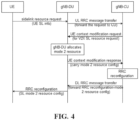
- a UE sends a sidelink resource request to its associated gNB-DU.
- the sidelink resource request can be a sidelink UE Information message or a UE Assistance Information message.
- the sidelink resource request can include at least one of the following information: service type, destination identity, frequency of interest, service QoS information (e.g., including PC5 QoS index list, QFI, priority level, reliability level, latency, communication range, 5QI, and/or VQI list), communication type (e.g., including unicast, groupcast, broadcast, and/or unicast in group), group leader, group member, group information (e.g., including number of group members, identifier of each group member, unicast UE pair in group, and/or unicast UE list), cross-RAT interest indication, mapping relationship between (a) service type and/or destination identity and (b) Tx profile (e.g., including transport format, protocol version information such as LTE/NR/R14/R
- the DU After receiving the sidelink resource request, in some embodiments, the DU cannot directly identify or decode information contained by the sidelink resource request, and the DU forwards the sidelink resource request to an associated gNB-CU using F1 interface UL RRC message transfer. It should be noted that the DU may recognize msg 3 or UL-CCCH/DL-CCCH message (transmitted by SRB0, not yet encrypted and guaranteed), but may not be able to identify or decode an RRC message within the UL-DCCH/DL-DCCH message (transmitted through SRB1/2).
- the CU can perform authorization verification based on the UE's request and the authorization information in the UE context. For example, the CU can obtain V2X authorization information of the UE from core network element(s) such as the AMF, or from another base station, and save the authorization information into the UE context. If the authorization is successful, the CU can request the DU to allocate sidelink communication resource to the UE using the F1 interface UE context modification process or an F1 message defined for requesting sidelink resource configuration. For example, the CU can send to the DU a UE context modification request message, which can include CU to DU RRC Information that indicates the sidelink resource request information (or named UE sidelink information or other name).
- the sidelink resource request information sent by the CU in this manner can be recognized by the DU.
- the sidelink resource request information can include at least one of: mode 1 resource scheduling, configured grant type 2 scheduling, configured grant type 2 activation, configured grant type 2 deactivation, configured grant type 2 periodicity, mode 1 resource pool, Modulation and Coding Scheme (rcs), per destination duplication carrier sets, or mapping between (a) LCG and (b) PC5 QoS index, QFI, priority level, and/or reliability level.
- the DU After receiving the UE sidelink resource request information sent by the CU, the DU performs sidelink resource configuration, such as configuring LTE sidelink resources, mode1 and/or mode2 resources, and/or related parameters associated with various resource types.
- sidelink resource configuration such as configuring LTE sidelink resources, mode1 and/or mode2 resources, and/or related parameters associated with various resource types.
- the configuration information can include at least one of the following: SL BWP configuration, SL-V-RNTI, scheduling resource pool information, mapping relationship(s) between (a) logical channel group (LCG) and/or logical channel (LCH) and (b) 5QI, VQI, priority, reliability, PDB, PER, PPPP, PPPR, QFI, and/or communication range, mcs configuration, and/or SR configuration (e.g., mapping relationship(s) between (a) LCG and/or LCH and (b) SR mapping, mapping between (a) SR and (b) 5QI, VQI, priority, reliability, PDB, PER, PPPP, PPPR, QFI, and/or communication range).
- SL BWP configuration e.g., SL-V-RNTI
- scheduling resource pool information e.g., mapping relationship(s) between (a) LCG and/or LCH and (b) SR mapping, mapping between (a) SR and (b)
- the resource configuration information can include at least one of the following: SL CG-config index, period, subcarrier spacing, subframe offset, time-frequency domain resource, mcs, mapping relationship(s) between (a) SL LCH and/or SL LCG and (b) CG-config index, and/or the CG-config index associated 5QI, VQI, priority, reliability, PDB, PER, PPPP, PPPR, QFI, and/or communication range.
- the resource configuration information can include at least one of the following: allocated SL-CS-RNTI, period, CG-config index, subcarrier spacing, mcs, mapping relationship(s) between (a) SL LCH and/or SL LCG and (b) CG-config index, and/or the CG-config index associated 5QI, VQI, priority, reliability, PDB, PER, PPPP, PPPR, QFI, and/or communication range.
- the resource configuration information can include at least one of the following: mode 2 transmission resource pool(s) for unicast, mode 2 transmission resource pool(s) for groupcast, mode 2 transmission resource pool(s) for broadcast, and/or exceptional resource pool(s).
- the resource configuration information generated for the UE can be sent by the DU to the CU using the F1 interface UE context modification response (e.g., DU to CU RRC Information), or using a newly defined F1 interface message and/or information element.
- the CU can then generate an RRC reconfiguration message for the UE, and include the above-mentioned sidelink resource configuration information.
- the CU can send the RRC reconfiguration message to the DU using the F1 interface DL RRC message transfer (e.g., an RRC container), and the DU can send the RRC reconfiguration message to the UE.
- the F1 interface DL RRC message transfer e.g., an RRC container
- the UE further sends SR/BSR to the DU, and the DU configures the SL grant, as shown in FIG. 3 .
- the UE For configured grant type 1 configuration, after the UE obtains the sidelink resource configuration information, the UE can use correspondingly configured resource(s).
- the DU For configured grant type 2 configuration, the DU further indicates the activation/deactivation of specific resource location(s) and resource configuration(s) through PDCCH DCI.
- the UE can select resource(s) from the resource pool for sidelink communication, based on the mode 2 resource selection processing criterion.
- multiple configured grant type 1 and/or configured grant type 2 can be configured at the same time, substantially concurrently, or sequentially, and mode 1 and mode 2 resource configurations can be performed at the same time, substantially concurrently, or sequentially.
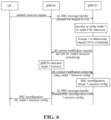
- the CU can obtain V2X sidelink resource pool information from Operation Administration and Maintenance (OAM), and the CU can obtain mode 1 and mode 2 resource pool CBR measurement results through the sidelink measurement(s) reported by UE and thereby determine the usage of each resource pool if supported, the CU (instead of DU) can therefore make configuration decisions for mode 1 and/or mode 2 resources. If the CU decides to configure mode 2 and/or mode 1 configured grant type 1 resource(s), the CU can directly perform related resource and/or resource pool configuration without communicating with the DU, and then send the RRC reconfiguration message (via the DU) to the UE, as shown in FIG. 5 . As compared with the first embodiment, this approach can reduce F1 signaling interactions.
- OAM Operation Administration and Maintenance
- the CU can further request the DU to perform resource scheduling through the F1 interface. Similar to the first embodiment, the CU can send the sidelink resource request information to the DU via the F1 message, and the DU can then perform resource configuration (e.g., for mode 1). The resulting resource configuration information can then be sent from the DU to the CU (e.g., in the UE context modification response), and the CU generates an RRC reconfiguration message and sends it (e.g., via the DU) to the UE.
- the CU can send the sidelink resource request information to the DU via the F1 message, and the DU can then perform resource configuration (e.g., for mode 1).
- the resulting resource configuration information can then be sent from the DU to the CU (e.g., in the UE context modification response), and the CU generates an RRC reconfiguration message and sends it (e.g., via the DU) to the UE.
- the CU can send mode 1 resource pool configuration information or configured grant type 2 indication to the DU, and the DU can configure or activate/deactivate SL grant for the UE.
- the sidelink information CU sent to DU may include at least one of: mode 1 resource scheduling, configured grant type 2 scheduling or activation and/or deactivation, configured grant type 2 periodicity, mode 1 resource pool, Modulation and Coding Scheme (mcs), mapping between logical channel group (LCG) and PC5 QoS index/QFI/priority level/reliability level, or per destination duplication carrier sets.
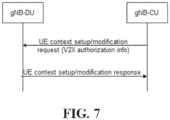
- the gNB-DU can obtain the UE V2X authorization information from the gNB-CU through the F1 interface UE context establishment/modification process and save the authorization information in the UE context.
- the CU can obtain the V2X authorization information of the UE from core network element(s) such as the AMF or from other base station, and save the information in the UE context.
- the DU after the DU initially receives the sidelink resource request sent by the UE, the DU forwards the request to the CU because the DU may not be capable of decoding the UL-DCCH message. Therefore, after the CU receives the sidelink resource request, the CU can perform authorization verification on the UE. If the authentication is successful, the CU requests the DU, via the F1 interface, to configure sidelink resource for the UE or the CU performs sidelink resource configuring for the UE, as described in the first embodiment and the second embodiment, respectively.
- the CU may not have information on whether the DU can schedule and/or configure LTE sidelink resource; or, the UE may not indicate any request for LTE/NR SL resource in its sidelink resource request, instead, the UE indicates the request for LTE/NR SL resource via SL BSR.
- the DU (instead of the CU) can perform authorization verification on the UE using the UE V2X authorization information obtained from the CU through the F1 interface (e.g., as part of the UE context establishment/modification process), as shown in FIG. 7 . If the verification succeeds, the DU can schedule the corresponding LTE/NR SL resource for the UE.
- the V2X authorization information can include at least one of the following: vehicle UE, pedestrian UE, sidelink discovery authorization, sidelink communication authorization, LTE sidelink communication authorization, NR sidelink communication authorization, sidelink cross-RAT authorization, NR sidelink unicast authorization, NR sidelink broadcast authorization, NR sidelink multicast authorization, authorization-supported service types (e.g., platooning, automated driving, remote driving, a specific V2X service, destination L2 ID list, or the like), authorization-supported service roles (e.g., platooning/group leader UE, automated UE, remote driving UE, or the like), authorization-supported service automation level(s) (e.g., automation level 0 ⁇ 5 or other level representation).
- authorization-supported service types e.g., platooning, automated driving, remote driving, a specific V2X service, destination L2 ID list, or the like
- authorization-supported service roles e.g., platooning/group leader UE, automated UE, remote driving UE, or the like
- This embodiment addresses process(es) for communicating PC5 QoS information, sidelink communication assistance configuration information, and/or sidelink bearer configuration information between the CU and DU.
- the DU can obtain the UE PC5 QoS information from the gNB-CU through the F1 interface UE context establishment/modification process and save the QoS information in the UE context.
- the CU can obtain the PC5 QoS information of the UE from core network element(s) such as the AMF or from other base station, and save the QoS information in the UE context.
- the CU and/or DU can use the PC5 QoS information as a basis for performing sidelink resource configuration and/or sidelink bearer configuration to meet PC5 QoS requirements.
- the PC5 QoS information can include at least one of the following: (a) UE PC5 AMBR, (b) per PC5 QoS flow MFBR, GFBR and/or ARP, or (c) service QoS information (e.g., PC5 QoS index/QFI/priority level/reliability level/latency/communication range).
- service QoS information e.g., PC5 QoS index/QFI/priority level/reliability level/latency/communication range.
- the CU and/or DU can send sidelink communication assistance configuration information via the V2X SIB, specifically, in at least two ways: 1) During the F1 interface establishment process, the DU determines the sidelink communication assistance configuration information, sends it to CU using an F1 setup request message (e.g., served cell info or a newly defined information element), and the CU generates encoded V2X SIB (including the sidelink communication assistance configuration information); or 2) The CU determines the sidelink communication assistance configuration information and includes it in the V2X SIB, and then sends to the DU during the F1 interface setup/establishment process.
- F1 setup request message e.g., served cell info or a newly defined information element
- V2X SIB including the sidelink communication assistance configuration information
- the CU determines the sidelink communication assistance configuration information and includes it in the V2X SIB, and then sends to the DU during the F1 interface setup/establishment process.
- the sidelink communication assistance configuration information can include at least one of the following: mapping relationship(s) between (a) PDB, latency, VQI, and/or priority level and (b) maximum PSSCH duration and/or subcarrier space (SCS), threshold(s) of priority level and/or PDB used to determine which priority level(s) can use configured grant type1, type 2, mode 1, and/or mode 2 resource(s), threshold(s) of PER and/or reliability level used to determine which reliability level can trigger RLC AM and/or PDCP duplication, and/or mapping relationship(s) between (a) LCG and (b) priority level and/or reliability level.
- the UE can obtain the V2X SIB.
- the gNB-CU and/or DU can send the sidelink communication assistance configuration information to the UE by using RRC dedicated signaling, specifically, in at least two ways: 1) when the DU receives the sidelink resource request information from the CU, it determines the type(s) of resource(s) to configure for the UE. At the same time or substantially concurrently, the DU can configure sidelink communication assistance configuration information for the UE (to enable the UE to autonomously establish a sidelink logical channel and map the V2X data packet to the corresponding sidelink logical channel for transmission), and send it to the CU. The CU generates an RRC reconfiguration message, and further sends the message to the UE via the DU, as shown in FIG. 9 .
- the F1 message can be an existing F1 interface message, or a newly defined F1 message and/or message element dedicated to sending sidelink related configuration information.
- This process is otherwise similar to that in the first embodiment; or 2) when the CU receives the sidelink resource request, it determines the type(s) of resource(s) to configure for the UE, and at the same time or substantially concurrently, the CU configures the sidelink communication assistance configuration information for the UE, and includes it in the RRC reconfiguration message. This process is otherwise similar to that of the second embodiment.
- the UE After receiving the sidelink communication assistance configuration information configured by the gNB-DU and/or CU, the UE establishes a sidelink logical channel and associates it with the LCG. For QoS data flows corresponding to different maximum PSSCH duration, SCS, priority level, whether triggering RLC AM, and/or other factors, different logical channels can be established; QoS flows corresponding to the same feature(s) described above can be mapped to the same logical channel.
- the UE can match the QoS information corresponding to the PC5 QoS flow to the corresponding maximum PSSCH duration, SCS, available resource type (e.g., configured type1/type 2, dynamic/mode 1, mode 2, or the like), RLC AM, PDCP duplication, etc., and map the PC5 QoS flow to the corresponding sidelink logical channel to perform transmission.
- available resource type e.g., configured type1/type 2, dynamic/mode 1, mode 2, or the like
- RLC AM Radio Link Control
- PDCP duplication etc.
- the base station may only be able to detect the buffer size corresponding to different priorities, and may not be able to use LCGID to detect the SCS, the maximum PSSCH duration, and/or the like corresponding to the resource(s) as required by the UE.
- the presently disclosed technology can include: 1) adding the SCS and/or maximum PSSCH duration indication in the SL BSR; 2) adding the mapping relationship between (a) the LCGID and (b) the SCS and/or the maximum PSSCH duration; 3) for a connected UE, the associated base station configures, for each destination ID, the mapping relationship(s) between the LCG and the QoS index, the SCS corresponding to each LCG, the maximum PSSCH duration, and/or the type of resources that can be used.
- the gNB-CU and/or DU can configure sidelink bearer configuration information and/or SL logical channel for the UE, in a way similar to the Uu interface.
- the configuration can include: mapping relationship(s) between (a) the QoS index, VQI, 5QI, and/or QFI and (b) the SL logical channel, the logical channel group to which it belongs, the SCS corresponding to each SL logical channel, the maximum PSSCH duration, whether the configured grant type 1/configured grant type 2/mode 1 is allowed, whether data duplication is required, and/or the carrier sets corresponding to data duplication.
- the UE when there is a new PC5 QoS flow transmission, the UE can send QFI (or PC5 QoS flow profile/parameters) to the CU, and the CU configures mapping relationship(s) between the PC5 QoS flow and the SL RB, or establishes a new SL RB to transmit the PC5 QoS flow.
- the CU configures the SL RB (e.g., SDAP, PDCP configuration), and the CU sends such configuration information (and the PC5 QoS flow profile/parameters, SL RB QoS) to the DU (e.g., using the F1 UE context setup/modification process).
- the DU determines whether to accept the configuration according to resource status. If the DU accepts, the corresponding RLC/LCH/MAC parameters are configured and sent to the CU, and the CU generates an RRC reconfiguration message, which is sent to the UE via the DU.
- This embodiment describes how the UE obtains V2X SIB message(s) under the CU/DU separation architecture, thereby obtaining V2X sidelink transmission/reception resource pool(s) and/or sidelink related configuration(s).
- the DU performs scheduling of broadcast messages and transmits broadcast messages based on scheduling parameters.
- the DU is responsible for the MIB and SIB1 encoding; the CU is responsible for the encoding of the other SI (except MIB and SIB1), and instructs the DU to broadcast the requested SIB through the System Information Delivery command.
- the DU sends the encoded MIB and the SIB1 to the CU through an F1 setup request message.
- the CU sends the encoded other SIBs (except MIB and SIB1) to the DU through an F1 setup response message.
- the DU can update its configuration to the CU through gNB-DU configuration update message(s) (e.g., updated MIB and/or SIB1).
- the CU can update its configuration to the DU through gNR-CU configuration update (e.g., updated other SIBs).
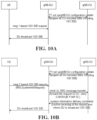
- the DU sends an ACK (e.g., via msg2 MAC CE) and broadcasts the requested SIB (e.g., all SIBs already obtained via the F1 establishment process and/or the CU configuration update); for msg 3 based SI Request (e.g., not configured with any requesting SI's resource), after receiving the RRCSystemInfoRequest, the DU forwards it to the CU using the Initial UL RRC Message Transfer.
- an ACK e.g., via msg2 MAC CE
- the requested SIB e.g., all SIBs already obtained via the F1 establishment process and/or the CU configuration update
- msg 3 based SI Request e.g., not configured with any requesting SI's resource
- the CU After receiving the RRCSystemInfoRequest, the CU indicates in the SYSTEM INFORMATION DELIVERY COMMAND message which SIB(s) (e.g., via SIType list, which is the SIBs requested in RRCSystemInfoRequest) that the DU will broadcast. After the DU receives it, the DU sends an ACK (e.g., MSG4) to the UE and broadcasts the requested SIB.
- SIB(s) e.g., via SIType list, which is the SIBs requested in RRCSystemInfoRequest
- the CU will send the encoded V2X SIB (and/or all other SIBs) to the DU when the F1 interface is set up/established and/or via CU configuration update.
- the UE may use the dedicated SI RACH resource (e.g., msg 1 based, if configured) to request the V2X SIB, and the gNB-DU broadcasts the V2X SIB upon receiving the request; or, the UE can use msg3 based on-demand SI request (e.g., RRC SystemInfoRequest) to indicate V2X SIB index and/or V2X sidelink communication purpose, in order to request the V2X SIB.
- the dedicated SI RACH resource e.g., msg 1 based, if configured
- the gNB-DU broadcasts the V2X SIB upon receiving the request
- msg3 based on-demand SI request e.g., RRC SystemInfoRequest
- the gNB-DU After receiving the V2X SI Request, the gNB-DU forwards the V2X SI Request to the gNB-CU through the F1-initial UL RRC message.
- the gNB-CU uses the SYSTEM INFORMATION DELIVERY COMMAND to indicate V2X SIB(s) for the DU to broadcast, and the gNB-DU broadcasts the V2X SIB after receiving the message.
- the UE can indicate whether it supports V2X sidelink communication in the UE capability information it sends to the gNB-CU/DU. If V2X sidelink communication is supported, the gNB-CU can use RRC dedicated signaling (e.g., an RRC reconfiguration message) to send the V2X SIB (and/or other SIBs) to UE.
- RRC dedicated signaling e.g., an RRC reconfiguration message
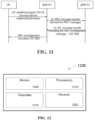
- the gNB-CU after the gNB-CU receives the sidelinkUEInformation message sent by the UE, the gNB-CU sends the V2X SIB to the UE using RRC dedicated signaling (e.g., an RRC reconfiguration message).
- RRC dedicated signaling e.g., an RRC reconfiguration message
- the OAM can simultaneously manage the CU and the DU.
- the CU/DU has an interface with the OAM, and all the cell parameters of the DU are configured by the OAM.
- the DU is responsible for sidelink resource allocation, and the CU is responsible for V2X SIB encoding.
- the CU/DU can obtain the V2X sidelink communication resource pool(s) using at least one of the following three ways:
- FIG. 12 shows an exemplary block diagram of a communication node or a network node 1200.
- the communication node 1200 can include a user equipment (UE), a mobile device, or a multimedia gateway.
- the network node 1200 can include a base station, a RAN node, a gNB, a master node in a dual-connectivity system, a secondary node in a dual-connectivity system, or a network element such as a distributed unit (DU) or a centralized unit (CU).
- the communication or network node 1200 includes at least one processor 1210 and a memory 1205 having instructions stored thereupon. The instructions upon execution by the processor 1210 configure the communication or network node 1200 to perform the operations in the various embodiments described in this patent document.
- the transmitter 1215 transmits or sends information or data to another network node or another communication node.
- the receiver 1220 receives information or data transmitted or sent by another network node or another communication node.
- a computer-readable medium may include removable and non-removable storage devices including, but not limited to, Read Only Memory (ROM), Random Access Memory (RAM), compact discs (CDs), digital versatile discs (DVD), etc. Therefore, the computer-readable media can include a non-transitory storage media.
- program modules may include routines, programs, objects, components, data structures, etc. that perform particular tasks or implement particular abstract data types.
- Computer- or processor-executable instructions, associated data structures, and program modules represent examples of program code for executing steps of the methods disclosed herein. The particular sequence of such executable instructions or associated data structures represents examples of corresponding acts for implementing the functions described in such steps or processes.
- a hardware circuit implementation can include discrete analog and/or digital components that are, for example, integrated as part of a printed circuit board.
- the disclosed components or modules can be implemented as an Application Specific Integrated Circuit (ASIC) and/or as a Field Programmable Gate Array (FPGA) device.
- ASIC Application Specific Integrated Circuit
- FPGA Field Programmable Gate Array
- DSP digital signal processor
- the various components or sub-components within each module may be implemented in software, hardware or firmware.
- the connectivity between the modules and/or components within the modules may be provided using any one of the connectivity methods and media that is known in the art, including, but not limited to, communications over the Internet, wired, or wireless networks using the appropriate protocols.
Landscapes
- Engineering & Computer Science (AREA)
- Computer Networks & Wireless Communication (AREA)
- Signal Processing (AREA)
- Multimedia (AREA)
- Mobile Radio Communication Systems (AREA)
Priority Applications (1)
| Application Number | Priority Date | Filing Date | Title |
|---|---|---|---|
| EP25166063.5A EP4568412A3 (de) | 2019-02-13 | 2019-02-13 | Ressourcenkonfiguration für sidelink-kommunikation |
Applications Claiming Priority (3)
| Application Number | Priority Date | Filing Date | Title |
|---|---|---|---|
| EP25166063.5A EP4568412A3 (de) | 2019-02-13 | 2019-02-13 | Ressourcenkonfiguration für sidelink-kommunikation |
| EP19915282.8A EP3925344B1 (de) | 2019-02-13 | 2019-02-13 | Ressourcenkonfiguration für sidelink-kommunikationen |
| PCT/CN2019/074951 WO2020164009A1 (en) | 2019-02-13 | 2019-02-13 | Resource configuration for sidelink communication |
Related Parent Applications (2)
| Application Number | Title | Priority Date | Filing Date |
|---|---|---|---|
| EP19915282.8A Division EP3925344B1 (de) | 2019-02-13 | 2019-02-13 | Ressourcenkonfiguration für sidelink-kommunikationen |
| EP19915282.8A Division-Into EP3925344B1 (de) | 2019-02-13 | 2019-02-13 | Ressourcenkonfiguration für sidelink-kommunikationen |
Publications (2)
| Publication Number | Publication Date |
|---|---|
| EP4568412A2 true EP4568412A2 (de) | 2025-06-11 |
| EP4568412A3 EP4568412A3 (de) | 2025-07-16 |
Family
ID=72044317
Family Applications (2)
| Application Number | Title | Priority Date | Filing Date |
|---|---|---|---|
| EP19915282.8A Active EP3925344B1 (de) | 2019-02-13 | 2019-02-13 | Ressourcenkonfiguration für sidelink-kommunikationen |
| EP25166063.5A Pending EP4568412A3 (de) | 2019-02-13 | 2019-02-13 | Ressourcenkonfiguration für sidelink-kommunikation |
Family Applications Before (1)
| Application Number | Title | Priority Date | Filing Date |
|---|---|---|---|
| EP19915282.8A Active EP3925344B1 (de) | 2019-02-13 | 2019-02-13 | Ressourcenkonfiguration für sidelink-kommunikationen |
Country Status (3)
| Country | Link |
|---|---|
| US (2) | US12075412B2 (de) |
| EP (2) | EP3925344B1 (de) |
| WO (1) | WO2020164009A1 (de) |
Families Citing this family (26)
| Publication number | Priority date | Publication date | Assignee | Title |
|---|---|---|---|---|
| WO2020164009A1 (en) * | 2019-02-13 | 2020-08-20 | Zte Corporation | Resource configuration for sidelink communication |
| CN111436118A (zh) * | 2019-02-15 | 2020-07-21 | 维沃移动通信有限公司 | 传输资源检测方法、传输资源确定方法和通信设备 |
| US12096273B2 (en) * | 2019-05-01 | 2024-09-17 | Lg Electronics Inc. | SDAP configuration for destination in sidelink communication |
| CN115580939A (zh) * | 2019-05-24 | 2023-01-06 | 大唐移动通信设备有限公司 | 一种通信方法、装置、设备及计算机可读存储介质 |
| CN118474812A (zh) * | 2019-07-16 | 2024-08-09 | 汉尼拔Ip有限责任公司 | 用户装置及由用户装置执行的用于侧链的方法 |
| US10887751B1 (en) * | 2019-08-14 | 2021-01-05 | Verizon Patent And Licensing Inc. | Systems and methods for facilitating network function device discovery |
| US12120545B2 (en) * | 2019-11-06 | 2024-10-15 | Intel Corporation | Cross-layer quality of service (QoS) indication for sidelink communications |
| US11490365B2 (en) * | 2019-11-15 | 2022-11-01 | Mediatek Inc. | Method to handle joint restriction of transmission resource and data QoS requirement |
| WO2021099359A1 (en) * | 2019-11-18 | 2021-05-27 | Telefonaktiebolaget Lm Ericsson (Publ) | Sidelink configuration in dual connectivity |
| US20210211947A1 (en) * | 2020-01-06 | 2021-07-08 | Samsung Electronics Co., Ltd. | Method and apparatus for performing communication in wireless communication system |
| US12501497B2 (en) * | 2020-01-29 | 2025-12-16 | Interdigital Patent Holdings, Inc. | Methods, architectures, apparatuses and systems directed to improved service continuity for out of range proximity wireless transmit/receive devices |
| WO2021158060A1 (ko) * | 2020-02-05 | 2021-08-12 | 삼성전자 주식회사 | 무선 통신 시스템에서 사이드링크 drx를 지원하기 위한 방법 및 장치 |
| BR112023000698A2 (pt) * | 2020-07-23 | 2023-02-07 | Apple Inc | Sistemas e métodos para fornecer informações de sistema por meio de retransmissão de ue para rede |
| CA3206129A1 (en) * | 2020-08-03 | 2022-02-10 | Ofinno, Llc | Methods, apparatuses and system for uplink resource configuration |
| US11956677B2 (en) * | 2020-08-12 | 2024-04-09 | Qualcomm Incorporated | Quality of experience measurement and reporting |
| EP4033819A1 (de) | 2021-01-22 | 2022-07-27 | Robert Bosch GmbH | Verfahren und vorrichtungen zur sidelink-kommunikation |
| CN115175319A (zh) * | 2021-04-01 | 2022-10-11 | 中兴通讯股份有限公司 | 频域资源确定方法、装置、节点和存储介质 |
| CN115278815A (zh) * | 2021-04-30 | 2022-11-01 | 北京三星通信技术研究有限公司 | 数据传输方法、装置、设备及计算机可读存储介质 |
| US12225430B2 (en) * | 2021-07-14 | 2025-02-11 | Qualcomm Incorporated | Sidelink positioning anchor configuration |
| CN115811804A (zh) * | 2021-09-14 | 2023-03-17 | 大唐移动通信设备有限公司 | 一种信息处理方法、装置、终端设备及网络设备 |
| US11785467B2 (en) * | 2021-10-26 | 2023-10-10 | Qualcomm Incorporated | Detecting mistrusted user equipment (UE) in sidelink |
| US12192827B2 (en) * | 2022-03-03 | 2025-01-07 | Verizon Patent and Lic ensing Inc. | Systems and methods for dynamic maximum transmission unit adjustment in a wireless network |
| US12335782B2 (en) | 2022-07-15 | 2025-06-17 | Dell Products L.P. | Latency and reliability improvements for sidelink service |
| US12335940B2 (en) * | 2022-08-12 | 2025-06-17 | Dell Products L.P. | Latency and reliability improvements for sidelink service |
| WO2024036520A1 (zh) * | 2022-08-17 | 2024-02-22 | 北京小米移动软件有限公司 | 一种侧行链路逻辑信道标识的确定方法及装置 |
| WO2025156443A1 (en) * | 2024-04-07 | 2025-07-31 | Zte Corporation | Method, device and computer program product for wireless communication |
Family Cites Families (7)
| Publication number | Priority date | Publication date | Assignee | Title |
|---|---|---|---|---|
| KR102781879B1 (ko) | 2016-09-30 | 2025-03-18 | 씨스코 시스템즈, 인코포레이티드 | V2x를 위한 자원 풀 결정 방법 및 장치 |
| CN109076627B (zh) * | 2016-10-27 | 2022-08-09 | Lg 电子株式会社 | 建立承载的方法和装置 |
| CN109246747B (zh) * | 2017-05-05 | 2021-09-21 | 北京三星通信技术研究有限公司 | 前向接口的建立方法、ue接入方法、ue切换方法及装置 |
| US10694427B2 (en) * | 2017-09-27 | 2020-06-23 | Intel IP Corporation | Solution for vehicle-to-everything (V2X) communication authorization in 5G system |
| US20220086935A1 (en) * | 2019-01-16 | 2022-03-17 | Lg Electronics Inc. | Method and apparatus for controlling radio resource for a redundant route for a dual-connecting iab-node in a wireless communication system |
| WO2020149575A1 (en) * | 2019-01-16 | 2020-07-23 | Lg Electronics Inc. | Sidelink resource handling for cu-du split based v2x communication |
| WO2020164009A1 (en) * | 2019-02-13 | 2020-08-20 | Zte Corporation | Resource configuration for sidelink communication |
-
2019
- 2019-02-13 WO PCT/CN2019/074951 patent/WO2020164009A1/en not_active Ceased
- 2019-02-13 EP EP19915282.8A patent/EP3925344B1/de active Active
- 2019-02-13 EP EP25166063.5A patent/EP4568412A3/de active Pending
-
2021
- 2021-08-12 US US17/401,058 patent/US12075412B2/en active Active
-
2024
- 2024-06-04 US US18/733,765 patent/US12395990B2/en active Active
Also Published As
| Publication number | Publication date |
|---|---|
| EP3925344A1 (de) | 2021-12-22 |
| WO2020164009A1 (en) | 2020-08-20 |
| KR20210125062A (ko) | 2021-10-15 |
| US20220022228A1 (en) | 2022-01-20 |
| US12395990B2 (en) | 2025-08-19 |
| EP3925344A4 (de) | 2022-08-10 |
| US12075412B2 (en) | 2024-08-27 |
| US20240334434A1 (en) | 2024-10-03 |
| EP4568412A3 (de) | 2025-07-16 |
| EP3925344B1 (de) | 2025-05-14 |
Similar Documents
| Publication | Publication Date | Title |
|---|---|---|
| US12395990B2 (en) | Resource configuration for sidelink communication | |
| US12028834B2 (en) | Resource configuration and selection for device-to-device links | |
| JP7784475B2 (ja) | 協力し合う車両間における効率的なリソース使用のための方法 | |
| US20250203640A1 (en) | Method and apparatus for resource configuration for sidelink in internet of vehicles | |
| CN112997565B (zh) | 用于单播和/或多播链路建立和维持的l2过程 | |
| US11979859B2 (en) | Methods and systems for autonomous sidelink resource allocation | |
| RU2733420C2 (ru) | Улучшенные начальные и повторные передачи данных для v2x-передач | |
| US10743155B2 (en) | Mechanism for QOS implementation in vehicular communication | |
| EP3395114B1 (de) | Kanalzugriffsprozedur und qos-bereitstellung für uplink-laa | |
| CA2915317C (en) | Systems and methods for traffic-aware medium access selection | |
| CN104754748B (zh) | 一种d2d资源分配方法、数据传输方法及装置 | |
| US10616927B2 (en) | Method by which terminal transmits V2X signal in wireless communication system, and terminal using method | |
| CN115039503B (zh) | 分配用于侧行链路传输的资源的方法和设备 | |
| KR20180035638A (ko) | RRC Inactive 및 active 상태에서 data 전송 결정 및 방법 및 장치 | |
| KR20190098156A (ko) | 무선 통신 시스템에서 v2x 단말에 의해 수행되는 v2x 통신 수행 방법 및 상기 방법을 이용하는 단말 | |
| EP3571891A1 (de) | Basisstation und kommunikationsvorrichtung zur unterstützung lokalisierter drahtloskommunikationsdienste | |
| CN114365515A (zh) | 在无线通信系统中使用侧链路进行通信的装置和方法 | |
| KR102509359B1 (ko) | 무선 통신 시스템에서 v2x 통신을 위한 자원 할당 방법 및 장치 | |
| KR20220110752A (ko) | 무선 통신 네트워크에서의 사이드링크 통신을 위한 시스템 및 방법 | |
| WO2023199171A1 (en) | Sidelink carrier aggregation selection | |
| JP2024501702A (ja) | Nr v2xにおける端末タイプによるsl drx動作方法及び装置 | |
| CN116368862A (zh) | 在无线通信系统中执行移动性的方法和设备 | |
| KR102896328B1 (ko) | 사이드링크 통신을 위한 자원 구성 | |
| CN117796139A (zh) | 用于在nr v2x中执行sl drx操作的方法和设备 | |
| WO2023092507A1 (zh) | 侧链路通信方法及装置 |
Legal Events
| Date | Code | Title | Description |
|---|---|---|---|
| PUAI | Public reference made under article 153(3) epc to a published international application that has entered the european phase |
Free format text: ORIGINAL CODE: 0009012 |
|
| STAA | Information on the status of an ep patent application or granted ep patent |
Free format text: STATUS: THE APPLICATION HAS BEEN PUBLISHED |
|
| AC | Divisional application: reference to earlier application |
Ref document number: 3925344 Country of ref document: EP Kind code of ref document: P |
|
| AK | Designated contracting states |
Kind code of ref document: A2 Designated state(s): AL AT BE BG CH CY CZ DE DK EE ES FI FR GB GR HR HU IE IS IT LI LT LU LV MC MK MT NL NO PL PT RO RS SE SI SK SM TR |
|
| REG | Reference to a national code |
Ref country code: DE Ref legal event code: R079 Free format text: PREVIOUS MAIN CLASS: H04W0076140000 Ipc: H04W0072400000 |
|
| PUAL | Search report despatched |
Free format text: ORIGINAL CODE: 0009013 |
|
| AK | Designated contracting states |
Kind code of ref document: A3 Designated state(s): AL AT BE BG CH CY CZ DE DK EE ES FI FR GB GR HR HU IE IS IT LI LT LU LV MC MK MT NL NO PL PT RO RS SE SI SK SM TR |
|
| RIC1 | Information provided on ipc code assigned before grant |
Ipc: H04W 72/40 20230101AFI20250611BHEP Ipc: H04W 88/08 20090101ALI20250611BHEP Ipc: H04W 4/06 20090101ALN20250611BHEP Ipc: H04W 4/46 20180101ALN20250611BHEP Ipc: H04W 76/14 20180101ALN20250611BHEP Ipc: H04W 72/29 20230101ALN20250611BHEP |
|
| STAA | Information on the status of an ep patent application or granted ep patent |
Free format text: STATUS: REQUEST FOR EXAMINATION WAS MADE |
|
| REG | Reference to a national code |
Ref country code: DE Ref legal event code: R079 Free format text: PREVIOUS MAIN CLASS: H04W0072400000 Ipc: H04W0072290000 |
|
| GRAP | Despatch of communication of intention to grant a patent |
Free format text: ORIGINAL CODE: EPIDOSNIGR1 |
|
| STAA | Information on the status of an ep patent application or granted ep patent |
Free format text: STATUS: GRANT OF PATENT IS INTENDED |