EP4568293A2 - Darstellung verdeckter audioelemente - Google Patents
Darstellung verdeckter audioelemente Download PDFInfo
- Publication number
- EP4568293A2 EP4568293A2 EP25171150.3A EP25171150A EP4568293A2 EP 4568293 A2 EP4568293 A2 EP 4568293A2 EP 25171150 A EP25171150 A EP 25171150A EP 4568293 A2 EP4568293 A2 EP 4568293A2
- Authority
- EP
- European Patent Office
- Prior art keywords
- virtual loudspeaker
- audio
- audio element
- occlusion
- virtual
- Prior art date
- Legal status (The legal status is an assumption and is not a legal conclusion. Google has not performed a legal analysis and makes no representation as to the accuracy of the status listed.)
- Pending
Links
Images







Classifications
-
- G—PHYSICS
- G10—MUSICAL INSTRUMENTS; ACOUSTICS
- G10L—SPEECH ANALYSIS TECHNIQUES OR SPEECH SYNTHESIS; SPEECH RECOGNITION; SPEECH OR VOICE PROCESSING TECHNIQUES; SPEECH OR AUDIO CODING OR DECODING
- G10L25/00—Speech or voice analysis techniques not restricted to a single one of groups G10L15/00 - G10L21/00
- G10L25/03—Speech or voice analysis techniques not restricted to a single one of groups G10L15/00 - G10L21/00 characterised by the type of extracted parameters
-
- H—ELECTRICITY
- H04—ELECTRIC COMMUNICATION TECHNIQUE
- H04S—STEREOPHONIC SYSTEMS
- H04S7/00—Indicating arrangements; Control arrangements, e.g. balance control
- H04S7/30—Control circuits for electronic adaptation of the sound field
- H04S7/302—Electronic adaptation of stereophonic sound system to listener position or orientation
-
- H—ELECTRICITY
- H04—ELECTRIC COMMUNICATION TECHNIQUE
- H04S—STEREOPHONIC SYSTEMS
- H04S7/00—Indicating arrangements; Control arrangements, e.g. balance control
- H04S7/30—Control circuits for electronic adaptation of the sound field
-
- G—PHYSICS
- G10—MUSICAL INSTRUMENTS; ACOUSTICS
- G10L—SPEECH ANALYSIS TECHNIQUES OR SPEECH SYNTHESIS; SPEECH RECOGNITION; SPEECH OR VOICE PROCESSING TECHNIQUES; SPEECH OR AUDIO CODING OR DECODING
- G10L25/00—Speech or voice analysis techniques not restricted to a single one of groups G10L15/00 - G10L21/00
- G10L25/27—Speech or voice analysis techniques not restricted to a single one of groups G10L15/00 - G10L21/00 characterised by the analysis technique
-
- G—PHYSICS
- G10—MUSICAL INSTRUMENTS; ACOUSTICS
- G10L—SPEECH ANALYSIS TECHNIQUES OR SPEECH SYNTHESIS; SPEECH RECOGNITION; SPEECH OR VOICE PROCESSING TECHNIQUES; SPEECH OR AUDIO CODING OR DECODING
- G10L25/00—Speech or voice analysis techniques not restricted to a single one of groups G10L15/00 - G10L21/00
- G10L25/48—Speech or voice analysis techniques not restricted to a single one of groups G10L15/00 - G10L21/00 specially adapted for particular use
-
- H—ELECTRICITY
- H04—ELECTRIC COMMUNICATION TECHNIQUE
- H04R—LOUDSPEAKERS, MICROPHONES, GRAMOPHONE PICK-UPS OR LIKE ACOUSTIC ELECTROMECHANICAL TRANSDUCERS; ELECTRIC HEARING AIDS; PUBLIC ADDRESS SYSTEMS
- H04R3/00—Circuits for transducers
-
- H—ELECTRICITY
- H04—ELECTRIC COMMUNICATION TECHNIQUE
- H04S—STEREOPHONIC SYSTEMS
- H04S2400/00—Details of stereophonic systems covered by H04S but not provided for in its groups
- H04S2400/11—Positioning of individual sound objects, e.g. moving airplane, within a sound field
Definitions
- Spatial audio rendering is a process used for presenting audio within an extended reality (XR) scene (e.g., a virtual reality (VR), augmented reality (AR), or mixed reality (MR) scene) in order to give a listener the impression that sound is coming from physical sources within the scene at a certain position and having a certain size and shape (i.e., extent).
- XR extended reality
- the presentation can be made through headphone speakers or other speakers. If the presentation is made via headphone speakers, the processing used is called binaural rendering and uses spatial cues of human spatial hearing that make it possible to determine from which direction sounds are coming.
- the cues involve inter-aural time delay (ITD), inter-aural level difference (ILD), and/or spectral difference.
- each sound source is defined to emanate sound from one specific point. Because each sound source is defined to emanate sound from one specific point, the sound source doesn't have any size or shape. In order to render a sound source having an extent (size and shape), different methods have been developed.
- One such known method is to create multiple copies of a mono audio element at positions around the audio element. This arrangement creates the perception of a spatially homogeneous object with a certain size. This concept is used, for example, in the "object spread” and “object divergence” features of the MPEG-H 3D Audio standard (see references [1] and [2]), and in the "object divergence” feature of the EBU Audio Definition Model (ADM) standard (see reference [4]).
- Another rendering method renders a spatially diffuse component in addition to a mono audio signal, which creates the perception of a somewhat diffuse object that, in contrast to the original mono audio element, has no distinct pin-point location.
- This concept is used, for example, in the "object diffuseness" feature of the MPEG-H 3D Audio standard (see reference [3]) and the "object diffuseness” feature of the EBU ADM (see reference [5]).
- the "object extent" feature of the EBU ADM combines the creation of multiple copies of a mono audio element with the addition of diffuse components (see reference [6]).
- an audio element can be described well enough with a basic shape (e.g., a sphere or a box). But sometimes the actual shape is more complicated and needs to be described in a more detailed form (e.g., a mesh structure or a parametric description format).
- a basic shape e.g., a sphere or a box.
- the actual shape is more complicated and needs to be described in a more detailed form (e.g., a mesh structure or a parametric description format).
- the audio element comprises at least two audio channels (i.e., audio signals) to describe a spatial variation over its extent.
- XR scenes there may be an object that blocks at least part of an audio element in the XR scene.
- the audio element is said to be at least partially occluded.
- occlusion happens when, from the viewpoint of a listener at a given listening position, an audio element is completely or partly hidden behind some object such that no or less direct sound from the occluded part of the audio element reaches the listener.
- the occlusion effect might be either complete occlusion (e.g. when the occluding object is a thick wall), or soft occlusion where some of the audio energy from the audio element passes through the occluding object (e.g., when the occluding object is made of thin fabric such as a curtain).
- WO2019/066348 discloses an audio signal processing device.
- the processor can acquire information related to an input audio signal and a virtual space in which the input audio signal is simulated, can determine whether a blocking object, which performs blocking between a sound source and a listener, exists among a plurality of objects, on the basis of the position of each of the plurality of objects included in the virtual space and the position of the sound source corresponding to the input audio signal, with respect to the listener in the virtual space, and can binaurally render the input audio signal on the basis of the determination result so as to generate an output audio signal.
- a blocking object which performs blocking between a sound source and a listener
- the audio engine uses geometric volumes to represent sound sources and any sound occluders.
- a volumetric response is generated based on sound projected from a volumetric sound source to a listener, taking into consideration any volumetric occluders in-between.
- EP0966179 discloses a method of synthesizing an audio signal in two speaker systems or headphones.
- US2016/150345 discloses a method and apparatus for controlling a sound to be provided to a user based on a multipole sound object.
- occlusion rendering techniques deal with point sources where the occurrence of occlusion can be detected easily using raytracing between the listener position and the position of the point source, but for an audio element with an extent, the situation is more complicated since an occluding object may occlude only a part of the extended audio element. Therefore, a more elaborate occlusion detection technique is needed (e.g., one that determines which part of the extended audio element is occluded).
- a heterogeneous extended audio element i.e., an audio element with an extent which has non-homogeneous spatial audio information distributed over its extent (e.g.
- a left (L) and right (R) speaker would mean that basically all spatial information is lost whenever either the L or R virtual loudspeaker is occluded.
- extended objects that are rendered using a discrete number of virtual loudspeakers (so also including non-heterogeneous audio elements, e.g. homogeneous or diffuse extended audio elements), there is a problem with the amount of occlusion changing in a step-wise manner when the audio element, the occluding object, and/or listener are moving relative to each other.
- a method for rendering an audio element that is partially occluded where the audio element has an extent and is represented using a set of two or more virtual loudspeakers, the set comprising a first virtual loudspeaker.
- a projection of the audio element is divided into at least a first and a second sub-area.
- the method includes determining a first occlusion amount, O1, for the first sub-area and modifying a first virtual loudspeaker signal for the first virtual loudspeaker based on O1 such that the modified loudspeaker signal is equal to: g1 * VS1, where g1 is a gain factor that is calculated using O1 and VS1 is the first virtual loudspeaker signal, thereby producing a first modified virtual loudspeaker signal.
- the method also includes determining a second occlusion amount, O2, for the second sub-area and modifying a second virtual loudspeaker signal for the second virtual loudspeaker based on O2 such that the second modified loudspeaker signal is equal to: g2 * VS2, where g2 is a gain factor that is calculated using O2 and VS2 is the second virtual loudspeaker signal, thereby producing a second modified virtual loudspeaker signal.
- the method also includes using the first and second modified virtual loudspeaker signals to render the audio element (e.g., generate an output signal using the first modified virtual loudspeaker signal).
- the method includes moving the first virtual loudspeaker from an initial position to a new position.
- the method also includes generating a first virtual loudspeaker signal for the first virtual loudspeaker based on the new position of the first virtual loudspeaker.
- the method also includes using the first virtual loudspeaker signal to render the audio element.
- the rendering apparatus may include memory and processing circuitry coupled to the memory.
- An advantage of the embodiments disclosed herein is that the rendering of an audio element that is at least partially occluded is done in a way that preserves the quality of the spatial information of the audio element.
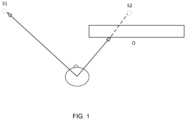
- FIG. 1 shows an example of two point sources (S1 and S2), where one is occluded by an object (O) (which is referred to as the "occluding object") and the other is not.
- O object
- the occluded audio element should be muted in a way that corresponds to the acoustic properties of the material of the occluding object. If the occluding object is a thick wall, the rendering of the direct sounds from the occluded audio element should be more or less completely muted.
- the audio element (E) may be only partly occluded. This means that the rendering of the audio element needs to be altered in a way that reflects what part of the extent is occluded and what part is not occluded.
- One strategy to for solving the occlusion problem for an audio element having an extent is to represent the audio element 302 with a large number of point sources spread out over the extent (as shown in FIG. 3 ) and calculate the occlusion effect individually for each point source using one of the known methods for point sources.
- This strategy is highly inefficient due to the large number of point sources that need to be used in order to get a good enough resolution of the occlusion effect. And even if many point sources are used so that the resolution for a static case is good enough, there would still be a stepwise behavior where the effect of the occlusion changes in discrete steps as the individual point sources are either occluded or not occluded in a dynamic scene.
- Another disadvantage with using many point sources to represent a heterogeneous (multi-channel) audio element is that it is not trivial how to up-mix from a few audio channels to a large number of point sources without causing spatial and/or spectral distortions in the resulting listener signals (due to the fact that neighboring point sources would be highly correlated).
- an amount of occlusion can be calculated for each said sub-area.
- the amount of occlusion can be calculated as the percentage of the sub-area that is occluded from the listening position.
- the sub-areas of the projection of the audio element can be defined in many different ways. In one embodiment, there are as many sub-areas as there are virtual loudspeakers used for the rendering, and each sub-area corresponds to one virtual loudspeaker. In another embodiment, the sub-areas are defined independently from the number and/or positions of the virtual loudspeakers used for the rendering.
- the sub-areas may be equal in size.
- the sub-areas may be directly adjacent to each other.
- the sub-areas together may completely fill the surface area of the projected extent of the audio element, i.e. the total size of the projected extent is equal to the sum of the surface areas of all the sub-areas.
- O for a given sub-area is a function of a frequency dependent occlusion factor (OF) and a value P, where P is the percentage of the sub-area that is covered by the occluding object (i.e., the percentage of the sub-area that cannot be seen by the listener due to the fact that the occluding object is located between the listener and the sub-area).
- a brick wall may have an occlusion factor of 1, whereas a thin curtain of cotton may have an occlusion factor of 0.2, and for a second frequency, the brick wall may have an occlusion factor of 0.8, whereas a thin curtain of cotton may have an occlusion factor of 0.1.
- the gain factor is calculated using the assumption that the audio element is mostly diffuse in spatial information and a 50% occlusion amount should give a -3dB reduction in audio energy from that sub-area.
- the embodiments are not limited to the above examples as other gain functions for calculating the gain of a sub-area are possible.
- the effect of the occlusion can be a gradual one when the audio element is partly occluded, so that the signal from a virtual loudspeaker is not necessarily completely muted whenever the virtual loudspeaker is occluded for the listener. This prevents that, for example, in the case of a stereo rendering with two virtual loudspeakers, no sound at all is received from, for example, the left half of the audio element whenever the left virtual loudspeaker is occluded. Additionally, it prevents the undesirable "step-wise" occlusion effect when the occluding object, the audio element and/or the listener are moving relative to each other.
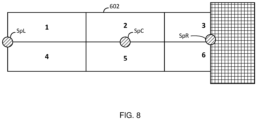
- the positions of the virtual loudspeakers representing the audio element can be moved so that they better represent the non-occluded part. If one of the edges of the extent of the audio element is occluded, the virtual loudspeaker(s) representing this edge should be move to the edge where the occlusion is happening as illustrated in FIG. 8 and FIG. 9B .
- an occlusion that covers either the bottom or top part can be rendered by changing the vertical position of the virtual loudspeakers so that their vertical position corresponds to the middle of the non-occluded part of the extent.
- the vertical position of each virtual loudspeaker is controlled by the ratio of occlusion amount in the upper sub-area and the lower sub-area.
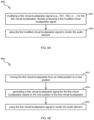
- FIG. 4A is a flowchart illustrating a process 400, according to an embodiment, for rendering an at least partially occluded audio element represented using a set of two or more virtual loudspeakers, the set comprising a first virtual loudspeaker.
- Process 400 may begin in step s402.
- Step s402 comprises modifying a first virtual loudspeaker signal for the first virtual loudspeaker, thereby producing a first modified virtual loudspeaker signal.
- Step s404 comprises using the first modified virtual loudspeaker signal to render the audio element (e.g., generate an output signal using the first modified virtual loudspeaker signal).
- the process further includes obtaining information indicating that the audio element is at least partially occluded, wherein the modifying is performed as a result of obtaining the information.
- the process further includes detecting that the audio element is at least partially occluded, wherein the modifying is performed as a result of the detection.
- modifying the first virtual loudspeaker signal comprises adjusting the gain of the first virtual loudspeaker signal.
- the process further includes moving the first virtual loudspeaker from an initial position (e.g., default position) to a new position and then generating the first virtual loudspeaker signal using information indicating the new position.
- an initial position e.g., default position
- the process further includes determining an occlusion amount (O) associated with the first virtual loudspeaker and the step of modifying the first virtual loudspeaker signal for the first virtual loudspeaker comprises modifying the first virtual loudspeaker signal based on O.
- modifying the first virtual loudspeaker signal based on O comprises modifying the first virtual loudspeaker signal VS1 such that the modified loudspeaker signal equals (g * VS 1), where g is a gain factor that is calculated using O and VS1 is the first virtual loudspeaker signal.
- determining O comprises obtaining a particular occlusion factor (Of) for the occluding object and determining a percentage of a sub-area of a projection of the audio element that is covered by the occluding object, where the first virtual loudspeaker is associated with the sub-area.
- Of occlusion factor
- FIG. 4B is a flowchart illustrating a process 450, according to an embodiment, for rendering an at least partially occluded audio element represented using a set of two or more virtual loudspeakers, the set comprising a first virtual loudspeaker.
- Process 450 may begin in step s452.
- Step s452 comprises moving the first virtual loudspeaker from an initial position to a new position.
- Step s454 comprises generating a first virtual loudspeaker signal for the first virtual loudspeaker based on the new position of the first virtual loudspeaker.
- Step s456 comprises using the first virtual loudspeaker signal to render the audio element.
- the process further includes obtaining information indicating that the audio element is at least partially occluded, wherein the moving is performed as a result of obtaining the information. In some embodiments, the process further includes detecting that the audio element is at least partially occluded, wherein the moving is performed as a result of the detection.
- FIG. 5 is a flowchart illustrating a process 500, according to an embodiment, for rendering an occluded audio element.
- Process 500 may begin in step s502.
- Step s502 comprises obtaining metadata for an audio element and metadata for an object occluding the audio element (the metadata for the occluding object may include information specifying the occlusion factors for the object at different frequencies).
- Step s504 comprises, for each sub-area of the audio element, determining the amount of occlusion.
- Step s506 comprises calculating a gain factor for each virtual loudspeaker signal based on the amount of occlusion.
- Step s508 comprises, for each virtual loudspeaker, determining whether the virtual loudspeaker should be positioned in a new location and position the virtual loudspeaker in the new location.
- Step s510 comprises generating the virtual loudspeaker signals based on the locations of the virtual speakers.
- Step s512 comprises, based on the gain factors, adjusting the gains of one or more of the virtual loudspeaker signals.
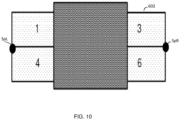
- FIG. 6A is an example of where audio element 602 (or, more precisely, the projection of the audio element 602 as seen from the listener position) is logically divided into six parts (a.k.a., six sub-areas), where parts 1 & 4 represents the left area of the audio element 602, parts 3 & 6 represents the right area, and parts 2 & 5 represents the center. Also, parts 1, 2 & 3 together represent the upper area of the audio element and parts 4, 5 & 6 represent the lower area of the audio element.
- FIG. 6B shows an example scenario where audio element 602 as seen by the listener is partially occluded by an occluding object 604, which, in this example and the other examples, has an occlusion factor of 1.
- the relative gain balance of the left, center and right parts can be calculated.
- a relative gain balance of the upper area as compared to the lower area can be calculated.
- the right area of the audio element should be completely muted as it is completely covered by object 604, the center area should have slightly lower gain and the left area is unaffected. There is no difference in occlusion of the upper area as compared to the lower area.
- FIG. 6C shows an example scenario where audio element 602 is partially occluded by an occluding object 614.
- the center and right area should be partly muted.
- the lower part should be more muted than the upper part.
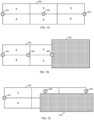
- FIG. 7A shows an example where audio element 602 is represented by three virtual loudspeakers, SpL, SpC, SpR.
- FIG. 7B shows how the positions of the virtual loudspeakers are modified to reflect the occlusion of audio element 602 by object 604.
- the speaker SpR representing the right edge of the extent, is moved to the edge where the occlusion is happening.
- Speaker SpC is moved to the center of the part that is not occluded.
- FIG. 7C shows how the positions of the virtual loudspeakers are modified to reflect the occlusion of audio element 602 by object 614.
- the speaker SpR, representing the right edge of the extent is moved upward to a new position and speaker SpC is also moved upward.
- FIG. 8 shows an example where the right sub-areas of audio element 602 are partly occluded.
- the virtual loudspeaker representing the right edge is moved so that it lines up with the edge where the occlusion happens.
- the center speaker may be moved to the position representing the center of the non-occluded part of the audio element
- FIGs. 9A and 9B show an example of an audio element 902 that is represented by six virtual loudspeakers, where the lower part of the audio element is occluded. In this case the virtual loudspeakers representing the bottom edge are moved so that they line up with the edge where the occlusion happens.
- FIG. 10 shows an example where the middle of the audio element 602 is occluded.
- the positions of the loudspeakers are kept as they are since neither the left or the right edges are occluded and need to be represented.
- the occlusion in this case is only affecting the gain of the signals to each speaker.
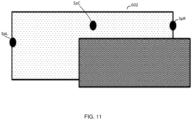
- FIG. 11 shows an example where the center and right areas of audio element 602 are partly occluded.
- the positions of the virtual loudspeakers are modified in elevation so that the greater amount of occlusion of these lower parts is reflected.
- the gain of the signals should also be lowered in order to reflect that the center and right areas are partly occluded.
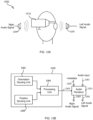
- FIG. 12A illustrates an XR system 1200 in which the embodiments may be applied.
- XR system 1200 includes speakers 1204 and 1205 (which may be speakers of headphones worn by the listener) and a display device 1210 that is configured to be worn by the listener.
- XR system 1210 may comprise an orientation sensing unit 1201, a position sensing unit 1202, and a processing unit 1203 coupled (directly or indirectly) to an audio render 1251 for producing output audio signals (e.g., a left audio signal 1281 for a left speaker and a right audio signal 1282 for a right speaker as shown).
- Audio renderer 1251 produces the output signals based on input audio signals, metadata regarding the XR scene the listener is experiencing, and information about the location and orientation of the listener.
- the metadata for the XR scene may include metadata for each object and audio element included in the XR scene, and the metadata for an object may include information about the dimensions of the object and the occlusion factors for the object (e.g., the metadata may specify a set of occlusion factors where each occlusion factor is applicable for a different frequency or frequency range).
- Audio renderer 1251 may be a component of display device 1210 or it may be remote from the listener (e.g., renderer 1251 may be implemented in the "cloud").
- Orientation sensing unit 1201 is configured to detect a change in the orientation of the listener and provides information regarding the detected change to processing unit 1203.
- processing unit 1203 determines the absolute orientation (in relation to some coordinate system) given the detected change in orientation detected by orientation sensing unit 1201.
- orientation sensing unit 1201 may determine the absolute orientation (in relation to some coordinate system) given the detected change in orientation.
- the processing unit 1203 may simply multiplex the absolute orientation data from orientation sensing unit 1201 and positional data from position sensing unit 1202.
- orientation sensing unit 1201 may comprise one or more accelerometers and/or one or more gyroscopes.
- FIG. 13 shows an example implementation of audio renderer 1251 for producing sound for the XR scene.
- Audio renderer 1251 includes a controller 1301 and a signal modifier 1302 for modifying audio signal(s) 1261 (e.g., the audio signals of a multi-channel audio element) based on control information 1310 from controller 1301.
- Controller 1301 may be configured to receive one or more parameters and to trigger modifier 1302 to perform modifications on audio signals 1261 based on the received parameters (e.g., increasing or decreasing the volume level).
- the received parameters include information 1263 regarding the position and/or orientation of the listener (e.g., direction and distance to an audio element), metadata 1262 regarding an audio element in the XR scene (e.g., audio element 602), and metadata regarding an object occluding the audio element (e.g., object 154) (in some embodiments, controller 1301 itself produces the metadata 1262). Using the metadata and position/orientation information, controller 1301 may calculate one more gain factors (g) for an audio element in the XR scene that is at least partially occluded as described above.
- g gain factors
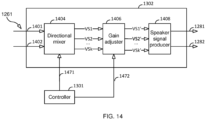
- FIG. 14 shows an example implementation of signal modifier 1302 according to one embodiment.
- Signal modifier 1302 includes a directional mixer 1404, a gain adjuster 1406, and a speaker signal producer 1408.
- Directional mixer 1404 receives audio input 1261, which in this example includes a pair of audio signals 1401 and 1402 associated with an audio element (e.g. audio element 602), and produces a set of k virtual loudspeaker signals (VS1, VS2, ..., VSk) based on the audio input and control information 1471.
- the signal for each virtual loudspeaker can be derived by, for example, the appropriate mixing of the signals that comprise the audio input 1261.
- VS1 ⁇ ⁇ L + ⁇ ⁇ R, where L is input audio signal 1401, R is input audio signal 1402, and ⁇ and ⁇ are factors that are dependent on, for example, the position of the listener relative to the audio element and the position of the virtual loudspeaker to which VS1 corresponds.
- k will equal 3 for the audio element and VS1 may correspond to SpL, VS2 may correspond to SpC, and VS3 may correspond to SpR.
- the control information 1471 used by directional mixer to produce the virtual loudspeaker signals may include the positions of each virtual loudspeaker relative to the audio element.
- controller 1301 is configured such that, when the audio element is occluded, controller 1301 may adjust the position of one or more of the virtual loudspeakers associated with the audio element and provide the position information to directional mixer 1404 which then uses the updated position information to produce the signals for the virtual loudspeakers (i.e., VS1, VS2, ..., VSk).
- controller 1301 may adjust the position of one or more of the virtual loudspeakers associated with the audio element and provide the position information to directional mixer 1404 which then uses the updated position information to produce the signals for the virtual loudspeakers (i.e., VS1, VS2, ..., VSk).
- speaker signal producer 1408 uses virtual loudspeaker signals VS1', VS2', ..., VSk', speaker signal producer 1408 produces output signals (e.g., output signal 1281 and output signal 1282) for driving speakers (e.g., headphone speakers or other speakers).
- speaker signal producer 1408 may perform conventional binaural rendering to produce the output signals.
- speaker signal producer 1408 may perform conventional speaking panning to produce the output signals.
- FIG. 15 is a block diagram of an audio rendering apparatus 1500, according to some embodiments, for performing the methods disclosed herein (e.g., audio renderer 1251 may be implemented using audio rendering apparatus 1500).
- audio rendering apparatus 1500 may comprise: processing circuitry (PC) 1502, which may include one or more processors (P) 1555 (e.g., a general purpose microprocessor and/or one or more other processors, such as an application specific integrated circuit (ASIC), field-programmable gate arrays (FPGAs), and the like), which processors may be co-located in a single housing or in a single data center or may be geographically distributed (i.e., apparatus 1500 may be a distributed computing apparatus); at least one network interface 1548 comprising a transmitter (Tx) 1545 and a receiver (Rx) 1547 for enabling apparatus 1500 to transmit data to and receive data from other nodes connected to a network 110 (e.g., an Internet Protocol (IP) network) to which network interface 1548 is connected (directly or indirectly)
- IP Internet Protocol
- CPP 1541 includes a computer readable medium (CRM) 1542 storing a computer program (CP) 1543 comprising computer readable instructions (CRI) 1544.
- CRM 1542 may be a non-transitory computer readable medium, such as, magnetic media (e.g., a hard disk), optical media, memory devices (e.g., random access memory, flash memory), and the like.
- the CRI 1544 of computer program 1543 is configured such that when executed by PC 1502, the CRI causes audio rendering apparatus 1500 to perform steps described herein (e.g., steps described herein with reference to the flow charts).
- audio rendering apparatus 1500 may be configured to perform steps described herein without the need for code. That is, for example, PC 1502 may consist merely of one or more ASICs. Hence, the features of the embodiments described herein may be implemented in hardware and/or software.
- a first virtual loudspeaker signal e.g., VS1, VS2, or 10.1.
- modifying the first virtual loudspeaker signal comprises adjusting the gain of the first virtual loudspeaker signal.
- A5 The method of any one of embodiments A1-A4, further comprising moving the first virtual loudspeaker from an initial position (e.g., default position) to a new position and then generating the first virtual loudspeaker signal using information indicating the new position.
- an initial position e.g., default position
- A6 The method of any one of embodiments A1-A5, further comprising determining a first occlusion amount (OA1), wherein the step of modifying the first virtual loudspeaker signal for the first virtual loudspeaker comprises modifying the first virtual loudspeaker signal based on OA1.
- OA1 first occlusion amount
- modifying the first virtual loudspeaker signal based on OA1 comprises modifying the first virtual loudspeaker signal such that the modified loudspeaker signal is equal to: g1 * VS1, where g1 is a gain factor that is calculated using OA1 and VS1 is the first virtual loudspeaker signal.
- A9 The method of embodiment A6, A7, or A8, wherein the audio element is at least partially occluded by an occluding object, and determining OA1 comprises obtaining an occlusion factor for the occluding object and determining a percentage of a first sub-area of a projection of the audio element that is covered by the occluding object, where the first virtual loudspeaker is associated with the first sub-area.
- obtaining the occlusion factor comprises selecting the occlusion factor from a set of occlusion factors, wherein the selection is based on a frequency associated with the audio element. For example, each occlusion factor (OF) included in the set of occlusion factors is associated with a different frequency range, and the selection is based on a frequency associated with the audio element such that the selected OF is associated with a frequency range that encompasses the frequency associated with the audio element.
- OF occlusion factor
- A12 The method of any one of embodiments A1-A11, further comprising: modifying a second virtual loudspeaker signal for the second virtual loudspeaker, thereby producing a second modified virtual loudspeaker signal, and using the first and second modified virtual loudspeaker signals to render the audio element.
- modifying the second virtual loudspeaker signal based on OA2 comprises modifying the second virtual loudspeaker signal such that the second modified loudspeaker signal is equal to: g2 * VS2, where g2 is a gain factor that is calculated using OA2 and VS2 is the second virtual loudspeaker signal.
- determining OA2 comprises determining a percentage of a second sub-area of the projection of the audio element that is covered by the occluding object, where the second virtual loudspeaker is associated with the second sub-area.
- a method for rendering an at least partially occluded audio element (602, 902) represented using a set of two or more virtual loudspeakers, the set comprising a first virtual loudspeaker and a second virtual loudspeaker comprising: moving the first virtual loudspeaker from an initial position to a new position, generating a first virtual loudspeaker signal for the first virtual loudspeaker based on the new position of the first virtual loudspeaker, and using the first virtual loudspeaker signal to render the audio element.
- a computer program comprising instructions which when executed by processing circuitry of an audio renderer causes the audio renderer to perform the method of any one of the above embodiments.
- a carrier containing the computer program wherein the carrier is one of an electronic signal, an optical signal, a radio signal, and a computer readable storage medium.
- An audio rendering apparatus that is configured to perform the method of any one of the above embodiments.
Landscapes
- Engineering & Computer Science (AREA)
- Physics & Mathematics (AREA)
- Acoustics & Sound (AREA)
- Signal Processing (AREA)
- Computational Linguistics (AREA)
- Health & Medical Sciences (AREA)
- Audiology, Speech & Language Pathology (AREA)
- Human Computer Interaction (AREA)
- Multimedia (AREA)
- Stereophonic System (AREA)
- Inks, Pencil-Leads, Or Crayons (AREA)
Applications Claiming Priority (3)
| Application Number | Priority Date | Filing Date | Title |
|---|---|---|---|
| US202163174727P | 2021-04-14 | 2021-04-14 | |
| EP22722489.6A EP4324225B1 (de) | 2021-04-14 | 2022-04-12 | Darstellung verdeckter audioelemente |
| PCT/EP2022/059762 WO2022218986A1 (en) | 2021-04-14 | 2022-04-12 | Rendering of occluded audio elements |
Related Parent Applications (2)
| Application Number | Title | Priority Date | Filing Date |
|---|---|---|---|
| EP22722489.6A Division EP4324225B1 (de) | 2021-04-14 | 2022-04-12 | Darstellung verdeckter audioelemente |
| EP22722489.6A Division-Into EP4324225B1 (de) | 2021-04-14 | 2022-04-12 | Darstellung verdeckter audioelemente |
Publications (2)
| Publication Number | Publication Date |
|---|---|
| EP4568293A2 true EP4568293A2 (de) | 2025-06-11 |
| EP4568293A3 EP4568293A3 (de) | 2025-08-06 |
Family
ID=81598097
Family Applications (2)
| Application Number | Title | Priority Date | Filing Date |
|---|---|---|---|
| EP25171150.3A Pending EP4568293A3 (de) | 2021-04-14 | 2022-04-12 | Darstellung verdeckter audioelemente |
| EP22722489.6A Active EP4324225B1 (de) | 2021-04-14 | 2022-04-12 | Darstellung verdeckter audioelemente |
Family Applications After (1)
| Application Number | Title | Priority Date | Filing Date |
|---|---|---|---|
| EP22722489.6A Active EP4324225B1 (de) | 2021-04-14 | 2022-04-12 | Darstellung verdeckter audioelemente |
Country Status (8)
| Country | Link |
|---|---|
| US (1) | US12598440B2 (de) |
| EP (2) | EP4568293A3 (de) |
| JP (2) | JP7703043B2 (de) |
| CN (2) | CN118782083A (de) |
| AU (2) | AU2022256751B2 (de) |
| ES (1) | ES3035369T3 (de) |
| PL (1) | PL4324225T3 (de) |
| WO (1) | WO2022218986A1 (de) |
Families Citing this family (3)
| Publication number | Priority date | Publication date | Assignee | Title |
|---|---|---|---|---|
| US11096004B2 (en) * | 2017-01-23 | 2021-08-17 | Nokia Technologies Oy | Spatial audio rendering point extension |
| KR20250016263A (ko) | 2022-07-13 | 2025-02-03 | 텔레폰악티에볼라겟엘엠에릭슨(펍) | 차폐된 오디오 요소의 렌더링 |
| WO2024121188A1 (en) * | 2022-12-06 | 2024-06-13 | Telefonaktiebolaget Lm Ericsson (Publ) | Rendering of occluded audio elements |
Citations (6)
| Publication number | Priority date | Publication date | Assignee | Title |
|---|---|---|---|---|
| EP0966179A2 (de) | 1998-06-20 | 1999-12-22 | Central Research Laboratories Limited | Verfahren zur Synthese eines Audiosignals |
| US20160150345A1 (en) | 2014-11-24 | 2016-05-26 | Electronics And Telecommunications Research Institute | Method and apparatus for controlling sound using multipole sound object |
| WO2019066348A1 (ko) | 2017-09-28 | 2019-04-04 | 가우디오디오랩 주식회사 | 오디오 신호 처리 방법 및 장치 |
| WO2020144062A1 (en) | 2019-01-08 | 2020-07-16 | Telefonaktiebolaget Lm Ericsson (Publ) | Efficient spatially-heterogeneous audio elements for virtual reality |
| US20200296533A1 (en) | 2017-09-29 | 2020-09-17 | Apple Inc. | 3d audio rendering using volumetric audio rendering and scripted audio level-of-detail |
| WO2021180820A1 (en) | 2020-03-13 | 2021-09-16 | Telefonaktiebolaget Lm Ericsson (Publ) | Rendering of audio objects with a complex shape |
Family Cites Families (9)
| Publication number | Priority date | Publication date | Assignee | Title |
|---|---|---|---|---|
| US7813933B2 (en) * | 2004-11-22 | 2010-10-12 | Bang & Olufsen A/S | Method and apparatus for multichannel upmixing and downmixing |
| JP3977405B1 (ja) | 2006-03-13 | 2007-09-19 | 株式会社コナミデジタルエンタテインメント | ゲーム音出力装置、ゲーム音制御方法、および、プログラム |
| US9854376B2 (en) | 2015-07-06 | 2017-12-26 | Bose Corporation | Simulating acoustic output at a location corresponding to source position data |
| US10706889B2 (en) * | 2016-07-07 | 2020-07-07 | Oath Inc. | Selective content insertion into areas of media objects |
| WO2020153890A1 (en) * | 2019-01-25 | 2020-07-30 | Flatfrog Laboratories Ab | A videoconferencing terminal and method of operating the same |
| US11070933B1 (en) * | 2019-08-06 | 2021-07-20 | Apple Inc. | Real-time acoustic simulation of edge diffraction |
| US11521308B2 (en) * | 2020-04-30 | 2022-12-06 | Advanced Micro Devices, Inc. | Ambient occlusion using bounding volume hierarchy bounding box tests |
| US11335008B2 (en) * | 2020-09-18 | 2022-05-17 | Microsoft Technology Licensing, Llc | Training multi-object tracking models using simulation |
| EP4202841A1 (de) * | 2021-12-21 | 2023-06-28 | Nokia Technologies Oy | Okklusionserkennung |
-
2022
- 2022-04-12 EP EP25171150.3A patent/EP4568293A3/de active Pending
- 2022-04-12 WO PCT/EP2022/059762 patent/WO2022218986A1/en not_active Ceased
- 2022-04-12 AU AU2022256751A patent/AU2022256751B2/en active Active
- 2022-04-12 JP JP2023562908A patent/JP7703043B2/ja active Active
- 2022-04-12 EP EP22722489.6A patent/EP4324225B1/de active Active
- 2022-04-12 US US18/286,841 patent/US12598440B2/en active Active
- 2022-04-12 ES ES22722489T patent/ES3035369T3/es active Active
- 2022-04-12 PL PL22722489.6T patent/PL4324225T3/pl unknown
- 2022-04-12 CN CN202410782609.2A patent/CN118782083A/zh active Pending
- 2022-04-12 CN CN202280028363.9A patent/CN117121514A/zh active Pending
-
2025
- 2025-05-26 AU AU2025203860A patent/AU2025203860A1/en active Pending
- 2025-06-24 JP JP2025106042A patent/JP2025157249A/ja active Pending
Patent Citations (6)
| Publication number | Priority date | Publication date | Assignee | Title |
|---|---|---|---|---|
| EP0966179A2 (de) | 1998-06-20 | 1999-12-22 | Central Research Laboratories Limited | Verfahren zur Synthese eines Audiosignals |
| US20160150345A1 (en) | 2014-11-24 | 2016-05-26 | Electronics And Telecommunications Research Institute | Method and apparatus for controlling sound using multipole sound object |
| WO2019066348A1 (ko) | 2017-09-28 | 2019-04-04 | 가우디오디오랩 주식회사 | 오디오 신호 처리 방법 및 장치 |
| US20200296533A1 (en) | 2017-09-29 | 2020-09-17 | Apple Inc. | 3d audio rendering using volumetric audio rendering and scripted audio level-of-detail |
| WO2020144062A1 (en) | 2019-01-08 | 2020-07-16 | Telefonaktiebolaget Lm Ericsson (Publ) | Efficient spatially-heterogeneous audio elements for virtual reality |
| WO2021180820A1 (en) | 2020-03-13 | 2021-09-16 | Telefonaktiebolaget Lm Ericsson (Publ) | Rendering of audio objects with a complex shape |
Non-Patent Citations (7)
| Title |
|---|
| "Decorrelation Filters", EBU ADM RENDERER TECH 3388, CLAUSE 7.4 |
| "Diffuseness Rendering", MPEG-H 3D AUDIO, CLAUSE 18.11 |
| "Divergence", EBU ADM RENDERER TECH 3388, CLAUSE 7.3.6 |
| "Efficient HRTF-based Spatial Audio for Area and Volumetric Sources", IEEE TRANSACTIONS ON VISUALIZATION AND COMPUTER GRAPHICS, vol. 22, no. 4, January 2016 (2016-01-01), pages 1 - 1 |
| "Element Metadata Preprocessing", MPEG-H 3D AUDIO, CLAUSE 18.1 |
| "Extent Panner", EBU ADM RENDERER TECH 3388, CLAUSE 7.3.7 |
| "Spreading", MPEG-H 3D AUDIO, CLAUSE 8.4.4.7 |
Also Published As
| Publication number | Publication date |
|---|---|
| CN118782083A (zh) | 2024-10-15 |
| WO2022218986A1 (en) | 2022-10-20 |
| EP4324225A1 (de) | 2024-02-21 |
| PL4324225T3 (pl) | 2025-11-12 |
| US20240388863A1 (en) | 2024-11-21 |
| CN117121514A (zh) | 2023-11-24 |
| AU2022256751A1 (en) | 2023-10-12 |
| EP4568293A3 (de) | 2025-08-06 |
| JP2024514170A (ja) | 2024-03-28 |
| EP4324225B1 (de) | 2025-06-18 |
| AU2025203860A1 (en) | 2025-06-19 |
| JP2025157249A (ja) | 2025-10-15 |
| JP7703043B2 (ja) | 2025-07-04 |
| AU2022256751B2 (en) | 2025-03-13 |
| US12598440B2 (en) | 2026-04-07 |
| ES3035369T3 (en) | 2025-09-02 |
Similar Documents
| Publication | Publication Date | Title |
|---|---|---|
| EP4568293A2 (de) | Darstellung verdeckter audioelemente | |
| JP2025186226A (ja) | オーディオ要素のレンダリング | |
| US20240422500A1 (en) | Rendering of audio elements | |
| US20250227427A1 (en) | Method of rendering an audio element having a size, corresponding apparatus and computer program | |
| US20250031003A1 (en) | Spatially-bounded audio elements with derived interior representation | |
| JP7751754B2 (ja) | オクルージョンされたオーディオ要素のレンダリング | |
| AU2022258764B2 (en) | Spatially-bounded audio elements with derived interior representation | |
| WO2024121188A1 (en) | Rendering of occluded audio elements | |
| KR20160113036A (ko) | 3차원 사운드를 편집 및 제공하는 방법 및 장치 | |
| KR20160113035A (ko) | 음상 외재화에서 3차원 사운드 이미지를 재생하는 장치 및 방법 |
Legal Events
| Date | Code | Title | Description |
|---|---|---|---|
| PUAI | Public reference made under article 153(3) epc to a published international application that has entered the european phase |
Free format text: ORIGINAL CODE: 0009012 |
|
| STAA | Information on the status of an ep patent application or granted ep patent |
Free format text: STATUS: THE APPLICATION HAS BEEN PUBLISHED |
|
| AC | Divisional application: reference to earlier application |
Ref document number: 4324225 Country of ref document: EP Kind code of ref document: P |
|
| AK | Designated contracting states |
Kind code of ref document: A2 Designated state(s): AL AT BE BG CH CY CZ DE DK EE ES FI FR GB GR HR HU IE IS IT LI LT LU LV MC MK MT NL NO PL PT RO RS SE SI SK SM TR |
|
| PUAL | Search report despatched |
Free format text: ORIGINAL CODE: 0009013 |
|
| AK | Designated contracting states |
Kind code of ref document: A3 Designated state(s): AL AT BE BG CH CY CZ DE DK EE ES FI FR GB GR HR HU IE IS IT LI LT LU LV MC MK MT NL NO PL PT RO RS SE SI SK SM TR |
|
| RIC1 | Information provided on ipc code assigned before grant |
Ipc: H04S 7/00 20060101AFI20250702BHEP |
|
| STAA | Information on the status of an ep patent application or granted ep patent |
Free format text: STATUS: REQUEST FOR EXAMINATION WAS MADE |
|
| GRAP | Despatch of communication of intention to grant a patent |
Free format text: ORIGINAL CODE: EPIDOSNIGR1 |
|
| STAA | Information on the status of an ep patent application or granted ep patent |
Free format text: STATUS: GRANT OF PATENT IS INTENDED |
|
| 17P | Request for examination filed |
Effective date: 20260113 |
|
| GRAJ | Information related to disapproval of communication of intention to grant by the applicant or resumption of examination proceedings by the epo deleted |
Free format text: ORIGINAL CODE: EPIDOSDIGR1 |
|
| STAA | Information on the status of an ep patent application or granted ep patent |
Free format text: STATUS: REQUEST FOR EXAMINATION WAS MADE |
|
| INTG | Intention to grant announced |
Effective date: 20260130 |
|
| GRAP | Despatch of communication of intention to grant a patent |
Free format text: ORIGINAL CODE: EPIDOSNIGR1 |
|
| STAA | Information on the status of an ep patent application or granted ep patent |
Free format text: STATUS: GRANT OF PATENT IS INTENDED |
|
| INTC | Intention to grant announced (deleted) | ||
| INTG | Intention to grant announced |
Effective date: 20260306 |