EP4568035A2 - Elektrofahrzeugladestation und schnittstellenvorrichtung dafür - Google Patents
Elektrofahrzeugladestation und schnittstellenvorrichtung dafür Download PDFInfo
- Publication number
- EP4568035A2 EP4568035A2 EP25172081.9A EP25172081A EP4568035A2 EP 4568035 A2 EP4568035 A2 EP 4568035A2 EP 25172081 A EP25172081 A EP 25172081A EP 4568035 A2 EP4568035 A2 EP 4568035A2
- Authority
- EP
- European Patent Office
- Prior art keywords
- bollard
- charging station
- electric vehicle
- vehicle charging
- sloped
- Prior art date
- Legal status (The legal status is an assumption and is not a legal conclusion. Google has not performed a legal analysis and makes no representation as to the accuracy of the status listed.)
- Pending
Links
Images


Classifications
-
- B—PERFORMING OPERATIONS; TRANSPORTING
- B60—VEHICLES IN GENERAL
- B60L—PROPULSION OF ELECTRICALLY-PROPELLED VEHICLES; SUPPLYING ELECTRIC POWER FOR AUXILIARY EQUIPMENT OF ELECTRICALLY-PROPELLED VEHICLES; ELECTRODYNAMIC BRAKE SYSTEMS FOR VEHICLES IN GENERAL; MAGNETIC SUSPENSION OR LEVITATION FOR VEHICLES; MONITORING OPERATING VARIABLES OF ELECTRICALLY-PROPELLED VEHICLES; ELECTRIC SAFETY DEVICES FOR ELECTRICALLY-PROPELLED VEHICLES
- B60L53/00—Methods of charging batteries, specially adapted for electric vehicles; Charging stations or on-board charging equipment therefor; Exchange of energy storage elements in electric vehicles
- B60L53/10—Methods of charging batteries, specially adapted for electric vehicles; Charging stations or on-board charging equipment therefor; Exchange of energy storage elements in electric vehicles characterised by the energy transfer between the charging station and the vehicle
- B60L53/14—Conductive energy transfer
- B60L53/16—Connectors, e.g. plugs or sockets, specially adapted for charging electric vehicles
-
- B—PERFORMING OPERATIONS; TRANSPORTING
- B60—VEHICLES IN GENERAL
- B60L—PROPULSION OF ELECTRICALLY-PROPELLED VEHICLES; SUPPLYING ELECTRIC POWER FOR AUXILIARY EQUIPMENT OF ELECTRICALLY-PROPELLED VEHICLES; ELECTRODYNAMIC BRAKE SYSTEMS FOR VEHICLES IN GENERAL; MAGNETIC SUSPENSION OR LEVITATION FOR VEHICLES; MONITORING OPERATING VARIABLES OF ELECTRICALLY-PROPELLED VEHICLES; ELECTRIC SAFETY DEVICES FOR ELECTRICALLY-PROPELLED VEHICLES
- B60L53/00—Methods of charging batteries, specially adapted for electric vehicles; Charging stations or on-board charging equipment therefor; Exchange of energy storage elements in electric vehicles
- B60L53/10—Methods of charging batteries, specially adapted for electric vehicles; Charging stations or on-board charging equipment therefor; Exchange of energy storage elements in electric vehicles characterised by the energy transfer between the charging station and the vehicle
- B60L53/14—Conductive energy transfer
-
- B—PERFORMING OPERATIONS; TRANSPORTING
- B60—VEHICLES IN GENERAL
- B60L—PROPULSION OF ELECTRICALLY-PROPELLED VEHICLES; SUPPLYING ELECTRIC POWER FOR AUXILIARY EQUIPMENT OF ELECTRICALLY-PROPELLED VEHICLES; ELECTRODYNAMIC BRAKE SYSTEMS FOR VEHICLES IN GENERAL; MAGNETIC SUSPENSION OR LEVITATION FOR VEHICLES; MONITORING OPERATING VARIABLES OF ELECTRICALLY-PROPELLED VEHICLES; ELECTRIC SAFETY DEVICES FOR ELECTRICALLY-PROPELLED VEHICLES
- B60L53/00—Methods of charging batteries, specially adapted for electric vehicles; Charging stations or on-board charging equipment therefor; Exchange of energy storage elements in electric vehicles
- B60L53/30—Constructional details of charging stations
-
- B—PERFORMING OPERATIONS; TRANSPORTING
- B60—VEHICLES IN GENERAL
- B60L—PROPULSION OF ELECTRICALLY-PROPELLED VEHICLES; SUPPLYING ELECTRIC POWER FOR AUXILIARY EQUIPMENT OF ELECTRICALLY-PROPELLED VEHICLES; ELECTRODYNAMIC BRAKE SYSTEMS FOR VEHICLES IN GENERAL; MAGNETIC SUSPENSION OR LEVITATION FOR VEHICLES; MONITORING OPERATING VARIABLES OF ELECTRICALLY-PROPELLED VEHICLES; ELECTRIC SAFETY DEVICES FOR ELECTRICALLY-PROPELLED VEHICLES
- B60L53/00—Methods of charging batteries, specially adapted for electric vehicles; Charging stations or on-board charging equipment therefor; Exchange of energy storage elements in electric vehicles
- B60L53/30—Constructional details of charging stations
- B60L53/31—Charging columns specially adapted for electric vehicles
-
- B—PERFORMING OPERATIONS; TRANSPORTING
- B60—VEHICLES IN GENERAL
- B60L—PROPULSION OF ELECTRICALLY-PROPELLED VEHICLES; SUPPLYING ELECTRIC POWER FOR AUXILIARY EQUIPMENT OF ELECTRICALLY-PROPELLED VEHICLES; ELECTRODYNAMIC BRAKE SYSTEMS FOR VEHICLES IN GENERAL; MAGNETIC SUSPENSION OR LEVITATION FOR VEHICLES; MONITORING OPERATING VARIABLES OF ELECTRICALLY-PROPELLED VEHICLES; ELECTRIC SAFETY DEVICES FOR ELECTRICALLY-PROPELLED VEHICLES
- B60L53/00—Methods of charging batteries, specially adapted for electric vehicles; Charging stations or on-board charging equipment therefor; Exchange of energy storage elements in electric vehicles
- B60L53/30—Constructional details of charging stations
- B60L53/35—Means for automatic or assisted adjustment of the relative position of charging devices and vehicles
-
- G—PHYSICS
- G07—CHECKING-DEVICES
- G07F—COIN-FREED OR LIKE APPARATUS
- G07F15/00—Coin-freed apparatus with meter-controlled dispensing of liquid, gas or electricity
- G07F15/003—Coin-freed apparatus with meter-controlled dispensing of liquid, gas or electricity for electricity
- G07F15/005—Coin-freed apparatus with meter-controlled dispensing of liquid, gas or electricity for electricity dispensed for the electrical charging of vehicles
-
- H—ELECTRICITY
- H02—GENERATION; CONVERSION OR DISTRIBUTION OF ELECTRIC POWER
- H02G—INSTALLATION OF ELECTRIC CABLES OR LINES, OR OF COMBINED OPTICAL AND ELECTRIC CABLES OR LINES
- H02G3/00—Installations of electric cables or lines or protective tubing therefor in or on buildings, equivalent structures or vehicles
- H02G3/02—Details
- H02G3/04—Protective tubing or conduits, e.g. cable ladders or cable troughs
- H02G3/0493—Service poles
-
- H—ELECTRICITY
- H02—GENERATION; CONVERSION OR DISTRIBUTION OF ELECTRIC POWER
- H02J—ELECTRIC POWER NETWORKS; CIRCUIT ARRANGEMENTS OR SYSTEMS FOR SUPPLYING OR DISTRIBUTING ELECTRIC POWER; SYSTEMS FOR STORING ELECTRIC ENERGY
- H02J7/00—Circuit arrangements for charging or discharging batteries or for supplying loads from batteries
- H02J7/70—Circuit arrangements for charging or discharging batteries or for supplying loads from batteries characterised by the mechanical construction
-
- B—PERFORMING OPERATIONS; TRANSPORTING
- B60—VEHICLES IN GENERAL
- B60L—PROPULSION OF ELECTRICALLY-PROPELLED VEHICLES; SUPPLYING ELECTRIC POWER FOR AUXILIARY EQUIPMENT OF ELECTRICALLY-PROPELLED VEHICLES; ELECTRODYNAMIC BRAKE SYSTEMS FOR VEHICLES IN GENERAL; MAGNETIC SUSPENSION OR LEVITATION FOR VEHICLES; MONITORING OPERATING VARIABLES OF ELECTRICALLY-PROPELLED VEHICLES; ELECTRIC SAFETY DEVICES FOR ELECTRICALLY-PROPELLED VEHICLES
- B60L2240/00—Control parameters of input or output; Target parameters
- B60L2240/60—Navigation input
- B60L2240/64—Road conditions
- B60L2240/642—Slope of road
-
- B—PERFORMING OPERATIONS; TRANSPORTING
- B60—VEHICLES IN GENERAL
- B60L—PROPULSION OF ELECTRICALLY-PROPELLED VEHICLES; SUPPLYING ELECTRIC POWER FOR AUXILIARY EQUIPMENT OF ELECTRICALLY-PROPELLED VEHICLES; ELECTRODYNAMIC BRAKE SYSTEMS FOR VEHICLES IN GENERAL; MAGNETIC SUSPENSION OR LEVITATION FOR VEHICLES; MONITORING OPERATING VARIABLES OF ELECTRICALLY-PROPELLED VEHICLES; ELECTRIC SAFETY DEVICES FOR ELECTRICALLY-PROPELLED VEHICLES
- B60L2270/00—Problem solutions or means not otherwise provided for
- B60L2270/40—Problem solutions or means not otherwise provided for related to technical updates when adding new parts or software
-
- Y—GENERAL TAGGING OF NEW TECHNOLOGICAL DEVELOPMENTS; GENERAL TAGGING OF CROSS-SECTIONAL TECHNOLOGIES SPANNING OVER SEVERAL SECTIONS OF THE IPC; TECHNICAL SUBJECTS COVERED BY FORMER USPC CROSS-REFERENCE ART COLLECTIONS [XRACs] AND DIGESTS
- Y02—TECHNOLOGIES OR APPLICATIONS FOR MITIGATION OR ADAPTATION AGAINST CLIMATE CHANGE
- Y02T—CLIMATE CHANGE MITIGATION TECHNOLOGIES RELATED TO TRANSPORTATION
- Y02T10/00—Road transport of goods or passengers
- Y02T10/60—Other road transportation technologies with climate change mitigation effect
- Y02T10/70—Energy storage systems for electromobility, e.g. batteries
-
- Y—GENERAL TAGGING OF NEW TECHNOLOGICAL DEVELOPMENTS; GENERAL TAGGING OF CROSS-SECTIONAL TECHNOLOGIES SPANNING OVER SEVERAL SECTIONS OF THE IPC; TECHNICAL SUBJECTS COVERED BY FORMER USPC CROSS-REFERENCE ART COLLECTIONS [XRACs] AND DIGESTS
- Y02—TECHNOLOGIES OR APPLICATIONS FOR MITIGATION OR ADAPTATION AGAINST CLIMATE CHANGE
- Y02T—CLIMATE CHANGE MITIGATION TECHNOLOGIES RELATED TO TRANSPORTATION
- Y02T10/00—Road transport of goods or passengers
- Y02T10/60—Other road transportation technologies with climate change mitigation effect
- Y02T10/7072—Electromobility specific charging systems or methods for batteries, ultracapacitors, supercapacitors or double-layer capacitors
-
- Y—GENERAL TAGGING OF NEW TECHNOLOGICAL DEVELOPMENTS; GENERAL TAGGING OF CROSS-SECTIONAL TECHNOLOGIES SPANNING OVER SEVERAL SECTIONS OF THE IPC; TECHNICAL SUBJECTS COVERED BY FORMER USPC CROSS-REFERENCE ART COLLECTIONS [XRACs] AND DIGESTS
- Y02—TECHNOLOGIES OR APPLICATIONS FOR MITIGATION OR ADAPTATION AGAINST CLIMATE CHANGE
- Y02T—CLIMATE CHANGE MITIGATION TECHNOLOGIES RELATED TO TRANSPORTATION
- Y02T90/00—Enabling technologies or technologies with a potential or indirect contribution to GHG emissions mitigation
- Y02T90/10—Technologies relating to charging of electric vehicles
- Y02T90/12—Electric charging stations
-
- Y—GENERAL TAGGING OF NEW TECHNOLOGICAL DEVELOPMENTS; GENERAL TAGGING OF CROSS-SECTIONAL TECHNOLOGIES SPANNING OVER SEVERAL SECTIONS OF THE IPC; TECHNICAL SUBJECTS COVERED BY FORMER USPC CROSS-REFERENCE ART COLLECTIONS [XRACs] AND DIGESTS
- Y02—TECHNOLOGIES OR APPLICATIONS FOR MITIGATION OR ADAPTATION AGAINST CLIMATE CHANGE
- Y02T—CLIMATE CHANGE MITIGATION TECHNOLOGIES RELATED TO TRANSPORTATION
- Y02T90/00—Enabling technologies or technologies with a potential or indirect contribution to GHG emissions mitigation
- Y02T90/10—Technologies relating to charging of electric vehicles
- Y02T90/14—Plug-in electric vehicles
Definitions
- the present invention relates to a charging interface device for releasably mounting on a bollard of an electric vehicle charging station; an electric vehicle charging station including the charging interface device; and methods of installing and servicing the electric vehicle charging station.
- a typical electric vehicle charging station includes a column installed on the pavement with a socket or charging cable connected to mains power. It is typically cemented in place.
- charging stations can restrict pavement space for pedestrians, in conjunction with other objects installed in the street, and can be considered unsightly.
- the charging station is installed in the ground by placing it in an excavated hole in the pavement and connecting a mains cable to it.
- the bollard can be extended above the surface to expose its charging socket for use, and when charging is complete the bollard can be retracted into the ground for storage. This frees up street space whilst concealing the charging station from view when not in use.
- care must be taken to avoid damaging utilities such as water pipes, power cables and drainage, which may be installed relatively close to the surface.
- one or more components of the charging station may fail over time, for example due to wear, exposure to the elements or another form of damage.
- Carrying out maintenance on an electric vehicle charging station installed in a pavement is not facile and may require the charging station to be exhumed. In some cases the pavement may need to be excavated to do this, which risks damaging both the charging station and nearby utilities, as well as requiring subsequent pavement repairs, which are costly and often result in an unsightly patchwork of repaired areas. It can be easier to replace the entire charging station with a newer charging station, rather than repair or upgrade the existing installation.
- the mains cable can be disconnected from it and the charging station lifted out of the ground.
- the charging station must be replaced in the ground and reconnected to the mains cable, which involves extra time and effort, particularly if further work is needed and the station must be disconnected and lifted out again.
- An electric vehicle charging station with a retractable charging portion is often designed to deploy along a vertical axis to minimise the footprint of the charging station.
- the top of the charging station needs to be installed flush with the pavement so that it does not present a trip hazard to pedestrians when the retractable portion is not deployed above ground.
- the charging portion will not deploy vertically but instead at an angle. This makes it awkward to use and places unwanted strain on the deployment mechanism.
- a charging interface device for releasably mounting on a bollard of an electric vehicle charging station, the device comprising a bollard top, first and second end walls depending from respective ends of the bollard top for fitting in or to the bollard, a first charging socket in the first end wall for receiving a plug of an electric vehicle charging cable, and a first power supply connector for releasably connecting a mains power cable to the charging socket, in which at least one of the bollard top, the first end wall and the second end wall includes connection means for releasably securing the device to the bollard.
- the charger interface device serves as a removable modular component which improves serviceability of an electric vehicle charging station.
- a service technician can disengage the connection means to allow the mounted charger interface device to be released from the bollard of the charging station without needing to dismantle other parts of the charging station.
- the modularity of the charger interface ensures that it can be easily swapped or replaced with another charger interface if there is a defect or need to upgrade the charging station. This is significantly quicker and more cost-effective than replacing the whole station, and avoids excavating the pavement and extricating the charging station from the ground.
- the device may be considered to be a kit or part of a kit for servicing (e.g. repairing) or upgrading a bollard of an electric vehicle charging station.
- the first and second end walls of the charging interface device may fit into the bollard.
- the first and second end walls may be substantially flush with adjacent walls of the bollard, or substantially recessed with respect to adjacent walls of the bollard.
- the bollard top may have a length and width substantially similar to the length and width of the bollard cross-section (or cross-section of an upper portion of the bollard).
- the bollard top may include or be an uppermost surface of the charging interface device.
- the bollard top may provide a walking surface.
- the bollard top may include a lateral surface suitable for walking on when the device is installed on top of a bollard which can be retracted into the ground.
- the walking surface or lateral surface may be substantially flat.
- the walking surface may lie substantially flush with the surrounding surface level, such as pavement or ground level, when provided as part of a retractable bollard which is installed in the surface and provided in a retracted position below the surface.
- connection means may be a tamper resistant connection means for releasably securing the device to the bollard in a secure manner.
- the tamper resistant connection means may be provided by a connection means which corresponds with (or is operable by) a specialist tool.
- a specialist tool may be considered to be a tool which is not readily available to a member of the public.
- connection means may have one or more connectors to engage one or more complementary connectors/apertures/recesses in the bollard; or there may be latch mechanism to engage the device on the bollard; or a lock mechanism for the same.
- a second charging socket may be provided, preferably in the second end wall.
- a second power supply connector may be provided for releasably connecting a second mains power cable to the second charging socket.
- the first socket may face laterally outwards from the device.
- the second socket may face laterally outwards from the device.
- the first socket may be laterally offset from a central plane disposed between and parallel to planes of the first and second end walls.
- the second socket may, where provided, be laterally offset from a central plane disposed between and parallel to planes of the first and second end walls.
- the first charging socket may face in a direction away from the second end wall.
- the second charging socket may, where provided, face in a direction away from the first end wall.
- a chamber or space may be provided between the first and second sockets or between the first and second end walls.
- this provides room for accommodating an actuator when the bollard is in a retracted position. This is particularly useful where the bollard is a telescopic bollard.
- the side walls may extend from the first end wall to the second end wall.
- the or each side wall may be provided with a charging socket.
- a power supply connector may be provided for each charging socket in the or each side wall.
- Locking means may be provided for the first charging socket and/or second charging socket.
- the locking means may prevent plug or charging cable removal from the socket(s) during charging. Where multiple charging sockets are provided, a locking means may be provided for each charging socket.
- the or each locking means may include a servo motor.
- One or more servo motors may be provided to operate the or each locking means.
- a locking mechanism may be actuatable by the servo motor(s).
- the locking mechanism may be actuated by a signal from a controller. The signal may be produced in response to a sensor, switch or similar which detects when the plug or charging cable is engaged with the socket. The signal may be produced in response to the control unit permitting or initiating charging of the electric vehicle.
- the locking means prevents accidental unplugging of the charging cable plug.
- the provision of a servo motor or motors allows the locking means to act as an automated locking means which temporarily locks the plug into the socket.
- the first and second end walls may be spaced apart.
- the end walls may be spaced apart by the length or longest dimension (selected from length and width) of the bollard top.
- the first end wall may be substantially L-shaped.
- the second end wall may be substantially L-shaped.
- Either or both end walls may be L-shaped in profile when the device is viewed from the side. That is, when viewed along an axis parallel to respective planes of the bollard top and either/both of the end walls.
- the or each substantially L-shaped wall may have a first wall section which depends from the bollard top and a second wall section which is substantially orthogonal to the first wall section.
- the cable guide or support may, where provided, be provided in the second wall section.
- the or each L-shaped wall may also have an angled third wall section which connects the first wall section to the second wall section.
- the or each L-shaped wall provides a recess behind the relevant socket (above the second wall section) to allow the mains cable to be connected to the socket.
- the locking means and servo motor(s) may be disposed in the recess.
- the first end wall may include a cable guide or support for receiving a mains power cable.
- the second end wall may include a cable guide or support for receiving a mains power cable.
- Each cable guide or support may include a power cable bore or channel for receiving a portion of the main power cable.
- the power cable bore or channel may be aligned on an axis which is substantially parallel to an upright wall portion of the L-shaped end wall.
- the cable guide or power cable bore may be arranged along a first axis, and the charging socket may be arranged along a second axis.
- the first and second axes may be substantially orthogonal.
- the cable guide retains the mains power cable in position during use. This is useful to manage movement of the mains cable near the power supply connectors when the bollard extends or retracts. This also reduces stress and strain on the main power cable.
- the device may be substantially symmetric.
- the device may be substantially symmetric about a central plane bisecting the device between the first and second end walls.
- substantially symmetric' means that the body of the charging interface device, i.e. the bollard top and end walls (and, if provided, side walls), is symmetric enough to be installed on top of a bollard in two different orientations which are rotationally offset by 180 degrees about a vertical axis.
- An upper surface of the bollard top may be sloped at an acute angle.
- the sloped top may be sloped in at least one dimension relative to a lateral plane through the first and/or second end walls.
- the lateral plane may be perpendicular to the first and/or second end walls.
- the sloped surface may be sloped from a first end of the bollard top to an opposing second end of the bollard top.
- the sloped upper surface may be substantially planar.
- the upper surface of the bollard top may be sloped at an acute angle in two orthogonal dimensions relative to the lateral plane.
- the sloped upper surface can be selected to correspond to a slope angle of an area of a pavement. That is, an area of pavement which is not substantially horizontal within the footprint of the charging station (typically on the order of about 1m 2 ).
- the top of the bollard when fitted to a charging station and installed in that area of pavement, is substantially similar in height to the surrounding pavement and does not present a trip hazard when the bollard is retracted.
- the charging station has a sloped upper housing surface, so that the slopes of the bollard top and the housing are substantially matched to the pavement slope.
- the charging interface device may include a load sensing arrangement or obstruction detector/sensor.
- a proximity sensor may be provided.
- the bollard top may include one or more reed switches. There may be a first reed switch in a first region of the bollard top. There may be a second reed switch in a second region of the bollard top.
- the bollard top may include a floating or sprung plate.
- the reed switches are used to detect when the bollard top is obstructed or subject to a load. For example, if during bollard deployment the bollard encounters an overhead obstruction, the bollard top can tilt slightly (e.g. if a floating or sprung plate is used) and one or more of the reed switches changes state. A controller in the charging station or charging interface device can then cease bollard deployment in response to this, thereby preventing damage to the charging interface device, charging station and/or the overhead obstruction (e.g. vehicle).
- the overhead obstruction e.g. vehicle
- the bollard top, the first end wall and the second end wall may form a generally U-shaped body, particularly a square-bottomed or rectangular-bottomed U-shape.
- the body when mounted to a bollard of an electric vehicle charging station, the body may be considered to be an inverted generally U-shaped body.
- the inverted nature refers to the bottom of the U-shape being disposed at a height above the sides (i.e. end walls) of the U-shape.
- the body may be U-shaped in profile when the device is viewed from the side. That is, when viewed along an axis parallel to respective planes of the bollard top and either/both of the end walls.
- the U-shaped body may be open at either or both sides, such that the body is generally defined by the first and second end walls and bollard top.
- the U-shaped body may substantially lack side walls extending between the first and second end walls.
- an electric vehicle charging station for charging an electric vehicle, the charging station comprising:
- the charging interface e.g. socket or power connector
- the bollard top i.e. the charging interface device
- the station may further comprise a top plate.
- the top plate may be releasably secured to the top of the housing.
- the top plate may include an opening to allow movement of the bollard between the retracted and deployed positions.
- the bollard top (provided by the charging interface device) may be substantially flush with the top plate when the bollard is in the retracted position.
- the charging station may include an actuator or mechanism for moving the bollard from the retracted position to the extended position, and from the extended position to the retracted position.
- the actuator may be electrically powered.
- the actuator may be hydraulically powered. Electronic actuators are preferred for comparatively better reliability in temperature extremes and fault diagnostics.
- the charging station may comprise a processing unit or controller for controlling movement of the movable bollard.
- the processing unit or controller may be disposed outside of the bollard.
- the processing unit or controller may be disposed at or towards one end of the housing.
- the top plate can be removed or opened to access the actuator or processing unit, for example.
- Providing the processing unit at one end of the charging station allows the processing unit to be more easily serviced or replaced, and can provide for a more direct connection to a mains power source.
- the control unit or electronic assembly may be housed within a separate electrical enclosure, e.g. in a base frame of the housing.
- An upper surface of the top plate may be angled or sloped at a non-orthogonal angle with respect to the vertical axis of the bollard when the top plate is secured to the top of the housing.
- the surface of the top plate is preferably shaped to be substantially flush where it meets the pavement (when installed in the ground) and substantially flush with the perimeter of the bollard top when the bollard is in the retracted position. This mitigates the potential of a trip hazard at boundaries of the top plate respectively.
- the sloped upper surface of the top plate and the sloped upper surface of the bollard top may be provided in substantially parallel planes, or may be substantially contiguous, when the bollard is in the retracted position.
- the slopes of the bollard and top plate should be aligned to mitigate the risk of a trip hazard where the bollard top meets the top plate in the retracted position.
- an electric vehicle charging station for charging an electric vehicle, the charging station comprising:
- Providing a sloped top on the bollard allows the top of the bollard to substantially match the slope of the surrounding pavement, so that it does not present a trip hazard when the bollard is in the retracted position. That is, the top of the bollard is substantially similar in height to the surrounding pavement when the bollard is stored below ground.
- a top plate may be provided on the charging station.
- the top plate may be substantially the same height as the surrounding pavement.
- the top plate may include an opening corresponding to the bollard.
- the top plate may be releasably securable to an upper portion of the housing.
- the top of the bollard and an upper surface of the top plate may each be angled or sloped at a common non-orthogonal angle with respect to the vertical axis of the bollard.
- the sloped top of the bollard may be disposed in a plane which is substantially parallel to a plane of the top plate.
- the upper portion of the housing may be angled with respect to a base of the housing.
- the base may be substantially horizontal for stability, and the upper portion may be sloped relative to the base to conform to a slope of the surrounding pavement it is installed in (or due to be installed in).
- the top of the bollard and the upper surface of the top plate may provide a substantially contiguous sloped surface when the bollard is in the retracted position.
- the charging station may comprise a processing unit or controller for controlling movement of the movable bollard.
- the processing unit or controller may be disposed outside of the bollard.
- the processing unit or controller may be disposed at or towards one end of the housing.
- the top plate may have a separate aperture or plate portion which can be removed specifically to access the processor unit.
- An actuator may be provided in the housing for deploying and retracting the bollard.
- the actuator may engage an underside of the top of the bollard.
- the movable bollard may be a telescopic bollard including at least a first body section and a second body section.
- a mid-plate or force transfer member may be disposed between the first and second body sections of the bollard.
- the mid-plate may transfer force between the first and second body sections, such as during bollard deployment. This may allow the inner section to pull up the outer section, for example.
- the actuator may include first and second rods.
- the first and second body sections may be movable by the first and second rods respectively.
- the first rod may extend first during bollard deployment, raising the first body section.
- the second rod may then extend, raising the second body section, after the first rod has partially or fully extended.
- a fourth aspect of the invention there is provided a method of servicing an electric vehicle charging station installed in the ground or in sloped ground, the method comprising the steps of:
- the mains cable(s) may be isolated from mains power prior to disconnecting the mains cable(s) from the charging station.
- the upper surface of the bollard top of the second charging interface device may have substantially the same shape or slope angle as the bollard top of the first charging interface device.
- a method of installing an electric vehicle charging station in sloped ground or pavement comprising the steps of:
- Vacant space around the charging station in the hole may be backfilled after the mains cables have been connected.
- the slope of the top plate may substantially match the slope determined in step (b) when the top plate is on the charging station.
- a charging interface device as set out in claim 28.
- the advantages are similar to the first aspect of the invention.
- the method may also comprise the step of moving the movable bollard to a deployed position in which it extends out from a housing of the electric vehicle charging station, prior to detaching the removable charger unit.
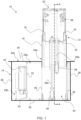
- an electric vehicle charging station is indicated generally at 10.
- the charging station 10 is suitable for installation in the ground.
- the station 10 is about 420mm long and about 150mm wide in this embodiment.
- the charging station 10 includes a bollard indicated generally at 12, and a housing indicated generally at 14.
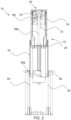
- the bollard 12 is moveable between a retracted position (not shown) in which it is substantially disposed within the housing 14, and a deployed position in which it extends substantially vertically from the housing 14. Whilst Figures 1 and 2 show the retractable bollard 12 in the deployed position, it will be appreciated that the bollard 12 is moveable along a substantially vertical axis into/out of the housing 14.
- the retractable bollard 12 is telescopic, although other embodiments are envisaged where a non-telescopic bollard is provided.
- the current embodiment has a first section or profile 16 and a second section or profile 18.
- the second section 18 is at least partially received in the first section 16 in both the retracted position and the deployed position.
- the sections 16, 18 are made of steel in this embodiment.
- Each section 16, 18 is a tubular member having a wall defining a hollow interior and two ends. Each section 16, 18 has a top and bottom end. Each section 16, 18 is prismatic. That is, each section has a profile that has been extruded along an axis.
- the bollard sections 16, 18 are hollow for accommodating an actuator mechanism between opposite ends of the charging interface device 20, when the bollard 12 is retracted.
- each wall has the form of a trapezium with rounded corners.
- each section has a substantially triangular, rectangular, pentagonal, hexagonal, heptagonal or octagonal cross-section for example, optionally with rounded corners.
- a circular cross-section to provide a cylindrical bollard is also contemplated.
- a removable charging interface device 20 is provided as a top end of the bollard 12.
- the device 20 substantially closes the top end of the second section 18 when fitted.
- the device 20 is shown in more detail in Figures 3 and 4 and will be discussed in more detail further below.
- a force transfer member 22, or mid-plate, is provided at or towards the bottom end of the second section 18.
- the member 22 is a mid-plate in the sense that it is disposed or extends to approximately midway along the bollard 12 in the deployed position.
- the second section 18 includes an inner wall 24 extending from the member 22 towards the top of the second section 18.
- the inner wall 24 is connected to the wall of the second section 18.
- the inner wall 24 is inset or spaced from a base of the second section 18.
- the housing 14 includes a base 26.
- the base 26 is substantially flat.
- the base 26 is a rectangular bottom wall in this embodiment.
- a sidewall 28 is provided around a perimeter of the base 26.
- the sidewall 28 includes four walls although only two are visible in Figure 1 .
- Each wall is substantially planar. Opposing pairs of walls are substantially parallel.
- the housing 14 is box-shaped in this embodiment.
- a first frame 29a is provided within the housing 14.
- the frame 29a includes a base frame portion, side frame portions and a top frame portion.
- the frame 29a may be considered to be a cuboidal frame.
- the side frame portions are substantially in height to the bollard 12 in the retracted arrangement.
- the first frame defines a chamber 30 for receiving the bollard 12.
- a second frame 29b is provided within the housing 14.
- the second frame 29b is disposed adjacent to the first frame 29a.
- the second frame 29b is smaller than the first frame 29a.
- the second frame 29b includes a base frame portion, side frame portions and a top frame portion.
- the top portion of the second frame is closer to the base portion of the first frame than the top portion of the first frame.
- the second frame 29b may be considered to be a cuboidal frame.
- the frames 29a, 29b may in some embodiments be provided on opposing sides of a dividing wall 32.
- the dividing wall 32 may extend to substantially the same height as top portion of the first frame 29a.
- the dividing wall 32 may be substantially planar, and may be substantially parallel with the opposing sidewall.
- Brackets (not shown) are provided to support the upper and lower corners where adjacent housing walls and/or frame portions meet.
- the backets may be internal or external brackets. Suitable fixing means such as screws are used to secure each bracket to the walls.
- a top plate 34 is provided on the housing 14.
- the top plate 34 is releasably connected to an upper portion of the housing 14.
- the top plate 34 is removable to access components of the charging station 10.
- the top plate is made of metal in this embodiment. Plastic mouldings may provide additional parts to connect the sections to other parts of the bollard.
- any one or more of a grip layer or coating, a roughened surface, or surface shape variations may be provided on top of the top plate to reduce the smoothness of the surface. This minimises the slipperiness of the top plate for walking on, such as if the plate is wet.
- a bollard aperture 34a is provided in the top plate 34.
- the opening 34a is sized and shaped to allow retractable bollard 12 to move through the plate 34a in either direction between retracted and deployed positions. Seals may be provided between the top plate 34 and sidewall 28, and/or between the bollard 12 and the opening 34a in the top plate 34.
- a second aperture and releasable cover may be provided through the top plate 34 in the region indicated at 34b. This allows access to the interior of the charging station 10 without removing the top plate, which is typically heavy to lift.
- Drainage holes can be provided through the base 26 or a lower portion of the side wall 28.
- the enclosure 14 may include seals for preventing or minimising ingress of water or moisture.
- the seals may be provided between the walls of the housing 14.
- An actuator unit 36 is provided for moving the retractable bollard 12 between retracted and deployed positions.
- the actuator unit includes a first linear actuator 36a extending from the base 26 to an upper end of an actuator housing 38.
- a second actuator unit 38 includes a second linear actuator 38a extending from a lower end of the actuator housing to the upper end of the second section 18, preferably to a portion of the removable charger unit 20.
- actuator units 36, 38 are electrically powered.
- the first and second linear actuators (or rods thereof) 36, 38 are offset from one another.
- the offset is also relative to the vertical axis along which the bollard 12 deploys and retracts.
- the linear actuators 36a, 38a are substantially parallel to each other and the vertical axis.
- the offset actuators allow full telescopic motion in a comparatively minimal depth. This minimises the installation depth in the ground.
- Each actuator unit 36, 38 includes a housing which is a substantially tubular member having a wall defining a hollow interior and two ends.
- the upper end of the first linear actuator is coupled to the force transfer member 22.
- the first linear actuator extends to the top of the force transfer member 22.
- the lower end of the second linear actuator is coupled to the force transfer member 22.
- the upper end of the second linear actuator is coupled to the charging interface device 20.
- Each actuator unit 36, 38 is waterproof, preferably IP68 rated.
- a bollard guiding means is provided in the housing 14 to guide the deployment and retraction of the bollard 12.
- four guide rails or rods 40 are provided around the periphery of the bollard 12, such as adjacent to the corners of the bollard.
- conical supports with cylindrical bores for the rods 40 are provided at the base of each rod 40, but it will be appreciated that any suitable support and support shape may be used.
- the first section 16 includes complementary guide means to interface with or follow the guide rails 40.
- the first section 16 includes a rail retaining means or apertured members connected to the first section 16.
- a control unit 42 is provided at one end of the housing 14.
- the control unit 42 includes processing means configured to electronically control operation of the charging station 10.
- the control unit 42 is disposed above or supported by the second frame 29b. In this embodiment, the control unit 42 is spaced from the bollard 12 by a chamber adjacent to the bollard 12 and within the first frame 29a.
- the control unit 42 is operably connected to the actuator units 36, 38 and the charging interface device 20.
- the control unit 42 includes electronic and electrical components which are necessary to control operation of the charging station 10.
- the control unit 42 may use power from the mains electrical supply.
- One or more mains power cable guides or supports 43 are provided. In this case, two guides are provided (although only one is visible in Figure 1 ). The number of guides 43 preferably matches or exceeds the number of charging sockets in the charging station 10.
- the charging interface device (or bollard top) 20 will now be described in more detail.
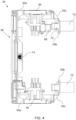
- FIGS 3 and 4 show one embodiment of the removable charging interface device 20.
- the device 20 includes two chargers or charging sockets 46.
- the sockets 46 are spaced apart by a chamber, indicated generally at 47.
- the device 20 includes a housing 48.
- the housing 48 includes an upper wall 49 and first and second end walls 50.
- the upper wall 49 is shaped and sized to fit in or on the upper end of the second section 18 of the bollard 12.
- the end walls 50 each form opposing ends of the upper wall 49.
- the end walls 50 are disposed in respective openings on opposite sides of the second section 18.
- the openings in the second section 18 are substantially U-shaped for receiving the end walls 50.
- a peripheral wall 49a is provided around the upper wall 49.
- the peripheral wall 49a provides a recessed area on top of the device 20.
- a centre region 49b of the upper wall 49 is raised.
- the actuator 38 is connected under the raised region 49b during use.
- Fastener apertures 52 are provided in the peripheral wall 49a, e.g. in the corners in the present embodiment.
- the fastener apertures 52 extend through the housing 48 to allow fasteners such as screws or bolts to be received and couple the device 20 to the bollard 12.
- a top unit is provided in the recessed section on the housing 48.
- the top unit includes a base portion 56 and a top portion 58.
- a sealing gasket 60 is provided between both the base portion 56 and top portion 58.
- the sealing gasket 60 may also extend to the peripheral wall 49a to provide a seal between the top unit and recessed section.
- a centre region 56a of the base portion 56 is raised for fitting over the raised area 49b on the housing 48.
- top portion 58 and upper wall 49 may be considered to be / provide bollard top. Both elements lie across the top of a bollard, when the device 20 is installed on a bollard.
- the top unit may include a magnet obstruction detector for detecting the presence of an object above the bollard 12.
- the top unit may include a switch obstruction detector for detecting the pressure exerted by an objection on the bollard 12.
- a plurality of reed switches 62 are provided on the base portion. Two reed switches 62 are disposed in a first half of the base portion 56, and the other two reed switches are disposed in the second half of the base portion 56. It will be appreciated that only one reed switch may be provided in each half, or that more reed switches could be used in other embodiments.
- First and second lights or LED members 64 are provided at opposite ends of the device 20.
- the top portion 58 includes apertures which the lights 64 pass through. Clear or coloured covers can be provided over the lights.
- the top unit or a portion of the top unit such as the top portion 58 may be floating. That is, the top portion 58 can be a floating plate.
- a biasing means such as one or more springs, can be provided to bias the floating top portion. If the top portion 58 encounters an obstruction during bollard movement, or if a load is applied to the top portion 58, then at least one of the reed switches 62 will change state and the control unit 42 can prevent or halt bollard movement.
- the end walls 50 are substantially identical in size and shape, mirrored about a central vertical plane bisecting the device 20. Each end wall 50 is substantially L-shaped. Each end wall 50 includes an upright wall 50a and a lateral wall 50b. In this embodiment, these walls 50a, 50b are joined by an oblique wall 50c.
- a charging socket or interface 46 is disposed in each end wall 50.
- the sockets 46 are recessed in the respective end walls 50.
- Each socket 46 is adapted to receive a plug of an electric vehicle charging cable.
- Each charging interface 46 includes a power supply connector for receiving a mains power cable and, during charging, conveying electricity to a plug engaged with the socket 46.
- a cover or lid 46a is provided for covering the socket 46. This can be lifted to allow access to the socket 46 for plugging in a cable. Preferably the cover 46 is biased into a closed position for protecting the socket from rain and debris, for example.
- a U-shaped member 66 is provided for fitting on each end wall 50.
- the U-shaped members may act as seals, mitigating water ingress into the bollard 12.
- Locking means are provided for each socket 46.
- the locking means can lock the plug of the electric vehicle charging cable so that it cannot be removed from the socket 46 during charging.
- a locking servo motor 68 is provided adjacent to a rear of each socket 46.
- the control unit 42 of the charging station 10 identifies when a plug has been engaged with the socket 46, and activates the locking means before (or substantially concurrently with) initiation of the power supply.
- the control unit 42 also controls deactivation of the locking means, to allow plug removal once charging has ceased (or substantially concurrently with cessation of the power supply to the plug).
- Each end wall 50 includes a cable guide or support 70.
- Each cable guide 70 includes a tubular bore for receiving a mains power cable.
- Each cable guide 70 can be connected to or integrally formed with the respective end wall.
- Each cable guide 70 is provided on one of the lateral walls 50b.
- a corresponding cable connector or receiver 72 is provided on each lateral wall 50b.
- Additional power transfer wire(s) or cabling and/or power converter(s) may be included, e.g. between the mains power cable and the socket. Any suitable means for transferring electricity may be used.
- a height sensor or deployment limiter 74 is provided on the charging interface device 20.
- the sensor or limiter 74 in this embodiment is provided on the upper wall 49.
- the sensor or limiter 74 can be configured to cooperate with the actuator so that the actuator does not over-deploy or over-extend the bollard.
- a support or frame 76 is provided in the bollard.
- the support or frame may be part of the bollard 12 or may be part of the charging interface device 20.
- the support or frame 76 has an inverted U-shaped section which the actuator extends into.
- the inverted U-shaped section abuts the underside of device 20.
- the inverted U-shaped section is flanked on either side by U-shaped sections. This can provide structural rigidity.
- the support 76 may be secured to the device 20 and/or the bollard 12.
- the U-shaped and inverted U-shaped profiles run along longitudinal axes which are substantially parallel to an axis between the charging sockets in this embodiment.
- the support frame 76 may be made of metal such as steel.
- the bollard 12 Prior to use, with the charging station 10 installed in the ground, e.g. pavement, the bollard 12 is normally in the retracted position below ground.
- the top of the bollard i.e. the top of the charging interface device 20, is substantially flush with the top plate 34.
- the top plate 34 is flush with the surface of the surrounding pavement.
- the bollard 12 may rise automatically or on request by a user.
- the inner telescopic section 18 may be deployed first via the actuator 38.
- the other actuator 36 begins extending to deploy the outer section 16.
- the force transfer member 22 between the extrusions 16, 18 can assist in raising the outer section 16 of the bollard 12.
- the bollard 12 is deployed for use in charging an adjacent electric vehicle via a charging cable (not shown).
- the cover 46a is lifted the cable is plugged into the socket 46.
- the control unit 42 detects the plug is engaged with the socket 46 and the servo 68 is activated to lock the plug in the socket 46. Charging can then be safely initiated when the power supply connector connects the mains supply to the socket and plug.
- the second socket 46 may be used in a similar manner for charging a second electric vehicle at the same time, if desired.
- the power supply connector in the relevant charging interface can disconnect the power supply from the socket.
- the servo 68 can then deactivate and allow the plug to be safely removed from the socket 46.
- the user may also wish to cease charging irrespective of the charge state of the battery of the electric vehicle.
- the bollard 12 can then retract back into the ground.
- the retraction may be a two-stage retraction similar to the deployment, or may be concerted.
- the charging station 10 is typically intended to be installed in the ground for a number of years. During that time, it is possible that the bollard may sustain damage or wear which prevents it from functioning safely and/or effectively.
- the charging interface device 20 One of the main parts that is more liable to fail is the charging interface device 20.
- the LED lights or other parts may short out if water gets into the electronics.
- the top plate may become damaged if subjected to a heavy load or if there is a collision by a vehicle, for example.
- the sockets 46 may wear out through normal use or short out if water enters them.
- the charging interface device 20 in the station 10 may be replaced by a new charging interface device in any of these circumstances, or as part of a regular maintenance schedule.
- the control unit 42 may have a maintenance mode which suitably prepares the charging station for the device swap.
- the top plate of the station 10 may be removed to facilitate access, or the bollard may be deployed to provide it at an easier working height.
- the fasteners can be removed (or whatever happens to secure the device 20 to the bollard 12 can be disengaged), and the device 20 can be lifted away from the bollard 12. It may be easiest to disconnect the mains power cables from the device 20 first, depending on the length of cable available and the additional weight to lift, if there is access to do so.
- the new device 20 can then be substituted in, connecting the mains cables through the respective cable guides and connecting the mains cables to the power supply connectors / charging interfaces and seating the new device on the bollard 12. These steps may be performed in any suitable order. Fasteners or other suitable connection means may then be used to secure the new device 20 in position. Suitable tests may then be carried out to check the new device 20 works as intended.
- the top plate may be removed and the entire control 42 accessed for replacement or repair without needing to do anything to the bollard 12. Where the control unit aperture is provided through the top plate, then the cover for that aperture can be removed in order to access the control unit 42 more easily.
- FIG. 1 another embodiment of an electric vehicle charging station is generally indicated at 100.
- the charging station 100 has substantially similar features to the charging station 10 of the embodiment described above, although most of the features are not explicitly illustrated in Figures 5 and 6 .
- Like reference numerals will be used to refer to like features where possible.
- charging interface device 20 it is not essential to include a charging interface device 20.
- the charging interface(s) may be fixed or integrated into the bollard, rather than removable. The additional features of this embodiment will now be described.
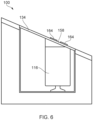
- the charging station 100 is adapted for installation in sloped ground or in a sloped pavement.
- the retractable charging bollard 112 includes two telescopic sections 116, 118. In this embodiment, only one actuator column 136 is shown, but it will be appreciated that two actuators can be used like the first embodiment.
- the ground in which the charging station 100 is installed is sloped ground.
- the base 126 of the housing is flat but the top plate 134 is sloped.
- the gradient of the top plate 134 substantially matches the gradient of the pavement in this embodiment.
- the plate 134 is substantially planar in this embodiment, although it is envisaged that the plate could be somewhat wedge-shaped in other embodiments.
- the first section 116 includes a sloped top 159.
- the sloped top 159 may be a separate member coupled to the section 116, or may be integrally formed with the section 116.
- the slope of the sloped top 159 substantially matches that of the top plate 134. When the bollard is retracted then the sloped top 159 is substantially flush with the sloped top plate 134 (see Figure 7).
- the second section 118 includes a sloped top 158.
- the sloped top 158 may be a separate member coupled to the section 118, or may be integrally formed with the section 118.
- the sloped top 158 is a top of a charging interface device 20, but this is not essential.
- the slope of the sloped top 158 substantially matches that of the other sloped top 159 and the top plate 134. When the bollard is retracted then the sloped top 158 is substantially flush with the other sloped top 159 and the sloped top plate 134 (again, see Figure 7).
- sloped tops 158, 159 are provided because there are two telescopic sections 116, 118. If a non-telescopic bollard is provided, then there would be only one sloped top, plus the sloped top plate. If a telescopic bollard with n telescopic sections is provided, then there would be n sloped tops, plus the sloped top plate.
- the ground in this embodiment only has an apparent slope in one direction (or dimension). However, it will be appreciated that the sloped top surfaces of the charging station 100 may be sloped in both lateral and longitudinal directions for ground that is sloped in two dimensions in other embodiments.
- the lights 164 on top of the bollard also have sloped tops in this embodiment, again at a substantially similar angle to the other sloped tops.
- the lights 164 protrude slightly from the ground when the bollard 112 is retracted - see Figure 7.
- the slope or gradient of the ground can be established immediately around the location where the charging station is to be installed. This allows for selection of a suitable sloped top plate 134 and other sloped elements 158, 159, 164. Alternatively, if a plurality of differently top plates and top elements are available, then it is not necessary to establish the slope in advance as trial and error could be used during the actual installation process.
- a hole is excavated for receiving the charging station 100 with sloped tops 158, 159.
- the station 100 is placed in the hole and mains cable(s) connected to it.
- the bollard 112 should be aligned on a substantially vertical axis.
- the hole is backfilled around the charging station, e.g. with cement.
- the sloped top plate 134 is then secured to the station 100. If it is not sufficiently flush with the surrounding pavement or ground, then some minor adjustments may be possible, e.g. abrading or rounding off edges of neighbouring paving slabs or bricks.
Landscapes
- Engineering & Computer Science (AREA)
- Power Engineering (AREA)
- Transportation (AREA)
- Mechanical Engineering (AREA)
- Architecture (AREA)
- Civil Engineering (AREA)
- Structural Engineering (AREA)
- Physics & Mathematics (AREA)
- General Physics & Mathematics (AREA)
- Charge And Discharge Circuits For Batteries Or The Like (AREA)
- Electric Propulsion And Braking For Vehicles (AREA)
Applications Claiming Priority (3)
| Application Number | Priority Date | Filing Date | Title |
|---|---|---|---|
| GB2110854.3A GB2609408B (en) | 2021-07-28 | 2021-07-28 | Electric vehicle charging station and interface device therefor |
| EP22753750.3A EP4377130B1 (de) | 2021-07-28 | 2022-07-28 | Elektrofahrzeug-ladestation und schnittstelleeinrichtung dafür |
| PCT/GB2022/051988 WO2023007169A1 (en) | 2021-07-28 | 2022-07-28 | Electric vehicle charging station and interface device therefor |
Related Parent Applications (2)
| Application Number | Title | Priority Date | Filing Date |
|---|---|---|---|
| EP22753750.3A Division EP4377130B1 (de) | 2021-07-28 | 2022-07-28 | Elektrofahrzeug-ladestation und schnittstelleeinrichtung dafür |
| EP22753750.3A Division-Into EP4377130B1 (de) | 2021-07-28 | 2022-07-28 | Elektrofahrzeug-ladestation und schnittstelleeinrichtung dafür |
Publications (2)
| Publication Number | Publication Date |
|---|---|
| EP4568035A2 true EP4568035A2 (de) | 2025-06-11 |
| EP4568035A3 EP4568035A3 (de) | 2025-08-20 |
Family
ID=77541032
Family Applications (2)
| Application Number | Title | Priority Date | Filing Date |
|---|---|---|---|
| EP22753750.3A Active EP4377130B1 (de) | 2021-07-28 | 2022-07-28 | Elektrofahrzeug-ladestation und schnittstelleeinrichtung dafür |
| EP25172081.9A Pending EP4568035A3 (de) | 2021-07-28 | 2022-07-28 | Elektrofahrzeugladestation und schnittstellenvorrichtung dafür |
Family Applications Before (1)
| Application Number | Title | Priority Date | Filing Date |
|---|---|---|---|
| EP22753750.3A Active EP4377130B1 (de) | 2021-07-28 | 2022-07-28 | Elektrofahrzeug-ladestation und schnittstelleeinrichtung dafür |
Country Status (9)
| Country | Link |
|---|---|
| EP (2) | EP4377130B1 (de) |
| JP (1) | JP2024528881A (de) |
| CN (1) | CN117999188A (de) |
| AU (1) | AU2022318298A1 (de) |
| CA (1) | CA3224063A1 (de) |
| ES (1) | ES3055808T3 (de) |
| GB (1) | GB2609408B (de) |
| MX (1) | MX2024001251A (de) |
| WO (1) | WO2023007169A1 (de) |
Families Citing this family (1)
| Publication number | Priority date | Publication date | Assignee | Title |
|---|---|---|---|---|
| FI131988B1 (en) * | 2023-08-18 | 2026-03-26 | Liikennevirta Oy / Virta Ltd | Device and method for managing the replacement of charging stations for electric vehicles |
Family Cites Families (17)
| Publication number | Priority date | Publication date | Assignee | Title |
|---|---|---|---|---|
| GB0611332D0 (en) * | 2006-06-08 | 2006-07-19 | Elektromotive Ltd | Charging station |
| JP4835724B2 (ja) * | 2009-05-28 | 2011-12-14 | パナソニック電工株式会社 | 電気自動車用充電スタンド |
| US20110066515A1 (en) * | 2009-09-16 | 2011-03-17 | Horvath Ronald F | Automated electric plug-in station for charging electric and hybrid vehicles |
| JP5406657B2 (ja) * | 2009-10-13 | 2014-02-05 | パナソニック株式会社 | 電気自動車用充電スタンド |
| WO2012034225A1 (en) * | 2010-09-13 | 2012-03-22 | AddÉnergie Technologies Inc. | Modular charging station |
| DE102011105421A1 (de) * | 2011-06-22 | 2012-12-27 | Gifas Electric Gmbh | Vorrichtung zum Aufladen von wenigstens einer Batterie eines mindestens teilweise mit Strom betreibbaren Fahrzeuges, insbesondere Landfahrzeuges, ein daraus gebildetes System und deren Verwendung |
| US10554059B1 (en) * | 2015-10-06 | 2020-02-04 | The Wiremold Company | Outdoor lighting and power charging station |
| DE102017218226A1 (de) * | 2017-03-20 | 2018-09-20 | Fraunhofer-Gesellschaft zur Förderung der angewandten Forschung e.V. | Unterflur-Kontaktsystem |
| CN107097679A (zh) * | 2017-06-19 | 2017-08-29 | 安徽易威斯新能源科技股份有限公司 | 一种地埋式四充电位大功率充电桩 |
| GB2567629B (en) * | 2017-10-13 | 2022-09-21 | Urban Electric Networks Ltd | Retractable charging station |
| GB2573748B (en) * | 2018-05-08 | 2023-01-04 | Urban Electric Networks Ltd | Electric vehicle charging station |
| GB2588672A (en) * | 2019-11-01 | 2021-05-05 | Urban Electric Networks Ltd | Electric vehicle charging station enclosure |
| WO2021133174A1 (en) * | 2019-12-27 | 2021-07-01 | Ep-Lift Bv | Retractable charging station |
| CN111284351B (zh) * | 2020-04-03 | 2020-10-16 | 郑州科技学院 | 一种用于新能源汽车的充电桩 |
| CN111546931A (zh) * | 2020-06-10 | 2020-08-18 | 袁晓四 | 一种防雨型自动升降式新能源汽车用充电桩 |
| CN111959323A (zh) * | 2020-09-01 | 2020-11-20 | 付贵林 | 一种新能源汽车充电设备防盗装置 |
| CN213167795U (zh) * | 2020-10-14 | 2021-05-11 | 刘昆明 | 一种地埋式新能源充电桩 |
-
2021
- 2021-07-28 GB GB2110854.3A patent/GB2609408B/en active Active
-
2022
- 2022-07-28 EP EP22753750.3A patent/EP4377130B1/de active Active
- 2022-07-28 MX MX2024001251A patent/MX2024001251A/es unknown
- 2022-07-28 CN CN202280063119.6A patent/CN117999188A/zh active Pending
- 2022-07-28 AU AU2022318298A patent/AU2022318298A1/en active Pending
- 2022-07-28 JP JP2024504925A patent/JP2024528881A/ja active Pending
- 2022-07-28 EP EP25172081.9A patent/EP4568035A3/de active Pending
- 2022-07-28 CA CA3224063A patent/CA3224063A1/en active Pending
- 2022-07-28 ES ES22753750T patent/ES3055808T3/es active Active
- 2022-07-28 WO PCT/GB2022/051988 patent/WO2023007169A1/en not_active Ceased
Also Published As
| Publication number | Publication date |
|---|---|
| EP4377130A1 (de) | 2024-06-05 |
| EP4568035A3 (de) | 2025-08-20 |
| AU2022318298A1 (en) | 2024-02-01 |
| MX2024001251A (es) | 2024-03-04 |
| CA3224063A1 (en) | 2023-02-02 |
| EP4377130B1 (de) | 2025-11-19 |
| WO2023007169A1 (en) | 2023-02-02 |
| JP2024528881A (ja) | 2024-08-01 |
| EP4377130C0 (de) | 2025-11-19 |
| ES3055808T3 (en) | 2026-02-16 |
| GB2609408B (en) | 2024-06-12 |
| GB202110854D0 (en) | 2021-09-08 |
| GB2609408A (en) | 2023-02-08 |
| CN117999188A (zh) | 2024-05-07 |
Similar Documents
| Publication | Publication Date | Title |
|---|---|---|
| EP3865337B1 (de) | Ladestation und -system für elektrofahrzeuge | |
| AU2022100165A4 (en) | Electric vehicle charging station | |
| US10538172B2 (en) | Apparatus that automates the connecting process between a primary connector and a secondary connector for charging an electric vehicle | |
| CN111225821A (zh) | 用于充电装置的组件和具有该组件的充电装置 | |
| EP4377130B1 (de) | Elektrofahrzeug-ladestation und schnittstelleeinrichtung dafür | |
| US6861584B2 (en) | Flush-to-grade vault with wall-mounted cross-connect panels | |
| US20240083278A1 (en) | Deployable electric vehicle charging point | |
| GB2588672A (en) | Electric vehicle charging station enclosure | |
| GB2630677A (en) | Electric vehicle charging station and interface device therefor | |
| EP4091225B1 (de) | Ausfahrbare ladestation für elektrofahrzeuge | |
| WO2021248180A1 (en) | Apparatus and method for charging electric vehicles | |
| HK1200411A1 (en) | Charging module for electric recharging of an electric vehicle | |
| US20250038509A1 (en) | Modular electric vehicle charging foundation system | |
| GB2608373A (en) | Modular electric vehicle charging foundation system | |
| HK40059751B (en) | Charging station and system for electric vehicles | |
| US20140284126A1 (en) | Integrated Service Center | |
| HK40110831A (zh) | 电动交通工具充电站 | |
| HK40009187A (en) | Electric vehicle charging station |
Legal Events
| Date | Code | Title | Description |
|---|---|---|---|
| PUAI | Public reference made under article 153(3) epc to a published international application that has entered the european phase |
Free format text: ORIGINAL CODE: 0009012 |
|
| STAA | Information on the status of an ep patent application or granted ep patent |
Free format text: STATUS: THE APPLICATION HAS BEEN PUBLISHED |
|
| AC | Divisional application: reference to earlier application |
Ref document number: 4377130 Country of ref document: EP Kind code of ref document: P |
|
| AK | Designated contracting states |
Kind code of ref document: A2 Designated state(s): AL AT BE BG CH CY CZ DE DK EE ES FI FR GB GR HR HU IE IS IT LI LT LU LV MC MK MT NL NO PL PT RO RS SE SI SK SM TR |
|
| REG | Reference to a national code |
Ref country code: DE Ref legal event code: R079 Free format text: PREVIOUS MAIN CLASS: H02G0003180000 Ipc: B60L0053140000 |
|
| PUAL | Search report despatched |
Free format text: ORIGINAL CODE: 0009013 |
|
| AK | Designated contracting states |
Kind code of ref document: A3 Designated state(s): AL AT BE BG CH CY CZ DE DK EE ES FI FR GB GR HR HU IE IS IT LI LT LU LV MC MK MT NL NO PL PT RO RS SE SI SK SM TR |
|
| RIC1 | Information provided on ipc code assigned before grant |
Ipc: B60L 53/14 20190101AFI20250715BHEP Ipc: B60L 53/16 20190101ALI20250715BHEP Ipc: B60L 53/31 20190101ALI20250715BHEP Ipc: B60L 53/35 20190101ALI20250715BHEP Ipc: G07F 15/00 20060101ALI20250715BHEP Ipc: G07F 17/00 20060101ALI20250715BHEP Ipc: H02G 3/04 20060101ALI20250715BHEP Ipc: H02G 3/18 20060101ALI20250715BHEP Ipc: H02J 7/00 20060101ALI20250715BHEP |
|
| STAA | Information on the status of an ep patent application or granted ep patent |
Free format text: STATUS: REQUEST FOR EXAMINATION WAS MADE |
|
| 17P | Request for examination filed |
Effective date: 20260219 |