EP4567962A2 - Batteriemodul - Google Patents
Batteriemodul Download PDFInfo
- Publication number
- EP4567962A2 EP4567962A2 EP24216541.3A EP24216541A EP4567962A2 EP 4567962 A2 EP4567962 A2 EP 4567962A2 EP 24216541 A EP24216541 A EP 24216541A EP 4567962 A2 EP4567962 A2 EP 4567962A2
- Authority
- EP
- European Patent Office
- Prior art keywords
- bus bar
- measurement circuit
- voltage measurement
- circuit portion
- battery module
- Prior art date
- Legal status (The legal status is an assumption and is not a legal conclusion. Google has not performed a legal analysis and makes no representation as to the accuracy of the status listed.)
- Pending
Links
Images



Classifications
-
- H—ELECTRICITY
- H01—ELECTRIC ELEMENTS
- H01M—PROCESSES OR MEANS, e.g. BATTERIES, FOR THE DIRECT CONVERSION OF CHEMICAL ENERGY INTO ELECTRICAL ENERGY
- H01M50/00—Constructional details or processes of manufacture of the non-active parts of electrochemical cells other than fuel cells, e.g. hybrid cells
- H01M50/50—Current conducting connections for cells or batteries
- H01M50/502—Interconnectors for connecting terminals of adjacent batteries; Interconnectors for connecting cells outside a battery casing
- H01M50/507—Interconnectors for connecting terminals of adjacent batteries; Interconnectors for connecting cells outside a battery casing comprising an arrangement of two or more busbars within a container structure, e.g. busbar modules
-
- G—PHYSICS
- G01—MEASURING; TESTING
- G01R—MEASURING ELECTRIC VARIABLES; MEASURING MAGNETIC VARIABLES
- G01R31/00—Arrangements for testing electric properties; Arrangements for locating electric faults; Arrangements for electrical testing characterised by what is being tested not provided for elsewhere
- G01R31/36—Arrangements for testing, measuring or monitoring the electrical condition of accumulators or electric batteries, e.g. capacity or state of charge [SoC]
- G01R31/382—Arrangements for monitoring battery or accumulator variables, e.g. SoC
- G01R31/3835—Arrangements for monitoring battery or accumulator variables, e.g. SoC involving only voltage measurements
-
- G—PHYSICS
- G01—MEASURING; TESTING
- G01R—MEASURING ELECTRIC VARIABLES; MEASURING MAGNETIC VARIABLES
- G01R31/00—Arrangements for testing electric properties; Arrangements for locating electric faults; Arrangements for electrical testing characterised by what is being tested not provided for elsewhere
- G01R31/36—Arrangements for testing, measuring or monitoring the electrical condition of accumulators or electric batteries, e.g. capacity or state of charge [SoC]
- G01R31/396—Acquisition or processing of data for testing or for monitoring individual cells or groups of cells within a battery
-
- H—ELECTRICITY
- H01—ELECTRIC ELEMENTS
- H01M—PROCESSES OR MEANS, e.g. BATTERIES, FOR THE DIRECT CONVERSION OF CHEMICAL ENERGY INTO ELECTRICAL ENERGY
- H01M10/00—Secondary cells; Manufacture thereof
- H01M10/42—Methods or arrangements for servicing or maintenance of secondary cells or secondary half-cells
- H01M10/425—Structural combination with electronic components, e.g. electronic circuits integrated to the outside of the casing
-
- H—ELECTRICITY
- H01—ELECTRIC ELEMENTS
- H01M—PROCESSES OR MEANS, e.g. BATTERIES, FOR THE DIRECT CONVERSION OF CHEMICAL ENERGY INTO ELECTRICAL ENERGY
- H01M10/00—Secondary cells; Manufacture thereof
- H01M10/42—Methods or arrangements for servicing or maintenance of secondary cells or secondary half-cells
- H01M10/48—Accumulators combined with arrangements for measuring, testing or indicating the condition of cells, e.g. the level or density of the electrolyte
-
- H—ELECTRICITY
- H01—ELECTRIC ELEMENTS
- H01M—PROCESSES OR MEANS, e.g. BATTERIES, FOR THE DIRECT CONVERSION OF CHEMICAL ENERGY INTO ELECTRICAL ENERGY
- H01M10/00—Secondary cells; Manufacture thereof
- H01M10/42—Methods or arrangements for servicing or maintenance of secondary cells or secondary half-cells
- H01M10/48—Accumulators combined with arrangements for measuring, testing or indicating the condition of cells, e.g. the level or density of the electrolyte
- H01M10/482—Accumulators combined with arrangements for measuring, testing or indicating the condition of cells, e.g. the level or density of the electrolyte for several batteries or cells simultaneously or sequentially
-
- H—ELECTRICITY
- H01—ELECTRIC ELEMENTS
- H01M—PROCESSES OR MEANS, e.g. BATTERIES, FOR THE DIRECT CONVERSION OF CHEMICAL ENERGY INTO ELECTRICAL ENERGY
- H01M10/00—Secondary cells; Manufacture thereof
- H01M10/42—Methods or arrangements for servicing or maintenance of secondary cells or secondary half-cells
- H01M10/48—Accumulators combined with arrangements for measuring, testing or indicating the condition of cells, e.g. the level or density of the electrolyte
- H01M10/486—Accumulators combined with arrangements for measuring, testing or indicating the condition of cells, e.g. the level or density of the electrolyte for measuring temperature
-
- H—ELECTRICITY
- H01—ELECTRIC ELEMENTS
- H01M—PROCESSES OR MEANS, e.g. BATTERIES, FOR THE DIRECT CONVERSION OF CHEMICAL ENERGY INTO ELECTRICAL ENERGY
- H01M50/00—Constructional details or processes of manufacture of the non-active parts of electrochemical cells other than fuel cells, e.g. hybrid cells
- H01M50/50—Current conducting connections for cells or batteries
- H01M50/502—Interconnectors for connecting terminals of adjacent batteries; Interconnectors for connecting cells outside a battery casing
-
- H—ELECTRICITY
- H01—ELECTRIC ELEMENTS
- H01M—PROCESSES OR MEANS, e.g. BATTERIES, FOR THE DIRECT CONVERSION OF CHEMICAL ENERGY INTO ELECTRICAL ENERGY
- H01M50/00—Constructional details or processes of manufacture of the non-active parts of electrochemical cells other than fuel cells, e.g. hybrid cells
- H01M50/50—Current conducting connections for cells or batteries
- H01M50/502—Interconnectors for connecting terminals of adjacent batteries; Interconnectors for connecting cells outside a battery casing
- H01M50/519—Interconnectors for connecting terminals of adjacent batteries; Interconnectors for connecting cells outside a battery casing comprising printed circuit boards [PCB]
-
- H—ELECTRICITY
- H01—ELECTRIC ELEMENTS
- H01M—PROCESSES OR MEANS, e.g. BATTERIES, FOR THE DIRECT CONVERSION OF CHEMICAL ENERGY INTO ELECTRICAL ENERGY
- H01M50/00—Constructional details or processes of manufacture of the non-active parts of electrochemical cells other than fuel cells, e.g. hybrid cells
- H01M50/50—Current conducting connections for cells or batteries
- H01M50/569—Constructional details of current conducting connections for detecting conditions inside cells or batteries, e.g. details of voltage sensing terminals
-
- H—ELECTRICITY
- H01—ELECTRIC ELEMENTS
- H01M—PROCESSES OR MEANS, e.g. BATTERIES, FOR THE DIRECT CONVERSION OF CHEMICAL ENERGY INTO ELECTRICAL ENERGY
- H01M50/00—Constructional details or processes of manufacture of the non-active parts of electrochemical cells other than fuel cells, e.g. hybrid cells
- H01M50/50—Current conducting connections for cells or batteries
- H01M50/572—Means for preventing undesired use or discharge
- H01M50/574—Devices or arrangements for the interruption of current
- H01M50/583—Devices or arrangements for the interruption of current in response to current, e.g. fuses
-
- H—ELECTRICITY
- H01—ELECTRIC ELEMENTS
- H01M—PROCESSES OR MEANS, e.g. BATTERIES, FOR THE DIRECT CONVERSION OF CHEMICAL ENERGY INTO ELECTRICAL ENERGY
- H01M10/00—Secondary cells; Manufacture thereof
- H01M10/42—Methods or arrangements for servicing or maintenance of secondary cells or secondary half-cells
- H01M10/425—Structural combination with electronic components, e.g. electronic circuits integrated to the outside of the casing
- H01M2010/4271—Battery management systems including electronic circuits, e.g. control of current or voltage to keep battery in healthy state, cell balancing
-
- H—ELECTRICITY
- H01—ELECTRIC ELEMENTS
- H01M—PROCESSES OR MEANS, e.g. BATTERIES, FOR THE DIRECT CONVERSION OF CHEMICAL ENERGY INTO ELECTRICAL ENERGY
- H01M2200/00—Safety devices for primary or secondary batteries
- H01M2200/10—Temperature sensitive devices
- H01M2200/103—Fuse
-
- H—ELECTRICITY
- H01—ELECTRIC ELEMENTS
- H01M—PROCESSES OR MEANS, e.g. BATTERIES, FOR THE DIRECT CONVERSION OF CHEMICAL ENERGY INTO ELECTRICAL ENERGY
- H01M50/00—Constructional details or processes of manufacture of the non-active parts of electrochemical cells other than fuel cells, e.g. hybrid cells
- H01M50/50—Current conducting connections for cells or batteries
- H01M50/502—Interconnectors for connecting terminals of adjacent batteries; Interconnectors for connecting cells outside a battery casing
- H01M50/521—Interconnectors for connecting terminals of adjacent batteries; Interconnectors for connecting cells outside a battery casing characterised by the material
- H01M50/522—Inorganic material
-
- Y—GENERAL TAGGING OF NEW TECHNOLOGICAL DEVELOPMENTS; GENERAL TAGGING OF CROSS-SECTIONAL TECHNOLOGIES SPANNING OVER SEVERAL SECTIONS OF THE IPC; TECHNICAL SUBJECTS COVERED BY FORMER USPC CROSS-REFERENCE ART COLLECTIONS [XRACs] AND DIGESTS
- Y02—TECHNOLOGIES OR APPLICATIONS FOR MITIGATION OR ADAPTATION AGAINST CLIMATE CHANGE
- Y02E—REDUCTION OF GREENHOUSE GAS [GHG] EMISSIONS, RELATED TO ENERGY GENERATION, TRANSMISSION OR DISTRIBUTION
- Y02E60/00—Enabling technologies; Technologies with a potential or indirect contribution to GHG emissions mitigation
- Y02E60/10—Energy storage using batteries
Definitions
- aspects of embodiments of the present disclosure relate to a battery module.
- Secondary batteries are rechargeable, unlike non-rechargeable primary batteries.
- Low-capacity secondary batteries may be used in small portable electronic devices, such as smartphones, feature phones, laptop computers, digital cameras, and camcorders, and high-capacity secondary batteries may be used as motor-driving power sources, power-storing batteries, etc. for hybrid vehicles, electric vehicles, etc.
- a secondary battery may include an electrode assembly including a cathode and an anode, a case accommodating the electrode assembly, an electrode terminal connected to the electrode assembly, etc.
- a battery module includes a plurality of battery cells.
- the battery module is configured to measure a voltage to identify a state of charge of each of the plurality of battery cells.
- Examples of an electronic component that measures a voltage of each battery cell may include a wire harness, a flexible printed circuit assembly (FPCA), etc.
- the wire harness has been used as the electronic component.
- the FPCA is available as an alternative to the wire harness.
- due to a complicated manufacturing process of the FPCA in comparison to that of the wire harness a manufacturing cost of the FPCA is high.
- a battery module including a coupling structure of a circuit measuring a voltage of a battery cell and a holder bus bar is provided. According to another aspect of one or more embodiments of the present disclosure, a battery module with reduced manufacturing costs due to improving a formation structure of an electronic component that measures the voltage of battery cells included in the battery module is provided.
- a battery module includes a bus bar configured to electrically connect a plurality of battery cells to each other, a holder bus bar configured to fix the bus bar, and a voltage measurement circuit portion configured to measure a voltage of each of the plurality of battery cells.
- the voltage measurement circuit portion is integrally formed with the holder bus bar.
- the voltage measurement circuit portion may be formed on a surface of the holder bus bar by laser direct structuring (LDS).
- LDS laser direct structuring
- the battery module may further include an insulating film covering the voltage measurement circuit portion.
- the insulating film may include a polyimide (PI) resin or a polyethylene naphthalate (PEN) resin.
- PI polyimide
- PEN polyethylene naphthalate
- the voltage measurement circuit portion and the bus bar may be electrically connected to each other through a wire bonding structure.
- the voltage measurement circuit portion and the bus bar may be electrically connected to each other through a flexible printed circuit (FPC) component.
- FPC flexible printed circuit
- the voltage measurement circuit portion and the bus bar may be electrically connected to each other through a flexible die cut (FDC) component.
- FDC flexible die cut
- the voltage measurement circuit portion and the bus bar may be electrically connected to each other through a lug terminal.
- a component electrically connecting the voltage measurement circuit portion to the bus bar may include a fuse portion configured as a FPC.
- a component electrically connecting the voltage measurement circuit portion to the bus bar may include a fuse portion having a hybrid structure of a FDC and a FPC.
- comparison targets are "the same” as each other may mean that they are the same or substantially the same as each other.
- a case in which the comparison targets are "the same” or “substantially the same” as each other may include a case in which they have a deviation regarded as a low level, e.g., a deviation of 5 % or less. If a uniform parameter is uniform in a predetermined area, it may mean that it is uniform from an average point of view.
- first may be used to describe various components, these components are not limited by these terms. These terms are used to distinguish one component from other components, and, unless specifically stated to the contrary, a first component may be described as a second component.
- a component is arranged on "a top portion (or a bottom portion)" of another component or “on (or under)” the other component, it may refer to not only a case in which the component is arranged adjacent to a top surface (or a bottom surface) of the other component, but also a case in which another component may be interposed between the other component and the component arranged on (or under) the other component.
- a component is described as being “connected,” “coupled,” or “connectable” to another component, it is to be understood that the components may be directly connected, coupled, or connectable to each other, but another component may be interposed between the components, or the components may be “connected,” “coupled,” or “connectable” to each other through another component.
- a portion is electrically coupled to another portion, this may include not only a case in which they are directly connected to each other, but also a case in which they are connected with another device therebetween.
- a and/or B may mean A, B, or A and B, unless specifically stated otherwise. That is, “and/or” may include all or any combination of a plurality of items listed. “C to D” may mean at least C but not more than D, unless specifically stated otherwise.
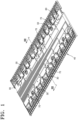
- FIG. 1 is a perspective view showing an assembly structure of a bus bar, a holder bus bar, and a voltage measurement circuit portion included in a battery module according to an embodiment of the present disclosure.
- FIG. 2 is a perspective view showing some components shown in FIG. 1 being separated.
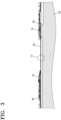
- FIG. 3 is a cross-sectional view taken along the line III-III shown in FIG. 1 .
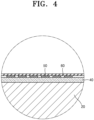
- FIG. 4 is an enlarged view of a region "A" shown in FIG. 3 .
- FIG. 5 is a perspective view showing an assembly structure of a bus bar, a holder bus bar, and a voltage measurement circuit portion included in the battery module according to another embodiment of the present disclosure.
- FIG. 6 is a perspective view showing some components shown in FIG. 5 being separated.
- FIG. 7 is a view showing a configuration in which a fuse portion is formed in a component that electrically connects the voltage measurement circuit portion to the bus bar shown in FIG. 5 .
- FIG. 8 is a perspective view showing an example shape of lug terminal.
- a battery module may include a plurality of battery cells 20.
- the battery cell 20 may be a prismatic (e.g., square) battery cell.
- the plurality of battery cells 20 may be provided.
- the battery cells 20 may be arranged (e.g., regularly arranged) in a case (not shown).
- the battery module may include a bus bar 30, a holder bus bar 40, a voltage measurement circuit portion 50, an insulating film 60, and a connection component 70.
- the bus bar 30 is a component that electrically connects the plurality of battery cells 20 to each other.
- the bus bar 30 may include a metal with electrical conductivity.
- the holder bus bar 40 is a component that fixes the bus bar 30 in a certain position.
- the holder bus bar 40 may include synthetic resin.
- the bus bar 30 may be coupled in a structure supported by upper and lower supports formed on the holder bus bar 40.
- the voltage measurement circuit portion 50 may perform a function of measuring a voltage of the battery cell 20.
- the voltage measurement circuit portion 50 may be connected to the battery cell 20 through the bus bar 30.
- the voltage measurement circuit portion 50 may be integrally formed with the holder bus bar 40.
- the voltage measurement circuit portion 50 may be inseparably coupled to the holder bus bar 40.
- the voltage measurement circuit portion 50 may be formed on a surface of the holder bus bar 40.
- the voltage measurement circuit portion 50 may be formed on an upper surface of the holder bus bar 40.
- the voltage measurement circuit portion 50 may be formed by using a laser direct structuring (LDS) method.
- LDS may be implemented by surface-treating a part constituting the voltage measurement circuit portion 50 by irradiating laser light and then plating the same with copper (Cu) and nickel (Ni) to configure an electric circuit.
- the voltage measurement circuit portion 50 may be formed before the holder bus bar 40 and the bus bar 30 are coupled to each other.
- the insulating film 60 is a structure that covers the voltage measurement circuit portion 50.
- the insulating film 60 may electrically protect the voltage measurement circuit portion 50.
- the insulating film 60 may include an insulating synthetic resin.
- the insulating film 60 may include a polyimide (PI) resin or polyethylene naphthalate (PEN) resin.
- the insulating film 60 may be attached to the voltage measurement circuit portion 50 using, for example, a thermal compression or adhesive method.
- the voltage measurement circuit portion 50 and the bus bar 30 may be electrically connected to each other through a connection component 70 of a wire bonding structure.
- the voltage measurement circuit portion 50 and the bus bar 30 may be electrically connected to each other through the connection component 70 including a flexible printed circuit (FPC) component.
- FPC flexible printed circuit
- the connection component 70 may be configured in a structure in which, for example, a nickel tab and an FPC are coupled to each other.
- the voltage measurement circuit portion 50 and the bus bar 30 may be electrically connected to each other through the connection component 70 including a flexible die cut (FDC) circuit component.
- the FDC component may be formed by cutting a conductive metal thin plate into a pattern (e.g., a predetermined pattern) by using upper and lower rollers and then adhering the same to a resin film.
- the FDC component may have an advantage of low manufacturing cost.
- the connection component 70 may be configured in a structure in which, for example, a nickel tab and an FPC are coupled to each other.
- the voltage measurement circuit portion 50 and the bus bar 30 may be electrically connected to each other through a lug terminal as the connection component 70.
- the lug terminal may have an advantage of being easily adopted as a connection component of a known structure that may be conventionally used.
- the connection component 70 that electrically connects the voltage measurement circuit portion 50 to the bus bar 30 may include a fuse portion 90 configured as the FPC.
- the fuse portion 90 may electrically protect the voltage measurement circuit portion 50 if overcurrent flows from the battery cell 20.
- the FPC may have an advantage of precisely forming a structure of the fuse portion 90 with a width of 0.08 mm or less.
- connection component 70 that electrically connects the voltage measurement circuit portion 50 to the bus bar 30 may include the fuse portion 90 in a hybrid structure as a mixture of a FDC and a FPC.
- the FDC may be produced at low cost, but may be limited in manufacturing a width of a circuit pattern formed to be smaller than a certain size.
- the FPC may be expensive to manufacture, it may be advantageous to manufacturing the precise fuse portion 90 because a width of a circuit pattern formed may be formed much smaller than that of the FDC.
- a hybrid component in which most of circuits are manufactured with the FDC and the precise fuse portion 90 (e.g., only the precise fuse portion 90) is manufactured with the FPC and coupled to each other using a method such as hot pressing may provide the effects of maintaining stable quality and reducing manufacturing costs.
- the voltage measurement circuit portion 50 may include a temperature sensor 80.
- the FDC/FPC hybrid structure may also be adopted in a component that connects the temperature sensor 80 to the voltage measurement circuit portion 50.
- the temperature sensor 80 is a sensor that measures the temperature of the battery cell 20.
- a voltage measurement circuit portion that measures the voltage of a battery cell is integrally formed with a holder bus bar, and, thus, manufacturing costs may be reduced and an assembly process may be simplified, thereby providing an effect of innovatively improving productivity.
- the voltage measurement circuit portion and the bus bar may be connected to each other in various forms. If a component that electrically connects the voltage measurement circuit portion to the bus bar is formed in a hybrid structure of a FDC and a FPC, as in one or more embodiments of the present disclosure, manufacturing costs may be reduced by applying the FDC, and a precise safety device may effectively configure the fuse portion 90 by applying the FPC.
- the voltage measurement circuit portion that measures the voltage of a battery cell is integrally formed with the holder bus bar, and, thus, there is no need to assemble the voltage measurement circuit portion and the holder bus bar through a separate process, thereby providing an effect of significantly reducing cost.
- the quality and durability of the voltage measurement circuit portion may be improved.
- the component that connects the voltage measurement circuit portion to the bus bar includes the FPC and the FDC, as in one or more embodiments of the present disclosure, a cost of configuring a fuse portion that prevents or substantially prevents the voltage measurement circuit portion from being damaged by overcurrent may be reduced.
- a voltage measurement circuit portion that measures the voltage of a battery cell is integrally formed with a holder bus bar, and, thus, there is no need to assemble the voltage measurement circuit portion and the holder bus bar through a separate process, thereby providing the effect of significantly reducing a cost.
Landscapes
- Chemical & Material Sciences (AREA)
- Chemical Kinetics & Catalysis (AREA)
- Electrochemistry (AREA)
- General Chemical & Material Sciences (AREA)
- Engineering & Computer Science (AREA)
- Manufacturing & Machinery (AREA)
- Physics & Mathematics (AREA)
- General Physics & Mathematics (AREA)
- Microelectronics & Electronic Packaging (AREA)
- Connection Of Batteries Or Terminals (AREA)
- Secondary Cells (AREA)
- Battery Mounting, Suspending (AREA)
Applications Claiming Priority (1)
| Application Number | Priority Date | Filing Date | Title |
|---|---|---|---|
| KR1020230174885A KR20250085506A (ko) | 2023-12-05 | 2023-12-05 | 배터리 모듈 |
Publications (2)
| Publication Number | Publication Date |
|---|---|
| EP4567962A2 true EP4567962A2 (de) | 2025-06-11 |
| EP4567962A3 EP4567962A3 (de) | 2025-08-06 |
Family
ID=93742847
Family Applications (1)
| Application Number | Title | Priority Date | Filing Date |
|---|---|---|---|
| EP24216541.3A Pending EP4567962A3 (de) | 2023-12-05 | 2024-11-29 | Batteriemodul |
Country Status (4)
| Country | Link |
|---|---|
| US (1) | US20250183500A1 (de) |
| EP (1) | EP4567962A3 (de) |
| KR (1) | KR20250085506A (de) |
| CN (2) | CN223993376U (de) |
Family Cites Families (4)
| Publication number | Priority date | Publication date | Assignee | Title |
|---|---|---|---|---|
| DE102014003090B4 (de) * | 2014-03-01 | 2023-01-19 | Audi Ag | Verfahren zum Herstellen eines Batteriemoduls |
| JP6533505B2 (ja) * | 2016-09-26 | 2019-06-19 | 矢崎総業株式会社 | バスバーモジュール |
| JP2020511362A (ja) | 2017-03-13 | 2020-04-16 | マザーソン・イノベーションズ・カンパニー・リミテッド | 多機能リアビュー装置 |
| CN116632465B (zh) * | 2023-07-19 | 2023-10-27 | 中国第一汽车股份有限公司 | 直连式电池模组及其设计方法、电池包及车辆 |
-
2023
- 2023-12-05 KR KR1020230174885A patent/KR20250085506A/ko active Pending
-
2024
- 2024-08-08 US US18/798,483 patent/US20250183500A1/en active Pending
- 2024-11-29 EP EP24216541.3A patent/EP4567962A3/de active Pending
- 2024-12-04 CN CN202422986325.3U patent/CN223993376U/zh active Active
- 2024-12-04 CN CN202411771656.3A patent/CN120109445A/zh active Pending
Also Published As
| Publication number | Publication date |
|---|---|
| US20250183500A1 (en) | 2025-06-05 |
| KR20250085506A (ko) | 2025-06-12 |
| CN120109445A (zh) | 2025-06-06 |
| EP4567962A3 (de) | 2025-08-06 |
| CN223993376U (zh) | 2026-03-13 |
Similar Documents
| Publication | Publication Date | Title |
|---|---|---|
| US11673205B2 (en) | Battery module having bus bar, and battery pack | |
| US11217850B2 (en) | Frame assembly and method for manufacturing same | |
| US9716258B2 (en) | Battery pack | |
| US9017836B2 (en) | Battery pack | |
| US20200321590A1 (en) | Battery module having bus bar and battery pack | |
| US20150044511A1 (en) | Battery pack | |
| KR20200071614A (ko) | 배터리 모듈용 fpcb 조립체, 그 제조방법 및 그를 포함하는 배터리 모듈 | |
| US20140178715A1 (en) | Battery pack | |
| EP3561907B1 (de) | Batteriemodul und herstellungsverfahren dafür | |
| EP2624331A1 (de) | Batteriepack | |
| US20140349163A1 (en) | Battery pack | |
| EP4567962A2 (de) | Batteriemodul | |
| KR101222392B1 (ko) | 배터리 팩 | |
| KR102847231B1 (ko) | 배터리 장치 및 그 제조 방법 | |
| EP4439828A1 (de) | Zellenhalter für ein batteriepack und batteriepack damit | |
| US9362543B2 (en) | Battery pack | |
| US20250140955A1 (en) | Battery module | |
| KR101892164B1 (ko) | 배터리팩을 위한 보호회로모듈 | |
| EP4625610A1 (de) | Batteriemodul | |
| CN219512967U (zh) | 一种电容模组及逆变器 | |
| US20250096341A1 (en) | Apparatus for measuring battery temperature | |
| KR20260054499A (ko) | 연성인쇄회로기판 조립체, 이를 포함하는 전지 모듈 및 연성인쇄회로기판의 제조 방법 | |
| EP4730925A2 (de) | Leiterplattenanordnung und wiederaufladbare batterie damit | |
| US20140212699A1 (en) | Protection circuit module integrated cap assembly, and method of manufacturing cap assembly and secondary battery | |
| KR20210116040A (ko) | 신규한 센싱 구조를 포함하는 배터리 모듈 및 이를 포함하는 배터리 팩 |
Legal Events
| Date | Code | Title | Description |
|---|---|---|---|
| PUAI | Public reference made under article 153(3) epc to a published international application that has entered the european phase |
Free format text: ORIGINAL CODE: 0009012 |
|
| STAA | Information on the status of an ep patent application or granted ep patent |
Free format text: STATUS: REQUEST FOR EXAMINATION WAS MADE |
|
| 17P | Request for examination filed |
Effective date: 20241129 |
|
| AK | Designated contracting states |
Kind code of ref document: A2 Designated state(s): AL AT BE BG CH CY CZ DE DK EE ES FI FR GB GR HR HU IE IS IT LI LT LU LV MC ME MK MT NL NO PL PT RO RS SE SI SK SM TR |
|
| PUAL | Search report despatched |
Free format text: ORIGINAL CODE: 0009013 |
|
| AK | Designated contracting states |
Kind code of ref document: A3 Designated state(s): AL AT BE BG CH CY CZ DE DK EE ES FI FR GB GR HR HU IE IS IT LI LT LU LV MC ME MK MT NL NO PL PT RO RS SE SI SK SM TR |
|
| RIC1 | Information provided on ipc code assigned before grant |
Ipc: H01M 10/48 20060101AFI20250703BHEP Ipc: H01M 50/507 20210101ALI20250703BHEP Ipc: H01M 50/519 20210101ALI20250703BHEP Ipc: H01M 50/569 20210101ALI20250703BHEP Ipc: G01R 31/3835 20190101ALI20250703BHEP Ipc: G01R 31/396 20190101ALI20250703BHEP Ipc: H01M 10/42 20060101ALN20250703BHEP |