EP4567950A1 - Zellstapelungsverfahren - Google Patents
Zellstapelungsverfahren Download PDFInfo
- Publication number
- EP4567950A1 EP4567950A1 EP24741742.1A EP24741742A EP4567950A1 EP 4567950 A1 EP4567950 A1 EP 4567950A1 EP 24741742 A EP24741742 A EP 24741742A EP 4567950 A1 EP4567950 A1 EP 4567950A1
- Authority
- EP
- European Patent Office
- Prior art keywords
- cells
- cell
- electrode
- stacking
- center
- Prior art date
- Legal status (The legal status is an assumption and is not a legal conclusion. Google has not performed a legal analysis and makes no representation as to the accuracy of the status listed.)
- Pending
Links
Images



Classifications
-
- H—ELECTRICITY
- H01—ELECTRIC ELEMENTS
- H01M—PROCESSES OR MEANS, e.g. BATTERIES, FOR THE DIRECT CONVERSION OF CHEMICAL ENERGY INTO ELECTRICAL ENERGY
- H01M10/00—Secondary cells; Manufacture thereof
- H01M10/04—Construction or manufacture in general
-
- H—ELECTRICITY
- H01—ELECTRIC ELEMENTS
- H01M—PROCESSES OR MEANS, e.g. BATTERIES, FOR THE DIRECT CONVERSION OF CHEMICAL ENERGY INTO ELECTRICAL ENERGY
- H01M10/00—Secondary cells; Manufacture thereof
- H01M10/04—Construction or manufacture in general
- H01M10/0404—Machines for assembling batteries
-
- H—ELECTRICITY
- H01—ELECTRIC ELEMENTS
- H01M—PROCESSES OR MEANS, e.g. BATTERIES, FOR THE DIRECT CONVERSION OF CHEMICAL ENERGY INTO ELECTRICAL ENERGY
- H01M10/00—Secondary cells; Manufacture thereof
- H01M10/04—Construction or manufacture in general
- H01M10/0413—Large-sized flat cells or batteries for motive or stationary systems with plate-like electrodes
-
- H—ELECTRICITY
- H01—ELECTRIC ELEMENTS
- H01M—PROCESSES OR MEANS, e.g. BATTERIES, FOR THE DIRECT CONVERSION OF CHEMICAL ENERGY INTO ELECTRICAL ENERGY
- H01M10/00—Secondary cells; Manufacture thereof
- H01M10/05—Accumulators with non-aqueous electrolyte
- H01M10/058—Construction or manufacture
- H01M10/0585—Construction or manufacture of accumulators having only flat construction elements, i.e. flat positive electrodes, flat negative electrodes and flat separators
-
- H—ELECTRICITY
- H01—ELECTRIC ELEMENTS
- H01M—PROCESSES OR MEANS, e.g. BATTERIES, FOR THE DIRECT CONVERSION OF CHEMICAL ENERGY INTO ELECTRICAL ENERGY
- H01M50/00—Constructional details or processes of manufacture of the non-active parts of electrochemical cells other than fuel cells, e.g. hybrid cells
- H01M50/50—Current conducting connections for cells or batteries
- H01M50/531—Electrode connections inside a battery casing
- H01M50/54—Connection of several leads or tabs of plate-like electrode stacks, e.g. electrode pole straps or bridges
-
- Y—GENERAL TAGGING OF NEW TECHNOLOGICAL DEVELOPMENTS; GENERAL TAGGING OF CROSS-SECTIONAL TECHNOLOGIES SPANNING OVER SEVERAL SECTIONS OF THE IPC; TECHNICAL SUBJECTS COVERED BY FORMER USPC CROSS-REFERENCE ART COLLECTIONS [XRACs] AND DIGESTS
- Y02—TECHNOLOGIES OR APPLICATIONS FOR MITIGATION OR ADAPTATION AGAINST CLIMATE CHANGE
- Y02E—REDUCTION OF GREENHOUSE GAS [GHG] EMISSIONS, RELATED TO ENERGY GENERATION, TRANSMISSION OR DISTRIBUTION
- Y02E60/00—Enabling technologies; Technologies with a potential or indirect contribution to GHG emissions mitigation
- Y02E60/10—Energy storage using batteries
-
- Y—GENERAL TAGGING OF NEW TECHNOLOGICAL DEVELOPMENTS; GENERAL TAGGING OF CROSS-SECTIONAL TECHNOLOGIES SPANNING OVER SEVERAL SECTIONS OF THE IPC; TECHNICAL SUBJECTS COVERED BY FORMER USPC CROSS-REFERENCE ART COLLECTIONS [XRACs] AND DIGESTS
- Y02—TECHNOLOGIES OR APPLICATIONS FOR MITIGATION OR ADAPTATION AGAINST CLIMATE CHANGE
- Y02P—CLIMATE CHANGE MITIGATION TECHNOLOGIES IN THE PRODUCTION OR PROCESSING OF GOODS
- Y02P70/00—Climate change mitigation technologies in the production process for final industrial or consumer products
- Y02P70/50—Manufacturing or production processes characterised by the final manufactured product
Definitions
- the present invention relates to a method of stacking cells, characterized by establishing an imaginary base line on each cell and aligning the cells so that the base lines coincide.
- Secondary batteries which possess electrical characteristics such as high energy density and ease of application according to product range, are widely applied not only in portable devices but also in electric or hybrid vehicles driven by electric power sources, power storage devices, etc. These secondary batteries are attracting attention as a new energy source for eco-friendly and energy efficiency improvement, not only because of their primary advantage of dramatically reducing the use of fossil fuels, but also because they do not generate any byproducts from the use of energy.
- prismatic batteries, pouch-type batteries, and the like which can be stacked with a high density and have a small weight relative to capacity, are mainly used as battery cells in medium to large-sized battery modules.
- the battery module may include a frame member having an open front and back side to receive the cell stack in an internal space to protect the cell stack from external shock, heat, or vibration.
- the alignment of each battery cell is one of the important issues affecting the performance of the secondary battery.
- the position of each battery cell C is corrected as shown in FIG. 1 , and then the battery cells C are stacked, but some position imbalance may occur depending on structural limitations of the battery cells C and the like.
- FIG. 2 illustrates a cell stack Cs including a battery module, and it can be seen that there is a misalignment between the battery cells Cs, wherein the positions of the positive leads L1 and the negative leads L2 are opposite to each other.
- the present invention is invented to solve the above problems, and directed to provide a cell stacking method that can increase the alignment of each cell with regard to stacking cells.
- the present invention provides a method of stacking cells, characterized in that the method includes establishing an imaginary base line at a center of the cells; and stacking a plurality of cells with the base line established, the stacked cells are aligned such that the base lines coincide.
- the cell may comprise an electrode assembly having a plurality of electrodes stacked therein, and electrode leads may be derived on both sides electrically connected with the electrode assembly, respectively.
- a base line may be established at a position corresponding to a center of an electrode included in an uppermost portion of the electrode assembly.
- the cell may include an accommodating part in which the electrode assembly is located; and a derivation part in which the electrode leads are located.
- a step is formed between the accommodating part and the derivation part, and the center may correspond to a location centered on the location where the step begins on both sides of the accommodating part.
- the center of the cell may correspond to a location centered at a corner of both ends of the accommodating part.
- the center of the cell may correspond to a position based on the corner positions of both ends of the accommodating part is one half.
- the base line may be formed across the center of the cell such that electrode leads are positioned on both sides.
- the base line may be formed to a position centered at the position of both ends of the electrodes included in the uppermost portion of the electrode assembly.
- the electrode assembly including a positive electrode, a separator, and a negative electrode
- the electrode leads include a positive lead electrically connected to the positive electrode of the electrode assembly and a negative lead electrically connected to the negative electrode of the electrode assembly, and wherein the neighboring pair of cells may be alternately stacked so that the positions of the positive lead and the negative lead are opposite.
- Each of the cells may be adjusted in position by moving horizontally so that the base lines coincide.
- the alignment of each cell can be improved, thereby improving the stability of the secondary battery.
- the present invention relates to a method of stacking cells, characterized in that an imaginary base line is established on each cell and the cells are aligned and stacked so that the base lines coincide.
- the plurality of cells is stacked in a certain quantity to form a cell stack, and the cell stack thus formed is coupled with a busbar electrically connected to each cell and a frame enclosing an outer surface to protect the cell stack to form a battery module.
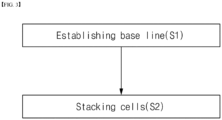
- FIG. 3 is a flowchart of a cell stacking method of the present invention.
- the cell stacking method of the present invention will be described with reference to the above flowchart.
- the center of the cell C may be found by identifying the corner parts Co on both sides of the cell C with a visual sensor S.
- FIG. 4 shows a cell C to be used in a method of stacking cells C according to a first embodiment of the present invention, and a visual sensor S to be used to locate the center of the cell C
- FIG. 5 is a side view of the cell C and visual sensor S of FIG. 4 .
- the cell C has an electrode assembly (not shown) having a plurality of electrodes stacked and accommodated therein, and electrode leads Le electrically connected with the electrode assembly on both sides as shown in FIGS. 4 and 5 , respectively.
- the electrode assembly includes a positive electrode, a separator, and a negative electrode, wherein the positive electrode, separator, and negative electrode are alternately stacked.
- the electrode leads Le include a positive lead L1 electrically connected to a positive electrode of the electrode assembly and a negative lead L2 electrically connected to a negative electrode of the electrode assembly.
- Neighboring pairs of cells C may be alternately stacked so that the positions of the positive leads L1 and negative leads L2 are opposite or may be stacked in pairs of several such that the positive leads L1 and negative leads L2 are in the same position.
- the cell C comprises an accommodating part Pr and a derivation part Pe, as shown in FIG. 5 .
- an electrode assembly may be located, and in the derivation part Pe, electrode leads Le may be located.
- a step is formed between the accommodating part Pr and the derivation part Pe.
- the step may vary in height depending on the thickness of the electrode assembly including the accommodating part Pr.
- a method of stacking cells C of the present invention is characterized by establishing an imaginary base line BL on each cell C to be stacked and aligning the cells C so that the base lines BL coincide with each other when the cells C are stacked.
- the base line BL corresponds to the center of the cell C, and the center of each cell C is found based on the position of both ends of the accommodating part Pr of the corresponding cell C.
- the center of each cell C is found based on the position of both ends of the accommodating part Pr is one half.
- the center of the cell C corresponds to the center of the electrode assembly, and the base line BL is formed to pass through the center of the cell C. More specifically, the base line BL is formed across the center of the cell C such that the electrode leads Le of the cell C are located on both sides.
- the base line BL is established at a position corresponding to the center of the electrode included in the upper portion of the electrode assembly included in the accommodating part Pr. In other words, the base line BL is formed at a position centered on both ends of the electrode included in the uppermost portion of the electrode assembly.
- Both ends of the electrode including the uppermost portion of the electrode assembly correspond to the boundary points of the accommodating part Pr and the derivation part Pe, or correspond to the locations where the steps begin on both sides of the accommodating part Pr.
- FIG. 6 illustrates the boundary points of the accommodating part Pr and the derivation part Pe of the cell C.
- the location where the step starts at the boundary points of the accommodating part Pr and the derivation part Pe, or at both ends of the electrodes including the uppermost portion of the electrode assembly, corresponds to the end of the uppermost electrode as shown in FIG. 6 .
- the plurality of stacked electrodes may have slightly different end positions, as illustrated in FIG. 6 .
- the present invention identifies both ends of the electrodes located in the uppermost portion of the electrode assembly in order to quickly locate the center of the cell C and establish a base line BL and forms an imaginary base line BL by finding the center of the electrodes based on the positions of both ends of the identified electrodes.
- the corner parts of both ends of the accommodating part Pr may be identified by a visual sensor S, as shown in FIGS. 4 and 5 .
- the visual sensors S are positioned in the upper portions of both sides of the cell C to identify the end positions of the cell C to be targeted and established an imaginary base line BL passing through the center of the cell C based on the identified end positions.
- the center of the cell C corresponds to a position that is halfway based on the corner part positions of both ends of the accommodating part Pr.
- a plurality of cells C having a base line BL established is stacked.
- FIG. 7 illustrates a process of stacking a plurality of cells C.
- each cell C is stacked, there may be a large difference in the position of the cell C, as shown in FIG. 7 .
- Each of the cells C is position-corrected so that the base lines BL established in each of them coincide with each other.
- each cell C is adjusted in position by moving in the length direction of the cell C so that the base lines BL are coincided.
- the cells C are stacked to form a single cell stack Cs.
- a method of stacking cells C of the present invention is applicable not only to a cell C in a form in which electrode leads Le are derived at both ends, but also to a cell C in a form in which a pair of electrode leads Le are derived on one side.
- FIG. 8 shows a cell C to be used in the cell C stacking method according to the second embodiment of the present invention, and a visual sensor S to be used for locating the center of the cell C.
- FIG. 9 shows the cell C and the visual sensor S of FIG. 8 from a side view.
- the cell C stacking method of the second embodiment is also characterized in that, as in the same manner as the cell C stacking method of the first embodiment above, an imaginary base line BL is established for each cell C to be stacked, and when each of the cells C is stacked, the base lines BL are aligned so that they coincide with each other.
- the base line BL corresponds to the center of the cell C, and the center of each cell C is found based on the position of both ends of the accommodating part Pr of the cell C.
- the center of each cell C is found based on the position of both ends of the accommodating part Pr is one half.
- the center of the cell C corresponds to the center of the electrode assembly, and the base line BL is formed to pass through the center of the cell C. More specifically, the base line BL is formed across the center of the cell C such that the electrode leads Le of the cell C are located on one side.
- the base line BL is established at a position corresponding to a center of the electrode included in the uppermost of the electrode assemblies included in the accommodating part Pr. In other words, the base line BL is formed at a position centered on both ends of the electrode included in the uppermost of the electrode assemblies.
- Both ends of the electrodes included in the uppermost part of the electrode assembly correspond to positions where the step starts on both sides of the accommodating part Pr.
- the plurality of stacked electrodes may have slightly different end positions.
- the present invention identifies both ends of an electrode located in the uppermost portion of the electrode assembly in order to quickly locate the center of the cell C and establish a base line BL and forms an imaginary base line BL by finding the center of the electrode based on the positions of both ends of the identified electrode.
- the corner parts of both ends of the accommodating part Pr may be identified by a visual sensor S, as shown in FIGS. 8 and 9 .
- the visual sensors S are positioned in the upper portions of both sides of the cell C to identify the end positions of the cell C to be targeted and establish an imaginary base line BL passing through the center of the cell C based on the identified end positions.
- the center of the cell C corresponds to a position based on the corner part positions of both ends of the accommodating part Pr is one half.
- each cell C is established a respective base line BL.
Landscapes
- Chemical & Material Sciences (AREA)
- Chemical Kinetics & Catalysis (AREA)
- Electrochemistry (AREA)
- General Chemical & Material Sciences (AREA)
- Engineering & Computer Science (AREA)
- Manufacturing & Machinery (AREA)
- Secondary Cells (AREA)
- Micro-Organisms Or Cultivation Processes Thereof (AREA)
- Battery Mounting, Suspending (AREA)
Applications Claiming Priority (2)
| Application Number | Priority Date | Filing Date | Title |
|---|---|---|---|
| KR1020230005584A KR20240113256A (ko) | 2023-01-13 | 2023-01-13 | 셀 적층 방법 |
| PCT/KR2024/000585 WO2024151121A1 (ko) | 2023-01-13 | 2024-01-12 | 셀 적층 방법 |
Publications (2)
| Publication Number | Publication Date |
|---|---|
| EP4567950A1 true EP4567950A1 (de) | 2025-06-11 |
| EP4567950A4 EP4567950A4 (de) | 2026-02-25 |
Family
ID=91897321
Family Applications (1)
| Application Number | Title | Priority Date | Filing Date |
|---|---|---|---|
| EP24741742.1A Pending EP4567950A4 (de) | 2023-01-13 | 2024-01-12 | Zellstapelungsverfahren |
Country Status (5)
| Country | Link |
|---|---|
| EP (1) | EP4567950A4 (de) |
| JP (1) | JP2025527782A (de) |
| KR (1) | KR20240113256A (de) |
| CN (1) | CN119895606A (de) |
| WO (1) | WO2024151121A1 (de) |
Family Cites Families (16)
| Publication number | Priority date | Publication date | Assignee | Title |
|---|---|---|---|---|
| JP4872280B2 (ja) * | 2005-09-06 | 2012-02-08 | トヨタ自動車株式会社 | 組電池、及び単位電池 |
| JP2007080636A (ja) * | 2005-09-13 | 2007-03-29 | Toyota Motor Corp | 組電池、及び単位電池 |
| KR20190041852A (ko) * | 2017-10-13 | 2019-04-23 | 주식회사 엘지화학 | 가이드 부재, 상기 가이드 부재를 사용하여 스택형 전지를 제조하는 방법 및 이로부터 제조된 스택형 전지 |
| KR102445958B1 (ko) * | 2018-01-29 | 2022-09-20 | 주식회사 엘지에너지솔루션 | 전극 조립체 제조방법 및 이차전지 제조방법 |
| KR102667758B1 (ko) * | 2018-10-18 | 2024-05-22 | 주식회사 엘지에너지솔루션 | 전극, 전극 조립체, 이차전지 및 전극 조립체의 제조 방법 |
| KR102849372B1 (ko) * | 2019-03-28 | 2025-08-25 | 주식회사 엘지에너지솔루션 | 전극 조립체 제조방법 및 전극 조립체 제조장치 |
| KR102774953B1 (ko) | 2019-10-25 | 2025-02-27 | 주식회사 엘지에너지솔루션 | 전지셀 적층 장치, 전지셀 적층 방법 및 전지 모듈 |
| KR102515416B1 (ko) * | 2020-09-08 | 2023-03-30 | 엘지전자 주식회사 | 이차전지 제조 장치 |
| KR20220039619A (ko) * | 2020-09-22 | 2022-03-29 | 주식회사 엘지에너지솔루션 | 배터리 모듈, 이를 포함하는 배터리 팩, 및 자동차 |
| KR102251320B1 (ko) * | 2020-10-14 | 2021-05-12 | ㈜아이비젼웍스 | 시트적층을 위한 비전얼라인방법 및 비전얼라인장치 |
| JP7533319B2 (ja) * | 2021-03-31 | 2024-08-14 | トヨタ自動車株式会社 | 蓄電装置 |
| JP7597635B2 (ja) * | 2021-04-27 | 2024-12-10 | トヨタ自動車株式会社 | 組電池の製造方法 |
| KR102582525B1 (ko) | 2021-07-01 | 2023-09-26 | 한국항공우주산업 주식회사 | 전파흡수 구조체 |
| KR102413546B1 (ko) * | 2021-08-09 | 2022-06-27 | 주식회사 제이디 | 이차전지용 전극 조립체 및 이를 제조하는 방법 |
| FR3131099B1 (fr) * | 2021-12-22 | 2023-12-29 | Plastic Omnium Advanced Innovation & Res | Sous-module de batterie pour véhicule automobile |
| CN115342725B (zh) * | 2022-08-03 | 2024-12-17 | 蔚来汽车科技(安徽)有限公司 | 对齐度检测装置、检测方法、电芯制造装置和制造方法 |
-
2023
- 2023-01-13 KR KR1020230005584A patent/KR20240113256A/ko active Pending
-
2024
- 2024-01-12 EP EP24741742.1A patent/EP4567950A4/de active Pending
- 2024-01-12 JP JP2025512157A patent/JP2025527782A/ja active Pending
- 2024-01-12 WO PCT/KR2024/000585 patent/WO2024151121A1/ko not_active Ceased
- 2024-01-12 CN CN202480003941.2A patent/CN119895606A/zh active Pending
Also Published As
| Publication number | Publication date |
|---|---|
| KR20240113256A (ko) | 2024-07-22 |
| WO2024151121A1 (ko) | 2024-07-18 |
| EP4567950A4 (de) | 2026-02-25 |
| CN119895606A (zh) | 2025-04-25 |
| JP2025527782A (ja) | 2025-08-22 |
Similar Documents
| Publication | Publication Date | Title |
|---|---|---|
| EP2802034B1 (de) | Elektrodenanordnung mit stufenförmiger struktur | |
| CN101803068B (zh) | 用于二次电池的模块 | |
| KR102488138B1 (ko) | 각주형 전기화학 셀 | |
| EP3582286B1 (de) | Batteriezellenrahmen und batteriemodul damit | |
| CN104904054B (zh) | 阶梯电极组堆叠体 | |
| KR102782675B1 (ko) | 배터리 셀 | |
| US11476548B2 (en) | Battery module | |
| CN103367668A (zh) | 电池 | |
| CN108391453B (zh) | 用于软包电池的穿墙集流体 | |
| US10115997B2 (en) | Prismatic electrochemical cell | |
| US20220181749A1 (en) | Battery module, method of manufacturing battery module and battery pack including battery module | |
| US10193109B2 (en) | Prismatic electrochemical cell | |
| KR101416544B1 (ko) | 이차전지 케이스 | |
| EP4310968A1 (de) | Elektrodenstruktur und prismatische batterie mit der elektrodenstruktur | |
| EP4567950A1 (de) | Zellstapelungsverfahren | |
| KR101739300B1 (ko) | 이차전지 | |
| KR102066913B1 (ko) | 단자 플레이트의 삽입 및 장착이 용이한 구조의 전지모듈 | |
| KR102517098B1 (ko) | 배터리 모듈 | |
| KR102256102B1 (ko) | 배터리 셀, 이러한 배터리 셀을 포함하는 배터리 모듈 및 이러한 배터리 모듈을 포함하는 배터리 팩 | |
| KR102167431B1 (ko) | 두께가 상이한 단일 전극리드로 결합된 전지셀 어셈블리 | |
| KR20140058058A (ko) | 배터리 모듈 | |
| EP4567990A1 (de) | Batteriepackgehäuse und batteriepack damit | |
| KR20240113262A (ko) | 셀 적층 방법 | |
| EP4723356A1 (de) | Sammelschienenhalter und batteriemodul damit | |
| JP7062211B2 (ja) | 電池パックおよびそれを含むデバイス |
Legal Events
| Date | Code | Title | Description |
|---|---|---|---|
| STAA | Information on the status of an ep patent application or granted ep patent |
Free format text: STATUS: THE INTERNATIONAL PUBLICATION HAS BEEN MADE |
|
| PUAI | Public reference made under article 153(3) epc to a published international application that has entered the european phase |
Free format text: ORIGINAL CODE: 0009012 |
|
| STAA | Information on the status of an ep patent application or granted ep patent |
Free format text: STATUS: REQUEST FOR EXAMINATION WAS MADE |
|
| 17P | Request for examination filed |
Effective date: 20250306 |
|
| AK | Designated contracting states |
Kind code of ref document: A1 Designated state(s): AL AT BE BG CH CY CZ DE DK EE ES FI FR GB GR HR HU IE IS IT LI LT LU LV MC ME MK MT NL NO PL PT RO RS SE SI SK SM TR |
|
| A4 | Supplementary search report drawn up and despatched |
Effective date: 20260122 |
|
| RIC1 | Information provided on ipc code assigned before grant |
Ipc: H01M 10/04 20060101AFI20260116BHEP Ipc: H01M 50/54 20210101ALI20260116BHEP Ipc: H01M 10/0585 20100101ALI20260116BHEP |
|
| DAV | Request for validation of the european patent (deleted) | ||
| DAX | Request for extension of the european patent (deleted) |