EP4567232A1 - Mit zapfen versehene bolzenhalterung und verschlusssystem damit - Google Patents
Mit zapfen versehene bolzenhalterung und verschlusssystem damit Download PDFInfo
- Publication number
- EP4567232A1 EP4567232A1 EP24217413.4A EP24217413A EP4567232A1 EP 4567232 A1 EP4567232 A1 EP 4567232A1 EP 24217413 A EP24217413 A EP 24217413A EP 4567232 A1 EP4567232 A1 EP 4567232A1
- Authority
- EP
- European Patent Office
- Prior art keywords
- longitudinal direction
- bolt
- latch bolt
- morticed
- engager
- Prior art date
- Legal status (The legal status is an assumption and is not a legal conclusion. Google has not performed a legal analysis and makes no representation as to the accuracy of the status listed.)
- Pending
Links
Images




Classifications
-
- E—FIXED CONSTRUCTIONS
- E05—LOCKS; KEYS; WINDOW OR DOOR FITTINGS; SAFES
- E05B—LOCKS; ACCESSORIES THEREFOR; HANDCUFFS
- E05B47/00—Operating or controlling locks or other fastening devices by electric or magnetic means
- E05B47/0046—Electric or magnetic means in the striker or on the frame; Operating or controlling the striker plate
-
- E—FIXED CONSTRUCTIONS
- E05—LOCKS; KEYS; WINDOW OR DOOR FITTINGS; SAFES
- E05B—LOCKS; ACCESSORIES THEREFOR; HANDCUFFS
- E05B15/00—Other details of locks; Parts for engagement by bolts of fastening devices
- E05B15/0053—Other details of locks; Parts for engagement by bolts of fastening devices means providing a stable, i.e. indexed, position of lock parts
- E05B15/0073—Other details of locks; Parts for engagement by bolts of fastening devices means providing a stable, i.e. indexed, position of lock parts magnetically operated
-
- E—FIXED CONSTRUCTIONS
- E05—LOCKS; KEYS; WINDOW OR DOOR FITTINGS; SAFES
- E05B—LOCKS; ACCESSORIES THEREFOR; HANDCUFFS
- E05B47/00—Operating or controlling locks or other fastening devices by electric or magnetic means
- E05B47/0001—Operating or controlling locks or other fastening devices by electric or magnetic means with electric actuators; Constructional features thereof
- E05B47/0002—Operating or controlling locks or other fastening devices by electric or magnetic means with electric actuators; Constructional features thereof with electromagnets
- E05B47/0003—Operating or controlling locks or other fastening devices by electric or magnetic means with electric actuators; Constructional features thereof with electromagnets having a movable core
- E05B47/0004—Operating or controlling locks or other fastening devices by electric or magnetic means with electric actuators; Constructional features thereof with electromagnets having a movable core said core being linearly movable
-
- E—FIXED CONSTRUCTIONS
- E05—LOCKS; KEYS; WINDOW OR DOOR FITTINGS; SAFES
- E05B—LOCKS; ACCESSORIES THEREFOR; HANDCUFFS
- E05B47/00—Operating or controlling locks or other fastening devices by electric or magnetic means
- E05B47/0038—Operating or controlling locks or other fastening devices by electric or magnetic means using permanent magnets
-
- E—FIXED CONSTRUCTIONS
- E05—LOCKS; KEYS; WINDOW OR DOOR FITTINGS; SAFES
- E05B—LOCKS; ACCESSORIES THEREFOR; HANDCUFFS
- E05B15/00—Other details of locks; Parts for engagement by bolts of fastening devices
- E05B15/02—Striking-plates; Keepers; Bolt staples; Escutcheons
- E05B15/0205—Striking-plates, keepers, staples
-
- E—FIXED CONSTRUCTIONS
- E05—LOCKS; KEYS; WINDOW OR DOOR FITTINGS; SAFES
- E05B—LOCKS; ACCESSORIES THEREFOR; HANDCUFFS
- E05B15/00—Other details of locks; Parts for engagement by bolts of fastening devices
- E05B15/02—Striking-plates; Keepers; Bolt staples; Escutcheons
- E05B15/0205—Striking-plates, keepers, staples
- E05B2015/023—Keeper shape
-
- E—FIXED CONSTRUCTIONS
- E05—LOCKS; KEYS; WINDOW OR DOOR FITTINGS; SAFES
- E05B—LOCKS; ACCESSORIES THEREFOR; HANDCUFFS
- E05B63/00—Locks or fastenings with special structural characteristics
- E05B63/24—Arrangements in which the fastening members which engage one another are mounted respectively on the wing and the frame and are both movable, e.g. for release by moving either of them
- E05B63/244—Arrangements in which the fastening members which engage one another are mounted respectively on the wing and the frame and are both movable, e.g. for release by moving either of them the striker being movable for latching, the bolt for unlatching, or vice versa
-
- E—FIXED CONSTRUCTIONS
- E05—LOCKS; KEYS; WINDOW OR DOOR FITTINGS; SAFES
- E05B—LOCKS; ACCESSORIES THEREFOR; HANDCUFFS
- E05B65/00—Locks or fastenings for special use
- E05B65/0007—Locks or fastenings for special use for gates
Definitions
- the present invention relates to a morticed bolt keep configured to cooperate with a lock having a latch bolt which is slidable between a retracted position and an extended position.
- the present invention further relates to closure system comprising a closure wing and a support with the morticed bolt keep mounted in the support.
- EP 4 159 962 A1 discloses a morticed bolt keep comprising: an elongated body extending in a longitudinal direction and configured to be positioned inside a hollow tubular member which extends in the longitudinal direction; and a cavity inside the elongated body and configured to receive the latch bolt in its extended position.
- the morticed bolt keep is designed to receive the latch bolt in its extended position thereby keeping the closure wing on which the lock is mounted in the closed position. A user can unlatch the closure wing by actuating the lock thereby sliding the latch bolt from the morticed bolt keep.
- the morticed bolt keep comprises: an elongated body extending in a longitudinal direction and configured to be positioned inside a closure wing; a cavity inside the elongated body and configured to receive the latch bolt in its extended position; a latch bolt engager mounted in the elongated body which is displaceable between a rest state and an actuated state; and a magnetic actuator mounted inside the elongated body and configured to displace the latch bolt engager from its rest state to its actuated state upon activation.
- the magnetic actuator disclosed in DE 10 2009 056 348 A1 relies on a fixed coil surrounding an iron core. Upon activation of the coil, the iron core is withdrawn into the coil thereby actuating an L-shaped lever to tilt so that a roller provided on the free end of the L-shaped lever pushes the latch bolt outside the cavity thereby unlatching the latch bolt.
- a main issue with the morticed bolt keep disclosed in DE 10 2009 056 348 A1 is its size. More particularly, the morticed bolt keep is not suited to be inserted in a hollow tubular member having only limited dimensions. Such hollow tubular members are common in outdoor applications (e.g. as part of a fence) and tend to have square or rectangular cross-sections with external dimensions of 4 cm, 5 cm or 6 cm (e.g. a rectangular cross-section of 3x6 cm or 4x6 cm). The morticed bolt keep disclosed in DE 10 2009 056 348 A1 is unlikely to fit into such a narrow space.
- the throw of the latch bolt in outdoor application is also much longer when compared to indoor use. More specifically, a lock for outdoor use may have a throw exceeding 10 mm, e.g. 15 mm, whereas this is typically 2 to 4 mm in indoor applications. The main reason therefor is that a longer throw allows to compensate for misalignment (e.g. sagging, crooked, etc.) between the closure member and the support.
- misalignment e.g. sagging, crooked, etc.
- DE 10 2009 056 348 A1 further discloses a mechanical catch to keep the iron core in its withdrawn position.
- the mechanical catch more specifically engages a groove at the lower end of the iron core.
- a return spring biases the L-shaped lever back to its rest position thereby disengaging the mechanical catch.
- the mechanical catch can lead to malfunctions of the bolt keep. More specifically, dirt, insects, misalignment in post/closure member spacing etc. can hamper the operation of the mechanical catch thereby increasing the force required to pull the iron core from the mechanical catch.
- a first aspect of the present invention is characterised in that the morticed bolt keep further comprises: a latch bolt engager mounted in the elongated body which is displaceable between a rest state and an actuated state; and a magnetic actuator mounted inside the elongated body and configured to displace the latch bolt engager from its rest state to its actuated state upon activation, the magnetic actuator comprising: a core which extends in the longitudinal direction and comprises at least one permanent magnet; and a coil assembly which extends in the longitudinal direction and comprises at least one coil, wherein one of the core and the coil assembly is slidable in the longitudinal direction and is operatively connected to the latch bolt engager.
- the core comprises at least two permanent magnets and/or the coil assembly comprises at least two coils.
- An embodiment comprising a single permanent magnet and a single coil is not intended to be part of this aspect.
- the specific construction of the magnetic actuator i.e. based on a longitudinally extending coil assembly and a longitudinally extending core, allows to place the bolt keep inside a hollow tubular member thereby overcoming one of the disadvantages of the morticed bolt keep disclosed in DE 10 2009 056 348 A1 .
- the use of at least one permanent magnet in the core of the magnetic actuator improves upon the iron core design disclosed in DE 10 2009 056 348 A1 .
- the use of permanent magnet is a more energy-efficient design allowing higher forces over a long throw to be generated when activating the magnetic actuator.
- the morticed bolt keep according to the invention is thus ideally suited for outdoor use where higher forces over a long throw are required to push the latch bolt from the keep.
- a second aspect of the present invention is characterised in that the morticed bolt keep further comprises: a latch bolt engager mounted inside the elongated body which is displaceable between a rest state and an actuated state; a magnetic actuator mounted inside the elongated body and configured to displace the latch bolt engager from its rest state to its actuated state upon activation; and an electromagnet mounted inside the elongated body and a magnetic catch fixed to the magnetic actuator, the electromagnet being configured to temporarily attract the magnetic catch to maintain the latch bolt engager in its actuated state.
- the electromagnet also requires less power to maintain the latch bolt engager in its actuated state when compared to the power requirements of the magnetic actuator.
- magnetic catch is intended to refer to an element or part thereof which is attracted by an electromagnet, such as manufactured (in part) of a (soft) ferromagnetic or ferrimagnetic material.
- the core comprises a frame comprising a first mounting space and a second mounting space separated by a frame part, wherein the first mounting space and the second mounting space are spaced apart from one another in the longitudinal direction by the frame part, wherein said at least one permanent magnet comprises a first permanent magnet mounted in the first mounting space and a second permanent magnet mounted in the second mounting space, the permanent magnets being oriented such that they repel one another in the longitudinal direction, and wherein the at least one coil is disposed at least around the frame part.
- the force generated by the magnetic actuator is dependent on a number of factors, incl. the magnetic flux (density) generated by the permanent magnet through the coil(s) in the coil assembly. As such, a higher flux density is desired.
- incl the magnetic flux (density) generated by the permanent magnet through the coil(s) in the coil assembly.
- a higher flux density is desired.
- By relying on two permanent magnets which repel one another, their magnetic field lines are compressed into a smaller volume thus increasing the magnetic flux density.
- the magnetic field lines are particularly compressed in the region of the frame part around which the coil is positioned.
- each permanent magnet has a north pole and a south pole with a magnetic axis parallel to the longitudinal direction, wherein the first and second permanent magnets are oriented such that either their north poles or their south poles are facing one another in the longitudinal direction.
- the generated Lorentz force is also in the longitudinal direction thus causing a sliding motion of either the core or the coil assembly. Such a sliding motion may be readily transferred to the latch bolt engager.
- An embodiment of the present invention is characterised in that the frame comprises a third mounting space spaced apart from the second mounting space in the longitudinal direction by a further frame part, wherein the first mounting space and the third mounting space are on opposite sides of the second mounting space in the longitudinal direction, wherein said at least one permanent magnet comprises a third permanent magnet mounted in the third mounting space, the second and third permanent magnets being oriented such that they repel one another in the longitudinal direction, wherein said at least one coil comprises a first coil and a second coil, the first coil being disposed at least around the frame part and the second coil being disposed at least around the further frame part.
- the core comprises a frame comprising a first mounting space and a second mounting space separated by a frame part, wherein the first mounting space and the second mounting space are spaced apart from one another in the longitudinal direction by the frame part, wherein said at least one permanent magnet comprises a first permanent magnet mounted in the first mounting space and a second permanent magnet mounted in the second mounting space, the permanent magnets being oriented such that their magnetic axis are perpendicular to the longitudinal direction and such that they attract one another in the longitudinal direction, wherein said at least one coil comprises a first coil and a second coil.
- the force generated by the magnetic actuator is dependent on a number of factors, incl. the amount of coil (e.g. the number of windings and/or the total wire length) which is exposed to a magnetic flux.
- the use of multiple coils thus increases the Lorentz force generated by the magnetic actuator.
- An embodiment of the present invention is characterised in that the coils are disposed adjacent the frame on opposite sides thereof and have a same magnetic polarity.
- each coil is coiled about a direction perpendicular to the longitudinal direction and is located on an opposite side of the core frame.
- An embodiment of the present invention is characterised in that said at least one permanent magnet has a north pole and a south pole with a magnetic axis parallel to the longitudinal direction, wherein said at least one coil comprises a first coil and a second coil separated from one another in the longitudinal direction, the first coil being disposed at least around the north pole and the second coil being disposed at least around the south pole, the coils having an opposite magnetic polarity.
- the force generated by the magnetic actuator is dependent on a number of factors, incl. the amount of coil (e.g. the number of windings and/or the total wire length) which is exposed to a magnetic flux.
- the use of multiple coils thus increases the Lorentz force generated by the magnetic actuator.
- each permanent magnet has a substantially constant cross sectional area viewed perpendicular to its magnetic axis, each permanent magnet particularly being a bar magnet.
- the magnetic actuator further comprises a magnetic shielding extending in the longitudinal direction and radially enclosing the coil assembly.
- the magnetic shielding comprises a metal cylinder.
- An embodiment of the present invention is characterised in that the core is slidable in the longitudinal direction and is operatively connected to the latch bolt engager.
- the magnetic actuator is thus a Moving Magnet Actuator (MMA).
- MMA Moving Magnet Actuator
- An embodiment of the present invention is characterised in that the core is operatively connected to the latch bolt engager by means of a rigid rod extending between a first end and a second end, wherein the first end is pivotable with respect to the core and the second end is pivotable with respect to the latch bolt engager, and wherein the rigid rod has a first smallest angle with respect to the longitudinal direction when the latch bolt engager is in its rest state and a second smallest angle with respect to the longitudinal direction when the latch bolt engager is in its actuated state, the second smallest angle being larger than the first smallest angle.
- the bolt keep is designed to cooperate with a lock having a spring-biased latch bolt.
- the latch bolt is normally spring biased by a compression spring which is depressed when actuating the latch bolt engager. The more the latch bolt spring is compressed, the larger the force required. As such, the highest force is required near and at the actuated position of the latch bolt engager.
- a rigid tiltable rod allows more efficiently coupling the core to the latch bolt engager. More specifically, as compared to an equal arm length first order lever, the rigid rod has a higher efficiency near the end stroke of the core. For a same magnetic actuator force, the rigid rod can thus exert a larger force on the latch bolt engager than an equal arm length first order lever.
- An embodiment of the present invention is characterised in that the rigid rod is connected to the elongated body by means of two guiding levers. This allows a near frictionless guiding of the rigid rod.
- An embodiment of the present invention is characterised in that, in its rest state, the latch bolt engager is in a depressed position within the cavity and, in its actuated state, the latch bolt engager is in an extended position within the cavity, wherein the latch bolt engager is configured to push the latch bolt towards its retracted position when being displaced from its rest state to its actuated state.
- the morticed bolt keep is a fail close design. If there is no electricity, the latch bolt remains in the keep and the closure wing remains latched.
- An embodiment of the present invention is characterised in that, in its rest state, the latch bolt engager is in an extended position within the cavity and, in its actuated state, the latch bolt engager is in a depressed position within the cavity, wherein the latch bolt engager is configured to allow the latch bolt to slide to its extended position into the cavity when being displaced from its rest state to its actuated state, wherein the morticed bolt keep preferably comprises a biasing member inside the elongated body which exerts a biasing force urging the latch bolt engager to its rest position, the magnetic actuator being configured to, upon activation, slide said one of the core and the coil in the longitudinal direction against said biasing force.
- the morticed bolt keep is a fail-open design. If there is no electricity, the latch bolt is kept outside the keep and the closure wing remains open.
- a biasing member is an elegant way of reversing the operation of the magnetic actuator thus allowing a substantially unchanged magnetic actuator to be used for both the fail-safe and fail-open morticed bolt keep.
- An embodiment of the present invention is characterised in that the electromagnet comprises a fixed core which directly attracts the magnetic catch.
- An embodiment of the present invention is characterised in that, when the latch bolt engager is in its actuated state, the magnetic catch is in direct contact with the fixed core.
- a direct contact between the fixed core and the magnetic catch creates a very strong connection and particularly much stronger than a similar setup where a slight air gap is present.
- the power required to maintain the magnetic catch attracted to the fixed core is thus much lower in a direct contact design compared to an air gap design.
- the morticed bolt keep further comprises a magnetic shielding extending in the longitudinal direction interposed between the magnetic actuator and the electromagnet.
- the magnetic catch comprises an L-shaped member having a first leg and a second leg, wherein the electromagnet is configured to temporarily attract the first leg of the magnetic catch, and wherein the second leg forms said magnetic shielding.
- Such magnetic shielding avoids interference of the magnetic actuator and the electromagnet.
- the magnetic actuator relies on the use of one or more permanent magnets, these may unwantedly magnetize the (fixed) core of the electromagnet thereby preventing the magnetic catch from being released even when the electromagnet is no longer energized.
- Having the shielding as part of the magnetic catch i.e. the L-shaped member
- the morticed bolt keep comprises a control module configured to control the magnetic actuator and the electromagnet so that the electromagnet remains active for a period of time, for example 10 seconds, after the magnetic actuator has deactivated.
- the control module is configured to either simultaneously activate the magnetic actuator and the electromagnet or to activate the electromagnet only after the magnetic actuator has been activated.
- the time for which the magnetic actuator and the electromagnet remain active may be pre-set or programmable in a memory of the control module. Alternatively, this time may be externally controlled through a remote controller interacting with the control module.
- An embodiment of the present invention is characterised in that the electromagnet requires a lower power to maintain the latch bolt engager in its actuated state when compared to a power required by the magnetic actuator to displace the latch bolt engager towards its actuated state.
- the latch bolt engager (and thus the latch bolt of the lock) remains in the desired position with a reduced power consumption due to the presence of the electromagnet over the total period of time when compared to a bolt keep which relies solely on the magnetic actuator to keep the latch bolt engager in the desired position for that same time period. Moreover, this may also prevent overheating of the magnetic actuator that may occur when having to keep this active for extended periods of time (e.g. 10 seconds).
- An embodiment of the present invention is characterised in that the electromagnet is configured to temporarily maintain the magnetic actuator in its actuated state against a force of at least 5 N urging the magnetic actuator to its rest state.
- An embodiment of the present invention is characterised in that the magnetic actuator comprises a longitudinally extending core which is slidable in the longitudinal direction and operatively connected to the latch bolt engager, the magnetic catch being attached to the core.
- the magnetic actuator is thus a Moving Magnet Actuator (MMA).
- MMA Moving Magnet Actuator
- the magnetic catch is attached to the core and thus ensures that the core (and through this the latch bolt engager) is kept in the actuated state. No other intermediate elements need be present between the core and the magnetic catch thus avoiding potential force losses.
- the object according to the present invention is also achieved with a closure system comprising a closure wing and a support, the closure wing being provided with a lock having a latch bolt which is slidable between a retracted position and an extended position, the support extending in a longitudinal direction and comprising a hollow tubular member, wherein the closure system further comprises a morticed bolt keep as described above mounted in the hollow tubular member.
- the closure system includes the morticed bolt keep as described above and thus achieves the same advantages.
- the present invention generally relates to a morticed bolt keep 1 which comprises a faceplate 3 and an elongated body 5.
- the elongated body 5 is designed to be inserted into a hollow tubular member 7 which can be either be a fixed support or a leaf (also termed closure wing) of a double winged closure system.
- the tubular member 7 extends in a longitudinal direction 10.
- Other relevant directions are the depth direction 9 and the width direction 8 which together determine a horizontal plane.
- the depth direction 9 is the direction in which the closure wing pivotally opens/closes with respect to the hollow tubular member 7.
- the directions 8, 9, 10 are mutually orthogonal.
- the hollow tubular member 7 is common in outdoor applications (e.g. as part of a fence) and usually has square or rectangular cross-sections with external dimensions of 4 cm, 5 cm or 6 cm (e.g. a rectangular cross-section of 3x6 cm or 4x6 cm). In the illustrated embodiment, the tubular member 7 has a rectangular cross-section with outer dimensions of 4x6 cm. In the context of the present invention, mainly the depth of the hollow tubular member 7 is important and is preferably at least 5 cm so that the outer depth dimension of the hollow tubular member 7 is usually about 6 cm. Deeper hollow tubular members are also uncommon in normal outdoor applications.
- the morticed bolt keep 1 is designed for cooperation with a lock 11 as shown in figures 3A and 3B .
- the illustrated lock 11 is morticed into a hollow tubular member 13 of a closure wing.
- Examples of such locks are disclosed in EP 2 186 974 , EP 3 153 645 , and EP 4 159 962 A1 and further details can be found therein.
- the invention is however not limited to a morticed lock and surface-mounted locks, for example as disclosed in EP 1 118 739 A1 , EP 2 915 939 A1 , and EP 4 191 007 A1 , may also be used.
- the morticed bolt keep 1 is designed for cooperation with a lock 11 comprising a latch bolt (not shown) which is slidably (in the width direction 8) mounted in the lock 11 to slide between a retracted and an extended position.
- the latch bolt is, in the illustrated embodiment, operated by means of handles 6.
- the illustrated lock further comprises a deadbolt (not shown) which is operated by means of a lock cylinder 12, for example a single-barrel europrofile cylinder.
- the morticed bolt keep 1 comprises a faceplate 3 and a partially hollow body 5.
- the faceplate 3 comprises a latch bolt receiving opening 14 in which the latch bolt is received when extended.
- the faceplate 3 also comprises a deadbolt receiving opening 15 in which the deadbolt is received when extended.
- the morticed bolt keep 1 further comprises a stop 17 which acts to stop a movement of the closure wing 13.
- the stop 17 is provided with bumpers 19 reducing noise and/or preventing damage to the closure wing.
- the stop 17 is generally part of an L-shaped member having a first leg forming the stop and a second leg 18 positioned between the faceplate 3 and the support 7 as shown in figures 4 and 5 .
- a shortest distance between the stop 17 and the latch bolt receiving opening 14 (which is measured in the depth direction 9) may be adjustable to account for different closure wings 13. Such adjustment means are disclosed in EP 1 600 584 A1 and EP 3 239 440 A1 and will not be described further.
- the faceplate 1 comprises two openings (not shown), i.e. one on either side of the bolt receiving openings 14, 15, which are used to mount the morticed bolt keep 1 to the hollow tubular member 7.
- the morticed bolt keep 1 is mounted inside a hollow tubular member as disclosed in EP 4 159 962 A1 , EP 4 245 950 A1 , and EP 4 245 951 A1 .
- the various mounting means disclosed in EP 4 159 962 A1 and in EP 4 245 951 A1 may thus be used in the context of the present invention as well.
- the hollow tubular member 7 comprises an elongated slot (not shown) with semi-circular notches at the top/bottom end of this elongated slot.
- the elongated body 5 of the bolt keep 1 is provided with a slidable fixation member 20 on the upper end of the body 5.
- the slidable fixation member 20 is slidable in the width direction 8 with respect to the body 5.
- the fixation member 20 has a bolt receiving opening for receiving a bolt 22 (or other generic fixation means). When tightening the bolt 22, the slidable fixation member 20 is slid until it engages the inner wall of the hollow tubular member 7.
- the lower end of the body 5 is not fixed to the hollow tubular member 7 but is nonetheless correctly positioned by means of bolt 24 (or other generic fixation means) that is positioned through the faceplate 3 and the semi-circular notch (not shown) provided in the hollow support member 7.
- This specific mounting mechanism allows inserting the body 5 into the hollow member 7 by tilting the body 5 so that the slidable fixation member 20 is inside the hollow member 7 and afterwards aligning the body 5 with the elongated slot in the hollow member 7 so as to slide the entire body 5 deeper into the hollow member 7 so that the faceplate 3 abuts the outer wall of the hollow member 7.
- the bolts 22, 24 are finally inserted and the slidable fixation member 20 is tightened against the inner wall of the hollow tubular member 7.
- the morticed bolt keep 1 is provided with a latch bolt engager 25 positioned inside the latch bolt receiving opening 14.
- the latch bolt engager 25 is designed to, upon activation of the magnetic actuator inside the morticed bolt keep 1, push the latch bolt out of the latch bolt receiving opening 14 without requiring a user to actuate the latch bolt using the handles 6. Details of the internal construction of the morticed bolt keep 1 is described below with respect to figures 4 and 5 .
- the morticed bolt keep 1 comprises a magnetic actuator 30 which generally comprises a coil assembly 31 and a core assembly 32 which both extend in the longitudinal direction 10.
- the magnetic actuator 30 is based on the principle of Moving Magnet Actuators (MMA) meaning that the coil assembly 31 is stationary within the elongated body 5 whereas the core assembly 32 is slidable in the longitudinal direction 10.
- the core assembly 32 is connected by a lever 35 to the latch bolt engager 25, which lever 35 thus transfers a sliding motion of the core 32 in the longitudinal direction 10 to a sliding motion of the latch bolt engage 25 in the width direction 8.
- MMA Moving Magnet Actuators
- the magnetic actuator is based on the principle of Moving Coil Actuators (MCA) meaning that the core assembly is stationary within the elongated body whereas the coil assembly is slidable in the longitudinal direction 10.
- MCA Moving Coil Actuators
- Both principles may be used in the context of the present invention.
- the MMA principle is preferred as the core assembly is a standalone component whereas the coil assembly must by physically connected to a power source so that moving the coil assembly as required in the MCA principle is complex.
- the core assembly 32 comprises three permanent magnets separated by core elements. More specifically, when viewed in the longitudinal direction 10, there is an upper magnet 36, an upper core element 37, a middle magnet 38, a lower core element 39, and a lower magnet 40. Each magnet 36, 38, 40 is oriented with its magnetic axis parallel to the longitudinal direction 10. In the illustrated embodiment, each magnetic axis is actually coinciding. The magnets 36, 38, 40 are oriented such that the middle magnet 38 repels the upper and lower magnets 36, 40.
- the core assembly 32 naturally comprises a frame holding these magnets 36, 38, 40 in a static position with respect to one another.
- the coil assembly 31 comprises two coils, namely an upper coil 41 surrounding the upper core element 37 and a lower coil 42 surrounding the lower core element 39.
- Each coil 41, 42 is coiled around the longitudinal direction 10 and has a same magnetic polarity. It will be readily appreciated that the same principle may be used in a two-magnet setup with a single coil.
- the direction of the Lorentz force depends on the magnetic field orientation (dependent on the core assembly 32) and the magnetic polarity (dependent on the coil assembly 31) which is influenced by the coil handedness and the current direction.
- the generated Lorentz force F has a magnitude of about 20 N. This ensures that the morticed bolt keep 1 is suitable to be used with the locks commercially available by the present Applicant which may have a latch bolt biased towards its extended position by a biasing force of up to 15 N.
- a further detail of the morticed bolt keep 1 is the height extension of the magnets 36, 38, 40 and the coils 41, 42 viewed in the longitudinal direction 10. More specifically, the middle magnet 38 is purposefully higher than the outer magnets 36, 40. Firstly, this is done in order to maximize the total coil height in the longitudinal direction in view of the total height available which is limited by the elongated slot provided in the hollow tubular member 7. Secondly, due to the moving core, once a permanent magnet moves too much with respect to a static coil its opposite magnetic pole enters the coil area thus decreasing the generated Lorentz force. This may illustrated by comparing the position of the middle magnet 38 and the upper coil 41 in figures 4 and 5 . In figure 4 , the middle magnet 38 is nearly wholly beneath the upper coil 41.
- the middle magnet 38 When moving upwards, only the upper half (i.e. the north pole) of the middle magnet 38 enters the upper coil 41 thus maximizing the generated Lorentz force. If the middle magnet 38 moves up higher, then the lower half (i.e. the south pole) would also enter the upper coil 41 thereby creating a counteracting Lorentz force. As such, if a shorter middle magnet would be used, a counteracting Lorentz force would be created. Ideally, the lower magnet 40 would also be longer to avoid the north pole of entering the lower coil 42. However, there was not sufficient space to allow this.
- Figure 4 and 5 further illustrate that the morticed bolt keep 1 comprises an electromagnet 50 to attract a magnetic catch 55.
- the electromagnet 50 has a fixed core 52 surrounded by a coil 51.
- the magnetic catch 55 is fixed to and thus slidable with the core assembly 32 when activating the magnetic actuator 30.
- the magnetic catch 55 In the actuated state of the magnetic actuator 30 (i.e. when the latch bolt engager 25 is extended in the embodiment shown in figures 4 and 5 ), the magnetic catch 55 is directly contacting the fixed core 52.
- the electromagnet 50 is designed to take over the role of the magnetic actuator 30 once the core assembly 32 has reached its actuated state (i.e. the upwards position shown in figure 5 ). More specifically, the electromagnet 50, once activated, causes the magnetic catch 55 to be stuck to the fixed core 52 thereby maintaining the core assembly 32 (and the latch bolt engager 25) in its actuated state. This allows the magnetic actuator 30 to be turned off. This is advantageous to avoid overheating the magnetic actuator 30. Furthermore, due to the direct contact between the fixed core 52 and the magnetic catch 55, the electromagnet 50 requires less power to maintaining the core assembly 32 (and the latch bolt engager 25) in its actuated state when compared to the power requirements of the magnetic actuator 30.
- a magnetic shielding 53 is also provided between the electromagnet 50 and the magnetic actuator 30.
- This shielding 53 prevents that the fixed core 52 would be magnetized due to the permanent magnets 36, 38, 40 thus causing the magnetic catch 55 to remain stuck to the fixed core 52 even after deactivating the electromagnet 50.
- the magnetic shielding 53 is jointly made with the magnetic catch 55 as part of an L-shaped member. This is feasible since the shielding 53 is only needed when the core assembly 32 has reached its actuated state.
- the magnetic shielding 53 is typically made of a ferromagnetic material (e.g. iron) with a high magnetic susceptibility to attract magnetic field lines from the lower magnet 40 thereby shielding the electromagnet 50.
- a further measure to avoid (or reduce) interference of the permanent magnets in the magnetic actuator 30 on the electromagnet 50 is to position the electromagnet 50 to the side of the magnetic actuator 30 as in the illustrated embodiments. If, on the other hand, the electromagnet 50 would be positioned directly above or below the magnetic actuator 30, this tends to magnetize the fixed core 52 thus causing the magnetic catch 55 to remain stuck to the fixed core 52 even after deactivating the electromagnet 50.
- the sidewards placement is further useful to limit the height required.
- a suitable controller (not shown) is provided in the morticed bolt keep 1 to control the operation thereof.
- the controller is generally a computer system comprising a bus, a processor, a local memory, one or more input/output (I/O) interfaces, and/or a communications interface.
- the bus comprises one or more multiple conductors and allows communication between the different components of the computer system.
- Processor comprises any type of conventional processor or microprocessor that reads and executes computer program instructions.
- Local memory is intended to comprise any form of computer-readable information storage medium, such as a working memory (e.g., Random Access Memory - RAM), a static memory (e.g., a Read-Only Memory - ROM), a hard drive, or removable storage media (e.g.
- the local memory typically serves to store information and instructions to be processed by the processor.
- the I/O interface may comprise one or more conventional systems that enable communication between the controller and a user. Examples comprise a keyboard, a mouse, speech recognition, biometrics, a (touch) screen, a printer, a speaker, etc.
- the communication interface is typically a transceiver system that allows communication with external systems. Examples are a Wide Area Network (WAN), such as the Internet, a Low Power Wide Area Network (LPWAN) such as Sigfox, LoRa, NarrowBand loT, etc., a Personal Area Network (PAN) such as Bluetooth, or a Local Area Network (LAN).
- the controller controls the operation (e.g. active duration, time of activation, etc.) of the magnetic actuator 30 and the electromagnet 50.
- the embodiment illustrated in figures 4 and 5 is a fail close morticed bolt keep 1. More specifically, when no power is supplied to the coil assembly 31, the core assembly 32 is in its downwards position and the latch bolt engager 25 is withdrawn into the latch bolt receiving opening 14 (as shown in figure 4 ). This position may be achieved, for example, due to gravity, due to a latch bolt pushing on the latch bolt engager 25, etc. If power is supplied to the coil assembly 31 (i.e. when a current is circulated in the coils 41, 42), an upwards Lorentz force is generated and exerted on the core assembly 32 thereby sliding the core assembly 32 upwards and moving the latch bolt engager 25 towards its extended position (shown in figure 5 ) thereby pushing the latch bolt from the latch bolt receiving opening 14.
- the morticed bolt keep 1 illustrated in figures 6 and 7 is similar to the morticed bolt keep 1 described above. The main difference is that the morticed bolt keep 1 illustrated in figures 6 and 7 is a fail-open morticed bolt keep 1.
- two compression springs 49 (or other generic biasing means) are provided. These springs 49 bias the core 32 upwards and maintain the latch bolt engager 25 in its extended position (shown in figure 6 ).
- the springs 49 are sufficiently strong so as to keep the latch bolt engager 25 towards its extended position even when a latch bolt is pushing thereon.
- the other revision in the fail-open morticed bolt keep 1 is that the generated Lorentz force has an opposite direction. This may be achieved in various ways, e.g.
- the lever 35 interposed between the core assembly 32 and the latch bolt engager 25 is, in the illustrated embodiment, a first order lever with substantially equal arms. As such, there is no force reduction or amplification between the core assembly 32 and the latch bolt engager 25.
- FIG. 10A and 10B An alternative coupling between the core assembly 32 and the latch bolt engager 25 is shown in figure 10A and 10B .
- This coupling comprises a rigid rod 80 extending between a first end and a second end. The first end is pivotably fixed to the core assembly 32 by means of a first axle 81.
- This axle 81 is guided in an elongated slot 82 which extends in the vertical direction 10.
- the core assembly frame has a protruding part 83 in which the axle 81 partially extends. In this manner, the first end of the rigid rod 80 is vertically displaceable jointly with the core assembly 32.
- the second end of the rigid rod 80 engages the latch bolt engager 25.
- This second end is connected to a pivotable lever 84 by means of a second axle 85.
- the pivotable lever 84 is connected to the elongated body 5 by a third axle 86.
- the axle 85 could be fixed to the latch bolt engager 25 as well.
- a further guiding lever 87 is provided which interconnects the body 5 to the rigid rod 80 by means of two axles 88, 89. Due to the presence of the two levers 84, 87, a sliding motion of the core assembly 32 causes a pivoting motion of the rigid rod 80 so that its second end slides in the width direction 8 thereby pushing the latch bolt engager 25 outwards.
- the rigid rod 80 When the latch bolt engager 25 is in its rest position, the rigid rod 80 has a smallest angle ⁇ 1 with respect to the elongated direction 10 and when the latch bolt engager 25 is in its actuated position, the rigid rod 80 has a smallest angle ⁇ 2 with respect to the elongated direction 10.
- the angle ⁇ 2 is larger than the angle ⁇ 1 which causes an increased efficiency of the coupling the nearer the latch bolt engager 25 is to its actuated position.
- the use of the two guiding levers 84, 87 allow to guide the rigid rod 80 displacement in a near frictionless manner.
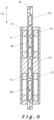
- the magnetic actuator 30 is provided with four permanent magnets 65, 66, 67, 68. Each magnet is oriented with its magnetic axis perpendicular to the longitudinal direction 10 and each two adjacent magnets have an opposite orientation of their poles. In this way, the magnets are attracting one another in the longitudinal direction 10.
- the coil assembly 31 comprises four coils 70, 71, 72, 73 grouped in pairs. Each pair of coils (i.e. 70, 71 and 72, 73) are located on opposite sides of the core assembly 32 and each coil of a pair has a same magnetic polarity.
- Figure 8 illustrates the actuated state of the magnetic actuator 30 with the core assembly 32 slip upwards with respect to the stationary coil assembly 31. In the rest state, the core assembly 32 is located more downwards with respect to the stationary coil assembly 31 with the (centre of the) upper magnet 65 substantially aligned with the upper parts of coils 70, 71.
- FIG 9B Another alternative magnetic actuator is schematically illustrated in figure 9B .
- the magnetic actuator relies on four permanent magnets 62 which repel one another in the longitudinal direction (similar to the setup used in the morticed bolt keep of figures 4 to 7 ).
- the main difference is the presence of a magnetic shielding 60 surrounding the magnetic actuator. More specifically, the shielding 60 is positioned outside and around the coil assembly.
- the magnetic shielding 60 is typically made of a ferromagnetic material (e.g. iron) with a high magnetic susceptibility to attract magnetic field lines.
- the shielding 60 reduces the reluctance of the magnetic field, increases the magnetic flux into a smaller volume, and better orients the magnetic field lines to be perpendicular to the longitudinal direction.
Landscapes
- Physics & Mathematics (AREA)
- Electromagnetism (AREA)
- Electromagnets (AREA)
Applications Claiming Priority (1)
| Application Number | Priority Date | Filing Date | Title |
|---|---|---|---|
| EP23214079.8A EP4567231A1 (de) | 2023-12-04 | 2023-12-04 | Mit zapfen versehene bolzenhalterung und verschlusssystem damit |
Publications (1)
| Publication Number | Publication Date |
|---|---|
| EP4567232A1 true EP4567232A1 (de) | 2025-06-11 |
Family
ID=89076212
Family Applications (2)
| Application Number | Title | Priority Date | Filing Date |
|---|---|---|---|
| EP23214079.8A Pending EP4567231A1 (de) | 2023-12-04 | 2023-12-04 | Mit zapfen versehene bolzenhalterung und verschlusssystem damit |
| EP24217413.4A Pending EP4567232A1 (de) | 2023-12-04 | 2024-12-04 | Mit zapfen versehene bolzenhalterung und verschlusssystem damit |
Family Applications Before (1)
| Application Number | Title | Priority Date | Filing Date |
|---|---|---|---|
| EP23214079.8A Pending EP4567231A1 (de) | 2023-12-04 | 2023-12-04 | Mit zapfen versehene bolzenhalterung und verschlusssystem damit |
Country Status (2)
| Country | Link |
|---|---|
| US (1) | US20250179834A1 (de) |
| EP (2) | EP4567231A1 (de) |
Citations (14)
| Publication number | Priority date | Publication date | Assignee | Title |
|---|---|---|---|---|
| EP1118739A1 (de) | 2000-01-21 | 2001-07-25 | Joseph Talpe, Jr. | Schloss |
| EP1600584A1 (de) | 2004-05-26 | 2005-11-30 | Joseph Talpe | Satz mit Schloss und Schliessblech |
| EP2186974A1 (de) | 2008-11-14 | 2010-05-19 | Joseph Talpe | Zylinderschloss mit schwenkbar montiertem Bolzen |
| DE102009056348A1 (de) | 2009-11-25 | 2011-06-09 | Reinhard Beierlein | Universeller elektrischer Türöffner für selbstverriegelnde Fallenpanikschlösser u.a. |
| EP2915939A1 (de) | 2014-03-05 | 2015-09-09 | Locinox | Schloss |
| US9187938B2 (en) * | 2013-09-16 | 2015-11-17 | Michael Richard Pluta | Wireless-actuated wall-mounted deadbolt system |
| EP3153645A1 (de) | 2015-10-06 | 2017-04-12 | Locinox | Türschlosshalterung zur montage auf einem rohrförmigen element |
| EP3239440A1 (de) | 2016-04-26 | 2017-11-01 | Locinox | Schliessblech |
| EP3421695A1 (de) | 2017-06-26 | 2019-01-02 | Locinox | Oberflächenmontierbarer elektrischer türöffner |
| US20190024412A1 (en) * | 2017-07-24 | 2019-01-24 | Amesbury Group, Inc. | Sealed keeper sensors |
| EP4159962A1 (de) | 2021-10-01 | 2023-04-05 | Locinox | Doppelflügeltor und verfahren zur konstruktion davon |
| EP4191007A1 (de) | 2021-12-06 | 2023-06-07 | Locinox | Schloss für ein scharnierverschlusselement |
| EP4245950A1 (de) | 2022-03-17 | 2023-09-20 | Locinox | Türschlosshalterung, die auf einem rohrförmigen element montiert ist |
| EP4245951A1 (de) | 2022-03-17 | 2023-09-20 | Locinox | Türschlossvorrichtung zur montage auf einem rohrförmigen element |
Family Cites Families (8)
| Publication number | Priority date | Publication date | Assignee | Title |
|---|---|---|---|---|
| US508518A (en) * | 1893-11-14 | johnson | ||
| US3751086A (en) * | 1972-07-12 | 1973-08-07 | A Geringer | Fail-safe means for solenoid actuated devices |
| GB1538297A (en) * | 1975-11-21 | 1979-01-17 | Access Control Syst | Door lock apparatus |
| DE102004030362B4 (de) * | 2004-06-23 | 2011-07-07 | EUCHNER GmbH + Co. KG, 70771 | Vorrichtung zum gesteuerten Arretieren einer sicherheitsrelevanten Einrichtung, wie beispielweise einer Schutztür oder dergleichen |
| DE102015000611B4 (de) * | 2015-01-16 | 2025-01-02 | Assa Abloy Sicherheitstechnik Gmbh | Verriegelungsvorrichtung für eine Tür |
| BE1025390B1 (nl) * | 2017-07-14 | 2019-02-12 | Molenzicht Bvba | Automatisch deuropeningssysteem |
| WO2021211071A1 (en) * | 2020-04-16 | 2021-10-21 | Master Teknik Tasarim Makina Sanayi Ve Ticaret Ltd. Sti | Magnetic push-to-open door actuator |
| WO2021257443A1 (en) * | 2020-06-15 | 2021-12-23 | Gell Jason | Electronic strike plate for door assembly |
-
2023
- 2023-12-04 EP EP23214079.8A patent/EP4567231A1/de active Pending
-
2024
- 2024-12-04 EP EP24217413.4A patent/EP4567232A1/de active Pending
- 2024-12-04 US US18/968,004 patent/US20250179834A1/en active Pending
Patent Citations (14)
| Publication number | Priority date | Publication date | Assignee | Title |
|---|---|---|---|---|
| EP1118739A1 (de) | 2000-01-21 | 2001-07-25 | Joseph Talpe, Jr. | Schloss |
| EP1600584A1 (de) | 2004-05-26 | 2005-11-30 | Joseph Talpe | Satz mit Schloss und Schliessblech |
| EP2186974A1 (de) | 2008-11-14 | 2010-05-19 | Joseph Talpe | Zylinderschloss mit schwenkbar montiertem Bolzen |
| DE102009056348A1 (de) | 2009-11-25 | 2011-06-09 | Reinhard Beierlein | Universeller elektrischer Türöffner für selbstverriegelnde Fallenpanikschlösser u.a. |
| US9187938B2 (en) * | 2013-09-16 | 2015-11-17 | Michael Richard Pluta | Wireless-actuated wall-mounted deadbolt system |
| EP2915939A1 (de) | 2014-03-05 | 2015-09-09 | Locinox | Schloss |
| EP3153645A1 (de) | 2015-10-06 | 2017-04-12 | Locinox | Türschlosshalterung zur montage auf einem rohrförmigen element |
| EP3239440A1 (de) | 2016-04-26 | 2017-11-01 | Locinox | Schliessblech |
| EP3421695A1 (de) | 2017-06-26 | 2019-01-02 | Locinox | Oberflächenmontierbarer elektrischer türöffner |
| US20190024412A1 (en) * | 2017-07-24 | 2019-01-24 | Amesbury Group, Inc. | Sealed keeper sensors |
| EP4159962A1 (de) | 2021-10-01 | 2023-04-05 | Locinox | Doppelflügeltor und verfahren zur konstruktion davon |
| EP4191007A1 (de) | 2021-12-06 | 2023-06-07 | Locinox | Schloss für ein scharnierverschlusselement |
| EP4245950A1 (de) | 2022-03-17 | 2023-09-20 | Locinox | Türschlosshalterung, die auf einem rohrförmigen element montiert ist |
| EP4245951A1 (de) | 2022-03-17 | 2023-09-20 | Locinox | Türschlossvorrichtung zur montage auf einem rohrförmigen element |
Also Published As
| Publication number | Publication date |
|---|---|
| EP4567231A1 (de) | 2025-06-11 |
| US20250179834A1 (en) | 2025-06-05 |
Similar Documents
| Publication | Publication Date | Title |
|---|---|---|
| US8454063B2 (en) | Mode-switchable door strike | |
| AU2013362827B2 (en) | Latch mechanism | |
| US20140225383A1 (en) | Gate latch | |
| EP3155193A2 (de) | Verriegelungssystem | |
| EP3421695A1 (de) | Oberflächenmontierbarer elektrischer türöffner | |
| EP3109381B1 (de) | Elektrischer türöffner | |
| KR101272518B1 (ko) | 자동차용 액티브 후드 장치의 액츄에이터 | |
| EP4567232A1 (de) | Mit zapfen versehene bolzenhalterung und verschlusssystem damit | |
| DE202015101504U1 (de) | Verriegelungssystem | |
| EP4567230A1 (de) | Mit zapfen versehene bolzenhalterung und verschlusssystem damit | |
| DE102011110776B4 (de) | Überwachungsvorrichtung zur Positionsbestimmung eines Schlossriegels | |
| EP1528216A2 (de) | Magnetische Verriegelungsvorrichtung für die Bodenschiene einer Jalousie | |
| EP3789574B1 (de) | Türschliesseranordnung | |
| EP3421697A1 (de) | Elektrischer türöffner | |
| CN111779387B (zh) | 门用定位器组件 | |
| EP3918162B1 (de) | Verriegelungsvorrichtung für fenster und türen | |
| EP1741855A2 (de) | Zuhaltung für ein Bauteil zum Verschliessen einer Öffnung | |
| US7155945B2 (en) | Lock having a lockable handle shaft | |
| DE202014102708U1 (de) | Verriegelungssystem | |
| US4771255A (en) | Solenoid with a mechanical locking linkage | |
| EP3421696A1 (de) | Elektrischer türöffner | |
| WO2000070178A1 (en) | Improved electronic lock | |
| KR101103307B1 (ko) | 양문형 출입문용 고정장치 | |
| RU2283411C1 (ru) | Электромагнитный замок | |
| AU2019273665A1 (en) | Lock, fitting, strike plate and locking mechanism for sliding doors, and sliding door system |
Legal Events
| Date | Code | Title | Description |
|---|---|---|---|
| PUAI | Public reference made under article 153(3) epc to a published international application that has entered the european phase |
Free format text: ORIGINAL CODE: 0009012 |
|
| STAA | Information on the status of an ep patent application or granted ep patent |
Free format text: STATUS: THE APPLICATION HAS BEEN PUBLISHED |
|
| AK | Designated contracting states |
Kind code of ref document: A1 Designated state(s): AL AT BE BG CH CY CZ DE DK EE ES FI FR GB GR HR HU IE IS IT LI LT LU LV MC ME MK MT NL NO PL PT RO RS SE SI SK SM TR |
|
| STAA | Information on the status of an ep patent application or granted ep patent |
Free format text: STATUS: REQUEST FOR EXAMINATION WAS MADE |
|
| 17P | Request for examination filed |
Effective date: 20250715 |
|
| GRAP | Despatch of communication of intention to grant a patent |
Free format text: ORIGINAL CODE: EPIDOSNIGR1 |
|
| STAA | Information on the status of an ep patent application or granted ep patent |
Free format text: STATUS: GRANT OF PATENT IS INTENDED |
|
| RIC1 | Information provided on ipc code assigned before grant |
Ipc: E05B 47/00 20060101AFI20251114BHEP Ipc: E05B 15/02 20060101ALN20251114BHEP Ipc: E05B 63/24 20060101ALN20251114BHEP Ipc: E05B 65/00 20060101ALN20251114BHEP |
|
| INTG | Intention to grant announced |
Effective date: 20251209 |