EP4566809A1 - Behälter für produkte der lebensmittelindustrie - Google Patents
Behälter für produkte der lebensmittelindustrie Download PDFInfo
- Publication number
- EP4566809A1 EP4566809A1 EP23215254.6A EP23215254A EP4566809A1 EP 4566809 A1 EP4566809 A1 EP 4566809A1 EP 23215254 A EP23215254 A EP 23215254A EP 4566809 A1 EP4566809 A1 EP 4566809A1
- Authority
- EP
- European Patent Office
- Prior art keywords
- gsm
- layer
- container
- wall
- paper
- Prior art date
- Legal status (The legal status is an assumption and is not a legal conclusion. Google has not performed a legal analysis and makes no representation as to the accuracy of the status listed.)
- Pending
Links
Images

Classifications
-
- B—PERFORMING OPERATIONS; TRANSPORTING
- B32—LAYERED PRODUCTS
- B32B—LAYERED PRODUCTS, i.e. PRODUCTS BUILT-UP OF STRATA OF FLAT OR NON-FLAT, e.g. CELLULAR OR HONEYCOMB, FORM
- B32B27/00—Layered products comprising a layer of synthetic resin
- B32B27/06—Layered products comprising a layer of synthetic resin as the main or only constituent of a layer, which is next to another layer of the same or of a different material
- B32B27/10—Layered products comprising a layer of synthetic resin as the main or only constituent of a layer, which is next to another layer of the same or of a different material of paper or cardboard
-
- B—PERFORMING OPERATIONS; TRANSPORTING
- B32—LAYERED PRODUCTS
- B32B—LAYERED PRODUCTS, i.e. PRODUCTS BUILT-UP OF STRATA OF FLAT OR NON-FLAT, e.g. CELLULAR OR HONEYCOMB, FORM
- B32B27/00—Layered products comprising a layer of synthetic resin
- B32B27/06—Layered products comprising a layer of synthetic resin as the main or only constituent of a layer, which is next to another layer of the same or of a different material
- B32B27/08—Layered products comprising a layer of synthetic resin as the main or only constituent of a layer, which is next to another layer of the same or of a different material of synthetic resin
-
- B—PERFORMING OPERATIONS; TRANSPORTING
- B32—LAYERED PRODUCTS
- B32B—LAYERED PRODUCTS, i.e. PRODUCTS BUILT-UP OF STRATA OF FLAT OR NON-FLAT, e.g. CELLULAR OR HONEYCOMB, FORM
- B32B27/00—Layered products comprising a layer of synthetic resin
- B32B27/32—Layered products comprising a layer of synthetic resin comprising polyolefins
-
- B—PERFORMING OPERATIONS; TRANSPORTING
- B32—LAYERED PRODUCTS
- B32B—LAYERED PRODUCTS, i.e. PRODUCTS BUILT-UP OF STRATA OF FLAT OR NON-FLAT, e.g. CELLULAR OR HONEYCOMB, FORM
- B32B27/00—Layered products comprising a layer of synthetic resin
- B32B27/32—Layered products comprising a layer of synthetic resin comprising polyolefins
- B32B27/322—Layered products comprising a layer of synthetic resin comprising polyolefins comprising halogenated polyolefins, e.g. PTFE
-
- B—PERFORMING OPERATIONS; TRANSPORTING
- B32—LAYERED PRODUCTS
- B32B—LAYERED PRODUCTS, i.e. PRODUCTS BUILT-UP OF STRATA OF FLAT OR NON-FLAT, e.g. CELLULAR OR HONEYCOMB, FORM
- B32B27/00—Layered products comprising a layer of synthetic resin
- B32B27/34—Layered products comprising a layer of synthetic resin comprising polyamides
-
- B—PERFORMING OPERATIONS; TRANSPORTING
- B32—LAYERED PRODUCTS
- B32B—LAYERED PRODUCTS, i.e. PRODUCTS BUILT-UP OF STRATA OF FLAT OR NON-FLAT, e.g. CELLULAR OR HONEYCOMB, FORM
- B32B27/00—Layered products comprising a layer of synthetic resin
- B32B27/36—Layered products comprising a layer of synthetic resin comprising polyesters
-
- B—PERFORMING OPERATIONS; TRANSPORTING
- B32—LAYERED PRODUCTS
- B32B—LAYERED PRODUCTS, i.e. PRODUCTS BUILT-UP OF STRATA OF FLAT OR NON-FLAT, e.g. CELLULAR OR HONEYCOMB, FORM
- B32B29/00—Layered products comprising a layer of paper or cardboard
- B32B29/08—Corrugated paper or cardboard
-
- B—PERFORMING OPERATIONS; TRANSPORTING
- B32—LAYERED PRODUCTS
- B32B—LAYERED PRODUCTS, i.e. PRODUCTS BUILT-UP OF STRATA OF FLAT OR NON-FLAT, e.g. CELLULAR OR HONEYCOMB, FORM
- B32B37/00—Methods or apparatus for laminating, e.g. by curing or by ultrasonic bonding
- B32B37/12—Methods or apparatus for laminating, e.g. by curing or by ultrasonic bonding characterised by using adhesives
-
- B—PERFORMING OPERATIONS; TRANSPORTING
- B32—LAYERED PRODUCTS
- B32B—LAYERED PRODUCTS, i.e. PRODUCTS BUILT-UP OF STRATA OF FLAT OR NON-FLAT, e.g. CELLULAR OR HONEYCOMB, FORM
- B32B37/00—Methods or apparatus for laminating, e.g. by curing or by ultrasonic bonding
- B32B37/14—Methods or apparatus for laminating, e.g. by curing or by ultrasonic bonding characterised by the properties of the layers
- B32B37/16—Methods or apparatus for laminating, e.g. by curing or by ultrasonic bonding characterised by the properties of the layers with all layers existing as coherent layers before laminating
- B32B37/18—Methods or apparatus for laminating, e.g. by curing or by ultrasonic bonding characterised by the properties of the layers with all layers existing as coherent layers before laminating involving the assembly of discrete sheets or panels only
- B32B37/182—Methods or apparatus for laminating, e.g. by curing or by ultrasonic bonding characterised by the properties of the layers with all layers existing as coherent layers before laminating involving the assembly of discrete sheets or panels only one or more of the layers being plastic
-
- B—PERFORMING OPERATIONS; TRANSPORTING
- B32—LAYERED PRODUCTS
- B32B—LAYERED PRODUCTS, i.e. PRODUCTS BUILT-UP OF STRATA OF FLAT OR NON-FLAT, e.g. CELLULAR OR HONEYCOMB, FORM
- B32B7/00—Layered products characterised by the relation between layers; Layered products characterised by the relative orientation of features between layers, or by the relative values of a measurable parameter between layers, i.e. products comprising layers having different physical, chemical or physicochemical properties; Layered products characterised by the interconnection of layers
- B32B7/04—Interconnection of layers
- B32B7/12—Interconnection of layers using interposed adhesives or interposed materials with bonding properties
-
- B—PERFORMING OPERATIONS; TRANSPORTING
- B65—CONVEYING; PACKING; STORING; HANDLING THIN OR FILAMENTARY MATERIAL
- B65D—CONTAINERS FOR STORAGE OR TRANSPORT OF ARTICLES OR MATERIALS, e.g. BAGS, BARRELS, BOTTLES, BOXES, CANS, CARTONS, CRATES, DRUMS, JARS, TANKS, HOPPERS, FORWARDING CONTAINERS; ACCESSORIES, CLOSURES, OR FITTINGS THEREFOR; PACKAGING ELEMENTS; PACKAGES
- B65D5/00—Rigid or semi-rigid containers of polygonal cross-section, e.g. boxes, cartons or trays, formed by folding or erecting one or more blanks made of paper
- B65D5/02—Rigid or semi-rigid containers of polygonal cross-section, e.g. boxes, cartons or trays, formed by folding or erecting one or more blanks made of paper by folding or erecting a single blank to form a tubular body with or without subsequent folding operations, or the addition of separate elements, to close the ends of the body
- B65D5/0209—Rigid or semi-rigid containers of polygonal cross-section, e.g. boxes, cartons or trays, formed by folding or erecting one or more blanks made of paper by folding or erecting a single blank to form a tubular body with or without subsequent folding operations, or the addition of separate elements, to close the ends of the body the tubular body having a curved or partially curved cross-section
-
- B—PERFORMING OPERATIONS; TRANSPORTING
- B65—CONVEYING; PACKING; STORING; HANDLING THIN OR FILAMENTARY MATERIAL
- B65D—CONTAINERS FOR STORAGE OR TRANSPORT OF ARTICLES OR MATERIALS, e.g. BAGS, BARRELS, BOTTLES, BOXES, CANS, CARTONS, CRATES, DRUMS, JARS, TANKS, HOPPERS, FORWARDING CONTAINERS; ACCESSORIES, CLOSURES, OR FITTINGS THEREFOR; PACKAGING ELEMENTS; PACKAGES
- B65D5/00—Rigid or semi-rigid containers of polygonal cross-section, e.g. boxes, cartons or trays, formed by folding or erecting one or more blanks made of paper
- B65D5/42—Details of containers or of foldable or erectable container blanks
- B65D5/56—Linings or internal coatings, e.g. pre-formed trays provided with a blow- or thermoformed layer
- B65D5/563—Laminated linings; Coatings
-
- B—PERFORMING OPERATIONS; TRANSPORTING
- B32—LAYERED PRODUCTS
- B32B—LAYERED PRODUCTS, i.e. PRODUCTS BUILT-UP OF STRATA OF FLAT OR NON-FLAT, e.g. CELLULAR OR HONEYCOMB, FORM
- B32B2255/00—Coating on the layer surface
- B32B2255/10—Coating on the layer surface on synthetic resin layer or on natural or synthetic rubber layer
-
- B—PERFORMING OPERATIONS; TRANSPORTING
- B32—LAYERED PRODUCTS
- B32B—LAYERED PRODUCTS, i.e. PRODUCTS BUILT-UP OF STRATA OF FLAT OR NON-FLAT, e.g. CELLULAR OR HONEYCOMB, FORM
- B32B2255/00—Coating on the layer surface
- B32B2255/12—Coating on the layer surface on paper layer
-
- B—PERFORMING OPERATIONS; TRANSPORTING
- B32—LAYERED PRODUCTS
- B32B—LAYERED PRODUCTS, i.e. PRODUCTS BUILT-UP OF STRATA OF FLAT OR NON-FLAT, e.g. CELLULAR OR HONEYCOMB, FORM
- B32B2255/00—Coating on the layer surface
- B32B2255/20—Inorganic coating
- B32B2255/205—Metallic coating
-
- B—PERFORMING OPERATIONS; TRANSPORTING
- B32—LAYERED PRODUCTS
- B32B—LAYERED PRODUCTS, i.e. PRODUCTS BUILT-UP OF STRATA OF FLAT OR NON-FLAT, e.g. CELLULAR OR HONEYCOMB, FORM
- B32B2255/00—Coating on the layer surface
- B32B2255/28—Multiple coating on one surface
-
- B—PERFORMING OPERATIONS; TRANSPORTING
- B32—LAYERED PRODUCTS
- B32B—LAYERED PRODUCTS, i.e. PRODUCTS BUILT-UP OF STRATA OF FLAT OR NON-FLAT, e.g. CELLULAR OR HONEYCOMB, FORM
- B32B2307/00—Properties of the layers or laminate
- B32B2307/30—Properties of the layers or laminate having particular thermal properties
- B32B2307/31—Heat sealable
-
- B—PERFORMING OPERATIONS; TRANSPORTING
- B32—LAYERED PRODUCTS
- B32B—LAYERED PRODUCTS, i.e. PRODUCTS BUILT-UP OF STRATA OF FLAT OR NON-FLAT, e.g. CELLULAR OR HONEYCOMB, FORM
- B32B2307/00—Properties of the layers or laminate
- B32B2307/50—Properties of the layers or laminate having particular mechanical properties
- B32B2307/554—Wear resistance
-
- B—PERFORMING OPERATIONS; TRANSPORTING
- B32—LAYERED PRODUCTS
- B32B—LAYERED PRODUCTS, i.e. PRODUCTS BUILT-UP OF STRATA OF FLAT OR NON-FLAT, e.g. CELLULAR OR HONEYCOMB, FORM
- B32B2307/00—Properties of the layers or laminate
- B32B2307/70—Other properties
- B32B2307/718—Weight, e.g. weight per square meter
-
- B—PERFORMING OPERATIONS; TRANSPORTING
- B32—LAYERED PRODUCTS
- B32B—LAYERED PRODUCTS, i.e. PRODUCTS BUILT-UP OF STRATA OF FLAT OR NON-FLAT, e.g. CELLULAR OR HONEYCOMB, FORM
- B32B2307/00—Properties of the layers or laminate
- B32B2307/70—Other properties
- B32B2307/732—Dimensional properties
- B32B2307/737—Dimensions, e.g. volume or area
- B32B2307/7375—Linear, e.g. length, distance or width
- B32B2307/7376—Thickness
-
- B—PERFORMING OPERATIONS; TRANSPORTING
- B32—LAYERED PRODUCTS
- B32B—LAYERED PRODUCTS, i.e. PRODUCTS BUILT-UP OF STRATA OF FLAT OR NON-FLAT, e.g. CELLULAR OR HONEYCOMB, FORM
- B32B2317/00—Animal or vegetable based
- B32B2317/12—Paper, e.g. cardboard
- B32B2317/122—Kraft paper
-
- B—PERFORMING OPERATIONS; TRANSPORTING
- B32—LAYERED PRODUCTS
- B32B—LAYERED PRODUCTS, i.e. PRODUCTS BUILT-UP OF STRATA OF FLAT OR NON-FLAT, e.g. CELLULAR OR HONEYCOMB, FORM
- B32B2439/00—Containers; Receptacles
- B32B2439/40—Closed containers
- B32B2439/62—Boxes, cartons, cases
-
- B—PERFORMING OPERATIONS; TRANSPORTING
- B32—LAYERED PRODUCTS
- B32B—LAYERED PRODUCTS, i.e. PRODUCTS BUILT-UP OF STRATA OF FLAT OR NON-FLAT, e.g. CELLULAR OR HONEYCOMB, FORM
- B32B2439/00—Containers; Receptacles
- B32B2439/70—Food packaging
Definitions
- the present invention relates to a container for products of the food industry.
- the invention relates to a container for products of the food industry comprising a wall wherein the wall comprises layers such that the share of the paper of the container can be increased.
- containers for packaging of various food products are widely used. They are particularly useful for maintaining the food products in a desired state so as to reduce their degradation. Such containers are used for instance for potato chips or other chips, dehydrated food powder, coffee, milk powder, tobacco or the like.
- can shaped composite containers are widely used. These containers have a rigid tubular body, a top closure of the tubular body that can be opened and a bottom closure of the tubular body which is permanently attached to the tubular body.
- such containers In order to fulfill customer requirements, such containers have to reveal certain properties. For instance they should be rigid enough to be handled properly. Further, they should have a sufficient sealing ability, an adequate mechanical integrity, and a low coefficient of friction (COF).
- the COF represents a level of friction that the packaging material has when interacting with different parts of the packaging machine.
- such containers should have a high share of paper to improve recycling capabilities.
- the body of the containers of the prior art usually consists of a multilayer liner comprising a paper layer, e.g., kraft-layer for mechanical stability and a barrier layer.
- the bottom of the container is typically made from a metal plate.
- the top closure of the container is usually provided such that the opening happens in the paper layer of the body of the container.
- the walls of the containers consist of a plurality of different materials. Thus, they are difficult to recycle.
- the paper share may not be optimal to facilitate processing in paper recycling streams. This can lead to an increase in waste and can have adverse environmental impacts.
- the top closure of the container may not be optimally matched to the body of the container to facilitate peeling off the top closure.
- a container for products of the food industry comprising a wall, a method for manufacturing a wall of such a container, and a container for products of the food industry, according to the subject-matter of the independent claims. Further aspects of the present disclosure are defined in the dependent claims. Since the container for products of the food industry comprising a wall, the method for manufacturing a wall of such a container, and the container for products of the food industry, all relate to the same filed, it will be understood that advantages and/or features are interchangeable applicable.
- Container comprising a wall
- the object is achieved by a container for products of the food industry, the container comprising a wall comprising: a paper-based layer; a barrier layer being an at least one-sided metallized polymer layer, preferably an at least one-sided metallized polyester layer, more preferably an at least one-sided metallized polyethylene terephthalate (mPET) layer; a lamination layer, bonding the paper-based layer and the barrier layer; wherein the lamination layer has a grammage of at most 20 gsm, preferably at most 15 gsm, more preferably at most 12 gsm, more preferably at most 10 gsm, more preferably at most 8 gsm, more preferably at most 6 gsm, more preferably at most 5 gsm, most preferably at most 4 gsm.
- the container according to the present disclosure provides the advantage that substantially no aluminum need to be used for the container. This improves the recycling capabilities and reduces environmental impacts, whilst the performance characteristics of the container are maintained or can be increased.
- the overall share of the paper of the container can be increased, which is attributable to the paper-based layer, the barrier layer, and the lamination layer.
- This has the advantage that recycling is improved, since time, effort, and costs of separating different materials, which cannot be recycled together, can be saved.
- the container can be recycled by way of mechanical recycling, which may be an extraordinary efficient recycling process.
- the paper-based layer increases the mechanical stability and integrity of the container. Thereby, the container has sufficient mechanical properties so as to withstand impacts due to handling and/or due to environmental impacts. In addition, the share of the paper of the container is increased bay way of the paper-based layer.
- the barrier layer may allow for a barrier so as to prevent any kind of fluids and/or particles from at least partially passing through the barrier layer.
- the fluids and/or particles include but are not limited to water vapor, moisture, oxygen, mineral oil, and/or grease. This may increase the shelf life of the goods within the container. Accordingly, this bears the potential to prevent waste of food. Further, the barrier layer may also improve protection against environmental impacts.
- the metallized side of the barrier layer may be either side of the two sides of the barrier layer, i.e., the side facing the paper-based layer or the side facing away from it. Preferably, the metallized side of the polymer layer faces the paper-based layer. This has the advantage that the polymer may protect the metallized side from damage, which may occur during ordinary use of the container.
- the lamination layer facilitates that two layers, e.g., the paper-based layer and the barrier layer can be held together. In this manner, it is understood that the lamination layer is arranged between the paper-based layer and the barrier layer.
- the lamination layer may be understood as a bonding layer. In some instances, it may be understood as an adhesive layer.
- the lamination layer as described herein has the particular advantage that it can be provided thinner than in the prior art. This reduces the amount of polymer, saves material, and increases the share of the paper of the container.
- the inventors found that the application of a metallized polymer as a barrier layer provides for the advantage that the grammage of the lamination layer can be reduced.
- the reduction of the grammage of the lamination layer provides a more cost-effective container, whilst at the same time sufficient bonding between the paper-based layer and the barrier layer can be ensured.
- the wall may comprise further layers and/or elements and is not limited to the layers specified herein.
- the wall may be any wall of the container or at least a part of a wall of the container.
- the wall may be a side wall, a top wall and/or a bottom wall of the container.
- the container may store any kind of products.
- the products may include but may not be limited to potato or other chips, food powder, such as dehydrated food powder, coffee, milk powder, tobacco, crisp food products, snacks, nuts, or the like.
- the container may in some instances have the shape of a can.
- the container may be a paper based spiral wound can.
- the container may not be understood limiting in a manner such that a closed or fully closed arrangement is required. Rather, the container must merely have a wall, which can have further layers. Thereby, any structural arrangement having a wall, wherein the structural arrangement could be used as a container, e.g., by way of further processing steps to the container comprising the wall, are encompassed herein.
- the container comprising the wall improves packaging of various products of the food industry and improves the performance of said packaging and reduces ecological impacts.
- the barrier layer is a double-sided metallized polymer layer, preferably a double-sided metallized polyethylene terephthalate (mPETm) layer.
- mPETm double-sided metallized polyethylene terephthalate
- the double-sided metallized polymer layer in particular the double-sided metallized polyethylene terephthalate (mPETm) has the advantage that a high barrier performance can be achieved even if the metallized parts may be damaged. Such a damage may occur during usage, during machining, and/or during converting or the like.
- the metallized parts of the mPETm has the advantage to provide a high barrier.
- the polymer, e.g., the PET, of the double-sided metallized polymer layer may protect any one of the metallized parts.
- the double-sided metallized polymer layer increases the protection and the barrier performance.
- an optimum bonding of the lamination layer and/or the sealing layer may be provided by way of the doubled-sided metallized polymer layer.
- the sealing layer is an extrusion coated layer, this may improve bonding to the metallized surface of the mPETm. It has been found that this is advantageous over bonding to a PET surface.
- the polymer of the at least one-sided and/or double-sided metallized polymer is selected from a list comprising polyester and polyolefin, wherein, optionally, polyester comprises polyethylene-terephthalate (PET), polybutylene-terephthalate (PBT), polyethylene-furanoate (PEF), polyhydroxy-butyrate (PHB), polylactide (PLA) and the like, wherein, optionally, polyolefin comprises polyethylene (PE), polypropylene (PP) and the like.
- PET polyethylene-terephthalate
- PBT polybutylene-terephthalate
- PEF polyethylene-furanoate
- PHB polyhydroxy-butyrate
- PLA polylactide
- polyolefin comprises polyethylene (PE), polypropylene (PP) and the like.
- polyester has proven to be particularly advantageous. Usage of a polyolefin as the polymer of the barrier layer may also be advantageous. In some instance, rather polyester should be used, as polyester has improved performance compared to polyolefin in providing a barrier to mineral oil, in providing temperature stability due to heat and/or in providing abrasion resistance.
- PET is quite tough and provides a rather high stretchability, which has additional benefits.
- PET allows for an improved curling area in a top portion of the container. In this manner, it provides for a bigger area, such that sealing can be improved.
- bio-degradable polyesters can be used according to the present invention.
- bio-degradable as used herein may be understood as plastics that can be decomposed by the action of living organisms. Examples of such a bio-degradable polyester may be PHB, which is particularly attractive because of its compostable characteristics. It is noticed that usage of PLA as a further example of a bio-degradable polyester is also of growing importance as it can be economically produced from renewable resources.
- the polymers as used in the barrier layer according to the present disclosure can facilitate an economically more efficient process and can make a valuable contribution to a higher sustainability.
- the barrier layer has a thickness of at most 30 ⁇ m, preferably at most 25 ⁇ m, more preferably at most 20 ⁇ m, more preferably at most 18 ⁇ m, more preferably at most 16 ⁇ m, more preferably at most 14 ⁇ m, most preferably at most 12 ⁇ m.
- the barrier layer has a thickness of at least 0.5 ⁇ m, preferably at least 1 ⁇ m, preferably at least 2 ⁇ m, more preferably at least 3 ⁇ m, more preferably at least 4 ⁇ m, more preferably at least 5 ⁇ m, most preferably at least 6 ⁇ m.
- the reduced thickness has the advantage that the polymer share is lowered, whilst keeping a high barrier performance.
- the reduced thickness and the high barrier performance can be ensured by way of the one-sided or double-sided metallized polymer layer.
- the thickness can be rather low, such as 0.5 ⁇ m, which may be relevant for condensation films.
- the paper-based layer has a grammage of at most 400 grams per square meter, gsm, preferably at most 300 gsm, more preferably at most 200 gsm, more preferably at most 150 gsm, more preferably at most 90 gsm, more preferably at most 80 gsm, more preferably at most 70 gsm, more preferably at most 60 gsm, more preferably at most 50 gsm, most preferably at most 40 gsm and/or the paper-based layer has a grammage of at least 10 gsm, preferably at least 14 gsm, more preferably at least 16 gsm, more preferably at least 18 gsm, more preferably at least 20 gsm, more preferably at least 25 gsm, more preferably at least 30 gsm, more preferably at least 35 gsm, most preferably at least 40 gsm.
- the lamination layer has a grammage of at least 0.5 gsm, preferably at least 1 gsm, more preferably at least 1.5 gsm, more preferably at least 2 gsm, more preferably at least 2.5 gsm, most preferably at least 3 gsm.
- the lower limit of the grammage of the lamination layer has the advantage that sufficient material may be available for bonding. This improves the mechanical connection between the paper-based layer and the barrier layer.
- the wall of the container further comprises: a sealing layer, being an ionomer, preferably an abrasion resistant, extrusion coated layer, for at least partially sealing the container, preferably arranged adjacent the barrier layer on a side of the barrier layer facing away from the paper-based layer, preferably wherein the ionomer, preferably the abrasion resistant ionomer, extrusion coated layer comprises polyamide (PA), in particular polyamide 6.
- a sealing layer being an ionomer, preferably an abrasion resistant, extrusion coated layer, for at least partially sealing the container, preferably arranged adjacent the barrier layer on a side of the barrier layer facing away from the paper-based layer, preferably wherein the ionomer, preferably the abrasion resistant ionomer, extrusion coated layer comprises polyamide (PA), in particular polyamide 6.
- PA polyamide
- the ionomer extrusion coated layer could be of any construction.
- an abrasion resistant (AR) extrusion coated layer may be employed.
- the ionomer AR may be an ionomer with about 10 to 30% polyamide (PA).
- PA polyamide
- the ionomer AR may be a sodium ionomer with about 10 to 30% polyamide.
- the ionomer AR may be identified as such by way of a shipping test in one example. For instance, the leakage of the container may be counted so as to determine that the ionomer is an ionomer AR when the leakage is sufficiently low and/or is lower than an upper threshold. Typically commonly known ionomers have a rather high upper threshold.
- the sealing layer may act as a sealing to the interior of the container.
- the sealing layer facilitates a low coefficient of friction (COF), which provides particular advantages for machinability and/or processing.
- COF low coefficient of friction
- the sealing layer may have a lower melting temperature than the remaining layers (for instance, PET may have a rather high melting temperature). This facilitates sealing, e.g., by way of hot sealing. Thereby, the integrity of the remaining layers of the container is facilitated.
- the sealing layer may be disposed adjacent the barrier layer so as to form the interior-facing layer of the wall.
- a different and/or more specific ionomer may be employed as compared to the side wall and/or the bottom wall of the container.
- the sealing layer has a grammage of at most 40 grams per square meter, gsm, preferably at most 35 gsm, more preferably at most 30 gsm, more preferably at most 28 gsm, more preferably at most 26 gsm, more preferably at most 24 gsm, most preferably at most 22 gsm, and/or the sealing layer has a grammage of at least 2 gsm, preferably at least 4 gsm, more preferably at least 6 gsm, more preferably at least 8 gsm, more preferably at least 10 gsm, most preferably at least 12 gsm.
- the upper limit of the grammage of the sealing layer has the advantage that the sealing layer weight can be reduced whilst still the performance of said layer, e.g., a low COF, a high sealing ability, and/or a sufficient integrity of the container, can be ensured.
- the thickness of the sealing layer may thus be reduced, whilst maintaining sufficient resistance against sharp edged filling goods.
- the ionomer abrasion resistant (AR) extrusion coated sealing layer having such a grammage may further enhance these advantages.
- the ionomer AR enhances abrasion resistance and allows to reduce the grammage of the sealing layer to a minimum. This may reduce the risk of damaging the barrier performance, which may occur for instance by sharp edged goods located within the container, or the like.
- the ionomer AR may be particularly useful for the wall described herein when being a side wall of the container (e.g., a tubular side wall when the container has the shape of a can) and/or for the bottom wall of the container.
- the lamination layer comprises or substantially consists of a polyolefin, wherein, optionally, polyolefin comprises polyethylene (PE), polypropylene (PP), wherein, preferably, the lamination layer consists of PE or an ethylene-based copolymer or terpolymer.
- polyolefin comprises polyethylene (PE), polypropylene (PP), wherein, preferably, the lamination layer consists of PE or an ethylene-based copolymer or terpolymer.
- the materials have the advantage that they can be easily procured and easily processed. In addition, they contribute to a sufficient bonding of layers and the mechanical integrity of the container.
- EMAA Ethylene Methacrylic Acid
- the EMAA may comprise a low acid content, e.g. of about less than 2 or 3%.
- the wall is a bottom wall, wherein: the paper-based layer is a cardboard-based layer; the lamination layer is a polyethylene (PE) layer; wherein the lamination layer has a grammage of at most 25 gsm, preferably at most 20 gsm, preferably at most 18 gsm, more preferably at most 16 gsm, most preferably at most 15 gsm, and/or of at least 2 gsm, preferably at least 4 gsm, more preferably at least 6 gsm, more preferably at least 8 gsm, more preferably at least 10 gsm.
- PE polyethylene
- the bottom wall of the container typically stands on a ground during ordinary use of the container. However, when the container is rotated, e.g., by about 180 degrees, the bottom wall may be facing away from a ground as understood by the skilled person.
- the cardboard-based layer provides for sufficient rigidity and mechanical integrity. In addition, the share of paper is increased thereby.
- the lamination layer referred to herein by way of the bottom wall corresponds to the lamination layer as described elsewhere herein, and further includes the additional limitation by way of the bottom wall. Hence, similar advantages as described elsewhere are applicable to the bottom wall. Same applies to all remaining layers even when not explicitly mentioned by way of the bottom wall but merely by way of the wall of the container.
- the lamination layer may have a grammage of, e.g., 11, 12, 13, or 14 gsm.
- the PE may be provided with one or more anchorage additives.
- An anchorage additive may be a mixture to improve abrasion resistance and adhesion of a coating, such as a cured coating.
- the mixture of the anchorage additive may comprise reactive silanes.
- the PE can be a coextruded layer with ethylene-based co- or terpolymers. Any co- or terpolymers may be suitable.
- An example for a suitable copolymer may be Ethylene Methacrylic Acid (EMAA).
- the cardboard-based layer of the bottom wall has a grammage of at most 400 grams per square meter, gsm, preferably at most 350 gsm, more preferably at most 320 gsm, more preferably at most 300 gsm, more preferably at most 280 gsm, more preferably at most 260 gsm, most preferably at most 250 gsm, and/or the cardboard-based layer of the bottom wall has a grammage of at least 60 gsm, preferably at least 100 gsm, more preferably at least 120 gsm, more preferably at least 140 gsm, more preferably at least 160 gsm, most preferably at least 180 gsm.
- the bottom wall of the container typically stands on a ground during ordinary use.
- the paper-based layer i.e., the cardboard-based layer
- the overall stability can be improved. This may be the case, since the wall contacting the ground is provided with increased stability and supports the remaining parts of the container.
- the wall is a top wall, the top wall further comprising: a sealing layer comprising a peel coating such that the sealing layer of the top wall has a peel force of at least 2 N/15 mm, preferably at least 3 N/15 mm, more preferably at least 4 N/15 mm, most preferably at least 5 N/15 mm, and/or of at most 30 N/15 mm, preferably at most 25 N/15 mm, more preferably at most 20 N/15 mm, more preferably at most 15 N/15 mm, more preferably at most 10 N/15 mm, most preferably at most 8 N/15 mm; wherein the paper-based layer is a paper layer, preferably a kraft paper layer, more preferably a machine glazed bleached kraft paper layer.
- the top wall as described herein is particularly advantageous when used in combination with the wall described herein being a side wall of the container. This is because substantially similar materials for the top wall and the side wall are employed. Thereby, surfaces may bond tightly together during heating. Accordingly, when the container is transported, a substantially safe housing is provided for any goods within the container.
- the sealing layer with the specified peel force has the advantage that the top wall may easily peel off, for instance when a consumer wants to access the interior of the container.
- the top wall facilitates a convenient access for the consumer and supports that the container may be easily opened without tearing the container at an unwanted location thereof. This ensures the integrity of the container. In addition, the sealing to the wall being a side wall of the container can be ensured.
- any suitable material may be employed for the peel coating of the sealing layer.
- an ionomer with one or more blends e.g., fillers, talcum, PE, PP, PB may be employed.
- the machine glazed bleached kraft paper provides a high rigidity and durability. In addition, it provides extraordinarily high gloss on one side of the kraft paper.
- the top wall may also be referred to as a membrane.
- the top wall may be provided such that it can be removed from the container. For instance, this may allow a consumer-friendly access to the interior of the container.
- the metallization of the barrier layer of the top wall in particular the double-sided metallization (e.g. mPETm) has the advantage that the optical density can be improved. This facilitations that an unwanted scrap rate during an optical sensor control for the membrane sealing integrity can be minimized.
- top wall corresponds to the wall as described elsewhere herein, and further includes the additional limitation explicitly mentioned by way of the top wall. Hence, similar advantages as described elsewhere are applicable to the top wall.
- the top wall of the container typically faces away from a ground during ordinary use. However, when the container is rotated, e.g., by about 180 degrees, the top wall may stand on a ground as understood by the skilled person.
- the sealing layer of the top wall has a grammage of at most 45 grams per square meter, gsm, preferably at most 40 gsm, more preferably at most 38 gsm, more preferably at most 36 gsm, more preferably at most 34 gsm, more preferably at most 32 gsm, most preferably at most 30 gsm, and/or the sealing layer of the top wall has a grammage of at least 10 gsm, preferably at least 12 gsm, more preferably at least 14 gsm, more preferably at least 16 gsm, more preferably at least 18 gsm, most preferably at least 20 gsm.
- the sealing layer of the top wall has a grammage of 27 gsm.
- the barrier layer has a thickness of at least 7 ⁇ m, preferably at least 8 ⁇ m. This has proven to be particularly advantageous for the top wall.
- a method for manufacturing a wall of a container comprising the following steps:
- the method comprises further method steps so as to provide the features mentioned in the context of the container.
- a container for products of the food industry comprising: a side wall as described herein (i.e., described as the wall herein), optionally the side wall further comprises one or two kraft liners and a printed clay-coated kraft paper, arranged adjacent the paper-based layer towards an outer side of the container; a bottom wall as described herein, the bottom wall at least partially circumscribing a bottom edge of the side wall; a top wall as described herein, the top wall at least partially circumscribing a top edge of the side wall.
- the container has a tubular shape, such as a can, wherein the wall of the container is a tubular side wall, optionally wherein the bottom wall is a disc-shaped bottom wall, optionally wherein the top wall is a disc-shaped top wall.
- the container provides for a user-friendly shape, which facilitates that a user can easily grab the container.
- other shapes of the container are possible and fully encompassed by the present disclosure.
- the container comprises at least 70%, preferably at least 75%, more preferably at least 80%, more preferably at least 85%, more preferably at least 90%, most preferably at least 95% by mass of paper-based material.
- the mass of paper-based material may be understood as the share of paper described elsewhere herein.
- the wall optionally the bottom wall, further optionally the top wall do not comprise aluminum.
- the barrier layer may have (after converting), a water vapor barrier of about less than ⁇ 1 gram/square meter/day. This may be the case under tropical condition, e.g., 38°C and 90%relative humidity.
- the barrier layer may have an oxygen barrier of about less than 2 cubic centimeter/square meter/day/bar. This may be the case under conditions of about 23°C and 50% relative humidity.
- the expression share of paper may additionally or alternatively be understood as fiber share, e.g., cellulose fibers from wood, fiber crops, wastepaper, or rags.
- the expression share of paper relates to the share taking the overall mass of the container for products of the food industry as the reference.
- a share of paper of 95% means that 95% of the mass of the container is paper-based or paper. It is understood that the goods within the container do not contribute to the weight of the container meant herein.
- the grammage as referred to herein is the area density of a product, i.e., the mass per unit area. In the context of the present disclosure, the grammage is expressed in grams (g) per square meter (g/m 2 ), i.e., gsm.
- An ionomer may be a polymer composed of repeating units of electrically neutral and ionized units.
- the ionized units may be covalently bonded to the polymer.
- the ionized units may be carboxylic acid groups.
- the coefficient of friction is a dimensionless number that is defined as the ratio between friction force and normal force.
- a low COF of a layer and/or material facilitates processing thereof when, for instance, pull belts are employed for handling of such a layer and/or material.
- polyolefin or “polyolefins” are a type of polymer with the general formula (CH 2 CHR) n where R is an alkyl group. They may also be referred to as polyalkenes.
- PE polyethylene
- PP polypropylene
- PA polyamides
- PET polyethylene-terephthalate
- PBT polybutylene-terephthalate
- PHB polyhydroxy-butyrate
- PLM polylactide
- PEF polyethylene-furanoate
- the term of the relative position in space may be intended to include different orientations of the container, wall, part, component and/or feature other than those shown in the figures.
- the container, wall, part, component and/or feature in the figure is turned over, the container, wall, part, component and/or feature described as being “below” or “under” other containers, walls, parts, components and/or features will be “above” the other container, wall, part, component and/or feature. Therefore, the exemplary term “below” can encompass both the above and below orientations.
- the container, wall, part, component and/or feature can be oriented in other ways (rotated by 90 degrees, 180 degrees or other orientations), and the space-related descriptors used herein are explained accordingly. More specifically, the word “above” means that one container, wall, part, component and/or feature is arranged or configured relatively in an exterior direction of the container, wall, part, component and/or feature towards another container, wall, part, component and/or feature; the word “below” means that one container, wall, part, component and/or feature is arranged or configured relatively in an interior direction of the container, wall, part, component and/or feature towards the another container, wall, part, component and/or feature.
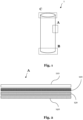
- Fig. 1 shows a schematic of a container 1 according to an embodiment of the present disclosure.
- the container 1 has the shape of a can.
- the container 1 may store any kind of products, e.g., potato or other chips, food powder, such as dehydrated food powder, coffee, milk powder, tobacco, crisp food products, snacks, nuts, or the like.
- the container 1 may be a paper based spiral wound can.
- the container may comprise a side wall (A), a bottom wall (B) and a top wall (C).
- the top wall may facilitate opening of the container 1 so as to allow a consumer to access the interior of it.
- the container 1 has a tubular shape, such as a can.
- the side wall of the container 1 is a tubular side wall.
- the bottom wall is a disc-shaped bottom wall and provides for a closure of one end of the side wall.
- the top wall is a disc-shaped top wall and provides for a closure of the other end of the side wall.
- the container 1 is arranged substantially vertically. However, when rotated, the container may also be arranged horizontally or in any other direction.
- the bottom wall of the container 1 stands on a ground, which may typically be the case during ordinary use of the container 1. Thereby, the bottom wall is arranged on a vertically lower end of the side wall.
- the top wall is arranged on a vertically upper end of the side wall.
- Fig. 2 shows a schematic cross-section of a wall (A) of a container for products of the food industry according to an embodiment of the present disclosure.
- the wall (A) may be a side wall of the container as indicated in Fig. 1 .
- the wall comprises a paper-based layer 110.
- the wall further comprises a barrier layer 130 being an at least one-sided metallized polymer layer, preferably an at least one-sided metallized polyester layer, more preferably an at least one-sided metallized polyethylene terephthalate (mPET) layer.
- the barrier layer 130 is a double-sided metallized polyethylene terephthalate (mPETm) layer.
- the wall comprises a lamination layer 120, bonding the paper-based layer 110 and the barrier layer 130.
- the lamination layer 120 may be an adhesive or a PE layer.
- the barrier layer 130 of the wall may have a thickness of between 6 ⁇ m and 12 ⁇ m.
- the thickness may be measured along a substantially straight line perpendicularly to a main surface of the wall.
- the wall of the container 1 further comprises a sealing layer 140, which is an ionomer, preferably an abrasion resistant, extrusion coated layer, for at least partially sealing the container 1.
- the sealing layer 140 may be arranged adjacent the barrier layer 130 on a side of the barrier layer 130 facing away from the paper-based layer 110.
- the ionomer extrusion coated layer preferably the ionomer abrasion resistant extrusion coated layer comprises polyamide (PA), in particular polyamide 6.
- PA polyamide
- the sealing layer 140 may have a grammage of between 12 to 22 gsm.
- the abrasion resistance has the advantage that the sealing layer 140 is not damaged, e.g., in case the filling goods have sharp edges, such as chips.
- the wall further comprises one or two kraft liners and a printed clay-coated kraft paper, arranged adjacent the paper-based layer towards an outer side of the container 1.
- the outer side of the container 1 may best be seen in Fig. 1 .
- Fig. 3 shows a schematic cross-section of a bottom wall (B) of a container for products of the food industry according to a preferred embodiment of the present disclosure.
- the arrangement of the bottom wall (B) can best be seen in Fig. 1 .
- the bottom wall comprises similar layers as the wall described with reference to Fig. 2 . Predominantly the differences may be described in here.
- the bottom wall comprises a paper-based layer 210, which is a cardboard-based layer 210.
- the barrier layer 230 is an at least one-sided metallized polymer layer, preferably an at least one-sided metallized polyester layer, more preferably an at least one-sided metallized polyethylene terephthalate (mPET) layer. Most preferably, the barrier layer 230 is a double-sided metallized polyethylene terephthalate (mPETm) layer.
- the bottom wall comprises a lamination layer 220, bonding the paper-based layer 210 and the barrier layer 230.
- the lamination layer 220 may be a PE layer.
- the barrier layer 230 of the bottom wall may have a thickness of between 6 ⁇ m and 12 ⁇ m.
- the bottom wall further comprises a sealing layer 240, being an ionomer abrasion resistant extrusion coated layer, for at least partially sealing the container 1.
- the sealing layer 240 is arranged adjacent the barrier layer 230 opposite the paper-based layer 210.
- the sealing layer 240 may have a grammage of between 12 to 22 gsm.
- the cardboard-based layer 210 of the bottom wall may have a grammage of between 150-400 gsm, particularly in the range from 180-250 gsm.
- Fig. 4 shows a schematic cross-section of a top wall (C) of a container 1 for products of the food industry according to a preferred embodiment of the present disclosure.
- the arrangement of the top wall (C) can best be seen in Fig. 1 .
- the top wall comprises similar layers as the wall described with reference to Fig. 2 . Predominantly the differences may be described in here.
- the top wall comprises a sealing layer 340 comprising a peel coating such that the sealing layer 340 of the top wall has a rather high peel force as described herein.
- the paper-based layer 310 is a paper layer, preferably a kraft paper layer, and most preferably a machine glazed bleached kraft paper layer.
- the lamination layer 320 may be a PE layer.
- the sealing layer 340 of the top wall has a grammage of between 10 gsm and 45 gsm. Most preferably, the grammage is between 20 and 30 gsm.
- the barrier layer 330 of the top wall may have a thickness of between 8 ⁇ m and 12 ⁇ m.
- the embodiments described herein allow to produce a container with an extremely high fiber share, e.g., of at least 95%. This facilitates recycling in any kind of conventionally used paper waste stream, which makes the container very cost-effective.
- the construction of the layer of any one of the walls of the embodiments described herein facilitates that a sufficient performance of the walls and/or the container during manufacturing, such as converting is provided.
- the mechanical integrity, the sealing, and the barrier is also ensured.
- the low grammage of the layers, e.g., of the lamination, the barrier layer, and the sealing layer reduces the polymer share, which makes recycling even easier.
- the metallization of the barrier layer of the top wall improves the optical density, which facilitates that an unwanted scrap rate during an optical sensor control is minimized.
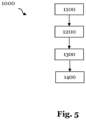
- Fig. 5 shows a schematic flow chart of a method 1000 according to an embodiment of the present disclosure.
- the method 1000 for manufacturing a wall of a container 1 comprises the following steps:
Landscapes
- Engineering & Computer Science (AREA)
- Mechanical Engineering (AREA)
- Laminated Bodies (AREA)
- Packages (AREA)
- Wrappers (AREA)
Priority Applications (3)
| Application Number | Priority Date | Filing Date | Title |
|---|---|---|---|
| EP23215254.6A EP4566809A1 (de) | 2023-12-08 | 2023-12-08 | Behälter für produkte der lebensmittelindustrie |
| JP2024208273A JP2025092451A (ja) | 2023-12-08 | 2024-11-29 | 食品産業の製品のため容器 |
| US18/971,627 US20250187316A1 (en) | 2023-12-08 | 2024-12-06 | Container for products of the food industry |
Applications Claiming Priority (1)
| Application Number | Priority Date | Filing Date | Title |
|---|---|---|---|
| EP23215254.6A EP4566809A1 (de) | 2023-12-08 | 2023-12-08 | Behälter für produkte der lebensmittelindustrie |
Publications (1)
| Publication Number | Publication Date |
|---|---|
| EP4566809A1 true EP4566809A1 (de) | 2025-06-11 |
Family
ID=89164554
Family Applications (1)
| Application Number | Title | Priority Date | Filing Date |
|---|---|---|---|
| EP23215254.6A Pending EP4566809A1 (de) | 2023-12-08 | 2023-12-08 | Behälter für produkte der lebensmittelindustrie |
Country Status (3)
| Country | Link |
|---|---|
| US (1) | US20250187316A1 (de) |
| EP (1) | EP4566809A1 (de) |
| JP (1) | JP2025092451A (de) |
Citations (3)
| Publication number | Priority date | Publication date | Assignee | Title |
|---|---|---|---|---|
| US20130172488A1 (en) * | 2011-12-30 | 2013-07-04 | E.I. Du Pont De Nemours And Company | Compositions of Polyamide and Ionomer |
| US20190202191A1 (en) * | 2015-11-27 | 2019-07-04 | Tetra Laval Holdings & Finance S.A. | Method of manufacturing a laminated packaging material, the packaging material obtained by the method and packaging containers manufactured therefrom |
| WO2023001853A1 (en) * | 2021-07-20 | 2023-01-26 | Société des Produits Nestlé S.A. | A multi-layer flexible packaging material |
Family Cites Families (2)
| Publication number | Priority date | Publication date | Assignee | Title |
|---|---|---|---|---|
| US20050252952A1 (en) * | 2004-05-12 | 2005-11-17 | Sonoco Development, Inc. | High-barrier liner for beaded composite can |
| JP6834149B2 (ja) * | 2016-03-09 | 2021-02-24 | 大日本印刷株式会社 | 液体用紙容器 |
-
2023
- 2023-12-08 EP EP23215254.6A patent/EP4566809A1/de active Pending
-
2024
- 2024-11-29 JP JP2024208273A patent/JP2025092451A/ja active Pending
- 2024-12-06 US US18/971,627 patent/US20250187316A1/en active Pending
Patent Citations (3)
| Publication number | Priority date | Publication date | Assignee | Title |
|---|---|---|---|---|
| US20130172488A1 (en) * | 2011-12-30 | 2013-07-04 | E.I. Du Pont De Nemours And Company | Compositions of Polyamide and Ionomer |
| US20190202191A1 (en) * | 2015-11-27 | 2019-07-04 | Tetra Laval Holdings & Finance S.A. | Method of manufacturing a laminated packaging material, the packaging material obtained by the method and packaging containers manufactured therefrom |
| WO2023001853A1 (en) * | 2021-07-20 | 2023-01-26 | Société des Produits Nestlé S.A. | A multi-layer flexible packaging material |
Non-Patent Citations (1)
| Title |
|---|
| WEISS ET AL: "Parameters that influence the barrier properties of metallized polyester and polypropylene films", THIN SOLID FILMS, ELSEVIER, AMSTERDAM, NL, vol. 204, no. 1, 20 September 1991 (1991-09-20), pages 203 - 216, XP024614763, ISSN: 0040-6090, [retrieved on 19910920], DOI: 10.1016/0040-6090(91)90506-S * |
Also Published As
| Publication number | Publication date |
|---|---|
| JP2025092451A (ja) | 2025-06-19 |
| US20250187316A1 (en) | 2025-06-12 |
Similar Documents
| Publication | Publication Date | Title |
|---|---|---|
| US12521973B2 (en) | Recyclable paper-based laminate and a beverage carton made therefrom | |
| US10889092B2 (en) | Laminated barrier film and edge-covering strip for packaging | |
| US12508802B2 (en) | Recyclable cardboard packaging material comprising a metallized barrier layer applied by transfer metallization | |
| US10857769B2 (en) | Laminated packaging material comprising a barrier film and packaging containers manufactured therefrom | |
| EP0469925A1 (de) | Formbare Bahn zur Auskleidung eines harten Behälters | |
| US20010026874A1 (en) | Foodstuff package coverstructure | |
| US12539695B2 (en) | Recyclable paper-based laminate and a beverage carton made therefrom | |
| US9937681B2 (en) | Method for improving the heat sealability of packaging material and method for manufacturing heat-sealed container or package | |
| WO2000076862A9 (en) | Multi-layer resin/paper laminate structure containing at least a polymer/nanoclay composite layer and packaging materials made thereof | |
| EP4566809A1 (de) | Behälter für produkte der lebensmittelindustrie | |
| RU2843644C1 (ru) | Картонный упаковочный материал, пригодный для вторичной переработки и содержащий металлизированный барьерный слой, наносимый путем переноса металлизации | |
| EP3368299A1 (de) | Laminierter sperrfilm und kantenabdeckungsstreifen für verpackung | |
| RU2842500C1 (ru) | Многослойный материал на основе бумаги, пригодный для вторичной переработки, и изготовленная из него картонная упаковка для напитков | |
| RU2843643C1 (ru) | Многослойный материал на основе бумаги, пригодный для вторичной переработки, и изготовленная из него картонная упаковка для напитков | |
| WO2026073901A1 (en) | Molded pulp container |
Legal Events
| Date | Code | Title | Description |
|---|---|---|---|
| PUAI | Public reference made under article 153(3) epc to a published international application that has entered the european phase |
Free format text: ORIGINAL CODE: 0009012 |
|
| STAA | Information on the status of an ep patent application or granted ep patent |
Free format text: STATUS: THE APPLICATION HAS BEEN PUBLISHED |
|
| AK | Designated contracting states |
Kind code of ref document: A1 Designated state(s): AL AT BE BG CH CY CZ DE DK EE ES FI FR GB GR HR HU IE IS IT LI LT LU LV MC ME MK MT NL NO PL PT RO RS SE SI SK SM TR |
|
| STAA | Information on the status of an ep patent application or granted ep patent |
Free format text: STATUS: REQUEST FOR EXAMINATION WAS MADE |
|
| 17P | Request for examination filed |
Effective date: 20251210 |