EP4566733A1 - Cold rolling method, method for manufacturing steel plate, cold rolling equipment, and equipment for manufacturing steel plate - Google Patents
Cold rolling method, method for manufacturing steel plate, cold rolling equipment, and equipment for manufacturing steel plate Download PDFInfo
- Publication number
- EP4566733A1 EP4566733A1 EP23882131.8A EP23882131A EP4566733A1 EP 4566733 A1 EP4566733 A1 EP 4566733A1 EP 23882131 A EP23882131 A EP 23882131A EP 4566733 A1 EP4566733 A1 EP 4566733A1
- Authority
- EP
- European Patent Office
- Prior art keywords
- cold rolling
- cold
- order
- leveling
- rolled material
- Prior art date
- Legal status (The legal status is an assumption and is not a legal conclusion. Google has not performed a legal analysis and makes no representation as to the accuracy of the status listed.)
- Pending
Links
Images



Classifications
-
- B—PERFORMING OPERATIONS; TRANSPORTING
- B21—MECHANICAL METAL-WORKING WITHOUT ESSENTIALLY REMOVING MATERIAL; PUNCHING METAL
- B21B—ROLLING OF METAL
- B21B37/00—Control devices or methods specially adapted for metal-rolling mills or the work produced thereby
- B21B37/28—Control of flatness or profile during rolling of strip, sheets or plates
-
- B—PERFORMING OPERATIONS; TRANSPORTING
- B21—MECHANICAL METAL-WORKING WITHOUT ESSENTIALLY REMOVING MATERIAL; PUNCHING METAL
- B21B—ROLLING OF METAL
- B21B37/00—Control devices or methods specially adapted for metal-rolling mills or the work produced thereby
- B21B37/58—Roll-force control; Roll-gap control
-
- B—PERFORMING OPERATIONS; TRANSPORTING
- B21—MECHANICAL METAL-WORKING WITHOUT ESSENTIALLY REMOVING MATERIAL; PUNCHING METAL
- B21B—ROLLING OF METAL
- B21B1/00—Metal-rolling methods or mills for making semi-finished products of solid or profiled cross-section; Sequence of operations in milling trains; Layout of rolling-mill plant, e.g. grouping of stands; Succession of passes or of sectional pass alternations
- B21B1/22—Metal-rolling methods or mills for making semi-finished products of solid or profiled cross-section; Sequence of operations in milling trains; Layout of rolling-mill plant, e.g. grouping of stands; Succession of passes or of sectional pass alternations for rolling plates, strips, bands or sheets of indefinite length
- B21B1/24—Metal-rolling methods or mills for making semi-finished products of solid or profiled cross-section; Sequence of operations in milling trains; Layout of rolling-mill plant, e.g. grouping of stands; Succession of passes or of sectional pass alternations for rolling plates, strips, bands or sheets of indefinite length in a continuous or semi-continuous process
- B21B1/28—Metal-rolling methods or mills for making semi-finished products of solid or profiled cross-section; Sequence of operations in milling trains; Layout of rolling-mill plant, e.g. grouping of stands; Succession of passes or of sectional pass alternations for rolling plates, strips, bands or sheets of indefinite length in a continuous or semi-continuous process by cold-rolling, e.g. Steckel cold mill
-
- B—PERFORMING OPERATIONS; TRANSPORTING
- B21—MECHANICAL METAL-WORKING WITHOUT ESSENTIALLY REMOVING MATERIAL; PUNCHING METAL
- B21B—ROLLING OF METAL
- B21B1/00—Metal-rolling methods or mills for making semi-finished products of solid or profiled cross-section; Sequence of operations in milling trains; Layout of rolling-mill plant, e.g. grouping of stands; Succession of passes or of sectional pass alternations
- B21B1/22—Metal-rolling methods or mills for making semi-finished products of solid or profiled cross-section; Sequence of operations in milling trains; Layout of rolling-mill plant, e.g. grouping of stands; Succession of passes or of sectional pass alternations for rolling plates, strips, bands or sheets of indefinite length
- B21B2001/221—Metal-rolling methods or mills for making semi-finished products of solid or profiled cross-section; Sequence of operations in milling trains; Layout of rolling-mill plant, e.g. grouping of stands; Succession of passes or of sectional pass alternations for rolling plates, strips, bands or sheets of indefinite length by cold-rolling
-
- B—PERFORMING OPERATIONS; TRANSPORTING
- B21—MECHANICAL METAL-WORKING WITHOUT ESSENTIALLY REMOVING MATERIAL; PUNCHING METAL
- B21B—ROLLING OF METAL
- B21B37/00—Control devices or methods specially adapted for metal-rolling mills or the work produced thereby
- B21B37/28—Control of flatness or profile during rolling of strip, sheets or plates
- B21B37/38—Control of flatness or profile during rolling of strip, sheets or plates using roll bending
Definitions
- the present disclosure relates to a cold rolling method, a method of producing a steel sheet, a cold rolling line, and a steel sheet production line.
- rolled material such as cold-rolled thin steel sheets (hereinafter also referred to simply as "rolled material") be carried out with a sheet passing property of the rolled material stabilized.
- the sheet passing property of rolled material is stabilized by maintaining good shape (or flatness) of the rolled material while maintaining good thickness precision in the rolling direction and the transverse direction of the rolled material.
- difficult-to-roll material such as thin hard material having a high load capacity and a thin pre-rolled thickness for purposes such as improving fuel efficiency by reducing weight.
- difficult-to-roll material is sent to the cold rolling process after being thinned in a hot rolling process prior to cold rolling.
- Difficult-to-roll material is sometimes joined to the next coil with bends remaining at the leading and trailing ends of the coil caused by shape defects during hot rolling.
- changes in cold mill roll gap, leveling, bender, intermediate roll shift, and the like cannot be accommodated by automatic control.
- Patent Literature 1 a shape meter is disposed at rolling mill delivery, symmetric and asymmetric components of shape data (elongation difference rate distribution) from the shape meter are calculated, and shape feedback (FB) control is used to automatically control rolling mill leveling with the asymmetric component and bending with the symmetric component.
- shape feedback (FB) control is used to automatically control rolling mill leveling with the asymmetric component and bending with the symmetric component.
- unit tension in the vicinity of transverse direction ends needs to be small and asymmetry in the vicinity of transverse direction ends needs to be small.
- the index of an asymmetric component expressed by the correlation of a first-order power function as in PTL 1 is affected by elongation difference rate at the center in the transverse direction and the asymmetric component in the vicinity of transverse direction ends cannot be well controlled.
- a cold rolling method a method of producing a steel sheet, a cold rolling line, and a steel sheet production line that can suppress the occurrence of fracture can be provided. Further, the suppression of fracture occurrence makes it possible to produce steel sheets with excellent stability and productivity. Even when applying cold rolling to rolled material (in particular material having a high load and thin pre-rolled thickness), cold rolling can be carried out with good yield while securing cold rolling stability.
- a cold rolling method, a method of producing a steel sheet, a cold rolling line, and a steel sheet production line according to an embodiment of the present disclosure are described below with reference to the drawings.
- identical or equivalent parts are marked with the same reference sign.
- description of identical or equivalent parts is omitted or simplified as appropriate.
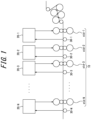
- FIG. 1 illustrates an example configuration of a cold rolling line that carries out the cold rolling method according to the present embodiment.
- the cold rolling line is part of a steel sheet production line and cold rolls steel material (a steel sheet) that is rolled material.
- the cold rolling method according to the present embodiment is used as a cold rolling process to cold roll the rolled material in the method of producing a steel sheet.
- the continuous cold mill (cold mill 10) illustrated in FIG. 1 is a machine that applies cold rolling to target material and comprises N stands (std-1 to std-N). N is an integer greater than or equal to 1, for example 5. That is, the cold mill 10 includes a plurality of stands.
- a shape meter 30 (30-1 to 30-N in FIG. 1 ).
- the shape meter 30 is a load meter divided in the transverse direction.
- the load meter measures normal force received from the steel sheet and calculates elongation difference rate distribution in the transverse direction from the normal force.
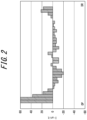
- FIG. 2 illustrates an example of the elongation difference rate distribution of delivery shape.
- the elongation difference rate distribution is illustrated in I-units, with positive values representing elongation and negative values representing tension.
- the elongation difference rate is defined as the difference between the length along the steel sheet curve surface of a certain rolling direction section and average value of same in the transverse direction, divided by the difference of the average value.
- I-units are the elongation difference rate multiplied by 10 5 . Further, in the horizontal axis of FIG. 2 , the left side is the operator (OP) side and the right side is the drive (DR) side.
- controller 20 (20-1 to 20-N in FIG. 1 ) that controls the cold mill 10.
- the controller 20 inputs the elongation difference rate distribution from the shape meter 30 and outputs target values for leveling and bender load.
- leveling control control over the leveling of the cold mill 10 is referred to as leveling control.
- FIG. 3 is a block diagram of leveling control. Arrows in FIG. 3 indicate data flow. Further, "i" corresponds to one of 1 to N in FIG. 1 . That is, the leveling control according to the present embodiment is carried out in all of the plurality of stands (std-1 to std-N).
- the controller 20-i calculates a leveling target value of the cold mill 10 (std-i) based on an index of an asymmetric component of the elongation difference rate distribution of the rolled material after cold rolling at delivery of the cold mill 10 (std-i).
- the controller 20-i then executes leveling control of the cold mill 10 (std-i) based on the leveling target value.
- the details of processing calculating the leveling target value are described below. Hereafter, descriptions of processing that does not depend on the order of the stands does not use suffixes such as "i", "N", and the like.
- the controller 20-i is denoted simply as controller 20.
- the controller 20 inputs the elongation difference rate distribution from the shape meter 30 and evaluates with an evaluation function J indicated in the following Expression (1).
- J ⁇ b , ⁇ l ⁇ ⁇ 1 1 e b ⁇ bx 2 + e l ⁇ lx ⁇ k x 2 dx
- the controller 20 searches for and finds a leveling update amount ( ⁇ l) and a bender update amount ( ⁇ b) such that the evaluation function J is minimized.
- x is the normalized transverse direction position.
- e b is a bender influence coefficient.
- e l is a leveling influence coefficient.
- k is shape deviation (difference between delivery shape and target shape).
- the controller 20 integrates the leveling update amount (PI control) to calculate the leveling target value.
- the controller 20 executes leveling control of the cold mill 10 based on the leveling target value.
- the purpose of the leveling control is to calculate a leveling target value that makes the delivery shape in FIG. 2 bilaterally symmetrical.
- the numerator on the right-hand side of Expression (2) is the correlation of k and x, which are functions. Correlation is a metric of similarity; the greater the correlation, the more similar the functions are to each other.
- the function x is a first-order power function, so is referred to as a first-order correlation of shape deviation k.
- the leveling update amount is a first-order correlation of the shape deviation k and is a metric of an asymmetric component recognized by the control.
- the asymmetric component and symmetric component of shape are controlled independently, and the first-order correlation of the delivery shape is used as an index of asymmetry.
- Expression (1) is a standard leveling control law, that is, a conventional method.
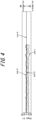
- FIG. 4 is a graph of shape A1, with time on the horizontal axis and shape A1 on the vertical axis. One tick on the horizontal axis is 10 seconds. Further, the units for the shape ⁇ 1 of the vertical axis are I-units.
- the shape A1 is the difference between the OP side and the DR side obtained based on an approximated function, obtained by approximating the elongation difference rate distribution with a sixth-order polynomial function using the least squares method. In other words, the shape A1 is the difference in shape between the OP side and the DR side of the rolled material.
- the leveling control output is, for example, as illustrated in FIG. 5 .
- the vertical axis of leveling in FIG. 5 means the leveling change amount output from the controller 20, which corresponds to the leveling target value.
- the unit is ⁇ m.
- the horizontal axis in FIG. 5 is the same as in FIG. 4 .
- the delivery shape of std-1 is OP elongation, and therefore the leveling control output must move in the DR closing direction.
- std-1 refers to the state in which the rolled material is elongated on the OP side.
- DR elongation means the same for the DR side.
- DR closing refers to narrowing the work roll gap on the DR side, resulting in OP elongation.
- OP closing means the same for the OP side.
- std-3 is the third stand from the upstream side and std-4 is the fourth stand from the upstream side.
- FIG. 6 illustrates the leveling change amount of std-1 in this failure example.
- Search in FIG. 6 indicates the leveling update amount of std-1 expressed in Expression (2).
- Output in FIG. 6 indicates the leveling control output of std-1.
- the leveling update amount is somewhat biased to OP elongation, but does not indicate OP elongation as clearly as shape A1.
- FIG. 7 illustrates the elongation difference rate distribution of the delivery side of std-1 in this failure example.
- the vertical and horizontal axes are the same as in FIG. 2 .
- the leveling update amount represented by the first-order correlation in Expression (2) does not result in OP elongation even for the elongation difference rate distribution illustrated in FIG. 7 , resulting in almost no elongation.
- the time to fracture is illustrated at the top of each graph.
- the shape A1 calculated by the difference between the OP side and the DR side of the elongation difference rate approximation curve is relatively close to the asymmetry recognized by a human observer.
- the distribution shape in FIG. 7 illustrates that the information at the transverse direction ends needs to be emphasized.
- the leveling update amount ( ⁇ l) is calculated by the following Expression (5), where the numerator on the right-hand side can be a third-order correlation.
- J ⁇ b , ⁇ l ⁇ ⁇ 1 1 e b ⁇ bx 2 + e l ⁇ lx 3 ⁇ k x 2 dx
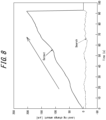
- FIG. 8 illustrates the leveling change amount of std-1 when the leveling update amount is a third-order correlation.
- “Search” indicates the leveling update amount for std-1
- “Output” indicates the leveling control output for std-1.
- FIG. 8 illustrates that the leveling update amount is OP elongation and is improved. Further, the leveling control output is in the DR closing direction.
- third-order correlation was assumed by multiplying the elongation difference rate distribution by a third-order power function as an odd function, but may be a higher-order correlation other than third-order.
- the evaluation function J can be expressed as the following Expression (6).
- the leveling update amount ( ⁇ l) is calculated by the following Expression (7), where the numerator of the right-hand side can be a p-order correlation. p is a real number greater than or equal to 1. However, when p is 1, this corresponds to a conventional method.
- the odd function can be obtained by multiplying a first-order power function by an absolute value power function that is greater than zero-order to obtain a p-order correlation.
- Using higher-order correlations can bring the shape closer to A1 (that is, closer to the asymmetry observed by humans), but would be more susceptible to errors in the shape meter 30.
- the shape deviation k is a measurement error model sin( ⁇ x)
- the error impact on the leveling update amount can be expressed as the following Expression (8).
- ⁇ l ⁇ ⁇ 1 1 sin ⁇ x x x p ⁇ 1 dx ⁇ ⁇ 1 1 x 2 x 2 p ⁇ 1 dx
- the leveling influence coefficient (e 1 ) is set to 1 and ⁇ is the frequency of the modeled error.
- ⁇ is the frequency of the modeled error.
- Expression (8) can be transformed into the following Expression (9) by considering the leveling update amount as a function of ⁇ .
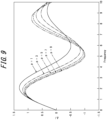
- FIG. 9 illustrates a relationship between the error frequency ( ⁇ ) and the leveling update amount ( ⁇ l).
- the horizontal axis in FIG. 9 is the error frequency ⁇ (no units). It can be seen in FIG. 9 that the larger the order, the higher the susceptibility to high-frequency error.
- Leveling control based on third-order correlation is applied to at least the most upstream stand, preferably to four upstream stands other than the last stand, and leveling control based on first-order correlation is applied to the last stand.
- first-order correlation is preferable because the shape must be created for the downstream line. That is, leveling control based on third-order or higher order correlation is executed for all stands except the last stand. Further, third-order or higher order correlation may be applied only to steel grades that are prone to fracture, for example, those containing at least 1.5 % silicon.
- the shape A1 of std-1 to std-4 can be suppressed to 20 I-units or less.
- the fracture rate was decreased for the Examples using higher-order correlation.
- the fracture rate was calculated for approximately 1000 coils for the Comparative Example and each of the Examples.
- the columns std-1 to std-5 indicate the order of correlation, or p-order, in Expression (7), which calculates the leveling update amount ( ⁇ l). Further, the failure ratio was calculated as "shape defective coils/total coils".
Landscapes
- Engineering & Computer Science (AREA)
- Mechanical Engineering (AREA)
- Control Of Metal Rolling (AREA)
- Metal Rolling (AREA)
Abstract
Description
- The present disclosure relates to a cold rolling method, a method of producing a steel sheet, a cold rolling line, and a steel sheet production line.
- In general, it is desirable that cold rolling of rolled material such as cold-rolled thin steel sheets (hereinafter also referred to simply as "rolled material") be carried out with a sheet passing property of the rolled material stabilized. The sheet passing property of rolled material is stabilized by maintaining good shape (or flatness) of the rolled material while maintaining good thickness precision in the rolling direction and the transverse direction of the rolled material. On the other hand, there is a growing need for difficult-to-roll material such as thin hard material having a high load capacity and a thin pre-rolled thickness for purposes such as improving fuel efficiency by reducing weight. In order to decrease the rolling load during cold rolling, such difficult-to-roll material is sent to the cold rolling process after being thinned in a hot rolling process prior to cold rolling.
- Difficult-to-roll material is sometimes joined to the next coil with bends remaining at the leading and trailing ends of the coil caused by shape defects during hot rolling. When cold rolling such joined portions, changes in cold mill roll gap, leveling, bender, intermediate roll shift, and the like cannot be accommodated by automatic control. As a result, there is a possibility of poor shape of the rolled material after cold rolling or sheet fracture during cold rolling.
- In recent years, many of the control factors of cold mills are automatically controlled by actuators mounted on the cold mills. For example, as indicated in Patent Literature (PTL) 1, a shape meter is disposed at rolling mill delivery, symmetric and asymmetric components of shape data (elongation difference rate distribution) from the shape meter are calculated, and shape feedback (FB) control is used to automatically control rolling mill leveling with the asymmetric component and bending with the symmetric component.
- PTL 1:
JP H11-156419 A - To suppress the occurrence of fractures, unit tension in the vicinity of transverse direction ends needs to be small and asymmetry in the vicinity of transverse direction ends needs to be small. However, the index of an asymmetric component expressed by the correlation of a first-order power function as in
PTL 1 is affected by elongation difference rate at the center in the transverse direction and the asymmetric component in the vicinity of transverse direction ends cannot be well controlled. - It would be helpful to provide a cold rolling method, a method of producing a steel sheet, a cold rolling line, and a steel sheet production line that can suppress the occurrence of fracture.
-
- (1) A cold rolling method according to an embodiment of the present disclosure comprises:
- a process of calculating a leveling target value for a cold mill that carries out cold rolling on rolled material, the calculation being based on an index of an asymmetric component of an elongation difference rate distribution of the rolled material after cold rolling at delivery of the cold mill; and
- a process of executing leveling control of the cold mill based on the leveling target value, wherein
- the index of the asymmetric component of the elongation difference rate distribution is calculated based on a correlation between the elongation difference rate distribution and an odd function, where the odd function is obtained by multiplying a first-order power function by an absolute value power function that is greater than zero-order.
- (2) The cold rolling method according to (1), as an embodiment of the present disclosure, wherein
the odd function is a third-order power function. - (3) The cold rolling method according to (1) or (2), as an embodiment of the present disclosure, wherein
- the cold mill comprises a plurality of stands, and
- the leveling control based on third-order or higher-order correlation is executed for all stands of the plurality of stands except the last stand.
- (4) The cold rolling method according to any one of (1) to (3), as an embodiment of the present disclosure, wherein
in the index of the asymmetric component, the leveling target value is calculated so that the shape difference between an OP side and a DR side of the rolled material is 20 I-units or less. - (5) A method of producing a steel sheet according to an embodiment of the present disclosure, the method comprising
a cold rolling process of cold rolling a steel sheet as the rolled material by the cold rolling method according to any one of (1) to (4). - (6) A cold rolling line according to an embodiment of the present disclosure comprises:
- a cold mill that carries out cold rolling on rolled material; and
- a controller that calculates a leveling target value of the cold mill based on an index of an asymmetric component of an elongation difference rate distribution of the rolled material after cold rolling at delivery of the cold mill, and executes leveling control of the cold mill based on the leveling target value, wherein
- the index of the asymmetric component of the elongation difference rate distribution is calculated based on a correlation between the elongation difference rate distribution and an odd function, where the odd function is obtained by multiplying a first-order power function by an absolute value power function that is greater than zero-order.
- (7) The cold rolling line according to (6), as an embodiment of the present disclosure, wherein
the odd function is a third-order power function. - (8) The cold rolling line according to (6) or (7), as an embodiment of the present disclosure, wherein
- the cold mill comprises a plurality of stands, and
- the leveling control based on third-order or higher-order correlation is executed for all stands of the plurality of stands except the last stand.
- (9) The cold rolling line according to any one of (6) to (8), as an embodiment of the present disclosure, wherein,
in the index of the asymmetric component, the leveling target value is calculated so that the shape difference between an OP side and a DR side of the rolled material is 20 I-units or less. - (10) A steel sheet production line according to an embodiment of the present disclosure comprises
the cold rolling line according to any one of (6) to (9), wherein the cold rolling line cold rolls a steel sheet as the rolled material. - According to the present disclosure, a cold rolling method, a method of producing a steel sheet, a cold rolling line, and a steel sheet production line that can suppress the occurrence of fracture can be provided. Further, the suppression of fracture occurrence makes it possible to produce steel sheets with excellent stability and productivity. Even when applying cold rolling to rolled material (in particular material having a high load and thin pre-rolled thickness), cold rolling can be carried out with good yield while securing cold rolling stability.
- In the accompanying drawings:
-
FIG. 1 is a schematic diagram illustrating an example configuration of a cold rolling line that carries out a cold rolling method according to an embodiment of the present disclosure; -
FIG. 2 is a diagram illustrating an example of elongation difference rate distribution of delivery shape; -
FIG. 3 is a block diagram of leveling control; -
FIG. 4 is a graph illustrating changes in shape Λ1; -
FIG. 5 is a graph illustrating changes in leveling control output; -
FIG. 6 is a diagram illustrating std-1 leveling change amounts; -
FIG. 7 is a diagram illustrating elongation difference rate distribution at std-1 delivery; -
FIG. 8 is a diagram illustrating std-1 leveling change amounts; and -
FIG. 9 is a diagram illustrating a relationship between error frequency and leveling update amount. - A cold rolling method, a method of producing a steel sheet, a cold rolling line, and a steel sheet production line according to an embodiment of the present disclosure are described below with reference to the drawings. In each drawing, identical or equivalent parts are marked with the same reference sign. In description of the present embodiment, description of identical or equivalent parts is omitted or simplified as appropriate.
-
FIG. 1 illustrates an example configuration of a cold rolling line that carries out the cold rolling method according to the present embodiment. According to the present embodiment, the cold rolling line is part of a steel sheet production line and cold rolls steel material (a steel sheet) that is rolled material. In other words, the cold rolling method according to the present embodiment is used as a cold rolling process to cold roll the rolled material in the method of producing a steel sheet. - In
FIG. 1 , the right hand side is the upstream side in the conveyance direction of the rolled material, and the left hand side is the downstream side in the conveyance direction of the rolled material. The continuous cold mill (cold mill 10) illustrated inFIG. 1 is a machine that applies cold rolling to target material and comprises N stands (std-1 to std-N). N is an integer greater than or equal to 1, for example 5. That is, thecold mill 10 includes a plurality of stands. On the delivery side (downstream side) of each stand is disposed a shape meter 30 (30-1 to 30-N inFIG. 1 ). Theshape meter 30 is a load meter divided in the transverse direction. The load meter measures normal force received from the steel sheet and calculates elongation difference rate distribution in the transverse direction from the normal force.FIG. 2 illustrates an example of the elongation difference rate distribution of delivery shape. The elongation difference rate distribution is illustrated in I-units, with positive values representing elongation and negative values representing tension. The elongation difference rate is defined as the difference between the length along the steel sheet curve surface of a certain rolling direction section and average value of same in the transverse direction, divided by the difference of the average value. I-units are the elongation difference rate multiplied by 105. Further, in the horizontal axis ofFIG. 2 , the left side is the operator (OP) side and the right side is the drive (DR) side. - Further, at each stand is disposed a controller 20 (20-1 to 20-N in
FIG. 1 ) that controls thecold mill 10. According to the present embodiment, thecontroller 20 inputs the elongation difference rate distribution from theshape meter 30 and outputs target values for leveling and bender load. Hereinafter, control over the leveling of thecold mill 10 is referred to as leveling control. -
FIG. 3 is a block diagram of leveling control. Arrows inFIG. 3 indicate data flow. Further, "i" corresponds to one of 1 to N inFIG. 1 . That is, the leveling control according to the present embodiment is carried out in all of the plurality of stands (std-1 to std-N). - As an overview, the controller 20-i calculates a leveling target value of the cold mill 10 (std-i) based on an index of an asymmetric component of the elongation difference rate distribution of the rolled material after cold rolling at delivery of the cold mill 10 (std-i). The controller 20-i then executes leveling control of the cold mill 10 (std-i) based on the leveling target value. The details of processing calculating the leveling target value are described below. Hereafter, descriptions of processing that does not depend on the order of the stands does not use suffixes such as "i", "N", and the like. For example, the controller 20-i is denoted simply as
controller 20. - First, the
controller 20 inputs the elongation difference rate distribution from theshape meter 30 and evaluates with an evaluation function J indicated in the following Expression (1).
[Math. 1]
- The
controller 20 searches for and finds a leveling update amount (Δl) and a bender update amount (Δb) such that the evaluation function J is minimized. Here x is the normalized transverse direction position. eb is a bender influence coefficient. el is a leveling influence coefficient. k is shape deviation (difference between delivery shape and target shape). As illustrated inFIG. 3 , thecontroller 20 integrates the leveling update amount (PI control) to calculate the leveling target value. Thecontroller 20 then executes leveling control of thecold mill 10 based on the leveling target value. The purpose of the leveling control is to calculate a leveling target value that makes the delivery shape inFIG. 2 bilaterally symmetrical. - From Expression (1), the leveling update amount and bender update amount can be obtained analytically. The leveling update amount (Δl) is calculated by the following Expression (2). Further, the bender update amount (Δb) is calculated by the following Expression (3).

- The numerator on the right-hand side of Expression (2) is the correlation of k and x, which are functions. Correlation is a metric of similarity; the greater the correlation, the more similar the functions are to each other. In this example, the function x is a first-order power function, so is referred to as a first-order correlation of shape deviation k. The leveling update amount is a first-order correlation of the shape deviation k and is a metric of an asymmetric component recognized by the control. The asymmetric component and symmetric component of shape are controlled independently, and the first-order correlation of the delivery shape is used as an index of asymmetry. Expression (1) is a standard leveling control law, that is, a conventional method.
- Here, an example of leveling control failure is described.
FIG. 4 is a graph of shape A1, with time on the horizontal axis and shape A1 on the vertical axis. One tick on the horizontal axis is 10 seconds. Further, the units for the shape Λ1 of the vertical axis are I-units. The shape A1 is the difference between the OP side and the DR side obtained based on an approximated function, obtained by approximating the elongation difference rate distribution with a sixth-order polynomial function using the least squares method. In other words, the shape A1 is the difference in shape between the OP side and the DR side of the rolled material. - Here, as a failure example, it is assumed that the shape A1 of std-1 (the most upstream stand) does not reach zero and a fracture occurs between std-1 and std-2 (the second stand from the upstream side). When such a failure occurs, the leveling control output is, for example, as illustrated in
FIG. 5 . The vertical axis of leveling inFIG. 5 means the leveling change amount output from thecontroller 20, which corresponds to the leveling target value. The unit is µm. The horizontal axis inFIG. 5 is the same as inFIG. 4 . In the example inFIG. 5 , the delivery shape of std-1 is OP elongation, and therefore the leveling control output must move in the DR closing direction. However, the leveling control output of std-1 is moving in a DR-closing manner, but movement is slow and does not fully correct the asymmetry of the delivery shape. Here, OP elongation refers to the state in which the rolled material is elongated on the OP side. DR elongation means the same for the DR side. Further, DR closing refers to narrowing the work roll gap on the DR side, resulting in OP elongation. OP closing means the same for the OP side. Here, inFIG. 4 andFIG. 5 , std-3 is the third stand from the upstream side and std-4 is the fourth stand from the upstream side. -
FIG. 6 illustrates the leveling change amount of std-1 in this failure example. "Search" inFIG. 6 indicates the leveling update amount of std-1 expressed in Expression (2). Further, "Output" inFIG. 6 indicates the leveling control output of std-1. The leveling update amount is somewhat biased to OP elongation, but does not indicate OP elongation as clearly as shape A1. - Further,
FIG. 7 illustrates the elongation difference rate distribution of the delivery side of std-1 in this failure example. The vertical and horizontal axes are the same as inFIG. 2 . Although clearly recognizable as OP elongation to a human observer, the leveling update amount represented by the first-order correlation in Expression (2) does not result in OP elongation even for the elongation difference rate distribution illustrated inFIG. 7 , resulting in almost no elongation. Here, the time to fracture is illustrated at the top of each graph. - Here, it is known that the shape A1 calculated by the difference between the OP side and the DR side of the elongation difference rate approximation curve is relatively close to the asymmetry recognized by a human observer. Further, the distribution shape in
FIG. 7 illustrates that the information at the transverse direction ends needs to be emphasized. - Based on the above considerations, the following evaluation function J in Expression (4) is used. In this case, the leveling update amount (Δl) is calculated by the following Expression (5), where the numerator on the right-hand side can be a third-order correlation.

-
FIG. 8 illustrates the leveling change amount of std-1 when the leveling update amount is a third-order correlation. As inFIG. 6 , "Search" indicates the leveling update amount for std-1, and "Output" indicates the leveling control output for std-1.FIG. 8 illustrates that the leveling update amount is OP elongation and is improved. Further, the leveling control output is in the DR closing direction. - Here, according to the embodiment described above, third-order correlation was assumed by multiplying the elongation difference rate distribution by a third-order power function as an odd function, but may be a higher-order correlation other than third-order. In general, the evaluation function J can be expressed as the following Expression (6). In this case, the leveling update amount (Δl) is calculated by the following Expression (7), where the numerator of the right-hand side can be a p-order correlation. p is a real number greater than or equal to 1. However, when p is 1, this corresponds to a conventional method.

- That is, the odd function can be obtained by multiplying a first-order power function by an absolute value power function that is greater than zero-order to obtain a p-order correlation. Using higher-order correlations can bring the shape closer to A1 (that is, closer to the asymmetry observed by humans), but would be more susceptible to errors in the
shape meter 30. Here, in Expression (7), when the shape deviation k is a measurement error model sin(ωx), the error impact on the leveling update amount can be expressed as the following Expression (8).
[Math. 5]
- Here, the leveling influence coefficient (e1) is set to 1 and ω is the frequency of the modeled error. The larger the value of ω, the shorter the wavelength and the higher the error frequency. Expression (8) can be transformed into the following Expression (9) by considering the leveling update amount as a function of ω. Here, F is a hypergeometric function.
[Math. 6]
-
FIG. 9 illustrates a relationship between the error frequency (ω) and the leveling update amount (Δl). The horizontal axis inFIG. 9 is the error frequency ω (no units). It can be seen inFIG. 9 that the larger the order, the higher the susceptibility to high-frequency error. - Leveling control based on third-order correlation is applied to at least the most upstream stand, preferably to four upstream stands other than the last stand, and leveling control based on first-order correlation is applied to the last stand. For the last stand (the most downstream stand), first-order correlation is preferable because the shape must be created for the downstream line. That is, leveling control based on third-order or higher order correlation is executed for all stands except the last stand. Further, third-order or higher order correlation may be applied only to steel grades that are prone to fracture, for example, those containing at least 1.5 % silicon.
- By using the leveling control with the evaluation function J of Expression (4), the shape A1 of std-1 to std-4 can be suppressed to 20 I-units or less. As indicated in Table 1 below, the fracture rate was decreased for the Examples using higher-order correlation. Here, the fracture rate was calculated for approximately 1000 coils for the Comparative Example and each of the Examples. The columns std-1 to std-5 indicate the order of correlation, or p-order, in Expression (7), which calculates the leveling update amount (Δl). Further, the failure ratio was calculated as "shape defective coils/total coils".
-
(Table 1) No. std-1 std-2 std-3 std-4 std-5 Fracture rate Failure ratio of std-5 delivery shape Remarks 1 1st-order 1st-order 1st-order 1st-order 1st-order 2.00% 1.00% Comparative Example 2 3rd-order 3rd-order 3rd-order 3rd-order 1st-order 0.40% 1.00% Example 3 5th-order 5th-order 5th-order 5th-order 1st-order 1.20% 1.00% Example 4 7th order 7th order 7th order 7th order 1st-order 1.50% 1.00% Example 5 3rd-order 3rd-order 3rd-order 3rd-order 3rd-order 0.40% 1.50% Example - Although embodiments of the present disclosure have been described based on the drawings and examples, it should be noted that a person skilled in the art may make variations and modifications based on the present disclosure. Therefore, it should be noted that such variations and modifications are included within the scope of the present disclosure.
-
- 10
- cold mill
- 20
- controller
- 30
- shape meter
Claims (10)
- A method of cold rolling, the method comprising:a process of calculating a leveling target value for a cold mill that carries out cold rolling on rolled material, the calculation being based on an index of an asymmetric component of an elongation difference rate distribution of the rolled material after cold rolling at delivery of the cold mill; anda process of executing leveling control of the cold mill based on the leveling target value, whereinthe index of the asymmetric component of the elongation difference rate distribution is calculated based on a correlation between the elongation difference rate distribution and an odd function, where the odd function is obtained by multiplying a first-order power function by an absolute value power function that is greater than zero-order.
- The cold rolling method according to claim 1, wherein the odd function is a third-order power function.
- The cold rolling method according to claim 1 or 2, wherein the cold mill comprises a plurality of stands, and
the leveling control based on third-order or higher-order correlation is executed for all stands of the plurality of stands except the last stand. - The cold rolling method according to any one of claims 1 to 3, wherein, in the index of the asymmetric component, the leveling target value is calculated so that the shape difference between an OP side and a DR side of the rolled material is 20 I-units or less.
- A method of producing a steel sheet, comprising a cold rolling process of cold rolling a steel sheet as the rolled material by the cold rolling method according to any one of claims 1 to 4.
- A cold rolling line comprising:a cold mill that carries out cold rolling on rolled material; anda controller that calculates a leveling target value of the cold mill based on an index of an asymmetric component of an elongation difference rate distribution of the rolled material after cold rolling at delivery of the cold mill, and executes leveling control of the cold mill based on the leveling target value, whereinthe index of the asymmetric component of the elongation difference rate distribution is calculated based on a correlation between the elongation difference rate distribution and an odd function, where the odd function is obtained by multiplying a first-order power function by an absolute value power function that is greater than zero-order.
- The cold rolling line according to claim 6, wherein the odd function is a third-order power function.
- The cold rolling line according to claim 6 or 7, wherein the cold mill comprises a plurality of stands, and
the leveling control based on third-order or higher-order correlation is executed for all stands of the plurality of stands except the last stand. - The cold rolling line according to any one of claims 6 to 8, wherein, in the index of the asymmetric component, the leveling target value is calculated so that the shape difference between an OP side and a DR side of the rolled material is 20 I-units or less.
- A steel sheet production line comprising the cold rolling line according to any one of claims 6 to 9, wherein the cold rolling line cold rolls a steel sheet as the rolled material.
Applications Claiming Priority (2)
| Application Number | Priority Date | Filing Date | Title |
|---|---|---|---|
| JP2022173723A JP7323037B1 (en) | 2022-10-28 | 2022-10-28 | Cold rolling method, steel plate manufacturing method, cold rolling equipment and steel plate manufacturing equipment |
| PCT/JP2023/015498 WO2024089913A1 (en) | 2022-10-28 | 2023-04-18 | Cold rolling method, method for manufacturing steel plate, cold rolling equipment, and equipment for manufacturing steel plate |
Publications (2)
| Publication Number | Publication Date |
|---|---|
| EP4566733A1 true EP4566733A1 (en) | 2025-06-11 |
| EP4566733A4 EP4566733A4 (en) | 2025-11-26 |
Family
ID=87519393
Family Applications (1)
| Application Number | Title | Priority Date | Filing Date |
|---|---|---|---|
| EP23882131.8A Pending EP4566733A4 (en) | 2022-10-28 | 2023-04-18 | COLD ROLLING PROCESS, PROCESS FOR PRODUCING A STEEL PLATE, COLD ROLLING EQUIPMENT AND EQUIPMENT FOR PRODUCING A STEEL PLATE |
Country Status (4)
| Country | Link |
|---|---|
| US (1) | US20260102801A1 (en) |
| EP (1) | EP4566733A4 (en) |
| JP (1) | JP7323037B1 (en) |
| WO (1) | WO2024089913A1 (en) |
Family Cites Families (9)
| Publication number | Priority date | Publication date | Assignee | Title |
|---|---|---|---|---|
| JPS5747516A (en) * | 1980-09-05 | 1982-03-18 | Kawasaki Steel Corp | Controlling method for shape of thin sheet |
| JPS5775214A (en) * | 1980-10-30 | 1982-05-11 | Mitsubishi Electric Corp | Controlling system for shape of strip |
| JPS6178506A (en) * | 1984-09-26 | 1986-04-22 | Nippon Kokan Kk <Nkk> | Shape control method of thin plate |
| JPS6178507A (en) * | 1984-09-26 | 1986-04-22 | Nippon Kokan Kk <Nkk> | Shape control method of thin plate |
| JPH0638961B2 (en) * | 1984-12-03 | 1994-05-25 | 株式会社日立製作所 | Shape control method for rolled material |
| JP2518370B2 (en) * | 1988-12-28 | 1996-07-24 | 株式会社安川電機 | Tension leveler control method |
| JP3636151B2 (en) * | 2002-03-12 | 2005-04-06 | 住友金属工業株式会社 | Metal strip manufacturing method |
| JP4709628B2 (en) * | 2005-10-18 | 2011-06-22 | 新日本製鐵株式会社 | Cold rolled steel sheet manufacturing method |
| JP7131235B2 (en) * | 2018-09-20 | 2022-09-06 | 日本製鉄株式会社 | meandering control system, meandering control method, and program |
-
2022
- 2022-10-28 JP JP2022173723A patent/JP7323037B1/en active Active
-
2023
- 2023-04-18 WO PCT/JP2023/015498 patent/WO2024089913A1/en not_active Ceased
- 2023-04-18 US US19/117,081 patent/US20260102801A1/en active Pending
- 2023-04-18 EP EP23882131.8A patent/EP4566733A4/en active Pending
Also Published As
| Publication number | Publication date |
|---|---|
| WO2024089913A1 (en) | 2024-05-02 |
| US20260102801A1 (en) | 2026-04-16 |
| JP2024064822A (en) | 2024-05-14 |
| EP4566733A4 (en) | 2025-11-26 |
| JP7323037B1 (en) | 2023-08-08 |
Similar Documents
| Publication | Publication Date | Title |
|---|---|---|
| CN106475420B (en) | A kind of board-shape control method based on the setting of cold-strip steel target flatness | |
| CN101618402B (en) | Method for controlling planeness of cold-rolling strip steel | |
| CN101683659B (en) | Comprehensive control method for flatness and transverse thickness difference of cold-rolled strip steel | |
| CN102029294B (en) | Control method of lateral thick difference of cold-rolling strip steels | |
| US20100121471A1 (en) | Learing method of rolling load prediction for hot rolling | |
| CN104923568B (en) | A kind of control method for preventing thin strip cold rolling process broken belt | |
| CN113333470B (en) | Hot rolling method for improving 780 MPa-level thin-specification dual-phase steel edge wave | |
| CN1243047A (en) | Interlinked control method for plate-band rolling course based on coordination law of plate shape and plate thickness | |
| EP4566733A1 (en) | Cold rolling method, method for manufacturing steel plate, cold rolling equipment, and equipment for manufacturing steel plate | |
| CN104923571B (en) | A kind of hot-rolling plate belt steel rolling code dynamic setting method | |
| JP6620777B2 (en) | Leveling setting method for rolling mill and leveling setting apparatus for rolling mill | |
| JPH04167910A (en) | Method and apparatus for controlling rolling mill | |
| JP5626172B2 (en) | Steel strip manufacturing equipment | |
| JP2020032462A (en) | Temper rolling method of hot rolled steel sheet | |
| JP4525037B2 (en) | Roller straightening method for steel sheet | |
| KR101528690B1 (en) | Method for manufacturing steel sheet | |
| JP3520868B2 (en) | Steel sheet manufacturing method | |
| JP3636151B2 (en) | Metal strip manufacturing method | |
| JP2698830B2 (en) | Steel strip temper rolling mill | |
| JPH08267114A (en) | Edge-drop controlled rolling method in cold rolling | |
| JP4330134B2 (en) | Shape control method in cold rolling | |
| JP2003326308A (en) | Rolling method | |
| US20240226978A1 (en) | Plate crown control device | |
| JP3244113B2 (en) | Edge drop control method for sheet material | |
| JP3664067B2 (en) | Manufacturing method of hot rolled steel sheet |
Legal Events
| Date | Code | Title | Description |
|---|---|---|---|
| STAA | Information on the status of an ep patent application or granted ep patent |
Free format text: STATUS: THE INTERNATIONAL PUBLICATION HAS BEEN MADE |
|
| PUAI | Public reference made under article 153(3) epc to a published international application that has entered the european phase |
Free format text: ORIGINAL CODE: 0009012 |
|
| STAA | Information on the status of an ep patent application or granted ep patent |
Free format text: STATUS: REQUEST FOR EXAMINATION WAS MADE |
|
| 17P | Request for examination filed |
Effective date: 20250307 |
|
| AK | Designated contracting states |
Kind code of ref document: A1 Designated state(s): AL AT BE BG CH CY CZ DE DK EE ES FI FR GB GR HR HU IE IS IT LI LT LU LV MC ME MK MT NL NO PL PT RO RS SE SI SK SM TR |
|
| A4 | Supplementary search report drawn up and despatched |
Effective date: 20251023 |
|
| RIC1 | Information provided on ipc code assigned before grant |
Ipc: B21B 37/58 20060101AFI20251017BHEP Ipc: B21B 1/28 20060101ALI20251017BHEP Ipc: B21B 37/38 20060101ALI20251017BHEP |
|
| DAV | Request for validation of the european patent (deleted) | ||
| DAX | Request for extension of the european patent (deleted) |