EP4564237A1 - Verfahren, system und computerprogramm zur verbesserung der schätzung von fermionoperatoren auf einem quantencomputer auf basis von simultaner messung verrauschter majoranaobservablen - Google Patents
Verfahren, system und computerprogramm zur verbesserung der schätzung von fermionoperatoren auf einem quantencomputer auf basis von simultaner messung verrauschter majoranaobservablen Download PDFInfo
- Publication number
- EP4564237A1 EP4564237A1 EP23461683.7A EP23461683A EP4564237A1 EP 4564237 A1 EP4564237 A1 EP 4564237A1 EP 23461683 A EP23461683 A EP 23461683A EP 4564237 A1 EP4564237 A1 EP 4564237A1
- Authority
- EP
- European Patent Office
- Prior art keywords
- fermionic
- majorana
- operators
- quantum
- measurement
- Prior art date
- Legal status (The legal status is an assumption and is not a legal conclusion. Google has not performed a legal analysis and makes no representation as to the accuracy of the status listed.)
- Pending
Links
Images



Classifications
-
- G—PHYSICS
- G06—COMPUTING OR CALCULATING; COUNTING
- G06N—COMPUTING ARRANGEMENTS BASED ON SPECIFIC COMPUTATIONAL MODELS
- G06N10/00—Quantum computing, i.e. information processing based on quantum-mechanical phenomena
- G06N10/20—Models of quantum computing, e.g. quantum circuits or universal quantum computers
Definitions
- the present invention relates to a method for estimating expectation values of a fermionic operators of a quantum state implemented on a quantum computer.
- Quantum chemistry and quantum many-body physics is one of the most promising areas in which quantum computers can offer an advantage over classical computers in the near-term.
- the basic idea is to encode states on a quantum system (which requires exponentially large memory to be even stored on a classical computer) in a moderate size quantum computer, whose size scales linearly with the size of the physical problem, and to use quantum gates to manipulate it.
- Such manipulations can be used to implement various algorithms important for understanding many physical problems such as finding ground or thermal states of a quantum many body system, assessment of correlations and other characteristics present in this states - such as k-body fermionic reduced density matrices (for fermionic systems).
- Such data can be extremely useful for many applications such as material sciences (designing new materials with desired properties), quantum chemistry or drug industry.
- Variational Quantum Eigensolver is one of the examples) require estimation of multiple operators that in general cannot be measured jointly on a quantum computer.
- the cost can be quantified in terms of circuit complexity needed to realize measurements, number of measurement settings that need to be realized, as well as sampling complexity i.e. the number of times a quantum device needs to be queried in order to accurately carry out the estimation procedure.
- US20180053112A1 discloses a technique that relates to reducing qubits required on a quantum computer.
- a Fermionic system is characterized in terms of a Hamiltonian.
- the Fermionic system includes Fermions and Fermionic modes with a total number of 2M Fermionic modes.
- the Hamiltonian has a parity symmetry encoded by spin up and spin down parity operators. Fermionic modes are sorted such that the first half of 2M modes corresponds to spin up and the second half of 2M modes corresponds to spin down.
- the Hamiltonian and the parity operators are transformed utilizing a Fermion to qubit mapping that transforms parity operators to a first single qubit Pauli operator on a qubit M and a second single qubit Pauli operator on a qubit 2M.
- the qubit M having been operated on by the first single qubit Pauli operator and the qubit 2M having been operated on by the second single qubit Pauli operator are removed.
- a system can comprise a memory that stores computer executable components and a processor that executes the computer executable components stored in the memory.
- the computer executable components can comprise a selection component that selects a quantum state measurement basis having a probability defined based on a ratio of a Pauli operator in a Hamiltonian of a quantum system.
- the computer executable components can further comprise a measurement component that captures a quantum state measurement of a qubit in the quantum system based on the quantum state measurement basis.
- the method includes forming a set of excitation operators.
- the method includes forming a set of commutators from the set of excitation operators and a Hamiltonian operator.
- the method includes mapping the set of commutators onto a set of qubit states, the set of qubit states corresponding to a set of qubits of the quantum processor.
- the method includes evaluating, using the quantum processor and memory, the set of commutators.
- the method includes causing a quantum readout circuit to measure an excited state energy from the set of computed commutators.
- a method includes the actions of selecting a first set of basis functions for the simulation, wherein the first set of basis functions comprises an active and a virtual set of orbitals; defining a set of expansion operators for the simulation, wherein expansion operators in the set of expansion operators approximate fermionic excitations in an active space spanned by the active set of orbitals and a virtual space spanned by the virtual set of orbitals; performing multiple quantum computations to determine a matrix representation of a Hamiltonian characterizing the system in a second set of basis functions, computing, using the determined matrix representation of the Hamiltonian, eigenvalues and eigenvectors of the Hamiltonian; and determining properties of the physical system using the computed eigenvalues and eigenvectors.
- US10922617B2 discloses a method for generating a computing specification to be executed by a quantum processor includes: accepting a problem specification that corresponds to a second-quantized representation of a fermionic Hamiltonian, and transforming the fermionic Hamiltonian into a first qubit Hamiltonian including a first set of qubits that encode a fermionic state specified by occupancy of spin orbitals.
- An occupancy of any spin orbital is encoded in a number of qubits that is logarithmic in the number of spin orbitals, and a parity for a transition between any two spin orbitals is encoded in a number of qubits that is logarithmic in the number of spin orbitals.
- An eigenspectrum of a second qubit Hamiltonian including the first set of qubits and a second set of qubit, includes a low-energy subspace and a high-energy subspace, and an eigenspectrum of the first qubit Hamiltonian is approximated by a set of low-energy eigenvalues of the low-energy subspace.
- US20220188682A1 discloses techniques for mitigating readout error for quantum expectation are presented.
- Calibration component applies first random Pauli gates to qubits at first output of first circuit prior to first readout measurements of the qubits.
- Estimation component applies second random Pauli gates to qubits at second output of second circuit prior to second readout measurements of the qubits, and generates an error-mitigated readout determination based on first random Pauli gates applied to qubits at first circuit output and second random Pauli gates applied to qubits at second circuit output.
- Calibration component determines calibration data based on first readout measurements.
- Estimation component determines estimation data based on second readout measurements.
- Estimation component determines normalization scalar value based on the calibration data, determines estimation scalar value based on the estimation data, and determines the error-mitigated readout determination associated with a circuit of interest based on the normalization scalar value and estimation scalar value.
- the present invention has been made in view of the above problems, and an object of the present invention is a method for estimating many properties of fermionic quantum system via family of circuits whose depth scales linearly (N) in the system size (but in certain embodiments, like 2D qubit layout, exhibits scaling ⁇ N .
- the important feature of the scheme is that circuits differ between each other only by a simple modification, which amounts to applying an array of single qubit Pauli gates. At the same time sample complexity and number of circuits that need to be implemented are comparable, and sometimes superior to other state-of the art methods.
- the present patent application describes a novel method for efficient estimation of expectation values of fermionic observables on a general quantum state encoded on a quantum computer.
- the invention provides a way to estimate k-body fermionic reduced density matrices and quantum fermionic Hamiltonians, a task which incurs significant cost due to the necessary sampling overheads and complicated circuits that need to be executed on a quantum computer, i that are difficult to solve with classical computers.
- the method utilizes a single layer of gates implementing a transformation via product of Majorana - fermion operators, a unitary transformation belonging to a class of fermionic Gaussian transformations , measurement of the occupation numbers in Fermionic modes and post-processing of the results of the measurements performed in a computational basis on a quantum computer.
- the invention has applications in a range of fields, including chemistry, materials science, drug discovery, and quantum simulation, where accurate estimation of properties of fermionic quantum systems is critical.
- the method enables the efficient solution of problems that previously required higher computing power for setting the system, thus representing a significant advancement in the field of quantum computing.
- the patent application provides a detailed description of the method, including the underlying theory and the practical implementation on a quantum computing system.
- the patent claims encompass various embodiments of the invention, including the use of different gate sets and unitary transformations.
- the patent application also provides examples of the method applied to specific quantum systems (estimation of energy of exemplary molecular quantum Hamiltonians), demonstrating the comparable performance to state-of-the art methods, while requiring (asymptotically) smaller circuit depths and smaller number of complicated quantum transformations (requiring to entangle all the qubits)
- the present invention represents a significant development in the field of quantum computing, allowing for effective estimation of expectation values of fermionic Hamiltonians.
- the implementation of the joint measurement of noisy versions of Majorana fermion operators (observables) in step i is realized by the following actions:
- the global Gaussian fermionic unitary transformation are chosen as:
- a pre-defined fermion-to-qubit mapping is used for encoding of the fermionic system into the quantum computer, consisting of distinguishable qubits, in which the Majorana fermion operators are encoded as strings of Pauli operators.
- step i the joint measurement of noisy versions of products of Majorana fermion operators (observables) in step i is realized by the following actions:
- fermion-to qubit mapping is realized on a rectangular arrangement of qubits realizing a Jordan Wigner transformation and four Gaussian fermionic unitaries, as explained in Section VI of the part "How to realize the invention", which are used to implement the estimation of expectation value of the fermionic quantum Hamiltonian.
- the present invention covers also a system comprising a quantum computer and a classical computer, programmed and configured for implementing the inventive method as described above.
- the present invention covers also a computer program comprising instructions which, when the program is executed by the classical computer in the system as above, cause the system to carry out the inventive method as described above.
- the present invention is applicable to quantum many-body systems, quantum chemistry etc.
- the number of physical quantities to be measured grows as the 4 th power (N ⁇ 4) with the size of the system (number of fermionic modes N). It is important to read relevant information on the output of the quantum computer, wherein the initial state of said quantum computer reflected the problem to be solved.
- the present invention provides quality comparable with prior art solutions, but at the same time remarkably reduces the "cost", understood as computational complexity (number of operations to be performed and time needed for them).
- the present invention has the following features:
- the general measurement scheme for an N mode fermionic system involves sampling from two distinct subsets of unitaries followed by a measurement of the occupation numbers and a simple classical post-processing.
- the first subset resizes the Majorana operators while the second subset (which consists of K fermionic Gaussian unitaries) rotates blocks of the operators into balanced superpositions.
- the second subset which consists of K fermionic Gaussian unitaries
- n ⁇
- i ⁇ i 1 N of single-particle Hilbert space C N ).
- ⁇ A : i A / 2 ⁇ i ⁇ A ⁇ i , where
- Another important element of our strategy will be the class of so-called fermionic Gaussian unitaries, also known under the name of fermionic linear optics..
- R ⁇ O (2 N ) it is possible to find V ⁇ FLO for which Eq. (2) holds.
- the corresponding V R ⁇ FLO( N ) is defined up to a physically irrelevant global phase. From Eq.
- V R 1 V R 2 V R 1 R 2 (up to a global phase).
- our aim is to present a measurement scheme, described by a single (parent) POVM, that jointly measures noisy variants of all non-commuting Majorana observables.
- the visibility for each A will be sufficiently large due to its inverse controlling the sample complexity of our estimation scheme.
- JW Jordan-Wigner
- Jordan-Wigner transformation can be defined irrespective of the physical arrangement of qubits, different layouts (and labellings of qubits) can have benefits from an implementation perspective in terms of the feasibility of a physical realization (see Fig. 1 for exemplary realizations of Jordan-Wigner transformation in 1D and 2D layouts).
- steps (i)--(iii) above are independent on observable ⁇ A whose noisy variant we aim to measure.
- step (iv) we conduct an efficient post-processing that depends only on A, B' (which can depend on A) and a randomly chosen subset X.
- the POVM realized in steps (i)--(iii) is a parent POVM for noisy versions of observables ⁇ A with visibility parameter ⁇ A , for all subsets A ⁇ [ 2N ] of even size.
- V V sup V pair
- V pair corresponds to a permutation R ⁇ ⁇ O (2 N )
- This modification realizes a joint measurement of all pairs and quadruples with visibilities ⁇ ij ⁇ (1/ K 2 ) ⁇ ij and ⁇ ijkl ⁇ (1/ K 4 ) ⁇ ijkl , where ⁇ A is the visibility attainable from the unitary whose partition is compatible with A, and K 2 , K 4 are the numbers of measurement settings that ensure all pairs and quadruples are compatible with at least one measurement round, respectively.
- 4) .
- step (i) In standard fermion-to-qubit mappings (like Jordan-Wigner, Parity, Bravyi-Kitaev, or superfast encodings), unitaries from step (i) can be implemented via a depth 1 circuit consisting of Pauli gates.
- V ⁇ FLO( N ) V ⁇ ⁇ 1 s
- ⁇ can be implemented using O N 2 gates of the form exp(i ⁇ i,i +1 ) .
- each of the unitaries exp(i ⁇ ij ) can be realized in depth O N , which is a consequence of the fermion-to-qubit encoding which maps ⁇ ij into a Pauli string with support on at most O N qubits, and thus realizable in depth O N and using O N gates (unitaries exp(i ⁇ P ), for a Pauli string supported on k qubits can be implemented via O k two-qubit gates) ⁇ cite ⁇ nielsen00 ⁇ .
- V sup As well as V pair , V resh r can be implemented in depth O N 1 / 2 and O N 3 / 2 two-qubit gates.
- V resh r can be implemented in depth O N 1 / 2 and O N 3 / 2 two-qubit gates.
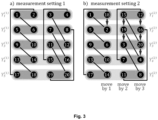
- the superposition unitary V sup corresponds to direct sum of orthogonal transformations which independently affect the rows in which the Majorana modes are arranged in Fig. 3 (see also Eq. (14)).
- Such transformations are consistent with the ordering giving rise to JW encoding and therefore can be implemented by a product of L+1 independent FLO unitaries, each acting on qubits arranged in a given row. Therefore V sup can be implemented in depth O N 1 / 2 and O N 3 / 2 nearest-neighbour two-qubit gates.
- V ( r ) ⁇ FLO( N ) (corresponding to R ⁇ ( r ) ⁇ ⁇ O (2 N )) is constructed in order to simultaneously measure all quadratic terms in H and a subset of the quartic terms such that every quartic term is measured in at least one of the 4 rounds.
- An example of 4 rounds satisfying this property is presented in Fig. 4 .
- a key feature of the chosen unitary, which has the form V r V resh r V sup V pair from Eq. (15), is that it can be decomposed into a product of unitaries which act only within a row or column of the 2D layout of qubits, similarly as formulated in Eq. formulated in (15) for the strategies aiming at estimating all Majorana pairs and quadruples.
- V pair V sup and V resh r
- the second and third even columns are permuted cyclically by 1 and 2 respectively (see Fig. 4 ).
- the odd modes are divided into L clusters O 1 , ... , O L and the even modes into L clusters E 1 , ... , E L each containing L modes. Within those clusters they are put into balanced superposition.
- the first four strategies are taken from a summary in [Zhao2021] of the following methods: classical shadows with Pauli measurements (CS Pauli [Huang2020]); locally biased classical shadows (LBCS [Hadfield2022]); basis-rotation grouping (BRG [Huggins2021]); and classical shadows with fermionic Gaussian unitaries (CS (FGU) [Zhao2021]). Where applicable, the Jordan-Wigner encoding was used. The last column summarises our results.
- Appendix B Number of measurement settings ensuring all quadruples are measured in 2D setting
- ⁇ Q denotes the transformed version of , in which every box of is moved according to action of permutation ⁇ .
Landscapes
- Engineering & Computer Science (AREA)
- General Physics & Mathematics (AREA)
- Theoretical Computer Science (AREA)
- Physics & Mathematics (AREA)
- Mathematical Analysis (AREA)
- Data Mining & Analysis (AREA)
- Evolutionary Computation (AREA)
- Condensed Matter Physics & Semiconductors (AREA)
- Computational Mathematics (AREA)
- Mathematical Optimization (AREA)
- Pure & Applied Mathematics (AREA)
- Computing Systems (AREA)
- General Engineering & Computer Science (AREA)
- Mathematical Physics (AREA)
- Software Systems (AREA)
- Artificial Intelligence (AREA)
- Management, Administration, Business Operations System, And Electronic Commerce (AREA)
Priority Applications (1)
| Application Number | Priority Date | Filing Date | Title |
|---|---|---|---|
| EP23461683.7A EP4564237A1 (de) | 2023-11-30 | 2023-11-30 | Verfahren, system und computerprogramm zur verbesserung der schätzung von fermionoperatoren auf einem quantencomputer auf basis von simultaner messung verrauschter majoranaobservablen |
Applications Claiming Priority (1)
| Application Number | Priority Date | Filing Date | Title |
|---|---|---|---|
| EP23461683.7A EP4564237A1 (de) | 2023-11-30 | 2023-11-30 | Verfahren, system und computerprogramm zur verbesserung der schätzung von fermionoperatoren auf einem quantencomputer auf basis von simultaner messung verrauschter majoranaobservablen |
Publications (1)
| Publication Number | Publication Date |
|---|---|
| EP4564237A1 true EP4564237A1 (de) | 2025-06-04 |
Family
ID=89190554
Family Applications (1)
| Application Number | Title | Priority Date | Filing Date |
|---|---|---|---|
| EP23461683.7A Pending EP4564237A1 (de) | 2023-11-30 | 2023-11-30 | Verfahren, system und computerprogramm zur verbesserung der schätzung von fermionoperatoren auf einem quantencomputer auf basis von simultaner messung verrauschter majoranaobservablen |
Country Status (1)
| Country | Link |
|---|---|
| EP (1) | EP4564237A1 (de) |
Citations (6)
| Publication number | Priority date | Publication date | Assignee | Title |
|---|---|---|---|---|
| US20180053112A1 (en) | 2016-08-17 | 2018-02-22 | International Business Machines Corporation | Efficient reduction of resources for the simulation of fermionic hamiltonians on quantum hardware |
| US10922617B2 (en) | 2013-11-05 | 2021-02-16 | President And Fellows Of Harvard College | Embedding electronic structure in controllable quantum systems |
| US20220188682A1 (en) | 2020-12-16 | 2022-06-16 | International Business Machines Corporation | Readout-error mitigation for quantum expectation |
| US11676056B2 (en) | 2018-09-11 | 2023-06-13 | International Business Machines Corporation | Calculating excited state properties of a molecular system using a hybrid classical-quantum computing system |
| AU2023203460A1 (en) | 2019-02-15 | 2023-06-29 | Google Llc | Increasing representation accuracy of quantum simulations without additional quantum resources |
| US20230289637A1 (en) | 2019-12-16 | 2023-09-14 | International Business Machines Corporation | Estimation of an expected energy value of a hamiltonian |
-
2023
- 2023-11-30 EP EP23461683.7A patent/EP4564237A1/de active Pending
Patent Citations (6)
| Publication number | Priority date | Publication date | Assignee | Title |
|---|---|---|---|---|
| US10922617B2 (en) | 2013-11-05 | 2021-02-16 | President And Fellows Of Harvard College | Embedding electronic structure in controllable quantum systems |
| US20180053112A1 (en) | 2016-08-17 | 2018-02-22 | International Business Machines Corporation | Efficient reduction of resources for the simulation of fermionic hamiltonians on quantum hardware |
| US11676056B2 (en) | 2018-09-11 | 2023-06-13 | International Business Machines Corporation | Calculating excited state properties of a molecular system using a hybrid classical-quantum computing system |
| AU2023203460A1 (en) | 2019-02-15 | 2023-06-29 | Google Llc | Increasing representation accuracy of quantum simulations without additional quantum resources |
| US20230289637A1 (en) | 2019-12-16 | 2023-09-14 | International Business Machines Corporation | Estimation of an expected energy value of a hamiltonian |
| US20220188682A1 (en) | 2020-12-16 | 2022-06-16 | International Business Machines Corporation | Readout-error mitigation for quantum expectation |
Non-Patent Citations (30)
| Title |
|---|
| A. F. IZMAYLOVT. C. YENR. A. LANGV. VERTELETSKYI, J.CHEM. THEORY COMPUT, vol. 16, 2020, pages 190 |
| A. ZHAOA. TRANTERW. M. KIRBYS. F. UNGA. MIYAKEP. J.LOVE, PHYS. REV. A, vol. 101, 2020 |
| BAUER, BELA ET AL.: "Quantum algorithms for quantum chemistry and quantum materials science", CHEMICAL REVIEWS, vol. 120, no. 22, 2020, pages 12685 - 12717 |
| BHARTI, KISHOR ET AL.: "Noisy intermediate-scale quantum algorithms", REVIEWS OF MODERN PHYSICS, vol. 94, no. 1, 2022 |
| BUSCH, PAUL: "Unsharp reality and joint measurements for spin observables", PHYSICAL REVIEW D, vol. 33, no. 8, 1986, pages 2253 |
| C. CADEL. MINEHA. MONTANAROS. STANISIC, PHYS. REV. B, vol. 102, 2020, pages 235122 |
| D. MCNULTYF. B. MACIEJEWSKIM. OSZMANIEC, PHYS. REV. LETT., vol. 130, 2023, pages 100801 |
| DANIEL MCNULTY ET AL: "Estimating Quantum Hamiltonians via Joint Measurements of Noisy Non-Commuting Observables", ARXIV.ORG, CORNELL UNIVERSITY LIBRARY, 201 OLIN LIBRARY CORNELL UNIVERSITY ITHACA, NY 14853, 12 March 2023 (2023-03-12), XP091462921, DOI: 10.1103/PHYSREVLETT.130.100801 * |
| DANIEL MCNULTY: "Optimal Fermionic Joint Measurements for Estimating Non-Commuting Majorana Observables", ARXIV.ORG, 29 February 2024 (2024-02-29), Ithaca, pages 1 - 30, XP093158425, Retrieved from the Internet <URL:https://arxiv.org/pdf/2402.19349> [retrieved on 20240503], DOI: 10.48550/arxiv.2402.19349 * |
| G. GARCIA-PEREZM. A. ROSSIB. SOKOLOVF. TACCHINOP. K. BARKOUTSOSG. MAZZOLAI. TAVERNELLIS. MANISCALCO, PRX QUANTUM 2, 2021 |
| GOKHALE, PRANAV ET AL.: "Minimizing state preparations in variational quantum eigensolver by partitioning into commuting families", ARXIVPREPRINT ARXIV:1907.13623, 2019 |
| HADFIELD, CHARLES ET AL.: "Measurements of quantum Hamiltonians with locally-biased classical shadows", COMMUNICATIONS IN MATHEMATICAL PHYSICS, vol. 391, no. 3, 2022, pages 951 - 967, XP037811690, DOI: 10.1007/s00220-022-04343-8 |
| HEINOSAARI, TEIKODANIEL REITZNERPETER STANO: "Notes on joint measurability of quantum observables", FOUNDATIONS OF PHYSICS, vol. 38, 2008, pages 1133 - 1147, XP019642214, DOI: 10.1007/s10701-008-9256-7 |
| HU, HONG-YESOONWON CHOIYI-ZHUANG YOU: "Classical shadow tomography with locally scrambled quantum dynamics", PHYSICAL REVIEW RESEARCH, vol. 5, no. 2, 2023 |
| HUANG, HSIN-YUANRICHARD KUENGJOHN PRESKILL: "Predicting many properties of a quantum system from very few measurements", NATURE PHYSICS, vol. 16, no. 10, 2020, pages 1050 - 1057, XP037261004, DOI: 10.1038/s41567-020-0932-7 |
| J. R. MCCLEANJ. ROMEROR. BABBUSHA. ASPURU-GUZIK, NEW J. PHYS, vol. 18, 2016 |
| JENA, ANDREWSCOTT GENINMICHELE MOSCA: "Pauli partitioning with respect to gate sets", ARXIVPREPRINT ARXIV:1907.07859, 2019 |
| JOANNA MAJSAK: "A Simple and Efficient Joint Measurement Strategy for Estimating Fermionic Observables and Hamiltonians", ARXIV.ORG, 29 February 2024 (2024-02-29), Ithaca, pages 1 - 16, XP093158422, Retrieved from the Internet <URL:https://arxiv.org/pdf/2402.19230> [retrieved on 20240503], DOI: 10.48550/arxiv.2402.19230 * |
| K. WANW. J. HUGGINSJ. LEER. BABBUSH, COMMUNICATIONS IN MATHEMATICAL PHYSICS, vol. 404, 2023, pages 629 |
| LOW, GUANG HAO: "Classical shadows of fermionswith particle number symmetry", ARXIV PREPRINT ARXIV:2208.08964, 2022 |
| M. OSZMANIECN. DANGNIAMM. E. MORALESZ. ZIMBORAS, PRX QUANTUM, vol. 3, 2022 |
| MCNULTY, DANIELFILIP B. MACIEJEWSKIMICHAT OSZMANIEC: "Estimating Quantum Hamiltonians via Joint Measurements of Noisy Noncommuting Observables", PHYSICAL REVIEW LETTERS, vol. 130, no. 10, 2023, pages 100801 |
| O. CRAWFORDB. V. STRAATEND. WANGT. PARKSE. CAMPBELLS. BRIERLEY, QUANTUM, vol. 5, 2021, pages 385 |
| PRESKILL, JOHN: "Quantum computing in the NISQ era and beyond", QUANTUM 2, 2018, pages 79, XP055742853, DOI: 10.22331/q-2018-08-06-79 |
| VERTELETSKYI, T. C. YENA. F. IZMAYLOV, J. CHEM. PHYS, vol. 152, 2020, pages 124114 |
| W. J. HUGGINSJ. R. MCCLEANN. C. RUBINZ. JIANGN. WIEBEK. B. WHALEYR. BABBUSH, NPJ QUANTUM INF, vol. 7, 2021, pages 1 |
| YEN, TZU-CHINGVLADYSLAV VERTELETSKYIARTUR F. IZMAYLOV: "Measuring all compatible operators in one series of single-qubit measurements using unitary transformations", JOURNAL OF CHEMICAL THEORY AND COMPUTATION, vol. 16, no. 4, 2020, pages 2400 - 2409, XP055812757, DOI: 10.1021/acs.jctc.0c00008 |
| Z. JIANGK. J. SUNGK. KECHEDZHIV. N. SMELYANSKIYS. BOIXO, PHYS. REV. APPL., vol. 9, 2018 |
| ZHAO, ANDREW ET AL.: "Measurement reduction in variational quantum algorithms", PHYSICAL REVIEW A, vol. 101, no. 6, 2020 |
| ZHAO, ANDREWNICHOLAS C. RUBINAKIMASA MIYAKE: "Fermionic partial tomography via classical shadows", PHYSICAL REVIEW LETTERS, vol. 127, no. 11, 2021, pages 110504 |
Similar Documents
| Publication | Publication Date | Title |
|---|---|---|
| Gokhale et al. | $ O (N^ 3) $ Measurement Cost for Variational Quantum Eigensolver on Molecular Hamiltonians | |
| Schatzki et al. | Theoretical guarantees for permutation-equivariant quantum neural networks | |
| Sidhu et al. | Tight bounds on the simultaneous estimation of incompatible parameters | |
| EP3966753B1 (de) | Wechselnetzwerke für quantenberechnung | |
| US10423887B2 (en) | Compilation, memory management, and fault localization with ancillas in an unknown state | |
| Huang et al. | Certifying almost all quantum states with few single-qubit measurements | |
| Subaşı et al. | Entanglement spectroscopy with a depth-two quantum circuit | |
| Camino et al. | Quantum computing and materials science: A practical guide to applying quantum annealing to the configurational analysis of materials | |
| US20210287761A1 (en) | Symmetry-based quantum computational chemistry | |
| CN114528996A (zh) | 一种目标体系试验态初始参数的确定方法、装置及介质 | |
| Gokhale et al. | Optimization of simultaneous measurement for variational quantum eigensolver applications | |
| Kirshanova et al. | Quantum algorithms for the approximate k-list problem and their application to lattice sieving | |
| Safi et al. | Influence of hw-sw-co-design on quantum computing scalability | |
| Halder et al. | Dual exponential coupled cluster theory: Unitary adaptation, implementation in the variational quantum eigensolver framework and pilot applications | |
| Brakerski et al. | (Pseudo) random quantum states with binary phase | |
| Pelofske et al. | Quantum annealing algorithms for Boolean tensor networks | |
| Li Manni et al. | Resolution of Electronic States in Heisenberg Cluster Models within the Unitary Group Approach | |
| García-Martín et al. | Architectures and random properties of symplectic quantum circuits | |
| Georges et al. | Quantum simulations of chemistry in first quantization with any basis set | |
| Majsak et al. | A simple and efficient joint measurement strategy for estimating fermionic observables and Hamiltonians | |
| Heyraud et al. | Unified framework for matchgate classical shadows | |
| D'Arcangelo | Numerical simulation of random Dirac operators | |
| Leimkuhler et al. | A quantum eigenvalue solver based on tensor networks | |
| Chen et al. | Error-mitigated quantum simulation of interacting fermions with trapped ions | |
| EP4564237A1 (de) | Verfahren, system und computerprogramm zur verbesserung der schätzung von fermionoperatoren auf einem quantencomputer auf basis von simultaner messung verrauschter majoranaobservablen |
Legal Events
| Date | Code | Title | Description |
|---|---|---|---|
| PUAI | Public reference made under article 153(3) epc to a published international application that has entered the european phase |
Free format text: ORIGINAL CODE: 0009012 |
|
| STAA | Information on the status of an ep patent application or granted ep patent |
Free format text: STATUS: THE APPLICATION HAS BEEN PUBLISHED |
|
| AK | Designated contracting states |
Kind code of ref document: A1 Designated state(s): AL AT BE BG CH CY CZ DE DK EE ES FI FR GB GR HR HU IE IS IT LI LT LU LV MC ME MK MT NL NO PL PT RO RS SE SI SK SM TR |
|
| STAA | Information on the status of an ep patent application or granted ep patent |
Free format text: STATUS: REQUEST FOR EXAMINATION WAS MADE |
|
| 17P | Request for examination filed |
Effective date: 20251128 |