EP4563570A1 - Alkyl halide, alkylating agent using same, and method for producing derivative of nucleoside - Google Patents
Alkyl halide, alkylating agent using same, and method for producing derivative of nucleoside Download PDFInfo
- Publication number
- EP4563570A1 EP4563570A1 EP23846496.0A EP23846496A EP4563570A1 EP 4563570 A1 EP4563570 A1 EP 4563570A1 EP 23846496 A EP23846496 A EP 23846496A EP 4563570 A1 EP4563570 A1 EP 4563570A1
- Authority
- EP
- European Patent Office
- Prior art keywords
- group
- alkyl halide
- general formula
- formula
- alkyl
- Prior art date
- Legal status (The legal status is an assumption and is not a legal conclusion. Google has not performed a legal analysis and makes no representation as to the accuracy of the status listed.)
- Withdrawn
Links
Classifications
-
- C—CHEMISTRY; METALLURGY
- C07—ORGANIC CHEMISTRY
- C07C—ACYCLIC OR CARBOCYCLIC COMPOUNDS
- C07C255/00—Carboxylic acid nitriles
- C07C255/01—Carboxylic acid nitriles having cyano groups bound to acyclic carbon atoms
- C07C255/11—Carboxylic acid nitriles having cyano groups bound to acyclic carbon atoms containing cyano groups and singly-bound oxygen atoms bound to the same saturated acyclic carbon skeleton
- C07C255/14—Carboxylic acid nitriles having cyano groups bound to acyclic carbon atoms containing cyano groups and singly-bound oxygen atoms bound to the same saturated acyclic carbon skeleton containing cyano groups and esterified hydroxy groups bound to the carbon skeleton
-
- C—CHEMISTRY; METALLURGY
- C07—ORGANIC CHEMISTRY
- C07C—ACYCLIC OR CARBOCYCLIC COMPOUNDS
- C07C255/00—Carboxylic acid nitriles
- C07C255/01—Carboxylic acid nitriles having cyano groups bound to acyclic carbon atoms
- C07C255/11—Carboxylic acid nitriles having cyano groups bound to acyclic carbon atoms containing cyano groups and singly-bound oxygen atoms bound to the same saturated acyclic carbon skeleton
- C07C255/13—Carboxylic acid nitriles having cyano groups bound to acyclic carbon atoms containing cyano groups and singly-bound oxygen atoms bound to the same saturated acyclic carbon skeleton containing cyano groups and etherified hydroxy groups bound to the carbon skeleton
-
- C—CHEMISTRY; METALLURGY
- C07—ORGANIC CHEMISTRY
- C07H—SUGARS; DERIVATIVES THEREOF; NUCLEOSIDES; NUCLEOTIDES; NUCLEIC ACIDS
- C07H1/00—Processes for the preparation of sugar derivatives
-
- C—CHEMISTRY; METALLURGY
- C07—ORGANIC CHEMISTRY
- C07H—SUGARS; DERIVATIVES THEREOF; NUCLEOSIDES; NUCLEOTIDES; NUCLEIC ACIDS
- C07H19/00—Compounds containing a hetero ring sharing one ring hetero atom with a saccharide radical; Nucleosides; Mononucleotides; Anhydro-derivatives thereof
- C07H19/02—Compounds containing a hetero ring sharing one ring hetero atom with a saccharide radical; Nucleosides; Mononucleotides; Anhydro-derivatives thereof sharing nitrogen
- C07H19/04—Heterocyclic radicals containing only nitrogen atoms as ring hetero atom
- C07H19/06—Pyrimidine radicals
- C07H19/067—Pyrimidine radicals with ribosyl as the saccharide radical
-
- Y—GENERAL TAGGING OF NEW TECHNOLOGICAL DEVELOPMENTS; GENERAL TAGGING OF CROSS-SECTIONAL TECHNOLOGIES SPANNING OVER SEVERAL SECTIONS OF THE IPC; TECHNICAL SUBJECTS COVERED BY FORMER USPC CROSS-REFERENCE ART COLLECTIONS [XRACs] AND DIGESTS
- Y02—TECHNOLOGIES OR APPLICATIONS FOR MITIGATION OR ADAPTATION AGAINST CLIMATE CHANGE
- Y02P—CLIMATE CHANGE MITIGATION TECHNOLOGIES IN THE PRODUCTION OR PROCESSING OF GOODS
- Y02P20/00—Technologies relating to chemical industry
- Y02P20/50—Improvements relating to the production of bulk chemicals
- Y02P20/55—Design of synthesis routes, e.g. reducing the use of auxiliary or protecting groups
Definitions
- the present invention relates to a novel alkyl halide, an alkylating agent using the same, and a production method of a nucleoside derivative.
- Non-Patent Literature 1 Examples of methods of synthesizing oligonucleic acids include the phosphate triester method, the H-phosphonate method, and the phosphoramidite method, with the phosphoramidite method being most widely used (Non-Patent Literature 1).
- phosphoramidite As a raw material for synthesizing nucleic acid by the phosphoramidite method, phosphoramidite (hereinafter referred to as amidite) of nucleoside is used.
- amidite phosphoramidite
- TBDMS tert-butyldimethylsilyl
- TOM triisopropylsilyloxymethyl
- ACE bis(2-acetoxyethoxy)methyl
- CEM cyanoethoxymethyl
- Patent Literatures 1 to 3 describe amidite (hereinafter referred to as amidite compound) that enables the synthesis of RNA with high purity by using the following group as a protective group for the hydroxyl group at the 2'-position of the amidite.
- n is an integer of 1 to 5
- R 1 and R 2 are the same or different and each is a methyl group, an ethyl group, or a hydrogen atom
- EWG is a cyano group or a SO 2 R 3 group
- R 3 is a phenyl group, an alkyl group having 1 to 10 carbon atoms, or a benzyl group, which may be substituted with a halogen atom(s), a methyl group(s), a nitro group(s), a methoxy group(s), or a trifluoromethyl group(s))].
- Patent Literature 1 The amidite compound described in Patent Literature 1 is synthesized by a complicated synthetic method including alkylating a compound of the formula (VI) shown below using an alkylating agent of the formula (V) shown below, followed by three steps.
- Non-Patent Literature 2 describes as a method of producing CEM amidite, a method of synthesizing in a short step by alkylating a compound of the formula (VIII) shown below using an alkylating agent of the formula (VII) shown below. It is desirable that an amidite compound can also be synthesized in a short step, similarly to the CEM amidite.
- the alkylating agent of the formula (V) is not applicable to the alkylation of the compound of the formula (VIII) having a 4,4'-dimethoxytrityl (hereinafter referred to as DMTr) group which is easily decomposed in the presence of an acid.
- an object of the present invention is to provide an alkylating agent capable of alkylating the hydroxyl group at the 2'-position of a synthetic intermediate of an amidite compound in the presence of a base, in order to synthesize the amidite compound in a short step.
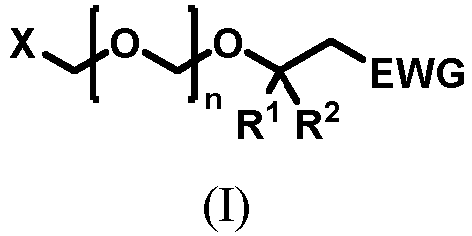
- a nucleoside derivative of the general formula (II) shown below can be alkylated in the presence of a base using an alkyl halide of the general formula (I) shown below as an alkylating agent to obtain a nucleoside derivative of the general formula (III) shown below.
- X is a halogen atom
- n is an integer of 1 to 5
- R 1 and R 2 are the same or different and each is a methyl group, an ethyl group, or a hydrogen atom
- EWG is a cyano group or a SO 2 R 3 group (R 3 is a phenyl group, an alkyl group having 1 to 10 carbon atoms, or a benzyl group, which may be substituted with a halogen atom(s), a methyl group(s), a nitro group(s), a methoxy group(s), or a trifluoromethyl group(s))]
- G is a protective group for a hydroxyl group
- B is a nucleobase which may be protected and/or substituted
- n is an integer of 1 to 5
- R 1 and R 2 are the same or different and each is a methyl group, an ethyl group, or a hydrogen atom
- EWG is a cyan
- the alkyl halide of the present invention is characterized by the following general formula (I): [in the formula, X is a halogen atom, n is an integer of 1 to 5, R 1 and R 2 are the same or different and each is a methyl group, an ethyl group, or a hydrogen atom, and EWG is a cyano group or a SO 2 R 3 group (R 3 is a phenyl group, an alkyl group having 1 to 10 carbon atoms, or a benzyl group, which may be substituted with a halogen atom(s), a methyl group(s), a nitro group(s), a methoxy group(s), or a trifluoromethyl group(s))]
- the alkyl halide of the above general formula (I) may be not only a single stereoisomer but also a mixture of stereoisomers such as a racemate (for example, a mixture of enantiomers).
- Stereoisomers refer to compounds that have the same chemical structure but different arrangements in three-dimensional space. Examples include conformational isomers, rotational isomers, tautomers, enantiomers, and diastereomers.
- halogen atoms include fluorine, chlorine, bromine, and iodine.
- the alkyl group may be either linear or branched, and is preferably an alkyl group having 1 to 10 carbon atoms, more preferably an alkyl group having 1 to 6 carbon atoms.
- Examples of the alkyl group include, but are not limited to, a methyl group, an ethyl group, an n-propyl group, an isopropyl group, an n-butyl group, an isobutyl group, a tert-butyl group, an n-pentyl group, an isopentyl group, and a hexyl group.
- X is preferably chlorine, bromine, or iodine, more preferably chlorine, and may be an alkyl chloride of the following general formula (I'):
- n is an integer of 1 to 5;
- R 1 and R 2 are the same or different and each is a methyl group, an ethyl group, or a hydrogen atom, and
- EWG is a cyano group or a SO 2 R 3 group (R 3 is a phenyl group, an alkyl group having 1 to 10 carbon atoms, or a benzyl group, which may be substituted with a halogen atom(s), a methyl group(s), a nitro group(s), a methoxy group(s), or a trifluoromethyl group(s))].
- n is preferably an integer from 1 to 4, more preferably 1.
- R 1 and R 2 are preferably each independently a methyl group or a hydrogen atom.
- the alkyl chloride of the above general formula (I') can be produced, for example, but not limited to, by reacting a compound of the general formula (IV) shown below with sulfuryl chloride in a solvent according to the following scheme 1.
- n is an integer of 1 to 5; R 1 and R 2 are the same or different and each is a methyl group, an ethyl group, or a hydrogen atom, and EWG is a cyano group or a SO 2 R 3 group (R 3 is a phenyl group, an alkyl group having 1 to 10 carbon atoms, or a benzyl group, which may be substituted with a halogen atom(s), a methyl group(s), a nitro group(s), a methoxy group(s), or a trifluoromethyl group(s))].
- the molar equivalent of sulfuryl chloride is preferably 0.5 to 10 molar equivalents, more preferably 0.5 to 2 molar equivalents, relative to the compound of the above general formula (IV).
- Examples of the solvent used in the production of the alkyl chloride of the above general formula (I') includes, but is not limited to, chloroform, dichloromethane, and dichloroethane.
- the amount of solvent used in the production of alkyl chloride of the above general formula (I') is preferably 1 to 100 times by weight relative to the compound of the above general formula (IV).
- the reaction time for production of the alkyl chlorides of the above general formula (I') can be appropriately set, but typically may be 1 hour or more, for example, from 1 to 2 hours.
- the reaction temperature for production of the alkyl chlorides of the above general formula (I') can be appropriately set and may range from 10°C to 100°C. Usually, room temperature (about 10°C to about 35°C) is preferred.
- Alkyl halide of the above general formula (I) can be used as an alkylating agent.
- alkyl chloride of the above general formula (I') may be alkyl chloride of the following formula (I'-1) or the following formula (I'-2):
- the present invention provides a method of producing a nucleoside derivative of the general formula (III) shown below, the method including an alkylation step in which an alkyl halide of the above general formula (I) is reacted with a nucleoside derivative of the general formula (II) shown below in the presence of a base.
- the steps of the production method are shown below.
- G is a protective group for a hydroxyl group
- B is a nucleobase which may be protected and/or substituted
- n is an integer of 1 to 5
- R 1 and R 2 are the same or different and each is a methyl group, an ethyl group, or a hydrogen atom
- EWG is a cyano group or a SO 2 R 3 group (R 3 is a phenyl group, an alkyl group having 1 to 10 carbon atoms, or a benzyl group, which may be substituted with a halogen atom(s), a methyl group(s), a nitro group(s), a methoxy group(s), or a trifluoromethyl group(s))]
- nucleoside derivative of the above general formula (III) is obtained by an alkylation step (Scheme 2 shown below) in which alkyl halide of the above general formula (I) is reacted with a nucleoside derivative of the above general formula (II) in the presence of a base.
- G is a protective group for a hydroxyl group
- B is a nucleobase which may be protected and/or substituted
- X is a halogen atom
- n is an integer of 1 to 5
- R 1 and R 2 are the same or different and each is a methyl group, an ethyl group, or a hydrogen atom
- EWG is a cyano group or a SO 2 R 3 group (R 3 is a phenyl group, an alkyl group having 1 to 10 carbon atoms, or a benzyl group, which may be substituted with a halogen atom(s), a methyl group(s), a nitro group(s), a methoxy group(s), or a trifluoromethyl group(s))]
- nucleoside derivatives of the above general formulas (II) and (III) may be not only a single stereoisomer but also a mixture of stereoisomers such as a racemate (for example, a mixture of enantiomers).
- the nucleoside derivative of the above general formula (II) may be a commercially available product, or may be synthesized by a known method or a method similar thereto.
- G is a protective group, for example, a functional group that converts a hydroxyl group to an inactive one, and may be a known protective group for a hydroxyl group.
- the protective group for a hydroxyl group for example, the description in the literature ( Protective Groups in Organic Synthesis 4th edition, Greene et al., 2007, John Wiley & Sons, Inc .) can be incorporated herein.
- G examples include, but not limited to, a tert-butyldimethylsilyl group, a bis(2-acetoxyethyloxy)methyl group, a triisopropylsilyloxymethyl group, a 1-(2-cyanoethoxy)ethyl group, a 2-cyanoethoxymethyl group, a 2-cyanoethyl group, a trisulfonylethoxymethyl group, a trityl group, a 4-methoxytrityl group, or a DMTr group.
- G is preferably a trityl group, a 4-methoxytrityl group, or a DMTr group.
- B is a nucleobase which may be protected and/or substituted.
- the nucleobase include, but are not limited to, adenine, cytosine, guanine, uracil, thymine, 5-methylcytosine, pseudouracil, and 1-methylpseudouracil.
- examples of the substituent on the nucleobase include, but are not limited to, a halogen atom, an acyl group, an alkyl group, an arylalkyl group, an alkoxy group, an alkoxyalkyl group, a cyanoalkyl group, a hydroxy group, a hydroxymethyl group, an acyloxymethyl group, an amino group, a monoalkylamino group, a dialkylamino group, a carboxy group, a cyano group, and a nitro group, as well as combinations of two or more of these substituents.
- the protective group for the amino group can be a known protective group used in the field of nucleic acid chemistry, and examples thereof include, but are not limited to, a methyl group, a benzoyl group, a 4-methoxybenzoyl group, an acetyl group, a propionyl group, a butyryl group, an isobutyryl group, a phenylacetyl group, a phenoxyacetyl group, a 4-tert-butylphenoxyacetyl group, a 4-isopropylphenoxyacetyl group, a dimethylaminomethylene group, and combinations of two or more of these protective groups.
- Examples of the base used in the alkylation step include, but are not limited to, a tertiary amine, a pyridine derivative, an aniline derivative, or an inorganic base.
- tertiary amine examples include, but are not limited to, triethylamine, tri-n-butylamine, diisopropylethylamine, dicyclohexylmethylamine, 1,2,2,6,6-pentamethylpiperidine, and 1,2,2,6,6-pentamethyl-4-piperidyl methacrylate.
- Examples of the pyridine derivative include, but are not limited to, 2,6-lutidine, 2,6-di-tert-butylpyridine, 2,6-dimethoxypyridine, 2,6-dichloropyridine, and 2,6-dibromopyridine.
- aniline derivative examples include, but are not limited to, 2,6-dimethylaniline, 2,6-diisopropylaniline, N,N-dimethylaniline, N,N-diethylaniline, and N,N,2-trimethylaniline.
- the molar equivalent of the base used in the alkylation step is preferably 1 to 10 molar equivalents, more preferably 2 to 4 molar equivalents, relative to the nucleoside derivative of the above general formula (II).
- An additive may be used in the alkylation step, and examples of the additive include, but are not limited to, a tin compound, a boron compound, and an antimony compound.
- tin compound examples include, but are not limited to, n-butyltin trichloride, dimethyltin dichloride, di-n-butyltin dichloride, di-tert-butyltin dichloride, diphenyltin dichloride, tri-n-butyltin chloride, and di-n-butyltin oxide.
- Examples of the boron compound include, but are not limited to, phenylboronic acid, 4-trifluoromethylphenylboronic acid, 4-chlorophenylboronic acid, 4-methoxyphenylboronic acid, 2-trifluoromethylphenylboronic acid, 2-chlorophenylboronic acid, 2-biphenylboronic acid, 2,6-dichlorophenylboronic acid, 2-furylboronic acid, 3-pyridylboronic acid, 4-pyridylboronic acid, diphenylborinic acid, 2-aminoethyl diphenylborinate, dimesitylborinic acid, and triphenylborane.
- antimony compound examples include, but are not limited to, triphenylantimony dichloride, triphenylantimony oxide, and tetraphenylantimony bromide.
- the molar equivalent of the additive used in the alkylation step is preferably 0.1 to 10 molar equivalents, more preferably 0.1 to 2 molar equivalents, relative to the nucleoside derivative of the above general formula (II).
- Solvents may be used in the alkylation step.
- the solvent include, but are not limited to, toluene, xylene, dichloromethane, chloroform, dichloroethane, methyl tert-butyl ether, cyclopentyl methyl ether, diethyl ether, dimethoxyethane, tetrahydrofuran, 1,4-dioxane, methyl ethyl ketone, methyl isobutyl ketone, acetone, methyl acetate, ethyl acetate, dimethylformamide, dimethylacetamide, N-methyl pyrrolidone, 1,3-dimethyl-2-imidazolidinone, N,N'-dimethylpropyleneurea, acetonitrile, propionitrile, dimethyl sulfoxide, and sulfolane.
- the amount of solvent used in the alkylation step is preferably 1 to 100 times by weight relative to the nucleoside derivative of the above general formula (II).
- the reaction time for the alkylation step can be appropriately set, but may be typically 2 hours or more, for example, 2 to 24 hours.
- the reaction temperature for the alkylation step can be appropriately set, and may range from 10°C to 100°C, for example. Usually, room temperature (about 10°C to about 35°C) is preferred.
- EMM thiomethyl (10.0 g, 62.0 mmol) was dissolved in dichloromethane (100 mL), and then sulfuryl chloride (10.5 g, 78.0 mmol) was added. The reaction solution was stirred at room temperature for 1 hour, and the solvent was then distilled off under reduced pressure. The resulting residue was purified by distillation under reduced pressure (1 mmHg, 94°C) to obtain EMM chloride (7.01 g, yield 76%) of the following formula (I'-1) as a yellow liquid.
- the hydroxyl group at the 2'-position of a synthetic intermediate of an amidite compound can be alkylated in the presence of a base.
Landscapes
- Chemical & Material Sciences (AREA)
- Organic Chemistry (AREA)
- Health & Medical Sciences (AREA)
- Life Sciences & Earth Sciences (AREA)
- Engineering & Computer Science (AREA)
- Biochemistry (AREA)
- Biotechnology (AREA)
- General Health & Medical Sciences (AREA)
- Genetics & Genomics (AREA)
- Molecular Biology (AREA)
- Saccharide Compounds (AREA)
Abstract

Description
- The present invention relates to a novel alkyl halide, an alkylating agent using the same, and a production method of a nucleoside derivative.
- Examples of methods of synthesizing oligonucleic acids include the phosphate triester method, the H-phosphonate method, and the phosphoramidite method, with the phosphoramidite method being most widely used (Non-Patent Literature 1).
- As a raw material for synthesizing nucleic acid by the phosphoramidite method, phosphoramidite (hereinafter referred to as amidite) of nucleoside is used. For example, TBDMS (tert-butyldimethylsilyl), TOM (triisopropylsilyloxymethyl), ACE (bis(2-acetoxyethoxy)methyl), and CEM (cyanoethoxymethyl) (Non-Patent Literature 2) are known as protective groups for the hydroxyl group at the 2' position of amidite. However, these methods of RNA synthesis using amidites having such protective groups are not satisfactory in terms of yield and purity of the resulting RNA.
- On the other hand, Patent Literatures 1 to 3 describe amidite (hereinafter referred to as amidite compound) that enables the synthesis of RNA with high purity by using the following group as a protective group for the hydroxyl group at the 2'-position of the amidite.

- The amidite compound described in Patent Literature 1 is synthesized by a complicated synthetic method including alkylating a compound of the formula (VI) shown below using an alkylating agent of the formula (V) shown below, followed by three steps.

- On the other hand, Non-Patent Literature 2 describes as a method of producing CEM amidite, a method of synthesizing in a short step by alkylating a compound of the formula (VIII) shown below using an alkylating agent of the formula (VII) shown below. It is desirable that an amidite compound can also be synthesized in a short step, similarly to the CEM amidite.

-
- Patent Literature 1:
WO 2013/027843 - Patent Literature 2:
WO 2019/208571 - Patent Literature 3:
WO 2021/079617 -
- Non-Patent Literature 1: Nielsen et al., Nucleic Acids Research, 1986, Vol. 14, pp. 7391 - 7403.
- Non-Patent Literature 2: Ohgi et al., Orgnic Letters, 2005, Vol. 16, pp.3477 - 3480.
- However, the presence of an acid is essential for the alkylation of the hydroxyl group at the 2' position of the synthetic intermediate of the amidite compound of the formula (VI) using the alkylating agent of the formula (V). Therefore, the alkylating agent of the formula (V) is not applicable to the alkylation of the compound of the formula (VIII) having a 4,4'-dimethoxytrityl (hereinafter referred to as DMTr) group which is easily decomposed in the presence of an acid.
- Therefore, an object of the present invention is to provide an alkylating agent capable of alkylating the hydroxyl group at the 2'-position of a synthetic intermediate of an amidite compound in the presence of a base, in order to synthesize the amidite compound in a short step.
- As a result of intensive study to solve the above problems, the present inventors have attained the following inventions (1) through (7).
- (1) Alkyl halide of the following general formula (I):

- (2) The alkyl halide according to (1), wherein X is chlorine.
- (3) The alkyl halide according to (1) or (2), wherein EWG is a cyano group.
- (4) The alkyl halide according to any one of (1) to (3), wherein n is 1.
- (5) The alkyl halide according to any one of (1) to (4), wherein the alkyl halide is an alkylating agent.
- (6) A production method of a nucleoside derivative of the general formula (III) shown below, the production method including an alkylation step in which alkyl halide of the general formula (I) shown below is reacted with a nucleoside derivative of the general formula (II) shown below in the presence of a base.


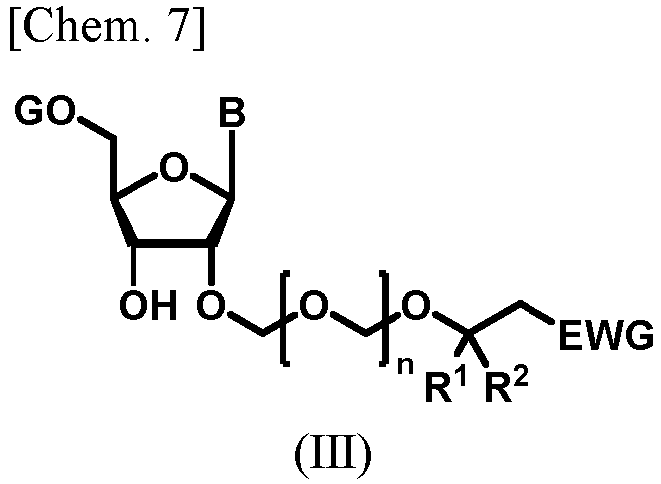
- (7) The production method according to (6), wherein G is a trityl group, a 4-methoxytrityl group, or a DMTr group.
- According to the present invention, a nucleoside derivative of the general formula (II) shown below can be alkylated in the presence of a base using an alkyl halide of the general formula (I) shown below as an alkylating agent to obtain a nucleoside derivative of the general formula (III) shown below.


- The present invention will be described in detail below.
- The alkyl halide of the present invention is characterized by the following general formula (I):


- The alkyl halide of the above general formula (I) may be not only a single stereoisomer but also a mixture of stereoisomers such as a racemate (for example, a mixture of enantiomers).
- Stereoisomers refer to compounds that have the same chemical structure but different arrangements in three-dimensional space. Examples include conformational isomers, rotational isomers, tautomers, enantiomers, and diastereomers.
- Examples of halogen atoms include fluorine, chlorine, bromine, and iodine.
- The alkyl group may be either linear or branched, and is preferably an alkyl group having 1 to 10 carbon atoms, more preferably an alkyl group having 1 to 6 carbon atoms. Examples of the alkyl group include, but are not limited to, a methyl group, an ethyl group, an n-propyl group, an isopropyl group, an n-butyl group, an isobutyl group, a tert-butyl group, an n-pentyl group, an isopentyl group, and a hexyl group.
- In the above general formula (I), X is preferably chlorine, bromine, or iodine, more preferably chlorine, and may be an alkyl chloride of the following general formula (I'):

- In the above general formula (I), n is preferably an integer from 1 to 4, more preferably 1.
- In the above general formula (I), R1 and R2 are preferably each independently a methyl group or a hydrogen atom.
- In the above general formula (I), as a preferred aspect of the combination of X, n, R1, R2, and EWG, a combination in which X is chlorine, n is 1, R1 and R2 are both hydrogen atoms, and EWG is a cyano group, or a combination in which X is chlorine, n is 1, R1 is a methyl group, R2 is a hydrogen atom, and EWG is a cyano group is suitable.
- As an example of the production method of the alkyl halide of the general formula (I), a production method of the alkyl chloride of the general formula (I') is shown below.
- The alkyl chloride of the above general formula (I') can be produced, for example, but not limited to, by reacting a compound of the general formula (IV) shown below with sulfuryl chloride in a solvent according to the following scheme 1.

- The molar equivalent of sulfuryl chloride is preferably 0.5 to 10 molar equivalents, more preferably 0.5 to 2 molar equivalents, relative to the compound of the above general formula (IV).
- Examples of the solvent used in the production of the alkyl chloride of the above general formula (I') includes, but is not limited to, chloroform, dichloromethane, and dichloroethane.
- The amount of solvent used in the production of alkyl chloride of the above general formula (I') is preferably 1 to 100 times by weight relative to the compound of the above general formula (IV).
- The reaction time for production of the alkyl chlorides of the above general formula (I') can be appropriately set, but typically may be 1 hour or more, for example, from 1 to 2 hours.
- The reaction temperature for production of the alkyl chlorides of the above general formula (I') can be appropriately set and may range from 10°C to 100°C. Usually, room temperature (about 10°C to about 35°C) is preferred.
- Alkyl halide of the above general formula (I) can be used as an alkylating agent.
- In a preferred embodiment, the alkyl chloride of the above general formula (I') may be alkyl chloride of the following formula (I'-1) or the following formula (I'-2):


- Further, the present invention provides a method of producing a nucleoside derivative of the general formula (III) shown below, the method including an alkylation step in which an alkyl halide of the above general formula (I) is reacted with a nucleoside derivative of the general formula (II) shown below in the presence of a base. The steps of the production method are shown below.


- Further, a nucleoside derivative of the above general formula (III) is obtained by an alkylation step (Scheme 2 shown below) in which alkyl halide of the above general formula (I) is reacted with a nucleoside derivative of the above general formula (II) in the presence of a base.


- The nucleoside derivatives of the above general formulas (II) and (III) may be not only a single stereoisomer but also a mixture of stereoisomers such as a racemate (for example, a mixture of enantiomers).
- The nucleoside derivative of the above general formula (II) may be a commercially available product, or may be synthesized by a known method or a method similar thereto.
- In the above general formulas (II) and (III), G is a protective group, for example, a functional group that converts a hydroxyl group to an inactive one, and may be a known protective group for a hydroxyl group. Regarding the protective group for a hydroxyl group, for example, the description in the literature (Protective Groups in Organic Synthesis 4th edition, Greene et al., 2007, John Wiley & Sons, Inc.) can be incorporated herein. Examples of G include, but not limited to, a tert-butyldimethylsilyl group, a bis(2-acetoxyethyloxy)methyl group, a triisopropylsilyloxymethyl group, a 1-(2-cyanoethoxy)ethyl group, a 2-cyanoethoxymethyl group, a 2-cyanoethyl group, a trisulfonylethoxymethyl group, a trityl group, a 4-methoxytrityl group, or a DMTr group. G is preferably a trityl group, a 4-methoxytrityl group, or a DMTr group.
- In the above general formulas (II) and (III), B is a nucleobase which may be protected and/or substituted. Examples of the nucleobase include, but are not limited to, adenine, cytosine, guanine, uracil, thymine, 5-methylcytosine, pseudouracil, and 1-methylpseudouracil. Furthermore, examples of the substituent on the nucleobase include, but are not limited to, a halogen atom, an acyl group, an alkyl group, an arylalkyl group, an alkoxy group, an alkoxyalkyl group, a cyanoalkyl group, a hydroxy group, a hydroxymethyl group, an acyloxymethyl group, an amino group, a monoalkylamino group, a dialkylamino group, a carboxy group, a cyano group, and a nitro group, as well as combinations of two or more of these substituents.
- When a nucleobase has an exocyclic amino group, the protective group for the amino group can be a known protective group used in the field of nucleic acid chemistry, and examples thereof include, but are not limited to, a methyl group, a benzoyl group, a 4-methoxybenzoyl group, an acetyl group, a propionyl group, a butyryl group, an isobutyryl group, a phenylacetyl group, a phenoxyacetyl group, a 4-tert-butylphenoxyacetyl group, a 4-isopropylphenoxyacetyl group, a dimethylaminomethylene group, and combinations of two or more of these protective groups.
- Examples of the base used in the alkylation step include, but are not limited to, a tertiary amine, a pyridine derivative, an aniline derivative, or an inorganic base.
- Examples of the tertiary amine include, but are not limited to, triethylamine, tri-n-butylamine, diisopropylethylamine, dicyclohexylmethylamine, 1,2,2,6,6-pentamethylpiperidine, and 1,2,2,6,6-pentamethyl-4-piperidyl methacrylate.
- Examples of the pyridine derivative include, but are not limited to, 2,6-lutidine, 2,6-di-tert-butylpyridine, 2,6-dimethoxypyridine, 2,6-dichloropyridine, and 2,6-dibromopyridine.
- Examples of the aniline derivative include, but are not limited to, 2,6-dimethylaniline, 2,6-diisopropylaniline, N,N-dimethylaniline, N,N-diethylaniline, and N,N,2-trimethylaniline.
- The molar equivalent of the base used in the alkylation step is preferably 1 to 10 molar equivalents, more preferably 2 to 4 molar equivalents, relative to the nucleoside derivative of the above general formula (II).
- An additive may be used in the alkylation step, and examples of the additive include, but are not limited to, a tin compound, a boron compound, and an antimony compound.
- Examples of the tin compound include, but are not limited to, n-butyltin trichloride, dimethyltin dichloride, di-n-butyltin dichloride, di-tert-butyltin dichloride, diphenyltin dichloride, tri-n-butyltin chloride, and di-n-butyltin oxide.
- Examples of the boron compound include, but are not limited to, phenylboronic acid, 4-trifluoromethylphenylboronic acid, 4-chlorophenylboronic acid, 4-methoxyphenylboronic acid, 2-trifluoromethylphenylboronic acid, 2-chlorophenylboronic acid, 2-biphenylboronic acid, 2,6-dichlorophenylboronic acid, 2-furylboronic acid, 3-pyridylboronic acid, 4-pyridylboronic acid, diphenylborinic acid, 2-aminoethyl diphenylborinate, dimesitylborinic acid, and triphenylborane.
- Examples of the antimony compound include, but are not limited to, triphenylantimony dichloride, triphenylantimony oxide, and tetraphenylantimony bromide.
- The molar equivalent of the additive used in the alkylation step is preferably 0.1 to 10 molar equivalents, more preferably 0.1 to 2 molar equivalents, relative to the nucleoside derivative of the above general formula (II).
- Solvents may be used in the alkylation step. Examples of the solvent include, but are not limited to, toluene, xylene, dichloromethane, chloroform, dichloroethane, methyl tert-butyl ether, cyclopentyl methyl ether, diethyl ether, dimethoxyethane, tetrahydrofuran, 1,4-dioxane, methyl ethyl ketone, methyl isobutyl ketone, acetone, methyl acetate, ethyl acetate, dimethylformamide, dimethylacetamide, N-methyl pyrrolidone, 1,3-dimethyl-2-imidazolidinone, N,N'-dimethylpropyleneurea, acetonitrile, propionitrile, dimethyl sulfoxide, and sulfolane.
- The amount of solvent used in the alkylation step is preferably 1 to 100 times by weight relative to the nucleoside derivative of the above general formula (II).
- The reaction time for the alkylation step can be appropriately set, but may be typically 2 hours or more, for example, 2 to 24 hours.
- The reaction temperature for the alkylation step can be appropriately set, and may range from 10°C to 100°C, for example. Usually, room temperature (about 10°C to about 35°C) is preferred.
- Hereinafter, the present invention will be more specifically described with reference to Examples. However, the technical scope of the present invention is not limited to these examples.
- Synthesis of 2-cyanoethoxymethoxymethyl (hereinafter referred to as "EMM") chloride (Scheme 3 below): Scheme 3

- EMM thiomethyl (10.0 g, 62.0 mmol) was dissolved in dichloromethane (100 mL), and then sulfuryl chloride (10.5 g, 78.0 mmol) was added. The reaction solution was stirred at room temperature for 1 hour, and the solvent was then distilled off under reduced pressure. The resulting residue was purified by distillation under reduced pressure (1 mmHg, 94°C) to obtain EMM chloride (7.01 g, yield 76%) of the following formula (I'-1) as a yellow liquid.

- 1H-NMR(400MHz, CDCl3): δ 5.54 (s, 2H), 4.92 (s, 2H), 3.82 (t, J = 6.2 Hz, 2H), 2.66 (t, J = 6.2 Hz, 2H).
- Synthesis of 1-cyanopropane-2-yl-oxymethoxymethyl (hereinafter referred to as "PMM") chloride (Scheme 4 below): Scheme 4

- PMM thiomethyl (336 mg, 1.92 mmol) was dissolved in dichloromethane (1.70 mL), and then sulfuryl chloride (311 mg, 2.30 mmol) was added. The reaction solution was stirred at room temperature for 1 hour, and the solvent was then distilled off under reduced pressure. The resulting residue was purified by distillation under reduced pressure (4 mmHg, 110°C) to obtain PMM chloride (189 mg, yield 60%) of the following formula (I'-2) as a yellow liquid.

- 1H-NMR (400 MHz, CDCl3): δ 5.60 (d, J = 5.9 Hz, 1H), 5.54 (d, J = 5.9 Hz, 1H), 4.97 (d, J = 7.3 Hz, 1H), 4.90 (d, J = 7.3 Hz, 1H), 4.07 - 4.00 (m, 1H), 2.61 (dd, J = 16.7, 5.3 Hz, 1H), 2.55 (dd, J = 16.7, 6.2 Hz, 2H), 1.35 (d, J = 5.9 Hz, 3H).
- Scheme 5

- DMTr-uridine (50.0 mg, 0.0915 mmol) was dissolved in tetrahydrofuran (0.500 mL), and then diisopropylethylamine (47.3 mg, 0.366 mmol) and di-n-butyltin dichloride (30.6 mg, 0.101 mmol) were added. The reaction solution was stirred at room temperature for 30 minutes before EMM chloride (16.4 mg, 0.110 mmol) was added. The reaction solution was further stirred at room temperature for 4 hours, and then purified by column chromatography (developing solvent: chloroform/methanol = 100/0 to 90/10) using amino silica gel as a filler to obtain DMTr-EMM-uridine (39.1 mg, yield 65%).
- By using the alkyl halide of the present invention as an alkylating agent, the hydroxyl group at the 2'-position of a synthetic intermediate of an amidite compound can be alkylated in the presence of a base.
Claims (7)
- Alkyl halide of the following general formula (I):

- The alkyl halide according to claim 1, wherein X is chlorine.
- The alkyl halide according to claim 1 or 2, wherein EWG is a cyano group.
- The alkyl halide according to any one of claims 1 to 3, wherein n is 1.
- The alkyl halide according to any one of claims 1 to 4, wherein the alkyl halide is an alkylating agent.
- A production method of a nucleoside derivative of the general formula (III) shown below,
the production method comprising an alkylation step in which alkyl halide of the general formula (I) shown below is reacted with a nucleoside derivative of the general formula (II) shown below in the presence of a base.


- The production method according to claim 6, wherein G is a trityl group, a 4-methoxytrityl group, or a 4,4'-dimethoxytrityl group.
Applications Claiming Priority (2)
| Application Number | Priority Date | Filing Date | Title |
|---|---|---|---|
| JP2022117801 | 2022-07-25 | ||
| PCT/JP2023/027116 WO2024024766A1 (en) | 2022-07-25 | 2023-07-25 | Alkyl halide, alkylating agent using same, and method for producing derivative of nucleotide |
Publications (1)
| Publication Number | Publication Date |
|---|---|
| EP4563570A1 true EP4563570A1 (en) | 2025-06-04 |
Family
ID=89706427
Family Applications (1)
| Application Number | Title | Priority Date | Filing Date |
|---|---|---|---|
| EP23846496.0A Withdrawn EP4563570A1 (en) | 2022-07-25 | 2023-07-25 | Alkyl halide, alkylating agent using same, and method for producing derivative of nucleoside |
Country Status (6)
| Country | Link |
|---|---|
| US (1) | US20250388532A1 (en) |
| EP (1) | EP4563570A1 (en) |
| JP (1) | JPWO2024024766A1 (en) |
| KR (1) | KR20250044189A (en) |
| CN (1) | CN119630639A (en) |
| WO (1) | WO2024024766A1 (en) |
Family Cites Families (3)
| Publication number | Priority date | Publication date | Assignee | Title |
|---|---|---|---|---|
| US9481702B2 (en) | 2011-08-25 | 2016-11-01 | Bonac Corporation | Glycoside compound, method for producing thioether, ether, method for producing ether, method for producing glycoside compound, method for producing nucleic acid |
| US11401296B2 (en) | 2018-04-24 | 2022-08-02 | Sumitomo Chemical Company, Limited | Amidite compound and method for producing polynucleotide using said compound |
| DK4049996T3 (en) | 2019-10-23 | 2026-02-09 | Sumitomo Chemical Co | GLYCOSIDE COMPOUND, AMIDITE COMPOUND AND METHOD FOR PREPARING POLYNUCLEOTIDE USING SAID COMPOUNDS |
-
2023
- 2023-07-25 EP EP23846496.0A patent/EP4563570A1/en not_active Withdrawn
- 2023-07-25 JP JP2023545926A patent/JPWO2024024766A1/ja active Pending
- 2023-07-25 CN CN202380056726.4A patent/CN119630639A/en active Pending
- 2023-07-25 WO PCT/JP2023/027116 patent/WO2024024766A1/en not_active Ceased
- 2023-07-25 KR KR1020247041407A patent/KR20250044189A/en active Pending
- 2023-07-25 US US18/880,565 patent/US20250388532A1/en not_active Abandoned
Also Published As
| Publication number | Publication date |
|---|---|
| CN119630639A (en) | 2025-03-14 |
| US20250388532A1 (en) | 2025-12-25 |
| WO2024024766A1 (en) | 2024-02-01 |
| JPWO2024024766A1 (en) | 2024-02-01 |
| KR20250044189A (en) | 2025-03-31 |
Similar Documents
| Publication | Publication Date | Title |
|---|---|---|
| US20130018181A1 (en) | Novel and Highly Stereoselective Process for Preparing Gemcitabine and Intermediates Thereof | |
| US20250388532A1 (en) | Alkyl halide, alkylating agent using same, and method for producing derivative of nucleoside | |
| EP1634882A1 (en) | Inosine derivative and process for producing the same | |
| CA2149286A1 (en) | Process for the preparation of n-alkyl-n-pyridinyl-1h-indole-1-amines | |
| EP0990651B1 (en) | Process for producing 5-trifluoromethyluracil derivatives | |
| US6822090B2 (en) | Process for the preparation of cytidine derivatives | |
| US12173028B2 (en) | Method for producing glycoside compound | |
| US5399682A (en) | Process for preparing 2,3'-O-cyclocytidine | |
| KR100699099B1 (en) | 1-α-halo-2,2-difluoro-2-deoxy-D-ribofuranose derivative and preparation method thereof | |
| JPWO2010079813A1 (en) | Method for producing inosine derivative | |
| JP2009256335A (en) | Preparation method of ribonucleic acid having alkyl protective group at position 2' | |
| JP3294594B2 (en) | Method for producing vinylpyrimidine | |
| US20030236397A1 (en) | Process for preparing beta-L-2'deoxy-thymidine | |
| US6875860B2 (en) | Method for purifying 5′ -protected thymidines and novel derivatives thereof | |
| WO2021079617A1 (en) | Glycoside compound, amidite compound, and production method for polynucleotide using said compounds | |
| JP4181233B2 (en) | Method for producing pyrrolidine-2,4-dione derivative | |
| WO2025027567A1 (en) | Process for preparing mavacamten and process intermediate | |
| JPH072846A (en) | Tetrahydrofurfuryl alcohol derivative | |
| US20060069248A1 (en) | Process for producing phosphoroamidite | |
| HU198949B (en) | Process for producing 5-substituted-3'azido-2',3'-dideoxyribonucleosides | |
| JPH10259192A (en) | Method for producing phosphorothioate diester compound | |
| JP2001354692A (en) | Method for producing cytidine derivative | |
| JPH07116210B2 (en) | Thymine derivative | |
| JPS62187482A (en) | 2-deoxy-3-0-thiobenzoyl-D-ribofuranose derivative | |
| KR20050036412A (en) | A process for preparing carbazolone derivatives |
Legal Events
| Date | Code | Title | Description |
|---|---|---|---|
| STAA | Information on the status of an ep patent application or granted ep patent |
Free format text: STATUS: THE INTERNATIONAL PUBLICATION HAS BEEN MADE |
|
| PUAI | Public reference made under article 153(3) epc to a published international application that has entered the european phase |
Free format text: ORIGINAL CODE: 0009012 |
|
| STAA | Information on the status of an ep patent application or granted ep patent |
Free format text: STATUS: REQUEST FOR EXAMINATION WAS MADE |
|
| 17P | Request for examination filed |
Effective date: 20241217 |
|
| AK | Designated contracting states |
Kind code of ref document: A1 Designated state(s): AL AT BE BG CH CY CZ DE DK EE ES FI FR GB GR HR HU IE IS IT LI LT LU LV MC ME MK MT NL NO PL PT RO RS SE SI SK SM TR |
|
| DAV | Request for validation of the european patent (deleted) | ||
| DAX | Request for extension of the european patent (deleted) | ||
| STAA | Information on the status of an ep patent application or granted ep patent |
Free format text: STATUS: THE APPLICATION HAS BEEN WITHDRAWN |
|
| 18W | Application withdrawn |
Effective date: 20260309 |