EP4560058A1 - Ultrafine polyphenylene sulfide fiber, nonwoven fabric, and methods for producing same - Google Patents
Ultrafine polyphenylene sulfide fiber, nonwoven fabric, and methods for producing same Download PDFInfo
- Publication number
- EP4560058A1 EP4560058A1 EP23842759.5A EP23842759A EP4560058A1 EP 4560058 A1 EP4560058 A1 EP 4560058A1 EP 23842759 A EP23842759 A EP 23842759A EP 4560058 A1 EP4560058 A1 EP 4560058A1
- Authority
- EP
- European Patent Office
- Prior art keywords
- fiber
- polyphenylene sulfide
- nonwoven fabric
- less
- ultrafine
- Prior art date
- Legal status (The legal status is an assumption and is not a legal conclusion. Google has not performed a legal analysis and makes no representation as to the accuracy of the status listed.)
- Pending
Links
Images

Classifications
-
- D—TEXTILES; PAPER
- D04—BRAIDING; LACE-MAKING; KNITTING; TRIMMINGS; NON-WOVEN FABRICS
- D04H—MAKING TEXTILE FABRICS, e.g. FROM FIBRES OR FILAMENTARY MATERIAL; FABRICS MADE BY SUCH PROCESSES OR APPARATUS, e.g. FELTS, NON-WOVEN FABRICS; COTTON-WOOL; WADDING ; NON-WOVEN FABRICS FROM STAPLE FIBRES, FILAMENTS OR YARNS, BONDED WITH AT LEAST ONE WEB-LIKE MATERIAL DURING THEIR CONSOLIDATION
- D04H1/00—Non-woven fabrics formed wholly or mainly of staple fibres or like relatively short fibres
- D04H1/70—Non-woven fabrics formed wholly or mainly of staple fibres or like relatively short fibres characterised by the method of forming fleeces or layers, e.g. reorientation of fibres
- D04H1/72—Non-woven fabrics formed wholly or mainly of staple fibres or like relatively short fibres characterised by the method of forming fleeces or layers, e.g. reorientation of fibres the fibres being randomly arranged
- D04H1/732—Non-woven fabrics formed wholly or mainly of staple fibres or like relatively short fibres characterised by the method of forming fleeces or layers, e.g. reorientation of fibres the fibres being randomly arranged by fluid current, e.g. air-lay
-
- D—TEXTILES; PAPER
- D01—NATURAL OR MAN-MADE THREADS OR FIBRES; SPINNING
- D01F—CHEMICAL FEATURES IN THE MANUFACTURE OF ARTIFICIAL FILAMENTS, THREADS, FIBRES, BRISTLES OR RIBBONS; APPARATUS SPECIALLY ADAPTED FOR THE MANUFACTURE OF CARBON FILAMENTS
- D01F6/00—Monocomponent artificial filaments or the like of synthetic polymers; Manufacture thereof
- D01F6/58—Monocomponent artificial filaments or the like of synthetic polymers; Manufacture thereof from homopolycondensation products
- D01F6/76—Monocomponent artificial filaments or the like of synthetic polymers; Manufacture thereof from homopolycondensation products from other polycondensation products
-
- D—TEXTILES; PAPER
- D01—NATURAL OR MAN-MADE THREADS OR FIBRES; SPINNING
- D01F—CHEMICAL FEATURES IN THE MANUFACTURE OF ARTIFICIAL FILAMENTS, THREADS, FIBRES, BRISTLES OR RIBBONS; APPARATUS SPECIALLY ADAPTED FOR THE MANUFACTURE OF CARBON FILAMENTS
- D01F6/00—Monocomponent artificial filaments or the like of synthetic polymers; Manufacture thereof
- D01F6/58—Monocomponent artificial filaments or the like of synthetic polymers; Manufacture thereof from homopolycondensation products
- D01F6/76—Monocomponent artificial filaments or the like of synthetic polymers; Manufacture thereof from homopolycondensation products from other polycondensation products
- D01F6/765—Monocomponent artificial filaments or the like of synthetic polymers; Manufacture thereof from homopolycondensation products from other polycondensation products from polyarylene sulfides
-
- D—TEXTILES; PAPER
- D01—NATURAL OR MAN-MADE THREADS OR FIBRES; SPINNING
- D01F—CHEMICAL FEATURES IN THE MANUFACTURE OF ARTIFICIAL FILAMENTS, THREADS, FIBRES, BRISTLES OR RIBBONS; APPARATUS SPECIALLY ADAPTED FOR THE MANUFACTURE OF CARBON FILAMENTS
- D01F8/00—Conjugated, i.e. bi- or multicomponent, artificial filaments or the like; Manufacture thereof
- D01F8/04—Conjugated, i.e. bi- or multicomponent, artificial filaments or the like; Manufacture thereof from synthetic polymers
- D01F8/14—Conjugated, i.e. bi- or multicomponent, artificial filaments or the like; Manufacture thereof from synthetic polymers with at least one polyester as constituent
-
- D—TEXTILES; PAPER
- D01—NATURAL OR MAN-MADE THREADS OR FIBRES; SPINNING
- D01F—CHEMICAL FEATURES IN THE MANUFACTURE OF ARTIFICIAL FILAMENTS, THREADS, FIBRES, BRISTLES OR RIBBONS; APPARATUS SPECIALLY ADAPTED FOR THE MANUFACTURE OF CARBON FILAMENTS
- D01F8/00—Conjugated, i.e. bi- or multicomponent, artificial filaments or the like; Manufacture thereof
- D01F8/04—Conjugated, i.e. bi- or multicomponent, artificial filaments or the like; Manufacture thereof from synthetic polymers
- D01F8/16—Conjugated, i.e. bi- or multicomponent, artificial filaments or the like; Manufacture thereof from synthetic polymers with at least one other macromolecular compound obtained otherwise than by reactions only involving carbon-to-carbon unsaturated bonds as constituent
-
- D—TEXTILES; PAPER
- D04—BRAIDING; LACE-MAKING; KNITTING; TRIMMINGS; NON-WOVEN FABRICS
- D04H—MAKING TEXTILE FABRICS, e.g. FROM FIBRES OR FILAMENTARY MATERIAL; FABRICS MADE BY SUCH PROCESSES OR APPARATUS, e.g. FELTS, NON-WOVEN FABRICS; COTTON-WOOL; WADDING ; NON-WOVEN FABRICS FROM STAPLE FIBRES, FILAMENTS OR YARNS, BONDED WITH AT LEAST ONE WEB-LIKE MATERIAL DURING THEIR CONSOLIDATION
- D04H1/00—Non-woven fabrics formed wholly or mainly of staple fibres or like relatively short fibres
- D04H1/40—Non-woven fabrics formed wholly or mainly of staple fibres or like relatively short fibres from fleeces or layers composed of fibres without existing or potential cohesive properties
- D04H1/42—Non-woven fabrics formed wholly or mainly of staple fibres or like relatively short fibres from fleeces or layers composed of fibres without existing or potential cohesive properties characterised by the use of certain kinds of fibres insofar as this use has no preponderant influence on the consolidation of the fleece
- D04H1/4326—Condensation or reaction polymers
-
- D—TEXTILES; PAPER
- D04—BRAIDING; LACE-MAKING; KNITTING; TRIMMINGS; NON-WOVEN FABRICS
- D04H—MAKING TEXTILE FABRICS, e.g. FROM FIBRES OR FILAMENTARY MATERIAL; FABRICS MADE BY SUCH PROCESSES OR APPARATUS, e.g. FELTS, NON-WOVEN FABRICS; COTTON-WOOL; WADDING ; NON-WOVEN FABRICS FROM STAPLE FIBRES, FILAMENTS OR YARNS, BONDED WITH AT LEAST ONE WEB-LIKE MATERIAL DURING THEIR CONSOLIDATION
- D04H1/00—Non-woven fabrics formed wholly or mainly of staple fibres or like relatively short fibres
- D04H1/40—Non-woven fabrics formed wholly or mainly of staple fibres or like relatively short fibres from fleeces or layers composed of fibres without existing or potential cohesive properties
- D04H1/42—Non-woven fabrics formed wholly or mainly of staple fibres or like relatively short fibres from fleeces or layers composed of fibres without existing or potential cohesive properties characterised by the use of certain kinds of fibres insofar as this use has no preponderant influence on the consolidation of the fleece
- D04H1/4382—Stretched reticular film fibres; Composite fibres; Mixed fibres; Ultrafine fibres; Fibres for artificial leather
- D04H1/43838—Ultrafine fibres, e.g. microfibres
-
- D—TEXTILES; PAPER
- D04—BRAIDING; LACE-MAKING; KNITTING; TRIMMINGS; NON-WOVEN FABRICS
- D04H—MAKING TEXTILE FABRICS, e.g. FROM FIBRES OR FILAMENTARY MATERIAL; FABRICS MADE BY SUCH PROCESSES OR APPARATUS, e.g. FELTS, NON-WOVEN FABRICS; COTTON-WOOL; WADDING ; NON-WOVEN FABRICS FROM STAPLE FIBRES, FILAMENTS OR YARNS, BONDED WITH AT LEAST ONE WEB-LIKE MATERIAL DURING THEIR CONSOLIDATION
- D04H1/00—Non-woven fabrics formed wholly or mainly of staple fibres or like relatively short fibres
- D04H1/40—Non-woven fabrics formed wholly or mainly of staple fibres or like relatively short fibres from fleeces or layers composed of fibres without existing or potential cohesive properties
- D04H1/42—Non-woven fabrics formed wholly or mainly of staple fibres or like relatively short fibres from fleeces or layers composed of fibres without existing or potential cohesive properties characterised by the use of certain kinds of fibres insofar as this use has no preponderant influence on the consolidation of the fleece
- D04H1/4391—Non-woven fabrics formed wholly or mainly of staple fibres or like relatively short fibres from fleeces or layers composed of fibres without existing or potential cohesive properties characterised by the use of certain kinds of fibres insofar as this use has no preponderant influence on the consolidation of the fleece characterised by the shape of the fibres
- D04H1/43912—Non-woven fabrics formed wholly or mainly of staple fibres or like relatively short fibres from fleeces or layers composed of fibres without existing or potential cohesive properties characterised by the use of certain kinds of fibres insofar as this use has no preponderant influence on the consolidation of the fleece characterised by the shape of the fibres fibres with noncircular cross-sections
-
- D—TEXTILES; PAPER
- D04—BRAIDING; LACE-MAKING; KNITTING; TRIMMINGS; NON-WOVEN FABRICS
- D04H—MAKING TEXTILE FABRICS, e.g. FROM FIBRES OR FILAMENTARY MATERIAL; FABRICS MADE BY SUCH PROCESSES OR APPARATUS, e.g. FELTS, NON-WOVEN FABRICS; COTTON-WOOL; WADDING ; NON-WOVEN FABRICS FROM STAPLE FIBRES, FILAMENTS OR YARNS, BONDED WITH AT LEAST ONE WEB-LIKE MATERIAL DURING THEIR CONSOLIDATION
- D04H1/00—Non-woven fabrics formed wholly or mainly of staple fibres or like relatively short fibres
- D04H1/40—Non-woven fabrics formed wholly or mainly of staple fibres or like relatively short fibres from fleeces or layers composed of fibres without existing or potential cohesive properties
- D04H1/44—Non-woven fabrics formed wholly or mainly of staple fibres or like relatively short fibres from fleeces or layers composed of fibres without existing or potential cohesive properties the fleeces or layers being consolidated by mechanical means, e.g. by rolling
-
- D—TEXTILES; PAPER
- D04—BRAIDING; LACE-MAKING; KNITTING; TRIMMINGS; NON-WOVEN FABRICS
- D04H—MAKING TEXTILE FABRICS, e.g. FROM FIBRES OR FILAMENTARY MATERIAL; FABRICS MADE BY SUCH PROCESSES OR APPARATUS, e.g. FELTS, NON-WOVEN FABRICS; COTTON-WOOL; WADDING ; NON-WOVEN FABRICS FROM STAPLE FIBRES, FILAMENTS OR YARNS, BONDED WITH AT LEAST ONE WEB-LIKE MATERIAL DURING THEIR CONSOLIDATION
- D04H1/00—Non-woven fabrics formed wholly or mainly of staple fibres or like relatively short fibres
- D04H1/40—Non-woven fabrics formed wholly or mainly of staple fibres or like relatively short fibres from fleeces or layers composed of fibres without existing or potential cohesive properties
- D04H1/54—Non-woven fabrics formed wholly or mainly of staple fibres or like relatively short fibres from fleeces or layers composed of fibres without existing or potential cohesive properties by welding together the fibres, e.g. by partially melting or dissolving
-
- D—TEXTILES; PAPER
- D04—BRAIDING; LACE-MAKING; KNITTING; TRIMMINGS; NON-WOVEN FABRICS
- D04H—MAKING TEXTILE FABRICS, e.g. FROM FIBRES OR FILAMENTARY MATERIAL; FABRICS MADE BY SUCH PROCESSES OR APPARATUS, e.g. FELTS, NON-WOVEN FABRICS; COTTON-WOOL; WADDING ; NON-WOVEN FABRICS FROM STAPLE FIBRES, FILAMENTS OR YARNS, BONDED WITH AT LEAST ONE WEB-LIKE MATERIAL DURING THEIR CONSOLIDATION
- D04H1/00—Non-woven fabrics formed wholly or mainly of staple fibres or like relatively short fibres
- D04H1/40—Non-woven fabrics formed wholly or mainly of staple fibres or like relatively short fibres from fleeces or layers composed of fibres without existing or potential cohesive properties
- D04H1/54—Non-woven fabrics formed wholly or mainly of staple fibres or like relatively short fibres from fleeces or layers composed of fibres without existing or potential cohesive properties by welding together the fibres, e.g. by partially melting or dissolving
- D04H1/542—Adhesive fibres
- D04H1/551—Resins thereof not provided for in groups D04H1/544 - D04H1/55
-
- D—TEXTILES; PAPER
- D01—NATURAL OR MAN-MADE THREADS OR FIBRES; SPINNING
- D01D—MECHANICAL METHODS OR APPARATUS IN THE MANUFACTURE OF ARTIFICIAL FILAMENTS, THREADS, FIBRES, BRISTLES OR RIBBONS
- D01D5/00—Formation of filaments, threads, or the like
- D01D5/253—Formation of filaments, threads, or the like with a non-circular cross section; Spinnerette packs therefor
-
- D—TEXTILES; PAPER
- D01—NATURAL OR MAN-MADE THREADS OR FIBRES; SPINNING
- D01D—MECHANICAL METHODS OR APPARATUS IN THE MANUFACTURE OF ARTIFICIAL FILAMENTS, THREADS, FIBRES, BRISTLES OR RIBBONS
- D01D5/00—Formation of filaments, threads, or the like
- D01D5/28—Formation of filaments, threads, or the like while mixing different spinning solutions or melts during the spinning operation; Spinnerette packs therefor
- D01D5/30—Conjugate filaments; Spinnerette packs therefor
- D01D5/36—Matrix structure; Spinnerette packs therefor
Definitions
- the present invention relates to an ultrafine polyphenylene sulfide fiber having excellent adhesiveness and dispersibility, a nonwoven fabric including the same, and methods for producing the same.
- Polyphenylene sulfide which has excellent mechanical properties and molding processability as well as high heat resistance, chemical resistance, electrical insulation, and flame retardancy, is widely used as a metal alternative material and a material that can withstand extreme environments.
- Polyphenylene sulfide fibers produced by forming polyphenylene sulfide into fibers are used for applications such as bag filters, paper-making canvases, electrically insulating papers, battery separators, and various diaphragms, taking advantage of these properties.
- characteristics of polyphenylene sulfide such as heat resistance and chemical resistance to a high-concentration alkaline solution, and ion permeability and gas separability of a nonwoven fabric material are combined to develop wet nonwoven fabrics made of polyphenylene sulfide fibers for a diaphragm for a hydrogen production device, a diaphragm for a fuel cell, and a reinforcing material for these diaphragms.
- nonwoven fabrics used for the above applications are required to be reduced in thickness and basis weight for the purpose of reducing the size and weight of an apparatus and improving the performance of the apparatus.
- a thin nonwoven fabric having a low basis weight tends to be broken due to minute tension fluctuation during the production process. Further, such a nonwoven fabric is easily torn due to contact with an edge or a burr of another member in the modularization step. Therefore, for the purpose of improving the strength, various studies have been made for improving the strength and adhesiveness of binder fibers, which are components contributing to adhesion between fibers constituting a nonwoven fabric.
- the binder fiber In the nonwoven fabric made of the polyphenylene sulfide fiber, the binder fiber also needs to be made of polyphenylene sulfide in order not to impair the heat resistance and chemical resistance of polyphenylene sulfide.
- a polyphenylene sulfide fiber having a low thermal shrinkage rate can be obtained by subjecting a polyphenylene sulfide undrawn fiber produced by a melt spinning method to relaxation heat treatment and shrinkage in a production process.
- the polyphenylene sulfide undrawn fiber obtained by the method has a substantially large fiber diameter, it is difficult to obtain a thin nonwoven fabric or a nonwoven fabric having a low basis weight.
- Patent Documents 2 and 4 relate to nonwoven fabrics using ultrafine polyphenylene sulfide fibers having fiber diameters of 2 ⁇ m or less. According to these techniques, it is possible to enhance nonwoven fabric performance, but since the exemplified binder fibers are general polyphenylene sulfide undrawn yarns, it is difficult to obtain a thin nonwoven fabric or a nonwoven fabric having a low basis weight.
- a production method for obtaining an ultrafine polyphenylene sulfide fiber by removing a sea component of a sea-island fiber using a polyphenylene sulfide fiber as an island component is exemplified, but the ultrafine polyphenylene sulfide fiber obtained by the production method has insufficient adhesiveness when used as a binder fiber because crystallization proceeds by heating during sea removal.
- Patent Document 3 by using a polyphenylene sulfide fiber having a modified cross-section and a polyphenylene sulfide fiber having a round cross-sectional shape and having a fiber diameter of 5 ⁇ m or less, it is possible to obtain a nonwoven fabric that hardly experiences paper breakage when the nonwoven fabric is produced by a wet paper-making method.
- the nonwoven fabric obtained by the method has a limited effect of improving strength, and when a thin nonwoven fabric or a nonwoven fabric having a low basis weight as required in recent years is to be obtained, it is difficult to realize enough strength to be put to practical use.
- An object of the present invention has been made in view of the above circumstances and is to provide an ultrafine polyphenylene sulfide fiber having excellent adhesiveness and water dispersibility, a nonwoven fabric including the same, and methods for producing the same.
- the present inventors have conducted studies and resultantly found that it is effective to reduce the fiber diameter of the binder fiber contributing to adhesion between fibers among fibers constituting a nonwoven fabric in order to reduce the thickness and basis weight and improve the strength of the nonwoven fabric including a polyphenylene sulfide fiber.
- a method of drawing an undrawn yarn or a method of eluting and removing the sea component of the sea-island fiber with a high-temperature solution has been used, but crystallization proceeds by molecular orientation and heat, and the resulting binder fiber has had low adhesiveness.
- the present inventors have made further intensive studies, and as a result, have found that even when the fiber diameter is reduced, an ultrafine polyphenylene sulfide fiber having excellent adhesiveness and dispersibility is obtained by setting the crystallinity calculated by differential scanning calorimetry to a specific range, and have completed the present invention.
- an ultrafine polyphenylene sulfide fiber of the present invention has an average fiber diameter of 0.2 ⁇ m or more and 5.0 ⁇ m or less and a crystallinity of 0% or more and 15% or less, as calculated by differential scanning calorimetry.
- the ultrafine polyphenylene sulfide fiber is a modified cross-section fiber and has a modification degree defined by a formula below of 1.2 or more.
- Modification degree minimum circumscribed circle diameter/maximum inscribed circle diameter
- the minimum circumscribed circle diameter is the diameter ( ⁇ m) of the smallest circle enclosing the entire transverse section of the fiber
- the maximum inscribed circle diameter is the diameter ( ⁇ m) of the largest circle contained in the transverse section of the fiber.
- the average fiber length is 0.1 mm or more and 6.0 mm or less.
- a method for producing an ultrafine polyphenylene sulfide fiber of the present invention includes removing a sea component of an undrawn fiber having a sea-island composite cross-section including polyphenylene sulfide as an island component in an alkaline aqueous solution at 70°C or less to provide a fiber having an average fiber diameter of 0.2 ⁇ m or more and 5.0 ⁇ m or less and a crystallinity of 0% or more and 15% or less as calculated by differential scanning calorimetry.
- a method for producing a nonwoven fabric of the present invention includes mixing the ultrafine polyphenylene sulfide fiber and a polyphenylene sulfide drawn fiber in a paper-making dispersion to make a paper, and then performing thermocompression bonding at a temperature of 130°C or more and 250°C or less.
- an ultrafine polyphenylene sulfide fiber having excellent adhesiveness and dispersibility can be obtained.
- Fig. 1 is a conceptual diagram for illustrating an example of a transverse section of an ultrafine polyphenylene sulfide fiber of the present invention and a method for measuring a modification degree.
- An ultrafine polyphenylene sulfide fiber of the present invention has an average fiber diameter of 0.2 ⁇ m or more and 5.0 ⁇ m or less and a crystallinity of 0% or more and 15% or less as calculated by differential scanning calorimetry.
- the constituent elements of the present invention will be described in detail, but the present invention is not limited to the scope described below at all as long as the gist thereof is not exceeded.
- the polyphenylene sulfide according to the present invention is a polymer including, as a main repeating unit, a diphenylene sulfide unit such as a p-phenylene sulfide unit represented by Structural Formula (1) below and a m-phenylene sulfide unit.
- the content of the p-phenylene sulfide unit is preferably 60 mol% or more.
- the content of the p-phenylene sulfide unit is preferably 60 mol% or more, more preferably 70 mol% or more, still more preferably 80 mol% or more.
- a fiber excellent in heat resistance is obtained.
- a nonwoven fabric having excellent strength is obtained.
- the polyphenylene sulfide according to the present invention may contain a copolymerization unit other than the diphenylene sulfide unit as long as the effects of the present invention are not impaired.
- the copolymerization unit other than the diphenylene sulfide unit include aromatic sulfides such as triphenylene sulfide and biphenylene sulfide, and alkyl substitution products and halogen substitution products thereof.
- the polyphenylene sulfide according to the present invention may contain various additives such as inorganic substances including titanium oxide, silica, barium oxide, and calcium carbonate, coloring agents such as carbon black, dyes, and pigments, flame retardants, fluorescent whitening agents, antioxidants, and ultraviolet absorbers as long as the effects of the present invention are not impaired.
- additives such as inorganic substances including titanium oxide, silica, barium oxide, and calcium carbonate, coloring agents such as carbon black, dyes, and pigments, flame retardants, fluorescent whitening agents, antioxidants, and ultraviolet absorbers as long as the effects of the present invention are not impaired.
- the ultrafine polyphenylene sulfide fiber of the present invention may be a single-component fiber or a composite fiber obtained by combining two or more resins.
- the form of the composite is not particularly limited as long as the effects of the present invention are not impaired, and it may be appropriately selected from a core-sheath type, a sea-island type, a side-by-side type, an eccentric core-sheath type, a blended type, and the like.
- the ultrafine polyphenylene sulfide fiber is a composite fiber
- polyphenylene sulfide having a different copolymerization ratio of the m-phenylene sulfide unit is suitably used as the resin to be used together with the polyphenylene sulfide from the viewpoint of process stability and flexibility in the production process.
- the core component may be polyphenylene sulfide composed only of the p-phenylene sulfide unit
- the sheath component may be polyphenylene sulfide obtained by copolymerizing the m-phenylene sulfide unit.
- the sea component may be polyphenylene sulfide composed only of the p-phenylene sulfide unit, and the island component may be polyphenylene sulfide obtained by copolymerizing the m-phenylene sulfide unit.
- the transverse sectional shape of the ultrafine polyphenylene sulfide fiber of the present invention is never limited and can be formed in a round cross-section as well as any modified cross-section such as a multilobar cross-section such as a Y-shaped cross-section and a triangular cross-section, a flat cross-section, an S-shaped cross-section, a cross-shaped cross-section, and a hollow cross-section.
- the ultrafine polyphenylene sulfide fiber of the present invention preferably has a modification degree defined by the following formula of 1.2 or more.
- a modification degree defined by the following formula of 1.2 or more.
- the upper limit of the modification degree is not particularly limited, but an attainable upper limit in the present invention is about 500.
- the modification degree here is measured by a method described below, and will be described in detail with reference to Fig. 1 .
- Fig. 1 shows an example of a transverse section of the ultrafine polyphenylene sulfide fiber of the present invention.
- an image is captured with a scanning electron microscope at a magnification at which one fiber can be observed in a transverse section of the fiber.
- the minimum circumscribed circle and the maximum inscribed circle in the transverse section are drawn using image analysis software, and the modification degree is calculated from the following formula.
- the modification degrees of 20 fibers arbitrarily extracted are measured, and a simple number average is determined and rounded off to one decimal place.
- Modification Degree minimum circumscribed circle diameter/maximum inscribed circle diameter
- the minimum circumscribed circle diameter is the diameter ( ⁇ m) of the smallest circle enclosing the entire transverse section of the fiber
- the maximum inscribed circle diameter is the diameter ( ⁇ m) of the largest circle contained in the transverse section of the fiber.
- the ultrafine polyphenylene sulfide fiber of the present invention has an average fiber diameter of 0.2 ⁇ m or more and 5.0 ⁇ m or less.
- the average fiber diameter is 0.2 ⁇ m or more, preferably 0.4 ⁇ m or more, more preferably 0.5 ⁇ m or more, the fibers are less likely to be entangled with each other, and the dispersibility of the fibers is improved, so that the uniformity of the basis weight is improved when a nonwoven fabric is formed.
- the average fiber diameter 5.0 ⁇ m or less, preferably 3.0 ⁇ m or less, more preferably 2.0 ⁇ m or less, the number of constituent fibers in the same fineness and the same weight increases, so that the number of bonding points when used as a binder increases, and a nonwoven fabric having good strength is obtained.
- the average fiber diameter ( ⁇ m) of the fiber described herein is determined as follows.
- the ultrafine polyphenylene sulfide fiber of the present invention can be used as a long fiber but can also be cut to a certain length to be a short fiber before being processed into a nonwoven fabric or the like.
- the average fiber length is preferably 0.1 mm or more and 6.0 mm or less.
- the average fiber length is preferably 0.1 mm or more, more preferably 0.2 mm or more, still more preferably 0.3 mm or more.
- fibers are less likely to fall off in the step of processing into a nonwoven fabric.
- the average fiber length is preferably 6.0 mm or less, more preferably 4.0 mm or less, still more preferably 2.0 mm or less, the fibers are less likely to be entangled with each other, and the dispersibility of the fiber is improved, so that the quality is improved when a nonwoven fabric is formed.
- the average fiber length of the fiber as used herein is determined on the basis of "8.4.1. Average fiber length (c direct method)" in JIS L 1015:2010 "Test methods for man-made staple fibres”.
- the ultrafine polyphenylene sulfide fiber of the present invention has a crystallinity of 0% or more and 15% or less as calculated by differential scanning calorimetry.
- a fiber excellent in handleability in higher order processes are obtained.
- a polyphenylene sulfide fiber suitable for a binder fiber and having excellent adhesiveness is obtained.
- the crystallinity (%) of the fiber described herein is determined as follows.
- ⁇ Hm 0 is a heat of complete fusion of crystals (J/g), and in the case of polyphenylene sulfide, 140.1 J/g is generally used.
- the nonwoven fabric of the present invention is a nonwoven fabric containing the ultrafine polyphenylene sulfide fiber.
- the ultrafine polyphenylene sulfide fiber By containing the ultrafine polyphenylene sulfide fiber, the number of fibers constituting the nonwoven fabric increases, so that the nonwoven fabric is hardly broken and has excellent strength. In addition, since the constituent fibers themselves become thin, a nonwoven fabric having a small thickness can be obtained.
- the proportion of the ultrafine polyphenylene sulfide fiber in the nonwoven fabric of the present invention is preferably 10 mass% or more and 80 mass% or less.
- the proportion of the ultrafine polyphenylene sulfide fiber is preferably 10 mass% or more, more preferably 20 mass% or more, still more preferably 30 mass% or more.
- the number of fibers constituting the nonwoven fabric increases, so that the number of bonding points between fibers increases, and a nonwoven fabric excellent in mechanical characteristics is obtained.
- the proportion of the ultrafine polyphenylene sulfide fiber By setting the proportion of the ultrafine polyphenylene sulfide fiber to preferably 80 mass% or less, more preferably 75 mass% or less, still more preferably 70 mass% or less, a nonwoven fabric having appropriate air permeability and flexibility is obtained.
- the fibers other than the ultrafine polyphenylene sulfide contained in the nonwoven fabric of the present invention are not particularly limited, and examples thereof include fibers composed of polyphenylene sulfide, polypropylene, polyethylene, poly-4-methylpentene-1, polycarbonates, polyacrylates, polyethylene terephthalate, polybutylene terephthalate, polytrimethylene terephthalate, polyethylene naphthalate, polylactic acid, aromatic polyesters, polyamides, aromatic polyamides, thermoplastic polyurethane, polytetrafluoroethylene, polyvinylidene fluoride, copolymers thereof, and the like.
- a fiber made of polyphenylene sulfide is suitably used from the viewpoint of chemical resistance, heat resistance, and adhesiveness to the ultrafine polyphenylene sulfide fiber.
- the basis weight of the nonwoven fabric of the present invention is preferably 2 g/m 2 or more and 80 g/m 2 or less.
- the basis weight is preferably 2 g/m 2 or more, more preferably 5 g/m 2 or more, a nonwoven fabric having excellent strength is obtained.
- the basis weight is preferably 80 g/m 2 or less, more preferably 50 g/m 2 or less, a nonwoven fabric having excellent flexibility is obtained.
- the basis weight (g/m 2 ) of the nonwoven fabric as used herein refers to a value measured and calculated according to the following procedure in accordance with "6.2 Mass per unit area (ISO method)" in “Test methods for nonwovens” specified in JIS L 1913:2010.
- the nonwoven fabric of the present invention preferably has a thickness of 170 ⁇ m or less.
- a thickness of the nonwoven fabric By setting the thickness of the nonwoven fabric to preferably 170 ⁇ m or less, more preferably 155 ⁇ m or less, a nonwoven fabric having appropriate air permeability and flexibility is obtained.
- the lower limit of the thickness of the nonwoven fabric of the present invention is not particularly limited but is preferably 2 ⁇ m or more, more preferably 5 ⁇ m or more in order to obtain a nonwoven fabric having practical strength.
- the thickness ( ⁇ m) of the nonwoven fabric is a value obtained by collecting 20 sample pieces of 10 cm ⁇ 10 cm on the basis of JIS P 8118:2014 "Paper and board - Determination of thickness, density and specific volume", measuring the thicknesses of 20 test pieces one by one using a thickness meter (such as "Micrometer” manufactured by Mitutoyo Corporation), determining the simple number average, calculating the thickness ( ⁇ m) of the nonwoven fabric, and rounding the thickness off to the nearest integer.
- a thickness meter such as "Micrometer” manufactured by Mitutoyo Corporation
- the strength of the nonwoven fabric of the present invention is preferably 10 N/15 mm or more.
- the strength of the nonwoven fabric is preferably 10 N/15 mm or more, more preferably 15 N/15 mm or more, still more preferably 20 N/15 mm or more, a nonwoven fabric that is suitable for diaphragm applications and filter applications and is hardly broken is obtained.
- the upper limit of the strength of the nonwoven fabric of the present invention is not particularly limited, but the strength that can be achieved by the nonwoven fabric of the present invention is about 100 N/15 mm.
- the strength (N/15 mm) of the nonwoven fabric is a value obtained by measuring the value of the maximum point load of the nonwoven fabric cut out to have a sample width of 15 mm under the conditions of a sample width of 15 mm, an initial length of 20 mm, and a tensile speed of 20 mm/min using a tensile tester Tensilon (such as UTM-III-100 manufactured by ORIENTEC CORPORATION), determining the simple number average of 5 measurements, calculating the strength (N/15 mm) of the nonwoven fabric, and rounding off the calculated value to the nearest integer.
- Tensilon such as UTM-III-100 manufactured by ORIENTEC CORPORATION
- the strength per basis weight of the nonwoven fabric of the present invention is preferably 0.25 (N/15 mm)/(g/m 2 ) or more.
- the strength of the nonwoven fabric is preferably 0.25 (N/15 mm)/(g/m 2 ) or more, more preferably 0.38 (N/15 mm)/(g/m 2 ) or more, still more preferably 0.50 (N/15 mm)/(g/m 2 ) or more.
- the upper limit of the strength of the nonwoven fabric of the present invention is not particularly limited, but the strength that can be achieved by the nonwoven fabric of the present invention is about 2.50 (N/15 mm)/(g/m 2 ).
- the strength per basis weight of the nonwoven fabric ((N/15 mm)/(g/m 2 )) is a value obtained by calculating a value obtained by dividing the strength of the nonwoven fabric obtained above by the basis weight and rounding the value off to two decimal places.
- the ultrafine polyphenylene sulfide fiber of the present invention and the nonwoven fabric made thereof have not only excellent long-term heat resistance but also chemical resistance, mechanical properties, electrical insulation, and flame retardancy, these characteristics are suitably utilized to various applications including diaphragm applications such as a diaphragm for a hydrogen production device, a diaphragm for a fuel cell, a battery separator, a diaphragm for an electrode, and a reinforcing material for these diaphragms, filter applications such as a bag filter, a chemical liquid filter, food filter, a chemical filter, an oil filter, an engine oil filter, and an air cleaning filter, paper applications such as an electrical insulation paper, heat-resistant work clothing applications such as fireproof clothing, safety clothing, experimental work clothing, heat-retaining clothing, flame-retardant clothing, paper-making felt, heat-resistant felt, a release material, a paper-making dryer canvas, a cardiac patch, artificial skin, a printed circuit board base material, a copy rolling cleaner, an
- the method for producing the ultrafine polyphenylene sulfide fiber of the present invention includes removing a sea component of an undrawn fiber having a sea-island composite cross-section including polyphenylene sulfide as an island component in an alkaline aqueous solution at 70°C or less to provide a fiber having an average fiber diameter of 0.2 ⁇ m or more and 5.0 ⁇ m or less and a crystallinity of 0% or more and 15% or less as calculated by differential scanning calorimetry.
- the polyphenylene sulfide to be used is preferably dried before subjected to melt spinning, to increase yarn-making capabilities.
- the drying conditions generally used are vacuum drying at 100 to 200°C for 1 to 24 hours.
- melt spinning a melt-spinning technique using, for example, a pressure melter-type extruder or a single screw or twin screw extruder can be employed.
- the extruded polyphenylene sulfide goes through a pipe, is weighed by weighing equipment such as a gear pump, passes through a filter for removing foreign matter, and then is guided to a spinneret.
- the temperature (spinning temperature) from the polymer pipe to the spinneret is preferably 290°C or more in order to increase the flowability, and is preferably set at 380°C or less in order to suppress pyrolysis of the polymer.
- the ultrafine polyphenylene sulfide fiber of the present invention can be obtained by removing a polymer of a sea component of a sea-island composite fiber having a sea-island composite cross-section in which polyphenylene sulfide is disposed as an island component. Since the transverse sectional shape of the ultrafine polyphenylene sulfide fiber of the present invention is substantially the same as the transverse sectional shape of the island component of the sea-island composite fiber, it is possible to obtain an ultrafine polyphenylene sulfide fiber having a desired transverse sectional shape by making the sectional shape of the island component an arbitrary shape.
- the method for controlling the transverse sectional shape of the island component is not particularly limited, but for example, the methods disclosed in Japanese Patent Laid-open Publication No. 2010-216042 and Japanese Patent Laid-open Publication No. 2016-188454 are preferable.
- an easily soluble polymer As the sea component of the sea-island composite fiber, an easily soluble polymer is suitably used.
- the easily soluble polymer include melt-moldable polymers such as polyethylene terephthalate, polyethylene naphthalate, polybutylene terephthalate, polytrimethylene terephthalate, polypropylene, polyolefins, polycarbonates, polyacrylates, polyamides, polylactic acid, and thermoplastic polyurethane, and copolymers thereof.
- the sea component is preferably a copolymerized polyester, polylactic acid, polyvinyl alcohol, or the like that exhibits easy elutability in an aqueous solvent, hot water, or the like, and is preferably a polyester copolymerized with only sodium 5-sulfoisophthalate or a polyester obtained by copolymerizing polyethylene glycol in combination for further improving the elutability.
- the thermal decomposition of the easy-to-elute polymer proceeds during spinning, the sectional formability and the spinnability of the composite fiber are deteriorated, so that the composite fiber is required to be hardly thermally decomposed, that is, have high heat resistance, at the spinning temperature.
- a polyester copolymerized with only sodium 5-sulfoisophthalate is more preferable.
- the copolymerization amount of sodium 5-sulfoisophthalate is preferably 2 mol% or more and 20 mol% or less from the viewpoint of achieving both solubility in an aqueous solvent and heat resistance.
- the copolymerization amount of sodium 5-sulfoisophthalate is preferably 20 mol% or less, more preferably 15 mol% or less, a polymer having excellent heat resistance is obtained.
- sea-island composite fiber As for the sea-island composite fiber to be used in the present invention, polyphenylene sulfide and the other component polymer are separately melted, each weighed by known weighing equipment such as a gear pump via a polymer pipe, pass through a filter for removing foreign matter, and then are guided to a spinneret. Respective polymers guided to the spinneret are combined and formed into a composite form while the shape thereof is regulated in the spinneret, and then discharged from a spinneret hole as a sea-island composite fiber.
- known weighing equipment such as a gear pump via a polymer pipe
- the spinneret used for discharge has a spinneret hole preferably having a hole diameter D of 0.1 mm or more and 0.6 mm or less.
- a ratio L/D that is defined by a quotient obtained by dividing a land length L (the length of a straight pipe identical with the hole diameter of the spinneret hole) of the spinneret hole by the hole diameter is 1 or more and 10 or less.
- the shape and sectional area of the island component in the sea-island composite fiber may be the same as the area of the fiber transverse section calculated from the fiber shape and the average fiber diameter.
- a round cross-section fiber having an average fiber diameter of 2.0 ⁇ m can be produced by forming polyphenylene sulfide as the island component into a round shape having a diameter of 2.0 ⁇ m. Therefore, in order to obtain an ultrafine polyphenylene sulfide fiber having an average fiber diameter of 0.2 ⁇ m or more and 5.0 ⁇ m or less, the diameter of the island component is set to 0.2 ⁇ m or more and 5.0 ⁇ m or less.
- the number of island components in the sea-island composite fiber is not particularly limited but is preferably 20 or more and 4,000 or less.
- the diameter of the island component can be reduced, so that the average fiber diameter of the ultrafine polyphenylene sulfide fiber can be reduced.
- the number of the island component is preferably 4,000 or less, more preferably 3,000 or less, the fiber cross section formability is improved, so that a fiber having small variations in fiber diameter can be obtained.
- the sea-island composite fiber discharged from the spinneret hole is subjected to a cooling blast (air), and thus cooled and solidified.
- the temperature of the cooling blast can be determined according to the balance with the speed of the cooling blast, from the viewpoint of cooling efficiency. In a preferred aspect, however, the temperature is 30°C or less.
- the fiber has a stable solidification behavior by cooling and has high fiber-diameter uniformity.
- the cooling blast is preferably flown substantially perpendicularly to the fiber axis on the undrawn fiber discharged from the spinneret.
- the speed of the cooling blast is preferably 10 m/min or more from the viewpoint of cooling efficiency and fineness uniformity, and is preferably 100 m/min or less from the viewpoint of yarn-making stability.
- the cooled and solidified undrawn fiber is taken up by a roller (godet roller) rotating at a constant speed.
- the take-up speed is preferably 300 m/min or more in order to improve linear uniformity and productivity, and is preferably 1,500 m/min or less in order not to advance the orientation of molecular chains.
- the undrawn fiber thus obtained is subjected to the next step as an undrawn fiber without being drawn.
- the obtained undrawn fiber may be crimped with a crimper as necessary, and the shape may be fixed with a setter at a temperature of 70°C or less.
- a setter at a temperature of 70°C or less.
- the number of crimps in the crimping is preferably 2 crimps/25 mm or more and 15 crimps/25 mm or less.
- the number of crimps in the crimping is preferably 2 crimps/25 mm or more and 15 crimps/25 mm or less.
- the fiber length of the short fiber is preferably 0.1 mm or more and 6.0 mm or less.
- the average fiber length is preferably 0.1 mm or more, more preferably 0.2 mm or more, still more preferably 0.3 mm or more, fibers are less likely to fall off in the step of processing into a nonwoven fabric.
- the average fiber length preferably 6.0 mm or less, more preferably 4.0 mm or less, still more preferably 2.0 mm or less, the fibers are less likely to be entangled with each other, and the dispersibility of the fiber is improved, so that the uniformity of the basis weight is improved when a nonwoven fabric is formed.
- the cutting of the fiber with the cutter may be performed after obtaining an ultrafine polyphenylene sulfide fiber by a method described later.
- the sea-island composite fiber is immersed in a solvent or the like capable of dissolving the sea component to remove the polymer of the sea component.
- a solvent or the like capable of dissolving the sea component to remove the polymer of the sea component.
- the bath ratio between the sea-island composite fiber and the alkaline aqueous solution is preferably 1/10,000 or more and 1/5 or less, more preferably 1/5,000 or more and 1/10 or less. Within this range, it is possible to inhibit the ultrafine fibers from being unnecessarily entangled with each other when the sea component is dissolved.
- the alkali concentration of the alkaline aqueous solution is preferably 0.1 mass% or more and 5.0 mass% or less, more preferably 0.5 mass% or more and 3 mass% or less. Within this range, the dissolution of the sea component can be completed in a short time.
- the temperature of the alkaline aqueous solution at the time of removing the sea component is 70°C or less.
- the temperature of the alkaline aqueous solution is 70°C or less, preferably 65°C or less, more preferably 60°C or less, crystallization does not proceed during the elution treatment, so that an ultrafine polyphenylene sulfide fiber having a low crystallinity and excellent adhesiveness can be obtained.
- the treatment time with the alkaline aqueous solution is preferably 10 minutes or more and 100 minutes or less.
- the treatment time is preferably 10 minutes or more, more preferably 20 minutes or more.
- the residue of the sea component dissolution is less likely to remain, and an ultrafine polyphenylene sulfide fiber having excellent dispersibility is obtained.
- the treatment time is preferably 100 minutes or less, more preferably 70 minutes or less, crystallization is less likely to occur during the treatment, and an ultrafine polyphenylene sulfide fiber having excellent adhesiveness is obtained.
- a surfactant as a dissolution accelerator for the sea component to the alkaline aqueous solution.
- the surfactant include a cationic surfactant, an anionic surfactant, and a nonionic surfactant, and when a polyester is used for the easily soluble polymer, a cationic surfactant is suitably used.
- the surfactant concentration in the alkaline aqueous solution is preferably 0.05 mass% or more and 2 mass% or less, more preferably 0.1 mass% or more and 1 mass% or less with respect to the weight of the alkaline aqueous solution. Within this range, it is possible to complete the dissolution of the sea component in a short time even at a temperature of 70°C or less.
- a paper-making solution can be prepared by using the short fiber made of the ultrafine polyphenylene sulfide fiber obtained as described above as the binder fiber and dispersing, in water, the binder fiber together with a fiber to be bound.
- a polyphenylene sulfide drawn fiber is usually used as the fiber to be bound.
- the ratio of the binder fiber to the fiber to be bound in the paper-making liquid is preferably 10 mass% or more and 80 mass% or less.
- the ratio of the binder fiber to the fiber to be bound is preferably 10 mass% or more, more preferably 20 mass% or more, still more preferably 30 mass% or more.
- the number of bonding points between fibers increases, and a nonwoven fabric excellent in mechanical characteristics is obtained.
- a nonwoven fabric having appropriate air permeability and flexibility is obtained.
- a supply of the paper-making solution to a paper-making machine enables acquisition of a nonwoven fabric. Adjustment of the fiber concentration in the supplied paper-making solution enables a change in basis weight of the obtained nonwoven fabric.
- the nonwoven fabric obtained as described above is preferably dried for removal of moisture.
- the drying temperature is preferably 70°C or less, not to cause a decrease in weldability due to crystallization of an amorphous portion.
- the nonwoven fabric obtained as described above is subjected to thermocompression bonding with a flatbed heat press machine or a calender roll to cause welding between fibers to be bound due to the ultrafine polyphenylene sulfide fiber according to the present invention and thus becomes a nonwoven fabric having excellent mechanical characteristics.
- the thermocompression bonding temperature is preferably set at 130°C or more and 250°C or less, and the compression bonding time is preferably 10 minutes or less.
- the thermocompression bonding temperature is preferably 130°C or more, more preferably 150°C or more, still more preferably 170°C or more, due to the welding of the ultrafine polyphenylene sulfide fiber according to the present invention, the nonwoven fabric has excellent mechanical characteristics.
- thermocompression bonding temperature at preferably 250°C or less
- formation of creases due to heat shrinkage of the nonwoven fabric during the thermocompression bonding can be reduced.
- compression bonding time to preferably 10 minutes or less, more preferably 5 minutes or less, it is possible to suppress the decrease in flexibility of the nonwoven fabric due to excessive crystallization.
- the nonwoven fabric produced in each of the examples and comparative examples was measured as described above using a tensile tester Tensilon (UTM-III-100 manufactured by ORIENTEC CORPORATION).
- the quality of the obtained nonwoven fabric was evaluated according to the following three ranks.
- Polyphenylene sulfide composed only of p-phenylene sulfide units was vacuum-dried at 150°C for 12 hours, and then melt-spun at a spinning temperature of 330°C.
- the polyphenylene sulfide was melt-extruded with a twin screw extruder, weighed with a gear pump, passed through a filter to remove foreign matter, and then supplied to a spinning pack. Thereafter, the polyphenylene sulfide was discharged from a spinneret having 36 discharge holes under the condition of a single-hole discharge rate of 0.2 g/min.
- the spinneret that was used had a straight hole as an introduction hole positioned directly above the spinneret holes, and had a tapered connection portion between the introduction hole and the spinneret holes.
- the polyphenylene sulfide discharged from the spinneret was made to pass a 50-mm warm region and then air-cooled over 1.0 m, using a uniflow cooling device, under the conditions of a temperature of 25°C and a wind speed of 18 m/min. Thereafter, an oil agent was imparted, and all the 36 filaments were wound up by a winder via a first godet roller and a second godet roller at 1,000 m/min to give an undrawn fiber.
- the obtained undrawn fiber was drawn 3.0 times between rollers heated to 90°C, and then heat-set with a roller heated to 200°C to provide a polyphenylene sulfide drawn fiber.
- the obtained polyphenylene sulfide drawn fiber was cut with a cutter to provide a short fiber having an average fiber length of 6 mm.
- Polyphenylene sulfide composed only of p-phenylene sulfide units was used as the island component, and polyethylene terephthalate in which 5.0 mol% of sodium 5-sulfoisophthalate was copolymerized was used as the sea component.
- the polymers were each vacuum-dried at 150°C for 12 hours and then melt-spun at a spinning temperature of 310°C. In the melt spinning, the island component and the sea component were separately melted, each metered with a gear pump via a polymer pipe, passed through a filter for removing foreign matter, and then each supplied to a spinning pack.
- sea-island composite spinneret (number of islands: 1,000, D: 0.4 mm, L: 0.8 mm) configured to form the island component into a circular shape
- a yarn was melt-discharged with a composite ratio of the sea component to the island component of 40/60, the yarn was cooled and solidified, an oil agent was then applied, and the yarn was wound at a spinning speed of 1,000 m/min to provide an undrawn fiber having a sea-island composite cross section (single hole discharge amount: 2.6 g/min).
- the obtained sea-island composite fiber was cut with a cutter to provide a short fiber having an average fiber length of 0.5 mm. Thereafter, the obtained short fiber was subjected to dissolution treatment for 40 minutes in a 3-mass% aqueous sodium hydroxide solution (bath ratio: 1/100) heated to 50°C to provide a binder fiber made of an ultrafine polyphenylene sulfide fiber.
- aqueous sodium hydroxide solution "DY-1125K (quaternary ammonium salt type cationic surfactant)" manufactured by Lion Specialty Chemicals Co., Ltd. was added as a dissolution accelerator in an amount of 0.5 mass% with respect to the mass of the aqueous sodium hydroxide solution to perform the treatment.
- a paper-making dispersion 50 mass% of the ultrafine polyphenylene sulfide fiber as a binder fiber and 50 mass% of the polyphenylene sulfide drawn fiber obtained in Reference Example 1 as a fiber to be bound were mixed, and the mixture was prepared so that a fiber concentration was 0.4 mass%.
- This paper-making solution was supplied to a simple paper-making machine to give a wet nonwoven fabric having a basis weight of 40 g/m 2 . Further, the wet nonwoven fabric was put into a hot-air drier at 120°C, treated for 3 minutes, then air-cooled, and then subjected to thermocompression bonding using a flatbed heat press machine at 200°C, at a pressing pressure of 1.5 MPa for 3 minutes.
- a polyphenylene sulfide fiber for a binder and a nonwoven fabric were obtained in the same manner as in Example 1 except that the number of islands of the sea-island composite spinneret was changed.
- the evaluation results of the obtained binder fiber and nonwoven fabric are shown in Table 1.
- a polyphenylene sulfide fiber for a binder and a nonwoven fabric were obtained in the same manner as in Example 1 except that the sea-island composite fiber was cut into a short fiber having an average fiber length of 2.5 mm when cut with a cutter.
- the evaluation results of the obtained binder fiber and nonwoven fabric are shown in Table 1.
- a nonwoven fabric was obtained in the same manner as in Example 1 except that the undrawn fiber obtained in Reference Example 1 was used as the binder fiber without being drawn.
- the evaluation results of the obtained binder fiber and nonwoven fabric are shown in Table 1.
- a polyphenylene sulfide fiber for a binder and a nonwoven fabric were obtained in the same manner as in Example 1 except that the undrawn fiber having a sea-island composite cross section obtained by the method in Example 1 was drawn 3.0 times between rollers heated to 90°C and then heat-set with a roller heated to 200°C.
- the evaluation results of the obtained binder fiber and nonwoven fabric are shown in Table 1.
- Example 5 An ultrafine polyphenylene sulfide fiber and a nonwoven fabric were obtained in the same manner as in Example 1 except that the temperature of the alkaline aqueous solution in the dissolution treatment of the short fiber of the sea-island composite fiber was changed to 70°C (Example 5) and 90°C (Comparative Example 3), respectively.
- the evaluation results of the obtained binder fibers and nonwoven fabrics are shown in Table 1.
- a polyphenylene sulfide fiber for a binder and a nonwoven fabric were obtained in the same manner as in Example 3 except that the island component shape of the sea-island composite fiber was changed to a Y-shape, and the transverse section of the polyphenylene sulfide fiber after elution of the sea component was changed to a Y-shaped cross-section having a modification degree of 1.7.
- the evaluation results of the obtained binder fiber and nonwoven fabric are shown in Table 1.
- a polyphenylene sulfide fiber for a binder and a nonwoven fabric were obtained in the same manner as in Example 3 except that the island component shape of the sea-island composite fiber was changed to a flat shape, and the transverse section of the polyphenylene sulfide fiber after elution of the sea component was changed to a flat cross-section having a modification degree of 3.8.
- the evaluation results of the obtained binder fiber and nonwoven fabric are shown in Table 1.
- Ultrafine polyphenylene sulfide fibers and nonwoven fabrics were obtained in the same manner as in Example 1 except that the basis weight of the nonwoven fabric was changed to 10 g/m 2 (Example 8) and 5 g/m 2 (Example 9), respectively.
- the evaluation results of the obtained binder fibers and nonwoven fabrics are shown in Table 2.
- Comparative Example 1 the nonwoven fabric was thick because of the large fiber diameter, and in Comparative Examples 2 and 3, the strength and strength per basis weight of the nonwoven fabrics were low because of the low adhesiveness of the binder fiber, and in addition, the quality was poor.
Landscapes
- Engineering & Computer Science (AREA)
- Textile Engineering (AREA)
- Chemical & Material Sciences (AREA)
- Chemical Kinetics & Catalysis (AREA)
- General Chemical & Material Sciences (AREA)
- Mechanical Engineering (AREA)
- Nonwoven Fabrics (AREA)
Abstract
Provided is an ultrafine polyphenylene sulfide fiber having an average fiber diameter of 0.2 µm to 5.0 µm and a crystallinity of 0% to 15%, as calculated by differential scanning calorimetry. Provided are an ultrafine polyphenylene sulfide fiber having excellent adhesiveness and dispersibility, a nonwoven fabric comprising the same, and methods for producing the same.
Description
- The present invention relates to an ultrafine polyphenylene sulfide fiber having excellent adhesiveness and dispersibility, a nonwoven fabric including the same, and methods for producing the same.
- Polyphenylene sulfide, which has excellent mechanical properties and molding processability as well as high heat resistance, chemical resistance, electrical insulation, and flame retardancy, is widely used as a metal alternative material and a material that can withstand extreme environments. Polyphenylene sulfide fibers produced by forming polyphenylene sulfide into fibers are used for applications such as bag filters, paper-making canvases, electrically insulating papers, battery separators, and various diaphragms, taking advantage of these properties. In particular, characteristics of polyphenylene sulfide, such as heat resistance and chemical resistance to a high-concentration alkaline solution, and ion permeability and gas separability of a nonwoven fabric material are combined to develop wet nonwoven fabrics made of polyphenylene sulfide fibers for a diaphragm for a hydrogen production device, a diaphragm for a fuel cell, and a reinforcing material for these diaphragms.
- In recent years, nonwoven fabrics used for the above applications are required to be reduced in thickness and basis weight for the purpose of reducing the size and weight of an apparatus and improving the performance of the apparatus. A thin nonwoven fabric having a low basis weight tends to be broken due to minute tension fluctuation during the production process. Further, such a nonwoven fabric is easily torn due to contact with an edge or a burr of another member in the modularization step. Therefore, for the purpose of improving the strength, various studies have been made for improving the strength and adhesiveness of binder fibers, which are components contributing to adhesion between fibers constituting a nonwoven fabric. In the nonwoven fabric made of the polyphenylene sulfide fiber, the binder fiber also needs to be made of polyphenylene sulfide in order not to impair the heat resistance and chemical resistance of polyphenylene sulfide.
- From such a background, for the purpose of obtaining a polyphenylene sulfide fiber for paper-making having a low thermal shrinkage rate and good water dispersibility, there has been proposed a method for producing a polyphenylene sulfide fiber for paper-making, in which a polyphenylene sulfide undrawn fiber produced by melt spinning is passed through warm water at 70°C or more to be heat-treated, and then the undrawn fiber is passed through a dry heat region at 70 to 90°C in a relaxed state to be subjected to relaxation heat treatment for 5 to 60 minutes (see, for example, Patent Document 1).
- On the other hand, in order to improve the performance of a nonwoven fabric made of a polyphenylene sulfide fiber, there have been proposed a nonwoven fabric including an ultrafine acid-resistant fiber A having a fiber diameter of 2 µm or less and an acid-resistant fiber B having a fiber diameter larger than that of the acid-resistant fiber A (see, for example, Patent Document 2), and a nonwoven fabric including a polyphenylene sulfide fiber having a modified cross-section and a polyphenylene sulfide fiber having a round cross-sectional shape having a fiber diameter of 5 µm or less (see, for example, Patent Document 3).
- In addition, a method for producing a filtration cloth for bag filters using an ultrafine fiber having a fiber diameter of 200 to 2,000 nm obtained by dissolving and removing a sea component of a sea-island composite fiber composed of the sea component and an island component has also been proposed (see, for example, Patent Document 4).
-
- Patent Document 1:
Japanese Patent Laid-open Publication No. 2010-174400 - Patent Document 2:
Japanese Patent Laid-open Publication No. 2020-172729 - Patent Document 3:
Japanese Patent Laid-open Publication No. 2020-66818 - Patent Document 4: International Publication No.
2017/086186 - In the technique of
Patent Document 1, a polyphenylene sulfide fiber having a low thermal shrinkage rate can be obtained by subjecting a polyphenylene sulfide undrawn fiber produced by a melt spinning method to relaxation heat treatment and shrinkage in a production process. However, since the polyphenylene sulfide undrawn fiber obtained by the method has a substantially large fiber diameter, it is difficult to obtain a thin nonwoven fabric or a nonwoven fabric having a low basis weight. - The techniques of
Patent Documents 2 and 4 relate to nonwoven fabrics using ultrafine polyphenylene sulfide fibers having fiber diameters of 2 µm or less. According to these techniques, it is possible to enhance nonwoven fabric performance, but since the exemplified binder fibers are general polyphenylene sulfide undrawn yarns, it is difficult to obtain a thin nonwoven fabric or a nonwoven fabric having a low basis weight. In addition, a production method for obtaining an ultrafine polyphenylene sulfide fiber by removing a sea component of a sea-island fiber using a polyphenylene sulfide fiber as an island component is exemplified, but the ultrafine polyphenylene sulfide fiber obtained by the production method has insufficient adhesiveness when used as a binder fiber because crystallization proceeds by heating during sea removal. - Furthermore, in the technique of
Patent Document 3, by using a polyphenylene sulfide fiber having a modified cross-section and a polyphenylene sulfide fiber having a round cross-sectional shape and having a fiber diameter of 5 µm or less, it is possible to obtain a nonwoven fabric that hardly experiences paper breakage when the nonwoven fabric is produced by a wet paper-making method. However, the nonwoven fabric obtained by the method has a limited effect of improving strength, and when a thin nonwoven fabric or a nonwoven fabric having a low basis weight as required in recent years is to be obtained, it is difficult to realize enough strength to be put to practical use. - An object of the present invention has been made in view of the above circumstances and is to provide an ultrafine polyphenylene sulfide fiber having excellent adhesiveness and water dispersibility, a nonwoven fabric including the same, and methods for producing the same.
- The present inventors have conducted studies and resultantly found that it is effective to reduce the fiber diameter of the binder fiber contributing to adhesion between fibers among fibers constituting a nonwoven fabric in order to reduce the thickness and basis weight and improve the strength of the nonwoven fabric including a polyphenylene sulfide fiber. On the other hand, when an attempt was made to reduce the fiber diameter, a method of drawing an undrawn yarn or a method of eluting and removing the sea component of the sea-island fiber with a high-temperature solution has been used, but crystallization proceeds by molecular orientation and heat, and the resulting binder fiber has had low adhesiveness.
- Therefore, in order to achieve the above object, the present inventors have made further intensive studies, and as a result, have found that even when the fiber diameter is reduced, an ultrafine polyphenylene sulfide fiber having excellent adhesiveness and dispersibility is obtained by setting the crystallinity calculated by differential scanning calorimetry to a specific range, and have completed the present invention.
- The present invention is intended to solve the above-mentioned problems, and an ultrafine polyphenylene sulfide fiber of the present invention has an average fiber diameter of 0.2 µm or more and 5.0 µm or less and a crystallinity of 0% or more and 15% or less, as calculated by differential scanning calorimetry.
- In a preferable aspect of the ultrafine polyphenylene sulfide fiber of the present invention, the ultrafine polyphenylene sulfide fiber is a modified cross-section fiber and has a modification degree defined by a formula below of 1.2 or more.
Modification degree = minimum circumscribed circle diameter/maximum inscribed circle diameter - Here, the minimum circumscribed circle diameter is the diameter (µm) of the smallest circle enclosing the entire transverse section of the fiber, and the maximum inscribed circle diameter is the diameter (µm) of the largest circle contained in the transverse section of the fiber.
- In a preferable aspect of the ultrafine polyphenylene sulfide fiber of the present invention, the average fiber length is 0.1 mm or more and 6.0 mm or less.
- A method for producing an ultrafine polyphenylene sulfide fiber of the present invention includes removing a sea component of an undrawn fiber having a sea-island composite cross-section including polyphenylene sulfide as an island component in an alkaline aqueous solution at 70°C or less to provide a fiber having an average fiber diameter of 0.2 µm or more and 5.0 µm or less and a crystallinity of 0% or more and 15% or less as calculated by differential scanning calorimetry.
- A method for producing a nonwoven fabric of the present invention includes mixing the ultrafine polyphenylene sulfide fiber and a polyphenylene sulfide drawn fiber in a paper-making dispersion to make a paper, and then performing thermocompression bonding at a temperature of 130°C or more and 250°C or less.
- According to the present invention, an ultrafine polyphenylene sulfide fiber having excellent adhesiveness and dispersibility can be obtained.
-
Fig. 1 is a conceptual diagram for illustrating an example of a transverse section of an ultrafine polyphenylene sulfide fiber of the present invention and a method for measuring a modification degree. - An ultrafine polyphenylene sulfide fiber of the present invention has an average fiber diameter of 0.2 µm or more and 5.0 µm or less and a crystallinity of 0% or more and 15% or less as calculated by differential scanning calorimetry. Hereinafter, the constituent elements of the present invention will be described in detail, but the present invention is not limited to the scope described below at all as long as the gist thereof is not exceeded.
- The polyphenylene sulfide according to the present invention is a polymer including, as a main repeating unit, a diphenylene sulfide unit such as a p-phenylene sulfide unit represented by Structural Formula (1) below and a m-phenylene sulfide unit.

- In the polyphenylene sulfide according to the present invention, the content of the p-phenylene sulfide unit is preferably 60 mol% or more. By setting the content of the p-phenylene sulfide unit to preferably 60 mol% or more, more preferably 70 mol% or more, still more preferably 80 mol% or more, a fiber excellent in heat resistance is obtained. In addition, when processed as a nonwoven fabric, a nonwoven fabric having excellent strength is obtained.
- The polyphenylene sulfide according to the present invention may contain a copolymerization unit other than the diphenylene sulfide unit as long as the effects of the present invention are not impaired. Examples of the copolymerization unit other than the diphenylene sulfide unit include aromatic sulfides such as triphenylene sulfide and biphenylene sulfide, and alkyl substitution products and halogen substitution products thereof.
- The polyphenylene sulfide according to the present invention may contain various additives such as inorganic substances including titanium oxide, silica, barium oxide, and calcium carbonate, coloring agents such as carbon black, dyes, and pigments, flame retardants, fluorescent whitening agents, antioxidants, and ultraviolet absorbers as long as the effects of the present invention are not impaired.
- The ultrafine polyphenylene sulfide fiber of the present invention may be a single-component fiber or a composite fiber obtained by combining two or more resins. When the ultrafine polyphenylene sulfide fiber is a composite fiber, the form of the composite is not particularly limited as long as the effects of the present invention are not impaired, and it may be appropriately selected from a core-sheath type, a sea-island type, a side-by-side type, an eccentric core-sheath type, a blended type, and the like. When the ultrafine polyphenylene sulfide fiber is a composite fiber, polyphenylene sulfide having a different copolymerization ratio of the m-phenylene sulfide unit is suitably used as the resin to be used together with the polyphenylene sulfide from the viewpoint of process stability and flexibility in the production process. For example, in the case of using a core-sheath composite fiber, the core component may be polyphenylene sulfide composed only of the p-phenylene sulfide unit, and the sheath component may be polyphenylene sulfide obtained by copolymerizing the m-phenylene sulfide unit. In the case of using a sea-island composite fiber, the sea component may be polyphenylene sulfide composed only of the p-phenylene sulfide unit, and the island component may be polyphenylene sulfide obtained by copolymerizing the m-phenylene sulfide unit.
- The transverse sectional shape of the ultrafine polyphenylene sulfide fiber of the present invention is never limited and can be formed in a round cross-section as well as any modified cross-section such as a multilobar cross-section such as a Y-shaped cross-section and a triangular cross-section, a flat cross-section, an S-shaped cross-section, a cross-shaped cross-section, and a hollow cross-section.
- The ultrafine polyphenylene sulfide fiber of the present invention preferably has a modification degree defined by the following formula of 1.2 or more. By setting the modification degree to preferably 1.2 or more, more preferably 1.5 or more, still more preferably 1.7 or more, the specific surface area of the fiber increases, so that the bonding area when used as a binder increases, and a nonwoven fabric having good strength is obtained. The upper limit of the modification degree is not particularly limited, but an attainable upper limit in the present invention is about 500.
- The modification degree here is measured by a method described below, and will be described in detail with reference to
Fig. 1 . -
Fig. 1 shows an example of a transverse section of the ultrafine polyphenylene sulfide fiber of the present invention. - First, an image is captured with a scanning electron microscope at a magnification at which one fiber can be observed in a transverse section of the fiber. Using the captured image, the minimum circumscribed circle and the maximum inscribed circle in the transverse section are drawn using image analysis software, and the modification degree is calculated from the following formula. The modification degrees of 20 fibers arbitrarily extracted are measured, and a simple number average is determined and rounded off to one decimal place.
Modification Degree = minimum circumscribed circle diameter/maximum inscribed circle diameter - Here, the minimum circumscribed circle diameter is the diameter (µm) of the smallest circle enclosing the entire transverse section of the fiber, and the maximum inscribed circle diameter is the diameter (µm) of the largest circle contained in the transverse section of the fiber.
- The ultrafine polyphenylene sulfide fiber of the present invention has an average fiber diameter of 0.2 µm or more and 5.0 µm or less. When the average fiber diameter is 0.2 µm or more, preferably 0.4 µm or more, more preferably 0.5 µm or more, the fibers are less likely to be entangled with each other, and the dispersibility of the fibers is improved, so that the uniformity of the basis weight is improved when a nonwoven fabric is formed. In addition, by setting the average fiber diameter to 5.0 µm or less, preferably 3.0 µm or less, more preferably 2.0 µm or less, the number of constituent fibers in the same fineness and the same weight increases, so that the number of bonding points when used as a binder increases, and a nonwoven fabric having good strength is obtained.
- The average fiber diameter (µm) of the fiber described herein is determined as follows.
- (1) An image is captured with a scanning electron microscope at a magnification at which one fiber can be observed in a transverse section of the fiber.
- (2) Using the captured image, an area Af (µm2) formed by a transverse sectional contour of a single-fiber is measured using image analysis software, and a diameter of a perfect circle having the same area as the area Af is calculated.
- (3) This is measured for 100 randomly selected fibers, and the average fiber diameter (µm) is calculated by taking a simple number average, and then rounded off to one decimal place.
- The ultrafine polyphenylene sulfide fiber of the present invention can be used as a long fiber but can also be cut to a certain length to be a short fiber before being processed into a nonwoven fabric or the like.
- In the case where the ultrafine polyphenylene sulfide fiber of the present invention is a short fiber, the average fiber length is preferably 0.1 mm or more and 6.0 mm or less. By setting the average fiber length to preferably 0.1 mm or more, more preferably 0.2 mm or more, still more preferably 0.3 mm or more, fibers are less likely to fall off in the step of processing into a nonwoven fabric. In addition, by setting the average fiber length to preferably 6.0 mm or less, more preferably 4.0 mm or less, still more preferably 2.0 mm or less, the fibers are less likely to be entangled with each other, and the dispersibility of the fiber is improved, so that the quality is improved when a nonwoven fabric is formed.
- The average fiber length of the fiber as used herein is determined on the basis of "8.4.1. Average fiber length (c direct method)" in JIS L 1015:2010 "Test methods for man-made staple fibres".
- The ultrafine polyphenylene sulfide fiber of the present invention has a crystallinity of 0% or more and 15% or less as calculated by differential scanning calorimetry. By setting the crystallinity to 0% or more, preferably 1% or more, a fiber excellent in handleability in higher order processes are obtained. By setting the crystallinity to 15% or less, preferably 12% or less, more preferably 10% or less, still more preferably 9% or less, a polyphenylene sulfide fiber suitable for a binder fiber and having excellent adhesiveness is obtained.
- The crystallinity (%) of the fiber described herein is determined as follows.
- (1) About 5 mg of the fiber is weighed using an electronic balance, then the fiber is set in a differential scanning calorimeter, and differential scanning calorimetry is performed in nitrogen at a temperature raising rate of 16°C/min and a measurement temperature range of 50 to 320°C.
- (2) The crystallization calorific value ΔHc (J/g) is calculated from the area of the exothermic peak in the obtained measurement result (DSC curve), and the heat of fusion of crystals ΔHm (J/g) is calculated from the area of the endothermic peak. When a plurality of exothermic peaks or endothermic peaks are observed, ΔHc or ΔHm is calculated from the sum of the areas of all the peaks.
- (3) Measurement is performed three times while changing the measurement position per level, a simple number average value is obtained, ΔHc and ΔHm are calculated, and then the crystallinity (%) is calculated by Formula (1) below and rounded off to the nearest integer.
- Here, ΔHm0 is a heat of complete fusion of crystals (J/g), and in the case of polyphenylene sulfide, 140.1 J/g is generally used.
- The nonwoven fabric of the present invention is a nonwoven fabric containing the ultrafine polyphenylene sulfide fiber. By containing the ultrafine polyphenylene sulfide fiber, the number of fibers constituting the nonwoven fabric increases, so that the nonwoven fabric is hardly broken and has excellent strength. In addition, since the constituent fibers themselves become thin, a nonwoven fabric having a small thickness can be obtained.
- The proportion of the ultrafine polyphenylene sulfide fiber in the nonwoven fabric of the present invention is preferably 10 mass% or more and 80 mass% or less. By setting the proportion of the ultrafine polyphenylene sulfide fiber to preferably 10 mass% or more, more preferably 20 mass% or more, still more preferably 30 mass% or more, the number of fibers constituting the nonwoven fabric increases, so that the number of bonding points between fibers increases, and a nonwoven fabric excellent in mechanical characteristics is obtained. By setting the proportion of the ultrafine polyphenylene sulfide fiber to preferably 80 mass% or less, more preferably 75 mass% or less, still more preferably 70 mass% or less, a nonwoven fabric having appropriate air permeability and flexibility is obtained.
- The fibers other than the ultrafine polyphenylene sulfide contained in the nonwoven fabric of the present invention are not particularly limited, and examples thereof include fibers composed of polyphenylene sulfide, polypropylene, polyethylene, poly-4-methylpentene-1, polycarbonates, polyacrylates, polyethylene terephthalate, polybutylene terephthalate, polytrimethylene terephthalate, polyethylene naphthalate, polylactic acid, aromatic polyesters, polyamides, aromatic polyamides, thermoplastic polyurethane, polytetrafluoroethylene, polyvinylidene fluoride, copolymers thereof, and the like. Among them, a fiber made of polyphenylene sulfide is suitably used from the viewpoint of chemical resistance, heat resistance, and adhesiveness to the ultrafine polyphenylene sulfide fiber.
- The basis weight of the nonwoven fabric of the present invention is preferably 2 g/m2 or more and 80 g/m2 or less. When the basis weight is preferably 2 g/m2 or more, more preferably 5 g/m2 or more, a nonwoven fabric having excellent strength is obtained. When the basis weight is preferably 80 g/m2 or less, more preferably 50 g/m2 or less, a nonwoven fabric having excellent flexibility is obtained.
- The basis weight (g/m2) of the nonwoven fabric as used herein refers to a value measured and calculated according to the following procedure in accordance with "6.2 Mass per unit area (ISO method)" in "Test methods for nonwovens" specified in JIS L 1913:2010.
- (1) A test piece of 20 cm × 25 cm is collected from the nonwoven fabric.
- (2) The mass (g) of the collected test piece in the standard state is measured and converted into a mass (g/m2) per area of 1 m2.
- (3) Measurement is performed three times while changing the sampling point of the test piece per level, and a value obtained by rounding off the arithmetic average value to the nearest integer is calculated as the basis weight (g/m2).
- The nonwoven fabric of the present invention preferably has a thickness of 170 µm or less. By setting the thickness of the nonwoven fabric to preferably 170 µm or less, more preferably 155 µm or less, a nonwoven fabric having appropriate air permeability and flexibility is obtained. The lower limit of the thickness of the nonwoven fabric of the present invention is not particularly limited but is preferably 2 µm or more, more preferably 5 µm or more in order to obtain a nonwoven fabric having practical strength.
- Here, the thickness (µm) of the nonwoven fabric is a value obtained by collecting 20 sample pieces of 10 cm × 10 cm on the basis of JIS P 8118:2014 "Paper and board - Determination of thickness, density and specific volume", measuring the thicknesses of 20 test pieces one by one using a thickness meter (such as "Micrometer" manufactured by Mitutoyo Corporation), determining the simple number average, calculating the thickness (µm) of the nonwoven fabric, and rounding the thickness off to the nearest integer.
- The strength of the nonwoven fabric of the present invention is preferably 10 N/15 mm or more. By setting the strength of the nonwoven fabric to preferably 10 N/15 mm or more, more preferably 15 N/15 mm or more, still more preferably 20 N/15 mm or more, a nonwoven fabric that is suitable for diaphragm applications and filter applications and is hardly broken is obtained. The upper limit of the strength of the nonwoven fabric of the present invention is not particularly limited, but the strength that can be achieved by the nonwoven fabric of the present invention is about 100 N/15 mm.
- Here, the strength (N/15 mm) of the nonwoven fabric is a value obtained by measuring the value of the maximum point load of the nonwoven fabric cut out to have a sample width of 15 mm under the conditions of a sample width of 15 mm, an initial length of 20 mm, and a tensile speed of 20 mm/min using a tensile tester Tensilon (such as UTM-III-100 manufactured by ORIENTEC CORPORATION), determining the simple number average of 5 measurements, calculating the strength (N/15 mm) of the nonwoven fabric, and rounding off the calculated value to the nearest integer.
- The strength per basis weight of the nonwoven fabric of the present invention is preferably 0.25 (N/15 mm)/(g/m2) or more. By setting the strength of the nonwoven fabric to preferably 0.25 (N/15 mm)/(g/m2) or more, more preferably 0.38 (N/15 mm)/(g/m2) or more, still more preferably 0.50 (N/15 mm)/(g/m2) or more, a nonwoven fabric that is suitable for diaphragm applications and filter applications and is hardly broken is obtained. The upper limit of the strength of the nonwoven fabric of the present invention is not particularly limited, but the strength that can be achieved by the nonwoven fabric of the present invention is about 2.50 (N/15 mm)/(g/m2).
- Here, the strength per basis weight of the nonwoven fabric ((N/15 mm)/(g/m2)) is a value obtained by calculating a value obtained by dividing the strength of the nonwoven fabric obtained above by the basis weight and rounding the value off to two decimal places.
- Since the ultrafine polyphenylene sulfide fiber of the present invention and the nonwoven fabric made thereof have not only excellent long-term heat resistance but also chemical resistance, mechanical properties, electrical insulation, and flame retardancy, these characteristics are suitably utilized to various applications including diaphragm applications such as a diaphragm for a hydrogen production device, a diaphragm for a fuel cell, a battery separator, a diaphragm for an electrode, and a reinforcing material for these diaphragms, filter applications such as a bag filter, a chemical liquid filter, food filter, a chemical filter, an oil filter, an engine oil filter, and an air cleaning filter, paper applications such as an electrical insulation paper, heat-resistant work clothing applications such as fireproof clothing, safety clothing, experimental work clothing, heat-retaining clothing, flame-retardant clothing, paper-making felt, heat-resistant felt, a release material, a paper-making dryer canvas, a cardiac patch, artificial skin, a printed circuit board base material, a copy rolling cleaner, an ion exchange base material, an oil retaining material, a heat insulating material, a cushioning material, and a net conveyor, and the ultrafine polyphenylene sulfide fiber of the present invention and the nonwoven fabric made thereof can be preferably used particularly for diaphragm applications and paper applications where reduction in thickness and basis weight is required, but are not limited to these applications.
- Next, a preferable embodiment for producing the ultrafine polyphenylene sulfide fiber of the present invention and the nonwoven fabric will be specifically described.
- The method for producing the ultrafine polyphenylene sulfide fiber of the present invention includes removing a sea component of an undrawn fiber having a sea-island composite cross-section including polyphenylene sulfide as an island component in an alkaline aqueous solution at 70°C or less to provide a fiber having an average fiber diameter of 0.2 µm or more and 5.0 µm or less and a crystallinity of 0% or more and 15% or less as calculated by differential scanning calorimetry.
- For the purpose of preventing incorporation of moisture or removal of an oligomer, the polyphenylene sulfide to be used is preferably dried before subjected to melt spinning, to increase yarn-making capabilities. The drying conditions generally used are vacuum drying at 100 to 200°C for 1 to 24 hours.
- In the melt spinning, a melt-spinning technique using, for example, a pressure melter-type extruder or a single screw or twin screw extruder can be employed. The extruded polyphenylene sulfide goes through a pipe, is weighed by weighing equipment such as a gear pump, passes through a filter for removing foreign matter, and then is guided to a spinneret. At this time, the temperature (spinning temperature) from the polymer pipe to the spinneret is preferably 290°C or more in order to increase the flowability, and is preferably set at 380°C or less in order to suppress pyrolysis of the polymer.
- The ultrafine polyphenylene sulfide fiber of the present invention can be obtained by removing a polymer of a sea component of a sea-island composite fiber having a sea-island composite cross-section in which polyphenylene sulfide is disposed as an island component. Since the transverse sectional shape of the ultrafine polyphenylene sulfide fiber of the present invention is substantially the same as the transverse sectional shape of the island component of the sea-island composite fiber, it is possible to obtain an ultrafine polyphenylene sulfide fiber having a desired transverse sectional shape by making the sectional shape of the island component an arbitrary shape. The method for controlling the transverse sectional shape of the island component is not particularly limited, but for example, the methods disclosed in
Japanese Patent Laid-open Publication No. 2010-216042 Japanese Patent Laid-open Publication No. 2016-188454 - As the sea component of the sea-island composite fiber, an easily soluble polymer is suitably used. Herein, examples of the easily soluble polymer include melt-moldable polymers such as polyethylene terephthalate, polyethylene naphthalate, polybutylene terephthalate, polytrimethylene terephthalate, polypropylene, polyolefins, polycarbonates, polyacrylates, polyamides, polylactic acid, and thermoplastic polyurethane, and copolymers thereof. Among them, from the viewpoint of simplifying the elution step of the sea component, the sea component is preferably a copolymerized polyester, polylactic acid, polyvinyl alcohol, or the like that exhibits easy elutability in an aqueous solvent, hot water, or the like, and is preferably a polyester copolymerized with only sodium 5-sulfoisophthalate or a polyester obtained by copolymerizing polyethylene glycol in combination for further improving the elutability. On the other hand, when the thermal decomposition of the easy-to-elute polymer proceeds during spinning, the sectional formability and the spinnability of the composite fiber are deteriorated, so that the composite fiber is required to be hardly thermally decomposed, that is, have high heat resistance, at the spinning temperature. From such a viewpoint, a polyester copolymerized with only sodium 5-sulfoisophthalate is more preferable.
- When a polyester copolymerized with only sodium 5-sulfoisophthalate is used as the sea component, the copolymerization amount of sodium 5-sulfoisophthalate is preferably 2 mol% or more and 20 mol% or less from the viewpoint of achieving both solubility in an aqueous solvent and heat resistance. By setting the copolymerization amount of sodium 5-sulfoisophthalate to preferably 2 mol% or more, more preferably 3 mol% or more, solubility in an aqueous solvent is improved, and thus the sea component can be easily removed when the polymer is used as the sea component of the sea-island composite fiber. When the copolymerization amount of sodium 5-sulfoisophthalate is preferably 20 mol% or less, more preferably 15 mol% or less, a polymer having excellent heat resistance is obtained.
- As for the sea-island composite fiber to be used in the present invention, polyphenylene sulfide and the other component polymer are separately melted, each weighed by known weighing equipment such as a gear pump via a polymer pipe, pass through a filter for removing foreign matter, and then are guided to a spinneret. Respective polymers guided to the spinneret are combined and formed into a composite form while the shape thereof is regulated in the spinneret, and then discharged from a spinneret hole as a sea-island composite fiber.
- The spinneret used for discharge has a spinneret hole preferably having a hole diameter D of 0.1 mm or more and 0.6 mm or less. A ratio L/D that is defined by a quotient obtained by dividing a land length L (the length of a straight pipe identical with the hole diameter of the spinneret hole) of the spinneret hole by the hole diameter is 1 or more and 10 or less.
- The shape and sectional area of the island component in the sea-island composite fiber may be the same as the area of the fiber transverse section calculated from the fiber shape and the average fiber diameter. For example, a round cross-section fiber having an average fiber diameter of 2.0 µm can be produced by forming polyphenylene sulfide as the island component into a round shape having a diameter of 2.0 µm. Therefore, in order to obtain an ultrafine polyphenylene sulfide fiber having an average fiber diameter of 0.2 µm or more and 5.0 µm or less, the diameter of the island component is set to 0.2 µm or more and 5.0 µm or less.
- The number of island components in the sea-island composite fiber is not particularly limited but is preferably 20 or more and 4,000 or less. By setting the number of the island component to preferably 20 or more, more preferably 100 or more, still more preferably 200, the diameter of the island component can be reduced, so that the average fiber diameter of the ultrafine polyphenylene sulfide fiber can be reduced. When the number of the island component is preferably 4,000 or less, more preferably 3,000 or less, the fiber cross section formability is improved, so that a fiber having small variations in fiber diameter can be obtained.
- The sea-island composite fiber discharged from the spinneret hole is subjected to a cooling blast (air), and thus cooled and solidified. The temperature of the cooling blast can be determined according to the balance with the speed of the cooling blast, from the viewpoint of cooling efficiency. In a preferred aspect, however, the temperature is 30°C or less. By setting the temperature of the cooling blast at preferably 30°C or less, the fiber has a stable solidification behavior by cooling and has high fiber-diameter uniformity.
- The cooling blast is preferably flown substantially perpendicularly to the fiber axis on the undrawn fiber discharged from the spinneret. In the blast cooling, the speed of the cooling blast is preferably 10 m/min or more from the viewpoint of cooling efficiency and fineness uniformity, and is preferably 100 m/min or less from the viewpoint of yarn-making stability.
- The cooled and solidified undrawn fiber is taken up by a roller (godet roller) rotating at a constant speed. The take-up speed is preferably 300 m/min or more in order to improve linear uniformity and productivity, and is preferably 1,500 m/min or less in order not to advance the orientation of molecular chains.
- The undrawn fiber thus obtained is subjected to the next step as an undrawn fiber without being drawn.
- The obtained undrawn fiber may be crimped with a crimper as necessary, and the shape may be fixed with a setter at a temperature of 70°C or less. By imparting the crimp, fibers are entangled with each other to increase the bonding area between the fibers, and thus a nonwoven fabric excellent in mechanical strength can be obtained.
- The number of crimps in the crimping is preferably 2 crimps/25 mm or more and 15 crimps/25 mm or less. By setting the number of crimps to preferably 2 crimps/25 mm or more, fibers are easily entangled with each other to be formed into a nonwoven fabric excellent in mechanical strength. By setting the number of crimps to preferably 15 crimps/25 mm or less, the fibers improve their dispersibility in the dispersion to be formed into a uniform nonwoven fabric.
- Then, the obtained sea-island composite fiber is cut into a predetermined length with a cutter to obtain a short fiber. The fiber length of the short fiber is preferably 0.1 mm or more and 6.0 mm or less. By setting the average fiber length to preferably 0.1 mm or more, more preferably 0.2 mm or more, still more preferably 0.3 mm or more, fibers are less likely to fall off in the step of processing into a nonwoven fabric. In addition, by setting the average fiber length to preferably 6.0 mm or less, more preferably 4.0 mm or less, still more preferably 2.0 mm or less, the fibers are less likely to be entangled with each other, and the dispersibility of the fiber is improved, so that the uniformity of the basis weight is improved when a nonwoven fabric is formed.
- The cutting of the fiber with the cutter may be performed after obtaining an ultrafine polyphenylene sulfide fiber by a method described later.
- In order to obtain the ultrafine polyphenylene sulfide fiber of the present invention, the sea-island composite fiber is immersed in a solvent or the like capable of dissolving the sea component to remove the polymer of the sea component. When the polymer of the sea component is copolymerized polyethylene terephthalate obtained by copolymerization with sodium 5-sulfoisophthalate or the like, it is possible to use an alkaline aqueous solution such as an aqueous sodium hydroxide solution. At this time, the bath ratio between the sea-island composite fiber and the alkaline aqueous solution (mass of sea-island composite fiber (g)/mass of alkaline aqueous solution (g)) is preferably 1/10,000 or more and 1/5 or less, more preferably 1/5,000 or more and 1/10 or less. Within this range, it is possible to inhibit the ultrafine fibers from being unnecessarily entangled with each other when the sea component is dissolved.
- At this time, the alkali concentration of the alkaline aqueous solution is preferably 0.1 mass% or more and 5.0 mass% or less, more preferably 0.5 mass% or more and 3 mass% or less. Within this range, the dissolution of the sea component can be completed in a short time.
- It is important that the temperature of the alkaline aqueous solution at the time of removing the sea component is 70°C or less. By setting the temperature of the alkaline aqueous solution to 70°C or less, preferably 65°C or less, more preferably 60°C or less, crystallization does not proceed during the elution treatment, so that an ultrafine polyphenylene sulfide fiber having a low crystallinity and excellent adhesiveness can be obtained.
- The treatment time with the alkaline aqueous solution is preferably 10 minutes or more and 100 minutes or less. By setting the treatment time to preferably 10 minutes or more, more preferably 20 minutes or more, the residue of the sea component dissolution is less likely to remain, and an ultrafine polyphenylene sulfide fiber having excellent dispersibility is obtained. By setting the treatment time to preferably 100 minutes or less, more preferably 70 minutes or less, crystallization is less likely to occur during the treatment, and an ultrafine polyphenylene sulfide fiber having excellent adhesiveness is obtained.
- Furthermore, it is preferable to add a surfactant as a dissolution accelerator for the sea component to the alkaline aqueous solution. Examples of the surfactant include a cationic surfactant, an anionic surfactant, and a nonionic surfactant, and when a polyester is used for the easily soluble polymer, a cationic surfactant is suitably used. In addition, the surfactant concentration in the alkaline aqueous solution is preferably 0.05 mass% or more and 2 mass% or less, more preferably 0.1 mass% or more and 1 mass% or less with respect to the weight of the alkaline aqueous solution. Within this range, it is possible to complete the dissolution of the sea component in a short time even at a temperature of 70°C or less.
- A paper-making solution can be prepared by using the short fiber made of the ultrafine polyphenylene sulfide fiber obtained as described above as the binder fiber and dispersing, in water, the binder fiber together with a fiber to be bound. A polyphenylene sulfide drawn fiber is usually used as the fiber to be bound.
- The ratio of the binder fiber to the fiber to be bound in the paper-making liquid is preferably 10 mass% or more and 80 mass% or less. By setting the ratio of the binder fiber to the fiber to be bound to preferably 10 mass% or more, more preferably 20 mass% or more, still more preferably 30 mass% or more, the number of bonding points between fibers increases, and a nonwoven fabric excellent in mechanical characteristics is obtained. By setting the ratio of the binder fiber to the fiber to be bound to preferably 80 mass% or less, more preferably 75 mass% or less, still more preferably 70 mass% or less, a nonwoven fabric having appropriate air permeability and flexibility is obtained.
- A supply of the paper-making solution to a paper-making machine enables acquisition of a nonwoven fabric. Adjustment of the fiber concentration in the supplied paper-making solution enables a change in basis weight of the obtained nonwoven fabric.
- The nonwoven fabric obtained as described above is preferably dried for removal of moisture. The drying temperature is preferably 70°C or less, not to cause a decrease in weldability due to crystallization of an amorphous portion.
- The nonwoven fabric obtained as described above is subjected to thermocompression bonding with a flatbed heat press machine or a calender roll to cause welding between fibers to be bound due to the ultrafine polyphenylene sulfide fiber according to the present invention and thus becomes a nonwoven fabric having excellent mechanical characteristics. The thermocompression bonding temperature is preferably set at 130°C or more and 250°C or less, and the compression bonding time is preferably 10 minutes or less. By setting the thermocompression bonding temperature at preferably 130°C or more, more preferably 150°C or more, still more preferably 170°C or more, due to the welding of the ultrafine polyphenylene sulfide fiber according to the present invention, the nonwoven fabric has excellent mechanical characteristics. In addition, by setting the thermocompression bonding temperature at preferably 250°C or less, formation of creases due to heat shrinkage of the nonwoven fabric during the thermocompression bonding can be reduced. Furthermore, by setting the compression bonding time to preferably 10 minutes or less, more preferably 5 minutes or less, it is possible to suppress the decrease in flexibility of the nonwoven fabric due to excessive crystallization.
- Next, the present invention will be described in detail with reference to examples. However, the present invention is not limited only to these examples. In addition, for the measurement of all the physical properties, they are measured in accordance with the methods above unless otherwise described.
- Measurement was performed as described above using a scanning electron microscope "S-5500" manufactured by Hitachi High-Technologies Corporation as a scanning electron microscope and "WinROOF2015" manufactured by MITANI CORPORATION as image analysis software.
- Measurement was performed as described above using a scanning electron microscope "S-5500" manufactured by Hitachi High-Technologies Corporation as a scanning electron microscope and "WinROOF2015" manufactured by MITANI CORPORATION as image analysis software.
- Measurement was performed as described above on the basis of "8.4.1. Average fiber length (c direct method)" in JIS L 1015:2010 "Test methods for man-made staple fibres".
- Measurement was performed as described above using a differential scanning calorimeter "DSC Q2000" manufactured by TA Instruments, Inc.
- Measurement was performed as described above in accordance with "6.2 Mass per unit area" in "Test methods for nonwovens" in JIS L 1913:2010.
- In accordance with JIS P 8118:2014 "Paper and board - Determination of thickness, density and specific volume", measurement was performed as described above using "Micrometer" manufactured by Mitutoyo Corporation.
- The nonwoven fabric produced in each of the examples and comparative examples was measured as described above using a tensile tester Tensilon (UTM-III-100 manufactured by ORIENTEC CORPORATION).
- The quality of the obtained nonwoven fabric was evaluated according to the following three ranks.
- A: There is no unevenness in basis weight, and uniformity of appearance is good.
- B: A fiber bundle, a fiber aggregate, or the like can be visually recognized in the nonwoven fabric.
- C: The nonwoven fabric is broken or has pinholes.
- Polyphenylene sulfide composed only of p-phenylene sulfide units was vacuum-dried at 150°C for 12 hours, and then melt-spun at a spinning temperature of 330°C. In the melt spinning, the polyphenylene sulfide was melt-extruded with a twin screw extruder, weighed with a gear pump, passed through a filter to remove foreign matter, and then supplied to a spinning pack. Thereafter, the polyphenylene sulfide was discharged from a spinneret having 36 discharge holes under the condition of a single-hole discharge rate of 0.2 g/min. The spinneret that was used had a straight hole as an introduction hole positioned directly above the spinneret holes, and had a tapered connection portion between the introduction hole and the spinneret holes. The polyphenylene sulfide discharged from the spinneret was made to pass a 50-mm warm region and then air-cooled over 1.0 m, using a uniflow cooling device, under the conditions of a temperature of 25°C and a wind speed of 18 m/min. Thereafter, an oil agent was imparted, and all the 36 filaments were wound up by a winder via a first godet roller and a second godet roller at 1,000 m/min to give an undrawn fiber.
- Subsequently, the obtained undrawn fiber was drawn 3.0 times between rollers heated to 90°C, and then heat-set with a roller heated to 200°C to provide a polyphenylene sulfide drawn fiber.
- Thereafter, the obtained polyphenylene sulfide drawn fiber was cut with a cutter to provide a short fiber having an average fiber length of 6 mm.
- Polyphenylene sulfide composed only of p-phenylene sulfide units was used as the island component, and polyethylene terephthalate in which 5.0 mol% of sodium 5-sulfoisophthalate was copolymerized was used as the sea component. The polymers were each vacuum-dried at 150°C for 12 hours and then melt-spun at a spinning temperature of 310°C. In the melt spinning, the island component and the sea component were separately melted, each metered with a gear pump via a polymer pipe, passed through a filter for removing foreign matter, and then each supplied to a spinning pack. Thereafter, using a sea-island composite spinneret (number of islands: 1,000, D: 0.4 mm, L: 0.8 mm) configured to form the island component into a circular shape, a yarn was melt-discharged with a composite ratio of the sea component to the island component of 40/60, the yarn was cooled and solidified, an oil agent was then applied, and the yarn was wound at a spinning speed of 1,000 m/min to provide an undrawn fiber having a sea-island composite cross section (single hole discharge amount: 2.6 g/min).
- Then, the obtained sea-island composite fiber was cut with a cutter to provide a short fiber having an average fiber length of 0.5 mm. Thereafter, the obtained short fiber was subjected to dissolution treatment for 40 minutes in a 3-mass% aqueous sodium hydroxide solution (bath ratio: 1/100) heated to 50°C to provide a binder fiber made of an ultrafine polyphenylene sulfide fiber. In the aqueous sodium hydroxide solution, "DY-1125K (quaternary ammonium salt type cationic surfactant)" manufactured by Lion Specialty Chemicals Co., Ltd. was added as a dissolution accelerator in an amount of 0.5 mass% with respect to the mass of the aqueous sodium hydroxide solution to perform the treatment.
- In a paper-making dispersion, 50 mass% of the ultrafine polyphenylene sulfide fiber as a binder fiber and 50 mass% of the polyphenylene sulfide drawn fiber obtained in Reference Example 1 as a fiber to be bound were mixed, and the mixture was prepared so that a fiber concentration was 0.4 mass%. This paper-making solution was supplied to a simple paper-making machine to give a wet nonwoven fabric having a basis weight of 40 g/m2. Further, the wet nonwoven fabric was put into a hot-air drier at 120°C, treated for 3 minutes, then air-cooled, and then subjected to thermocompression bonding using a flatbed heat press machine at 200°C, at a pressing pressure of 1.5 MPa for 3 minutes.
- The evaluation results of the obtained binder fiber and nonwoven fabric are shown in Table 1.
- A polyphenylene sulfide fiber for a binder and a nonwoven fabric were obtained in the same manner as in Example 1 except that the number of islands of the sea-island composite spinneret was changed. The evaluation results of the obtained binder fiber and nonwoven fabric are shown in Table 1.
- A polyphenylene sulfide fiber for a binder and a nonwoven fabric were obtained in the same manner as in Example 1 except that the sea-island composite fiber was cut into a short fiber having an average fiber length of 2.5 mm when cut with a cutter. The evaluation results of the obtained binder fiber and nonwoven fabric are shown in Table 1.
- A nonwoven fabric was obtained in the same manner as in Example 1 except that the undrawn fiber obtained in Reference Example 1 was used as the binder fiber without being drawn. The evaluation results of the obtained binder fiber and nonwoven fabric are shown in Table 1.
- A polyphenylene sulfide fiber for a binder and a nonwoven fabric were obtained in the same manner as in Example 1 except that the undrawn fiber having a sea-island composite cross section obtained by the method in Example 1 was drawn 3.0 times between rollers heated to 90°C and then heat-set with a roller heated to 200°C. The evaluation results of the obtained binder fiber and nonwoven fabric are shown in Table 1.
- An ultrafine polyphenylene sulfide fiber and a nonwoven fabric were obtained in the same manner as in Example 1 except that the temperature of the alkaline aqueous solution in the dissolution treatment of the short fiber of the sea-island composite fiber was changed to 70°C (Example 5) and 90°C (Comparative Example 3), respectively. The evaluation results of the obtained binder fibers and nonwoven fabrics are shown in Table 1.
- A polyphenylene sulfide fiber for a binder and a nonwoven fabric were obtained in the same manner as in Example 3 except that the island component shape of the sea-island composite fiber was changed to a Y-shape, and the transverse section of the polyphenylene sulfide fiber after elution of the sea component was changed to a Y-shaped cross-section having a modification degree of 1.7. The evaluation results of the obtained binder fiber and nonwoven fabric are shown in Table 1.
- A polyphenylene sulfide fiber for a binder and a nonwoven fabric were obtained in the same manner as in Example 3 except that the island component shape of the sea-island composite fiber was changed to a flat shape, and the transverse section of the polyphenylene sulfide fiber after elution of the sea component was changed to a flat cross-section having a modification degree of 3.8. The evaluation results of the obtained binder fiber and nonwoven fabric are shown in Table 1.


- Ultrafine polyphenylene sulfide fibers and nonwoven fabrics were obtained in the same manner as in Example 1 except that the basis weight of the nonwoven fabric was changed to 10 g/m2 (Example 8) and 5 g/m2 (Example 9), respectively. The evaluation results of the obtained binder fibers and nonwoven fabrics are shown in Table 2.
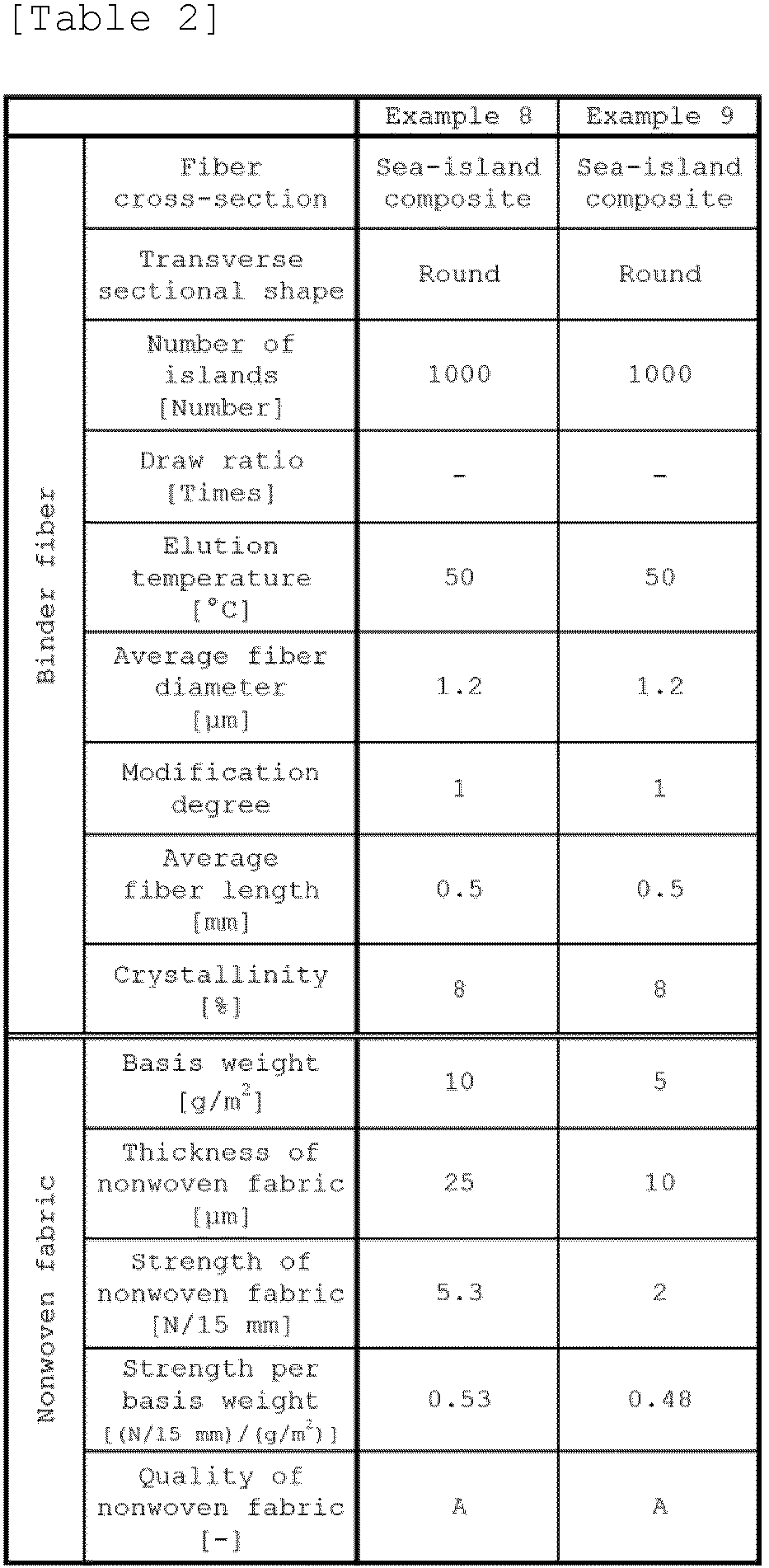
- In Examples 1 to 9, since the average fiber diameters were small and the crystallinities were low, it can be seen that thinning of the nonwoven fabrics is possible, and adhesiveness and quality are good.
- On the other hand, in Comparative Example 1, the nonwoven fabric was thick because of the large fiber diameter, and in Comparative Examples 2 and 3, the strength and strength per basis weight of the nonwoven fabrics were low because of the low adhesiveness of the binder fiber, and in addition, the quality was poor.
-
- 1: Transverse sectional contour of fiber
- 2: Minimum circumscribed circle
- 3: Maximum inscribed circle

Claims (6)
- An ultrafine polyphenylene sulfide fiber having an average fiber diameter of 0.2 µm or more and 5.0 µm or less and a crystallinity of 0% or more and 15% or less, as calculated by differential scanning calorimetry.
- The ultrafine polyphenylene sulfide fiber according to claim 1, comprising a modified cross-section fiber and having a modification degree defined by a formula below of 1.2 or more:Modification Degree = minimum circumscribed circle diameter/maximum inscribed circle diameter,where the minimum circumscribed circle diameter is a diameter (µm) of a smallest circle enclosing an entire transverse section of the fiber, and the maximum inscribed circle diameter is a diameter (µm) of a largest circle contained in the transverse section of the fiber.
- The ultrafine polyphenylene sulfide fiber according to claim 1 or 2, having an average fiber length of 0.1 mm or more and 6.0 mm or less.
- A nonwoven fabric comprising the ultrafine polyphenylene sulfide fiber according to claim 1.
- A method for producing an ultrafine polyphenylene sulfide fiber, comprising removing a sea component of an undrawn fiber having a sea-island composite cross-section including polyphenylene sulfide as an island component in an alkaline aqueous solution at 70°C or less to provide a fiber having an average fiber diameter of 0.2 µm or more and 5.0 µm or less and a crystallinity of 0% or more and 15% or less as calculated by differential scanning calorimetry.
- A method for producing a nonwoven fabric, comprising: mixing the ultrafine polyphenylene sulfide fiber according to claim 1 or 2 and a polyphenylene sulfide drawn fiber in a paper-making dispersion to make a paper; and then performing thermocompression bonding at a temperature of 130°C or more and 250°C or less.
Applications Claiming Priority (3)
| Application Number | Priority Date | Filing Date | Title |
|---|---|---|---|
| JP2022115282 | 2022-07-20 | ||
| JP2022196106 | 2022-12-08 | ||
| PCT/JP2023/023495 WO2024018828A1 (en) | 2022-07-20 | 2023-06-26 | Ultrafine polyphenylene sulfide fiber, nonwoven fabric, and methods for producing same |
Publications (2)
| Publication Number | Publication Date |
|---|---|
| EP4560058A1 true EP4560058A1 (en) | 2025-05-28 |
| EP4560058A4 EP4560058A4 (en) | 2026-07-22 |
Family
ID=89617632
Family Applications (1)
| Application Number | Title | Priority Date | Filing Date |
|---|---|---|---|
| EP23842759.5A Pending EP4560058A4 (en) | 2022-07-20 | 2023-06-26 | ULTRAFINE POLYPHENYLENE SULFIDE FIBER, NONWOVEN FABRIC AND METHOD FOR PRODUCING THEREMISH |
Country Status (5)
| Country | Link |
|---|---|
| EP (1) | EP4560058A4 (en) |
| JP (1) | JPWO2024018828A1 (en) |
| KR (1) | KR20250038637A (en) |
| CN (1) | CN119365642A (en) |
| WO (1) | WO2024018828A1 (en) |
Family Cites Families (12)
| Publication number | Priority date | Publication date | Assignee | Title |
|---|---|---|---|---|
| JPS63152499A (en) * | 1986-12-10 | 1988-06-24 | 東レ株式会社 | Special paper like sheet |
| JP5414963B2 (en) * | 2005-02-16 | 2014-02-12 | 東レ株式会社 | Dry nonwoven fabric made of polyphenylene sulfide nanofiber |
| KR20110040843A (en) * | 2008-07-18 | 2011-04-20 | 도레이 카부시키가이샤 | Polyphenylene sulfide fiber and manufacturing method thereof, wet nonwoven fabric, manufacturing method of wet nonwoven fabric |
| JP2010077544A (en) * | 2008-09-24 | 2010-04-08 | Toray Ind Inc | Polyphenylene sulfide fiber for papermaking and method for producing the same |
| JP2010174400A (en) | 2009-01-29 | 2010-08-12 | Toray Ind Inc | Method for producing polyphenylene sulfide fiber for papermaking |
| JP2010216042A (en) | 2009-03-18 | 2010-09-30 | Japan Vilene Co Ltd | Ultrafine fiber nonwoven fabric and method for producing the same |
| KR101745975B1 (en) * | 2009-12-09 | 2017-06-12 | 도레이 카부시키가이샤 | Method for producing long fiber nonwoven fabric |
| JP6672861B2 (en) | 2015-03-27 | 2020-03-25 | 東レ株式会社 | Composite die, method for producing multilayer laminated fiber using the same, and multilayer laminated fiber |
| US11253801B2 (en) | 2015-11-19 | 2022-02-22 | Teijin Frontier Co., Ltd. | Filter cloth for bag filter, method for producing the same, and bag filter |
| JP2019000793A (en) * | 2017-06-14 | 2019-01-10 | 旭化成株式会社 | Filter medium for dust collector filter |
| JP7232617B2 (en) | 2018-10-24 | 2023-03-03 | 三菱製紙株式会社 | Wet-laid nonwoven fabric containing polyphenylene sulfide fiber |
| JP2020172729A (en) | 2019-04-12 | 2020-10-22 | 帝人フロンティア株式会社 | Non-woven fabric, laminated non-woven fabric structure, and filter cloth for filter |
-
2023
- 2023-06-26 KR KR1020247036420A patent/KR20250038637A/en active Pending
- 2023-06-26 WO PCT/JP2023/023495 patent/WO2024018828A1/en not_active Ceased
- 2023-06-26 CN CN202380042171.8A patent/CN119365642A/en active Pending
- 2023-06-26 JP JP2024534992A patent/JPWO2024018828A1/ja active Pending
- 2023-06-26 EP EP23842759.5A patent/EP4560058A4/en active Pending
Also Published As
| Publication number | Publication date |
|---|---|
| KR20250038637A (en) | 2025-03-19 |
| EP4560058A4 (en) | 2026-07-22 |
| WO2024018828A1 (en) | 2024-01-25 |
| JPWO2024018828A1 (en) | 2024-01-25 |
| CN119365642A (en) | 2025-01-24 |
Similar Documents
| Publication | Publication Date | Title |
|---|---|---|
| KR101421317B1 (en) | Wet nonwoven and filter | |
| US8734614B2 (en) | Polyphenylene sulfide fiber, method for producing the same, wet-laid nonwoven fabric, and method for producing wet-laid nonwoven fabric | |
| KR101441723B1 (en) | Thin paper | |
| US20200324234A1 (en) | Polyphenylene sulfide short fiber, fibrous structure, filter felt, and bag filter | |
| EP2716800A1 (en) | Polyphenylene sulfide fibers and nonwoven fabric | |
| JP6068868B2 (en) | Shortcut fiber for wet nonwoven fabric | |
| JP4185748B2 (en) | Nonwoven fabric and separator for lithium ion secondary battery | |
| JPS6316502B2 (en) | ||
| KR101387000B1 (en) | Splittable conjugate fiber including polyacetal, and fibrous form and product each obtained from the same | |
| JP5414963B2 (en) | Dry nonwoven fabric made of polyphenylene sulfide nanofiber | |
| JP2024051375A (en) | Polyarylene sulfide fiber and nonwoven fabric made thereof | |
| US20170198414A1 (en) | Polyphenylene sulfide fibers, and manufacturing method therefor | |
| EP3859058B1 (en) | Copolymerized polyphenylene sulfide fibers | |
| JP2013079486A (en) | Method of manufacturing dry nonwoven fabric composed of polyphenylene sulfide nanofiber | |
| JP7703835B2 (en) | Method for producing polyphenylene sulfide composite fiber and wet-laid nonwoven fabric | |
| WO2024018828A1 (en) | Ultrafine polyphenylene sulfide fiber, nonwoven fabric, and methods for producing same | |
| CN116670344B (en) | Polyphenylene sulfide fiber nonwoven fabric and separator comprising same | |
| JP2006274503A (en) | Dry nonwoven fabric made of polymer alloy fibers | |
| JP7767967B2 (en) | Polyphenylene sulfide fiber | |
| JP7613646B1 (en) | Wet-laid nonwoven fabric, electrolyte-reinforced membrane, and method for producing wet-laid nonwoven fabric | |
| WO2025121216A1 (en) | Polyphenylene sulfide fiber, method for producing same, woven or nonwoven fabric, diaphragm for alkaline water electrolysis, and electrolytic tank for alkaline water electrolysis | |
| JP2005146428A (en) | Non-woven | |
| JP2022117559A (en) | polyphenylene sulfide fiber | |
| JP2010230987A (en) | Cleaning web for copying machine | |
| JP2005146427A (en) | Polyphenylene sulfide fiber |
Legal Events
| Date | Code | Title | Description |
|---|---|---|---|
| STAA | Information on the status of an ep patent application or granted ep patent |
Free format text: STATUS: THE INTERNATIONAL PUBLICATION HAS BEEN MADE |
|
| PUAI | Public reference made under article 153(3) epc to a published international application that has entered the european phase |
Free format text: ORIGINAL CODE: 0009012 |
|
| STAA | Information on the status of an ep patent application or granted ep patent |
Free format text: STATUS: REQUEST FOR EXAMINATION WAS MADE |
|
| 17P | Request for examination filed |
Effective date: 20250117 |
|
| AK | Designated contracting states |
Kind code of ref document: A1 Designated state(s): AL AT BE BG CH CY CZ DE DK EE ES FI FR GB GR HR HU IE IS IT LI LT LU LV MC ME MK MT NL NO PL PT RO RS SE SI SK SM TR |
|
| DAV | Request for validation of the european patent (deleted) | ||
| DAX | Request for extension of the european patent (deleted) | ||
| A4 | Supplementary search report drawn up and despatched |
Effective date: 20260617 |